Prognostic Role of Worst Pattern of Invasion in Oral Squamous Cell Carcinoma
 ,
,  ,
,  ,
,  and
and 
Abstract
1. Introduction
2. Relevant Sections
2.1. Methodology
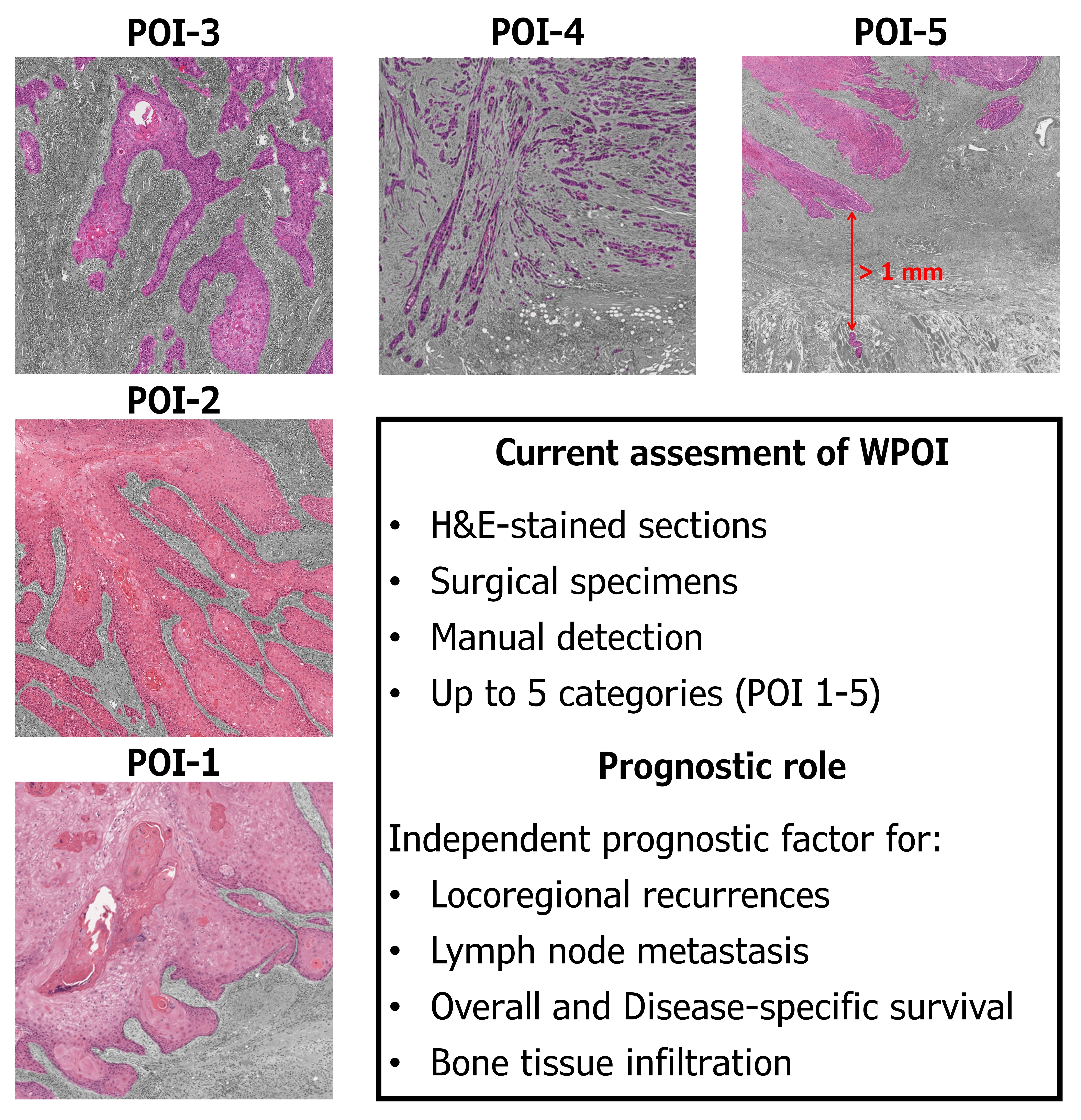
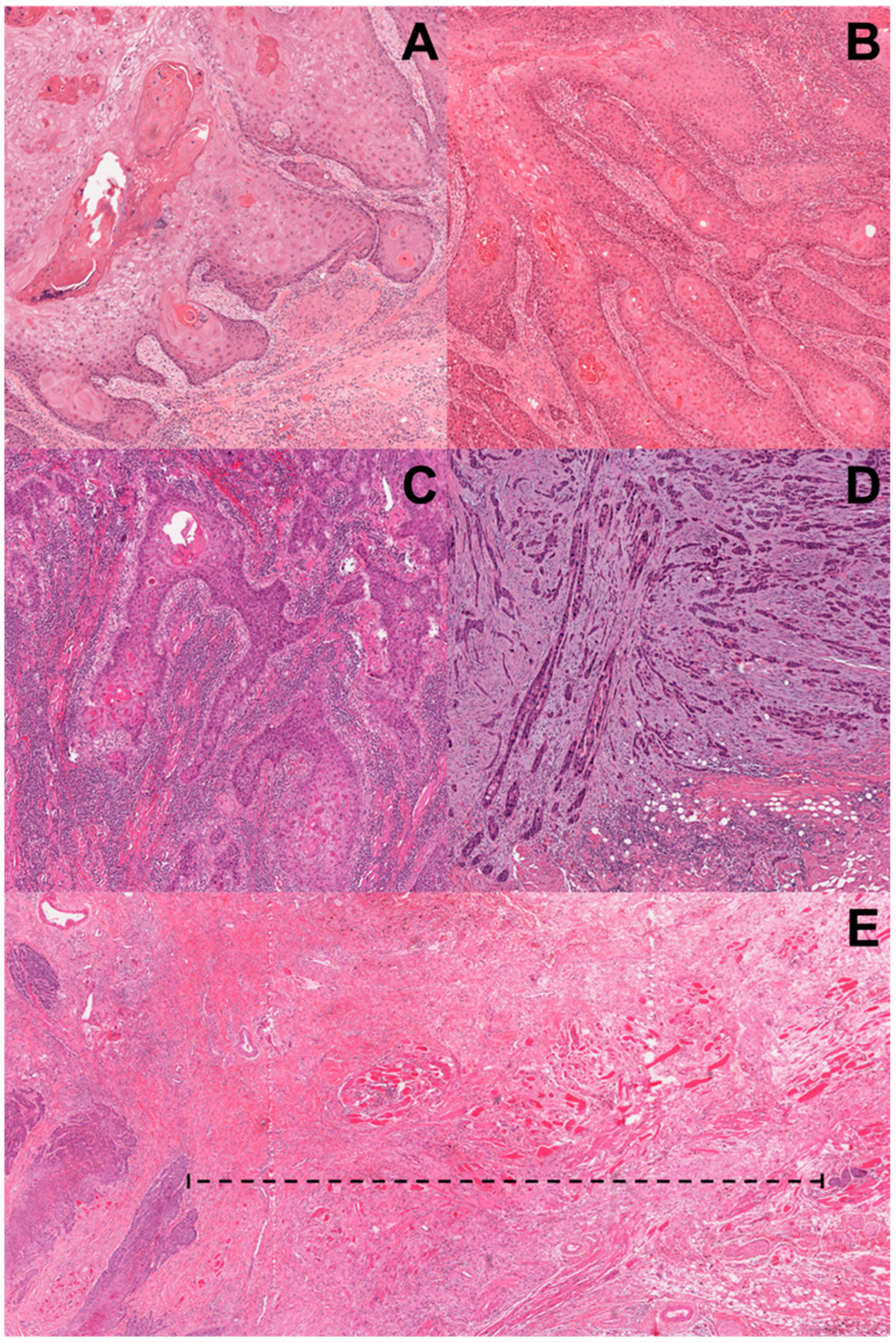
2.2. Worst Pattern of Invasion Scores in Oral Squamous Cell Carcinoma: Historical Perspective and Current Trends
2.3. Worst Pattern of Invasion Risk Model in Oral Squamous Cell Carcinoma
2.4. Sample Detection of Worst Pattern of Invasion in Oral Squamous Cell Carcinoma
2.5. Correlations Between Worst Pattern of Invasion and Histopathological Features in Oral Squamous Cell Carcinoma
2.6. Prognostic Role of Worst Pattern of Invasion in Oral Squamous Cell Carcinoma

| Authors (Year) | Results | HR (95% CI) | I2 |
|---|---|---|---|
| Binmadi et al. (2023) [65] | WPOI-4 and WPOI-5 are significant associated with worst OS, DFS, DSS, LRR, and LRFS in OSCC. | OS: 2.17 (1.79–2.55) DSS: 4.67 (1.30–8.04) DFS: 1.58 (1.10–2.07) LRR: 3.37 (2.62–4.12) LRFS: 1.68 (1.03–2.33) Mortality rate: 3.86 (2.84–4.88) | 0.0% 93.47% 68.6% 8.8% 46.52% N.A. |
| Elseragy et al. (2022) [75] | WPOI is significantly associated with worst DFS in OTSCC. | DFS: 1.95 (1.04–3.64) | 28% |
3. Discussion
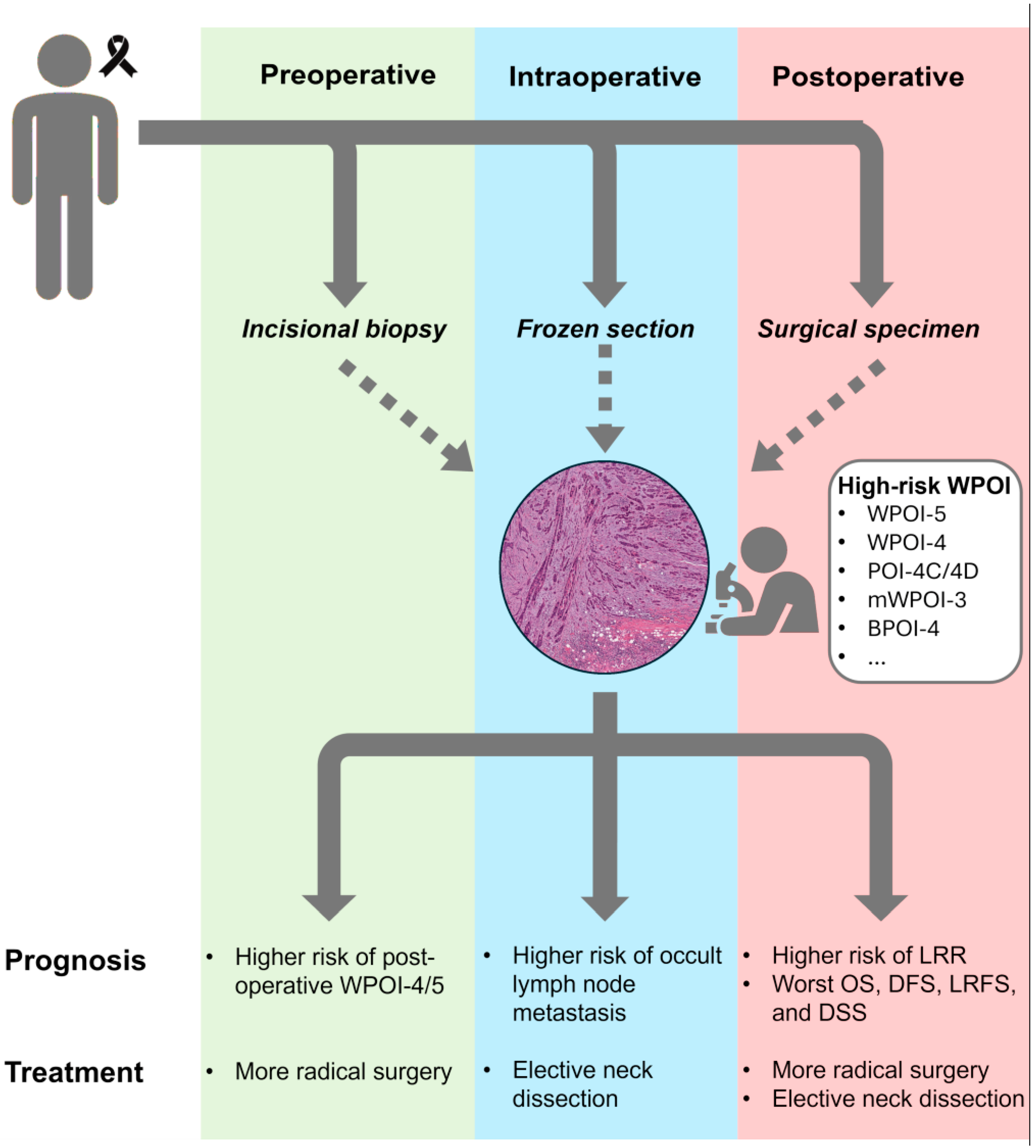
Clinical Implications and Therapeutic Impact of Worst Pattern of Invasion in Oral Squamous Cell Carcinoma
4. Conclusions and Future Directions
Author Contributions
Funding
Institutional Review Board Statement
Informed Consent Statement
Data Availability Statement
Acknowledgments
Conflicts of Interest
Abbreviations
| AJCC | American Joint Committee on Cancer |
| BPOI | Biopsy Pattern of Invasion |
| DFS | Disease-Free Survival |
| DOI | Depth of Invasion |
| DSS | Disease-Specific Survival |
| END | Elective Neck Dissection |
| HRM | Histological Risk Model |
| HRS | High Risk Score |
| ITBCC | International Tumor Budding Consensus Conference |
| LNM | Lymph Node Metastases |
| LHR | Lymphocytic Host Response |
| LRR | Locoregional Recurrence |
| LVI | Lymphovascular invasion |
| mWPOI | Modified Worst Pattern of Invasion |
| NCCN | National Comprehensive Cancer Network |
| OS | Overall Survival |
| OSCC | Oral Squamous Cell Carcinoma |
| OTSCC | Oral Tongue Squamous Cell Carcinoma |
| POI | Pattern of Invasion |
| PPOI | Predominant Pattern of Invasion |
| PNI | Perineural Invasion |
| RT | Radiation Therapy |
| TB | Tumor Budding |
| TME | Tumor Microenvironment |
| WPOI | Worst Pattern of Invasion |
References
- National Cancer Institute. Surveillance, Epidemiology, End Results Program. 2021. Available online: https://seer.cancer.gov/statfacts/html/oralcav.html?utm_source=chatgpt.com (accessed on 1 December 2025).
- Stepan, K.O.; Mazul, A.L.; Larson, J.; Shah, P.; Jackson, R.S.; Pipkorn, P.; Kang, S.Y.; Puram, S.V. Changing Epidemiology of Oral Cavity Cancer in the United States. Otolaryngol. Head Neck Surg. 2023, 168, 761–768. [Google Scholar] [CrossRef]
- Mascitti, M.; Togni, L.; Caponio, V.C.A.; Zhurakivska, K.; Muzio, L.L.; Rubini, C.; Santarelli, A.; Troiano, G. Prognostic significance of tumor budding thresholds in oral tongue squamous cell carcinoma. Oral Dis. 2022, 29, 1947–1958. [Google Scholar] [CrossRef]
- Caponio, V.C.A.; Togni, L.; Zhurakivska, K.; Santarelli, A.; Arena, C.; Rubini, C.; Muzio, L.L.; Troiano, G.; Mascitti, M. Prognostic assessment of different methods for eosinophils detection in oral tongue cancer. J. Oral Pathol. Med. 2021, 51, 240–248. [Google Scholar] [CrossRef]
- Amin, M.B.; Greene, F.L.; Edge, S.B.; Compton, C.C.; Gershenwald, J.E.; Brookland, R.K.; Meyer, L.; Gress, D.M.; Byrd, D.R.; Winchester, D.P. The Eighth Edition AJCC Cancer Staging Manual: Continuing to build a bridge from a population-based to a more “personalized” approach to cancer staging. CA Cancer J. Clin. 2017, 67, 93–99. [Google Scholar] [CrossRef]
- Roi, C.I.; Roi, A.; Nicoară, A.; Nica, D.; Rusu, L.C.; Soancă, A.; Motofelea, A.C.; Riviș, M. Impact of Treatment on Systemic Immune-Inflammatory Index and Other Inflammatory Markers in Odontogenic Cervicofacial Phlegmon Cases: A Retrospective Study. Biomedicines 2023, 11, 1710. [Google Scholar] [CrossRef]
- Ramamonjisoa, N.; Ackerstaff, E. Characterization of the Tumor Microenvironment and Tumor-Stroma Interaction by Non-invasive Preclinical Imaging. Front. Oncol. 2017, 7, 3. [Google Scholar] [CrossRef] [PubMed]
- Almangush, A.; Alabi, R.O.; Troiano, G.; Coletta, R.D.; Salo, T.; Pirinen, M.; Mäkitie, A.A.; Leivo, I. Clinical significance of tumor-stroma ratio in head and neck cancer: A systematic review and meta-analysis. BMC Cancer 2021, 21, 480. [Google Scholar] [CrossRef] [PubMed]
- Morais, E.F.; Morais, H.; Martins, H.; Carlan, L.; Costa, A.; Freitas, R. Prognostic and clinicopathological significance of tumor-stroma ratio in head and neck squamous cell carcinoma: A systematic review. Med. Oral Patol. Oral Cir. Bucal 2022, 27, e301–e309. [Google Scholar] [CrossRef]
- Togni, L.; Furlani, M.; Belloni, A.; Riberti, N.; Giuliani, A.; Notarstefano, V.; Santoni, C.; Giorgini, E.; Rubini, C.; Santarelli, A.; et al. Biomolecular alterations temporally anticipate microarchitectural modifications of collagen in oral tongue squamous cell carcinoma. iScience 2024, 27, 110303. [Google Scholar] [CrossRef]
- Mascitti, M.; Zhurakivska, K.; Togni, L.; A Caponio, V.C.; Almangush, A.; Balercia, P.; Balercia, A.; Rubini, C.; Muzio, L.L.; Santarelli, A.; et al. Addition of the tumour-stroma ratio to the 8th edition American Joint Committee on Cancer staging system improves survival prediction for patients with oral tongue squamous cell carcinoma. Histopathology 2020, 77, 810–822. [Google Scholar] [CrossRef]
- Cheng, B.; Yu, Q.; Wang, W. Intimate communications within the tumor microenvironment: Stromal factors function as an orchestra. J. Biomed. Sci. 2023, 30, 1. [Google Scholar] [CrossRef]
- Brandwein-Gensler, M.; Teixeira, M.S.; Lewis, C.M.; Lee, B.; Rolnitzky, L.; Hille, J.J.D.; Genden, E.; Urken, M.L.; Wang, B.Y. Oral squamous cell carcinoma: Histologic risk assessment, but not margin status, is strongly predictive of local disease-free and overall survival. Am. J. Surg. Pathol. 2005, 29, 167–178. [Google Scholar] [CrossRef]
- Beggan, C.; Fives, C.; O’Leary, G.; Sheahan, P.; Heffron, C.C.; Feeley, L. Pattern of invasion and lymphovascular invasion in squamous cell carcinoma of the floor of the mouth: An interobserver variability study. Histopathology 2016, 69, 914–920. [Google Scholar] [CrossRef]
- Shimizu, S.; Miyazaki, A.; Sonoda, T.; Koike, K.; Ogi, K.; Kobayashi, J.-I.; Kaneko, T.; Igarashi, T.; Ueda, M.; Dehari, H.; et al. Tumor budding is an independent prognostic marker in early stage oral squamous cell carcinoma: With special reference to the mode of invasion and worst pattern of invasion. PLoS ONE 2018, 13, e0195451. [Google Scholar] [CrossRef]
- Chang, H.Y.; Hang, J.F.; Kuo, Y.J. New Histopathologic Risk Model for Early T-stage Oral Squamous Cell Carcinoma: Focusing on a Modified Worst Pattern of Invasion System and a New Tumor Budding Score. Am. J. Surg. Pathol. 2024, 48, 59–69. [Google Scholar] [CrossRef] [PubMed]
- De Silva, R.K.; Siriwardena, B.; Samaranayaka, A.; Abeyasinghe, W.; Tilakaratne, W.M. A model to predict nodal metastasis in patients with oral squamous cell carcinoma. PLoS ONE 2018, 13, e0201755. [Google Scholar] [CrossRef]
- Siriwardena, B.; Rambukewela, I.K.; Pitakotuwage, T.N.; Udagama, M.N.G.P.K.; Kumarasiri, P.V.R.; Tilakaratne, W.M. A Predictive Model to Determine the Pattern of Nodal Metastasis in Oral Squamous Cell Carcinoma. BioMed Res. Int. 2018, 2018, 8925818. [Google Scholar] [CrossRef]
- Crissman, J.D.; Liu, W.Y.; Gluckman, J.L.; Cummings, G. Prognostic value of histopathologic parameters in squamous cell carcinoma of the oropharynx. Cancer 1984, 54, 2995–3001. [Google Scholar] [CrossRef] [PubMed]
- Anneroth, G.; Batsakis, J.; Luna, M. Review of the literature and a recommended system of malignancy grading in oral squamous cell carcinomas. Scand. J. Dent. Res. 1987, 95, 229–249. [Google Scholar] [CrossRef] [PubMed]
- Jakobsson, P.A.; Eneroth, C.M.; Killander, D.; Moberger, G.; Martensson, B. Histologic classification and grading of malignancy in carcinoma of the larynx. Acta Radiol. Ther. Phys. Biol. 1973, 12, 1–8. [Google Scholar] [CrossRef] [PubMed]
- Yamamoto, E.; Miyakawa, A.; Kohama, G. Mode of invasion and lymph node metastasis in squamous cell carcinoma of the oral cavity. Head Neck Surg. 1984, 6, 938–947. [Google Scholar] [CrossRef]
- Chatterjee, D.; Bansal, V.; Malik, V.; Bhagat, R.; Punia, R.S.; Handa, U.; Gupta, A.; Dass, A. Tumor Budding and Worse Pattern of Invasion Can Predict Nodal Metastasis in Oral Cancers and Associated with Poor Survival in Early-Stage Tumors. Ear Nose Throat J. 2019, 98, E112–E119. [Google Scholar] [CrossRef] [PubMed]
- Pu, Y.; Ding, L.; Wang, Y.; Wang, Y.; Chen, S.; Huang, X.; He, Z.; Ni, Y.; Hu, Q. Biopsy pattern of invasion type to determine the surgical approach in early-stage oral squamous cell carcinoma. Virchows Arch. 2021, 479, 109–119. [Google Scholar] [CrossRef]
- Yue, L.E.; Sharif, K.F.; Sims, J.R.; Sandler, M.L.; Baik, F.M.; Sobotka, S.; Everest, S.; Brandwein-Weber, M.; Khorsandi, A.S.; Likhterov, I.; et al. Oral squamous carcinoma: Aggressive tumor pattern of invasion predicts direct mandible invasion. Head Neck 2020, 42, 3171–3178. [Google Scholar] [CrossRef]
- Akolkar, S.; Hande, A.; Patil, S.K.; Sonone, A.M.; Pakhale, A. Assessment of Bone Invasion and Its Correlation With Brandwein-Gensler Criteria in Oral Squamous Cell Carcinoma. Cureus 2024, 16, e61194. [Google Scholar] [CrossRef]
- Almangush, A.; Bello, I.O.; Coletta, R.D.; Mäkitie, A.A.; Mäkinen, L.K.; Kauppila, J.H.; Pukkila, M.; Hagström, J.; Laranne, J.; Soini, Y.; et al. For early-stage oral tongue cancer, depth of invasion and worst pattern of invasion are the strongest pathological predictors for locoregional recurrence and mortality. Virchows Arch. 2015, 467, 39–46. [Google Scholar] [CrossRef]
- Almangush, A.; Bello, I.O.; Keski–Säntti, H.; Mäkinen, L.K.; Kauppila, J.H.; Pukkila, M.; Hagström, J.; Laranne, J.; Tommola, S.; Nieminen, O.; et al. Depth of invasion, tumor budding, and worst pattern of invasion: Prognostic indicators in early-stage oral tongue cancer. Head Neck 2014, 36, 811–818. [Google Scholar] [CrossRef] [PubMed]
- Hori, Y.; Kubota, A.; Yokose, T.; Furukawa, M.; Matsushita, T.; Oridate, N. Association between pathological invasion patterns and late lymph node metastases in patients with surgically treated clinical No early oral tongue carcinoma. Head Neck 2020, 42, 238–243. [Google Scholar] [CrossRef] [PubMed]
- Anneroth, G.; Hansen, L.S. A methodologic study of histologic classification and grading of malignancy in oral squamous cell carcinoma. Scand. J. Dent. Res. 1984, 92, 448–468. [Google Scholar] [CrossRef]
- Kakuguchi, W.; Ashikaga, Y.; Yanagawa-Matsuda, A.; Kuribayashi, K.; Shinohara, S.; Ogawa, N.; Maishi, N.; Hida, K.; Fang, C.-Y.; Ohiro, Y. Significant association of Yamamoto-Kohama classification and pathological depth of invasion with cervical lymph node metastasis in early-stage tongue squamous cell carcinoma (Stage I/II). J. Dent. Sci. 2023, 18, 1663–1668. [Google Scholar] [CrossRef]
- Heerema, M.G.; Melchers, L.J.; Roodenburg, J.L.N.; Schuuring, E.; de Bock, G.H.; van der Vegt, B. Reproducibility and prognostic value of pattern of invasion scoring in low-stage oral squamous cell carcinoma. Histopathology 2016, 68, 388–397. [Google Scholar] [CrossRef]
- Sharma, A.; Natarajan, S.; Manaktala, N.; Boaz, K.; Kp, N.; Lewis, A.; Yellapurkar, S. Prognostic Nomogram for Lymph-Node Metastasis in Oral Squamous Cell Carcinoma (OSCC) Using Immunohistochemical Marker D2-40. Cancer Manag. Res. 2023, 15, 929–936. [Google Scholar] [CrossRef]
- Caprioli, S.; Giordano, G.-G.; Pennacchi, A.; Campagnari, V.; Iandelli, A.; Parrinello, G.; Conforti, C.; Gili, R.; Giannini, E.; Marabotto, E.; et al. Can High-Frequency Intraoral Ultrasound Predict Histological Risk Factors in Oral Squamous Cell Carcinoma? A Preliminary Experience. Cancers 2023, 15, 4413. [Google Scholar] [CrossRef]
- Deshpande, N.S.; Munemane, A.B.; Karle, R.R.; Dongre, S.D. Relevance of Tumor Budding and Pattern of Invasion in Oral Squamous Cell Carcinoma. Int. J. Appl. Basic Med. Res. 2024, 14, 29–34. [Google Scholar] [CrossRef] [PubMed]
- Hurnik, P.; Režnarová, J.; Chyra, Z.; Motyka, O.; Putnová, B.M.; Čermáková, Z.; Blažek, T.; Fománek, M.; Gaykalova, D.; Buchtová, M.; et al. Enhancing oral squamous cell carcinoma prediction: The prognostic power of the worst pattern of invasion and the limited impact of molecular resection margins. Front. Oncol. 2023, 13, 1287650. [Google Scholar] [CrossRef] [PubMed]
- Larson, A.R.; Kemmer, J.; Formeister, E.; El-Sayed, I.; Ha, P.; George, J.; Ryan, W.; Chan, E.; Heaton, C. Beyond Depth of Invasion: Adverse Pathologic Tumor Features in Early Oral Tongue Squamous Cell Carcinoma. Laryngoscope 2020, 130, 1715–1720. [Google Scholar] [CrossRef] [PubMed]
- Ramasubramanian, S.; Pandiar, D.; Krishnan, R.P.; Ramalingam, K.; Bologna-Molina, R. Correlation of Bony Invasion With Nodal Metastasis, Pattern of Invasion and Survival in Oral Squamous Cell Carcinoma: A Retrospective Analysis of 122 Primary Cases From Oral Cancer Centre of South India. Cureus 2023, 15, e42887. [Google Scholar] [CrossRef]
- Xu, B.; Salama, A.M.; Valero, C.; Yuan, A.; Khimraj, A.; Saliba, M.; Zanoni, D.K.; Ganly, I.; Patel, S.G.; Katabi, N.; et al. The prognostic role of histologic grade, worst pattern of invasion, and tumor budding in early oral tongue squamous cell carcinoma: A comparative study. Virchows Arch. 2021, 479, 597–606. [Google Scholar] [CrossRef]
- Beute, J.E.; Greenberg, L.A.; Wein, L.E.; Kapustin, D.A.; Fan, J.; Dowling, E.M.; Samankan, S.; Matloob, A.; Xing, M.; Modica, I.; et al. WPOI-5: Accurately Identified at Intraoperative Consultation and Predictive of Occult Cervical Metastases. Head Neck Pathol. 2023, 17, 479–486. [Google Scholar] [CrossRef]
- Marzouki, H.Z.; Bukhari, A.F.; A Al-Ghamdi, D.; Abdullah, R.M.; Al-Hajeili, M.; Khayyat, S.; Alzahrani, R.M.; Alotaibi, Y.R.; Al-Wassia, R.; Al-Marzouki, H.; et al. Worst pattern of invasion and other histopathological features in oral cancer as determinants of prognosis and survival rate: A retrospective cohort analysis. Oncol. Lett. 2023, 25, 75. [Google Scholar] [CrossRef]
- Kohler, H.F.; Vartanian, J.G.; Pinto, C.A.L.; da Silva Rodrigues, I.F.P.; Kowalski, L.P. The impact of worst pattern of invasion on the extension of surgical margins in oral squamous cell carcinoma. Head Neck 2022, 44, 691–697. [Google Scholar] [CrossRef]
- Marinelli, L.M.; Chatzopoulos, K.; Marinelli, J.P.; Chen, T.Y.; Collins, A.R.; Sotiriou, S.; Raslan, S.W.; Vêncio, E.F.; Price, D.L.; Garcia, J.J.; et al. Clinicopathologic predictors of survival in buccal squamous cell carcinoma. J. Oral Pathol. Med. 2020, 49, 857–864. [Google Scholar] [CrossRef]
- Mishra, A.; Das, A.; Dhal, I.; Shankar, R.; Bhavya, B.; Singh, N.; Tripathi, P.; Daga, D.; Rai, A.; Gupta, M.; et al. Worst pattern of invasion in oral squamous cell carcinoma is an independent prognostic factor. J. Oral Biol. Craniofacial Res. 2022, 12, 771–776. [Google Scholar] [CrossRef] [PubMed]
- Mohamed, S.; Jawad, H.; Sullivan, R.O.; Callanan, D.; Sheahan, P.; Feeley, L. Significance of Worst Pattern of Invasion-5 in Early-Stage Oral Cavity Squamous Cell Carcinoma. Head Neck Pathol. 2023, 17, 679–687. [Google Scholar] [CrossRef]
- Yamauchi, M.; Ishida, T.; Minesaki, A.; Kuratomi, Y. WPOI-4/5 Correlates With Lymph Node Recurrence and Poor Prognosis in Early-stage Tongue Squamous Cell Carcinoma. Cancer Diagn. Progn. 2023, 3, 457–462. [Google Scholar] [CrossRef]
- Yasuda, M.; Chiodo, C.; Lilley, C.; Mehrotra, S.; Ananthanarayanan, V.; Ziegler, A.; Thorpe, E. Relationship Between Worst Pattern of Invasion and Extranodal Extension in Oral Tongue Squamous Cell Carcinomas. Head Neck Pathol. 2023, 17, 460–466. [Google Scholar] [CrossRef]
- Anto, R.; Vidya, K.; Thomas, M.; Tirkey, A.J.; Agarwal, M.; Riju, J.; Patil, S.; Bhandari, S.; Rekh. Worst Pattern of Invasion as an Independent Predictor of Lymph node Metastasis and Prognosis in oral Cavity Squamous cell carcinoma—A Retrospective Cohort Study. Indian J. Otolaryngol. Head Neck Surg. 2023, 75, 440–449. [Google Scholar] [CrossRef]
- Shan, J.; Jiang, R.; Chen, X.; Zhong, Y.; Zhang, W.; Xie, L.; Cheng, J.; Jiang, H. Machine Learning Predicts Lymph Node Metastasis in Early-Stage Oral Tongue Squamous Cell Carcinoma. J. Oral Maxillofac. Surg. 2020, 78, 2208–2218. [Google Scholar] [CrossRef] [PubMed]
- Chaitra, B.; Burela, M.; Kasula, L.; Inuganti, R.V.; Vaddatti, T. Correlative study of tumor budding, mode of invasion and lymphocytic host response with known clinicopathological prognostic factors in oral squamous cell carcinoma. J. Oral. Maxillofac. Pathol. 2020, 24, 484–491. [Google Scholar] [CrossRef]
- Lakhera, K.K.; Nama, Y.; Maan, P.; Jindal, R.; Patel, P.; Singh, S.; Hussain, A.; Sharma, R.G. Worst Pattern of Invasion as a Predictor of Nodal Metastasis in Early-Stage Oral Squamous Cell Carcinoma. Indian J. Surg. Oncol. 2023, 14, 160–168. [Google Scholar] [CrossRef] [PubMed]
- Parekh, D.; Kukreja, P.; Mallick, I.; Roy, P. Worst pattern of invasion—Type 4 (WPOI-4) and Lymphocyte host response should be mandatory reporting criteria for oral cavity squamous cell carcinoma: A re-look at the American Joint Committee of Cancer (AJCC) minimum dataset. Indian J. Pathol. Microbiol. 2020, 63, 527–533. [Google Scholar] [CrossRef]
- Verma, R.; Singh, A.; Chowdhury, N.; Joshi, P.P.; Durgapal, P.; Rao, S.; Kishore, S. Evaluation of Histomorphological Parameters to Predict Occult Nodal Metastasis in Early-Stage Oral Squamous Cell Carcinoma. Turk. Patoloji Derg. 2022, 38, 227–234. [Google Scholar] [CrossRef]
- Rhutso, Y.; Kakoti, L.M.; Sharma, J.D.; Kalita, M. Significance of Pattern of Invasion in Tongue Squamous Cell Carcinoma-A Retrospective Study from a Regional Cancer Center of North-East India. South. Asian J. Cancer 2022, 11, 140–145. [Google Scholar] [CrossRef]
- Salzano, G.; Togo, G.; Maffia, F.; Vaira, L.A.; Maglitto, F.; Committeri, U.; Fusco, R.; Maglione, M.G.; Nocini, R.; De Luca, P.; et al. Early-Stage Oral Tongue Squamous Cell Carcinoma and a Positive Sentinel Lymph Node Biopsy: Description of a Prognostic Correlation between Pre-Treatment Inflammatory Biomarkers, the Depth of Invasion and the Worst Pattern of Invasion. J. Pers. Med. 2022, 12, 1931. [Google Scholar] [CrossRef]
- Chaturvedi, A.; Husain, N.; Misra, S.; Kumar, V.; Gupta, S.; Akhtar, N.; Lakshmanan, M.; Garg, S.; Arora, A.; Jain, K. Validation of the Brandwein Gensler Risk Model in Patients of Oral Cavity Squamous Cell Carcinoma in North India. Head Neck Pathol. 2020, 14, 616–622. [Google Scholar] [CrossRef]
- Almangush, A.; Salo, T.D.; Haglund, C.; Kowalski, L.P.; Hagström, J.D.; Coletta, R.D.D.; Mäkitie, A.A.; Leivo, I. Validation of a New Histopathologic Risk Model in Early Oral Tongue Cancer: A Combination of a Modified Worst Pattern of Invasion and a New Tumor Budding Score. Am. J. Surg. Pathol. 2025, 49, 1036–1041. [Google Scholar] [CrossRef]
- de Morais, E.F.; Dias, L.; Rangel, A.; Coletta, R.D. Prognostic Significance of a Novel Histopathologic Risk Model Incorporating Modifications to the Worst Pattern of Invasion and Tumor Budding for Oral Squamous Cell Carcinoma. J. Oral. Pathol. Med. 2025, 54, 903–908. [Google Scholar] [CrossRef] [PubMed]
- Lundqvist, L.; Stenlund, H.; Laurell, G.; Nylander, K. The importance of stromal inflammation in squamous cell carcinoma of the tongue. J. Oral Pathol. Med. 2012, 41, 379–383. [Google Scholar] [CrossRef] [PubMed]
- Wolf, G.T.; Chepeha, D.B.; Bellile, E.; Nguyen, A.; Thomas, D.; McHugh, J.; The University of Michigan Head and Neck SPORE Program. Tumor infiltrating lymphocytes (TIL) and prognosis in oral cavity squamous carcinoma: A preliminary study. Oral Oncol. 2015, 51, 90–95. [Google Scholar] [CrossRef] [PubMed]
- Kasture, J.U.; Dharrao, S.S.; Giri, V.A.; Vankudre, A.J.; Bajaj, P.S. Association of worst pattern of invasion and depth of invasion in oral squamous cell carcinoma with clinicopathological parameters. J. Oral Maxillofac. Pathol. 2025, 29, 430–434. [Google Scholar] [CrossRef]
- Khan, A.A.; Ahuja, S.; Zaheer, S.; Mitha, M.; Ranga, S. Association of worst pattern of invasion in oral squamous cell carcinoma with clinicopathological parameters. J. Med. Surg. Public Health 2023, 1, 100029. [Google Scholar] [CrossRef]
- Campbell, B.; Gundale, A.; de Cap, M.R.; Kaul, S.; Gomez, E.; Nishino, M.; Jalisi, S. The role of worst pattern of invasion in the prognosis of oral cavity malignancies. Int. J. Otorhinolaryngol. Head Neck Surg. 2025, 11, 101–109. [Google Scholar] [CrossRef]
- Iqbal, K.; Abidi, F.; Bhurgri, Z.H.; Fatima, S. Association of Worst Pattern of Invasion with Clinicopathological Characteristics in Oral Squamous Cell Carcinoma. Found. Univ. Med. J. 2025, 7, 17–23. [Google Scholar]
- Binmadi, N.O.; Mohamed, Y.A. Impact of worst pattern of invasion on prognosis of oral squamous cell carcinoma: A systematic review and meta-analysis. J. Int. Med. Res. 2023, 51, 3000605231206260. [Google Scholar] [CrossRef] [PubMed]
- Atasoy, B.M.; Özden, G.; Cinel, L.; Gül, D.; Yumuşakhuylu, A.C.; Doğan, Z.A. The impact of worst patterns of invasion on survival outcomes in oral cavity cancer: Implications for adjuvant therapy and prognostic stratification. Clin. Transl. Oncol. 2025, 27, 2651–2657. [Google Scholar] [CrossRef] [PubMed]
- Manjula, B.V.; Augustine, S.; Selvam, S.; Mohan, A.M. Prognostic and predictive factors in gingivo buccal complex squamous cell carcinoma: Role of tumor budding and pattern of invasion. Indian J. Otolaryngol. Head Neck Surg. 2015, 67, 98–104. [Google Scholar] [CrossRef]
- Wu, K.; Wei, J.; Liu, Z.; Yu, B.; Yang, X.; Zhang, C.; Abdelrehem, A.; Zhang, C.; Li, S. Can pattern and depth of invasion predict lymph node relapse and prognosis in tongue squamous cell carcinoma. BMC Cancer 2019, 19, 714. [Google Scholar] [CrossRef]
- Singh, A.; Pradhan, S.A.; Kannan, R.; Lakshminarayan, A.; Kumar, K.; Shaikh, M.; Gupta, P. Neoteric Predictors for Lymph Node Metastasis in Early Oral Squamous Cell Carcinoma: Tumor Budding and Worst Pattern of Invasion. Indian J. Otolaryngol. Head Neck Surg. 2024, 76, 5639–5646. [Google Scholar] [CrossRef] [PubMed]
- Oikawa, Y.; Fukuda, M.; Noguchi, Y.; Ito, K.; Igarashi, H.; Takano, H. Clinicopathological study of invasion patterns and late cervical lymph node metastasis in pT1/T2 oral squamous cell carcinoma. Int. J. Oral Maxillofac. Surg. 2025, 54, 1011–1018. [Google Scholar] [CrossRef]
- Elseragy, A.; Salo, T.; Coletta, R.D.; Kowalski, L.P.; Haglund, C.; Nieminen, P.; Mäkitie, A.A.; Leivo, I.; Almangush, A. A Proposal to Revise the Histopathologic Grading System of Early Oral Tongue Cancer Incorporating Tumor Budding. Am. J. Surg. Pathol. 2019, 43, 703–709. [Google Scholar] [CrossRef]
- Divya, G.M.; Thomas, S.; Anila, K.; Kannan, S.; Vimal, J.; Varghese, B.T.; Iype, E.M.; George, N.A.; Mathew, A. Association between the Worst Pattern of Tumor Invasion and Epithelial-mesenchymal Transition and their Prognostic Impact on Early-stage Oral Tongue Squamous Cell Carcinoma. Indian J. Otolaryngol. Head Neck Surg. 2024, 76, 4307–4315. [Google Scholar] [CrossRef] [PubMed]
- Li, Y.; Bai, S.; Carroll, W.; Dayan, D.; Dort, J.C.; Heller, K.; Jour, G.; Lau, H.; Penner, C.; Prystowsky, M.; et al. Validation of the risk model: High-risk classification and tumor pattern of invasion predict outcome for patients with low-stage oral cavity squamous cell carcinoma. Head Neck Pathol. 2013, 7, 211–223. [Google Scholar] [CrossRef]
- Vered, M.; Dobriyan, A.; Dayan, D.; Yahalom, R.; Talmi, Y.P.; Bedrin, L.; Barshack, I.; Taicher, S. Tumor-host histopathologic variables, stromal myofibroblasts and risk score, are significantly associated with recurrent disease in tongue cancer. Cancer Sci. 2010, 101, 274–280. [Google Scholar] [CrossRef]
- Elseragy, A.; Bello, I.O.; Wahab, A.; Coletta, R.D.; Mäkitie, A.A.; Leivo, I.; Almangush, A.; Salo, T. Emerging histopathologic markers in early-stage oral tongue cancer: A systematic review and meta-analysis. Head Neck 2022, 44, 1481–1491. [Google Scholar] [CrossRef]
- Tan, A.; Taskin, T. Tumor Budding Should Be in Oral Cavity Cancer Reporting: A Retrospective Cohort Study Based on Tumor Microenvironment. Cancers 2023, 15, 3905. [Google Scholar] [CrossRef]
- Badanale, R.; Mohta, V.; Wagh, A.; Singh, K. Prognostic Role of Tumor Budding and Worst Pattern of Invasion in Lymph Node Metastasis and Disease-Free Survival in Oral Squamous Cell Cancer Patients: Result from Central India’s Regional Cancer Centre. Indian J. Otolaryngol. Head Neck Surg. 2024, 76, 3261–3270. [Google Scholar] [CrossRef] [PubMed]
- Hintze, J.; Berg, N.v.D.; Callanan, D.; Mohamed, S.; Feeley, L.; Sheahan, P. Impact of WPOI-5 on Risk of Regional Recurrence in Early Oral Cancer With pN0 Neck. Laryngoscope 2025, 135, 3213–3221. [Google Scholar] [CrossRef]
- Tsai, M.H.; Huang, H.; Chou, C.; Chuang, H.; Lin, Y.; Lu, H.; Chien, C.; Fang, F. The Prognostic Value of Worst Pattern of Invasion-5 on Low-Risk and Early-Stage Oral Tongue Cancer. Head Neck 2025. [Google Scholar] [CrossRef]
- D’Cruz, A.K.; Siddachari, R.C.; Walvekar, R.R.; Pantvaidya, G.H.; Chaukar, D.A.; Deshpande, M.S.; Pai, P.S.; Chaturvedi, P. Elective neck dissection for the management of the N0 neck in early cancer of the oral tongue: Need for a randomized controlled trial. Head Neck 2009, 31, 618–624. [Google Scholar] [CrossRef]
- Liu, S.; Zhang, Y.; Ju, Y.; Li, Y.; Kang, X.; Yang, X.; Niu, T.; Xing, X.; Lu, Y. Establishment and Clinical Application of an Artificial Intelligence Diagnostic Platform for Identifying Rectal Cancer Tumor Budding. Front. Oncol. 2021, 11, 626626. [Google Scholar] [CrossRef]
- Lobanova, O.A.; Kolesnikova, A.O.; Ponomareva, V.A.; Vekhova, K.A.; Shaginyan, A.L.; Semenova, A.B.; Nekhoroshkov, D.P.; Kochetkova, S.E.; Kretova, N.V.; Zanozin, A.S.; et al. Artificial intelligence (AI) for tumor microenvironment (TME) and tumor budding (TB) identification in colorectal cancer (CRC) patients: A systematic review. J. Pathol. Inform. 2024, 15, 100353. [Google Scholar] [CrossRef] [PubMed]
- Smit, M.A.; Mesker, W.E. The role of artificial intelligence to quantify the tumour-stroma ratio for survival in colorectal cancer. EBioMedicine 2020, 61, 103070. [Google Scholar] [CrossRef] [PubMed]
- Heilijgers, F.; Polack, M.; Roodvoets, A.G.H.; Kranenbarg, E.M.-K.; Peeters, K.C.M.J.; Buettner, R.; Tolkach, Y.; E Mesker, W.; UNITED Collaboration. Automating tumor-stroma ratio quantification in colon cancer patients from the UNITED study. ESMO Open 2025, 11, 105934. [Google Scholar] [CrossRef]
- Baandrup, L.; Kjær, S.K.; Jacobsen, Ó.; Bzorek, M.; Eriksen, T.T.; Larsen, L.G.; Fiehn, A.-M.K. Development of a digital algorithm for assessing tumor-stroma ratio, tumor budding and tumor infiltrating lymphocytes in vulvar squamous cell carcinomas. Ann. Diagn. Pathol. 2025, 76, 152462. [Google Scholar] [CrossRef]
- Riley, R.D.; Ensor, J.; I E Snell, K.; Archer, L.; Whittle, R.; Dhiman, P.; Alderman, J.; Liu, X.; Kirton, L.; Manson-Whitton, J.; et al. Importance of sample size on the quality and utility of AI-based prediction models for healthcare. Lancet Digit. Health 2025, 7, 100857. [Google Scholar] [CrossRef] [PubMed]


| Author, Year | Parameters | Score | Comments |
|---|---|---|---|
| Brandwein-Gensler et al., 2005 [13] |
| 0: None PNI; Continuous band of LHR; WPOI 1-2-3. 1–2: Small nerves; Large patches of LHR; WPOI-4. 3–7: Large nerves; Little or none LHR; WPOI-5. |
|
| Shimizu et al., 2018 [15] |
| Low-risk: WPOI-1/4 and TB ≤ 4. Intermediate-risk: POI-4C/4D and TB 5–9. High-risk: WPOI-5; POI-4C/4D and TB ≥ 10. |
|
| De Silva et al., 2018 [17] |
| Low-risk: pT1 and POI-2/3/4; pT2 and POI-2/3. Minor-risk: pT2, DOI < 4 mm, and POI-4; pT3 and POI-2; pT4, DOI < 4 mm, and POI-2. Moderate-risk: pT3 and POI-3; pT4, DOI < 4 mm, and POI-3; pT4, DOI ≥ 4 mm, and POI-2. High-risk: pT3, DOI < 4 mm, and POI-4; pT4, DOI ≥ 4 mm and POI-4. Severe-risk: pT3, DOI ≥ 4 mm, and POI-4; pT4 and POI-4. |
|
| Siriwardena et al., 2018 [18] |
| Level 1: POI-1 and S-3; POI-2 and S-1/2. Level 2: POI-1 and S-4; POI-2 and S-3; POI-3 and S-1/2. Level 3: POI-2 and S-4; POI-3 and S-3; POI-4 and S-1/2. Level 4: POI-3 and S-4; POI-4 and S-3. Level 5: POI-4 and S-4. | The model provides a clinical guide for the lymph node treatment in early and advanced OSCC. Early OSCC:
In S3 the dissection follows the grade of POI. Advanced OSCC
|
| Author, Year | Parameters | Score | Comments |
|---|---|---|---|
| De Silva et al., 2018 [17] |
| Low-risk: pT1 and POI-2/3; pT2, DOI < 4 mm, and POI-2. Minor-risk: pT1 and POI-4; pT2, DOI < 4 mm, and POI-3; pT2, DOI ≥ 4 mm, and POI-2. Moderate-risk: pT2, DOI ≥ 4 mm, and POI-3; pT3, DOI < 4 mm, and POI-2. High-risk: pT2 and POI-4; pT3, DOI < 4 mm, and POI-3; pT3, DOI ≥ 4 mm, and POI-2. Severe-risk: pT3/4 and POI-4; pT4 and POI-3; pT3, DOI ≥ 4 mm, and POI-3; pT4, DOI ≥ 4 mm, and POI-2. |
|
| Chang et al., 2024 [16] |
| 0–1: mWPOI-1 and TB0/1; mWPOI-2 and TB0. 2–3: mWPOI-1/2 and TB0/1/2; mWPOI-3 and TB0/1. 4: mWPOI-3 and TB2 |
|
| Parameters | Modalities Reported in Literature |
|---|---|
| Evaluation approaches |
|
| Cut-off |
|
| Specimen |
|
| Oral subsite |
|
| Author | Parameters | Clinical Decision Making |
|---|---|---|
| AJCC 8th Ed. [5] | DOI | Elective neck dissection in tumors with DOI ≥ 4 mm |
| Shimizu et al. [15] | POI TB | Short-term follow-up and imaging in tumors with >5 buds and POI-4C/4D patterns. Wide surgical resection with elective neck dissection in tumors with >10 buds and POI-4D or WPOI-5 patterns. |
| Siriwardena et al. [18] | POI Stage | Early OSCC:
In S3 the dissection follows the grade of POI. Advanced OSCC
|
| Brandwein-Gensler et al. [13] | Stage | Surgery and adjuvant radiation therapy in pT1-2, pN0-1 OSCC. |
| Yamauchi et al. [46] | Stage WPOI-5 | Elective neck dissection in early-OSCCs with WPOI-5 or WPOI-4. |
| Kohler et al. [42] | Surgical margin WPOI | Wide resection with surgical margins > 8 mm and adjuvant treatment in tumors with WPOI-4/5. |
Disclaimer/Publisher’s Note: The statements, opinions and data contained in all publications are solely those of the individual author(s) and contributor(s) and not of MDPI and/or the editor(s). MDPI and/or the editor(s) disclaim responsibility for any injury to people or property resulting from any ideas, methods, instructions or products referred to in the content. |
© 2026 by the authors. Licensee MDPI, Basel, Switzerland. This article is an open access article distributed under the terms and conditions of the Creative Commons Attribution (CC BY) license.
Share and Cite
Togni, L.; Mascitti, M.; Staffinati, P.M.A.; Consorti, G.; Isola, G.; Russo, L.L.; Santarelli, A. Prognostic Role of Worst Pattern of Invasion in Oral Squamous Cell Carcinoma. J. Clin. Med. 2026, 15, 965. https://doi.org/10.3390/jcm15030965
Togni L, Mascitti M, Staffinati PMA, Consorti G, Isola G, Russo LL, Santarelli A. Prognostic Role of Worst Pattern of Invasion in Oral Squamous Cell Carcinoma. Journal of Clinical Medicine. 2026; 15(3):965. https://doi.org/10.3390/jcm15030965
Chicago/Turabian StyleTogni, Lucrezia, Marco Mascitti, Paolo Maria Antonio Staffinati, Giuseppe Consorti, Gaetano Isola, Lucio Lo Russo, and Andrea Santarelli. 2026. "Prognostic Role of Worst Pattern of Invasion in Oral Squamous Cell Carcinoma" Journal of Clinical Medicine 15, no. 3: 965. https://doi.org/10.3390/jcm15030965
APA StyleTogni, L., Mascitti, M., Staffinati, P. M. A., Consorti, G., Isola, G., Russo, L. L., & Santarelli, A. (2026). Prognostic Role of Worst Pattern of Invasion in Oral Squamous Cell Carcinoma. Journal of Clinical Medicine, 15(3), 965. https://doi.org/10.3390/jcm15030965