Efficacy of Resin Infiltrants in Non-Cavitated Occlusal Carious Lesions: A Systematic Review

 ,
,  , ,
, ,  ,
, 
Abstract
1. Introduction
2. Materials and Methods
2.1. Protocol and Registration
2.2. Eligibility Criteria
2.3. Data Sources and Search Strategy
2.4. Study Selection
2.5. Data Extraction
2.6. Risk-of-Bias Assessment
2.7. Assessment of Certainty of Evidence
2.8. Strategy for Data Synthesis
3. Results
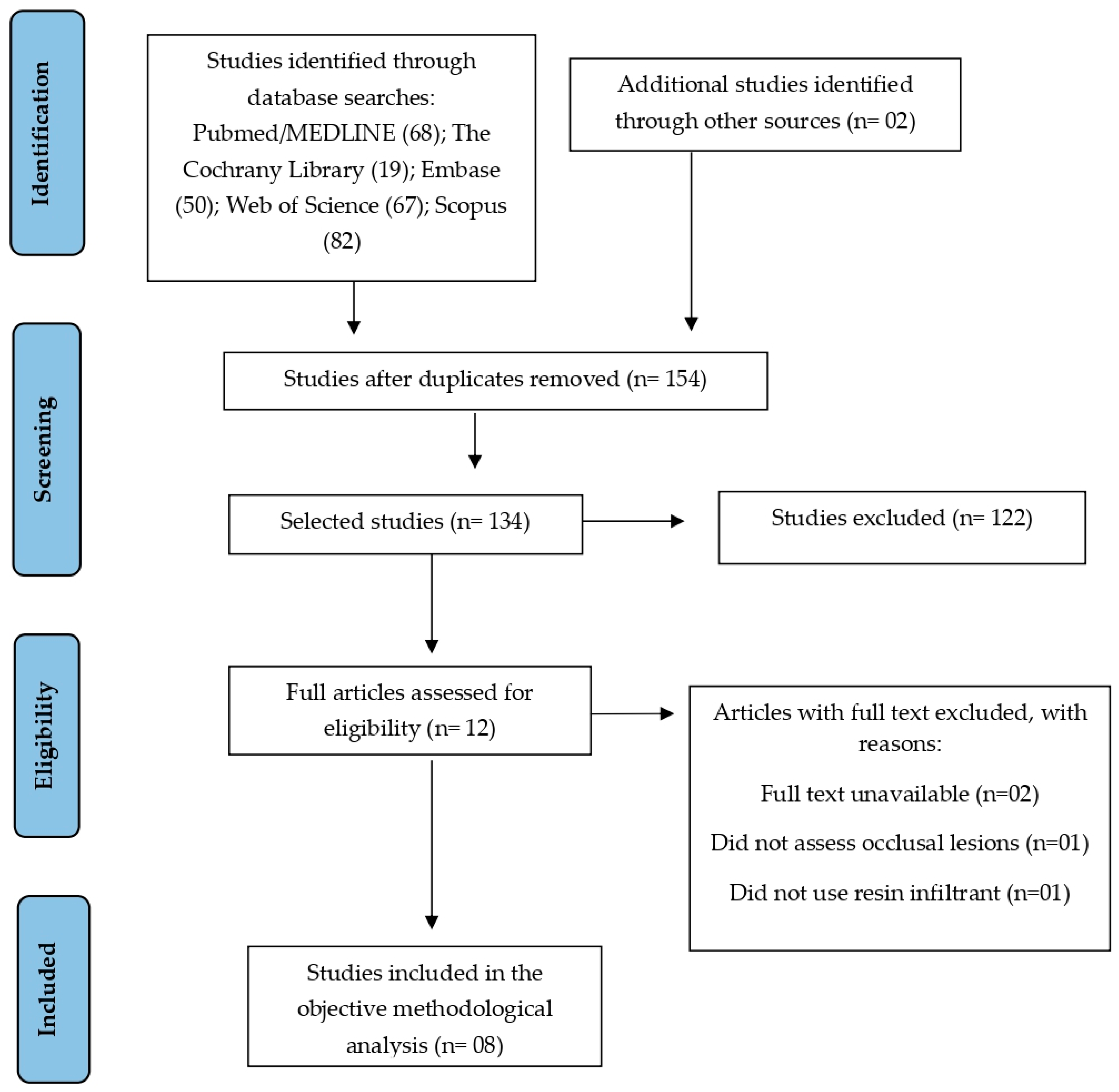
3.1. Study Selection
3.2. Characteristics of the Studies
3.3. Caries Progression Rate of RCTs
3.4. Penetration, Microleakage, and Fluorescence Outcomes of Laboratory Studies
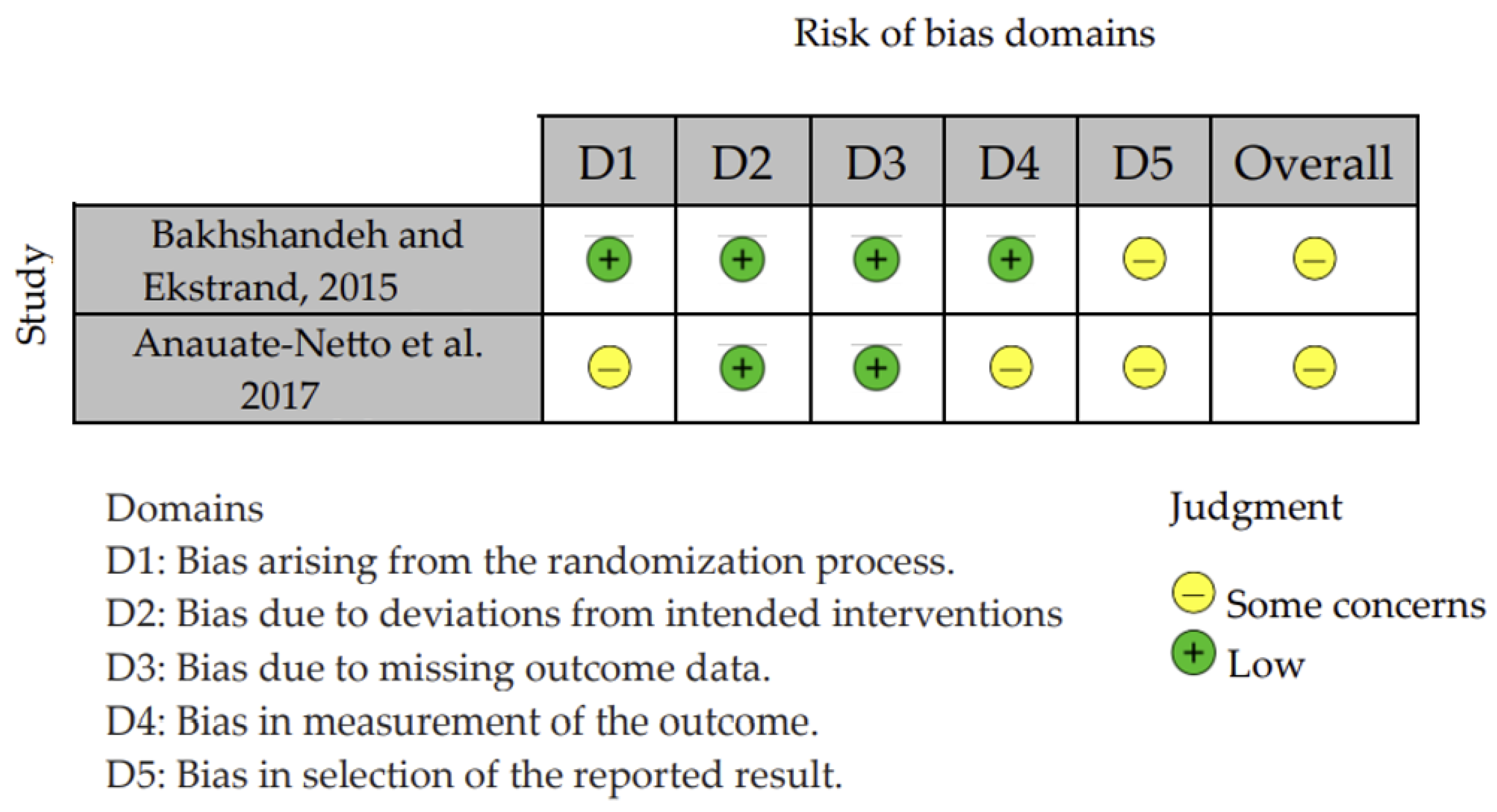
3.5. Risk of Bias in the Studies
3.6. Certainty of Evidence
4. Discussion
5. Conclusions
Supplementary Materials
Author Contributions
Funding
Institutional Review Board Statement
Data Availability Statement
Acknowledgments
Conflicts of Interest
References
- Pitts, N.B.; Zero, D.T.; Marsh, P.D.; Ekstrand, K.; Weintraub, J.A.; Ramos-Gomez, F.; Tagami, J.; Twetman, S.; Tsakos, G.; Ismail, A. Dental caries. Nat. Rev. Dis. Prim. 2017, 3, 17030. [Google Scholar] [CrossRef]
- Manji, F.; Dahlen, G.; Fejerskov, O. Caries and periodontitis: Contesting the conventional wisdom on their aetiology. Caries Res. 2018, 52, 548–564. [Google Scholar] [CrossRef]
- Watt, R.G.; Daly, B.; Allison, P.; Macpherson, L.M.D.; Venturelli, R.; Listl, S.; Weyant, R.J.; Mathur, M.R.; Guarnizo-Herreño, C.C.; Celeste, R.K.; et al. Ending the neglect of global oral health: Time for radical action. Lancet 2019, 394, 261–272. [Google Scholar] [CrossRef] [PubMed]
- Ricucci, D.; Siqueira, J.F., Jr. Bacteriologic status of non-cavitated proximal enamel caries lesions: A histologic and histobacteriologic study. J. Dent. 2020, 100, 103422. [Google Scholar] [CrossRef] [PubMed]
- Campos, P.H.; Gimenez, T.; Rocha, R.S.; Caneppele, T.M.; Guaré, R.O.; Lussi, A.; Bresciani, E.; Diniz, M.B. Prevalence of white spot caries lesions in primary teeth in preschool children: Systematic review and meta-analysis. Curr. Pediatr. Rev. 2022, 18, 33–46. [Google Scholar] [CrossRef] [PubMed]
- Urquhart, O.; Tampi, M.P.; Pilcher, L.; Slayton, R.L.; Araujo, M.W.B.; Fontana, M.; Guzmán-Armstrong, S.; Nascimento, M.M.; Nový, B.; Tinanoff, N.; et al. Nonrestorative treatments for caries: Systematic review and network meta-analysis. J. Dent. Res. 2019, 98, 14–26. [Google Scholar] [CrossRef]
- Amaechi, B.T. Remineralisation—The buzzword for early MI caries management. Br. Dent. J. 2017, 223, 173–182. [Google Scholar] [CrossRef]
- Allen, D.N.; Fine, C.M.; Newton, M.N.; Kabani, F.; Muzzin, K.B.; Reed, K.M. Resin infiltration therapy: A micro-invasive treatment approach for white spot lesions. J. Dent. Hyg. 2021, 95, 31–35. [Google Scholar]
- Anauate-Netto, C.; Neto, L.B.; Amore, R.; DI Hipólito, V.; D’aLpino, P.H.P. Caries progression in non-cavitated fissures after infiltrant application: A 3-year follow-up of a randomized controlled clinical trial. J. Appl. Oral Sci. 2017, 25, 442–454. [Google Scholar] [CrossRef]
- Li, M.; Yang, Z.; Huang, Y.; Li, Y.; Zhou, Z. In vitro effect of resin infiltrant on resistance of sound enamel surfaces in permanent teeth to demineralization. PeerJ 2021, 9, e12008. [Google Scholar] [CrossRef]
- Wang, L.; Freitas, M.C.C.; Prakki, A.; Mosquim, V.; González, A.H.M.; Rios, D.; Honório, H.M. Experimental self-etching resin infiltrants on the treatment of simulated carious white spot lesions. J. Mech. Behav. Biomed. Mater. 2021, 113, 104146. [Google Scholar] [CrossRef]
- Moher, D.; Liberati, A.; Tetzlaff, J.; Altman, D.G.; Prisma Group. Preferred reporting items for systematic reviews and meta-analyses: The PRISMA statement. Rev. Esp. Nutr. Hum. Diet. 2014, 18, 172–181. [Google Scholar] [CrossRef]
- Ouzzani, M.; Hammady, H.; Fedorowicz, Z.; Elmagarmid, A. Rayyan—A web and mobile app for systematic reviews. Syst. Rev. 2016, 5, 210. [Google Scholar] [CrossRef]
- Landis, J.R.; Koch, G.G. The measurement of observer agreement for categorical data. Biometrics 1977, 33, 159–174. [Google Scholar] [CrossRef] [PubMed]
- Higgins, J.P.T. Cochrane Handbook for Systematic Reviews of Interventions; Wiley-Blackwell: Chichester, UK, 2008. [Google Scholar]
- Sarkis-Onofre, R.; Skupien, J.; Cenci, M.S.; Moraes, R.; Pereira-Cenci, T. The role of resin cement on bond strength of glass-fiber posts luted into root canals: A systematic review and meta-analysis of in vitro studies. Oper. Dent. 2014, 39, E31–E44. [Google Scholar] [CrossRef] [PubMed]
- GRADE Working Group. Grading quality of evidence and strength of recommendations. BMJ 2004, 328, 1490. [Google Scholar] [CrossRef] [PubMed]
- Bakhshandeh, A.; Ekstrand, K. Infiltration and sealing versus fluoride treatment of occlusal caries lesions in primary molar teeth: 2–3 years results. Int. J. Paediatr. Dent. 2015, 25, 43–50. [Google Scholar] [CrossRef]
- Paris, S.; Lausch, J.; Selje, T.; Dörfer, C.; Meyer-Lueckel, H. Comparison of sealant and infiltrant penetration into pit and fissure caries lesions in vitro. J. Dent. 2014, 42, 432–438. [Google Scholar] [CrossRef]
- Lausch, J.; Paris, S.; Selje, T.; Dörfer, C.E.; Meyer-Lueckel, H. Resin infiltration of fissure caries with various techniques of pretreatment in vitro. Caries Res. 2015, 49, 50–55. [Google Scholar] [CrossRef]
- Kielbassa, A.M.; Ulrich, I.; Schmidl, R.; Schüller, C.; Frank, W.; Werth, V.D. Resin infiltration of deproteinised natural occlusal subsurface lesions improves initial quality of fissure sealing. Int. J. Oral Sci. 2017, 9, 117–124. [Google Scholar] [CrossRef]
- Silva, F.G.; Freitas, P.M.; Mendes, F.M.; de Novaes, T.F.; Diniz, M.B.; Guaré, R.O. Monitoring enamel caries on resin-treated occlusal surfaces using quantitative light-induced fluorescence: An in vitro study. Lasers Med. Sci. 2020, 35, 1629–1636. [Google Scholar] [CrossRef] [PubMed]
- da Silva, V.B.; de Carvalho, R.N.; Bergstrom, T.G.; dos Santos, T.M.P.; Lopes, R.T.; de Almeida Neves, A. Sealing carious fissures with resin infiltrant in association with a flowable composite reduces immediate microleakage? Pesqui. Bras. Odontopediatria Clin. Integr. 2020, 20, e5114. [Google Scholar] [CrossRef]
- Meyer-Lueckel, H.; Moser, C.; Wierichs, R.J.; Lausch, J. Improved surface layer erosion of pit and fissure caries lesions in preparation for resin infiltration. Caries Res. 2022, 56, 496–502. [Google Scholar] [CrossRef] [PubMed]
- Skeie, M.S.; Sen, A.; Dahllöf, G.; Fagerhaug, T.N.; Høvik, H.; Klock, K.S. Dental caries at enamel and dentine level among European adolescents: A systematic review and meta-analysis. BMC Oral Health 2022, 22, 620. [Google Scholar] [CrossRef]
- Spatafora, G.; Li, Y.; He, X.; Cowan, A.; Tanner, A.C.R. The evolving microbiome of dental caries. Microorganisms 2024, 12, 121. [Google Scholar] [CrossRef]
- Paris, S.; Bitter, K.; Krois, J.; Meyer-Lueckel, H. Seven-year efficacy of proximal caries infiltration: Randomized clinical trial. J. Dent. 2020, 93, 103277. [Google Scholar] [CrossRef]
- Predapramote, V.; Tantilertanant, Y.; Srisawasdi, S. Evaluation of resin infiltration for inhibiting initial caries progression: An in vitro study using micro-computed tomographic analysis. Saudi Dent. J. 2024, 36, 745–750. [Google Scholar] [CrossRef]
- Dziaruddin, N.; Zakaria, A.S.I. Resin infiltration of non-cavitated enamel lesions in paediatric dentistry: A narrative review. Children 2022, 9, 1893. [Google Scholar] [CrossRef]
- Schneider, H.; Park, K.J.; Rueger, C.; Ziebolz, D.; Krause, F.; Haak, R. Imaging resin infiltration into non-cavitated carious lesions by optical coherence tomography. J. Dent. 2017, 60, 94–98. [Google Scholar] [CrossRef]
- Doméjean, S.; Ducamp, R.; Léger, S.; Holmgren, C. Resin infiltration of non-cavitated caries lesions: A systematic review. Med. Princ. Pract. 2015, 24, 216–221. [Google Scholar] [CrossRef]
- Page, M.J.; McKenzie, J.E.; Bossuyt, P.M.; Boutron, I.; Hoffmann, T.C.; Mulrow, C.D.; Shamseer, L.; Tetzlaff, J.M.; Akl, E.A.; Brennan, S.E.; et al. The PRISMA 2020 statement: An updated guideline for reporting systematic reviews. BMJ 2021, 372, n71. [Google Scholar] [CrossRef]


| Database | Search Strategy |
|---|---|
| PubMed | (resin infiltration OR caries infiltration OR infiltrate resin OR infiltration OR infiltrant) AND (occlusal caries OR fissure caries OR fissure caries lesion OR non-cavitated carious lesions OR non-cavitated fissures OR occlusal surfaces OR early occlusal caries) AND (Penetration ability OR caries progression) |
| Embase | (‘resin infiltration’/exp OR ‘resin infiltration’ OR ((‘resin’/exp OR resin) AND (‘infiltration’/exp OR infiltration)) OR ‘caries infiltration’ OR ((‘caries’/exp OR caries) AND (‘infiltration’/exp OR infiltration)) OR ‘infiltrate resin’ OR ((‘infiltrate’/exp OR infiltrate) AND (‘resin’/exp OR resin)) OR ‘infiltration’/exp OR infiltration OR infiltrant) AND (‘occlusal caries’/exp OR ‘occlusal caries’ OR ((‘occlusal’/exp OR occlusal) AND (‘caries’/exp OR caries)) OR ‘fissure caries’ OR ((‘fissure’/exp OR fissure) AND (‘caries’/exp OR caries)) OR ‘fissure caries lesion’ OR ((‘fissure’/exp OR fissure) AND (‘caries’/exp OR caries) AND (‘lesion’/exp OR lesion)) OR ‘non-cavitated carious lesions’ OR (‘non cavitated’ AND carious AND lesions) OR ‘non-cavitated fissures’ OR (‘non cavitated’ AND fissures) OR ‘occlusal surfaces’ OR ((‘occlusal’/exp OR occlusal) AND surfaces) OR ‘early occlusal caries’ OR (early AND (‘occlusal’/exp OR occlusal) AND (‘caries’/exp OR caries))) AND (‘penetration ability’ OR ((‘penetration’/exp OR penetration) AND (‘ability’/exp OR ability)) OR ‘caries progression’ OR ((‘caries’/exp OR caries) AND (‘progression’/exp OR progression))) |
| Web of Science | (TS=(Penetration ability OR caries progression)) AND TS=((resin infiltration OR caries infiltration OR infiltrate resin OR infiltration OR infiltrant) AND (occlusal caries OR fissure caries OR fissure caries lesion OR non-cavitated carious lesions OR non-cavitated fissures OR occlusal surfaces OR early occlusal caries) AND (Penetration ability OR caries progression)) |
| The Cochrane Library | (resin infiltration OR caries infiltration OR infiltrate resin OR infiltration OR infiltrant) AND (occlusal caries OR fissure caries OR fissure caries lesion OR non-cavitated carious lesions OR non-cavitated fissures OR occlusal surfaces OR early occlusal caries) AND (Penetration ability OR caries progression) |
| Scopus | (resin AND infiltration OR caries AND infiltration OR infiltrate AND resin OR infiltration OR infiltrant) AND (occlusal AND caries OR fissure AND caries OR fissure AND caries AND lesion OR non-cavitated AND carious AND lesions OR non-cavitated AND fissures OR occlusal AND surfaces OR early AND occlusal AND caries) AND (penetration AND ability OR caries AND progression) |
| Author, Year | Design of Study | Lesion Type | n | Sample | Initial Depth of Lesion | Resin Infiltrant | Intervention | Comparison | Follow-Up Period | Method of Assessing Caries Progression Rate | Caries Progression Rate | Main Results | Adverse Events |
|---|---|---|---|---|---|---|---|---|---|---|---|---|---|
| Bakhshandeh and Ekstrand, 2015 [18] | RCT, split-mouth. | Natural | 47 patients (150 teeth) | Deciduous molars (ICDAS 1, 2, and 4). Age range: 5 to 8 years. | 84%—Enamel–dentin junction (EDJ) or outer third of dentin. | ICON® (I) (DMG Chemisch-Pharmazeutische Fabrik GmbH, Hamburg, Germany). | 15% HCl + 95% ethanol + ICON Infiltrant + Duraphat. | Delton sealant (S) + Duraphat fluoride varnish (F). | 8 to 34 months. | Interproximal radiographs. | I+F (15%), S+F (19%), and F (36%); a significant difference was found between I+F and F (p = 0.021). | I+F was significantly higher than F (p = 0.021). | No adverse events reported. |
| Paris et al. 2014 [19] | In vitro | Artificial | Premolars and molars (ICDAS 0, 1, and 2). | Até 1192 (805–1512) μm | ICON (DMG, Hamburg, Germany). | ICON Infiltrant with 15% HCl or 37% H3PO4. | Duraphat fluoride varnish (F) alone. | Immediate evaluation. | Laser scanning confocal microscopy (CLSM). | Not applicable. | Greater penetration with HCl + Icon (PPmax 41%) compared to H3PO4 (11%) and sealant (5%). | Limited penetration due to fissures, biofilm, and air bubbles. | |
| Lausch et al. 2015 [20] | In vitro | Artificial | 123 teeth. | Premolars and molars (ICDAS 2). | ~1232 μm | Icon (DMG, Hamburg, Germany). | ICON after 15% HCl, with variations: abrasives, type of brush, and application time. | Sealing with Helioseal. | Immediate evaluation. | Confocal fluorescence microscopy. | Not applicable. | Microabrasion with a stiff brush + HCl promoted greater penetration (almost complete). | Limited penetration due to morphology, biofilm, and air bubbles. |
| Anauate-Netto et al. 2017 [9] | RCT split-mouth. | Natural | 23 patients (86 teeth) | Permanent molars (ICDAS 1 to 3). Age range: 8 to 24 years. | Between the EDJ and the middle third of dentin | Icon® (DMG, Germany). | ICON, 15% HCl, ethanol, and infiltrant for 2 min. | Conventional 15% HCl for 120 s + Icon for 180 s. | 3 years. | Interproximal radiographs, DIAGNOdent, explorer probe, and scanning electron microscopy (SEM). | Infiltrant (2.4%) and sealant (2.5%); laser fluorescence: infiltrant (2.6%) and sealant (5.6%). | Similar efficacy; the infiltrant showed better marginal integrity and stability after 1 year. | Marginal integrity decreased after 1 year and stabilized in years 2 and 3. |
| Kielbassa et al. 2017 [21] | Ex vivo | Artificial | 40 teeth. | Premolars and molars (ICDAS 2). Age range: not specified. | EDJ (detected by DIAGNOdent) | Icon® (DMG, Hamburg, Germany). | ICON + sealing with G-ænial Flow (GC Europe). | Sealant (Alpha Seal). | Immediate evaluation. | Confocal microscopy (CLSM). | Not applicable. | Infiltration rate: 57.9% (premolars), 35.3% (molars); less microleakage and fewer bubbles in RI/CR than in CR. | No adverse events reported. |
| Silva FG et al. 2020 [22] | In vitro | Natural | 60 teeth. | Permanent teeth (ICDAS 1, 2, and 3). | Mean lesion area: ICDAS 1 = 0.70 mm2; ICDAS 2 = 3.10 mm2; ICDAS 3 = 2.99 mm2. | Icon Infiltrant® (DMG, Hamburg, Germany). | ICON with 15% HCl + ethanol + two layers of resin. | Sealing with G-ænial Flow, without infiltration. | Immediate evaluation. | QLF for lesion area, ΔF and ΔQ, confirmed by polarized light microscopy. | Not applicable. | Reduction in post-treatment values; greater resin penetration in ICDAS 2 and 3 lesions. | Incomplete infiltration in ICDAS 3 lesions; lower penetration in ICDAS 1 lesions. |
| Silva VB et al. 2020 [23] | In vitro. | Artificial | 20 teeth. | Third molars. | Micro-CT with E1, E2, D1, and D2. Surface demineralization to the involvement of outer dentin. | Icon (DMG America, Ridgefield Park, NJ, USA). | Resin infiltrant + flowable resin. | Pre- and post-treatment with resin infiltration in ICDAS 1, 2, and 3 lesions; no control group. | Immediate evaluation. | Microleakage test using 3% methylene blue, analyzed under a stereomicroscope (25×). | Not applicable. | Infiltrant + flowable resin—effective immediate sealing of 80%; flowable resin alone—immediate sealing of 30%. | No adverse events reported. |
| Meyer-Lueckel et al. 2022 [24] | In vitro | Artificial | 60 teeth | Molars (ICDAS 2). | Depth: 537 μm (range: 274–876 μm). Thickness of the non-infiltrated surface layer: 33 μm (23–51 μm). | Icon (DMG, Germany) | Pretreatment techniques: 15% HCl for 120 s (H120); 15% HCl with brushing (H30B); 15% HCl with abrasive and brushing (H30BA); 37% H3PO4 for 120 s (P120); H3PO4 with abrasive and brushing (P120BA). After pretreatment, standard infiltration with Icon® (DMG, Germany) was performed for 180 s. | Flowable resin. | Immediate evaluation. | Measurement of SL, LD, and PD by CLSM. Laser scanning confocal microscopy with fluorescence. | Not applicable. | The H30BA group (HCl + abrasive + brushing) showed: greater removal of the superficial layer; greater infiltrant penetration (almost complete). Groups with phosphoric acid (P120 and P120BA): less erosion of the superficial layer; lower resin penetration. Groups with HCl (without brushing/abrasive) showed intermediate results. | Infiltration limitations in the phosphoric acid groups. |
| Author, Year | Groups | n (Lesions) | Lesions with Progression | Caries Progression Rate | Statistical Difference |
|---|---|---|---|---|---|
| Bakhshandeh and Ekstrand, 2015 [18] | Resin infiltrant + fluoride varnish | 47 | 7 | 15% | (p = 0.021) vs. F (p = 0.774) vs. S+F |
| Sealant + fluoride varnish (S+F) | 47 | 9 | 19% | (p = 0.096) vs. F | |
| Fluoride varnish only (F) | 47 | 17 | 36% | - | |
| Anauate-Netto et al. [9] | Resin infiltrant | 42 | 1 | 2.4% | No significant difference |
| Conventional sealant | 40 | 1 | 2.5% | No significant difference |
| Author, Year | Outcome | Groups | n | Result | Unit/Indicator |
|---|---|---|---|---|---|
| Paris et al. 2014 [19] | Penetration (PPmax) | Icon (ICDAS 2) | 9 | 41% (30–78%) 5% (0–9%) 11% (0–21%) | Maximum penetration % |
| Selant (ICDAS 2) | 10 | ||||
| Soft-Etch (H3PO4) (ICDAS 2) | 9 | ||||
| Lausch et al. 2015 [20] | Penetration | HCl + abrasive (120 s brushing) | 20 | 64% 61% 23% | % of completely infiltrated fissures |
| HCl + abrasive (30 s brushing) | 20 | ||||
| Standard HCl (120 s) | 20 | ||||
| Kielbassa et al. 2017 [21] | Microleakage | Icon + flowable resin | 20 | 1/20; Bubbles 2/20 5/20; Bubbles 17/20 | Absolute frequency |
| Flowable resin alone | 20 | ||||
| Penetration | Icon + flow (premolars) | 10 | 57.9% ± 23.1% 35.3% ± 22.1% | % infiltrated area | |
| Icon + flow (molars) | 10 | ||||
| Silva FG et al. 2020 [22] | Fluorescence (ΔF, ΔQ) | Icon | 60 | Significant reduction in fluorescence loss (p < 0.05) Values remained unchanged | ΔF (% fluorescence) |
| Control (no treatment) | 60 | ||||
| Silva VB et al. 2020 [23] | Microleakage | Icon + flow | 20 | Effective sealing in 80% of the samples (score 0 or 1) Effective sealing in 30% of the samples (score 0 or 1) | % effective sealing (microleakage score 0 or 1) |
| flow alone | 20 | ||||
| Meyer-Lueckel et al. 2022 [24] | Penetration | HCl + abrasive (H30BA) | 12 | Almost complete penetration Less than H30BA—intermediate penetration Overall lower penetration | Qualitative + confocal Comparative Comparative Comparative |
| Standard HCl (H120) | 12 | ||||
| H3PO4 + abrasive (P120BA) | 12 | ||||
| Standard H3PO4 (P120) | 12 |
| Study | Teeth Randomization | Teeth Free of Caries | Standardization of Enamel/Dentine Surface Samples | Sample Size | Blinding of the Examiner | Sample Size Calculation | Complete Outcome Data | Risk of Bias |
|---|---|---|---|---|---|---|---|---|
| Paris et al. 2014 [19] | Yes | Yes | Yes | Yes | NR | NR | Yes | Moderate |
| Lausch et al. 2015 [20] | Yes | Yes | Yes | Yes | NR | NR | Yes | Moderate |
| Kielbassa et al. 2017 [21] | Yes | Yes | Yes | Yes | Yes | NR | Yes | Low |
| Silva FG et al. 2020 [22] | Yes | Yes | Yes | Yes | Yes | Yes | Yes | Low |
| Silva VB et al. 2020 [23] | Yes | Yes | Yes | Yes | NR | NR | Yes | Moderate |
| Meyer-Lueckel et al. 2022 [24] | Yes | Yes | Yes | Yes | NR | NR | Yes | Moderate |
| Certainty Assessment | |||||||||
|---|---|---|---|---|---|---|---|---|---|
| Parameter | No of Studies | Study Design | Risk of Bias | Inconsistency | Indirectness | Imprecision | Other Considerations | Important | Certainty |
| Infiltrant penetration | 6 | 5 in vitro, 1 RCT | Serious a | Not serious c | Not serious d | Not serious e | None | - | ⊕⊕⊕⊝ Moderate |
| Microleakage/sealing | 4 | 3 in vitro, 1 RCT | Serious a | Not serious c | Not seriousd | Serious f | None | - | ⊕⊕⊝⊝ Low |
| Fluorescence (ΔF) | 1 | In vitro | Not serious b | Not applicable | Not serious d | Serious f | None | - | ⊕⊕⊝⊝ Low |
| Lesion progression (Clinical) | 2 | RCT | Serious a | Not serious c | Not serious d | Serious f | None | - | ⊕⊕⊝⊝ Low |
Disclaimer/Publisher’s Note: The statements, opinions and data contained in all publications are solely those of the individual author(s) and contributor(s) and not of MDPI and/or the editor(s). MDPI and/or the editor(s) disclaim responsibility for any injury to people or property resulting from any ideas, methods, instructions or products referred to in the content. |
© 2026 by the authors. Licensee MDPI, Basel, Switzerland. This article is an open access article distributed under the terms and conditions of the Creative Commons Attribution (CC BY) license.
Share and Cite
Miranda, S.B.; Lins, R.B.E.; Silveira, J.A.M.d.; Leal, C.d.F.C.; Souza, C.M.C.d.; Moura, H.S.; Guimarães, L.G.; Prosini, P.; Montes, M.A.J.R. Efficacy of Resin Infiltrants in Non-Cavitated Occlusal Carious Lesions: A Systematic Review. J. Clin. Med. 2026, 15, 1310. https://doi.org/10.3390/jcm15031310
Miranda SB, Lins RBE, Silveira JAMd, Leal CdFC, Souza CMCd, Moura HS, Guimarães LG, Prosini P, Montes MAJR. Efficacy of Resin Infiltrants in Non-Cavitated Occlusal Carious Lesions: A Systematic Review. Journal of Clinical Medicine. 2026; 15(3):1310. https://doi.org/10.3390/jcm15031310
Chicago/Turabian StyleMiranda, Samille Biasi, Rodrigo Barros Esteves Lins, Julia Almeida Maciel da Silveira, Caroline de Farias Charamba Leal, Caroline Mathias Carvalho de Souza, Helene Soares Moura, Lorena Gomes Guimarães, Priscila Prosini, and Marcos Antonio Japiassú Resende Montes. 2026. "Efficacy of Resin Infiltrants in Non-Cavitated Occlusal Carious Lesions: A Systematic Review" Journal of Clinical Medicine 15, no. 3: 1310. https://doi.org/10.3390/jcm15031310
APA StyleMiranda, S. B., Lins, R. B. E., Silveira, J. A. M. d., Leal, C. d. F. C., Souza, C. M. C. d., Moura, H. S., Guimarães, L. G., Prosini, P., & Montes, M. A. J. R. (2026). Efficacy of Resin Infiltrants in Non-Cavitated Occlusal Carious Lesions: A Systematic Review. Journal of Clinical Medicine, 15(3), 1310. https://doi.org/10.3390/jcm15031310