Clinical Heterogeneity in Inguinal Hernia Repair and the Need for Tailored Management: A Retrospective Observational Study of Postoperative Complications and Hospitalization Duration
 and
and
Abstract
1. Introduction
2. Materials and Methods
2.1. Operation Method
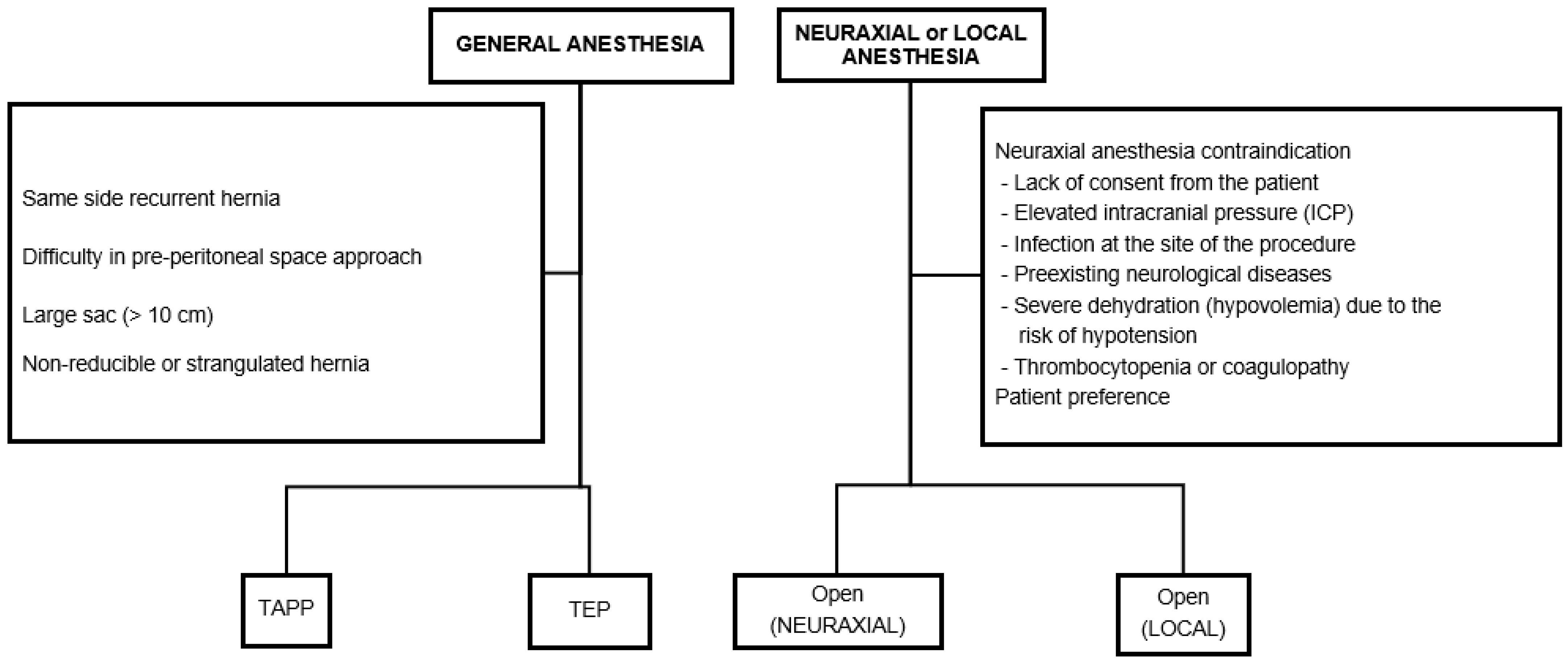
- Recurrent hernia where the previous surgical approach was anterior
- PPS for TEP surgery was challenging due to previous lower abdominal surgery, robotic-assisted radical prostatectomy, cystectomy, and radiation therapy
- Large sac or mass exceeding 10 cm
- Manual reduction of the hernia was not possible
- Strangulated hernia
2.2. Anesthesia Method
2.3. Patient Population
2.4. Main Outcome
2.5. Statistical Analysis
3. Results
3.1. Preoperative Data of Patients
3.2. Intraoperative Data of Patients
3.3. Postoperative Data of Patients
4. Discussion
5. Conclusions
Author Contributions
Funding
Institutional Review Board Statement
Informed Consent Statement
Data Availability Statement
Acknowledgments
Conflicts of Interest
Abbreviations
| TEP | Totally Extra Peritonea |
| TAPP | Trans Abdominal Pre Peritoneal |
| PPS | Pre Peritoneal Space |
| ASA | American Society of Anesthesiologists’ physical status classification |
| DM | Diabetes Mellitus |
| HTN | Hypertension |
| LC | Liver Cirrhosis |
| COPD | Chronic Obstructive Pulmonary Disease |
| CVA | Cerebro Vascular Accident |
| MI | Myocardial Infarction |
| CRF | Chronic Renal Failure |
References
- Han, S.-R.; Kim, H.-J.; Kim, N.-H.; Shin, S.; Na Yoo, R.; Kim, G.; Cho, H.-M. Inguinal hernia surgery in Korea: Nationwide data from 2007–2015. Ann. Surg. Treat. Res. 2019, 97, 41–47. [Google Scholar] [CrossRef]
- HerniaSurge Group. International guidelines for groin hernia management. Hernia 2018, 22, 1–165. [Google Scholar] [CrossRef]
- Stabilini, C.; van Veenendaal, N.; Aasvang, E.; Agresta, F.; Aufenacker, T.; Berrevoet, F.; Burgmans, I.; Chen, D.; de Beaux, A.; East, B.; et al. Update of the international HerniaSurge guidelines for groin hernia management. BJS Open 2023, 7, zrad080. [Google Scholar] [CrossRef]
- Weyhe, D.; Tabriz, N.; Sahlmann, B.; Uslar, V.-N. Risk factors for perioperative complications in inguinal hernia repair—A systematic review. Innov. Surg. Sci. 2017, 2, 47–52. [Google Scholar] [CrossRef]
- Li, J.; Ji, Z.; Li, Y. Comparison of laparoscopic versus open procedure in the treatment of recurrent inguinal hernia: A meta-analysis of the results. Am. J. Surg. 2014, 207, 602–612. [Google Scholar] [CrossRef] [PubMed]
- Gass, M.; Banz, V.M.; Rosella, L.; Adamina, M.; Candinas, D.; Güller, U. TAPP or TEP? Population-based analysis of prospective data on 4,552 patients undergoing endoscopic inguinal hernia repair. World J. Surg. 2012, 36, 2782–2786. [Google Scholar] [CrossRef] [PubMed]
- Bracale, U.; Melillo, P.; Pignata, G.; Di Salvo, E.; Rovani, M.; Merola, G.; Pecchia, L. Which is the best laparoscopic approach for inguinal hernia repair: TEP or TAPP? A systematic review of the literature with a network meta-analysis. Surg. Endosc. 2012, 26, 3355–3366. [Google Scholar] [CrossRef] [PubMed]
- Verras, G.-I.; Mulita, F. Butyrylcholinesterase levels correlate with surgical site infection risk and severity after colorectal surgery: A prospective single-center study. Front. Surg. 2024, 11, 1379410. [Google Scholar] [CrossRef]
- Mulita, F.; Parchas, N.; Solou, K.; Tchabashvili, L.; Gatomati, F.; Iliopoulos, F.; Maroulis, I. Postoperative Pain Scores After Open Inguinal Hernia Repair: Comparison of Three Postoperative Analgesic Regimens. Med. Arch. 2020, 74, 355–358. [Google Scholar] [CrossRef]
- Köckerling, F.; Bittner, R.; Kuthe, A.; Hukauf, M.; Mayer, F.; Fortelny, R.; Schug-Pass, C. TEP or TAPP for recurrent inguinal hernia repair-register-based comparison of the outcome. Surg. Endosc. 2017, 31, 3872–3882. [Google Scholar] [CrossRef]
- Cao, C.; Shi, X.; Jin, W.; Luan, F. Clinical data analysis for treatment of adult inguinal hernia by TAPP or TEP. Front. Surg. 2022, 9, 900843. [Google Scholar] [CrossRef]
- Khan, W.F.; Rathore, Y.S.; Aggarwal, S.; Chumber, S.; Arumugaswamy, P.R.; Baig, K.A.M.; Patidar, A.; Rai, S.K. Endoscopic totally extraperitoneal repair for groin hernia: Experience from a tertiary care centre. J. Minimal Access Surg. 2023, 19, 107–111. [Google Scholar] [CrossRef]
- Krishna, A.; Bansal, V.K.; Misra, M.C.; Prajapati, O.; Kumar, S. Totally extraperitoneal repair in inguinal hernia: More than a decade’s experience at a tertiary care hospital. Surg. Laparosc. Endosc. Percutaneous Tech. 2019, 29, 247–251. [Google Scholar] [CrossRef]
- Sakon, M.; Sekino, Y.; Okada, M.; Seki, H.; Munakata, Y. Laparoscopic inguinal hernioplasty after robot-assisted laparoscopic radical prostatectomy. Hernia 2017, 21, 745–748. [Google Scholar] [CrossRef]
- Yamada, Y.; Fujimura, T.; Fukuhara, H.; Sugihara, T.; Takemura, K.; Kakutani, S.; Suzuki, M.; Nakagawa, T.; Kume, H.; Igawa, Y.; et al. Incidence and risk factors of inguinal hernia after robot-assisted radical prostatectomy. World J. Surg. Oncol. 2017, 15, 61. [Google Scholar] [CrossRef] [PubMed]
- Tabrizi, N.S.; Demos, R.A.; Schumann, R.; Musuku, S.R.; Shapeton, A.D. Neuraxial anesthesia in patients with aortic stenosis: A systematic review. J. Cardiothorac. Vasc. Anesth. 2024, 38, 505–516. [Google Scholar] [CrossRef]
- Cabrera-Vargas, L.F.; Mendoza-Zuchini, A.; Aparicio, B.S.; Pedraza, M.; Sajona-Leguia, W.A.; Arias, J.S.R.; Lozada-Martinez, I.D.; Picón-Jaimes, Y.A.; Narvaez-Rojas, A.R. Postoperative outcomes using Lichtenstein open hernioplasty versus Nyhus preperitoneal hernioplasty in inguinal hernia: A comparative analysis with 1-year follow-up. Health Sci. Rep. 2023, 6, e1151. [Google Scholar] [CrossRef]
- Ahmadinejad, I.; Jalali, A.; Ahmadinejad, M.; Soltanian, A.; Ahamdinejad, Y.; Shirzadi, A.; Chaghamirzayi, P. Inguinal hernia: Lichtenstein vs Shouldice technique repair: A randomized controlled trial. Surg. Open Sci. 2024, 17, 70–74. [Google Scholar] [CrossRef] [PubMed]
- Mulugeta, H.; Zemedkun, A.; Getachew, H. Selective spinal anesthesia in a patient with low ejection fraction who underwent emergent below-knee amputation in a resource-constrained setting. Local Reg. Anesth. 2020, 13, 135–140. [Google Scholar] [CrossRef]
- Balentine, C.J.; Meier, J.; Berger, M.; Reisch, J.; Cullum, M.; Lee, S.C.; Skinner, C.S.; Brown, C.J. Using local anesthesia for inguinal hernia repair reduces complications in older patients. J. Surg. Res. 2021, 258, 64–72. [Google Scholar] [CrossRef] [PubMed]
- Meier, J.; Berger, M.; Hogan, T.; Reisch, J.; Zeh, H.; Cullum, C.M.; Lee, S.C.; Skinner, C.S.; Brown, C.J.; Balentine, C.J. Using local rather than general anesthesia for inguinal hernia repair may significantly reduce complications for frail veterans. Am. J. Surg. 2021, 222, 619–624. [Google Scholar] [CrossRef] [PubMed]
- Argo, M.; Favela, J.; Phung, T.; Huerta, S. Local VS. other forms of anesthesia for open inguinal hernia repair: A meta-analysis of randomized controlled trials. Am. J. Surg. 2019, 218, 1008–1015. [Google Scholar] [CrossRef] [PubMed]
- Mao, S.; Chen, S.; Guo, L.; Luo, Q.; Liu, Y. Comparative benefits of local anesthesia and spinal anesthesia in adult open inguinal hernia: A meta-analysis of clinical randomized controlled trials. Minerva Anestesiol. 2022, 88, 604–614. [Google Scholar] [CrossRef] [PubMed]
- Varshney, P.; Varshney, M.; Bhadoria, P. Comparison of total intravenous anaesthesia, spinal anaesthesia and local block for day care inguinal herniorrhaphy. Internet J. Anesthesiol. 2008, 22, 1. [Google Scholar]
- Reece-Smith, A.M.; Maggio, A.Q.; Tang, T.Y.; Walsh, S.R. Local anaesthetic vs. general anaesthetic for inguinal hernia repair: Systematic review and meta-analysis. Int. J. Clin. Pract. 2009, 63, 1739–1742. [Google Scholar] [CrossRef]



| Overall | OPEN | TAPP | TEP | p | Test | |
|---|---|---|---|---|---|---|
| n | 229 | 26 | 65 | 138 | ||
| AGE (median [IQR]) | 69.00 [62.00, 76.00] | 74.00 [69.00, 78.75] | 70.00 [63.00, 75.00] | 68.00 [59.25, 76.00] | 0.036 | † |
| SEX (%) | 0.866 | ‡ | ||||
| Female (%) | 16 (7.0) | 2 (7.7) | 5 (7.7) | 9 (6.5) | ||
| Male (%) | 213 (93.0) | 24 (92.3) | 60 (92.3) | 129 (93.5) | ||
| ASA (median [IQR]) | 2.00 [2.00, 3.00] | 3.50 [3.00, 4.00] | 2.00 [2.00, 3.00] | 2.00 [2.00, 3.00] | <0.001 | † |
| ANESTHESIA (%) | <0.001 | |||||
| LOCAL | 10 (4.4) | 10 (38.5) | 0 (0.0) | 0 (0.0) | ||
| NEURAXIAL | 16 (7.0) | 16 (53.8) | 0 (0.0) | 0 (0.0) | ||
| GENERAL | 203 (88.6) | 0 (0.0) | 65 (100.0) | 138 (100.0) | ||
| DM (%) | 51 (22.4) | 7 (28.0) | 13 (20.0) | 31 (22.5) | 0.716 | ‡ |
| HTN (%) | 95 (41.7) | 15 (57.7) | 31 (47.7) | 49 (35.8) | 0.058 | ‡ |
| LC (%) | 10 (4.4) | 4 (15.4) | 0 (0.0) | 6 (4.3) | 0.006 | ‡ |
| COPD (%) | 20 (8.7) | 13 (50.0) | 1 (1.5) | 6 (4.3) | <0.001 | ‡ |
| ASTHMA (%) | 15 (6.6) | 6 (23.1) | 2 (3.1) | 7 (5.1) | 0.005 | ‡ |
| CVA (%) | 22 (9.6) | 6 (23.1) | 3 (4.6) | 13 (9.4) | 0.032 | ‡ |
| ANGINA, MI (%) | 29 (12.7) | 5 (19.2) | 8 (12.3) | 16 (11.6) | 0.536 | ‡ |
| HEART FAILURE (%) | 7 (3.1) | 6 (23.1) | 0 (0.0) | 1 (0.7) | <0.001 | ‡ |
| CRF (%) | 19 (8.3) | 5 (19.2) | 3 (4.6) | 11 (8.0) | 0.085 | ‡ |
| RECUR (%) | 15 (6.6) | 1 (3.8) | 9 (13.8) | 5 (3.6) | 0.024 | ‡ |
| Overall | OPEN | TAPP | TEP | p | Test | |
|---|---|---|---|---|---|---|
| n | 229 | 26 | 65 | 138 | ||
| Bleeding (%) | 0 (0.0) | 0 (0.0) | 0 (0.0) | 0 (0.0) | ‡ | |
| Bowel injury (%) | 0 (0.0) | 0 (0.0) | 0 (0.0) | 1 (0.7) | 1.000 | ‡ |
| conversion (%) | 3 (1.3) | 0 (0.0) | 1 (1.5) | 2 (1.4) | 1.000 | ‡ |
| Overall | OPEN | TAPP | TEP | p | Test | |
|---|---|---|---|---|---|---|
| n | 229 | 26 | 65 | 138 | ||
| HD | 3.53 | 3.77 | 3.98 | 3.27 | ||
| Total (%) | 14(6.1) | 4(15.4) | 4(6.2) | 6(4.3) | 0.100 | ‡ |
| Hematoma (%) | 2 (0.9) | 1 (3.8) | 1 (1.5) | 0 (0.0) | 0.077 | ‡ |
| Seroma (%) | 4 (1.7) | 1 (3.8) | 2 (3.1) | 1 (0.7) | 0.202 | |
| Surgical site infection (%) | 3 (1.3) | 1 (3.8) | 1 (1.5) | 1 (0.7) | 0.202 | ‡ |
| Urinary retention (%) | 4 (1.7) | 1 (3.8) | 3 (2.2) | 0 (0.0) | 0.302 | ‡ |
| Ileus (%) | 1 (0.4) | 0 (0.0) | 0 (0.0) | 1 (0.7) | 1.000 | ‡ |
| Chronic pain (%) | 0 (0.0) | 0 (0.0) | 0 (0.0) | 0 (0.0) | ‡ | |
| RECUR (%) | 0 (0.0) | 0 (0.0) | 0 (0.0) | 0 (0.0) | ‡ |
Disclaimer/Publisher’s Note: The statements, opinions and data contained in all publications are solely those of the individual author(s) and contributor(s) and not of MDPI and/or the editor(s). MDPI and/or the editor(s) disclaim responsibility for any injury to people or property resulting from any ideas, methods, instructions or products referred to in the content. |
© 2026 by the authors. Licensee MDPI, Basel, Switzerland. This article is an open access article distributed under the terms and conditions of the Creative Commons Attribution (CC BY) license.
Share and Cite
Han, J.H.; Choi, J.B.; Kim, M.J.; Bang, J.H.; Jo, H.J.; Park, E.J.; Lee, B.C. Clinical Heterogeneity in Inguinal Hernia Repair and the Need for Tailored Management: A Retrospective Observational Study of Postoperative Complications and Hospitalization Duration. J. Clin. Med. 2026, 15, 1258. https://doi.org/10.3390/jcm15031258
Han JH, Choi JB, Kim MJ, Bang JH, Jo HJ, Park EJ, Lee BC. Clinical Heterogeneity in Inguinal Hernia Repair and the Need for Tailored Management: A Retrospective Observational Study of Postoperative Complications and Hospitalization Duration. Journal of Clinical Medicine. 2026; 15(3):1258. https://doi.org/10.3390/jcm15031258
Chicago/Turabian StyleHan, Jeong Hee, Jung Bum Choi, Min Ju Kim, Jun Hyung Bang, Hong Jae Jo, Eun Ji Park, and Byoung Chul Lee. 2026. "Clinical Heterogeneity in Inguinal Hernia Repair and the Need for Tailored Management: A Retrospective Observational Study of Postoperative Complications and Hospitalization Duration" Journal of Clinical Medicine 15, no. 3: 1258. https://doi.org/10.3390/jcm15031258
APA StyleHan, J. H., Choi, J. B., Kim, M. J., Bang, J. H., Jo, H. J., Park, E. J., & Lee, B. C. (2026). Clinical Heterogeneity in Inguinal Hernia Repair and the Need for Tailored Management: A Retrospective Observational Study of Postoperative Complications and Hospitalization Duration. Journal of Clinical Medicine, 15(3), 1258. https://doi.org/10.3390/jcm15031258