Association Between Continuous Consumption of Yogurt Fermented with Lactobacillus delbrueckii ssp. bulgaricus OLL1073R-1, Salivary Antimicrobial Proteins, and Tongue-Coating Microbiota: An Observational Human Study
 , , , , ,
Abstract
1. Introduction
2. Materials and Methods
2.1. General Data
2.2. Ethical Approval
2.3. Collecting Saliva
2.4. Collecting Tongue Coating
2.5. Salivary Protein Quantitation
2.6. DNA Extraction from Tongue-Coating Samples
2.7. Analysis of Tongue-Coating Microbiota
2.8. Bayesian Network Analysis
2.9. Statistical Analysis
3. Results
3.1. General Data of Participants
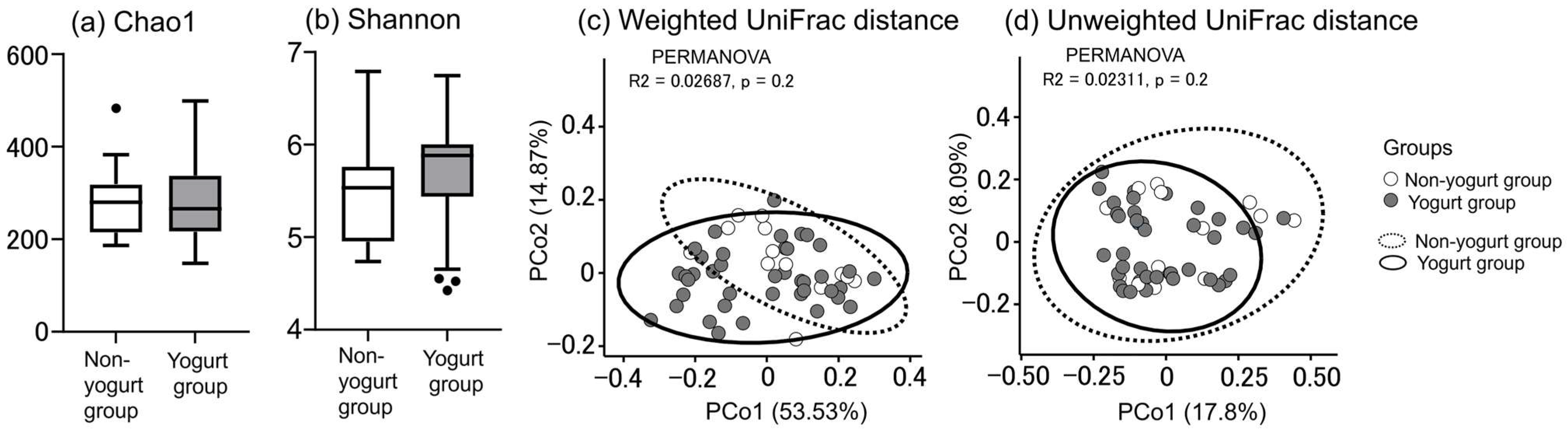
3.2. Tongue-Coating Microbiota Diversity
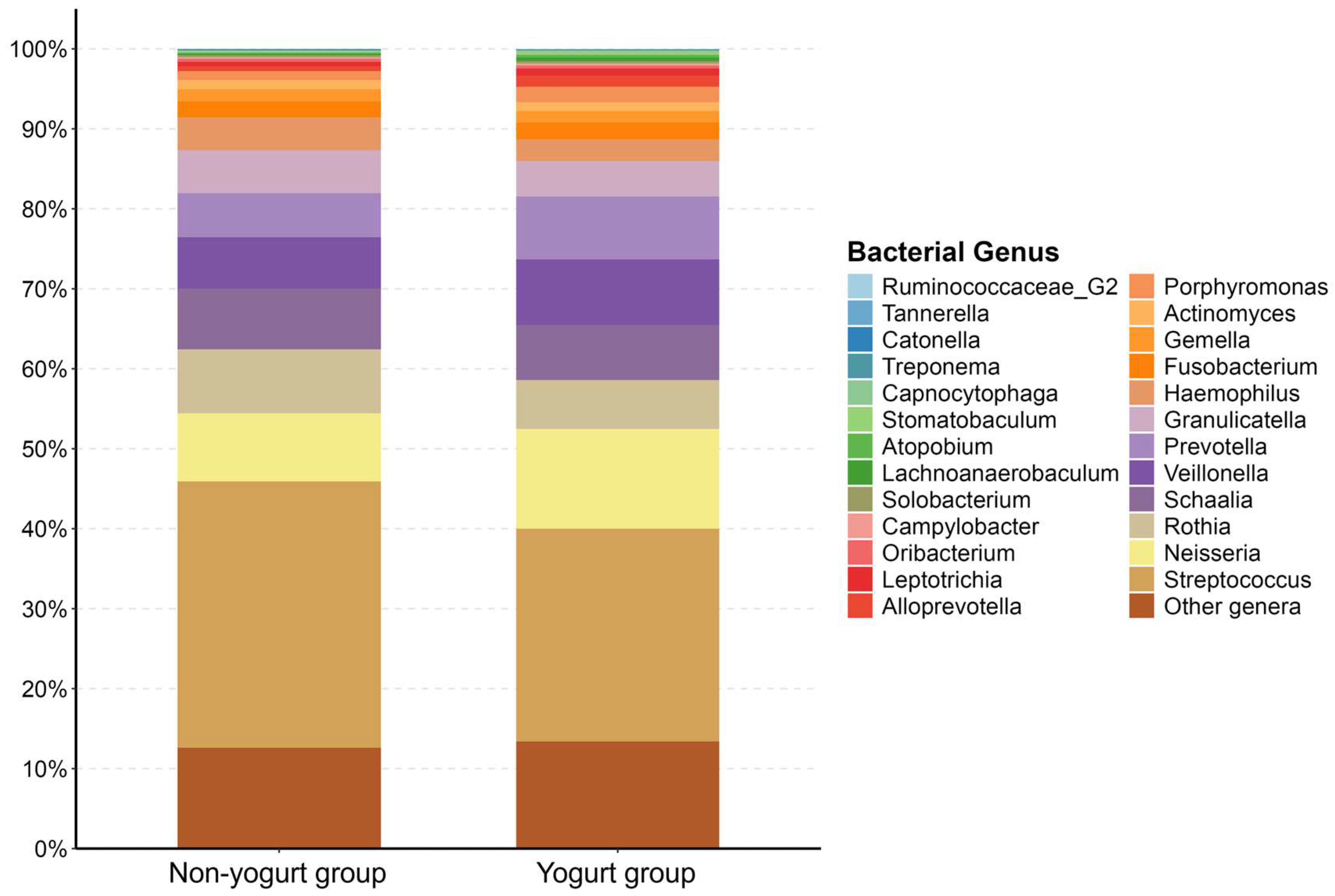
3.3. Tongue-Coating Microbiota Composition
3.4. Fusobacterium Species Abundances in the Tongue-Coating Microbiota
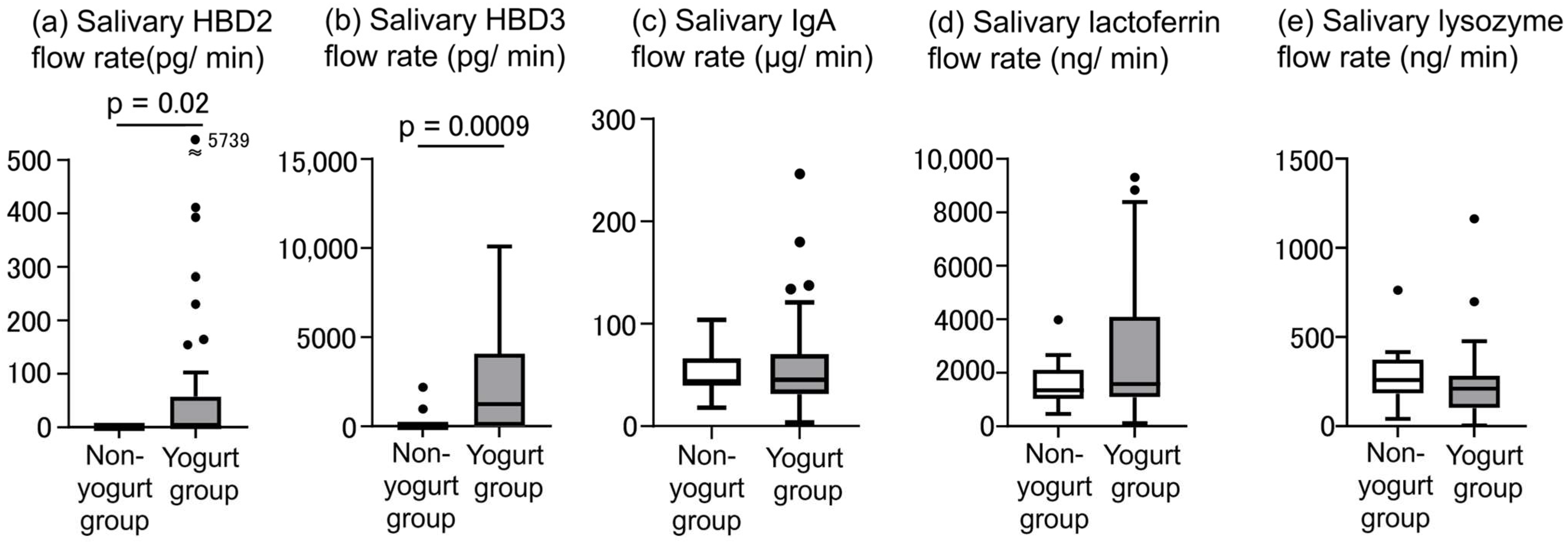
3.5. Salivary AMPs Flow Rate
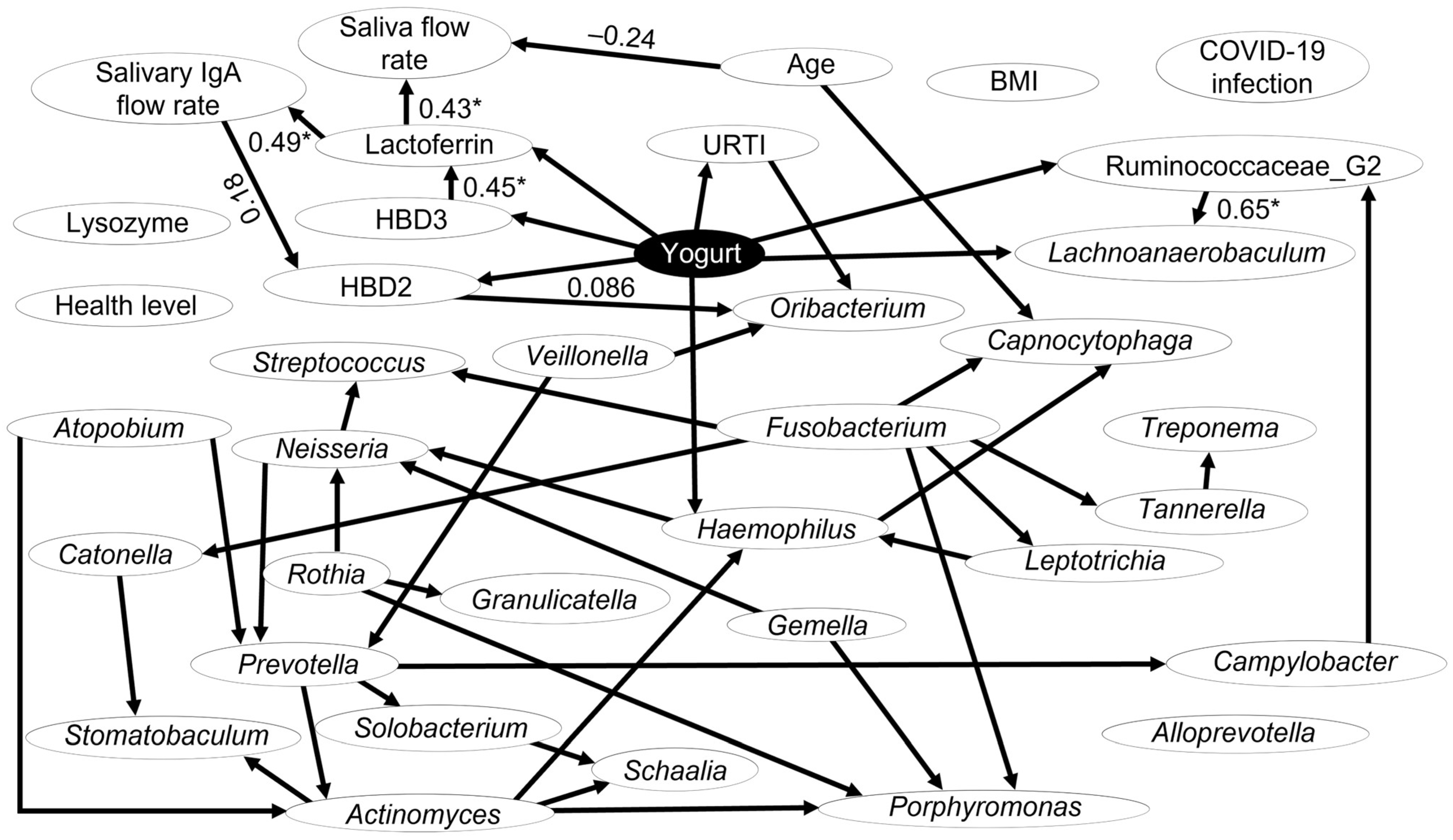
3.6. Causal Analysis Using a Bayesian Network
4. Discussion
5. Conclusions
Author Contributions
Funding
Institutional Review Board Statement
Informed Consent Statement
Data Availability Statement
Acknowledgments
Conflicts of Interest
Abbreviations
| AMP | Antimicrobial Protein |
| BMI | Body Mass Index |
| COVID-19 | Coronavirus Disease 2019 |
| ELISA | Enzyme-linked immunosorbent assay |
| EPS | Exopolysaccharide |
| FDR | False Discovery Rate |
| HBD | Human β-defensin |
| IgA | Immunoglobulin A |
| IL-1β | Interleukin-1 beta |
| LbR1 | Lactobacillus delbrueckii ssp. bulgaricus OLL1073R-1 |
| NK | Natural Killer |
| PCoA | Performing principal Coordinate Analysis |
| PERMANOVA | Permutational Multivariate Analysis of Variance |
| TNF-α | Tumor Necrosis Factor Alpha |
| URTI | Upper Respiratory Tract Infection |
References
- Yue, Z.; Fan, Y.; Shan, G.; Chen, X. Oral microbiome contributions to metabolic syndrome pathogenesis. Front. Microbiol. 2025, 16, 1630828. [Google Scholar] [CrossRef]
- Rajasekaran, J.J.; Krishnamurthy, H.K.; Bosco, J.; Jayaraman, V.; Krishna, K.; Wang, T.; Bei, K. Oral Microbiome: A Review of Its Impact on Oral and Systemic Health. Microorganisms 2024, 12, 1797. [Google Scholar] [CrossRef]
- Kunath, B.J.; De Rudder, C.; Laczny, C.C.; Letellier, E.; Wilmes, P. The oral-gut microbiome axis in health and disease. Nat. Rev. Microbiol. 2024, 22, 791–805. [Google Scholar] [CrossRef] [PubMed]
- Fijan, S. Microorganisms with claimed probiotic properties: An overview of recent literature. Int. J. Environ. Res. Public Health 2014, 11, 4745–4767. [Google Scholar] [CrossRef] [PubMed]
- Cui, Z.; Wang, P.; Gao, W. Microbial dysbiosis in periodontitis and peri-implantitis: Pathogenesis, immune responses, and therapeutic. Front. Cell Infect. Microbiol. 2025, 15, 1517154. [Google Scholar] [CrossRef] [PubMed]
- Zhang, Y.; Xu, Y.; Hu, L.; Wang, X. Advancements related to probiotics for preventing and treating recurrent respiratory tract infections in children. Front. Pediatr. 2025, 13, 1508613. [Google Scholar] [CrossRef]
- Paduchová, Z.; Nagyová, Z.; Wang, D.; Muchová, J. The impact of probiotics and vitamin C on the prevention of upper respiratory tract symptoms in two preschool children cohorts. Nutr. Res. Pract. 2024, 8, 98–109. [Google Scholar] [CrossRef]
- Dempsey, E.; Corr, S.C. Lactobacillus spp. for Gastrointestinal Health: Current and Future Perspectives. Front. Immunol. 2022, 13, 840245. [Google Scholar] [CrossRef]
- Lundtorp-Olsen, C.; Markvart, M.; Twetman, S.; Belstrøm, D. Effect of Probiotic Supplements on the Oral Microbiota—A Narrative Review. Pathogens 2024, 13, 419. [Google Scholar] [CrossRef]
- Yamazaki, K. Oral-gut axis as a novel biological mechanism linking periodontal disease and systemic diseases: A review. Jpn. Dent. Sci. Rev. 2023, 59, 273–280. [Google Scholar] [CrossRef]
- Tian, S.; Ding, T.; Li, H. Oral microbiome in human health and diseases. mLife 2024, 3, 367–383. [Google Scholar] [CrossRef]
- Willmott, T.; Serrage, H.J.; Cottrell, E.C.; Humphreys, G.J.; Myers, J.; Campbell, P.M.; McBain, A.J. Investigating the association between nitrate dosing and nitrite generation by the human oral microbiota in continuous culture. Appl. Environ. Microbiol. 2024, 90, e0203523. [Google Scholar] [CrossRef]
- Gallo, M.; Ferrari, E.; Giovati, L.; Pertinhez, T.A.; Artesani, L.; Conti, S.; Ciociola, T. The Variability of the Salivary Antimicrobial Peptide Profile: Impact of Lifestyle. Int. J. Mol. Sci. 2024, 25, 11501. [Google Scholar] [CrossRef] [PubMed]
- Yamamoto, Y.; Fujino, K.; Saruta, J.; Takahashi, T.; To, M.; Fuchida, S.; Shimizu, T.; Kamata, Y.; Misawa, K.; Tsukinoki, K. Effects of yogurt fermented with Lactobacillus delbrueckii ssp. bulgaricus OLL1073R-1 on the IgA flow rate of saliva in elderly persons residing in a nursing home: A before-after non-randomised intervention study. Gerodontology 2017, 34, 479–485. [Google Scholar] [CrossRef] [PubMed]
- Yamamoto, Y.; Saruta, J.; Takahashi, T.; To, M.; Shimizu, T.; Hayashi, T.; Morozumi, T.; Kubota, N.; Kamata, Y.; Makino, S.; et al. Effect of ingesting yogurt fermented with Lactobacillus delbrueckii ssp. bulgaricus OLL1073R-1 on influenza virus-bound salivary IgA in elderly residents of nursing homes: A randomized controlled trial. Acta Odontol. Scand. 2019, 77, 517–524. [Google Scholar] [CrossRef] [PubMed]
- Makino, S.; Sato, A.; Goto, A.; Nakamura, M.; Ogawa, M.; Chiba, Y.; Hemmi, J.; Kano, H.; Takeda, K.; Okumura, K.; et al. Enhanced natural killer cell activation by exopolysaccharides derived from yogurt fermented with Lactobacillus delbrueckii ssp. bulgaricus OLL1073R-1. J. Dairy Sci. 2016, 99, 915–923. [Google Scholar] [CrossRef]
- CXS 243-2003; Codex Alimentarius. Standard for Fermented Milks. Food and Agriculture Organization: Rome, Italy, 2003. Available online: https://www.fao.org/fao-who-codexalimentarius/sh-proxy/en/?lnk=1&url=https%253A%252F%252Fworkspace.fao.org%252Fsites%252Fcodex%252FStandards%252FCXS%2B243-2003%252FCXS_243e.pdf (accessed on 24 January 2026).
- Matsui, T.; Morozumi, T.; Yamamoto, Y.; Kobayashi, T.; Takuma, R.; Yoneda, M.; Nogami, A.; Kessoku, T.; Tamura, M.; Nomura, Y.; et al. Relationship of Metabolic Dysfunction-Associated Steatohepatitis-Related Hepatocellular Carcinoma with Oral and Intestinal Microbiota: A Cross-Sectional Pilot Study. Medicina 2024, 60, 1150. [Google Scholar] [CrossRef]
- Costea, P.I.; Zeller, G.; Sunagawa, S.; Pelletier, E.; Alberti, A.; Levenez, F.; Tramontano, M.; Driessen, M.; Hercog, R.; Jung, F.E.; et al. Towards standards for human fecal sample processing in metagenomic studies. Nat. Biotechnol. 2017, 35, 1069–1076. [Google Scholar] [CrossRef]
- Na, H.S.; Song, Y.; Yu, Y.; Chung, J. Comparative Analysis of Primers Used for 16S rRNA Gene Sequencing in Oral Microbiome Studies. Methods Protoc. 2023, 6, 71. [Google Scholar] [CrossRef]
- Allali, I.; Arnold, J.W.; Roach, J.; Cadenas, M.B.; Butz, N.; Hassan, H.M.; Koci, M.; Ballou, A.; Mendoza, M.; Ali, R.; et al. A comparison of sequencing platforms and bioinformatics pipelines for compositional analysis of the gut microbiome. BMC Microbiol. 2017, 17, 194. [Google Scholar] [CrossRef]
- Bolyen, E.; Rideout, J.R.; Dillon, M.R.; Bokulich, N.A.; Abnet, C.C.; Al-Ghalith, G.A.; Alexander, H.; Alm, E.J.; Arumugam, M.; Asnicar, F.; et al. Reproducible, interactive, scalable and extensible microbiome data science using QIIME 2. Nat. Biotechnol. 2019, 37, 852–857. [Google Scholar] [CrossRef]
- Escapa, I.F.; Chen, T.; Huang, Y.; Gajare, P.; Dewhirst, F.E.; Lemon, K.P. New Insights into Human Nostril Microbiome from the Expanded Human Oral Microbiome Database (eHOMD): A Resource for the Microbiome of the Human Aerodigestive Tract. mSystems 2018, 3, e00187-18. [Google Scholar] [CrossRef]
- Maglogiannis, I.; Zafiropoulos, E.; Platis, A.; Lambrinoudakis, C. Risk analysis of a patient monitoring system using Bayesian Network modeling. J. Biomed. Inform. 2006, 39, 637–647. [Google Scholar] [CrossRef] [PubMed]
- Ramsay, J.A.; Mascaro, S.; Campbell, A.J.; Foley, D.A.; Mace, A.O.; Ingram, P.; Borland, M.L.; Blyth, C.C.; Larkins, N.G.; Robertson, T.; et al. Urinary tract infections in children: Building a causal model-based decision support tool for diagnosis with domain knowledge and prospective data. BMC Med. Res. Methodol. 2022, 22, 218. [Google Scholar] [CrossRef] [PubMed]
- Delgadillo, J.; Budimir, S.; Barkham, M.; Humer, E.; Pieh, C.; Probst, T. A Bayesian network analysis of psychosocial risk and protective factors for suicidal ideation. Front. Public Health 2023, 11, 1010264. [Google Scholar] [CrossRef] [PubMed]
- Howey, R.; Shin, S.Y.; Relton, C.; Davey Smith, G.; Cordell, H.J. Bayesian network analysis incorporating genetic anchors complements conventional Mendelian randomization approaches for exploratory analysis of causal relationships in complex data. PLoS Genet. 2020, 16, e1008198. [Google Scholar] [CrossRef]
- Yamamoto, Y.; Takahashi, T.; To, M.; Nakagawa, Y.; Hayashi, T.; Shimizu, T.; Kamata, Y.; Saruta, J.; Tsukinoki, K. The Salivary IgA Flow Rate Is Increased by High Concentrations of Short-Chain Fatty Acids in the Cecum of Rats Ingesting Fructooligosaccharides. Nutrients 2016, 8, 500. [Google Scholar] [CrossRef]
- Ye, G.C.; Peng, H.; Xiang, J.C.; Miao, L.T.; Liu, C.Z.; Wang, S.G.; Xia, Q.D. Comprehensive analysis of the interaction microbiome and prostate cancer: An initial exploration from multi-cohort metagenome and GWAS studies. J. Transl. Med. 2025, 23, 130. [Google Scholar] [CrossRef]
- Narengaowa; Kong, W.; Lan, F.; Awan, U.F.; Qing, H.; Ni, J. The Oral-Gut-Brain AXIS: The Influence of Microbes in Alzheimer’s Disease. Front. Cell Neurosci. 2021, 15, 633735. [Google Scholar] [CrossRef]
- Hemarajata, P.; Versalovic, J. Effects of probiotics on gut microbiota: Mechanisms of intestinal immunomodulation and neuromodulation. Ther. Adv. Gastroenterol. 2013, 6, 39–51. [Google Scholar] [CrossRef]
- Coleman, J.L.; Hatch-McChesney, A.; Small, S.D.; Allen, J.T.; Sullo, E.; Agans, R.T.; Fagnant, H.S.; Bukhari, A.S.; Karl, J.P. Orally Ingested Probiotics, Prebiotics, and Synbiotics as Countermeasures for Respiratory Tract Infections in Nonelderly Adults: A Systematic Review and Meta-Analysis. Adv. Nutr. 2022, 13, 2277–2295. [Google Scholar] [CrossRef] [PubMed]
- Joly, S.; Maze, C.; McCray, P.B., Jr.; Guthmiller, J.M. Human beta-defensins 2 and 3 demonstrate strain-selective activity against oral microorganisms. J. Clin. Microbiol. 2004, 42, 1024–1029. [Google Scholar] [CrossRef] [PubMed]
- Abiko, Y.; Saitoh, M. Salivary defensins and their importance in oral health and disease. Curr. Pharm. Des. 2007, 13, 3065–3072. [Google Scholar] [CrossRef] [PubMed]
- Kusumaningsih, T.; Subijanto, M.S.; Indrawati, R.; Devijanti, R.R. The level of beta defensin-2 in saliva and its expression in parotid gland epithelial cells after probiotic (Lactobacillus reuteri) induction to inhibit Streptococcus mutans in caries. Eur. J. Dent. 2016, 10, 556–560. [Google Scholar] [CrossRef][Green Version]
- Dong, H.; Rowland, I.; Yaqoob, P. Comparative effects of six probiotic strains on immune function in vitro. Br. J. Nutr. 2012, 108, 459–470. [Google Scholar] [CrossRef]
- Leikina, E.; Delanoe-Ayari, H.; Melikov, K.; Cho, M.S.; Chen, A.; Waring, A.J.; Wang, W.; Xie, Y.; Loo, J.A.; Lehrer, R.I.; et al. Carbohydrate-binding molecules inhibit viral fusion and entry by crosslinking membrane glycoproteins. Nat. Immunol. 2005, 6, 995–1001. [Google Scholar] [CrossRef]
- Rudney, J.D.; Smith, Q.T. Relationships between levels of lysozyme, lactoferrin, salivary peroxidase, and secretory immunoglobulin A in stimulated parotid saliva. Infect. Immun. 1985, 49, 469–475. [Google Scholar] [CrossRef]
- Caccavo, D.; Pellegrino, N.M.; Altamura, M.; Rigon, A.; Amati, L.; Amoroso, A.; Jirillo, E. Antimicrobial and immunoregulatory functions of lactoferrin and its potential therapeutic application. J. Endotoxin Res. 2002, 8, 403–417. [Google Scholar]
- Kuhara, T.; Yamauchi, K.; Tamura, Y.; Okamura, H. Oral administration of lactoferrin increases NK cell activity in mice via increased production of IL-18 and type I IFN in the small intestine. J. Interferon Cytokine Res. 2006, 26, 489–499. [Google Scholar] [CrossRef]
- Woof, J.M.; Kerr, M.A. The function of immunoglobulin A in immunity. J. Pathol. 2006, 208, 270–282. [Google Scholar] [CrossRef]
- Vissink, A.; Spijkervet, F.K.; Van Nieuw Amerongen, A. Aging and saliva: A review of the literature. Spec. Care Dentist. 1996, 16, 95–103. [Google Scholar] [CrossRef]
- Qvarnstrom, M.; Janket, S.J.; Jones, J.A.; Jethwani, K.; Nuutinen, P.; Garcia, R.I.; Baird, A.E.; Van Dyke, T.E.; Meurman, J.H. Association of salivary lysozyme and C-reactive protein with metabolic syndrome. J. Clin. Periodontol. 2010, 37, 805–811. [Google Scholar] [CrossRef] [PubMed]
- Muchova, M.; Kuehne, S.A.; Grant, M.M.; Smith, P.P.; Nagi, M.; Chapple, I.L.C.; Hirschfeld, J. Fusobacterium nucleatum elicits subspecies-specific responses in human neutrophils. Front. Cell Infect. Microbiol. 2024, 14, 1449539. [Google Scholar] [CrossRef] [PubMed]
- Ye, X.; Wang, R.; Bhattacharya, R.; Boulbes, D.R.; Fan, F.; Xia, L.; Adoni, H.; Ajami, N.J.; Wong, M.C.; Smith, D.P.; et al. Fusobacterium Nucleatum Subspecies Animalis Influences Proinflammatory Cytokine Expression and Monocyte Activation in Human Colorectal Tumors. Cancer Prev. Res. 2017, 10, 398–409. [Google Scholar] [CrossRef] [PubMed]
- Srivastava, S.; Saha, S.; Kumari, M.; Mohd, S. Effect of Probiotic Curd on Salivary pH and Streptococcus mutans: A Double Blind Parallel Randomized Controlled Trial. J. Clin. Diagn. Res. 2016, 10, ZC13-6. [Google Scholar] [CrossRef]
- Zepeda-Rivera, M.; Minot, S.S.; Bouzek, H.; Wu, H.; Blanco-Míguez, A.; Manghi, P.; Jones, D.S.; LaCourse, K.D.; Wu, Y.; McMahon, E.F.; et al. A distinct Fusobacterium nucleatum clade dominates the colorectal cancer niche. Nature 2024, 628, 424–432. [Google Scholar] [CrossRef]
- Sachelarie, L.; Scrobota, I.; Romanul, I.; Iurcov, R.; Potra Cicalau, G.I.; Todor, L. Probiotic Therapy as an Adjuvant in the Treatment of Periodontal Disease: An Innovative Approach. Medicina 2025, 61, 126. [Google Scholar] [CrossRef]
- Ziganshina, E.E.; Sagitov, I.I.; Akhmetova, R.F.; Saleeva, G.T.; Kiassov, A.P.; Gogoleva, N.E.; Shagimardanova, E.I.; Ziganshin, A.M. Comparison of the Microbiota and Inorganic Anion Content in the Saliva of Patients with Gastroesophageal Reflux Disease and Gastroesophageal Reflux Disease-Free Individuals. Biomed. Res. Int. 2020, 2020, 2681791. [Google Scholar] [CrossRef]
- Hedberg, M.E.; Moore, E.R.B.; Svensson-Stadler, L.; Hörstedt, P.; Baranov, V.; Hernell, O.; Wai, S.N.; Hammarström, S.; Hammarström, M.L. Lachnoanaerobaculum gen. nov., a new genus in the Lachnospiraceae: Characterization of Lachnoanaerobaculum umeaense gen. nov., sp. nov., isolated from the human small intestine, and Lachnoanaerobaculum orale sp. nov., isolated from saliva, and reclassification of Eubacterium saburreum (Prevot 1966) Holdeman and Moore 1970 as Lachnoanaerobaculum saburreum comb. Nov. Int. J. Syst. Evol. Microbiol. 2012, 62, 2685–2690. [Google Scholar]
- Kohn, J.N.; Kosciolek, T.; Marotz, C.; Aleti, G.; Guay-Ross, R.N.; Hong, S.H.; Hansen, S.; Swafford, A.; Knight, R.; Hong, S. Differing salivary microbiome diversity, community and diurnal rhythmicity in association with affective state and peripheral inflammation in adults. Brain Behav. Immun. 2020, 87, 591–602. [Google Scholar] [CrossRef]
- Sasaki, M.; Schwab, C.; Ramirez Garcia, A.; Li, Q.; Ferstl, R.; Bersuch, E.; Akdis, C.A.; Lauener, R.; CK-CARE study group; Frei, R.; et al. The abundance of Ruminococcus bromii is associated with faecal butyrate levels and atopic dermatitis in infancy. Allergy 2022, 77, 3629–3640. [Google Scholar] [CrossRef] [PubMed]
- Wicaksono, D.P.; Washio, J.; Abiko, Y.; Domon, H.; Takahashi, N. Nitrite Production from Nitrate and Its Link with Lactate Metabolism in Oral Veillonella spp. Appl. Environ. Microbiol. 2020, 86, e01255-20. [Google Scholar] [CrossRef] [PubMed]
- Shirasugi, M.; Nakagawa, M.; Nishioka, K.; Yamamoto, T.; Nakaya, T.; Kanamura, N. Relationship between periodontal disease and butyric acid produced by periodontopathic bacteria. Inflamm. Regen. 2018, 38, 23. [Google Scholar] [CrossRef] [PubMed]
- Marsh, P.D.; Do, T.; Beighton, D.; Devine, D.A. Influence of saliva on the oral microbiota. Periodontol 2000 2016, 70, 80–92. [Google Scholar] [CrossRef]
- Santos, A.F.P.; Cervantes, L.C.C.; Panahipour, L.; Souza, F.Á.; Gruber, R. Proof-of-Principle Study Suggesting Potential Anti-Inflammatory Activity of Butyrate and Propionate in Periodontal Cells. Int. J. Mol. Sci. 2022, 23, 11006. [Google Scholar] [CrossRef]
- Vogtmann, E.; Hua, X.; Zhou, L.; Wan, Y.; Suman, S.; Zhu, B.; Dagnall, C.L.; Hutchinson, A.; Jones, K.; Hicks, B.D.; et al. Temporal Variability of Oral Microbiota over 10 Months and the Implications for Future Epidemiologic Studies. Cancer Epidemiol. Biomark. Prev. 2018, 27, 594–600. [Google Scholar] [CrossRef]
- Radaic, A.; Kapila, Y.L. The oralome and its dysbiosis: New insights into oral microbiome-host interactions. Comput. Struct. Biotechnol. J. 2021, 19, 1335–1360. [Google Scholar] [CrossRef]
- Seerangaiyan, K.; van Winkelhoff, A.J.; Harmsen, H.J.M.; Rossen, J.W.A.; Winkel, E.G. The tongue microbiome in healthy subjects and patients with intra-oral halitosis. J. Breath Res. 2017, 11, 036010. [Google Scholar] [CrossRef]
- Cieślik, M.; Bagińska, N.; Górski, A.; Jończyk-Matysiak, E. Human β-Defensin 2 and Its Postulated Role in Modulation of the Immune Response. Cells 2021, 10, 2991. [Google Scholar] [CrossRef]
- Mantis, N.J.; Rol, N.; Corthésy, B. Secretory IgA’s complex roles in immunity and mucosal homeostasis in the gut. Mucosal Immunol. 2011, 4, 603–611. [Google Scholar] [CrossRef]
- Hermsen, J.L.; Sano, Y.; Gomez, F.E.; Maeshima, Y.; Kang, W.; Kudsk, K.A. Parenteral nutrition inhibits tumor necrosis factor-alpha-mediated IgA response to injury. Surg. Infect. 2008, 9, 33–40. [Google Scholar] [CrossRef]
- Shelley, J.R.; Davidson, D.J.; Dorin, J.R. The Dichotomous Responses Driven by β-Defensins. Front. Immunol. 2020, 11, 1176. [Google Scholar] [CrossRef] [PubMed]
- Berlutti, F.; Pilloni, A.; Pietropaoli, M.; Polimeni, A.; Valenti, P. Lactoferrin and oral diseases: Current status and perspective in periodontitis. Ann. Stomatol. 2011, 2, 10–18. [Google Scholar]
- Rudney, J.D.; Krig, M.A.; Neuvar, E.K.; Soberay, A.H.; Iverson, L. Antimicrobial proteins in human unstimulated whole saliva in relation to each other, and to measures of health status, dental plaque accumulation and composition. Arch. Oral. Biol. 1991, 36, 497–506. [Google Scholar] [CrossRef] [PubMed]
- Fábián, T.K.; Hermann, P.; Beck, A.; Fejérdy, P.; Fábián, G. Salivary defense proteins: Their network and role in innate and acquired oral immunity. Int. J. Mol. Sci. 2012, 13, 4295–4320. [Google Scholar] [CrossRef]
- Antequera, D.; Moneo, D.; Carrero, L.; Bartolome, F.; Ferrer, I.; Proctor, G.; Carro, E. Salivary Lactoferrin Expression in a Mouse Model of Alzheimer’s Disease. Front. Immunol. 2021, 12, 749468. [Google Scholar] [CrossRef]
- Gautam, D.; Heard, T.S.; Cui, Y.; Miller, G.; Bloodworth, L.; Wess, J. Cholinergic stimulation of salivary secretion studied with M1 and M3 muscarinic receptor single- and double-knockout mice. Mol. Pharmacol. 2004, 66, 260–267. [Google Scholar] [CrossRef]
- Romão da Silva, L.F.; de Oliveira, Y.; de Souza, E.L.; de Luna Freire, M.O.; Braga, V.A.; Magnani, M.; de Brito Alves, J.L. Effects of probiotic therapy on cardio-metabolic parameters and autonomic modulation in hypertensive women: A randomized, triple-blind, placebo-controlled trial. Food Funct. 2020, 11, 7152–7163. [Google Scholar] [CrossRef]
- Yeh, C.K.; Johnson, D.A.; Dodds, M.W. Impact of aging on human salivary gland function: A community-based study. Aging 1998, 10, 421–428. [Google Scholar] [CrossRef]
- Iwabuchi, H.; Fujibayashi, T.; Yamane, G.Y.; Imai, H.; Nakao, H. Relationship between hyposalivation and acute respiratory infection in dental outpatients. Gerontology 2012, 58, 205–211. [Google Scholar] [CrossRef]
- Wang, F.; Pan, B.; Xu, S.; Xu, Z.; Zhang, T.; Zhang, Q.; Bao, Y.; Wang, Y.; Zhang, J.; Xu, C.; et al. A meta-analysis reveals the effectiveness of probiotics and prebiotics against respiratory viral infection. Biosci. Rep. 2021, 41, BSR20203638. [Google Scholar] [CrossRef]
- Colbey, C.; Cox, A.J.; Pyne, D.B.; Zhang, P.; Cripps, A.W.; West, N.P. Upper Respiratory Symptoms, Gut Health and Mucosal Immunity in Athletes. Sports Med. 2018, 48, 65–77. [Google Scholar] [CrossRef] [PubMed]
- Hwang, J.K.; Na, J.Y.; Kim, J.; Oh, J.W.; Kim, Y.J.; Choi, Y.J. Age-Specific Characteristics of Adult and Pediatric Respiratory Viral Infections: A Retrospective Single-Center Study. J. Clin. Med. 2022, 11, 3197. [Google Scholar] [CrossRef] [PubMed]
- Ishak, N.; Tikhomirova, A.; Bent, S.J.; Ehrlich, G.D.; Hu, F.Z.; Kidd, S.P. There is a specific response to pH by isolates of Haemophilus influenzae and this has a direct influence on biofilm formation. BMC Microbiol. 2014, 14, 47. [Google Scholar] [CrossRef] [PubMed]
- Giacomini, J.J.; Torres-Morales, J.; Tang, J.; Dewhirst, F.E.; Borisy, G.G.; Mark Welch, J.L. Spatial ecology of Haemophilus and Aggregatibacter in the human oral cavity. Microbiol. Spectr. 2024, 12, e0401723. [Google Scholar] [CrossRef]
- Cook, J.A. A simulation study showed that linear regression and Mann-Whitney test can be used to analyze the Days Alive and at Home by Day 30 outcome in a randomized controlled trial. J. Clin. Epidemiol. 2025, 180, 111674. [Google Scholar] [CrossRef]
- Špiljak, B.; Ozretić, P.; Andabak Rogulj, A.; Lončar Brzak, B.; Brailo, V.; Škerlj, M.; Vidović Juras, D. Oral Microbiome Research in Biopsy Samples of Oral Potentially Malignant Disorders and Oral Squamous Cell Carcinoma and Its Challenges. Appl. Sci. 2024, 14, 11405. [Google Scholar] [CrossRef]
- Li, L.; Li, T.; Liang, X.; Zhu, L.; Fang, Y.; Dong, L.; Zheng, Y.; Xu, X.; Li, M.; Cai, T.; et al. A decrease in Flavonifractor plautii and its product, phytosphingosine, predisposes individuals with phlegm-dampness constitution to metabolic disorders. Cell Discov. 2025, 11, 25. [Google Scholar] [CrossRef]
- Wang, F.; Chen, S.; Zhou, J.; Zhu, R.; Chen, J.; Wang, Y. ARTP mutagenesis for genome-wide identification of genes important for biofilm regulation in spoilage bacterium Pseudomonas fluorescens PF08. Appl. Environ. Microbiol. 2025, 91, e0021825. [Google Scholar] [CrossRef]
- Huang, K.; Bai, H.; Meng, C.; Kashif, M.; Wei, Z.; Tang, Z.; He, S.; Wu, S.; He, S.; Jiang, C. Deciphering the ammonia transformation mechanism of a novel marine multi-stress-tolerant yeast, Pichia kudriavzevii HJ2, as revealed by integrated omics analysis. Appl. Environ. Microbiol. 2025, 91, e0221124. [Google Scholar] [CrossRef]




| Parameter | Non-Yogurt Group (n = 13) | Yogurt Group (n = 40) | p-Value |
|---|---|---|---|
| Sex (n): Female/male | 6/7 | 33/7 | |
| Age (year) | 39 (31–48) | 54 (39–66) | 0.03 * |
| BMI (%) | 19.1 (17.4–24.7) | 22.2 (19.9–25.3) | 0.1 |
| Number of teeth | 28.0 (26.0–28.0) | 28.0 (26.3–28.0) | 0.8 |
| Daily sleep duration (h) | 6.5 (6.0–7.0) | 6.0 (6.0–7.0) | 0.3 |
| Total number of COVID-19 infections (times) | 1 (0–1) | 1 (0–1) | 0.4 |
| Number of URTI (times/year) | 0 (0–1) Average: 0.215 | 0 (0–0) Average: 0.025 | 0.003 * |
| Current subjective health status (−7 to 7) | 1.1 (0–5.4) | 0.6 (0–3.1) | 0.3 |
| Salivary flow rate (mL/min) | 0.669 (0.460–0.764) | 0.619 (0.348–0.745) | 0.6 |
| Genus | Non-Yogurt Group (n = 13) | Yogurt Group (n = 40) | p-Value |
|---|---|---|---|
| Streptococcus | 33.3 (20.4–42.6) | 26.6 (18.7–32.9) | 0.3 |
| Neisseria | 8.50 (2.23–26.5) | 12.5 (2.10–22.3) | 1.0 |
| Veillonella | 6.44 (5.24–8.78) | 8.19 (5.04–10.2) | 0.3 |
| Prevotella | 5.50 (2.89–7.69) | 7.84 (5.11–17.5) | 0.1 |
| Schaalia | 7.58 (3.60–10.8) | 6.91 (4.56–9.17) | 1.0 |
| Rothia | 8.02 (5.43–10.7) | 6.11 (3.28–9.57) | 0.3 |
| Granulicatella | 5.34 (2.15–6.57) | 4.46 (2.85–5.36) | 0.6 |
| Haemophilus | 4.15 (1.94–6.43) | 2.71 (1.06–5.78) | 0.1 |
| Fusobacterium | 1.95 (0.58–5.39) | 2.11 (0.94–3.61) | 0.6 |
| Porphyromonas | 1.10 (0.46–5.34) | 1.94 (0.57–3.56) | 1.0 |
| Alloprevotella | 0.62 (0.23–0.98) | 1.41 (0.34–2.70) | 0.1 |
| Gemella | 1.54 (0.99–2.34) | 1.40 (0.90–2.53) | 0.9 |
| Actinomyces | 1.17 (0.46–1.50) | 1.11 (0.60–2.17) | 0.6 |
| Leptotrichia | 0.54 (0.42–0.91) | 0.88 (0.59–1.55) | 0.1 |
| Lachnoanaerobaculum | 0.19 (0.12–0.26) | 0.43 (0.21–0.80) | 0.004 * |
| Stomatobaculum | 0.13 (0.075–0.72) | 0.40 (0.16–0.92) | 0.1 |
| Oribacterium | 0.37 (0.22–0.48) | 0.37 (0.26–0.57) | 0.3 |
| Atopobium | 0.16 (0.040–0.28) | 0.33 (0.11–0.87) | 0.1 |
| Campylobacter | 0.25 (0.15–0.38) | 0.30 (0.16–0.38) | 0.5 |
| Solobacterium | 0.20 (0.10–0.34) | 0.27 (0.11–0.72) | 0.3 |
| Capnocytophaga | 0.13 (0.035–0.32) | 0.18 (0.023–0.46) | 0.7 |
| Catonella | 0.07 (0.035–0.09) | 0.08 (0.02–0.13) | 0.6 |
| Ruminococcaceae_G2 | 0.01 (0.005–0.03) | 0.045 (0.03–0.12) | 0.004 * |
| Tannerella | 0.03 (0.02–0.09) | 0.035 (0.01–0.078) | 0.4 |
| Treponema | 0.08 (0.01–0.23) | 0.015 (0–0.075) | 0.06 |
| Species | Non-Yogurt Group (n = 13) | Yogurt Group (n = 40) | p-Value |
|---|---|---|---|
| Fusobacterium hwasookii | 0 (0–0) | 0 (0–0.02) | 0.2 |
| Fusobacterium nucleatum ssp. animalis | 0.04 (0.02–0.09) | 0.02 (0–0.05) | 0.04 * |
| Fusobacterium nucleatum ssp. nucleatum | 0 (0–0) | 0 (0–0) | 0.7 |
| Fusobacterium nucleatum ssp. polymorphum | 0 (0–0.04) | 0 (0–0.04) | 1.0 |
| Fusobacterium nucleatum ssp. vincentii | 0.01 (0.005–0.2) | 0.02 (0–0.08) | 0.5 |
| Fusobacterium periodonticum | 1.8 (0.31–4.4) | 1.5 (0.76–3.2) | 0.6 |
| Fusobacterium sp. HMT 203 | 0 (0–0.01) | 0 (0–0) | 0.3 |
| Fusobacterium sp. HMT 204 | 0 (0–0) | 0 (0–0) | 0.8 |
| Fusobacterium sp. HMT 248 | 0 (0–0) | 0 (0–0) | 0.6 |
Disclaimer/Publisher’s Note: The statements, opinions and data contained in all publications are solely those of the individual author(s) and contributor(s) and not of MDPI and/or the editor(s). MDPI and/or the editor(s) disclaim responsibility for any injury to people or property resulting from any ideas, methods, instructions or products referred to in the content. |
© 2026 by the authors. Licensee MDPI, Basel, Switzerland. This article is an open access article distributed under the terms and conditions of the Creative Commons Attribution (CC BY) license.
Share and Cite
Yamamoto, Y.; Morozumi, T.; Yokoo, T.; Takahashi, T.; Saruta, J.; Tsuchihashi, H.; Negishi, H.; Mochizuki, J.; Hosomi, Y.; Sakaguchi, W.; et al. Association Between Continuous Consumption of Yogurt Fermented with Lactobacillus delbrueckii ssp. bulgaricus OLL1073R-1, Salivary Antimicrobial Proteins, and Tongue-Coating Microbiota: An Observational Human Study. J. Clin. Med. 2026, 15, 1244. https://doi.org/10.3390/jcm15031244
Yamamoto Y, Morozumi T, Yokoo T, Takahashi T, Saruta J, Tsuchihashi H, Negishi H, Mochizuki J, Hosomi Y, Sakaguchi W, et al. Association Between Continuous Consumption of Yogurt Fermented with Lactobacillus delbrueckii ssp. bulgaricus OLL1073R-1, Salivary Antimicrobial Proteins, and Tongue-Coating Microbiota: An Observational Human Study. Journal of Clinical Medicine. 2026; 15(3):1244. https://doi.org/10.3390/jcm15031244
Chicago/Turabian StyleYamamoto, Yuko, Toshiya Morozumi, Takehiro Yokoo, Toru Takahashi, Juri Saruta, Hanae Tsuchihashi, Hiroki Negishi, Junko Mochizuki, Yuta Hosomi, Wakako Sakaguchi, and et al. 2026. "Association Between Continuous Consumption of Yogurt Fermented with Lactobacillus delbrueckii ssp. bulgaricus OLL1073R-1, Salivary Antimicrobial Proteins, and Tongue-Coating Microbiota: An Observational Human Study" Journal of Clinical Medicine 15, no. 3: 1244. https://doi.org/10.3390/jcm15031244
APA StyleYamamoto, Y., Morozumi, T., Yokoo, T., Takahashi, T., Saruta, J., Tsuchihashi, H., Negishi, H., Mochizuki, J., Hosomi, Y., Sakaguchi, W., To, M., Makino, S., Kano, H., Hojo, K., & Tsukinoki, K. (2026). Association Between Continuous Consumption of Yogurt Fermented with Lactobacillus delbrueckii ssp. bulgaricus OLL1073R-1, Salivary Antimicrobial Proteins, and Tongue-Coating Microbiota: An Observational Human Study. Journal of Clinical Medicine, 15(3), 1244. https://doi.org/10.3390/jcm15031244