Catheter Ablation for Persistent Atrial Fibrillation: Rationale, Evidence, and Contemporary Strategies Beyond Pulmonary Veins
 , , , , , , and
Abstract
1. Introduction
2. Ablation Techniques for Atrial Fibrillation: Radiofrequency, Cryoballoon, and Pulsed Field
2.1. Radiofrequency Ablation
2.2. Cryoballoon Ablation
2.3. Pulsed Field Ablation
2.4. Ablation Strategies in Persistent Atrial Fibrillation
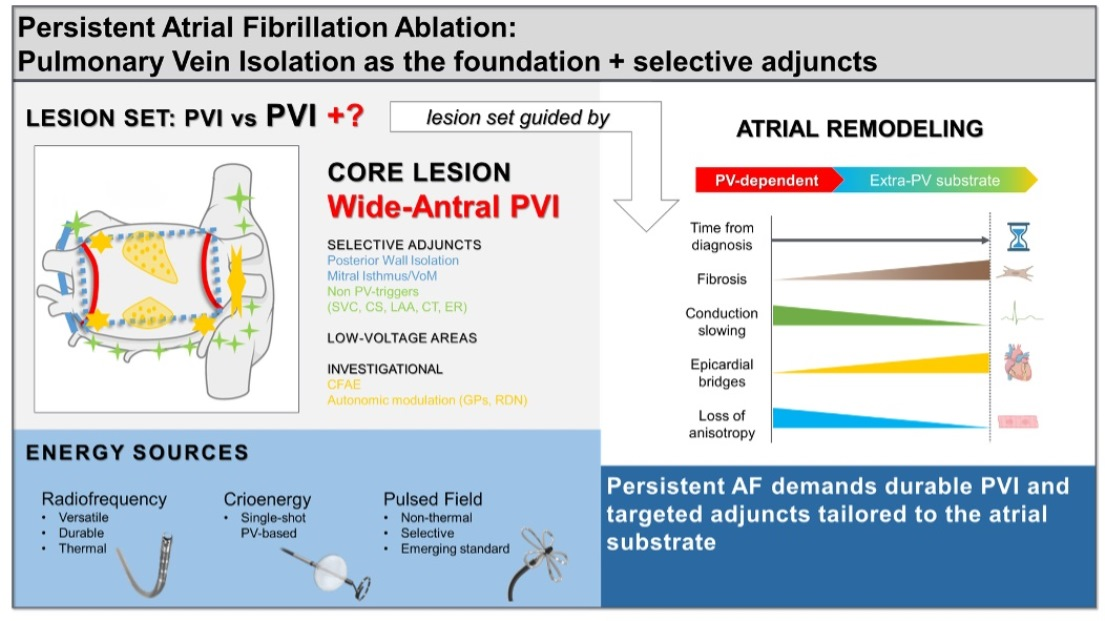
2.5. Evidence-Based Lesion Sets
2.5.1. Pulmonary Vein Isolation
2.5.2. Posterior Wall
2.5.3. Mitral Isthmus and Vein of Marshall
2.5.4. Non-Pulmonary Vein Triggers
2.5.5. Complex Fractionated Atrial Electrograms
2.5.6. Low-Voltage Substrate-Guided Ablation
2.5.7. Autonomic Modulation Strategies: Ganglionated Plexi and Renal Denervation
2.5.8. Redo Ablation and Mapping-Targeted Strategies
2.5.9. Hybrid Endocardial–Epicardial Ablation
3. Discussion
4. Conclusions

| Lesion Set/Section | Indications | Safety | Evidence Summary | Clinical Role |
|---|---|---|---|---|
| Posterior Wall (Roof/Floor or “box”) | Persistent AF with posterior wall vulnerability or low voltage. | Thermal: esophageal injury risk; PFA: low acute complications and rare coronary spasm | RCTs negative [37,38]; benefit only in selected anatomies [41]; and PFA promising but registry data neutral [44]. | Selective |
| Mitral Isthmus (Lateral/Anterior) | Peri-mitral flutter; macro-reentrant circuits. | RF: CS injury risk; PFA: low acute complications | Endocardial block often incomplete; anterior line more reliable; and PFA with favorable acute success [52,99]. | Selective |
| Vein of Marshall | Adjunct to MI block; peri-mitral circuits; and selected persistent AF. | Rare CS trauma, pericarditis, and phrenic nerve injury; overall low major complications. | VENUS and MARSHAL-Plan positive; improved MI block durability [47,48]. | Essential in selected cases |
| Left Atrial Appendage | Redo AF; LAA triggers; and maze-like “unintentional” isolation. | Risk of impaired flow and thrombus; may need LAA occlusion. | Improves rhythm control but increases thromboembolism; LAAO often required [54,56]. | Selective–high expertise |
| Coronary Sinus | CS triggers; epicardial MI/peri-mitral flutter contribution. | RF: perforation risk; PFA safe but limited durability; and phrenic nerve caution. | Durable isolation difficult; VOM facilitates; and PFA high acute and low durable (≈1%) [55,57]. | Selective |
| Right-Atrial Triggers (SVC, CT, Eustachian Ridge) | Documented SVC firing; CT/ER focal AT/AF; and CTI flutter. | SVC: phrenic palsy risk; CT: low complications; and PFA safe | SVC: 6–12% triggers; CT high acute success; and ER mostly CTI component [63,66]. | Selective; essential only for CTI |
| CFAE | Persistent AF substrate modulation. | Prolonged procedures increase thermal injury. | STAR-AF II negative; rotor/phase mapping inconsistent [9]. | Investigational |
| LOW VOLTAGE AREA | Persistent AF with advanced atrial remodeling. | Increased ablation burden and longer procedures; thermal injury risk proportional to lesion extent; and PFA safe. | ERASE-AF positive randomized trial [78]; SUPPRESS-AF neutral overall with efficacy signal in patients with advanced left atrial enlargement [79,80]; and feasibility of PFA-based low-voltage targeting demonstrated, but long-term benefit unproven [81]. | Selective. |
| Autonomic Modulation (GPs, RDN) | Vagal AF (GPs); hypertension + AF (RDN). | GPs: vagal injury risk; RDN: vascular access risks. | GPs: no benefit; RDN: paroxysmal AF positive and persistent AF mixed/negative [83,86]. | Investigational |
| Hybrid Endo–Epicardial Ablation | Persistent/long-standing AF with advanced substrate or prior failed ablation. | Surgical access; low esophageal risk; and acceptable complication rate. | RCTs (CONVERGE, CEASE-AF) show superior arrhythmia-free survival vs. endocardial ablation alone, with improved lesion durability through direct treatment of epicardial substrates not accessible endocardially [92,93]. | Selective, for experienced centers |
Supplementary Materials
Funding
Data Availability Statement
Conflicts of Interest
References
- Van Gelder, I.C.; Kotecha, D.; Rienstra, M.; Bunting, K.V.; Casado-Arroyo, R.; Caso, V.; Crijns, H.; De Potter, T.; Dwight, J. 2024 ESC Guidelines for the management of atrial fibrillation developed in collaboration with the European Association for Cardio-Thoracic Surgery (EACTS). Eur. Heart J. 2024, 45, 3314–3414. [Google Scholar] [CrossRef] [PubMed]
- Joglar, J.A.; Chung, M.K.; Armbruster, A.L.; Benjamin, E.J.; Chyou, J.Y.; Cronin, E.M.; Deswal, A.; Eckhardt, L.; Goldberger, Z.; Gopinathannair, R.; et al. 2023 ACC/AHA/ACCP/HRS Guideline for the Diagnosis and Management of Atrial Fibrillation: A Report of the American College of Cardiology/American Heart Association Joint Committee on Clinical Practice Guidelines. Circulation 2024, 149, e1–e156. [Google Scholar] [CrossRef] [PubMed]
- Calkins, H.; Hindricks, G.; Cappato, R.; Kim, Y.H.; Saad, E.B.; Aguinaga, L.; Akar, J.; Badhwar, V.; Brugada, J.; Camm, J.; et al. 2017 HRS/EHRA/ECAS/APHRS/SOLAECE expert consensus statement on catheter and surgical ablation of atrial fibrillation. Heart Rhythm 2017, 14, e275–e444. [Google Scholar] [CrossRef] [PubMed]
- Tzeis, S.; Gerstenfeld, E.P.; Kalman, J.; Saad, E.B.; Sepehri Shamloo, A.; Andrade, J.G.; Barbhaiya, C.; Baykaner, T.; Boveda, S.; Calkins, H.; et al. 2024 European Heart Rhythm Association/Heart Rhythm Society/Asia Pacific Heart Rhythm Society/Latin American Heart Rhythm Society expert consensus statement on catheter and surgical ablation of atrial fibrillation. Europace 2024, 26, euae043. [Google Scholar] [CrossRef]
- McCauley, M.D.; Iacobellis, G.; Li, N.; Nattel, S.; Goldberger, J.J. Targeting the Substrate for Atrial Fibrillation: JACC Review Topic of the Week. J. Am. Coll. Cardiol. 2024, 83, 2015–2027. [Google Scholar] [CrossRef]
- Marrouche, N.F.; Wilber, D.; Hindricks, G.; Jais, P.; Akoum, N.; Marchlinski, F.; Kholmovski, E.; Burgon, N.; Hu, N.; Mont, L.; et al. Association of atrial tissue fibrosis identified by delayed enhancement MRI and atrial fibrillation catheter ablation: The DECAAF study. JAMA 2014, 311, 498–506. [Google Scholar] [CrossRef]
- Goette, A.; Kalman, J.M.; Aguinaga, L.; Akar, J.; Cabrera, J.A.; Chen, S.A.; Chugh, S.; Corradi, D.; D’Avila, A.; Dobrev, D.; et al. EHRA/HRS/APHRS/SOLAECE expert consensus on atrial cardiomyopathies: Definition, characterization, and clinical implication. Europace 2016, 18, 1455–1490. [Google Scholar] [CrossRef]
- Pathak, R.K.; Elliott, A.D.; Lau, D.H.; Middeldorp, M.E.; Linz, D.; Fitzgerald, J.L.; Gupta, A.; Ariyaratnam, J.; Malik, V.; Noubiap, J.; et al. Aggressive Risk Factor Reduction Study for Atrial Fibrillation Implications for Ablation Outcomes: The ARREST-AF Randomized Clinical Trial. JAMA Cardiol. 2025, 10, 1295–1304. [Google Scholar] [CrossRef]
- Verma, A.; Jiang Cyang Betts, T.R.; Chen, J.; Deisenhofer, I.; Mantovan, R. Approaches to Catheter Ablation for Persistent Atrial Fibrillation. N. Engl. J. Med. 2015, 372, 1812–1822. [Google Scholar] [CrossRef]
- Leshem, E.; Zilberman, I.; Tschabrunn, C.M.; Barkagan, M.; Contreras-Valdes, F.M.; Govari, A.; Macle, L.; Morillo, C.; Haverkamp, W.; Weerasooriya, R.; et al. High-Power and Short-Duration Ablation for Pulmonary Vein Isolation: Biophysical Characterization. JACC Clin. Electrophysiol. 2018, 4, 467–479. [Google Scholar] [CrossRef]
- Cabral, D.C.B.I.; Rivera, A.; Braga, M.A.P.; Passos, B.M.F.; Ferreira Felix, I.; Ternes, C.M.P.; Ternes, C.; Brigido, A.; de Carvalho, G.; Deshmukh, A.; et al. High-Power Short-Duration Ablation Versus Conventional Power Ablation in Pulmonary Vein Isolation in Patients With Atrial Fibrillation: An Updated Systematic Review and Meta-Analysis of Randomized Controlled Trials. J. Cardiovasc. Electrophysiol. 2025, 36, 2620–2628. [Google Scholar] [CrossRef] [PubMed]
- Han, H.C.; Ha, F.J.; Sanders, P.; Spencer, R.; Teh, A.W.; O’Donnell, D.; Arouque, O.; Lim, H. Atrioesophageal Fistula: Clinical Presentation, Procedural Characteristics, Diagnostic Investigations, and Treatment Outcomes. Circ. Arrhythmia Electrophysiol. 2017, 10, e005579. [Google Scholar] [CrossRef] [PubMed]
- Duytschaever, M.; Vijgen, J.; De Potter, T.; Scherr, D.; Van Herendael, H.; Knecht, S.; Kobza, R.; Berte, B.; Sandgaard, N.; Albenque, J.; et al. Standardized pulmonary vein isolation workflow to enclose veins with contiguous lesions: The multicentre VISTAX trial. Europace 2020, 22, 1645–1652. [Google Scholar] [CrossRef] [PubMed]
- Cappato, R.; Calkins, H.; Chen, S.A.; Davies, W.; Iesaka, Y.; Kalman, J.; Kalman, J.; Kim, Y.; Klein, G.; Natale, A.; et al. Updated worldwide survey on the methods, efficacy, and safety of catheter ablation for human atrial fibrillation. Circ. Arrhythm. Electrophysiol. 2010, 3, 32–38. [Google Scholar] [CrossRef]
- Reddy, V.Y.; Neuzil, P.; Koruth, J.S.; Petru, J.; Funosako, M.; Cochet, H.; Sediva, L.; Chovanec, M.; Dukkipati, S.; Jais, P. Pulsed Field Ablation for Pulmonary Vein Isolation in Atrial Fibrillation. J. Am. Coll. Cardiol. 2019, 74, 315–326. [Google Scholar] [CrossRef]
- Kuck, K.H.; Brugada, J.; Fürnkranz, A.; Metzner, A.; Ouyang, F.; Chun, J.; Elvan, A.; Arentz, T.; Bestehorn, K.; Pocock, S.; et al. Cryoballoon or radiofrequency ablation for paroxysmal atrial fibrillation. J. Cardiopulm. Rehabil. Prev. 2016, 374, 2235–2245. [Google Scholar] [CrossRef]
- Wazni, O.M.; Dandamudi, G.; Sood, N.; Hoyt, R.; Tyler, J.; Durrani, S.; Niebauer, M.; Makati, K.; Halperin, B.; Gauri, A.; et al. Cryoballoon Ablation as Initial Therapy for Atrial Fibrillation. N. Engl. J. Med. 2021, 384, 316–324. [Google Scholar] [CrossRef]
- Andrade, J.G.; Wells, G.A.; Deyell, M.W.; Bennett, M.; Essebag, V.; Champagne, J.; Roux, J.; Yung, D.; Skanes, A.; Khaykin, Y.; et al. Cryoablation or Drug Therapy for Initial Treatment of Atrial Fibrillation. N. Engl. J. Med. 2021, 384, 305–315. [Google Scholar] [CrossRef]
- Buiatti, A.; Von Olshausen, G.; Barthel, P.; Schneider, S.; Luik, A.; Kaess, B.; Laugwitz, K.; Hoppmann, P. Cryoballoon vs. Radiofrequency ablation for paroxysmal atrial fibrillation: An updated meta-analysis of randomized and observational studies. Europace 2017, 19, 378–384. [Google Scholar] [CrossRef]
- Gao, Y.M.; Cai, T.Z.; Ma, H.L. Cryoballoon versus radiofrequency ablation for persistent atrial fibrillation: An updated systematic review and meta-analysis. Eur. J. Med. Res. 2025, 30, 639. [Google Scholar] [CrossRef]
- Stewart, M.T.; Haines, D.E.; Miklavčič, D.; Kos, B.; Kirchhof, N.; Barka, N.; Mattison, L.; Martien, M.; Onal, B.; Howard, B.; et al. Safety and chronic lesion characterization of pulsed field ablation in a Porcine model. J. Cardiovasc. Electrophysiol. 2021, 32, 958–969. [Google Scholar] [CrossRef] [PubMed]
- Reddy, V.Y.; Mansour, M.; Calkins, H.; d’Avila, A.; Chinitz, L.; Woods, C.; Gupta, S.; Kim, J.; Eldadah, Z.; Pickett, R.; et al. Pulsed Field vs Conventional Thermal Ablation for Paroxysmal Atrial Fibrillation: Recurrent Atrial Arrhythmia Burden. J. Am. Coll. Cardiol. 2024, 84, 61–74. [Google Scholar] [CrossRef] [PubMed]
- Reddy, V.Y.; Gerstenfeld, E.P.; Natale, A.; Whang, W.; Cuoco, F.A.; Patel, C.; Mountantonakis, S.; Gibson, D.; Harding, J.; Ellis, C.; et al. Pulsed Field or Conventional Thermal Ablation for Paroxysmal Atrial Fibrillation. N. Engl. J. Med. 2023, 389, 1660–1671. [Google Scholar] [CrossRef] [PubMed]
- Reddy, V.Y.; Dukkipati, S.R.; Neuzil, P.; Anic, A.; Petru, J.; Funasako, M.; Cochet, H.; Minami, K.; Breskovic, T.; Sikiric, I.; et al. Pulsed Field Ablation of Paroxysmal Atrial Fibrillation: 1-Year Outcomes of IMPULSE, PEFCAT, and PEFCAT II. JACC Clin. Electrophysiol. 2021, 7, 614–627. [Google Scholar] [CrossRef]
- Turagam, M.K.; Neuzil, P.; Schmidt, B.; Reichlin, T.; Neven, K.; Metzner, A.; Hansen, J.; Blaauw, Y.; Maury, P.; Arentz, T.; et al. Safety and Effectiveness of Pulsed Field Ablation to Treat Atrial Fibrillation: One-Year Outcomes From the MANIFEST-PF Registry. Circulation 2023, 148, 35–46. [Google Scholar] [CrossRef]
- Kueffer, T.; Bordignon, S.; Neven, K.; Blaauw, Y.; Hansen, J.; Adelino, R.; Ouss, A.; Füting, A.; Roten, L.; Mulder, B.; et al. Durability of Pulmonary Vein Isolation Using Pulsed-Field Ablation: Results From the Multicenter EU-PORIA Registry. JACC Clin. Electrophysiol. 2024, 10, 698–708. [Google Scholar] [CrossRef]
- Matos, C.D.; Hoyos, C.; Miranda-Arboleda, A.F.; Diaz, J.C.; Hincapie, D.; Patino, C.; Hernadez, R.; Zei, P.; Romero, J.; Osorio, J. Pulsed Field Ablation of Atrial Fibrillation: A Comprehensive Review. Rev. Cardiovasc. Med. 2023, 24, 337. [Google Scholar] [CrossRef]
- Xu, Y.; Gulburak, T.K.; Lu, Y.; Zhang, J.; TuErhong, Z.; Tang, B.; Zhou, X. Hemolysis after pulsed-field ablation of atrial fibrillation. Heart Rhythm 2025, 22, 1103–1109. [Google Scholar] [CrossRef]
- Reddy, V.Y.; Petru, J.; Funasako, M.; Kopriva, K.; Hala, P.; Chovanec, M.; Janotka, M.; Kralovec, S.; Neuzil, P. Coronary Arterial Spasm during Pulsed Field Ablation to Treat Atrial Fibrillation. Circulation 2022, 146, 1808–1819. [Google Scholar] [CrossRef]
- Oral, H.; Knight, B.P.; Tada, H.; Özaydin, M.; Chugh, A.; Hassan, S.; Scharf, C.; Lai, S.; Greenstein, R.; Pelosi, F. Pulmonary vein isolation for paroxysmal and persistent atrial fibrillation. Circulation 2002, 105, 1077–1081. [Google Scholar] [CrossRef]
- Huang, W.; Luo, Y.; Sun, H.; Yang, G.; Luo, D.; Xiong, S.; Long, Y.; Liu, H. Acute and long-term outcomes of pulmonary vein isolation and left atrial substrate modification for non-paroxysmal atrial fibrillation: A non-randomized trial. Cardiovasc. Diagn. Ther. 2023, 13, 1056–1067. [Google Scholar] [CrossRef] [PubMed]
- Clarnette, J.A.; Brooks, A.G.; Mahajan, R.; Elliott, A.D.; Twomey, D.J.; Pathak, R.K.; Kumar, S.; Munawar, D.; Young, G.; Kalman, J.; et al. Outcomes of persistent and long-standing persistent atrial fibrillation ablation: A systematic review and meta-analysis. Europace 2018, 20, f366–f376. [Google Scholar] [CrossRef] [PubMed]
- Proietti, R.; Santangeli, P.; Di Biase, L.; Joza, J.; Bernier, M.L.; Wang, Y.; Sagone, A.; Viecca, M.; Essebag, V.; Natale, A. Comparative effectiveness of wide antral versus ostial pulmonary vein isolation: A systematic review and meta-analysis. Circ. Arrhythm. Electrophysiol. 2014, 7, 39–45. [Google Scholar] [CrossRef] [PubMed]
- Tilz, R.R.; Heeger, C.H.; Vogler, J.; Eitel, C.; Feher, M.; Phan, H.L.; Mushfiq, I.; Popescu, S.; Zetzsch, L.; Traub, A.; et al. Wide antral circumferential vs. ostial pulmonary vein isolation using pulsed field ablation—The butterfly effect. Front. Cardiovasc. Med. 2023, 10, 1217745. [Google Scholar] [CrossRef]
- Sherif, H.M.F. The developing pulmonary veins and left atrium: Implications for ablation strategy for atrial fibrillation. Eur. J. Cardio-Thorac. Surg. 2013, 44, 792–799. [Google Scholar] [CrossRef]
- Cox, J.L. The surgical treatment of atrial fibrillation: IV. Surgical technique. J. Thorac. Cardiovasc. Surg. 1991, 101, 584–592. [Google Scholar] [CrossRef]
- Tamborero, D.; Mont, L.; Berruezo, A.; Matiello, M.; Benito, B.; Sitges, M.; Vidal, B.; Caralt, T.; Perea, R.; Vatasescu, R.; et al. Left atrial posterior wall isolation does not improve the outcome of circumferential pulmonary vein ablation for atrial fibrillation: A prospective randomized study. Circ. Arrhythm. Electrophysiol. 2009, 2, 35–40. [Google Scholar] [CrossRef]
- Kistler, P.M.; Chieng, D.; Sugumar, H.; Ling, L.H.; Segan, L.; Azzopardi, S.; Al-Kaisey, A.; Parameswaran, R.; Anderson, R.; Hawson, J.; et al. Effect of Catheter Ablation Using Pulmonary Vein Isolation with vs Without Posterior Left Atrial Wall Isolation on Atrial Arrhythmia Recurrence in Patients with Persistent Atrial Fibrillation: The CAPLA Randomized Clinical Trial. JAMA 2023, 329, 127–135. [Google Scholar] [CrossRef]
- Li, Y.; Xi, Y.; Zhang, W.; Hao, J. The Safety and Efficacy of Left Atrial BOX Ablation in Persistent Atrial Fibrillation: A Meta-Analysis. Rev. Cardiovasc. Med. 2024, 25, 316. [Google Scholar] [CrossRef]
- Li, C.; Zhao, Y.; Ju, R.; Liu, C.; Dong, S.; Song, J.; Qin, A.; Cao, J.; Yu, M.; Huang, X.; et al. Cryoballoon Roof Line and Pulmonary Vein Isolation for Persistent Atrial Fibrillation: A Randomized Trial. Circ. Arrhythm. Electrophysiol. 2025, 18, e013826. [Google Scholar] [CrossRef]
- Bai, R.; Di Biase, L.; Mohanty, P.; Trivedi, C.; Dello Russo, A.; Themistoclakis, S.; Casella, M.; Santarelli, P.; Fassini, G.; Santangeli, P.; et al. Proven isolation of the pulmonary vein antrum with or without left atrial posterior wall isolation in patients with persistent atrial fibrillation. Heart Rhythm 2016, 13, 132–140. [Google Scholar] [CrossRef] [PubMed]
- Natale, A.; Mohanty, S.; Sanders, P.; Anter, E.; Shah, A.; Al Mohani, G.; Haissaguerre, M. Catheter ablation for atrial fibrillation: Indications and future perspective. Eur. Heart J. 2024, 45, 4383–4398. [Google Scholar] [CrossRef] [PubMed]
- Badertscher, P.; Mannhart, D.; Weidlich, S.; Krisai, P.; Voellmin, G.; Osswald, S.; Knecht, S.; Sticherling, C.; Kühne, M. Left atrial posterior wall isolation using pulsed-field ablation: Procedural characteristics safety mid-term outcomes. J. Interv. Card. Electrophysiol. 2024, 67, 1359–1364. [Google Scholar] [CrossRef] [PubMed]
- Jaïs, P.; Matsuo, S.; Knecht, S.; Weerasooriya, R.; Hocini, M.; Sacher, F.; Wright, M.; Nault, I.; Lellouche, N.; Klein, G.; et al. A deductive mapping strategy for atrial tachycardia following atrial fibrillation ablation: Importance of localized reentry. J. Cardiovasc. Electrophysiol. 2009, 20, 480–491. [Google Scholar] [CrossRef]
- Valderrábano, M.; Liu, X.; Sasaridis, C.; Sidhu, J.; Little, S.; Khoury, D.S. Ethanol infusion in the vein of Marshall: Adjunctive effects during ablation of atrial fibrillation. Heart Rhythm 2009, 6, 1552–1558. [Google Scholar] [CrossRef]
- Rodríguez-Mañero, M.; Schurmann, P.; Valderrábano, M. Ligament and vein of Marshall: A therapeutic opportunity in atrial fibrillation. Heart Rhythm 2016, 13, 593–601. [Google Scholar] [CrossRef]
- Valderrábano, M.; Peterson, L.E.; Swarup, V.; Schurmann, P.A.; Makkar, A.; Doshi, R.N.; Delurgio, D.; Athill, C.; Ellenbogen, K.; Natale, A.; et al. Effect of Catheter Ablation with Vein of Marshall Ethanol Infusion vs Catheter Ablation Alone on Persistent Atrial Fibrillation: The VENUS Randomized Clinical Trial. J. Am. Med. Assoc. 2020, 324, 1620–1628. [Google Scholar] [CrossRef]
- Derval, N.; Duchateau, J.; Denis, A.; Ramirez, F.D.; Mahida, S.; André, C.; Krisai, P.; Nakatani, Y.; Kitamura, T.; Takigawa, M.; et al. Marshall bundle elimination, Pulmonary vein isolation, and Line completion for ANatomical ablation of persistent atrial fibrillation (Marshall-PLAN): Prospective, single-center study. Heart Rhythm 2021, 18, 529–537. [Google Scholar] [CrossRef]
- He, Z.; Yang, L.; Bai, M.; Yao, Y.; Zhang, Z. Feasibility, efficacy, and safety of ethanol infusion into the vein of Marshall for atrial fibrillation: A meta-analysis. Pacing Clin. Electrophysiol. 2021, 44, 1151–1162. [Google Scholar] [CrossRef]
- Aldaas, O.M.; Lupercio, F.; Lin, A.Y.; Han, F.T.; Hoffmayer, K.S.; Raissi, F.; Ho, G.; Krummen, D.; Feld, G.; Hsu, J.; et al. Ablation of mitral annular flutter ablation utilizing a left atrial anterior line versus a lateral mitral isthmus line: A systematic review and meta-analysis. J. Interv. Card. Electrophysiol. 2022, 63, 87–95. [Google Scholar] [CrossRef]
- Bergonti, M.; Spera, F.R.; Ferrero, T.G.; Nsahlai, M.; Bonomi, A.; Boris, W.; Saenen, J.; Huybrechts, W.; Miljoen, H.; Vandaele, L.; et al. Anterior mitral line in patients with persistent atrial fibrillation and anterior scar: A multicenter matched comparison—The MiLine study. Heart Rhythm 2023, 20, 658–665. [Google Scholar] [CrossRef] [PubMed]
- Brügger, J.; Isenegger, C.; Jordan, F.; Subin, B.; Stump, R.; Knecht, S.; Spreen, D.; Schaerli, N.; Krisai, P.; Schaer, B.; et al. Anterior mitral isthmus line using pulsed-field ablation with the pentaspline catheter or radiofrequency ablation: Procedural characteristics, safety, and mid-term outcomes. Europace 2025, 27, euaf265. [Google Scholar] [CrossRef] [PubMed]
- Della Rocca, D.G.; Di Biase, L.; Mohanty, S.; Trivedi, C.; Gianni, C.; Romero, J.; Tarantino, N.; Magnocavallo, M.; Bassiouny, M.; Natale, V.; et al. Targeting non-pulmonary vein triggers in persistent atrial fibrillation: Results from a prospective, multicentre, observational registry. Europace 2021, 23, 1939–1949. [Google Scholar] [CrossRef] [PubMed]
- Bordignon, S.; Perrotta, L.; Dugo, D.; Bologna, F.; Nagase, T.; Fuernkranz, A.; Chun, K.; Schmidt, B. Electrical isolation of the left atrial appendage by Maze-like catheter substrate modification: Areproducible strategy for pulmonary vein isolation nonresponders? J. Cardiovasc. Electrophysiol. 2017, 28, 1006–1014. [Google Scholar] [CrossRef]
- Santangeli, P.; Marchlinski, F.E. Techniques for the provocation, localization, and ablation of non–pulmonary vein triggers for atrial fibrillation. Heart Rhythm 2017, 14, 1087–1096. [Google Scholar] [CrossRef]
- Zender, N.; Weise, F.K.; Bordignon, S.; Herrmann, E.; Konstantinou, A.; Bologna, F.; Nagase, T.; Chen, S.; Chun, K.; Schmidt, B. Thromboembolism after electrical isolation of the left atrial appendage: A new indication for interventional closure? Europace 2019, 21, 1502–1508. [Google Scholar] [CrossRef]
- La Fazia, V.M.; Mohanty, S.; Gianni, C.; Zito, E.; Pierucci, N.; Stifano, G.; Torlapati, P.; Della Rocca, D.; Bode, W.; Burkhardt, J.; et al. Feasibility and Safety of Pulsed Field Ablation for Coronary Sinus and Left Atrial Appendage Isolation and Mitral Isthmus Ablation: Acute and Chronic Findings. Circ. Arrhythm. Electrophysiol. 2025, 18, e014026. [Google Scholar] [CrossRef]
- Vrachatis, D.A.; Papathanasiou, K.A.; Kossyvakis, C.; Giotaki, S.G.; Deftereos, G.; Kousta, M.S.; Iliodromitis, K.; Bogossian, H.; Avramides, D.; Giannopoulos, G.; et al. Efficacy, Safety and Feasibility of Superior Vena Cava Isolation in Patients Undergoing Atrial Fibrillation Catheter Ablation: An Up-to-Date Review. Biomedicines 2023, 11, 1022. [Google Scholar] [CrossRef]
- Higuchi, K.; Yamauchi, Y.; Hirao, K.; Sasaki, T.; Hachiya, H.; Sekiguchi, Y.; Nitta, J.; Isobe, M. Superior vena cava as initiator of atrial fibrillation: Factors related to its arrhythmogenicity. Heart Rhythm 2010, 7, 1186–1191. [Google Scholar] [CrossRef]
- Overeinder, I.; Osório, T.G.; Călburean, P.A.; Bisignani, A.; Bala, G.; Sieira, J.; Ströker, E.; Al Houssari, M.; Mojica, J.; Boveda, S. Comparison between superior vena cava ablation in addition to pulmonary vein isolation standard pulmonary vein isolation in patients with paroxysmal atrial fibrillation with the cryoballoon technique. J. Interv. Card. Electrophysiol. 2021, 62, 579–586. [Google Scholar] [CrossRef]
- Lin, Y.J.; Tai, C.T.; Liu, T.Y.; Higa, S.; Lee, P.C.; Huang, J.L.; Yuniadi, Y.; Huang, B.; Lee, K.; Lee, S.; et al. Electrophysiological mechanisms and catheter ablation of complex atrial arrhythmias from crista terminalis: Insight from three-dimensional noncontact mapping. Pacing Clin. Electrophysiol. 2004, 27, 1231–1239. [Google Scholar] [CrossRef]
- Hu, Y.F.; Higa, S.; Huang, J.L.; Tai, C.T.; Lin, Y.J.; Chang, S.L.; Tuan, T.; Chang, C.; Tsai, W.; Lee, P.; et al. Electrophysiologic characteristics and catheter ablation of focal atrial tachycardia with more than one focus. Heart Rhythm 2009, 6, 198–203. [Google Scholar] [CrossRef]
- Morris, G.M.; Segan, L.; Wong, G.; Wynn, G.; Watts, T.; Heck, P.; Walters, T.; Nisbet, A.; Sparks, P.; Morton, J.; et al. Atrial Tachycardia Arising From the Crista Terminalis, Detailed Electrophysiological Features and Long-Term Ablation Outcomes. JACC Clin. Electrophysiol. 2019, 5, 448–458. [Google Scholar] [CrossRef] [PubMed]
- Nakagawa, H.; Lazzara, R.; Khastgir, T.; Beckman, K.J.; McClelland, J.H.; Imai, S.; Pitha, J.; Becker, A.; Arruda, M.; Gonzalez, M.; et al. Role of the tricuspid annulus and the eustachian valve/ridge on atrial flutter: Relevance to catheter ablation of the septal isthmus and a new technique for rapid identification of ablation success. Circulation 1996, 94, 407–424. [Google Scholar] [CrossRef] [PubMed]
- Huang, J.L.; Tai, C.T.; Liu, T.Y.; Lin, Y.J.; Lee, P.C.; Ting, C.T.; Chen, S. High-resolution mapping around the Eustachian ridge during typical atrial flutter. J. Cardiovasc. Electrophysiol. 2006, 17, 1187–1192. [Google Scholar] [CrossRef] [PubMed]
- Yamauchi, Y.; Nakamura, R.; Shigeta, T.; Sagawa, Y.; Okishige, K.; Sasano, T. Persistent atrial fibrillation originating from prominent Eustachian ridge: Precise identification of non–pulmonary vein foci using a high-density grid mapping catheter. Heart Case Rep. 2021, 7, 386–390. [Google Scholar] [CrossRef]
- Rodriguez-Riascos, J.F.; Vemulapalli, H.S.; Muthu, P.; Prajapati, P.; Su, W.; Shen, W.K.; Valverde, A.; Srivathsan, K. Safety Efficacy of Pulsed Field Ablation for Cavotricuspid Isthmus-Dependent Flutter: ASystematic Literature Review. J. Cardiovasc. Electrophysiol. 2025, 36, 2013–2024. [Google Scholar] [CrossRef]
- Rodriguez-Riascos, J.F.; Vemulapalli, H.S.; Prajapati, P.; Muthu, P.; Kim, J.Y.; Sorajja, D.; Shen, W.; El Masry, H.; Sardana, M.; Valverde, A.; et al. Safety, Efficacy, and Mid-Term Outcomes of Pulsed Field Ablation for Cavotricuspid Isthmus–Dependent Flutter: Real-World Data From a Major Health System Registry. Circ. Arrhythm. Electrophysiol. 2025, 18, e014276. [Google Scholar] [CrossRef]
- Nademanee, K.; McKenzie, J.; Kosar, E.; Schwab, M.; Sunsaneewitayakul, B.; Vasavakul, T.; Khunnawat, C.; Ngarmukos, T. Anew approach for catheter ablation of atrial fibrillation: Mapping of the electrophysiologic substrate. J. Am. Coll. Cardiol. 2004, 43, 2044–2053. [Google Scholar] [CrossRef]
- Pappone, C.; Ciconte, G.; Vicedomini, G.; Mangual, J.O.; Li, W.; Conti, M.; Giannelli, L.; Lipartiti, F.; McSpadden, L.; Ryu, K.; et al. Clinical outcome of electrophysiologically guided ablation for nonparoxysmal atrial fibrillation using a novel real-time 3-dimensional mapping technique results from a prospective randomized trial. Circ. Arrhythm. Electrophysiol. 2018, 11, e005904. [Google Scholar] [CrossRef]
- Spitzer, S.G.; Miller, J.M.; Sommer, P.; Szili-Torok, T.; Reddy, V.Y.; Nölker, G.; Williams, C.; Sarver, A.; Wilber, D. Randomized evaluation of redo ablation procedures of atrial fibrillation with focal impulse and rotor modulation-guided procedures: The REDO-FIRM study. Europace 2023, 25, 74–82. [Google Scholar] [CrossRef] [PubMed]
- Yang, B.; Jiang, C.; Lin, Y.; Yang, G.; Chu, H.; Cai, H.; Lu, F.; Zhan, X.; Xu, J.; Wang, X.; et al. STABLE-SR (Electrophysiological substrate ablation in the left atrium during sinus rhythm) for the treatment of nonparoxysmal atrial fibrillation: A prospective, multicenter randomized clinical trial. Circ. Arrhythm. Electrophysiol. 2017, 10, e005405. [Google Scholar] [CrossRef] [PubMed]
- Haissaguerre, M.; Hocini, M.; Denis, A.; Shah, A.J.; Komatsu, Y.; Yamashita, S.; Daly, M.; Amraoui, S.; Zellerhoff, S.; Picat, M.; et al. Driver domains in persistent atrial fibrillation. Circulation 2014, 130, 530–538. [Google Scholar] [CrossRef] [PubMed]
- Lau, D.H.; Maesen, B.; Zeemering, S.; Verheule, S.; Crijns, H.J.; Schotten, U. Stability of complex fractionated atrial electrograms: A systematic review. J. Cardiovasc. Electrophysiol. 2012, 23, 980–987. [Google Scholar] [CrossRef]
- Waranugraha, Y.; Rizal, A.; Setiawan, D.; Aziz, I.J. Additional complex fractionated atrial electrogram ablation does not improve the outcomes of non-paroxysmal atrial fibrillation: A systematic review and meta-analysis of randomized controlled trials. Indian Heart J. 2021, 73, 63–73. [Google Scholar] [CrossRef]
- Deisenhofer, I.; Albenque, J.P.; Busch, S.; Gitenay, E.; Mountantonakis, S.E.; Roux, A.; Horvilleur, J.; Bakouboula, B.; Oza, S.; Abbey, S.; et al. Artificial intelligence for individualized treatment of persistent atrial fibrillation: A randomized controlled trial. Nat. Med. 2025, 31, 1286–1293. [Google Scholar] [CrossRef]
- Spach, M.S.; Boineau, J.P. Microfibrosis produces electrical load variations due to loss of side- to-side cell connections: A major mechanism of structural heart disease arrhythmias. Pacing Clin. Electrophysiol. 1997, 20, 397–413. [Google Scholar] [CrossRef]
- Huo, Y.; Gaspar, T.; Schönbauer, R.; Wójcik, M.; Fiedler, L.; Roithinger, F.X.; Martinek, M.; Pürerfellner, H.; Kirstein, B.; Richter, U.; et al. Low-Voltage Myocardium-Guided Ablation Trial of Persistent Atrial Fibrillation. NEJM Evid. 2022, 1, EVIDoa2200141. [Google Scholar] [CrossRef]
- Masuda, M.; Sunaga, A.; Tanaka, N.; Watanabe, T.; Minamiguchi, H.; Egami, Y. Low-voltage-area ablation for persistent atrial fibrillation: A randomized controlled trial. Nat. Med. 2025, 31, 1661–1667. [Google Scholar] [CrossRef]
- Masuda, M.; Matsuda, Y.; Uematsu, H.; Ooka, H.; Kudo, S.; Ochi, M.; Oka, T.; Minamisaka, T.; Kanda, T.; Okada, M.; et al. Efficacy of Low-Voltage-Area Ablation Is Enhanced in Patients With Advanced Left Atrial Enlargement: A Subanalysis of the SUPPRESS-AF Trial. Circ. Arrhythm. Electrophysiol. 2025, 18, e014210. [Google Scholar] [CrossRef]
- Della Rocca, D.G.; Sorgente, A.; Pannone, L.; Cespón-Fernández, M.; Vetta, G.; Almorad, A.; Bala, G.; Del Monte, A.; Ströker, E.; Sieira, J.; et al. Multielectrode catheter-based pulsed field ablation of persistent and long-standing persistent atrial fibrillation. Europace 2024, 26, euae246. [Google Scholar] [CrossRef]
- Iso, K.; Okumura, Y.; Watanabe, I.; Nagashima, K.; Takahashi, K.; Arai, M.; Watanabe, R.; Wakamatsu, Y.; Otsuka, N.; Yagyu, S.; et al. Is vagal response during left atrial ganglionated plexi stimulation a normal phenomenon?: Comparison between patients with and without atrial fibrillation. Circ. Arrhythm. Electrophysiol. 2019, 12, e007281. [Google Scholar] [CrossRef] [PubMed]
- Kim, M.Y.; Coyle, C.; Tomlinson, D.R.; Sikkel, M.B.; Sohaib, A.; Luther, V.; Leong, K.; Malcolme-Lawes, L.; Low, B.; Sandler, B.; et al. Ectopy-triggering ganglionated plexuses ablation to prevent atrial fibrillation: GANGLIA-AF study. Heart Rhythm 2022, 19, 516–524. [Google Scholar] [CrossRef] [PubMed]
- Nakasone, K.; Tanaka, K.; Del Monte, A.; Della Rocca, D.G.; Pannone, L.; Mouram, S.; Cespón-Fernández, M.; Doundoulakis, I.; Marcon, L.; Audiat, C.; et al. Distance-dependent neuromodulation effect during thermal ablation for atrial fibrillation. J. Cardiovasc. Electrophysiol. 2024, 35, 1997–2005. [Google Scholar] [CrossRef] [PubMed]
- Steinberg, J.S.; Shabanov, V.; Ponomarev, D.; Losik, D.; Ivanickiy, E.; Kropotkin, E.; Polyakov, K.; Ptaszynski, P.; Keweloh, B.; Yao, C.; et al. Effect of Renal Denervation and Catheter Ablation vs Catheter Ablation Alone on Atrial Fibrillation Recurrence among Patients with Paroxysmal Atrial Fibrillation and Hypertension: The ERADICATE-AF Randomized Clinical Trial. J. Am. Med. Assoc. 2020, 323, 248–255. [Google Scholar] [CrossRef]
- Kirstein, B.; Tomala, J.; Mayer, J.; Ulbrich, S.; Wagner, M.; Pu, L.; Piorkowski, J.; Hankel, A.; Huo, Y.; Gaspar, T.; et al. Effect of concomitant Renal DeNervation and cardiac ablation on Atrial Fibrillation recurrence–RDN+AF study. J. Cardiovasc. Electrophysiol. 2023, 34, 44–53. [Google Scholar] [CrossRef]
- De Groot, N.M.S.; Shah, D.; Boyle, P.M.; Anter, E.; Clifford, G.D.; Deisenhofer, I.; Deneke, T.; Van Dessel, P.; Doessel, O.; Dilaveris, P.; et al. Critical appraisal of technologies to assess electrical activity during atrial fibrillation: A position paper from the European Heart Rhythm Association and European Society of Cardiology Working Group on eCardiology in collaboration with the Heart Rhythm Society, Asia Pacific Heart Rhythm Society, Latin American Heart Rhythm Society and Computing in Cardiology. Europace 2022, 24, 313–330. [Google Scholar]
- Knecht, S.; Sohal, M.; Deisenhofer, I.; Albenque, J.P.; Arentz, T.; Neumann, T.; Cauchemez, B.; Duytschaever, M.; Ramoul, K.; Verbeet, T.; et al. Multicentre evaluation of non-invasive biatrial mapping for persistent atrial fibrillation ablation: The AFACART study. Europace 2017, 19, 1302–1309. [Google Scholar] [CrossRef]
- Cespón-Fernández, M.; Della Rocca, D.G.; Magnocavallo, M.; Betancur, A.; Lombardo, I.; Pannone, L.; Vetta, G.; Sorgente, A.; Polselli, M.; Audiat, C.; et al. Redo ablation procedures to treat recurrent atrial arrhythmias via a pentaspline pulsed field ablation catheter: A prospective, multicenter experience. J. Interv. Card. Electrophysiol. 2025, 68, 1267–1281. [Google Scholar] [CrossRef]
- KGehi, A.; CKiser, A.; Mounsey, J.P. Atrial Fibrillation Ablation by the Epicardial Approach. J. Atr. Fibrillation 2014, 6, 979. [Google Scholar]
- Piorkowski, C.; Kronborg, M.; Hourdain, J.; Piorkowski, J.; Kirstein, B.; Neudeck, S.; Wechselberger, S.; Päßler, E.; Löwen, A.; El-Armouche, A.; et al. Endo-/Epicardial Catheter Ablation of Atrial Fibrillation: Feasibility, Outcome, and Insights into Arrhythmia Mechanisms. Circ. Arrhythm. Electrophysiol. 2018, 11, e005748. [Google Scholar] [CrossRef] [PubMed]
- Doll, N.; Weimar, T.; Kosior, D.A.; Bulava, A.; Mokracek, A.; Mönnig, G.; Sahu, J.; Hunter, S.; Wijffels, M.; Van Putte, B.; et al. Durable effectiveness and safety of hybrid ablation versus catheter ablation: 2-year results from the randomized CEASE-AF trial. Eur. J. Cardio-Thorac. Surg. 2025, 67, ezaf146. [Google Scholar] [CrossRef] [PubMed]
- Delurgio, D.B.; Crossen, K.J.; Gill, J.; Blauth, C.; Oza, S.R.; Magnano, A.R.; Mostovych, M.; Halkos, M.; Tschopp, D.; Kerendi, F.; et al. Hybrid Convergent Procedure for the Treatment of Persistent and Long-Standing Persistent Atrial Fibrillation: Results of CONVERGE Clinical Trial. Circ. Arrhythm. Electrophysiol. 2020, 13, e009288. [Google Scholar] [CrossRef] [PubMed]
- Ellenbogen, K.A.; Khoynezhad, A.; La Meir, M.; de Asmundis, C.; Koneru, J.N.; Johnkoski, J.; Rist, K.; Mumtaz, M.; Link, M.; de Groot, J.; et al. Dual Epicardial and Endocardial Procedure (DEEP) for Persistent or Longstanding Persistent Atrial Fibrillation. Circ. Arrhythm. Electrophysiol. 2025, 18, e013692. [Google Scholar] [CrossRef]
- Leong-Sit, P.; Roux, J.F.; Zado, E.; Callans, D.J.; Garcia, F.; Lin, D.; Marchlinski, F.; Bala, R.; Dixit, S.; Riley, M.; et al. Antiarrhythmics after ablation of atrial fibrillation (5A study) six-month follow-up study. Circ. Arrhythm. Electrophysiol. 2011, 4, 11–14. [Google Scholar] [CrossRef]
- Darkner, S.; Chen, X.; Hansen, J.; Pehrson, S.; Johannessen, A.; Nielsen, J.B.; Svendsen, J. Recurrence of arrhythmia following short-term oral AMIOdarone after CATheter ablation for atrial fibrillation: Adouble-blind randomized placebo-controlled study (AMIO-CATtrial). Eur. Heart. J. 2014, 35, 3356–3364. [Google Scholar] [CrossRef]
- Schleberger, R.; Metzner, A.; Kuck, K.H.; Andresen, D.; Willems, S.; Hoffmann, E.; Deneke, T.; Eckardt, L.; Brachmann, J.; Hochadel, M.; et al. Antiarrhythmic drug therapy after catheter ablation for atrial fibrillation—Insights from the German Ablation Registry. Pharmacol. Res. Perspect. 2021, 9, e00880. [Google Scholar] [CrossRef]
- Piccini, J.P.; Fraulo, E.S.; Ansell, J.E.; Fonarow, G.C.; Gersh, B.J.; Go, A.S.; Hylek, E.; Kowey, P.; Mahaffey, K.; Thomas, L.; et al. Outcomes registry for better informed treatment of atrial fibrillation: Rationale and design of ORBIT-AF. Am. Heart J. 2011, 162, 606–612.e1. [Google Scholar] [CrossRef]
- Jaïs, P.; Hocini, M.; Hsu, L.F.; Sanders, P.; Scavee, C.; Weerasooriya, R.; Macle, L.; Raybaud, F.; Garrigue, S.; Shah, D.; et al. Technique and results of linear ablation at the mitral isthmus. Circulation 2004, 110, 2996–3002. [Google Scholar] [CrossRef]
Disclaimer/Publisher’s Note: The statements, opinions and data contained in all publications are solely those of the individual author(s) and contributor(s) and not of MDPI and/or the editor(s). MDPI and/or the editor(s) disclaim responsibility for any injury to people or property resulting from any ideas, methods, instructions or products referred to in the content. |
© 2026 by the authors. Licensee MDPI, Basel, Switzerland. This article is an open access article distributed under the terms and conditions of the Creative Commons Attribution (CC BY) license.
Share and Cite
Ruscio, E.; Marsilia, M.; Bencardino, G.; Narducci, M.L.; Perna, F.; Comerci, G.; Pinnacchio, G.; Burzotta, F.; Scacciavillani, R.; Pelargonio, G. Catheter Ablation for Persistent Atrial Fibrillation: Rationale, Evidence, and Contemporary Strategies Beyond Pulmonary Veins. J. Clin. Med. 2026, 15, 1167. https://doi.org/10.3390/jcm15031167
Ruscio E, Marsilia M, Bencardino G, Narducci ML, Perna F, Comerci G, Pinnacchio G, Burzotta F, Scacciavillani R, Pelargonio G. Catheter Ablation for Persistent Atrial Fibrillation: Rationale, Evidence, and Contemporary Strategies Beyond Pulmonary Veins. Journal of Clinical Medicine. 2026; 15(3):1167. https://doi.org/10.3390/jcm15031167
Chicago/Turabian StyleRuscio, Eleonora, Mario Marsilia, Gianluigi Bencardino, Maria Lucia Narducci, Francesco Perna, Gianluca Comerci, Gaetano Pinnacchio, Francesco Burzotta, Roberto Scacciavillani, and Gemma Pelargonio. 2026. "Catheter Ablation for Persistent Atrial Fibrillation: Rationale, Evidence, and Contemporary Strategies Beyond Pulmonary Veins" Journal of Clinical Medicine 15, no. 3: 1167. https://doi.org/10.3390/jcm15031167
APA StyleRuscio, E., Marsilia, M., Bencardino, G., Narducci, M. L., Perna, F., Comerci, G., Pinnacchio, G., Burzotta, F., Scacciavillani, R., & Pelargonio, G. (2026). Catheter Ablation for Persistent Atrial Fibrillation: Rationale, Evidence, and Contemporary Strategies Beyond Pulmonary Veins. Journal of Clinical Medicine, 15(3), 1167. https://doi.org/10.3390/jcm15031167