High-Power Laser Therapy for Oral Lichen Planus: A Systematic Review

 , ,
, ,  , , , and
Abstract
1. Introduction
1.1. Rationale—Oral Lichen Planus
1.2. Rationale—Lasers
1.3. Objectives
2. Materials and Methods
2.1. Focused Question
2.2. Search Strategy
2.3. Outcome Measures
2.4. Selection of Studies
2.5. Risk of Bias in Individual Studies
2.6. Quality Assessment and Risk of Bias Across Studies
2.7. Data Extraction
- Study Details: Author, year, and study design.
- Participants: Sample size, gender distribution, and age range.
- Treatment Types: Interventions compared (e.g., CO2 laser vs. corticosteroids).
- Laser Parameters: Wavelength and power output of lasers used.
- Outcome Measures:
- Follow-up: Duration of follow-up periods.
- Adverse Effects: Notable side effects or complications observed.
3. Results
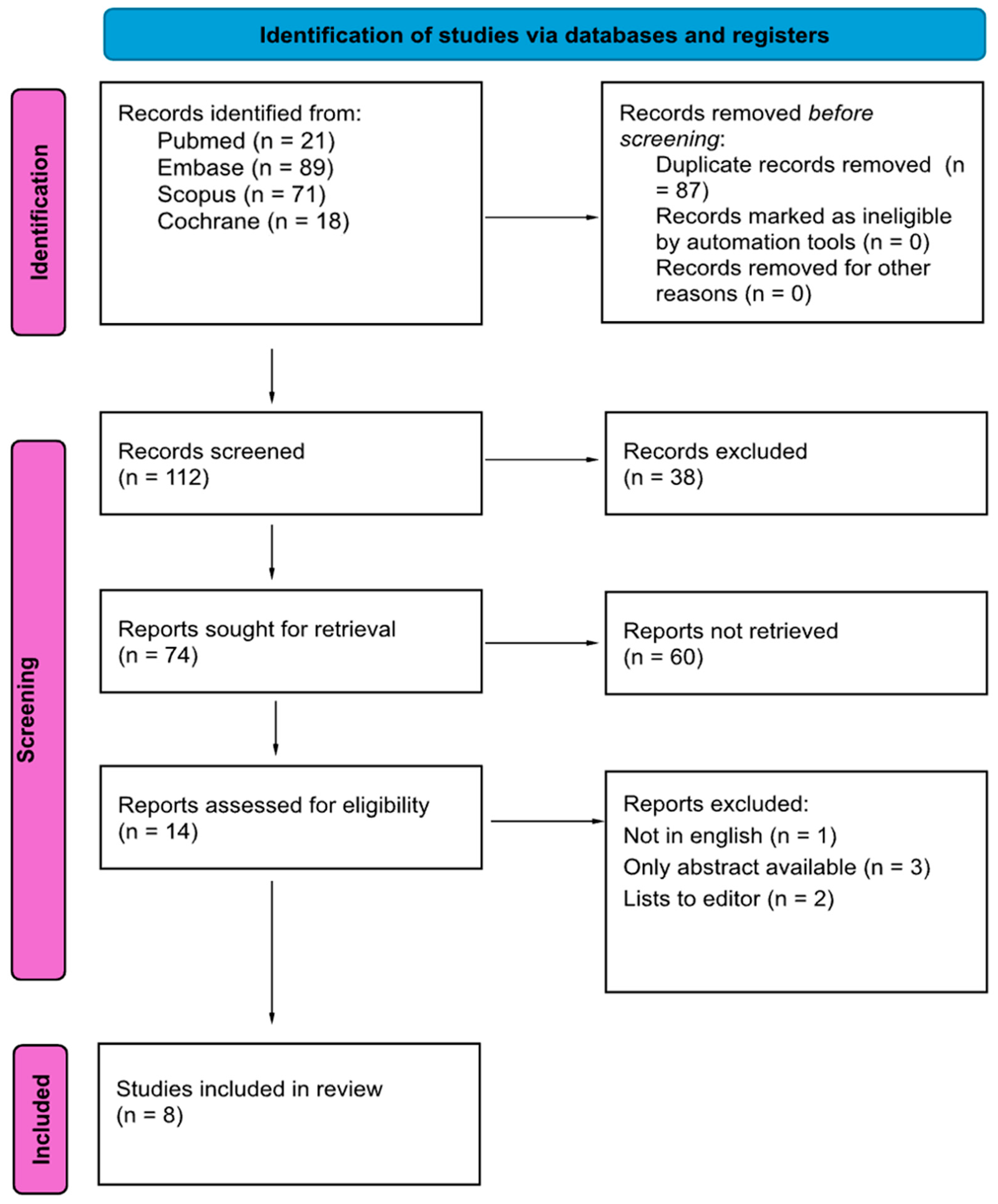
3.1. Study Selection
3.2. Risk of Bias and Quality Assessment of Evidence Results
3.3. General Characteristics of the Included Studies
3.4. Main Study Outcomes
3.4.1. Lesion Size Reduction
3.4.2. Pain Reduction
3.4.3. Recurrence
3.4.4. Secondary Outcomes
4. Discussion
4.1. Results in the Context of Other Evidence
4.2. Limitations of Evidence
4.3. Limitations of Review
4.4. Implications
5. Conclusions
Supplementary Materials
Author Contributions
Funding
Data Availability Statement
Conflicts of Interest
References
- Raj, G.; Raj, M. Oral Lichen Planus. In StatPearls [Internet]; StatPearls Publishing: Treasure Island, FL, USA, 2024. Available online: https://www.ncbi.nlm.nih.gov/books/NBK578201/ (accessed on 1 January 2025).
- Gupta, S.; Jawanda, M.K. Oral Lichen Planus: An Update on Etiology, Pathogenesis, Clinical Presentation, Diagnosis and Management. Indian J. Dermatol. 2015, 60, 222–229. [Google Scholar] [CrossRef] [PubMed] [PubMed Central]
- Hashemipour, M.A.; Sheikhhoseini, S.; Afshari, Z.; Nassab, A.R.G. The relationship between clinical symptoms of oral lichen planus and quality of life related to oral health. BMC Oral Health 2024, 24, 556. [Google Scholar] [CrossRef]
- Nukaly, H.Y.; Halawani, I.R.; Alghamdi, S.M.S.; Alruwaili, A.G.; Binhezaim, A.; Algahamdi, R.A.A.; Alzahrani, R.A.J.; Alharamlah, F.S.S.; Aldumkh, S.H.S.; Alasqah, H.M.A.; et al. Oral Lichen Planus: A Narrative Review Navigating Etiologies, Clinical Manifestations, Diagnostics, and Therapeutic Approaches. J. Clin. Med. 2024, 13, 5280. [Google Scholar] [CrossRef]
- Lavanya, N.; Jayanthi, P.; Rao, U.K.; Ranganathan, K. Oral lichen planus: An update on pathogenesis and treatment. J. Oral Maxillofac. Pathol. 2011, 15, 127–132. [Google Scholar] [CrossRef] [PubMed] [PubMed Central]
- Popa, C.; Sciuca, A.M.; Onofrei, B.A.; Toader, S.; Condurache Hritcu, O.M.; Boțoc Colac, C.; Andrese, E.P.; Brănișteanu, D.E.; Toader, M.P. Integrative Approaches for the Diagnosis and Management of Erosive Oral Lichen Planus. Diagnostics 2024, 14, 692. [Google Scholar] [CrossRef]
- Manchanda, Y.; Rathi, S.K.; Joshi, A.; Das, S. Oral Lichen Planus: An Updated Review of Etiopathogenesis, Clinical Presentation, and Management. Indian Dermatol. Online J. 2023, 15, 8–23. [Google Scholar] [CrossRef] [PubMed] [PubMed Central]
- Borba Filla, J.; Fontanelli, A.F.; Brown, M.A.; Naval Machado, M.A. Treatment of Symptomatic Oral Lichen Planus: A Literature Review. Pol. Przegląd Otorynolaryngologiczny 2016, 5, 30–35. [Google Scholar]
- Lodi, G.; Manfredi, M.; Mercadante, V.; Murphy, R.; Carrozzo, M. Interventions for treating oral lichen planus: Corticosteroid therapies. Cochrane Database Syst. Rev. 2020, 2, CD001168. [Google Scholar] [CrossRef] [PubMed] [PubMed Central]
- Poetker, D.M.; Reh, D.D. A comprehensive review of the adverse effects of systemic corticosteroids. Otolaryngol. Clin. N. Am. 2010, 43, 753–768. [Google Scholar] [CrossRef] [PubMed]
- Keshava, D. Laser Therapy in Oral Lichen Planus. Int. J. Sci. Res. Sci. Technol. 2023, 10, 87–112. [Google Scholar] [CrossRef]
- Kaplan, M.; Vitruk, P. Soft tissue 10,600 nm CO2 laser orthodontic procedures. Orthod. Pract. US 2015, 6, 59–64. [Google Scholar]
- Riggs, K.; Keller, M.; Humphreys, T.R. Ablative laser resurfacing: High-energy pulsed carbon dioxide and erbium:yttrium-aluminum-garnet. Clin. Dermatol. 2007, 25, 462–473. [Google Scholar] [CrossRef] [PubMed]
- Momeni, E.; Didehdar, M.; Sarlak, E.; Safari, M. In Vitro Effect of a High-Intensity Laser on Candida albicans Colony Count. J. Lasers Med. Sci. 2022, 13, e59. [Google Scholar] [CrossRef] [PubMed] [PubMed Central]
- Farivar, S.; Malekshahabi, T.; Shiari, R. Biological effects of low level laser therapy. J. Lasers Med. Sci. 2014, 5, 58–62. [Google Scholar] [PubMed] [PubMed Central]
- Misra, N.; Chittoria, N.; Umapathy, D.; Misra, P. Efficacy of Diode Laser in the Management of Oral Lichen Planus. BMJ Case Rep. 2013, 2013, bcr2012007609. [Google Scholar] [CrossRef]
- Elshenawy, H.M.; Eldin, A.M.; Abdelmonem, M.A. Clinical Assessment of the Efficiency of Low Level Laser Therapy in the Treatment of Oral Lichen Planus. Open Access Maced. J. Med. Sci. 2015, 3, 717–721. [Google Scholar] [CrossRef] [PubMed] [PubMed Central]
- Khalkhal, E.; Razzaghi, M.; Rostami-Nejad, M.; Rezaei-Tavirani, M.; Heidari Beigvand, H.; Rezaei Tavirani, M. Evaluation of Laser Effects on the Human Body After Laser Therapy. J. Lasers Med. Sci. 2020, 11, 91–97. [Google Scholar] [CrossRef] [PubMed] [PubMed Central]
- Mahdavi, O.; Boostani, N.; Jajarm, H.; Falaki, F.; Tabesh, A. Use of Low-Level Laser Therapy for Oral Lichen Planus: Report of Two Cases. J. Dent. 2013, 14, 201–204. [Google Scholar]
- Mansouri, V.; Arjmand, B.; Rezaei Tavirani, M.; Razzaghi, M.; Rostami-Nejad, M.; Hamdieh, M. Evaluation of Efficacy of Low-Level Laser Therapy. J. Lasers Med. Sci. 2020, 11, 369–380. [Google Scholar] [CrossRef]
- Schardt, C.; Adams, M.B.; Owens, T.; Keitz, S.; Fontelo, P. Utilization of the PICO Framework to Improve Searching PubMed for Clinical Questions. BMC Med. Inform. Decis. Mak. 2007, 7, 16. [Google Scholar] [CrossRef]
- Page, M.J.; McKenzie, J.E.; Bossuyt, P.M.; Boutron, I.; Hoffmann, T.C.; Mulrow, C.D.; Shamseer, L.; Tetzlaff, J.M.; Akl, E.A.; Brennan, S.E.; et al. The PRISMA 2020 Statement: An Updated Guideline for Reporting Systematic Reviews. BMJ 2021, 372, n71. [Google Scholar] [CrossRef]
- Watson, P.F.; Petrie, A. Method Agreement Analysis: A Review of Correct Methodology. Theriogenology 2010, 73, 1167–1179. [Google Scholar] [CrossRef]
- Higgins, J.; Thomas, J.; Chandler, J.; Cumpston, M.; Li, T.; Page, M.; Welch, V. Cochrane Handbook for Systematic Reviews of Interventions, 2nd ed.; Cochrane: London, UK, 2023; Available online: www.training.cochrane.org/handbook (accessed on 20 October 2024).
- Agha-Hosseini, F.; Moslemi, E.; Mirzaii-Dizgah, I. Comparative Evaluation of Low-Level Laser and CO2 Laser in Treatment of Patients with Oral Lichen Planus. Int. J. Oral Maxillofac. Surg. 2012, 41, 1265–1269. [Google Scholar] [CrossRef] [PubMed]
- Ibrahim, R.; Abdul-Hak, M.; Kujan, O.; Hamadah, O. CO2 Laser Vaporisation in Treating Oral Lichen Planus: A Split-Mouth Randomised Clinical Trial. Oral Dis. 2024, 30, 2306–2313. [Google Scholar] [CrossRef]
- Khater, M.M.; Khattab, F.M. Efficacy of 1064 Q-Switched Nd:YAG Laser in the Treatment of Oral Lichen Planus. J. Dermatol. Treat. 2020, 31, 655–659. [Google Scholar] [CrossRef] [PubMed]
- Matsumoto, K.; Matsuo, K.; Yatagai, N.; Enomoto, Y.; Shigeoka, M.; Hasegawa, T.; Suzuki, H.; Komori, T. Clinical Evaluation of CO2 Laser Vaporization Therapy for Oral Lichen Planus: A Single-Arm Intervention Study. Photobiomodulation Photomed. Laser Surg. 2019, 37, 175–181. [Google Scholar] [CrossRef] [PubMed]
- Mücke, T.; Gentz, I.; Kanatas, A.; Ritschl, L.M.; Mitchell, D.A.; Wolff, K.D.; Deppe, H. Clinical Trial Analyzing the Impact of Continuous Defocused CO2 Laser Vaporisation on the Malignant Transformation of Erosive Oral Lichen Planus. J. Cranio-Maxillofac. Surg. 2015, 43, 1567–1570. [Google Scholar] [CrossRef]
- Qi, L.; Wang, X.; Deng, Q. The Erosive Oral Lichen Planus Treatment with Nd:YAG Laser Combined with Total Glucosides of Paeony. Glob. J. Med. Clin. Case Rep. 2017, 4, 25–27. [Google Scholar] [CrossRef]
- Tarasenko, S.; Stepanov, M.; Morozova, E.; Unkovskiy, A. High-Level Laser Therapy versus Scalpel Surgery in the Treatment of Oral Lichen Planus: A Randomized Control Trial. Clin. Oral Investig. 2021, 25, 5649–5660. [Google Scholar] [CrossRef]
- Van Der Hem, P.S.; Egges, M.; Van Der Wal, J.E.; Roodenburg, J.L. CO2 Laser Evaporation of Oral Lichen Planus. Int. J. Oral Maxillofac. Surg. 2008, 37, 630–633. [Google Scholar] [CrossRef]
- Luke, A.M.; Mathew, S.; Altawash, M.M.; Madan, B.M. Lasers: A Review with Their Applications in Oral Medicine. J. Lasers Med. Sci. 2019, 10, 324–329. [Google Scholar] [CrossRef]
- Dalirsani, Z.; Seyyedi, S.A. Treatment of Plaque-Like Oral Lichen Planus with CO2 Laser. Indian J. Dermatol. 2021, 66, 698–703. [Google Scholar] [CrossRef]
- Habib, T.; Khondker, L.; Kabir, H.; Rahman, M.; Bhuiyan, M.D.A.; Nahar-E-Farzana, S.; Hossain, M. Management of oral lichen planus by the application of carbon dioxide laser: A systematic review. J. Popul. Ther. Clin. Pharmacol. 2024, 31, 110–121. [Google Scholar] [CrossRef]
- Mozafari, H.; Farhadzadeh, K.; Rezaei, F. A Study of the Effects of CO2 Laser Therapy on Oral Lichen Planus (OLP). J. Appl. Environ. Biol. Sci. 2015, 5, 114–118. [Google Scholar]
- Huang, Z.; Wang, Y.; Liang, Q.; Zhang, L.; Zhang, D.; Chen, W. The application of a carbon dioxide laser in the treatment of superficial oral mucosal lesions. J. Craniofacial Surg. 2015, 26, e277–e279. [Google Scholar] [CrossRef] [PubMed]
- Saibene, A.M.; Rosso, C.; Castellarin, P.; Vultaggio, F.; Pipolo, C.; Maccari, A.; Ferrari, D.; Abati, S.; Felisati, G. Managing Benign and Malignant Oral Lesions with Carbon Dioxide Laser: Indications, Techniques, and Outcomes for Outpatient Surgery. Surg. J. 2019, 5, e69–e75. [Google Scholar] [CrossRef] [PubMed] [PubMed Central]
- Cloitre, A.; Rosa, R.W.; Arrive, E.; Fricain, J.C. Outcome of CO2 laser vaporization for oral potentially malignant disorders treatment. Med. Oral Patol. Oral Y Cir. Bucal 2018, 23, e237–e247. [Google Scholar] [CrossRef] [PubMed] [PubMed Central]
- Pakfetrat, A.; Falaki, F.; Ahrari, F.; Bidad, S. Removal of Refractory Erosive-Atrophic Lichen Planus by the CO2 Laser. Oral Health Dent. Manag. 2014, 13, 595–599. [Google Scholar] [PubMed]
- Beulah, J.M.; Deepthi, A.; Gracelin; Murugan, K.; Deepak, J.H. Efficacy of Carbon Dioxide Laser in Treating Oral Lichen Planus-A Scoping Review. J. Clin. Diagn. Res. 2023, 17, ZE01–ZE07. [Google Scholar] [CrossRef]


| Inclusion Criteria | Exclusion Criteria |
|---|---|
| Randomized controlled trials | Case reports/Case series |
| Non-randomized controlled trials | Narrative reviews |
| Full text available | Systematic reviews |
| Human studies | Meta-analysis |
| English language | Non-English language publications |
| Patients aged ≥ 18 years | Letters to Editor |
| Non-smoking patients | Animal studies |
| Low or moderate risk of bias | Studies on smoking patients |
| Conference papers |
| Study | ||||||||
|---|---|---|---|---|---|---|---|---|
| Criteria | Agha-Hosseini et al. (2012) [25] | Ibrahim et al. (2024) [26] | Khater and Khattab (2020) [27] | Matsumoto et al. (2019) [28] | Mücke et al. (2015) [29] | Qi et al. (2017) [30] | Tarasenko et al. (2021) [31] | Van Der Hem et al. (2008) [32] |
| Random allocation | 1 | 1 | 0 | 0 | 0 | 1 | 1 | 0 |
| Balanced study groups (+/− 10%) | 1 | 1 | 0 | 1 | 0 | 0 | 1 | 0 |
| Power meter used | 0 | 1 | 0 | 1 | 0 | 0 | 1 | 1 |
| Inclusion/exclusion criteria clearly defined | 1 | 1 | 1 | 1 | 1 | 1 | 1 | 1 |
| Both clinical and histopathological diagnosis | 1 | 1 | 1 | 1 | 1 | 1 | 1 | 1 |
| Source of funding not interfering with the results | 1 | 1 | 1 | 1 | 1 | 1 | 1 | 1 |
| Total | 5/6 | 6/6 | 3/6 | 5/6 | 3/6 | 4/6 | 6/6 | 4/6 |
| Risk of bias | Low | Low | Moderate | Low | Moderate | Moderate | Low | Moderate |
| Outcome | Number of Studies | Study Design | Risk of Bias | Inconsistency | Indirectness | Imprecision | Publication Bias | Overall Quality | Certainty |
|---|---|---|---|---|---|---|---|---|---|
| Reduction in lesion size [25,26,27,28,29,30,31,32] | 7 | RCTs, Clinical Trials | Low | Moderate (−1) | Not serious | Moderate (−1) | Not serious | Low | ⊕⊕◯◯ |
| Pain reduction [25,26,27,28,29,30,31,32] | 7 | RCTs, Clinical Trials | Low | Moderate (−1) | Not serious | Moderate (−1) | Not serious | Low | ⊕⊕◯◯ |
| Recurrence rates [25,26,28,29,32] | 5 | RCTs, Clinical Trials | Low | Not serious | Not serious | Moderate (−1) | Not serious | Moderate | ⊕⊕◯ |
| Adverse effects [26,32] | 2 | RCTs, Clinical Trials | Low | Not serious | Not serious | Moderate (−1) | Not serious | Moderate | ⊕⊕⊕◯ |
| Patient satisfaction [25,28,31,32] | 4 | RCTs, Clinical Trials | Low | Moderate (−1) | Not serious | Moderate (−1) | Not serious | Low | ⊕⊕◯◯ |
| Author and Year | Country | Study Design | Split-Mouth |
|---|---|---|---|
| Agha-Hosseini et al. (2012) [25] | Iran | Prospective clinical trial | No |
| Ibrahim et al. (2024) [26] | Syria | Randomized controlled trial | Yes |
| Khater and Khattab (2020) [27] | Egypt | Clinical trial | No |
| Matsumoto et al. (2019) [28] | Japan | Single-arm intervention study | No |
| Mücke et al. (2015) [29] | Germany | Prospective clinical study | No |
| Qi et al. (2017) [30] | China | Randomized clinical trial | No |
| Tarasenko et al. (2021) [31] | Russia | Randomized clinical trial | No |
| Van Der Hem et al. (2008) [32] | Netherlands | Clinical study | No |
| Author/Year | Sample Size Calculation | Patients | Sex | Age (Years) | ||
|---|---|---|---|---|---|---|
| Female | Male | Mean (±SD) | Range | |||
| Agha-Hosseini et al. (2012) [25] | Balanced block randomization, pilot study for dose determination | 28 | 21 | 7 | 50.7 | Not provided |
| Ibrahim et al. (2024) [26] | Calculated using G*Power, significance level 0.05, power 0.95 | 16 | 10 | 6 | 44.8 ± 12.6 | 32–57 |
| Khater and Khattab (2020) [27] | Not specified | 24 | 22 | 2 | 52 ± 14.9 | 24–65 |
| Matsumoto et al. (2019) [28] | Not specified | 16 | 14 | 2 | 62 | 46–75 |
| Mücke et al. (2015) [29] | Not specified | 171 | 87 | 84 | 52.43 ± 12.4 | 30–70 |
| Qi et al. (2017) [30] | Randomized with a control group, method not specified | 60 | 41 | 19 | 51.34 ± 10.07 | 41–78 |
| Tarasenko et al. (2021) [31] | Not specified | 75 | 59 | 34 | Not provided | Not provided |
| Van Der Hem et al. (2008) [32] | Not specified | 21 | 13 | 8 | 52.3 | 34–62 |
| Author/Year | Treatment Groups | Evaluation | Main Results | Follow-Up Period |
|---|---|---|---|---|
| Agha-Hosseini et al. (2012) [25] | CO2 laser (study group) vs. PBMT control group | Changes in lesion size, pain (VAS), and clinical response score at 2 weeks, 1, 2, and 3 months | No significant difference in baseline lesion sizes was found between the groups (PBMT: 3.2 cm; CO2 laser: 3.1 cm). However, lesion size reduction was significantly higher in the PBMT group at all follow-up stages (p < 0.05). Clinical response scores at baseline were similar in both groups, but PBMT patients showed greater improvement in clinical signs at follow-ups. In the CO2 group, 85% of patients showed partial to complete improvement, while 100% of PBMT patients showed such improvement. Pain reduction was observed in both groups, with significantly greater symptomatic relief in the PBMT group throughout follow-ups (p < 0.05). | 3 months |
| Ibrahim et al. (2024) [26] | CO2 laser vaporization (study group) vs. Triamcinolone acetonide injection (control group) | REU score for lesion severity, TSS, VAS for pain, lesion area reduction at weeks 0, 4, 9 | At the start, there were no significant differences between the two groups in REU, TSS, VAS scores, or lesion diameter. By the midpoint of the study, the CO2 group showed significant improvements in these measures (p < 0.001), while no significant changes were observed on the TA side. By the end of treatment, both groups demonstrated significant improvements (p < 0.01), though the CO2 group had greater improvements in REU, TSS scores, and lesion area compared to the TA group (p = 0.001, 0.002, and 0.048, respectively). However, there was no significant difference in VAS scores between the two groups (p = 0.54). During the 9-month follow-up, 75% of lesions recurred on the TA side, compared to 31.3% on the CO2 side, with a significant difference (p = 0.016). The mean time to recurrence was longer on the CO2 side (7.2 months) than on the TA side (3.92 months), also a significant difference (p = 0.034). Recurrence on the CO2 side was mostly reticular and asymptomatic, whereas 66.7% of recurrences on the TA side were symptomatic. | 9 months |
| Khater and Khattab (2020) [27] | Nd:YAG laser therapy (study group) vs. no treatment (control group) | Thongprasom sign score and VAS for pain before and after treatment | Before treatment, 75% of patients reported severe oral discomfort (VAS score 3), and 25% had a VAS score of 2. After therapy, all patients experienced symptom relief, with 66% reporting mild discomfort (VAS score 1) and four patients reporting no pain (VAS score 0). The Wilcoxon matched-pairs test showed a significant reduction in pain after laser therapy (p = 0.0005). Initially, 59 lesions were recorded, with 45.7% showing erosive destruction (scores 4 and 5). After Nd laser treatment, 59.3% of lesions showed clinical improvement. By the end of the treatment, 33.3% of lesions had complete improvement. The Thongprasom sign scores significantly decreased after therapy (p < 0.0001). All patients showed some degree of improvement, with most experiencing moderate recovery, and one patient achieving complete remission with no pain and normal mucosa. | 1 month |
| Matsumoto et al. (2019) [28] | CO2 laser vaporization (single-arm study) | NRS, TSS, lesion size reduction | ORL across 18 sites was analyzed. All patients initially underwent conservative treatment. 7 patients with 7 sites showed symptom improvement or declined laser treatment and were excluded from the laser treatment group. Laser irradiation was applied to nine patients at 11 sites. By day 7 post-irradiation, the NRS score had decreased at 5 of the 11 sites (45.5%) compared to pre-irradiation levels. At 1 month, 3 months, and 1 year post-irradiation, all 11 sites (100%) showed NRS score reductions. The Thongprasom sign score (TSS) decreased at 8 sites (72.7%) after 1 month, and at least 9 sites (81.8%) from 3 months to 1 year. Complete recovery (NRS and TSS scores of zero) was achieved in three sites (27.3%) after 1 year. Statistical analysis using Wilcoxon’s signed-rank test indicated that both NRS and TSS scores were significantly lower (p < 0.05) at 1 and 3 months (short-term), and at 6 months and 1 year (mid-long-term) compared to pre-irradiation scores. No malignant transformation was observed during the study. | 1 year |
| Mücke et al. (2015) [29] | CO2 laser treatment (study group) vs. symptomatic treatment (control group) | Incidence of SCC transformation, symptomatic relief (pain management) | In the study cohort, the duration of the disease was less than 1 year in 30.9% of patients, 1–5 years in 67.3%, and more than 5 years in 1.8%. Lesions were most common in the buccal mucosa (56%), followed by the gingiva (19%), tongue (14%), and floor of the mouth (11%). Lesions were bilateral in 51% of patients. Of the 171 patients, 60.2% received symptomatic conservative treatment, while 39.8% underwent continuous defocused CO2 laser treatments. Following laser vaporization, 38.2% of patients experienced recurrence of erosive lesions, while 61.8% did not have further erosive lesions, although some still exhibited reticular OLP in the oral cavity. In the group receiving conservative treatment, 87.4% still had active erosive lesions, and 12.6% had no further erosive OLP but displayed reticular lesions. A total of 16 patients (9.4%) developed oral SCC, with 2 patients (2.9%) in the laser treatment group and 14 patients (13.6%) in the conservative treatment group. | 2–6 years (varied by patient) 42.65 months (average) |
| Qi et al. (2017) [30] | Nd:YAG laser + TGP (study group) vs. TGP alone (control group) | VAS for pain, clinical sign score for lesion size | After three months of treatment, both groups showed improvements in VAS scores and physical signs. However, the observation group, which received a combination of TGP capsules and local Nd laser irradiation, had a significantly better VAS score compared to the control group. The effective rate in the treatment group was 82.1%, significantly higher than the control group (p < 0.05). No serious adverse reactions were observed during treatment. The study showed a significant reduction in signs and symptoms after treatment in both groups, but the observation group had better overall clinical efficacy. In contrast, the group taking only TGP capsules had an effective rate of 53.1%. Overall, the combination of TGP and Nd laser treatment was more effective than TGP alone in improving clinical outcomes. | 3 months |
| Tarasenko et al. (2021) [31] | Er:YAG (study group 1), Nd:YAG (study group 2), Er:YAG + Nd:YAG (study group 3), scalpel surgery (control group) | IL-1β, IL-6, IFN-γ levels, pain levels, and time of epithelization | No patients were lost during the first and second follow-ups, but by the third follow-up, 1 control and 7 intervention patients were lost due to OLP exacerbation. Additionally, 10 patients were excluded for using analgesics after scalpel excision. The mean lesion size varied across groups: 2.23 cm2 in the Er:YAG group, 3.25 cm2 in the Nd:YAG group, 4.17 cm2 in the Er:YAG + Nd:YAG group, and 2.37 cm2 in the control group. Lesions were primarily located on the tongue and buccal plane (49%), followed by the palate and alveolar process (both 15%), mouth floor (11%), and lips (10%). The average ablation time was approximately 12 min for Er:YAG and 5.5 min for Nd:YAG. | 2 years |
| Van Der Hem et al. (2008) [32] | CO2 laser evaporation (single-arm study) No control group | Pain relief, recurrence rate, and long-term symptom management | A total of 39 idiopathic lesions were treated with CO2 laser evaporation due to patient complaints. Most lesions (74%) were painful when consuming spicy foods, 7% were spontaneously painful, and 19% had pain that fluctuated over time. The clinical classification included 33% erosive/ulcerative lesions, 40% reticular, 16% plaque-like, and 11% unknown. The mean follow-up period was 8 years (range 1–18 years). After CO2 laser treatment, 62% of lesions showed no pain and no recurrence, while 38% had clinical recurrence. Of these, 6 lesions were painful and required retreatment with CO2 laser evaporation, which resolved the pain. Nine recurrent lesions were painless. All lesions healed completely within 3 weeks after treatment or retreatment. Some patients experienced new painful lesions at previously untreated locations in the mouth during follow-up. In one case, galvanic irritation was suggested as a potential etiological factor. | 1–18 years (mean 8 years) |
| Author/Year | Light Source | Operating Mode | Wavelength (nm) | Energy Density (Fluence) (J/cm2) | Power Output (mW) | Powermeter Used | Irradiation Time (s) | Output Spot Diameter (mm) |
|---|---|---|---|---|---|---|---|---|
| Agha-Hosseini et al. (2012) [25] | CO2 laser, Diode laser (PBMT) | Continuous (CO2), Pulsed (PBMT) | 10,600 (CO2), 890, 633 (PBMT) | 0.3–0.5 (PBMT) | 2 | Not specified | 120 | Not specified |
| Ibrahim et al. (2024) [26] | CO2 laser | Continuous defocused mode | 10,600 nm | 2.5 | 3 | Yes | 30 | 0.5 |
| Khater and Khattab (2020) [27] | Nd:YAG laser | Q-switched | 1064 | 1.2 | 0.5 | Not specified | 30 | Not specified |
| Matsumoto et al. (2019) [28] | CO2 laser | Continuous-wave mode | 10,600,000 | 8957–26,871 | 3 | Yes | 60 | Not specified |
| Mücke et al. (2015) [29] | CO2 laser | Continuous defocused | 10,600 | Not specified | 15 | Not specified | Not provided | 0.2 |
| Qi et al. (2017) [30] | Nd:YAG laser | Pulsed | 650 | 0.25 | 0.5 | Not specified | 10 | 2 |
| Tarasenko et al. (2021) [31] | Er:YAG, Nd:YAG | Continuous and Pulsed | 2940 (Er:YAG), 1064 (Nd:YAG) | Not specified | 2 | Yes | Not specified | Not specified |
| Van Der Hem et al. (2008) [32] | CO2 laser (Sharplan 791, Cavitron) | Defocused | 10,600 | 150–200 | 15–20 | Yes | Not provided | 1 |
Disclaimer/Publisher’s Note: The statements, opinions and data contained in all publications are solely those of the individual author(s) and contributor(s) and not of MDPI and/or the editor(s). MDPI and/or the editor(s) disclaim responsibility for any injury to people or property resulting from any ideas, methods, instructions or products referred to in the content. |
© 2026 by the authors. Licensee MDPI, Basel, Switzerland. This article is an open access article distributed under the terms and conditions of the Creative Commons Attribution (CC BY) license.
Share and Cite
Fiegler-Rudol, J.; Niemczyk, W.; Matys, J.; Hadzik, J.; Skaba, D.; Wiench, R.; Dominiak, M. High-Power Laser Therapy for Oral Lichen Planus: A Systematic Review. J. Clin. Med. 2026, 15, 1084. https://doi.org/10.3390/jcm15031084
Fiegler-Rudol J, Niemczyk W, Matys J, Hadzik J, Skaba D, Wiench R, Dominiak M. High-Power Laser Therapy for Oral Lichen Planus: A Systematic Review. Journal of Clinical Medicine. 2026; 15(3):1084. https://doi.org/10.3390/jcm15031084
Chicago/Turabian StyleFiegler-Rudol, Jakub, Wojciech Niemczyk, Jacek Matys, Jakub Hadzik, Dariusz Skaba, Rafał Wiench, and Marzena Dominiak. 2026. "High-Power Laser Therapy for Oral Lichen Planus: A Systematic Review" Journal of Clinical Medicine 15, no. 3: 1084. https://doi.org/10.3390/jcm15031084
APA StyleFiegler-Rudol, J., Niemczyk, W., Matys, J., Hadzik, J., Skaba, D., Wiench, R., & Dominiak, M. (2026). High-Power Laser Therapy for Oral Lichen Planus: A Systematic Review. Journal of Clinical Medicine, 15(3), 1084. https://doi.org/10.3390/jcm15031084