Article

Circulating microRNAs as Biomarkers of Brain Metastases in Lung Cancer: A Pilot Study

by
Karol Marschollek
1,*,
Maciej Powierża
2,
Dorota Kujawa
2,
Monika Kosacka
3,
Maciej Majchrzak
4,
Anna Brzecka-Bonnaud
3,
Aneta Kowal
5,
Sławomir Budrewicz
1,
Łukasz Łaczmański
2,† and
Anna Pokryszko-Dragan
1,†
1
Clinical Department of Neurology, University Centre of Neurology and Neurosurgery, Faculty of Medicine, Wroclaw Medical University, Borowska 213, 50-556 Wrocław, Poland
2
Laboratory of Genomics and Bioinformatics, Hirszfeld Institute of Immunology and Experimental Therapy, Polish Academy of Sciences, Weigla 12, 53-114 Wrocław, Poland
3
Department of Pulmonology and Lung Cancer, Faculty of Medicine, Wroclaw Medical University, Grabiszyńska 105, 53-439 Wrocław, Poland
4
Thoracic Surgery Clinic, University Center for General and Oncological Surgery, Wroclaw Medical University, Grabiszyńska 105, 53-439 Wrocław, Poland
5
Lower Silesian Center of Oncology, Pulmonology and Hematology, Hirszfelda 12, 53-413 Wrocław, Poland
*
Author to whom correspondence should be addressed.
These authors contributed equally to this work.
J. Clin. Med. 2026, 15(3), 1083; https://doi.org/10.3390/jcm15031083
Submission received: 28 November 2025 / Revised: 26 January 2026 / Accepted: 27 January 2026 / Published: 29 January 2026
(This article belongs to the Section Oncology)

Abstract

Background/Objectives: There is an ongoing search for reliable biomarkers of lung cancer (LC) and its progression, including nervous system involvement. MicroRNAs (miRNAs) play a crucial role in the regulation of gene expression and represent a promising focus of investigation in this field. The aim of this study was to assess the profile of miRNA expression in patients diagnosed with lung cancer, with or without brain metastases. Methods: This study comprised 13 patients diagnosed with non-small cell lung cancer (mean age 64.8 years, 61.5% females): 6 with brain metastases (LC + BM) and 7 without them (LC), and a control group of 6 healthy volunteers (HC). The expression levels of 179 miRNAs were assessed and compared between the study groups using quantitative reverse-transcription PCR (qRT-PCR). Results: In LC + BM subgroup, two miRNAs were found to be downregulated in comparison with HC: miR-409-3p (logFC = −17.42, p = 0.029) and miR-485-3p (logFC = −17.30, p = 0.026). An exploratory, probe-based feature-ranking analysis identified eleven miRNAs that were repeatedly selected across the resampling runs: miR-363-3p, miR-210-3p, miR-194-5p, miR-409-3p, miR-22-3p, miR-2110, miR-326, miR-485-3p, miR-223-5p, miR-16-2-3p, and miR-139-5p. Among these, miR-363-3p, miR-210-3p, and miR-194-5p exhibited the highest empirical stability. Predictive modeling was subsequently evaluated using a fully nested cross-validation framework in which feature selection and model training were repeated within each training fold. Under this stringent evaluation, the classification performance was close to chance across all the evaluated algorithms, indicating a limited predictive utility of the identified miRNAs for distinguishing patients with and without brain metastases in the present dataset. Conclusions: Notable differences in miRNA expression profiles were revealed for the patients with brain metastases from lung cancer, suggesting the role of the selected miRNAs in cancer metastasis to the CNS. However, while our analysis provides exploratory insights, the findings should be interpreted with caution and require validation in larger, independent cohorts before any clinical or translational implications can be established.

1. Introduction

Lung cancer is the most common malignancy and the leading cause of cancer-related deaths in the general population. According to epidemiological data, in 2022, almost 2.5 million new cases of lung cancer were diagnosed worldwide, and 1.8 million deaths due to it were recorded, which constituted almost 1/5 of overall mortality [1]. Lung cancer is characterized by a high propensity for metastatic spread, which contributes significantly to its poor prognosis and remains a major clinical challenge in the management of the affected patients. In one large, population-based study, as many as 56% of the patients with lung cancer had metastases diagnosed between diagnosis and death, the most common location of which were metastases to the central nervous system (CNS), detected in 39% of patients [2]. Apart from the adverse effects on the prognosis, these CNS metastases have a profound and devastating impact on the patients’ condition due to symptoms of neurological deficit and raised intracranial pressure. Moreover, in a large percentage of cases, the presence of distant metastases is already observed at the initial diagnosis of lung cancer. In both non-small cell lung cancer (NSCLC) and small cell lung cancer (SCLC), approximately 10% of patients are diagnosed with CNS metastases at the first clinical presentation of a neoplasm [3,4].
From a clinical point of view, the early detection of neoplastic metastasis to the CNS is extremely important. He et al. [5] reported a significantly longer overall survival (OS) in patients who received brain surgery and/or radiotherapy before surgical removal of the primary lung tumor. It is also known that carriers of oncogenic driver mutations, primarily mutations in the Epidermal Growth Factor Receptor (EGFR) and Anaplastic Lymphoma Kinase (ALK) rearrangement genes, are more susceptible to the occurrence of brain metastases [6,7], and the implementation of targeted treatment significantly improves the prognosis and the intracranial progression-free survival [8,9].
The identification of patients with lung cancer who are at higher risk for CNS metastases may therefore influence therapeutic decisions. Because of that, simple and easily accessible biomarkers are constantly sought, which would allow for the individualization of patient screening in this direction. Thanks to the development of advanced molecular techniques, particular attention is directed toward the use of “liquid biopsy”, enabling the evaluation of molecules circulating in the peripheral blood, such as circulating tumor DNA (ctDNA) or miRNAs [10].
MicroRNAs (miRNAs) are single-stranded, short, noncoding RNAs, typically around 21 nucleotides in length. As a part of miRNA-induced silencing complex (miRISC) they bind to the 3′ untranslated region (3′-UTR) of target messenger RNAs, acting as post-transcriptional regulators of gene expression [11]. miRNAs are believed to play a significant role in the development and progression of cancer, as they can modulate the expression of both oncogenes and tumor suppressor genes [12].
An assessment of the expression of specific miRNAs has already been applied in lung cancer. It has been shown that specific panels of miRNAs can serve as diagnostic biomarkers, enabling the distinction of malignant tumors from benign ones [13,14] or differentiating histopathological types of lung cancer [15]. In addition, miRNAs have been assessed as potential markers of disease progression [16,17] and of treatment response [18]. Despite the progress in understanding of the role of miRNAs in the development of lung cancer, there is still a lack of consistent data and firm validation of these biomarkers in large cohorts of patients, which limits the possibility of their routine use in clinical practice.
In particular, little is known about the role of an miRNA expression profile as a potential marker of CNS involvement, which seems a significant research gap in the context of lung cancer metastasis. Therefore, we made an attempt to address this topic in our investigation.
The aim of this study was to assess the profile of miRNA expression in patients diagnosed with lung cancer, with or without CNS metastases.

2. Materials and Methods

2.1. Study Groups

The subjects were recruited from patients hospitalized in the Departments of Pulmonology and Lung Cancer, Thoracic Surgery and Neurology at Wroclaw Medical University and in the Lower Silesian Centre of Oncology, Pulmonology and Hematology, between June 2022 and December 2023.
The LC group comprised the patients with histologically confirmed non-small cell lung cancer (NSCLC) without radiologically detectable brain metastases at the assessment. The second group (LC + BM) consisted of histologically confirmed NSCLC patients with concomitant brain metastases. All brain metastases were classified as synchronous, defined as detected within 3 months of the initial diagnosis. The presence of brain metastases was assessed by magnetic resonance imaging (MRI) or contrast-enhanced computed tomography (CT) of the head. The following exclusion criteria were applied: active infection at the time of admission, any concomitant chronic neurological or inflammatory/autoimmune disorders, history of any malignancies in the past 10 years, and lack of recent (since the diagnosis of lung cancer) brain imaging results (CT or MRI).
Finally, 7 patients were qualified for the LC group and 6 for LC + BM group. All these patients were diagnosed with NSCLC. Then, 7 healthy volunteers were recruited for the control group (HC), selected to match the patient groups in terms of age and sex distribution; 1 was excluded during quality control, resulting in 6 controls included in the final analysis.

2.2. Data Collection and Analysis

Demographic and clinical data were extracted from medical charts of each patient.
Samples of venous blood were collected from all participants at admission, centrifuged and stored at −20 °C until use. All samples were analyzed under the same laboratory conditions at the same time.
For molecular analysis, serum samples from study groups were processed for miRNA isolation using the miRCURY RNA Isolation Kit for Biofluids (Exiqon, Vedbæk, Denmark), following the manufacturer’s protocol. Subsequently, a complementary DNA (cDNA) library was acquired.
In order to assess the efficacy of RNA extraction, the internal spike-in controls UniSp2 and UniSp4 were used. The efficiency of cDNA synthesis was evaluated using UniSp6. A quantification cycle (Cp) value exceeding 37 for any of these controls was considered indicative of poor sample quality or low yield. Hemolysis and the presence of PCR inhibitors in serum samples were evaluated by measuring the expression levels of miR-451 and miR-23a. Samples with ΔCp(23a–451) greater than 7 were considered unreliable due to significant hemolysis.
The expression of 179 serum miRNAs was analyzed using the miRCURY LNA™ Serum/Plasma Focus PCR Panel (Exiqon), which utilizes Locked Nucleic Acid (LNA™) technology. Quantitative real-time PCR (qPCR) was performed using a CFX95 Real-Time PCR System (Bio-Rad, Hercules, CA, USA) on 96-well plates. The reaction conditions specified by the manufacturer were used.
Relative expression levels of miRNAs in cancer patient samples were calculated using the comparative Cp method:
ΔCp = Cpsample − Cpcontrol
To quantify the difference in expression, the Log Ratio (LR) was calculated as the base 2 logarithm of the fold change. An LR value greater than 1 was interpreted as upregulation, and an LR less than −1 as downregulation. Cpcontrol represents the mean Cp across the control group.
The miRNA analysis was conducted according to the validated and previously published method [19].
All the procedures were performed in accordance with the Declaration of Helsinki and its further amendments. All participants provided written informed consent prior to inclusion in this study. The project of this study was approved by the Wroclaw Medical University Bioethics Committee (approval no. KB-918/2021).

2.3. Statistical Analysis

All analyses were performed using R statistical software (Version 4.3.2). In addition to base R functions, the caret package was employed for data preprocessing, model training, and construction of confusion matrices. The pROC, ggplot2, and dplyr packages were used for result visualization and data handling.
First, observations from the HC and LC groups were aggregated into a single category to construct a contrast aimed at identifying miRNAs potentially associated with metastatic progression. Variables with near-zero variance were removed as an unsupervised preprocessing step.
Given the high-dimensional structure of the data, an exploratory, filter-based feature selection procedure was applied within a nested cross-validation framework. For each feature, a univariate Wilcoxon–Mann–Whitney test was computed and used solely as a ranking score, not for confirmatory hypothesis testing; therefore, the resulting p-values were not interpreted as measures of statistical significance.
Feature selection was performed using a probe-based procedure [20]. In each iteration, 50 probe variables were generated by randomly selecting an original feature and permuting its sample values to destroy any association with the outcome while preserving its marginal distribution. Original and probe variables were jointly ranked by their Wilcoxon scores, and the largest top-ranked set for which the running ratio of probes to original variables did not exceed 0.1 was retained.
To assess selection stability, the entire probe-based selection procedure was repeated across 100 random seeds within each training fold. Selection frequencies were computed for each original feature across repetitions, and features with a stability of at least 0.45 were retained. Importantly, this entire feature-selection workflow (including probe generation, ranking, stability assessment, and thresholding) was executed independently within each leave-one-out cross-validation (LOOCV) training fold, using only the training data for that fold. The held-out sample was not used at any stage of feature selection.
After feature selection, predictor variables were centered and scaled using statistics computed from the training fold only, and the same transformation was applied to the corresponding held-out sample.
Three classification algorithms, logistic regression with elastic net regularization (GLMNET), linear support vector machine (SVM), and random forest (RF), were evaluated. For each algorithm, hyperparameters were tuned within the training fold using an inner LOOCV procedure. Model performance was assessed using an outer LOOCV loop, where predictions were generated for each held-out sample from models trained without access to that sample.
Predictive performance was summarized using the area under the receiver operating characteristic curve (AUC), computed from the outer-fold predictions. Uncertainty in AUC estimates was quantified using bootstrap confidence intervals based on resampling of subjects.
Significance level was established as α  =  0.05.

3. Results

3.1. Study Population

One of the samples in the control group was excluded due to the insufficient quality of the microarray results; therefore, the final analysis was conducted on 19 patient samples. Serum samples from 19 subjects were included in the final analysis, of which 12 were women (63.2%). The mean age of the patients with LC was 64.8 years.
There were no significant differences in age or gender distribution between the analyzed groups. The basic demographic and clinical data of the participants are presented in Table 1.

3.2. miRNA Expression Analysis

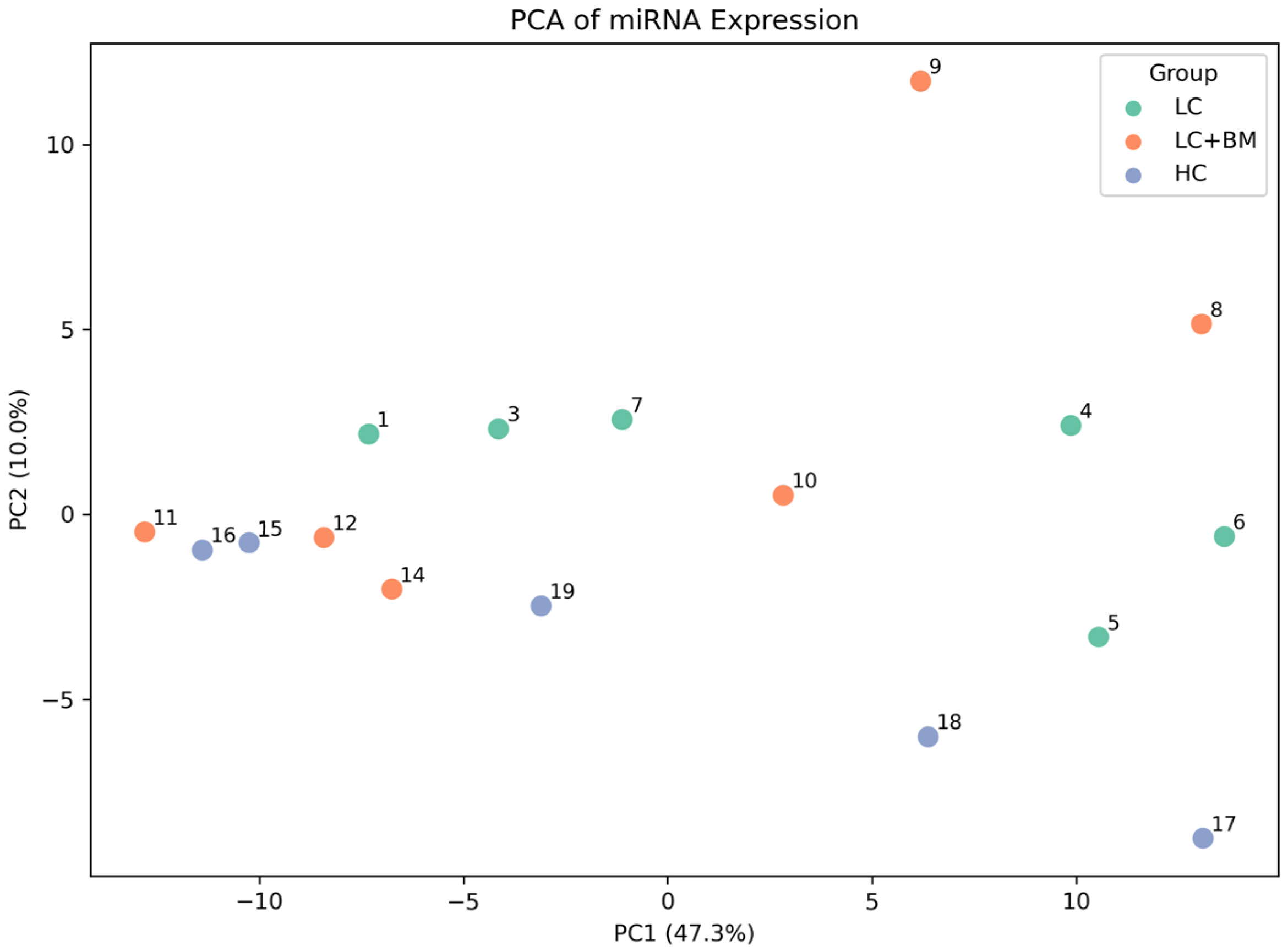
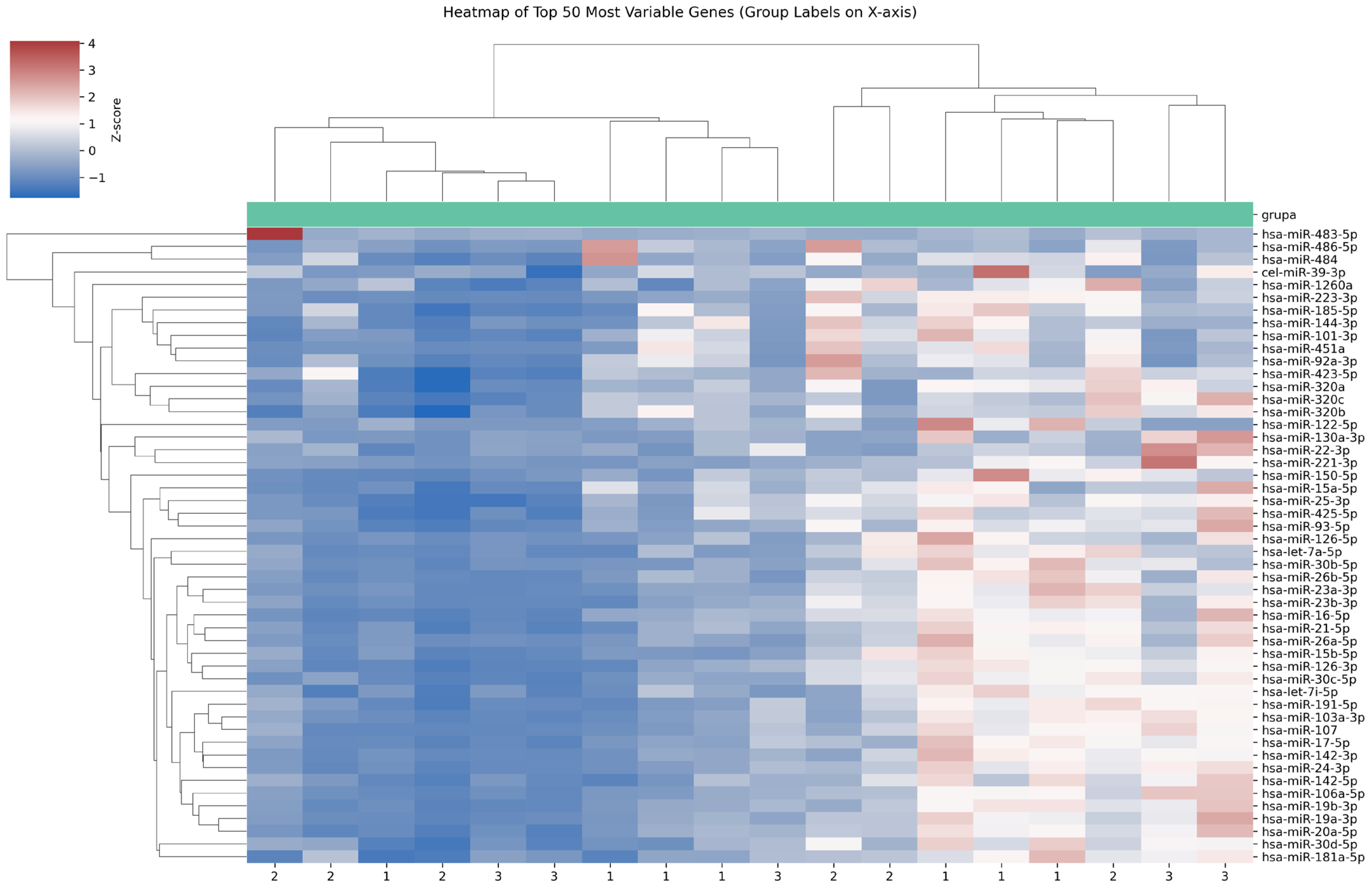
The expression levels of the 179 miRNAs were measured in the study samples. Principal component analysis mapping and hierarchical unsupervised clustering analysis were performed to visualize the expression patterns of the miRNAs in the patients and are displayed in Figure 1 and Figure 2.
The miRNA expression profiles were compared between the groups. The exploratory analysis showed a significant downregulation of nine miRNAs in the patients in the LC group compared to the HC group: miR-328-3p (logFC = −16.51, p = 0.005), miR-92a-3p (logFC = −9.46, p = 0.008), miR-101-3p (logFC = −14.57, p = 0.021), miR-451a (logFC = −8.18, p = 0.027), miR-374a-5p (logFC = −15.74, p = 0.028), miR-100-5p (logFC = −17.61, p = 0.036), miR-197-3p (log FC = −15.71, p = 0.039), miR-125b-5p (logFC = −15.02, p = 0.043), and miR-122-5p (log FC = −13.81, p = 0.049). In the patients in the LC + BM group, two miRNAs were found to be downregulated compared to the HC group: miR-409-3p (logFC = −17.42, p = 0.029) and miR-485-3p (logFC = −17.30, p = 0.026). The significantly dysregulated miRNAs are shown in Table 2 and Table 3.

3.3. Machine Learning Model

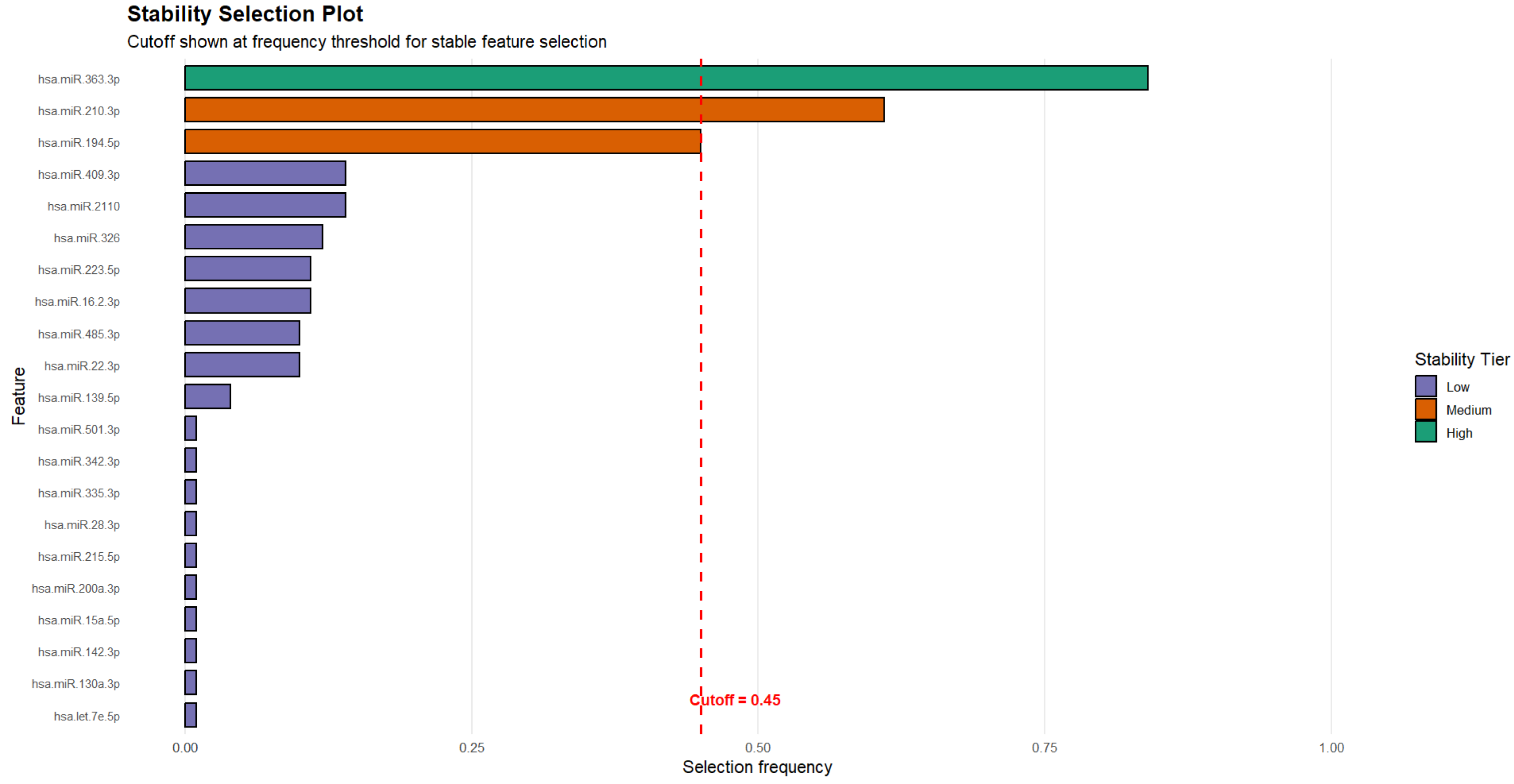
To define the classification task, the HC and LC samples were combined and contrasted against the LC + BM group. An initial exploratory analysis, performed on the full dataset, was used to summarize the miRNA features that repeatedly ranked highly in the univariate probe-based selection. This analysis identified eleven miRNAs with relatively high empirical selection frequencies: miR-363-3p, miR-210-3p, miR-194-5p, miR-409-3p, miR-22-3p, miR-2110, miR-326, miR-485-3p, miR-223-5p, miR-16-2-3p, and miR-139-5p. Among these, miR-363-3p, miR-210-3p, and miR-194-5p exhibited the highest stability across the resampling runs. These results are reported for descriptive purposes only; feature selection for predictive modeling was performed independently within each cross-validation training fold, and no fixed set of miRNAs was assumed during the model evaluation.
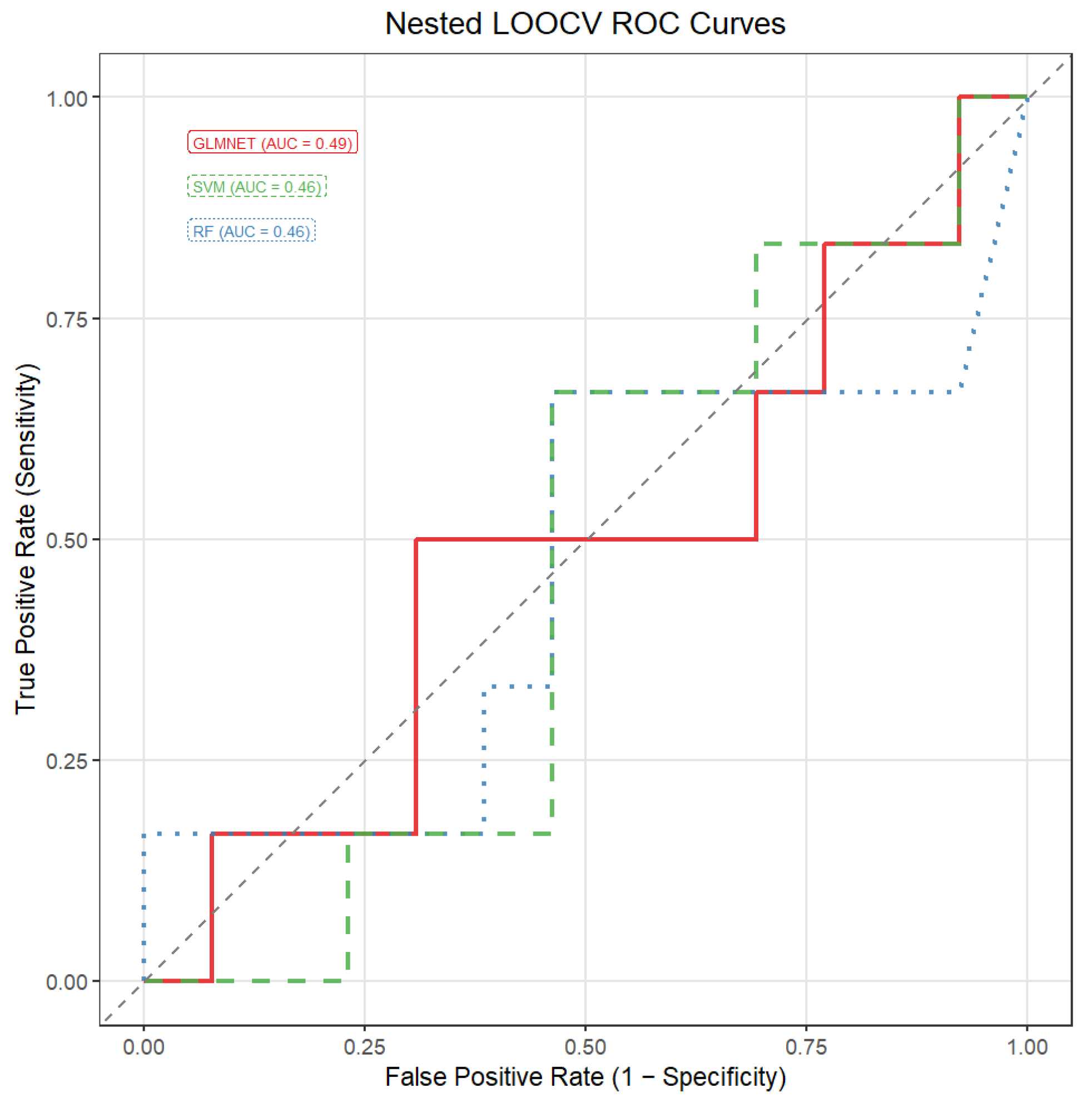
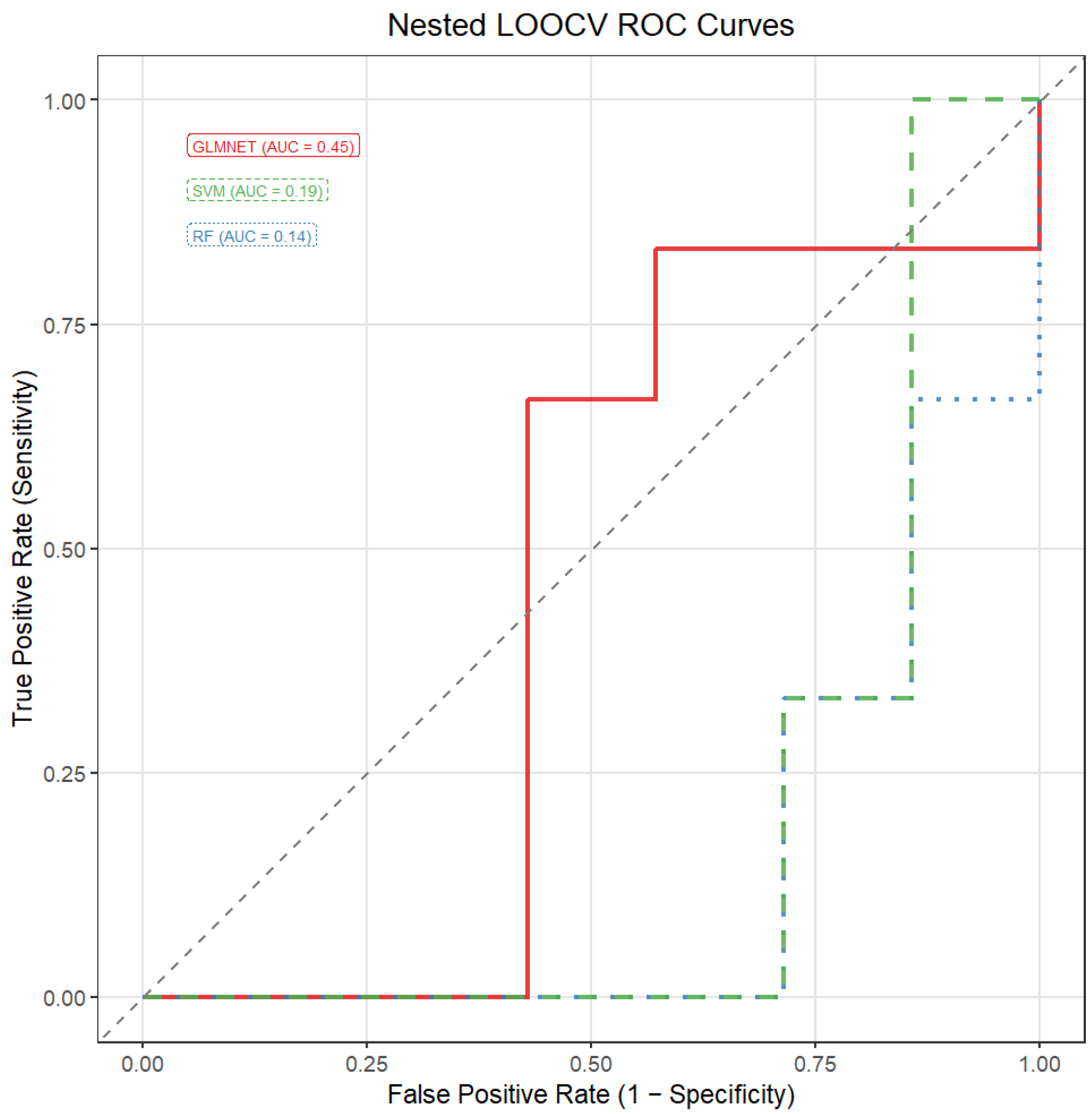
The predictive performance of all the evaluated models, trained using the nested fea-ture-selection and cross-validation procedure described in Section 2.3, was close to chance level. The areas under the ROC curve were 0.46 for the support vector machine, 0.46 for the random forest, and 0.49 for the elastic net logistic regression model. These results indicate that, under the present modelling framework and data constraints, the selected miRNA features do not provide meaningful discriminative power for the classification task.
Figure 3 illustrates the empirical stability of miRNA features estimated from the full dataset using the probe-based selection procedure. As indicated earlier in this section, this analysis was conducted for exploratory and descriptive purposes only, to visualize the relative robustness of individual miRNAs across repeated resampling runs and was not used for feature selection during model training or performance evaluation, which were performed within a fully nested cross-validation framework. The ROC curves for the respective classification models are displayed in Figure 4.
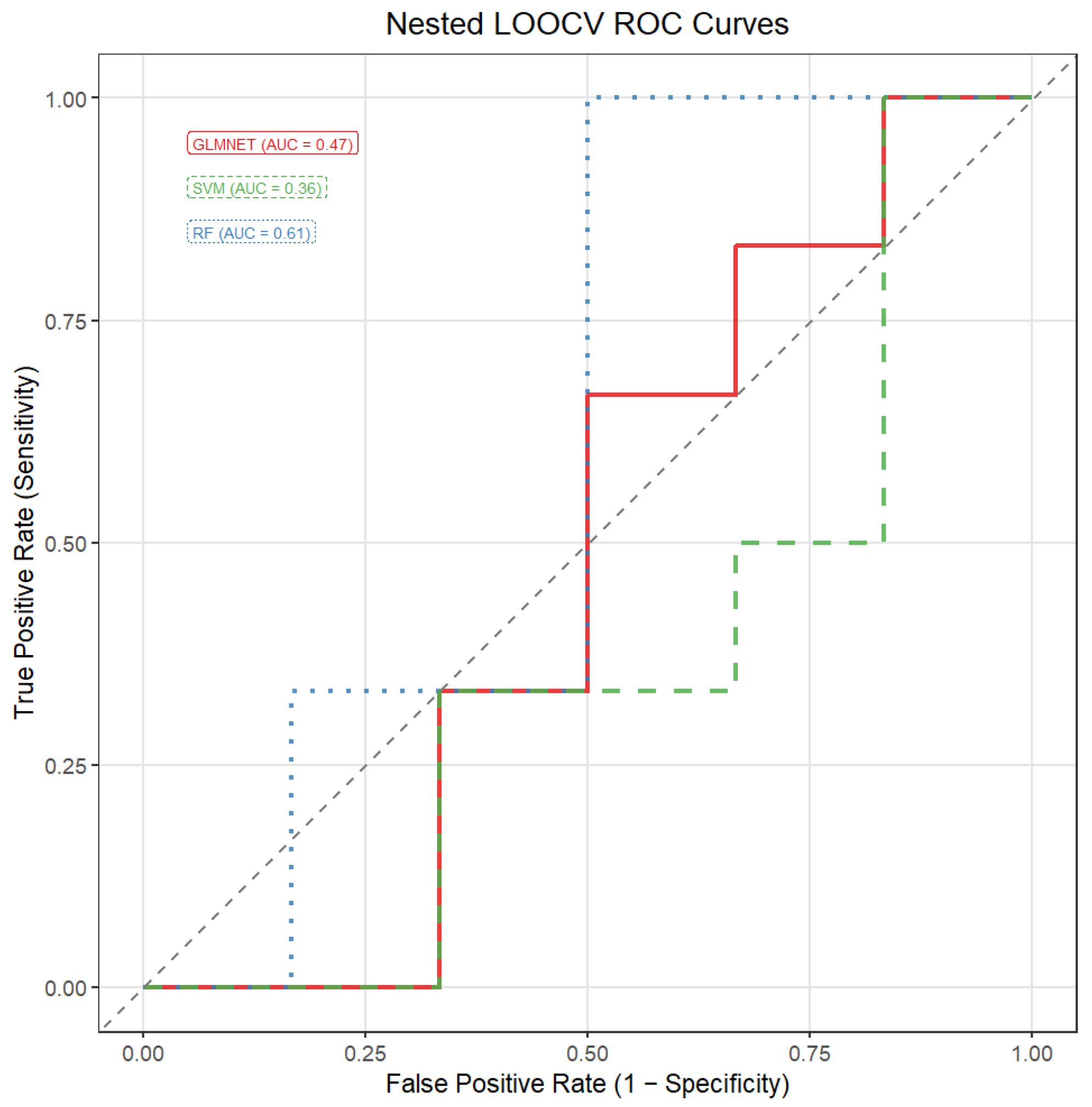
Additional subclass-specific analyses were performed in an exploratory manner. No meaningful discrimination under nested cross-validation was observed in the comparison between the patients with lung cancer and brain metastases versus the patients with lung cancer without brain metastases (Figure 5). In the comparison between the LC + BM and the HC groups, modest and model-dependent discrimination was observed (Figure A1 in Appendix B). These findings suggest that the evaluated miRNA panels may capture biological differences but do not yield reliable predictive performance in the present dataset.

4. Discussion

miRNAs play an important role in the regulation of gene expression and can contribute to all stages of cancer progression, including tumor growth and local and distant invasion. In this study, we focused on the relationships of miRNAs with brain metastases from lung cancer and their relevance as their potential biomarkers.
We found two miRNAs significantly downregulated in the patients with lung cancer and brain metastases compared to the healthy controls: miR-409-3p and miR-485-3p. These miRNAs exhibited very large negative logFC values, reflecting a pronounced relative downregulation at very low level, near the limit of detection. Although extremely low expression of miRNAs has been reported in the existing literature [22,23], the magnitude of downregulation observed in this study appears even greater. This may result from the small size of the study group, as a limited number of samples with near-threshold expression can disproportionately influence group-level estimates. While this points to the direction of differential expression, the absolute values of the observed fold changes should be interpreted with caution and larger, independent cohorts with sufficient power are required to confirm the extent of the observed downregulation.
To address the primary research objective, a binary classification framework was adopted in which the healthy controls and the patients with lung cancer without brain metastases were combined and contrasted against the patients with lung cancer and brain metastases. This design was motivated by the aim of identifying miRNAs potentially associated with central nervous system metastatic involvement rather than with lung cancer presence alone, and by the need to limit the model complexity given the sample size.
An exploratory feature-ranking analysis performed on the full dataset summarized miRNAs that were repeatedly selected by the probe-based procedure. This analysis identified eleven miRNAs with relatively high empirical selection frequencies: miR-363-3p, miR-210-3p, miR-194-5p, miR-409-3p, miR-22-3p, miR-2110, miR-326, miR-485-3p, miR-223-5p, miR-16-2-3p, and miR-139-5p. Among these, miR-363-3p, miR-210-3p, and miR-194-5p exhibited the highest stability across the resampling runs.
Importantly, these exploratory findings were not used to define a fixed feature set for predictive modeling. Instead, feature selection and model training were repeated independently within each cross-validation training fold. When evaluated under this fully nested framework, the resulting classification models demonstrated performance close to chance level, indicating that the identified miRNAs, while biologically plausible candidates, do not provide sufficient discriminative information to support the reliable prediction of brain metastases in the present dataset.
While this approach is justified by an exploratory setting, it does not fully reflect the most clinically relevant scenario, which is the discrimination of lung cancer patients with brain metastases from those without. While it reduces the risk of overfitting, combining HC and LC groups into a single negative class introduces a heterogeneity in the reference group and may bias performance estimates, therefore limiting the transferability to a clinical setting.
We additionally examined the comparison between the patients with lung cancer and brain metastases and those with lung cancer without metastatic involvement of the brain in an exploratory manner. This subgroup analysis revealed similar patterns of association, with the majority of the analyzed miRNAs present in the initial exploratory feature-ranking analysis. However, when evaluated under a fully nested cross-validation framework, these miRNA panels did not yield reliable discriminative performance, indicating that the observed associations should be interpreted only as hypothesis-generating rather than predictive. This analysis addresses a plausible use-case in which a circulating miRNA profile could support risk stratification for intracranial involvement and help prioritize neuroimaging in patients at higher risk. Such biomarkers would be expected to serve as a complementary tool for neuroimaging techniques, and any clinically useful implementation would require predefined thresholds and evaluation in representative cohorts.
The limited discriminative performance observed across all the evaluated classifiers, i.e., GLMNET, SVM and RF, likely reflects a combination of biological and methodological factors. First, the effective sample size in each cross-validation training fold was small, leading to substantial variance in performance estimates and unstable decision boundaries. Second, although several miRNAs were repeatedly selected in exploratory stability analyses as good discriminators, with miR-363-3p, miR-210-3p, and miR-194-5p being the most highly ranked, stable univariate ranking does not necessarily translate into multivariate separability, particularly when class distributions substantially overlap. Third, the distinction between lung cancer patients with and without brain metastases represents a biologically subtle phenotype that may not be strongly reflected in circulating miRNA profiles alone. Finally, the use of a fully nested cross-validation framework with probe-based feature selection minimizes optimistic bias.
Although the evaluated classifiers included both linear and nonlinear methods, it remains possible that more complex nonlinear models could capture higher-order interactions among miRNAs. However, given the limited sample size and the consistently low performance observed under the nested cross-validation, the present data are not likely to support the reliable training or validation of such models.
miR-409-3p has been extensively studied in recent years, as it was shown to be dysregulated in various malignancies. In most reports, a significant downregulation of miR-409-3p was described [24], suggesting an oncosuppressive role, although its upregulation has also been reported, for instance, in glioblastoma [25]. However, despite some inconsistent results, it was demonstrated to negatively affect the expression of proteins involved in the proliferation, metastasis, and apoptosis of tumor cells. Proposed molecular targets for miR-409-3p, include zinc-finger E-box-binding homeobox-1 (ZEB1) [26] and E74-like factor 2 (ELF2) [27] (identified in osteosarcoma), activating transcription factor 1 (ATF1) in cervical cancer [28], hexokinase 2 (HK2) in colon carcinoma [29], and high-mobility group nucleosome-binding domain 5 (HMGN5) in gliomas [30]. miR-409-3p has also been shown to inhibit the expression of some established prooncogenes, such as c-Met [31,32]. Regarding metastasis induction, a potential connection between miR-409-3p and angiogenesis promoting factors may draw particular attention. In the study by Weng et al. [33], miR-409-3p was found to suppress vascularization and metastasis by downregulating the expression of angiogenin in fibrosarcoma cells. Indeed, studies have also demonstrated the low value of miR-409-3p as a biomarker of metastasis and poor prognosis, including in breast [34], prostate [35], and gastric cancers [36].
The data on the significance of the abnormal expression of miR-409-3p in the central nervous system are scarce. Hu et al. observed that miR-409-3p secreted from activated mast cells via exosomes promoted microglial migration and activation, thereby inducing neuroinflammation by targeting the Nr4a2/NF-κB pathway [37].
miR-485-3p has also been previously proposed as a tumor suppressor agent in several malignancies. In prostate cancer cells, treatment with fludarabine reduced the release of miR-485-3p, suggesting that it was retained by the surviving cells, therefore promoting the expression of pro-survival genes [38]. Its expression levels were also found to be lowered in breast cancer tissues, possibly leading to the overexpression of ZEB1 [39] and PGC-1α, which promote spontaneous metastasis in vivo [40], as well as in osteosarcoma cells, where it is responsible for suppressing oncogenic carboxyl-terminal binding protein 1 (CtBP1) [41] and c-MET and AKT3/mTOR signaling [42]. In glioblastoma multiforme (GBM), miR-485-3p inhibited cell proliferation and migration by silencing ring finger protein 135 (RNF135) expression [43] and was established as an independent predictive factor of worse progression-free survival (PFS) and overall survival (OS) [44]. Finally, the downregulation of miR-485-3p was shown to exert an oncogenic role in NSCLC by acting through a SPI1/SNHG6/miR-485-3p/VPS45 axis [45]. Furthermore, miR-485-3p has been previously linked to neuroinflammation modulation, i.e., in Parkinson’s disease [46] and in Alzheimer’s disease [47].
miR-210-3p has been shown to be dysregulated in various cancers, although its role remains unclear. It was demonstrated that miR-210-3p expression is upregulated in lung cancer tissue and may serve as a potential diagnostic biomarker [48,49]. Some authors reported the induction of miR-210-3p expression under hypoxia, enhancing tumor proliferation, migration, and invasion by downregulating E2F3 expression [50] and by regulating C-C motif chemokine 2 (CCL2) mediated monocyte infiltration [51]. Interestingly, in a study by Zhao et al., miR-210 (along with miR-214 and miR-15a) was included in a three-miRNA signature model to predict the brain metastases of lung adenocarcinoma, which achieved high accuracy [52]. However, there are also some reports indicating the potential oncosuppresive role of miR-210-3p in other cancers, e.g., in a study by Yang et al. [53] it was found to inhibit tumor growth and metastases in bladder cancer in vitro and in vivo.
miR-363-3p has been predominantly characterized as a tumor-suppressive miRNA, acting through the inhibition of cell invasion and EMT. Consistently, miR-363-3p overexpression has been shown to suppress these processes in several malignancies (including lung cancer, colorectal cancer, hepatocellular carcinoma and osteosarcoma) by targeting oncogenic regulators such as NEDD9 [54], proliferating cell nuclear antigen (PCNA) [55] and pseudopodium-enriched atypical kinase 1 (PEAK1) [56]. Among these, sex-determining region Y box 4 (SOX4) has been most consistently identified as a relevant target of miR-363-3p [57,58,59,60]. In a study on lung adenocarcinoma cells, long non-coding RNA X-inactive specific transcript (XIST) bound to miR-363-3p was found to change mouse double minute clone 2 (MDM2) expression and regulate proliferation and apoptosis [61]. However, in glioma cells, miR-363-3p may be overexpressed [62], and suppression of miR-363-3p was shown to inhibit invasion and promote cell death by attenuating EMT and blocking the Wnt/β-catenin pathway [63].
miR-194-5p may be involved in metastatic progression through several distinct mechanisms of action. Similar to miR-363-3p, it is considered as a tumor-suppressive factor, and alterations in its expression may promote EMT by regulating specific targets, including Forkhead Box A1 (FOXA1) [64], ZEB1 [65], TEFM [66] and mitochondrial fission regulator 1 (MTFR1) [67]. Interestingly, in mouse models, miR-194-5p upregulation restrained angiogenesis and increased tight junction protein levels in angiotensin II-treated human retinal microvascular endothelial cells via the inactivation of SOX17/VEGF signaling [68]. In another report, the regulation of circ-USP1 via the miR-194-5p/FLI1 axis mediated the regulation of tight junction proteins, causing the disruption of blood–tumor barrier permeability in gliomas [69]. In addition, some hypotheses suggest that miR-194-5p may influence the regulation of proinflammatory cytokine secretion in the central nervous system via the neurexophilin 1 pathway [70], which could play a role in the stabilization of a metastatic niche within the brain. It may be further strengthened by the observation that the sponging of miR-194-5p promoted the PD-L1-mediated immune escape of lung cancer cells [71]. miR-194-5p was also linked to the development of brain metastases in breast cancer by regulating the expression of myocyte enhancer factor 2C (MEF2C), which was hypothesized to facilitate the crosstalk between tumor cells and astrocytes [72]. In the study by Roskova et al. [73], miR-194-5p was included in a panel that effectively distinguished the primary tumor origin in cases of brain metastases.
miR-22-3p has also been associated with NSCLC as a potential tumor suppressor. In one study [74], the expression of miR-22-3p was downregulated in lung adenocarcinoma and negatively correlated with established pro-metastatic factors, such as vascular endothelial growth factor (VEGF), marked microvessel density (MVD), and matrix metalloproteinases (MMP-3 and MMP-7). In another publication [75], the overexpression of miR-22-3p suppressed the migration and the epithelial–mesenchymal transition (EMT) of NSCLC cells by targeting RAS-related C3 botulinum toxin substrate 1 (RAC1). In an experimental setting, miR-22-3p mimics the inhibited MET-STAT3 signaling and induced apoptosis in lung adenocarcinoma cells, which may be significant with regard to metastatic niche colonization [76].
Data on the role of miR-2110 in cancer progression is limited. Available reports showed the possible effect of miR-2110 on the expression of minichromosome maintenance protein 2 (MCM2), which is involved in cancer cell proliferation [77].
Similar to the aforementioned miRNAs, miR-326 exhibits pleiotropic effects, influencing several potential mechanisms associated with metastasis. The potential molecular targets of miR-326 include ZEB1 [78], a transcription factor involved in EMT and the tropism of immunosuppressive cells and chemokines, possibly leading to the formation of a tumor immunosuppressive microenvironment [79]. In lung cancer, miR-326 has been shown to regulate several key pathways involved in tumor invasion, including Krüppel-like factor 3/specificity protein 1 (Sp1/KLF3) [80], beclin 1 (BECN1) [81], cyclin D1 and Bcl-2 [82], CXC Motif Chemokine Receptor 5 (CXCR5) [83] and nucleosome-binding protein 1 (NSBP1) [84]. Moreover, miR-326 has been reported to affect the regulation of SLC7A11, a protein promoting tumor aggressiveness and suppressing ferroptosis in NSCLC cells [85]. Another molecular target of miR-326, ADAM17 was reported to influence the expression of EMT markers [86]. Similar to miR-194-5p, miR-326 also modulates pathways associated with PD-L1, which may impact not only the survival of tumor cells within the metastatic niche but also the development of resistance to targeted therapies [87,88]. An analysis by Sun et al. [89] proved that in NSCLC, miR-326 inhibited the matrix metalloproteinases MMP-7 and MMP-9.
Interestingly, there is emerging evidence suggesting the role of miR-326 in the pathogenesis of neuroinflammatory diseases, particularly multiple sclerosis, where it has been proposed to contribute to TH17 differentiation and maturation [90,91].
In one report, the overexpression of miR-223-5p remarkably suppressed the proliferation of NSCLC cells in vitro and in vivo and led to reduced migration and invasion in NSCLC cells [92]. Similar to miR-326, the inhibition of miR-223-5p promoted SLC7A11 expression and resulted in ferroptosis suppression in NSCLC cells [93].
Despite the limited data available in lung cancer, miR-16-2-3p is considered an oncosuppressive miRNA. In other cancers, its influence on primary tumor growth, metastasis seeding, chemoresistance, and invasiveness has been reported through the modulation of the expression of targets such as fibroblast growth factor receptor 2 (FGFR2) [94]. In bladder cancer, miR-16-2-3p was found to influence the expression of the Wnt5a/ZEB1 axis, therefore preventing EMT [95].
miR-139-5p acts as a tumor suppressor and is known to be downregulated in lung adenocarcinoma [96]. In NSCLC, the decreased expression of miR-139 was significantly associated with distant lymph node metastasis and histological invasiveness [97], as well as lytic bone metastasis [98]. miR-139-5p has been primarily associated with the regulation of factors involved in EMT. One of its most strongly linked molecular targets is ZEB1, described in lung cancer and in other malignancies [99,100,101]. Additional targets which were proposed in the literature include matrix metalloproteinase 2 (MMP2) [102], ATPase Family AAA Domain Containing 2 (ATAD2) [103], and cyclin D2 [104]. Moreover, the upregulation of miR-139-5p can inhibit NSCLC proliferation, migration, and invasion in vitro via targeting insulin-like growth factor 1 receptor (IGF1R) [105,106]. It was shown that endothelial CXC Motif Chemokine Receptor 4 (CXCR4) is negatively regulated by miR-139-5p [107], which may be important in the context of tumor-related angiogenesis. The association between miR-139-5p and CXCR4 was later confirmed in squamous cell carcinoma [108].
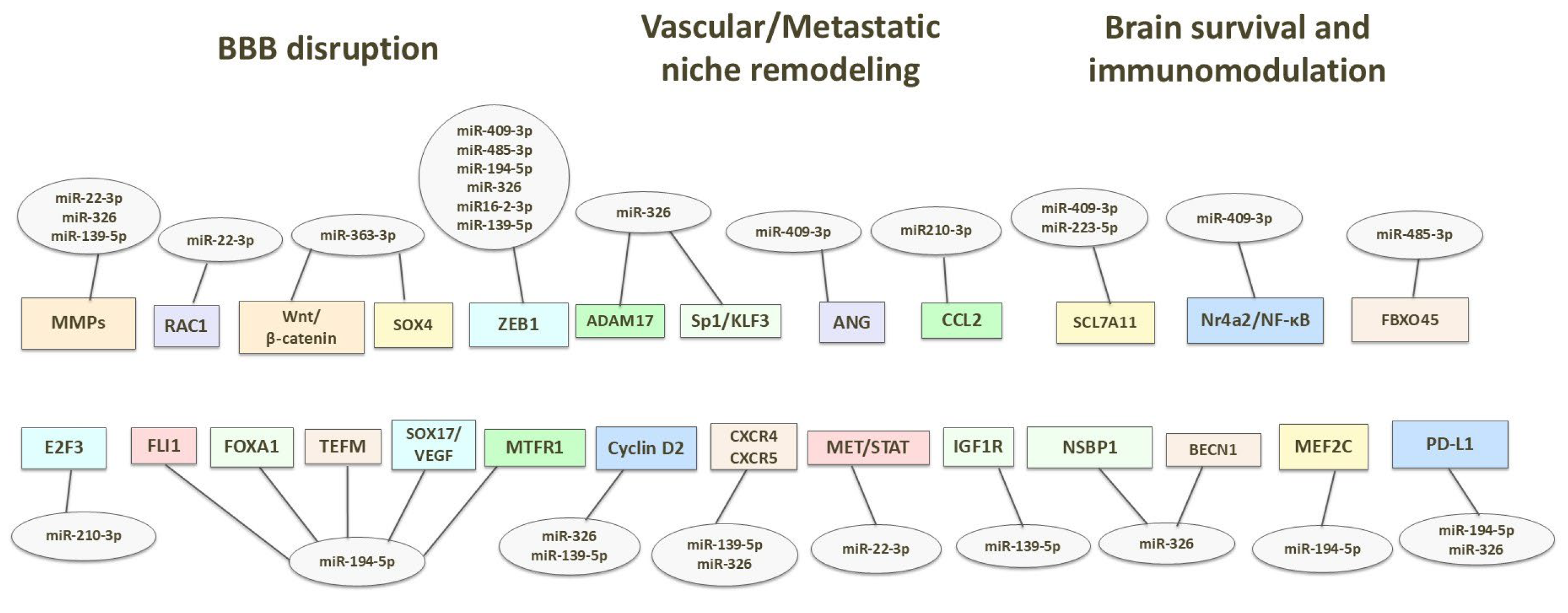
Despite the limited evidence directly linking miRNA profiles to the risk for brain metastases from lung cancer, our study provides new insights into the potential role of miRNA expression in this field. The miRNAs identified as relevant in our study may exert both oncogenic and oncosuppressive effects, and some of them are also involved in neoplastic or inflammatory processes within the nervous tissue. It is worth emphasizing that the CNS represents a distinct metastatic site, separated by the blood–brain barrier (BBB), which dynamically regulates the transfer of particles and cells from the systemic circulation. Therefore, the mechanisms of the metastasis to the brain may be unique and more complex in comparison to other sites of cancer spread. These mechanisms may include promoting the transmigration of circulating tumor cells across the blood–brain barrier by impairing the integrity of brain microvascular endothelial cells (BMECs) and altering vascular structure and function (i.e., angiogenesis and increased small vessels permeability), processes supporting the establishment of a premetastatic microenvironment and the adaptation/survival of tumor cells within the brain tissue [109,110]. Figure 6 shows potential molecular targets of the analyzed miRNAs, consistent with their involvement in the spread of cancer to the CNS.
Although the available data in the literature are limited, some other miRNAs have also been linked to CNS involvement in lung cancer and were suggested to regulate metabolic pathways directly associated with the unique characteristics of brain metastases. Li et al. [111] reported the modulating effect of miR-596-3p on YAP1 and IL-8, factors known to inhibit the invasion of cancer cells and the permeability of the BBB. YAP1 was also shown to be regulated by miR-550a-3-5p, which was significantly enriched in brain metastatic exosomes in lung cancer [112]. Among the miRNAs potentially promoting metastasis by modifying the BBB, there are also miRNA-522-3p [113] and miR-1207-5p [114]. miR-21, similar to the miR-22-3p revealed in our study, may influence apoptosis mechanisms in the metastatic niche via STAT3 [115]. Moreover, several other miRNAs were found to be dysregulated in lung cancer with CNS involvement, such as miRNA-197 and miRNA-184 [116], miRNA-328 and miRNA-378 [117], miR-328 [118], mmiR-330-3p [119] and miR-375 [120]. Tsakonas et al. [121] developed a panel of 11 miRNAs that differentiated primary NSCLC and brain metastases based on tissue biopsies. However, the particular mode of action of these miRNAs has not been defined. The heterogeneity of the cited findings likely reflects the diversity in the type of biological material analyzed (tissue vs. serum/plasma), the patient selection, the disease stage, and the methodological approaches. A lack of clear conclusions from these studies emphasizes the need for further investigation.
In this study, we assessed serum miRNA expression profiles in lung cancer patients with and without metastases to the CNS and compared them to healthy subjects. In order to maximize the chance of identifying potential biomarkers differentiating patients with brain metastases in relatively small groups of participants, we decided to use an exploratory approach using a broad panel of 179 specific miRNAs instead of focusing on a previously selected narrow set of molecules. We believe that the use of a broad miRNA panel allows for a hypothesis-generating purpose of the analysis and for the detection of candidate miRNAs that can be validated in larger, independent cohorts. Such a methodology minimizes the risk of omitting miRNAs potentially important for the metastatic progression of the disease, especially given the fact that there is still a knowledge gap regarding the role of miRNAs in CNS neoplastic involvement. Another strength of this study is associated with the application of up-to-date analytical techniques, including machine learning algorithms, which allowed a more accurate identification of complex associations between the selected variables.
We believe that these preliminary results encourage further investigation on miRNA profiles as putative biomarkers of CNS involvement in lung cancer. The expected clinical benefits from applying such a predictive tool would include the early identification of patients at increased risk for brain metastases and an individualized approach to their management (intensive treatment strategies and regular follow-up).
Nevertheless, several limitations need to be acknowledged. The sample size was relatively small, which might have substantially affected the robustness and generalizability of the results. The restricted size of the study group precluded the use of an independent external validation set. Therefore, all the obtained results are interpreted purely exploratorily as indicators of a potential signal rather than validated diagnostic tools.
Additional potential limitations include preanalytical factors that may have influenced the miRNA stability and measured expression levels, such as differences in the duration of sample storage prior to the analysis. Serum storage at −20 °C (rather than −80 °C) may also represent a preanalytical limitation that could contribute to measurement variability. Although all the samples were processed according to standardized protocols, such sources of technical variability cannot be fully excluded and may have contributed to the observed differences, especially given the small groups.
In addition, given the limited number of cases, it was not possible to perform a reliable analysis according to the different histological subtypes of lung cancer, which may exhibit distinct molecular and metastatic profiles. Furthermore, the LC + BM group tended to have a more advanced disease at baseline, which may have partially contributed to the observed miRNA expression differences. The LC versus LC + BM contrast was not fully clinically homogeneous. The LC group included patients with metastases to the other lung, while the LC + BM group exhibited additional extracranial metastatic disease (liver and adrenal gland). Due to the limited sample size, sensitivity analyses restricted to clinically more homogenous subgroups were not feasible. A possible oncologic treatment-related variability in miRNA expression may also exist. The serum sampling at admission occurred at variable time points relative to the diagnosis and the treatment initiation, which could have influenced the circulating miRNA levels. Therefore, the observed miRNA differences may partially reflect the global metastatic burden and treatment-related effects. Larger, clinically stratified cohorts with standardized sampling and adjustment for potential confounding factors are required for confirmatory evaluation. Nevertheless, the type of analysis applied in this study was supposed to reveal robust miRNA signals that persist regardless of therapeutic context.

5. Conclusions

In this study, we found differences in the expression of particular miRNAs and reviewed candidate miRNAs potentially associated with the development of brain metastases in lung cancer. However, under a fully nested framework, the analyzed classification models in the present dataset did not demonstrate sufficient discriminative information to support a reliable prediction of brain metastases.
While our analysis provides only exploratory insights, the findings should be interpreted with caution and require validation in larger, independent cohorts before any clinical or translational implications can be established. Therefore, there is a need for further studies focusing on establishing causal associations within the molecular pathways underlying central nervous system involvement in lung cancer.

Author Contributions

Conceptualization—K.M., A.P.-D., A.B.-B. and Ł.Ł.; methodology, K.M., A.P.-D., A.B.-B. and Ł.Ł.; laboratory and data analysis, M.P., D.K. and Ł.Ł.; investigation and resources, K.M., M.K., A.K. and M.M.; writing—original draft preparation, K.M.; writing—review and editing, A.B.-B., S.B., A.P.-D., M.P. and Ł.Ł.; supervision, A.B.-B., S.B., A.P.-D. and Ł.Ł.; project administration, funding acquisition, K.M. and A.P.-D. All authors have read and agreed to the published version of the manuscript.

Funding

This study was supported by a subsidy from the Wroclaw Medical University (grant no. SUBK.C220.23.054).

Institutional Review Board Statement

All the procedures were performed in accordance with the Declaration of Helsinki and its further amendments. All the participants provided written informed consent prior to inclusion in this study. The project of this study was approved by the Wroclaw Medical University Bioethics Committee (approval no. KB-918/2021 and date of approval: 26 November 2021).

Informed Consent Statement

Informed consent was obtained from all the subjects involved in this study.

Data Availability Statement

The datasets analyzed during this study are available from the corresponding author on reasonable request.

Acknowledgments

The authors thank all the participants and sincerely thank the patients with lung cancer for their valuable contribution to this study.

Conflicts of Interest

The authors declare no conflicts of interest.

Abbreviations

The following abbreviations are used in this manuscript:
LCLung cancer
miRNAsMicroRNAs
NSCLCNon-small cell lung cancer
SCLCSmall cell lung cancer
HCHealthy control
BMBrain metastasis
CNSCentral nervous system
OSOverall survival
LRLogistic regression
SVMSupport vector machine
RFRandom forest

Appendix A

Table A1. Detailed study group characteristics.
Study GroupGender
(F—Female, M—Male)
Age (Years)Histological Type
of LC
TNMTime From Diagnosis (Months)Site of MetastasesComorbiditiesCurrent Smoking StatusTreatmentTreatment status
Lung cancer without BM
LC1F71NSCLCT1N0M01 AH, HFrEFNoSurgicalSurgical treatment 1 month prior to sampling
LC2F54NSCLCT4N2M118other lung AH, anemiaNoImmunotherapy, CTHActive (systemic therapy 1 month prior to sampling)
LC3F73NSCLCT2N0M01 AH, asthma/COPD, hypothyroidism NoSurgicalSurgical treatment 1 month prior to sampling
LC4F64NSCLCT3N0M136other lung AH, DM2, obesityNoImmunotherapyActive (systemic therapy 1 month prior to sampling)
LC5M61NSCLCT2N0M01 BPHNoSurgicalSurgical treatment 1 month prior to sampling
LC6M65NSCLCT2N0M01 YesSurgicalSurgical treatment 1 month prior to sampling
LC7M75NSCLCT1N0M03 COPD, AH, obesityNoSurgical, CTHActive (systemic therapy 1 month prior to sampling)
Lung cancer
with BM
LCBM1F71NSCLCT4N2M12brain,
liver
AHNoCTH, RTHTreatment initiated after sampling
LCBM2F53NSCLCT4N2M11brain, adrenal glandAH, anemiaNoCTH, RTHTreatment initiated after sampling
LCBM3F58NSCLCT1N2M11brainAlcohol use disorderNoSurgical (palliative)Treatment initiated after sampling
LCBM4F75NSCLCT2N3M11brainAHYesPalliative careTreatment initiated after sampling
LCBM5M56NSCLCT2N3M11brain, adrenal gland YesPalliative careTreatment initiated after sampling
LCBM6M66NSCLCT4N1M113brain, other lungbenign hyperthyroidismNoCTH, RTHSystemic therapy in the past (more than 6 months prior to sampling)
Healthy controls
HC1F79 No
HC2F71 AF, obesityNo
HC3F54 No
HC4F73 AHNo
HC5M55 No
HC6M75 AHNo

Appendix B

Figure A1. ROC curves for the classification models. Comparison of lung cancer with BM vs. HC groups. GLMNET—logistic regression with elastic net regularization; SVM—support vector machine; RF—random forest; AUC—area under the ROC curve.
Jcm 15 01083 g0a1

References

  1. Bray, F.; Laversanne, M.; Sung, H.; Ferlay, J.; Siegel, R.L.; Soerjomataram, I.; Jemal, A. Global cancer statistics 2022: GLOBOCAN estimates of incidence and mortality worldwide for 36 cancers in 185 countries. CA Cancer J. Clin. 2024, 74, 229–263. [Google Scholar] [CrossRef]
  2. Riihimäki, M.; Hemminki, A.; Fallah, M.; Thomsen, H.; Sundquist, K.; Sundquist, J.; Hemminki, K. Metastatic sites and survival in lung cancer. Lung Cancer 2014, 86, 78–84. [Google Scholar] [CrossRef] [PubMed]
  3. Waqar, S.N.; Samson, P.P.; Robinson, C.G.; Bradley, J.; Devarakonda, S.; Du, L.; Govindan, R.; Gao, F.; Puri, V.; Morgensztern, D. Non-small-cell Lung Cancer With Brain Metastasis at Presentation. Clin. Lung Cancer 2018, 19, e373–e379. [Google Scholar] [CrossRef] [PubMed]
  4. Quan, A.L.; Videtic, G.M.; Suh, J.H. Brain metastases in small cell lung cancer. Oncology 2004, 18, 961–987. [Google Scholar] [PubMed]
  5. He, X.; Yin, S.; Liu, H.; Lu, R.; Kernstine, K.; Gerber, D.E.; Xie, Y.; Yang, D.M. Upfront Brain Treatments Followed by Lung Surgery Improves Survival for Stage IV Non-small Cell Lung Cancer Patients with Brain Metastases: A Large Cohort Analysis. Front. Surg. 2021, 8, 649531. [Google Scholar] [CrossRef]
  6. Shin, D.Y.; Na, I.I.; Kim, C.H.; Park, S.; Baek, H.; Yang, S.H. EGFR mutation and brain metastasis in pulmonary adenocarcinomas. J. Thorac. Oncol. 2014, 9, 195–199. [Google Scholar] [CrossRef]
  7. Fallet, V.; Cadranel, J.; Doubre, H.; Toper, C.; Monnet, I.; Chinet, T.; Oliviero, G.; Foulon, G.; De Cremoux, H.; Vieira, T.; et al. Prospective screening for ALK: Clinical features and outcome according to ALK status. Eur. J. Cancer 2014, 50, 1239–1246. [Google Scholar] [CrossRef]
  8. Singh, R.; Lehrer, E.J.; Ko, S.; Peterson, J.; Lou, Y.; Porter, A.B.; Kotecha, R.; Brown, P.D.; Zaorsky, N.G.; Trifiletti, D.M. Brain metastases from non-small cell lung cancer with EGFR or ALK mutations: A systematic review and meta-analysis of multidisciplinary approaches. Radiother. Oncol. J. Eur. Soc. Ther. Radiol. Oncol. 2020, 144, 165–179. [Google Scholar] [CrossRef]
  9. Ma, J.; Pang, X.; Zhang, S.; Huang, L.; Sun, L.; Han, C. First-line treatment of EGFR-mutated non-small cell lung cancer with brain metastases: A systematic review and meta-analysis. Sci. Rep. 2024, 14, 22901. [Google Scholar] [CrossRef]
  10. Marschollek, K.; Brzecka, A.; Pokryszko-Dragan, A. New biochemical, immune and molecular markers in lung cancer: Diagnostic and prognostic opportunities. Adv. Clin. Exp. Med. Off. Organ Wroc. Med. Univ. 2022, 31, 1391–1411. [Google Scholar] [CrossRef]
  11. Krol, J.; Loedige, I.; Filipowicz, W. The widespread regulation of microRNA biogenesis, function and decay. Nature reviews. Genetics 2010, 11, 597–610. [Google Scholar] [CrossRef]
  12. Budakoti, M.; Panwar, A.S.; Molpa, D.; Singh, R.K.; Büsselberg, D.; Mishra, A.P.; Coutinho, H.D.M.; Nigam, M. Micro-RNA: The darkhorse of cancer. Cell. Signal. 2021, 83, 109995. [Google Scholar] [CrossRef]
  13. Yu, L.; Todd, N.W.; Xing, L.; Xie, Y.; Zhang, H.; Liu, Z.; Fang, H.; Zhang, J.; Katz, R.L.; Jiang, F. Early detection of lung adenocarcinoma in sputum by a panel of microRNA markers. Int. J. Cancer 2010, 127, 2870–2878. [Google Scholar] [CrossRef] [PubMed]
  14. Fehlmann, T.; Kahraman, M.; Ludwig, N.; Backes, C.; Galata, V.; Keller, V.; Geffers, L.; Mercaldo, N.; Hornung, D.; Weis, T.; et al. Evaluating the Use of Circulating MicroRNA Profiles for Lung Cancer Detection in Symptomatic Patients. JAMA Oncol. 2020, 6, 714–723. [Google Scholar] [CrossRef] [PubMed]
  15. Pu, Q.; Huang, Y.; Lu, Y.; Peng, Y.; Zhang, J.; Feng, G.; Wang, C.; Liu, L.; Dai, Y. Tissue-specific and plasma microRNA profiles could be promising biomarkers of histological classification and TNM stage in non-small cell lung cancer. Thorac. Cancer 2016, 7, 348–354. [Google Scholar] [CrossRef] [PubMed]
  16. Lobera, E.S.; Varela, M.A.; Jimenez, R.L.; Moreno, R.B. miRNA as biomarker in lung cancer. Mol. Biol. Rep. 2023, 50, 9521–9527. [Google Scholar] [CrossRef]
  17. Wang, Y.; Gu, J.; Roth, J.A.; Hildebrandt, M.A.; Lippman, S.M.; Ye, Y.; Minna, J.D.; Wu, X. Pathway-based serum microRNA profiling and survival in patients with advanced stage non-small cell lung cancer. Cancer Res. 2013, 73, 4801–4809. [Google Scholar] [CrossRef]
  18. Zhong, S.; Golpon, H.; Zardo, P.; Borlak, J. miRNAs in lung cancer. A systematic review identifies predictive and prognostic miRNA candidates for precision medicine in lung cancer. Transl. Res. J. Lab. Clin. Med. 2021, 230, 164–196. [Google Scholar] [CrossRef]
  19. Pawelka, D.; Laczmanska, I.; Karpinski, P.; Supplitt, S.; Witkiewicz, W.; Knychalski, B.; Pelak, J.; Zebrowska, P.; Laczmanski, L. Machine-learning-based Analysis Identifies miRNA Expression Profile for Diagnosis and Prediction of Colorectal Cancer: A Preliminary Study. Cancer Genom. Proteom. 2022, 19, 503–511. [Google Scholar] [CrossRef]
  20. Guyon, I.; Elisseeff, A. An introduction to variable and feature selection. J. Mach. Learn. Res. 2003, 3, 1157–1182. [Google Scholar]
  21. Meinshausen, N.; Bühlmann, P. Stability selection. J. R. Stat. Soc. Ser. B 2010, 72, 417–473. [Google Scholar] [CrossRef]
  22. Towle, R.; Dickman, C.T.D.; MacLellan, S.A.; Chen, J.; Prisman, E.; Guillaud, M.; Garnis, C. Identification of a serum-based microRNA signature that detects recurrent oral squamous cell carcinoma before it is clinically evident. Br. J. Cancer 2023, 129, 1810–1817. [Google Scholar] [CrossRef] [PubMed]
  23. Brown, R.A.M.; Phillips, M.; Woo, A.J.; Kujan, O.; Flukes, S.; Winteringham, L.N.; Dymond, L.C.; Wheeler, F.; Pollock, B.; Beveridge, D.J.; et al. Systematic Review and Meta-Analysis of microRNA-7-5p Expression and Biological Significance in Head and Neck Squamous Cell Carcinoma. Cancers 2023, 17, 3232. [Google Scholar] [CrossRef] [PubMed]
  24. Xie, W.; Wang, Z.; Wang, J.; Wang, X.; Guan, H. Investigating the molecular mechanisms of microRNA 409 3p in tumor progression: Towards targeted therapeutics (Review). Int. J. Oncol. 2024, 65, 67. [Google Scholar] [CrossRef]
  25. Khalil, S.; Fabbri, E.; Santangelo, A.; Bezzerri, V.; Cantù, C.; Di Gennaro, G.; Finotti, A.; Ghimenton, C.; Eccher, A.; Dechecchi, M.; et al. miRNA array screening reveals cooperative MGMT-regulation between miR-181d-5p and miR-409-3p in glioblastoma. Oncotarget 2016, 7, 28195–28206. [Google Scholar] [CrossRef]
  26. Wu, L.; Zhang, Y.; Huang, Z.; Gu, H.; Zhou, K.; Yin, X.; Xu, J. MiR-409-3p Inhibits Cell Proliferation and Invasion of Osteosarcoma by Targeting Zinc-Finger E-Box-Binding Homeobox-1. Front. Pharmacol. 2019, 10, 137. [Google Scholar] [CrossRef]
  27. Zhang, J.; Hou, W.; Jia, J.; Zhao, Y.; Zhao, B. MiR-409-3p regulates cell proliferation and tumor growth by targeting E74-like factor 2 in osteosarcoma. FEBS Open Bio 2017, 7, 348–357. [Google Scholar] [CrossRef]
  28. Cui, X.; Chen, J.; Zheng, Y.; Shen, H. Circ_0000745 Promotes the Progression of Cervical Cancer by Regulating miR-409-3p/ATF1 Axis. Cancer Biother. Radiopharm. 2022, 37, 766–778. [Google Scholar] [CrossRef]
  29. Chen, J.; Wang, R.; Lu, E.; Song, S.; Zhu, Y. LINC00630 as a miR-409-3p sponge promotes apoptosis and glycolysis of colon carcinoma cells via regulating HK2. Am. J. Transl. Res. 2022, 14, 863–875. [Google Scholar]
  30. Cao, Y.; Zhang, L.; Wei, M.; Jiang, X.; Jia, D. MicroRNA-409-3p Represses Glioma Cell Invasion and Proliferation by Targeting High-Mobility Group Nucleosome-Binding Domain 5. Oncol. Res. 2017, 25, 1097–1107. [Google Scholar] [CrossRef]
  31. Xu, X.; Chen, H.; Lin, Y.; Hu, Z.; Mao, Y.; Wu, J.; Xu, X.; Zhu, Y.; Li, S.; Zheng, X.; et al. MicroRNA-409-3p inhibits migration and invasion of bladder cancer cells via targeting c-Met. Mol. Cells 2013, 36, 62–68. [Google Scholar] [CrossRef]
  32. Wan, L.; Zhu, L.; Xu, J.; Lu, B.; Yang, Y.; Liu, F.; Wang, Z. MicroRNA-409-3p functions as a tumor suppressor in human lung adenocarcinoma by targeting c-Met. Cell. Physiol. Biochem. Int. J. Exp. Cell. Physiol. Biochem. Pharmacol. 2014, 34, 1273–1290. [Google Scholar] [CrossRef] [PubMed]
  33. Weng, C.; Dong, H.; Chen, G.; Zhai, Y.; Bai, R.; Hu, H.; Lu, L.; Xu, Z. miR-409-3p inhibits HT1080 cell proliferation, vascularization and metastasis by targeting angiogenin. Cancer Lett. 2012, 323, 171–179. [Google Scholar] [CrossRef] [PubMed]
  34. Cao, G.H.; Sun, X.L.; Wu, F.; Chen, W.F.; Li, J.Q.; Hu, W.C. Low expression of miR-409-3p is a prognostic marker for breast cancer. Eur. Rev. Med. Pharmacol. Sci. 2016, 20, 3825–3829. [Google Scholar] [PubMed]
  35. Josson, S.; Gururajan, M.; Hu, P.; Shao, C.; Chu, G.Y.; Zhau, H.E.; Liu, C.; Lao, K.; Lu, C.L.; Lu, Y.T.; et al. miR-409-3p/-5p promotes tumorigenesis, epithelial-to-mesenchymal transition, and bone metastasis of human prostate cancer. Clin. Cancer Res. Off. J. Am. Assoc. Cancer Res. 2014, 20, 4636–4646. [Google Scholar] [CrossRef]
  36. Wang, Y.; Zhang, J.; Chen, X.; Gao, L. Circ_0001023 Promotes Proliferation and Metastasis of Gastric Cancer Cells Through miR-409-3p/PHF10 Axis. OncoTargets Ther. 2020, 13, 4533–4544. [Google Scholar] [CrossRef]
  37. Hu, L.; Si, L.; Dai, X.; Dong, H.; Ma, Z.; Sun, Z.; Li, N.; Sha, H.; Chen, Y.; Qian, Y.; et al. Exosomal miR-409-3p secreted from activated mast cells promotes microglial migration, activation and neuroinflammation by targeting Nr4a2 to activate the NF-κB pathway. J. Neuroinflammation 2021, 18, 68. [Google Scholar] [CrossRef]
  38. Lucotti, S.; Rainaldi, G.; Evangelista, M.; Rizzo, M. Fludarabine treatment favors the retention of miR-485-3p by prostate cancer cells: Implications for survival. Mol. Cancer 2013, 12, 52. [Google Scholar] [CrossRef]
  39. Xie, C.; Li, J.; Xu, C.; Xiong, W.; Yuan, X. CircRNA DNA methyltransferase 1 silence inhibits breast cancer development by regulating micoRNA-485-3p/zinc finger E-box binding homeobox 1 axis. J. Obstet. Gynaecol. Res. 2021, 47, 1068–1081. [Google Scholar] [CrossRef]
  40. Lou, C.; Xiao, M.; Cheng, S.; Lu, X.; Jia, S.; Ren, Y.; Li, Z. MiR-485-3p and miR-485-5p suppress breast cancer cell metastasis by inhibiting PGC-1α expression. Cell Death Dis. 2016, 7, e2159. [Google Scholar] [CrossRef]
  41. Du, K.; Zhang, X.; Lou, Z.; Guo, P.; Zhang, F.; Wang, B.; Chen, L.; Zhang, C. MicroRNA485-3p negatively regulates the transcriptional co-repressor CtBP1 to control the oncogenic process in osteosarcoma cells. Int. J. Biol. Sci. 2018, 14, 1445–1456. [Google Scholar] [CrossRef] [PubMed]
  42. Wang, Q.; Liu, M.J.; Bu, J.; Deng, J.L.; Jiang, B.Y.; Jiang, L.D.; He, X.J. miR-485-3p regulated by MALAT1 inhibits osteosarcoma glycolysis and metastasis by directly suppressing c-MET and AKT3/mTOR signalling. Life Sci. 2021, 268, 118925. [Google Scholar] [CrossRef]
  43. Zhang, Y.; Sui, R.; Chen, Y.; Liang, H.; Shi, J.; Piao, H. Downregulation of miR-485-3p promotes glioblastoma cell proliferation and migration via targeting RNF135. Exp. Ther. Med. 2019, 18, 475–482. [Google Scholar] [CrossRef] [PubMed]
  44. Wang, Z.Q.; Zhang, M.Y.; Deng, M.L.; Weng, N.Q.; Wang, H.Y.; Wu, S.X. Low serum level of miR-485-3p predicts poor survival in patients with glioblastoma. PLoS ONE 2017, 12, e0184969. [Google Scholar] [CrossRef] [PubMed]
  45. Gao, N.; Ye, B. SPI1-induced upregulation of lncRNA SNHG6 promotes non-small cell lung cancer via miR-485-3p/VPS45 axis. Biomed. Pharmacother. Biomed. Pharmacother. 2020, 129, 110239. [Google Scholar] [CrossRef]
  46. Lin, X.; Wang, R.; Li, R.; Tao, T.; Zhang, D.; Qi, Y. Diagnostic Performance of miR-485-3p in Patients with Parkinson’s Disease and its Relationship with Neuroinflammation. Neuromolecular Med. 2022, 24, 195–201. [Google Scholar] [CrossRef]
  47. Koh, H.S.; Lee, S.; Lee, H.J.; Min, J.W.; Iwatsubo, T.; Teunissen, C.E.; Cho, H.J.; Ryu, J.H. Targeting MicroRNA-485-3p Blocks Alzheimer’s Disease Progression. Int. J. Mol. Sci. 2021, 22, 13136. [Google Scholar] [CrossRef]
  48. Świtlik, W.Z.; Karbownik, M.S.; Suwalski, M.; Kozak, J.; Szemraj, J. Serum miR-210-3p as a Potential Noninvasive Biomarker of Lung Adenocarcinoma: A Preliminary Study. Genet. Test. Mol. Biomark. 2019, 23, 353–358. [Google Scholar] [CrossRef]
  49. Chen, Q.; Zhang, H.; Zhang, J.; Shen, L.; Yang, J.; Wang, Y.; Ma, J.; Zhuan, B. miR-210-3p Promotes Lung Cancer Development and Progression by Modulating USF1 and PCGF3. OncoTargets Ther. 2021, 14, 3687–3700. [Google Scholar] [CrossRef]
  50. Zhang, X.B.; Song, Y.; Lai, Y.T.; Qiu, S.Z.; Hu, A.K.; Li, D.X.; Zheng, N.S.; Zeng, H.Q.; Lin, Q.C. MiR-210-3p enhances intermittent hypoxia-induced tumor progression via inhibition of E2F3. Sleep Breath. 2024, 28, 607–617. [Google Scholar] [CrossRef]
  51. Arora, L.; Patra, D.; Roy, S.; Nanda, S.; Singh, N.; Verma, A.K.; Chakraborti, A.; Dasgupta, S.; Pal, D. Hypoxia-induced miR-210-3p expression in lung adenocarcinoma potentiates tumor development by regulating CCL2 mediated monocyte infiltration. Mol. Oncol. 2024, 18, 1278–1300. [Google Scholar] [CrossRef] [PubMed]
  52. Yang, X.; Shi, L.; Yi, C.; Yang, Y.; Chang, L.; Song, D. MiR-210-3p inhibits the tumor growth and metastasis of bladder cancer via targeting fibroblast growth factor receptor-like 1. Am. J. Cancer Res. 2017, 7, 1738–1753. [Google Scholar] [PubMed]
  53. Zhao, S.; Yu, J.; Wang, L. Machine Learning Based Prediction of Brain Metastasis of Patients with IIIA-N2 Lung Adenocarcinoma by a Three-miRNA Signature. Transl. Oncol. 2018, 11, 157–167. [Google Scholar] [CrossRef] [PubMed]
  54. Chang, J.; Gao, F.; Chu, H.; Lou, L.; Wang, H.; Chen, Y. miR-363-3p inhibits migration, invasion, and epithelial-mesenchymal transition by targeting NEDD9 and SOX4 in non-small-cell lung cancer. J. Cell. Physiol. 2020, 235, 1808–1820. [Google Scholar] [CrossRef]
  55. Wang, Y.; Chen, T.; Huang, H.; Jiang, Y.; Yang, L.; Lin, Z.; He, H.; Liu, T.; Wu, B.; Chen, J.; et al. miR-363-3p inhibits tumor growth by targeting PCNA in lung adenocarcinoma. Oncotarget 2017, 8, 20133–20144. [Google Scholar] [CrossRef]
  56. Geng, Q.; Li, Z.; Li, X.; Wu, Y.; Chen, N. LncRNA NORAD, sponging miR-363-3p, promotes invasion and EMT by upregulating PEAK1 and activating the ERK signaling pathway in NSCLC cells. J. Bioenerg. Biomembr. 2021, 53, 321–332. [Google Scholar] [CrossRef]
  57. Wang, K.; Yan, L.; Lu, F. miR-363-3p Inhibits Osteosarcoma Cell Proliferation and Invasion via Targeting SOX4. Oncol. Res. 2019, 27, 157–163. [Google Scholar] [CrossRef]
  58. Hu, F.; Min, J.; Cao, X.; Liu, L.; Ge, Z.; Hu, J.; Li, X. MiR-363-3p inhibits the epithelial-to-mesenchymal transition and suppresses metastasis in colorectal cancer by targeting Sox4. Biochem. Biophys. Res. Commun. 2016, 474, 35–42. [Google Scholar] [CrossRef]
  59. Wang, J.; Tang, Q.; Lu, L.; Luo, Z.; Li, W.; Lu, Y.; Pu, J. LncRNA OIP5-AS1 interacts with miR-363-3p to contribute to hepatocellular carcinoma progression through up-regulation of SOX4. Gene Ther. 2019, 27, 495–504. [Google Scholar] [CrossRef]
  60. Jin, L.; Chen, C.; Huang, L.; Sun, Q.; Bu, L. Long noncoding RNA NR2F1-AS1 stimulates the tumorigenic behavior of non-small cell lung cancer cells by sponging miR-363-3p to increase SOX4. Open Med. 2021, 17, 87–95. [Google Scholar] [CrossRef]
  61. Rong, H.; Chen, B.; Wei, X.; Peng, J.; Ma, K.; Duan, S.; He, J. Long non-coding RNA XIST expedites lung adenocarcinoma progression through upregulating MDM2 expression via binding to miR-363-3p. Thorac. Cancer 2020, 11, 659–671. [Google Scholar] [CrossRef] [PubMed]
  62. Xu, D.X.; Guo, J.J.; Zhu, G.Y.; Wu, H.J.; Zhang, Q.S.; Cui, T. MiR-363-3p modulates cell growth and invasion in glioma by directly targeting pyruvate dehydrogenase B. Eur. Rev. Med. Pharmacol. Sci. 2018, 22, 5230–5239. [Google Scholar] [CrossRef] [PubMed]
  63. Fan, B.; Su, B.; Song, G.; Liu, X.; Yan, Z.; Wang, S.; Hu, F.; Yang, J. miR-363-3p induces EMT via the Wnt/β-catenin pathway in glioma cells by targeting CELF2. J. Cell. Mol. Med. 2021, 25, 10418–10429. [Google Scholar] [CrossRef] [PubMed]
  64. Dodangeh, F.; Sadeghi, Z.; Maleki, P.; Raheb, J. Long non-coding RNA SOX2-OT enhances cancer biological traits via sponging to tumor suppressor miR-122-3p and miR-194-5p in non-small cell lung carcinoma. Sci. Rep. 2023, 13, 12371. [Google Scholar] [CrossRef]
  65. Yen, Y.T.; Yang, J.C.; Chang, J.B.; Tsai, S.C. Down-Regulation of miR-194-5p for Predicting Metastasis in Breast Cancer Cells. Int. J. Mol. Sci. 2021, 23, 325. [Google Scholar] [CrossRef]
  66. Wan, L.; Wang, Y.; Zhang, Z.; Wang, J.; Niu, M.; Wu, Y.; Yang, Y.; Dang, Y.; Hui, S.; Ni, M.; et al. Elevated TEFM expression promotes growth and metastasis through activation of ROS/ERK signaling in hepatocellular carcinoma. Cell Death Dis. 2021, 12, 325. [Google Scholar] [CrossRef]
  67. Jia, Y.; Chen, X.; Zhao, D.; Ma, S. SNHG1/miR-194-5p/MTFR1 Axis Promotes TGFβ1-Induced EMT, Migration and Invasion of Tongue Squamous Cell Carcinoma Cells. Mol. Biotechnol. 2022, 64, 780–790. [Google Scholar] [CrossRef]
  68. Wan, Q.; Liu, H.; Xu, Y.; Zhang, Q.; Tao, L. Upregulated miR-194-5p suppresses retinal microvascular endothelial cell dysfunction and mitigates the symptoms of hypertensive retinopathy in mice by targeting SOX17 and VEGF signaling. Cell Cycle 2023, 22, 331–346. [Google Scholar] [CrossRef]
  69. Gao, Y.; Wu, P.; Ma, Y.; Xue, Y.; Liu, Y.; Zheng, J.; Liu, X.; He, Q.; Ma, J.; Liu, L.; et al. Circular RNA USP1 regulates the permeability of blood-tumour barrier via miR-194-5p/FLI1 axis. J. Cell. Mol. Med. 2020, 24, 342–355. [Google Scholar] [CrossRef]
  70. Wang, M.; Li, Z.; Zuo, Q. miR-194-5p inhibits LPS-induced astrocytes activation by directly targeting neurexophilin 1. Mol. Cell. Biochem. 2020, 471, 203–213. [Google Scholar] [CrossRef]
  71. Yang, J.; Jia, Y.; Wang, B.; Yang, S.; Du, K.; Luo, Y.; Li, Y.; Zhu, B. Circular RNA CHST15 Sponges miR-155-5p and miR-194-5p to Promote the Immune Escape of Lung Cancer Cells Mediated by PD-L1. Front. Oncol. 2021, 11, 595609. [Google Scholar] [CrossRef] [PubMed]
  72. Sereno, M.; Haskó, J.; Molnár, K.; Medina, S.J.; Reisz, Z.; Malhó, R.; Videira, M.; Tiszlavicz, L.; Booth, S.A.; Wilhelm, I.; et al. Downregulation of circulating miR 802-5p and miR 194-5p and upregulation of brain MEF2C along breast cancer brain metastasization. Mol. Oncol. 2020, 14, 520–538. [Google Scholar] [CrossRef] [PubMed]
  73. Roskova, I.; Vecera, M.; Radova, L.; Trachtova, K.; Siegl, F.; Hermanova, M.; Hendrych, M.; Kren, L.; Vybihal, V.; Valekova, H.; et al. Small RNA Sequencing Identifies a Six-MicroRNA Signature Enabling Classification of Brain Metastases According to their Origin. Cancer Genom. Proteom. 2023, 20, 18–29. [Google Scholar] [CrossRef] [PubMed]
  74. Ma, D.J.; Zhou, X.Y.; Qin, Y.Z.; Tian, Z.H.; Liu, H.S.; Li, S.Q. MiR-22-3p Expression is down-regulated in lung adenocarcinoma. Acta Biochim. Pol. 2021, 68, 667–672. [Google Scholar] [CrossRef]
  75. Wang, X.; Wang, X.; Jiang, T.; Zhang, Z.; Xie, N.; Yang, G. MiR-22-3p suppresses NSCLC cell migration and EMT via targeting RAC1 expression. Funct. Integr. Genom. 2023, 23, 281. [Google Scholar] [CrossRef]
  76. Yang, X.; Su, W.; Li, Y.; Zhou, Z.; Zhou, Y.; Shan, H.; Han, X.; Zhang, M.; Zhang, Q.; Bai, Y.; et al. MiR-22-3p suppresses cell growth via MET/STAT3 signaling in lung cancer. Am. J. Transl. Res. 2021, 13, 1221–1232. [Google Scholar]
  77. Tanigawa, K.; Tomioka, Y.; Misono, S.; Asai, S.; Kikkawa, N.; Hagihara, Y.; Suetsugu, T.; Inoue, H.; Mizuno, K.; Seki, N. Minichromosome maintenance proteins in lung adenocarcinoma: Clinical significance and therapeutic targets. FEBS Open Bio 2023, 13, 1737–1755. [Google Scholar] [CrossRef]
  78. Liu, M.; Wu, H.; Liu, Y.; Tan, Y.; Wang, S.; Xie, S.; Xiang, R.; Liang, J.; Zhang, R.; Xu, C.; et al. MiR-326 mediates malignant biological behaviors of lung adenocarcinoma by targeting ZEB1. Sci. Prog. 2021, 104, 368504211009379. [Google Scholar] [CrossRef]
  79. Lu, J.; Fei, F.; Wu, C.; Mei, J.; Xu, J.; Lu, P. ZEB1: Catalyst of immune escape during tumor metastasis. Biomed. Pharmacother. 2022, 153, 113490. [Google Scholar] [CrossRef]
  80. Wang, R.; Xu, J.; Xu, J.; Zhu, W.; Qiu, T.; Li, J.; Zhang, M.; Wang, Q.; Xu, T.; Guo, R.; et al. MiR-326/Sp1/KLF3: A novel regulatory axis in lung cancer progression. Cell Prolif. 2019, 52, e12551. [Google Scholar] [CrossRef]
  81. Li, X.; Su, S.; Ye, D.; Yu, Z.; Lu, W.; Liu, L. Hsa_circ_0020850 promotes the malignant behaviors of lung adenocarcinoma by regulating miR-326/BECN1 axis. World J. Surg. Oncol. 2022, 20, 13. [Google Scholar] [CrossRef]
  82. Chen, J.; Xu, S.; Chen, S.; Zong, Z.; Han, X.; Zhao, Y.; Shang, H. CircPUM1 promotes the malignant behavior of lung adenocarcinoma by regulating miR-326. Biochem. Biophys. Res. Commun. 2019, 508, 844–849. [Google Scholar] [CrossRef] [PubMed]
  83. Dong, C.; Yang, L.; Zhao, G. Circ-PGAM1 Enhances Matrine Resistance of Non-Small Cell Lung Cancer via the miR-326/CXCR5 Axis. Cancer Biother. Radiopharm. 2024, 39, 593–599. [Google Scholar] [CrossRef] [PubMed]
  84. Li, D.; Du, X.; Liu, A.; Li, P. Suppression of nucleosome-binding protein 1 by miR-326 impedes cell proliferation and invasion in non-small cell lung cancer cells. Oncol. Rep. 2016, 35, 1117–1124. [Google Scholar] [CrossRef] [PubMed]
  85. Liu, Y.; Zhang, L.; Wang, J.; Xu, J.; Xu, J.; Xie, M.; Wang, R. Lung cancer cell derived sEVs enhance the metastasis of non-small cell lung cancer via SNHG12/miR-326/SLC7A11 axis. Cancer Biol. Ther. 2025, 26, 2510041. [Google Scholar] [CrossRef]
  86. Cai, M.; Wang, Z.; Zhang, J.; Zhou, H.; Jin, L.; Bai, R.; Weng, Y. Adam17, a Target of Mir-326, Promotes Emt-Induced Cells Invasion in Lung Adenocarcinoma. Cell. Physiol. Biochem. 2015, 36, 1175–1185. [Google Scholar] [CrossRef]
  87. Nakanishi, T.; Yoneshima, Y.; Okamura, K.; Yanagihara, T.; Hashisako, M.; Iwasaki, T.; Haratake, N.; Mizusaki, S.; Ota, K.; Iwama, E.; et al. MicroRNA-326 negatively regulates CD155 expression in lung adenocarcinoma. Cancer Sci. 2023, 114, 4101–4113. [Google Scholar] [CrossRef]
  88. Shao, L.; He, Q.; Wang, J.; He, F.; Lin, S.; Wu, L.; Gao, Y.; Ma, W.; Dong, J.; Yang, X.; et al. MicroRNA-326 attenuates immune escape and prevents metastasis in lung adenocarcinoma by targeting PD-L1 and B7-H3. Cell Death Discov. 2021, 7, 145. [Google Scholar] [CrossRef]
  89. Sun, C.; Huang, C.; Li, S.; Yang, C.; Xi, Y.; Wang, L.; Zhang, F.; Fu, Y.; Li, D. Hsa-miR-326 targets CCND1 and inhibits non-small cell lung cancer development. Oncotarget 2016, 7, 8341–8359. [Google Scholar] [CrossRef]
  90. Azimi, M.; Ghabaee, M.; Naser Moghadasi, A.; Izad, M. Altered Expression of miR-326 in T Cell-derived Exosomes of Patients with Relapsing-remitting Multiple Sclerosis. Iran. J. Allergy Asthma Immunol. 2019, 18, 108–113. [Google Scholar] [CrossRef]
  91. Du, C.; Liu, C.; Kang, J.; Zhao, G.; Ye, Z.; Huang, S.; Li, Z.; Wu, Z.; Pei, G. MicroRNA miR-326 regulates TH-17 differentiation and is associated with the pathogenesis of multiple sclerosis. Nat. Immunol. 2009, 10, 1252–1259. [Google Scholar] [CrossRef]
  92. Dou, L.; Han, K.; Xiao, M.; Lv, F. miR-223-5p Suppresses Tumor Growth and Metastasis in Non-Small Cell Lung Cancer by Targeting E2F8. Oncol. Res. 2019, 27, 261–268. [Google Scholar] [CrossRef] [PubMed]
  93. Shi, Z.; Jiang, T.; Sun, X.; Peng, L.; Cao, B.; Wang, Y. HDAC10 inhibits non-small-cell lung cancer cell ferroptosis through the microRNA-223-5p-SLC7A11 axis. Toxicol. Res. 2024, 13, tfae164. [Google Scholar] [CrossRef] [PubMed]
  94. Maximov, V.V.; Akkawi, R.; Khawaled, S.; Salah, Z.; Jaber, L.; Barhoum, A.; Or, O.; Galasso, M.; Kurek, K.C.; Yavin, E.; et al. MiR-16-1-3p and miR-16-2-3p possess strong tumor suppressive and antimetastatic properties in osteosarcoma. Int. J. Cancer 2019, 145, 3052–3063. [Google Scholar] [CrossRef] [PubMed]
  95. Li, Y.; Kong, Y.; An, M.; Luo, Y.; Zheng, H.; Lin, Y.; Chen, J.; Yang, J.; Liu, L.; Luo, B.; et al. ZEB1-mediated biogenesis of circNIPBL sustains the metastasis of bladder cancer via Wnt/β-catenin pathway. J. Exp. Clin. Cancer Res. CR 2023, 42, 191. [Google Scholar] [CrossRef]
  96. Petkova, V.; Marinova, D.; Kyurkchiyan, S.; Stancheva, G.; Mekov, E.; Kachakova-Yordanova, D.; Slavova, Y.; Kostadinov, D.; Mitev, V.; Kaneva, R. MiRNA expression profiling in adenocarcinoma and squamous cell lung carcinoma reveals both common and specific deregulated microRNAs. Medicine 2022, 101, e30027. [Google Scholar] [CrossRef]
  97. Watanabe, K.; Amano, Y.; Ishikawa, R.; Sunohara, M.; Kage, H.; Ichinose, J.; Sano, A.; Nakajima, J.; Fukayama, M.; Yatomi, Y.; et al. Histone methylation-mediated silencing of miR-139 enhances invasion of non-small-cell lung cancer. Cancer Med. 2015, 4, 1573–1582. [Google Scholar] [CrossRef]
  98. Xu, S.; Yang, F.; Liu, R.; Li, X.; Fan, H.; Liu, J.; Wei, S.; Chen, G.; Chen, J.; Da, Y. Serum microRNA-139-5p is downregulated in lung cancer patients with lytic bone metastasis. Oncol. Rep. 2018, 39, 2376–2384. [Google Scholar] [CrossRef]
  99. Qiu, G.; Lin, Y.; Zhang, H.; Wu, D. miR-139-5p inhibits epithelial-mesenchymal transition, migration and invasion of hepatocellular carcinoma cells by targeting ZEB1 and ZEB2. Biochem. Biophys. Res. Commun. 2015, 463, 315–321. [Google Scholar] [CrossRef]
  100. Yue, S.; Wang, L.; Zhang, H.; Min, Y.; Lou, Y.; Sun, H.; Jiang, Y.; Zhang, W.; Liang, A.; Guo, Y.; et al. miR-139-5p suppresses cancer cell migration and invasion through targeting ZEB1 and ZEB2 in GBM. Tumour Biol. J. Int. Soc. Oncodevelopmental Biol. Med. 2015, 36, 6741–6749. [Google Scholar] [CrossRef]
  101. Yang, C.; Sun, J.; Liu, W.; Yang, Y.; Chu, Z.; Yang, T.; Gui, Y.; Wang, D. Long noncoding RNA HCP5 contributes to epithelial-mesenchymal transition in colorectal cancer through ZEB1 activation and interacting with miR-139-5p. Am. J. Transl. Res. 2019, 11, 953–963. [Google Scholar]
  102. Zeng, F.; Yu, N.; Han, Y.; Ainiwaer, J. The long non-coding RNA MIAT/miR-139-5p/MMP2 axis regulates cell migration and invasion in non-small-cell lung cancer. J. Biosci. 2020, 45, 51. [Google Scholar] [CrossRef] [PubMed]
  103. Sun, T.; Liu, Z. MicroRNA-139-5p suppresses non-small cell lung cancer progression by targeting ATAD2. Pathol. Res. Pract. 2023, 249, 154719. [Google Scholar] [CrossRef] [PubMed]
  104. Zhu, H.; Xu, X.; Zheng, E.; Ni, J.; Jiang, X.; Yang, M.; Zhao, G. LncRNA RP11 805J14.5 functions as a ceRNA to regulate CCND2 by sponging miR 34b 3p and miR 139 5p in lung adenocarcinoma. Oncol. Rep. 2022, 48, 161. [Google Scholar] [CrossRef]
  105. Xu, W.; Hang, M.; Yuan, C.Y.; Wu, F.L.; Chen, S.B.; Xue, K. MicroRNA-139-5p inhibits cell proliferation and invasion by targeting insulin-like growth factor 1 receptor in human non-small cell lung cancer. Int. J. Clin. Exp. Pathol. 2015, 8, 3864–3870. [Google Scholar] [PubMed]
  106. Zhang, M.; Lin, B.; Liu, Y.; Huang, T.; Chen, M.; Lian, D.; Deng, S.; Zhuang, C. LINC00324 affects non-small cell lung cancer cell proliferation and invasion through regulation of the miR-139-5p/IGF1R axis. Mol. Cell. Biochem. 2020, 473, 193–202. [Google Scholar] [CrossRef]
  107. Papangeli, I.; Kim, J.; Maier, I.; Park, S.; Lee, A.; Kang, Y.; Tanaka, K.; Khan, O.F.; Ju, H.; Kojima, Y.; et al. MicroRNA 139-5p coordinates APLNR-CXCR4 crosstalk during vascular maturation. Nat. Commun. 2016, 7, 11268. [Google Scholar] [CrossRef]
  108. Jiang, Q.; Cao, Y.; Qiu, Y.; Li, C.; Liu, L.; Xu, G. Progression of squamous cell carcinoma is regulated by miR-139-5p/CXCR4. Front. Biosci. 2020, 25, 1732–1745. [Google Scholar] [CrossRef]
  109. Achrol, A.S.; Rennert, R.C.; Anders, C.; Soffietti, R.; Ahluwalia, M.S.; Nayak, L.; Peters, S.; Arvold, N.D.; Harsh, G.R.; Steeg, P.S.; et al. Brain metastases. Nature Reviews. Dis. Primers 2019, 5, 5. [Google Scholar] [CrossRef]
  110. Yousefi, M.; Bahrami, T.; Salmaninejad, A.; Nosrati, R.; Ghaffari, P.; Ghaffari, S.H. Lung cancer-associated brain metastasis: Molecular mechanisms and therapeutic options. Cell. Oncol. 2017, 40, 419–441. [Google Scholar] [CrossRef]
  111. Li, C.; Zheng, H.; Xiong, J.; Huang, Y.; Li, H.; Jin, H.; Ai, S.; Wang, Y.; Su, T.; Sun, G.; et al. miR-596-3p suppresses brain metastasis of non-small cell lung cancer by modulating YAP1 and IL-8. Cell Death Dis. 2022, 13, 699. [Google Scholar] [CrossRef] [PubMed]
  112. Wei, L.; Wang, G.; Yang, C.; Zhang, Y.; Chen, Y.; Zhong, C.; Li, Q. MicroRNA-550a-3-5p controls the brain metastasis of lung cancer by directly targeting YAP1. Cancer Cell Int. 2021, 21, 491. [Google Scholar] [CrossRef] [PubMed]
  113. Liu, Q.; Bao, H.; Zhang, S.; Li, C.; Sun, G.; Sun, X.; Fu, T.; Wang, Y.; Liang, P. MicroRNA-522-3p promotes brain metastasis in non-small cell lung cancer by targeting Tensin 1 and modulating blood-brain barrier permeability. Exp. Cell Res. 2024, 442, 114199. [Google Scholar] [CrossRef] [PubMed]
  114. Wu, D.; Deng, S.; Li, L.; Liu, T.; Zhang, T.; Li, J.; Yu, Y.; Xu, Y. TGF-β1-mediated exosomal lnc-MMP2-2 increases blood-brain barrier permeability via the miRNA-1207-5p/EPB41L5 axis to promote non-small cell lung cancer brain metastasis. Cell Death Dis. 2021, 12, 721. [Google Scholar] [CrossRef]
  115. Singh, M.; Garg, N.; Venugopal, C.; Hallett, R.; Tokar, T.; McFarlane, N.; Mahendram, S.; Bakhshinyan, D.; Manoranjan, B.; Vora, P.; et al. STAT3 pathway regulates lung-derived brain metastasis initiating cell capacity through miR-21 activation. Oncotarget 2015, 6, 27461–27477. [Google Scholar] [CrossRef]
  116. Remon, J.; Alvarez-Berdugo, D.; Majem, M.; Moran, T.; Reguart, N.; Lianes, P. miRNA-197 and miRNA-184 are associated with brain metastasis in EGFR-mutant lung cancers. Clin. Transl. Oncol. 2016, 18, 153–159. [Google Scholar] [CrossRef]
  117. Sun, D.; Li, X.; Ma, M.; Liu, J.; Xu, Y.; Ye, L.; Hou, H.; Wang, C.; Li, X.; Jiang, Y. The predictive value and potential mechanisms of miRNA-328 and miRNA-378 for brain metastases in operable and advanced non-small-cell lung cancer. Jpn. J. Clin. Oncol. 2015, 45, 464–473. [Google Scholar] [CrossRef]
  118. Arora, S.; Ranade, A.R.; Tran, N.L.; Nasser, S.; Sridhar, S.; Korn, R.L.; Ross, J.T.; Dhruv, H.; Foss, K.M.; Sibenaller, Z.; et al. MicroRNA-328 is associated with (non-small) cell lung cancer (NSCLC) brain metastasis and mediates NSCLC migration. Int. J. Cancer 2011, 129, 2621–2631. [Google Scholar] [CrossRef]
  119. Wei, C.; Zhang, R.; Cai, Q.; Gao, X.; Tong, F.; Dong, J.; Hu, Y.; Wu, G.; Dong, X. MicroRNA-330-3p promotes brain metastasis and epithelial-mesenchymal transition via GRIA3 in non-small cell lung cancer. Aging 2019, 11, 6734–6761. [Google Scholar] [CrossRef]
  120. Chen, L.J.; Li, X.Y.; Zhao, Y.Q.; Liu, W.J.; Wu, H.J.; Liu, J.; Mu, X.Q.; Wu, H.B. Down-regulated microRNA-375 expression as a predictive biomarker in non-small cell lung cancer brain metastasis and its prognostic significance. Pathol. Res. Pract. 2017, 213, 882–888. [Google Scholar] [CrossRef]
  121. Tsakonas, G.; Koulouris, A.; Kazmierczak, D.; Botling, J.; Ortiz-Villalon, C.; Nord, H.; Lindskog, M.; Sandelin, M.; Micke, P.; Hydbring, P.; et al. Matched Analyses of Brain Metastases versus Primary Non-Small Cell Lung Cancer Reveal a Unique microRNA Signature. Int. J. Mol. Sci. 2022, 24, 193. [Google Scholar] [CrossRef]
Figure 1. A principal component analysis map for the analyzed groups: lung cancer patients without brain metastases (green), lung cancer patients with brain metastases (orange), healthy controls (blue). LC—lung cancer; BM—brain metastasis; HC—healthy control.
Jcm 15 01083 g001
Figure 2. Heatmap of miRNA expression in the analyzed groups. (1) lung cancer patients without brain metastases, (2) lung cancer patients with brain metastases, (3) healthy controls.
Jcm 15 01083 g002
Figure 3. MiRNAs selected for the training of the predictive models with regard to their bootstrap stability. Thresholds for stability tiers were treated as tuning parameters, following Meinshausen et al. [21], who note that results vary little for “sensible” choices of the cutoff within the range 0.6–0.9. Features with stability ≥ 0.70 were therefore classified as highly stable. An exploratory medium-stability tier (≥0.45) was defined below the theoretical range, supported by an elbow in the empirical stability distribution.
Jcm 15 01083 g003
Figure 4. ROC curves for the classification models. GLMNET—logistic regression with elastic net regularization; SVM—support vector machine; RF—random forest; AUC—area under the ROC curve.
Jcm 15 01083 g004
Figure 5. ROC curves for the classification models. Comparison of lung cancer with BM vs. lung cancer without BM groups. GLMNET—logistic regression with elastic net regularization; SVM—support vector machine; RF—random forest; AUC—area under the ROC curve.
Jcm 15 01083 g005
Figure 6. Potential molecular targets of the analyzed miRNAs.
Jcm 15 01083 g006
Table 1. Characteristics of the study group. BM—brain metastasis; F—females; M—males.
Lung Cancer Without BM
n = 7
Lung Cancer with BM
n = 6
Healthy Controls
n = 6
Gender4 F, 3 M4 F, 2 M4 F, 2 M
Age66.1 ± 7.463.2 ± 8.867.8 ± 10.7
Smoking (active)1 (14.3%)2 (33.3%)0
TNM staging:
T12 (28.6%)1 (16.7%)-
T23 (42.9%)2 (33.3%)-
T31 (14.3%)--
T41 (14.3%)3 (50%)-
N06 (85.7%)--
N1-1 (16.7%)-
N21 (14.3%)3 (50%)-
N3-2 (33.3%)-
M05 (71.4%)--
M12 (28.6%)6 (100%)-
Distant metastases:
Brain-6 (100%)-
Other lung2 (28.6%)1 (16.7%)-
Adrenal gland-2 (33.3%)-
Liver-1 (16.7%)-
Table 2. Significantly dysregulated miRNAs in patients with lung cancer without brain metastases compared to healthy controls. FC—fold change.
miRNAFClogFCp-Value
miR-328-3p0.000011−16.510.005
miR-92a-3p0.001422−9.460.008
miR-101-3p0.000041−14.570.021
miR-451a0.003440−8.180.027
miR-374a-5p0.000018−15.740.028
miR-100-5p0.000005−17.610.036
miR-197-3p0.000019−15.710.039
miR-125b-5p0.000030−15.020.043
miR-122-5p0.000070−13.810.049
Table 3. Significantly dysregulated miRNAs in lung cancer patients with brain metastases compared to healthy controls. FC—fold change; logFC—second-degree logarithm of FC.
miRNAFClogFCp-Value
miR-409-3p0.000006−17.420.029
miR-485-3p0.000006−17.300.026
Disclaimer/Publisher’s Note: The statements, opinions and data contained in all publications are solely those of the individual author(s) and contributor(s) and not of MDPI and/or the editor(s). MDPI and/or the editor(s) disclaim responsibility for any injury to people or property resulting from any ideas, methods, instructions or products referred to in the content.