Stabilizing Sleep–Wake Cycles and Social Functioning in Bipolar Disorders: Effect of Interpersonal and Social Rhythm Therapy

 , and
, and
Abstract
1. Introduction
2. Method
2.1. Research Design
2.2. Setting
2.3. Ethical Considerations
2.4. Participants
2.5. Interventions
Control Group
2.6. Hypotheses
2.7. Outcomes
2.7.1. Measures
Demographic and Clinical Data Sheet for Individuals Diagnosed with BD
Social Rhythm Metric Scale-II-5 (SRM-II-5)
Interpersonal Problem Area Rating Scale-Modified (IPARS-M)
Multnomah Community Ability Scale (MCAS)
2.8. Sample Size Calculation
2.9. Assignment Methods
2.10. Blinding
2.11. Unit of Analysis
2.12. Statistical Methods
2.13. Pilot Investigation
3. Results
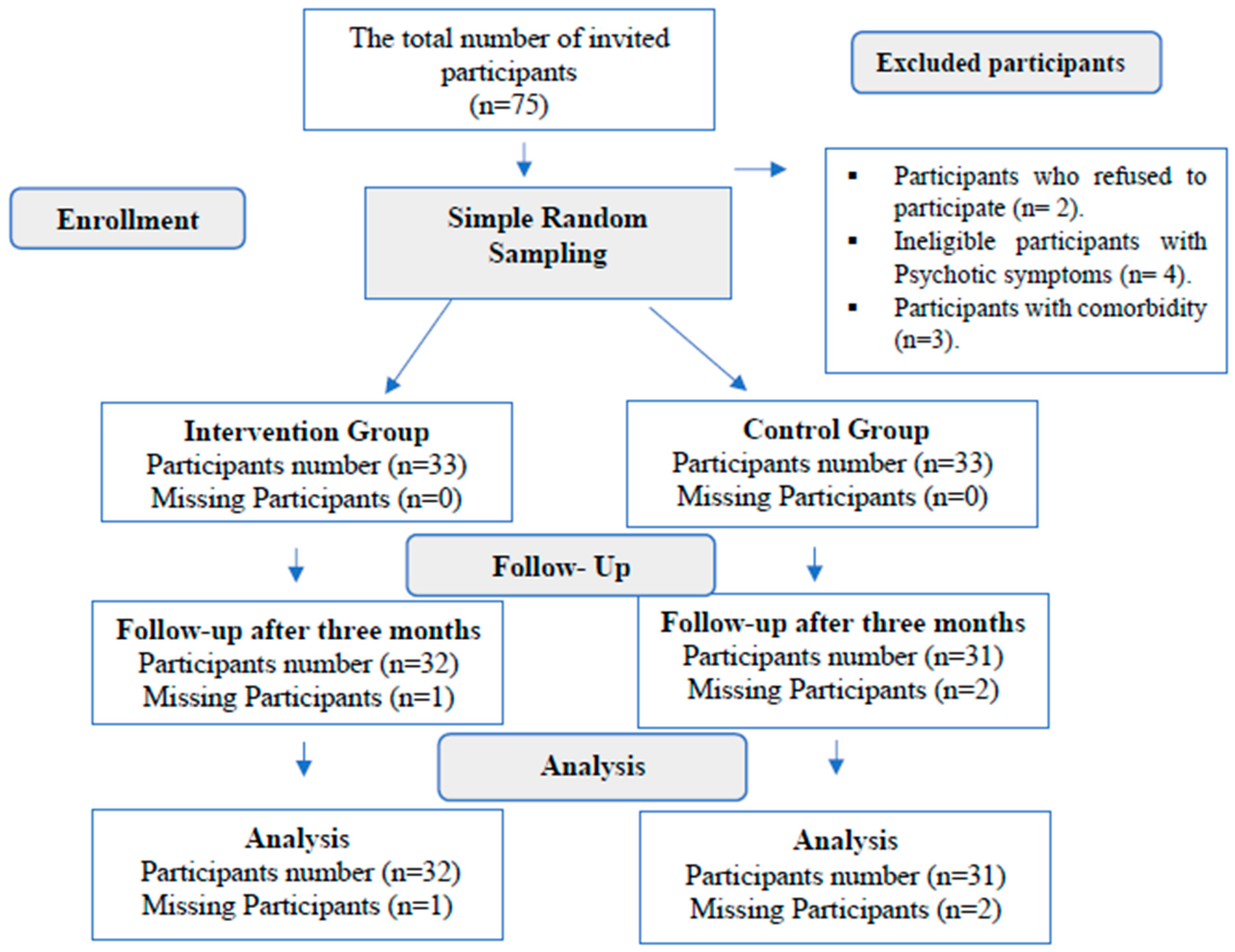
3.1. Participant Flow
3.2. The Participants’ Characteristics
3.2.1. Demographics
3.2.2. Clinical Data
- Interpersonal Relationship Problem Areas
- Circadian Rhythm
- Social Functioning
4. Discussion
4.1. Limitations of the Study
4.2. Conclusion and Recommendations
4.3. Relevance for Clinical Practice
Author Contributions
Funding
Institutional Review Board Statement
Informed Consent Statement
Data Availability Statement
Acknowledgments
Conflicts of Interest
References
- Kraepelin, E.; Kraepelin, E. Hundert Jahre Psychiatrie; Springer: Berlin/Heidelberg, Germany, 1918. [Google Scholar]
- Colomer, L.; Fico, G.; Gutiérrez, F.; Pujal, E.; Baldaquí, N.; Murru, A.; Vieta, E. Lifetime number of affective episodes and functioning in a cohort of patients with bipolar disorder: A cross-sectional study. Eur. Psychiatry 2023, 66, S384. [Google Scholar]
- Rowland, T.A.; Marwaha, S. Epidemiology and risk factors for bipolar disorder. Ther. Adv. Psychopharmacol. 2018, 8, 251–269. [Google Scholar] [CrossRef]
- Weinstein, S.M.; Isaia, A.; West, A.E. Bipolar Spectrum. In Child and Adolescent Psychotherapy: Components of Evidence-Based Treatments for Youth and Their Parents; Cambridge University Press: Cambridge, UK, 2018; Volume 120. [Google Scholar]
- Baldessarini, R.J.; Vázquez, G.H.; Tondo, L. Bipolar depression: A major unsolved challenge. Int. J. Bipolar Disord. 2020, 8, 1. [Google Scholar] [CrossRef]
- Geddes, J.R.; Miklowitz, D.J. Treatment of bipolar disorder. Lancet 2013, 381, 1672–1682. [Google Scholar] [CrossRef]
- Ghanem, M.; Gadallah, M.; Meky, F.A.; Mourad, S.; El Kholy, G. National survey of prevalence of mental disorders in Egypt: Preliminary survey. East. Mediterr. Health J. 2009, 15, 65–75. [Google Scholar] [CrossRef] [PubMed]
- Grunze, H.; Born, C. The impact of subsyndromal bipolar symptoms on patients’ functionality and quality of life. Front. Psychiatry 2020, 11, 510. [Google Scholar] [CrossRef]
- Ramain, J.; Conus, P.; Golay, P. A narrative review of intervention in first-episode affective psychoses. J. Psychiatr. Res. 2021, 143, 123–137. [Google Scholar] [CrossRef] [PubMed]
- Gitlin, M.J.; Miklowitz, D.J. The difficult lives of individuals with bipolar disorder: A review of functional outcomes and their implications for treatment. J. Affect. Disord. 2017, 209, 147–154. [Google Scholar] [CrossRef]
- Rajkumar, R.P. Specific cultural factors are associated with the incidence and burden of bipolar disorder: An ecological analysis of data from 115 countries. J. Affect. Disord. Rep. 2021, 6, 100203. [Google Scholar] [CrossRef]
- Azorin, J.-M.; Lefrere, A.; Belzeaux, R. The impact of bipolar disorder on couple functioning: Implications for care and treatment. A systematic review. Medicina 2021, 57, 771. [Google Scholar] [CrossRef]
- Crowe, M.; Whitehead, L.; Wilson, L.; Carlyle, D.; O’Brien, A.; Inder, M.; Joyce, P. Disorder-specific psychosocial interventions for bipolar disorder—A systematic review of the evidence for mental health nursing practice. Int. J. Nurs. Stud. 2010, 47, 896–908. [Google Scholar] [CrossRef] [PubMed]
- Kumar, M.; Das, D.R.; Mukherjee, D.A.; Paul, A.; Chakraborty, B. Psychosocial Intervention for Reducing Relapse and Improving Treatment Adherence in Bipolar Affective Disorder with Poor Socio-Occupational Functioning and High Expressed Emotion in the Family: A Case Report. Indian J. Appl. Res. 2022, 12, 22–24. [Google Scholar] [CrossRef]
- Dobson, D.; Dobson, K.S. Evidence-Based Practice of Cognitive-Behavioral Therapy; Guilford Publications: New York, NY, USA, 2018. [Google Scholar]
- Crowe, M.; Porter, R.; Inder, M.; Carlyle, D.; Luty, S.; Lacey, C.; Frampton, C. Clinical effectiveness trial of adjunctive interpersonal and social rhythm therapy for patients with bipolar disorder. Am. J. Psychother. 2020, 73, 107–114. [Google Scholar] [CrossRef]
- Khedr, M.A.; El-Ashry, A.M.; El-Sayed, M.M.; Elkot, M.A.; Hussein, R.M. The effect of a physical exercise program on social functioning, alexithymia, and sense of coherence among patients with bipolar disorders: A randomized control trial. Arch. Psychiatr. Nurs. 2024, 49, 83–92. [Google Scholar] [CrossRef]
- Grandin, L.D.; Alloy, L.B.; Abramson, L.Y. The Social Zeitgeber Theory, Circadian Rhythms, and Mood Disorders: A Review and Evaluation. Clin. Psychol. Rev. 2006, 26, 679–694. [Google Scholar] [CrossRef]
- Steardo, L.; Luciano, M.; Sampogna, G.; Zinno, F.; Saviano, P.; Staltari, F.; Segura García, C.; De Fazio, P.; Fiorillo, A. Efficacy of the interpersonal and social rhythm therapy (IPSRT) in patients with bipolar disorder: Results from a real-world, controlled trial. Ann. Gen. Psychiatry 2020, 19, 15. [Google Scholar] [CrossRef]
- Goldstein, T.R.; Merranko, J.; Krantz, M.; Garcia, M.; Franzen, P.; Levenson, J.; Axelson, D.; Birmaher, B.; Frank, E. Early intervention for adolescents at-risk for bipolar disorder: A pilot randomized trial of Interpersonal and Social Rhythm Therapy (IPSRT). J. Affect. Disord. 2018, 235, 348–356. [Google Scholar] [CrossRef] [PubMed]
- Gold, A.K.; Kinrys, G. Treating circadian rhythm disruption in bipolar disorder. Curr. Psychiatry Rep. 2019, 21, 14. [Google Scholar] [CrossRef]
- Frank, E.; Kupfer, D.J.; Thase, M.E.; Mallinger, A.G.; Swartz, H.A.; Fagiolini, A.M.; Grochocinski, V.; Houck, P.; Scott, J.; Thompson, W. Two-year outcomes for interpersonal and social rhythm therapy in individuals with bipolar I disorder. Arch. Gen. Psychiatry 2005, 62, 996–1004. [Google Scholar] [CrossRef]
- Hlastala, S.A.; Kotler, J.S.; McClellan, J.M.; McCauley, E.A. Interpersonal and social rhythm therapy for adolescents with bipolar disorder: Treatment development and results from an open trial. Depress. Anxiety 2010, 27, 457–464. [Google Scholar] [CrossRef]
- Alam, F.H.; El Fiky, E.R.; El-Amrosy, S.H. Efficacy of interpersonal and social rhythm therapy on sleep disorders and psychological adjustment among patients with bipolar disorder. Tanta Sci. Nurs. J. 2022, 27, 159–173. [Google Scholar] [CrossRef]
- Lam, C.; Chung, M.-H. A meta-analysis of the effect of interpersonal and social rhythm therapy on symptom and functioning improvement in patients with bipolar disorders. Appl. Res. Qual. Life 2021, 16, 153–165. [Google Scholar] [CrossRef]
- Novick, D.M.; Swartz, H.A. Evidence-based psychotherapies for bipolar disorder. Focus (Am. Psychiatr. Publ.) 2019, 17, 238–248. [Google Scholar] [CrossRef]
- Vlahov, D. Transparent reporting of evaluations with nonrandomized designs (TREND). J. Urban Health 2004, 81, 163–164. [Google Scholar] [CrossRef]
- APA. Diagnostic and Statistical Manual of Mental Disorders (DSM-5®); American Psychiatric Pub: Washington, DC, USA, 2013. [Google Scholar]
- Klerman, G.L.; Weissman, M.M.; Rounsaville, B.J.; Chevron, E.S. (Eds.) Interpersonal Psychotherapy of Depression; Basic Books: New York, NY, USA, 1984. [Google Scholar]
- Monk, T.H.; Flaherty, J.F.; Frank, E.; Hoskinson, K.; Kupfer, D.J. The social rhythm metric is an instrument to quantify the daily rhythms of life. J. Nerv. Ment. Dis. 1990, 178, 120–126. [Google Scholar] [CrossRef]
- Monk, T.H.; Frank, E.; Potts, J.M.; Kupfer, D.J. A simple way to measure daily lifestyle regularity. J. Sleep Res. 2002, 11, 183–190. [Google Scholar] [CrossRef] [PubMed]
- Fontes de Andrade, A.C.; Frank, E.; Neto, F.L.; Houck, P.R. An adaptation of the Interpersonal Problem Areas Rating Scale: Pilot and interrater agreement study. Braz. J. Psychiatry/Rev. Bras. Psiquiatr. 2008, 30, 353–357. [Google Scholar] [CrossRef][Green Version]
- Barker, S.; Barron, N.; McFarland, B.H.; Bigelow, D.A.; Carnahan, T. A community ability scale for chronically mentally ill consumers: Part II. Applications. Community Ment. Health J. 1994, 30, 459–472. [Google Scholar] [CrossRef]
- Durbin, J.; Dewa, C.S.; Aubry, T.; Krupa, T.; Rourke, S.; Foo, E. The use of the Multnomah Community Ability Scale as a program evaluation tool. Can. J. Program Eval. 2005, 19, 135–157. [Google Scholar] [CrossRef]
- Faul, F.; Erdfelder, E.; Buchner, A.; Lang, A.-G. Statistical power analyses using G*Power 3.1: Tests for correlation and regression analyses. Behav. Res. Methods 2009, 41, 1149–1160. [Google Scholar] [CrossRef] [PubMed]
- Blume, J.; Peipert, J.F. Randomization in controlled clinical trials: Why the flip of a coin is so important. J. Am. Assoc. Gynecol. Laparosc. 2004, 11, 320–325. [Google Scholar] [CrossRef]
- Aldrich, J.O. Using IBM SPSS Statistics: An Interactive Hands-On Approach; Sage Publications: Singapore, 2018. [Google Scholar]
- Echezarraga, A.; Calvete, E.; Orue, I.; Las Hayas, C. Resilience moderates the associations between bipolar disorder mood episodes and mental health. Clínica Salud 2022, 33, 83. [Google Scholar] [CrossRef]
- Frank, E.; Swartz, H.A.; Boland, E. Interpersonal and social rhythm therapy: An intervention addressing rhythm dysregulation in bipolar disorder. Dialogues Clin. Neurosci. 2007, 9, 325–332. [Google Scholar] [CrossRef]
- Douglas, K.M.; Inder, M.L.; Crowe, M.T.; Jordan, J.; Carlye, D.; Lacey, C.; Beaglehole, B.; Mulder, R.; Eggleston, K.; Donovan, K.A. Randomised controlled trial of Interpersonal and Social Rhythm Therapy and group-based Cognitive Remediation versus Interpersonal and Social Rhythm Therapy alone for mood disorders: Study protocol. BMC Psychiatry 2022, 22, 115. [Google Scholar] [CrossRef] [PubMed]
- Swerdlow, B.A.; Berk, L.; Johnson, S.L. Experiences of interpersonal emotion regulation for people with heightened emotions: An examination in people with bipolar disorder and those with high aggression. J. Emot. Psychopathol. 2023, 1, 313–327. [Google Scholar] [CrossRef]
- Taha, S.M.; El-Sayed, M.M.; Khedr, M.A.; El-Ashry, A.M.; Abdelraof, A.I.; Sonbol, H.M.; Hawash, M.M.; Elhay, E.S.A. Unraveling the power of sense of coherence: A key predictor of symptom severity among depressive disorders. BMC Nurs. 2025, 24, 21. [Google Scholar] [CrossRef]
- El-Sayed, M.M.; Elhay, E.S.A.; Taha, S.M.; Khedr, M.A.; Mansour, F.S.A.; El-Ashry, A.M. Efficacy of acceptance and commitment therapy on impulsivity and suicidality among clients with bipolar disorders: A randomized control trial. BMC Nurs. 2023, 22, 271. [Google Scholar] [CrossRef] [PubMed]
- Grover, S.; Nehra, R.; Thakur, A. Bipolar affective disorder and its impact on various aspects of marital relationships. Ind. Psychiatry J. 2017, 26, 114–120. [Google Scholar] [CrossRef] [PubMed]
- Proudfoot, J.G.; Parker, G.B.; Benoit, M.; Manicavasagar, V.; Smith, M.; Gayed, A. What happens after diagnosis? Understanding the experiences of patients with newly diagnosed bipolar disorder. Health Expect. 2009, 12, 120–129. [Google Scholar] [CrossRef]


| Phases | Tasks |
|---|---|
| Initial phase (3–5 sessions) | This initial intervention depends on the length and complexity of the client’s emotional history, interpersonal interactions, and the amount of psychoeducation necessary. |
| Intermediate phase (3 sessions) |
|
| Continuation or maintenance phase (4 sessions) |
|
| Final phase (2 sessions) | The last phase of IPSRT included efforts to end therapy or reduce the frequency of sessions even further. It also involved an assessment of the client’s treatment achievements and areas of susceptibility for future episodes (Frank et al. [22]) |
| Intervention Group (n = 32) | Control Group (n = 31) | Test of Sig. | p | |||
|---|---|---|---|---|---|---|
| Demographic Data | No. | % | No. | % | χ2 = 0.270 | MCp = 0.703 |
| Age | ||||||
| 20–29 | 15 | 49.0 | 14 | 45.2 | ||
| 30–40 | 7 | 21.0 | 6 | 19.4 | ||
| >40 | 10 | 30.0 | 11 | 35.4 | ||
| Gender | χ2 = 0.021 | 0.871 | ||||
| Male | 13 | 40.7 | 11 | 35.5 | ||
| Female | 19 | 59.3 | 20 | 64.5 | ||
| Marital Status | χ2 = 0.062 | MCp = 1.000 | ||||
| Single | 14 | 43.8 | 15 | 48.4 | ||
| Married | 12 | 37.5 | 11 | 35.5 | ||
| Divorced | 6 | 18.7 | 5 | 16.1 | ||
| Education levels | ||||||
| Primary | 0 | 0.0 | 1 | 3.2 | χ2 = 2.100 | 0.147 |
| Secondary | 13 | 40.6 | 14 | 45.2 | ||
| University | 19 | 59.4 | 16 | 51.6 | ||
| Occupation | ||||||
| Employed | 13 | 40.6 | 11 | 35.5 | χ2 = 0.045 | 0.729 |
| Unemployed | 19 | 59.4 | 20 | 64.5 | ||
| Monthly Income | ||||||
| Sufficient | 10 | 31.3 | 11 | 35.5 | χ2 = 1.706 | 0.279 |
| Sufficient to some extent | 13 | 40.6 | 12 | 38.7 | ||
| Insufficient | 9 | 28.1 | 8 | 25.8 | ||
| Residence Region | ||||||
| Urban | 20 | 62.5 | 21 | 67.7 | χ2 = 1.271 | MCp = 0.894 |
| Rural | 12 | 37.5 | 10 | 32.3 | ||
| Living Arrangements | ||||||
| With family | 24 | 75.0 | 25 | 80.6 | ||
| Alone | 8 | 25.0 | 6 | 19.4 | χ2 = 0.065 | 0.799 |
| Support System | ||||||
| Yes | 18 | 56.3 | 19 | 61.3 | ||
| No | 14 | 43.7 | 12 | 38.7 | χ2 = 1.150 | 0.347 |
| Clinical Data | ||||||
| Duration of Illness | ||||||
| <5 years | 18 | 56.3 | 19 | 61.3 | ||
| ≥5 years | 14 | 43.7 | 12 | 38.7 | χ2 = 0.241 | 0.426 |
| Number of Previous Hospital Admissions | ||||||
| None | 12 | 37.5 | 10 | 32.3 | ||
| One | 8 | 25.0 | 9 | 29.0 | χ2 = 0.121 | 0.962 |
| Two | 7 | 21.9 | 8 | 25.8 | ||
| ≥Three | 5 | 15.6 | 4 | 12.9 | ||
| Type of Last Episode | ||||||
| Depression | 14 | 43.8 | 16 | 51.6 | ||
| Mania | 15 | 46.8 | 13 | 41.9 | χ2 = 3.450 | MCp = 0.919 |
| Hypomania | 3 | 9.4 | 2 | 6.4 | ||
| Medications currently prescribed | ||||||
| Mood Stabilizers | 17 | 53.1 | 18 | 58.0 | ||
| Antipsychotics | 8 | 25.0 | 7 | 25.8 | χ2 = 1.860 | 0.449 |
| Both | 7 | 21.9 | 6 | 19.2 | ||
| Medications Compliance | ||||||
| Compliance | 24 | 75.0 | 22 | 71.0 | ||
| Noncompliance | 8 | 25.0 | 9 | 29.0 | χ2 = 0.780 | MCp = 0.957 |
| Intervention Group (n = 32) | Control Group (n = 31) | Test of Sig. | p | |||
|---|---|---|---|---|---|---|
| IPARS-M | No. | % | No. | % | 1.902 | MCp = 0.661 |
| Interpersonal Deficiencies | 11 | 34.4 | 10 | 32.3 | ||
| Interpersonal Role Conflicts | 9 | 28.1 | 8 | 25.8 | ||
| Unresolved Grief | 4 | 12.5 | 5 | 16.1 | ||
| Loss of Healthy Self | 5 | 15.6 | 6 | 19.4 | ||
| Role Transitions | 3 | 9.4 | 2 | 6.5 | ||
| Group/Time Point | Pretest M (SD) | Immediate Post M (SD) | 3-Month Follow-Up M (SD) | F (Within Group) p Value | Partial η2 |
|---|---|---|---|---|---|
| Intervention (n = 32) | 2.9 (1.3) | 3.7 (1.2) | 4.0 (1.5) | 18.5 <0.05 | 0.37 |
| Control (n = 31) | 2.3 (1.7) | 3.0 (1.9) | 2.9 (1.4) | 2.10 >0.05 | 0.07 |
| t test p value | 1.57 >0.05 | 1.68 >0.05 | 3.01 <0.05 | ||
| Cohen’s d 95% CI for d | 0.40 −0.09 to 0.89 | 0.44 −0.05 to 0.93 | 0.76 0.25 to 1.27 |
| Group/Time Point | Pretest M (SD) | Immediately Post M (SD) | 3-Month Follow-Up M (SD) | F (Within Group) | p Value | Partial η2 |
|---|---|---|---|---|---|---|
| Intervention (n = 32) | 55.5 (7.4) | 63.7 (7.1) | 62.3 (6.9) | 29.4 | <0.05 | 0.49 |
| Control (n = 31) | 53.8 (9.9) | 55.3 (8.9) | 56.0 (10.3) | 2.40 | >0.05 | 0.07 |
| t test p value | 0.79 >0.05 | 4.10 <0.001 | 2.73 0.008 | |||
| Cohen’s d 95% CI for d | 0.19 −0.30 to 0.68 | 1.05 0.54 to 1.56 | 0.72 0.20 to 1.23 |
Disclaimer/Publisher’s Note: The statements, opinions and data contained in all publications are solely those of the individual author(s) and contributor(s) and not of MDPI and/or the editor(s). MDPI and/or the editor(s) disclaim responsibility for any injury to people or property resulting from any ideas, methods, instructions or products referred to in the content. |
© 2026 by the authors. Licensee MDPI, Basel, Switzerland. This article is an open access article distributed under the terms and conditions of the Creative Commons Attribution (CC BY) license.
Share and Cite
Metwally El-Sayed, M.; Salihu, D.; Hendy, A.; Sharif, L.; Sharif, K. Stabilizing Sleep–Wake Cycles and Social Functioning in Bipolar Disorders: Effect of Interpersonal and Social Rhythm Therapy. J. Clin. Med. 2026, 15, 1071. https://doi.org/10.3390/jcm15031071
Metwally El-Sayed M, Salihu D, Hendy A, Sharif L, Sharif K. Stabilizing Sleep–Wake Cycles and Social Functioning in Bipolar Disorders: Effect of Interpersonal and Social Rhythm Therapy. Journal of Clinical Medicine. 2026; 15(3):1071. https://doi.org/10.3390/jcm15031071
Chicago/Turabian StyleMetwally El-Sayed, Mona, Dauda Salihu, Abdelaziz Hendy, Loujain Sharif, and Khalid Sharif. 2026. "Stabilizing Sleep–Wake Cycles and Social Functioning in Bipolar Disorders: Effect of Interpersonal and Social Rhythm Therapy" Journal of Clinical Medicine 15, no. 3: 1071. https://doi.org/10.3390/jcm15031071
APA StyleMetwally El-Sayed, M., Salihu, D., Hendy, A., Sharif, L., & Sharif, K. (2026). Stabilizing Sleep–Wake Cycles and Social Functioning in Bipolar Disorders: Effect of Interpersonal and Social Rhythm Therapy. Journal of Clinical Medicine, 15(3), 1071. https://doi.org/10.3390/jcm15031071