Association Between Cribriform Architecture and Lymphovascular Invasion in Prostate Cancer

 ,
,  , , ,
, , ,  ,
,
Abstract
1. Introduction
2. Materials and Methods
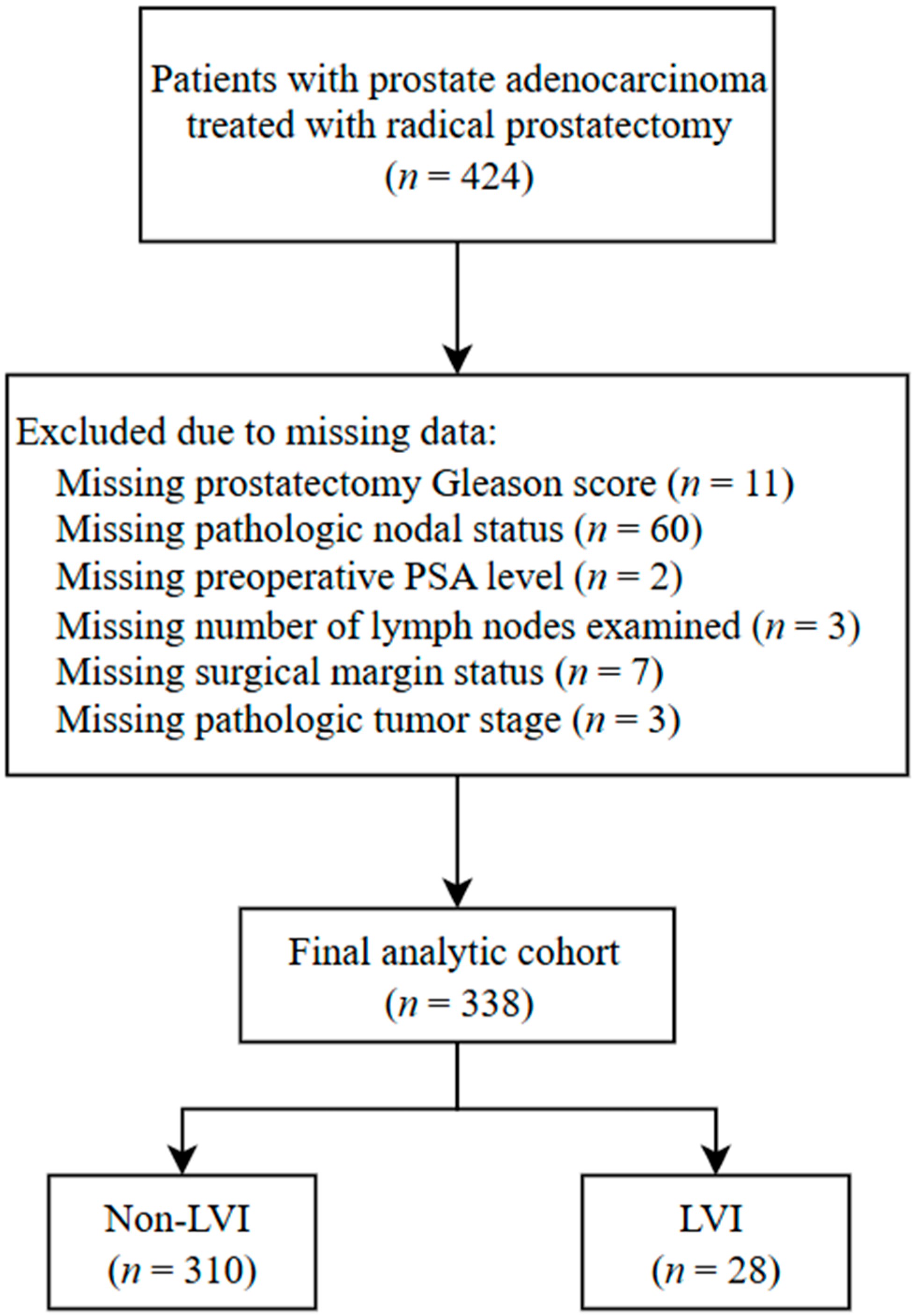
2.1. Study Population
2.2. Statistical Methods
2.2.1. Comparison of Clinical and Pathologic Factors Stratified by LVI
2.2.2. Covariate-Adjusted Odds Ratios for LVI
3. Results
3.1. Comparison of the Clinical and Pathologic Factors Stratified by LVI
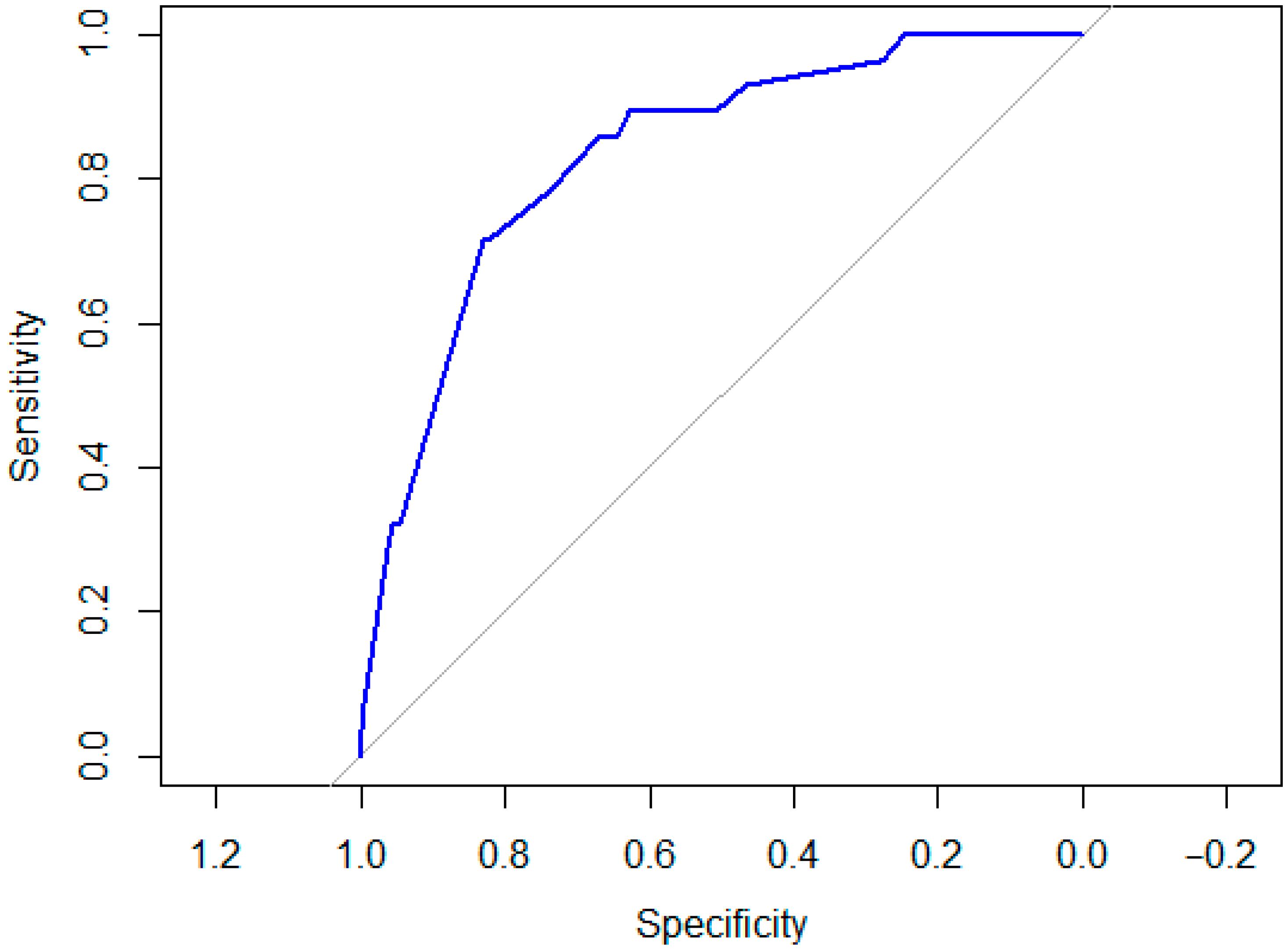
3.2. Covariate-Adjusted Odds Ratios for LVI
4. Discussion
5. Conclusions
Author Contributions
Funding
Institutional Review Board Statement
Informed Consent Statement
Data Availability Statement
Conflicts of Interest
Abbreviations
| ADT | Androgen deprivation therapy |
| AUC | Area under the curve |
| CI | Confidence interval |
| EPV | Events-per-variable |
| LVI | Lymphovascular invasion |
| OR | Odds ratio |
| PET | Positron emission tomography |
| PNI | Perineural invasion |
| PSA | Prostate-specific antigen |
| PSMA | Prostate-specific membrane antigen |
| ROC | Receiver operating characteristic |
| RP | Radical prostatectomy |
| TCGA | The Cancer Genome Atlas |
References
- Schaeffer, E.M.; Srinivas, S.; Adra, N.; An, Y.; Bitting, R.; Chapin, B.; Cheng, H.H.; D’Amico, A.V.; Desai, N.; Dorff, T.; et al. Prostate Cancer, Version 3.2024. J. Natl. Compr. Cancer Netw. 2024, 22, 140–150. [Google Scholar] [CrossRef]
- Kane, C.J.; Eggener, S.E.; Shindel, A.W.; Andriole, G.L. Variability in Outcomes for Patients with Intermediate-risk Prostate Cancer (Gleason Score 7, International Society of Urological Pathology Gleason Group 2-3) and Implications for Risk Stratification: A Systematic Review. Eur. Urol. Focus 2017, 3, 487–497. [Google Scholar] [CrossRef]
- Nguyen, J.K.; Magi-Galluzzi, C. Unfavorable Pathology, Tissue Biomarkers and Genomic Tests With Clinical Implications in Prostate Cancer Management. Adv. Anat. Pathol. 2018, 25, 293–303. [Google Scholar] [CrossRef]
- Mossanen, M.; Nepple, K.G.; Grubb, R.L.; Androile, G.L.; Kallogjeri, D.; Klein, E.A.; Stephenson, A.J.; Kibel, A.S. Heterogeneity in Definitions of High-risk Prostate Cancer and Varying Impact on Mortality Rates after Radical Prostatectomy. Eur. Urol. Oncol. 2018, 1, 143–148. [Google Scholar] [CrossRef]
- Sayan, M.; Tuac, Y.; Akgul, M.; Pratt, G.K.; Rowan, M.D.; Akbulut, D.; Kucukcolak, S.; Tjio, E.; Moningi, S.; Leeman, J.E.; et al. Prognostic Significance of the Cribriform Pattern in Prostate Cancer: Clinical Outcomes and Genomic Alterations. Cancers 2024, 16, 1248. [Google Scholar] [CrossRef]
- Walburn, T.; Tuaç, Y.; Aktan, Ç.; Argun, O.; Chen, L.W.; Yang, D.D.; Moningi, S.; Leeman, J.E.; Orio, P.F.; Nguyen, P.L.; et al. Impact of Cribriform Pattern on Progression-Free Survival After Radical Prostatectomy in Gleason Score 8-10 Prostate Cancer. Eurasian J. Med. 2025, 57, e25804. [Google Scholar] [CrossRef] [PubMed]
- Hilibrand, A.S.; Tuac, Y.; Argun, O.; Breneman, C.M.; Oh, M.; Moningi, S.; Leeman, J.E.; Sayan, M. Age-Specific Impact of Cribriform Pattern in Prostate Cancer Following Radical Prostatectomy. Clin. Med. Insights Oncol. 2025, 19, 11795549251363324. [Google Scholar] [CrossRef] [PubMed]
- Iczkowski, K.A.; Torkko, K.C.; Kotnis, G.R.; Wilson, R.S.; Huang, W.; Wheeler, T.M.; Abeyta, A.M.; La Rosa, F.G.; Cook, S.; Werahera, P.N.; et al. Digital quantification of five high-grade prostate cancer patterns, including the cribriform pattern, and their association with adverse outcome. Am. J. Clin. Pathol. 2011, 136, 98–107. [Google Scholar] [CrossRef] [PubMed]
- Kir, G.; Sarbay, B.C.; Gumus, E.; Topal, C.S. The association of the cribriform pattern with outcome for prostatic adenocarcinomas. Pathol. Res. Pract. 2014, 210, 640–644. [Google Scholar] [CrossRef] [PubMed]
- Kweldam, C.F.; Wildhagen, M.F.; Steyerberg, E.W.; Bangma, C.H.; van der Kwast, T.H.; van Leenders, G.J. Cribriform growth is highly predictive for postoperative metastasis and disease-specific death in Gleason score 7 prostate cancer. Mod. Pathol. 2015, 28, 457–464. [Google Scholar] [CrossRef]
- Kweldam, C.F.; Kummerlin, I.P.; Nieboer, D.; Verhoef, E.I.; Steyerberg, E.W.; van der Kwast, T.H.; Roobol, M.J.; van Leenders, G.J. Disease-specific survival of patients with invasive cribriform and intraductal prostate cancer at diagnostic biopsy. Mod. Pathol. 2016, 29, 630–636. [Google Scholar] [CrossRef]
- Trudel, D.; Downes, M.R.; Sykes, J.; Kron, K.J.; Trachtenberg, J.; van der Kwast, T.H. Prognostic impact of intraductal carcinoma and large cribriform carcinoma architecture after prostatectomy in a contemporary cohort. Eur. J. Cancer 2014, 50, 1610–1616. [Google Scholar] [CrossRef]
- Hollemans, E.; Verhoef, E.I.; Bangma, C.H.; Rietbergen, J.; Helleman, J.; Roobol, M.J.; van Leenders, G. Large cribriform growth pattern identifies ISUP grade 2 prostate cancer at high risk for recurrence and metastasis. Mod. Pathol. 2019, 32, 139–146. [Google Scholar] [CrossRef]
- Hollemans, E.; Verhoef, E.I.; Bangma, C.H.; Rietbergen, J.; Osanto, S.; Pelger, R.C.M.; van Wezel, T.; van der Poel, H.; Bekers, E.; Helleman, J.; et al. Cribriform architecture in radical prostatectomies predicts oncological outcome in Gleason score 8 prostate cancer patients. Mod. Pathol. 2021, 34, 184–193. [Google Scholar] [CrossRef]
- Russo, G.I.; Soeterik, T.; Puche-Sanz, I.; Broggi, G.; Lo Giudice, A.; De Nunzio, C.; Lombardo, R.; Marra, G.; Gandaglia, G.; European Association of Urology Young Academic Urologists. Oncological outcomes of cribriform histology pattern in prostate cancer patients: A systematic review and meta-analysis. Prostate Cancer Prostatic Dis. 2023, 26, 646–654. [Google Scholar] [CrossRef] [PubMed]
- Sushentsev, N.; Warren, A.Y.; Colling, R.; Verrill, C.; Pazukhina, E.; Blyuss, O.; Seibert, T.M.; Barrett, T.; Mills, I.G.; Bryant, R.J.; et al. Active Monitoring, Surgery, and Radiotherapy for Cribriform-Positive and Cribriform-Negative Prostate Cancer: A Secondary Analysis of the PROTECT Randomized Clinical Trial. JAMA Oncol. 2025, 11, 1512–1517. [Google Scholar] [CrossRef] [PubMed]
- Jiang, W.; Zhang, L.; Wu, B.; Zha, Z.; Zhao, H.; Jun, Y.; Jiang, Y. The impact of lymphovascular invasion in patients with prostate cancer following radical prostatectomy and its association with their clinicopathological features: An updated PRISMA-compliant systematic review and meta-analysis. Medicine 2018, 97, e13537. [Google Scholar] [CrossRef]
- Karwacki, J.; Stodolak, M.; Nowak, Ł.; Kiełb, P.; Krajewski, W.; Lemiński, A.; Szydełko, T.; Małkiewicz, B. Preoperative Factors for Lymphovascular Invasion in Prostate Cancer: A Systematic Review and Meta-Analysis. Int. J. Mol. Sci. 2024, 25, 856. [Google Scholar] [CrossRef]
- Karwacki, J.; Łątkowska, M.; Jarocki, M.; Jaworski, A.; Szuba, P.; Poterek, A.; Lemiński, A.; Kaczmarek, K.; Hałoń, A.; Szydełko, T.; et al. The clinical meaning of lymphovascular invasion: Preoperative predictors and postoperative implications in prostate cancer—A retrospective study. Front. Oncol. 2024, 14, 1349536. [Google Scholar] [CrossRef]
- Karwacki, J.; Gurwin, A.; Jaworski, A.; Jarocki, M.; Stodolak, M.; Dłubak, A.; Szuba, P.; Lemiński, A.; Kaczmarek, K.; Hałoń, A.; et al. Association of Lymphovascular Invasion with Lymph Node Metastases in Prostate Cancer-Lateralization Concept. Cancers 2024, 16, 925. [Google Scholar] [CrossRef] [PubMed]
- Shariat, S.F.; Khoddami, S.M.; Saboorian, H.; Koeneman, K.S.; Sagalowsky, A.I.; Cadeddu, J.A.; McConnell, J.D.; Holmes, M.N.; Roehrborn, C.G. Lymphovascular invasion is a pathological feature of biologically aggressive disease in patients treated with radical prostatectomy. J. Urol. 2004, 171, 1122–1127. [Google Scholar] [CrossRef]
- Sathianathen, N.J.; Furrer, M.A.; Mulholland, C.J.; Katsios, A.; Soliman, C.; Lawrentschuk, N.; Peters, J.S.; Zargar, H.; Costello, A.J.; Hovens, C.M.; et al. Lymphovascular Invasion at the Time of Radical Prostatectomy Adversely Impacts Oncological Outcomes. Cancers 2023, 16, 123. [Google Scholar] [CrossRef]
- Wilczak, W.; Wittmer, C.; Clauditz, T.; Minner, S.; Steurer, S.; Büscheck, F.; Krech, T.; Lennartz, M.; Harms, L.; Leleu, D.; et al. Marked Prognostic Impact of Minimal Lymphatic Tumor Spread in Prostate Cancer. Eur. Urol. 2018, 74, 376–386. [Google Scholar] [CrossRef]
- Chung, D.H.; Han, J.H.; Jeong, S.H.; Yuk, H.D.; Jeong, C.W.; Ku, J.H.; Kwak, C. Role of lymphatic invasion in predicting biochemical recurrence after radical prostatectomy. Front. Oncol. 2023, 13, 1226366. [Google Scholar] [CrossRef] [PubMed]
- Kang, Y.J.; Kim, H.S.; Jang, W.S.; Kwon, J.K.; Yoon, C.Y.; Lee, J.Y.; Cho, K.S.; Ham, W.S.; Choi, Y.D. Impact of lymphovascular invasion on lymph node metastasis for patients undergoing radical prostatectomy with negative resection margin. BMC Cancer 2017, 17, 321. [Google Scholar] [CrossRef] [PubMed]
- Guo, C.C.; Epstein, J.I. Intraductal carcinoma of the prostate on needle biopsy: Histologic features and clinical significance. Mod. Pathol. 2006, 19, 1528–1535. [Google Scholar] [CrossRef]
- Zhou, M. High-grade prostatic intraepithelial neoplasia, PIN-like carcinoma, ductal carcinoma, and intraductal carcinoma of the prostate. Mod. Pathol. 2018, 31, S71–S79. [Google Scholar] [CrossRef] [PubMed]
- Neuhäuser, M.; Ruxton, G.D. The Choice Between Pearson’s χ2 Test and Fisher’s Exact Test for 2 × 2 Tables. Pharm. Stat. 2025, 24, e70012. [Google Scholar] [CrossRef]
- Hollander, M.; Wolfe, D.A.; Chicken, E. Nonparametric Statistical Methods, 3rd ed.; John Wiley & Sons, Inc.: Hoboken, NJ, USA, 2013. [Google Scholar]
- Kleinbaum, D.G.; Klein, M. Logistic Regression: A Self-Learning Text; Springer: New York, NY, USA, 2010. [Google Scholar]
- Rothman, K.J.; Greenland, S.; Lash, T.L. Modern Epidemiology; Wolters Kluwer Health/Lippincott Williams & Wilkins: Baltimore, MD, USA, 2008. [Google Scholar]
- Hanley, J.A.; McNeil, B.J. The meaning and use of the area under a receiver operating characteristic (ROC) curve. Radiology 1982, 143, 29–36. [Google Scholar] [CrossRef]
- Firth, D. Bias reduction of maximum likelihood estimates. Biometrika 1993, 80, 27–38. [Google Scholar] [CrossRef]
- Fujisawa, M.; Miyake, H. Significance of micrometastases in prostate cancer. Surg. Oncol. 2008, 17, 247–252. [Google Scholar] [CrossRef]
- Murray, N.P.; Reyes, E.; Tapia, P.; Badinez, L.; Orellana, N.; Fuentealba, C.; Olivares, R.; Porcell, J.; Dueñas, R. Redefining micrometastasis in prostate cancer—A comparison of circulating prostate cells, bone marrow disseminated tumor cells and micrometastasis: Implications in determining local or systemic treatment for biochemical failure after radical prostatectomy. Int. J. Mol. Med. 2012, 30, 896–904. [Google Scholar] [CrossRef][Green Version]
- Miyake, H.; Hara, I.; Kurahashi, T.; Inoue, T.A.; Eto, H.; Fujisawa, M. Quantitative detection of micrometastases in pelvic lymph nodes in patients with clinically localized prostate cancer by real-time reverse transcriptase-PCR. Clin. Cancer Res. 2007, 13, 1192–1197. [Google Scholar] [CrossRef]
- Cher, M.L.; de Oliveira, J.G.; Beaman, A.A.; Nemeth, J.A.; Hussain, M.; Wood, D.P., Jr. Cellular proliferation and prevalence of micrometastatic cells in the bone marrow of patients with clinically localized prostate cancer. Clin. Cancer Res. 1999, 5, 2421–2425. [Google Scholar] [PubMed]
- Murray, N.P. Minimal residual disease in prostate cancer patients after primary treatment: Theoretical considerations, evidence and possible use in clinical management. Biol. Res. 2018, 51, 32. [Google Scholar] [CrossRef]
- Sartor, O.; de Bono, J.S. Metastatic Prostate Cancer. N. Engl. J. Med. 2018, 378, 645–657. [Google Scholar] [CrossRef] [PubMed]
- Sandhu, S.; Moore, C.M.; Chiong, E.; Beltran, H.; Bristow, R.G.; Williams, S.G. Prostate cancer. Lancet 2021, 398, 1075–1090. [Google Scholar] [CrossRef] [PubMed]
- Woo, S.; Russo, L.; Withey, S.J.; Dehghanpour, A.; García-Figueiras, R.; Schoots, I.G.; Petralia, G.; Lakhani, A.; Penzkofer, T.; Pecoraro, M.; et al. ESUR: Opportunities for PSMA-PET/CT and whole-body MRI in advanced prostate cancer. Eur. Radiol. 2025. [Google Scholar] [CrossRef]
- Zareba, P.; Flavin, R.; Isikbay, M.; Rider, J.R.; Gerke, T.A.; Finn, S.; Pettersson, A.; Giunchi, F.; Unger, R.H.; Tinianow, A.M.; et al. Perineural Invasion and Risk of Lethal Prostate Cancer. Cancer Epidemiol. Biomark. Prev. 2017, 26, 719–726. [Google Scholar] [CrossRef]
- Loeb, S.; Epstein, J.I.; Humphreys, E.B.; Walsh, P.C. Does perineural invasion on prostate biopsy predict adverse prostatectomy outcomes? BJU Int. 2010, 105, 1510–1513. [Google Scholar] [CrossRef]
- Fromont, G.; Godet, J.; Pires, C.; Yacoub, M.; Dore, B.; Irani, J. Biological significance of perineural invasion (PNI) in prostate cancer. Prostate 2012, 72, 542–548. [Google Scholar] [CrossRef] [PubMed]



| Non-LVI (n = 310) | LVI (n = 28) | p | |
|---|---|---|---|
| Age (years), median (IQR) | 62 (56, 66) | 62 (57, 65) | 0.700 |
| Pre-RP PSA, ng/mL, median (IQR) | 8 (5, 11) | 11 (8, 26) | <0.001 |
| Prostatectomy Gleason score, No. (%) | <0.001 | ||
| ≤7 | 185 (60%) | 7 (25%) | |
| 8–10 | 125 (40%) | 21 (75%) | |
| Prostatectomy tumor stage, No. (%) | <0.001 | ||
| T2 | 111 (36%) | 2 (7.1%) | |
| T3 | 196 (63%) | 23 (82%) | |
| T4 | 3 (1.0%) | 3 (11%) | |
| Prostatectomy margin status, No. (%) | 0.300 | ||
| Negative | 210 (68%) | 16 (57%) | |
| Positive | 100 (32%) | 12 (43%) | |
| Adjuvant treatment, No. (%) | 37 (12%) | 8 (29%) | |
| Number of lymph nodes examined, median (IQR) | 9 (5, 15) | 13 (6, 19) | 0.057 |
| Prostatectomy nodal status, No. (%) | 0.005 | ||
| N0 | 267 (86%) | 18 (64%) | |
| N1 | 43 (14%) | 10 (36%) | |
| PNI, No. (%) | 0.900 | ||
| No | 70 (23%) | 6 (21%) | |
| Yes | 240 (77%) | 22 (79%) | |
| Cribriform Pattern, No. (%) | <0.001 | ||
| No | 209 (67%) | 6 (21%) | |
| Yes | 101 (33%) | 22 (79%) |
| aOR | 95% CI | p | |
|---|---|---|---|
| Cribriform Pattern | |||
| No | Reference | Reference | |
| Yes | 5.20 | 2.12–14.40 | <0.001 |
| Prostatectomy Gleason score | |||
| ≤7 | Reference | Reference | |
| 8–10 | 2.08 | 0.81–5.93 | 0.13 |
| Prostatectomy tumor stage | |||
| T2 | Reference | Reference | |
| T3 | 2.55 | 0.74–13.3 | 0.15 |
| T4 | 33.6 | 3.81–365 | 0.002 |
| Prostatectomy nodal status | |||
| N0 | Reference | Reference | |
| N1 | 2.31 | 0.91–5.76 | 0.078 |
Disclaimer/Publisher’s Note: The statements, opinions and data contained in all publications are solely those of the individual author(s) and contributor(s) and not of MDPI and/or the editor(s). MDPI and/or the editor(s) disclaim responsibility for any injury to people or property resulting from any ideas, methods, instructions or products referred to in the content. |
© 2026 by the authors. Licensee MDPI, Basel, Switzerland. This article is an open access article distributed under the terms and conditions of the Creative Commons Attribution (CC BY) license.
Share and Cite
Chan, J.; Tuac, Y.; Argun, O.; Breneman, C.M.; Seeley, N.; Moriarty, H.N.; Kumar, K.S.; Chipidza, F.E.; Leeman, J.E.; Sayan, M. Association Between Cribriform Architecture and Lymphovascular Invasion in Prostate Cancer. J. Clin. Med. 2026, 15, 1032. https://doi.org/10.3390/jcm15031032
Chan J, Tuac Y, Argun O, Breneman CM, Seeley N, Moriarty HN, Kumar KS, Chipidza FE, Leeman JE, Sayan M. Association Between Cribriform Architecture and Lymphovascular Invasion in Prostate Cancer. Journal of Clinical Medicine. 2026; 15(3):1032. https://doi.org/10.3390/jcm15031032
Chicago/Turabian StyleChan, Jacqueline, Yetkin Tuac, Okan Argun, Christina M. Breneman, Nora Seeley, Haley N. Moriarty, Keerthana Senthil Kumar, Fallon E. Chipidza, Jonathan E. Leeman, and Mutlay Sayan. 2026. "Association Between Cribriform Architecture and Lymphovascular Invasion in Prostate Cancer" Journal of Clinical Medicine 15, no. 3: 1032. https://doi.org/10.3390/jcm15031032
APA StyleChan, J., Tuac, Y., Argun, O., Breneman, C. M., Seeley, N., Moriarty, H. N., Kumar, K. S., Chipidza, F. E., Leeman, J. E., & Sayan, M. (2026). Association Between Cribriform Architecture and Lymphovascular Invasion in Prostate Cancer. Journal of Clinical Medicine, 15(3), 1032. https://doi.org/10.3390/jcm15031032