

Next Article in Journal
Monocyte-Driven Systemic Biomarkers and Survival After Pulmonary Metastasectomy in Metachronous Lung-Limited Oligometastatic Disease: A Retrospective Single-Center Study
Previous Article in Journal
Reintervention for Failed Aortic Bioprostheses: Distinct Patient Profiles for Redo Surgery and Valve-in-Valve TAVR in an All-Comers Cohort
Previous Article in Special Issue
Persistent Liver Manifestations in Allopurinol-Induced Sweet’s Syndrome: An Uncommon Case Report
error_outline You can access the new MDPI.com website here. Explore and share your feedback with us.
 
 
Article

Dermoscopy-Guided High-Frequency Ultrasound Imaging of Subcentimeter Cutaneous and Subcutaneous Neurofibromas in Patients with Neurofibromatosis Type 1


1
Department of Dermatology, Venereology and Dermatooncology, Faculty of Medicine, Semmelweis University, 1085 Budapest, Hungary
2
Department of Dermatology, Roswell Park Comprehensive Cancer Center, Buffalo, NY 14203, USA
*
Author to whom correspondence should be addressed.
These authors contributed equally to this work.
J. Clin. Med. 2026, 15(2), 475; https://doi.org/10.3390/jcm15020475
Submission received: 21 November 2025 / Revised: 28 December 2025 / Accepted: 5 January 2026 / Published: 7 January 2026
(This article belongs to the Special Issue Fresh Insights in Skin Disease)

Abstract

Background: Neurofibromatosis type 1 (NF1) is an autosomal dominant disorder characterized by cutaneous and subcutaneous neurofibromas, which impact quality of life. Dermoscopy-guided high-frequency ultrasound (DG-HFUS) integrates dermoscopy with 33 MHz ultrasound, enabling precise lesion localization and reproducible measurements. Objective: To characterize neurofibromas in NF1 patients using DG-HFUS and identify imaging parameters for diagnosis, monitoring, and treatment planning. Methods: 14 genetically confirmed NF1 patients underwent DG-HFUS imaging (Dermus SkinScanner). 100 neurofibromas were assessed for size, location, shape, contours, surface, echogenicity, global echogenicity, and posterior acoustic features. Results: Lesions were dermal (79%) or subcutaneous (21%), round (28%), ovoid (63%), or spiked (9%). Mean vertical and lateral diameters were 5.37 ± 2.66 mm and 2.28 ± 1.39 mm. All were hypoechoic; 62% homogeneous, 38% heterogeneous. Margins were well-defined in 57% and poorly defined in 43%. Posterior enhancement occurred in 3% and shadowing in 10%. Conclusions: DG-HFUS provides a detailed, reproducible assessment of neurofibromas, supporting differential diagnosis, surgical planning, and longitudinal monitoring. The evaluated imaging parameters offer objective insights for optimizing NF1 management. Future developments, including 3D reconstruction and AI-assisted analysis, may further enhance its clinical utility.

1. Introduction

Neurofibromatosis type 1 (NF1) is an autosomal dominant genetic disorder affecting approximately 1 in 3000 individuals worldwide, irrespective of sex or ethnic background [1,2]. It is a neurocutaneous syndrome caused by pathogenic variants in the NF1 gene, which lead to the loss of functional neurofibromin. This protein normally acts as a negative regulator of RAS signaling. As a consequence, the RAS/RAF/MEK/ERK pathway becomes constitutively active, promoting cellular proliferation and playing a key role in tumor development [3]. In 50% of patients, family history is negative for NF1, and the disease results from a de novo NF1 mutation [4].
The clinical presentation of NF1 is highly diverse, with significant differences in symptoms and disease severity, even among individuals carrying the identical genetic alteration [5]. The literature indicates that characteristic clinical manifestations are present in approximately 50% of patients by the age of 1 year and in 97% by the age of 8 years [6]. The most frequent and earliest manifestations of the disease are cutaneous lesions. NF1 is characterized by multiple neurofibromas, café-au-lait macules (CALMs), axillary, inguinal, or diffuse freckling, and, less often, juvenile xanthogranuloma, nevus anemicus, or glomus tumour [7]. Among these cutaneous findings, neurofibromas are the hallmark lesions of NF1 [8]. These are benign nerve sheath tumors that occur in the vast majority of affected individuals and consist of Schwann cells, perineural cells, fibroblasts, mast cells, macrophages, neuronal axonal processes, and extracellular matrix components such as collagen [9]. They are classified into cutaneous, subcutaneous, and plexiform subtypes, each with distinct clinical and histopathological characteristics. The tumors may develop anywhere along peripheral nerves, their size ranging from a few millimeters to a few centimeters, and they may appear in large numbers, occasionally reaching hundreds or even thousands [1]. A characteristic feature known as the “buttonhole sign” refers to the invagination of the lesion when pressed [7]. Neurofibromas are often perceived by NF1 patients as their most significant burden due to visible disfigurement, which can lead to psychological distress and reduced quality of life (QOL) [8]. Additionally, pain and itching associated with neurofibromas may interfere with sleep, work, and social life, further diminishing QOL [8].
Beyond the characteristic dermatological manifestations, the clinical picture of NF1 commonly involves multiple organ systems, including neuropsychiatric, ophthalmological, musculoskeletal, cardiovascular, and endocrinological abnormalities, as well as an increased risk of various malignancies [4].
The diagnosis of NF1 is usually based on clinical findings; however, the use of molecular genetic testing is becoming more common to confirm the diagnosis. In May 2021, the diagnostic criteria for the disease were revised based on an international consensus recommendation, taking into account both the multidisciplinary clinical symptoms and the genetic background [10]. Molecular confirmation of the clinical diagnosis is increasingly important for distinguishing NF1 from related conditions, such as Legius syndrome, for exploring genotype–phenotype correlations and for identifying somatic mosaicism [11].
Molecular genetic testing in patients with NF1 primarily involves identifying a heterozygous pathogenic germline variant in the NF1 gene using DNA extracted from peripheral blood lymphocytes. CNV analysis is also recommended [12]. In mosaic or segmental forms of NF1, genetic analysis of tissue obtained from the affected area is required to establish the diagnosis [11].
Currently, there is no definitive cure for NF1, but with an accurate diagnosis, symptoms can be managed and patients can be regularly monitored in case more severe manifestations develop. Available treatment options for cutaneous and subcutaneous neurofibromas include electrodessication, photocoagulation, RF ablation, CO2 laser ablation, surgical excision, or modified shave technique [13,14,15,16,17,18,19,20,21,22,23,24,25]. Treatment planning should consider tumor number, size, location, cosmetic sensitivity of the area, scarring risk, and recurrence potential [26,27]. A new systemic treatment option—selumetinib, a MEK inhibitor—has been approved for NF1 by the FDA (2020) and EMA (2021), which is mainly used for symptomatic, inoperable plexiform neurofibromas in children [6,28]. Several new therapies are under evaluation, including systemic agents (everolimus, chloroquine, hydroxychloroquine), intralesional injections (1% deoxycholic acid, 1% polidocanol), mast cell–targeting treatments (tranilast, ketotifen), photodynamic therapy, and NFX-179 topical gel [29,30,31].
In recent years, novel, noninvasive imaging techniques, primarily used in dermatooncology, have revolutionized many fields of dermatology. These include high-frequency ultrasound (HFUS), optical coherence tomography (OCT), reflectance confocal microscopy (RCM), line-field confocal optical coherence tomography (LC-OCT), and multispectral imaging (MSI) [32,33,34,35,36]. The integration of artificial intelligence-based image analysis into these modalities holds promise for automated detection, classification, and longitudinal monitoring of neurofibromas, potentially improving diagnostic accuracy and enabling large-scale, standardized disease surveillance [37,38,39].
Dermoscopy-guided high-frequency ultrasound (DG-HFUS) is a newly developed portable device capable of providing simultaneous visualization of dermoscopic and HFUS images [40]. This feature facilitates precise positioning, thereby potentially enhancing the reproducibility of dermatologic examinations [41], a goal explicitly emphasized in Position Statement 5 of the European Federation of Societies for Ultrasound in Medicine and Biology (EFSUMB) on dermatologic ultrasound [42].
In this study, we aimed to explore the structural features of neurofibromas in NF1 patients using DG-HFUS and to identify objective parameters that could help guide diagnosis, monitor progression, and support treatment planning.

2. Materials and Methods

2.1. Inclusion and Exclusion Criteria

The inclusion criteria for this study involved obtaining informed consent from participants and confirming the diagnosis of NF1 based on the current criteria published by Legius et al. in 2021 [10], followed by molecular genetic analysis of the NF1 gene in all patients. Exclusion criteria were uncertain NF1 diagnosis (for example, Legius syndrome), lesions inaccessible for imaging due to body contour (skin folds, acral areas, genital region) or hair-covered areas, and lesions >10 mm due to equipment field-of-view limitations. Acral regions were excluded only in cases when they were practically inaccessible for imaging due to the body contour.
In patients presenting with a high number of cutaneous neurofibromas, a predefined number (5–10) of lesions per patient was selected for evaluation. These lesions were randomly selected from clinically eligible neurofibromas, aiming to represent different lesion sizes and anatomical locations. In patients presenting with fewer than 5 neurofibromas, all lesions were evaluated.
We assessed only localized cutaneous and subcutaneous neurofibromas. Plexiform, diffuse, and intraneural neurofibromas were not included in the present study.

2.2. DG-HFUS Imaging

From April 2023 to June 2024, measurements were performed at the Department of Dermatology, Venereology and Dermatooncology, Semmelweis University, using a portable DG-HFUS device (Dermus SkinScanner, Dermus Ltd., Budapest, Hungary). This system combines dermoscopic and HFUS imaging (33 MHz, range 20–40 MHz) to enhance diagnostic accuracy and reproducibility. The device features a silicone-membrane imaging window, gel coupling, and an optical module for precise lesion localization. Dermoscopic and ultrasound images are displayed side-by-side on a connected smartphone, with a 2-s acquisition time. Dermoscopy provides a 12 × 12 mm2 field of view (10× magnification), while ultrasound images extend 12 mm laterally and penetrate up to 10 mm. A red line marks the cross-sectional plane, and color coding aids structural visualization (the lowest intensities appear in dark shades, followed by green and blue, while the highest intensities are indicated by red and yellow) [41]. Recorded images were analyzed in SkinAid cloud software, stored under patient ID with demographic and lesion details. DG-HFUS assessments included size, location, shape, contours, surface, echogenicity, global echogenicity, and posterior acoustic features. At least five cross-sectional images were obtained per lesion.

3. Results

3.1. Patient and Lesion Characteristics

A total of 100 lesions, with a mean of 7.14 per patient, were evaluated from 14 patients with NF1. The cohort included 7 males and 7 females, with a mean age of 45 ± 15.87 years, and all had a diagnosis confirmed by molecular genetic analysis of the NF1 gene. Neurofibromas were typically located along peripheral nerves and were soft and compressible, features that help distinguish them from malignant lesions.

3.2. Clinical Presentation

The severity of symptoms among the examined patients (n = 14) showed considerable variability, which can be attributed to the variable expressivity of the disease. Café-au-lait macules (CALMs), axillary and inguinal freckling, as well as cutaneous and subcutaneous neurofibromas, were present in nearly all individuals; however, their number and size varied significantly between patients. Plexiform neurofibromas were observed in 43% of cases. Among ophthalmological findings, Lisch nodules were the most frequent, while scoliosis was the most common musculoskeletal manifestation. Malignancies occurred in three patients, specifically breast cancer, pheochromocytoma, and gastrointestinal stromal tumor (see Table 1).
The clinical characteristics according to the revised 2021 diagnostic criteria [10] are summarized for each patient in Table 2. The patients’ sex, age, age of onset of first symptoms, cutaneous and extracutaneous manifestations, and comorbidities are presented in Table 3.

3.3. DG-HFUS Imaging of Neurofibromas

DG-HFUS revealed that 79% of lesions were cutaneous neurofibromas (Figure 1b–e) and 21% were subcutaneous (Figure 1a). We classified a lesion as subcutaneous when more than 50% of the lesion was located in the subcutis. Based on clinical examination, shapes included ovoid (63%), round (28%), and spiked (9%) (Figure 1). The mean maximum vertical and lateral diameters were 5.37 ± 2.66 mm and 2.28 ± 1.39 mm, respectively. All lesions were hypoechoic; 62% had a homogeneous echotexture, while 38% were heterogeneous. Margins were well-defined in 57% and poorly defined in 43%. Surface elevation was present in 58% of lesions, whereas 42% appeared flat. Posterior acoustic enhancement was observed in 3% of cases, characterized by increased echogenicity distal to the lesion, and acoustic shadowing occurred in 10%, characterised by ultrasound signal attenuation beyond the lesion (Figure 1). The main results are summarized in Table 4.

4. Discussion

The morphological evaluation of neurofibromas in NF1 patients using DG-HFUS, as conducted in this study, may offer clinically relevant information that enhances diagnostic accuracy and supports therapeutic decision-making in everyday dermatologic practice.
The diagnosis of NF1 is primarily based on clinical findings [10]. However, these features often emerge progressively, and not all symptoms may be present at the time of examination. Although molecular genetic testing is increasingly used to confirm the diagnosis, it remains an expensive and time-consuming method, and not all pathogenic mutations have been identified to date. In cases where the patient presents with only a few neurofibromas, other lesions should be considered before establishing the diagnosis. As described above, neurofibromas typically exhibit a homogeneous and hypoechoic internal structure on ultrasound images, with well-defined but non-encapsulated margins. These sonographic features can assist in differentiating them from other subcutaneous or dermal lesions such as lipomas, epidermoid cysts, or dermatofibromas [43]. Furthermore, DG-HFUS allows for precise localization of the lesion within the dermis or subcutaneous tissue, which contributes to the differential diagnosis, as certain lesions show a predilection for specific skin layers.
HFUS imaging is also critical for identifying malignant peripheral nerve sheath tumors [44], which demand fundamentally different surgical management [45]. These malignancies most often develop from pre-existing plexiform neurofibromas, while cutaneous and subcutaneous neurofibromas are rarely associated with malignant transformation [46]. While magnetic resonance imaging (MRI) remains the gold standard for detecting and monitoring these lesions [46], DG-HFUS provides a valuable, non-invasive complementary tool, particularly well-suited for assessing superficial components. According to Rafailidis et al., HFUS reveals malignant peripheral nerve sheath tumors (MPNSTs) as fusiform, hypoechoic, and inhomogeneous lesions with continuity to a peripheral nerve [47]. These tumors frequently exhibit a partially thickened, irregularly hyperechoic peripheral rim, corresponding to a pseudocapsule. The borders may appear poorly defined in certain cases. Additional ultrasonographic features that should raise suspicion for malignancy include a lesion diameter exceeding 5 cm, poorly defined borders, central necrosis or hemorrhage, perilesional edema, and the presence of calcifications. Nonetheless, these findings are not pathognomonic and should be interpreted within the broader clinical context. Color, power, and spectral Doppler imaging could provide further information by visualizing abnormal vascular patterns, which indicate malignancy. These include vessel occlusion, stenosis, arteriovenous shunting, trifurcation, and tortuous vascular loops [47]. In malignant cases, the primary treatment is radical resection, aiming for complete tumor removal with wide safety margins. Adjuvant radiotherapy and chemotherapy may also be necessary in advanced or metastatic cases [45].
When neurofibromas cause significant quality-of-life impairment or result in marked aesthetic or functional deformities, surgical excision is warranted. Several excisional techniques are available, and DG-HFUS can aid in selecting the most appropriate approach. According to Chamseddin et al., the optimal method depends on lesion number and size: in patients with over 100 neurofibromas, CO2 laser ablation is recommended for lesions >5 mm, while electrodessication is preferred for lesions ≤5 mm. For those with fewer than 100 lesions, tumors >2 cm are best treated by in toto excision, whereas modified shave technique or photocoagulation is suitable for lesions <2 cm [26,27]. Experience from the Department of Dermatology, Venereology and Dermatooncology at Semmelweis University indicates that in toto excision brings the most favorable outcomes even for neurofibromas larger than 1 cm but smaller than 2 cm. Images obtained with the Dermus SkinScanner enable precise measurement of both lateral and vertical tumor diameters, which plays a critical role in determining the optimal excision method. DG-HFUS offers a comprehensive visualization of the lesion’s borders relative to adjacent tissues, thereby enabling more accurate delineation of tumor margins and minimizing unnecessary excision of uninvolved tissue [40]. In conclusion, the integration of HFUS imaging into the surgical management of neurofibromas contributes to improved aesthetic and functional outcomes.
In patients with NF1, neurofibromas typically manifest during puberty, with both their number and size potentially increasing progressively with age [7]. The application of DG-HFUS imaging offers a reliable modality for monitoring the progression of cutaneous lesions, as it enables precise documentation and reproducible measurements facilitated by optical guidance. While certain studies have reported an increase in the number and size of neurofibromas during pregnancy [7,48], other investigations have not identified statistically significant changes throughout gestation [49]. Consequently, DG-HFUS imaging could be valuable in clarifying this issue, as it allows detection and quantification of even the smallest changes during follow-up.
OCT is a non-invasive imaging modality that employs low-coherence interferometry with near-infrared light to acquire high-resolution cross-sectional images of cutaneous structures in real time. It provides excellent axial resolution (3–15 μm), enabling detailed visualization of the epidermis and superficial dermis. Despite its diagnostic utility, the technique is limited by a relatively shallow penetration depth (2 mm) and its high cost [34,35,50]. RCM utilizes a low-power laser to obtain high-resolution in vivo images of both the superficial and deeper layers of the skin [34,35]. Its principle is based on the interaction of monochromatic light with endogenous chromophores (e.g., melanin, hemoglobin), which reflect, scatter, or absorb the light depending on their optical characteristics. RCM achieves a lateral resolution of 0.5–1 μm and an axial resolution of 3–5 μm [34,35]. However, its penetration depth is relatively limited, typically ranging from 0.15 to 0.2 mm depending on the anatomical location [51]. MSI involves illuminating the skin with light beams of various wavelengths and capturing the reflected light using a highly sensitive detector. The technique primarily utilizes the visible and near-infrared regions of the electromagnetic spectrum (400–950 nm), with illumination provided by halogen lamps or LEDs. Since different skin components absorb and reflect light differently depending on the wavelength, the resulting spectral data enable detailed analysis of skin structure and composition [52]. Compared to the imaging modalities presented above, DG-HFUS offers numerous advantages. In contrast to OCT and RCM, DG-HFUS provides greater penetration depth, and it also outperforms these techniques in terms of portability, cost-effectiveness, and acquisition speed.
A major strength of our study is the application of a novel imaging modality that has not yet been widely adopted for the evaluation of cutaneous manifestations in NF1 patients. To the best of our knowledge, no previous studies have reported the use of dermoscopic guidance during ultrasonographic examination of neurofibromas.
The limitations of our study include the relatively small sample size, which is attributable to the rare nature of the disease. Another limitation of DG-HFUS is that its clinical applicability is highly dependent on operator expertise, and the measurements may be subjective to a certain extent. Additionally, the technique is not applicable in certain anatomical locations, and its field of view restricts the maximum area that can be imaged. Lesions larger than 10 mm need to be assessed by other imaging techniques in future studies. The examples shown in the images of Figure 1 present hypoechoic structures below 6–7 mm. In our experience, the DG-HFUS device utilized in this study is capable of visualizing deeper structures (e.g., echoes from bones) from up to 10 mm depth, whereas for many body locations, the tissues beneath the dermis appear as strongly hypoechoic, such as those in the images presented here. In addition, it is possible to change the brightness of the ultrasound images of the device within the application. Higher brightness settings usually help visualize signals from below 7 mm as well. However, in this study, lower brightness settings were intentionally applied to optimize image contrast and enable more accurate morphological assessment of neurofibromas.

5. Conclusions

NF1 is a multisystem genodermatosis with variable expressivity [53] and reduced life expectancy, primarily due to increased tumor risk [54]. Tumor surveillance is therefore essential, while neurofibromas also significantly impair quality of life through aesthetic, sensory, and functional symptoms [8]. Our findings show that DG-HFUS is a valuable, non-invasive tool for assessing cutaneous and subcutaneous neurofibromas, providing eight objective imaging parameters, size, location, shape, contours, surface, echogenicity, global echogenicity, and posterior acoustic features, that support diagnosis, surgical planning, and follow-up. By defining lesion dimensions and tissue relationships, DG-HFUS aids in selecting optimal surgical techniques and monitoring morphological changes over time.

Author Contributions

Conceptualization, K.K., M.M. and N.K.; methodology, K.K., M.B., M.M. and N.K.; software, K.K., M.B. and N.K.; validation, M.M., Z.M. and N.K.; formal analysis, K.K., M.M. and N.K.; investigation, K.K., M.M., Z.M. and N.K.; resources, M.M. and N.K.; data curation, K.K., M.M. and N.K.; writing—original draft preparation, K.K., M.M. and N.K.; writing—review and editing, K.K., M.B., M.M., Z.M. and N.K.; visualization, K.K., Z.M. and N.K.; supervision, M.M. and N.K.; project administration, K.K., M.M., Z.M. and N.K.; funding acquisition, M.M. and N.K. All authors have read and agreed to the published version of the manuscript.

Funding

This work was supported by the 2024-2.1.2-EKÖP-KDP-2024-00002 and EKÖP-2024-174 New National Excellence Program of the Ministry for Culture and Innovation from the source of the National Research, Development and Innovation Fund, the National Research, and the Development and Innovation Office of Hungary—NKFIH (FK131916, Semmelweis University, M.M.). Project no. 2020-1.1.5-GYORSÍTÓSÁV-2021-00015 was implemented with the support of the Ministry for Culture and Innovation of Hungary from the National Research, Development and Innovation Fund, financed under the 2020-1.1.5-GYORSÍTÓSÁV funding scheme.

Institutional Review Board Statement

The study was conducted in accordance with the Declaration of Helsinki and approved by the Ethics Committee of Semmelweis University, Budapest, Hungary (SE RKEB 16/2022, approval date: 11 February 2022).

Informed Consent Statement

Informed consent was obtained from all subjects involved in the study.

Data Availability Statement

The data presented in this study are available upon request from the corresponding author.

Acknowledgments

The Department of Dermatology, Venereology, and Dermatooncology, Semmelweis University, is a Reference Centre of the ERN-Skin: European Reference Network on Rare and Complex Skin Diseases. We express our gratitude to all colleagues at the Department of Dermatology, Venereology, and Dermatooncology, Semmelweis University. We are grateful to the professionals and physician colleagues who were involved in the management of the patients. We are also grateful to Gergely Csány and Miklós Gyöngy, as well as the entire team at Dermus Ltd.

Conflicts of Interest

M.M. is a member of the ERN-Skin Reference Centre of Semmelweis University, Budapest, Hungary.

Abbreviations

CALMcafé-au-lait macules
CNVcopy number variation
DG-HFUSdermoscopy-guided high-frequency ultrasound
EFSUMBEuropean Federation of Societies for Ultrasound in Medicine and Biology
HFUShigh-frequency ultrasound
LC-OCTline-field confocal optical coherence tomography
MPNSTmalignant peripheral nerve sheath tumors
MRImagnetic resonance imaging
MSImultispectral imaging
NF1neurofibromatosis type 1
OCToptical coherence tomography
QOLquality of life
RCMreflectance confocal microscopy

References

  1. Miller, D.T.; Freedenberg, D.; Schorry, E.; Ullrich, N.J.; Viskochil, D.; Korf, B.R.; Council on Genetics; American College of Medical Genetics and Genomics; Chen, E.; Trotter, T.L.; et al. Health Supervision for Children with Neurofibromatosis Type 1. Pediatrics 2019, 143, e20190660. [Google Scholar] [CrossRef]
  2. Hirbe, A.C.; Gutmann, D.H. Neurofibromatosis type 1: A multidisciplinary approach to care. Lancet Neurol. 2014, 13, 834–843. [Google Scholar] [CrossRef]
  3. Armstrong, A.E.; Belzberg, A.J.; Crawford, J.R.; Hirbe, A.C.; Wang, Z.J. Treatment decisions and the use of MEK inhibitors for children with neurofibromatosis type 1-related plexiform neurofibromas. BMC Cancer 2023, 23, 553. [Google Scholar] [CrossRef]
  4. Gutmann, D.H.; Ferner, R.E.; Listernick, R.H.; Korf, B.R.; Wolters, P.L.; Johnson, K.J. Neurofibromatosis type 1. Nat. Rev. Dis. Primers 2017, 3, 17004. [Google Scholar] [CrossRef] [PubMed]
  5. Tabata, M.M.; Li, S.; Knight, P.; Bakker, A.; Sarin, K.Y. Phenotypic heterogeneity of neurofibromatosis type 1 in a large international registry. JCI Insight 2020, 5, e136262. [Google Scholar] [CrossRef] [PubMed]
  6. Veres, K.; Bene, J.; Hadzsiev, K.; Garami, M.; Pálla, S.; Happle, R.; Medvecz, M.; Szalai, Z.Z. Superimposed Mosaicism in the Form of Extremely Extended Segmental Plexiform Neurofibroma Caused by a Novel Pathogenic Variant in the NF1 Gene. Int. J. Mol. Sci. 2023, 24, 12154. [Google Scholar] [CrossRef] [PubMed]
  7. Ozarslan, B.; Russo, T.; Argenziano, G.; Santoro, C.; Piccolo, V. Cutaneous Findings in Neurofibromatosis Type 1. Cancers 2021, 13, 463. [Google Scholar] [CrossRef]
  8. Jiang, C.; McKay, R.M.; Lee, S.Y.; Romo, C.G.; Blakeley, J.O.; Haniffa, M.; Serra, E.; Steensma, M.R.; Largaespada, D.; Le, L.Q. Cutaneous Neurofibroma Heterogeneity: Factors that Influence Tumor Burden in Neurofibromatosis Type 1. J. Investig. Dermatol. 2023, 143, 1369–1377. [Google Scholar] [CrossRef]
  9. Solares, I.; Vinal, D.; Morales-Conejo, M. Diagnostic and follow-up protocol for adult patients with neurofibromatosis type 1 in a Spanish reference unit. Rev. Clínica Española (Engl. Ed.) 2022, 222, 486–495. [Google Scholar] [CrossRef]
  10. Legius, E.; Messiaen, L.; Wolkenstein, P.; Pancza, P.; Avery, R.A.; Berman, Y.; Blakeley, J.; Babovic-Vuksanovic, D.; Cunha, K.S.; Ferner, R. Revised diagnostic criteria for neurofibromatosis type 1 and Legius syndrome: An international consensus recommendation. Genet. Med. 2021, 23, 1506–1513. [Google Scholar] [CrossRef]
  11. Legius, E.; Brems, H. Genetic basis of neurofibromatosis type 1 and related conditions, including mosaicism. Childs Nerv. Syst. 2020, 36, 2285–2295. [Google Scholar] [CrossRef] [PubMed]
  12. Wimmer, K.; Yao, S.; Claes, K.; Kehrer-Sawatzki, H.; Tinschert, S.; De Raedt, T.; Legius, E.; Callens, T.; Beiglböck, H.; Maertens, O. Spectrum of single- and multiexon NF1 copy number changes in a cohort of 1,100 unselected NF1 patients. Genes Chromosomes Cancer 2005, 45, 265–276. [Google Scholar] [CrossRef]
  13. Méni, C.; Sbidian, E.; Moreno, J.C.; Lafaye, S.; Buffard, V.; Goldzal, S.; Wolkenstein, P.; Valeyrie-Allanore, L. Treatment of neurofibromas with a carbon dioxide laser: A retrospective cross-sectional study of 106 patients. Dermatology 2015, 230, 263–268. [Google Scholar] [CrossRef]
  14. Chiang, Y.Z.; Al-Niaimi, F.; Ferguson, J.; August, P.J.; Madan, V. Carbon dioxide laser treatment of cutaneous neurofibromas. Dermatol. Ther. 2012, 2, 7. [Google Scholar] [CrossRef]
  15. Roenigk, R.K.; Ratz, J.L. CO2 laser treatment of cutaneous neurofibromas. Dermatol. Surg. 1987, 13, 187–190. [Google Scholar] [CrossRef]
  16. Elwakil, T.F.; Samy, N.A.; Elbasiouny, M.S. Non-excision treatment of multiple cutaneous neurofibromas by laser photocoagulation. Lasers Med. Sci. 2008, 23, 301–306. [Google Scholar] [CrossRef]
  17. Richey, P.; Funk, M.; Sakamoto, F.; Plotkin, S.; Ly, I.; Jordan, J.; Muzikansky, A.; Roberts, J.; Farinelli, W.; Levin, Y. Noninvasive treatment of cutaneous neurofibromas (cNFs): Results of a randomized prospective, direct comparison of four methods. J. Am. Acad. Dermatol. 2024, 90, 767–774. [Google Scholar] [CrossRef] [PubMed]
  18. Lutterodt, C.; Mohan, A.; Kirkpatrick, N. The use of electrodessication in the treatment of cutaneous neurofibromatosis: A retrospective patient satisfaction outcome assessment. J. Plast. Reconstr. Aesthetic Surg. 2016, 69, 765–769. [Google Scholar] [CrossRef] [PubMed]
  19. Beverly, S.; Goldberg, D.; Foley, E. Shave removal plus electrodessication for treatment of cutaneous neurofibromas: A quick, cost effective, and cosmetically acceptable removal technique. J. Am. Acad. Dermatol. 2012, 66, AB212. [Google Scholar] [CrossRef]
  20. Kim, S.-H.; Roh, S.-G.; Lee, N.-H.; Yang, K.-M. Radiofrequency ablation and excision of multiple cutaneous lesions in neurofibromatosis type 1. Arch. Plast. Surg. 2013, 40, 57–61. [Google Scholar] [CrossRef]
  21. Baujat, B.; Krastinova-Lolov, D.; Blumen, M.; Baglin, A.-C.; Coquille, F.; Chabolle, F. Radiofrequency in the treatment of craniofacial plexiform neurofibromatosis: A pilot study. Plast. Reconstr. Surg. 2006, 117, 1261–1268. [Google Scholar] [CrossRef]
  22. Mrowczynski, O.; Mau, C.; Nguyen, D.T.; Sarwani, N.; Rizk, E.; Harbaugh, K.; Mrowczynski, O.D. Percutaneous radiofrequency ablation for the treatment of peripheral nerve sheath tumors: A case report and review of the literature. Cureus 2018, 10, e2534. [Google Scholar] [CrossRef]
  23. Kim, D.H.; Hyun, D.J.; Piquette, R.; Beaumont, C.; Germain, L.; Larouche, D. 27.12 MHz radiofrequency ablation for benign cutaneous lesions. BioMed Res. Int. 2016, 2016, 6016943. [Google Scholar] [CrossRef] [PubMed]
  24. Latham, K.; Buchanan, E.P.; Suver, D.; Gruss, J.S. Neurofibromatosis of the head and neck: Classification and surgical management. Plast. Reconstr. Surg. 2015, 135, 845–855. [Google Scholar] [CrossRef]
  25. Ikuta, K.; Nishida, Y.; Sakai, T.; Koike, H.; Ito, K.; Urakawa, H.; Imagama, S. Surgical treatment and complications of deep-seated nodular plexiform neurofibromas associated with neurofibromatosis type 1. J. Clin. Med. 2022, 11, 5695. [Google Scholar] [CrossRef] [PubMed]
  26. Chamseddin, B.H.; Le, L.Q. Management of cutaneous neurofibroma: Current therapy and future directions. Neurooncol. Adv. 2019, 2, i107–i116. [Google Scholar] [CrossRef] [PubMed]
  27. Chamseddin, B.H.; Hernandez, L.; Solorzano, D.; Vega, J.; Le, L.Q. Robust surgical approach for cutaneous neurofibroma in neurofibromatosis type 1. JCI Insight 2019, 4, e128881. [Google Scholar] [CrossRef]
  28. Gross, A.M.; Wolters, P.L.; Dombi, E.; Baldwin, A.; Whitcomb, P.; Fisher, M.J.; Weiss, B.; Kim, A.; Bornhorst, M.; Shah, A.C.; et al. Selumetinib in Children with Inoperable Plexiform Neurofibromas. N. Engl. J. Med. 2020, 382, 1430–1442. [Google Scholar] [CrossRef]
  29. Saleh, M.; Dib, A.; Beaini, S.; Saad, C.; Faraj, S.; El Joueid, Y.; Kotob, Y.; Saoudi, L.; Emmanuel, N. Neurofibromatosis type 1 system-based manifestations and treatments: A review. Neurol. Sci. 2023, 44, 1931–1947. [Google Scholar] [CrossRef]
  30. Quirk, B.; Olasz, E.; Kumar, S.; Basel, D.; Whelan, H. Photodynamic Therapy for Benign Cutaneous Neurofibromas Using. Aminolevulinic Acid. Topical Application and 633 nm Red Light Illumination. Photobiomodulation Photomed. Laser Surg. 2021, 39, 411–417. [Google Scholar] [CrossRef]
  31. Sarin, K.Y.; Bradshaw, M.; O’Mara, C.; Shahryari, J.; Kincaid, J.; Kempers, S.; Tu, J.H.; Dhawan, S.; DuBois, J.; Wilson, D.; et al. Effect of NFX-179 MEK inhibitor on cutaneous neurofibromas in persons with neurofibromatosis type 1. Sci. Adv. 2024, 10, eadk4946. [Google Scholar] [CrossRef]
  32. Bakos, R.M.; Blumetti, T.P.; Roldán-Marín, R.; Salerni, G. Noninvasive Imaging Tools in the Diagnosis and Treatment of Skin Cancers. Am. J. Clin. Dermatol. 2018, 19, 3–14. [Google Scholar] [CrossRef]
  33. Varga, N.N.; Boostani, M.; Farkas, K.; Bánvölgyi, A.; Lőrincz, K.; Posta, M.; Lihacova, I.; Lihachev, A.; Medvecz, M.; Holló, P.; et al. Optically Guided High-Frequency Ultrasound Shows Superior Efficacy for Preoperative Estimation of Breslow Thickness in Comparison with Multispectral Imaging: A Single-Center Prospective Validation Study. Cancers 2024, 16, 157. [Google Scholar] [CrossRef]
  34. Boostani, M.; Bozsányi, S.; Suppa, M.; Cantisani, C.; Lőrincz, K.; Bánvölgyi, A.; Holló, P.; Wikonkál, N.M.; Huss, W.J.; Brady, K.L.; et al. Novel imaging techniques for tumor margin detection in basal cell carcinoma: A systematic scoping review of FDA and EMA-approved imaging modalities. Int. J. Dermatol. 2025, 64, 287–301. [Google Scholar] [CrossRef]
  35. Boostani, M.; Pellacani, G.; Wortsman, X.; Suppa, M.; Goldust, M.; Cantisani, C.; Pietkiewicz, P.; Lőrincz, K.; Bánvölgyi, A.; Wikonkál, N.M. FDA and EMA-approved noninvasive imaging techniques for basal cell carcinoma subtyping: A systematic review. JAAD Int. 2025, 21, 73–86. [Google Scholar] [CrossRef] [PubMed]
  36. Plorina, E.V.; Saulus, K.; Rudzitis, A.; Kiss, N.; Medvecz, M.; Linova, T.; Bliznuks, D.; Lihachev, A.; Lihacova, I. Multispectral Imaging Analysis of Skin Lesions in Patients with Neurofibromatosis Type 1. J. Clin. Med. 2023, 12, 6746. [Google Scholar] [CrossRef]
  37. Boostani, M.; Bánvölgyi, A.; Zouboulis, C.C.; Goldfarb, N.; Suppa, M.; Goldust, M.; Lőrincz, K.; Kiss, T.; Nádudvari, N.; Holló, P.; et al. Large language models in evaluating hidradenitis suppurativa from clinical images. J. Eur. Acad. Dermatol. Venereol. 2025, 39, e1052–e1055. [Google Scholar] [CrossRef]
  38. Boostani, M.; Bánvölgyi, A.; Goldust, M.; Cantisani, C.; Pietkiewicz, P.; Lőrincz, K.; Holló, P.; Wikonkál, N.M.; Paragh, G.; Kiss, N. Diagnostic Performance of GPT-4o and Gemini Flash 2.0 in Acne and Rosacea. Int. J. Dermatol. 2025, 64, 1881–1882. [Google Scholar] [CrossRef] [PubMed]
  39. Boostani, M.; Pellacani, G.; Goldust, M.; Nádudvari, N.; Rátky, D.; Cantisani, C.; Lőrincz, K.; Bánvölgyi, A.; Wikonkál, N.M.; Paragh, G.; et al. Diagnosing Actinic Keratosis and Squamous Cell Carcinoma With Large Language Models From Clinical Images. Int. J. Dermatol. 2025; online ahead of print. [Google Scholar] [CrossRef]
  40. Boostani, M.; Wortsman, X.; Pellacani, G.; Cantisani, C.; Suppa, M.; Mohos, A.; Goldust, M.; Pietkiewicz, P.; Bánvölgyi, A.; Holló, P.; et al. Dermoscopy-guided high-frequency ultrasound for preoperative assessment of basal cell carcinoma lateral margins: A pilot study. Br. J. Dermatol. 2025, 193, 572–574. [Google Scholar] [CrossRef] [PubMed]
  41. Csány, G.; Gergely, L.H.; Kiss, N.; Szalai, K.; Lőrincz, K.; Strobel, L.; Csabai, D.; Hegedüs, I.; Marosán-Vilimszky, P.; Füzesi, K.; et al. Preliminary Clinical Experience with a Novel Optical-Ultrasound Imaging Device on Various Skin Lesions. Diagnostics 2022, 12, 204. [Google Scholar] [CrossRef]
  42. Alfageme, F.; Wortsman, X.; Catalano, O.; Roustan, G.; Crisan, M.; Crisan, D.; Gaitini, D.E.; Cerezo, E.; Badea, R. European Federation of Societies for Ultrasound in Medicine and Biology (EFSUMB) Position Statement on Dermatologic Ultrasound. Ultraschall Med. 2021, 42, 39–47. [Google Scholar] [CrossRef] [PubMed]
  43. Miao, Y.; Ren, W.W.; Yang, F.Y.; Li, L.; Wu, L.; Dan Shan, D.; Chen, Z.T.; Wang, L.F.; Wang, Q.; Guo, L.H. Diagnostic value of high-frequency ultrasound (HFUS) in evaluation of subcutaneous lesions. Skin. Res. Technol. 2023, 29, e13464. [Google Scholar] [CrossRef]
  44. Jin, Z.; Wang, C.; Wang, D.; Li, X.; Guo, W.; Chen, T. Malignant and Benign Peripheral Nerve Sheath Tumors in a Single Center: Value of Clinical and Ultrasound Features for the Diagnosis of Malignant Peripheral Nerve Sheath Tumor Compared with Magnetic Resonance Imaging. J. Ultrasound Med. 2024, 43, 21–31. [Google Scholar] [CrossRef] [PubMed]
  45. Yao, C.; Zhou, H.; Dong, Y.; Alhaskawi, A.; Hasan Abdullah Ezzi, S.; Wang, Z.; Lai, J.; Goutham Kota, V.; Hasan Abdulla Hasan Abdulla, M.; Lu, H. Malignant Peripheral Nerve Sheath Tumors: Latest Concepts in Disease Pathogenesis and Clinical Management. Cancers 2023, 15, 1077. [Google Scholar] [CrossRef]
  46. Veres, K.; Nagy, B.; Ember, Z.; Bene, J.; Hadzsiev, K.; Medvecz, M.; Szabó, L.; Szalai, Z.Z. Increased Phenotype Severity Associated with Splice-Site Variants in a Hungarian Pediatric Neurofibromatosis 1 Cohort: A Retrospective Study. Biomedicines 2025, 13, 146. [Google Scholar] [CrossRef]
  47. Rafailidis, V.; Kaziani, T.; Theocharides, C.; Papanikolaou, A.; Rafailidis, D. Imaging of the malignant peripheral nerve sheath tumour with emphasis οn ultrasonography: Correlation with MRI. J. Ultrasound. 2014, 17, 219–223. [Google Scholar] [CrossRef]
  48. Yahya, H.; Sani, H. Eruptive Neurofibromas in Pregnancy. Ann. Afr. Med. 2020, 19, 150–152. [Google Scholar] [CrossRef]
  49. Well, L.; Jaeger, A.; Kehrer-Sawatzki, H.; Farschtschi, S.; Avanesov, M.; Sauer, M.; de Sousa, M.T.; Bannas, P.; Derlin, T.; Adam, G.; et al. The effect of pregnancy on growth-dynamics of neurofibromas in Neurofibromatosis type 1. PLoS ONE 2020, 15, e0232031. [Google Scholar] [CrossRef] [PubMed]
  50. Wan, B.; Ganier, C.; Du-Harpur, X.; Harun, N.; Watt, F.; Patalay, R.; Lynch, M.D. Applications and future directions for optical coherence tomography in dermatology. Br. J. Dermatol. 2021, 184, 1014–1022. [Google Scholar] [CrossRef]
  51. Levine, A.; Markowitz, O. Introduction to reflectance confocal microscopy and its use in clinical practice. JAAD Case Rep. 2018, 4, 1014–1023. [Google Scholar] [CrossRef]
  52. Ilișanu, M.-A.; Moldoveanu, F.; Moldoveanu, A. Multispectral Imaging for Skin Diseases Assessment—State of the Art and Perspectives. Sensors 2023, 23, 3888. [Google Scholar] [CrossRef] [PubMed]
  53. Pacot, L.; Burin des Roziers, C.; Laurendeau, I.; Briand-Suleau, A.; Coustier, A.; Mayard, T.; Tlemsani, C.; Faivre, L.; Thomas, Q.; Rodriguez, D.; et al. One NF1 Mutation may Conceal Another. Genes 2019, 10, 633. [Google Scholar] [CrossRef] [PubMed]
  54. Landry, J.P.; Schertz, K.L.; Chiang, Y.J.; Bhalla, A.D.; Yi, M.; Keung, E.Z.; Scally, C.P.; Feig, B.W.; Hunt, K.K.; Roland, C.L.; et al. Comparison of Cancer Prevalence in Patients With Neurofibromatosis Type 1 at an Academic Cancer Center vs in the General Population From 1985 to 2020. JAMA Netw. Open 2021, 4, e210945. [Google Scholar] [CrossRef] [PubMed]
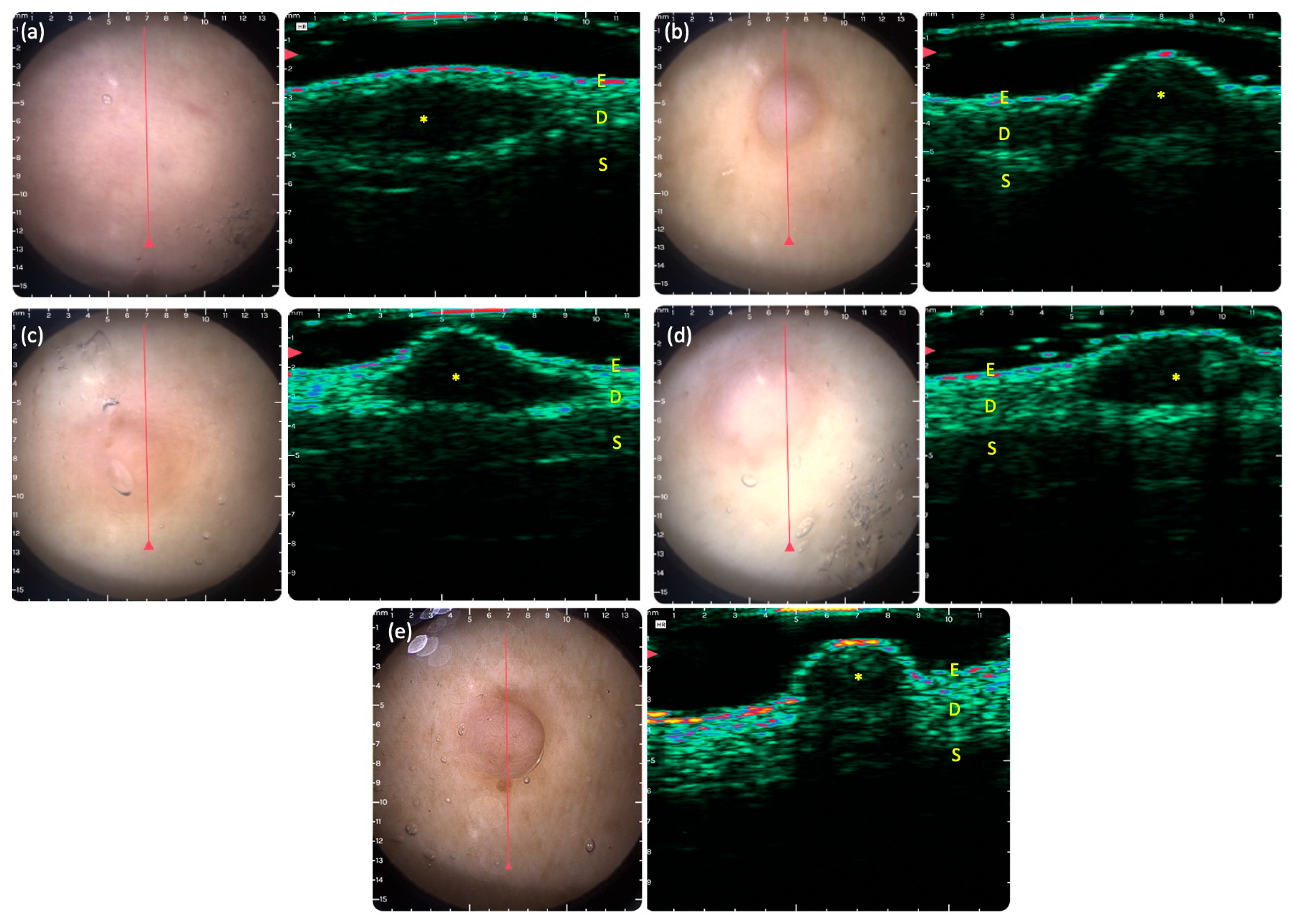
Figure 1. Dermoscopy-guided high-frequency ultrasound (DG-HFUS) images illustrating various shapes and posterior acoustic features of neurofibromas. (a) Ovoid shape; (b) round shape; (c) spiked shape; (d) posterior acoustic enhancement; (e) posterior acoustic shadowing. In the DG-HFUS images, the epidermis (E) appears as a thin, high-intensity band, and the dermis (D) shows lower echogenicity with occasional focal hyperintense areas. Neurofibromas (*) present as well-defined, hypoechoic structures located in the dermis or extending into the superficial subcutis. D: Dermis E: epidermis, S: subcutis.
Jcm 15 00475 g001
Table 1. The prevalence of clinical manifestations among NF1 patients included in the study.
SymptomsThe Number and Percentage of Affected Patients
CALM11 (79%)
Axillary and inguinal freckling12 (86%)
Cutaneous and subcutaneous neurofibroma14 (100%)
Plexiform neurofibroma6 (43%)
Lisch-nodule11 (79%)
Scoliosis5 (36%)
Malignancy3 (21%)
CALM: café-au-lait macule.
Table 2. Clinical data according to the revised 2021 diagnostic criteria.
PatientsCALMAxillary or Inguinal FrecklingNFOptic GliomaLisch NoduleSkeletal AbnormalityNF1 VariantFamily HistoryNumber of NF
NFP1>6>2->2-posneg4
NFP2>6>2->2-pospos4
NFP3-->2---posneg7
NFP4-->2---posneg7
NFP5>6>2->2-posneg8
NFP6>6>2->2-posneg9
NFP7>6>2->2-pospos10
NFP8>6>2->2-posneg6
NFP9>6>2---pospos5
NFP10>6>2->2-posneg8
NFP11>6>2->2-posneg7
NFP12>6>2->2-pospos13
NFP13>6>2->2-pospos3
NFP14->2->2-pospos9
CALM: café-au-lait macule; neg: negative; NF: neurofibroma; NF1: neurofibromatosis type 1; NFP: patient affected by neurofibromatosis; pos: positive.
Table 3. Epidemiological and clinical characteristics of the patients included in the study.
PatientsSex Assigned at BirthAge (Year)Onset of SymptomsCutaneous SymptomsExtracutaneous
Symptoms
Comorbidites
NFP1male50childhoodCALM, freckling, neurofiromaLisch nodules, hypertensionasthma bronchiale
NFP2male70childhoodCALM, freckling, neurofiromaLisch nodules, pheochromocytoma, hypertensionasthma bronchiale, BPH, nephrolithiasis, gastritis chronica
NFP3female58adulthoodneurofibromahypetensionstruma nodosa
NFP4female52adulthoodneurofibroma, nevus anemicusBreast cancer, adrenal adenoma-
NFP5female34adolescenceCALM, freckling, neurofiromaLisch-nodulesmigraine, myopia
NFP6female38adolescenceCALM, freckling, neurofiromaLisch-nodulescholelithiasis, gastric ulcer
NFP7male21childhoodCALM, freckling, neurofiromaLisch nodules, scoliosis-
NFP8male19childhoodCALM, freckling, neurofibroma, juvenile xanthogranulomaLisch nodules, scoliosis-
NFP9female35childhoodCALM, freckling, neurofibromascoliosiscataracta, myopia, allergic rhinitis
NFP10male31childhoodCALM, freckling, neurofibromaLisch nodulesmyopia, strabismus
NFP11male73adolescenceCALM, freckling, neurofibromaLisch nodules, scoliosis, hypertension, GISTcontact dermatitis
NFP12female56adolescenceCALM, freckling, neurofibromaLisch-noduleshyperlipidemia
NFP13female47childhoodCALM, freckling, neurofibromaLisch nodules, scoliosisspina bifida
NFP14female39childhoodfreckling, neurofibroma, nevus anemicusLisch nodules-
CALM: café-au-lait macule; BPH: benign prostatic hyperplasia; GIST: gastrointestinal stromal tumor; NFP: patient affected by neurofibromatosis.
Table 4. Ultrasound characteristics of 100 neurofibromas assessed with a dermoscopy-guided 33 MHz high-frequency ultrasound device.
LocationDermis79/100 (79%)
Subcutis21/100 (21%)
ShapeRound28/100 (28%)
Ovoid63/100 (63%)
Spiked9/100 (9%)
Global echogenicityHypoechoic100/100 (100%)
Hyperechoic0/100 (0%)
EchogenicityHomogenous62/100 (62%)
Heterogenous38/100 (38%)
ContourWell-defined57/100 (57%)
Poorly defined43/100 (43%)
Posterior acoustic featureEnhancement3/100 (3%)
Shadowing10/100 (10%)
SurfaceProtruding58/100 (58%)
Flat42/100 (42%)
Disclaimer/Publisher’s Note: The statements, opinions and data contained in all publications are solely those of the individual author(s) and contributor(s) and not of MDPI and/or the editor(s). MDPI and/or the editor(s) disclaim responsibility for any injury to people or property resulting from any ideas, methods, instructions or products referred to in the content.


