


Abstract
Background: This study aims to evaluate the effect of hand grip strength (HGS) on perioperative outcomes—particularly postoperative delirium (POD)—in patients scheduled for total knee arthroplasty (TKA). Methods: Older female patients, aged ≥ 65 years, who were scheduled for TKA under general anesthesia were enrolled in this study. We measured preoperative HGS and clinical frailty scale. The primary outcome was the incidence of POD within 30 days of surgery. Secondary outcomes included intraoperative hypotension, surgical site infection, postoperative pulmonary complications, postoperative nausea and vomiting, acute kidney injury, postoperative urinary retention, and hospital length of stay. Results: The final analysis was conducted on 78 participants. The median HGS was 17.9 kg, the patients were divided into Weak (HGS ≤ 17.9, n = 39) and Strong groups (HGS > 17.9, n = 39). POD was more prevalent in the Weak group (23.1% vs. 0.0%, p = 0.005). As secondary outcomes, there were no significant differences between the two groups, except the postoperative estimated glomerular filtration rate (101 [90; 120.5] mL/min/1.73 m2 in the Weak group vs. 122 [104; 138] mL/min/1.73 m2 in the Strong group; p = 0.007). In the receiver operating characteristic curve analysis of POD occurrence according to HGS, the cutoff value was 17.5 (area under curve 0.88, p < 0.001). In univariate logistic regression analysis, age and HGS were associated with the occurrence of POD. In multivariate logistic regression analysis, HGS was the only factor that affects POD. For each 1 kg increase in HGS, the risk of POD decreased by 28% (Odds ratio: 0.72). Conclusions: In this study, lower preoperative HGS was significantly associated with the occurrence of POD.
1. Introduction
Total knee arthroplasty (TKA) is an established and effective surgical treatment for patients with advanced knee osteoarthritis who fail to respond to conservative management [1]. With progressive population aging, the number of older adults undergoing TKA continues to increase worldwide. Although advances in surgical techniques, anesthesia, and perioperative care have improved overall outcomes, older patients remain particularly vulnerable to postoperative complications, which may result in prolonged hospitalization, delayed functional recovery, increased healthcare utilization, and higher medical costs [2,3,4,5]. Consequently, identifying preoperative risk factors that can predict adverse perioperative outcomes is of substantial clinical importance.
Among postoperative complications, postoperative delirium (POD) is one of the most frequent and clinically relevant neurocognitive disorders in older surgical patients [6]. POD is characterized by an acute and fluctuating disturbance of attention and cognition and has been consistently associated with poor short- and long-term outcomes, including prolonged length of stay, impaired rehabilitation, increased risk of institutionalization, long-term cognitive decline, and mortality [7]. In patients undergoing major orthopedic surgery such as TKA, POD not only complicates postoperative management but also interferes with early mobilization and functional recovery, which are essential for optimal surgical outcomes. Given its substantial clinical and socioeconomic impact, POD was prospectively defined as the primary outcome of the present study.
Frailty, a multidimensional syndrome reflecting decreased physiological reserve and increased vulnerability to stressors, has emerged as a key determinant of adverse postoperative outcomes, including POD, in older adults [8]. Various instruments have been proposed to assess frailty, such as the Clinical Frailty Scale (CFS), radiologic measurements of muscle mass, and anthropometric assessments of specific muscle groups or limb circumferences [9,10,11,12,13]. While informative, these methods often require additional examinations, specialized equipment, or substantial time, limiting their feasibility in routine perioperative practice.
Hand grip strength (HGS) has gained increasing attention as a simple, noninvasive, and objective surrogate marker of frailty and overall health status [14]. HGS can be measured within seconds using a handheld dynamometer and has been shown to correlate with sarcopenia, nutritional status, physical function, and long-term outcomes in older populations. Previous studies have demonstrated associations between low HGS and postoperative complications, cognitive impairment, and mortality across various surgical and medical settings [15,16,17]. However, evidence focusing specifically on the relationship between preoperative HGS and POD in patients undergoing TKA remains limited.
In addition, women represent the majority of patients undergoing TKA, and sex-related differences in muscle strength, frailty progression, and postoperative outcomes have been reported [18]. To reduce heterogeneity and enhance the interpretability of the results, this study focused exclusively on older female patients. We also assessed preoperative frailty using both HGS and CFS to better characterize patients’ baseline functional status.
Accordingly, we hypothesized a priori that lower preoperative HGS would be associated with a higher incidence of POD. The primary aim of this prospective observational study was to evaluate the association between preoperative HGS and POD, while secondary objectives included examining the impact of HGS on other perioperative outcomes in older female patients scheduled for TKA under general anesthesia.
2. Materials and Methods
2.1. Study Design, Ethics, and Registry
This prospective observational study was designed to evaluate the effect of HGS on postoperative outcomes in older female patients scheduled for TKA under general anesthesia. This trial was approved by the Institutional Review Board of Kyung Hee University Hospital (KHUH 2023-03-069) on 28 April 2023 and written informed consent was obtained from all participants in the trial. This study was registered prior to patient enrollment at the Clinical Research Information Service (No. KCT0008488; principal investigator: Hee Yong Kang; registration date: 2 June 2023) and was conducted in accordance with the Declaration of Helsinki. The study protocol is available from the Clinical Research Information Service. This study complied with the Strengthening the Reporting of Observational Studies in Epidemiology (STROBE) checklist.
2.2. Participants
Older female patients age ≥ 65 years who were scheduled for elective primary TKA under general anesthesia at single tertiary medical center were eligible for inclusion. The exclusion criteria included planned revision or bilateral TKA, inability to measure HGS, American Society of Anesthesiologists physical status class ≥ III, history of kidney disease, cerebrovascular disease, altered mental status, and a body mass index > 35 kg/m2. Recruitment began in June 2023 and ended in October 2023.
2.3. Outcomes
The primary outcome was the incidence of POD within 30 days after surgery, defined a priori. POD was defined as acute change in the patient’s mental status and a diagnosis of delirium by a psychiatrist using the Confusion Assessment Method [19,20]. The psychiatrist was blinded to all preoperative data, including HGS.
Secondary outcomes included intraoperative hypotension, surgical site infection (SSI), postoperative pulmonary complications (PPC), postoperative nausea and vomiting (PONV), acute kidney injury (AKI), postoperative urinary retention (POUR) until postoperative day 30, and postoperative hospital length of stay. Intraoperative hypotension was defined as a ≥20% reduction in systolic blood pressure from baseline [21]. SSI was defined as postoperative antibiotic administration or wound revision due to an abscess formation [22,23]. PPC was defined according to the European Joint Task Force published guidelines for perioperative clinical outcome. These include respiratory infection, respiratory failure, pleural effusion, atelectasis, pneumothorax, bronchospasm, and aspiration pneumonitis [24]. PONV was defined as the patient complained of nausea or vomiting, or antiemetics were administered [25]. AKI was evaluated using the Kidney Disease: Improving Global Outcomes criteria and was defined as an increase in serum creatinine (Cr) level ≥ 0.3 mg/dL from baseline [26]. POUR was defined as urinary retention ≥ 300 mL on bladder scan or if a urinary catheterization was performed while the patient complained of suprapubic discomfort [27,28].
Postoperative complications were assessed for up to 30 days after surgery to ensure comprehensive evaluation of patient safety, consistent with commonly used postoperative follow-up periods in clinical outcome studies [29]. Postoperative outcomes were assessed by a single researcher who was blinded to the patients’ preoperative data, including HGS, based on medical records up to 30 days after surgery.
2.4. Procedures
After entering the operating room, HGS and CFS were measured. The HGS was measured once on each hand using a manometer (Camry digital hand dynamometer; Camry scale, South El Monte, CA, USA), and the stronger value was used in the data analysis. The CFS was assessed using the Canadian Study of Health and Aging Clinical Frailty Scale, which categorizes frailty into nine levels by a single researcher (Supplementary Table S1) [9,30]. Standard patient monitoring was performed according to clinical practice guidelines. Immediately before anesthesia induction, glycopyrrolate 0.2 mg was administered as an anticholinergic agent, and palonosetron 0.075 mg was given as an antiemetic. For anesthesia induction, propofol at 1–1.5 mg/kg and rocuronium 0.8 mg/kg were administered. To minimize the impact of deep sedation on the occurrence of POD, anesthesia was maintained with sevoflurane at 0.8–1.2 minimum alveolar concentration, targeting a bispectral index 40–60 [31]. Remifentanil was administered at 0.05–0.2 mcg/kg/min while monitoring blood pressure and heart rate. When intraoperative hypotension occurred, 50 mcg of phenylephrine or 5 mg of ephedrine was administered depending on the vital signs. At the end of the surgery, 2 mg/kg of sugammadex was administered, and extubation was performed after confirming the patient’s spontaneous ventilation. Fentanyl-based (15 mcg/kg) IV patient-controlled analgesia was administered until postoperative day 2.
2.5. Sample Size Calculation
The authors conducted a pilot study on the incidence of delirium according to HGS who underwent TKA for sample size calculation. This study was conducted on 36 patients, and median HGS was 17.4 kg [12.3; 22.7]. Delirium occurred in four patients in the group with HGS lower than median value (incidence of POD: 0% (0/18) in strong group vs. 22.2% (4/18) in weak group). Based on these data, as a result of G-power analysis (α error 0.05, power 0.8), the target number of participants was 70. Considering the dropout rate of 10%, the calculated sample size was 78.
2.6. Statistical Analysis
The study data were presented as medians [interquartile ranges] or numbers (%), as appropriate. The Shapiro–Wilk test was performed to evaluate the normality of continuous variables. Independent variable t-tests or Wilcoxon rank–sum tests were used to analyze normal or non-normal distributed continuous variables, respectively. Chi-square test or Fisher’s exact test was performed to analyze categorical variables. The optimal HGS associated with POD was assessed based on clinical relevance and the Youden index (sensitivity (%) + specificity (%) − 100) from the Receiver operating characteristic (ROC) curve analysis. Univariate logistic regression analysis was performed to evaluate the factors causing POD, and all variables with p < 0.2 or previously described clinically important factors were included in the multivariate analysis. Covariates were adjusted for age, diabetes, hypertension, hematocrit, alanine transaminase (ALT), blood urea nitrogen, estimated glomerular filtration rate (eGFR), CFS, HGS, intraoperative hypotension and anesthesia time. Multicollinearity among the variables was evaluated via a variance inflation factor (VIF), with the VIF < 10 indicating no multicollinearity. Model calibration was assessed using the Hosmer–Lemeshow goodness-of-fit test. A post hoc power analysis was performed based on the data obtained in the current study. Statistical analysis were performed using the commercial statistical SPSS software (version 22.0; IBM Corp., Armonk, NY, USA). Differences were considered statistically significant at two-tailed p values < 0.05.
3. Results
3.1. Study Participants and Patient Characteristics
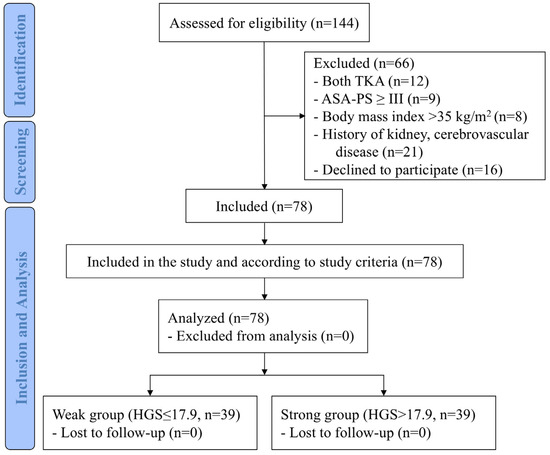
We screened 144 patients, of whom 66 were excluded, and 78 were enrolled. The median HGS value for all participants was 17.9 kg [12.6; 21.8], 39 patients were equally divided into Weak (HGS ≤ 17.9) or Strong (HGS > 17.9) groups. Finally, 78 patients were analyzed without follow-up loss (Figure 1).
Figure 1.
Patient flow chart. ASA-PS, American Society of Anesthesiologists physical status; HGS, hand grip strength; TKA, total knee arthroplasty.
In demographic data of the Weak group, the age (75 [72; 80] vs. 71 [68; 75], p = 0.006) was significantly higher and ALT (17 [14; 21] vs. 21 [17; 24], p = 0.019) were significantly lower than the Strong group. The HGS were 12.6 [10.4; 15.9] and 21.8 [20.1; 24.1] in the Weak and Strong group, respectively. Other patient characteristics were comparable in both groups (Table 1).
Table 1.
Patient characteristics according to weak or strong hand grip strength.
3.2. Primary Outcome
In the perioperative outcome evaluation, POD occurred more frequently in the Weak group than the Strong group (9 (23.1%) vs. 0 (0.0%), p = 0.005) (Table 2).
Table 2.
Perioperative data and outcomes until postoperative days 30.
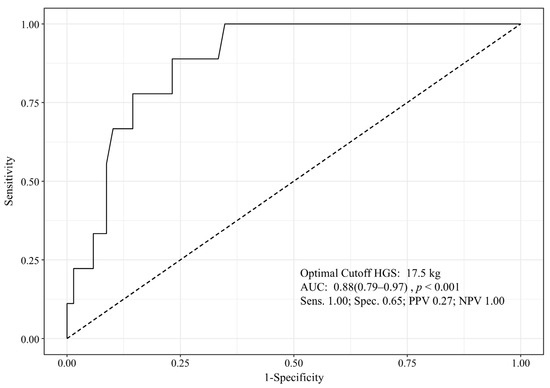
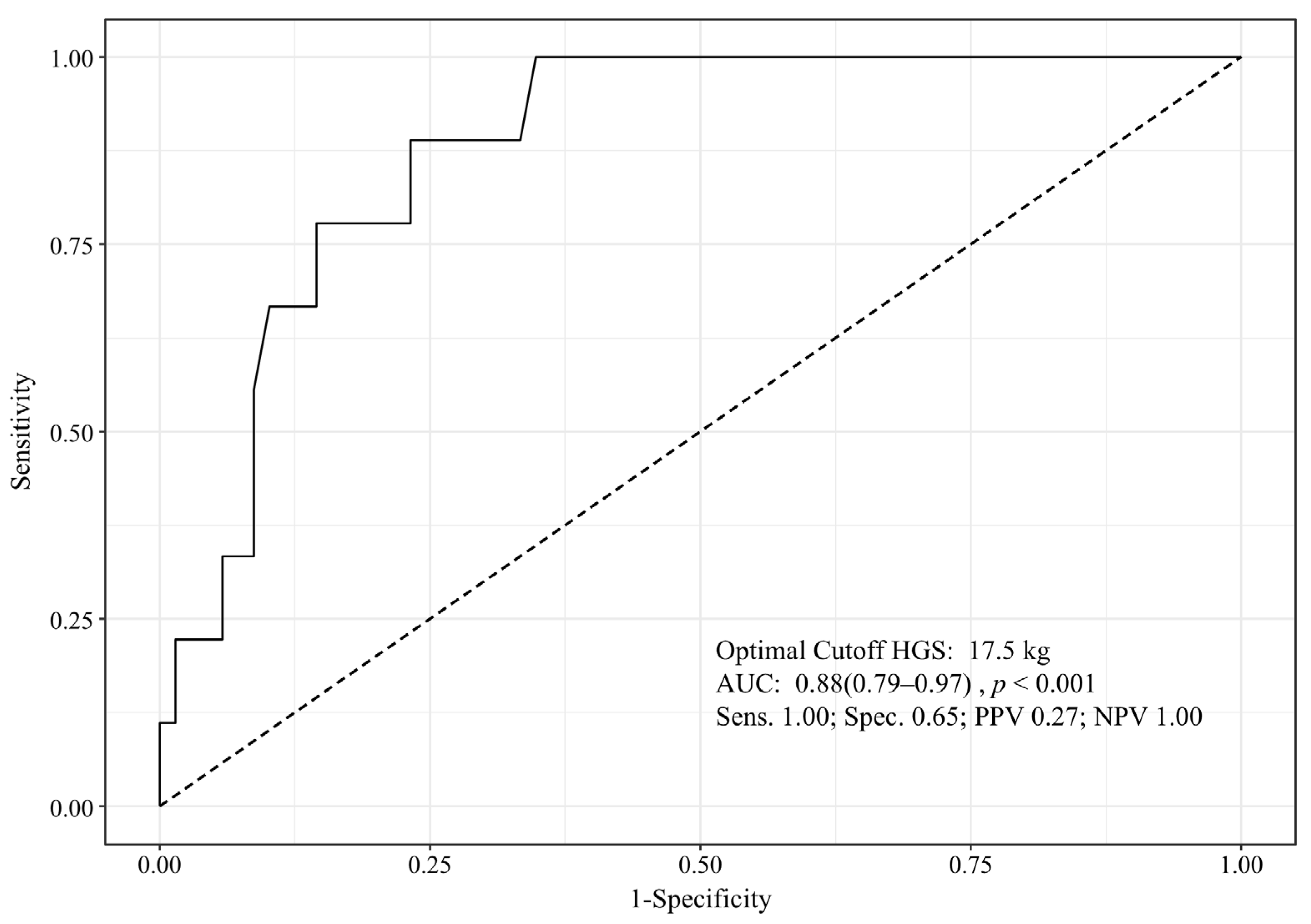
In the ROC curve analysis for the occurrence of POD according to HGS, the optimal cutoff value was 17.5 kg (Figure 2).
Figure 2.
Receiver operating characteristic curve analysis according to postoperative delirium occurrence among all patients of preoperative hand grip strength. AUC, area under curve; HGS, hand grip strength; NPV, negative predictive value; PPV, positive predictive value; Sens., sensitivity; Spec., specificity.
3.3. Secondary Outcomes
When divided into two groups based on HGS median 17.9, other postoperative outcomes were comparable in both groups except eGFR. The postoperative eGFR was significantly lower in the Weak group (101 [90; 121] vs. 122 [104; 138], p = 0.007) (Table 2).
In univariate logistic regression analysis, age, and HGS were found to be associated with the occurrence of POD. In multivariate logistic regression analysis, only HGS was associated with the occurrence of POD. For each 1 kg increase in HGS, the risk of POD decreased by 28% (Odds ratio: 0.72) (Table 3; Supplementary Figure S1). According to the estimated VIFs (<10), multicollinearity had a minimal impact on the results (Table 3). The Hosmer–Lemeshow test indicated good model calibration (χ2 = 3.859, df = 8, p = 0.870). Overall model performance was further supported by a low residual deviance relative to degrees of freedom (32.9/66 = 0.50) and a high explanatory power, as reflected by the Nagelkerke pseudo-R2 of 0.498.
Table 3.
Univariate and multivariate logistic regression analyses of factors associated with postoperative delirium.
During the study period, no serious complications, including mortality, occurred, and all participants were discharged to their home.
3.4. Post Hoc Power Analysis
Based on the data obtained in the current study, a post hoc power analysis was performed to determine the effect of the HGS on the occurrence of POD. Using the POD incidence of the Weak group and Strong group being 23.1% (9/39) and 0% (0/39), respectively, with an α error of 0.05, the power of this study was calculated to be 0.91.
4. Discussion
In this study, we found that lower preoperative HGS was associated with an increased incidence of POD in older female patients scheduled for TKA under general anesthesia. There have been reports suggesting that HGS can be used to assess patients’ overall health status and frailty [32]. Frailty is known to be a risk factor for POD [33]. Therefore, the higher incidence of POD observed in patients with low HGS is likely attributable to their increased frailty. The incidence of POD has been reported to vary widely, ranging from approximately 10–50%. It is considered a major factor contributing to prolonged hospital length of stays and increased healthcare costs [34,35]. By utilizing the findings of this study to predict and prepare for POD in patients with low preoperative HGS, limited healthcare resources can be allocated more efficiently. Measurement of HGS can be easily incorporated into routine preoperative assessments, allowing for early identification of high-risk patients without additional cost or time burden. For patients with low preoperative HGS, targeted interventions such as preoperative nutritional counseling, resistance-based prehabilitation programs aimed at improving muscle mass and strength, and closer perioperative monitoring for cognitive changes may help achieve better postoperative outcomes [36,37]. In addition, these patients may benefit from tailored anesthetic and analgesic strategies, early mobilization, and enhanced delirium prevention protocols, including optimized pain control, sleep promotion, and minimization of deliriogenic medications. Collectively, incorporating HGS into perioperative risk stratification may facilitate individualized care pathways and contribute to improved patient safety and recovery.
The association between HGS and the occurrence of POD has been mentioned in numerous previous studies [32,38,39]. In addition to previous studies, this study conducted a prospective analysis focusing solely on a specific patient population, allowing for a clearer determination of HGS. In the study by Qian et al. the cutoff value for HGS in female was reported as 18.05 kg [38]. Similarly, the Revised Japanese version of the Cardiovascular Health Study criteria [40] suggests a reference value of 18 kg for female. These values are comparable to the median HGS of 17.9 kg in this study, supporting the reliability of our data.
In this study, the optimal cutoff value determined by ROC curve analysis was 17.5 kg. This value is similar to both the median value of our study population and the reference values reported in previous studies [38,40]. However, its low positive predictive value limits its utility as a standalone screening tool in clinical practice. Therefore, if a patient presents with low HGS, it is important to consider this result in conjunction with other clinical findings and test results to anticipate and prepare for the possibility of POD. On the other hand, the high negative predictive value suggests that patients with higher HGS are less likely to develop POD, which could help avoid unnecessary use of additional medical resources.
In this study, CFS was measured alongside HGS preoperatively. Numerous studies have reported associations between CFS and HGS, as well as between CFS and POD [41,42,43]. However, this study did not find a statistically significant association related to CFS. This may be attributed to the subjective nature of CFS assessment. Since CFS is evaluated through a clinician observing and interacting with the patient, the assessor’s subjective judgment can influence the results [44]. Although we attempted to minimize bias by having a single researcher assess CFS, no significant findings were obtained. In contrast, HGS provides a numerical representation of a patient’s condition, offering the advantage of greater objectivity regardless of the researcher.
In the demographic data, the Weak group was older. This is an expected finding, as aging is associated with decreased HGS, a relationship that has been well-documented in numerous studies [45,46]. In the univariate logistic regression analysis, age was found to be significantly associated with POD. However, in the multivariate logistic regression analysis, only HGS remained a significant factor. The association between age and POD has been reported in previous studies [47,48]. The current study focused on patients aged ≥ 65, which may have led to an underestimation of the risk of delirium associated with aging. Our findings suggest that in older patients aged ≥ 65, HGS may be more strongly associated with POD than age itself. Future studies should investigate age-adjusted HGS thresholds to better distinguish age-related physiological decline from true frailty and to minimize potential confounding effects. Additionally, the weak group demonstrated statistically lower preoperative ALT levels and postoperative eGFR. ALT reflects hepatocellular function and may influence the hepatic metabolism of anesthetic agents such as propofol and remifentanil. Therefore, lower ALT levels could theoretically be associated with altered drug metabolism and might indirectly contribute to the pathogenesis of POD through liver–brain interactions. However, as both ALT and postoperative eGFR values were largely within the normal range in both groups, these differences are unlikely to have significant clinical implications. Further investigation is warranted in future studies involving patients with overt hepatic dysfunction.
Accumulating evidence indicates that systemic inflammation and neuroinflammation play central roles in the pathogenesis of POD [49]. Surgical trauma and anesthesia trigger a systemic immune response, leading to the release of pro-inflammatory cytokines such as interleukin-6 (IL-6), C-reactive protein (CRP), interleukin-8, and interleukin-1β into the circulation. These inflammatory mediators can disrupt the integrity of the blood–brain barrier, activate microglia and astrocytes, and promote central nervous system inflammation, which may impair neuronal function and contribute to delirium onset. Meta-analytic data have demonstrated that patients who develop POD exhibit significantly elevated levels of inflammatory biomarkers, including IL-6, CRP, and other cytokines, compared with those who do not develop delirium, supporting the concept that neuroinflammation is a key mechanism underlying POD development [50]. In the current study, preoperative white blood cell (WBC) counts were measured; however, there were limitations in assessing additional inflammatory biomarkers solely for research purposes. Preoperative WBC levels did not differ significantly between the two groups and were not associated with POD in univariate logistic regression analysis. As only relatively healthy patients (American Society of Anesthesiologists physical status I–II) were included, the baseline inflammatory burden may have been insufficient to exert a measurable influence on postoperative outcomes. Future studies investigating POD should incorporate a more comprehensive evaluation of inflammatory markers to better elucidate their role in POD pathophysiology.
A key strength of this study is the specific focus on older female patients, which helped minimize biases related to patient characteristics in postoperative outcomes. Additionally, surgery was performed by a single surgeon, minimizing variability in surgical techniques, and data were collected by a single researcher to reduce measurement biases caused by inter-researcher differences. To ensure the fairness of the results, the researcher assessing postoperative outcomes was blinded to the patients’ preoperative information. Lastly, both HGS and CFS were measured to gain a more comprehensive understanding of patients’ preoperative conditions. This allowed us to conclude that in older patients, HGS is more closely associated with POD than CFS.
This study has several limitations. First, the method for measuring HGS has not been clearly standardized. In this study, HGS was measured once on each hand, and the higher value was used for analysis. A previous study suggested measuring HGS three times on each hand [51], but we observed a tendency for HGS to decrease with repeated measurements. Although repeated measurements may improve reproducibility, single measurements per hand were chosen to minimize patient fatigue and improve feasibility in a real-world clinical setting. Second, we did not assess patients’ Mini-Mental State Exam (MMSE) scores preoperatively or postoperatively. Numerous previous studies have reported an association between cognitive function and HGS [52,53]. However, since this study aimed to evaluate various postoperative outcomes, we omitted MMSE assessments, which require considerable time and effort. Third, this study was conducted exclusively in older female patients undergoing TKA, and the relatively small sample size may limit the generalizability of the findings to a broader population. Although restricting the study population to female patients limits external validity, this approach allowed for a more homogeneous cohort and reduced potential confounding effects related to sex-specific differences in muscle strength and frailty. Moreover, the prospective design and the clearly defined primary outcome strengthen the internal validity of this study. This investigation was not intended to be a population-based analysis reflecting the overall incidence of TKA, but rather a hypothesis-driven prospective study focusing on a clinically relevant high-risk subgroup. Future large-scale prospective studies, including male patients, very elderly patients (>80 years), younger patients, and individuals undergoing TKA under regional anesthesia, are warranted to validate and generalize these findings. Fourth, postoperative pain was not evaluated. However, IV patient-controlled analgesia was administered to all patients to minimize postoperative pain. Fifth, complications treated at other hospitals within 30 days after surgery could not be verified. However, most patients returned to our institution for continuous follow-up after surgery. Sixth, we did not measure parameters commonly used to assess frailty in clinical practice, such as psoas muscle size or lower limb circumference [54,55]. However, these measurements require additional tests and time. The authors selected HGS and the CFS because both can be assessed quickly and easily in routine clinical practice without requiring additional testing, prolonged assessment time, or extra costs, thereby supporting the efficient utilization of limited healthcare resources. Moreover, the use of HGS in this study yielded clinically meaningful results. The present study focused on pragmatic frailty measures with high clinical applicability rather than exhaustive frailty phenotyping. Future studies should compare the impact of these parameters on postoperative outcomes. Lastly, follow-up was limited to 30 days postoperatively, preventing the assessment of long-term postoperative outcomes such as mortality. However, no mortality cases were observed during the study period.
5. Conclusions
In conclusion, lower preoperative HGS was associated with the occurrence of POD. For each 1 kg increase in HGS, the risk of POD decreased by 28% (Odds ratio: 0.72). By applying these findings to clinical practice, we aim to promote the efficient use of medical resources and support the rapid postoperative recovery of patients.
Supplementary Materials
The following supporting information can be downloaded at: https://www.mdpi.com/article/10.3390/jcm15020463/s1, Figure S1: Forest plot of the odds ratios for the occurrence of postoperative delirium; Table S1: Canadian study of health and aging clinical frailty scale [10].
Author Contributions
Conceptualization: S.L., A.H.Y. and H.Y.K.; formal analysis: S.L., D.Y.K. and H.Y.K.; investigation: D.Y.K. and H.Y.K.; methodology: S.L., M.K. and A.H.Y.; project administration: S.L. and H.Y.K.; software: M.K., J.E.K. and H.Y.K.; visualization: S.L. and A.H.Y.; Writing—Original draft: S.L.; Writing—Review and editing: S.L. and H.Y.K.; supervision: J.E.K. and H.Y.K. All authors have read and agreed to the published version of the manuscript.
Funding
This research received no external funding.
Institutional Review Board Statement
This study was conducted in accordance with the Declaration of Helsinki and approved by the Institutional Review Board of Kyung Hee University Hospital on 28 April 2023 (protocol code KHUH 2023-03-069).
Informed Consent Statement
Informed consent was obtained from all subjects involved in this study.
Data Availability Statement
The data supporting the findings of this study are available from the corresponding author upon reasonable request. Public access to the dataset is restricted due to privacy and ethical constraints.
Conflicts of Interest
The authors declare no conflicts of interest.
Abbreviations
The following abbreviations are used in this manuscript:
| AKI | Acute kidney injury |
| CFS | Clinical frailty scale |
| eGFR | Estimated glomerular filtration rate |
| HGS | Hand grip strength |
| LOS | Length of stay |
| POD | Postoperative delirium |
| PONV | Postoperative nausea and vomiting |
| POUR | Postoperative urinary retention |
| PPC | Postoperative pulmonary complications |
| SSI | Surgical site infection |
| TKA | Total knee arthroplasty |
| VIF | Variance inflation factor |
References
- Jenkins, P.J.; Clement, N.D.; Hamilton, D.F.; Gaston, P.; Patton, J.T.; Howie, C.R. Predicting the cost-effectiveness of total hip and knee replacement: A health economic analysis. Bone Jt. J. 2013, 95-b, 115–121. [Google Scholar] [CrossRef] [Scilit]
- Constantinescu, D.S.; Costello, J.P., 2nd; Yakkanti, R.R.; Vanden Berge, D.J.; Carvajal Alba, J.A.; Hernandez, V.H.; D’Apuzzo, M.R. Lower Perioperative Complication Rates and Shorter Lengths of Hospital Stay Associated With Technology-Assisted Total Knee Arthroplasty Versus Conventional Instrumentation in Primary Total Knee Arthroplasty. J. Arthroplast. 2024, 39, 1512–1517. [Google Scholar] [CrossRef] [Scilit] [PubMed]
- Rice, D.A.; Kluger, M.T.; McNair, P.J.; Lewis, G.N.; Somogyi, A.A.; Borotkanics, R.; Barratt, D.T.; Walker, M. Persistent postoperative pain after total knee arthroplasty: A prospective cohort study of potential risk factors. Br. J. Anaesth. 2018, 121, 804–812. [Google Scholar] [CrossRef] [Scilit] [PubMed]
- Takazawa, T.; Horiuchi, T.; Orihara, M.; Nagumo, K.; Tomioka, A.; Ideno, Y.; Hayashi, K.; Yashima, H.; Araki, T.; Hatayama, K.; et al. Prevention of Postoperative Cognitive Dysfunction by Minocycline in Elderly Patients after Total Knee Arthroplasty: A Randomized, Double-blind, Placebo-controlled Clinical Trial. Anesthesiology 2023, 138, 172–183. [Google Scholar] [CrossRef] [Scilit] [PubMed]
- Perlas, A.; Chan, V.W.; Beattie, S. Anesthesia Technique and Mortality after Total Hip or Knee Arthroplasty: A Retrospective, Propensity Score-matched Cohort Study. Anesthesiology 2016, 125, 724–731. [Google Scholar] [CrossRef] [Scilit]
- Huang, H.; Li, H.; Zhang, X.; Shi, G.; Xu, M.; Ru, X.; Chen, Y.; Patel, M.B.; Ely, E.W.; Lin, S.; et al. Association of postoperative delirium with cognitive outcomes: A meta-analysis. J. Clin. Anesth. 2021, 75, 110496. [Google Scholar] [CrossRef] [Scilit]
- Feng, Y.; Sun, R.; Zhang, Y.; Ma, L.; Huang, Y.; Yu, K. Association between sarcopenia and postoperative delirium in elderly surgical patients: A systematic review and meta-analysis. BMC Geriatr. 2025, 25, 520. [Google Scholar] [CrossRef] [Scilit]
- Park, C.M.; Lie, J.J.; Yang, L.; Cooper, Z.; Kim, D.H. Impact of peri-operative frailty and operative stress on post-discharge mortality, readmission and days at home in Medicare beneficiaries. Anaesthesia 2024, 79, 829–838. [Google Scholar] [CrossRef] [Scilit]
- Rockwood, K.; Song, X.; MacKnight, C.; Bergman, H.; Hogan, D.B.; McDowell, I.; Mitnitski, A. A global clinical measure of fitness and frailty in elderly people. Can. Med. Assoc. J. 2005, 173, 489–495. [Google Scholar] [CrossRef] [Scilit]
- Gong, S.; Qian, D.; Riazi, S.; Chung, F.; Englesakis, M.; Li, Q.; Huszti, E.; Wong, J. Association Between the FRAIL Scale and Postoperative Complications in Older Surgical Patients: A Systematic Review and Meta-Analysis. Anesth. Analg. 2023, 136, 251–261. [Google Scholar] [CrossRef] [Scilit]
- Sun, C.Y.; Huang, C.C.; Tsai, Y.S.; Chang, Y.T.; Ou, C.H.; Su, W.C.; Fan, S.Y.; Wang, S.T.; Yang, D.C.; Huang, C.C.; et al. Clinical Frailty Scale in Predicting Postoperative Outcomes in Older Patients Undergoing Curative Surgery for Urologic Malignancies: A Prospective Observational Cohort Study. Urology 2020, 144, 38–45. [Google Scholar] [CrossRef] [Scilit]
- Balsam, L.B. Psoas muscle area: A new standard for frailty assessment in cardiac surgery? J. Thorac. Dis. 2018, 10, S3846–S3849. [Google Scholar] [CrossRef] [Scilit] [PubMed]
- Landi, F.; Onder, G.; Russo, A.; Liperoti, R.; Tosato, M.; Martone, A.M.; Capoluongo, E.; Bernabei, R. Calf circumference, frailty and physical performance among older adults living in the community. Clin. Nutr. 2014, 33, 539–544. [Google Scholar] [CrossRef] [Scilit] [PubMed]
- Vaishya, R.; Misra, A.; Vaish, A.; Ursino, N.; D’Ambrosi, R. Hand grip strength as a proposed new vital sign of health: A narrative review of evidences. J. Health Popul. Nutr. 2024, 43, 7. [Google Scholar] [CrossRef] [Scilit] [PubMed]
- Dodds, R.M.; Syddall, H.E.; Cooper, R.; Benzeval, M.; Deary, I.J.; Dennison, E.M.; Der, G.; Gale, C.R.; Inskip, H.M.; Jagger, C.; et al. Grip strength across the life course: Normative data from twelve British studies. PLoS ONE 2014, 9, e113637. [Google Scholar] [CrossRef] [Scilit]
- Xu, B.Y.; Yan, S.; Low, L.L.; Vasanwala, F.F.; Low, S.G. Predictors of poor functional outcomes and mortality in patients with hip fracture: A systematic review. BMC Musculoskelet. Disord. 2019, 20, 568. [Google Scholar] [CrossRef] [Scilit]
- Velghe, A.; De Buyser, S.; Noens, L.; Demuynck, R.; Petrovic, M. Hand grip strength as a screening tool for frailty in older patients with haematological malignancies. Acta Clin. Belg. 2016, 71, 227–230. [Google Scholar] [CrossRef] [Scilit]
- Ayers, D.C.; Zheng, H.; Yang, W.; Yousef, M. Gender Differences in Pain, Function, and Quality of Life Five Years Following Primary Total Knee Arthroplasty. J. Arthroplast. 2024, 39, S100–S107. [Google Scholar] [CrossRef] [Scilit]
- Leung, J.M.; Rojas, J.C.; Tang, C.; Chan, B.; Lario-Lago, A.; Boxer, A.L.; Do, Q.; Kramer, J.H.; Du, Z.; Du, P.; et al. Presence of Preoperative Neurodegeneration Biofluid Markers in Patients with Postoperative Delirium. Anesthesiology 2023, 139, 432–443. [Google Scholar] [CrossRef] [Scilit]
- Inouye, S.K.; van Dyck, C.H.; Alessi, C.A.; Balkin, S.; Siegal, A.P.; Horwitz, R.I. Clarifying confusion: The confusion assessment method. A new method for detection of delirium. Ann. Intern. Med. 1990, 113, 941–948. [Google Scholar] [CrossRef] [Scilit]
- Lee, S.; Kim, D.Y.; Han, J.; Kim, K.; You, A.H.; Kang, H.Y.; Park, S.W.; Kim, M.K.; Kim, J.E.; Choi, J.H. Hemodynamic changes in the prone position according to fluid loading after anaesthesia induction in patients undergoing lumbar spine surgery: A randomized, assessor-blind, prospective study. Ann. Med. 2024, 56, 2356645. [Google Scholar] [CrossRef] [Scilit] [PubMed]
- Horan, T.C.; Andrus, M.; Dudeck, M.A. CDC/NHSN surveillance definition of health care-associated infection and criteria for specific types of infections in the acute care setting. Am. J. Infect. Control 2008, 36, 309–332. [Google Scholar] [CrossRef] [Scilit] [PubMed]
- Fang, X.; Cai, Y.; Mei, J.; Huang, Z.; Zhang, C.; Yang, B.; Li, W.; Zhang, W. Optimizing culture methods according to preoperative mNGS results can improve joint infection diagnosis. Bone Jt. J. 2021, 103-b, 39–45. [Google Scholar] [CrossRef] [Scilit] [PubMed]
- Jammer, I.; Wickboldt, N.; Sander, M.; Smith, A.; Schultz, M.J.; Pelosi, P.; Leva, B.; Rhodes, A.; Hoeft, A.; Walder, B.; et al. Standards for definitions and use of outcome measures for clinical effectiveness research in perioperative medicine: European Perioperative Clinical Outcome (EPCO) definitions: A statement from the ESA-ESICM joint taskforce on perioperative outcome measures. Eur. J. Anaesthesiol. 2015, 32, 88–105. [Google Scholar] [CrossRef] [Scilit]
- Lee, S.; You, A.H.; Kim, M.; Kang, H.Y. Postoperative Nausea and Vomiting According to Target-Controlled or Manual Remifentanil Infusion in Gynecological Patients Undergoing Pelviscopic Surgery: A Randomized Controlled Trial. J. Pers. Med. 2023, 13, 176. [Google Scholar] [CrossRef] [Scilit]
- Khwaja, A. KDIGO clinical practice guidelines for acute kidney injury. Nephron Clin. Pract. 2012, 120, c179–c184. [Google Scholar] [CrossRef] [Scilit]
- Serlin, D.C.; Heidelbaugh, J.J.; Stoffel, J.T. Urinary Retention in Adults: Evaluation and Initial Management. Am. Fam. Physician 2018, 98, 496–503. [Google Scholar]
- Stoffel, J.T.; Peterson, A.C.; Sandhu, J.S.; Suskind, A.M.; Wei, J.T.; Lightner, D.J. AUA White Paper on Nonneurogenic Chronic Urinary Retention: Consensus Definition, Treatment Algorithm, and Outcome End Points. J. Urol. 2017, 198, 153–160. [Google Scholar] [CrossRef] [Scilit]
- Global variation in postoperative mortality and complications after cancer surgery: A multicentre, prospective cohort study in 82 countries. Lancet 2021, 397, 387–397. [CrossRef] [Scilit]
- Church, S.; Rogers, E.; Rockwood, K.; Theou, O. A scoping review of the Clinical Frailty Scale. BMC Geriatr. 2020, 20, 393. [Google Scholar] [CrossRef] [Scilit]
- Evered, L.A.; Chan, M.T.V.; Han, R.; Chu, M.H.M.; Cheng, B.P.; Scott, D.A.; Pryor, K.O.; Sessler, D.I.; Veselis, R.; Frampton, C.; et al. Anaesthetic depth and delirium after major surgery: A randomised clinical trial. Br. J. Anaesth. 2021, 127, 704–712. [Google Scholar] [CrossRef] [Scilit] [PubMed]
- Kotani, T.; Ida, M.; Inoue, S.; Naito, Y.; Kawaguchi, M. Association between Preoperative Hand Grip Strength and Postoperative Delirium after Cardiovascular Surgery: A Retrospective Study. J. Clin. Med. 2023, 12, 2705. [Google Scholar] [CrossRef] [Scilit] [PubMed]
- Brown, C.H.t.; Max, L.; LaFlam, A.; Kirk, L.; Gross, A.; Arora, R.; Neufeld, K.; Hogue, C.W.; Walston, J.; Pustavoitau, A. The Association Between Preoperative Frailty and Postoperative Delirium After Cardiac Surgery. Anesth. Analg. 2016, 123, 430–435. [Google Scholar] [CrossRef] [Scilit] [PubMed]
- Swarbrick, C.J.; Partridge, J.S.L. Evidence-based strategies to reduce the incidence of postoperative delirium: A narrative review. Anaesthesia 2022, 77, 92–101. [Google Scholar] [CrossRef] [Scilit]
- Sadeghirad, B.; Dodsworth, B.T.; Schmutz Gelsomino, N.; Goettel, N.; Spence, J.; Buchan, T.A.; Crandon, H.N.; Baneshi, M.R.; Pol, R.A.; Brattinga, B.; et al. Perioperative Factors Associated With Postoperative Delirium in Patients Undergoing Noncardiac Surgery: An Individual Patient Data Meta-Analysis. JAMA Netw. Open 2023, 6, e2337239. [Google Scholar] [CrossRef] [Scilit]
- Batchelor, T.J.P.; Rasburn, N.J.; Abdelnour-Berchtold, E.; Brunelli, A.; Cerfolio, R.J.; Gonzalez, M.; Ljungqvist, O.; Petersen, R.H.; Popescu, W.M.; Slinger, P.D.; et al. Guidelines for enhanced recovery after lung surgery: Recommendations of the Enhanced Recovery After Surgery (ERAS®) Society and the European Society of Thoracic Surgeons (ESTS). Eur. J. Cardio-Thorac. Surg. 2019, 55, 91–115. [Google Scholar] [CrossRef] [Scilit]
- Gillis, C.; Buhler, K.; Bresee, L.; Carli, F.; Gramlich, L.; Culos-Reed, N.; Sajobi, T.T.; Fenton, T.R. Effects of Nutritional Prehabilitation, With and Without Exercise, on Outcomes of Patients Who Undergo Colorectal Surgery: A Systematic Review and Meta-analysis. Gastroenterology 2018, 155, 391–410.e394. [Google Scholar] [CrossRef] [Scilit]
- Qian, J.; Shen, X.; Gao, X.; Sun, Q. Grip Strength is a Predictor for Subsyndromal Delirium Among Older Adults Following Joint Replacement. Clin. Interv. Aging 2023, 18, 1675–1685. [Google Scholar] [CrossRef] [Scilit]
- Choi, J.Y.; Kim, J.K.; Kim, K.I.; Lee, Y.K.; Koo, K.H.; Kim, C.H. How does the multidimensional frailty score compare with grip strength for predicting outcomes after hip fracture surgery in older patients? A retrospective cohort study. BMC Geriatr. 2021, 21, 234. [Google Scholar] [CrossRef] [Scilit]
- Satake, S.; Arai, H. The revised Japanese version of the Cardiovascular Health Study criteria (revised J-CHS criteria). Geriatr. Gerontol. Int. 2020, 20, 992–993. [Google Scholar] [CrossRef] [Scilit]
- Vancea Nemirschi, A.T.; Lupu, A.A.; Aivaz, K.A.; Iliescu, M.G.; Deriaz, M.; Marzan, M.; Spiru, L. Exploring the Connections Between Grip Strength, Nutritional Status, Frailty, Depression, and Cognition as Initial Assessment Tools in Geriatric Rehabilitation-A Pilot Study. Medicina 2024, 60, 1916. [Google Scholar] [CrossRef] [Scilit] [PubMed]
- McIsaac, D.I.; MacDonald, D.B.; Aucoin, S.D. Frailty for Perioperative Clinicians: A Narrative Review. Anesth. Analg. 2020, 130, 1450–1460. [Google Scholar] [CrossRef] [Scilit] [PubMed]
- Fang, P.P.; Shang, Z.X.; Xu, J.; Hu, J.; Zhang, S.C.; Fan, Y.G.; Lu, Y.; Liu, X.S.; Maze, M. Contribution of intraoperative electroencephalogram suppression to frailty-associated postoperative delirium: Mediation analysis of a prospective surgical cohort. Br. J. Anaesth. 2023, 130, e263–e271. [Google Scholar] [CrossRef] [Scilit] [PubMed]
- Mizuguchi, Y.; Nakao, M.; Nagai, T.; Takahashi, Y.; Abe, T.; Kakinoki, S.; Imagawa, S.; Matsutani, K.; Saito, T.; Takahashi, M.; et al. Machine learning-based gait analysis to predict clinical frailty scale in elderly patients with heart failure. Eur. Heart J. Digit. Health 2024, 5, 152–162. [Google Scholar] [CrossRef] [Scilit]
- Labott, B.K.; Bucht, H.; Morat, M.; Morat, T.; Donath, L. Effects of Exercise Training on Handgrip Strength in Older Adults: A Meta-Analytical Review. Gerontology 2019, 65, 686–698. [Google Scholar] [CrossRef] [Scilit]
- Albrecht, B.M.; Stalling, I.; Bammann, K. Sex- and age-specific normative values for handgrip strength and components of the Senior Fitness Test in community-dwelling older adults aged 65-75 years in Germany: Results from the OUTDOOR ACTIVE study. BMC Geriatr. 2021, 21, 273. [Google Scholar] [CrossRef] [Scilit]
- Mevorach, L.; Forookhi, A.; Farcomeni, A.; Romagnoli, S.; Bilotta, F. Perioperative risk factors associated with increased incidence of postoperative delirium: Systematic review, meta-analysis, and Grading of Recommendations Assessment, Development, and Evaluation system report of clinical literature. Br. J. Anaesth. 2023, 130, e254–e262. [Google Scholar] [CrossRef] [Scilit]
- Poeran, J.; Cozowicz, C.; Zubizarreta, N.; Weinstein, S.M.; Deiner, S.G.; Leipzig, R.M.; Friedman, J.I.; Liu, J.; Mazumdar, M.; Memtsoudis, S.G. Modifiable factors associated with postoperative delirium after hip fracture repair: An age-stratified retrospective cohort study. Eur. J. Anaesthesiol. 2020, 37, 649–658. [Google Scholar] [CrossRef] [Scilit]
- Brattinga, B.; Plas, M.; Spikman, J.M.; Rutgers, A.; de Haan, J.J.; Absalom, A.R.; van der Wal-Huisman, H.; de Bock, G.H.; van Leeuwen, B.L. The association between the inflammatory response following surgery and post-operative delirium in older oncological patients: A prospective cohort study. Age Ageing 2022, 51, afab237. [Google Scholar] [CrossRef] [Scilit]
- Mosharaf, M.P.; Alam, K.; Gow, J.; Mahumud, R.A. Cytokines and inflammatory biomarkers and their association with post-operative delirium: A meta-analysis and systematic review. Sci. Rep. 2025, 15, 7830. [Google Scholar] [CrossRef] [Scilit]
- Reijnierse, E.M.; de Jong, N.; Trappenburg, M.C.; Blauw, G.J.; Butler-Browne, G.; Gapeyeva, H.; Hogrel, J.Y.; McPhee, J.S.; Narici, M.V.; Sipilä, S.; et al. Assessment of maximal handgrip strength: How many attempts are needed? J. Cachexia Sarcopenia Muscle 2017, 8, 466–474. [Google Scholar] [CrossRef] [Scilit]
- Lu, C.F.; Liu, W.S.; Cang, X.M.; Sun, X.; Wang, X.Q.; Wang, C.H.; Xu, F. The bidirectional associations between sarcopenia-related traits and cognitive performance. Sci. Rep. 2024, 14, 7591. [Google Scholar] [CrossRef] [Scilit]
- Duchowny, K.A.; Ackley, S.F.; Brenowitz, W.D.; Wang, J.; Zimmerman, S.C.; Caunca, M.R.; Glymour, M.M. Associations Between Handgrip Strength and Dementia Risk, Cognition, and Neuroimaging Outcomes in the UK Biobank Cohort Study. JAMA Netw. Open 2022, 5, e2218314. [Google Scholar] [CrossRef] [Scilit]
- Xu, J.Y.; Madden, H.E.; Martínez-Camblor, P.; Deiner, S.G. Frailty as an independent risk factor for prolonged postoperative length of stay: A retrospective analysis of 2015–2019 ACS NSQIP data. J. Clin. Anesth. 2025, 101, 111730. [Google Scholar] [CrossRef] [Scilit]
- Zhu, Y.X.; Zhang, Y.; Wang, Y.Y.; Ren, C.X.; Xu, J.; Zhang, X.Y. Low calf circumference is associated with frailty in diabetic adults aged over 80 years. BMC Geriatr. 2020, 20, 414. [Google Scholar] [CrossRef] [Scilit]

Disclaimer/Publisher’s Note: The statements, opinions and data contained in all publications are solely those of the individual author(s) and contributor(s) and not of MDPI and/or the editor(s). MDPI and/or the editor(s) disclaim responsibility for any injury to people or property resulting from any ideas, methods, instructions or products referred to in the content. |
© 2026 by the authors. Licensee MDPI, Basel, Switzerland. This article is an open access article distributed under the terms and conditions of the Creative Commons Attribution (CC BY) license.