


Abstract
Background/Objectives: Edentulism represents a major public health challenge, causing disorders of social, psychological and biological origin. Full-arch implant-supported restorations represent a viable alternative to mitigate this problem. This study aimed to evaluate immediate implant-supported restorations for the rehabilitation of the edentulous maxilla using four implants and distal implant tilting between 15 and 20 years. Methods: A total of 740 patients were included (women: 440; men: 300; average age: 55.3 years) rehabilitated with 740 prostheses, supported by 2960 dental implants. The primary outcome measure was prosthetic/implant cumulative survival and success (CSurR;CSucR). Secondary outcome measures included marginal bone loss (MBL), and the incidence of complications was evaluated as a secondary outcome measure. The outcomes were evaluated at 15 and 20 years. Results: In total, 287 patients (38.8%) with 1148 implants (38.8%) were lost to follow-up. A total of 170 implants (5.7%) in 101 patients (13.6%) failed, resulting in an implant CSurR and CSucR of 90.7% and 84.6%, respectively, after up to 20 years of follow-up. The prosthetic success rate was 98.1%. The average MBL was 1.07 mm ± 1.38 mm and 1.46 mm ± 1.56 mm at 15- and 20-years, respectively. Mechanical complication incidence was 78.5%, occurring in 581 patients (provisional prostheses: n = 448, 60.5%; definitive prostheses: n = 374, 50.5%). Biological complications occurred in 449 implants (15.2%) in 260 patients (35.1%). Biological complications and smoking habits were major risk indicators. Conclusions: Considering the study limitations, it can be concluded that the current rehabilitation concept is a viable treatment option in the long term, with mechanical and biological maintenance being necessary throughout the patients’ lives.
1. Introduction
Edentulism is a major problem for oral health, causing biological, psychological and social disorders [1]. The estimated global average prevalence of edentulism in 2019 was almost 7%, with more than 350 million cases worldwide. Among the WHO regions, the highest rate is estimated for the European Region (31.3%), with about 88 million cases occurring in people aged 20 years or more [2,3]. Considering the prevalence and burden of edentulism, implant-supported fixed prostheses emerge as the only reliable solution for the resolution and maintenance of function in the long term.
Immediate full-arch maxillary fixed prosthetic rehabilitations supported by four implants (two axial anterior implants and two tilted posterior implants), as in the All-on-4 concept (Nobel Biocare AB, Gothenburg, Sweden), consists of a treatment alternative to rehabilitate edentulous patients. Based on the insertion of two anterior implants in an axial position and two posterior implants tilted distally, following the anterior wall of the maxillary sinus, it is possible to provide support and function for a full-arch prosthesis immediately, on the same day, while avoiding more complex, time consuming and invasive procedures such as bone grafting [4,5]. This is of particular importance for maxillary rehabilitations, where often low bone density and quantity represent a common finding, and where this immediate full-arch concept provided good outcomes during short-, medium-, and long-term follow-up [6,7]. The possibility of using tilted implants in distal areas provided good anchorage in areas of poor bone quality and quantity and enabled both good anterior–posterior spread and cantilever reduction for increased prosthetic load balance and reduced mechanical stress in peri-implant bone [8,9]. Furthermore, previous systematic reviews registered good outcomes for immediate implant-supported restorations for the edentulous rehabilitation of the maxilla using four implants and distal implant tilting in the two posterior implants [6,10,11]. In a previous study, high cumulative survival rates were reported for implants (94.7%) and prostheses (99.2%), together with an incidence of biological and mechanical complications of 7.8% and 58.8%, respectively, with up to 13 years of follow-up [7]. Nevertheless, studies evaluating the very long-term outcome of full-arch maxillary restorations supported by implants in immediate function are scarce, limiting the validity of this treatment alternative. This study aimed was to investigate the outcome between 15 and 20 years of immediate implant-supported rehabilitations using four implants and posterior implant tilting.
2. Materials and Methods
This article was written following the STROBE guidelines for observational studies [12]. This retrospective study was performed at a private rehabilitation center (Maló Clinic, Lisbon, Portugal) and approved by an independent ethics committee (Ethical Committee for Health; Authorization nº 002/2025). The present study was performed in agreement with the Declaration of Helsinki of 1964, as revised in 2013. Patient treatment occurred between November 2002 and December 2008. The inclusion criteria comprised patients requiring fixed full-arch maxillary prosthetic rehabilitation supported by implants in immediate function, due to edentulism or the presence of hopeless teeth, as well as patients with immediate full-arch rehabilitations using four implants and posterior implant treatment for the rehabilitation of the edentulous maxilla, who completed the rehabilitation process at the clinic. Exclusion criteria for performing the rehabilitations included patients in active chemotherapy or radiotherapy, existence of posterior teeth with a healthy status and sufficient bone height allowing implant insertion in the posterior section for partial restorations. The mere presence of a systemic condition or smoking habit was not considered as an exclusion criterion.
For each patient, medical history was assessed, followed by clinical examinations and radiographic assessments (orthopantomography and computerized tomography scan). All procedures were performed under local anesthesia with mepivacaine hydrochloride and epinephrine 1:100,000 (Scandinibsa 2%; Inibsa Laboratory, Barcelona, Spain). Patients received preoperative diazepam (Valium® 10 mg, Roche, Amadora, Portugal) and antibiotic prophylaxis (amoxicillin/clavulanic acid 875/125 mg, Labesfal, Campo de Besteiros, Portugal) starting 1 h before surgery and continued for 6 days postoperatively. A tapering corticosteroid regimen with prednisone (15–5 mg/day, Meticorten®, Schering-Plough Farma, Lda, Agualva-Cacém, Portugal) was prescribed for 4 days, followed by ibuprofen (600 mg, Ratiopharm, Lda, Carnaxide, Portugal) from postoperative days 4 to 7. Analgesics (clonixine 300 mg, Clonix®, Janssen-Cilag Farmaceutica, Lda, Barcarena, Portugal) were administered on the day of surgery and as needed for up to 3 days, and omeprazole (20 mg, Alter SA, Lisbon, Portugal) was prescribed for gastric protection until postoperative day 6. When indicated, teeth were extracted intraoperatively prior to implant placement. A mucoperiosteal flap was then elevated along the ridge crest, with releasing incisions on the buccal aspect of the molar region. A small lateral window was created using a round bur to identify the anterior wall of the maxillary sinus. Implant placement followed standard protocols, with intentional under-preparation of the osteotomies to achieve insertion torque values between 30 and 50 Ncm. Countersinking was performed when necessary to accommodate the implant head of tilted implants and/or to ensure engagement of both buccal and lingual cortical bone in cases of thin crests. The vertical position of the implant platform varied according to implant design: 0.8 mm supracrestal for Mk III/Mk IV implants (Brånemark System; Nobel Biocare AB) and equicrestal for NobelSpeedy implants (Nobel Biocare AB). Bicortical anchorage was achieved whenever possible. The two posterior implants were placed first, tilted 30–45° relative to the occlusal plane and positioned along the anterior wall of the maxillary sinus using an edentulous surgical guide emerging between the first premolar and first molar sites, depending on the degree of maxillary atrophy. Subsequently, two anterior implants were inserted axially following the anatomy of the anterior maxilla. Angulated 30° multi-unit abutments (Nobel Biocare AB) were connected to the posterior implants, while straight (0°) or 17° angulated multi-unit abutments (Nobel Biocare AB) were placed on the anterior implants. Soft tissues were sutured back in position using nonresorbable sutures (3-0, Silkam; B. Braun Aesculap, Center Valley, PA, USA), and abutments were accessed using a mechanical soft-tissue punch (Nobel Biocare AB).
A provisional prosthesis of high-density acrylic resin (PalaXpress Ultra; Heraeus Kulzer GmbH, Hanau, Germany) with acrylic resin teeth (Premium Teeth; Heraeus Kulzer GmbH) and Temporary Multi-unit Titanium Copings (Nobel Biocare AB) was delivered on the same day of surgery. Definitive prostheses were delivered no earlier than 6 months postoperatively and were fabricated according to patient preference, consisting of a titanium framework (Procera; Nobel Biocare AB) veneered with alumina ceramic crowns (Procera Crowns; NobelRondo Ceramics, Nobel Biocare AB) or acrylic resin teeth and high-density acrylic resin.
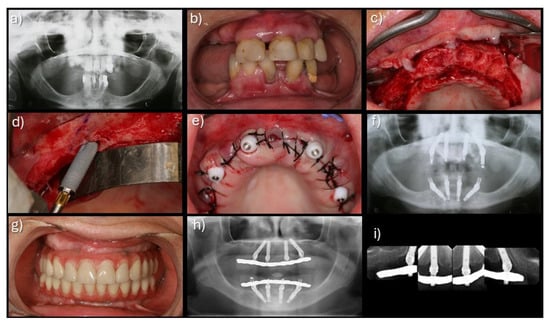
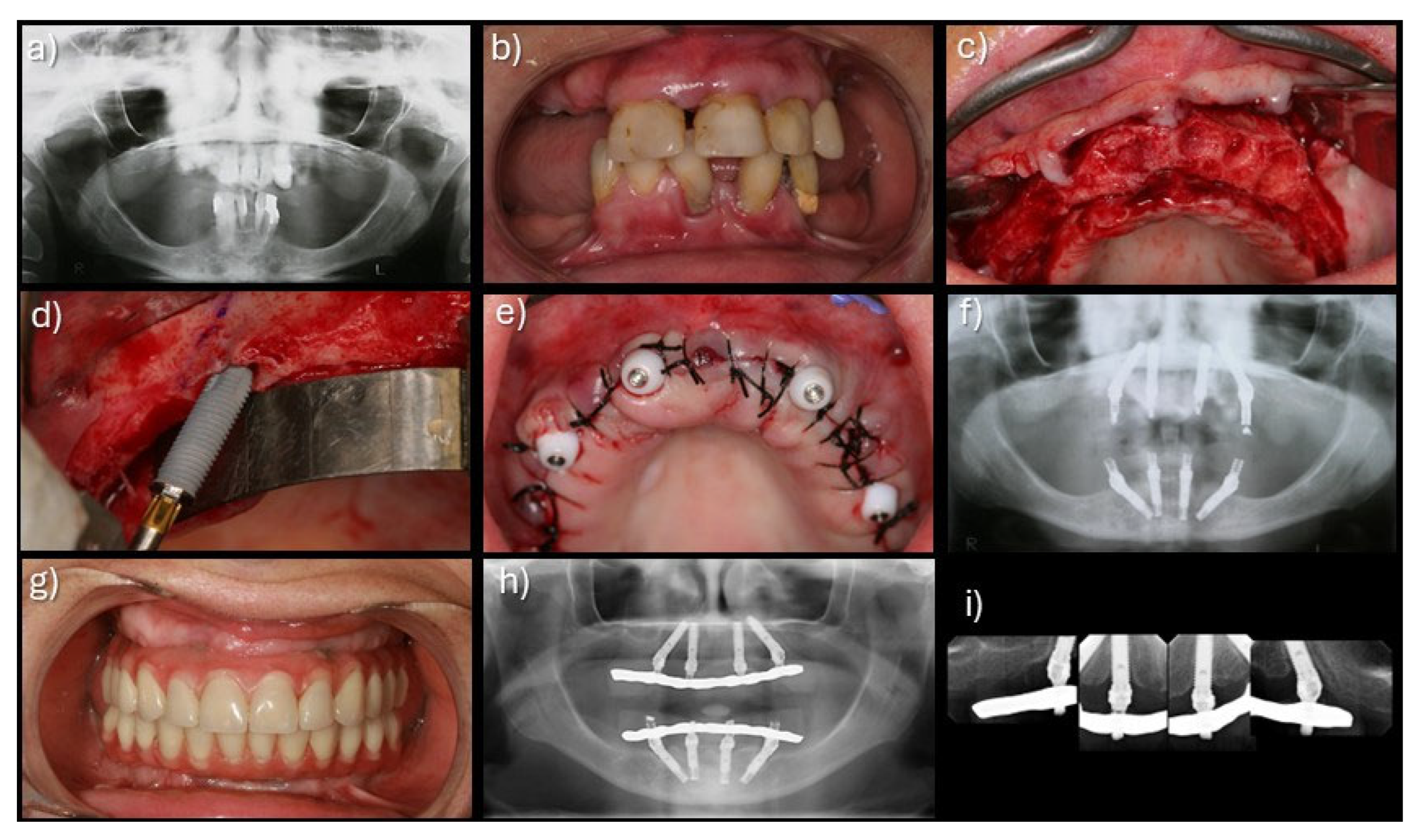
Patients were instructed to follow a soft-food diet during the initial postoperative period and were enrolled in a standardized maintenance program including oral hygiene instructions [13]. The recall regimen was set at 10 days; 2, 4, and 6 months; 1 year; and every 6 months thereafter, and included prosthesis removal, diagnosis, professional prophylaxis, and reinforcement of oral hygiene measures. A clinical case with very long-term follow-up is illustrated in Figure 1.
Figure 1.
Clinical case of an immediate implant-supported full-arch maxillary rehabilitation using 4 implants and posterior implant tilting, from implant insertion to 20 years: (a) pre-treatment orthopantomography; (b) pre-treatment intra-oral view; (c) per-operative intra-oral view after teeth extraction and bone regularization; (d) per-operative intra-oral view of the insertion of the tilted posterior implant anterior to the maxillary sinus; (e) per-operative intra-oral view after implant insertion and suturing; (f) orthopantomography on the day of surgery with immediate prosthesis in place achieving immediate function; (g) intra-oral view of the definitive prostheses in place; (h) orthopantomography with the definitive prostheses in place; (i) periapical radiographs of the maxillary rehabilitation at 20 years of follow-up.
Primary outcome measures included prosthetic success and implant survival/success. Prosthetic success was defined as continued function without replacement. The implants were assessed considering success criteria [14] requiring that implants (a) supported the prosthesis without “sleeping”; (b) were stable on manual testing; (c) demonstrated absence of persistent infection that could jeopardize the implant outcome; (d) showed no radiolucency; (e) achieved good aesthetics with no complaints from the prosthodontist nor patient; and (f) allowed a fixed prosthesis that was comfortable and hygienic for the patient. Implants not complying with the criteria were considered survivals. Implant removal was classified as failure. Secondary outcomes included marginal bone loss (MBL) as well as the incidence of mechanical and biological complications. MBL was assessed using periapical radiographs obtained at implant placement and at 15 and 20 years acquired with the parallel technique and a film holder (Super-bite; Hawe Neos, Bioggio, Switzerland), manually adjusted to approximate an orthogonal orientation. The assessment was performed by a calibrated, blinded assessor using image analysis software (iRYS, version 13.0; MyRay, Bologna, Italy). The implant platform (horizontal interface between implant and abutment) served as the reference point, and MBL was defined as the change in marginal bone level relative to surgery. Radiographs were included for analysis only if implant threads were clearly visible, ensuring both image sharpness and proper beam orientation. Measurements were calibrated based on the known distance between implant threads.
Mechanical complications evaluated in this study were fracture or loosening of any prosthetic components, while biological complications assessed included infections, chronic peri-implant disease (pockets over 5 mm, bleeding upon probing, and concurrent presence of marginal bone loss and clinical attachment loss), fistula or abscess formation.
Descriptive statistics were calculated for prosthetic survival (with the prosthetic restoration as the unit of analysis), implant survival/success (with the implant as the unit of analysis), and marginal bone loss (implant as analytical unit). Life tables were used to estimate the cumulative survival rates of prosthesis and implant.
Inferential analyses were conducted to assess potential differences and to identify risk indicators. Multivariate regression models were used for this purpose. Cox proportional hazards models were applied to estimate crude hazard ratios (HRs) with 95% confidence intervals (CIs) for factors associated with the outcome variable “implant failure.” Binary logistic regression models were used to estimate crude odds ratios (ORs) with 95% CIs for factors associated with the outcomes “marginal bone loss > 3 mm,” “biological complications,” and “mechanical complications.” All analyses considered the patient as the unit of analysis.
The analytical strategy consisted of initial univariate analyses to identify covariates associated with each dependent variable. For implant failure, the following variables were evaluated: age, sex, presence of systemic conditions, smoking status, type of opposing dentition (natural teeth, fixed prosthesis on natural teeth, implant-supported prosthesis, removable prosthesis, or miscellaneous), prosthetic material (acrylic resin, metal–acrylic resin, metal–ceramic), cantilever length (none, 1-unit, or 2-unit), and the presence of mechanical or biological complications. For the outcomes “marginal bone loss > 3 mm,” “mechanical complications,” and “biological complications,” the same variables were analyzed, with the addition of previous failure of an adjacent implant. Covariates showing a p-value < 0.150 in the univariate analyses were subsequently included in the multivariate models [15]. Additional statistical analyses was performed to evaluate the potential effect and impact of those lost to follow-up on the results. A sensitivity analysis was performed for implant survival estimating the best case (all patients lost to follow-up retained their implants in function) and worst case (all patients lost to follow-up lost all implants) scenarios. A comparison between patients lost to follow-up and patients with completed follow-up was performed for the variables of age (Mann–Whitney U test), gender (Chi-square test), systemic conditions (Chi-square test), and smoking habits (Chi-square test). The level of significance was set at 5%. The IBM SPSS Statistics software version 26 (IBM, Armonk, NY, USA) was used for statistical analysis.
3. Results
3.1. Sample
This study included 740 patients (440 women and 300 men), with an average age of 55.3 years (ranging between 20 and 88 years).
There were 286 patients presenting conditions considering the International Classification of Disease, version 11 (ICD-11); of these, 216 patients (29.2%) presented a single systemic condition, 70 patients (9.5%) > one condition and 222 patients were smokers (30%) (Table 1). One hundred and ninety-seven patients were judged to have bruxism (26.6%). Two hundred and eighty-seven patients (38.8%) with 1148 implants (38.8%) were lost to follow-up. Forty-two patients (168 implants) were deceased (non-related to the implant treatment), while two hundred and forty-six patients (984 implants) became unreachable. The comparison in baseline characteristics between patients lost to follow-up and patients with completed follow-up yielded a significant difference in age (p < 0.001, Mann–Whitney U test), with patients lost to follow-up being older. No significant differences between these two groups were registered for gender (p = 0.080, Chi-square test), systemic condition (p = 0.432, Chi-square test), and smoking (p = 0.742, Chi-square test).
Table 1.
Overall medical status according to the ICD-11, including the distribution of patients deceased and lost to follow-up in the sample.
3.2. Prostheses and Implants
A total of 740 restorations were attached in the maxilla, supported by 2960 implants—17 Brånemark System Mk III implants [n = 2 failures], 92 Brånemark System Mk IV implants [n = 11 failures], 2851 NobelSpeedy Groovy implants [n = 157 failures]—with widths ranging between 3.3 and 5 mm and lengths ranging from 8.5 to 18 mm and all with anodically oxidized surface. Concerning the opposing dentition, 255 patients presented implant-supported fixed prosthesis, 145 patients presented natural teeth, 315 patients presented a miscellaneous combination of implant-supported fixed prosthesis and natural teeth, 1 patient presented fixed prosthetics over natural teeth, and 24 patients had a removable prosthesis.
3.3. Prosthetic Success, Implant Survival/Success and Risk Indicators for Implant Failure
Thirteen patients (1.8%) lost their prostheses: nine patients (1.2%) lost their prostheses due to implant failures, and four patients (0.5%) fractured the prosthesis (one provisional prostheses and three definitive prostheses), rendering a 98.1% prosthetic success rate after up to 20 years of follow-up (Table 2).
Table 2.
Life table estimating the prosthetic success rate.
A total of 170 implants (5.7%) in 101 patients (52 women and 49 men; 13.6%) failed, with 140 implants lost in the first 180 months and 30 implants lost between 181 months and 240 months, resulting in an implant cumulative survival rate of 94.1% and 90.7% at 15 and 20 years, respectively (Table 3). Implant failures occurred in 50 patients with smoking habits, in 31 patients with bruxism and in 12 patients with both conditions. The sensitivity analysis estimated a potential cumulative implant survival rate at 20 years of 93.1% and 59.4% for best and worst case scenarios, respectively (Table 4). From the patients with implant failures, 83 patients lost implants, with the prostheses kept in function and supported on the remaining implants for a healing period of 6 months, followed by the insertion of new implants (not accounted in this study) to restore function supported on 4 implants; 18 patients lost implants and refused surgery, opting to have their prostheses supported on the remaining implants; and 9 patients lost implants and prostheses. Adding to the 170 failed implants, 127 implants were judged as unsuccessful after applying the success criteria, registering a cumulative implant success rate of 89.4% and 84.6% at 15 and 20 years, respectively (Table 5).
Table 3.
Life table estimating the cumulative implant survival rate.
Table 4.
Sensitivity analysis: life table estimating the cumulative implant survival rate assuming best and worst case scenarios.
Table 5.
Life table estimating the cumulative implant success rate.
Univariately, the regression analysis registered associations between implant failure and gender (p = 0.058), systemic condition (p = 0.053), smoking (p < 0.001), opposing dentition (p = 0.119), and biological complications (p < 0.001) (Cox proportional hazards). The multivariate analysis disclosed the variables smoking (HR = 1.93) and biological complications (HR = 2.18) as risk indicators for implant failure, when controlled for sex, presence of systemic conditions and opposing dentition (Cox proportional hazards, Table 6).
Table 6.
Multivariate analysis of potential hazard risk indicators associated with implant failure using the Cox proportional hazards regression model.
3.4. Marginal Bone Loss and Risk Indicators for MBL > 3 mm
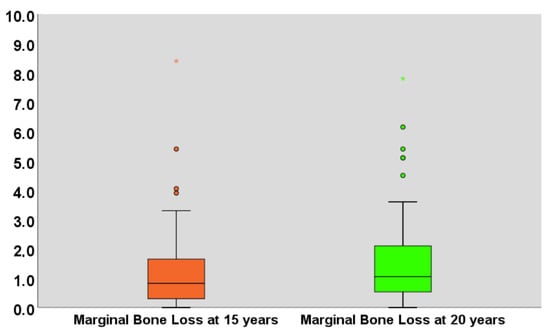
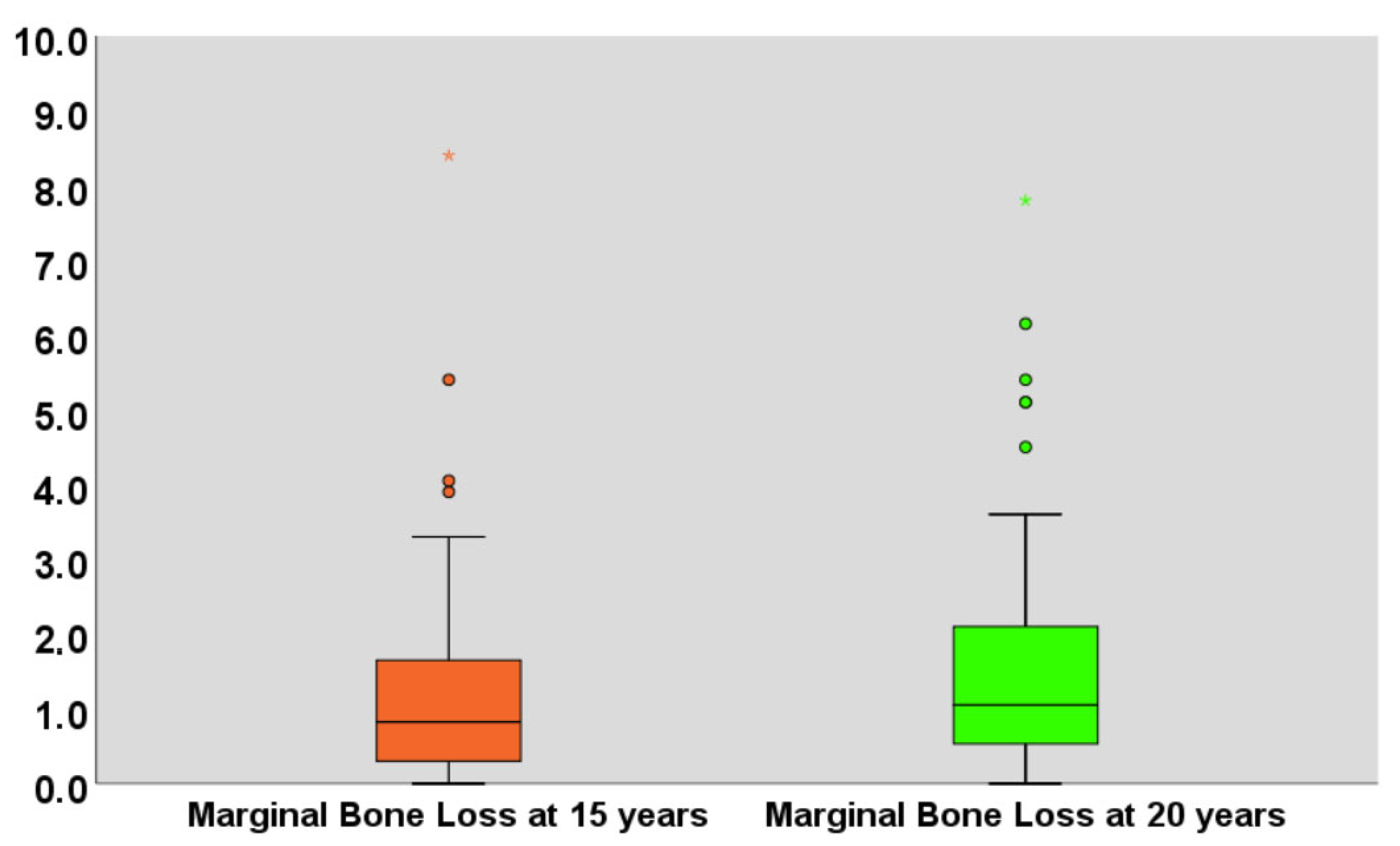
In total, 74% and 93% of the implant radiographs were readable for marginal bone loss at 15 and 20 years, respectively. At 15 and 20 years follow-up, the average (standard deviation) marginal bone loss was 1.07 mm ± 1.38 mm, and 1.46 mm ± 1.56 mm (Figure 2, Table 7).
Figure 2.
Boxplot illustrating the marginal bone loss measured in millimeters at 15 and 20 years of follow-up. The median is represented by the horizontal black line inside the box; the lower box edge represents the 25th percentile; the upper box edge represents the 75th percentile; whiskers represent the standard deviation; asterisk and dots represent outlier values.
Table 7.
Marginal bone loss registered at 15 and 20 years.
There were 63 patients with 95 implants and 8 patients with 14 implants exceeding MBL of 3 mm at 15 years and 20 years, respectively. The univariate logistic regression analysis registered smoking (p < 0.001), mechanical complications (p = 0.031), biological complications (p = 0.002) and previous failure of a contiguous implant (p = 0.021) as potentially associated with MBL > 3 mm. In the multivariate analysis, the variables smoking (OR = 3.60) and biological complications (OR = 3.70) were considered as risk indicators for MBL, while mechanical complications had a protective effect (OR = 0.26), when controlled for the presence of a previous failure of a contiguous implant (Table 8).
Table 8.
Regression analysis to evaluate the potential risk indicators for the incidence of MBL > 3 mm.
3.5. Mechanical Complications and Incidence Risk Indicators
Mechanical complications were observed in 581 patients (78.5%): provisional prostheses (n = 448 patients; 60.5%) and definitive prostheses (n = 374 patients; 50.5%) (Table 9), for a total of 144 patients accumulating complications in both prostheses. Of these complications, 299 occurred in patients diagnosed with bruxism (n = 186), and 301 occurred in patients whose prostheses occluded against implant-supported fixed prostheses in the opposing dentition (n = 200). Occlusal adjustments were performed for all patients, loose components were retightened, and provisional prostheses were repaired. Minor ceramic chippings were adjusted, and major ceramic chipping or fracture implied the replacement of the crown; nightguards were manufactured and placed in patients judged to be bruxers. No significant associations between potential risk indicators and mechanical complications were found (Table 10).
Table 9.
Incidence of mechanical complications in provisional and definitive prostheses.
Table 10.
Univariate analysis. Binary logistic regression to evaluate the potential risk indicators for the incidence of mechanical complications.
3.6. Biological Complications and Incidence Risk Indicators
Biological complications occurred in 449 of the implants (15.2%) in 260 patients (35.1%). Implant infections during the first year of follow-up were recorded in 117 implants across 81 patients, leading to 7 implant failures. Chronic peri-implant disease affected 332 implants in 199 patients and resulted in 54 implant failures. In 175 patients with 249 implants, the problem was solved (non-surgically: 222 implants in 164 patients; surgically: 27 implants in 23 patients). For 200 implants in 123 patients, the problem was not resolved after non-surgical and surgical treatment, resulting in 61 implant losses and 139 implants considered as survivals, 6 implants (4 patients) that were lost to follow-up immediately after diagnosis, and 7 implants in 6 patients whose treatment outcome was not yet confirmed at the time of study completion. The univariate analysis disclosed age (p < 0.001), smoking (p < 0.001) and opposing dentition (miscellaneous: p = 0.084) as variables potentially associated with the incidence of biological complications. In the multivariate analysis, age (OR = 0.48) and smoking (OR = 1.78) remained significant when controlled for the presence of opposing dentition (Table 11).
Table 11.
Binary logistic regression analysis to assess risk indicators for the incidence of biological complications.
4. Discussion
The present study, to the authors knowledge, registered the longest follow-up time (up to 20 years) for immediate full-arch implant-supported maxillary rehabilitations using four implants (two posterior implants tilted distally and two axially oriented anterior implants). Our study reported good outcomes for implants placed in immediate function, registering a 98.1% prosthetic success rate, 90.7% cumulative implant survival and 84.6% cumulative implant success rates. This study extends the results obtained in previous publications including a sample of 1072 patients with a 13-year 99.2% prosthetic success rate and a 94.7% cumulative implant survival rate [7], as well as previous meta-analytic studies [6,10], further validating the current full-arch concept. In the absence of studies applying the immediate function approach to full-arch maxillary rehabilitations in very long-term follow-up, the authors compare the results with other studies using two-stage surgical approaches and very long-term follow-up. Previous studies [16,17,18] with follow-ups between 20 and 25 years registered an implant survival rate ranging between 71.05% and 99.2%. The implant survival rate of the present study is within the range reported in these previous publications [16,17,18], despite the more comprehensive inclusion criteria (including patients with history of periodontitis, unlike Carossa et al. [18], the significantly greater sample size and follow-up (compared to Astrand et al. [16]), and the higher survival rate despite the smaller sample size and follow-up (compared to Jemt et al. [17])).
The analysis of survival provides a good overview for long-term success while attesting to the non-superiority of two-stage protocols over immediate loading. Moreover, it does so underlining the stability that it is possible to maintain using only four implants for support of a full-arch maxillary restoration, even in the presence of implant failures. However, it is also important to underline that implant failures and complications occur frequently in very long-term follow-ups. In the present study, 170 implant failures occurred in 101 patients (with 67 implant failures in 36 patients during the first year of function). The process of resolving an implant failure and restoring full prosthetic support through the insertion of implants (as in the case of the present study) is burdensome to both patient and clinician, with physical and monetary costs that need to be considered and informed at the pre-treatment phase, stressing the need for structured surgical, prosthodontic and maintenance protocols. Nevertheless, the trend for a higher implant failure rate during the biological osseointegration period was previously documented, with a pattern of failure for implants from the same system observed during healing or the first year of function [19].
The Cox proportional hazards regression and the binary logistic regression models determined the variables biological complications and smoking habits as risk indicators for both implant failure and marginal bone loss exceeding 3 mm (with smoking also significantly associated with biological complications). Biological complications have long been associated with implant failure, particularly with late implant failure, with a significant number of studies providing evidence of its harmful effect [20,21,22,23,24,25]. With infection indicated as a significant factor for implant failures [20,21], chronic peri-implant disease is considered the attributable cause for late failures [22,25], as in most situations registered in the present study. Moreover, it is plausible to assume biological complications as a risk indicator for increased marginal bone loss, since the destruction of the peri-implant complex is the means of disease expression, resulting in marginal bone loss. The clinical significance of this result relies on the need for primary prevention (good oral hygiene and regular professional care) in order to prevent the disease [24], and secondary prevention (to address the complication through non-surgical and surgical approaches as soon as possible) [23]. Smoking aggregates a significant number of publications that previously attested to its deleterious effect on the successful outcome of implant-supported rehabilitations, with a previous systematic review and meta-analysis indicating almost three times increased odds for implant failure in smokers compared to non-smokers [26]. Furthermore, smoking has the potential to significantly impact both early and late failures by negatively influencing the osseointegration process, impairing the immune response [27], and most notably, providing a chronic inflammation state that increases the probability of biological complications occurring [28], acting as a facilitating factor. In our study, smoking was the only variable present in three models, registered as a risk indicator for implant failure, biological complications and increased marginal bone loss simultaneously. This result is of paramount clinical significance, deeming it necessary to inform patients about the risks that smoking habits may introduce in the outcome of their implant-supported rehabilitations prior to performing the treatment, and referring the patient for smoking cessation appointments.
The fact that the incidence of mechanical complications was registered as a protective effect for marginal bone loss in our sample may be explained clinically and epidemiologically. On one hand, the mechanical complication acts as a warning sign and is the weakest link that occurs in lieu of a more serious event, such as a loss of osseointegration or a substantial marginal bone loss around the implant. On the other hand, patients with mechanical complications needed to be present in more clinical appointments, in which the prostheses were removed and prophylaxis was performed, consisting of the probable real protective factor for marginal bone loss [29], acting as a “second intention pseudo-maintenance protocol”. Nevertheless the average marginal bone loss registered in the present study represented a stable trend, building from the results of previous publications by our group on the same concept and using patients from the current sample, with averages of 0.9–1.2 mm at 1 year [4,30], 1.18 mm at 5 years [7], and 1.67 mm at 10 years [7]. From a clinical point of view, it should be noted that marginal bone loss may be influenced by complications occurring during osseointegration or by chronic conditions (including the effect of smoking or peri-implant disease) in the long term, requiring its assessment during regular follow-ups.
The 78.5% cumulative incidence rate for mechanical complications at the patient level (with 60.5% and 50.5% in provisional and definitive prostheses, respectively) represents a consequence of the very long-term exposure to function, imposing substantial prosthetic maintenance over time, as previously reported in a 20-year follow-up study in edentulous patients with implant-supported fixed prostheses [31]. Attard et al. [31] noted that prosthetic maintenance was ongoing, including fractured components and replacement of prostheses, and that the longevity of a fixed prosthesis for this group of patients was on average 8.39 ± 5.30 years. Clinically, it poses the need to inform the patient beforehand that maintenance or replacement of prosthetic components (and consequent costs to cover material and clinical appointments) is going to be needed throughout the patients’ life.
The cumulative incidence of biological complications was 15.2% at implant level, affecting 35.1% of patients (n = 260 patients). Previous systematic reviews estimated the occurrence of biological complications in a range between 19.5% and 85% [32,33], a very large confidence interval that is related to not only different diagnostic criteria but also different exposure times. Epidemiologically, it is necessary to take into consideration that increased follow-up times are linked to increased exposure times to risk factors, be they environmentally related (such as smoking) or host-related (such as the patients’ age), precisely the two variables that were significantly associated with an increased probability of biological complications. Nevertheless, both associations between smoking and age with chronic peri-implant disease, from an epidemiological point of view, should be attributed to a confounding effect. Smoking was described as a confounder in the association with chronic peri-implant disease in previous studies [34,35], with smoking strongly associated with periodontitis [34], and therefore, with a history of periodontitis as the underlying risk indicator for chronic peri-implant disease, as stated in previous systematic reviews [36,37]. The effect registered for age, with patients over 60 years at decreased risk for biological complications, can be explained by the increased time of exposure, as younger patients at the time of surgery are more likely to be exposed for a longer period of time during function compared to older patients. In addition, in our sample, patients under 60 years of age had an 18% increased prevalence of smoking habits compared to patients ≥ 60 years of age (40.7% vs. 22.8% smoking prevalence, respectively). It should be noted that the multivariable analysis lacked the inclusion of variables such as the history of periodontitis and bacterial plaque, representing a limitation of the present study. From a clinical perspective, the impact of biological complications makes it mandatory, first, to inform the patient beforehand that prevention is key and, second, that chronic peri-implant disease may require additional interventions for its resolution, including surgical procedures and associated costs.
The study strengths include the large sample size and multivariate statistical analysis applied to the different outcome measures. The large sample size enabled a higher statistical power and better representation of the population, reducing the impact of outliers and ensuring higher reliability. The multivariate analysis allowed a holistic view of the data and greater statistical efficiency, enhancing both accuracy and prediction. This in turn enables better forecasting from a clinical point of view, analyzing multiple factors that influence the outcome risk, which is of clinical and practical relevance.
The limitations of the present study include the study being single-centered, reducing external validity; the retrospective design, which may result in unmeasured or missing data and marginal bone loss being underestimated considering the 26% and 7% ineligible radiographs at 15 and 20 years, respectively; and being performed by a single outcome assessor. A further limitation was those lost to follow-up reaching 38.8%. The potential impact of this limitation on the outcome was illustrated by sensitivity analysis, where a 33.7% difference between the best case and worst case scenarios was estimated. A best case scenario of 93.1% and a worst case scenario of 59.4% in cumulative implant survival rate were estimated, warranting caution in the evaluation of the results due to the wide range in potential survival. A comparison between patients lost to follow-up and those with complete data was performed for age, sex, systemic conditions, and smoking. This analysis yielded a significant difference only for age, with patients lost to follow-up being older, posing an increased risk of selection bias. However, it is likely that an underestimation of deceased patients occurred, taking into consideration the average age at the time of surgery (55 years) and the very long-term follow-up with up to 20 years. Moreover, the present study’s follow-up crossed the COVID-19 pandemic, where age was the most significant factor for mortality, with odds increasing 20 times for the age group our sample would be at after 20 years of follow-up (71 to 75 years of age) [38]. Taking these points into account, a high loss to follow-up rate should be anticipated, similar to previous long-term publications, with over 56% reporting lost to follow-up rates [16,17]. Considering the study limitations, the interpretation of the results warrants caution as it is susceptible to overestimation of survival and underestimation of both complications and marginal bone loss. Future studies should prioritize the reporting of very long-term outcomes of immediate full-arch maxillary rehabilitation with four-implant-supported fixed prostheses, incorporating different restorative materials and implant micro designs to substantiate and compare alternatives to the current treatment protocol, which stands as the gold standard for this concept.
5. Conclusions
Based on the results, the high implant and prosthetic survival rates at 20 years and the low marginal bone loss demonstrate that full-arch fixed prosthetic maxillary rehabilitations supported by four implants (two posterior implants tilted distally and two anterior implants axially oriented) is a viable treatment option in the long term. Nevertheless, implant failures occur (the majority during the biological osseointegration period), as well as biological and mechanical complications during long-term follow-up; however, the existence of surgical, prosthetic and maintenance protocols is viewed as necessary for maintaining success in the long term, given that the maintenance and resolution of mechanical and biological complications are going to be needed throughout the patients’ life. Patients susceptible to biological complications and with smoking habits warrant special vigilance, considering the deleterious influence of these two factors on implant survival, marginal bone loss and biological complications.
Author Contributions
Conceptualization, M.d.A.N.; data curation, M.d.A.N.; formal analysis, M.d.A.N. and I.V.; investigation, M.d.A.N., A.L., A.F., C.M.G., R.A., M.N., M.G., D.S. and I.V.; methodology, M.d.A.N.; project administration: M.d.A.N.; resources: M.d.A.N.; software: M.d.A.N. and I.V.; validation, M.d.A.N., A.L., A.F., C.M.G., R.A., M.N., M.G., D.S. and I.V.; visualization, M.d.A.N., A.L., A.F., C.M.G., R.A., M.N., M.G., D.S. and I.V.; writing—original draft preparation, M.d.A.N. and I.V.; writing—review and editing, M.d.A.N., A.L., A.F., C.M.G., R.A., M.N., M.G., D.S. and I.V. All authors have read and agreed to the published version of the manuscript.
Funding
This research received no external funding.
Institutional Review Board Statement
The study was conducted in accordance with the Declaration of Helsinki and approved by the Ethical Committee for Health (protocol code 002/2025; date of approval: 3 January 2025).
Informed Consent Statement
Informed consent was obtained from all subjects involved in the study.
Data Availability Statement
The data is available at a public repository link: https://osf.io/dyjr7/overview.
Acknowledgments
The authors would like to acknowledge the clinicians from Maló Clinic for their technical support.
Conflicts of Interest
The authors declare no conflicts of interest.
References
- World Health Organization. Oral Health. Available online: https://www.who.int/health-topics/oral-health#tab=tab_1 (accessed on 28 August 2025).
- World Health Organization. Global Oral Health Status Report: Towards Universal Health Coverage for Oral Health by 2030; World Health Organization: Geneva, Switzerland, 2022. [Google Scholar]
- Global Burden of Disease Collaborative Network. GBD 2019; Institute for Health Metrics and Evaluation: Seattle, WA, USA, 2020. [Google Scholar]
- Maló, P.; Rangert, B.; Nobre, M. All-on-4 Immediate-Function Concept with Brånemark System Implants for Completely Edentulous Maxillae: A 1-Year Retrospective Clinical Study. Clin. Implant Dent. Relat. Res. 2005, 7, S88–S94. [Google Scholar] [CrossRef] [Scilit] [PubMed]
- Hof, M.; Tepper, G.; Semo, B.; Arnhart, C.; Watzek, G.; Pommer, B. Patients’ perspectives on dental implant and bone graft surgery: Questionnaire-based interview survey. Clin. Oral. Implant. Res. 2014, 25, 42–45. [Google Scholar] [CrossRef] [Scilit] [PubMed]
- Del Fabbro, M.; Pozzi, A.; Romeo, D.; de Araújo Nobre, M.; Agliardi, E. Outcomes of Fixed Full-Arch Rehabilitations Supported by Tilted and Axially Placed Implants: A Systematic Review and Meta-Analysis. Int. J. Oral Maxillofac. Implants 2022, 37, 1003–1025. [Google Scholar] [CrossRef] [Scilit] [PubMed]
- Maló, P.; de Araújo Nobre, M.; Lopes, A.; Ferro, A.; Nunes, M. The All-on-4 Concept for Full-Arch Rehabilitation of the Edentulous Maxillae: A Longitudinal Study with 5–13 Years of Follow-Up. Clin. Implant Dent. Relat. Res. 2019, 21, 538–549. [Google Scholar] [CrossRef] [Scilit]
- De Vico, G.; Bonino, M.; Spinelli, D.; Schiavetti, R.; Sannino, G.; Pozzi, A.; Ottria, L. Rationale for Tilted Implants: FEA Considerations and Clinical Reports. Oral Implantol. 2011, 4, 23–33. [Google Scholar]
- Weinstein, R.; Agliardi, E.; Del Fabbro, M.; Romeo, D.; Francetti, L. Immediate Rehabilitation of the Extremely Atrophic Mandible with Fixed Full-Prosthesis Supported by Four Implants. Clin. Implant Dent. Relat. Res. 2012, 14, 434–441. [Google Scholar] [CrossRef] [Scilit]
- Daudt Polido, W.; Aghaloo, T.; Emmett, T.W.; Taylor, T.D.; Morton, D. Number of implants placed for complete-arch fixed prostheses: A systematic review and meta-analysis. Clin. Oral. Implant. Res. 2018, 29, S154–S183. [Google Scholar] [CrossRef] [Scilit]
- Soto-Penaloza, D.; Zaragozí-Alonso, R.; Penarrocha-Diago, M.; Penarrocha-Diago, M. The All-on-Four Treatment Concept: Systematic Review. J. Clin. Exp. Dent. 2017, 9, e474–e488. [Google Scholar] [CrossRef] [Scilit]
- von Elm, E.; Altman, D.G.; Egger, M.; Pocock, S.J.; Gøtzsche, P.C.; Vandenbroucke, J.P. The STROBE Statement: Guidelines for Reporting Observational Studies. Ann. Intern. Med. 2007, 147, 573–577. [Google Scholar] [CrossRef] [Scilit]
- de Araújo Nobre, M.; Cintra, N.; Maló, P. Peri-Implant Maintenance of Immediate Function Implants: A Pilot Study Comparing Hyaluronic Acid and Chlorhexidine. Int. J. Dent. Hyg. 2007, 5, 87–94. [Google Scholar] [CrossRef] [Scilit]
- Maló, P.; de Araújo Nobre, M.; Ferro, A.S.; Parreira, G. Five-Year Outcome of a Retrospective Cohort Study Comparing Smokers vs. Nonsmokers with Full-Arch Mandibular Implant-Supported Rehabilitation Using the All-on-4 Concept. J. Oral Sci. 2018, 60, 177–186. [Google Scholar] [CrossRef] [Scilit]
- Heinze, G.; Wallisch, C.; Dunkler, D. Variable Selection—A Review and Recommendations for the Practicing Statistician. Biom. J. 2018, 60, 431–449. [Google Scholar] [CrossRef] [Scilit]
- Åstrand, P.; Ahlqvist, J.; Gunne, J.; Nilson, H. Implant Treatment of Patients with Edentulous Jaws: A 20-Year Follow-Up. Clin. Implant Dent. Relat. Res. 2008, 10, 207–217. [Google Scholar] [CrossRef] [Scilit] [PubMed]
- Jemt, T. Implant Survival in the Edentulous Jaw: 30 Years of Experience. Part I. Int. J. Prosthodont. 2018, 31, 425–435. [Google Scholar] [CrossRef] [Scilit] [PubMed]
- Carossa, M.; Pera, F.; Alovisi, M.; Ponzio, M.; Schierano, G.; Migliaretti, G.; Carossa, S.; Scotti, N. Implant Survival Rate and Marginal Bone Loss over ≥20 Years: A Retrospective Study. J. Prosthodont. 2024, 33, 764–773. [Google Scholar] [CrossRef] [Scilit] [PubMed]
- Esposito, M.; Hirsch, J.M.; Lekholm, U.; Thomsen, P. Failure patterns of four osseointegrated oral implant systems. J. Mat. Sci. Mat. Med. 1997, 8, 843–847. [Google Scholar] [CrossRef] [Scilit]
- Esposito, M.; Hirsch, J.M.; Lekholm, U.; Thomsen, P. Biological Factors Contributing to Failures of Osseointegrated Oral Implants. Eur. J. Oral Sci. 1998, 106, 527–551. [Google Scholar] [CrossRef] [Scilit]
- Esposito, M.; Hirsch, J.M.; Lekholm, U.; Thomsen, P. Differential Diagnosis and Treatment Strategies for Biologic Complications and Failing Oral Implants. Int. J. Oral Maxillofac. Implants 1999, 14, 473–490. [Google Scholar]
- Lang, N.P.; Wilson, T.G.; Corbet, E.F. Biological Complications with Dental Implants: Prevention, Diagnosis and Treatment. Clin. Oral Implants Res. 2000, 11, 146–155. [Google Scholar] [CrossRef] [Scilit]
- Bhochhibhoya, A.; Guragain, M.; Shrestha, R. Biologic Complications of Dental Implants: An Update. J. Karnali Acad. Health Sci. 2022, 5, 1–5. [Google Scholar] [CrossRef] [Scilit]
- Gupta, A.; Kale, B.; Masurkar, D.; Jaiswal, P. Etiology of Dental Implant Complication and Failure—An Overview. AIMS Bioeng. 2023, 10, 141–152. [Google Scholar] [CrossRef] [Scilit]
- Paquette, D.W.; Brodala, N.; Williams, R.C. Risk Factors for Endosseous Dental Implant Failure. Dent. Clin. N. Am. 2006, 50, 361–374. [Google Scholar] [CrossRef] [Scilit] [PubMed]
- Mustapha, A.D.; Salame, Z.; Chrcanovic, B.R. Smoking and Dental Implants: A Systematic Review and Meta-Analysis. Medicina 2021, 58, 39. [Google Scholar] [CrossRef] [Scilit] [PubMed]
- Chrcanovic, B.R.; Albrektsson, T.; Wennerberg, A. Smoking and Dental Implants: A Systematic Review and Meta-Analysis. J. Dent. 2015, 43, 487–498. [Google Scholar] [CrossRef] [Scilit]
- Al-Bashaireh, A.M.; Haddad, L.G.; Weaver, M.; Kelly, D.L.; Chengguo, X.; Yoon, S. The Effect of Tobacco Smoking on Musculoskeletal Health: A Systematic Review. J. Environ. Public Health 2018, 2018, 4184190. [Google Scholar] [CrossRef] [Scilit]
- Atieh, M.A.; AlAli, F.; Alsabeeha, N.H.M. Outcome of Supportive Peri-Implant Therapy. Quintessence Int. 2021, 52, 122–131. [Google Scholar]
- Maló, P.; de Araújo Nobre, M.; Petersson, U.; Wigren, S. A pilot study of complete edentulous rehabilitation with immediate function using a new implant design: Case series. Clin. Implant. Dent. Relat. Res. 2006, 8, 223–232. [Google Scholar] [CrossRef] [Scilit]
- Attard, N.J.; Zarb, G.A. Long-Term Treatment Outcomes in Edentulous Patients with Implant-Fixed Prostheses. Int. J. Prosthodont. 2004, 17, 417–424. [Google Scholar] [CrossRef] [Scilit]
- Dreyer, H.; Grischke, J.; Tiede, C.; Eberhard, J.; Schweitzer, A.; Toikkanen, S.E.; Glöckner, S.; Krause, G.; Stiesch, M. Epidemiology and Risk Factors of Peri-Implantitis. J. Periodontal Res. 2018, 53, 657–681. [Google Scholar] [CrossRef] [Scilit]
- Diaz, P.; Gonzalo, E.; Villagra, L.J.G.; Miegimolle, B.; Suarez, M.J. Prevalence of Peri-Implantitis: A Systematic Review. BMC Oral Health 2022, 22, 449. [Google Scholar] [CrossRef] [Scilit]
- Renvert, S.; Persson, G.R. Periodontitis as a Potential Risk Factor for Peri-Implantitis. J. Clin. Periodontol. 2009, 36, 9–14. [Google Scholar] [CrossRef] [Scilit]
- de Araújo Nobre, M.; Mano Azul, A.; Rocha, E.; Maló, P. Risk Factors of Peri-Implant Pathology. Eur. J. Oral Sci. 2015, 123, 131–139. [Google Scholar] [CrossRef] [Scilit]
- Serroni, M.; Borgnakke, W.S.; Romano, L.; Balice, G.; Paolantonio, M.; Saleh, M.H.A.; Ravidà, A. History of Periodontitis as a Risk Factor for Implant Failure. Clin. Implant Dent. Relat. Res. 2024, 26, 482–508. [Google Scholar] [CrossRef] [Scilit]
- Giok, K.C.; Veettil, S.K.; Menon, R.K. Risk Factors for Peri-Implantitis: An Umbrella Review. J. Dent. 2024, 146, 105065. [Google Scholar] [CrossRef] [Scilit]
- Nogueira, P.J.; de Araújo Nobre, M.; Costa, A.; Ribeiro, R.M.; Furtado, C.; Bacelar Nicolau, L.; Camarinha, C.; Luís, M.; Abrantes, R.; Vaz Carneiro, A. The Role of Health Preconditions on COVID-19 Deaths in Portugal: Evidence from Surveillance Data of the First 20293 Infection Cases. J. Clin. Med. 2020, 9, 2368. [Google Scholar] [CrossRef] [Scilit]

Disclaimer/Publisher’s Note: The statements, opinions and data contained in all publications are solely those of the individual author(s) and contributor(s) and not of MDPI and/or the editor(s). MDPI and/or the editor(s) disclaim responsibility for any injury to people or property resulting from any ideas, methods, instructions or products referred to in the content. |
© 2026 by the authors. Licensee MDPI, Basel, Switzerland. This article is an open access article distributed under the terms and conditions of the Creative Commons Attribution (CC BY) license.