Clinical and Radiological Outcomes of C1–C2 Fixation: 3D-Printed Template vs. Free-Hand Technique

 , , , , , , , , and
Abstract
1. Introduction
2. Materials and Methods
2.1. Study Design and Sample
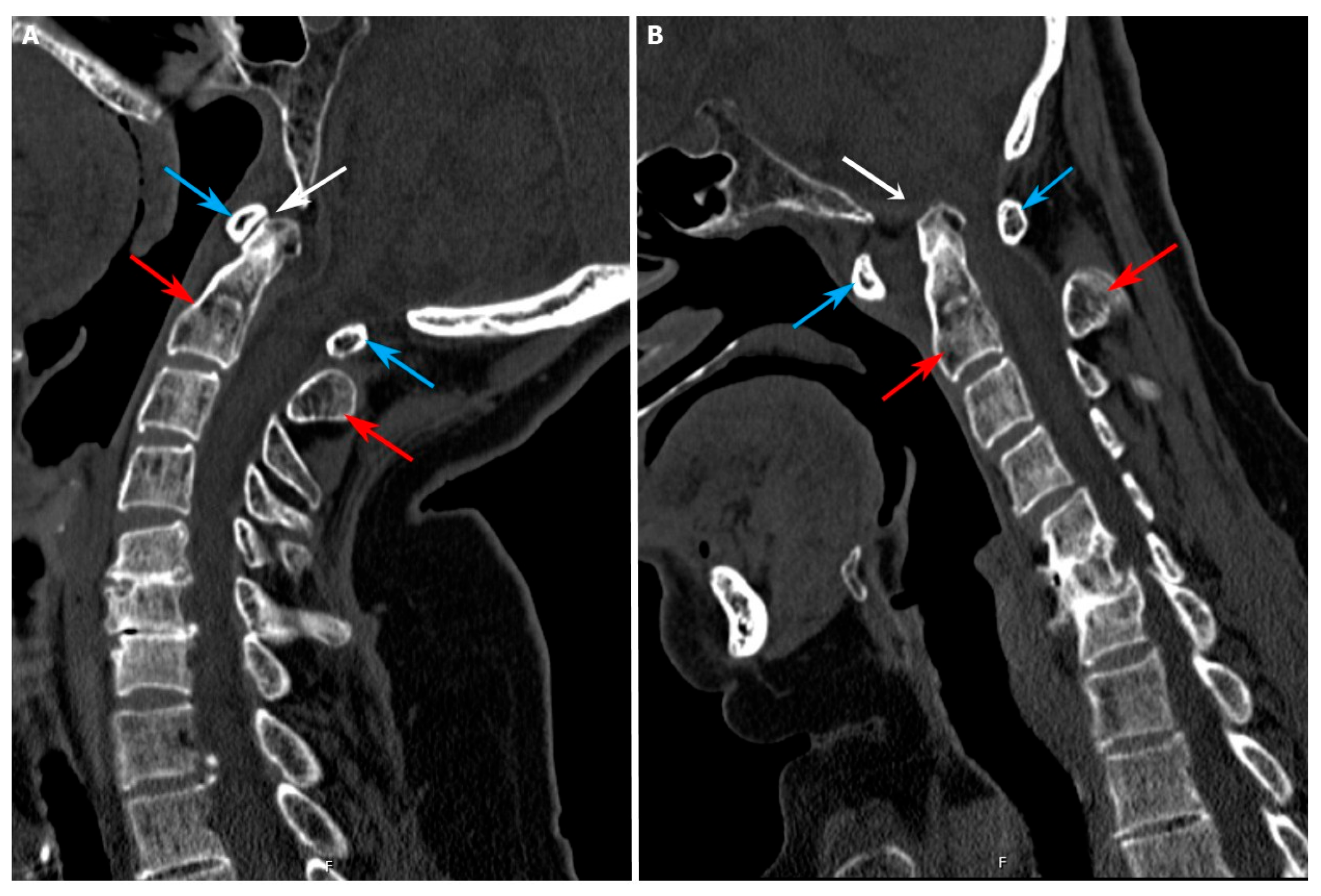
2.2. Imaging Data
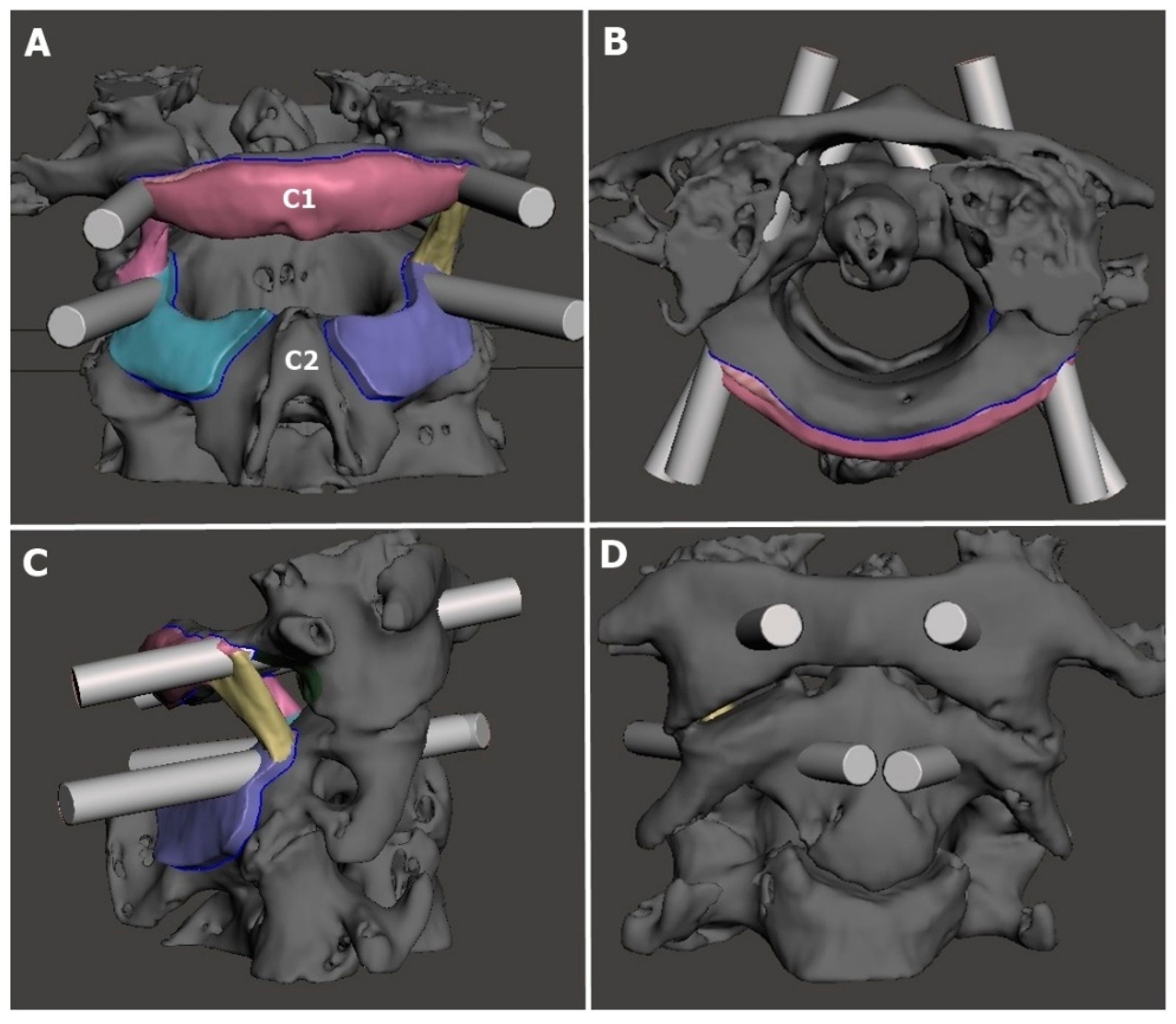
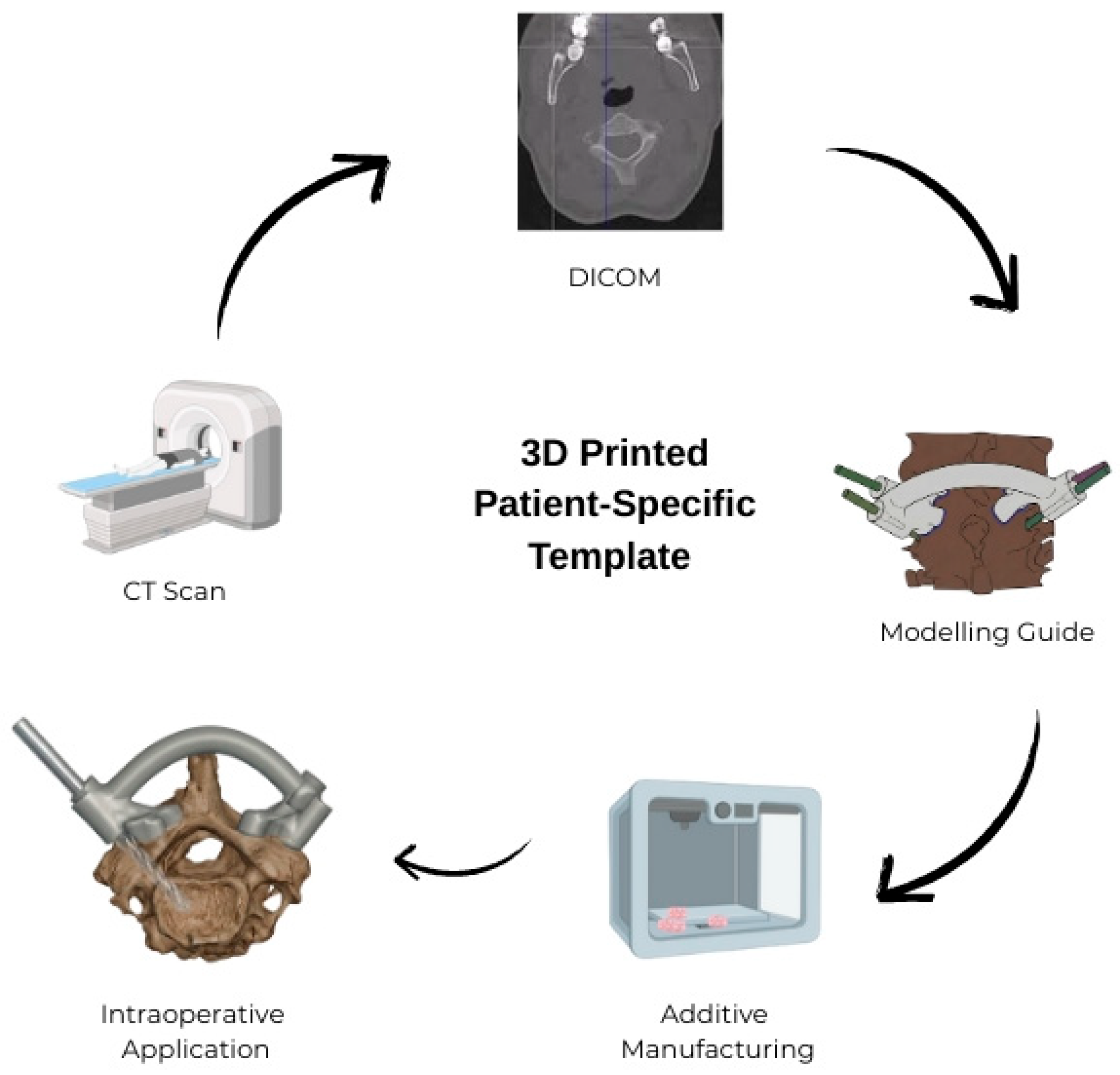
2.3. Preparation and Printing of 3D Models
2.4. Data Collection
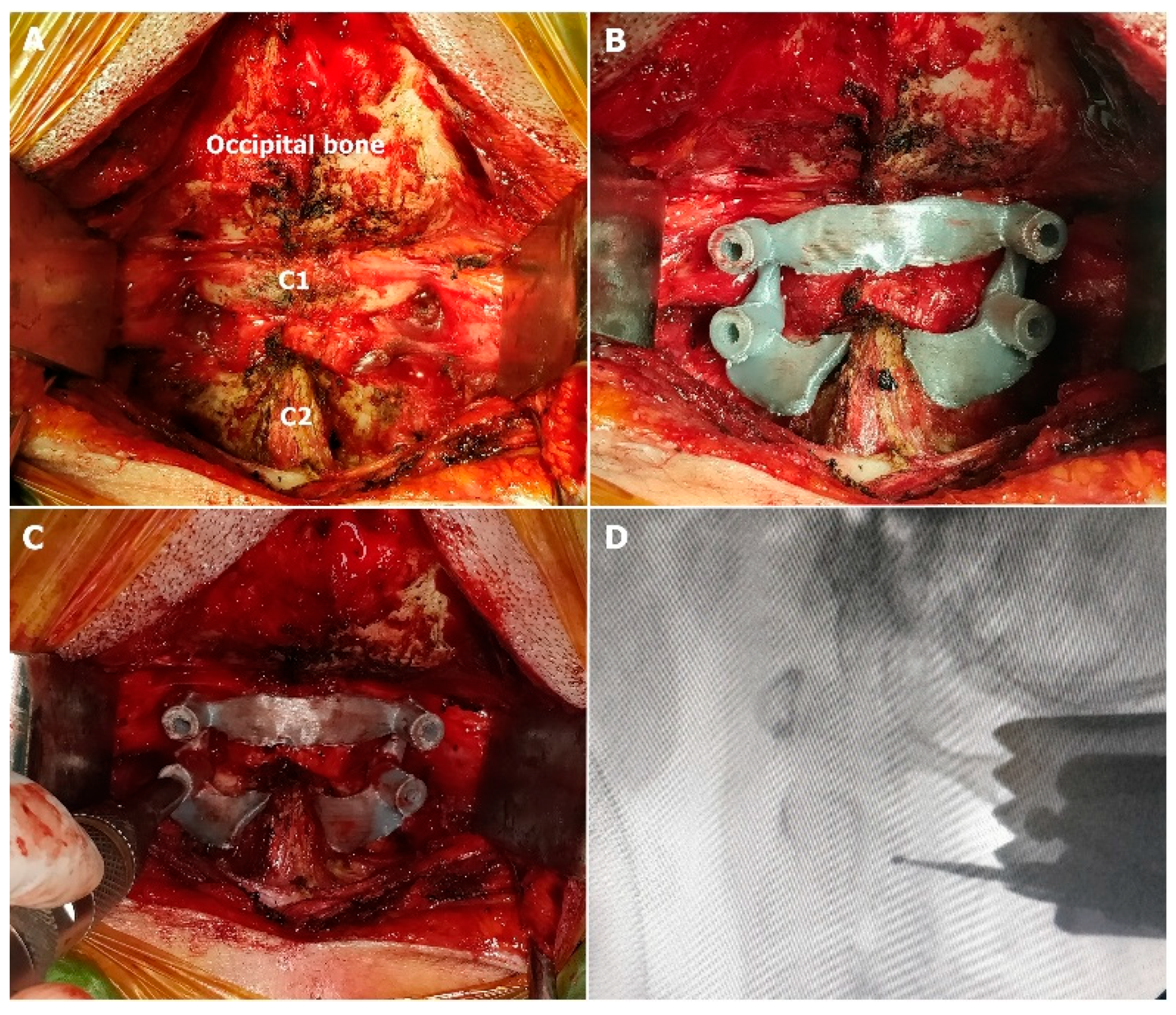
2.5. Surgical Technique
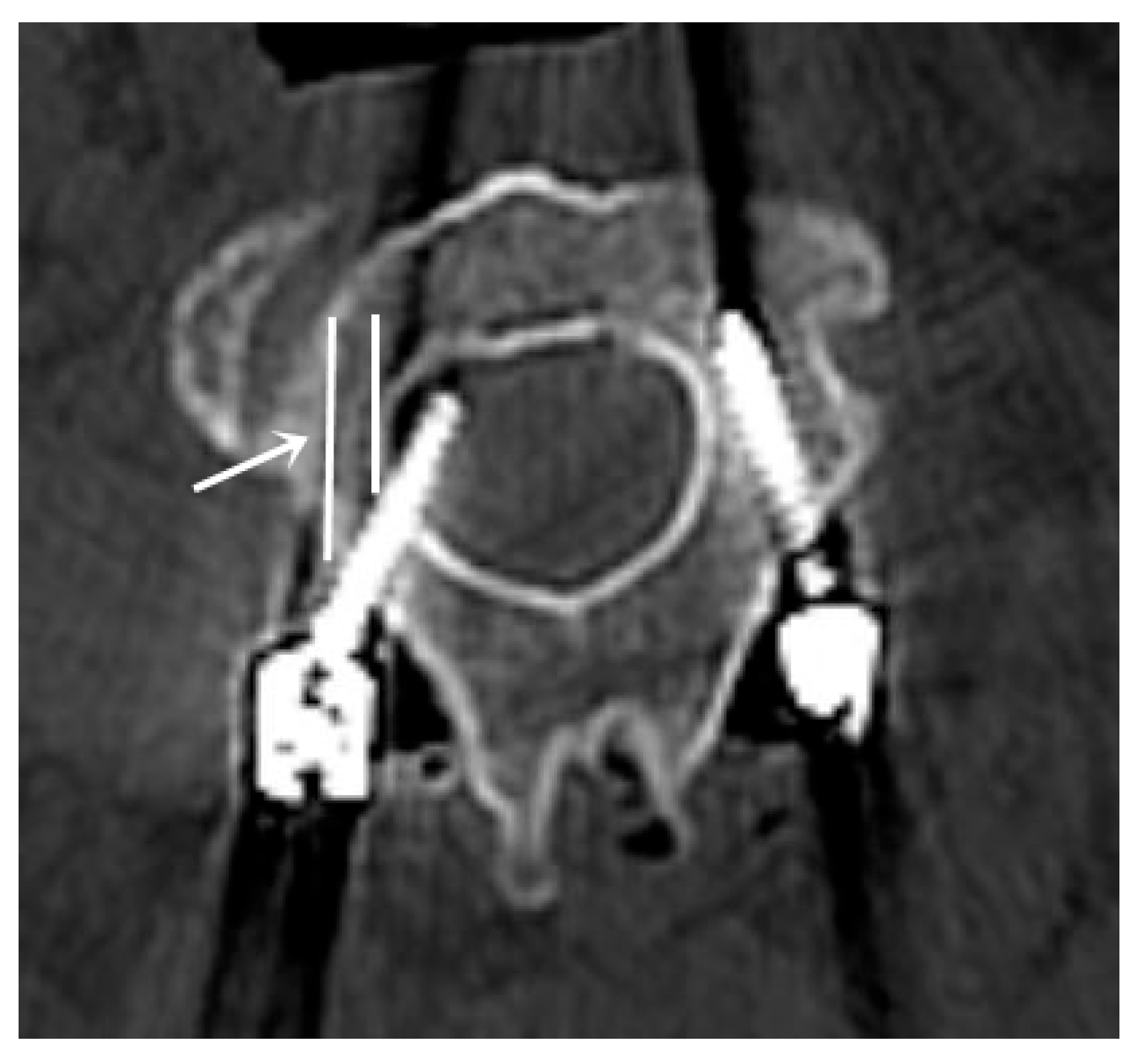
- Grade A: Completely intrapedicular position without cortical breach.
- Grade B: Cortical breach < 2 mm.
- Grade C: Cortical breach between 2 and 4 mm.
- Grade D: Cortical breach between 4 and 6 mm.
- Grade E: Cortical breach > 6 mm or screw located entirely outside the pedicle.
2.6. Statistical Analysis
3. Results
4. Discussion
5. Conclusions
Author Contributions
Funding
Institutional Review Board Statement
Informed Consent Statement
Data Availability Statement
Conflicts of Interest
Abbreviations
| CVJ | Craniovertebral junction |
| CT | Computed tomography |
| ADI | Atlantodental interval |
| VASSNP | Visual Analog Scale Score for Neck Pain |
| JOA | Japanese Orthopaedic Association |
| SD | Standard deviations |
References
- Du, Y.Q.; Qiao, G.Y.; Yin, Y.H.; Li, T.; Tong, H.Y.; Yu, X.G. Usefulness of 3D printed models in the management of complex craniovertebral junction anomalies: Choice of treatment strategy, design of screw trajectory, and protection of vertebral artery. World Neurosurg. 2020, 133, e722–e729. [Google Scholar] [CrossRef] [PubMed]
- Tu, Q.; Chen, H.; Ma, X.Y.; Wang, J.H.; Zhang, K.; Xu, J.Z.; Xia, H. Usefulness of a three-dimensional-printed model in the treatment of irreducible atlantoaxial dislocation with transoral atlantoaxial reduction plate. Orthop. Surg. 2021, 13, 799–811. [Google Scholar] [CrossRef] [PubMed]
- Rashim, K.; Verma Pawan, K.; Sinha, V.D. Increasing the safety of surgical treatment for complex Cranio-vertebral anomalies using customized 3D printed models. J. Clin. Neurosci. 2018, 48, 203–208. [Google Scholar] [CrossRef] [PubMed]
- Goel, A. Treatment of basilar invagination by atlantoaxial joint distraction and direct lateral mass fixation. J. Neurosurg. Spine 2004, 1, 281–286. [Google Scholar] [CrossRef]
- Yin, Y.H.; Tong, H.Y.; Qiao, G.Y.; Yu, X.G. Posterior reduction of fixed atlantoaxial dislocation and basilar invagination by atlantoaxial facet joint release and fixation: A modified technique with 174 cases. Neurosurgery 2016, 78, 391–400. [Google Scholar] [CrossRef]
- Chandra, P.S.; Kumar, A.; Chauhan, A.; Ansari, A.; Mishra, N.K.; Sharma, B.S. Distraction, compression, and extension reduction of basilar invagination and atlantoaxial dislocation: A novel pilot technique. Neurosurgery 2013, 72, 1040–1053. [Google Scholar] [CrossRef]
- Ohya, J.; Chikuda, H.; Kato, S.; Horiguchi, H.; Takeshita, K.; Tanaka, S.; Yasunaga, H. Risks of in-hospital death and complications after fusion surgery in patients with atlantoaxial subluxation: Analysis of 1090 patients using the japanese diagnosis procedure combination database. World Neurosurg. 2015, 83, 603–607. [Google Scholar] [CrossRef]
- Shilo, D.; Emodi, O.; Blanc, O.; Noy, D.; Rachmiel, A. Printing the future—Updates in 3D printing for surgical applications. Rambam Maimonides Med. J. 2018, 9, e0020. [Google Scholar] [CrossRef]
- Neo, M.; Matsushita, M.; Iwashita, Y.; Yasuda, T.; Sakamoto, T.; Nakamura, T. Atlantoaxial transarticular screw fixation for a high-riding vertebral artery. Spine 2003, 28, 666–670. [Google Scholar] [CrossRef]
- Harms, J.; Melcher, R.P. Posterior C1–C2 fusion with polyaxial screw and rod fixation. Spine 2001, 26, 2467–2471. [Google Scholar] [CrossRef]
- Pan, J.; Li, L.; Qian, L.; Tan, J.; Sun, G.; Li, X. C1 lateral mass screw insertion with protection of C1-C2 venous sinus: Technical note and review of the literature. Spine 2010, 35, E1133–E1136. [Google Scholar] [CrossRef] [PubMed]
- Kosmopoulos, V.; Schizas, C. Pedicle Screw Placement Accuracy: A Meta-analysis. Spine 2007, 32, E111–E120. [Google Scholar] [CrossRef] [PubMed]
- Magerl, F.; Seemann, P.S. Stable posterior fusion of the atlas and axis by transarticular screw fixation. In Cervical Spine I: Strasbourg 1985; Kehr, P., Weidner, A., Eds.; Springer: Vienna, Austria, 1987; pp. 322–327. [Google Scholar] [CrossRef]
- Neo, M.; Fujibayashi, S.; Miyata, M.; Takemoto, M.; Nakamura, T. Vertebral artery injury during cervical spine surgery: A survey of more than 5600 operations. Spine 2008, 33, 779–785. [Google Scholar] [CrossRef] [PubMed]
- Akinduro, O.O.; Baum, G.R.; Howard, B.M.; Pradilla, G.; Grossberg, J.A.; Rodts, G.E.; Ahmad, F.U. Neurological outcomes following iatrogenic vascular injury during posterior atlanto-axial instrumentation. Clin. Neurol. Neurosurg. 2016, 150, 110–116. [Google Scholar] [CrossRef]
- Elliott, R.E.; Tanweer, O.; Boah, A.; Morsi, A.; Ma, T.; Frempong-Boadu, A.; Smith, M.L. Outcome comparison of atlantoaxial fusion with transarticular screws and screw-rod constructs: Meta-analysis and review of literature. Clin. Spine Surg. 2014, 27, 11–28. [Google Scholar] [CrossRef]
- Schatlo, B.; Martinez, R.; Alaid, A.; von Eckardstein, K.; Akhavan-Sigari, R.; Hahn, A.; Stockhammer, F.; Rohde, V. Unskilled unawareness and the learning curve in robotic spine surgery. Acta Neurochir. 2015, 157, 1819–1823. [Google Scholar] [CrossRef]
- Buza, J.A.; Good, C.R.; Lehman, R.A.; Pollina, J.; Chua, R.V.; Buchholz, A.L.; Gum, J.L. Robotic-assisted cortical bone trajectory (CBT) screws using the Mazor X Stealth Edition (MXSE) system: Workflow and technical tips for safe and efficient use. J. Robot. Surg. 2021, 15, 13–23. [Google Scholar] [CrossRef]
- Keric, N.; Doenitz, C.; Haj, A.; Rachwal-Czyzewicz, I.; Renovanz, M.; Wesp, D.M.; Boor, S.; Conrad, J.; Brawanski, A.; Giese, A.; et al. Evaluation of robot-guided minimally invasive implantation of 2067 pedicle screws. Neurosurg. Focus 2017, 42, E11. [Google Scholar] [CrossRef]
- Pai, M.; Srinivasa, V.; Thirugnanam, B.; Soni, A.; Kashyap, A.; Vidyadhara, A.; Rao, S.K. Robotic-assisted cervical pedicle screw fixation with custom instruments: An analysis of 206 screws in 22 patients. Clin. Spine Surg. 2025. [Google Scholar] [CrossRef]
- Garufi, G.; Scalia, G.; Graziano, F.; Costanzo, R.; Porzio, M.; Ponzo, G.; Giuffrida, M.; Ricciardo, G.; Umana, G.E.; Nicoletti, G.F.; et al. Robot-assisted versus navigated spinal fusion surgery: A comparative multicenter study on transpedicular screw placement accuracy and patient outcomes. Neurosurg. Rev. 2025, 48, 524. [Google Scholar] [CrossRef]
- Dea, N.; Fisher, C.G.; Batke, J.; Strelzow, J.; Mendelsohn, D.; Paquette, S.J.; Kwon, B.K.; Boyd, M.D.; Dvorak, M.F.; Street, J.T. Economic evaluation comparing intraoperative cone beam CT-based navigation and conventional fluoroscopy for the placement of spinal pedicle screws: A patient-level data cost-effectiveness analysis. Spine J. 2016, 16, 23–31. [Google Scholar] [CrossRef] [PubMed]
- Costa, F.; Cardia, A.; Ortolina, A.; Fabio, G.; Zerbi, A.; Fornari, M. Spinal navigation: Standard preoperative: Versus: Intraoperative computed tomography data set acquisition for computer-guidance system: Radiological and clinical study in 100 consecutive patients. Spine 2011, 36, 2094–2098. [Google Scholar] [CrossRef] [PubMed]
- Shin, B.J.; James, A.R.; Njoku, I.U.; Härtl, R. Pedicle screw navigation: A systematic review and meta-analysis of perforation risk for computer-navigated versus freehand insertion: A review. J. Neurosurg. Spine 2012, 17, 113–122. [Google Scholar] [CrossRef] [PubMed]
- Sugawara, T.; Higashiyama, N.; Kaneyama, S.; Sumi, M. Accurate and simple screw insertion procedure with patient-specific screw guide templates for posterior C1-C2 fixation. Spine 2017, 42, E340–E346. [Google Scholar] [CrossRef]
- Buchmann, N.; Schweizer, C.; Kirschke, J.S.; Rienmüller, A.; Gempt, J.; Ringel, F.; Meyer, B.; Ryang, Y.M. C1–C2 posterior screw fixation in atlantoaxial fractures revisited: Technical update based on 127 cases. Eur. Spine J. 2020, 29, 1036–1042. [Google Scholar] [CrossRef]
- Czabanka, M.; Haemmerli, J.; Hecht, N.; Foehre, B.; Arden, K.; Liebig, T.; Woitzik, J.; Vajkoczy, P. Spinal navigation for posterior instrumentation of C1–2 instability using a mobile intraoperative CT scanner. J. Neurosurg. Spine 2017, 27, 268–275. [Google Scholar] [CrossRef]
- Bredow, J.; Oppermann, J.; Kraus, B.; Schiller, P.; Schiffer, G.; Sobottke, R.; Eysel, P.; Koy, T. The accuracy of 3D fluoroscopy-navigated screw insertion in the upper and subaxial cervical spine. Eur. Spine J. 2015, 24, 2967–2976. [Google Scholar] [CrossRef]
- Smith, J.D.; Jack, M.M.; Harn, N.R.; Bertsch, J.R.; Arnold, P.M. Screw placement accuracy and outcomes following O-arm-navigated atlantoaxial fusion: A feasibility study. Glob. Spine J. 2015, 6, 344–349. [Google Scholar] [CrossRef]
- Jeon, S.W.; Jeong, J.H.; Choi, G.H.; Moon, S.M.; Hwang, H.S.; Choi, S.K. Clinical outcome of posterior fixation of the C1 lateral mass and C2 pedicle by polyaxial screw and rod. Clin. Neurol. Neurosurg. 2012, 114, 539–544. [Google Scholar] [CrossRef]
- Yang, Y.L.; Zhou, D.S.; He, J.L. Comparison of isocentric C-arm 3-dimensional navigation and conventional fluoroscopy for C1 lateral mass and C2 pedicle screw placement for atlantoaxial instability. Clin. Spine Surg. 2013, 26, 127–134. [Google Scholar] [CrossRef]
- Merc, M.; Drstvensek, I.; Vogrin, M.; Brajlih, T.; Recnik, G. A multi-level rapid prototyping drill guide template reduces the perforation risk of pedicle screw placement in the lumbar and sacral spine. Arch. Orthop. Trauma Surg. 2013, 133, 893–899. [Google Scholar] [CrossRef]
- Wu, Z.X.; Huang, L.Y.; Sang, H.X.; Ma, Z.S.; Wan, S.Y.; Cui, G.; Lei, W. Accuracy and safety assessment of pedicle screw placement using the rapid prototyping technique in severe congenital scoliosis. Clin. Spine Surg. 2011, 24, 444–450. [Google Scholar] [CrossRef]
- Lu, S.; Xu, Y.Q.; Chen, G.P.; Zhang, Y.Z.; Lu, D.; Chen, Y.B.; Shi, J.H.; Xu, X.M. Efficacy and accuracy of a novel rapid prototyping drill template for cervical pedicle screw placement. Comput. Aided Surg. 2011, 16, 240–248. [Google Scholar] [CrossRef]
- Putzier, M.; Strube, P.; Cecchinato, R.; Lamartina, C.; Hoff, E.K. A new navigational tool for pedicle screw placement in patients with severe scoliosis: A pilot study to prove feasibility, accuracy, and identify operative challenges. Clin. Spine Surg. 2017, 30, E430–E439. [Google Scholar] [CrossRef]



| Characteristic | 3D-Printed Template (n = 10) | Free-Hand (n = 11) | p-Value |
|---|---|---|---|
| Age (years), mean ± SD | 47.70 ± 20.81 | 60.81 ± 14.79 | 0.173 |
| Sex, n (%) | 0.835 | ||
| Male | 5 (50.0%) | 6 (54.5%) | |
| Female | 5 (50.0%) | 5 (45.5%) | |
| Etiology, n (%) | 0.716 | ||
| Atlantoaxial dislocation | 4 (40.0%) | 4 (36.4%) | |
| Fracture | 4 (40.0%) | 6 (54.5%) | |
| Tumor | 1 (10.0%) | 1 (9.1%) | |
| Atlas assimilation | 1 (10.0%) | 0 (0.0%) | |
| Comorbidity, n (%) | 0.835 | ||
| Yes | 5 (50.0%) | 5 (45.5%) | |
| Presenting symptoms, n (%) | 0.784 | ||
| Occiput/neck pain | 5 (50.0%) | 7 (63.6%) | |
| Extremity weakness | 3 (30.0%) | 2 (18.2%) | |
| Paresthesia | 2 (20.0%) | 2 (18.2%) |
| Parameter (Mean ± SD) | 3D-Printed Template (n = 10) | Free-Hand (n = 11) | p-Value |
|---|---|---|---|
| C1 posterior arch height (mm) | 7.31 ± 1.98 | 7.34 ± 1.28 | 0.944 |
| Minimum C1 lateral mass width (mm) | 7.59 ± 1.55 | 7.16 ± 1.03 | 0.341 |
| Minimum C2 pedicle width (mm) | 4.34 ± 0.86 | 4.48 ± 0.50 | 0.502 |
| Preoperative atlantodental interval (mm) | 6.01 ± 3.98 | 2.64 ± 1.66 | 0.062 |
| Postoperative atlantodental interval (mm) | 2.37 ± 2.24 | 1.90 ± 1.10 | 0.621 |
| Preoperative cervicomedullary angle (°) | 138.00 ± 11.50 | 143.09 ± 8.61 | 0.230 |
| Postoperative cervicomedullary angle (°) | 149.70 ± 17.95 | 144.90 ± 10.51 | 0.324 |
| Operative time (min) | 126.60 ± 28.70 | 171.36 ± 40.44 | 0.010 |
| Intraoperative blood loss (mL) | 324.54 ± 152.99 | 412.50 ± 97.53 | 0.192 |
| Fluoroscopy time (s) | 21.90 ± 4.33 | 27.09 ± 13.48 | 0.012 |
| Level | Number of Screws (n) | Grade A, n (%) | Grade B, n (%) | Grade C, n (%) | Grade D, n (%) | Grade E, n (%) |
|---|---|---|---|---|---|---|
| 3D-printed template—C1 screw | 20 | 20 (100%) | 0 (0%) | 0 (0%) | 0 (0%) | 0 (0%) |
| 3D-printed template—C2 screw | 20 | 18 (90.0%) | 0 (0%) | 1 (5.0%) | 1 (5.0%) | 0 (0%) |
| Free-hand—C1 screw | 22 | 19 (86.4%) | 2 (9.1%) | 1 (4.5%) | 0 (0%) | 0 (0%) |
| Free-hand—C2 screw | 22 | 17 (77.3%) | 3 (13.6%) | 0 (0%) | 1 (4.5%) | 1 (4.5%) |
| Variable | 3D-Printed Template (n = 10) | Free-Hand (n = 11) | p-Value |
|---|---|---|---|
| VASSNP, mean ± SD | 2.30 ± 1.33 | 2.36 ± 1.20 | 0.942 |
| Nurick Scale, n (%) | 0.806 | ||
| Grade 0 | 6 (60.0%) | 6 (54.5%) | |
| Grade 1 | 4 (40.0%) | 5 (45.5%) | |
| Neck Stiffness, n (%) | 0.741 | ||
| None | 6 (60.0%) | 7 (63.6%) | |
| Mild | 3 (30.0%) | 4 (36.4%) | |
| Severe | 1 (10.0%) | 0 (0.0%) | |
| Preop JOA Score, mean ± SD | 13.40 ± 5.10 | 17.45 ± 0.68 | 0.006 |
| Postop JOA Score, mean ± SD | 14.80 ± 4.44 | 17.90 ± 0.30 | 0.025 |
Disclaimer/Publisher’s Note: The statements, opinions and data contained in all publications are solely those of the individual author(s) and contributor(s) and not of MDPI and/or the editor(s). MDPI and/or the editor(s) disclaim responsibility for any injury to people or property resulting from any ideas, methods, instructions or products referred to in the content. |
© 2026 by the authors. Licensee MDPI, Basel, Switzerland. This article is an open access article distributed under the terms and conditions of the Creative Commons Attribution (CC BY) license.
Share and Cite
Kizmazoglu, C.; Ur, K.; Uzunoglu, I.; Husemoglu, B.; Ikizoglu, E.; Sezer, M.; Coskun, E.; Arslan, M.; Sahin, H.M.; Ozer, E. Clinical and Radiological Outcomes of C1–C2 Fixation: 3D-Printed Template vs. Free-Hand Technique. J. Clin. Med. 2026, 15, 408. https://doi.org/10.3390/jcm15020408
Kizmazoglu C, Ur K, Uzunoglu I, Husemoglu B, Ikizoglu E, Sezer M, Coskun E, Arslan M, Sahin HM, Ozer E. Clinical and Radiological Outcomes of C1–C2 Fixation: 3D-Printed Template vs. Free-Hand Technique. Journal of Clinical Medicine. 2026; 15(2):408. https://doi.org/10.3390/jcm15020408
Chicago/Turabian StyleKizmazoglu, Ceren, Koray Ur, Inan Uzunoglu, Bugra Husemoglu, Ersin Ikizoglu, Musa Sezer, Ege Coskun, Mert Arslan, Hatun Mine Sahin, and Ercan Ozer. 2026. "Clinical and Radiological Outcomes of C1–C2 Fixation: 3D-Printed Template vs. Free-Hand Technique" Journal of Clinical Medicine 15, no. 2: 408. https://doi.org/10.3390/jcm15020408
APA StyleKizmazoglu, C., Ur, K., Uzunoglu, I., Husemoglu, B., Ikizoglu, E., Sezer, M., Coskun, E., Arslan, M., Sahin, H. M., & Ozer, E. (2026). Clinical and Radiological Outcomes of C1–C2 Fixation: 3D-Printed Template vs. Free-Hand Technique. Journal of Clinical Medicine, 15(2), 408. https://doi.org/10.3390/jcm15020408