This is an early access version, the complete PDF, HTML, and XML versions will be available soon.
Systematic Review

Reference Ranges for Fetal Ventricular Global Longitudinal Strain (GLS) Using Bidimensional Speckle-Tracking Echocardiography: A Systematic Review


by
Danielle Bittencourt Sodré Barmpas
1,2,*,
Maria de Fátima Monteiro Pereira Leite
1,2,3,
Saint Clair Gomes Junior, Junior
1,
Karla G. Camacho
1,4,
Maria Virginia M. Peixoto
1,
Heron Werner
3 and
Renato Augusto Moreira de Sá
1,5
1
Fernandes Figueira National Institute of Women’s, Children’s and Adolescents’ Health (IFF/Fiocruz), Rio de Janeiro CEP 22250-020, Brazil
2
Fetal Medicine Department, Instituto de Estudos em Tecnologia da Saúde (IETECS), Rio de Janeiro CEP 22775-022, Brazil
3
Department of Fetal Medicine, Biodesign Laboratory DASA/PUC, Campus Gávea, Rio de Janeiro CEP 22451-900, Brazil
4
Hospital Universitário Pedro Ernesto, Rio de Janeiro State University (UERJ), Rio de Janeiro CEP 20551-030, Brazil
5
Department of Obstetrics, Hospital de Cascais Dr. José de Almeida, 2755-009 Cascais, Portugal
*
Author to whom correspondence should be addressed.
J. Clin. Med. 2026, 15(17), 6536; https://doi.org/10.3390/jcm15176536
Submission received: 23 June 2026 / Revised: 9 July 2026 / Accepted: 10 July 2026 / Published: 24 August 2026
(This article belongs to the Special Issue Challenges and Opportunities in Prenatal Diagnosis)

Abstract

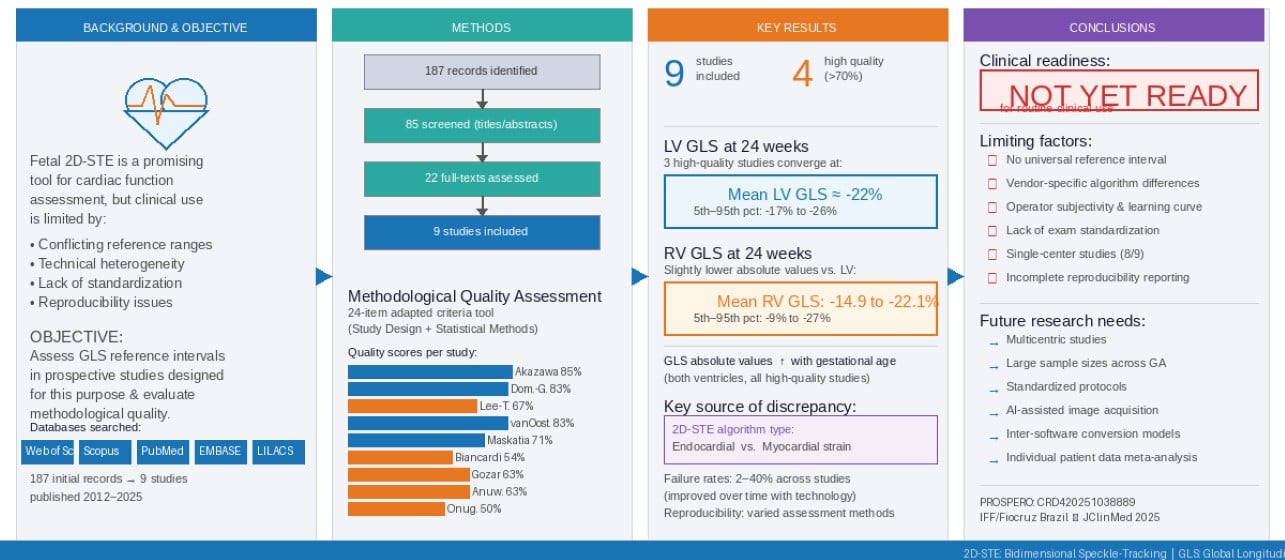
Background/Objectives: The primary objective was to assess reference intervals for fetal Global Longitudinal Strain (GLS) using bidimensional speckle-tracking echocardiography (2D-STE), including only prospective studies specifically designed for this purpose. An additional objective was to evaluate studies’ methodological quality and reproducibility. Methods: The study is a systematic review registered at PROSPERO (CRD420251038889). Five electronic databases (Web of Science, Scopus, MEDLINE/PubMed, EMBASE and LILACS) were searched, from inception to May 2025. Prospective studies specifically designed to establish 2D-STE GLS reference intervals in low-risk singleton pregnancies with normal fetuses were included. Data were independently extracted by two reviewers. Risk of bias was assessed using an adapted tool, including study design and statistical and reporting methods. Results: After the initial identification of 187 records, nine studies published between 2012 and 2025 were included. There was marked heterogeneity among the studies. Four articles achieved high-quality scores (>70%) and three reported similar left ventricular (LV) GLS at 24 weeks (−22%). Right ventricular GLS absolute values were slightly lower than LV values. Regression models for both ventricles showed GLS absolute values decreased with gestation across studies. The 2D-STE algorithm (endocardial versus myocardial) was the main source of discrepancy between studies. Conclusions: High-quality prospective studies show a consistent pattern of biventricular GLS variation with gestational age. However, technical heterogeneity, lack of standardization, operator subjectivity and vendor-specific algorithm differences currently limit the applicability of the method. Multicentric studies with large sample sizes, standardized protocols and artificial intelligence-assisted tools are needed to consolidate this technique.
Keywords: fetal heart; echocardiography; prenatal diagnosis; global longitudinal strain; speckle tracking echocardiography; reference values; reproducibility fetal heart; echocardiography; prenatal diagnosis; global longitudinal strain; speckle tracking echocardiography; reference values; reproducibility
Graphical Abstract