Comparison of Perioperative, Oncologic, and Functional Outcomes Following Robotic and Laparoscopic Intersphincteric Resection for Low Rectal Cancer: A Systematic Review and Meta-Analysis


 , , , , , , and
Abstract
1. Introduction
2. Materials and Methods
2.1. Study Design
2.2. Literature Search
2.3. Eligibility Criteria
2.4. Study Selection, Data Extraction and Outcomes
2.5. Risk of Bias Assessment and Statistical Analysis
3. Results
3.1. Search Results
3.2. Baseline Characteristics
3.3. Meta-Analysis
3.4. Primary Outcomes
3.5. Risk of Bias Assessment
3.6. Sensitivity Analysis
3.7. GRADE Assessment and Evidence Certainty
4. Discussion
4.1. Strengths and Limitations
4.2. Future Directions and Proposal of a Prospective Study
5. Conclusions
Supplementary Materials
Author Contributions
Funding
Institutional Review Board Statement
Informed Consent Statement
Data Availability Statement
Conflicts of Interest
Abbreviations
| Abbreviation | Definition |
| APR | Abdominoperineal resection |
| CI | Confidence interval |
| CRM | Circumferential resection margin |
| CRT | Chemoradiotherapy |
| GRADE | Grading of Recommendations Assessment, Development and Evaluation |
| IPSS | International Prostate Symptom Score |
| IIEF-5 | International Index of Erectile Function-5 |
| IPTW | Inverse Probability of Treatment Weighting |
| ISR | Intersphincteric resection |
| I2 | Higgins inconsistency statistic |
| L-ISR | Laparoscopic intersphincteric resection |
| LARS | Low Anterior Resection Syndrome |
| MD | Mean difference |
| OR | Odds ratio |
| PRISMA | Preferred Reporting Items for Systematic Reviews and Meta-Analyses |
| PROSPERO | International Prospective Register of Systematic Reviews |
| PSM | Propensity score matching |
| RCT | Randomized controlled trial |
| R-ISR | Robotic intersphincteric resection |
| ROBINS-I | Risk Of Bias In Non-randomized Studies of Interventions |
| TME | Total mesorectal excision |
| FSFI | Female Sexual Function Index |
| EORTC | European Organization for Research and Treatment of Cancer |
| QLQ-C30 | Quality of Life Questionnaire-Core 30 |
| QLQ-CR29 | Quality of Life Questionnaire-Colorectal Cancer Module 29 |
References
- Sung, H.; Ferlay, J.; Siegel, R.L.; Laversanne, M.; Soerjomataram, I.; Jemal, A.; Bray, F. Global cancer statistics 2020: GLOBOCAN estimates of incidence and mortality worldwide for 36 cancers in 185 countries. CA Cancer J. Clin. 2021, 71, 209–249. [Google Scholar] [CrossRef] [Scilit] [PubMed]
- Ramakrishnan, A.S.; Kothari, J.; Dabas, S.K.; Munnikrishnan, V.; Sudheer, O.V.; Vishnoi, J.R.; Singh, S.; Dixit, J.; Nayak, S.; Sharma, A.; et al. Short-term clinical outcomes of open, laparoscopic, and robotic-assisted rectal resections: A multicenter real-world evidence study from Indian collaborative group on rectal resections (ICGRR). J. Robot. Surg. 2025, 19, 222. [Google Scholar] [CrossRef] [Scilit] [PubMed]
- Gatto, T.; Monsellato, I.; Palucci, M.; Sangiuolo, F.; Alagia, M.; Del Basso, C.; Giannone, F.; Cassese, G.; Panaro, F. Robotic rectal cancer surgery in a medium-volume center: Oncologic and functional outcomes of an 8-year experience. J. Robot. Surg. 2025, 19, 749. [Google Scholar] [CrossRef] [Scilit] [PubMed]
- Shadmanov, N.; Aliyev, V.; Piozzi, G.N.; Bakır, B.; Goksel, S.; Asoglu, O. Perioperative and long-term oncological outcomes of robotic versus laparoscopic total mesorectal excision: A retrospective study of 672 patients. J. Robot. Surg. 2024, 18, 144. [Google Scholar] [CrossRef] [Scilit] [PubMed]
- Puntambekar, S.P.; Gandhi, N.M.; Attar, M.A.A.; Bharambe, S.; Sathe, R.; Panse, M.; Chitale, M.; Manerikar, K.; Inampudi, S.; Puntambekar, A. Intersphincteric resection and coloanal anastomosis in the treatment of distal rectal cancers. Laparosc. Endosc. Robot. Surg. 2023, 6, 57–62. [Google Scholar] [CrossRef] [Scilit]
- Piozzi, G.N.; Kim, S.H. Robotic intersphincteric resection for low rectal cancer: Technical controversies and a systematic review on the perioperative, oncological, and functional outcomes. Ann. Coloproctol. 2021, 37, 351–367. [Google Scholar] [CrossRef] [Scilit] [PubMed]
- Denost, Q.; Rullier, E. Intersphincteric resection pushing the envelope for sphincter preservation. Clin. Colon. Rectal. Surg. 2017, 30, 368–376. [Google Scholar] [CrossRef] [Scilit] [PubMed]
- Li, X.; Xu, L.; Shen, X.; Li, H. Comparison of surgical outcomes between robotic and laparoscopic surgery for mid-low rectal cancer: A meta-analysis of randomized controlled trials. J. Robot. Surg. 2025, 19, 177. [Google Scholar] [CrossRef] [Scilit] [PubMed]
- Ribeiro, U., Jr.; Tayar, D.O.; Ribeiro, R.A.; Andrade, P.; Junqueira, S.M., Jr. Laparoscopic vs. open colorectal surgery: Economic and clinical outcomes in the Brazilian healthcare. Medicine 2020, 99, e22718. [Google Scholar] [CrossRef] [Scilit] [PubMed]
- Takashima, Y.; Shimizu, H.; Kuriu, Y.; Arita, T.; Kiuchi, J.; Morimura, R.; Shiozaki, A.; Ikoma, H.; Kubota, T.; Fujiwara, H.; et al. Advantages of robotic surgery for rectal cancer compared to laparoscopic surgery: Pelvic anatomy and its impact on urinary dysfunction. J. Robot. Surg. 2024, 18, 338. [Google Scholar] [CrossRef] [Scilit] [PubMed]
- Mazaki, J.; Ishizaki, T.; Kuboyama, Y.; Udo, R.; Tago, T.; Kasahara, K.; Yamada, T.; Nagakawa, Y. Long-term outcomes of robot-assisted laparoscopic surgery versus conventional laparoscopic surgery for rectal cancer: Single-center, retrospective, propensity score analyses. J. Robot. Surg. 2024, 18, 157. [Google Scholar] [CrossRef] [Scilit] [PubMed]
- Samalavicius, N.E.; Karpiciute, R.; Nausediene, V.; Willeke, F.; Hansen, O.M.; Menke, V. Experiences in robotic colorectal surgery: Comprehensive insights from a multi-center analysis using the Senhance robotic system. J. Robot. Surg. 2024, 18, 375. [Google Scholar] [CrossRef] [Scilit] [PubMed]
- Alkhamis, A.; Soliman, D.; Alkandari, O.; Alrashed, A.; Alansari, M.; Alsadder, K.; Chamkha, Z.; Souza, D.; AlShaban, B.; Alsafran, S.; et al. Outcomes in robotic-assisted compared to laparoscopic-assisted colorectal surgery in a newly established colorectal tertiary center: A retrospective comparative cohort study. J. Robot. Surg. 2024, 18, 152. [Google Scholar] [CrossRef] [Scilit] [PubMed]
- Shafiei, F.; Kani, F.; Porkar, N.; Mirzaee, M.; Heidarzadeh, F.; Kolivand, M.; Behdad, S.; Shokri, A. Open, laparoscopic, and robotic approaches in colorectal surgery: A comprehensive review with focus on colorectal cancer. J. Robot. Surg. 2026, 20, 153. [Google Scholar] [CrossRef] [Scilit] [PubMed]
- Chen, Z.L.; Du, Q.L.; Zhu, Y.B.; Wang, H.F. A systematic review and meta-analysis of short-term outcomes comparing the efficacy of robotic versus laparoscopic colorectal surgery in obese patients. J. Robot. Surg. 2024, 18, 167. [Google Scholar] [CrossRef] [Scilit] [PubMed]
- Li, H.; Shen, X.; Lu, H. Mapping the knowledge landscape of robotic colorectal cancer surgery: A visualization study. J. Robot. Surg. 2025, 19, 648. [Google Scholar] [CrossRef] [Scilit] [PubMed]
- Mirza, W.; Dadan, S.; Khan, H.M.; Yasmin, S. Robotic versus laparoscopic surgery for rectal cancer: A systematic review and meta-analysis of randomized trials evaluating functional recovery, complication risk, and oncologic quality. J. Robot. Surg. 2025, 19, 457. [Google Scholar] [CrossRef] [Scilit] [PubMed]
- Zhao, S.; Li, R.; Zhou, J.; Sun, L.; Sun, Q.; Wang, W.; Wang, D. Comparison of robotic versus laparoscopic surgery for visceral obesity in mid–low rectal cancer: A propensity-matched analysis. J. Robot. Surg. 2024, 18, 178. [Google Scholar] [CrossRef] [Scilit] [PubMed]
- Liu, C.; Wu, Y.; Liu, H.; Zhao, D.; Wang, S. Robotic versus laparoscopic total mesorectal excision for mid–low rectal cancer after neoadjuvant chemoradiotherapy: A systematic review and meta-analysis of oncological, perioperative, and survival-related outcomes. J. Robot. Surg. 2025, 19, 570. [Google Scholar] [CrossRef] [Scilit] [PubMed]
- Jiang, Y.; Sun, A.; Zhai, P.; Bao, Z.; Zheng, F.; Liu, X.; Xie, H.; Zhang, H. Development and validation of a predictive model for postoperative urinary dysfunction following robotic total mesorectal excision in mid-low rectal cancer. J. Robot. Surg. 2026, 20, 292. [Google Scholar] [CrossRef] [Scilit] [PubMed]
- Baik, S.H.; Kang, C.M.; Lee, W.J.; Kim, N.K.; Sohn, S.K.; Chi, H.S.; Cho, C.H. Robotic total mesorectal excision for the treatment of rectal cancer. J. Robot. Surg. 2007, 1, 99–102. [Google Scholar] [CrossRef] [Scilit] [PubMed]
- Page, M.J.; McKenzie, J.E.; Bossuyt, P.M.; Boutron, I.; Hoffmann, T.C.; Mulrow, C.D.; Shamseer, L.; Tetzlaff, J.M.; Akl, E.A.; Brennan, S.E.; et al. The PRISMA 2020 statement: An updated guideline for reporting systematic reviews. BMJ 2021, 372, n71. [Google Scholar] [CrossRef] [Scilit] [PubMed]
- Higgins, J.; Thomas, J.; Chandler, J.; Cumpston, M.; Li, T.; Page, M.; Welch, V.; Flemyng, E. (Eds.) Cochrane Handbook for Systematic Reviews of Interventions Version 6.5 (Updated August 2024); Cochrane: London, UK, 2024; Available online: www.cochrane.org/handbook (accessed on 10 May 2026).
- Sterne, J.A.C.; Hernán, M.A.; Reeves, B.C.; Savović, J.; Berkman, N.D.; Viswanathan, M.; Henry, D.; Altman, D.G.; Ansari, M.T.; Boutron, I.; et al. ROBINS-I: A tool for assessing risk of bias in non-randomised studies of interventions. BMJ 2016, 355, i4919. [Google Scholar] [CrossRef] [Scilit] [PubMed]
- Review Manager (RevMan), Version 7.2.0; The Cochrane Collaboration: London, UK, 2024.
- Wan, X.; Wang, W.; Liu, J.; Tong, T. Estimating the sample mean and standard deviation from the sample size, median, range and/or interquartile range. BMC Med. Res. Methodol. 2014, 14, 135. [Google Scholar] [CrossRef] [Scilit] [PubMed]
- Zhu, H.; Zou, J.; Pan, H.; Huang, Y.; Chi, P. Comparison of laparoscopic versus robot-assisted surgery for rectal cancer after neoadjuvant therapy: A large volume single center experience. BMC Surg. 2025, 25, 98. [Google Scholar] [CrossRef] [Scilit] [PubMed]
- Bo, Y.; Yigao, W.; Mingye, Z.; Zhao, J.; Li, Y. Long-term functional and prognostic outcomes of robotic intersphincteric resection for treating low rectal cancer: A single-center retrospective study. Int. J. Colorectal Dis. 2025, 40, 56. [Google Scholar] [CrossRef] [Scilit] [PubMed]
- Ge, W.; Shao, L.H.; Qiu, Y.D.; Chen, G. Robotic versus laparoscopic intersphincteric resection for patients with low rectal cancer: Short-term outcomes. J. Minimal Access Surg. 2025, 21, 60–65. [Google Scholar] [CrossRef] [Scilit] [PubMed]
- Sun, L.; Zhou, J.; Ji, L.; Zhao, S.; Li, R.; Fu, Y.; Wang, W.; Qian, C.; Sun, Q.; Wang, D. Sphincter-preserving effect of robotic-assisted intersphincteric resection for ultra-low rectal cancer: A propensity score matching analysis. J. Robot. Surg. 2024, 18, 83. [Google Scholar] [CrossRef] [Scilit] [PubMed]
- Aliyev, V.; Piozzi, G.N.; Bulut, A.; Guven, K.; Bakir, B.; Saglam, S.; Goksel, S.; Asoglu, O. Robotic vs. laparoscopic intersphincteric resection for low rectal cancer: A case matched study reporting a median of 7-year long-term oncological and functional outcomes. Updates Surg. 2022, 74, 1851–1860. [Google Scholar] [CrossRef] [Scilit] [PubMed]
- Kazi, M.; Jajoo, B.; Rohila, J.; Dohale, S.; Bhuta, P.; Desouza, A.; Saklani, A. Functional outcomes after robotic or laparoscopic intersphincteric resection: An inverse probability weighting analysis. Eur. J. Surg. Oncol. 2023, 49, 196–201. [Google Scholar] [CrossRef] [Scilit] [PubMed]
- Park, S.Y.; Choi, G.S.; Park, J.S.; Kim, H.J.; Ryuk, J.P. Short-term clinical outcome of robot-assisted intersphincteric resection for low rectal cancer: A retrospective comparison with conventional laparoscopy. Surg. Endosc. 2013, 27, 48–55. [Google Scholar] [CrossRef] [Scilit] [PubMed]
- Guyatt, G.H.; Oxman, A.D.; Vist, G.E.; Kunz, R.; Falck-Ytter, Y.; Alonso-Coello, P.; Schünemann, H.J. GRADE: An emerging consensus on rating quality of evidence and strength of recommendations. BMJ 2008, 336, 924–926. [Google Scholar] [CrossRef] [Scilit] [PubMed]
- Dimitrijevic, I.; Miladinov, M.; Jelenkovic, J.; Gavrilovic, P.; Sekulic, A.; Barisic, G.; Stojkovic, J.R. Open vs. laparoscopic surgery for rectal cancer: Impact on identification and preservation of pelvic autonomic nerves and effects on urinary and sexual function and quality of life. J. Clin. Med. 2026, 15, 2421. [Google Scholar] [CrossRef] [Scilit] [PubMed]
- Liao, C.K.; Yu, Y.L.; Kuo, Y.T.; Hsu, Y.J.; Chern, Y.J.; Lin, Y.C.; Hsieh, P.S.; You, J.F.; Chiang, J.M. Transanal versus transabdominal total mesorectal excision for rectal cancer in minimally invasive surgery: Meta-analysis. BJS Open 2025, 9, zraf111. [Google Scholar] [CrossRef] [Scilit] [PubMed]
- Madarasz, Z.; Leitz, M.; Vladimirov, M.; Baginski, K.; Hoyer, A.; Hoeppner, J.; Nimczewski, F.; Nowakowski, K. Robotic versus laparoscopic versus open surgery for rectal cancer. J. Clin. Med. 2025, 14, 6743. [Google Scholar] [CrossRef] [Scilit] [PubMed]
- Zhang, J.; Qi, X.; Yi, F.; Cao, R.; Gao, G.; Zhang, C. Comparison of clinical efficacy and safety between da Vinci robotic and laparoscopic intersphincteric resection for low rectal cancer: A meta-analysis. Front. Surg. 2021, 8, 752009. [Google Scholar] [CrossRef] [Scilit] [PubMed]
- Lee, S.H.; Kim, D.H.; Lim, S.W. Robotic versus laparoscopic intersphincteric resection for low rectal cancer: A systematic review and meta-analysis. Int. J. Colorectal Dis. 2018, 33, 1741–1753. [Google Scholar] [CrossRef] [Scilit] [PubMed]


| Author (Year) | Design | Center | Sample Size (R/L) | Age (R/L) | Male % (R/L) | BMI (R/L) | Tumor Height cm (R/L) | Neoadjuvant CRT % (R/L) | Experiences Surgeon (R/L) [Yes/No) | Total/Assisted Robotic | High-Volume Center |
|---|---|---|---|---|---|---|---|---|---|---|---|
| Zhu et al. (2025) [27] | RCS | SC | 49/27 | 56.67/53.56 | 57.1/70.4 | 22.67/22.87 | 3.94/3.85 | 100/100 | Yes/Yes | Robot-assisted | Yes |
| Yang Bo et al. (2025) [28] | RCS | SC | 150/150 | 58.3 ± 10.4/60.2 ± 10.8 | 62.7%/64.0% | 23.6 ± 3.2/23.3 ± 3.7 | 3.94 ± 0.48/5.66 ± 0.47 | 22.0/32.0 | Yes/Yes | Robot-assisted ISR | Yes |
| Ge et al. (2024) [29] | RCS | SC | 16/12 | 57.1 ± 15.2/58.0 ± 9.5 | 50.0%/58.3% | 23.8 ± 2.8/24.5 ± 3.1 | 3.2 ± 1.0/2.5 ± 0.9 | 0/8.3 | NR/NR | Robotic-assisted | NR |
| Sun et al. (2024) [30] | PSM | MC | 68/68 | 62.5 ± 8.7/63.1 ± 8.0 | 70.6%/67.6% | 23.97 ± 3.18/23.93 ± 2.12 | 2.9 ± 0.61/3.2 ± 0.69 | 0/0 | Yes/Yes | Robotic-assisted | NR |
| Aliyev et al. (2022) [31] | RCS | SC | 60/55 | 60.0 ± 10.2/58.0 ± 9.7 | 70.0/65.5 | 23.0 ± 2.8/24.0 ± 2.4 | 3.0 ± 0.6/3.5 ± 0.7 | 100/94.5 | Yes/Yes (single expert colorectal surgeon) | Total robotic (da Vinci Si/Xi) | Yes |
| Kazi et al. (2023) [32] | IPTW | SC | 130/132 (IPTW weighted) | 46.42 ± 12.19/46.34 ± 12.55 | 73.5/74.1 | 23.69 ± 3.62/23.67 ± 3.36 | 3.3 ± 1.52/3.3 ± 1.49 | 84.6/84.9 | No/Yes (not reported by group; robotic experience lower overall, ~4:1 lap:robot ratio) | Total robotic (da Vinci Xi) | Yes |
| Park et al. (2013) [33] | RCS | SC | 40/40 | 57.3 ± 12.1/63.6 ± 10.6 | 70.0/62.5 | 23.9 ± 2.4/24.3 ± 3.1 | 3.4 ± 1.1/3.6 ± 1.3 | 80.0/50.0 | Initial robotic experience included | Robotic-assisted | NR |
| Outcome | Number of Studies | MD/OR [95%CI] | p Value | I2 | Funnel Plot Interpretation |
|---|---|---|---|---|---|
| Overall R-ISR vs. L-ISR | |||||
| Operative duration | 5 | 34.53 [7.48, 61.59] | 0.02 | 81 | asymmetry |
| Blood loss | 5 | −8.15 [−23.03, 6.73] | 0.2 | 37 | symmetry |
| Conversion to open surgery | 2 | 0.35 [0.02, 6.02] | 0.13 | 0 | inconclusive (2 studies only) |
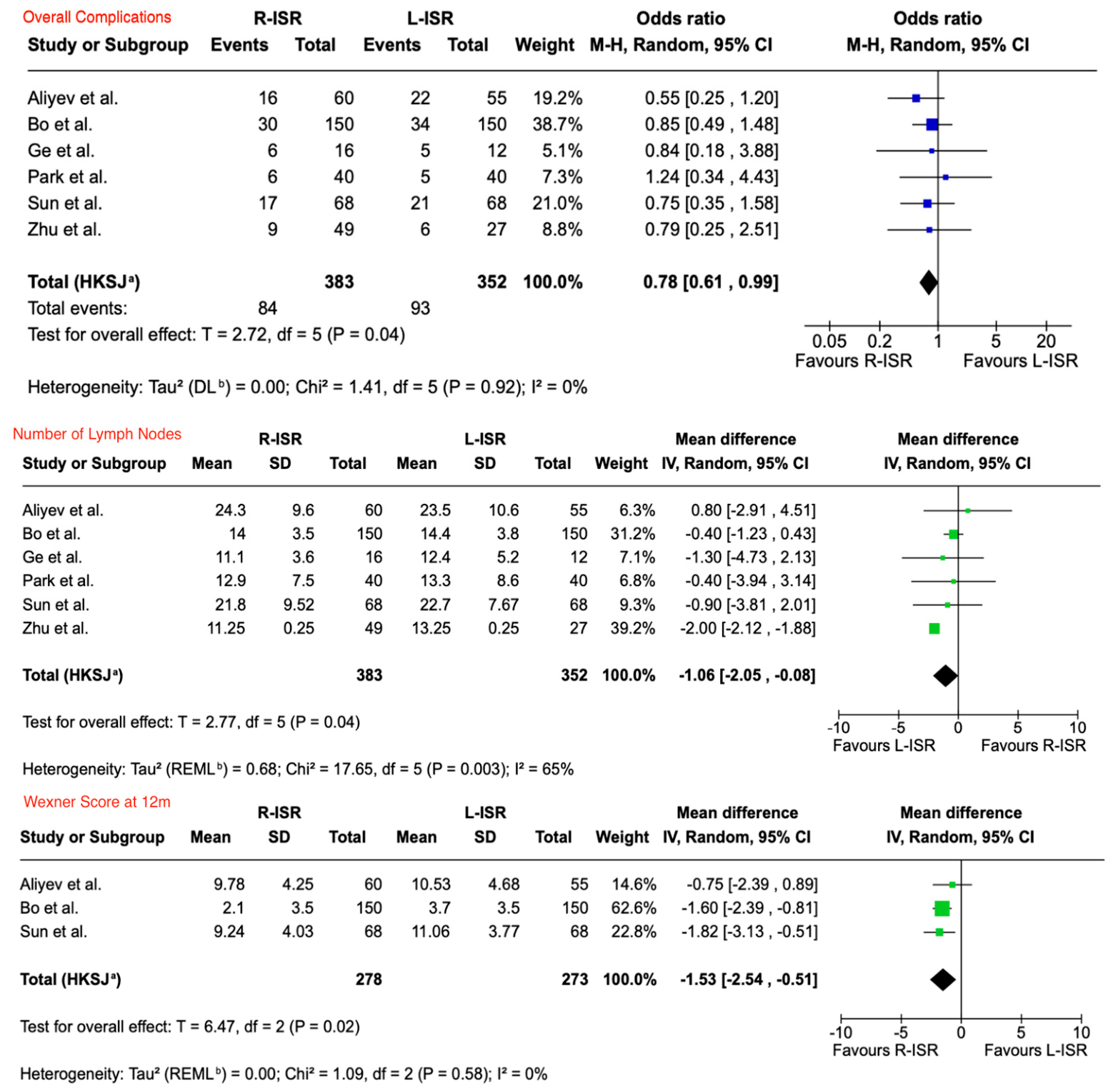
| Overall complications | 6 | 0.78 [0.61, 0.99] | 0.04 | 0 | symmetry |
| Anastomotic leakage | 6 | 0.92 [0.61, 1.37] | 0.6 | 0 | mild asymmetry |
| Length of hospital stay | 5 | −0.48 [−1.16, 0.21] | 0.12 | 0 | symmetry |
| Lymph nodes harvested | 6 | −1.06 [−2.05, −0.08] | 0.04 | 65 | mild asymmetry |
| CRM + | 2 | 0.93 [0.01, 69.04] | 0.87 | 0 | inconclusive (2 studies only) |
| Wexner 12 m | 3 | −1.53 [−2.54, −0.51] | 0.02 | 0 | inconclusive (3 studies only) |
| Experienced surgeons | |||||
| Operative duration | 3 | 25.42 [−16.60, 67.44] | 0.12 | 83 | Not assessed |
| Blood loss | 3 | −8.09 [−35.24, 19.06] | 0.33 | 55 | |
| Conversion to open surgery | 0 | n/a | |||
| Overall complications | 4 | 0.74 [0.54, 1.02] | 0.06 | 0 | |
| Anastomotic leakage | 4 | 0.84 [0.48, 1.47] | 0.4 | 0 | |
| Length of hospital stay | 3 | −0.36 [−0.95, 0.24] | 0.12 | 0 | |
| Lymph nodes harvested | 4 | −1.05 [−2.73, 0.63] | 0.14 | 78 | |
| CRM + | 0 | n/a | |||
| Wexner 12 m | 0 | n/a | |||
| High-volume centers | |||||
| Operative duration | 2 | 28.29 [−185.17, 241.75] | 0.34 | 88 | Not assessed |
| Blood loss | 2 | 1.23 [−75.47, 77.94] | 0.87 | 0 | |
| Conversion to open surgery | 1 | n/a | |||
| Overall complications | 3 | 0.74 [0.41, 1.35] | 0.17 | 0 | |
| Anastomotic leakage | 3 | 0.83 [0.32, 2.15] | 0.48 | 0 | |
| Length of hospital stay | 2 | −0.59 [−1.53, 0.36] | 0.08 | 0 | |
| Lymph nodes harvested | 3 | −1.02 [−4.05, 2.02] | 0.29 | 87 | |
| CRM + | 1 | n/a | |||
| Wexner 12 m | 2 | −1.44 [−5.67, 2.79] | 0.14 | 0 | |
| Study | Confounding | Selection of Participants | Classification of Interventions | Deviations from Intended Interventions | Missing Data | Measurement of Outcomes | Selection of Reported Results | Overall ROBINS-I |
|---|---|---|---|---|---|---|---|---|
| Zhu et al., 2025 (ISR subgroup) [27] | Serious | Moderate | Low | Low | Moderate | Moderate | Moderate | Serious |
| Yang Bo et al. (2025) [28] | Serious | Moderate | Low | Low | Moderate | Moderate | Moderate | Serious |
| Ge et al. (2024) [29] | Serious | Moderate | Low | Low | Low | Moderate | Moderate | Serious |
| Sun et al. (2024) [30] | Moderate | Moderate | Low | Low | Low | Moderate | Moderate | Moderate |
| Aliyev et al. (2022) [31] | Moderate | Moderate | Low | Low | Moderate | Moderate | Moderate | Moderate |
| Kazi et al. (2023) [32] | Moderate | Moderate | Low | Low | Moderate | Moderate | Moderate | Moderate |
| Park et al. (2013) [33] | Serious | Moderate | Low | Low | Low | Moderate | Moderate | Serious |
| Sensitivity Analysis “Leave One Out” | |
|---|---|
| Operative duration | Exclusion of Aliyev et al. [31] and Park et al. [33] rendered the pooled estimate non-significant, but the heterogeneity remained high. |
| Blood loss | Exclusion of Bo et al. [28] rendered the effect significant in favor of R-ISR and dropped heterogeneity to 0%. |
| Lymph nodes harvested | Exclusion of Bo et al. [28] dropped heterogeneity to 22% from 65%, with results remaining significant in favor of L-ISR, whereas exclusion of Ge et al., [29] Park et al., [33] and Sun et al., [30] rendered the pooled estimated non-significant whilst increasing heterogeneity. Exclusion of Zhu et al., [27] rendered the pooled estimated non-significant but dropped heterogeneity to 0%. |
| Sensitivity analysis: exclusion of studies with serious risk of bias | |
| operative duration | Exclusion of studies with high risk of bias rendered the pooled estimate non-significant and heterogeneity spiked to 87%. |
| blood loss | Exclusion of studies with high risk of bias rendered the pooled estimate non-significant and heterogeneity dropped to 0%. |
| lymph nodes harvested | Exclusion of studies with high risk of bias rendered the pooled estimate non-significant and heterogeneity dropped to 0%. |
| Outcome | Studies | Effect (95% CI) | Inconsistency | Imprecision | Publication Bias | Certainty |
|---|---|---|---|---|---|---|
| Operative duration | 5 | 34.53 (7.48, 61.59) | Very serious (I2 = 81%) | Serious | Suspected (asymmetry) | Very low |
| Blood loss | 5 | −8.15 (−23.03, 6.73) | Not serious | Serious | Not suspected (symmetry) | Low |
| Conversion to open | 2 | 0.35 (0.02, 6.02) | Not serious | Very serious | Not assessable | Very low |
| Overall complications | 6 | 0.78 (0.61, 0.99) | Not serious | Borderline | Not suspected (symmetry) | Moderate |
| Anastomotic leakage | 6 | 0.92 (0.61, 1.37) | Not serious | Serious | Possible (mild asymmetry) | Low |
| Length of stay | 5 | −0.48 (−1.16, 0.21) | Not serious | Serious | Not suspected (symmetry) | Low |
| Lymph nodes harvested | 6 | −1.06 (−2.05, −0.08) | Serious (I2 = 65%) | Serious | Possible (mild asymmetry) | Low |
| CRM positive | 2 | 0.93 (0.01, 69.04) | Not serious | Very serious | Not assessable | Very low |
| Wexner score (12 months) | 3 | −1.53 (−2.54, −0.51) | Not serious | Serious | Not assessable | Low |
| Subgroup: Experienced surgeons cohort | ||||||
| Operative duration | 3 | 25.42 (−16.60, 67.44) | Very serious (I2 = 83%) | Very serious | Not assessable | Very low |
| Blood loss | 3 | −8.09 (−35.24, 19.06) | Serious (I2 = 55%) | Very serious | Not assessable | Very low |
| Overall complications | 4 | 0.74 (0.54, 1.02) | Not serious | Serious | Not assessable | Low |
| Anastomotic leakage | 4 | 0.84 (0.48, 1.47) | Not serious | Serious | Not assessable | Low |
| Length of stay | 3 | −0.36 (−0.95, 0.24) | Not serious | Serious | Not assessable | Low |
| Lymph nodes harvested | 4 | −1.05 (−2.73, 0.63) | Very serious (I2 = 78%) | Serious | Not assessable | Very low |
| Subgroup: High-Volume centers | ||||||
| Operative duration | 2 | 28.29 (−185.17, 241.75) | Very serious (I2 = 88%) | Very serious | Not assessable | Very low |
| Blood loss | 2 | 1.23 (−75.47, 77.94) | Not serious | Very serious | Not assessable | Very low |
| Overall complications | 3 | 0.74 (0.41, 1.35) | Not serious | Serious | Not assessable | Low |
| Anastomotic leakage | 3 | 0.83 (0.32, 2.15) | Not serious | Serious | Not assessable | Low |
| Length of stay | 2 | −0.59 (−1.53, 0.36) | Not serious | Serious | Not assessable | Low |
| Lymph nodes harvested | 3 | −1.02 (−4.05, 2.02) | Very serious (I2 = 87%) | Serious | Not assessable | Very low |
| Wexner score (12 months) | 2 | −1.44 (−5.67, 2.79) | Not serious | Very serious | Not assessable | Very low |
Disclaimer/Publisher’s Note: The statements, opinions and data contained in all publications are solely those of the individual author(s) and contributor(s) and not of MDPI and/or the editor(s). MDPI and/or the editor(s) disclaim responsibility for any injury to people or property resulting from any ideas, methods, instructions or products referred to in the content. |
© 2026 by the authors. Licensee MDPI, Basel, Switzerland. This article is an open access article distributed under the terms and conditions of the Creative Commons Attribution (CC BY) license.
Share and Cite
Kossenas, K.; Frountzas, M.; Syllaios, A.; Pararas, N.; Kokoropoulos, P.; Michelakis, D.; Tsimogiannis, K.; Symeonidis, D.; Schizas, D. Comparison of Perioperative, Oncologic, and Functional Outcomes Following Robotic and Laparoscopic Intersphincteric Resection for Low Rectal Cancer: A Systematic Review and Meta-Analysis. J. Clin. Med. 2026, 15, 6483. https://doi.org/10.3390/jcm15166483
Kossenas K, Frountzas M, Syllaios A, Pararas N, Kokoropoulos P, Michelakis D, Tsimogiannis K, Symeonidis D, Schizas D. Comparison of Perioperative, Oncologic, and Functional Outcomes Following Robotic and Laparoscopic Intersphincteric Resection for Low Rectal Cancer: A Systematic Review and Meta-Analysis. Journal of Clinical Medicine. 2026; 15(16):6483. https://doi.org/10.3390/jcm15166483
Chicago/Turabian StyleKossenas, Konstantinos, Maximos Frountzas, Athanasios Syllaios, Nikolaos Pararas, Panagiotis Kokoropoulos, Dimosthenis Michelakis, Konstantinos Tsimogiannis, Dimitrios Symeonidis, and Dimitrios Schizas. 2026. "Comparison of Perioperative, Oncologic, and Functional Outcomes Following Robotic and Laparoscopic Intersphincteric Resection for Low Rectal Cancer: A Systematic Review and Meta-Analysis" Journal of Clinical Medicine 15, no. 16: 6483. https://doi.org/10.3390/jcm15166483
APA StyleKossenas, K., Frountzas, M., Syllaios, A., Pararas, N., Kokoropoulos, P., Michelakis, D., Tsimogiannis, K., Symeonidis, D., & Schizas, D. (2026). Comparison of Perioperative, Oncologic, and Functional Outcomes Following Robotic and Laparoscopic Intersphincteric Resection for Low Rectal Cancer: A Systematic Review and Meta-Analysis. Journal of Clinical Medicine, 15(16), 6483. https://doi.org/10.3390/jcm15166483