AI-Supported Prediction of Vesicoureteral Reflux in Children Based on Cystoscopic Configuration of the Ureteric Orifice

 ,
,  ,
,
Abstract
1. Introduction
2. Materials and Methods
2.1. Ethics and Patient Cohort
2.2. Image Extraction and Annotation
2.3. Model Training and AI Performance Metrics
3. Results
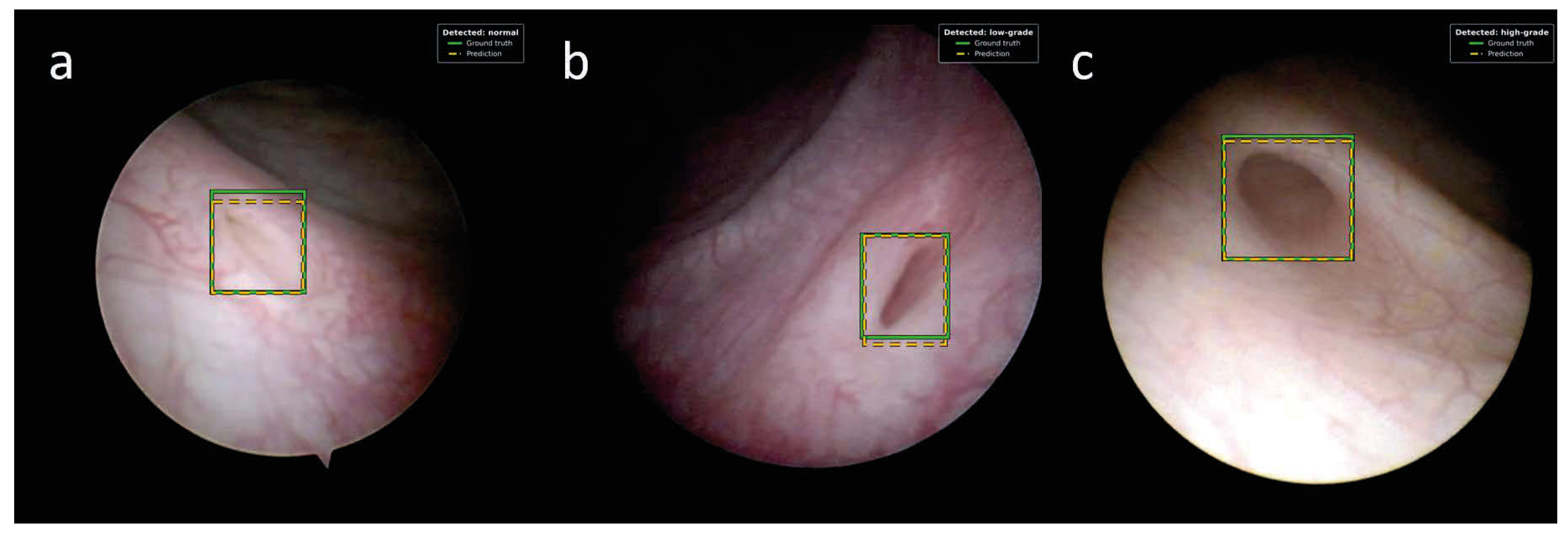
3.1. Three-Class Object Detection
3.2. Task Simplification
3.3. Sequence Aggregation
4. Discussion
Author Contributions
Funding
Institutional Review Board Statement
Informed Consent Statement
Data Availability Statement
Conflicts of Interest
Abbreviations
| VUR | vesicoureteral reflux |
| UO | ureteric orifice |
| VCUG | voiding cystourethrography |
| AI | artificial intelligence |
| UTI | urinary tract infection |
| ML | machine learning |
| UPJO | ureteropelvic junction obstruction |
| CVAT | computer vision annotation tool |
| YOLO | you only look once |
| LOVO | leave-one-out |
References
- Sargent, M.A. What is the normal prevalence of vesicoureteral reflux? Pediatr. Radiol. 2000, 30, 587–593. [Google Scholar] [CrossRef] [Scilit] [PubMed]
- Brakeman, P. Vesicoureteral reflux, reflux nephropathy, and end-stage renal disease. Adv. Urol. 2008, 2008, 508949. [Google Scholar] [CrossRef] [Scilit] [PubMed]
- Lebowitz, R.L.; Olbing, H.; Parkkulainen, K.V.; Smellie, J.M.; Tamminen-Mobius, T.E. International system of radiographic grading of vesicoureteric reflux. International Reflux Study in Children. Pediatr. Radiol. 1985, 15, 105–109. [Google Scholar] [CrossRef] [Scilit] [PubMed]
- Schaeffer, A.J.; Greenfield, S.P.; Ivanova, A.; Cui, G.; Zerin, J.M.; Chow, J.S.; Hoberman, A.; Mathews, R.I.; Mattoo, T.K.; Carpenter, M.A.; et al. Reliability of grading of vesicoureteral reflux and other findings on voiding cystourethrography. J. Pediatr. Urol. 2017, 13, 192–198. [Google Scholar] [CrossRef] [Scilit] [PubMed]
- Mackie, G.G.; Awang, H.; Stephens, F.D. The ureteric orifice: The embryologic key to radiologic status of duplex kidneys. J. Pediatr. Surg. 1975, 10, 473–481. [Google Scholar] [CrossRef] [Scilit] [PubMed]
- Lyon, R.P.; Marshall, S.; Tanagho, E.A. The ureteral orifice: Its configuration and competency. J. Urol. 1969, 102, 504–509. [Google Scholar] [CrossRef] [Scilit] [PubMed]
- Zvizdic, Z.; Catic, A.; Zivojevic, S.; Jonuzi, A.; Glamoclija, U.; Vranic, S. The correlation between ureteric orifice morphology and primary vesicoureteral reflux grade and the impact on the effectiveness of endoscopic reflux correction. J. Pediatr. Urol. 2024, 20, 295–301. [Google Scholar] [CrossRef] [Scilit] [PubMed]
- Kirsch, A.J.; Kaye, J.D.; Cerwinka, W.H.; Watson, J.M.; Elmore, J.M.; Lyles, R.H.; Molitierno, J.A.; Scherz, H.C. Dynamic hydrodistention of the ureteral orifice: A novel grading system with high interobserver concordance and correlation with vesicoureteral reflux grade. J. Urol. 2009, 182, 1688–1692. [Google Scholar] [CrossRef] [Scilit] [PubMed]
- Khondker, A.; Kaushal, S.; Wu, J.; Gupta, N.; Kwong, J.C.; Li, T.; Erdman, L.; Rickard, M.; Lorenzo, A.J. Predicting vesicoureteral reflux outcomes using artificial intelligence: A critical appraisal using APPRAISE-AI. PLoS Digit. Health 2026, 5, e0001237. [Google Scholar] [CrossRef] [Scilit] [PubMed]
- Scott Wang, H.H.; Vasdev, R.; Nelson, C.P. Artificial Intelligence in Pediatric Urology. Urol. Clin. N. Am. 2024, 51, 91–103. [Google Scholar] [CrossRef] [Scilit] [PubMed]
- Li, Z.; Tan, Z.; Wang, Z.; Tang, W.; Ren, X.; Fu, J.; Wang, G.; Chu, H.; Chen, J.; Duan, Y.; et al. Development and multi-institutional validation of a deep learning model for grading of vesicoureteral reflux on voiding cystourethrogram: A retrospective multicenter study. EClinicalMedicine 2024, 69, 102466. [Google Scholar] [CrossRef] [Scilit] [PubMed]
- Tian, Y.; Ye, Q.; Doermann, D. YOLOv12: Attention-Centric Real-Time Object Detectors; Neural Information Processing Systems Foundation, Inc. (NeurIPS): San Diego, CA, USA, 2025. [Google Scholar]
- Tan, M.; Le, Q. EfficientNet: Rethinking Model Scaling for Convolutional Neural Networks. arXiv 2019, arXiv:1905.11946. [Google Scholar] [CrossRef] [Scilit]
- Geppert, J.; Auguste, P.; Asgharzadeh, A.; Ghiasvand, H.; Patel, M.; Brown, A.; Jayakody, S.; Helm, E.; Todkill, D.; Madan, J.; et al. Software with artificial intelligence-derived algorithms for detecting and analysing lung nodules in CT scans: Systematic review and economic evaluation. Health Technol. Assess. 2025, 29, 1–234. [Google Scholar] [CrossRef] [Scilit] [PubMed]
- Lu, J.; Shen, L.; Zhou, C.; Bi, Z.; Ye, X.; Zhao, Z.; Zeng, M.; Wang, M. Image Quality Improvement and Artificial Intelligence Performance in Pulmonary Embolism Detection at Deep Learning Reconstruction-Based Ultra-low Radiation Dose CT Pulmonary Angiography. Acad. Radiol. 2025, 32, 7562–7572. [Google Scholar] [CrossRef] [Scilit] [PubMed]
- Park, D.K.; Kim, E.J.; Im, J.P.; Lim, H.; Lim, Y.J.; Byeon, J.S.; Kim, K.O.; Chung, J.W.; Kim, Y.J. A prospective multicenter randomized controlled trial on artificial intelligence assisted colonoscopy for enhanced polyp detection. Sci. Rep. 2024, 14, 25453. [Google Scholar] [CrossRef] [Scilit] [PubMed]
- Scherkl, M.; Stranger, N.; Ciornei-Hoffman, A.; Singer, G.; Till, T.; Till, H.; Hrzic, F.; Tschauner, S. Automated AI fracture detection in initial presentation pediatric wrist X-rays: Effects and benefits of adding follow-up examinations. Radiol. Med. 2026, 131, 458–469. [Google Scholar] [CrossRef] [Scilit] [PubMed]
- Stranger, N.; Scherkl, M.; Stutz, D.; Janisch, M.; Singer, G.; Hankel, S.; Till, H.; Sackl, M.; Hrzic, F.; Herzog, S.; et al. Impact of Test Set Composition on AI Performance for Pediatric Radiograph Appendicular Skeleton Fracture Detection. Radiology 2026, 318, e250540. [Google Scholar] [CrossRef] [Scilit] [PubMed]
- Zheng, F.; Zhu, Q.; Yuan, P.; Wu, F.; Cui, Y.; Xiao, Z.; Li, H.; Li, X.; Wu, J.; Qu, Z.; et al. Application of artificial intelligence for detection of Helicobacter pylori infection by magnetically controlled capsule endoscopy. Surg. Endosc. 2026, 40, 1504–1513. [Google Scholar] [CrossRef] [Scilit] [PubMed]
- Kalfa, N.; Bonnin, Y.; Tessier, B.; Garnier, S.; Mekhenane, N.; Cazals, A.; Donmez, M.I. The future of pediatric vesicoureteral reflux management. J. Pediatr. Urol. 2026; in press. [CrossRef] [Scilit] [PubMed]
- Khondker, A.; Kwong, J.C.C.; Rickard, M.; Skreta, M.; Keefe, D.T.; Lorenzo, A.J.; Erdman, L. A machine learning-based approach for quantitative grading of vesicoureteral reflux from voiding cystourethrograms: Methods and proof of concept. J. Pediatr. Urol. 2022, 18, 78.e1–78.e7. [Google Scholar] [CrossRef] [Scilit] [PubMed]
- Scott Wang, H.H.; Li, M.; Cahill, D.; Panagides, J.; Logvinenko, T.; Chow, J.; Nelson, C. A machine learning algorithm predicting risk of dilating VUR among infants with hydronephrosis using UTD classification. J. Pediatr. Urol. 2024, 20, 271–278. [Google Scholar] [CrossRef] [Scilit] [PubMed]
- Bertsimas, D.; Li, M.; Estrada, C.; Nelson, C.; Scott Wang, H.H. Selecting Children with Vesicoureteral Reflux Who are Most Likely to Benefit from Antibiotic Prophylaxis: Application of Machine Learning to RIVUR. J. Urol. 2021, 205, 1170–1179. [Google Scholar] [CrossRef] [Scilit] [PubMed]
- Serrano-Durba, A.; Serrano, A.J.; Magdalena, J.R.; Martin, J.D.; Soria, E.; Dominguez, C.; Estornell, F.; Garcia-Ibarra, F. The use of neural networks for predicting the result of endoscopic treatment for vesico-ureteric reflux. BJU Int. 2004, 94, 120–122. [Google Scholar] [CrossRef] [Scilit] [PubMed]
- Akyol Onder, E.N.; Ensari, E.; Ertan, P. ChatGPT-4o’s performance on pediatric Vesicoureteral reflux. J. Pediatr. Urol. 2025, 21, 504–509. [Google Scholar] [CrossRef] [Scilit] [PubMed]
- King, A.; Fowler, G.E.; Macefield, R.C.; Walker, H.; Thomas, C.; Markar, S.; Higgins, E.; Blazeby, J.M.; Blencowe, N.S. Use of artificial intelligence in the analysis of digital videos of invasive surgical procedures: Scoping review. BJS Open 2025, 9, zraf073. [Google Scholar] [CrossRef] [Scilit] [PubMed]
- Mascagni, P.; Alapatt, D.; Sestini, L.; Altieri, M.S.; Madani, A.; Watanabe, Y.; Alseidi, A.; Redan, J.A.; Alfieri, S.; Costamagna, G.; et al. Computer vision in surgery: From potential to clinical value. npj Digit. Med. 2022, 5, 163. [Google Scholar] [CrossRef] [Scilit] [PubMed]
- Oksuz, K.; Cam, B.C.; Kalkan, S.; Akbas, E. Imbalance problems in object detection: A review. IEEE Trans. Pattern Anal. Mach. Intell. 2021, 43, 3388–3415. [Google Scholar] [CrossRef] [Scilit] [PubMed]
- Johnson, J.M.; Khoshgoftaar, T.M. Survey on deep learning with class imbalance. J. Big Data 2019, 6, 27. [Google Scholar] [CrossRef] [Scilit]


| Class | Ureteric Orifices | Proportion |
|---|---|---|
| No reflux | 68 | 58.1% |
| Low-grade (grades II–III) | 26 | 22.2% |
| High-grade (grades IV–V) | 23 | 19.7% |
| Parameter | Value |
|---|---|
| Hardware | Single NVIDIA RTX 3060, 12GB RAM |
| Architecture | Per-model definition |
| Input image size | 640 × 640 pixels |
| Batch size | 16 (nominal batch size of 64, gradient accumulation over 4 steps |
| Epochs | 10 (with early stopping, patience of 4) |
| Optimizer | AdamW |
| Initial learning rate | 1.43 × 10⁻³ |
| Learning rate schedule | Linear decay to 1% of the initial value (final 1.56 × 10⁻⁴) with a 3-epoch warm-up |
| Momentum | 0.9 (warm-up momentum 0.8) |
| Weight decay | 5 × 10⁻⁴ |
| Loss weights | Box 7.5, classification 0.5, distribution focal loss 1.5 |
| Augmentation | Mosaic, horizontal flip (p = 0.5), HSV jitter (0.015, 0.7, 0.4), translation 0.1, scaling 0.5 |
| NMS | IoU threshold 0.7, maximum 300 detections per image |
| Numerical precision | Automatic mixed precision |
| Seed | 0, deterministic mode enabled |
| Model | mAP@50 | mAP@50-95 | Per-Frame Accuracy |
|---|---|---|---|
| YOLOv12n | 0.31 | 0.14 | 0.40 |
| YOLOv12s | 0.37 | 0.17 | 0.42 |
| YOLOv12m | 0.31 | 0.14 | 0.36 |
| YOLOv12l | 0.32 | 0.14 | 0.34 |
| Model | Per-UO Accuracy (Static) | Per-UO Accuracy (LOVO) | 95%-CI (LOVO) |
|---|---|---|---|
| YOLOv12n | 0.74 (@0.05) | 0.71 | [0.57–0.86] |
| YOLOv12s | 0.74 (@0.15) | 0.69 | [0.51–0.83] |
| YOLOv12m | 0.74 (@0.05) | 0.71 | [0.57–0.86] |
| YOLOv12l | 0.77 (@0.00) | 0.77 | [0.63–0.89] |
Disclaimer/Publisher’s Note: The statements, opinions and data contained in all publications are solely those of the individual author(s) and contributor(s) and not of MDPI and/or the editor(s). MDPI and/or the editor(s) disclaim responsibility for any injury to people or property resulting from any ideas, methods, instructions or products referred to in the content. |
© 2026 by the authors. Licensee MDPI, Basel, Switzerland. This article is an open access article distributed under the terms and conditions of the Creative Commons Attribution (CC BY) license.
Share and Cite
Wolfschluckner, V.; Till, T.; Tschauner, S.; Singer, G.; Basharkhah, A.; Till, H. AI-Supported Prediction of Vesicoureteral Reflux in Children Based on Cystoscopic Configuration of the Ureteric Orifice. J. Clin. Med. 2026, 15, 6246. https://doi.org/10.3390/jcm15166246
Wolfschluckner V, Till T, Tschauner S, Singer G, Basharkhah A, Till H. AI-Supported Prediction of Vesicoureteral Reflux in Children Based on Cystoscopic Configuration of the Ureteric Orifice. Journal of Clinical Medicine. 2026; 15(16):6246. https://doi.org/10.3390/jcm15166246
Chicago/Turabian StyleWolfschluckner, Vanessa, Tristan Till, Sebastian Tschauner, Georg Singer, Alireza Basharkhah, and Holger Till. 2026. "AI-Supported Prediction of Vesicoureteral Reflux in Children Based on Cystoscopic Configuration of the Ureteric Orifice" Journal of Clinical Medicine 15, no. 16: 6246. https://doi.org/10.3390/jcm15166246
APA StyleWolfschluckner, V., Till, T., Tschauner, S., Singer, G., Basharkhah, A., & Till, H. (2026). AI-Supported Prediction of Vesicoureteral Reflux in Children Based on Cystoscopic Configuration of the Ureteric Orifice. Journal of Clinical Medicine, 15(16), 6246. https://doi.org/10.3390/jcm15166246