Quality of Life in Patients with Hepatic Encephalopathy Treated with Rifaximin: A Systematic Review




Abstract
1. Introduction
Aim of the Review
2. Methods
2.1. Search Strategy
2.2. Eligibility Criteria
2.3. Data Extraction
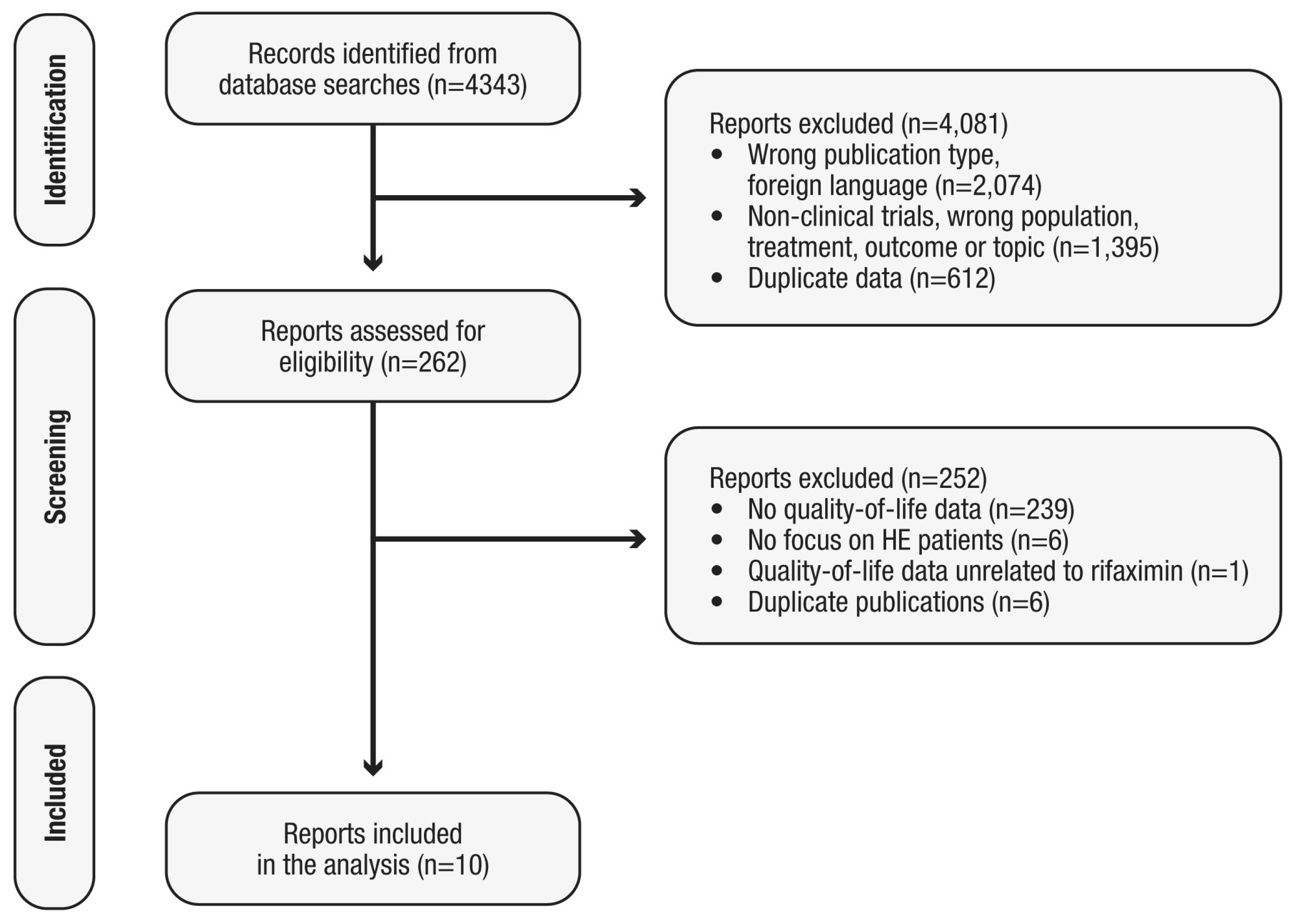
2.4. Data Selection
2.5. Risk of Bias Assessment
3. Results
3.1. Characteristics of the Selected Studies
3.2. Risk of Bias Assessment
3.3. Summary of QoL Outcomes
4. Discussion
Strengths and Limitations
5. Conclusions
Supplementary Materials
Author Contributions
Funding
Institutional Review Board Statement
Informed Consent Statement
Data Availability Statement
Acknowledgments
Conflicts of Interest
References
- Zacharias, H.D.; Kamel, F.; Tan, J.; Kimer, N.; Gluud, L.L.; Morgan, M.Y. Rifaximin for prevention and treatment of hepatic encephalopathy in people with cirrhosis. Cochrane Database Syst. Rev. 2023, 7, CD011585. [Google Scholar] [CrossRef] [PubMed]
- Hu, Y.; Zhang, X.; Xiao, Y.; Wu, Z.; Wang, Y. Efficacy and safety of rifaximin in preventing hepatic encephalopathy: A systematic review and meta-analysis. PLoS ONE 2025, 20, e0323359. [Google Scholar] [CrossRef] [PubMed]
- Alazazzi, H.; Algahiny, A.T.; Sharif, Z.; Sil, N.; Zaidi, A.Y.; Mashori, F.R.; Ali, B.; Jaffery, A.F.; Abouelella, O.H.; Sil, U.; et al. Evaluating Clinical Outcomes of Adjunct Rifaximin Therapy in Patients with Overt Hepatic Encephalopathy: A Prospective Randomized Study. Euroasian J. Hepatogastroenterol. 2025, 15, 58–62. [Google Scholar] [CrossRef] [PubMed]
- Kawaratani, H.; Namisaki, T.; Kondo, Y.; Tatsumi, R.; Kawabe, N.; Tanabe, N.; Sakamaki, A.; Hoshikawa, K.; Uchida, Y.; Endo, K.; et al. Real-World Setting of Efficacy and Safety of 3 Years of Rifaximin Administration in Japanese Patients with Hepatic Encephalopathy: A Multicenter Retrospective Study. J. Clin. Med. 2025, 14, 1358. [Google Scholar] [CrossRef] [PubMed]
- Luo, M.; Xin, R.J.; Hu, F.R.; Yao, L.; Hu, S.J.; Bai, F.H. Role of gut microbiota in the pathogenesis and therapeutics of minimal hepatic encephalopathy via the gut-liver-brain axis. World J. Gastroenterol. 2023, 29, 144–156. [Google Scholar] [CrossRef] [PubMed]
- Huang, J.; Cheng, C.; Li, Y.; Liu, Y.; Liu, Y. Efficacy and safety of rifaximin for the prophylaxis of hepatic encephalopathy: A meta-analysis. Medicine 2025, 104, e39905. [Google Scholar] [CrossRef] [PubMed]
- Oriko, D.O.; Khawaj, Z.; Cheema, M.U.; Talreja, A.; Tayyab, M.A.; Zamir, M.H.; Iqbal, M.; Farooq, U.; Ekomwereren, O.; Tariq, M.M.; et al. Therapeutic duel of rifaximin versus lactulose in hepatic encephalopathy: A systematic review. Cureus 2025, 17, e86193. [Google Scholar] [CrossRef] [PubMed]
- Patel, V.C.; Lee, S.; McPhail, M.J.W.; Da Silva, K.; Guilly, S.; Zamalloa, A.; Witherden, E.; Støy, S.; Vijay, G.K.M.; Pons, N.; et al. Rifaximin-α reduces gut-derived inflammation and mucin degradation in cirrhosis and encephalopathy: RIFSYS randomised controlled trial. J. Hepatol. 2022, 76, 332–342. [Google Scholar] [CrossRef] [PubMed]
- Torre, A.; Córdova-Gallardo, J.; Frati Munari, A.C. Rifaximin alfa and liver diseases: More than a treatment for encephalopathy, a disease modifier. Ther. Clin. Risk Manag. 2023, 19, 839–851. [Google Scholar] [CrossRef] [PubMed]
- Montagnese, S.; Rautou, P.; Romero-Gómez, M. EASL Clinical Practice Guidelines on the management of hepatic encephalopathy. J. Hepatol. 2022, 77, 807–824. [Google Scholar] [CrossRef]
- Moon, A.M.; Kim, H.P.; Jiang, Y.; Lupu, G.; Bissram, J.S.; Barritt, A.S., 4th; Tapper, E.B. Systematic Review and Meta-Analysis on the Effects of Lactulose and Rifaximin on Patient-Reported Outcomes in Hepatic Encephalopathy. Am. J. Gastroenterol. 2023, 118, 284–293. [Google Scholar] [CrossRef] [PubMed]
- Sidhu, S.S.; Goyal, O.; Mishra, B.P.; Sood, A.; Chhina, R.S.; Soni, R.K. Rifaximin improves psychometric performance and health-related quality of life in patients with minimal hepatic encephalopathy (the RIME Trial). Am. J. Gastroenterol. 2011, 106, 307–316. [Google Scholar] [CrossRef] [PubMed]
- Sanyal, A.; Younossi, Z.M.; Bass, N.M.; Mullen, K.D.; Poordad, F.; Brown, R.S.; Vemuru, R.P.; Jamal, M.M.; Huang, S.; Merchant, K.; et al. Randomised clinical trial: Rifaximin improves health-related quality of life in cirrhotic patients with hepatic encephalopathy—A double-blind placebo-controlled study. Aliment. Pharmacol. Ther. 2011, 34, 853–861. [Google Scholar] [CrossRef] [PubMed]
- Bajaj, J.S.; Heuman, D.M.; Wade, J.B.; Gibson, D.P.; Saeian, K.; Wegelin, J.A.; Hafeezullah, M.; Bell, D.E.; Sterling, R.K.; Stravitz, R.T.; et al. Rifaximin improves driving simulator performance in a randomized trial of patients with minimal hepatic encephalopathy. Gastroenterology 2011, 140, 478–487.e1. [Google Scholar] [CrossRef] [PubMed]
- Bruyneel, M.; Sersté, T.; Libert, W.; Broecke, S.v.D.; Ameye, L.; Dachy, B.; Mulkay, J.-P.; Moreno, C.; Gustot, T. Improvement of sleep architecture parameters in cirrhotic patients with recurrent hepatic encephalopathy with the use of rifaximin. Eur. J. Gastroenterol. Hepatol. 2017, 29, 302–308. [Google Scholar] [CrossRef] [PubMed]
- Tan, W.; Wang, J.; Shi, P.M.; Feng, L.-M.; Shi, J.; Ning, B.-F.; Yuan, Z.-L.; Zeng, X.; Xie, W.-F. Effects of low-dose and high-dose rifaximin in the treatment of covert hepatic encephalopathy. J. Clin. Transl. Hepatol. 2022, 10, 1099–1106. [Google Scholar] [CrossRef] [PubMed]
- Bakulin, I.G.; Ivanova, K.N.; Eremina, E.Y.; Marchenko, N.V.; NORMIND study team. Comparative analysis of the efficacy of different regimens of 12 months rifaximin-alfa therapy in patients with liver cirrhosis and minimal hepatic encephalopathy. Diagnostics 2023, 13, 3239. [Google Scholar] [CrossRef] [PubMed]
- Sidhu, S.S.; Goyal, O.; Parker, R.A.; Kishore, H.; Sood, A. Rifaximin vs. lactulose in treatment of minimal hepatic encephalopathy. Liver Int. 2016, 36, 378–385. [Google Scholar] [CrossRef] [PubMed]
- Elnoemany, K.S.; Alghoraieb, A.A.; Shebl, N.A.E.; Salman, T.A.H.; Reweisha, E.A. #P-0687 Challenges in treatment of minimal hepatic encephalopathy. J. Gastreonterol Pathol. 2017, 32, 154–194. [Google Scholar] [CrossRef][Green Version]
- Glal, K.A.M.; Abd-Elsalam, S.M.; Mostafa, T.M. Nitazoxanide versus rifaximin in preventing the recurrence of hepatic encephalopathy: A randomized double-blind controlled trial. J. Hepatobiliary Pancreat. Sci. 2021, 28, 812–824. [Google Scholar] [CrossRef] [PubMed]
- Sahid Aziz, S. Comparative study of rifaximin vs lactulose on minimal hepatic encephalopathy, an open label randomized trial. J. Clin. Exp. Hepatol. 2023, 13, S28. [Google Scholar] [CrossRef]
- Bass, N.M.; Mullen, K.D.; Sanyal, A.; Poordad, F.; Neff, G.; Leevy, C.B.; Sigal, S.; Sheikh, M.Y.; Beavers, K.; Frederick, T.; et al. Rifaximin treatment in hepatic encephalopathy. N. Engl. J. Med. 2010, 362, 1071–1081. [Google Scholar] [CrossRef] [PubMed]
- Mullen, K.D.; Sanyal, A.J.; Bass, N.M.; Poordad, F.F.; Sheikh, M.Y.; Frederick, R.T.; Bortey, E.; Forbes, W.P. Rifaximin is safe and well tolerated for long-term maintenance of remission from overt hepatic encephalopathy. Clin. Gastroenterol. Hepatol. 2014, 12, 1390–1397.e2. [Google Scholar] [CrossRef] [PubMed]
- Wang, Z.; Chu, P.; Wang, W. Combination of rifaximin and lactulose improves clinical efficacy and mortality in patients with hepatic encephalopathy. Drug Des. Devel Ther. 2018, 13, 1–11. [Google Scholar] [CrossRef] [PubMed]
- de Wit, K.; Schaapman, J.J.; Nevens, F.; Verbeek, J.; Coenen, S.; Cuperus, F.J.C.; Kramer, M.; Tjwa, E.T.T.L.; Mostafavi, N.; Dijkgraaf, M.G.W.; et al. Prevention of hepatic encephalopathy by administration of rifaximin and lactulose in patients with liver cirrhosis undergoing placement of a transjugular intrahepatic portosystemic shunt (TIPS): A multicentre randomised, double blind, placebo controlled trial (PEARL trial). BMJ Open Gastroenterol. 2020, 7, e000531. [Google Scholar] [CrossRef] [PubMed]
- Page, M.J.; McKenzie, J.E.; Bossuyt, P.M.; Boutron, I.; Hoffmann, T.C.; Mulrow, C.D.; Shamseer, L.; Tetzlaff, J.M.; Akl, E.A.; Brennan, S.E.; et al. The PRISMA 2020 statement: An updated guideline for reporting systematic reviews. BMJ 2021, 372, n71. [Google Scholar] [CrossRef] [PubMed]


| Author(s), Year | Study Design & Population | Treatment | QoL Tools | Main QoL Findings |
|---|---|---|---|---|
| Minimal/Covert HE | ||||
| Sidhu et al., 2011 [12] (RIME trial) | RCT, double blind; n = 94 | RFX 1200 mg/day (n = 49) vs. placebo (n = 45) Duration: 8 weeks | SIP | Total SIP: RFX: 11.67 → 6.45, p < 0.001; placebo: 9.86 → 8.51; p = 0.82. Correlates: improvement in psychometric tests |
| Bajaj et al., 2011 [14] | RCT, double blind; n = 42 | RFX 550 mg BID (n = 21) vs. placebo (n = 21) Duration: 8 weeks | SIP; driving simulation and cognitive testing | SIP psychosocial: RFX 13 ± 3 → 8 ± 2, p = 0.04; placebo 13 ± 4 → 11 ± 3, p = 0.45 Other SIP dimensions: NS Driving errors: RFX −76% vs. placebo −33%, p = 0.013. Cognition: RFX 91% vs. placebo 61%, p = 0.02. |
| Tan et al., 2022 [16] | RCT, open label, n = 40 | RFX low dose: 800 mg/day (n = 12) RFX high dose: 1200 mg/day f (n = 14) Duration: 8 weeks Control (n = 14) | SIP | Total SIP: low dose vs. control: −1.98 vs. 0; p = 0.048; high dose vs. control: −4.00 vs. 0; p = 0.007. Low vs. high dose: NS, p = 0.592. |
| Bakulin et al., 2023 [17] | Observational, n = 258 | Continuous: 1200 mg/day for 12 months (n = 41) Cyclic: 600–1200 mg/day for 7–14 days/month (n = 217) | CLDQ | Total CLDQ: improved in both subgroups. Between subgroups: NS. |
| Recurrent overt HE | ||||
| Sanyal et al., 2011 [13] | RCT, double blind, n = 219 | RFX 550 mg BID (lactulose permitted) (n = 101) vs. placebo (n = 118) Duration: 6 months | CLDQ | Overall CLDQ: RFX vs. placebo, p = 0.0093. Domains improved: fatigue p = 0.0087; abdominal symptoms p = 0.0090; systemic symptoms p = 0.0160; activity p = 0.0022; emotional function p = 0.0065; worry p = 0.0436. |
| Bruyneel et al., 2017 [15] | Observational, n = 15 | RFX 550 mg BID + daily lactulose Duration: 28 days | SF-36, HADS | SF-36/HADS: NS. REM sleep: 2.5%→8.5%, p = 0.003. REM + stage 3 sleep: 37.6%→55.6%, p = 0.007. |
| Author(s), Year | Study Design & Population | Treatment Regimens Compared | QoL Tools | Main QoL Findings |
|---|---|---|---|---|
| Minimal/Covert HE | ||||
| Sidhu et al., 2016 [18] | RCT, open label, n = 112 | RFX 400 mg TID (n = 57) vs. lactulose 30–120 mL/day (n = 55) Duration: 3 months | SIP | Total SIP: RFX15.7 → 7.5 vs. lactulose: 15.2 → 8.2; adjusted mean difference: −0.92 (95% CI −2.36–0.52; p = 0.20) SIP domains: NS. |
| Elnoemany et al., 2017 [19] | Observational; n = 126 | Lactulose 30–60 mL BID (n = 31) vs. RFX 200 mg TID (n = 32) vs. LOLA 6 g TID (n = 32) vs. combination therapy (n = 31) | SIP | Total SIP improvement: 24.7 vs. 16.1 vs. 16.3; p = 0.001 Between groups: NS; p > 0.05. |
| Sahid Aziz et al., 2023 [21] | RCT, open label; n = 31 | RFX 400 mg TID (n = 15) vs. lactulose 30–120 mL/day (n = 16) Duration: 12 weeks | SF-12 (PCS, MCS); PSQI | SF-12 physical/mental scores: improved in both groups; p < 0.001. PSQI: improved at 12 weeks; p < 0.001. Between groups: NS for QoL outcomes. |
| Recurrent overt HE | ||||
| Glal et al., 2021 [20] | RCT, double blind; n = 60 | RFX 550 mg BID (n = 30) vs. nitazoxanide 500 mg BID (n = 30) Duration: 24 weeks | CLDQ | Total CLDQ: RFX: 3.5 ± 0.7 → 3.6 ± 0.9, p < 0.39; nitazoxanide: 3.6 ± 0.7 → 4 ± 0.3, p = 0.0004 RFX improvement in CLDQ domains: fatigue p = 0.013; activity p = 0.019. |
| Observational Studies a | Selection | Comparability | Outcome | Overall Quality | ||
|---|---|---|---|---|---|---|
| Bakulin et al., 2023 [17] | *** | ** | ** | H | ||
| Bruyneel et al., 2017 [15] | ** | NA | ** | L | ||
| Elnoemany et al., 2017 [19] | * | * | * | H | ||
| Randomized Controlled Trials b | 1 | 2 | 3 | 4 | 5 | Overall Quality |
| Sahid Aziz et al., 2023 [21] | U | U | H | L | L | L |
| Bajaj et al., 2011 [14] | L | L | L | L | L | H |
| Glal et al., 2021 [20] | L | L | L | L | L | H |
| Sanyal et al., 2011 [13] | L | L | L | L | L | H |
| Sidhu et al., 2011 [12] | L | U | H | L | L | L |
| Sidhu et al., 2016 [18] | L | L | L | L | L | H |
| Tan et al., 2022 [16] | L | L | L | L | L | H |
Disclaimer/Publisher’s Note: The statements, opinions and data contained in all publications are solely those of the individual author(s) and contributor(s) and not of MDPI and/or the editor(s). MDPI and/or the editor(s) disclaim responsibility for any injury to people or property resulting from any ideas, methods, instructions or products referred to in the content. |
© 2026 by the authors. Licensee MDPI, Basel, Switzerland. This article is an open access article distributed under the terms and conditions of the Creative Commons Attribution (CC BY) license.
Share and Cite
Sacco, R.; Corti, A.; Giacomelli, L.; Facciorusso, A. Quality of Life in Patients with Hepatic Encephalopathy Treated with Rifaximin: A Systematic Review. J. Clin. Med. 2026, 15, 5600. https://doi.org/10.3390/jcm15145600
Sacco R, Corti A, Giacomelli L, Facciorusso A. Quality of Life in Patients with Hepatic Encephalopathy Treated with Rifaximin: A Systematic Review. Journal of Clinical Medicine. 2026; 15(14):5600. https://doi.org/10.3390/jcm15145600
Chicago/Turabian StyleSacco, Rodolfo, Ambra Corti, Luca Giacomelli, and Antonio Facciorusso. 2026. "Quality of Life in Patients with Hepatic Encephalopathy Treated with Rifaximin: A Systematic Review" Journal of Clinical Medicine 15, no. 14: 5600. https://doi.org/10.3390/jcm15145600
APA StyleSacco, R., Corti, A., Giacomelli, L., & Facciorusso, A. (2026). Quality of Life in Patients with Hepatic Encephalopathy Treated with Rifaximin: A Systematic Review. Journal of Clinical Medicine, 15(14), 5600. https://doi.org/10.3390/jcm15145600