A Brief Online Mentalization-Based Video-Feedback Intervention (VFI-RF) for Mother–Infant Interaction in Postnatal Risk Conditions: Protocol for a Multicenter Single-Arm Feasibility Study

 ,
,  , , , , , and
Abstract
1. Introduction
1.1. Research Question
- Can eligible mothers be successfully identified, recruited, and retained across the study period?
- Are the assessment procedures, including questionnaire completion and follow-up assessments, feasible and acceptable to participants?
- Are the privacy, video-sharing, and data management procedures acceptable and implementable in a fully online format?
- Do participant-reported satisfaction and qualitative feedback support the acceptability of the VFI-RF intervention and study procedures?
1.2. Primary Outcomes
1.3. Secondary Outcomes
1.4. Trial Design
2. Materials and Methods
2.1. Participants and Intervention
2.1.1. Eligibility
2.1.2. Inclusion Criteria
2.1.3. Exclusion Criteria
2.1.4. Sample Size
2.1.5. Recruitment
- (i)
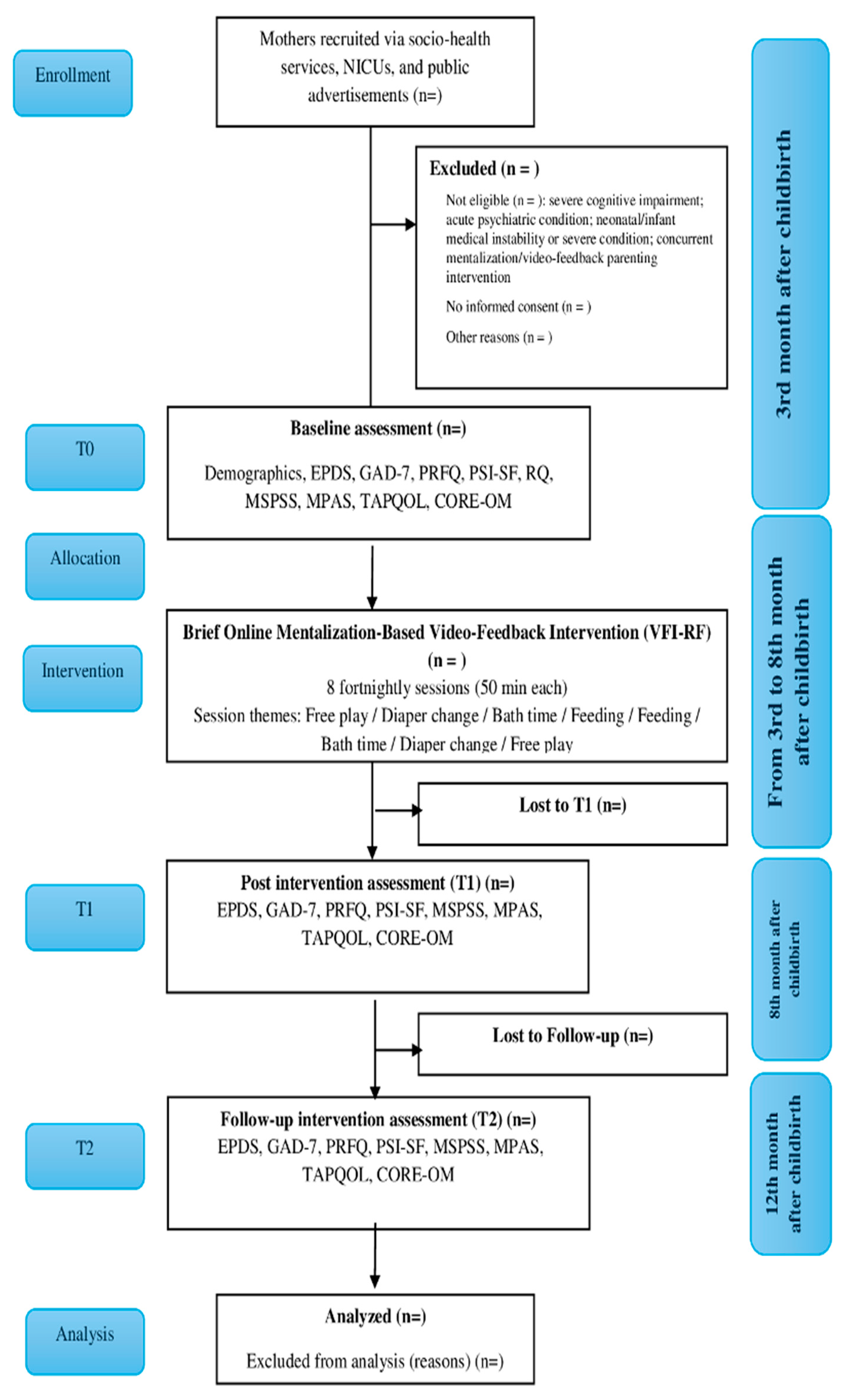
- Mothers with moderate-to-high anxiety and/or depressive symptoms will be recruited through a network of local and regional counselling and socio-health services (e.g., the Department of Mental Health, ASL Roma 1, Lazio Region).
- (ii)
- Mothers of preterm infants will be recruited through the Neonatal Units and the Neonatal Intensive Care Units (NICUs) of Hospitals in the Abruzzo region
- (iii)
- Public advertisements, including online announcements, local media, and flyers/pamphlets distributed in relevant community and healthcare settings.
2.1.6. Procedure
2.1.7. Description
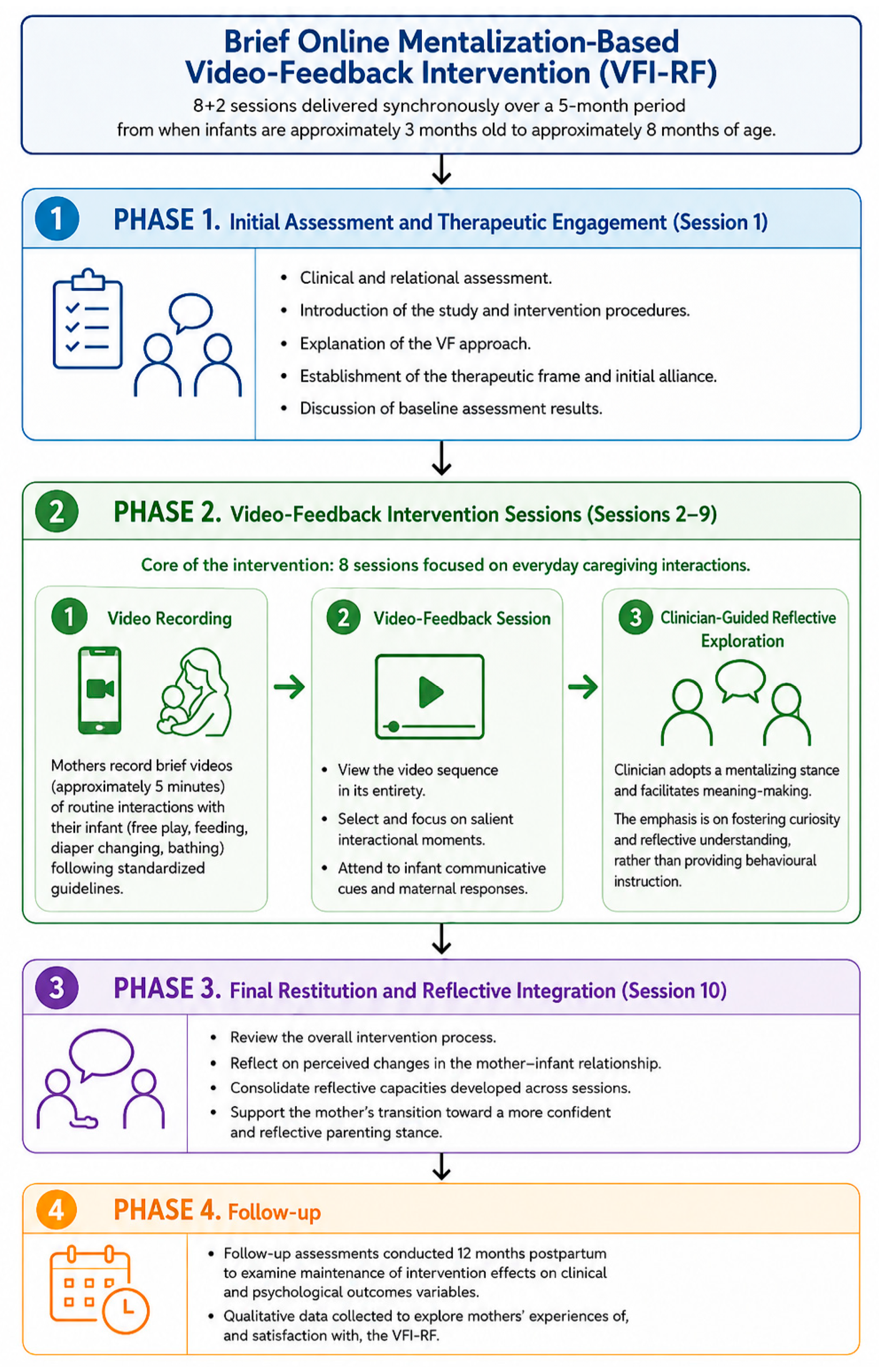
Brief Online Mentalization-Based Video-Feedback Intervention (VFI-RF)
Dosage and Administration
2.2. Outcomes
2.2.1. Feasibility and Acceptability
2.2.2. Clinical Outcome Measures—Self-Attribution
2.3. Data Analysis
2.4. Auditing
3. Discussion
Strengths and Limitations
4. Conclusions
Supplementary Materials
Author Contributions
Funding
Institutional Review Board Statement
Informed Consent Statement
Data Availability Statement
Conflicts of Interest
Abbreviations
| PRF | parental reflective functioning |
| VFI-RF | mentalization-based video-feedback intervention |
| VF | video-feedback |
| VFIs | video-feedback interventions |
| NICUs | Neonatal Intensive Care Units |
| PRFQ | Parental Reflective Functioning Questionnaire |
| IC | Interest and Curiosity |
| CMS | Certainty about Mental States |
| PM | Pre-Mentalizing |
| EPDS | Edinburgh Postnatal Depression Scale |
| GAD-7 | Generalized Anxiety Disorder Scale |
| PSI-SF | Parenting Stress Index–Short Form |
| MSPSS | Multidimensional Scale of Perceived Social Support |
| RQ | Relationship Questionnaire |
| MPAS | Maternal Postnatal Attachment Scale |
| TAPQOL | TNO-AZL Preschool Children Quality of Life |
| CORE-OM | Clinical Outcomes in Routine Evaluation—Outcome Measure |
| GDPR | General Data Protection Regulation |
References
- Pilkington, P.D.; Bedford-Dyer, I. Mothers’ Worries During Pregnancy: A Content Analysis of Reddit Posts. J. Perinat. Educ. 2021, 30, 98–107. [Google Scholar] [CrossRef] [PubMed]
- Fonagy, P.; Target, M. Early Intervention and the Development of Self-Regulation. Psychoanal. Inq. 2002, 22, 307–335. [Google Scholar] [CrossRef]
- Slade, A.; Grienenberger, J.; Bernbach, E.; Levy, D.; Locker, A. Maternal reflective functioning, attachment, and the transmission gap: A preliminary study. Attach. Hum. Dev. 2005, 7, 283–298. [Google Scholar] [CrossRef] [PubMed]
- Luyten, P.; Mayes, L.C.; Nijssens, L.; Fonagy, P. The parental reflective functioning questionnaire: Development and preliminary validation. PLoS ONE 2017, 12, e0176218. [Google Scholar] [CrossRef] [PubMed]
- Murray, L.; Fearon, P.; Cooper, P. Postnatal Depression, Mother–Infant Interactions, and Child Development: Prospects for Screening and Treatment. In Identifying Perinatal Depression and Anxiety, 1st ed.; Milgrom, J., Gemmill, A.W., Eds.; Wiley: Hoboken, NJ, USA, 2015; pp. 139–164. [Google Scholar]
- Riva Crugnola, C.; Ierardi, E.; Peruta, V.; Moioli, M.; Albizzati, A. Video-feedback attachment based intervention aimed at adolescent and young mothers: Effectiveness on infant-mother interaction and maternal mind-mindedness. Early Child Dev. Care 2021, 191, 475–489. [Google Scholar]
- Stein, A.; Pearson, R.M.; Goodman, S.H.; Rapa, E.; Rahman, A.; McCallum, M.; Howard, L.M.; Pariante, C.M. Effects of perinatal mental disorders on the fetus and child. Lancet 2014, 384, 1800–1819. [Google Scholar] [CrossRef] [PubMed]
- Tambelli, R.; Odorisio, F.; Lucarelli, L. Prenatal and Postnatal Maternal Representations in Nonrisk and At-Risk Parenting: Exploring the Influences on Mother-Infant Feeding Interactions: Prenatal and Postnatal Maternal Representations. Infant Ment. Health J. 2014, 35, 376–388. [Google Scholar] [CrossRef] [PubMed]
- Slomian, J.; Honvo, G.; Emonts, P.; Reginster, J.Y.; Bruyère, O. Consequences of maternal postpartum depression: A systematic review of maternal and infant outcomes. Womens Health 2019, 15, 1745506519844044. [Google Scholar] [CrossRef]
- Tambelli, R.; Del Proposto, L.; Favieri, F. Understanding Parental Representations Across the Perinatal Period: A Systematic Review of Empirical Findings and Clinical Implications. Children 2025, 12, 1051. [Google Scholar] [CrossRef] [PubMed]
- White-Traut, R.; Norr, K.F.; Fabiyi, C.; Rankin, K.M.; Li, Z.; Liu, L. Mother-infant interaction improves with a developmental intervention for mother-preterm infant dyads. Infant Behav. Dev. 2013, 36, 694–706. [Google Scholar] [CrossRef] [PubMed]
- Siva, N.; Nayak, R.; Ghosh, D. Pain and pain-related stress in high-risk neonates at NICU—A narrative review. J. Neonatal Nurs. 2025, 31, 101675. [Google Scholar] [CrossRef]
- Barlow, J.; Bennett, C.; Midgley, N.; Larkin, S.K.; Wei, Y. Parent-infant psychotherapy for improving parental and infant mental health. Cochrane Database Syst. Rev. 2015, 1, CD010534. [Google Scholar] [CrossRef] [PubMed]
- Barlow, J.; Bennett, C.; Midgley, N.; Larkin, S.K.; Wei, Y. Parent–infant psychotherapy: A systematic review of the evidence for improving parental and infant mental health. J. Reprod. Infant Psychol. 2016, 34, 464–482. [Google Scholar] [CrossRef]
- Alsancak-Akbulut, C.; Sahin-Acar, B.; Sumer, N. Effect of video-feedback intervention on Turkish mothers’ sensitivity and physical intrusiveness: A randomized control trial. Attach. Hum. Dev. 2021, 23, 795–813. [Google Scholar] [CrossRef] [PubMed]
- Alvarenga, P.; Cerezo, M.Á.; Wiese, E.; Piccinini, C.A. Effects of a short video feedback intervention on enhancing maternal sensitivity and infant development in low-income families. Attach. Hum. Dev. 2020, 22, 534–554. [Google Scholar] [PubMed]
- Cassibba, R.; Castoro, G.; Costantino, E.; Sette, G.; Van Ijzendoorn, M.H. Enhancing Maternal Sensitivity and Infant Attachment Security with Video Feedback: An Exploratory Study In Italy: Enhancing Security in Families with Primiparous Mothers. Infant Ment. Health J. 2015, 36, 53–61. [Google Scholar] [PubMed]
- Kristensen, I.H.; Simonsen, M.; Trillingsgaard, T.; Kronborg, H. Video feedback promotes relations between infants and vulnerable first-time mothers: A quasi-experimental study. BMC Pregnancy Childbirth 2017, 17, 379. [Google Scholar] [PubMed]
- Moss, E.; Tarabulsy, G.M.; St-Georges, R.; Dubois-Comtois, K.; Cyr, C.; Bernier, A.; St-Laurent, D.; Pascuzzo, K.; Lecompte, V. Video-feedback intervention with maltreating parents and their children: Program implementation and case study. Attach. Hum. Dev. 2014, 16, 329–342. [Google Scholar] [CrossRef] [PubMed]
- Sadler, L.S.; Slade, A.; Close, N.; Webb, D.L.; Simpson, T.; Fennie, K.; Mayes, L.C. Minding the Baby: Enhancing Reflectiveness to Improve Early Health and Relationship Outcomes in an Interdisciplinary Home-Visiting Program. Infant Ment. Health J. 2013, 34, 391–405. [Google Scholar] [CrossRef] [PubMed]
- Slade, A.; Holland, M.L.; Ordway, M.R.; Carlson, E.A.; Jeon, S.; Close, N.; Mayes, L.C.; Sadler, L.S. Minding the Baby ®: Enhancing parental reflective functioning and infant attachment in an attachment-based, interdisciplinary home visiting program. Dev. Psychopathol. 2020, 32, 123–137. [Google Scholar] [PubMed]
- Cimino, S.; Cerniglia, L. Further Evidence on Online Video-Feedback Intervention: Enhancing Parent–Child Interactions and Reducing Disordered Eating in Children. Int. J. Environ. Res. Public Health 2024, 21, 1260. [Google Scholar] [PubMed]
- Linhares, M.B.M.; Altafim, E.R.P.; Gaspardo, C.M.; Oliveira, R.C.D. A Personalized Remote Video-Feedback Universal Parenting Program: A Randomized Controlled Trial. Psychosoc. Interv. 2021, 31, 21–32. [Google Scholar] [CrossRef]
- Provenzi, L.; Giusti, L.; Caglia, M.; Rosa, E.; Mascheroni, E.; Montirosso, R. Evidence and Open Questions for the Use of Video-Feedback Interventions with Parents of Children with Neurodevelopmental Disabilities. Front. Psychol. 2020, 11, 1374. [Google Scholar] [CrossRef] [PubMed]
- Høivik, M.; Lydersen, S.; Drugli, M.; Onsøien, R.; Hansen, M.; Nielsen, T. Video feedback compared to treatment as usual in families with parent–child interactions problems: A randomized controlled trial. Child Adolesc. Psychiatry Ment. Health 2015, 9, 3. [Google Scholar] [CrossRef] [PubMed]
- McGoron, L.; Ondersma, S.J. Pediatrician and Parent-Reported Interest in Technology-Based Positive Parenting Promotion. Clin. Pract. Pediatr. Psychol. 2015, 3, 282–287. [Google Scholar] [CrossRef]
- Favieri, F.; Lombardi, L.; Mazza, C.; Babore, A.; Crugnola, C.R.; Tambelli, R. Video-Feedback Interventions Focusing on the Mother–Child Relationship: A Systematic Review of Program Characteristics, Evidence, and Outcomes in Early Childhood. Clin. Child Fam. Psychol. Rev. 2026. [Google Scholar] [CrossRef] [PubMed]
- Balldin, S.; Fisher, P.A.; Wirtberg, I. Video Feedback Intervention with Children: A Systematic Review. Res. Soc. Work Pract. 2018, 28, 682–695. [Google Scholar]
- Andersson, G.; Titov, N.; Dear, B.F.; Rozental, A.; Carlbring, P. Internet-delivered psychological treatments: From innovation to implementation. World Psychiatry 2019, 18, 20–28. [Google Scholar] [CrossRef] [PubMed]
- Bond, C.; Lancaster, G.A.; Campbell, M.; Chan, C.; Eddy, S.; Hopewell, S.; Mellor, K.; Thabane, L.; Eldridge, S. Pilot and feasibility studies: Extending the conceptual framework. Pilot Feasibility Stud. 2023, 9, 24. [Google Scholar] [CrossRef] [PubMed]
- Jones, S.; McGrath, E.; Hampshire, K.; Owen, R.; Riste, L.; Roberts, C.; Davies, L.; Mayes, D. A randomised controlled trial of time limited CBT informed psychological therapy for anxiety in bipolar disorder. BMC Psychiatry 2013, 13, 54. [Google Scholar] [CrossRef] [PubMed]
- Whitehead, A.L.; Julious, S.A.; Cooper, C.L.; Campbell, M.J. Estimating the sample size for a pilot randomised trial to minimise the overall trial sample size for the external pilot and main trial for a continuous outcome variable. Stat. Methods Med. Res. 2016, 25, 1057–1073. [Google Scholar] [PubMed]
- Slade, A. Parental reflective functioning: An introduction. Attach. Hum. Dev. 2005, 7, 269–281. [Google Scholar] [CrossRef] [PubMed]
- Beebe, B.; Lachmann, F.M. The Origins of Attachment; Routledge: New York, NY, USA, 2013. [Google Scholar]
- Avery, K.N.; Williamson, P.R.; Gamble, C.; Francischetto, E.O.; Metcalfe, C.; Davidson, P.; Williams, H.; Blazeby, J.M. Informing efficient randomised controlled trials: Exploration of challenges in developing progression criteria for internal pilot studies. BMJ Open 2017, 7, e013537. [Google Scholar] [CrossRef] [PubMed]
- Mellor, K.; Albury, C.; Dutton, S.J.; Eldridge, S.; Hopewell, S. Recommendations for progression criteria during external randomised pilot trial design, conduct, analysis and reporting. Pilot Feasibility Stud. 2023, 9, 59. [Google Scholar] [CrossRef] [PubMed]
- Pazzagli, C.; Delvecchio, E.; Raspa, V.; Mazzeschi, C.; Luyten, P. The Parental Reflective Functioning Questionnaire in Mothers and Fathers of School-Aged Children. J. Child Fam. Stud. 2018, 27, 80–90. [Google Scholar]
- Benvenuti, P. The Edinburgh Postnatal Depression Scale: Validation for an Italian sample. J. Affect. Disord. 1999, 53, 137–141. [Google Scholar] [CrossRef] [PubMed]
- Cox, J.L.; Holden, J.M.; Sagovsky, R. Detection of Postnatal Depression: Development of the 10-item Edinburgh Postnatal Depression Scale. Br. J. Psychiatry 1987, 150, 782–786. [Google Scholar] [CrossRef] [PubMed]
- Spitzer, R.L.; Kroenke, K.; Williams, J.B.W.; Löwe, B. A Brief Measure for Assessing Generalized Anxiety Disorder: The GAD-7. Arch. Intern. Med. 2006, 166, 1092. [Google Scholar] [CrossRef] [PubMed]
- Bolgeo, T.; Di Matteo, R.; Simonelli, N.; Dal Molin, A.; Lusignani, M.; Bassola, B.; Vellone, E.; Maconi, A.; Iovino, P. Psychometric properties and measurement invariance of the 7-item General Anxiety Disorder scale (GAD-7) in an Italian coronary heart disease population. J. Affect. Disord. 2023, 334, 213–219. [Google Scholar] [CrossRef] [PubMed]
- Guarino, A.; Di Blasio, P.; D’Alessio, M.; Camisasca, E.; Sserantoni, G. Parenting Stress Index SF; Giunti O.S.: Florence, Italy, 2008. [Google Scholar]
- Abidin, R.; Flens, J.R.; Austin, W.G. The Parenting Stress Index. In Forensic Uses of Clinical Assessment Instruments; Archer, R.P., Ed.; Lawrence Erlbaum Associates Publishers: Mahwah, NJ, USA, 2006; pp. 297–328. [Google Scholar]
- Zimet, G.D.; Dahlem, N.W.; Zimet, S.G.; Farley, G.K. The Multidimensional Scale of Perceived Social Support. J. Pers. Assess. 1988, 52, 30–41. [Google Scholar] [CrossRef]
- Di Fabio, A.; Busoni, L. Misurare il supporto sociale percepito: Proprietà psicometriche della Multidimensional Scale of Perceived Social Support (MSPSS) in un campione di studenti universitari. [Measuring perceived social support: Psychometric properties of the Multidimensional Scale of Perceived Social Support (MSPSS) in a sample of university students.]. Risorsa Uomo Riv. Psicol. Lav. E Dell Organ. 2008, 14, 339–350. [Google Scholar]
- Bartholomew, K.; Horowitz, L.M. Attachment styles among young adults: A test of a four-category model. J. Pers. Soc. Psychol. 1991, 61, 226–244. [Google Scholar] [CrossRef] [PubMed]
- Morandotti, N.; Brondino, N.; Merelli, A.; Boldrini, A.; De Vidovich, G.Z.; Ricciardo, S.; Abbiati, V.; Ambrosi, P.; Caverzasi, E.; Fonagy, P.; et al. The Italian version of the Reflective Functioning Questionnaire: Validity data for adults and its association with severity of borderline personality disorder. PLoS ONE 2018, 13, e0206433. [Google Scholar] [CrossRef] [PubMed]
- Condon, J.T.; Corkindale Corolyn, J. The Assessment of Parent-to-Infant Attachment: Development of a self-report questionnaire instrument. J. Reprod. Infant Psychol. 1998, 16, 57–76. [Google Scholar] [CrossRef]
- Scopesi, A.; Viterbori, P.; Sponza, S.; Zucchinetti, P. Assessing mother-to-infant attachment: The Italian adaptation of a self-report questionnaire. J. Reprod. Infant Psychol. 2004, 22, 99–109. [Google Scholar] [CrossRef]
- Fekkes, M.; Theunissen, N.C.M.; Brugman, E.; Veen, S.; Verrips, E.G.H.; Koopman, H.M.; Vogels, T.; Wit, J.; Verloove-Vanhorick, S. Development and psychometric evaluation of the TAPQOL: A health-related quality of life instrument for 1–5-year-old children. Qual. Life Res. 2000, 9, 961–972. [Google Scholar] [CrossRef] [PubMed]
- Evans, C.; Connell, J.; Barkham, M.; Margison, F.; McGrath, G.; Mellor-Clark, J.; Audin, K. Towards a standardised brief outcome measure: Psychometric properties and utility of the CORE–OM. Br. J. Psychiatry 2002, 180, 51–60. [Google Scholar] [CrossRef] [PubMed]
- Palmieri, G.; Evans, C.; Hansen, V.; Brancaleoni, G.; Ferrari, S.; Porcelli, P.; Reitano, F.; Rigatelli, M. Validation of the Italian version of the clinical outcomes in routine evaluation outcome measure (CORE-OM). Clin. Psychol. Psychother. 2009, 16, 444–449. [Google Scholar] [CrossRef] [PubMed]
- Barnicot, K.; Parker, J.; Kalwarowsky, S.; Stevens, E.; Iles, J.; Ramchandani, P.; Crawford, M. Mother and clinician experiences of a trial of a video feedback parent–infant intervention for mothers experiencing difficulties consistent with ‘personality disorder’: A qualitative interview study. Psychol. Psychother. Theory Res. Pract. 2023, 96, 480–503. [Google Scholar] [CrossRef]
- Riva Crugnola, C.; Tagini, A.; Ierardi, E. Maternal Mind-mindedness, Styles of Interaction, and Mother–Infant Emotion Regulation: Associations with Maternal Mental Health at Infant Age of Three Months. Merrill-Palmer Q. 2022, 68, 147–178. [Google Scholar] [CrossRef]



| Domain | Area | Indicator | Green | Amber | Red |
|---|---|---|---|---|---|
| Feasibility | Enrolment | Mothers referred | ≥80% of target | 60–79% | <60% |
| Eligible among referred | ≥60% | 40–59% | <40% | ||
| Consented among eligible | ≥70% | 50–69% | <50% | ||
| Intervention uptake | VFI-RF sessions attended | ≥75% | 50–74% | <50% | |
| Retention | Baseline participation | ≥90% | 75–89% | <75% | |
| Follow-up participation | ≥80% | 65–79% | <65% | ||
| Ineligibility/withdrawal reasons across study phases | Infrequent/ non-systematic | Modifiable reasons | Recurrent major issues | ||
| Assessment/data quality | Assessments completed | ≥85% | 70–84% | <70% | |
| Missing data on key measures | ≤10% | 11–20% | >20% | ||
| Acceptability | Assessment procedures | Number/frequency acceptable | ≥75% positive | 50–74% | <50% |
| Duration/content/mode acceptable | ≥75% positive | 50–74% | <50% | ||
| Mothers’ experience | VFI-RF experience | Predominantly positive | Mixed, with modifiable concerns | Predominantly negative or recurrent major concerns | |
| Satisfaction with VFI-RF/study procedures | ≥75% satisfied | 50–74% | <50% |
| Pre-Intervention | Post-Intervention | |||
|---|---|---|---|---|
| Screening | Baseline (T0) | Post-Treatment (T1) | Follow-Up (T2) | |
| Demographics (e.g., age, education, employment and marital status), clinical history, and psychosocial risk variables | ✔ | ✔ | ||
| Maternal reflective functioning (PRFQ) | ✔ | ✔ | ✔ | |
| Maternal depression (EPDS) | ✔ | ✔ | ✔ | ✔ |
| Maternal anxiety (GAD-7) | ✔ | ✔ | ✔ | ✔ |
| Maternal Parenting stress- Short Form (PSI-SF) | ✔ | ✔ | ✔ | |
| Maternal Perceived social support (MSPSS) | ✔ | ✔ | ✔ | |
| Relationship Questionnaire (RQ) | ✔ | |||
| Maternal postnatal attachment (MPAS) | ✔ | ✔ | ✔ | |
| Child’s emotional and behavioral development (TAPQOL) | ✔ | ✔ | ✔ | |
| Clinical Outcomes in Routine Evaluation- Outcome Measure (CORE-OM) | ✔ | ✔ | ✔ | |
| Satisfaction questionnaire ad hoc | ✔ | ✔ | ||
Disclaimer/Publisher’s Note: The statements, opinions and data contained in all publications are solely those of the individual author(s) and contributor(s) and not of MDPI and/or the editor(s). MDPI and/or the editor(s) disclaim responsibility for any injury to people or property resulting from any ideas, methods, instructions or products referred to in the content. |
© 2026 by the authors. Licensee MDPI, Basel, Switzerland. This article is an open access article distributed under the terms and conditions of the Creative Commons Attribution (CC BY) license.
Share and Cite
Mazza, C.; Favieri, F.; Lombardi, L.; Trumello, C.; Fiorenza, E.; La Stella, M.; Della Vedova, A.M.; Babore, A.; Tambelli, R. A Brief Online Mentalization-Based Video-Feedback Intervention (VFI-RF) for Mother–Infant Interaction in Postnatal Risk Conditions: Protocol for a Multicenter Single-Arm Feasibility Study. J. Clin. Med. 2026, 15, 5271. https://doi.org/10.3390/jcm15135271
Mazza C, Favieri F, Lombardi L, Trumello C, Fiorenza E, La Stella M, Della Vedova AM, Babore A, Tambelli R. A Brief Online Mentalization-Based Video-Feedback Intervention (VFI-RF) for Mother–Infant Interaction in Postnatal Risk Conditions: Protocol for a Multicenter Single-Arm Feasibility Study. Journal of Clinical Medicine. 2026; 15(13):5271. https://doi.org/10.3390/jcm15135271
Chicago/Turabian StyleMazza, Cristina, Francesca Favieri, Lucia Lombardi, Carmen Trumello, Eleonora Fiorenza, Michela La Stella, Anna Maria Della Vedova, Alessandra Babore, and Renata Tambelli. 2026. "A Brief Online Mentalization-Based Video-Feedback Intervention (VFI-RF) for Mother–Infant Interaction in Postnatal Risk Conditions: Protocol for a Multicenter Single-Arm Feasibility Study" Journal of Clinical Medicine 15, no. 13: 5271. https://doi.org/10.3390/jcm15135271
APA StyleMazza, C., Favieri, F., Lombardi, L., Trumello, C., Fiorenza, E., La Stella, M., Della Vedova, A. M., Babore, A., & Tambelli, R. (2026). A Brief Online Mentalization-Based Video-Feedback Intervention (VFI-RF) for Mother–Infant Interaction in Postnatal Risk Conditions: Protocol for a Multicenter Single-Arm Feasibility Study. Journal of Clinical Medicine, 15(13), 5271. https://doi.org/10.3390/jcm15135271