Article

Glasgow Prognostic Score and Gustave Roussy Immune Score in Hodgkin Lymphoma: Survival Associations and Limited Incremental Prognostic Value Beyond the International Prognostic Score

1
Hematology Clinic, İzmir Katip Çelebi University Atatürk Training and Research Hospital, 35170 İzmir, Turkey
2
Family Medicine, İzmir City Hospital, 35170 İzmir, Turkey
3
Family Medicine, Amasya Göynücek District State Hospital, 05900 Amasya, Turkey
*
Author to whom correspondence should be addressed.
J. Clin. Med. 2026, 15(13), 5159; https://doi.org/10.3390/jcm15135159 (registering DOI)
Submission received: 7 June 2026 / Revised: 26 June 2026 / Accepted: 27 June 2026 / Published: 2 July 2026

Abstract

Background/Objectives: Although outcomes in Hodgkin lymphoma (HL) have improved substantially, patients with advanced-stage disease, comorbidities, or relapsed/refractory presentations can still fare poorly. Blood-based indices of systemic inflammation and nutrition are derived from routine tests, but their value beyond established prognostic models is uncertain. We examined the association of the baseline Gustave Roussy Immune Score (GRIm) and Glasgow Prognostic Score (GPS) with treatment response, progression-free survival (PFS), and overall survival (OS) in HL, focusing on their performance relative to the seven-factor International Prognostic Score (IPS-7). Methods: We retrospectively analysed 110 adults with histologically confirmed HL treated at a tertiary haematology centre between January 2015 and December 2025. GPS, GRIm, and IPS-7 were calculated from data recorded at diagnosis. Treatment response was classified as complete versus non-complete. Outcomes were assessed with Kaplan–Meier analysis, log-rank tests, Cox regression, Harrell’s C-index, and likelihood-ratio testing. Results: Most patients had advanced-stage disease (69.1%) and received ABVD-based treatment (94.5%); complete response was achieved in 90 (81.8%). GPS and GRIm were not significantly associated with non-complete response, whereas IPS-7 was. Over a median follow-up of 39.5 months, 28 patients (25.5%) progressed or died and 17 (15.5%) died. In univariable Cox analysis, high GRIm risk (HR = 2.68, 95% CI 1.17–6.14), higher GPS (HR = 2.18 per point, 95% CI 1.23–3.89), and higher IPS-7 (HR = 2.10 per point, 95% CI 1.59–2.77) predicted shorter PFS. For OS, GPS and IPS-7 were significant, whereas GRIm was not. After adjustment for IPS-7, neither GPS nor GRIm remained independently associated with PFS or OS, and adding either score to IPS-7 produced only small, non-significant gains in discrimination. Conclusions: Baseline GPS and GRIm were associated with survival on univariable analysis, particularly for PFS, but their incremental value beyond IPS-7 was limited. These scores may help describe baseline inflammatory and nutritional risk and should not be regarded as alternatives to established HL prognostic models. In particular, GPS and GRIm were not significantly associated with treatment response and should be viewed as supportive markers requiring external validation, rather than as tools that can independently guide treatment decisions.

1. Introduction

Hodgkin lymphoma (HL) is a B-cell-derived malignancy defined histologically by Reed–Sternberg cells embedded in a reactive inflammatory infiltrate. It represents roughly 10% of all lymphomas and follows a bimodal age distribution, with incidence peaks in young adults and in patients older than 55 years [1]. Modern multi-agent chemotherapy, PET-adapted treatment, and improved supportive care have raised long-term survival above 90% in limited-stage disease [1,2]. Despite this progress, a clinically important minority of patients—those with advanced-stage disease, older age, comorbidities, high tumour burden, or relapsed/refractory disease—still relapse or die, which keeps the search for better baseline risk markers clinically relevant [3,4].
Risk assessment in HL has long relied on clinical and laboratory variables, including Ann Arbor stage, bulky disease, B symptoms, haemoglobin, leucocyte count, and lymphocyte count. These variables underpin the seven-factor International Prognostic Score (IPS-7), which remains the standard reference model in advanced-stage disease [5]. IPS-7 nonetheless leaves substantial outcome heterogeneity unexplained: patients within the same risk category can follow very different clinical courses, so simple markers that capture host inflammatory and nutritional status could, in principle, refine baseline stratification.
Functional imaging with 18F-fluorodeoxyglucose PET/computed tomography is central to staging and response assessment in HL [6], and quantitative measures such as baseline metabolic tumour volume carry independent prognostic weight [7]. These metrics are not yet standardised across centres, however, and are not universally available [8]. Inexpensive indices derived from routine blood tests at diagnosis, therefore, remain attractive, particularly when interpreted alongside—rather than instead of—established prognostic scores.
The Glasgow Prognostic Score (GPS), based on C-reactive protein (CRP) and albumin, summarises systemic inflammation together with nutritional reserve and is prognostic across many solid and haematological cancers [9]. In advanced classical HL, a higher GPS at diagnosis has been reported as an independent predictor of survival [10], and a recent meta-analysis confirmed its prognostic value across haematological malignancies [11].
The Gustave Roussy Immune Score (GRIm) combines the neutrophil-to-lymphocyte ratio (NLR), lactate dehydrogenase (LDH), and albumin. It was originally developed to select patients for early-phase immunotherapy trials [12] and has since shown prognostic value in several solid tumours [13,14,15], but its role in HL is poorly defined. Other routine blood-based markers, including the HALP score and the NLR, have also been linked to outcome in HL [16,17], reinforcing the broader relevance of inflammation- and nutrition-based indices in this disease. Even so, GPS and GRIm have rarely been compared directly within the same HL cohort, and—critically—neither has been formally tested against IPS-7. We therefore evaluated the association of baseline GPS and GRIm with treatment response, PFS, and OS in classical HL, and used IPS-7–adjusted Cox models and model-discrimination analyses to determine whether either score adds prognostic information beyond IPS-7.

2. Materials and Methods

2.1. Study Design and Population

This retrospective, single-centre study was conducted at the Hematology Clinic of İzmir Katip Çelebi University Atatürk Training and Research Hospital. Adult patients with histologically confirmed HL who received systemic chemotherapy at this institution between 1 January 2015 and 30 December 2025 were reviewed. Clinical, pathological, laboratory, imaging, treatment, response, and follow-up data were obtained from the institutional electronic health record system, including haematology outpatient records, inpatient files, pathology reports, PET/CT reports, chemotherapy protocols, and follow-up notes.
Patients were eligible if they were 18 years or older at diagnosis, had histopathologically confirmed HL, received at least one cycle of systemic chemotherapy during the study period, and had sufficient baseline clinical and laboratory data to calculate the GPS, GRIm, and IPS-7. Patients were excluded if they were younger than 18 years, pregnant, diagnosed at another centre and referred only for treatment without adequate baseline documentation, or had missing baseline data or insufficient follow-up to define survival outcomes. The final analytic cohort included 110 patients. Median follow-up, measured from diagnosis to last contact or death, was 39.5 months (interquartile range [IQR], 13.3–74.8 months).

2.2. Glasgow Prognostic Score

The GPS was assigned using established cut-offs. Patients with CRP < 1 mg/dL and albumin > 3.5 g/dL were scored as GPS 0; those with either elevated CRP (>1 mg/dL) or low albumin (<3.5 g/dL) were scored as GPS 1; and those with both abnormalities were scored as GPS 2.

2.3. Gustave Roussy Immune Score

The GRIm score was derived from the baseline neutrophil and lymphocyte counts, the NLR, serum albumin, and serum LDH. One point each was assigned for LDH above the upper limit of normal, albumin < 35 g/L, and NLR > 6; values within the normal range scored zero. Patients were then grouped into a low-risk category (total score 0–1) and a high-risk category (total score 2–3).

2.4. Endpoints

The study endpoints were treatment response, PFS, and OS. Treatment response was evaluated after first-line treatment and categorised as complete response or non-complete response; non-complete response included all categories other than complete response (partial response, inadequate/poor response, and no response). PFS was defined as the time from diagnosis to the first documented progression, relapse, or death from any cause, whichever occurred first; patients without these events were censored at last follow-up. OS was defined as the time from diagnosis to death from any cause, with surviving patients censored at last follow-up.

2.5. Statistical Analysis

Analyses were performed in SPSS version 25.0; Harrell’s C-index was calculated in Python 3.14.4. Python Software Foundation, Wilmington, DE, USA. Continuous variables were summarised as mean ± standard deviation or median with IQR or range, according to distribution, and categorical variables as counts and percentages. Categorical variables were compared with Pearson’s chi-square test or Fisher’s exact test, as appropriate. Treatment response was analysed as complete versus non-complete response, and binary logistic regression was used to identify factors associated with non-complete response.
Survival was estimated with the Kaplan–Meier method and compared using the log-rank test. Cox proportional hazards regression was used to estimate hazard ratios (HRs) with 95% confidence intervals (CIs) for PFS and OS. All 110 patients were included in the time-to-event analyses. Patients who were alive and event-free at last contact were treated as censored observations and contributed follow-up time up to the censoring date, rather than being removed from the models; censored cases were therefore retained in, and not excluded from, the Cox procedure. Univariable models were constructed first for GRIm, GPS, and IPS-7. To assess whether GPS and GRIm added prognostic information beyond IPS-7, additional Cox models adjusted for IPS-7 were fitted. GPS was entered as an ordinal variable, GRIm as a binary variable, and IPS-7 as a continuous score unless otherwise stated. Because the number of events was limited, particularly for OS, multivariable models were restricted to a small number of covariates to limit overfitting. Model discrimination was assessed with Harrell’s C-index for four models (IPS-7 alone; IPS-7 + GPS; IPS-7 + GRIm; and IPS-7 + GPS + GRIm), with 95% CIs estimated from 1000 bootstrap resamples. Nested Cox models were compared using likelihood-ratio (LR) tests based on changes in −2 log likelihood. A two-sided p-value < 0.05 was considered statistically significant.

3. Results

3.1. Patient Characteristics

The study included 110 patients with HL (median follow-up 39.5 months; IQR 13.3–74.8). Most patients were male (63.6%), and mixed cellularity was the most common subtype (53.6%). Advanced-stage disease was present in 69.1%, bulky disease in 21.8%, and B symptoms in 39.1%. Bone marrow involvement was detected by biopsy in 16.4% and by PET/CT in 39.1%. ABVD-based chemotherapy was the predominant regimen (94.5%), and complete response was achieved in 81.8%. Relapse, progression, and death occurred in 12.7%, 17.3%, and 15.5%, respectively. Baseline characteristics are summarised in Table 1.

3.2. Treatment Response

Overall, 90 patients (81.8%) achieved a complete response, and 20 (18.2%) had a non-complete response. Non-complete response was numerically more frequent in the GRIm high-risk group than in the low-risk group (26.3% vs. 16.5%), but the difference was not significant (p = 0.312). A similar non-significant gradient was seen across GPS categories (13.3%, 18.3%, and 25.0% for GPS 0, 1, and 2; p = 0.577). By contrast, IPS-7 was significantly associated with response: non-complete response rose from 7.8% in the low-risk group to 30.8% in the intermediate-risk group and 42.9% in the high-risk group (p = 0.003). The distribution of treatment response by score is shown in Table 2.
In logistic regression, IPS-7 was associated with non-complete response in univariable analysis (odds ratio [OR] = 1.85 per point, 95% CI 1.25–2.73, p = 0.002) and remained significant after adjustment for GPS or GRIm. Neither GPS nor GRIm was independently associated with non-complete response in adjusted models (Table 3).

3.3. Kaplan–Meier Survival Analyses

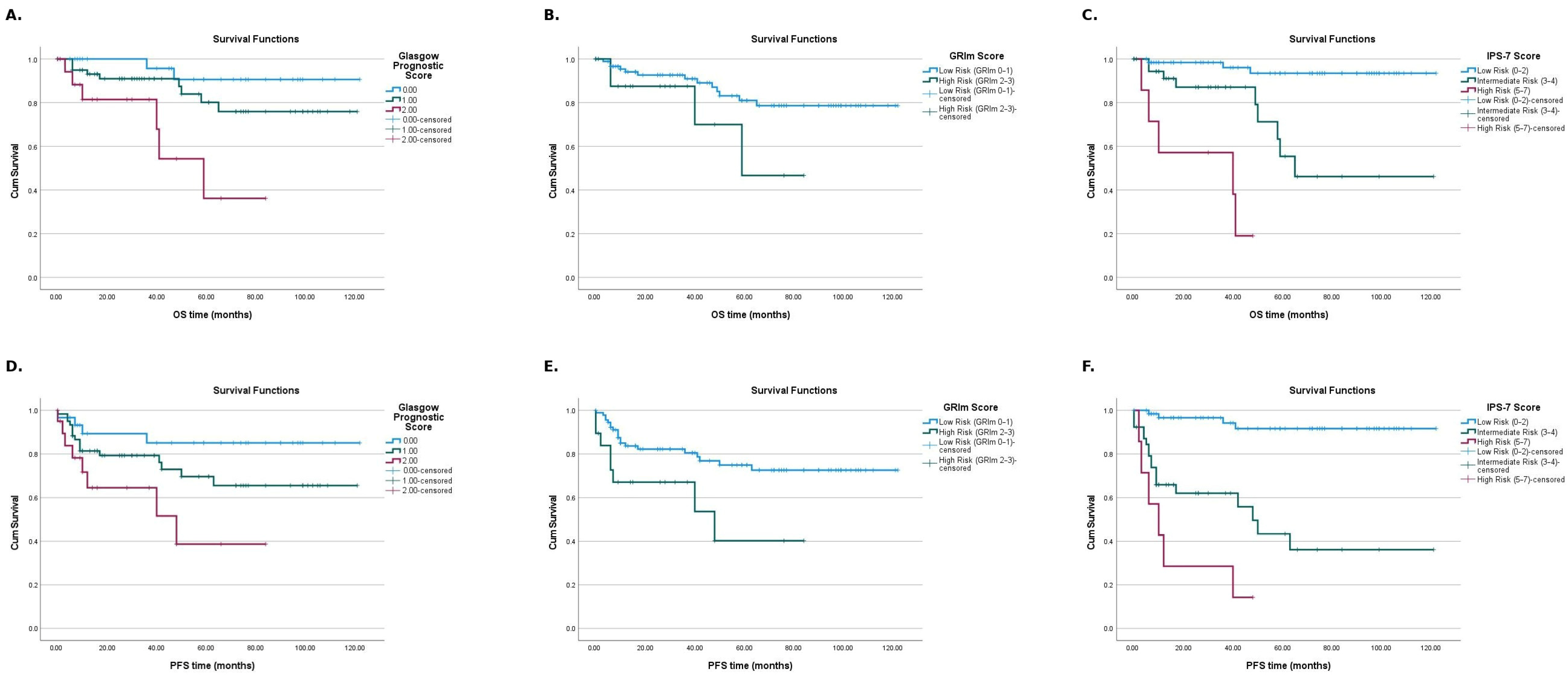
During follow-up, 28 patients (25.5%) progressed or died and 17 (15.5%) died. PFS differed significantly by GRIm, GPS, and IPS-7. PFS events were more frequent in the GRIm high-risk group than the low-risk group (42.1% vs. 22.0%; log-rank p = 0.014) and increased across GPS categories (13.3%, 26.7%, 40.0% for GPS 0, 1, 2; p = 0.021). IPS-7 produced the clearest separation, with PFS event rates of 6.3%, 46.2%, and 85.7% across low-, intermediate-, and high-risk groups (p < 0.001). For OS, GRIm showed a numerical but non-significant difference (21.1% vs. 14.3% deaths; p = 0.096), whereas GPS was significantly associated with OS (6.7%, 15.0%, and 30.0% deaths for GPS 0, 1, 2; p = 0.003). Estimates are presented in Table 4 and survival curves in Figure 1.

3.4. Cox Regression Analyses

In univariable PFS models, high GRIm risk (HR = 2.683, 95% CI 1.173–6.137, p = 0.019), higher GPS (HR = 2.183 per point, 95% CI 1.226–3.887, p = 0.008), and higher IPS-7 (HR = 2.099 per point, 95% CI 1.588–2.773, p < 0.001) were associated with shorter PFS. After adjustment for IPS-7, neither GPS (HR = 0.665, 95% CI 0.314–1.410, p = 0.288) nor GRIm (HR = 1.103, 95% CI 0.457–2.661, p = 0.828) remained independently associated with PFS, and in the full model only IPS-7 was significant.
For OS, GPS and IPS-7 were significant in univariable analysis, whereas GRIm was not. The HR was 3.194 per point for GPS (95% CI 1.487–6.859, p = 0.003) and 2.671 per point for IPS-7 (95% CI 1.790–3.986, p < 0.001); GRIm high-risk status carried a higher but non-significant mortality hazard (HR = 2.531, 95% CI 0.812–7.891, p = 0.110). In IPS-7-adjusted OS models, neither GPS nor GRIm retained independent significance. All 110 patients contributed to the OS analysis; the 93 patients who were alive at last follow-up were entered as censored observations and were retained in, rather than excluded from, the Cox models. Full results are shown in Table 5.

3.5. Incremental Prognostic Value Beyond IPS-7

Because IPS-7 dominated the adjusted Cox models, we tested whether adding GPS or GRIm improved performance beyond IPS-7. For PFS, the IPS-7-only model had a Harrell’s C-index of 0.771 (95% CI 0.671–0.852). The C-index increased only slightly after adding GPS (0.782), GRIm (0.775), or both (0.789), and LR testing showed no significant improvement over IPS-7 alone. The same pattern held for OS: the IPS-7-only C-index of 0.805 (95% CI 0.625–0.932) rose marginally with GPS (0.819), barely changed with GRIm (0.807), and reached 0.816 for the full model, with no significant gain in model fit. These results indicate only a limited incremental value of GPS and GRIm beyond IPS-7 in this cohort. Results are summarised in Table 6.

4. Discussion

In this single-center cohort of 110 patients with HL, baseline GPS and GRIm were associated with PFS in univariable analyses, and GPS was also associated with OS. IPS-7 showed the strongest and most consistent association with both treatment response and survival outcomes. After adjustment for IPS-7, however, neither GPS nor GRIm retained independent prognostic significance for PFS or OS. In addition, adding GPS, GRIm, or both scores to IPS-7 resulted in only small numerical changes in Harrell’s C-index and did not significantly improve model fit on likelihood-ratio testing. These findings suggest that GPS and GRIm carry prognostic signal in univariable analyses, but their incremental value beyond IPS-7 was limited in this cohort.
The observed associations are biologically plausible. HL is characterised by a prominent inflammatory microenvironment, and systemic inflammatory activity may be reflected in routinely measured laboratory parameters. GPS is based on CRP and albumin, which represent systemic inflammation and nutritional reserve. GRIm incorporates albumin together with LDH and the neutrophil-to-lymphocyte ratio, thereby combining markers of nutritional status, tumour burden, and host inflammatory response. Higher scores may therefore identify patients with a less favourable baseline inflammatory and nutritional profile at diagnosis.
The loss of significance after adjustment for IPS-7 is also clinically understandable. Several components of IPS-7 overlap conceptually or biologically with GPS and GRIm. Albumin is directly included in IPS-7, while stage, haemoglobin level, leukocyte count, and lymphocyte count capture dimensions of tumour burden, systemic illness, and immune status. Therefore, GPS and GRIm may partly reflect adverse biology already represented within IPS-7 rather than providing a clearly independent prognostic axis. This interpretation is supported by the model performance analyses, in which the addition of GPS and/or GRIm to IPS-7 produced only marginal, non-significant improvements in discrimination.
GPS appeared more consistent than GRIm in the present cohort. GPS was associated with both PFS and OS in univariable analyses, whereas GRIm was associated with PFS but not OS. One possible explanation is that GPS is built on CRP and albumin, two direct and clinically interpretable markers of systemic inflammation and nutritional status. In contrast, GRIm uses a fixed NLR threshold, which may reduce sensitivity in HL, where lymphocyte-related variables already have established prognostic relevance and are also represented in IPS-7. The limited number of deaths in this cohort may also have reduced statistical power for detecting an association between GRIm and OS. The GPS 2 subgroup, defined by concurrent elevated CRP and hypoalbuminemia, appeared to represent the most adverse inflammatory–nutritional phenotype and may be the clinically most informative GPS category. The treatment response analysis added an important clarification. Although the non-complete response was numerically more common in patients with higher GPS or high GRIm risk, neither GPS nor GRIm was significantly associated with non-complete response. IPS-7, however, was consistently associated with treatment response in univariable and adjusted logistic regression models. Thus, the prognostic signal of GPS and GRIm in this cohort appears more evident for time-to-event outcomes than for initial treatment response.
Our findings are generally consistent with previous evidence supporting the prognostic relevance of inflammation- and nutrition-based indices in HL and other haematological malignancies. Witte et al. reported that GPS at diagnosis independently predicted survival in advanced-stage classical HL [10]. Other routine blood-based indices, including the HALP score and post-treatment neutrophil and lymphocyte counts, have also been associated with relapse and survival outcomes in HL [16,17]. In addition, composite inflammatory indices have been linked to primary refractory disease in newly diagnosed classical HL [18]. These findings support the concept that systemic inflammation and nutritional reserve are relevant to HL outcomes.
Evidence for GRIm in HL remains limited, and most available data come from solid tumour cohorts. High GRIm scores have been associated with poorer treatment response or survival in several malignancies, including breast, gastric, renal, and colorectal cancers [13,14,15,19,20]. Modified GRIm-based models have also been evaluated in advanced gastric cancer, biliary tract carcinoma, and resectable proximal gastric cancer, with consistent associations between higher inflammatory risk and worse clinical outcomes [21,22,23]. GPS has likewise shown prognostic value in diffuse large B-cell lymphoma and multiple myeloma [24,25,26]. These studies support the broader relevance of inflammatory and nutritional markers across cancer types. However, the present data indicate that prognostic signals observed in other tumours, or in univariable HL analyses, should not be assumed to provide independent value once a disease-specific model such as IPS-7 is considered.
From a practical perspective, GPS and GRIm have clear advantages. They are inexpensive, routinely available, and can be calculated from baseline laboratory tests without additional procedures or specialised imaging. Their most appropriate use may be as descriptive markers of baseline inflammatory and nutritional risk, particularly in patients with pronounced abnormalities such as GPS 2. These scores may help identify patients who require closer clinical monitoring, nutritional assessment, or careful evaluation of performance status. They may also be useful in settings where some IPS-7 components or PET-derived quantitative metrics are unavailable. However, based on the present findings, GPS and GRIm should not be considered alternatives to IPS-7, nor should they be used alone to guide treatment escalation or de-escalation. In keeping with this, GPS and GRIm are best viewed as supportive markers that require external validation before they could be considered for any role in guiding treatment decisions, rather than as independent decision-making tools.
This study has several limitations. Its retrospective, single-center design introduces potential selection bias and limits generalisability. The cohort size was modest, and the number of outcome events was limited, particularly for OS, with 28 PFS events and 17 deaths. This limited statistical power and required restriction of multivariable models to reduce the risk of overfitting. GPS and GRIm were calculated only at diagnosis, and dynamic changes during treatment could not be evaluated. CRP may also be influenced by intercurrent infection or other inflammatory conditions. Baseline PET-derived quantitative parameters, such as metabolic tumour volume, were not uniformly available and could not be incorporated into the prognostic models. In addition, the proportional hazards assumption underlying the Cox models was not formally tested with a dedicated statistical procedure; the reported hazard ratios should therefore be interpreted as average effects over the follow-up period, and this should be regarded as a further methodological limitation. Finally, although the cohort largely consisted of classical HL subtypes, the inclusion of a small number of nodular lymphocyte-predominant HL cases may limit direct comparability with studies restricted exclusively to classical HL. Larger prospective multicenter studies are needed to determine whether inflammatory and nutritional indices add clinically meaningful information when evaluated together with IPS-7 and PET-based parameters.

5. Conclusions

In this single-center retrospective cohort of patients with HL, baseline GPS and GRIm were associated with survival outcomes in univariable analyses, particularly for PFS, and GPS was also associated with OS. However, after adjustment for IPS-7, neither score retained independent prognostic significance, and neither meaningfully improved model discrimination or fit beyond IPS-7. GPS and GRIm are inexpensive and routinely available markers that may help characterise baseline inflammatory and nutritional risk, but they should not be interpreted as substitutes for established HL prognostic models. Their role in HL risk stratification should be clarified in larger prospective multicenter cohorts. Overall, GPS and GRIm should be regarded as supportive markers of baseline inflammatory and nutritional status that require external validation, rather than as tools that can independently guide treatment decisions.

Author Contributions

Conceptualisation, K.A. and Ş.S.; methodology, K.A. and T.C.; software, İ.E. and O.A.; validation, K.A., Ş.S. and H.D.K.U.; formal analysis, İ.E. and O.A.; investigation, A.G.A. and E.A.; resources, T.C. and H.D.K.U.; data curation, O.A., A.G.A. and E.A.; writing—original draft preparation, K.A. and İ.E.; writing—review and editing, K.A., Ş.S. and T.C.; visualisation, İ.E. and O.A.; supervision, K.A. and Ş.S.; project administration, K.A. All authors have read and agreed to the published version of the manuscript.

Funding

This research received no external funding.

Institutional Review Board Statement

The study was conducted in accordance with the Declaration of Helsinki and approved by the İzmir Katip Çelebi University Health Research Institutional Review Board (Approval Code: 0188; Approval Date: 12 March 2026).

Informed Consent Statement

Patient consent was waived owing to the retrospective design of the study, in which anonymised archival data were analysed.

Data Availability Statement

The data presented in this study are available on request from the corresponding author. The data are not publicly available owing to privacy and ethical restrictions.

Conflicts of Interest

The authors declare no conflicts of interest.

Abbreviations

ABVD, doxorubicin, bleomycin, vinblastine, dacarbazine; CI, confidence interval; CRP, C-reactive protein; DLBCL, diffuse large B-cell lymphoma; GPS, Glasgow Prognostic Score; GRIm, Gustave Roussy Immune Score; HALP, haemoglobin–albumin–lymphocyte–platelet; HL, Hodgkin lymphoma; HR, hazard ratio; IPS-7, seven-factor International Prognostic Score; LDH, lactate dehydrogenase; LR, likelihood ratio; NLR, neutrophil-to-lymphocyte ratio; OS, overall survival; PET/CT, positron emission tomography/computed tomography; PFS, progression-free survival.

References

  1. Shanbhag, S.; Ambinder, R.F. Hodgkin Lymphoma: A Review and Update on Recent Progress. CA Cancer J. Clin. 2018, 68, 116–132. [Google Scholar] [PubMed]
  2. Ansell, S.M. Hodgkin Lymphoma: 2023 Update on Diagnosis, Risk-stratification, and Management. Am. J. Hematol. 2022, 97, 1478–1488. [Google Scholar] [PubMed]
  3. Connors, J.M.; Jurczak, W.; Straus, D.J.; Ansell, S.M.; Kim, W.S.; Gallamini, A.; Younes, A.; Alekseev, S.; Illés, Á.; Picardi, M. Brentuximab Vedotin with Chemotherapy for Stage III or IV Hodgkin’s Lymphoma. N. Engl. J. Med. 2018, 378, 331–344. [Google Scholar] [CrossRef] [PubMed]
  4. Engert, A.; Eichenauer, D.A.; Dreyling, M.; Group, E.G.W. Hodgkin’s Lymphoma: ESMO Clinical Practice Guidelines for Diagnosis, Treatment and Follow-Up. Ann. Oncol. 2010, 21, v168–v171. [Google Scholar] [PubMed]
  5. Hasenclever, D.; Diehl, V.; Armitage, J.O.; Assouline, D.; Björkholm, M.; Brusamolino, E.; Canellos, G.P.; Carde, P.; Crowther, D.; Cunningham, D. A Prognostic Score for Advanced Hodgkin’s Disease. N. Engl. J. Med. 1998, 339, 1506–1514. [Google Scholar] [PubMed]
  6. Barrington, S.F.; Mikhaeel, N.G.; Kostakoglu, L.; Meignan, M.; Hutchings, M.; Müeller, S.P.; Schwartz, L.H.; Zucca, E.; Fisher, R.I.; Trotman, J. Role of Imaging in the Staging and Response Assessment of Lymphoma: Consensus of the International Conference on Malignant Lymphomas Imaging Working Group. J. Clin. Oncol. 2014, 32, 3048–3058. [Google Scholar] [CrossRef] [PubMed]
  7. Cottereau, A.-S.; Versari, A.; Loft, A.; Casasnovas, O.; Bellei, M.; Ricci, R.; Bardet, S.; Castagnoli, A.; Brice, P.; Raemaekers, J. Prognostic Value of Baseline Metabolic Tumor Volume in Early-Stage Hodgkin Lymphoma in the Standard Arm of the H10 Trial. Blood 2018, 131, 1456–1463. [Google Scholar] [CrossRef] [PubMed]
  8. Barrington, S.F.; Meignan, M. Time to Prepare for Risk Adaptation in Lymphoma by Standardizing Measurement of Metabolic Tumor Burden. J. Nucl. Med. 2019, 60, 1096–1102. [Google Scholar] [CrossRef] [PubMed]
  9. Proctor, M.J.; Morrison, D.S.; Talwar, D.; Balmer, S.M.; Fletcher, C.D.; O’Reilly, D.S.J.; Foulis, A.K.; Horgan, P.G.; McMillan, D.C. A Comparison of Inflammation-Based Prognostic Scores in Patients with Cancer. A Glasgow Inflammation Outcome Study. Eur. J. Cancer 2011, 47, 2633–2641. [Google Scholar] [CrossRef] [PubMed]
  10. Witte, H.; Biersack, H.; Kopelke, S.; Rades, D.; Merz, H.; Bernard, V.; Lehnert, H.; Fetscher, S.; Gebauer, N. The Glasgow Prognostic Score at Diagnosis Is an Independent Predictor of Survival in Advanced Stage Classical Hodgkin Lymphoma. Br. J. Haematol. 2019, 184, 869–873. [Google Scholar] [PubMed]
  11. Jiang, L.; Jin, W. Prognostic Value of Glasgow Prognostic Score in Hematological Malignancies: A Systematic Review and Meta-Analysis. Int. J. Hematol. 2025, 121, 450–461. [Google Scholar] [CrossRef] [PubMed]
  12. Bigot, F.; Castanon, E.; Baldini, C.; Hollebecque, A.; Carmona, A.; Postel-Vinay, S.; Angevin, E.; Armand, J.-P.; Ribrag, V.; Aspeslagh, S. Prospective Validation of a Prognostic Score for Patients in Immunotherapy Phase I Trials: The Gustave Roussy Immune Score (GRIm-Score). Eur. J. Cancer 2017, 84, 212–218. [Google Scholar] [CrossRef] [PubMed]
  13. Tan, C.; Xu, J.; Yang, X.; Wu, D.; Zhang, S.; Liu, S.; Yu, B.; Huang, Y. The Gustave Roussy Immune Score (GRIm Score) as a Novel Prognostic Score for Early Breast Cancer Patients: A Real-World Retrospective Study. Int. J. Med. Sci. 2024, 21, 2640. [Google Scholar] [CrossRef] [PubMed]
  14. Cotan, H.; Iaciu, C.; Radu, E.; Niculae, T.; Rosu, O.A.; Nitipir, C. Gustave Roussy Immune Score (GRIm-Score) as a Prognostic and Predictive Score in Metastatic Colorectal Cancer. Cureus 2024, 16, e58935. [Google Scholar] [CrossRef] [PubMed]
  15. Nakazawa, N.; Sohda, M.; Endo, M.; Hosoi, N.; Uchida, S.; Watanabe, T.; Sano, A.; Sakai, M.; Ogawa, H.; Shirabe, K. The Gustave Roussy Immune Score Is a Powerful Biomarker for Predicting Therapeutic Resistance to Chemotherapy in Gastric Cancer Patients. Cancer Chemother. Pharmacol. 2024, 94, 517–522. [Google Scholar] [CrossRef] [PubMed]
  16. Patir, P.; Cerci, K.; Kurtoglu, E. Prognostic Evaluation of Hemoglobin, Albumin, Lymphocyte, and Platelet (HALP) Score and Hematological Indices in Classic Hodgkin Lymphoma. Int. J. Lab. Hematol. 2025, 47, 68–78. [Google Scholar] [PubMed]
  17. Tan, G.F.; Goh, S.; Chang, E.W.Y.; Tan, Y.H.; Chiang, J.; Yang, V.S.; Poon, E.Y.L.; Somasundaram, N.; Bin Harunal Rashid, M.F.; Tao, M. Post-Treatment Neutrophil and Lymphocyte Counts Predict Progression-Free Survival Following First-Line Chemotherapy in Hodgkin’s Lymphoma. Hematol. Rep. 2023, 15, 108–118. [Google Scholar] [PubMed]
  18. Hunutlu, F.Ç.; Öztop, H.; Gürsoy, V.; Ersal, T.; Elgün, E.; Yavuz, Ş.; İldemir Ekizoğlu, S.; Ekizoğlu, A.A.; Özkocaman, V.; Özkalemkaş, F. Modified Endothelial Activation and Stress Index: A New Predictor for Survival Outcomes in Classical Hodgkin Lymphoma Treated with Doxorubicin-Bleomycin-Vinblastine-Dacarbazine-Based Therapy. Diagnostics 2025, 15, 185. [Google Scholar] [PubMed]
  19. Önder, A.H.; İlhan, Y.; Balçık, O.Y.; Karakaya, G. Can Gustave Roussy Immune Score predict the prognosis and survival in patients with operable colorectal cancers? Turk. J. Clin. Lab. 2023, 14, 496–507. [Google Scholar]
  20. Erdoğan, B.; Gökmen, İ.; Elpen Kodaz, C.; Küçükarda, A.; Divriklioğlu, D.; Bayrakçı, İ.; Hacıbekiroğlu, İ.; Engin, E.Ö.; Hacıoğlu, M.B.; Özcan, E. Gustave Roussy Immune Score as an Independent Prognostic Factor for Treatment Response and Survival in Advanced Renal Cell Carcinoma Treated with Nivolumab in Second-Line and Beyond. Front. Oncol. 2025, 15, 1657053. [Google Scholar] [CrossRef] [PubMed]
  21. Ma, Y.; Pan, Y.; Li, Y.; Dai, G. The Modified-Gustave Roussy Immune Score: Assessing Immune Prognosis in Advanced Gastric Cancer Patients at Baseline. Future Oncol. 2025, 21, 3305–3317. [Google Scholar] [CrossRef] [PubMed]
  22. Ma, Y.; Pan, Y.; Li, Y.; Guan, H.; Dai, G. Correction: Prognosis of Patients with Advanced Bile Tract Carcinoma: Assessment Using the Modified-Gustave Roussy Immune Score (MGRIm-s) as a Clinico-Immunological Tool. J. Cancer Res. Clin. Oncol. 2024, 150, 330. [Google Scholar] [PubMed]
  23. Shi, Y.; Ju, M.; Di, X.; Sun, X.; Chen, X.; He, C.; Liang, L. Prognostic Value of Modified-Gustave-Roussy Immunity Score in Resectable Proximal Gastric Cancer. Medicine 2023, 102, e33334. [Google Scholar] [PubMed]
  24. Krishnan, B.; Narayanan, G.; Nair, S.G.; Purushothaman, P.N.; Thambi, S.M. 777P Glasgow Prognostic Score in Diffuse Large B Cell Lymphoma: Single Institutional Observational Study. Ann. Oncol. 2024, 35, S1690–S1691. [Google Scholar] [CrossRef]
  25. Li, S.; Zhang, L.; Liu, S.; Liang, Z.; Wang, W.; Wang, Y.; Liang, Y. Glasgow Prognostic Score Serves as a Prognostic Factor of Clinical Outcome in Patients with Newly Diagnosed Multiple Myeloma. J. Inflamm. Res. 2025, 18, 12699–12711. [Google Scholar] [CrossRef] [PubMed]
  26. Witte, H.M.; Bonorden, B.; Riecke, A.; Biersack, H.; Steinestel, K.; Merz, H.; Feller, A.C.; Bernard, V.; Fetscher, S.; von Bubnoff, N. The Glasgow Prognostic Score at Diagnosis Is a Predictor of Clinical Outcome in Patients with Multiple Myeloma Undergoing Autologous Haematopoietic Stem Cell Transplantation. Cancers 2020, 12, 921. [Google Scholar] [CrossRef] [PubMed]
Figure 1. Kaplan–Meier curves for OS (AC) and PFS (DF) according to GPS (A,D), GRIm (B,E), and IPS-7 (C,F) categories.
Jcm 15 05159 g001
Table 1. General characteristics of the study cohort (n = 110).
VariableCategoryn%
SexMale7063.6
Female4036.4
Histopathological subtypeNodular sclerosis4036.4
Mixed cellularity5953.6
Lymphocyte-rich65.5
Lymphocyte-depleted32.7
Nodular lymphocyte-predominant21.8
Disease stageEarly stage (I-II)3430.9
Advanced stage (III-IV)7669.1
Ann Arbor stageIA65.5
IB10.9
IIA2119.1
IIB65.5
IIIA1816.4
IIIB1715.5
IVA2220.0
IVB1917.3
Bulky diseasePresent2421.8
Absent8678.2
B symptomsPresent4339.1
Absent6760.9
Bone marrow involvement by biopsyPresent1816.4
Absent9283.6
Bone marrow involvement by PET/CTPresent4339.1
Absent6760.9
Treatment regimenABVD10494.5
MOPP10.9
R-CHOP21.8
COPP32.7
Treatment responseComplete response9081.8
Partial response76.4
Stable/poor response54.5
No response87.3
RelapsePresent1412.7
Absent9485.5
Unknown/not reported21.8
ProgressionPresent1917.3
Absent9182.7
Survival statusDeceased1715.5
Alive9384.5
ComorbiditiesDiabetes1110.0
Hypertension87.3
Cardiac disease43.6
Thyroid disease10.9
Malignancy21.8
Other1614.5
None6861.8
Note: PET/CT, positron emission tomography/computed tomography; ABVD, doxorubicin, bleomycin, vinblastine, dacarbazine; MOPP, mechlorethamine, vincristine, procarbazine, prednisone; R-CHOP, rituximab, cyclophosphamide, doxorubicin, vincristine, prednisone; COPP, cyclophosphamide, vincristine, procarbazine, prednisone.
Table 2. Association of GRIm, GPS, and IPS-7 with treatment response.
ScoreCategoryComplete Response, n/N (%)Non-Complete Response, n/N (%)p-Value
GRImLow risk76/91 (83.5)15/91 (16.5)0.312
High risk14/19 (73.7)5/19 (26.3)
GPS026/30 (86.7)4/30 (13.3)0.577
149/60 (81.7)11/60 (18.3)
215/20 (75.0)5/20 (25.0)
IPS-7Low risk59/64 (92.2)5/64 (7.8)0.003
Intermediate risk27/39 (69.2)12/39 (30.8)
High risk4/7 (57.1)3/7 (42.9)
Note: Non-complete response included all response categories other than complete response. p-values were calculated using Pearson’s chi-square test; because some expected cell counts were below 5, results should be interpreted cautiously. GRIm, Gustave Roussy Immune Score; GPS, Glasgow Prognostic Score; IPS-7, International Prognostic Score.
Table 3. Logistic regression analyses for non-complete response.
ModelVariableOR95% CIp-Value
UnivariableGRIm high risk1.8100.566–5.7820.317
UnivariableGPS, per 1-point increase1.4720.709–3.0580.300
UnivariableIPS-7, per 1-point increase1.8451.249–2.7260.002
IPS-7 + GPSIPS-72.2331.318–3.7840.003
GPS0.5660.216–1.4810.246
IPS-7 + GRImIPS-71.9161.245–2.9480.003
GRIm0.7530.200–2.8410.675
IPS-7 + GPS + GRImIPS-72.2451.312–3.8400.003
GPS0.5730.211–1.5550.275
GRIm0.9310.230–3.7690.920
Note: The outcome variable was non-complete response. GRIm was entered as a binary variable, GPS as an ordinal variable, and IPS-7 as a continuous score. OR, odds ratio; CI, confidence interval.
Table 4. Kaplan–Meier survival analyses according to GRIm, GPS, and IPS-7.
EndpointScoreCategoryEvents/Total (%)Mean Survival, Months (95% CI)p-Value
PFSGRImLow risk20/91 (22.0)94.5 (84.0–105.0)0.014
High risk8/19 (42.1)46.8 (28.7–65.0)
PFSGPS04/30 (13.3)106.0 (91.4–120.6)0.021
116/60 (26.7)87.7 (73.9–101.4)
28/20 (40.0)46.0 (27.8–64.2)
PFSIPS-7Low risk4/64 (6.3)114.0 (106.4–121.5)<0.001
Intermediate18/39 (46.2)59.5 (40.2–78.7)
High risk6/7 (85.7)17.3 (4.4–30.1)
OSGRImLow risk13/91 (14.3)103.7 (94.6–112.7)0.096
High risk4/19 (21.1)60.7 (43.1–78.3)
OSGPS02/30 (6.7)114.5 (104.6–124.4)0.003
19/60 (15.0)101.2 (89.5–112.8)
26/20 (30.0)53.3 (36.3–70.3)
Note: Survival curves were compared using the log-rank test. Mean survival is reported because median survival was not reached in several strata. PFS, progression-free survival; OS, overall survival; CI, confidence interval.
Table 5. Cox regression analyses for PFS and OS.
EndpointModelVariableHR95% CIp-Value
PFSUnivariableGRIm high risk2.6831.173–6.1370.019
PFSUnivariableGPS, per 1-point2.1831.226–3.8870.008
PFSUnivariableIPS-7, per 1-point2.0991.588–2.773<0.001
PFSIPS-7 + GPSIPS-72.4421.627–3.666<0.001
PFSIPS-7 + GPSGPS0.6650.314–1.4100.288
PFSIPS-7 + GRImIPS-72.0761.544–2.791<0.001
PFSIPS-7 + GRImGRIm1.1030.457–2.6610.828
PFSIPS-7 + GPS + GRImIPS-72.4451.623–3.683<0.001
PFSIPS-7 + GPS + GRImGPS0.6010.270–1.3380.213
PFSIPS-7 + GPS + GRImGRIm1.3970.532–3.6650.498
OSUnivariableGRIm high risk2.5310.812–7.8910.110
OSUnivariableGPS, per 1-point3.1941.487–6.8590.003
OSUnivariableIPS-7, per 1-point2.6711.790–3.986<0.001
OSIPS-7 + GPSIPS-72.9661.677–5.246<0.001
OSIPS-7 + GPSGPS0.7720.294–2.0270.599
OSIPS-7 + GRImIPS-72.7631.818–4.198<0.001
OSIPS-7 + GRImGRIm0.7430.224–2.4630.627
OSIPS-7 + GPS + GRImIPS-72.9561.677–5.209<0.001
OSIPS-7 + GPS + GRImGPS0.8250.288–2.3640.720
OSIPS-7 + GPS + GRImGRIm0.8130.220–3.0040.756
Note: Models were kept restricted because of the limited number of events, particularly for OS. GPS was entered as an ordinal variable, GRIm as a binary variable, and IPS-7 as a continuous score unless otherwise specified. HR, hazard ratio; CI, confidence interval; PFS, progression-free survival; OS, overall survival.
Table 6. Incremental prognostic value of GPS and GRIm beyond IPS-7.
EndpointModel−2LLLR χ2 vs. IPS-7dfp-ValueC-Index (95% CI)
PFSIPS-7 alone216.045Reference0.771 (0.671–0.852)
PFSIPS-7 + GPS214.9101.13510.2870.782 (0.681–0.862)
PFSIPS-7 + GRIm215.9980.04710.8280.775 (0.672–0.857)
PFSIPS-7 + GPS + GRIm214.4591.58620.4520.789 (0.684–0.874)
OSIPS-7 alone115.773Reference0.805 (0.625–0.932)
OSIPS-7 + GPS115.4980.27510.6000.819 (0.637–0.940)
OSIPS-7 + GRIm115.5280.24510.6210.807 (0.629–0.935)
OSIPS-7 + GPS + GRIm115.4000.37320.8300.816 (0.638–0.939)
Note: LR tests compared each expanded model with the IPS-7-only model. C-index values are Harrell’s concordance index with bootstrap-derived 95% CIs. −2LL, minus two log likelihood; LR, likelihood ratio; CI, confidence interval.
Disclaimer/Publisher’s Note: The statements, opinions and data contained in all publications are solely those of the individual author(s) and contributor(s) and not of MDPI and/or the editor(s). MDPI and/or the editor(s) disclaim responsibility for any injury to people or property resulting from any ideas, methods, instructions or products referred to in the content.