Injectable Therapies for Orofacial Myofascial Pain: A Rapid Review of Randomized Controlled Trials
 , ,
, ,  , , , and
Abstract
1. Introduction
1.1. Rationale
1.2. Objectives
2. Materials and Methods
2.1. Protocol and Registration
2.2. Eligibility Criteria
2.3. Information Sources
2.4. Search
2.5. Selection of Sources
2.6. Data Charting Process
2.7. Data Items
2.8. Critical Appraisal of Individual Sources of Evidence
2.9. Synthesis of Results
3. Results
3.1. Selection of Sources of Evidence
3.2. Characteristics of Sources Evidence
3.3. Critical Appraisal Within Sources of Evidence
3.4. Results of Individual Studies and Synthesis of Evidence
4. Discussion
4.1. Summary of Evidence
4.2. Clinical Implications
4.3. Safety Considerations
4.4. Future Research Directions
4.5. Strengths
4.6. Limitations
5. Conclusions
Author Contributions
Funding
Institutional Review Board Statement
Informed Consent Statement
Data Availability Statement
Conflicts of Interest
Abbreviations
| DC/TMD | Diagnostic Criteria for Temporomandibular Disorders |
| DN | dry needling |
| JBI | Joanna Briggs Institute |
| MFP | myofascial pain |
| MIO | maximum interincisal opening |
| MMO | maximum mouth opening |
| MPS | myofascial pain syndrome |
| OHIP-14 | Oral Health Impact Profile-14 |
| OSF | Open Science Framework |
| PICOTS | Population, Intervention, Comparator, Outcome, Timeframe, Study design |
| PPI | pressure pain sensitivity |
| PRP | platelet-rich plasma |
| RCT | randomized controlled trial |
| TrP | trigger point |
| VAS | Visual Analogue Scale |
Appendix A

| Title | First Author, Publication Year | Identifier | Reason for Exclusion |
|---|---|---|---|
| Comparison of Lidocaine, Mepivacaine, and Dry Needling in Myofascial Pain Syndrome, | Münevveroğlu, 2025 | NCT07079449 | Excluded because only a trial registry record was available and no study results were reported |
| Comparative analysis of different dilution methods in botulinum toxin application | Develi, 2025 | DOI: 10.1016/j.ijom.2025.04.1144 | Excluded due to ineligible study design (retrospective study, not a randomized controlled trial) |
| Trigger Point Management | Shipton, 2023 | PMID: 36791442 | Excluded due to ineligible study design (clinical/narrative review, not a randomized controlled trial) |
| Comparative study of 5% dextrose vs. 18% dextrose prolotherapy in myofascial pain syndrome | Not reported, 2024 | CENTRAL: CN-02775764 | Excluded because only a trial registry record was available and no study results were reported |
References
- Reda, B.; Contardo, L.; Vidoni, G.; El-Outa, A. Prevalence of Temporomandibular Disorders (TMD) in Dental Patients at a Specialized Regional Medical Center in Italy. Cureus 2024, 16, e60819. [Google Scholar] [CrossRef] [PubMed]
- Cakir, M.; Ülker, G.M.Y.; Erdogan, Ö. Prevalence and Comparison of Temporomandibular Disorders According to Axis I in RDC/TMD and DC/TMD: A Cross-Sectional Study. Quintessence Int. 2025, 56, 238–247. [Google Scholar] [CrossRef] [PubMed]
- Riente, A.; Abeltino, A.; Serantoni, C.; De Giulio, M.M.; Bianchetti, G.; Santantonio, M.; Passali, G.C.; Capezzone, S.; Esposito, R.; De Spirito, M.; et al. Using Quantitative Masticatory Dysfunction to Inform Pain Management in Trigeminal Neuralgia Through Electromyographic Monitoring. J. Oral Pathol. Med. 2025, 54, 863–871. [Google Scholar] [CrossRef] [PubMed]
- Dąbkowska, I.; Sobiech, L.; Czępińska, A.; Bęben, A.; Turżańska, K.; Gawda, P. Multimodal Approaches in the Management of Temporomandibular Disorders: A Narrative Review. J. Clin. Med. 2025, 14, 4326. [Google Scholar] [CrossRef] [PubMed]
- Dunning, J.; Butts, R.; Mourad, F.; Young, I.; Flannagan, S.; Perreault, T. Dry Needling: A Literature Review with Implications for Clinical Practice Guidelines. Phys. Ther. Rev. 2014, 19, 252–265. [Google Scholar] [CrossRef] [PubMed]
- Nowak, Z.; Chęciński, M.; Nitecka-Buchta, A.; Bulanda, S.; Ilczuk-Rypuła, D.; Postek-Stefańska, L.; Baron, S. Intramuscular Injections and Dry Needling within Masticatory Muscles in Management of Myofascial Pain. Systematic Review of Clinical Trials. Int. J. Environ. Res. Public Health 2021, 18, 9552. [Google Scholar] [CrossRef] [PubMed]
- Anwar, N.; Wei, X.; Jie, Y.; Zhao, H.; Jin, H.; Zhu, Z. Current Advances in the Treatment of Myofascial Pain Syndrome with Trigger Point Injections: A Review. Medicine 2024, 103, e39885. [Google Scholar] [CrossRef] [PubMed]
- Gupta, P.; Singh, V.; Sethi, S.; Kumar, A. A Comparative Study of Trigger Point Therapy with Local Anaesthetic (0.5% Bupivacaine) Versus Combined Trigger Point Injection Therapy and Levosulpiride in the Management of Myofascial Pain Syndrome in the Orofacial Region. J. Maxillofac. Oral Surg. 2016, 15, 376–383. [Google Scholar] [CrossRef] [PubMed]
- De La Torre Canales, G.; Câmara-Souza, M.B.; Ernberg, M.; Al-Moraissi, E.A.; Grigoriadis, A.; Poluha, R.L.; Christidis, M.; Jasim, H.; Lövgren, A.; Christidis, N. Botulinum Toxin-A for the Treatment of Myogenous Temporomandibular Disorders: An Umbrella Review of Systematic Reviews. Drugs 2024, 84, 779–809. [Google Scholar] [CrossRef] [PubMed]
- Agarwal, V.; Gupta, A.; Singh, H.; Kamboj, M.; Popli, H.; Saroha, S. Comparative Efficacy of Platelet-Rich Plasma and Dry Needling for Management of Trigger Points in Masseter Muscle in Myofascial Pain Syndrome Patients: A Randomized Controlled Trial. J. Oral Facial Pain Headache 2022, 36, 253–262. [Google Scholar] [CrossRef] [PubMed]
- Campana, M.D.; De Paolis, G.; Sammartino, G.; Bucci, P.; Aliberti, A.; Gasparro, R. Cannabinoids: Therapeutic Perspectives for Management of Orofacial Pain, Oral Inflammation and Bone Healing—A Systematic Review. Int. J. Mol. Sci. 2025, 26, 3766. [Google Scholar] [CrossRef] [PubMed]
- Tardelli, J.D.C.; Gubitoso, B.; Botelho, A.L.; Valente, M.L.D.C.; Reis, A.C.D. Efficacy of Acupuncture on Craniomandibular Myofascial Pain in Temporomandibular Disorder Patients: A Systematic Review. Heliyon 2024, 10, e32075. [Google Scholar] [CrossRef] [PubMed]
- Steen, J.P.; Jaiswal, K.S.; Kumbhare, D. Myofascial Pain Syndrome: An Update on Clinical Characteristics, Etiopathogenesis, Diagnosis, and Treatment. Muscle Nerve 2025, 71, 889–910. [Google Scholar] [CrossRef] [PubMed]
- Lubecka, K.; Chęcińska, K.; Bliźniak, F.; Chęciński, M.; Turosz, N.; Rąpalska, I.; Michcik, A.; Chlubek, D.; Sikora, M. Update on Evidence and Directions in Temporomandibular Joint Injection Techniques: A Rapid Review of Primary Research. J. Clin. Med. 2024, 13, 4022. [Google Scholar] [CrossRef] [PubMed]
- Tricco, A.C.; Lillie, E.; Zarin, W.; O’Brien, K.K.; Colquhoun, H.; Levac, D.; Moher, D.; Peters, M.D.J.; Horsley, T.; Weeks, L.; et al. PRISMA Extension for Scoping Reviews (PRISMA-ScR): Checklist and Explanation. Ann. Intern. Med. 2018, 169, 467–473. [Google Scholar] [CrossRef] [PubMed]
- Amir-Behghadami, M.; Janati, A. Population, Intervention, Comparison, Outcomes and Study (PICOS) Design as a Framework to Formulate Eligibility Criteria in Systematic Reviews. Emerg. Med. J. 2020, 37, 387. [Google Scholar] [CrossRef] [PubMed]
- Association for Computing Machinery. Available online: https://www.acm.org/ (accessed on 22 May 2026).
- BASE (Bielefeld Academic Search Engine): Wyszukiwanie Ogólne. Available online: https://www.base-search.net/ (accessed on 22 May 2026).
- About the Cochrane Library|Cochrane Library. Available online: https://www.cochranelibrary.com/about/about-cochrane-library (accessed on 22 May 2026).
- PubMed. Available online: https://pubmed.ncbi.nlm.nih.gov/ (accessed on 22 May 2026).
- Scopus|Abstract and Citation Database|Elsevier. Available online: https://www.elsevier.com/products/scopus (accessed on 22 May 2026).
- Page, M.J.; McKenzie, J.E.; Bossuyt, P.M.; Boutron, I.; Hoffmann, T.C.; Mulrow, C.D.; Shamseer, L.; Tetzlaff, J.M.; Akl, E.A.; Brennan, S.E.; et al. The PRISMA 2020 Statement: An Updated Guideline for Reporting Systematic Reviews. BMJ 2021, 372, n71. [Google Scholar] [CrossRef] [PubMed]
- Barker, T.H.; Stone, J.C.; Sears, K.; Klugar, M.; Tufanaru, C.; Leonardi-Bee, J.; Aromataris, E.; Munn, Z. The Revised JBI Critical Appraisal Tool for the Assessment of Risk of Bias for Randomized Controlled Trials. JBI Evid. Synth. 2023, 21, 494–506. [Google Scholar] [CrossRef] [PubMed]
- Shabaan, A.A.; Kassem, I.; Aboulmagd, I.; Amer, I.A.; Shaaban, A.; Abd-El-Ghafour, M.; Refahee, S.M. Effectiveness of Intra-Oral Botulinum Toxin Injection in Comparison to the Extra-Oral Approach on Pain and Quality of Life in Patients with Myofascial Pain: A Randomized Clinical Trial. Clin. Oral Investig. 2024, 29, 18. [Google Scholar] [CrossRef] [PubMed]
- Saba, Q.; Rathore, A.; Yadav, A.; Pradhan, S.; Waikhom, S.; Uma, A. Comparative Evaluation of the Efficacy of Platelet-Rich Plasma and Dexamethasone Injections in Myofascial Pain Trigger Points in the Masseter Muscle. J. Dent. Spec. 2025, 13, 240–246. [Google Scholar] [CrossRef]
- Saglam, R.; Delilbasi, C.; Sayin Ozel, G.; Subasi, I.D. Evaluation of the Effects of Occlusal Splint and Masseter Muscle Injection in Patients with Myofascial Pain: A Randomised Controlled Trial. J. Oral Facial Pain Headache 2024, 38, 64–76. [Google Scholar] [CrossRef] [PubMed]
- Refahee, S.M.; Mahrous, A.I.; Shabaan, A.A. Clinical Efficacy of Magnesium Sulfate Injection in the Treatment of Masseter Muscle Trigger Points: A Randomized Clinical Study. BMC Oral Health 2022, 22, 408. [Google Scholar] [CrossRef] [PubMed]
- Pavicic, T.; Burgess, C.; Fabi, S.; Nestor, M.S.; Bee, E.K.; Imhof, M.; Dersch, H.; Sudimac, V. Aesthetic Improvements Over Time: Long-Term Efficacy and Additional Outcomes of IncobotulinumtoxinA in the Simultaneous Treatment of Upper Facial Lines. J. Cosmet. Dermatol. 2025, 24, e70460. [Google Scholar] [CrossRef] [PubMed]
- Ye, Z.; Chen, H.; Qiao, Y.; Wu, C.; Cho, E.; Wu, X.; Li, Z.; Wu, J.; Lu, S.; Xie, G.; et al. Intra-Articular Platelet-Rich Plasma Injection After Anterior Cruciate Ligament Reconstruction: A Randomized Clinical Trial. JAMA Netw. Open 2024, 7, e2410134. [Google Scholar] [CrossRef] [PubMed]
- Paget, L.D.A.; Reurink, G.; De Vos, R.-J.; Weir, A.; Moen, M.H.; Bierma-Zeinstra, S.M.A.; Stufkens, S.A.S.; Goedegebuure, S.; Krips, R.; Maas, M.; et al. Platelet-Rich Plasma Injections for the Treatment of Ankle Osteoarthritis. Am. J. Sports Med. 2023, 51, 2625–2634. [Google Scholar] [CrossRef] [PubMed]
- De Melo Carvalho Rocha, E.; Riberto, M.; Da Ponte Barbosa, R.; Geronimo, R.M.P.; Menezes-Junior, M. Use of Botulinum Toxin as a Treatment of Hemiplegic Shoulder Pain Syndrome: A Randomized Trial. Toxins 2023, 15, 327. [Google Scholar] [CrossRef] [PubMed]


| Criteria for Inclusion | Criteria for Exclusion | |
|---|---|---|
| Population | Patients with myofascial pain syndrome affecting the masticatory muscles | Non-human populations; non-masticatory myofascial pain syndrome; no clear clinical diagnosis |
| Intervention | Active injectable agent administered intramuscularly into the masticatory muscle(s) | Dry needling; acupuncture without injection; intra-articular temporomandibular joint injection; systemic administration |
| Comparator | Placebo; sham injection; saline; needle insertion without active agent; no treatment; wait-list; usual care; active comparator; non-injectable comparator | No eligible comparator or control group |
| Outcome | At least one eligible outcome reported: pain intensity; masticatory function; mandibular range of motion | No relevant outcome reported |
| Timeframe | Studies published from 19 April 2021 through 15 March 2026 | Studies published before 19 April 2021 or after 15 March 2026 |
| Study design | Randomized controlled trials | Non-randomized studies; observational studies; case series; case reports; reviews; animal/in vitro studies |
| Language | No language restriction; non-English full texts translated where feasible | Full text unavailable and not translatable/assessable |
| First Author | Number of Patients | Population | Follow-Up |
|---|---|---|---|
| Shabaan [24] | 42 | Patients with myofascial pain (DC/TMD), masseter trigger points, and limited mouth opening | Baseline, 1, 3, and 6 months |
| Saba [25] | 30 | Patients with myofascial pain (masseter trigger points) | Baseline, day 5, day 15, 1 month |
| Agarwal [10] | 30 | Patients with myofascial trigger points in the masseter muscle diagnosed according to DC/TMD | Baseline, 2 weeks, 4 weeks, and 3 months; pain and patient satisfaction also assessed at 6 months |
| Saglam [26] | 60 | Patients with myofascial trigger points in the masseter muscle diagnosed according to DC/TMD | 1 and 3 months |
| Refahee [27] | 180 | Patients with myofascial pain (DC/TMD) and masseter trigger points | Baseline, 1, 3, and 6 months |
| First Author | Injectable Agent | Injection Site | Route | Volume Per Injection | Number of Injections | Comparator |
|---|---|---|---|---|---|---|
| Shabaan [24] | Botulinum toxin A (Botox) | Masseter muscle trigger points | Intramuscular (intraoral vs. extraoral technique) | 0.1 mL per trigger point | Single session (100 U total) | Extraoral injection technique |
| Saba [25] | Platelet-rich plasma (PRP) vs. dexamethasone | Masseter muscle trigger points | Intramuscular | PRP: 0.5 mL/TrP; dexamethasone: 0.4 mL/TrP | Not reported | Dexamethasone injection |
| Agarwal [10] | Platelet-rich plasma (PRP) | Masseter muscle trigger points | Intramuscular | 0.5 mL per trigger point | Baseline treatment; repeat sessions allowed at follow-up if VAS reduction was <50% | Dry needling (DN) |
| Saglam [26] | Lidocaine | Masseter muscle trigger points | Masseter muscle trigger points | Not reported | Not reported | Occlusal splint; splint + injection; healthy controls |
| Refahee [27] | Magnesium sulfate (MgSO4) | Masseter muscle trigger points | Intramuscular | 2 mL per trigger point | Single session (per trigger point) | Saline injection |
| First Author | Random Sequence Generation | Allocation Concealment | Blinding of Participants and Personnel | Blinding of Outcome Assessment | Incomplete Outcome Data | Selective Reporting | Other Sources of Bias | Overall |
|---|---|---|---|---|---|---|---|---|
| Shabaan [24] | Low | Unclear | High | Low | Low | Low | Moderate | High |
| Saba [25] | Low | High | High | High | Moderate | Low | High | High |
| Agarwal [10] | Low | Unclear | High | Low | Low | Low | High | High |
| Saglam [26] | Unclear | Unclear | High | High | Low | High | Moderate | High |
| Refahee [27] | Low | Low | Low | Low | Low | Low | Unclear | Low |
| First Author | Pain Intensity | Masticatory Function | MMO | Adverse Events | Key Findings |
|---|---|---|---|---|---|
| Shabaan [24] | Pain decreased in both groups; significantly lower in the intraoral group at all follow-ups | Not reported directly (OHIP-14 assessed quality of life instead) | Improved in both groups; significantly greater in the intraoral group at 1 and 3 months, with no significant difference at 6 months | Not reported | Intraoral botulinum toxin injection resulted in greater improvement in pain intensity, short-term MMO, and quality of life compared with the extraoral approach |
| Saba [25] | Significant reduction in VAS pain in both groups; no significant difference between groups | Not reported | Improved in both groups (MMO/MIO); no significant difference overall | Not reported | Both PRP and dexamethasone significantly improved outcomes, with no statistically significant differences between groups, although PRP showed a trend toward earlier pain reduction and dexamethasone toward earlier improvement in mouth opening |
| Agarwal [10] | Greater pain reduction in the PRP group; significant intergroup differences at 2 weeks, 4 weeks, and 6 months | Not reported directly | Mandibular functional movements improved in both groups; no significant intergroup differences reported for mouth-opening measures | No major adverse effects; transient post-procedural pain up to 24 h | PRP showed better pain relief and higher long-term patient satisfaction than dry needling |
| Saglam [26] | Occlusal splint; splint + injection; healthy controls | Not reported | Improved in all groups; no significant intergroup differences | Not reported | All treatment modalities demonstrated similar improvements in pain, MMO, and muscle stiffness, with no significant differences between groups |
| Refahee [27] | Significantly lower pain scores in MgSO4 group at all follow-ups | Not reported | Greater MMO in MgSO4 group up to 3 months; no significant difference at 6 months | Transient redness and mild discomfort resolving within 24 h | MgSO4 injections resulted in significantly greater pain reduction and improved quality of life compared to saline, with transient local adverse effects |
| Agent | Main Mechanism of Action | Main Effects | Observed Outcomes | Notes/Limitations |
|---|---|---|---|---|
| Botulinum toxin A | Blocks acetylcholine release at neuromuscular junction. | Muscle relaxation; reduction in hyperactivity and pain | Significant pain reduction (VAS), (Shabaan et al., 2025) [24] | Effect transient (3–6 months) |
| Platelet-rich plasma | Releasing PDGF, TGF-β, IGF-1, VEGF promotes myofiber regeneration, angiogenesis | Regenerative, anti-inflammatory, analgesia | Sustainable pain and function improvement vs. dry needling or dexamethasone (Agarwal 2022, Saba 2025) [10,25] | Protocols highly variable |
| Local anesthetics | Sodium-channel blockade | Analgesia, muscle relaxation. | Decreased pain and stiffness; similar outcomes vs. occlusal splint therapy (Saglam 2024) [26] | Transient effect; limited duration |
| Magnesium sulfate | NMDA-receptor antagonism; membrane stabilization | Central sensitization reduction | Greater pain relief and increased MMO vs. saline up to 3 months (Refahee 2022) [27] | Few studies available |
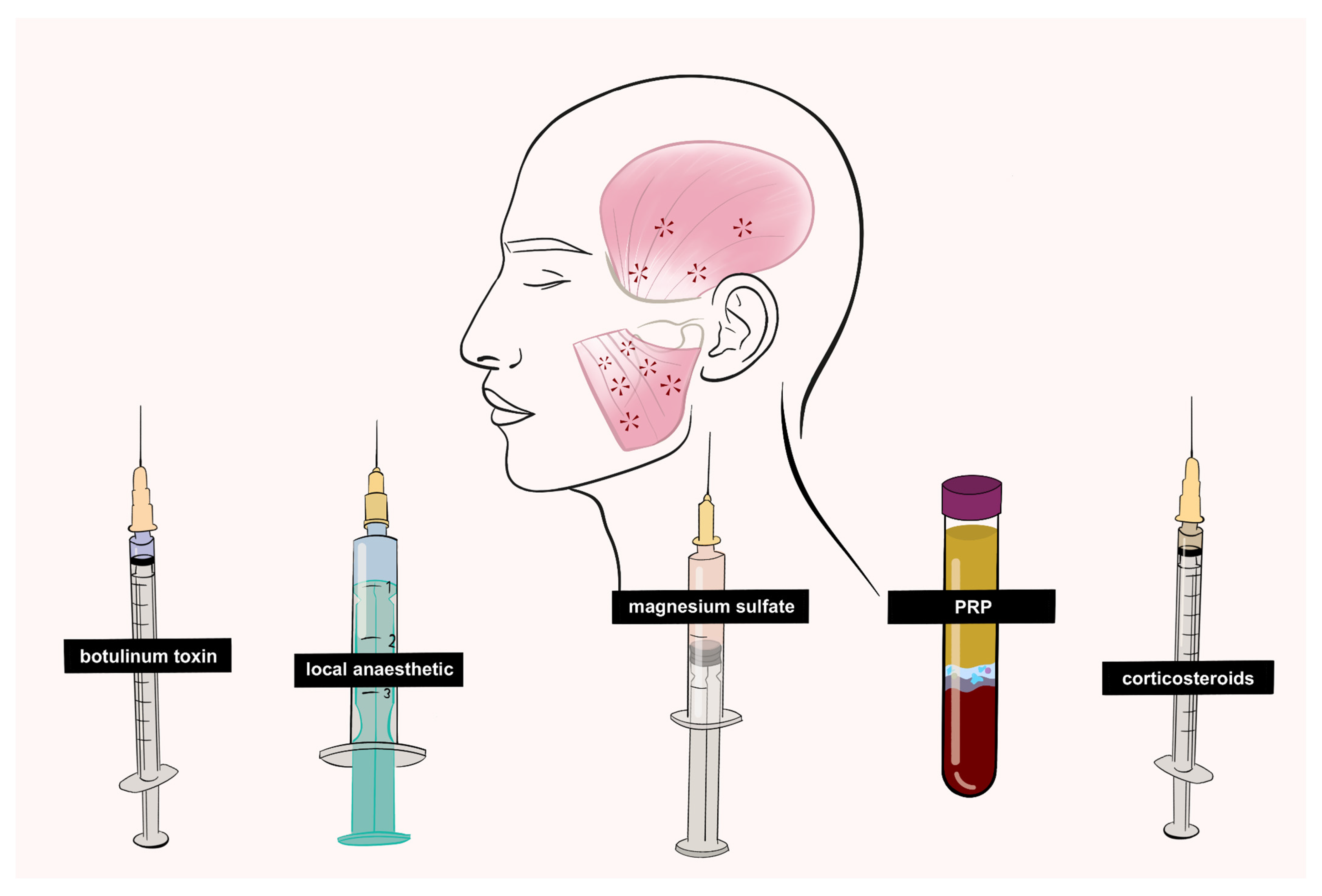
| Corticosteroids | Inhibition of prostaglandin and cytokine synthesis | Anti-inflammatory | Comparable to PRP in short-term pain relief (Saba 2025) [25] | Risk of tissue atrophy with repeated administration. |
Disclaimer/Publisher’s Note: The statements, opinions and data contained in all publications are solely those of the individual author(s) and contributor(s) and not of MDPI and/or the editor(s). MDPI and/or the editor(s) disclaim responsibility for any injury to people or property resulting from any ideas, methods, instructions or products referred to in the content. |
© 2026 by the authors. Licensee MDPI, Basel, Switzerland. This article is an open access article distributed under the terms and conditions of the Creative Commons Attribution (CC BY) license.
Share and Cite
Grzybowska-Kowalczyk, K.; Chyży, I.; Chęcińska, K.; Macek, W.; Kosińska, M.; Chęciński, M.; Hoppe, A.; Kasprzycka, J.; Jagiełło, O.; Horodniczy, T.; et al. Injectable Therapies for Orofacial Myofascial Pain: A Rapid Review of Randomized Controlled Trials. J. Clin. Med. 2026, 15, 5143. https://doi.org/10.3390/jcm15135143
Grzybowska-Kowalczyk K, Chyży I, Chęcińska K, Macek W, Kosińska M, Chęciński M, Hoppe A, Kasprzycka J, Jagiełło O, Horodniczy T, et al. Injectable Therapies for Orofacial Myofascial Pain: A Rapid Review of Randomized Controlled Trials. Journal of Clinical Medicine. 2026; 15(13):5143. https://doi.org/10.3390/jcm15135143
Chicago/Turabian StyleGrzybowska-Kowalczyk, Karolina, Izabella Chyży, Kamila Chęcińska, Wojciech Macek, Maja Kosińska, Maciej Chęciński, Amelia Hoppe, Julia Kasprzycka, Oliwia Jagiełło, Tomasz Horodniczy, and et al. 2026. "Injectable Therapies for Orofacial Myofascial Pain: A Rapid Review of Randomized Controlled Trials" Journal of Clinical Medicine 15, no. 13: 5143. https://doi.org/10.3390/jcm15135143
APA StyleGrzybowska-Kowalczyk, K., Chyży, I., Chęcińska, K., Macek, W., Kosińska, M., Chęciński, M., Hoppe, A., Kasprzycka, J., Jagiełło, O., Horodniczy, T., Baniak, Z., & Sikora, M. (2026). Injectable Therapies for Orofacial Myofascial Pain: A Rapid Review of Randomized Controlled Trials. Journal of Clinical Medicine, 15(13), 5143. https://doi.org/10.3390/jcm15135143