Effectiveness of Physical Exercise Programs in Reducing Secondary Lymphedema Associated with Breast Cancer: An Overview of Systematic Reviews
 , , , , , , , ,
Abstract
1. Introduction
2. Materials and Methods
2.1. Protocol and Registration
2.2. Design Eligibility Criteria
2.3. Participant and Context Eligibility Criteria
2.4. Intervention Eligibility Criteria
2.5. Comparison Eligibility Criteria
2.6. Outcome Eligibility Criteria
- Volumetric changes in the arm, evaluated in comparison with the unaffected side and expressed as total lymphedema volume, volume reduction, or percent reduction. Measurements were carried out using validated methods, such as water displacement volumetry, circumference measurement, bioimpedance, dual X-ray absorptiometry, or perometry (see Supplementary Material S2).
- Quality of life, measured with generic or specific validated self-reported scales (e.g., EORTC-QLQ-C30).
- Pain intensity, evaluated using validated self-reported scales, such as the numeric rating scale (NRS) or visual analogue scale (VAS).
- Adverse events of exercise programs, such as increased lymphedema volume and pain.
- Grip strength, evaluated using dynamometry in patients undergoing physiotherapeutic interventions.
- Range of motion, measured using goniometry in patients who received physiotherapy.
- Upper-extremity function, evaluated with generic or specifically validated self-report scales, such as the DASH scale (Disabilities of the Arm, Shoulder, and Hand).
2.7. Information Sources
2.8. Selection Process
2.9. Data Extraction
- Publication details: Authors, year, research team, institutions, countries, databases, and type of synthesis (qualitative or quantitative).
- Participant characteristics: Sample size and key demographics.
- Intervention details: Exercise modality, type (multicomponent or single component), intensity, dosage, and duration.
- Comparator groups: Description of control or comparison conditions.
- Outcomes of interest: Primary and secondary outcomes.
- Authors’ conclusions: Main conclusions reported by the SR authors.
2.10. Derivation of the Analytic RCT Set
2.11. SR Risk of Bias Assessment
- Assessment of relevance.
- Identification of concerns in the review process.
- Judgement on the risk of bias.
2.12. Risk of Bias in Included Primary Studies
2.13. Certainty of Evidence in Included SRs
- High certainty: The intervention has an effect.
- Moderate certainty: The intervention probably has an effect.
- Low certainty: The intervention may have an effect.
- Very low certainty: The evidence about the effect is very uncertain.
2.14. Overall Certainty Assessment of the Evidence in the Overview
2.15. Managing Overlapping SRs
2.16. Data Synthesis
- Relative risk (RR) with a 95% confidence interval (CI) for dichotomous data.
- Mean difference (MD) with 95% CI for continuous outcomes measured on the same scale.
- Standardized mean difference (SMD) when outcomes were measured on different scales.
2.17. Use of Generative Artificial Intelligence
3. Results
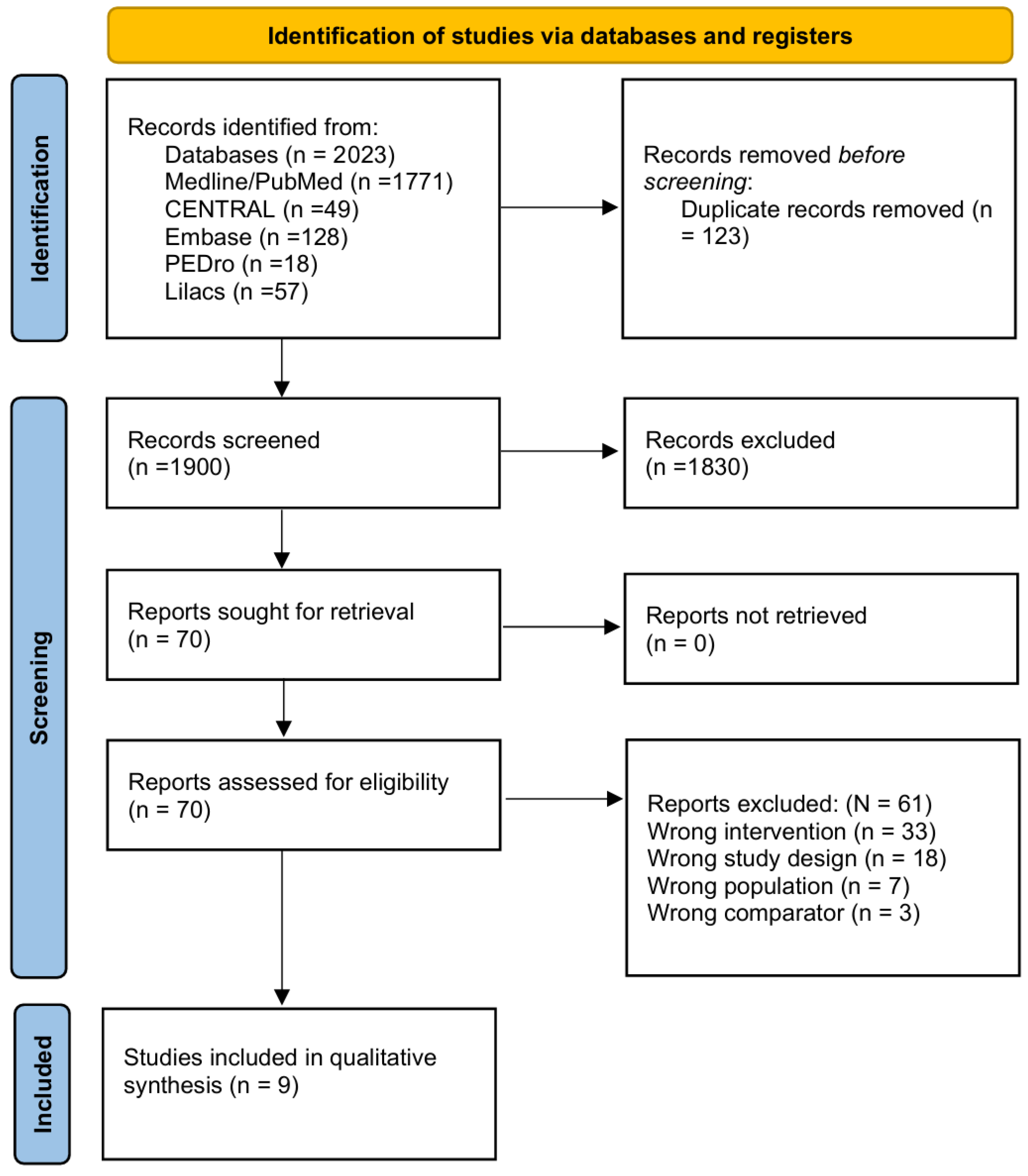
3.1. Study Selection
3.2. Characteristics of the Included SRs
3.3. Evaluation of Included SRs’ Methodological Quality
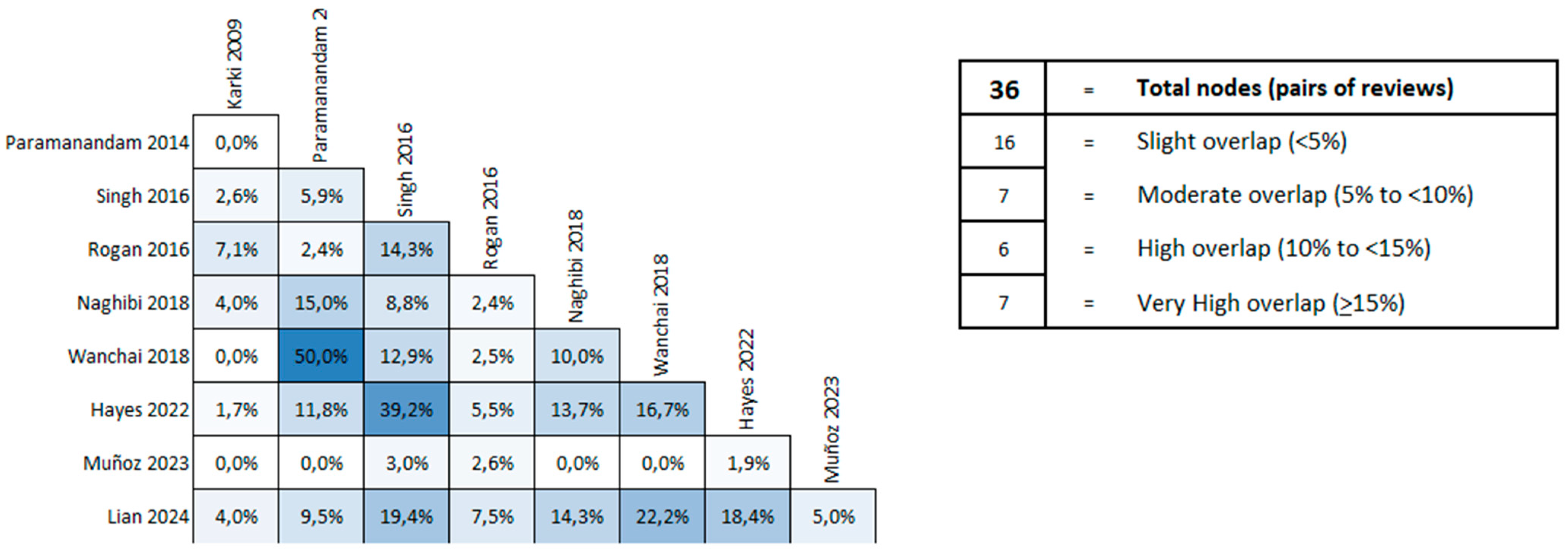
3.4. Degree of Overlap Between SRs
3.5. Certainty of Evidence Reported in Included SRs
3.6. Primary-Study Risk of Bias
3.7. Intervention Effects
3.7.1. Primary Outcomes
3.7.2. Volumetric Changes in the Arm
- -
- Lymphedema volume (LV) (<6 months): One SR [67], which included one RCT with 23 participants [211], was included in the meta-analysis, demonstrating uncertainty about whether a home-based physical exercise program combined with standard self-care may reduce LV compared with standard self-care alone. The CoE was very low.
- -
- Lymphedema volume (LV) (>6 months): Six SRs [47,68,70,71,72,73] identified the same RCT with 139 participants [212]. After overlap management, this RCT contributed once to the meta-analysis and showed that a supervised weightlifting program probably reduces the risk of a ≥5% increase in LV compared with standard care (RR: 0.13; 95% CI: 0.07 to 0.25; moderate CoE). On the other hand, for a ≥5% reduction in LV, the evidence is very uncertain about the effect of the program (RR: 0.85; 95% CI: 0.44 to 1.66; very low CoE).
- -
- Volume reduction (VR) (<6 months): One SR [68], which included one RCT with 23 participants [211], was included in the meta-analysis, and showed that there is uncertainty about whether a home exercise program in addition to standard self-care may reduce VR compared with standard care. The CoE was very low.
- -
- Percent reduction (<6 months): One SR [68], which included one RCT with 23 participants [211], was included in the meta-analysis. The evidence is very uncertain regarding the effect of a home exercise program in addition to standard care on percentage reduction in lymphedema volume compared with standard care alone. The CoE was very low.
3.7.3. Quality of Life (QoL)
- -
- -
- -
- -
- -
- -
- -
- -
3.7.4. Secondary Outcomes
- -
- Adverse events (AEs): None of the included studies reported AEs. However, because they were not consistently defined or systematically reported across the included RCTs, the absence of reported AEs should not be interpreted as definitive evidence of safety.
- -
- -
- Wrist and elbow ROM (<6 months): Four SRs [68,71,72,73] contributed evidence concerning this outcome, all identifying the same RCT [216] with 124 participants, which evaluated the effect of resistance exercise on wrist flexion and extension, as well as elbow flexion and extension. The evidence is notably uncertain about the effect of the intervention for all outcomes due to very low CoE.
- -
- Shoulder flexion ROM (<6 months): Across five SRs [68,69,71,72,73] contributing evidence on this outcome, four RCTs were identified, with a total of 194 participants. One study [222] suggested that aquatic exercise may be more beneficial than Pilates (low CoE). For the other studies, the evidence is highly uncertain about the effect of the interventions due to a very low CoE [216,223,224].
- -
- Shoulder extension ROM (<6 months): Four SRs [68,71,72,73] presented evidence on this factor, identifying two RCTs [216,222] with a total of 192 participants. One study [222] suggested that aquatic exercise may be more beneficial than Pilates (low CoE), while the other study [216] presented remarkably uncertain evidence regarding its intervention’s effect due to a very low CoE.
- -
- Shoulder abduction ROM (<6 months): Five SRs [68,69,71,72,73] contributed evidence for this outcome across four RCTs with 277 participants in total. One study [222] suggested that aquatic exercise may be more beneficial than Pilates (low CoE), while in the other studies, the evidence is very uncertain about the effects of the interventions due to a very low CoE [216,223,224].
- -
- Shoulder internal rotation ROM (<6 months): One SR [72] provided evidence on this factor, identifying a single RCT with 68 participants that compared aquatic exercise with Pilates (MD: 1.93; 95% CI: −1.05 to 4.91). The evidence is highly uncertain about the effect of the intervention due to very low CoE [222].
- -
- -
3.8. Results of Additional Analyses
4. Discussion
4.1. Summary of Key Findings
4.2. Clinical Implications
4.3. Implications for Future Research
4.4. Strengths and Limitations
5. Conclusions
Supplementary Materials
Author Contributions
Funding
Institutional Review Board Statement
Informed Consent Statement
Data Availability Statement
Acknowledgments
Conflicts of Interest
Abbreviations
| BCRL | Breast cancer-related lymphedema |
| QoL | Quality of life |
| AE | Aerobic exercise |
| RE | Resistance exercise |
| CoE | Certainty of evidence |
| GRADE | Grading of Recommendations Assessment, Development and Evaluation |
| PRIOR Statement | Preferred Reporting Items for Overviews of Reviews |
| SRs | Systematic reviews |
| RCTs | Randomized controlled trials |
| EORTC QLQ-C30 | European Organisation for Research and Treatment of Cancer Quality of Life |
| NRS | Numeric rating scale |
| VAS | Visual analogue scale |
| DASH | Disabilities of the Arm, Shoulder and Hand |
| CCA | Corrected Covered Area |
| RR | Relative risk |
| CI | Confidence interval |
| MD | Mean difference |
| SMD | Standardized mean difference |
| non-RCTs | Non-randomized controlled trials |
| GROOVE | Graphical Representation of Overlap for Overviews |
| LV | Lymphedema volume |
| VR | Volume reduction |
| AEs | Adverse events |
| ROM | Range of motion |
References
- Bray, F.; Laversanne, M.; Sung, H.; Ferlay, J.; Siegel, R.L.; Soerjomataram, I.; Jemal, A. Global cancer statistics 2022: GLOBOCAN estimates of incidence and mortality worldwide for 36 cancers in 185 countries. CA Cancer J. Clin. 2024, 74, 229–263. [Google Scholar] [CrossRef] [PubMed]
- Hendrick, R.E.; Helvie, M.A.; Monticciolo, D.L. Breast cancer mortality rates have stopped declining in U.S. women younger than 40 years. Radiology 2021, 299, 143–149. [Google Scholar] [CrossRef] [PubMed]
- Britt, K.L.; Cuzick, J.; Phillips, K.A. Key steps for effective breast cancer prevention. Nat. Rev. Cancer 2020, 20, 417–436. [Google Scholar] [CrossRef] [PubMed]
- Basu, P.; Zhang, L.; Hariprasad, R.; Carvalho, A.L.; Barchuk, A. A pragmatic approach to tackle the rising burden of breast cancer through prevention & early detection in countries ‘in transition’. Indian J. Med. Res. 2020, 152, 343–355. [Google Scholar] [CrossRef] [PubMed]
- Pashayan, N.; Antoniou, A.C.; Ivanus, U.; Esserman, L.J.; Easton, D.F.; French, D.; Sroczynski, G.; Hall, P.; Cuzick, J.; Evans, D.G.; et al. Personalized early detection and prevention of breast cancer: ENVISION consensus statement. Nat. Rev. Clin. Oncol. 2020, 17, 687–705. [Google Scholar] [CrossRef] [PubMed]
- Macdonald, E.R.; Amorim, N.M.L.; Hagstrom, A.D.; Markovic, K.; Simar, D.; Ward, R.E.; Clifford, B.K. Evaluating the effect of upper-body morbidity on quality of life following primary breast cancer treatment: A systematic review and meta-analysis. J. Cancer Surviv. 2024, 18, 1517–1547. [Google Scholar] [PubMed]
- Alkhaifi, M.; Zhang, E.; Peera, M.; Jerzak, K.; Czarnota, G.; Eisen, A.; Roberts, A.; Carmona-Gonzalez, C.A.; Pezo, R.; Gandhi, S. Risk factors for treatment toxicity and high side effect burden among breast cancer survivors: A retrospective chart review. Cancers 2025, 17, 328. [Google Scholar] [CrossRef] [PubMed]
- Choulli, F.; Tafenzi, H.A.; El Hattimy, F.; Choulli, M.K.; Belbaraka, R. Chemotherapy-related adverse effects with anthracycline and taxane-containing regimens in patients with localized breast cancer: A descriptive study. BMC Cancer 2024, 24, 17. [Google Scholar] [PubMed]
- Larsen, G.S.; Johansen, C.; von Heymann, A.; Rafn, B.S. Prevalence of lymphedema symptoms across cancer diagnoses and association with depression, pain interference and health-related quality of life. Acta Oncol. 2025, 64, 87–95. [Google Scholar] [CrossRef] [PubMed]
- Thomis, S.; Devoogdt, N.; Bechter-Hugl, B.; Fourneau, I. Early disturbance of lymphatic transport as a risk factor for the development of breast-cancer-related lymphedema. Cancers 2023, 15, 1774. [Google Scholar] [CrossRef] [PubMed]
- McLaughlin, S.A.; Brunelle, C.L.; Taghian, A. Breast cancer-related lymphedema: Risk factors, screening, management, and the impact of locoregional treatment. J. Clin. Oncol. 2020, 38, 2341–2350. [Google Scholar] [PubMed]
- Leray, H.; Malloizel-Delaunay, J.; Lusque, A.; Chantalat, E.; Bouglon, L.; Chollet, C.; Chaput, B.; Garmy-Susini, B.; Yannoutsos, A.; Vaysse, C. Body mass index as a major risk factor for severe breast cancer-related lymphedema. Lymphat. Res. Biol. 2020, 18, 510–516. [Google Scholar] [CrossRef] [PubMed]
- He, L.; Qu, H.; Wu, Q.; Song, Y. Lymphedema in survivors of breast cancer. Oncol. Lett. 2020, 19, 2085–2096. [Google Scholar] [CrossRef] [PubMed]
- Mazzutti, F.S.; Custódio, I.D.D.; Lima, M.T.M.; de Carvalho, K.P.; Pereira, T.S.S.; Molina, M.d.C.B.; Canto, P.P.L.; Paiva, C.E.; Maia, Y.C.d.P. Breast cancer survivors undergoing endocrine therapy have a worrying risk factor profile for cardiovascular diseases. Nutrients 2021, 13, 1114. [Google Scholar] [CrossRef] [PubMed]
- Jung, J.G.; Ahn, S.H.; Lee, S.; Kim, E.K.; Ryu, J.M.; Park, S.; Lim, W.; Jung, Y.S.; Chung, I.Y.; Jeong, J.; et al. No axillary surgical treatment for lymph node-negative patients after ultrasonography [NAUTILUS]: Protocol of a prospective randomized clinical trial. BMC Cancer 2022, 22, 189. [Google Scholar] [CrossRef] [PubMed]
- Kibar, S.; Dalyan Aras, M.; Ünsal Delialioğlu, S. The risk factors and prevalence of upper extremity impairments and an analysis of effects of lymphoedema and other impairments on the quality of life of breast cancer patients. Eur. J. Cancer Care 2017, 26, e12433. [Google Scholar]
- Nesvold, I.L.; Fosså, S.D.; Holm, I.; Naume, B.; Dahl, A.A. Arm/shoulder problems in breast cancer survivors are associated with reduced health and poorer physical quality of life. Acta Oncol. 2010, 49, 347–353. [Google Scholar] [PubMed]
- Ramírez-Parada, K.; Mella-Abarca, W.; Nicoletti-Santoni, N.; Torres-Riveros, G.; Villagrán-Gutiérrez, I.; Petric-Guajardo, M.; Aguilera-Eguía, R. Implementación de un modelo de atención kinesiológico, temprano y prospectivo, en personas con cáncer de mama. Rev. Cir. 2019, 71, 476–481. [Google Scholar] [CrossRef]
- Huang, T.W.; Tseng, S.H.; Lin, C.C.; Bai, C.H.; Chen, C.S.; Hung, C.S.; Wu, C.H.; Tam, K.W. Effects of manual lymphatic drainage on breast cancer-related lymphedema: A systematic review and meta-analysis of randomized controlled trials. World J. Surg. Oncol. 2013, 11, 15. [Google Scholar] [CrossRef] [PubMed]
- Thompson, B.; Gaitatzis, K.; Janse de Jonge, X.; Blackwell, R.; Koelmeyer, L.A. Manual lymphatic drainage treatment for lymphedema: A systematic review of the literature. J. Cancer Surviv. 2021, 15, 244–258. [Google Scholar] [PubMed]
- Liang, M.; Chen, Q.; Peng, K.; Deng, L.; He, L.; Hou, Y.; Zhang, Y.; Guo, J.; Mei, Z.; Li, L. Manual lymphatic drainage for lymphedema in patients after breast cancer surgery: A systematic review and meta-analysis of randomized controlled trials. Medicine 2020, 99, e23192. [Google Scholar] [CrossRef] [PubMed]
- Monteiro, S.E.; Resende, L.V.; Felicíssimo, M.F.; Araújo, A.R.; Vaz, C.T. Treatment of upper limb lymphedema with low-level laser: A systematic review. Fisioter. Mov. 2014, 27, 663–674. [Google Scholar] [CrossRef][Green Version]
- Baxter, G.D.; Liu, L.; Petrich, S.; Gisselman, A.S.; Chapple, C.; Anders, J.J.; Tumilty, S. Low level laser therapy (Photobiomodulation therapy) for breast cancer-related lymphedema: A systematic review. BMC Cancer 2017, 17, 833. [Google Scholar] [CrossRef] [PubMed]
- Shao, Y.; Qi, K.; Zhou, Q.H.; Zhong, D.S. Intermittent pneumatic compression pump for breast cancer-related lymphedema: A systematic review and meta-analysis of randomized controlled trials. Oncol. Res. Treat. 2014, 37, 170–174. [Google Scholar] [CrossRef] [PubMed]
- Thomaz, J.P.; Dias, T.S.M.; de Rezende, L.F. Effect of taping as treatment to reduce breast cancer lymphedema: Literature review. J. Vasc. Bras. 2018, 17, 136–140. [Google Scholar] [PubMed]
- Kasawara, K.T.; Mapa, J.M.R.; Ferreira, V.; Added, M.A.N.; Shiwa, S.R.; Carvas, N., Jr.; Batista, P.A. Effects of Kinesio Taping on breast cancer-related lymphedema: A meta-analysis in clinical trials. Physiother. Theory Pract. 2018, 34, 337–345. [Google Scholar] [CrossRef] [PubMed]
- Keilani, M.; Hasenoehrl, T.; Neubauer, M.; Crevenna, R. Resistance exercise and secondary lymphedema in breast cancer survivors—A systematic review. Support. Care Cancer 2016, 24, 1907–1916. [Google Scholar] [PubMed]
- Yeung, W.; Semciw, A.I. Aquatic therapy for people with lymphedema: A systematic review and meta-analysis. Lymphat. Res. Biol. 2018, 16, 9–19. [Google Scholar] [CrossRef] [PubMed]
- Panchik, D.; Masco, S.; Zinnikas, P.; Hillriegel, B.; Lauder, T.; Suttmann, E.; Chinchilli, V.; McBeth, M.; Hermann, W. Effect of exercise on breast cancer-related lymphedema: What the lymphatic surgeon needs to know. J. Reconstr. Microsurg. 2019, 35, 37–45. [Google Scholar] [PubMed]
- Haque, M.A. Effects of physiotherapy on breast cancer related secondary lymphedema: A systematic review. Int. J. Med. Sci. Diagn. Res. 2018, 2, 5–10. [Google Scholar]
- Hasenoehrl, T.; Keilani, M.; Palma, S.; Crevenna, R. Resistance exercise and breast cancer related lymphedema—A systematic review update. Disabil. Rehabil. 2020, 42, 26–35. [Google Scholar] [PubMed]
- Cheema, B.; Gaul, C.A.; Lane, K.; Fiatarone Singh, M.A. Progressive resistance training in breast cancer: A systematic review of clinical trials. Breast Cancer Res. Treat. 2008, 109, 9–26. [Google Scholar] [PubMed]
- Romesberg, M.; Tucker, A.; Kuzminski, K.; Tremback-Ball, A. The effects of resistance exercises on secondary lymphedema due to treatment of breast cancer: A review of current literature. J. Womens Health Phys. Ther. 2017, 41, 91–99. [Google Scholar] [CrossRef]
- Tatham, B.; Smith, J.; Cheifetz, O.; Gillespie, J.; Snowden, K.; Temesy, J.; Vandenberk, L. The efficacy of exercise therapy in reducing shoulder pain related to breast cancer: A systematic review. Physiother. Can. 2013, 65, 321–330. [Google Scholar] [CrossRef] [PubMed]
- De Groef, A.; Van Kampen, M.; Dieltjens, E.; Christiaens, M.R.; Neven, P.; Geraerts, I.; Devoogdt, N. Effectiveness of postoperative physical therapy for upper-limb impairments after breast cancer treatment: A systematic review. Arch. Phys. Med. Rehabil. 2015, 96, 1140–1153. [Google Scholar] [CrossRef] [PubMed]
- Moseley, A.L.; Carati, C.J.; Piller, N.B. A systematic review of common conservative therapies for arm lymphoedema secondary to breast cancer treatment. Ann. Oncol. 2007, 18, 639–646. [Google Scholar] [PubMed]
- Nelson, N.L. Breast cancer-related lymphedema and resistance exercise: A systematic review. J. Strength Cond. Res. 2016, 30, 2656–2665. [Google Scholar] [PubMed]
- Stuiver, M.M.; ten Tusscher, M.R.; Agasi-Idenburg, C.S.; Lucas, C.; Aaronson, N.K.; Bossuyt, P.M.M. Conservative interventions for preventing clinically detectable upper-limb lymphoedema in patients who are at risk of developing lymphoedema after breast cancer therapy. Cochrane Database Syst. Rev. 2015, 2, CD009765. [Google Scholar] [CrossRef]
- Baumann, F.T.; Reike, A.; Hallek, M.; Wiskemann, J.; Reimer, V. Does exercise have a preventive effect on secondary lymphedema in breast cancer patients following local treatment? A systematic review. Breast Care 2018, 13, 380–385. [Google Scholar] [CrossRef] [PubMed]
- Tendero-Ruiz, L.; Palomo-Carrión, R.; Megía-García-Carpintero, Á.; Pérez-Nombela, S.; López-Muñoz, P.; Bravo-Esteban, E. The effect of therapeutic exercise in the prevention of lymphoedema secondary to breast cancer: A systematic review. Arch. Med. Sci. 2023, 19, 1684–1692. [Google Scholar] [PubMed]
- McNeely, M.L.; Campbell, K.; Ospina, M.; Rowe, B.H.; Dabbs, K.; Klassen, T.P.; Mackey, J.; Courneya, K. Exercise interventions for upper-limb dysfunction due to breast cancer treatment. Cochrane Database Syst. Rev. 2010, 6, CD005211. [Google Scholar] [CrossRef]
- Douglass, J.; Graves, P.; Gordon, S. Self-care for management of secondary lymphedema: A systematic review. PLoS Negl. Trop. Dis. 2016, 10, e0004740. [Google Scholar] [CrossRef] [PubMed]
- Fernández-Ortega, J.A.; Díaz-Peñas, F.J.A. Efectos de un programa combinado de ejercicios de fuerza y aeróbicos de alta intensidad en pacientes supervivientes del cáncer de mama. Apunt. Med. Esport 2015, 51, 3–12. [Google Scholar]
- Rogan, S.; Taeymans, J.; Luginbuehl, H.; Aebi, M.; Mahnig, S.; Gebruers, N. Therapy modalities to reduce lymphoedema in female breast cancer patients: A systematic review and meta-analysis. Breast Cancer Res. Treat. 2016, 159, 1–14. [Google Scholar] [CrossRef] [PubMed]
- Wirtz, P.; Baumann, F.T. Physical activity, exercise and breast cancer—What is the evidence for rehabilitation, aftercare, and survival? A review. Breast Care 2018, 13, 93–101. [Google Scholar] [PubMed]
- Cheema, B.S.; Kilbreath, S.L.; Fahey, P.P.; Delaney, G.P.; Atlantis, E. Safety and efficacy of progressive resistance training in breast cancer: A systematic review and meta-analysis. Breast Cancer Res. Treat. 2014, 148, 249–268. [Google Scholar] [CrossRef] [PubMed]
- Naghibi, S.; Varshoie Tabrizi, F. Exercise training and breast cancer-related lymphedema: A systematic review. Razavi Int. J. Med. 2018, 6, e62127. [Google Scholar] [CrossRef]
- Rafn, B.S.; Bodilsen, A.; von Heymann, A.; Lindberg, M.J.; Byllov, S.; Andreasen, T.G.; Johansen, C.; Christiansen, P.; Zachariae, R. Examining the efficacy of treatments for arm lymphedema in breast cancer survivors: An overview of systematic reviews with meta-analyses. eClinicalMedicine 2024, 67, 102397. [Google Scholar] [PubMed]
- Pollock, M.; Fernandes, R.M.; Becker, L.A.; Pieper, D.; Hartling, L. Chapter V: Overviews of Reviews. In Cochrane Handbook for Systematic Reviews of Interventions, Version 6.2; Higgins, J.P.T., Thomas, J., Chandler, J., Cumpston, M., Li, T., Page, M.J., Welch, V.A., Eds.; Cochrane: London, UK, 2021; Available online: https://www.cochrane.org/authors/handbooks-and-manuals/handbook/current/chapter-v (accessed on 6 May 2026).
- Gates, M.; Gates, A.; Pieper, D.; Fernandes, R.M.; Tricco, A.C.; Moher, D.; Brennan, S.E.; Li, T.; Pollock, M.; Lunny, C.; et al. Reporting guideline for overviews of reviews of healthcare interventions: Development of the PRIOR statement. BMJ 2022, 378, e070849. [Google Scholar] [CrossRef] [PubMed]
- Aguilera-Eguía, R.A.; Gutiérrez-Arias, R.; Zaror, C.; Seron, P. Effectiveness of physical exercise programmes in reducing complications associated with secondary lymphoedema to breast cancer: A protocol for an overview of systematic reviews. BMJ Open 2023, 13, e071630. [Google Scholar] [CrossRef] [PubMed]
- Page, M.J.; McKenzie, J.E.; Bossuyt, P.M.; Boutron, I.; Hoffmann, T.C.; Mulrow, C.D.; Shamseer, L.; Tetzlaff, J.M.; Akl, E.A.; Brennan, S.E.; et al. The PRISMA 2020 statement: An updated guideline for reporting systematic reviews. BMJ 2021, 372, n71. [Google Scholar] [CrossRef] [PubMed]
- Pollock, M.; Fernandes, R.M.; Becker, L.A.; Featherstone, R.; Hartling, L. What guidance is available for researchers conducting overviews of reviews of healthcare interventions? A scoping review and qualitative metasummary. Syst. Rev. 2016, 5, 190. [Google Scholar] [CrossRef] [PubMed]
- MacEntee, M.I. A typology of systematic reviews for synthesising evidence on health care. Gerodontology 2019, 36, 303–312. [Google Scholar] [CrossRef] [PubMed]
- Aromataris, E.; Pearson, A. The systematic review: An overview. Am. J. Nurs. 2014, 114, 53–58. [Google Scholar] [PubMed]
- Tricco, A.C.; Antony, J.; Zarin, W.; Strifler, L.; Ghassemi, M.; Ivory, J.; Perrier, L.; Hutton, B.; Moher, D.; Straus, S.E. A scoping review of rapid review methods. BMC Med. 2015, 13, 224. [Google Scholar] [CrossRef] [PubMed]
- Ouzzani, M.; Hammady, H.; Fedorowicz, Z.; Elmagarmid, A. Rayyan—A web and mobile app for systematic reviews. Syst. Rev. 2016, 5, 210. [Google Scholar] [CrossRef] [PubMed]
- Whiting, P.; Savović, J.; Higgins, J.P.T.; Caldwell, D.M.; Reeves, B.C.; Shea, B.; Davies, P.; Kleijnen, J.; Churchill, R. ROBIS: A new tool to assess risk of bias in systematic reviews was developed. J. Clin. Epidemiol. 2016, 69, 225–234. [Google Scholar] [CrossRef] [PubMed]
- Higgins, J.P.T.; Altman, D.G.; Gøtzsche, P.C.; Jüni, P.; Moher, D.; Oxman, A.D.; Savović, J.; Schulz, K.F.; Weeks, L.; Sterne, J.A.C. The Cochrane Collaboration’s tool for assessing risk of bias in randomised trials. BMJ 2011, 343, d5928. [Google Scholar] [CrossRef] [PubMed]
- Kirmayr, M.; Quilodrán, C.; Valente, B.; Loezar, C.; Garegnani, L.; Franco, J.V.A. Metodología GRADE, parte 1: Cómo evaluar la certeza de la evidencia. Medwave 2021, 21, e8109. [Google Scholar] [CrossRef] [PubMed]
- Hultcrantz, M.; Rind, D.; Akl, E.A.; Treweek, S.; Mustafa, R.A.; Iorio, A.; Kelly, S.E.; Tunte-Dominguez, H.; Welch, V.; Florez, I.D.; et al. The GRADE Working Group clarifies the construct of certainty of evidence. J. Clin. Epidemiol. 2017, 87, 4–13. [Google Scholar] [CrossRef] [PubMed]
- Santesso, N.; Glenton, C.; Dahm, P.; Garner, P.; Akl, E.A.; Alper, B.; Bhatt, M.; Butcher, D.; Carrasco-Labra, A.; De Beer, H.; et al. GRADE guidelines 26: Informative statements to communicate the findings of systematic reviews of interventions. J. Clin. Epidemiol. 2020, 119, 126–135. [Google Scholar] [CrossRef] [PubMed]
- Pollock, M.; Fernandes, R.M.; Newton, A.S.; Scott, S.D.; Hartling, L. The impact of different inclusion decisions on the comprehensiveness and complexity of overviews of reviews of healthcare interventions. Syst. Rev. 2019, 8, 57. [Google Scholar] [CrossRef]
- Pérez-Bracchiglione, J.; Meza, N.; Bangdiwala, S.I.; Niño de Guzmán, E.; Urrútia, G.; Bonfill, X.; Madrid, E. Graphical Representation of Overlap for OVErviews: GROOVE tool. Res. Synth. Methods 2022, 13, 381–388. [Google Scholar] [CrossRef] [PubMed]
- Higgins, J.P.T.; Thomas, J.; Chandler, J.; Cumpston, M.; Li, T.; Page, M.J.; Welch, V.A. (Eds.) Cochrane Handbook for Systematic Reviews of Interventions, Version 6.3; Cochrane: London, UK, 2022; Available online: https://training.cochrane.org/handbook (accessed on 6 May 2026).
- Deeks, J.J.; Higgins, J.P.T.; Altman, D.G. Chapter 10: Analysing data and undertaking meta-analyses. In Cochrane Handbook for Systematic Reviews of Interventions, Version 6.2; Higgins, J.P.T., Thomas, J., Chandler, J., Cumpston, M., Li, T., Page, M.J., Welch, V.A., Eds.; Cochrane: London, UK, 2021; Available online: https://training.cochrane.org/handbook/current/chapter-10 (accessed on 6 May 2026).
- Kärki, A.; Anttila, H.; Tasmuth, T.; Rautakorpi, U.M. Lymphoedema therapy in breast cancer patients—A systematic review on effectiveness and a survey of current practices and costs in Finland. Acta Oncol. 2009, 48, 850–859. [Google Scholar] [PubMed]
- Lian, Y.; Sandhu, S.; Asefa, Y.; Gupta, A. The effect of exercise on reducing lymphedema severity in breast cancer survivors. Cancers 2024, 16, 1367. [Google Scholar] [CrossRef] [PubMed]
- Muñoz-Gómez, E.; Arnal-Gómez, A.; López Cascón, A.; Espí-López, G.V. Systematic review of aquatic therapeutic exercise efficacy in breast cancer survivors. Support. Care Cancer 2023, 31, 44. [Google Scholar]
- Paramanandam, V.S.; Roberts, D. Weight training is not harmful for women with breast cancer-related lymphoedema: A systematic review. J. Physiother. 2014, 60, 136–143. [Google Scholar] [CrossRef] [PubMed]
- Singh, B.; DiSipio, T.; Peake, J.; Hayes, S.C. Systematic review and meta-analysis of the effects of exercise for those with cancer-related lymphedema. Arch. Phys. Med. Rehabil. 2016, 97, 302–315.e13. [Google Scholar] [PubMed]
- Hayes, S.C.; Singh, B.; Reul-Hirche, H.; Bloomquist, K.; Johansson, K.; Jönsson, C.; Plinsinga, M.L. The effect of exercise for the prevention and treatment of cancer-related lymphedema: A systematic review with meta-analysis. Med. Sci. Sports Exerc. 2022, 54, 1389–1399. [Google Scholar] [CrossRef] [PubMed]
- Wanchai, A.; Armer, J.M. Effects of weight-lifting or resistance exercise on breast cancer-related lymphedema: A systematic review. Int. J. Nurs. Sci. 2019, 6, 92–98. [Google Scholar] [PubMed]
- Shamoun, S.; Ahmad, M. Complete decongestive therapy effect on breast cancer related to lymphedema: A systemic review and meta-analysis of randomized controlled trials. Asian Pac. J. Cancer Prev. 2023, 24, 2225–2238. [Google Scholar] [CrossRef] [PubMed]
- Qiao, J.; Yang, L.N.; Kong, Y.H.; Huang, X.; Li, Y.; Bai, D.Q. Effect of manual lymphatic drainage on breast cancer-related postmastectomy lymphedema: A meta-analysis of randomized controlled trials. Cancer Nurs. 2023, 46, 159–166. [Google Scholar] [PubMed]
- Mahmood, D.; Ahmad, A.; Sharif, F.; Arslan, S.A. Clinical application of low-level laser therapy (Photo-biomodulation therapy) in the management of breast cancer-related lymphedema: A systematic review. BMC Cancer 2022, 22, 937. [Google Scholar] [PubMed]
- Bagatini, O.A.; Bertin, C.; Hong, F.; Guarita, M.L.C.; Shinzato, G.T.; Imamura, M.; Battistella, L.R. Uso da terapia por ondas de choque para o tratamento do linfedema associado ao câncer de mama. Acta Fisiatr. 2018, 25, e0318005. [Google Scholar] [CrossRef]
- Balcombe, L.; Miller, C.; McGuiness, W. Approaches to the application and removal of compression therapy: A literature review. Br. J. Community Nurs. 2017, 22, S6–S14. [Google Scholar] [CrossRef] [PubMed]
- Rangon, F.B.; da Silva, J.; Dibai-Filho, A.V.; Guirro, R.R.J.; Guirro, E.C.O. Effects of complex physical therapy and multimodal approaches on lymphedema secondary to breast cancer: A systematic review and meta-analysis of randomized controlled trials. Arch. Phys. Med. Rehabil. 2022, 103, 353–363. [Google Scholar] [CrossRef] [PubMed]
- Braz, N.F.; Leal, S.; Carrara, H.H.A.; Vieira, K.F.; Homsi, C. Tratamientos fisioterapéuticos para el linfedema después de la cirugía de cáncer de seno: Una revisión de literatura. Rev. Lat.-Am. Enferm. 2009, 17, 730–736. [Google Scholar]
- Cendron, S.W.; Paiva, L.L.; Darski, C.; Colla, C. Fisioterapia complexa descongestiva associada a terapias de compressão no tratamento do linfedema secundário ao câncer de mama: Uma revisão sistemática. Rev. Bras. Cancerol. 2015, 61, 49–58. [Google Scholar] [CrossRef]
- Chan, D.N.S.; Lui, L.Y.; So, W.K.W. Effectiveness of exercise programmes on shoulder mobility and lymphoedema after axillary lymph node dissection for breast cancer: Systematic review. J. Adv. Nurs. 2010, 66, 1902–1914. [Google Scholar] [CrossRef] [PubMed]
- Cheifetz, O.; Haley, L. Management of secondary lymphedema related to breast cancer. Can. Fam. Physician 2010, 56, 1277–1284. [Google Scholar] [PubMed]
- Donahue, P.M.C.; MacKenzie, A.; Filipovic, A.; Koelmeyer, L. Advances in the prevention and treatment of breast cancer-related lymphedema. Breast Cancer Res. Treat. 2023, 200, 1–14. [Google Scholar] [CrossRef] [PubMed]
- Gatt, M.; Willis, S.; Leuschner, S. A meta-analysis of the effectiveness and safety of kinesiology taping in the management of cancer-related lymphoedema. Eur. J. Cancer Care 2017, 26, e12510. [Google Scholar]
- Gerland, L.; Baumann, F.T.; Niels, T. Resistance exercise for breast cancer patients? Evidence from the last decade. Breast Care 2021, 16, 657–663. [Google Scholar] [CrossRef] [PubMed]
- Pereira de Godoy, J.M.; Guerreiro Godoy, M.F.; Pereira de Godoy, H.J. Mechanical lymphatic drainage (RAGodoy®): Literature review. Cureus 2022, 14, e21302. [Google Scholar] [CrossRef]
- Gomide, L.B.; Matheus, J.P.C.; Candido Dos Reis, F.J. Morbidity after breast cancer treatment and physiotherapeutic performance. Int. J. Clin. Pract. 2007, 61, 972–982. [Google Scholar] [CrossRef] [PubMed]
- Hill, J.E.; Whitaker, J.C.; Sharafi, N.; Hamer, O.; Chohan, A.; Harris, C.; Dawson, S.; Sheridan, B.; Spencer, A.M.; Bee, P.E.; et al. The effectiveness and safety of heat/cold therapy in adults with lymphoedema: Systematic review. Disabil. Rehabil. 2024, 46, 2184–2195. [Google Scholar] [PubMed]
- Jang, S.; Ko, Y.; Sasaki, Y.; Park, S.; Jo, J.; Kang, N.H.; Yoon, J.; Kim, K.H. Acupuncture as an adjuvant therapy for management of treatment-related symptoms in breast cancer patients: Systematic review and meta-analysis (PRISMA-compliant). Medicine 2020, 99, e21820. [Google Scholar] [PubMed]
- Kligman, L.; Wong, R.K.S.; Johnston, M.; Laetsch, N.S. The treatment of lymphedema related to breast cancer: A systematic review and evidence summary. Support. Care Cancer 2004, 12, 421–431. [Google Scholar] [CrossRef] [PubMed]
- Lasinski, B.B.; Thrift, K.M.K.; Squire, D.C.; Austin, M.K.; Smith, K.M.; Wanchai, A.; Watson, T.; Donahue, P.M.C.; Heckler, C.E.; Armer, J.M. A systematic review of the evidence for complete decongestive therapy in the treatment of lymphedema from 2004 to 2011. PM R. 2012, 4, 580–601. [Google Scholar] [CrossRef] [PubMed]
- Lin, Y.; Chen, Y.; Liu, R.; Cao, B. Effect of exercise on rehabilitation of breast cancer surgery patients: A systematic review and meta-analysis of randomized controlled trials. Nurs. Open 2023, 10, 2030–2043. [Google Scholar] [PubMed]
- Maccarone, M.C.; Venturini, E.; Menegatti, E.; Gianesini, S.; Masiero, S. Water-based exercise for upper and lower limb lymphedema treatment. J. Vasc. Surg. Venous Lymphat. Disord. 2023, 11, 201–209. [Google Scholar] [PubMed]
- Ezzo, J.; Manheimer, E.; McNeely, M.L.; Howell, D.M.; Weiss, R.; Johansson, K.I.; Bao, T.; Bily, L.; Tuppo, C.M.; Williams, A.F.; et al. Manual lymphatic drainage for lymphedema following breast cancer treatment. Cochrane Database Syst. Rev. 2015, 5, CD003475. [Google Scholar] [CrossRef]
- Marotta, N.; Lippi, L.; Ammendolia, V.; Calafiore, D.; Inzitari, M.T.; Pinto, M.; de Sire, A.; Invernizzi, M. Efficacy of kinesio taping on upper limb volume reduction in patients with breast cancer-related lymphedema: A systematic review of randomized controlled trials. Eur. J. Phys. Rehabil. Med. 2023, 59, 237–247. [Google Scholar] [CrossRef] [PubMed]
- Merchant, S.J.; Chen, S.L. Prevention and management of lymphedema after breast cancer treatment. Breast J. 2015, 21, 276–284. [Google Scholar] [CrossRef] [PubMed]
- Miccinilli, S.; Bravi, M.; Maselli, M.; Santacaterina, F.; Morrone, M.; Manco, D.; Brandolini, S.; Sterzi, S.; Bressi, F. The effectiveness of extracorporeal shock wave therapy on breast cancer-related lymphedema: A literature review. Lymphology 2020, 53, 164–180. [Google Scholar] [CrossRef]
- Michelotti, A.; Invernizzi, M.; Lopez, G.; Lorenzini, D.; Nesa, F.; De Sire, A.; Lippi, L.; Ammendolia, V.; Carda, S.; Picelli, A.; et al. Tackling the diversity of breast cancer related lymphedema: Perspectives on diagnosis, risk assessment, and clinical management. Breast 2019, 44, 15–23. [Google Scholar] [CrossRef] [PubMed]
- Morris, D.; Jones, D.; Ryan, H.; Ryan, C.G. The clinical effects of Kinesio® Tex taping: A systematic review. Physiother. Theory Pract. 2013, 29, 259–270. [Google Scholar] [PubMed]
- Müller, M.; Klingberg, K.; Wertli, M.M.; Carreira, H. Manual lymphatic drainage and quality of life in patients with lymphoedema and mixed oedema: A systematic review of randomised controlled trials. Qual. Life Res. 2018, 27, 1403–1414. [Google Scholar] [CrossRef] [PubMed]
- Mur-Gimeno, E.; Postigo-Martin, P.; Cantarero-Villanueva, I.; Sebio-Garcia, R. Systematic review of the effect of aquatic therapeutic exercise in breast cancer survivors. Eur. J. Cancer Care 2022, 31, e13535. [Google Scholar]
- Omar, M.T.A.; Shaheen, A.A.M.; Zafar, H. A systematic review of the effect of low-level laser therapy in the management of breast cancer-related lymphedema. Support. Care Cancer 2012, 20, 2977–2984. [Google Scholar] [PubMed]
- Oremus, M.; Dayes, I.; Walker, K.; Raina, P. Systematic review: Conservative treatments for secondary lymphedema. BMC Cancer 2012, 12, 6. [Google Scholar] [CrossRef] [PubMed]
- Pan, Y.Q.; Yang, K.H.; Wang, Y.L.; Zhang, L.P.; Liang, H.Q. Massage interventions and treatment-related side effects of breast cancer: A systematic review and meta-analysis. Int. J. Clin. Oncol. 2014, 19, 829–841. [Google Scholar] [PubMed]
- Perdomo, M.; Davies, C.; Levenhagen, K.; Ryans, K.; Gilchrist, L. Patient education for breast cancer-related lymphedema: A systematic review. J. Cancer Surviv. 2023, 17, 384–398. [Google Scholar] [PubMed]
- Robijns, J.; Censabella, S.; Bulens, P.; Maes, A.; Mebis, J. The use of low-level light therapy in supportive care for patients with breast cancer: Review of the literature. Lasers Med. Sci. 2017, 32, 229–242. [Google Scholar] [PubMed]
- Shao, Y.; Zhong, D.S. Manual lymphatic drainage for breast cancer-related lymphoedema. Eur. J. Cancer Care 2017, 26, e12517. [Google Scholar]
- Smykla, A.; Walewicz, K.; Trybulski, R.; Halski, T.; Kucharzewski, M.; Kucio, C.; Mikusek, W.; Klakla, K.; Taradaj, J. Effect of kinesiology taping on breast cancer-related lymphedema: A randomized single-blind controlled pilot study. Biomed. Res. Int. 2013, 2013, 767106. [Google Scholar] [CrossRef] [PubMed]
- Academy of Oncologic Physical Therapy. Academy of Oncologic Physical Therapy CSM 2020 platform and poster presentations. Rehabil. Oncol. 2020, 38, E11–E31. [Google Scholar] [CrossRef]
- Tsai, Y.L.; Ting Jie, I.; Chuang, Y.C.; Cheng, Y.Y.; Lee, Y.C. Extracorporeal shock wave therapy combined with complex decongestive therapy in patients with breast cancer-related lymphedema: A systemic review and meta-analysis. J. Clin. Med. 2021, 10, 5640. [Google Scholar] [CrossRef]
- Wang, Y.; Ge, Y.; Xing, W.; Liu, J.; Wu, J.; Lin, H.; Lu, Y. The effectiveness and safety of low-level laser therapy on breast cancer-related lymphedema: An overview and update of systematic reviews. Lasers Med. Sci. 2022, 37, 1389–1413. [Google Scholar] [PubMed]
- Xing, W.; Duan, D.; Ye, C.; Chen, C.; Ge, Y.; Li, Y.; Wang, C.; Zhang, S.; Huang, Y. Effectiveness of manual lymphatic drainage for breast cancer-related lymphoedema: An overview of systematic reviews and meta-analyses. Eur. J. Gynaecol. Oncol. 2023, 44, 1–16. [Google Scholar] [CrossRef]
- Devoogdt, N.; Van Kampen, M.; Geraerts, I.; Coremans, T.; Christiaens, M.R. Different physical treatment modalities for lymphoedema developing after axillary lymph node dissection for breast cancer: A review. Eur. J. Obstet. Gynecol. Reprod. Biol. 2010, 149, 3–9. [Google Scholar] [CrossRef] [PubMed]
- Finnane, A.; Janda, M.; Hayes, S.C. Review of the evidence of lymphedema treatment effect. Am. J. Phys. Med. Rehabil. 2015, 94, 483–498. [Google Scholar] [CrossRef] [PubMed]
- Ding, J.F.; Hasan, B.; Malandris, K.; Farah, M.H.; Manolopoulos, A.; Ginex, P.K.; Salama, L.; Tande, A.J.; Erwin, P.J.; Murad, M.H. Prospective surveillance and risk reduction of cancer treatment-related lymphedema: Systematic review and meta-analysis. Oncol. Nurs. Forum 2020, 47, E161–E170. [Google Scholar] [PubMed]
- Hayes, S.; Singh, B.; Bloomquist, K.; Johansson, K. Do women with breast cancer-related lymphoedema need to wear compression while exercising? Results from a systematic review and meta-analysis. Curr. Breast Cancer Rep. 2020, 12, 193–201. [Google Scholar]
- Kwan, M.L.; Cohn, J.C.; Armer, J.M.; Stewart, B.R.; Cormier, J.N. Exercise in patients with lymphedema: A systematic review of the contemporary literature. J. Cancer Surviv. 2011, 5, 320–336. [Google Scholar] [CrossRef] [PubMed]
- Megens, A.M.; Harris, S.R. Physical therapist management of lymphedema following treatment for breast cancer: A critical review of its effectiveness. Phys. Ther. 1998, 78, 1302–1311. [Google Scholar] [CrossRef] [PubMed][Green Version]
- Naik, M.; Nayak, P.; Kumar, K.D. Effect of physiotherapy in the prevention and relief of secondary lymphoedema in subjects with postoperative breast cancer: A systematic review of randomised controlled trials. J. Clin. Diagn. Res. 2021, 15, YE01–YE05. [Google Scholar]
- Ridner, S.H.; Fu, M.R.; Wanchai, A.; Stewart, B.R.; Armer, J.M.; Cormier, J.N. Self-management of lymphedema: A systematic review of the literature from 2004 to 2011. Nurs. Res. 2012, 61, 291–299. [Google Scholar] [CrossRef] [PubMed]
- Saraswathi, V.; Latha, S.; Niraimathi, K.; Vidhubala, E. Managing lymphedema, increasing range of motion, and quality of life through yoga therapy among breast cancer survivors. Int. J. Yoga 2021, 14, 3–17. [Google Scholar] [CrossRef] [PubMed]
- Wanchai, A.; Armer, J.M. The effects of yoga on breast-cancer-related lymphedema: A systematic review. J. Health Res. 2020, 34, 409–418. [Google Scholar]
- Ammitzbøll, G.; Johansen, C.; Lanng, C.; Andersen, E.W.; Kroman, N.; Zerahn, B.; Hyldegaard, O.; Wittenkamp, M.C.; Dalton, S.O. Progressive resistance training to prevent arm lymphedema in the first year after breast cancer surgery: Results of a randomized controlled trial. Cancer 2019, 125, 1683–1692. [Google Scholar] [CrossRef] [PubMed]
- Andersen, L.; Højris, I.; Erlandsen, M.; Andersen, J. Treatment of breast-cancer-related lymphedema with or without manual lymphatic drainage: A randomized study. Acta Oncol. 2000, 39, 399–405. [Google Scholar] [CrossRef] [PubMed]
- Anderson, R.T.; Kimmick, G.G.; McCoy, T.P.; Hopkins, J.; Levine, E.; Miller, G.; Ribisl, P.; Mihalko, S.L. A randomized trial of exercise on well-being and function following breast cancer surgery: The RESTORE trial. J. Cancer Surviv. 2012, 6, 172–181. [Google Scholar] [PubMed]
- Balzarini, A.; Pirovano, C.; Diazzi, G.; Olivieri, R.; Ferla, F.; Galperti, G.; Sensi, S.; Martino, G. Ultrasound therapy of chronic arm lymphedema after surgical treatment of breast cancer. Lymphology 1993, 26, 128–134. [Google Scholar] [PubMed]
- Bertelli, G.; Venturini, M.; Forno, G.; Macchiavello, F.; Dini, D. Conservative treatment of postmastectomy lymphedema: A controlled, randomized trial. Ann. Oncol. 1991, 2, 575–578. [Google Scholar] [CrossRef] [PubMed]
- Bloomquist, K.; Krustrup, P.; Fristrup, B.; Sørensen, V.; Helge, J.W.; Helge, E.W.; Vadstrup, E.S.; Rørth, M.; Hayes, S.C.; Uth, J. Effects of football fitness training on lymphedema and upper-extremity function in women after treatment for breast cancer: A randomized trial. Acta Oncol. 2021, 60, 392–400. [Google Scholar] [CrossRef] [PubMed]
- Box, R.C.; Reul-Hirche, H.M.; Bullock-Saxton, J.E.; Furnival, C.M. Physiotherapy after breast cancer surgery: Results of a randomised controlled study to minimise lymphoedema. Breast Cancer Res. Treat. 2002, 75, 51–64. [Google Scholar] [CrossRef] [PubMed]
- Bracha, J.; Katz-Leurer, M. The immediate effect of upper arm exercise compared with lower or combined upper and lower arm exercise on arm volume reduction in women with breast cancer related lymphedema: A randomized preliminary study. Rehabil. Oncol. 2012, 30, 10–15. [Google Scholar] [CrossRef]
- Buchan, J.; Janda, M.; Box, R.; Schmitz, K.; Hayes, S. A randomized trial on the effect of exercise mode on breast cancer-related lymphedema. Med. Sci. Sports Exerc. 2016, 48, 1866–1874. [Google Scholar] [CrossRef] [PubMed]
- Buzato, E.; Barufi, S.; Dias Guimarães, T.; Amador Franco Brigidio, P. Exercises using leisure resources to reduce arm lymphedema. J. Phlebol. Lymphol. 2011, 4, 17–20. [Google Scholar]
- Cantarero-Villanueva, I.; Fernández-Lao, C.; Fernández-de-las-Peñas, C.; López-Barajas, I.B.; Del-Moral-Ávila, R.; de la-Llave-Rincón, A.I.; Arroyo-Morales, M. Effectiveness of water physical therapy on pain, pressure pain sensitivity, and myofascial trigger points in breast cancer survivors: A randomized, controlled clinical trial. Pain Med. 2012, 13, 1509–1519. [Google Scholar] [CrossRef] [PubMed]
- Cantarero-Villanueva, I.; Fernández-Lao, C.; Cuesta-Vargas, A.I.; Del Moral-Avila, R.; Fernández-de-las-Peñas, C.; Arroyo-Morales, M. The effectiveness of a deep water aquatic exercise program in cancer-related fatigue in breast cancer survivors: A randomized controlled trial. Arch. Phys. Med. Rehabil. 2013, 94, 221–230. [Google Scholar] [CrossRef] [PubMed]
- Carati, C.J.; Anderson, S.N.; Gannon, B.J.; Piller, N.B. Treatment of postmastectomy lymphedema with low-level laser therapy: A double blind, placebo-controlled trial. Cancer 2003, 98, 1114–1122. [Google Scholar] [CrossRef] [PubMed]
- Cormie, P.; Galvão, D.A.; Spry, N.; Newton, R.U. Neither heavy nor light load resistance exercise acutely exacerbates lymphedema in breast cancer survivor. Integr. Cancer Ther. 2013, 12, 423–432. [Google Scholar] [CrossRef] [PubMed]
- Cormie, P.; Singh, B.; Hayes, S.; Peake, J.M.; Galvão, D.A.; Taaffe, D.R.; Spry, N.; Nosaka, K.; Cornish, B.; Schmitz, K.H.; et al. Acute inflammatory response to low-, moderate-, and high-load resistance exercise in women with breast cancer-related lymphedema. Integr. Cancer Ther. 2016, 15, 308–317. [Google Scholar] [CrossRef] [PubMed]
- Courneya, K.S.; Segal, R.J.; Mackey, J.R.; Gelmon, K.; Reid, R.D.; Friedenreich, C.M.; Ladha, A.B.; Proulx, C.; Vallance, J.K.H.; Lane, K.; et al. Effects of aerobic and resistance exercise in breast cancer patients receiving adjuvant chemotherapy: A multicenter randomized controlled trial. J. Clin. Oncol. 2007, 25, 4396–4404. [Google Scholar] [CrossRef] [PubMed]
- Courneya, K.S.; Sellar, C.M.; Stevinson, C.; McNeely, M.L.; Peddle, C.J.; Friedenreich, C.M.; Tankel, K.; Basi, S.; Chua, N.; Mazurek, A.; et al. Randomized controlled trial of the effects of aerobic exercise on physical functioning and quality of life in lymphoma patients. J. Clin. Oncol. 2009, 27, 4605–4612. [Google Scholar] [CrossRef] [PubMed]
- Courneya, K.S.; Sellar, C.M.; Stevinson, C.; McNeely, M.L.; Friedenreich, C.M.; Peddle, C.J.; Basi, S.; Chua, N.; Tankel, K.; Mazurek, A.; et al. Moderator effects in a randomized controlled trial of exercise training in lymphoma patients. Cancer Epidemiol. Biomark. Prev. 2009, 18, 2600–2607. [Google Scholar] [CrossRef]
- Damstra, R.J.; Partsch, H. Compression therapy in breast cancer-related lymphedema: A randomized, controlled comparative study of relation between volume and interface pressure changes. J. Vasc. Surg. 2009, 49, 1256–1263. [Google Scholar] [CrossRef] [PubMed]
- Dayes, I.S.; Whelan, T.J.; Julian, J.A.; Parpia, S.; Pritchard, K.I.; D’Souza, D.P.; Kligman, L.; Reise, D.; LeBlanc, L.; McNeely, M.L.; et al. Randomized trial of decongestive lymphatic therapy for the treatment of lymphedema in women with breast cancer. J. Clin. Oncol. 2013, 31, 3758–3763. [Google Scholar] [CrossRef] [PubMed]
- Deacon, R.; de Noronha, M.; Shanley, L.; Young, K. Does the speed of aquatic therapy exercise alter arm volume in women with breast cancer related lymphoedema? A cross-over randomized controlled trial. Braz. J. Phys. Ther. 2019, 23, 140–147. [Google Scholar] [CrossRef] [PubMed]
- Di Blasio, A.; Morano, T.; Napolitano, G.; Bucci, I.; Di Santo, S.; Gallina, S.; Cugusi, L.; Di Donato, F.; D’Arielli, A.; Cianchetti, E. Nordic walking and the Isa method for breast cancer survivors: Effects on upper limb circumferences and total body extracellular water—A pilot study. Breast Care 2016, 11, 428–431. [Google Scholar] [PubMed]
- Karadibak, D.; Yurdalan, S.U.; Saydam, S.; Arican, Z. The comparison of two different physiotherapy methods in treatment of lymphedema after breast surgery. Breast Cancer Res. Treat. 2005, 93, 49–54. [Google Scholar] [CrossRef]
- Dini, D.; Del Mastro, L.; Gozza, A.; Lionetto, R.; Garrone, O.; Forno, G.; Vidili, G.; Bertelli, G.; Venturini, M. The role of pneumatic compression in the treatment of postmastectomy lymphedema: A randomized phase III study. Ann. Oncol. 1998, 9, 187–190. [Google Scholar] [CrossRef] [PubMed]
- Dionne, A.; Goulet, S.; Leone, M.; Comtois, A.S. Aquatic exercise training outcomes on functional capacity, quality of life, and lower limb lymphedema: Pilot study. J. Altern. Complement. Med. 2018, 24, 1007–1009. [Google Scholar] [CrossRef] [PubMed]
- Ergin, G.; Karadibak, D.; Sener, H.O.; Gurpinar, B. Effects of aqua-lymphatic therapy on lower extremity lymphedema: A randomized controlled study. Lymphat. Res. Biol. 2017, 15, 284–291. [Google Scholar] [CrossRef] [PubMed]
- Fisher, M.I.; Donahoe-Fillmore, B.; Leach, L.; O’Malley, C.; Paeplow, C.; Prescott, T.; Merriman, H. Effects of yoga on arm volume among women with breast cancer related lymphedema: A pilot study. J. Bodyw. Mov. Ther. 2014, 18, 559–565. [Google Scholar] [CrossRef] [PubMed]
- Fong, S.S.M.; Ng, S.S.M.; Luk, W.S.; Chung, J.W.Y.; Ho, J.S.C.; Ying, M.; Ma, A.W.W. Effects of qigong exercise on upper limb lymphedema and blood flow in survivors of breast cancer: A pilot study. Integr. Cancer Ther. 2014, 13, 54–61. [Google Scholar] [PubMed]
- Gautam, A.P.; Maiya, A.G.; Vidyasagar, M.S. Effect of home-based exercise program on lymphedema and quality of life in female postmastectomy patients: Pre-post intervention study. J. Rehabil. Res. Dev. 2011, 48, 1261–1268. [Google Scholar] [PubMed]
- Guerreiro Godoy, M.F.; Guimaraes, T.D.; Oliani, A.H.; Pereira de Godoy, J.M. Association of Godoy & Godoy contention with mechanism with apparatus-assisted exercises in patients with arm lymphedema after breast cancer. Int. J. Gen. Med. 2011, 4, 373–376. [Google Scholar] [CrossRef][Green Version]
- Guerreiro Godoy, M.F.; Oliani, A.H.; Pereira de Godoy, J.M. Active exercises utilizing a facilitating device in the treatment of lymphedema resulting from breast cancer therapy. GMS Ger. Med. Sci. 2010, 8, Doc31. [Google Scholar] [CrossRef] [PubMed]
- Haghighat, S.; Lotfi-Tokaldany, M.; Yunesian, M.; Akbari, M.E.; Nazemi, F.; Weiss, J. Comparing two treatment methods for post mastectomy lymphedema: Complex decongestive therapy alone and in combination with intermittent pneumatic compression. Lymphology 2010, 43, 25–33. [Google Scholar] [PubMed]
- Hamner, J.B.; Fleming, M.D. Lymphedema therapy reduces the volume of edema and pain in patients with breast cancer. Ann. Surg. Oncol. 2007, 14, 1904–1908. [Google Scholar] [CrossRef] [PubMed]
- Harris, S.R. “We’re all in the same boat”: A review of the benefits of dragon boat racing for women living with breast cancer. Evid.-Based Complement. Altern. Med. 2012, 2012, 167651. [Google Scholar]
- Hayes, S.C.; Speck, R.M.; Reimet, E.; Stark, A.; Schmitz, K.H. Does the effect of weight lifting on lymphedema following breast cancer differ by diagnostic method: Results from a randomized controlled trial. Breast Cancer Res. Treat. 2011, 130, 227–234. [Google Scholar] [CrossRef] [PubMed]
- Hayes, S.C.; Rye, S.; DiSipio, T.; Yates, P.; Bashford, J.; Pyke, C.; Saunders, C.; Battistutta, D.; Eakin, E. Exercise for health: A randomized, controlled trial evaluating the impact of a pragmatic, translational exercise intervention on the quality of life, function and treatment-related side effects following breast cancer. Breast Cancer Res. Treat. 2013, 137, 175–186. [Google Scholar] [PubMed]
- Iyer, N.S.; Cartmel, B.; Friedman, L.; Li, F.; Zhou, Y.; Ercolano, E.; Harrigan, M.; Gottlieb, L.; McCorkle, R.; Schwartz, P.E.; et al. Lymphedema in ovarian cancer survivors: Assessing diagnostic methods and the effects of physical activity. Cancer 2018, 124, 1929–1937. [Google Scholar] [CrossRef] [PubMed]
- Johansson, K.; Lie, E.; Ekdahl, C.; Lindfeldt, J. A randomized study comparing manual lymph drainage with sequential pneumatic compression for treatment of postoperative arm lymphedema. Lymphology 1998, 31, 56–64. [Google Scholar] [PubMed]
- Johansson, K.; Tibe, K.; Weibull, A.; Newton, R.U. Low intensity resistance exercise for breast cancer patients with arm lymphedema with or without compression sleeve. Lymphology 2005, 38, 167–180. [Google Scholar] [PubMed]
- Johansson, K.; Klernäs, P.; Weibull, A.; Mattsson, S. A home-based weight lifting program for patients with arm lymphedema following breast cancer treatment: A pilot and feasibility study. Lymphology 2014, 47, 51–64. [Google Scholar] [PubMed]
- Johansson, K.; Albertsson, M.; Ingvar, C.; Ekdahl, C. Effects of compression bandaging with or without manual lymph drainage treatment in patients with postoperative arm lymphedema. Lymphology 1999, 32, 103–110. [Google Scholar] [PubMed]
- Jönsson, C.; Johansson, K. Pole walking for patients with breast cancer-related arm lymphedema. Physiother. Theory Pract. 2009, 25, 165–173. [Google Scholar] [CrossRef] [PubMed]
- Jönsson, C.; Johansson, K. The effects of pole walking on arm lymphedema and cardiovascular fitness in women treated for breast cancer: A pilot and feasibility study. Physiother. Theory Pract. 2014, 30, 236–242. [Google Scholar] [PubMed]
- Kasseroller, R.G.; Brenner, E. A prospective randomised study of alginate-drenched low stretch bandages as an alternative to conventional lymphologic compression bandaging. Support. Care Cancer 2010, 18, 343–350. [Google Scholar] [PubMed]
- Katz, E.; Dugan, N.L.; Cohn, J.C.; Chu, C.; Smith, R.G.; Schmitz, K.H. Weight lifting in patients with lower-extremity lymphedema secondary to cancer: A pilot and feasibility study. Arch. Phys. Med. Rehabil. 2010, 91, 1070–1076. [Google Scholar] [CrossRef] [PubMed]
- Kaviani, A.; Fateh, M.; Yousefi-Nooraie, R.; Alinagi-Zadeh, M.R.; Ataie-Fashtami, L. Low-level laser therapy in management of postmastectomy lymphedema. Lasers Med. Sci. 2006, 21, 90–94. [Google Scholar] [CrossRef] [PubMed]
- Kilbreath, S.L.; Refshauge, K.M.; Beith, J.M.; Ward, L.C.; Lee, M.; Simpson, J.M.; Hansen, R. Upper limb progressive resistance training and stretching exercises following surgery for early breast cancer: A randomized controlled trial. Breast Cancer Res. Treat. 2012, 133, 667–676. [Google Scholar] [CrossRef] [PubMed]
- Kilbreath, S.; Refshauge, K.; Beith, J.; Lee, M. Resistance and stretching shoulder exercises early following axillary surgery for breast cancer. Rehabil. Oncol. 2006, 24, 9–14. [Google Scholar] [CrossRef]
- King, M.; Deveaux, A.; White, H.; Rayson, D. Compression garments versus compression bandaging in decongestive lymphatic therapy for breast cancer-related lymphedema: A randomized controlled trial. Support. Care Cancer 2012, 20, 1031–1036. [Google Scholar] [PubMed]
- Kozanoglu, E.; Basaran, S.; Paydas, S.; Sarpel, T. Efficacy of pneumatic compression and low-level laser therapy in the treatment of postmastectomy lymphoedema: A randomized controlled trial. Clin. Rehabil. 2009, 23, 117–124. [Google Scholar] [CrossRef] [PubMed]
- Maher, J.; Refshauge, K.; Ward, L.; Paterson, R.; Kilbreath, S. Change in extracellular fluid and arm volumes as a consequence of a single session of lymphatic massage followed by rest with or without compression. Support. Care Cancer 2012, 20, 3079–3086. [Google Scholar] [CrossRef] [PubMed]
- Maldonado, G.E.M.; Pérez, C.A.A.; Covarrubias, E.E.A.; Cabriales, S.A.M.; Leyva, L.A.; Pérez, J.C.J.; de la Garza-Salazar, J.G. Autologous stem cells for the treatment of post-mastectomy lymphedema: A pilot study. Cytotherapy 2011, 13, 1249–1255. [Google Scholar] [CrossRef] [PubMed]
- Malicka, I.; Stefańska, M.; Rudziak, M.; Jarmoluk, P.; Pawłowska, K.; Szczepańska-Gieracha, J.; Woźniewski, M. The influence of Nordic walking exercise on upper extremity strength and the volume of lymphoedema in women following breast cancer treatment. Isokinet. Exerc. Sci. 2011, 19, 295–304. [Google Scholar] [CrossRef]
- Malicka, I.; Rosseger, A.; Hanuszkiewicz, J.; Woźniewski, M. Kinesiology taping reduces lymphedema of the upper extremity in women after breast cancer treatment: A pilot study. Prz. Menopauzalny 2014, 13, 221–226. [Google Scholar] [CrossRef] [PubMed]
- McNeely, M.L.; Magee, D.J.; Lees, A.W.; Bagnall, K.M.; Haykowsky, M.; Hanson, J. The addition of manual lymph drainage to compression therapy for breast cancer related lymphedema: A randomized controlled trial. Breast Cancer Res. Treat. 2004, 86, 95–106. [Google Scholar] [CrossRef] [PubMed]
- Naughton, M.J.; Liu, H.; Seisler, D.K.; Le-Rademacher, J.; Armer, J.M.; Oliveri, J.M.; Sloan, J.A.; Hock, K.; Schwartz, M.; Unzeitig, G.; et al. Health-related quality of life outcomes for the LEAP study—CALGB 70305 (Alliance): A lymphedema prevention intervention trial for newly diagnosed breast cancer patients. Cancer 2021, 127, 300–309. [Google Scholar] [PubMed]
- Odynets, T.; Briskin, Y.; Perederiy, A.; Pityn, M.; Svistelnyk, I. Effect of water physical therapy on quality of life in breast cancer survivors. Physiother. Q. 2018, 26, 11–16. [Google Scholar] [CrossRef]
- Odynets, T.; Briskin, Y.; Todorova, V. Effects of different exercise interventions on quality of life in breast cancer patients: A randomized controlled trial. Integr. Cancer Ther. 2019, 18, 1534735419880598. [Google Scholar] [CrossRef] [PubMed]
- Odynets, T.; Briskin, Y.; Sydorko, O.; Tyshchenko, V.; Putrov, S. Effectiveness of individualized physical rehabilitation programs on post-mastectomy pain in breast cancer survivors. Physiother. Q. 2018, 26, 1–5. [Google Scholar] [CrossRef]
- Ohira, T.; Schmitz, K.H.; Ahmed, R.L.; Yee, D. Effects of weight training on quality of life in recent breast cancer survivors: The Weight Training for Breast Cancer Survivors (WTBS) study. Cancer 2006, 106, 2076–2083. [Google Scholar] [PubMed]
- Pilch, U.; Woźniewski, M.; Szuba, A. Influence of compression cycle time and number of sleeve chambers on upper extremity lymphedema volume reduction during intermittent pneumatic compression. Lymphology 2009, 42, 26–35. [Google Scholar] [PubMed]
- Randheer, S.; Kadambari, D.; Srinivasan, K.; Bhuvaneswari, V.; Bhanumathy, M.; Salaja, R. Comprehensive decongestive therapy in postmastectomy lymphedema: An Indian perspective. Indian J. Cancer 2011, 48, 397–402. [Google Scholar] [CrossRef] [PubMed]
- Ridner, S.H.; Murphy, B.; Deng, J.; Kidd, N.; Galford, E.; Bonner, C.; Bond, S.M.; Dietrich, M.S. A randomized clinical trial comparing advanced pneumatic truncal, chest, and arm treatment to arm treatment only in self-care of arm lymphedema. Breast Cancer Res. Treat. 2012, 131, 147–158. [Google Scholar] [PubMed]
- Ridner, S.H.; Dietrich, M.S.; Davis, A.J.; Sinclair, V. A randomized clinical trial comparing the impact of a web-based multimedia intervention versus an educational pamphlet on patient outcomes in breast cancer survivors with chronic secondary lymphedema. J. Womens Health 2020, 29, 734–744. [Google Scholar] [CrossRef]
- Sagen, Å.; Kåresen, R.; Risberg, M.A. Physical activity for the affected limb and arm lymphedema after breast cancer surgery: A prospective, randomized controlled trial with two years follow-up. Acta Oncol. 2009, 48, 1102–1110. [Google Scholar] [CrossRef] [PubMed]
- Schmitz, K.H.; Ahmed, R.L.; Hannan, P.J.; Yee, D. Safety and efficacy of weight training in recent breast cancer survivors to alter body composition, insulin, and insulin-like growth factor axis proteins. Cancer Epidemiol. Biomark. Prev. 2005, 14, 1672–1680. [Google Scholar] [CrossRef]
- Schmitz, K.H.; Troxel, A.B.; Cheville, A.; Grant, L.L.; Bryan, C.J.; Gross, C.R.; Lytle, L.A.; Ahmed, R.L. Physical activity and lymphedema (the PAL trial): Assessing the safety of progressive strength training in breast cancer survivors. Contemp. Clin. Trials 2009, 30, 233–245. [Google Scholar] [CrossRef] [PubMed]
- Simonavice, E.; Kim, J.S.; Panton, L. Effects of resistance exercise in women with or at risk for breast cancer-related lymphedema. Support. Care Cancer 2017, 25, 9–15. [Google Scholar] [PubMed]
- Singh, B.; Buchan, J.; Box, R.; Janda, M.; Peake, J.; Purcell, A.; Reul-Hirche, H.; Hayes, S.C. Compression use during an exercise intervention and associated changes in breast cancer-related lymphedema. Asia Pac. J. Clin. Oncol. 2016, 12, 216–224. [Google Scholar] [CrossRef] [PubMed]
- Sitzia, J.; Sobrido, L.; Harlow, W. Manual lymphatic drainage compared with simple lymphatic drainage in the treatment of post-mastectomy lymphoedema: A pilot randomised trial. Physiotherapy 2002, 88, 99–107. [Google Scholar] [CrossRef]
- Smoot, B.; Zerzan, S.; Krasnoff, J.; Wong, J.; Cho, M.; Dodd, M. Upper extremity bioimpedance before and after treadmill testing in women post breast cancer treatment. Breast Cancer Res. Treat. 2014, 148, 445–453. [Google Scholar] [CrossRef] [PubMed]
- Stout Gergich, N.L.; Pfalzer, L.A.; McGarvey, C.; Springer, B.; Gerber, L.H.; Soballe, P. Preoperative assessment enables the early diagnosis and successful treatment of lymphedema. Cancer 2008, 112, 2809–2819. [Google Scholar] [CrossRef] [PubMed]
- Szuba, A.; Achalu, R.; Rockson, S.G. Decongestive lymphatic therapy for patients with breast carcinoma-associated lymphedema: A randomized, prospective study of a role for adjunctive intermittent pneumatic compression. Cancer 2002, 95, 2260–2267. [Google Scholar] [PubMed]
- Uzkeser, H.; Karatay, S. Intermittent pneumatic compression pump in upper extremity impairments of breast cancer-related lymphedema. Turk. J. Med. Sci. 2013, 43, 99–103. [Google Scholar] [CrossRef]
- Vale, T.C.P.; Guimarães, T.D.; Libanori, D.; Baruffi, S.M. Synergistic effect of low elastic compression sleeves in the treatment of lymphedema after breast cancer treatment. J. Phlebol. Lymphol. 2011, 4, 5–9. [Google Scholar]
- Wilburn, O.; Wilburn, P.; Rockson, S.G. A pilot, prospective evaluation of a novel alternative for maintenance therapy of breast cancer-associated lymphedema. BMC Cancer 2006, 6, 84. [Google Scholar] [CrossRef] [PubMed]
- Williams, A.F.; Vadgama, A.; Franks, P.J.; Mortimer, P.S. A randomized controlled crossover study of manual lymphatic drainage therapy in women with breast cancer-related lymphoedema. Eur. J. Cancer Care 2002, 11, 254–261. [Google Scholar] [CrossRef]
- Guerreiro Godoy, M.F.; Pereira, M.R.; Oliani, A.H.; de Godoy, J.M.P. Synergic effect of compression therapy and controlled active exercises using a facilitating device in the treatment of arm lymphedema. Int. J. Med. Sci. 2012, 9, 280–284. [Google Scholar] [CrossRef]
- Lindquist, H.; Enblom, A.; Dunberger, G.; Nyberg, T.; Bergmark, K. Water exercise compared to land exercise or standard care in female cancer survivors with secondary lymphedema. Lymphology 2015, 48, 64–79. [Google Scholar] [PubMed]
- Luz, R.P.C.; Haddad, C.A.S.; Rizzi, S.K.L.A.; Elias, S.; Nazario, A.C.P.; Facina, G. Complex therapy physical alone or associated with strengthening exercises in patients with lymphedema after breast cancer treatment: A controlled clinical trial. Asian Pac. J. Cancer Prev. 2018, 19, 1405–1410. [Google Scholar] [CrossRef] [PubMed]
- Ahmed, R.L.; Thomas, W.; Yee, D.; Schmitz, K.H. Randomized controlled trial of weight training and lymphedema in breast cancer survivors. J. Clin. Oncol. 2006, 24, 2765–2772. [Google Scholar] [CrossRef] [PubMed]
- Bok, S.K.; Jeon, Y.; Hwang, P.S. Ultrasonographic evaluation of the effects of progressive resistive exercise in breast cancer-related lymphedema. Lymphat. Res. Biol. 2016, 14, 18–24. [Google Scholar] [CrossRef] [PubMed]
- Kilbreath, S.L.; Ward, L.C.; Davis, G.M.; Degnim, A.C.; Hackett, D.A.; Skinner, T.L.; Black, D. Reduction of breast lymphoedema secondary to breast cancer: A randomised controlled exercise trial. Breast Cancer Res. Treat. 2020, 184, 459–467. [Google Scholar] [CrossRef] [PubMed]
- Schmitz, K.H.; Troxel, A.B.; Dean, L.T.; DeMichele, A.; Brown, J.C.; Sturgeon, K.; Zhang, Z.; Evangelisti, M.; Spinelli, B.; Kallan, M.J.; et al. Effect of home-based exercise and weight loss programs on breast cancer-related lymphedema outcomes among overweight breast cancer survivors: The WISER Survivor randomized clinical trial. JAMA Oncol. 2019, 5, 1605–1613. [Google Scholar] [CrossRef] [PubMed]
- Hayes, S.C.; Reul-Hirche, H.; Turner, J. Exercise and secondary lymphedema: Safety, potential benefits, and research issues. Med. Sci. Sports Exerc. 2009, 41, 483–489. [Google Scholar] [PubMed]
- Irdesel, J.; Kahraman Celiktas, S. Effectiveness of exercise and compression garments in the treatment of breast cancer related lymphedema. Turk. J. Phys. Med. Rehabil. 2007, 53, 16–21. [Google Scholar]
- Omar, M.T.A.; Gwada, R.F.M.; Omar, G.S.M.; EL-Sabagh, R.M.; Mersal, A.E.A.E. Low-intensity resistance training and compression garment in the management of breast cancer-related lymphedema: Single-blinded randomized controlled trial. J. Cancer Educ. 2020, 35, 1101–1110. [Google Scholar] [PubMed]
- Jeffs, E.; Wiseman, T. Randomised controlled trial to determine the benefit of daily home-based exercise in addition to self-care in the management of breast cancer-related lymphoedema: A feasibility study. Support. Care Cancer 2013, 21, 1013–1023. [Google Scholar] [PubMed]
- Schmitz, K.H.; Ahmed, R.L.; Troxel, A.; Cheville, A.; Smith, R.; Lewis-Grant, L.; Bryan, C.J.; Williams-Smith, C.T.; Greene, Q.P. Weight lifting in women with breast-cancer–related lymphedema. N. Engl. J. Med. 2009, 361, 664–673. [Google Scholar] [PubMed]
- Loudon, A.; Barnett, T.; Piller, N.; Immink, M.A.; Williams, A.D. Yoga management of breast cancer-related lymphoedema: A randomised controlled pilot-trial. BMC Complement. Altern. Med. 2014, 14, 214. [Google Scholar] [CrossRef] [PubMed]
- Pasyar, N.; Barshan Tashnizi, N.; Mansouri, P.; Tahmasebi, S. Effect of yoga exercise on the quality of life and upper extremity volume among women with breast cancer related lymphedema: A pilot study. Eur. J. Oncol. Nurs. 2019, 42, 103–109. [Google Scholar] [CrossRef] [PubMed]
- Do, J.H.; Kim, W.; Cho, Y.K.; Lee, J.; Song, E.J.; Chun, Y.M.; Jeon, J.Y. Effects of resistance exercises and complex decongestive therapy on arm function and muscular strength in breast cancer related lymphedema. Lymphology 2015, 48, 184–196. [Google Scholar] [PubMed]
- Cormie, P.; Pumpa, K.; Galvão, D.A.; Turner, E.; Spry, N.; Saunders, C.; Zissiadis, Y.; Newton, R.U. Is it safe and efficacious for women with lymphedema secondary to breast cancer to lift heavy weights during exercise: A randomised controlled trial. J. Cancer Surviv. 2013, 7, 413–424. [Google Scholar] [CrossRef] [PubMed]
- Kim, D.S.; Sim, Y.J.; Jeong, H.J.; Kim, G.C. Effect of active resistive exercise on breast cancer-related lymphedema: A randomized controlled trial. Arch. Phys. Med. Rehabil. 2010, 91, 1844–1848. [Google Scholar] [PubMed]
- McKenzie, D.C.; Kalda, A.L. Effect of upper extremity exercise on secondary lymphedema in breast cancer patients: A pilot study. J. Clin. Oncol. 2003, 21, 463–466. [Google Scholar] [CrossRef] [PubMed]
- Tidhar, D.; Katz-Leurer, M. Aqua lymphatic therapy in women who suffer from breast cancer treatment-related lymphedema: A randomized controlled study. Support. Care Cancer 2010, 18, 383–392. [Google Scholar] [PubMed]
- Speck, R.M.; Gross, C.R.; Hormes, J.M.; Ahmed, R.L.; Lytle, L.A.; Hwang, W.T.; Schmitz, K.H. Changes in the Body Image and Relationship Scale following a one-year strength training trial for breast cancer survivors with or at risk for lymphedema. Breast Cancer Res. Treat. 2010, 121, 421–430. [Google Scholar] [PubMed]
- Letellier, M.E.; Towers, A.; Shimony, A.; Tidhar, D. Breast cancer-related lymphedema: A randomized controlled pilot and feasibility study. Am. J. Phys. Med. Rehabil. 2014, 93, 751–759. [Google Scholar] [PubMed]
- Odynets, T.; Briskin, Y.; Yefremova, A.; Goncharenko, I. The effectiveness of two individualized physical interventions on the upper limb condition after radical mastectomy. Physiother. Q. 2019, 27, 12–17. [Google Scholar] [CrossRef]
- Şener, H.Ö.; Malkoç, M.; Ergin, G.; Karadibak, D.; Yavuzşen, T. Effects of clinical Pilates exercises on patients developing lymphedema after breast cancer treatment: A randomized clinical trial. J. Breast Health 2017, 13, 16–22. [Google Scholar] [CrossRef] [PubMed]
- Johansson, K.; Hayes, S.; Speck, R.M.; Schmitz, K.H. Water-based exercise for patients with chronic arm lymphedema: A randomized controlled pilot trial. Am. J. Phys. Med. Rehabil. 2013, 92, 312–319. [Google Scholar] [PubMed]
- Baumann, F.T.; Reike, A.; Reimer, V.; Schumann, M.; Hallek, M.; Taaffe, D.R.; Newton, R.U.; Galvão, D.A. Effects of physical exercise on breast cancer-related secondary lymphedema: A systematic review. Breast Cancer Res. Treat. 2018, 170, 1–13. [Google Scholar] [CrossRef] [PubMed]
- Lane, K.; Worsley, D.; McKenzie, D. Exercise and the lymphatic system: Implications for breast-cancer survivors. Sports Med. 2005, 35, 461–471. [Google Scholar] [PubMed]
- Aukland, K.; Reed, R.K. Interstitial-lymphatic mechanisms in the control of extracellular fluid volume. Physiol. Rev. 1993, 73, 1–78. [Google Scholar] [CrossRef] [PubMed]
- Innocenti, T.; Feller, D.; Giagio, S.; Salvioli, S.; Minnucci, S.; Brindisino, F.; Cosentino, C.; Piano, L.; Chiarotto, A.; Ostelo, R. Adherence to the PRISMA statement and its association with risk of bias in systematic reviews published in rehabilitation journals: A meta-research study. Braz. J. Phys. Ther. 2022, 26, 100450. [Google Scholar] [CrossRef] [PubMed]
- Schiavo, J.H. PROSPERO: An international register of systematic review protocols. Med. Ref. Serv. Q. 2019, 38, 171–180. [Google Scholar] [CrossRef] [PubMed]
- Pieper, D.; Rombey, T. Where to prospectively register a systematic review. Syst. Rev. 2022, 11, 8. [Google Scholar] [CrossRef] [PubMed]
- Zheng, Q.; Lai, F.; Li, B.; Xu, J.; Long, J.; Peng, S.; Li, Y.; Liu, Y.; Xiao, H. Association between prospective registration and quality of systematic reviews in type 2 diabetes mellitus: A meta-epidemiological study. Front. Med. 2021, 8, 639652. [Google Scholar] [CrossRef]



| Author/Year | Country | Databases Consulted | Search Date | Study Designs Included | Sample Size | Population/Age | No. of Studies Included | Intervention | Components of Intervention | Comparator | Risk of Bias Assessment Tool | Certainty of Evidence | Type of Synthesis |
|---|---|---|---|---|---|---|---|---|---|---|---|---|---|
| Karki 2009 [67] | Finland | Ovid MEDLINE, CINAHL, CRD (Centre for Reviews and Dissemination), OAIster, PEDro, Cochrane Database of Systematic Reviews, Embase | January 2004 to March 2008 | RCTs | NR | Patients with lymphedema after breast cancer treatment/NR | 14 | Physical therapy for BCRL | Compression bandaging; compression sleeves; manual lymphatic drainage; mechanical or pneumatic lymphatic drainage; therapeutic exercise, including active or passive movement; physical modalities, including laser, electrical stimulation, ultrasound, and heat; any combination of these interventions | No treatment; placebo or sham therapy; alternative physiotherapeutic interventions, such as compression bandaging or manual lymphatic drainage; combination of treatments | Cochrane RoB 1 | Van Tulder criteria | Qualitative |
| Lian 2024 [68] | Ireland | PubMed, Embase, Scopus | Until November 2023 | RCTs | NR | Adults with BCRL/>18 years | 13 | Structured exercise programs | Yoga; resistance exercise; combined resistance and aerobic exercise; aquatic exercise | Self-care or standard care without structured exercise | Cochrane RoB 1 | NR | Qualitative |
| Muñoz-Gómez 2023 [69] | Spain | PubMed, Web of Science, Cochrane Library | Last 10 years, 2010 to 2020 | RCTs | 606 | Breast cancer survivors/mean age: 56.67 years | 10 | Aquatic therapeutic exercise | Aquatic aerobic exercise; aquatic resistance training; respiratory exercises; joint mobility and stretching; lymphatic self-massage; specific aquatic modalities, such as Ai Chi | Standard care; non-classified interventions such as therapeutic physical exercise, either in water or on land | PEDro; Jadad scale | NR | Qualitative |
| Rogan 2016 [44] | Switzerland | CINAHL, Cochrane Central Register of Controlled Trials, PEDro | Until January 2016 | RCTs; pre–post studies | NR | Patients with breast cancer/NR | 32 | Therapeutic modalities | Lymphatic drainage; kinesiotape or lymphatic taping; compression bandaging; compression sleeve; intermittent pneumatic compression; exercise | Control intervention; exercise | RoB tool | NR | Quantitative and qualitative |
| Paramanandam 2014 [70] | United Kingdom | PubMed, EMBASE, PsycINFO, CINAHL, AMED, Cochrane, PEDro, SPORTDiscus, Web of Science | July/August 2012 | RCTs | 1091 | Women with or at risk of BCRL/range: 49 to 57 years | 11 | Progressive weight-training exercise | Weight training or resistance exercises | No intervention; sham exercise; light exercise; gentle stretching; lower-limb exercises | PEDro | NR | Quantitative and qualitative |
| Singh 2016 [71] | Australia | CINAHL, Cochrane, EBSCOhost, MEDLINE, PubMed, ProQuest Health and Medical Complete, ProQuest Nursing and Allied Health Source, ScienceDirect, SPORTDiscus | Until January 2015 | RCTs; non-RCTs; single-group pre–post studies | NR | Patients with extremity lymphedema related to breast cancer or other cancers/NR | Review 1: 20; Review 2: 3; total: 23 | Resistance exercise | Weightlifting; resistance exercise; aerobic exercise; other types of exercise | No exercise; other types of exercise; standard care | EPHPP | NHMRC | Quantitative and qualitative |
| Hayes 2022 [72] | Australia | Cochrane Library, PubMed, CINAHL, SPORTDiscus via EBSCOhost, EMBASE, ProQuest Health and Medical Complete, ProQuest Nursing and Allied Health Source | Until March 2021 | RCTs; non-RCTs; single-group pre–post studies | NR | Patients at risk of, or with, cancer-related lymphedema affecting upper limb after breast cancer or lower limb after other cancers, including melanoma, gynecological, and head and neck cancers/mean age: 55 years; range: 29 to 58 years | Objective 1: 10; Objective 2: 26; total: 36 | Exercise | Objective 1: Exercise for prevention of cancer-related lymphedema; Objective 2: exercise for treatment of lymphedema | No exercise; other types of exercise; standard care | EPHPP | GRADE | Quantitative and qualitative |
| Wanchai 2018 [73] | Thailand | ScienceDirect, PubMed, Scopus, CINAHL | 2007 to 2017 | RCTs | NR | Patients with BCRL or at risk of developing BCRL/NR | 15 | Resistance training | Weight training; resistance exercises | No exercise; other types of exercise; standard care | PEDro | NR | Qualitative |
| Naghibi 2018 [47] | Iran | PubMed, MEDLINE, CINAHL, Google Scholar | Until August 2016 | RCTs; non-RCTs | NR | Patients with BCRL/NR | 12 | Exercise training | Physical training; exercise therapy; physical activity | No exercise | TGCPS | NR | Qualitative |
| Review | Phase 2 | Phase 3 | |||
|---|---|---|---|---|---|
| 1. STUDY ELIGIBILITY CRITERIA | 2. IDENTIFICATION AND SELECTION OF STUDIES | 3. DATA COLLECTION AND STUDY APPRAISAL | 4. SYNTHESIS AND FINDINGS | RISK OF BIAS IN THE REVIEW | |
| Karki 2009 [67] | ☹ | ☹ | ☹ | ☹ | ☹ |
| Lian 2024 [68] | ☹ | ☹ | ☹ | ☹ | ☹ |
| Muñoz-Gómez 2023 [69] | ☹ | ☹ | ☹ | ☹ | ☹ |
| Rogan 2016 [44] | ☹ | ☹ | ☹ | ☹ | ☹ |
| Paramanandam 2014 [70] | ☺ | ☹ | ☹ | ☹ | ☹ |
| Singh 2016 [71] | ☹ | ☹ | ☺ | ☹ | ☹ |
| Hayes 2022 [72] | ? | ☹ | ? | ☺ | ☹ |
| Wanchai 2018 [73] | ☹ | ☹ | ☹ | ☹ | ☹ |
| Naghibi 2018 [47] | ☺ | ☹ | ☹ | ☹ | ☹ |
Disclaimer/Publisher’s Note: The statements, opinions and data contained in all publications are solely those of the individual author(s) and contributor(s) and not of MDPI and/or the editor(s). MDPI and/or the editor(s) disclaim responsibility for any injury to people or property resulting from any ideas, methods, instructions or products referred to in the content. |
© 2026 by the authors. Licensee MDPI, Basel, Switzerland. This article is an open access article distributed under the terms and conditions of the Creative Commons Attribution (CC BY) license.
Share and Cite
Aguilera-Eguía, R.A.; Zaror, C.; Gutiérrez-Arias, R.; Fuentes-Barria, H.; López-Soto, O.P.; Flores-Fernández, C.; Alarcón-Rivera, M.Á.; Roco-Videla, Á.; Búrgos-Mansilla, B.; Ulloa-López, C.; et al. Effectiveness of Physical Exercise Programs in Reducing Secondary Lymphedema Associated with Breast Cancer: An Overview of Systematic Reviews. J. Clin. Med. 2026, 15, 5001. https://doi.org/10.3390/jcm15135001
Aguilera-Eguía RA, Zaror C, Gutiérrez-Arias R, Fuentes-Barria H, López-Soto OP, Flores-Fernández C, Alarcón-Rivera MÁ, Roco-Videla Á, Búrgos-Mansilla B, Ulloa-López C, et al. Effectiveness of Physical Exercise Programs in Reducing Secondary Lymphedema Associated with Breast Cancer: An Overview of Systematic Reviews. Journal of Clinical Medicine. 2026; 15(13):5001. https://doi.org/10.3390/jcm15135001
Chicago/Turabian StyleAguilera-Eguía, Raúl Alberto, Carlos Zaror, Ruvistay Gutiérrez-Arias, Héctor Fuentes-Barria, Olga Patricia López-Soto, Cherie Flores-Fernández, Miguel Ángel Alarcón-Rivera, Ángel Roco-Videla, Bárbara Búrgos-Mansilla, Constanza Ulloa-López, and et al. 2026. "Effectiveness of Physical Exercise Programs in Reducing Secondary Lymphedema Associated with Breast Cancer: An Overview of Systematic Reviews" Journal of Clinical Medicine 15, no. 13: 5001. https://doi.org/10.3390/jcm15135001
APA StyleAguilera-Eguía, R. A., Zaror, C., Gutiérrez-Arias, R., Fuentes-Barria, H., López-Soto, O. P., Flores-Fernández, C., Alarcón-Rivera, M. Á., Roco-Videla, Á., Búrgos-Mansilla, B., Ulloa-López, C., Pérez-Galdavini, V., Arriagada-Pérez, L., Melo-Lonconao, M., Bonfill, X., & Seron, P. (2026). Effectiveness of Physical Exercise Programs in Reducing Secondary Lymphedema Associated with Breast Cancer: An Overview of Systematic Reviews. Journal of Clinical Medicine, 15(13), 5001. https://doi.org/10.3390/jcm15135001