The Association of G Protein-Coupled Estrogen Receptor (GPER) Polymorphisms with Ionizing Radiation Exposure in Healthcare Workers


Abstract
1. Introduction
2. Patients and Methods
2.1. Study Population
2.2. DNA Isolation from Whole-Blood Samples
2.3. PCR Amplification and Purification
2.4. DNA Sequencing Reaction and Purification
2.5. Capillary Electrophoresis
2.6. In Silico Functional and Clinical Annotation of Rs11544331
2.7. Statistical Analysis
3. Results
3.1. Clinical Characteristics
3.2. Rs3808350 Genotype and Allele Distributions
3.3. Rs3808351 Genotype and Allele Distributions
3.4. Rs11544331 Genotype and Allele Distributions
3.5. Genotype and Allele Distributions
3.6. In Silico Functional and Clinical Annotation of Rs11544331
4. Discussion
5. Conclusions
6. Limitations
Author Contributions
Funding
Institutional Review Board Statement
Informed Consent Statement
Data Availability Statement
Conflicts of Interest
References
- Hall, K.A.; Filardo, E.J. The G Protein-Coupled Estrogen Receptor (GPER): A Critical Therapeutic Target for Cancer. Cells 2023, 12, 2460. [Google Scholar] [CrossRef] [PubMed]
- Kurt, A.H.; Yuksel, K.Z.; Uremis, N.; Uremis, M.M.; Altun, I.; Bosnak, M.; Kilicaslan, D.; Alli, B. Protective Effects of G Protein-Coupled Estrogen Receptor 1 (GPER1) on β-Amyloid-Induced Neurotoxicity: Implications for Alzheimer’s Disease. Neurochem. J. 2019, 13, 99–104. [Google Scholar] [CrossRef]
- Miziak, P.; Baran, M.; Blaszczak, E.; Przybyszewska-Podstawka, A.; Kalafut, J.; Smok-Kalwat, J.; Dmoszynska-Graniczka, M.; Kielbus, M.; Stepulak, A. Estrogen Receptor Signaling in Breast Cancer. Cancers 2023, 15, 4689. [Google Scholar] [CrossRef] [PubMed]
- Clusan, L.; Ferrière, F.; Flouriot, G.; Pakdel, F. A Basic Review on Estrogen Receptor Signaling Pathways in Breast Cancer. Int. J. Mol. Sci. 2023, 24, 6834. [Google Scholar] [CrossRef] [PubMed]
- Gan, X.; Dai, G.; Li, Y.; Xu, L.; Liu, G. Intricate roles of estrogen and estrogen receptors in digestive system cancers: A systematic review. Cancer Biol. Med. 2024, 21, 898–915. [Google Scholar] [CrossRef] [PubMed]
- Evans, P.D. Rapid signalling responses via the G protein-coupled estrogen receptor, GPER, in a hippocampal cell line. Steroids 2019, 152, 108487. [Google Scholar] [CrossRef] [PubMed]
- Pupo, M.; Maggiolini, M.; Musti, A.M. GPER Mediates Non-Genomic Effects of Estrogen. Methods Mol. Biol. 2016, 1366, 471–488. [Google Scholar] [CrossRef] [PubMed]
- Kurt, A.H.; Bozkus, F.; Uremis, N.; Uremis, M.M. The protective role of G protein-coupled estrogen receptor 1 (GPER-1) on methotrexate-induced nephrotoxicity in human renal epithelium cells. Ren. Fail. 2016, 38, 686–692. [Google Scholar] [CrossRef] [PubMed]
- Arterburn, J.B.; Prossnitz, E.R. G Protein-Coupled Estrogen Receptor GPER: Molecular Pharmacology and Therapeutic Applications. Annu. Rev. Pharmacol. Toxicol. 2023, 63, 295–320. [Google Scholar] [CrossRef] [PubMed]
- Saha, T.; Lukong, K.E. Decoding estrogen receptor and GPER biology: Structural insights and therapeutic advances in ERalpha-positive breast cancer. Front. Oncol. 2025, 15, 1513225. [Google Scholar] [CrossRef] [PubMed]
- Liu, L.; Zhou, Y.; Liu, J.; Zhang, X.; He, C.; Zeng, X.; Dejenie, R.; Zeb, U.; Zeng, Q.; Liu, L.; et al. GPER in metabolic homeostasis and disease: Molecular mechanisms, nutritional regulation, and therapeutic potential. J. Transl. Med. 2025, 23, 960. [Google Scholar] [CrossRef] [PubMed]
- Torres-López, L.; Olivas-Aguirre, M.; Dobrovinskaya, O. The G Protein-Coupled Estrogen Receptor GPER in the Development and Progression of Cancer. Receptors 2024, 3, 220–254. [Google Scholar] [CrossRef]
- Li, Z.; Xie, C.; Cui, J.; Xu, H.; Li, D. GPER1 is involved in shaping tumor immune microenvironment and its expression is decreased in NSCLC tumorigenesis. Sci. Rep. 2025, 15, 29488. [Google Scholar] [CrossRef] [PubMed]
- Gutiérrez-Almeida, C.E.; Santerre, A.; León-Moreno, L.C.; Aguilar-García, I.G.; Castañeda-Arellano, R.; Dueñas-Jiménez, S.H.; Dueñas-Jiménez, J.M. Proliferation and apoptosis regulation by G protein-coupled estrogen receptor in glioblastoma C6 cells. Oncol. Lett. 2022, 24, 217. [Google Scholar] [CrossRef] [PubMed]
- Liu, C.; Liao, Y.; Fan, S.; Fu, X.; Xiong, J.; Zhou, S.; Zou, M.; Wang, J. G-Protein-Coupled Estrogen Receptor Antagonist G15 Decreases Estrogen-Induced Development of Non-Small Cell Lung Cancer. Oncol. Res. 2019, 27, 283–292. [Google Scholar] [CrossRef] [PubMed]
- Petrie, W.K.; Dennis, M.K.; Hu, C.; Dai, D.; Arterburn, J.B.; Smith, H.O.; Hathaway, H.J.; Prossnitz, E.R. G protein-coupled estrogen receptor-selective ligands modulate endometrial tumor growth. Obs. Gynecol. Int. 2013, 2013, 472720. [Google Scholar] [CrossRef] [PubMed]
- Saini, S.; Gurung, P. A comprehensive review of sensors of radiation-induced damage, radiation-induced proximal events, and cell death. Immunol. Rev. 2025, 329, e13409. [Google Scholar] [CrossRef] [PubMed]
- Yan, S.; Sorrell, M.; Berman, Z. Functional interplay between ATM/ATR-mediated DNA damage response and DNA repair pathways in oxidative stress. Cell. Mol. Life Sci. 2014, 71, 3951–3967. [Google Scholar] [CrossRef] [PubMed]
- Giess, M.; Lattrich, C.; Springwald, A.; Goerse, R.; Ortmann, O.; Treeck, O. GPR30 gene polymorphisms are associated with progesterone receptor status and histopathological characteristics of breast cancer patients. J. Steroid Biochem. Mol. Biol. 2010, 118, 7–12. [Google Scholar] [CrossRef] [PubMed]
- Hong, D.G.; Park, J.Y.; Chong, G.O.; Lee, Y.H.; Lee, H.J.; Shinn, J.U.; Lee, Y.S.; Seong, W.J. Transmembrane G protein-coupled receptor 30 gene polymorphisms and uterine adenomyosis in Korean women. Gynecol. Endocrinol. 2019, 35, 498–501. [Google Scholar] [CrossRef] [PubMed]
- Chevalier, N.; Paul-Bellon, R.; Camparo, P.; Michiels, J.F.; Chevallier, D.; Fénichel, P. Genetic variants of GPER/GPR30, a novel estrogen-related G protein receptor, are associated with human seminoma. Int. J. Mol. Sci. 2014, 15, 1574–1589. [Google Scholar] [CrossRef] [PubMed]
- Ulhaq, Z.S.; Soraya, G.V.; Milliana, A.; Tse, W.K.F. Association between GPER gene polymorphisms and GPER expression levels with cancer predisposition and progression. Heliyon 2021, 7, e06428. [Google Scholar] [CrossRef] [PubMed]
- Feldman, R.D.; Gros, R.; Ding, Q.; Hussain, Y.; Ban, M.R.; McIntyre, A.D.; Hegele, R.A. A common hypofunctional genetic variant of GPER is associated with increased blood pressure in women. Br. J. Clin. Pharmacol. 2014, 78, 1441–1452. [Google Scholar] [CrossRef] [PubMed]
- Kasap, B.; Öztürk Turhan, N.; Edgünlü, T.; Duran, M.; Akbaba, E.; Öner, G. G-protein-coupled estrogen receptor-30 gene polymorphisms are associated with uterine leiomyoma risk. Bosn. J. Basic Med. Sci. 2016, 16, 39–45. [Google Scholar] [CrossRef] [PubMed]
- McLaren, W.; Gil, L.; Hunt, S.E.; Riat, H.S.; Ritchie, G.R.; Thormann, A.; Flicek, P.; Cunningham, F. The Ensembl Variant Effect Predictor. Genome Biol. 2016, 17, 122. [Google Scholar] [CrossRef] [PubMed]
- UniProt, C. UniProt: The Universal Protein Knowledgebase in 2023. Nucleic Acids Res. 2023, 51, D523–D531. [Google Scholar] [CrossRef]
- Cheng, J.; Novati, G.; Pan, J.; Bycroft, C.; Zemgulyte, A.; Applebaum, T.; Pritzel, A.; Wong, L.H.; Zielinski, M.; Sargeant, T.; et al. Accurate proteome-wide missense variant effect prediction with AlphaMissense. Science 2023, 381, eadg7492. [Google Scholar] [CrossRef] [PubMed]
- Rentzsch, P.; Witten, D.; Cooper, G.M.; Shendure, J.; Kircher, M. CADD: Predicting the deleteriousness of variants throughout the human genome. Nucleic Acids Res. 2019, 47, D886–D894. [Google Scholar] [CrossRef] [PubMed]
- Landrum, M.J.; Chitipiralla, S.; Brown, G.R.; Chen, C.; Gu, B.; Hart, J.; Hoffman, D.; Jang, W.; Kaur, K.; Liu, C.; et al. ClinVar: Improvements to accessing data. Nucleic Acids Res. 2020, 48, D835–D844. [Google Scholar] [CrossRef] [PubMed]
- Jaganathan, K.; Kyriazopoulou Panagiotopoulou, S.; McRae, J.F.; Darbandi, S.F.; Knowles, D.; Li, Y.I.; Kosmicki, J.A.; Arbelaez, J.; Cui, W.; Schwartz, G.B.; et al. Predicting Splicing from Primary Sequence with Deep Learning. Cell 2019, 176, 535–548.e24. [Google Scholar] [CrossRef] [PubMed]
- Ng, P.C.; Henikoff, S. SIFT: Predicting amino acid changes that affect protein function. Nucleic Acids Res. 2003, 31, 3812–3814. [Google Scholar] [CrossRef] [PubMed]
- Adzhubei, I.; Jordan, D.M.; Sunyaev, S.R. Predicting functional effect of human missense mutations using PolyPhen-2. In Current Protocols in Human Genetics; John Wiley & Sons: Hoboken, NJ, USA, 2013; Chapter 7, Unit 7.20. [Google Scholar] [CrossRef] [PubMed]
- Wigginton, J.E.; Cutler, D.J.; Abecasis, G.R. A note on exact tests of Hardy-Weinberg equilibrium. Am. J. Hum. Genet. 2005, 76, 887–893. [Google Scholar] [CrossRef] [PubMed]
- Barnard, G.A. SIGNIFICANCE TESTS FOR 2×2 TABLES. Biometrika 1947, 34, 123–138. [Google Scholar] [CrossRef]
- SciStatCalc. Barnard’s Test Calculator. Available online: https://scistatcalc.blogspot.com/2013/11/barnards-test-calculator.html (accessed on 10 February 2026).
- Notas, G.; Kampa, M.; Castanas, E. G Protein-Coupled Estrogen Receptor in Immune Cells and Its Role in Immune-Related Diseases. Front. Endocrinol. 2020, 11, 579420. [Google Scholar] [CrossRef] [PubMed]
- Prossnitz, E.R.; Barton, M. The G protein-coupled oestrogen receptor GPER in health and disease: An update. Nat. Rev. Endocrinol. 2023, 19, 407–424. [Google Scholar] [CrossRef] [PubMed]
- Aneva, N.; Zaharieva, E.; Katsarska, O.; Savova, G.; Stankova, K.; Djounova, J.; Boteva, R. Inflammatory profile dysregulation in nuclear workers occupationally exposed to low-dose gamma radiation. J. Radiat. Res. 2019, 60, 768–779. [Google Scholar] [CrossRef] [PubMed]
- Öztürk, U.; Aksimsek, M.; Belge Kurutas, E. Oxidative and Nitrosative Stress Biomarkers in Personnel of Radiodiagnostic Laboratory Services Exposed to Ionizing Radiation. Cureus 2026, 18, e103923. [Google Scholar] [CrossRef] [PubMed]
- Baudin, C.; Bernier, M.O.; Klokov, D.; Andreassi, M.G. Biomarkers of Genotoxicity in Medical Workers Exposed to Low-Dose Ionizing Radiation: Systematic Review and Meta-Analyses. Int. J. Mol. Sci. 2021, 22, 7504. [Google Scholar] [CrossRef] [PubMed]
- Gao, J.; Dong, X.; Liu, T.; Zhang, L.; Ao, L. Antioxidant status and cytogenetic damage in hospital workers occupationally exposed to low dose ionizing radiation. Mutat. Res. Genet. Toxicol. Environ. Mutagen. 2020, 850–851, 503152. [Google Scholar] [CrossRef] [PubMed]
- Siama, Z.; Zosang-Zuali, M.; Vanlalruati, A.; Jagetia, G.C.; Pau, K.S.; Kumar, N.S. Chronic low dose exposure of hospital workers to ionizing radiation leads to increased micronuclei frequency and reduced antioxidants in their peripheral blood lymphocytes. Int. J. Radiat. Biol. 2019, 95, 697–709. [Google Scholar] [CrossRef] [PubMed]
- Ahmad, I.M.; Abdalla, M.Y.; Moore, T.A.; Bartenhagen, L.; Case, A.J.; Zimmerman, M.C. Healthcare Workers Occupationally Exposed to Ionizing Radiation Exhibit Altered Levels of Inflammatory Cytokines and Redox Parameters. Antioxidants 2019, 8, 12. [Google Scholar] [CrossRef] [PubMed]
- Peng, Y.; Liang, G.; Pei, Y.; Ye, W.; Liang, A.; Su, P. Genomic polymorphisms of G-protein estrogen receptor 1 are associated with severity of adolescent idiopathic scoliosis. Int. Orthop. 2012, 36, 671–677. [Google Scholar] [CrossRef] [PubMed]
- Muhammad, A.; Forcados, G.E.; Yusuf, A.P.; Abubakar, M.B.; Sadiq, I.Z.; Elhussin, I.; Siddique, M.A.; Aminu, S.; Suleiman, R.B.; Abubakar, Y.S.; et al. Comparative G-Protein-Coupled Estrogen Receptor (GPER) Systems in Diabetic and Cancer Conditions: A Review. Molecules 2022, 27, 8943. [Google Scholar] [CrossRef] [PubMed]
- Zang, L.; Zhang, Q.; Zhou, Y.; Zhao, Y.; Lu, L.; Jiang, Z.; Peng, Z.; Zou, S. Expression pattern of G protein-coupled estrogen receptor 1 (GPER) in human cumulus granulosa cells (CGCs) of patients with PCOS. Syst. Biol. Reprod. Med. 2016, 62, 184–191. [Google Scholar] [CrossRef] [PubMed]
- Korkmaz, H.A.; Edgunlu, T.; Eren, E.; Demir, K.; Cakir, E.D.; Celik, S.K.; Ozkan, B. GPR30 Gene Polymorphisms Are Associated with Gynecomastia Risk in Adolescents. Horm. Res. Paediatr. 2015, 83, 177–182. [Google Scholar] [CrossRef] [PubMed]
- Pupo, M.; Bodmer, A.; Berto, M.; Maggiolini, M.; Dietrich, P.Y.; Picard, D. A genetic polymorphism repurposes the G-protein coupled and membrane-associated estrogen receptor GPER to a transcription factor-like molecule promoting paracrine signaling between stroma and breast carcinoma cells. Oncotarget 2017, 8, 46728–46744. [Google Scholar] [CrossRef] [PubMed]



| Primer | Forward and Reverse Sequence | Synthesizing Firm | Amplicon Size (bp) |
|---|---|---|---|
| rs3808350 | F: CCAGATGCCCCGATCCGCTGACTCT R: CCTCGGGACCTGCTGGGGCTCA | Oligomer | 154 |
| rs3808351 | F: GGGGGAGCCCACGCAGGTCTCTG R: CCTCCCGCGCTCGCTGCAGAA | Oligomer | 121 |
| rs11544331 | F: ACGCCCGCCGGACGAGCAC R: GGTCCGCCACCGCCAGGTTGA | Oligomer | 182 |
| PCR Step | Temp (°C) | Time | Cycle |
|---|---|---|---|
| Initial Denaturation | 95 | 5 min | 1 |
| Denature | 95 | 30 s | 30 |
| Anneal | 67 | 30 s | |
| Extension | 72 | 30 s | |
| Final Extension | 72 | 5 min | 1 |
| Cooling | 4 | - | 1 |
| PCR Step | Temp (°C) | Time | Cycle |
|---|---|---|---|
| Initial Denaturation | 95 | 1 min | 1 |
| Denature | 95 | 10 s | 30 |
| Anneal | 50 | 5 s | |
| Extension | 60 | 4 s | |
| Cooling | 4 | - | 1 |
| Variable | Case | Control | p Value |
|---|---|---|---|
| Sex (female/male), n | 18/32 | 12/24 | - |
| Age (years) | 39.83 ± 8.05 | 36.21 ± 7.31 | 0.06 |
| Mobile phone use (hours/day) | 13.3 ± 3.1 | 12.45 ± 1.6 | 0.10 |
| Computer use (hours/day) | 7.5 ± 4.3 | 6.4 ± 3.6 | 0.20 |
| BMI (kg/m2) | 25.31 ± 4.16 | 24.67 ± 4.56 | 0.51 |
| Urea (mg/dL) | 28.44 ± 5.4 | 30.41 ± 5.12 | 0.09 |
| Creatinine (mg/dL) | 0.84 ± 0.19 | 0.83 ± 0.20 | 0.82 |
| Triglycerides (mg/dL) | 208.4 ± 103.1 | 210.70 ± 106.4 | 0.92 |
| Total cholesterol (mg/dL) | 155.1 ± 39.4 | 152.7 ± 42.9 | 0.79 |
| HDL cholesterol (mg/dL) | 36.1 ± 10.1 | 38.5 ± 9.6 | 0.27 |
| LDL cholesterol (mg/dL) | 79.9 ± 28.5 | 75.8 ± 30.2 | 0.53 |
| Model/Genotype | Case n (%) | Control n (%) | χ2 p Value | OR (95% CI) | p Value |
|---|---|---|---|---|---|
| AA | 19 (38) | 8 (22.22) | 0.3068 | – | – |
| AG | 26 (52) | 24 (66.66) | |||
| GG | 5 (10) | 4 (11.11) | |||
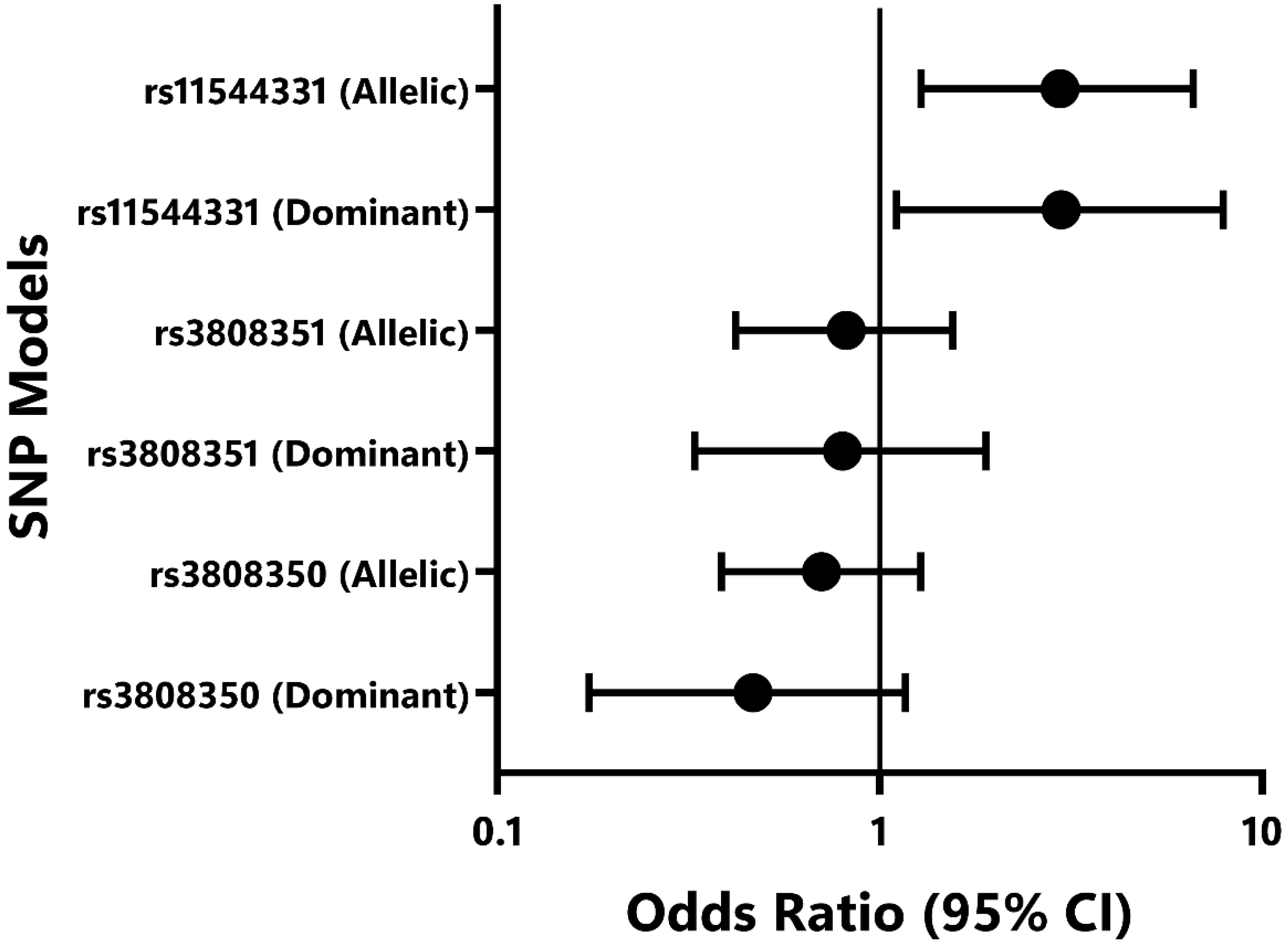
| Dominant (AG + GG vs. AA) | 31 (62) vs. 19 (38) | 28 (77.78) vs. 8 (22.22) | – | ref. 0.4662 (0.1736–1.167) | 0.1357 |
| Allelic (G vs. A) | 36 (36) vs. 64 (64) | 32 (44.44) vs. 40 (55.56) | – | ref. 0.7031 (0.3852–1.280) | 0.3330 |
| Model/Genotype | Case n (%) | Control n (%) | χ2 p Value | OR (95% CI) | p Value |
|---|---|---|---|---|---|
| GG | 25 (50) | 16 (44.44) | 0.8531 | – | – |
| GA | 21 (42) | 16 (44.44) | |||
| AA | 4 (8) | 4 (11.11) | |||
| Dominant (GA + AA vs. GG) | 25 (50) vs. 25 (50) | 20 (55.56) vs. 16 (44.44) | – | ref. 0.8000 (0.3285–1.893) | 0.6319 |
| Allelic (A vs. G) | 29 (29) vs. 71 (71) | 24 (33.33) vs. 48 (66.67) | – | ref. 0.8169 (0.4196–1.550) | 0.6026 |
| Model/Genotype | Case n (%) | Control n (%) | χ2 p Value | OR (95% CI) | p Value |
|---|---|---|---|---|---|
| CC | 27 (54) | 28 (77.78) | 0.0367 | – | – |
| CT | 19 (38) | 8 (22.22) | |||
| TT | 4 (8) | 0 (0) | |||
| Dominant (CT + TT vs. CC) | 23 (46) vs. 27 (54) | 8 (22.22) vs. 28 (77.78) | – | ref. 2.981 (1.106–7.904) | 0.0241 |
| Allelic (T vs. C) | 27 (27) vs. 73 (73) | 8 (11.11) vs. 64 (88.89) | – | ref. 2.959 (1.282–6.606) | 0.0110 |
| SNP | Observed Genotypes | Expected Genotypes | p (χ2) | p (Exact) |
|---|---|---|---|---|
| rs3808350 | AA = 8, AG = 24, GG = 4 | AA = 13.44, AG = 17.11, GG = 5.44 | 0.0685 | 0.0942 |
| rs3808351 | GG = 16, GA = 16, AA = 4 | GG = 16, GA = 16, AA = 4 | >0.9999 | 1.0000 |
| rs11544331 | CC = 28, CT = 8, TT = 0 | CC = 28.44, CT = 7.11, TT = 0.44 | 0.7549 | 0.7526 |
| Parameter | Result |
|---|---|
| SNP ID | rs11544331 |
| Gene | GPER1 |
| Gene ID | ENSG00000164850 |
| Protein | G protein-coupled estrogen receptor 1 |
| UniProt entry | GPER1_HUMAN |
| UniProt accession | Q99527 |
| Transcript | ENST00000397088/NM_001098201.3 |
| ClinVar variant name | NM_001098201.3(GPER1):c.47C>T (p.Pro16Leu) |
| ClinVar Variation ID | 1248609 |
| ClinVar accession | VCV001248609.2 |
| Cytogenetic band | 7p22.3 |
| Genomic location | NC_000007.14:g.1091775C>T; GRCh38: 7:1091775 |
| Variant type | Single-nucleotide variant |
| Molecular consequence | Missense/non-synonymous variant |
| Codon change | CCA>CTA |
| Protein position | 16 |
| Amino acid substitution | p.Pro16Leu/P16L |
| VEP impact | Moderate |
| SIFT | 0.19; Tolerated |
| PolyPhen-2 | 0.000; Benign |
| AlphaMissense | 0.0743; Likely benign |
| CADD raw score | 0.113797 |
| CADD PHRED score | 1.654 |
| Grantham score | 98 |
| SpliceAI scores | 0.000 for acceptor gain, acceptor loss, donor gain, and donor loss |
| ClinVar germline classification | Benign |
| ClinVar review status | Single submitter, criteria provided |
| ClinVar condition | Not provided |
| Global MAF | 0.1389, T allele |
| gnomAD exomes AF | Approximately 0.207–0.228 |
| Somatic clinical impact | No data submitted |
| Oncogenicity | No data submitted |
Disclaimer/Publisher’s Note: The statements, opinions and data contained in all publications are solely those of the individual author(s) and contributor(s) and not of MDPI and/or the editor(s). MDPI and/or the editor(s) disclaim responsibility for any injury to people or property resulting from any ideas, methods, instructions or products referred to in the content. |
© 2026 by the authors. Licensee MDPI, Basel, Switzerland. This article is an open access article distributed under the terms and conditions of the Creative Commons Attribution (CC BY) license.
Share and Cite
Öztürk, Ü.; Kurutaş, E.B.; Üremiş, N.; Üremiş, M.M.; Özkömeç, F.N. The Association of G Protein-Coupled Estrogen Receptor (GPER) Polymorphisms with Ionizing Radiation Exposure in Healthcare Workers. J. Clin. Med. 2026, 15, 4821. https://doi.org/10.3390/jcm15124821
Öztürk Ü, Kurutaş EB, Üremiş N, Üremiş MM, Özkömeç FN. The Association of G Protein-Coupled Estrogen Receptor (GPER) Polymorphisms with Ionizing Radiation Exposure in Healthcare Workers. Journal of Clinical Medicine. 2026; 15(12):4821. https://doi.org/10.3390/jcm15124821
Chicago/Turabian StyleÖztürk, Ünal, Ergül Belge Kurutaş, Nuray Üremiş, Muhammed Mehdi Üremiş, and Fatma Nur Özkömeç. 2026. "The Association of G Protein-Coupled Estrogen Receptor (GPER) Polymorphisms with Ionizing Radiation Exposure in Healthcare Workers" Journal of Clinical Medicine 15, no. 12: 4821. https://doi.org/10.3390/jcm15124821
APA StyleÖztürk, Ü., Kurutaş, E. B., Üremiş, N., Üremiş, M. M., & Özkömeç, F. N. (2026). The Association of G Protein-Coupled Estrogen Receptor (GPER) Polymorphisms with Ionizing Radiation Exposure in Healthcare Workers. Journal of Clinical Medicine, 15(12), 4821. https://doi.org/10.3390/jcm15124821