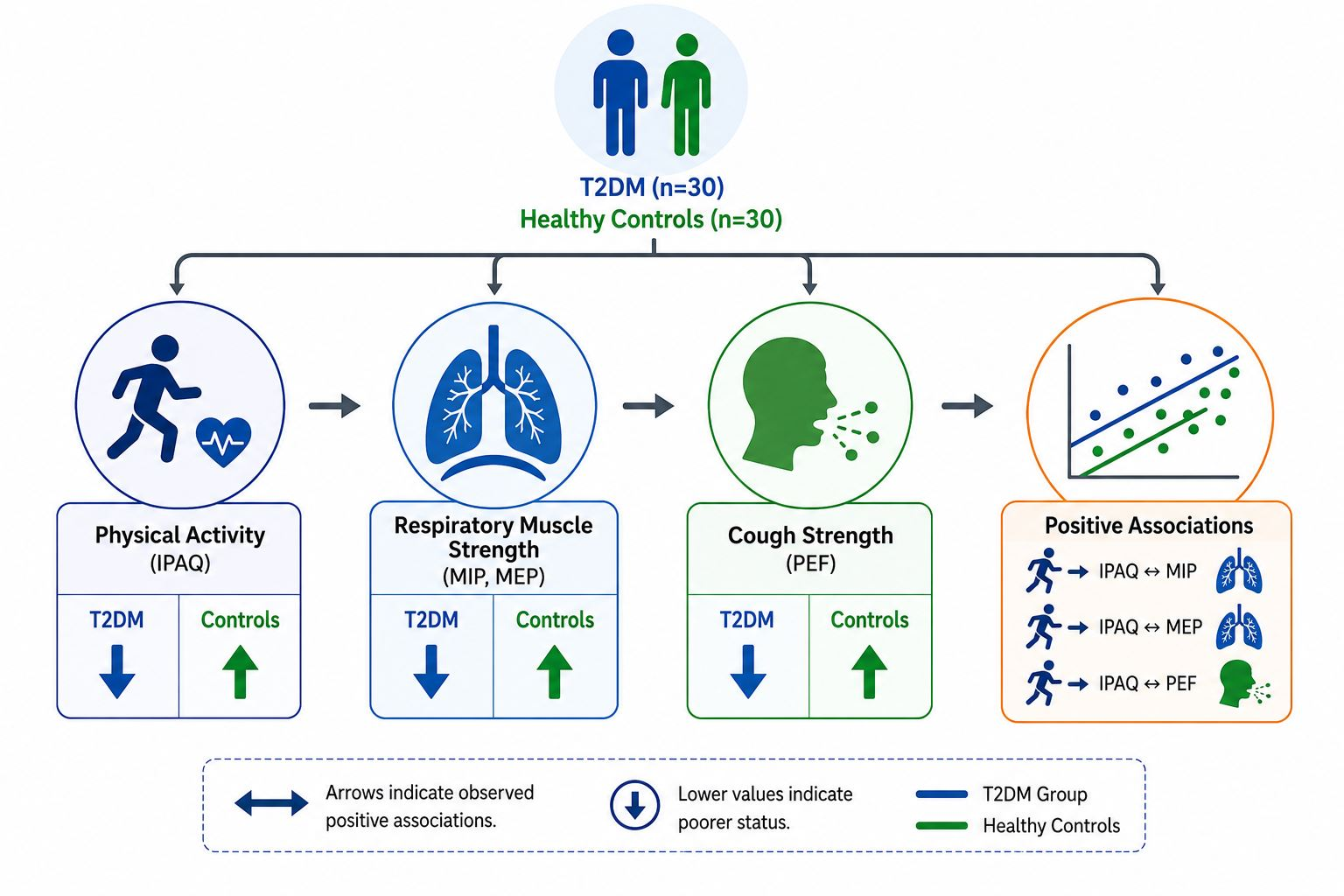
The Relationship Between Physical Activity Level, Respiratory Muscle Strength, and Cough Strength in Individuals with Type 2 Diabetes Mellitus: An Observational Cross-Sectional Study

 , and
, and
Abstract
1. Introduction
2. Materials and Methods
2.1. Study Design
2.2. Participants
2.3. Sample Size
2.4. Outcome Measurements
2.5. Statistical Analysis
3. Results
4. Discussion
Limitations
5. Conclusions
Author Contributions
Funding
Institutional Review Board Statement
Informed Consent Statement
Data Availability Statement
Acknowledgments
Conflicts of Interest
References
- Sharma, J.K.; Gupta, A.; Khanna, P. Diabetes and respiratory system including tuberculosis–challenges. Indian J. Tuberc. 2019, 66, 533–538. [Google Scholar] [CrossRef]
- International Diabetes Federation. IDF Diabetes Atlas, 11th ed.; International Diabetes Federation: Brussels, Belgium, 2025. [Google Scholar]
- Pongpanit, K.; Kulchanarat, C.; Buranapuntalug, S. Correlation between change in respiratory muscle strength and cough ability in patients submitted to open-heart surgery. East. J. Med. 2019, 24, 401–404. [Google Scholar] [CrossRef]
- Tosta, A.M.; Borges, M.C.; Silva, É.M.C.; Silva, A.A.; Crema, E. Pre- and postoperative respiratory muscle strength, body mass index and fasting glucose profile of patients with type 2 diabetes mellitus submitted to metabolic surgery. Fisioter. Mov. 2022, 33, e003351. [Google Scholar] [CrossRef]
- Van den Borst, H.R.; Gosker, M.P.; Zeegers, A. Pulmonary function in diabetes: A meta-analysis. Chest 2010, 138, 393–406. [Google Scholar] [CrossRef]
- Carvalho, T.D.; Pastre, C.M.; de Godoy, M.F. Fractal correlation property of heart rate variability in chronic obstructive pulmonary disease. Int. J. Chronic Obstr. Pulm. Dis. 2011, 6, 23–28. [Google Scholar] [CrossRef]
- Patel, N.; Howard, I.M.; Baydur, A. Respiratory considerations in patients with neuromuscular disorders. Muscle Nerve 2023, 68, 122–141. [Google Scholar] [CrossRef] [PubMed]
- Brennan, M.; McDonnell, M.J.; Duignan, N.; Gargoum, F.; Rutherford, R.M. The use of peak cough flow in the assessment of respiratory function in clinical practice: A narrative review. Respir. Med. 2022, 193, 106740. [Google Scholar] [CrossRef] [PubMed]
- Al-Khlaiwi, T.; Alsabih, A.O.; Khan, A.; Habib, S.; Sultan, M.; Habib, S.S. Reduced pulmonary functions and respiratory muscle strength in type 2 diabetes mellitus and its association with glycemic control. Eur. Rev. Med. Pharmacol. Sci. 2021, 25, 7363–7368. [Google Scholar]
- Salam, A.; Tilluckdharry, L.; Amoateng-Adjepong, Y.; Manthous, C.A. Neurologic status, cough, secretions and extubation outcomes. Intensive Care Med. 2004, 30, 1334–1339. [Google Scholar] [CrossRef] [PubMed]
- Duan, J.; Zhang, X.; Song, J. Predictive power of extubation failure diagnosed by cough strength: A systematic review and meta-analysis. Crit. Care 2021, 25, 357. [Google Scholar] [CrossRef]
- Meuffels, F.M.; Lichtmess, C.; Kreutz, T.; Held, S.; Brinkmann, C. Self-Reported Physical Activity Among Individuals with Diabetes Mellitus—Identifying Potential Barriers and Facilitators. Diabetology 2025, 6, 77. [Google Scholar] [CrossRef]
- Biernat, K.; Marciniak, D.M.; Mazurek, J.; Kuciel, N.; Hap, K.; Kisiel, M.; Sutkowska, E. The Level and Limitations of Physical Activity in Elderly Patients with Diabetes. J. Clin. Med. 2024, 13, 6329. [Google Scholar] [CrossRef]
- Vasconcelos, A.R.; Guimarães, F.J.S.P.; Cruz, P.W.S.; Carvalho, M.J.M.C.B.; Brito, A.F.; Costa, K.B.; Figueiredo, L.S.; Schwingel, P.A.; Vancea, D.M.M.; Costa, M.C. Sarcopenia and Functional Decline in Postmenopausal Women: The Roles of Type 2 Diabetes and Physical Activity. Med. Sci. 2025, 13, 268. [Google Scholar] [CrossRef] [PubMed]
- Persiani, M.; Laffi, A.; Piras, A.; Meoni, A.; Brodosi, L.; Nicastri, A.; Petroni, M.L.; Raffi, M. Relationship Between Physical Activity and Autonomic Responses in Adults with Type 2 Diabetes. Int. J. Environ. Res. Public Health 2025, 22, 1702. [Google Scholar] [CrossRef]
- Lecky, R.; Grogan, S.; Shukla, P.; Atkinson, S.; McClean, P.L.; Kelly, C. The Role of Obesity and Type 2 Diabetes in Lung Health: A Systematic Review. PLoS ONE 2026, 21, e0340692. [Google Scholar] [CrossRef]
- Breuil-Marsal, Z.; Godek, C.; Lotti, A.; Feiereisen, P.; Marçal, I.R.; Rehder-Santos, P.; Milan-Mattos, J.C.; de Abreu, R.M. Acute and Chronic Effects of Inspiratory Muscle Training in Patients with Type 2 Diabetes Mellitus: A Systematic Review of Randomized Controlled Trials. Front. Sports Act. Living 2024, 6, 1423308. [Google Scholar] [CrossRef] [PubMed]
- American Diabetes Association. Classification and diagnosis of diabetes: Standards of Care in Diabetes—2024. Diabetes Care 2024, 47, S20–S42. [Google Scholar] [CrossRef]
- Fuso, L.; Pitocco, D.; Longobardi, A. Reduced respiratory muscle strength and endurance in type 2 diabetes mellitus. Diabetes Metab. Res. Rev. 2012, 28, 370–375. [Google Scholar] [CrossRef]
- Simões, R.P.; Deus, A.P.; Auad, M.A.; Dionísio, J.; Mazzonetto, M.; Borghi-Silva, A. Maximal respiratory pressure in healthy 20 to 89 year-old sedentary individuals of central São Paulo State. Braz. J. Phys. Ther. 2010, 14, 60–67. [Google Scholar] [CrossRef]
- Takeda, H.; Yamashina, Y.; Tabira, K. Relationship between kyphosis and cough strength and respiratory function of community-dwelling elderly. Physiother. Theory Pract. 2022, 38, 3100–3107. [Google Scholar] [CrossRef]
- Nunn, A.J.; Gregg, I. New regression equations for predicting peak expiratory flow in adults. BMJ 1989, 298, 1068–1070. [Google Scholar] [CrossRef]
- Sibai, A.M.; Costanian, C.; Tohme, R. Physical activity in adults with and without diabetes: From the high-risk approach to the population-based approach of prevention. BMC Public Health 2013, 13, 1002. [Google Scholar] [CrossRef]
- Köklü, N.; Büyüköztürk, Ş.; Bökeoğlu, Ç.Ö. Sosyal Bilimler İçin İstatistik; Pegem Akademi: Ankara, Turkey, 2006. [Google Scholar]
- Freitas, F.S.; Ibiapina, C.C.; Alvim, C.G.; Britto, R.R.; Parreira, V.F. Relationship between cough strength and functional level in a group of elderly individuals. Braz. J. Phys. Ther. 2010, 14, 470–476. [Google Scholar] [CrossRef]
- Razak, S.; Justine, M. Relationship between respiratory muscle functions, obesity indices, and body compositions at different levels of physical activity in young adults. J. Exerc. Physiol. Online 2020, 23, 49. [Google Scholar]
- Silva, A.; Silva, L.; Lopes, I.; Francisco, A.; Neto, A.; Monteiro, M.; Muela, H. Association of dietary pattern and physical inactivity with hypertension, obesity, diabetes and metabolic syndrome. In Metabolic Syndrome–Lifestyle and Biological Risk Factors; Intech Open: London, UK, 2024. [Google Scholar]
- Saxena, Y.; Sidhwani, G.; Upmanyu, R. Abdominal obesity and pulmonary functions in young Indian adults: A prospective study. Indian J. Physiol. Pharmacol. 2009, 53, 318–326. [Google Scholar]
- Bach, J.R.; Gonçalves, M.R.; Páez, S.; Winck, J.C.; Leitão, S.; Abreu, P. Expiratory flow maneuvers in patients with neuromuscular diseases. Am. J. Phys. Med. Rehabil. 2006, 85, 105–111. [Google Scholar] [CrossRef]
- Suárez, A.A.; Pessolano, F.A.; Monteiro, S.G.; Ferreyra, G.; Capria, M.E.; Mesa, L.; Dubrovsky, A.; De Vito, E.L. Peak flow and peak cough flow in the evaluation of expiratory muscle weakness and bulbar impairment in patients with neuromuscular disease. Am. J. Phys. Med. Rehabil. 2002, 81, 506–511. [Google Scholar] [CrossRef] [PubMed]
- Kim, J.; Davenport, P.; Sapienza, C. Effect of expiratory muscle strength training on elderly cough function. Arch. Gerontol. Geriatr. 2009, 48, 361–366. [Google Scholar] [CrossRef] [PubMed]
- Winck, J.C.; LeBlanc, C.; Soto, J.L.; Plano, F. The value of cough peak flow measurements in the assessment of extubation or decannulation readiness. Rev. Port. Pneumol. (Engl. Ed.) 2015, 21, 94–98. [Google Scholar] [CrossRef] [PubMed]
- Al-Rifai, R.H.; Pearson, F.; Critchley, J.A. Association between diabetes mellitus and active tuberculosis: A systematic review and meta-analysis. PLoS ONE 2017, 12, e0187967. [Google Scholar] [CrossRef]


| Variable | Type 2 DM Group (Median, Q1–Q3) | Healthy Control Group (Median, Q1–Q3) | z | p |
|---|---|---|---|---|
| Age (years) | 52.0 (43.5–62.75) | 52.0 (43.5–62.75) | 0.000 | 1 |
| Weight (kg) | 85.5 (73.25–95.0) | 74.5 (62.25–87.0) | −2.026 | 0.043 * |
| Height (cm) | 160.0 (154.5–164.75 | 165.0 (160.0–171.75) | −1.681 | 0.093 |
| BMI (kg/m2) | 32.23 (28.25–37.73) | 28.29 (24.42–30.25) | −2.794 | 0.005 * |
| Waist (cm) | 125.0 (101.25–139.75) | 92.0 (85.0–107.0) | −4.478 | 0.001 * |
| Hip (cm) | 110.0 (101.0–115.5) | 103.0 (97.0–108.25) | −2.343 | 0.019 * |
| Waist/Hip | 1.11 (1.01–1.25) | 0.87 (0.85–1.03) | −4.606 | 0.001 * |
| SBP (mmHg) | 125.0 (120.0–133.75) | 120.0 (120.0–125.0) | −2.310 | 0.021 * |
| DBP (mmHg) | 80.0 (80.0–80.0) | 75.0 (70.0–80.0) | −3.951 | 0.001 * |
| Fasting blood glucose (mg/dL) | 153.5 (100.0–204.0) | 91.0 (86.25–97.0) | −4.498 | 0.001 * |
| Post-prandial blood glucose (mg/dL) | 222.0 (162.07–369.0) | 115.5 (105.25–122.5) | −5.945 | 0.001 * |
| HDL (mg/dL) | 50.5 (41.0–73.5) | 52.4 (45.25–60.0) | −0.148 | 0.882 |
| LDL (mg/dL) | 99.0 (85.75–116.0) | 125.0 (103.75–142.0) | −2.736 | 0.006 * |
| Total cholesterol (mg/dL) | 180.5 (162.75–204.75) | 188.0 (173.0–199.0) | −0.348 | 0.728 |
| Triglyceride (mg/dL) | 145.5 (93.5–246.75) | 98.5 (84.25–118.5) | −2.676 | 0.007 * |
| Vitamin B12 (pg/mL) | 330.3 (249.75–428.85) | 363.0 (280.25–499.25) | −0.695 | 0.487 |
| HbA1c (%) | 8.35 (7.12–11.05) | 5.20 (4.83–5.50) | −6.662 | 0.001 * |
| Folic acid (ng/mL) | 8.22 (7.34–10.07) | 7.96 (6.14–9.66) | −1.153 | 0.249 |
| Variable | Type 2 DM Group (Median, Q1–Q3) | Healthy Control Group (Median, Q1–Q3) | z | p |
|---|---|---|---|---|
| Cough Strength (L/min) | 250.0 (200.0–357.5) | 400.0 (340.0–450.0) | −4.081 | 0.001 * |
| MIP (cmH2O) | 55.0 (42.5–69.5) | 70.5 (66.25–80.75) | −3.853 | 0.001 * |
| MEP (cmH2O) | 62.0 (48.5–69.25) | 79.0 (73.25–86.75) | −4.526 | 0.001 * |
| MIP % | 78.0 (59.0–85.75) | 101.5 (88.25–113.75) | −3.786 | 0.001 * |
| MEP % | 59.0 (50.0–73.5) | 87.5 (76.25–100.0) | −3.845 | 0.001 * |
| IPAQ (MET min/week) | 696.5 (340.88–1073.25) | 1530.0 (714.0–2189.25) | −2.632 | 0.008 * |
| Variable | IPAQ (MET Min/Week) | |||
|---|---|---|---|---|
| Type 2 DM Group | Healthy Control Group | |||
| r | p | r | p | |
| Cough Strength (L/min) | 0.619 | <0.001 * | 0.470 | 0.010 * |
| MIP (cmH2O) | 0.438 | 0.016 * | 0.264 | 0.166 |
| MEP (cmH2O) | 0.581 | 0.001 * | 0.466 | 0.011 * |
| HbA1c (%) | −0.352 | 0.056 | 0.018 | 0.928 |
| Variable | Diabetes Duration | BMI | HbA1c (%) | WHR | ||||
|---|---|---|---|---|---|---|---|---|
| r | p | r | p | r | p | r | p | |
| Cough Strength (L/min) | −0.357 | 0.053 | −0.108 | 0.570 | −0.352 | 0.056 | −0.106 | 0.578 |
| MIP (cmH2O) | −0.412 | 0.024 * | −0.058 | 0.760 | −0.369 | 0.045 * | −0.047 | 0.758 |
| MEP (cmH2O) | −0.261 | 0.164 | −0.291 | 0.119 | −0.102 | 0.593 | −0.148 | 0.822 |
| IPAQ (MET min/week) | −0.029 | 0.878 | −0.095 | 0.616 | −0.352 | 0.056 | −0.246 | 0.190 |
| Dependent Variable | B (Group: Type 2 DM vs. Healthy Controls) | 95% CI | p Value |
|---|---|---|---|
| MIP (cmH2O) | −15.69 | −26.58 to −4.80 | 0.006 * |
| MEP (cmH2O) | −14.29 | −29.05 to 0.46 | 0.057 |
| Cough Strength (PEF, L/min) | −90.51 | −161.52 to −19.50 | 0.013 * |
Disclaimer/Publisher’s Note: The statements, opinions and data contained in all publications are solely those of the individual author(s) and contributor(s) and not of MDPI and/or the editor(s). MDPI and/or the editor(s) disclaim responsibility for any injury to people or property resulting from any ideas, methods, instructions or products referred to in the content. |
© 2026 by the authors. Licensee MDPI, Basel, Switzerland. This article is an open access article distributed under the terms and conditions of the Creative Commons Attribution (CC BY) license.
Share and Cite
Yılmaz, A.; Yilmaz, H.; Korkmaz, N.C.; Fenkçi, S.M.; Altinisik, G.; Söylemez, B.; Bektaş, E.Y. The Relationship Between Physical Activity Level, Respiratory Muscle Strength, and Cough Strength in Individuals with Type 2 Diabetes Mellitus: An Observational Cross-Sectional Study. J. Clin. Med. 2026, 15, 4566. https://doi.org/10.3390/jcm15124566
Yılmaz A, Yilmaz H, Korkmaz NC, Fenkçi SM, Altinisik G, Söylemez B, Bektaş EY. The Relationship Between Physical Activity Level, Respiratory Muscle Strength, and Cough Strength in Individuals with Type 2 Diabetes Mellitus: An Observational Cross-Sectional Study. Journal of Clinical Medicine. 2026; 15(12):4566. https://doi.org/10.3390/jcm15124566
Chicago/Turabian StyleYılmaz, Ayşenur, Halil Yilmaz, Nilufer Cetisli Korkmaz, Semin Melahat Fenkçi, Goksel Altinisik, Betül Söylemez, and Esra Yılmaz Bektaş. 2026. "The Relationship Between Physical Activity Level, Respiratory Muscle Strength, and Cough Strength in Individuals with Type 2 Diabetes Mellitus: An Observational Cross-Sectional Study" Journal of Clinical Medicine 15, no. 12: 4566. https://doi.org/10.3390/jcm15124566
APA StyleYılmaz, A., Yilmaz, H., Korkmaz, N. C., Fenkçi, S. M., Altinisik, G., Söylemez, B., & Bektaş, E. Y. (2026). The Relationship Between Physical Activity Level, Respiratory Muscle Strength, and Cough Strength in Individuals with Type 2 Diabetes Mellitus: An Observational Cross-Sectional Study. Journal of Clinical Medicine, 15(12), 4566. https://doi.org/10.3390/jcm15124566