Effect of Failed Debridement, Antibiotics, and Implant Retention on Subsequent Two-Stage Reimplantation for Periprosthetic Joint Infection Following Total Knee Arthroplasty: A Retrospective Cohort Study

Abstract
1. Introduction
2. Materials and Methods
2.1. Data Collection
2.2. Surgical Methods
2.2.1. DAIR Procedure (F-DAIR Group)
2.2.2. Two-Stage Revision Arthroplasty
2.3. Outcome Measurement
2.4. Statistical Analysis
3. Results
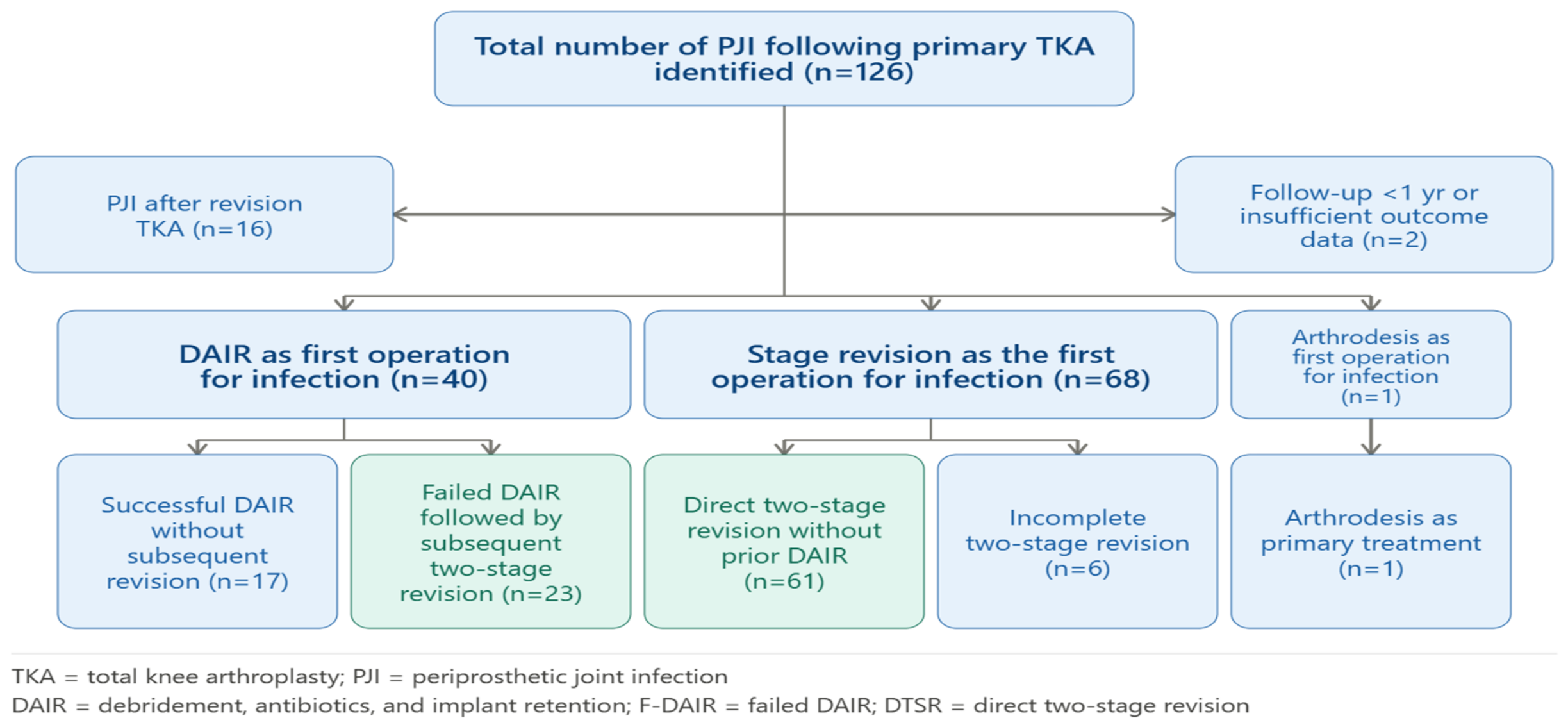
3.1. Patient Demographics
3.2. Microbiology
3.3. Treatment Outcomes
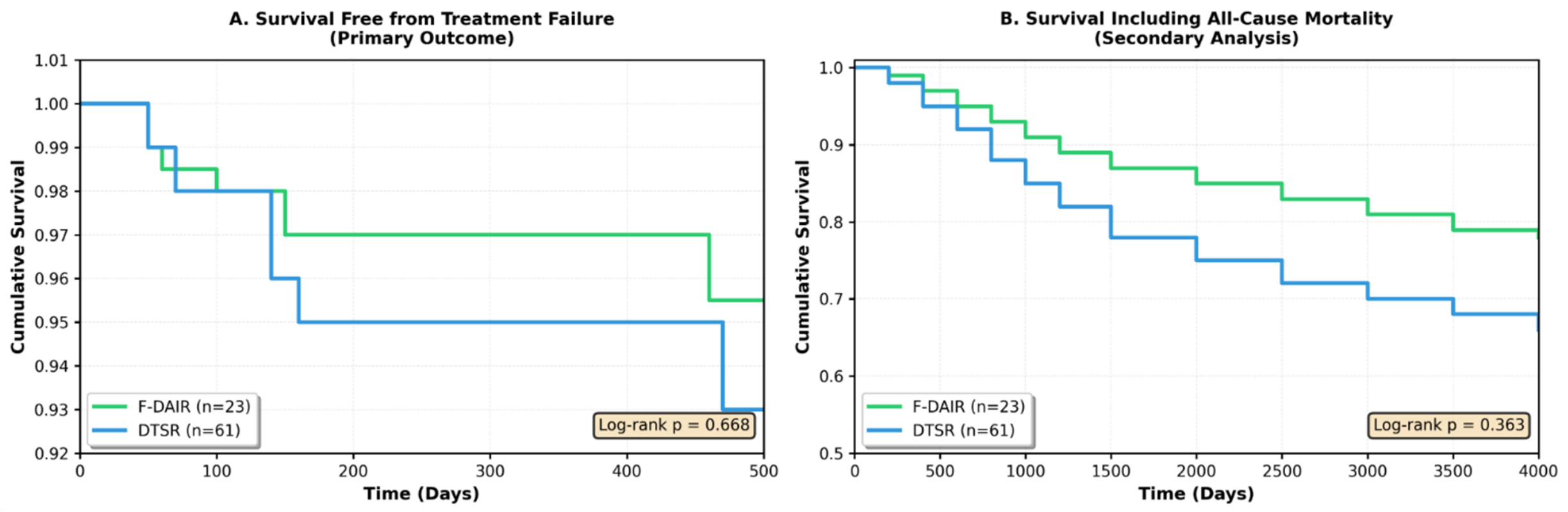
3.4. Survival Analysis
3.5. Predictive Factors
4. Discussion
5. Conclusions
Author Contributions
Funding
Institutional Review Board Statement
Informed Consent Statement
Data Availability Statement
Conflicts of Interest
References
- Whitehouse, J.D.; Friedman, N.D.; Kirkland, K.B.; Richardson, W.J.; Sexton, D.J. The impact of surgical-site infections following orthopedic surgery at a community hospital and a university hospital: Adverse quality of life, excess length of stay, and extra cost. Infect. Control Hosp. Epidemiol. 2002, 23, 183–189. [Google Scholar] [CrossRef]
- Kurtz, S.M.; Lau, E.C.; Son, M.S.; Chang, E.T.; Zimmerli, W.; Parvizi, J. Are We Winning or Losing the Battle With Periprosthetic Joint Infection: Trends in Periprosthetic Joint Infection and Mortality Risk for the Medicare Population. J. Arthroplast. 2018, 33, 3238–3245. [Google Scholar] [CrossRef]
- Zimmerli, W.; Trampuz, A.; Ochsner, P.E. Prosthetic-joint infections. N. Engl. J. Med. 2004, 351, 1645–1654. [Google Scholar] [CrossRef]
- Tande, A.J.; Patel, R. Prosthetic joint infection. Clin. Microbiol. Rev. 2014, 27, 302–345. [Google Scholar] [CrossRef]
- Jamsen, E.; Stogiannidis, I.; Malmivaara, A.; Pajamaki, J.; Puolakka, T.; Konttinen, Y.T. Outcome of prosthesis exchange for infected knee arthroplasty: The effect of treatment approach. Acta Orthop. 2009, 80, 67–77. [Google Scholar] [CrossRef]
- Sherrell, J.C.; Fehring, T.K.; Odum, S.; Hansen, E.; Zmistowski, B.; Dennos, A.; Kalore, N.; Periprosthetic Infection Consortium. The Chitranjan Ranawat Award: Fate of two-stage reimplantation after failed irrigation and debridement for periprosthetic knee infection. Clin. Orthop. Relat. Res. 2011, 469, 18–25. [Google Scholar] [CrossRef] [PubMed]
- Osmon, D.R.; Berbari, E.F.; Berendt, A.R.; Lew, D.; Zimmerli, W.; Steckelberg, J.M.; Rao, N.; Hanssen, A.; Wilson, W.R.; Infectious Diseases Society of America. Diagnosis and management of prosthetic joint infection: Clinical practice guidelines by the Infectious Diseases Society of America. Clin. Infect. Dis. 2013, 56, e1–e25. [Google Scholar] [CrossRef] [PubMed]
- Anagnostakos, K.; Kelm, J.; Regitz, T.; Schmitt, E.; Jung, W. Antibiotic-impregnated PMMA hip spacers: Current status. Acta Orthop. 2006, 77, 628–637. [Google Scholar] [CrossRef]
- Byren, I.; Bejon, P.; Atkins, B.L.; Angus, B.; Masters, S.; McLardy-Smith, P.; Gundle, R.; Berendt, A. One hundred and twelve infected arthroplasties treated with ’DAIR’ (debridement, antibiotics and implant retention): Antibiotic duration and outcome. J. Antimicrob. Chemother. 2009, 63, 1264–1271. [Google Scholar] [CrossRef] [PubMed]
- Cobo, J.; Miguel, L.G.S.; Euba, G.; Rodríguez, D.; García-Lechuz, J.; Riera, M.; Falgueras, L.; Palomino, J.; Benito, N.; Del Toro, M.D.; et al. Early prosthetic joint infection: Outcomes with debridement and implant retention followed by antibiotic therapy. Clin. Microbiol. Infect. 2011, 17, 1632–1637. [Google Scholar] [CrossRef]
- Puhto, A.P.; Puhto, T.; Syrjala, H. Short-course antibiotics for prosthetic joint infections treated with prosthesis retention. Clin. Microbiol. Infect. 2012, 18, 1143–1148. [Google Scholar] [CrossRef][Green Version]
- Azzam, K.A.; Seeley, M.; Ghanem, E.; Austin, M.S.; Purtill, J.J.; Parvizi, J. Irrigation and debridement in the management of prosthetic joint infection: Traditional indications revisited. J. Arthroplast. 2010, 25, 1022–1027. [Google Scholar] [CrossRef]
- Kunutsor, S.K.; Beswick, A.D.; Whitehouse, M.R.; Blom, A.W.; Lenguerrand, E. Debridement, antibiotics and implant retention for periprosthetic joint infections: A systematic review and meta-analysis of treatment outcomes. J. Infect. 2018, 77, 479–488. [Google Scholar] [CrossRef] [PubMed]
- Tornero, E.; Morata, L.; Martínez-Pastor, J.C.; Angulo, S.; Combalia, A.; Bori, G.; García-Ramiro, S.; Mensa, J.; Soriano, A. KLIC-score for predicting early failure in prosthetic joint infections treated with debridement, implant retention and antibiotics. Clin. Orthop. Relat. Res. 2015, 473, 3459–3465. [Google Scholar] [CrossRef]
- Grammatopoulos, G.; Bolduc, M.-E.; Atkins, B.L.; Kendrick, B.J.L.; McLardy-Smith, P.; Murray, D.W.; Gundle, R.; Taylor, A.H. Functional outcome of debridement, antibiotics and implant retention in periprosthetic joint infection involving the hip: A case-control study. Bone Jt. J. 2017, 99, 614–622. [Google Scholar] [CrossRef] [PubMed]
- Brimmo, O.; Ramanathan, D.; Schiltz, N.K.; Pillai, A.L.P.C.; Klika, A.K.; Barsoum, W.K. Irrigation and debridement before a 2-stage revision total knee arthroplasty does not increase risk of failure. J. Arthroplast. 2016, 31, 461–464. [Google Scholar] [CrossRef] [PubMed]
- Nodzo, S.R.; Boyle, K.K.; Nocon, A.A.; Henry, M.W.; Mayman, D.J.; Westrich, G.H. The influence of a failed irrigation and debridement on the outcomes of a subsequent 2-stage revision knee arthroplasty. J. Arthroplast. 2017, 32, 2508–2512. [Google Scholar] [CrossRef]
- Rajgopal, A.; Panda, I.; Rao, A.; Dahiya, V.; Gupta, H. Does prior failed debridement compromise the outcome of subsequent two-stage revision done for periprosthetic joint infection following total knee arthroplasty? J. Arthroplast. 2018, 33, 2588–2594. [Google Scholar] [CrossRef]
- Lizaur-Utrilla, A.; Asensio-Pascual, A.; Gonzalez-Parreño, S.; Miralles-Muñoz, F.A.; Lopez-Prats, F.A. Negative impact of prior debridement on functional outcome of subsequent two-stage revision for early knee periprosthetic infection. Knee Surg. Sports Traumatol. Arthrosc. 2019, 27, 2309–2315. [Google Scholar] [CrossRef]
- Kim, K.; Zhu, M.; Cavadino, A.; Munro, J.T.; Young, S.W. Failed debridement and implant retention does not compromise the success of subsequent staged revision in infected total knee arthroplasty. J. Arthroplast. 2019, 34, 1214–1220.e1. [Google Scholar] [CrossRef]
- Cochran, A.R.; Ong, K.L.; Lau, E.; Mont, M.A.; Malkani, A.L. Risk of reinfection after treatment of infected total knee arthroplasty. J. Arthroplast. 2016, 31, 156–161. [Google Scholar] [CrossRef] [PubMed]
- Corona, P.S.; Vicente, M.; Carrera, L.; Rodríguez-Pardo, D.; Corró, S. The actual success rate of the two-stage exchange arthroplasty strategy in chronic periprosthetic joint infection. Bone Jt. J. 2020, 102-B, 1682–1688. [Google Scholar] [CrossRef] [PubMed]
- Parvizi, J.; Zmistowski, B.; Berbari, E.F.; Bauer, T.W.; Springer, B.D.; Della Valle, C.J.; Garvin, K.L.; Mont, M.A.; Wongworawat, M.D.; Zalavras, C.G. New definition for periprosthetic joint infection: From the Workgroup of the Musculoskeletal Infection Society. Clin. Orthop. Relat. Res. 2011, 469, 2992–2994. [Google Scholar] [CrossRef] [PubMed]
- Parvizi, J.; Tan, T.L.; Goswami, K.; Higuera, C.; Della Valle, C.; Chen, A.F.; Shohat, N. The 2018 definition of periprosthetic hip and knee infection: An evidence-based and validated criteria. J. Arthroplast. 2018, 33, 1309–1314.e2. [Google Scholar] [CrossRef]
- McNally, M.; Sousa, R.; Wouthuyzen-Bakker, M.; Chen, A.F.; Soriano, A.; Vogely, H.C.; Clauss, M.; Higuera, C.A.; Trebše, R. The EBJIS definition of periprosthetic joint infection. Bone Jt. J. 2021, 103, 18–25. [Google Scholar] [CrossRef]
- Parvizi, J.; Gehrke, T. International Consensus Group on Periprosthetic Joint Infection. Definition of periprosthetic joint infection. J. Arthroplast. 2014, 29, 1331. [Google Scholar] [CrossRef]
- von Elm, E.; Altman, D.G.; Egger, M.; Pocock, S.J.; Gøtzsche, P.C.; Vandenbroucke, J.P.; STROBE Initiative. The Strengthening the Reporting of Observational Studies in Epidemiology (STROBE) statement: Guidelines for reporting observational studies. Lancet 2007, 370, 1453–1457. [Google Scholar] [CrossRef]
- Fillingham, Y.A.; Della Valle, C.J.; Suleiman, L.I.; Springer, B.D.; Gehrke, T.; Bini, S.A.; Segreti, J.; Chen, A.F.; Goswami, K.; Tan, T.L.; et al. Definition of successful infection management and guidelines for reporting of outcomes after surgical treatment of periprosthetic joint infection: From the Workgroup of the Musculoskeletal Infection Society (MSIS). J. Bone Jt. Surg. Am. 2019, 101, e69. [Google Scholar] [CrossRef]
- Peduzzi, P.; Concato, J.; Feinstein, A.R.; Holford, T.R. Importance of events per independent variable in proportional hazards regression analysis. II. Accuracy and precision of regression estimates. J. Clin. Epidemiol. 1995, 48, 1503–1510. [Google Scholar] [CrossRef]
- Tan, L.; Yang, J.; Yang, J.; Yang, Z.; Yu, K. Impact of prior failed irrigation and debridement on outcomes of subsequent two-stage revision arthroplasty: A systematic review and meta-analysis. Eur. Rev. Med. Pharmacol. Sci. 2022, 26, 9195–9203. [Google Scholar]
- Vasso, M.; Braile, A.; Ascione, F.; Toro, G.; De Cicco, A.; Lepore, F.; Panni, A.S. Two-stage reimplantation in periprosthetic knee infection. Eur. Rev. Med. Pharmacol. Sci. 2019, 23, 51–58. [Google Scholar] [CrossRef]
- Yang, L.; Sun, Y.; Li, G.; Liu, J. Is hemoglobin A1c and perioperative hyperglycemia predictive of periprosthetic joint infection following total joint arthroplasty? A systematic review and meta-analysis. Medicine 2017, 96, e8805. [Google Scholar] [CrossRef] [PubMed]
- Tarabichi, M.; Shohat, N.; Kheir, M.M.; Adelani, M.; Brigati, D.; Kearns, S.M.; Patel, P.; Clohisy, J.C.; Higuera, C.A.; Levine, B.R.; et al. Determining the threshold for HbA1c as a predictor for adverse outcomes after total joint arthroplasty: A multicenter, retrospective study. J. Arthroplast. 2017, 32, S263–S267.e1. [Google Scholar] [CrossRef]
- Minelli, E.B.; Benini, A.; Magnan, B.; Bartolozzi, P. Release of gentamicin and vancomycin from temporary hip spacers in two-stage revision of infected arthroplasties. J. Antimicrob. Chemother. 2004, 53, 329–334. [Google Scholar] [CrossRef]
- Kavolus, J.J.; Cunningham, D.J.; Eftekhary, N.; Ting, N.T.; Griffin, W.L.; Fehring, T.K. Fate of Two-Stage Reimplantation After Failed Irrigation and Debridement for Periprosthetic Hip Infection. Arthroplast. Today 2020, 6, 955–958. [Google Scholar] [CrossRef]
- Gardner, J.; Gioe, T.J.; Tatman, P. Can this prosthesis be saved?: Implant salvage attempts in infected primary total knee arthroplasty. Clin. Orthop. Relat. Res. 2011, 469, 970–976. [Google Scholar] [CrossRef] [PubMed]
- Bradbury, T.; Fehring, T.K.; Taunton, M.; Hanssen, A.; Azzam, K.; Parvizi, J.; Odum, S.M. The fate of acute methicillin-resistant Staphylococcus aureus periprosthetic knee infections treated by open debridement and retention of components. J. Arthroplast. 2009, 24, 101–104. [Google Scholar] [CrossRef] [PubMed]



| Tier | Definition |
|---|---|
| Tier 1. | Infection control with no continued antibiotic therapy |
| Tier 2. | Infection control with the patient on suppressive antibiotic therapy |
| Tier 3. | Need for reoperation and/or revision and/or spacer retention (assigned to subgroups A, B, C, D, E, and F based on the type of reoperation) A. Aseptic revision at >1 year from initiation of PJI treatment B. Septic revision (including debridement, antibiotics, and implant retention [DAIR]) at >1 year from initiation of PJI treatment (excluding amputation, resection arthroplasty, and arthrodesis) C. Aseptic revision at ≤1 year from initiation of PJI treatment D. Septic revision (including DAIR) at ≤1 year from initiation of PJI treatment (excluding amputation, resection arthroplasty, and arthrodesis) E. Amputation, resection arthroplasty, or arthrodesis F. Retained spacer |
| Tier 4. | Death (assigned to subgroups A or B). A. Death ≤ 1 year from initiation of PJI treatment B. Death > 1 year from initiation of PJI treatment |
| F-DAIR Group (n = 23) | Failure (n = 1) | DTSR Group (n = 61) | Failure (n = 6) | p Value | Overall (n = 84) | |
|---|---|---|---|---|---|---|
| Age (Mean, range) (years) | 69.78 (38–84) | 71.64 (48–83) | 0.409 | 71.13 (±8.16) | ||
| >70 years | 13 (56.5%) | 17 (27.9%) | 3 | 0.172 | ||
| Gender | 0.271 | |||||
| Male | 8 (34.8%) | 14 (23.0%) | 3 | 22 (26.2%) | ||
| Female | 15 (65.2%) | 1 | 47 (77.0%) | 3 | 62 (73.8%) | |
| ASA grade | 0.3 | |||||
| ASA 1 | 1 (4.3%) | 7 (11.5%) | 2 | 8 (9.5%) | ||
| ASA 2 | 16 (69.6%) | 46 (75.1%) | 3 | 62 (73.8%) | ||
| ASA 3 | 6 (26.1%) | 1 | 8 (13.1%) | 1 | 14 (16.7%) | |
| ASA 4 | 0 | 0 | 0 | |||
| Body mass index (BMI) | 24.39 (17.3–31.1) | 25.50 (17.58–41.26) | 0.228 | 24.69 (±3.75) | ||
| Co-morbidities | ||||||
| Diabetes | 11 (47.8%) | 1 | 20 (32.8%) | 3 | 0.203 | 31 (36.9%) |
| Rheumatoid Arthritis | 1 (4.3%) | 3 (4.9%) | 1 | 0.913 | 4 (4.8%) | |
| COPD | 0 | 4 (6.6%) | 0 | 4 (4.8%) | ||
| Chronic Kidney Disease | 0 | 2 (3.3%) | 0 | 2 (2.4%) | ||
| Liver Cirrhosis | 2 (8.7%) | 1 | 2 (3.3%) | 0 | 0.301 | 4 (4.8%) |
| Cardiovascular Disease | 4 (17.4%) | 11 (18.0%) | 1 | 0.945 | 15 (17.9%) | |
| Infection Type | 0.001 * | |||||
| Acute postoperative | 10 (43.5%) | 7 (11.5%) | 2 | 17 (20.2%) | ||
| Acute hematogenous | 9 (39.1%) | 1 | 22 (36.1%) | 3 | 31 (36.9%) | |
| Chronic | 4 (17.4%) | 32 (52.5%) | 1 | 36 (42.9%) | ||
| Implant age (month) | 26.65 (1–173) | 45.07 (2–203) | 0.097 | 40.54 (±45.067) | ||
| Stage interval (days) | 65.23 (27–279) | 56.34 (40–101) | 0.149 | 62.80 (±34.39) | ||
| Follow-up periods (Month) | 57.17 (16–136) | 63.51 (1–178) | 0.457 | 61.77 (±40.485) |
| F-DAIR Group (n = 23) | Failure (n = 1) | DTSR Group (n = 61) | Failure (n = 6) | p Value | Overall (n = 84) | |
|---|---|---|---|---|---|---|
| Culture negative | 4 (17.4%) | 33 (54.1%) | 3 | 0.003 * | 37 (44.0%) | |
| Antibiotic-resistant bacteria | 11 (47.8%) | 8 (13.1%) | 1 | 0.001 * | ||
| MRSE (Staphylococcus epidermidis) | 9 (39.1%) | 4 (6.6%) | 0.001 * | 13 (15.5%) | ||
| MRSA (Staphylococcus aureus) | 2 (8.7%) | 4 (6.6%) | 1 | 0.663 | 6 (7.1%) | |
| Escherichia coli | 2 (8.7%) | 1 | 4 (6.6%) | 0.663 | 6 (7.1%) | |
| MSSA (Staphylococcus aureus) | 1 (4.3%) | 4 (6.6%) | 1.00 | 5 (6.0%) | ||
| Streptococcus dysgalactiae | 1 (4.3%) | 2 (3.3%) | 1 | 1.00 | 3 (3.6%) | |
| Streptococcus pneumoniae | 1 (4.3%) | 0 | 0.274 | 1 (1.2%) | ||
| Candida spp. | 1 (4.3%) | 2 (3.3%) | 1.00 | 3 (3.6%) | ||
| Acinetobacter baumannii | 1 (4.3%) | 0 | 0.274 | 1 (1.2%) | ||
| Mycobacterium tuberculosis | 0 | 2 (3.3%) | 1.00 | 2 (2.4%) | ||
| Klebsiella pneumoniae | 0 | 1 (1.6%) | 1.00 | 1 (1.2%) | ||
| Pseudomonas spp. | 0 | 1 (1.6%) | 1.00 | 1 (1.2%) | ||
| Coagulase-negative staphylococci | 0 | 1 (1.6%) | 1 | 1.00 | 1 (1.2%) | |
| Enterobacter cloacae | 1 (4.3%) | 0 | 0.274 | 1 (1.2%) | ||
| Enterococcus faecalis | 0 | 1 (1.6%) | 1.00 | 1 (1.2%) | ||
| Corynebacterium striatum | 0 | 1 (1.6%) | 1.00 | 1 (1.2%) | ||
| MSSE (Staphylococcus epidermidis) | 0 | 1 (1.6%) | 1.00 | 1 (1.2%) |
| F-DAIR Group (n = 23) | DTSR Group (n = 61) | Overall (n = 84) | |
|---|---|---|---|
| Tier 1 | 20 (87.0%) | 46 (75.4%) | 66 (78.6%) |
| Tier 3B | 0 | 2 (3.3%) | 2 (2.4%) |
| Tier 3D | 1 (4.3%) | 2 (3.3%) | 3 (3.6%) |
| Tier 4A | 0 | 2 (3.3%) | 2 (2.4%) |
| Tier 4B | 2 (8.7%) | 9 (14.8%) | 11 (13.1%) |
| Covariate | Comparison | HR | 95% CI | p-Value |
|---|---|---|---|---|
| DAIR | F-DAIR vs. DTSR | 0.043 | 0.002–1.039 | 0.053 |
| Age | Age < 70 vs. Age > 70 | 0.751 | 0.077–7.286 | 0.805 |
| PJI type | Acute vs. chronic | 0.028 | 0.002–0.527 | 0.017 * |
| Culture | negative vs. positive Non-resistant vs. Antibiotic-resistant | 0.939 | 0.055–15.889 | 0.965 |
| Diabetes | No diabetes vs. diabetes | 12.809 | 1.217–134.769 | 0.034 |
| Rheumatoid Arthritis | No RA vs. RA | 3.392 | 0.249–46.171 | 0.359 |
| Liver Cirrhosis | No LC vs. LC | 33.725 | 1.325–858.530 | 0.098 |
| Age of prosthesis | 0.986 | 0.938–1.037 | 0.590 | |
| ASA score | 2.412 | 0.249–46.171 | 0.410 | |
| BMI | 1.094 | 0.818–1.463 | 0.545 |
Disclaimer/Publisher’s Note: The statements, opinions and data contained in all publications are solely those of the individual author(s) and contributor(s) and not of MDPI and/or the editor(s). MDPI and/or the editor(s) disclaim responsibility for any injury to people or property resulting from any ideas, methods, instructions or products referred to in the content. |
© 2026 by the authors. Licensee MDPI, Basel, Switzerland. This article is an open access article distributed under the terms and conditions of the Creative Commons Attribution (CC BY) license.
Share and Cite
Kim, D.H.; Lee, G.; Ko, B.W.; Lim, J.H.; Jo, S. Effect of Failed Debridement, Antibiotics, and Implant Retention on Subsequent Two-Stage Reimplantation for Periprosthetic Joint Infection Following Total Knee Arthroplasty: A Retrospective Cohort Study. J. Clin. Med. 2026, 15, 4563. https://doi.org/10.3390/jcm15124563
Kim DH, Lee G, Ko BW, Lim JH, Jo S. Effect of Failed Debridement, Antibiotics, and Implant Retention on Subsequent Two-Stage Reimplantation for Periprosthetic Joint Infection Following Total Knee Arthroplasty: A Retrospective Cohort Study. Journal of Clinical Medicine. 2026; 15(12):4563. https://doi.org/10.3390/jcm15124563
Chicago/Turabian StyleKim, Dong Hwi, GwangChul Lee, Ba Woo Ko, Jae Hwan Lim, and Suenghwan Jo. 2026. "Effect of Failed Debridement, Antibiotics, and Implant Retention on Subsequent Two-Stage Reimplantation for Periprosthetic Joint Infection Following Total Knee Arthroplasty: A Retrospective Cohort Study" Journal of Clinical Medicine 15, no. 12: 4563. https://doi.org/10.3390/jcm15124563
APA StyleKim, D. H., Lee, G., Ko, B. W., Lim, J. H., & Jo, S. (2026). Effect of Failed Debridement, Antibiotics, and Implant Retention on Subsequent Two-Stage Reimplantation for Periprosthetic Joint Infection Following Total Knee Arthroplasty: A Retrospective Cohort Study. Journal of Clinical Medicine, 15(12), 4563. https://doi.org/10.3390/jcm15124563