Longitudinal Changes in Body Composition and Fluid Distribution During Chemotherapy in Breast Cancer Patients: A Prospective Single-Center Longitudinal Observational Study Using Bioimpedance Spectroscopy
 , , , , , , and
Abstract
1. Introduction
2. Materials and Methods
2.1. Study Design and Patient Population
Bioimpedance Analysis
3. Definition of Body Composition Parameters and Outcome Measures
Statistical Analysis
4. Results
4.1. Patient Characteristics
4.2. Overall Changes in Body Composition and Fluid Distribution
4.3. Changes in Extracellular Fluid Volume
4.4. Changes in Lean Tissue Mass (LTM)
4.5. Changes in Adipose Tissue Mass (ATM)
5. Discussion
6. Conclusions
Author Contributions
Funding
Institutional Review Board Statement
Informed Consent Statement
Data Availability Statement
Conflicts of Interest
References
- Sung, H.; Ferlay, J.; Siegel, R.L.; Laversanne, M.; Soerjomataram, I.; Jemal, A.; Bray, F. Global cancer statistics 2020: GLOBOCAN estimates of incidence and mortality worldwide for 36 cancers in 185 countries. CA Cancer J. Clin. 2021, 71, 209–249. [Google Scholar] [CrossRef]
- Cardoso, F.; Kyriakides, S.; Ohno, S.; Penault-Llorca, F.; Poortmans, P.; Rubio, I.T.; Zackrisson, S.; Senkus, E.; Committee, E.G. Early breast cancer: ESMO Clinical Practice Guidelines for diagnosis, treatment and follow-up. Ann. Oncol. 2019, 30, 1194–1220. [Google Scholar] [CrossRef] [PubMed]
- Spring, L.M.; Fell, G.; Arfe, A.; Sharma, C.; Greenup, R.; Reynolds, K.L.; Smith, B.L.; Alexander, B.; Moy, B.; Isakoff, S.J. Pathologic complete response after neoadjuvant chemotherapy and impact on breast cancer recurrence and survival: A comprehensive meta-analysis. Clin. Cancer Res. 2020, 26, 2838–2848. [Google Scholar] [CrossRef] [PubMed]
- De Kruif, J.T.C.; Visser, M.; Van Den Berg, M.; Derks, M.; De Boer, M.; Van Laarhoven, H.; De Vries, J.; De Vries, Y.; Kampman, E.; Winkels, R. A longitudinal mixed methods study on changes in body weight, body composition, and lifestyle in breast cancer patients during chemotherapy and in a comparison group of women without cancer: Study protocol. BMC Cancer 2019, 19, 7. [Google Scholar] [CrossRef]
- Grupińska, J.; Wlazło, M.; Grajek, M.; Budzyń, M.; Malchrowicz-Mośko, E.; Jurys, T. Body Composition Analysis in Postoperative Breast Cancer Patients Undergoing Chemotherapy and Its Association with Physical Activity and Quality of Life: A Longitudinal Pilot Study. Nutrients 2025, 17, 3352. [Google Scholar] [CrossRef]
- His, M.; Baggio, I.; Chabaud, S.; Tassy, L.; Trédan, O.; Fervers, B.; Pérol, O. Long-term weight change among breast cancer patients treated with chemotherapy: A longitudinal study over 13 years. Breast Cancer Res. 2025, 27, 117. [Google Scholar] [CrossRef]
- Brown, J.C.; Sarwer, D.B.; Troxel, A.B.; Sturgeon, K.; DeMichele, A.M.; Denlinger, C.S.; Schmitz, K.H. A randomized trial of exercise and diet on body composition in survivors of breast cancer with overweight or obesity. Breast Cancer Res. Treat. 2021, 189, 145–154. [Google Scholar] [CrossRef]
- Prado, C.M.; Baracos, V.E.; McCargar, L.J.; Reiman, T.; Mourtzakis, M.; Tonkin, K.; Mackey, J.R.; Koski, S.; Pituskin, E.; Sawyer, M.B. Sarcopenia as a determinant of chemotherapy toxicity and time to tumor progression in metastatic breast cancer patients receiving capecitabine treatment. Clin. Cancer Res. 2009, 15, 2920–2926. [Google Scholar] [CrossRef]
- Roeland, E.J.; Bohlke, K.; Baracos, V.E.; Bruera, E.; Del Fabbro, E.; Dixon, S.; Fallon, M.; Herrstedt, J.; Lau, H.; Platek, M. Management of cancer cachexia: ASCO guideline. J. Clin. Oncol. 2020, 38, 2438–2453. [Google Scholar] [CrossRef]
- Siff, T.; Parajuli, P.; Razzaque, M.S.; Atfi, A. Cancer-mediated muscle cachexia: Etiology and clinical management. Trends Endocrinol. Metab. 2021, 32, 382–402. [Google Scholar] [CrossRef] [PubMed]
- Chaudhary, L.N.; Wen, S.; Xiao, J.; Swisher, A.K.; Kurian, S.; Abraham, J. Weight change associated with third-generation adjuvant chemotherapy in breast cancer patients. J. Community Support. Oncol. 2014, 12, 355–360. [Google Scholar] [CrossRef] [PubMed]
- Chovanec, J.; Chovanec, M.; Mego, M. Levels of NT-proBNP and troponin T in cancer patients-mini-review. Klin. Onkol. 2020, 33, 171–176. [Google Scholar] [CrossRef]
- Ozer, M.T.; Bayram, E.; Paydas, S.; Paydas, S. Clinical Evaluation of Patients Using Antineoplastic Chemotherapeutic Agents with Body Composition Monitor Measurement Before and at 3 Months of Treatment. J. Clin. Med. 2025, 14, 7148. [Google Scholar] [CrossRef]
- Kézdi, Á.; Szelke, E.; Dank, M.; Mühl, D.; Szentmártoni, G.; Szabó, G.; Joseph Fogarasi, D.; Takács, I.; Horváth, V.J.; Tabák, Á.G. Effects of taxane-anthracycline and taxane only treatment on cardiac function in breast cancer—A retrospective cohort study. Cardio-Oncology 2025, 11, 37. [Google Scholar] [CrossRef] [PubMed]
- Piccoli, A. Bioelectric impedance measurement for fluid status assessment. Contrib. Nephrol. 2010, 164, 143–152. [Google Scholar] [PubMed]
- Wabel, P.; Chamney, P.; Moissl, U.; Jirka, T. Importance of whole-body bioimpedance spectroscopy for the management of fluid balance. Blood Purif. 2009, 27, 75–80. [Google Scholar] [CrossRef]
- Bossi, P.; Delrio, P.; Mascheroni, A.; Zanetti, M. The spectrum of malnutrition/cachexia/sarcopenia in oncology according to different cancer types and settings: A narrative review. Nutrients 2021, 13, 1980. [Google Scholar] [CrossRef]
- Beirer, A. Malnutrition and cancer, diagnosis and treatment. Memo-Mag. Eur. Med. Oncol. 2021, 14, 168–173. [Google Scholar] [CrossRef]
- Cespedes Feliciano, E.M.; Chen, W.Y.; Lee, V.; Albers, K.B.; Prado, C.M.; Alexeeff, S.; Xiao, J.; Shachar, S.S.; Caan, B.J. Body composition, adherence to anthracycline and taxane-based chemotherapy, and survival after nonmetastatic breast cancer. JAMA Oncol. 2020, 6, 264–270. [Google Scholar] [CrossRef]
- Mialich, M.S.; da Silva, B.R.; Amstalden, B.T.; Elias, J., Jr.; Jordao, A.A. Association of skeletal muscle quantity and quality with mortality in women with nonmetastatic breast cancer. Discov. Oncol. 2025, 16, 247. [Google Scholar] [CrossRef]
- Shachar, S.S.; Deal, A.M.; Weinberg, M.; Williams, G.R.; Nyrop, K.A.; Popuri, K.; Choi, S.K.; Muss, H.B. Body composition as a predictor of toxicity in patients receiving anthracycline and taxane–based chemotherapy for early-stage breast cancer. Clin. Cancer Res. 2017, 23, 3537–3543. [Google Scholar] [CrossRef] [PubMed]
- Brzozowska, A.; Mlak, R.; Gołębiowski, P.; Małecka-Massalska, T. Status of hydration assessed by bioelectrical impedance analysis: A valuable predictive factor for radiation-induced oral mucositis in head and neck cancer patients. Clin. Transl. Oncol. 2019, 21, 615–620. [Google Scholar] [CrossRef] [PubMed]
- Chae, B.; Shin, Y.S.; Hong, S.-I.; Kim, S.M.; Kim, Y.-J.; Ryoo, S.M.; Kim, W.Y. Extracellular water to total body water ratio in septic shock patients receiving protocol-driven resuscitation bundle therapy. J. Clin. Med. 2021, 10, 2917. [Google Scholar] [CrossRef] [PubMed]
- García-Saenz, J.A.; Spera, G.; Pollán, M.; Bermejo, B.; Ruiz-Borrego, M.; Chan, A.; Martín, M.; Guerrero-Zotano, Á.; Calvo, L.; Rodríguez-Lescure, Á. Body mass index as a predictive factor for efficacy of adjuvant taxane-based chemotherapy in early-stage breast cancer patients: A pooled analysis from adjuvant GEICAM Spanish Breast Cancer Group and TRIO Translational Research in Oncology Group studies. Int. J. Cancer 2025, 157, 709–721. [Google Scholar] [CrossRef]
- Mendez, V.; Marstrand, S.D.; Nielsen, A.; Lund-Jacobsen, T.; Kistorp, C.; Schwarz, P.; Buch-Larsen, K. Body composition changes in women with early breast cancer after adjuvant treatment: A systematic review. Acta Oncol. 2025, 64, 44707. [Google Scholar] [CrossRef]
- Renu, K.; Abilash, V.; PB, T.P.; Arunachalam, S. Molecular mechanism of doxorubicin-induced cardiomyopathy–An update. Eur. J. Pharmacol. 2018, 818, 241–253. [Google Scholar] [CrossRef]
- Minotti, G.; Menna, P.; Salvatorelli, E.; Cairo, G.; Gianni, L. Anthracyclines: Molecular advances and pharmacologic developments in antitumor activity and cardiotoxicity. Pharmacol. Rev. 2004, 56, 185–229. [Google Scholar] [CrossRef]
- Mazzuca, F.; Onesti, C.E.; Roberto, M.; Di Girolamo, M.; Botticelli, A.; Begini, P.; Strigari, L.; Marchetti, P.; Muscaritoli, M. Lean body mass wasting and toxicity in early breast cancer patients receiving anthracyclines. Oncotarget 2018, 9, 25714. [Google Scholar] [CrossRef]
- Rachmawati, I.; Yohana, R.; Amam, B.; Zuhairini, Y. Reduced body mass index but not fat mass in anthracycline-based chemotherapy of locally advanced breast cancer patients. Indones. J. Clin. Nutr. Physician 2023, 6, 50–58. [Google Scholar] [CrossRef]
- Amathieu, R.; Tual, L.; Fessenmeyer, C.; Dhonneur, G. Docetaxel-induced acute pulmonary capillary-leak syndrome mimicking cardiogenic oedema. Ann. Fr. D’anesthesie Reanim. 2006, 26, 180–181. [Google Scholar] [CrossRef]
- Briasoulis, E.; Froudarakis, M.; Milionis, H.J.; Peponis, I.; Constantopoulos, S.; Pavlidis, N. Chemotherapy-induced noncardiogenic pulmonary edema related to gemcitabine plus docetaxel combination with granulocyte colony-stimulating factor support. Respiration 2000, 67, 680–683. [Google Scholar] [CrossRef]
- Semb, K.A.; Aamdal, S.; Oian, P. Capillary protein leak syndrome appears to explain fluid retention in cancer patients who receive docetaxel treatment. J. Clin. Oncol. 1998, 16, 3426–3432. [Google Scholar] [CrossRef] [PubMed]
- Trudeau, M.E.; Eisenhauer, E.A.; Higgins, B.P.; Letendre, F.; Lofters, W.S.; Norris, B.D.; Vandenberg, T.A.; Delorme, F.; Muldal, A.M. Docetaxel in patients with metastatic breast cancer: A phase II study of the National Cancer Institute of Canada-Clinical Trials Group. J. Clin. Oncol. 1996, 14, 422–428. [Google Scholar] [CrossRef] [PubMed]
- Ginzac, A.; Thivat, É.; Mouret-Reynier, M.-A.; Dubray-Longeras, P.; Van Praagh, I.; Passildas, J.; Abrial, C.; Kwiatkowski, F.; Boirie, Y.; Duclos, M. Weight evolution during endocrine therapy for breast cancer in postmenopausal patients: Effect of initial fat mass percentage and previous adjuvant treatments. Clin. Breast Cancer 2018, 18, e1093–e1102. [Google Scholar] [CrossRef] [PubMed]
- Van den Berg, M.; Kok, D.; Visser, M.; De Vries, J.; de Kruif, J.T.C.M.; De Vries, Y.; Posthuma, L.; Sommeijer, D.; Timmer-Bonte, A.; Los, M. Changes in body composition during and after adjuvant or neo-adjuvant chemotherapy in women with breast cancer stage I–IIIB compared with changes over a similar timeframe in women without cancer. Support. Care Cancer 2020, 28, 1685–1693. [Google Scholar] [CrossRef]
- Tavoian, D.; Ampomah, K.; Amano, S.; Law, T.D.; Clark, B.C. Changes in DXA-derived lean mass and MRI-derived cross-sectional area of the thigh are modestly associated. Sci. Rep. 2019, 9, 10028. [Google Scholar] [CrossRef]
- Ho, M.Y.; Mackey, J.R. Presentation and management of docetaxel-related adverse effects in patients with breast cancer. Cancer Manag. Res. 2014, 6, 253–259. [Google Scholar] [CrossRef]
- Czock, D.; Keller, F.; Rasche, F.M.; Häussler, U. Pharmacokinetics and pharmacodynamics of systemically administered glucocorticoids. Clin. Pharmacokinet. 2005, 44, 61–98. [Google Scholar] [CrossRef]
- Legler, U.F.; Frey, F.J.; Benet, L.Z. Prednisolone clearance at steady state in man. J. Clin. Endocrinol. Metab. 1982, 55, 762–767. [Google Scholar] [CrossRef]
- Balcer-Kubiczek, E.K.; Attarpour, M.; Jiang, J.; Kennedy, A.S.; Suntharalingam, M. Cytotoxicity of docetaxel (Taxotere®) used as a single agent and in combination with radiation in human gastric, cervical and pancreatic cancer cells. Chemotherapy 2006, 52, 231–240. [Google Scholar] [CrossRef]
- Piccart, M.; Klijn, J.; Paridaens, R.; Nooij, M.; Mauriac, L.; Coleman, R.; Bontenbal, M.; Awada, A.; Selleslags, J.; Van Vreckem, A. Corticosteroids significantly delay the onset of docetaxel-induced fluid retention: Final results of a randomized study of the European Organization for Research and Treatment of Cancer Investigational Drug Branch for Breast Cancer. J. Clin. Oncol. 1997, 15, 3149–3155. [Google Scholar] [CrossRef]
- Daskalakis, N.P.; Meijer, O.C.; de Kloet, E.R. Mineralocorticoid receptor and glucocorticoid receptor work alone and together in cell-type-specific manner: Implications for resilience prediction and targeted therapy. Neurobiol. Stress 2022, 18, 100455. [Google Scholar] [CrossRef]


| Baseline Characteristics | n (%) |
|---|---|
| Total patients | 51 |
| ECOG PS = 0 | 48 (94.1) |
| Never-smokers | 35 (68.6) |
| Age, years, median (range) | 55 (29–77) |
| BMI, kg/m2, median (IQR) | 30.0 (25.0–33.8) |
| Menopausal Status | |
| Postmenopausal | 36 (70.6) |
| Premenopausal | 15 (29.4) |
| Disease Stage | |
| Stage I | 5 (9.8) |
| Stage II | 21 (41.2) |
| Stage III | 21 (41.2) |
| Stage IV | 4 (7.8) |
| Histological Type | |
| Invasive carcinoma | 43 (84.3) |
| Lobular carcinoma | 6 (11.8) |
| Mixed carcinoma | 2 (3.9) |
| Molecular Subtype | |
| HR+/HER2− | 25 (49.0) |
| HR+/HER2+ | 14 (27.5) |
| HR−/HER2+ | 2 (3.9) |
| Triple-negative | 10 (19.6) |
| Treatment Exposure | |
| Anthracycline use | 29 (56.9) |
| No anthracycline | 22 (43.1) |
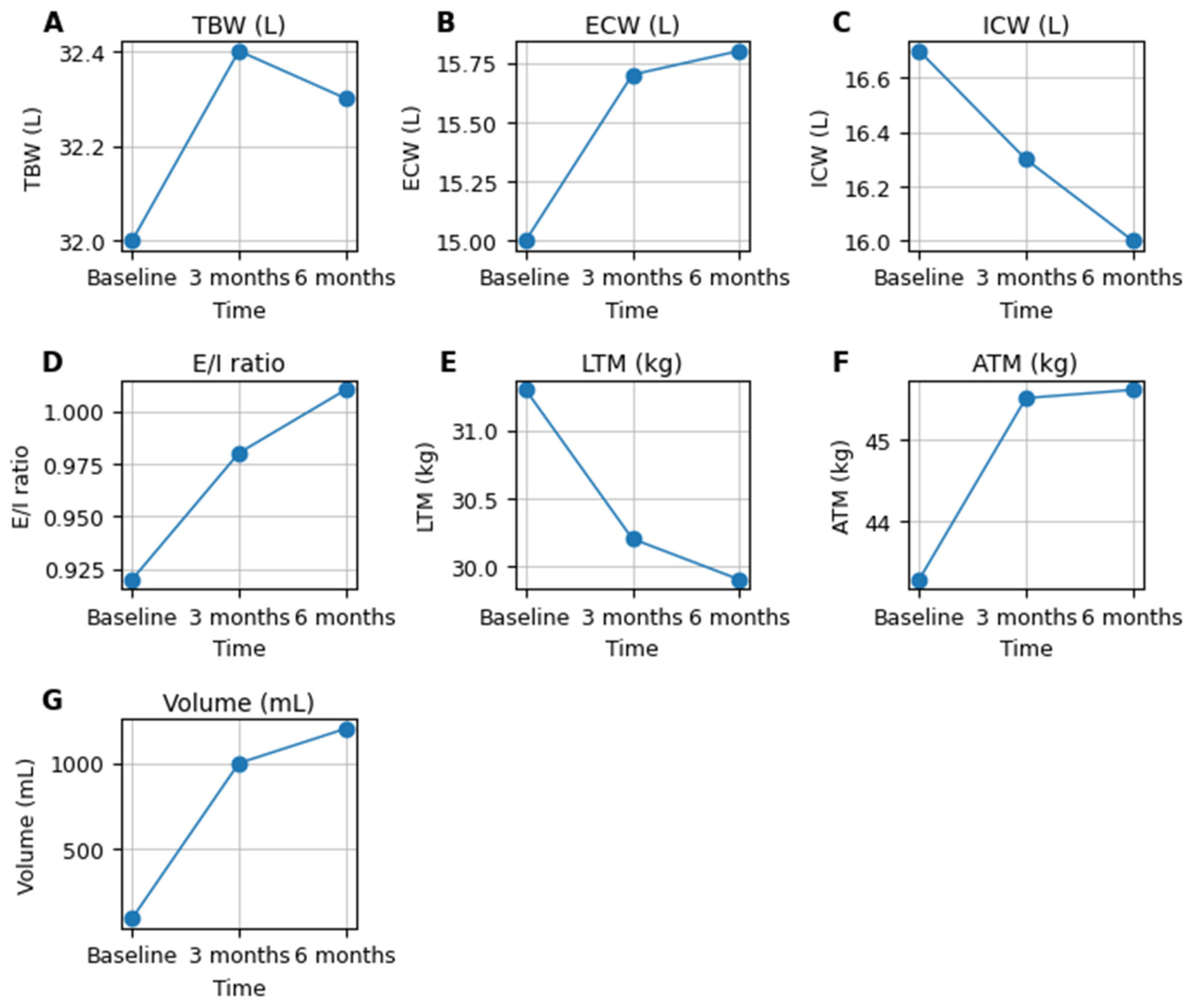
| Parameter | Baseline | 3 Months | 6 Months | Δ (0–6 Months) | p-Value |
|---|---|---|---|---|---|
| TBW (L) | 32.0 | 32.4 | 32.3 | +0.3 | 0.616 |
| ECW (L) | 15.0 | 15.7 | 15.8 | +0.8 | <0.001 |
| ICW (L) | 16.7 | 16.3 | 16.0 | −0.7 | 0.015 |
| E/I ratio | 0.92 | 0.98 | 1.01 | +0.09 | 0.011 |
| LTM (kg) | 31.3 | 30.2 | 29.9 | −1.4 | <0.001 |
| ATM (kg) | 43.3 | 45.5 | 45.6 | +2.3 | 0.015 |
| Volume (mL) | 100 | 1000 | 1200 | +1100 | <0.001 |
| Parameter | Δ1 (0–3 Months) | Δ2 (3–6 Months) | Δ3 (0–6 Months) |
|---|---|---|---|
| ATM (kg) | 1.3 (4.9) | 0.0 (1.7) | 1.2 (8.7) |
| LTM (kg) | −1.2 (5.2) | 0.0 (2.5) | −1.1 (5.6) |
| Volume (mL) | 1000 (1200) | 400 (700) | 1400 (1700) |
| E/I ratio | 0.058 (0.12) | 0.013 (0.13) | 0.081 (0.14) |
| Parameter | Non-Anthracycline (n = 22) Median (IQR) | Mean Rank | Anthracycline (n = 29) Median (IQR) | Mean Rank | p-Value * |
|---|---|---|---|---|---|
| ΔATM_1 (kg) | 0.85 (5.77) | 22.43 | 1.70 (6.85) | 28.71 | 0.135 |
| ΔATM_2 (kg) | 0.00 (2.05) | 24.25 | 0.10 (2.05) | 27.33 | 0.464 |
| ΔATM_3 (kg) | 0.75 (5.97) | 23.02 | 2.10 (11.10) | 28.26 | 0.213 |
| ΔVolume_1 (mL) | 1000 (1825) | 26.84 | 900 (1000) | 25.36 | 0.725 |
| ΔVolume_2 (mL) | 500 (725) | 26.48 | 400 (650) | 25.64 | 0.841 |
| ΔVolume_3 (mL) | 1200 (1925) | 26.75 | 1400 (1700) | 25.43 | 0.753 |
| ΔE/I_1 | 0.061 (0.13) | 25.68 | 0.054 (0.12) | 26.24 | 0.894 |
| ΔE/I_2 | 0.010 (0.19) | 26.48 | 0.014 (0.11) | 25.64 | 0.842 |
| ΔE/I_3 | 0.087 (0.20) | 26.64 | 0.081 (0.12) | 25.52 | 0.790 |
| ΔLTM_1 (kg) | −0.40 (7.40) | 31.93 | −1.90 (5.00) | 21.50 | 0.013 |
| ΔLTM_2 (kg) | 0.20 (2.87) | 27.82 | −0.70 (2.60) | 24.62 | 0.447 |
| ΔLTM_3 (kg) | −0.20 (4.00) | 31.80 | −2.30 (6.80) | 21.60 | 0.015 |
| Parameter | Non-Docetaxel (n = 6) Median (IQR) | Mean Rank | Docetaxel (n = 44) Median (IQR) | Mean Rank | p-Value * |
|---|---|---|---|---|---|
| ΔATM_1 (kg) | −0.50 (9.75) | 16.67 | 1.55 (5.28) | 26.70 | 0.114 |
| ΔATM_2 (kg) | 0.15 (2.18) | 32.42 | −0.05 (2.03) | 24.56 | 0.215 |
| ΔATM_3 (kg) | 1.10 (11.00) | 21.00 | 1.30 (9.17) | 26.11 | 0.420 |
| ΔVolume_1 (mL) | 350 (1100) | 17.08 | 1000 (1300) | 26.65 | 0.131 |
| ΔVolume_2 (mL) | 0 (475) | 11.92 | 500 (600) | 27.35 | 0.015 |
| ΔVolume_3 (mL) | 350 (1025) | 13.58 | 1500 (1700) | 27.13 | 0.033 |
| ΔE/I_1 | 0.022 (0.11) | 15.33 | 0.071 (0.15) | 26.89 | 0.069 |
| ΔE/I_2 | −0.018 (0.15) | 20.92 | 0.019 (0.12) | 26.13 | 0.412 |
| ΔE/I_3 | −0.023 (0.15) | 14.50 | 0.094 (0.12) | 27.00 | 0.049 |
| ΔLTM_1 (kg) | −0.25 (6.00) | 34.25 | −1.60 (5.13) | 24.31 | 0.117 |
| ΔLTM_2 (kg) | 0.10 (0.90) | 29.42 | −0.40 (3.13) | 24.97 | 0.483 |
| ΔLTM_3 (kg) | −0.10 (6.57) | 34.83 | −1.85 (5.78) | 24.23 | 0.094 |
Disclaimer/Publisher’s Note: The statements, opinions and data contained in all publications are solely those of the individual author(s) and contributor(s) and not of MDPI and/or the editor(s). MDPI and/or the editor(s) disclaim responsibility for any injury to people or property resulting from any ideas, methods, instructions or products referred to in the content. |
© 2026 by the authors. Licensee MDPI, Basel, Switzerland. This article is an open access article distributed under the terms and conditions of the Creative Commons Attribution (CC BY) license.
Share and Cite
Akkuş, A.F.; Öztürk, G.; Akkuş, Ö.F.; Kurultak, İ.; Aydın, T.İ.; Küçükarda, A.; Hacıoğlu, M.B.; Topaloğlu, S.; Erdoğan, B. Longitudinal Changes in Body Composition and Fluid Distribution During Chemotherapy in Breast Cancer Patients: A Prospective Single-Center Longitudinal Observational Study Using Bioimpedance Spectroscopy. J. Clin. Med. 2026, 15, 4556. https://doi.org/10.3390/jcm15124556
Akkuş AF, Öztürk G, Akkuş ÖF, Kurultak İ, Aydın Tİ, Küçükarda A, Hacıoğlu MB, Topaloğlu S, Erdoğan B. Longitudinal Changes in Body Composition and Fluid Distribution During Chemotherapy in Breast Cancer Patients: A Prospective Single-Center Longitudinal Observational Study Using Bioimpedance Spectroscopy. Journal of Clinical Medicine. 2026; 15(12):4556. https://doi.org/10.3390/jcm15124556
Chicago/Turabian StyleAkkuş, Aysun Fatma, Gökhan Öztürk, Ömer Ferudun Akkuş, İlhan Kurultak, Tayyip İlker Aydın, Ahmet Küçükarda, Muhammet Bekir Hacıoğlu, Sernaz Topaloğlu, and Bülent Erdoğan. 2026. "Longitudinal Changes in Body Composition and Fluid Distribution During Chemotherapy in Breast Cancer Patients: A Prospective Single-Center Longitudinal Observational Study Using Bioimpedance Spectroscopy" Journal of Clinical Medicine 15, no. 12: 4556. https://doi.org/10.3390/jcm15124556
APA StyleAkkuş, A. F., Öztürk, G., Akkuş, Ö. F., Kurultak, İ., Aydın, T. İ., Küçükarda, A., Hacıoğlu, M. B., Topaloğlu, S., & Erdoğan, B. (2026). Longitudinal Changes in Body Composition and Fluid Distribution During Chemotherapy in Breast Cancer Patients: A Prospective Single-Center Longitudinal Observational Study Using Bioimpedance Spectroscopy. Journal of Clinical Medicine, 15(12), 4556. https://doi.org/10.3390/jcm15124556