Sex-Dependent Prevalence of Sagittal Skeletal, Dental Malocclusions in Romanian Orthodontic Patients: An Observational Study

 ,
, 
 , , and
Abstract
1. Introduction
- There is no significant association between sex and the type of dental/skeletal malocclusion.
- There is no significant association between the type of dental/skeletal malocclusion and various cephalometric measurements such as FMA, SNA, SNB, ANB angles, etc.
2. Materials and Methods
2.1. Ethical Considerations
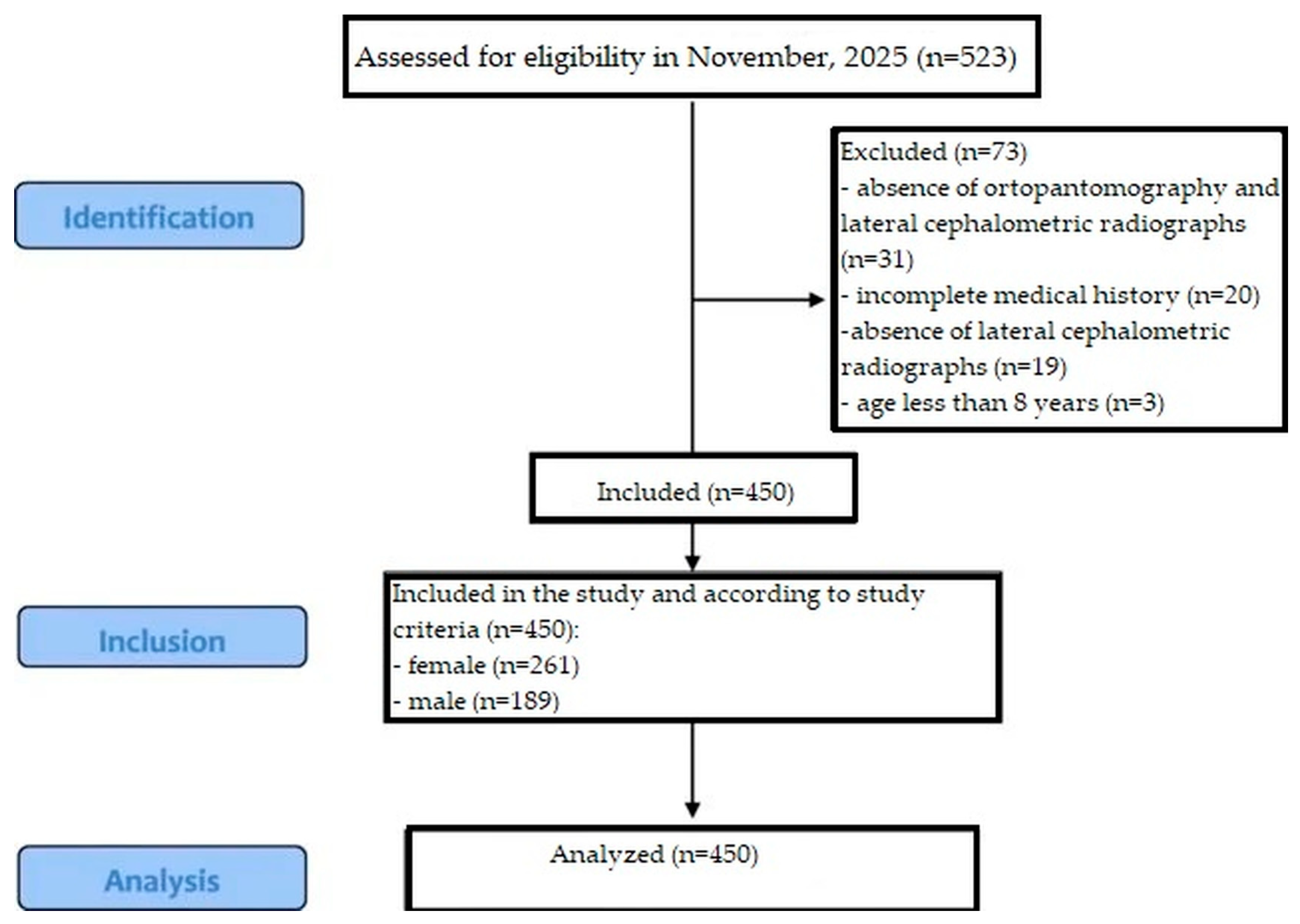
2.2. Sample Selection
2.3. Inclusion and Exclusion Criteria
2.4. Characterization of Growth Pattern and Skeletal Classification
2.5. Diagnosis of Dental Malocclusions
- Class I;
- Class II;
- Class II division 1;
- Class II division 2;
- Class III.
2.6. Reliability
- Initial collection of clinical data, including age and sex, from the dental records;
- Each examiner received an individual folder for each patient included in the study. The folder contained the patient’s age and sex, the initial panoramic radiograph, intraoral and extraoral photographic records, and the initial lateral cephalometric X-ray. In addition, the corresponding study cast was provided in physical format for direct evaluation.
- Assessment of the initial panoramic radiographs and photographic records, as presented in the present document;
- Evaluation of the study casts, which were physically examined by the investigators;
- Cephalometric analysis of the lateral radiographs using three analytical methods (Riedel, Roth–Jarabak, and Tweed), performed by the first examiner;
- Recording of the obtained measurements and observations in a dedicated Excel database by the first examiner;
- Independent cephalometric analysis of the lateral radiographs using the same three analytical methods (Riedel, Roth–Jarabak, and Tweed), performed by the second examiner;
- Recording of the obtained measurements and observations in a dedicated Excel database by the second examiner;
- Reassessment of the cephalometric radiographs after a 25-day interval by the first examiner using the same three analytical methods, with data entered into a separate Excel database in order to minimize measurement bias and examiner influence;
- Reassessment of the cephalometric radiographs after a 25-day interval by the second examiner using the same three analytical methods, with data recorded in a separate Excel database to minimize potential examiner-related bias;
- Consolidation and centralization of all collected data into a single Excel database;
- Statistical analysis of the compiled dataset.
2.7. Statistical Analysis
3. Results
- -
- Female patients presented more frequently with Class I (55.2% vs. 44.4%) or Class II division 2 malocclusion (6.9% vs. 1.6%), whereas male patients exhibited Class III malocclusion more frequently (23.8% vs. 5.7%).
- -
- Female patients exhibited skeletal Class II more frequently due to retrognathic mandible (36.8% vs. 17.5%), while skeletal Class III due to prognathic mandible was more common in male patients (14.3% vs. 4.6%).
- -
- Male patients were more frequently normodivergent (47.6% vs. 37.9%), while female patients were more frequently hyperdivergent (23% vs. 7.9%).
- -
- The inclination of the maxillary incisors (Max1-FH angle) was significantly different according to sex (p = 0.003). Post hoc Z-tests with Bonferroni correction showed that female patients exhibited retroclined upper incisors more frequently compared to males (19.5% vs. 9.5%), whereas male patients exhibited proclined upper incisors more frequently (57.1% vs. 43.7%).
- -
- Age was significantly different across groups (p < 0.001): patients aged 8–12 exhibited Class III malocclusion more frequently (30% vs. 7.5%/0%), patients aged 13–18 showed more frequently Class II/2 malocclusion (100% vs. 47.5%/20%) and patients over 18 years old exhibited more frequently Class II/1 or Class III malocclusion (45%/50% vs. 0%);
- -
- Gender was significantly different across groups (p < 0.001): female patients showed more frequent class II/1 or class II/2 malocclusion (57.5%/85.7% vs. 25%), while male patients showed more frequent class III malocclusion (75% vs. 42.5%/14.3%);
- -
- Skeletal anomalies were significantly different across groups (p < 0.001): patients with Class I skeletal anomaly showed more frequently Class II/1 or class III dental malocclusion (25%/45% vs. 0%), patients with Class II skeletal anomaly due to prognathic maxilla showed more frequently class II/1 or class II/2 dental malocclusion (25%/28.6% vs. 0%), patients with class II skeletal anomaly due to retrognathic mandible showed more frequently class II/1 or class II/2 dental malocclusion (50%/71.4% vs. 0%), patients with class III skeletal anomaly due to retrognathic maxilla showed more frequently class III dental malocclusion (10% vs. 0%/0%) and patients with classs III skeletal anomaly due to prognathic mandible showed more frequently class III dental malocclusion (45% vs. 0%/0%);
- -
- SNA was significantly different across groups (p = 0.033): patients with class II/2 malocclusion had higher SNA values than patients exhibiting class II/1 malocclusion (p = 0.029);
- -
- ANB was significantly different across groups (p < 0.001): patients with class III malocclusion had lower ANB values than patients exhibiting class II/1 (p < 0.001) or class II/2 malocclusion (p < 0.001);
- -
- SNB was significantly different across groups (p < 0.001): patients with class III malocclusion had higher SNB values than patients exhibiting class II/1 (p < 0.001) or class II/2 malocclusion (p < 0.001);
- -
- S-N/Go-Gn was significantly different across groups (p = 0.001): patients with class II/2 had lower S-N/Go-Gn values than patients exhibiting class II/1 malocclusion (p = 0.001);
- -
- N-A-Pog was significantly different across groups (p < 0.001): patients with class III malocclusion had lower N-A-Pog values than patients exhibiting class II/1 (p < 0.001) or class II/2 malocclusion (p < 0.001);
- -
- Interincisal angle was significantly different across groups (p < 0.001): patients with class II/2 malocclusion had higher interincisal angle values than patients exhibiting class II/1 (p < 0.001) or class III malocclusion (p = 0.002). Also, patients with class III malocclusion had higher interincisal angle values than patients exhibiting class II/1 malocclusion (p < 0.001);
- -
- Max1-FH was significantly different across groups (p < 0.001): patients with class II/2 malocclusion had lower Max1-FH values than patients exhibiting class II/1 (p < 0.001) or class III malocclusion (p < 0.001);
- -
- Ar-Go-Me was significantly different across groups (p < 0.001): patients with class II/2 malocclusion had lower Ar-Go-Me values than patients exhibiting class II/1 (p < 0.001) or class III malocclusion (p < 0.001). Also, patients with class III malocclusion had higher Ar-Go-Me values than patients exhibiting class II/1 malocclusion (p < 0.001);
- -
- FMA was significantly different across groups (p = 0.002): patients with class II/2 malocclusion had lower FMA values than patients with class II/1 (p = 0.001) or class III malocclusion (p = 0.027);
- -
- IMPA was significantly different across groups (p < 0.001): patients with class III malocclusion had lower IMPA values than patients exhibiting class II/1 (p < 0.001) or class II/2 malocclusion (p < 0.001).
4. Discussion
5. Conclusions
Author Contributions
Funding
Institutional Review Board Statement
Informed Consent Statement
Data Availability Statement
Acknowledgments
Conflicts of Interest
References
- Sousa, R.V.; Pinto-Monteiro, A.K.; Martins, C.C.; Granville-Garcia, A.F.; Paiva, S.M. Malocclusion and socioeconomic indicators in primary dentition. Braz. Oral Res. 2014, 28, 54–60. [Google Scholar] [CrossRef] [PubMed]
- Heimer, M.V.; Tornisiello Katz, C.R.; Rosenblatt, A. Non-nutritive sucking habits, dental malocclusions, and facial morphology in Brazilian children: A longitudinal study. Eur. J. Orthod. 2008, 30, 580–585. [Google Scholar] [CrossRef] [PubMed]
- Rapeepattana, S.; Thearmontree, A.; Suntornlohanakul, S. Etiology of Malocclusion and Dominant Orthodontic Problems in Mixed Dentition: A Cross-sectional Study in a Group of Thai Children Aged 8–9 Years. J. Int. Soc. Prev. Commun. Dent. 2019, 9, 383–389. [Google Scholar] [CrossRef] [PubMed] [PubMed Central]
- Koaban, A.; Al-Harbi, S.K.; Al-Shehri, A.Z.; Al-Shamri, B.S.; Aburazizah, M.F.; Al-Qahtani, G.H.; Al-Wusaybie, L.H.; Alkhalifa, L.B.; Al-Saad, M.M.; Al-Nehab, A.A.; et al. Current Trends in Pediatric Orthodontics: A Comprehensive Review. Cureus 2024, 16, e68537. [Google Scholar] [CrossRef] [PubMed] [PubMed Central]
- Närhi, L.; Tolvanen, M.; Pirttiniemi, P.; Silvola, A.S. Malocclusion severity and its associations with oral health-related quality of life in an adult population. Eur. J. Orthod. 2022, 44, 377–384. [Google Scholar] [CrossRef] [PubMed] [PubMed Central]
- Letra, A.; Menezes, R.; Granjeiro, J.M.; Vieira, A.R. Defining subphenotypes for oral clefts based on dental development. J. Dent. Res. 2007, 86, 986–991. [Google Scholar] [CrossRef] [PubMed] [PubMed Central]
- Guo, L.; Feng, Y.; Guo, H.G.; Liu, B.W.; Zhang, Y. Consequences of orthodontic treatment in malocclusion patients: Clinical and microbial effects in adults and children. BMC Oral Health 2016, 16, 112. [Google Scholar] [CrossRef] [PubMed] [PubMed Central]
- Alhammadi, M.S.; Halboub, E.; Fayed, M.S.; Labib, A.; El-Saaidi, C. Global distribution of malocclusion traits: A systematic review. Dent. Press J. Orthod. 2018, 23, 40.e1–40.e10, Erratum in Dent. Press J Orthod. 2019, 24, 113. https://doi.org/10.1590/2177-6709.24.3.113.err. [Google Scholar] [CrossRef] [PubMed] [PubMed Central]
- Naini, F.B.; Manouchehri, S.; Al-Bitar, Z.B.; Gill, D.S.; Garagiola, U.; Wertheim, D. The maxillary incisor labial face tangent: Clinical evaluation of maxillary incisor inclination in profile smiling view and idealized aesthetics. Maxillofac. Plast. Reconstr. Surg. 2019, 41, 31. [Google Scholar] [CrossRef] [PubMed] [PubMed Central]
- Riedel, R.A. The relation of maxillary structures to cranium in malocclusion and in normal occlusion. Angle Orthod. 1952, 22, 142–145. [Google Scholar] [CrossRef]
- Fishman, L.S. Individualized evaluation of facial form. Am. J. Orthod. Dentofac. Orthop. 1997, 111, 510–517. [Google Scholar] [CrossRef] [PubMed]
- Segner, D.; Hasund, A. Individualisierte Kephalometrie, 4th ed.; Segner: Munich, Germany, 2003. [Google Scholar]
- Panagiotidis, G.; Witt, E. Der individualisierte ANB-Winkel. Fortschr. Kieferorthop. 1977, 38, 408–416. [Google Scholar] [CrossRef]
- Pancherz, H.; Zieber, K.; Hoyer, B. Cephalometric characteristics of Class II division 1 and Class II division 2 malocclusions: A comparative study in children. Angle Orthod. 1997, 67, 111–120. [Google Scholar] [CrossRef] [PubMed]
- Lone, I.M.; Zohud, O.; Midlej, K.; Proff, P.; Watted, N.; Iraqi, F.A. Skeletal Class II Malocclusion: From Clinical Treatment Strategies to the Roadmap in Identifying the Genetic Bases of Development in Humans with the Support of the Collaborative Cross Mouse Population. J. Clin. Med. 2023, 12, 5148. [Google Scholar] [CrossRef] [PubMed] [PubMed Central]
- Maspero, C.; Galbiati, G.; Giannini, L.; Guenza, G.; Farronato, M. Class II division 1 malocclusions: Comparisons between one- and two-step treatment. Eur. J. Paediatr. Dent. 2018, 19, 295–299. [Google Scholar] [CrossRef] [PubMed]
- Hong, S.X.; Yi, C.K. A classification and characterization of skeletal class III malocclusion on etio-pathogenic basis. Int. J. Oral Maxillofac. Surg. 2001, 30, 264–271. [Google Scholar] [CrossRef] [PubMed]
- Cenzato, N.; Nobili, A.; Maspero, C. Prevalence of Dental Malocclusions in Different Geographical Areas: Scoping Review. Dent. J. 2021, 9, 117. [Google Scholar] [CrossRef] [PubMed] [PubMed Central]
- Zohud, O.; Lone, I.M.; Midlej, K.; Obaida, A.; Masarwa, S.; Schröder, A.; Küchler, E.C.; Nashef, A.; Kassem, F.; Reiser, V.; et al. Towards Genetic Dissection of Skeletal Class III Malocclusion: A Review of Genetic Variations Underlying the Phenotype in Humans and Future Directions. J. Clin. Med. 2023, 12, 3212. [Google Scholar] [CrossRef] [PubMed] [PubMed Central]
- Watanabe, M.; Suda, N.; Ohyama, K. Mandibular prognathism in Japanese families ascertained through orthognathically treated patients. Am. J. Orthod. Dentofac. Orthop. 2005, 128, 466–470. [Google Scholar] [CrossRef] [PubMed]
- Derwich, M.; Minch, L.; Mitus-Kenig, M.; Zoltowska, A.; Pawlowska, E. Personalized Orthodontics: From the Sagittal Position of Lower Incisors to the Facial Profile Esthetics. J. Pers. Med. 2021, 11, 692. [Google Scholar] [CrossRef] [PubMed] [PubMed Central]
- Kiełczykowski, M.; Perkowski, K.; Kamiński, K.; Zadurska, M.; Czochrowska, E. Evaluation of the soft tissue facial profile in different skeletal malocclusions in relation to age. BMC Oral Health 2024, 24, 711. [Google Scholar] [CrossRef] [PubMed] [PubMed Central]
- Amrollahi, N.; Hashemi, S.; Heidari, Z. Impact of molar incisor hypomineralization on oral health-related quality of life in 8–10 years old children: A systematic review and meta-analysis. J. Evid. Based Dent. Pract. 2023, 23, 101889. [Google Scholar] [CrossRef] [PubMed]
- Baskaradoss, J.K.; Geevarghese, A.; Alsaadi, W.; Alemam, H.; Alghaihab, A.; Almutairi, A.S.; Almthen, A. The impact of malocclusion on the oral health related quality of life of 11–14-year-old children. BMC Pediatr. 2022, 22, 91. [Google Scholar] [CrossRef] [PubMed] [PubMed Central]
- Kallunki, J.; Sollenius, O.; Paulsson, L.; Petrén, S.; Dimberg, L.; Bondemark, L. Oral health-related quality of life among children with excessive overjet or unilateral posterior crossbite with functional shift compared to children with no or mild orthodontic treatment need. Eur. J. Orthod. 2019, 41, 111–116. [Google Scholar] [CrossRef] [PubMed]
- Lombardo, G.; Vena, F.; Negri, P.; Pagano, S.; Barilotti, C.; Paglia, L.; Colombo, S.; Orso, M.; Cianetti, S. Worldwide prevalence of malocclusion in the different stages of dentition: A systematic review and meta-analysis. Eur. J. Paediatr. Dent. 2020, 21, 115–122. [Google Scholar] [CrossRef] [PubMed]
- Bourzgui, F.; Sebbar, M.; Hamza, M.; Lazrak, L.; Abidine, Z.; El Quars, F. Prevalence of malocclusions and orthodontic treatment need in 8- to 12-year-old schoolchildren in Casablanca, Morocco. Prog. Orthod. 2012, 13, 164–172. [Google Scholar] [CrossRef] [PubMed]
- Sidlauskas, A.; Svalkauskiene, V.; Sidlauskas, M. Assessment of skeletal and dental pattern of Class II division 1 malocclusion with relevance to clinical practice. Stomatologija 2006, 8, 3–8. [Google Scholar] [PubMed]
- Singh, S.; Sharma, A.; Sandhu, N.; Mehta, K. The prevalence of malocclusion and orthodontic treatment needs in school going children of Nalagarh, Himachal Pradesh, India. Indian. J. Dent. Res. 2016, 27, 317. [Google Scholar] [CrossRef]
- Miyajima, K.; McNamara, J.A.; Kimura, T., Jr.; Murata, S.; Iizuka, T. Craniofacial structure of Japanese and European-American adults with normal occlusions and well-balanced faces. Am. J. Orthod. Dentofac. Orthop. 1996, 110, 431–438. [Google Scholar] [CrossRef]
- Kanas, R.J.; Carapezza, L.; Kanas, S.J. Treatment classification of Class III malocclusion. J. Clin. Pediatr. Dent. 2008, 33, 175–185. [Google Scholar] [CrossRef] [PubMed]
- Mouakeh, M. Cephalometric evaluation of craniofacial pattern of Syrian children with Class III malocclusion. Am. J. Orthod. Dentofac. Orthop. 2001, 119, 640–649. [Google Scholar] [CrossRef] [PubMed]
- Sharma, D.; Avasthi, D.; Kumar, D.; Singh, D. Epidemiology of malocclusion: An Indian perspective-review article. Sch. J. Dent. Sci. 2019, 6, 142–147. [Google Scholar]
- Balachandran, P.; Janakiram, C. Prevalence of malocclusion among 8–15 years old children, India—A systematic review and meta-analysis. J. Oral Biol. Craniofac. Res. 2021, 11, 192–199. [Google Scholar] [CrossRef] [PubMed] [PubMed Central]
- Paddenberg, E.; Proff, P.; Kirschneck, C. Floating norms for individualising the ANB angle and the WITS appraisal in orthodontic cephalometric analysis based on guiding variables. J. Orofac. Orthop. 2023, 84, 10–18. [Google Scholar] [CrossRef] [PubMed] [PubMed Central]
- Shaw, W.C.; Lewis, H.G.; Robertson, N.R. Perception of malocclusion. Br. Dent. J. 1975, 138, 211–216. [Google Scholar] [CrossRef] [PubMed]
- Al-Zubair, N.M. Orthodontic treatment need of Yemeni children assessed with dental aesthetic index. J. Orthod. Sci. 2014, 3, 41–45. [Google Scholar] [CrossRef] [PubMed] [PubMed Central]
- De Ridder, L.; Aleksieva, A.; Willems, G.; Declerck, D.; Cadenas, L.P.M. Prevalence of Orthodontic malocclusions in Healthy Children and adolescents: A systematic review. Int. J. Environ. Res. Public. Health 2022, 19, 7446. [Google Scholar] [CrossRef] [PubMed]
- Atasever İşler, A.A.; Hezenci, Y.; Bulut, M. Prevalence of orthodontic malocclusion in children aged 10–12: An epidemiological study. BMC Oral Health 2025, 25, 249. [Google Scholar] [CrossRef] [PubMed] [PubMed Central]
- Akbari, M.; Lankarani, K.B.; Honarvar, B.; Tabrizi, R.; Mirhadi, H.; Moosazadeh, M. Prevalence of malocclusion among Iranian children: A systematic review and meta-analysis. Dent. Res. J. 2016, 13, 387–395. [Google Scholar] [CrossRef] [PubMed] [PubMed Central]
- Burgersdijk, R.; Truin, G.J.; Frankenmolen, F.; Kalsbeek, H.; van’t Hof, M.; Mulder, J. Malocclusion and orthodontic treatment need of 15–74-year-old Dutch adults. Commun. Dent. Oral Epidemiol. 1991, 19, 64–67. [Google Scholar] [CrossRef] [PubMed]
- Gardiner, J.H. An orthodontic survey of Libyan schoolchildren. Br. J. Orthod. 1982, 9, 59–61. [Google Scholar] [CrossRef] [PubMed]
- El-Mangoury, N.H.; Mostafa, Y.A. Epidemiologic panorama of dental occlusion. Angle Orthod. 1990, 60, 207–214. [Google Scholar] [CrossRef] [PubMed]
- Vaida, L.L.; Dima, R.; Cuc, E.A.; Negrutiu, B.M.; Moca, A.E.; Lile, I.E.; Daragiu, D.; Zalana, A.; Albert, E.L.; Todor, B.I. Comparative Study on the Efficiency of Intermaxillary Elastic Polymers used in the Treatment of Skeletal Class II Malocclusions in Growing Patients. Mater. Plast. 2019, 56, 341–345. [Google Scholar] [CrossRef]
- Shen, L.; He, F.; Zhang, C.; Jiang, H.; Wang, J. Prevalence of malocclusion in primary dentition in mainland China, 1988–2017: A systematic review and meta-analysis. Sci. Rep. 2018, 8, 4716. [Google Scholar] [CrossRef] [PubMed] [PubMed Central]
- Almotairy, N.; Almutairi, F. A Nation-wide Prevalence of Malocclusion Traits in Saudi Arabia: A Systematic Review. J. Int. Soc. Prev. Commun. Dent. 2022, 12, 1–11. [Google Scholar] [CrossRef] [PubMed] [PubMed Central]
- Aldrees, A.M. Lateral cephalometric norms for Saudi adults: A meta-analysis. Saudi Dent. J. 2011, 23, 3–7. [Google Scholar] [CrossRef] [PubMed] [PubMed Central]
- Lone, I.M.; Zohud, O.; Nashef, A.; Kirschneck, C.; Proff, P.; Watted, N.; Iraqi, F.A. Dissecting the Complexity of Skeletal-Malocclusion-Associated Phenotypes: Mouse for the Rescue. Int. J. Mol. Sci. 2023, 24, 2570. [Google Scholar] [CrossRef] [PubMed] [PubMed Central]
- Oh, E.; Ahn, S.J.; Sonnesen, L. Ethnic differences in craniofacial and upper spine morphology in children with skeletal Class II malocclusion. Angle Orthod. 2018, 88, 283–291. [Google Scholar] [CrossRef] [PubMed] [PubMed Central]
- Negruţiu, B.M.; Vaida, L.L.; Todor, B.I.; Judea, A.S.; Lile, I.E.; Moca, A.E.; Judea-Pusta, C.T. An important morphological feature of the face: Upper lip length. Rom. J. Morphol. Embryol. 2019, 60, 537–541. [Google Scholar] [PubMed]
- Alhammadi, M.S. Dentoalveolar compensation in different anterioposterior and vertical skeletal malocclusions. J. Clin. Exp. Dent. 2019, 11, e745–e753. [Google Scholar] [CrossRef] [PubMed] [PubMed Central]
- Steiner, C.C. Cephalometrics for You and Me. Am. J. Orthod. 1953, 39, 729–755. [Google Scholar] [CrossRef]
- Stahl, F.; Baccetti, T.; Franchi, L.; McNamara, J.A., Jr. Longitudinal growth changes in untreated subjects with Class II Division 1 malocclusion. Am. J. Orthod. Dentofac. Orthop. 2008, 134, 125–137. [Google Scholar] [CrossRef] [PubMed]
- Pillai, J.P.; Shah, R.J.; Darji, B.; Banker, A.; Pillai, R.J. Association of the Gonial Angle with Age, Gender, and Dental Status: A Radiographic Study Using Lateral Cephalogram and Orthopantomogram. J. Forensic. Radiol. Imaging 2018, 15, 8–13. [Google Scholar] [CrossRef]
- Paddenberg-Schubert, E.; Midlej, K.; Krohn, S.; Lone, I.M.; Zohud, O.; Awadi, O.; Masarwa, S.; Nashef, A.; Kirschneck, C.; Watted, N.; et al. Cross-Sectional Observational Study of the Differences in Cephalometric Parameters in German Class I/II Orthodontic Patients. Int. J. Dent. 2025, 2025, 9665260. [Google Scholar] [CrossRef] [PubMed] [PubMed Central]
- Kau, C.H.; Bakos, K.; Lamani, E. Quantifying changes in incisor inclination before and after orthodontic treatment in class I, II, and III malocclusions. J. World Fed. Orthod. 2020, 9, 170–174. [Google Scholar] [CrossRef] [PubMed]
- Lew, K.K.; Foong, W.C.; Loh, E. Malocclusion prevalence in an ethnic Chinese population. Aust. Dent. J. 1993, 38, 442–449. [Google Scholar] [CrossRef] [PubMed]
- Jacob, H.B.; Buschang, P.H. Mandibular growth comparisons of Class I and Class II division 1 skeletofacial patterns. Angle Orthod. 2014, 84, 755–761. [Google Scholar] [CrossRef] [PubMed] [PubMed Central]
- Midlej, K.; Watted, N.; Awadi, O.; Masarwa, S.; Lone, I.M.; Zohud, O.; Paddenberg, E.; Krohn, S.; Kuchler, E.; Proff, P.; et al. Lateral cephalometric parameters among Arab skeletal classes II and III patients and applying machine learning models. Clin. Oral Investig. 2024, 28, 511. [Google Scholar] [CrossRef] [PubMed] [PubMed Central]


| Cephalometric Parameter | Definition | Clinical Norm | Interpretation | |
|---|---|---|---|---|
| Decreased | Increased | |||
| SNA (°) | Angle formed by connecting the Sella-Nasion plane to the A point; determines the antero-posterior relationship of the maxilla to the anterior cranial base (S-N); | 82° ± 2° (Mc Laughlin) | Retrognathic maxilla | Prognathic maxilla |
| SNB (°) | Angle formed by connecting the Sella-Nasion plane to the B point; determines the antero-posterior relationship of the mandible to the anterior cranial base (S-N); | 80° ± 2° (Mc Laughlin) | Retrognathic mandible | Prognathic mandible |
| ANB (°) | Angle formed by subtracting SNB angle from SNA angle; determines a relative position of A point to B point, the sagittal jaw relationship; | 2° ± 2° (Mc Laughlin) | Skeletal class III | Skeletal class II |
| S-N/Go-Gn (°) | Angle formed by the anterior cranial base (S-N) and the mandibular plane (Go-Gn); determines the inclination of the mandibular plane to the anterior cranial base; | 32° ± 5° (Mc Laughlin) | Horizontal growing, counter-clockwise rotation, tendency to deep-bite | Vertical growing, clockwise rotation, tendency to open-bite |
| N-A-Pog (°) | Angle formed by Nasion-Point A plane and point A—Pogonion plane; it determines the angle of convexity (the convexity of the profile); | 0° ± 5° | Concave profile | Convex profile |
| Interincisal (°) | Angle formed by the axes of the upper and lower incisors, important for the stability of the teeth; it describes the vertical and horizontal dimensions of the occlusion of the incisors; | 135° ± 5° (Downs) | Proclined upper and lower incisors | Retroclined upper and lower incisors |
| Max1-FH (°) | Angle formed by the axis of the most prominent upper central incisor and the Frankfurt horizontal; it determines the inclination of the upper incisors relative to the Frankfurt horizontal plane; | 110° ± 2° (Downs) | Retroclined upper incisors | Proclined upper incisors |
| Ar-Go-Me (°) | Angle formed by the reference lines Ar-Go and Go-Me; it determines the gonial angle, referring to the relation between the corpus of the mandible and the mandibular ramus; | 130° ± 7° (Jarabak) | Anterior rotation of the mandible, vertical growth of the condyles | Posterior rotation of the mandible, posterior growth of the condyles |
| FMA (°) | Angle formed by the mandibular plane and the Frankfurt horizontal plane; it determines the divergency of the face; | 24° (Tweed) | hypodivergent | hyperdivergent |
| IMPA (°) | Angle formed by the mandibular plane and the axis of the most prominent lower incisors; it determines the inclination of the lower incisors; | 90° (Tweed) | Retroclined lower incisors | Proclined lower incisors |
| Parameter | Value |
|---|---|
| Age (Mean ± SD, Median (IQR)) | 20.07 ± 8.63, 16.65 (14.1–23.9) |
| Age category (No., %) | |
| 8–12 years | 30 (6.7%) |
| 13–18 years | 228 (50.7%) |
| ≥18 years | 192 (42.7%) |
| Sex (No., %) | |
| Female | 261 (58%) |
| Male | 189 (42%) |
| Dental malocclusion (No., %) | |
| Class I | 228 (50.7%) |
| Class II | 21 (4.7%) |
| Class II/1 | 120 (26.7%) |
| Class II/2 | 21 (4.7%) |
| Class III | 60 (13.3%) |
| SNA angle (Mean ± SD, Median (IQR)) | 82.79 ± 3.98, 82.6 (79.7–85.5) |
| ANB angle (Mean ± SD, Median (IQR)) | 4.16 ± 6.82, 4.15 (1.5–6.1) |
| SNB angle (Mean ± SD, Median (IQR)) | 78.62 ± 7.79, 78.75 (75.8–82.1) |
| S-N/Go-Gn angle (Mean ± SD, Median (IQR)) | 32.31 ± 6.35, 32.6 (27.6–36.8) |
| Skeletal anomaly (No., %) | |
| Class I | 195 (43.3%) |
| Class II—prognathic maxilla | 78 (17.3%) |
| Class II—retrognathic mandible | 129 (28.7%) |
| Class III—retrognathic maxilla | 9 (2%) |
| Class III—prognathic mandible | 39 (8.7%) |
| N-A-Pog angle (Mean ± SD, Median (IQR)) | 5.68 ± 7.87, 6.45 (0.7–11) |
| Interincisal angle (Mean ± SD, Median (IQR)) | 131.6 ± 12.77, 130.2 (123–138) |
| Max1-FH angle (Mean ± SD, Median (IQR)) | 114.46 ± 9.6, 114.8 (109–119) |
| Ar-Go-Me angle (Mean ± SD, Median (IQR)) | 125.07 ± 7.2, 125 (121–129) |
| FMA angle (Mean ± SD, Median (IQR)) | 22.96 ± 5.81, 22 (19–27) |
| IMPA angle (Mean ± SD, Median (IQR)) | 90.96 ± 8.65, 91 (86–98) |
| Age/Dental Malocclusion | 8–12 Years | 13–18 Years | ≥18 Years | p * | |||
|---|---|---|---|---|---|---|---|
| Nr. | % | Nr. | % | Nr. | % | ||
| Class I | 3 | 10% | 129 | 56.6% | 96 | 50% | <0.001 |
| Class II | 0 | 0% | 9 | 3.9% | 12 | 6.3% | |
| Class II/1 | 9 | 30% | 57 | 25% | 54 | 28.1% | |
| Class II/2 | 0 | 0% | 21 | 9.2% | 0 | 0% | |
| Class III | 18 | 60% | 12 | 5.3% | 30 | 15.6% | |
| Dental Malocclusion | Female | Male | p * | ||
|---|---|---|---|---|---|
| No. | % | No. | % | ||
| I | 144 | 55.2% | 84 | 44.4% | <0.001 |
| II | 15 | 5.7% | 6 | 3.2% | |
| II/1 | 69 | 26.4% | 51 | 27% | |
| II/2 | 18 | 6.9% | 3 | 1.6% | |
| III | 15 | 5.7% | 45 | 23.8% | |
| Skeletal anomaly | p * | ||||
| I | 105 | 40.2% | 90 | 47.6% | <0.001 |
| II-prognathic maxilla | 45 | 17.2% | 33 | 17.5% | |
| II-retrognathic mandible | 96 | 36.8% | 33 | 17.5% | |
| III-retrognathic maxilla | 3 | 1.1% | 6 | 3.2% | |
| III-prognathic mandible | 12 | 4.6% | 27 | 14.3% | |
| FMA angle | p * | ||||
| Low | 102 | 39.1% | 84 | 44.4% | <0.001 |
| Normal | 99 | 37.9% | 90 | 47.6% | |
| High | 60 | 23% | 15 | 7.9% | |
| Max1-FH angle | p * | ||||
| Low | 51 | 19.5% | 18 | 9.5% | 0.003 |
| Normal | 96 | 36.8% | 63 | 33.3% | |
| High | 114 | 43.7% | 108 | 57.1% | |
| Age/Dental Malocclusion | <18 years | ≥18 years | p * | ||
|---|---|---|---|---|---|
| Nr. | % | Nr. | % | ||
| Class I | 132 | 51.2% | 96 | 50% | 0.457 |
| Class II | 96 | 37.2% | 66 | 34.4% | |
| Class III | 30 | 11.6% | 30 | 15.6% | |
| Gender/Malocclusion | Female | Male | p* | ||
| Nr. | % | Nr. | % | ||
| Class I | 144 | 55.2% | 84 | 44.4% | <0.001 |
| Class II | 102 | 39.1% | 60 | 31.7% | |
| Class III | 15 | 5.7% | 45 | 23.8% | |
| Group * | Parameter | OR (95% C.I.) | p |
|---|---|---|---|
| Class II | Female | 0.996 (0.655–1.513) | 0.984 |
| <18 years | 1.058 (0.702–1.594) | 0.789 | |
| Class III | Female | 0.188 (0.099–0.360) | <0.001 |
| <18 years | 0.648 (0.358–1.172) | 0.152 |
| Parameter | Class II/1 | Class II/2 | Class III | p |
|---|---|---|---|---|
| Age (Median (IQR)) | 16.8 (14.5–28.5) | 15 (14–17.2) | 17.5 (10.6–21.9) | 0.015 * |
| Age group (Nr., %) | Class II/1 | Class II/2 | Class III | p |
| 8–12 years | 9 (7.5%) | 0 (0%) | 18 (30%) | <0.001 ** |
| 13–18 years | 57 (47.5%) | 21 (100%) | 12 (20%) | |
| ≥18 years | 54 (45%) | 0 (0%) | 30 (50%) | |
| Gender (Nr., %) | ||||
| Female | 69 (57.5%) | 18 (85.7%) | 15 (25%) | <0.001 ** |
| Male | 51 (42.5%) | 3 (14.3%) | 45 (75%) | |
| Skeletal anomaly (Nr., %) | ||||
| Class I | 30 (25%) | 0 (0%) | 27 (45%) | <0.001 ** |
| Class II—prognathic maxilla | 30 (25%) | 6 (28.6%) | 0 (0%) | |
| Class II—retrognathic mandible | 60 (50%) | 15 (71.4%) | 0 (0%) | |
| Class III—retrognathic maxilla | 0 (0%) | 0 (0%) | 6 (10%) | |
| Class III—prognathic mandible | 0 (0%) | 0 (0%) | 27 (45%) | |
| Analyzed angles (Median (IQR)) | ||||
| SNA | 81.1 (79.4–84.5) | 82.9 (81.2–86.8) | 81.6 (79.5–85.1) | 0.033 * |
| ANB | 5.95 (4.1–7.57) | 6.7 (4.6–7.2) | −0.35 (−3–0.78) | <0.001 * |
| SNB | 76 (73.8–78.6) | 76.8 (75.8–79.2) | 83.05 (79.4–88.6) | <0.001 * |
| S-N/Go-Gn | 32.4 (29–36.6) | 26.1 (21.4–34.1) | 31.8 (27–36.6) | 0.001 * |
| N-A-Pog | 9.4 (4.4–14.4) | 10.9 (7.6–13.9) | −2.4 (−11.3–0.7) | <0.001 * |
| Interincisal | 124 (116–131) | 148 (137–158) | 135 (124–145) | <0.001 * |
| Max1-FH | 117 (113–120) | 102 (90–103) | 118 (110–125) | <0.001 * |
| Ar-Go-Me | 123 (121–126) | 114 (110–121) | 127 (124–134) | <0.001 * |
| FMA | 23 (21–26.75) | 19 (12–24) | 22.5 (18.2–26.7) | 0.002 * |
| IMPA | 94 (89–99.75) | 95 (91–98) | 86 (77.5–91.5) | <0.001 * |
Disclaimer/Publisher’s Note: The statements, opinions and data contained in all publications are solely those of the individual author(s) and contributor(s) and not of MDPI and/or the editor(s). MDPI and/or the editor(s) disclaim responsibility for any injury to people or property resulting from any ideas, methods, instructions or products referred to in the content. |
© 2026 by the authors. Licensee MDPI, Basel, Switzerland. This article is an open access article distributed under the terms and conditions of the Creative Commons Attribution (CC BY) license.
Share and Cite
Negruțiu, B.M.; Todor, B.I.; Costea, C.P.; Iurcov, R.O.C.; Vaida, L.L.; Lucan, A.I.; Gârboan, R.L.; Pusta, C.J.; Rus, M.; Staniș, C.E. Sex-Dependent Prevalence of Sagittal Skeletal, Dental Malocclusions in Romanian Orthodontic Patients: An Observational Study. J. Clin. Med. 2026, 15, 4011. https://doi.org/10.3390/jcm15114011
Negruțiu BM, Todor BI, Costea CP, Iurcov ROC, Vaida LL, Lucan AI, Gârboan RL, Pusta CJ, Rus M, Staniș CE. Sex-Dependent Prevalence of Sagittal Skeletal, Dental Malocclusions in Romanian Orthodontic Patients: An Observational Study. Journal of Clinical Medicine. 2026; 15(11):4011. https://doi.org/10.3390/jcm15114011
Chicago/Turabian StyleNegruțiu, Bianca Maria, Bianca Ioana Todor, Cristina Paula Costea, Raluca Ortensia Cristina Iurcov, Ligia Luminița Vaida, Alexandra Ioana Lucan, Rebeca Lorena Gârboan, Claudia Judea Pusta, Marius Rus, and Claudia Elena Staniș. 2026. "Sex-Dependent Prevalence of Sagittal Skeletal, Dental Malocclusions in Romanian Orthodontic Patients: An Observational Study" Journal of Clinical Medicine 15, no. 11: 4011. https://doi.org/10.3390/jcm15114011
APA StyleNegruțiu, B. M., Todor, B. I., Costea, C. P., Iurcov, R. O. C., Vaida, L. L., Lucan, A. I., Gârboan, R. L., Pusta, C. J., Rus, M., & Staniș, C. E. (2026). Sex-Dependent Prevalence of Sagittal Skeletal, Dental Malocclusions in Romanian Orthodontic Patients: An Observational Study. Journal of Clinical Medicine, 15(11), 4011. https://doi.org/10.3390/jcm15114011