Effect of Cusp-Overlap View Technique on the Occurrence of Post-Procedural New Conduction Disturbance and Permanent Pacemaker Implantation Following Transcatheter Aortic Valve Replacement Using Self-Expanding Prostheses

 , , , , and
Abstract
1. Introduction
2. Methods
2.1. Study Population and Design
2.2. Inclusive and Exclusive Criteria
Ethics Statement
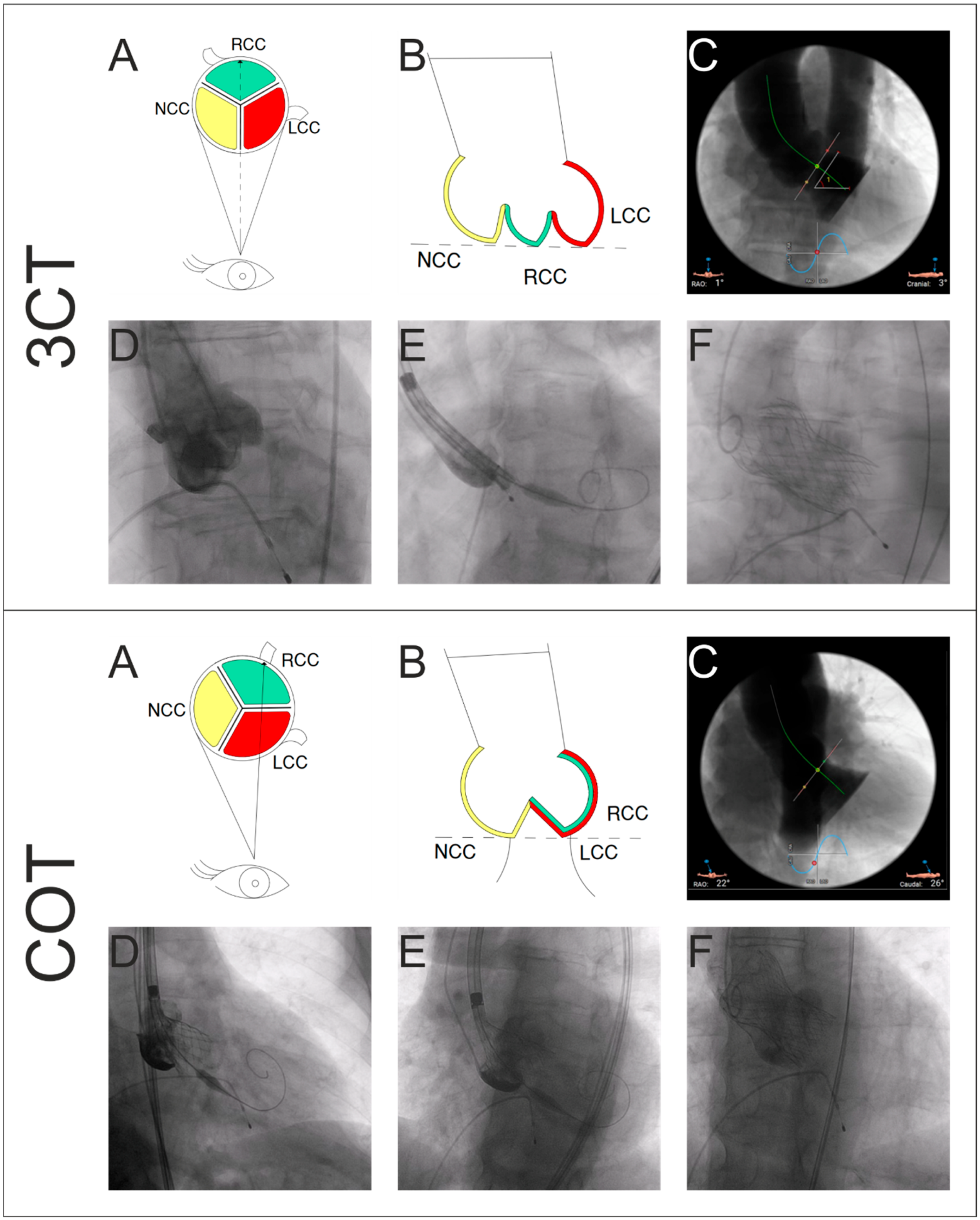
2.3. Transcatheter Aortic Valve Replacement Procedure (TAVR) [19]
2.4. Study Endpoints
2.5. Statistical Analysis
3. Results
3.1. Baseline Characteristics of the Study Population (Table 1)

| Characteristic | 3CT, n = 97 1 | COT, n = 106 1 | p-Value 2 |
|---|---|---|---|
| Age | 81.8 (±5.5) | 82.2 (±5.6) | >0.90 |
| female | 38/97 (39.1%) | 60/106 (56.6%) | 0.01 |
| BMI [kg/m2] | 27 (±5.02) | 27.07 (±5.05) | >0.90 |
| Diabetes | 49/97 (50.5%) | 50/106 (47.2%) | 0.63 |
| Dyslipidaemia | 59/97 (60.8%) | 68/106 (64.1%) | 0.62 |
| Hypertension | 93/97 (95.9%) | 101/106 (95.3%) | 0.84 |
| Atrial fibrillation or flutter | 42/97 (43.3%) | 55/106 (51.9%) | 0.22 |
| CAD | 50/97 (51.5%) | 70/106 (66%) | 0.04 |
| PAD | 16/97 (16.5%) | 16/106 (15.1%) | 0.78 |
| COPD | 8/97 (8.24%) | 15/106 (14.2%) | 0.18 |
| Previous cardiac surgery | 19/97 (19.6%) | 30/106 (28.3%) | 0.15 |
| Prior RBBB | 8/97 (8.2%) | 12/106 (11.3%) | 0.46 |
| Prior LBBB | 9/97 (9.3%) | 10/106 (9.4%) | 0.79 |
| Prior AVB I | 29/97 (29.9%) | 26/106 (24.5%) | 0.39 |
| Prior LAHB | 6/97 (6.1%) | 7/106 (6.6%) | 0.90 |
| NYHA class | 0.02 | ||
| I | 7/96 (7.3%) | 4/102 (3.9%) | |
| II | 20/96 (20.8%) | 42/102 (41.1%) | |
| III | 56/96 (58.3%) | 46/102 (45.1%) | |
| IV | 13/96 (13.5%) | 10/102 (9.2%) | |
| STS-Score [%] | 4.2 (±4) | 4.7 (±3.3) | 0.38 |
| Euroscore II | 7.3 (±6.5) | 6.1 (±6.3) | 0.21 |
| Ejection fraction | 50.4 (±11.6) | 51.6 (±9.2) | 0.43 |
| Ejection fraction category | 0.25 | ||
| I | 60/97 (61.8%) | 66/106 (62.3%) | |
| II | 13/97 (13.4%) | 23/106 (21.7%) | |
| III | 14/97 (14.4%) | 9/106 (8.5%) | |
| IV | 10/97 (10.3%) | 8/106 (7.5%) | |
| AV-MPG | 41.37 (±15.7) | 42.4 (±16.5) | 0.66 |
| AV-PPG | 66.93 (±20.72) | 70.69 (±18.93) | 0.60 |
| sPAP | 45.28 (±13.74) | 45.91 (±14.58) | 0.80 |
| Aortic regurgitation category | 0.40 | ||
| I | 84/97 (86.6%) | 90/106 (84.9%) | |
| II | 12/97 (12.3%) | 15/106 (14.2%) | |
| III | 1/97 (1.03%) | 0/106 (0%) | |
| IV | 0/97 (0.00%) | 1/106 (0.94%) | |
| AVA [cm2] | 0.73 (±0.17) | 0.74 (±0.16) | 0.77 |
3.2. Procedural Data, Hospitalisation, and 30-Day Outcomes (Table 2)
| Characteristic | 3CT, n = 97 1 | COT, n = 106 1 | p-Value 2 |
|---|---|---|---|
| New conduction disturbance | 51/97 (52.5%) | 34/106 (32.0%) | 0.003 |
| Type new conduction disturbance | 0.06 | ||
| AVB I | 5/97 (5.2%) | 6/106 (5.6%) | 0.87 |
| AVB II | 4/97 (4.1%) | 1/106 (0.9%) | 0.34 |
| AVB III | 22/97 (22.7%) | 13/106 (12.3%) | 0.05 |
| LBBB | 13/97 (13.4%) | 8/106 (7.5%) | 0.17 |
| RBBB | 1/97 (1.0%) | 0/106 (0.0%) | 0.22 |
| SSS | 3/97 (3.1%) | 1/106 (0.94%) | 0.26 |
| AF | 3/97 (3.1%) | 4/106 (3.8%) | 0.79 |
| VT | 0/97 (0.0%) | 1/106 (0.94%) | 0.25 |
| High-grade AVB (AVB II + AVB III) | 26/97 (26.8%) | 14/106 (13.2%) | 0.02 |
| High-grade AVB + LBBB | 39/97 (40.2%) | 22/106 (20.7%) | 0.002 |
| New pacemaker implantation | 24/97 (24.7%) | 13/106 (12.2%) | 0.02 |
| Type of pacemaker | 0.14 | ||
| VVI-PM | 5/24 (20.8%) | 2/13 (15.3%) | 0.20 |
| DDD-PM | 14/24 (58.3%) | 9/13 (69.2%) | 0.18 |
| CRT-P | 5/24 (20.8%) | 2/13 (15.3%) | 0.20 |
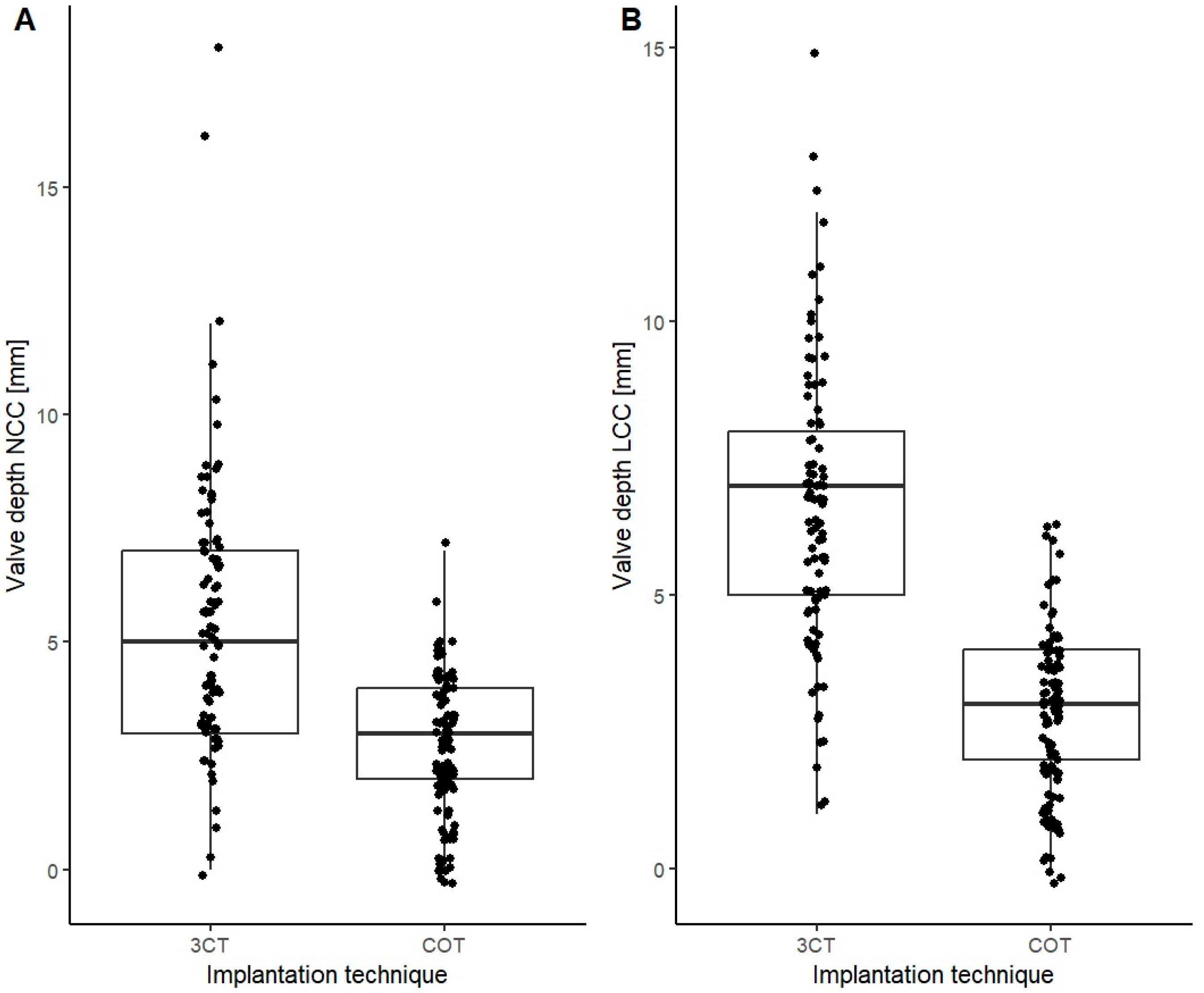
| Valve depth NCC [mm] | 5.4 (±3) | 2.7 (±1.5) | <0.001 |
| Valve depth LCC [mm] | 6.6 (±2.6) | 2.8 (±1.5) | <0.001 |
| Implantation attempts | 0.55 | ||
| 1 | 79/97 (81.4%) | 89/106 (84%) | |
| 2 | 13/97 (13.4%) | 14/106 (13.2%) | |
| 3 | 3/97 (3.1%) | 3/106 (2.8%) | |
| 4 | 1/97 (1.03%) | 0/106 (0.0%) | |
| 5 | 1/97 (1.03%) | 0/106 (0.0%) | |
| Valve size [mm] | 0.88 | ||
| 23 | 2/97 (2.0%) | 4/106 (3.8%) | |
| 26 | 22/97 (22.7%) | 25/106 (23.6%) | |
| 29 | 46/97 (47.4%) | 50/106 (47.2%) | |
| 34 | 27/97 (27.8%) | 27/106 (25.5%) | |
| Valve type | 0.30 | ||
| Evolut™ PRO | 18/97 (18.6%) | 14/106 (13.2%) | |
| Evolut™ R | 79/97 (81.4%) | 92/106 (86.8%) | |
| Procedure Duration [min] | 57.9 (±24.5) | 58.3 (±20.3) | 0.88 |
| Contrast agent used [ml] | 92.7 (±35) | 82 (±27.3) | 0.02 |
| Post-implantation aortic regurgitation category | 0.48 | ||
| 0 | 67/97 (69%) | 80/106 (75.5%) | |
| I | 22/97 (22.7%) | 21/106 (19.8%) | |
| II | 8/97 (8.2%) | 5/106 (4.7%) | |
| Stroke | 1/97 (1.03%) | 3/106 (2.8%) | 0.34 |
| Major vascular access site complication | 0/97 (0.0%) | 0/106 (0.0%) | |
| Minor vascular access site complication | 0/97 (0.0%) | 0/106 (0.0%) |
4. Discussion
5. Limitations
6. Conclusions
Author Contributions
Funding
Institutional Review Board Statement
Informed Consent Statement
Data Availability Statement
Conflicts of Interest
Abbreviations
| AS | aortic stenosis |
| CD | conduction disturbance |
| COT | cusp-overlap coplanar projection technique |
| ID | implantation depth |
| LCC | left coronary cusp |
| LVOT | left ventricle outflow tract |
| NCC | non-coronary cusp |
| RCC | right coronary cusp |
| SE | self-expanding |
| TAVR | transcatheter aortic valve replacement |
| THV | transcatheter heart valves, transcatheter aortic prostheses |
| 3CT | three-cusp coplanar view technique |
References
- Smith, C.R.; Leon, M.B.; Mack, M.J.; Miller, D.C.; Moses, J.W.; Svensson, L.G.; Tuzcu, E.M.; Webb, J.G.; Fontana, G.P.; Makkar, R.R.; et al. Transcatheter versus surgical aortic-valve replacement in high-risk patients. N. Engl. J. Med. 2011, 364, 2187–2198. [Google Scholar] [CrossRef]
- Leon, M.B.; Smith, C.R.; Mack, M.J.; Makkar, R.R.; Svensson, L.G.; Kodali, S.K.; Thourani, V.H.; Tuzcu, E.M.; Miller, D.C.; Herrmann, H.C.; et al. Transcatheter or surgical aortic-valve replacement in intermediate-risk patients. N. Engl. J. Med. 2016, 374, 1609–1620. [Google Scholar] [CrossRef]
- Reardon, M.J.; Van Mieghem, N.M.; Popma, J.J.; Kleiman, N.S.; Søndergaard, L.; Mumtaz, M.; Adams, D.H.; Deeb, G.M.; Maini, B.; Gada, H.; et al. Surgical or transcatheter aortic-valve replacement in intermediate-risk patients. N. Engl. J. Med. 2017, 376, 1321–1331. [Google Scholar] [CrossRef]
- Mack, M.J.; Leon, M.B.; Thourani, V.H.; Makkar, R.; Kodali, S.K.; Russo, M.; Kapadia, S.R.; Malaisrie, S.C.; Cohen, D.J.; Pibarot, P.; et al. Transcatheter aortic-valve replacement with a balloon-expandable valve in low-risk patients. N. Engl. J. Med. 2019, 380, 1695–1705. [Google Scholar] [CrossRef]
- Popma, J.J.; Deeb, G.M.; Yakubov, S.J.; Mumtaz, M.; Gada, H.; O’Hair, D.; Bajwa, T.; Heiser, J.C.; Merhi, W.; Kleiman, N.S.; et al. Transcatheter aortic-valve replacement with a self-expanding valve in low-risk patients. N. Engl. J. Med. 2019, 380, 1706–1715. [Google Scholar] [CrossRef] [PubMed]
- Vahanian, A.; Beyersdorf, F.; Praz, F.; Milojevic, M.; Baldus, S.; Bauersachs, J.; Capodanno, D.; Conradi, L.; De Bonis, M.; De Paulis, R.; et al. 2021 ESC/EACTS guidelines for the management of valvular heart disease. Eur. Heart J. 2021, 43, e395. [Google Scholar]
- Otto, C.M.; Nishimura, R.A.; Bonow, R.O.; Carabello, B.A.; Erwin, J.P., 3rd; Gentile, F.; Jneid, H.; Krieger, E.V.; Mack, M.; McLeod, C.; et al. 2020 ACC/AHA guideline for the management of patients with valvular heart disease: A report of the American College of Cardiology/American Heart Association Joint Committee on Clinical Practice Guidelines. Circulation 2020, 143, e72–e227. [Google Scholar] [PubMed]
- Guerreiro, C.; Ferreira, P.C.; Teles, R.C.; Braga, P.; da Silva, P.C.; Patrício, L.; Silva, J.C.; Baptista, J.; de Sousa Almeida, M.; Ribeiro, V.G.; et al. Short and long-term clinical impact of transcatheter aortic valve implantation in Portugal according to different access routes: Data from the Portuguese National Registry of TAVI. Rev. Port. Cardiol. (Engl. Ed.) 2020, 39, 705–717. [Google Scholar] [CrossRef]
- Arnold, S.V.; Lei, Y.; Reynolds, M.R.; Magnuson, E.A.; Suri, R.M.; Tuzcu, E.M.; Petersen, J.L., 2nd; Douglas, P.S.; Svensson, L.G.; Gada, H.; et al. Costs of periprocedural complications in patients treated with transcatheter aortic valve replacement: Results from the placement of aortic transcatheter valve trial. Circ. Cardiovasc. Interv. 2014, 7, 829–836. [Google Scholar] [CrossRef] [PubMed]
- Giustini, G.; Van der Boon, R.; Nicolas, J.; Dumonteil, N.; Chieffo, A.; de Jaegere, P.P.T.; Tchetche, D.; Marcheix, B.; Millischer, D.; Cassagneau, R.; et al. Impact of permanent pacemaker on mortality after transcatheter aortic valve implantation: The PRAGMATIC (Pooled Rotterdam-Milan-Toulouse in Collaboration) pacemaker substudy. EuroIntervention 2016, 12, 1185–1193. [Google Scholar] [CrossRef]
- Fadahunsi, O.; Olowoyeye, A.; Ukaigwe, A.; Ukaigwe, A.; Li, Z.; Vora, A.N.; Vemulapalli, S.; Elgin, E.; Donato, A. Incidence, predictors, and outcomes of permanent pacemaker implantation following transcatheter aortic valve replacement: Analysis from the U.S. Society of Thoracic Surgeons/American College of Cardiology TVT Registry. JACC Cardiovasc. Interv. 2016, 9, 2189–2199. [Google Scholar] [CrossRef]
- Regueiro, A.; Abdul-Jawad, O.; Del Trigo, M.; Campelo-Parada, F.; Puri, R.; Urena, M.; Philippon, F.; Rodés-Cabau, J. Impact of new-onset left bundle branch block and periprocedural permanent pacemaker implantation on clinical outcomes in patients undergoing transcatheter aortic valve replacement: A systematic review and meta-analysis. Circ. Cardiovasc. Interv. 2016, 9, e003635. [Google Scholar] [CrossRef]
- Chamandi, C.; Barbanti, M.; Munoz-Garcia, A.; Latib, A.; Nombela-Franco, L.; Gutiérrez-Ibanez, E.; Veiga-Fernandez, G.; Cheema, A.N.; Cruz-Gonzalez, I.; Serra, V.; et al. Long-term outcomes in patients with new permanent pacemaker implantation following transcatheter aortic valve replacement. JACC Cardiovasc. Interv. 2018, 11, 301–310. [Google Scholar] [CrossRef]
- Dizon, J.M.; Nazif, T.M.; Hess, P.L.; Biviano, A.; Garan, H.; Douglas, P.S.; Kapadia, S.; Babaliaros, V.; Herrmann, H.C.; Szeto, W.Y.; et al. Chronic pacing and adverse outcomes after transcatheter aortic valve implantation. Heart 2015, 101, 1665–1671. [Google Scholar] [CrossRef]
- Boerlage-Van Dijk, K.; Kooiman, K.M.; Yong, Z.Y.; Wiegerinck, E.M.; Damman, P.; Bouma, B.J.; Tijssen, J.G.; Piek, J.J.; Knops, R.E.; Baan, J. Predictors and permanency of cardiac conduction disorders and necessity of pacing after transcatheter aortic valve implantation. Pacing Clin. Electrophysiol. 2014, 37, 1520–1529. [Google Scholar] [CrossRef] [PubMed]
- Calvi, V.; Conti, S.; Pruiti, G.P.; Capodanno, D.; Puzzangara, E.; Tempio, D.; Di Grazia, A.; Ussia, G.P.; Tamburino, C. Incidence rate and predictors of permanent pacemaker implantation after transcatheter aortic valve implantation with self-expanding CoreValve prosthesis. J. Interv. Card. Electrophysiol. 2012, 34, 189–195. [Google Scholar] [CrossRef] [PubMed]
- Van der Boon, A.; Houthuizen, P.; Urena, M.; Poels, T.T.; van Mieghem, N.M.; Brueren, G.R.; Altintas, S.; Nuis, R.J.; Serruys, P.W.; van Garsse, L.A.; et al. Trends in the occurrence of new conduction abnormalities after transcatheter aortic valve implantation. Catheter. Cardiovasc. Interv. 2015, 85, E144–E152. [Google Scholar] [CrossRef] [PubMed]
- Manuel, A.M.; Almeida, J.; Guerreiro, C.; Dias, T.; Barbosa, A.; Teixeira, P.; Ribeiro, J.; Dias, A.; Caeiro, D.; Fonseca, M.; et al. The effects of transcatheter aortic valve implantation on cardiac electrical properties. Rev. Port. Cardiol. (Engl. Ed.) 2020, 39, 431–440. [Google Scholar] [CrossRef]
- Mendiz, O.A.; Noč, M.; Fava, C.M.; Jaikel, L.A.G.; Sztejfman, M.; Pleskovič, A.; Gamboa, P.; Valdivieso, L.R.; Gada, H.; Tang, G.H.L. Impact of Cusp-Overlap View for TAVR with Self-Expandable Valves on 30-Day Conduction Disturbances. J. Interv. Cardiol. 2021, 2021, 9991528. [Google Scholar] [CrossRef]
- Tang, G.H.L.; Zaid, S.; Michev, I.; Ahmad, H.; Kaple, R.; Undemir, C.; Cohen, M.; Lansman, S.L. “Cusp-overlap” view simplifies fluoroscopy-guided implantation of self-expanding valve in transcatheter aortic valve replacement. JACC Cardiovasc. Interv. 2018, 11, 1663–1665. [Google Scholar] [CrossRef]
- Sinning, J.M.; Petronio, A.S.; Van Mieghem, N.; Zucchelli, G.; Nickenig, G.; Bekeredjian, R.; Bosmans, J.; Bedogni, F.; Branny, M.; Stangl, K.; et al. Relation Between Clinical Best Practices and 6-Month Outcomes After Transcatheter Aortic Valve Implantation with CoreValve (from the ADVANCE II Study). Am. J. Cardiol. 2017, 119, 84–90. [Google Scholar] [CrossRef]
- Rode’s-Cabau, J.; Ellenbogen, K.A.; Krahn, A.D.; Latib, A.; Mack, M.; Mittal, S.; Muntané-Carol, G.; Nazif, T.M.; Sondergaard, L.; Urena, M.; et al. Management of Conduction Disturbances Associated with Transcatheter Aortic Valve Replacement: JACC Scientific Expert Panel. J. Am. Coll. Cardiol. 2019, 74, 1086–1106. [Google Scholar] [CrossRef]
- Auffret, V.; Puri, R.; Urena, M.; Chamandi, C.; Rodriguez-Gabella, T.; Philippon, F.; Rodés-Cabau, J. Conduction disturbances after transcatheter aortic valve replacement: Current status and future perspectives. Circulation 2017, 136, 1049–1069. [Google Scholar] [CrossRef] [PubMed]
- Siontis, G.C.M.; Jüni, P.; Pilgrim, T.; Stortecky, S.; Büllesfeld, L.; Meier, B.; Wenaweser, P.; Windecker, S. Predictors of permanent pacemaker implantation in patients with severe aortic stenosis undergoing TAVR: A meta-analysis. J. Am. Coll. Cardiol. 2014, 64, 129–140. [Google Scholar] [CrossRef] [PubMed]
- Pascual, I.; Avanzas, P.; Muñoz-García, A.J.; López-Otero, D.; Jimenez-Navarro, M.F.; Cid-Alvarez, B.; del Valle, R.; Alonso-Briales, J.H.; Ocaranza-Sanchez, R.; Alfonso, F.; et al. Percutaneous Implantation of the CoreValveW Self-expanding Valve Prosthesis in Patients with Severe Aortic Stenosis and Porcelain Aorta: Medium-term Follow-up. Rev. Esp. Cardiol. 2013, 66, 775–781. [Google Scholar] [CrossRef] [PubMed]
- Urena, M.; Webb, J.G.; Eltchaninoff, H.; Muñoz-García, A.J.; Bouleti, C.; Tamburino, C.; Nombela-Franco, L.; Nietlispach, F.; Moris, C.; Ruel, M.; et al. Late cardiac death in patients undergoing transcatheter aortic valve replacement: Incidence and predictors of advanced heart failure and sudden cardiac death. J. Am. Coll. Cardiol. 2015, 65, 437–448. [Google Scholar] [CrossRef]
- van Rosendael, P.J.; Delgado, V.; Bax, J.J. Pacemaker implantation rate after transcatheter aortic valve implantation with early and new-generation devices: A systematic review. Eur. Heart J. 2018, 39, 2003–2013. [Google Scholar] [CrossRef]
- Hamdan, A.; Guetta, V.; Klempfner, R.; Konen, E.; Raanani, E.; Glikson, M.; Goitein, O.; Segev, A.; Barbash, I.; Fefer, P.; et al. Inverse relationship between membranous septal length and the risk of atrioventricular block in patients undergoing transcatheter aortic valve implantation. JACC Cardiovasc. Interv. 2015, 8, 1218–1228. [Google Scholar] [CrossRef]
- Periault’-Lauzier, P.; Andalib, A.; Martucci, G.; Mylotte, D.; Cecere, R.; Lange, R.; Tchétché, D.; Modine, T.; van Mieghem, N.; Windecker, S.; et al. Fluoroscopic anatomy of left-sided heart structures for transcatheter interventions: Insight from multislice computed tomography. JACC Cardiovasc. Interv. 2014, 7, 947–957. [Google Scholar] [CrossRef]
- Chen, Y.; Zhu, G.; Liu, X.; Wu, W.; Chai, H.; Tao, M.; Kong, D.; Li, Y.; Wang, L. Comparison of cusp-overlap projection and standard three-cusp coplanar view during self-expanding transcatheter aortic valve replacement: A systematic review and meta-analysis. Front. Cardiovasc. Med. 2022, 9, 927642. [Google Scholar] [CrossRef]

| Variable | OR | 95% CI | p-Value |
|---|---|---|---|
| COT | 0.46 | 0.20–1.02 | 0.06 |
| Prior RBBB | 3.54 | 1.22–10.28 | 0.02 |
| Prior AVB I | 1.94 | 0.88–4.26 | 0.10 |
| Predilatation | 1.19 | 0.52–2.74 | 0.68 |
| Valve size | 1.00 | 0.88–1.12 | 0.94 |
| CAD | 0.69 | 0.32–1.48 | 0.34 |
| Variable | OR | 95% CI | p-Value |
|---|---|---|---|
| COT | 0.45 | 0.24–0.82 | 0.009 |
| Prior RBBB | 1.40 | 0.53–3.70 | 0.50 |
| Prior AVB I | 1.23 | 0.64–2.35 | 0.53 |
| Predilatation | 0.96 | 0.49–1.89 | 0.91 |
| Valve size | 0.97 | 0.88–1.06 | 0.52 |
| CAD | 0.59 | 0.33–1.06 | 0.08 |
Disclaimer/Publisher’s Note: The statements, opinions and data contained in all publications are solely those of the individual author(s) and contributor(s) and not of MDPI and/or the editor(s). MDPI and/or the editor(s) disclaim responsibility for any injury to people or property resulting from any ideas, methods, instructions or products referred to in the content. |
© 2026 by the authors. Licensee MDPI, Basel, Switzerland. This article is an open access article distributed under the terms and conditions of the Creative Commons Attribution (CC BY) license.
Share and Cite
Salem, M.; Voran, J.; Salem, M.; Rangel, R.; Seoudy, H.; Strake, A.; Lutter, G.; Frank, J.; Frank, D.; Saad, M. Effect of Cusp-Overlap View Technique on the Occurrence of Post-Procedural New Conduction Disturbance and Permanent Pacemaker Implantation Following Transcatheter Aortic Valve Replacement Using Self-Expanding Prostheses. J. Clin. Med. 2026, 15, 4009. https://doi.org/10.3390/jcm15114009
Salem M, Voran J, Salem M, Rangel R, Seoudy H, Strake A, Lutter G, Frank J, Frank D, Saad M. Effect of Cusp-Overlap View Technique on the Occurrence of Post-Procedural New Conduction Disturbance and Permanent Pacemaker Implantation Following Transcatheter Aortic Valve Replacement Using Self-Expanding Prostheses. Journal of Clinical Medicine. 2026; 15(11):4009. https://doi.org/10.3390/jcm15114009
Chicago/Turabian StyleSalem, Mostafa, Jakob Voran, Mohamed Salem, Rafael Rangel, Hatim Seoudy, Annika Strake, Georg Lutter, Johanne Frank, Derk Frank, and Mohammed Saad. 2026. "Effect of Cusp-Overlap View Technique on the Occurrence of Post-Procedural New Conduction Disturbance and Permanent Pacemaker Implantation Following Transcatheter Aortic Valve Replacement Using Self-Expanding Prostheses" Journal of Clinical Medicine 15, no. 11: 4009. https://doi.org/10.3390/jcm15114009
APA StyleSalem, M., Voran, J., Salem, M., Rangel, R., Seoudy, H., Strake, A., Lutter, G., Frank, J., Frank, D., & Saad, M. (2026). Effect of Cusp-Overlap View Technique on the Occurrence of Post-Procedural New Conduction Disturbance and Permanent Pacemaker Implantation Following Transcatheter Aortic Valve Replacement Using Self-Expanding Prostheses. Journal of Clinical Medicine, 15(11), 4009. https://doi.org/10.3390/jcm15114009