Multimodal Hand Hygiene Interventions and Clinical Healthcare-Associated Infection Outcomes in Acute Care Hospitals: A Systematic Review of Quasi-Experimental Studies

 , , , and
Abstract
1. Introduction
2. Materials and Methods
2.1. Search Strategy
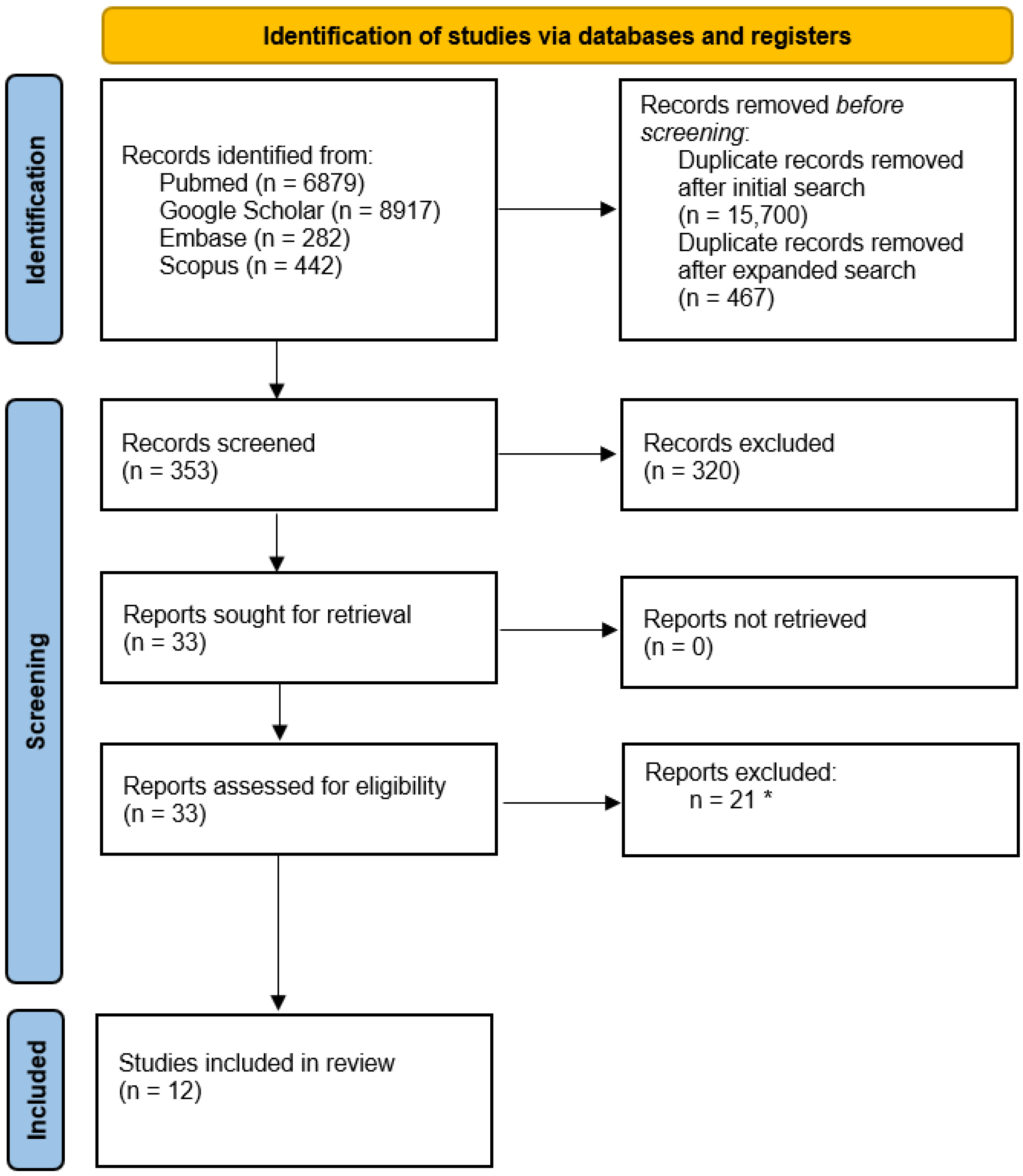
2.2. Study Selection
2.2.1. Eligibility Criteria
2.2.2. Definitions
2.3. Data Analysis
2.4. Risk of Bias
2.5. Use of AI Tools
3. Results
3.1. Overview of Included Studies
3.2. Effects of Multimodal Hand Hygiene Interventions
3.2.1. Overall Healthcare-Associated Infection Outcomes
3.2.2. Device-Associated Infections
3.2.3. Organism-Specific and Antimicrobial-Resistance-Related Outcomes
3.2.4. Structured Analysis of Heterogeneity Across Included Studies
3.3. Risk of Bias and Certainty of Evidence
4. Discussion
4.1. Interpretation of Main Findings in the Context of Previous Reviews
4.2. Strengths and Limitations of the Evidence and of This Review
4.3. Implications for Practice and Future Research
5. Conclusions
Supplementary Materials
Author Contributions
Funding
Institutional Review Board Statement
Informed Consent Statement
Data Availability Statement
Acknowledgments
Conflicts of Interest
Abbreviations
| HAI | Healthcare-associated infection |
| HH | Hand hygiene |
| HHC | Hand hygiene compliance |
| ABHR | Alcohol-based hand rub |
| CLABSI | Central line-associated bloodstream infection |
| CAUTI | Catheter-associated urinary tract infection |
| VAP | Ventilator-associated pneumonia |
| MRSA | Methicillin-resistant Staphylococcus aureus |
| MSSA | Methicillin-susceptible Staphylococcus aureus |
| VRE | Vancomycin-resistant Enterococcus |
| CDI | Clostridioides difficile infection |
| AMR | Antimicrobial resistance |
| ICU | Intensive care unit |
| IPC | Infection prevention and control |
| ITS | Interrupted time series |
| ROBINS-I | Risk Of Bias In Non-randomized Studies of Interventions |
| PRISMA | Preferred Reporting Items for Systematic Reviews and Meta-Analyses |
References
- Magill, S.S.; Edwards, J.R.; Bamberg, W.; Beldavs, Z.G.; Dumyati, G.; Kainer, M.A.; Lynfield, R.; Maloney, M.; McAllister-Hollod, L.; Nadle, J. Multistate point-prevalence survey of health care-associated infections. N. Engl. J. Med. 2014, 370, 1198–1208. [Google Scholar] [CrossRef]
- Suetens, C.; Latour, K.; Kärki, T.; Ricchizzi, E.; Kinross, P.; Moro, M.L.; Jans, B.; Hopkins, S.; Hansen, S.; Lyytikäinen, O.; et al. Prevalence of healthcare-associated infections, estimated incidence and composite antimicrobial resistance index in acute care hospitals and long-term care facilities: Results from two European point prevalence surveys, 2016 to 2017. Euro Surveill. 2018, 23, 1800516. [Google Scholar] [CrossRef]
- Cassini, A.; Plachouras, D.; Eckmanns, T.; Abu Sin, M.; Blank, H.-P.; Ducomble, T.; Haller, S.; Harder, T.; Klingeberg, A.; Sixtensson, M.; et al. Burden of six healthcare-associated infections on European population health: Estimating incidence-based disability-adjusted life years through a population prevalence-based modelling study. PLoS Med. 2016, 13, e1002150. [Google Scholar] [CrossRef]
- Boyce, J.M.; Pittet, D.; Healthcare Infection Control Practices Advisory Committee; HICPAC/SHEA/APIC/IDSA Hand Hygiene Task Force. Guideline for Hand Hygiene in Health-Care Settings. Infect. Control Hosp. Epidemiol. 2002, 23, S3–S40. [Google Scholar] [CrossRef] [PubMed]
- Allegranzi, B.; Pittet, D. Role of hand hygiene in healthcare-associated infection prevention. J. Hosp. Infect. 2009, 73, 305–315. [Google Scholar] [CrossRef]
- Siegel, J.D.; Rhinehart, E.; Jackson, M.; Chiarello, L.; Health Care Infection Control Practices Advisory Committee. 2007 Guideline for Isolation Precautions: Preventing Transmission of Infectious Agents in Health Care Settings. Am. J. Infect. Control 2007, 35, S65–S164. [Google Scholar] [CrossRef]
- Chau, J.P.C.; Liu, X.; Lo, S.H.S.; Chien, W.T.; Wan, X. Effects of environmental cleaning bundles on reducing healthcare-associated Clostridioides difficile infection: A systematic review and meta-analysis. J. Hosp. Infect. 2020, 106, 734–744. [Google Scholar] [CrossRef] [PubMed]
- Baur, D.; Gladstone, B.P.; Burkert, F.; Carrara, E.; Foschi, F.; Döbele, S.; Tacconelli, E. Effect of antibiotic stewardship on the incidence of infection and colonisation with antibiotic-resistant bacteria and Clostridium difficile infection: A systematic review and meta-analysis. Lancet Infect. Dis. 2017, 17, 990–1001. [Google Scholar] [CrossRef] [PubMed]
- Erasmus, V.; Daha, T.J.; Brug, H.; Richardus, J.H.; Behrendt, M.D.; Vos, M.C.; van Beeck, E.F. Systematic review of studies on compliance with hand hygiene guidelines in hospital care. Infect. Control Hosp. Epidemiol. 2010, 31, 283–294. [Google Scholar] [CrossRef] [PubMed]
- Luangasanatip, N.; Hongsuwan, M.; Limmathurotsakul, D.; Lubell, Y.; Lee, A.S.; Harbarth, S.; Day, N.P.J.; Graves, N.; Cooper, B.S. Comparative efficacy of interventions to promote hand hygiene in hospital: Systematic review and network meta-analysis. BMJ 2015, 351, h3728. [Google Scholar] [CrossRef]
- Gould, D.J.; Moralejo, D.; Drey, N.; Chudleigh, J.H.; Taljaard, M. Interventions to improve hand hygiene compliance in patient care. Cochrane Database Syst. Rev. 2017, 9, CD005186. [Google Scholar] [CrossRef]
- Clancy, C.; Delungahawatta, T.; Dunne, C.P. Hand-hygiene-related clinical trials reported between 2014 and 2020: A comprehensive systematic review. J. Hosp. Infect. 2021, 111, 6–26. [Google Scholar] [CrossRef]
- Page, M.J.; McKenzie, J.E.; Bossuyt, P.M.; Boutron, I.; Hoffmann, T.C.; Mulrow, C.D.; Shamseer, L.; Tetzlaff, J.M.; Akl, E.A.; Brennan, S.E.; et al. The PRISMA 2020 statement: An updated guideline for reporting systematic reviews. BMJ 2021, 372, n71. [Google Scholar] [CrossRef]
- Larson, E.L.; Quiros, D.; Lin, S.X. Dissemination of the CDC’s Hand Hygiene Guideline and impact on infection rates. Am. J. Infect. Control 2007, 35, 666–675. [Google Scholar] [CrossRef]
- Yue, J.; Pan, H. Enhancing hand hygiene compliance in healthcare settings: A long time intervention study. Front. Public Health 2025, 13, 1588336. [Google Scholar] [CrossRef]
- van der Kooi, T.; Sax, H.; Grundmann, H.; Pittet, D.; de Greeff, S.; van Dissel, J.; Clack, L.; Wu, A.W.; Davitt, J.; Kostourou, S.; et al. Hand hygiene improvement of individual healthcare workers: Results of the multicentre PROHIBIT study. Antimicrob. Resist. Infect. Control 2022, 11, 123. [Google Scholar] [CrossRef] [PubMed]
- Ragusa, R.; Giorgianni, G.; Lupo, L.; Sciacca, A.; Rametta, S.; La Verde, M.; Mulè, S.; Marranzano, M. Healthcare-associated Clostridium difficile infection: Role of correct hand hygiene in cross-infection control. J. Prev. Med. Hyg. 2018, 59, E145–E152. [Google Scholar]
- Lenz, A.M.; Andion, E.; Ruvinsky, S.; Aguirre, C.; Alvarez Parma, J.; Jorro, F.; López Cruz, G.; Pascutto, M.; Penazzi, M.; Santos, S.; et al. Impact of a program aimed at reducing catheter-related infections implemented in nine pediatric intensive care units in Argentina. Impacto de un programa de reducción de infección asociada a catéter en 9 unidades de cuidado intensivo pediátrico en Argentina. Arch. Argent. Pediatr. 2018, 116, 93–97. [Google Scholar] [CrossRef] [PubMed]
- Ojanperä, H.; Ohtonen, P.; Kanste, O.; Syrjälä, H. Impact of direct hand hygiene observations and feedback on hand hygiene compliance among nurses and doctors in medical and surgical wards: An eight-year observational study. J. Hosp. Infect. 2022, 127, 83–90. [Google Scholar] [CrossRef]
- von Lengerke, T.; Ebadi, E.; Schock, B.; Krauth, C.; Lange, K.; Stahmeyer, J.T.; Chaberny, I.F. Impact of psychologically tailored hand hygiene interventions on nosocomial infections with multidrug-resistant organisms: Results of the cluster-randomized controlled trial PSYGIENE. Antimicrob. Resist. Infect. Control 2019, 8, 56. [Google Scholar] [CrossRef] [PubMed]
- Ebnöther, C.; Tanner, B.; Schmid, F.; La Rocca, V.; Heinzer, I.; Bregenzer, T. Impact of an infection control program on the prevalence of nosocomial infections at a tertiary care center in Switzerland. Infect. Control Hosp. Epidemiol. 2008, 29, 38–43. [Google Scholar] [CrossRef] [PubMed]
- Harne-Britner, S.; Allen, M.; Fowler, K.A. Improving hand hygiene adherence among nursing staff. J. Nurs. Care Qual. 2011, 26, 39–48. [Google Scholar] [CrossRef]
- Le, T.A.; Dibley, M.J.; Vo, V.N.; Archibald, L.; Jarvis, W.R.; Sohn, A.H. Reduction in surgical site infections in neurosurgical patients associated with a bedside hand hygiene program in Vietnam. Infect. Control Hosp. Epidemiol. 2007, 28, 583–588. [Google Scholar] [CrossRef]
- Koff, M.D.; Corwin, H.L.; Beach, M.L.; Surgenor, S.D.; Loftus, R.W. Reduction in ventilator associated pneumonia in a mixed intensive care unit after initiation of a novel hand hygiene program. J. Crit. Care 2011, 26, 489–495. [Google Scholar] [CrossRef] [PubMed]
- Schelenz, S.; Tucker, D.; Georgeu, C.; Daly, S.; Hill, M.; Roxburgh, J.; French, G.L. Significant reduction of endemic MRSA acquisition and infection in cardiothoracic patients by means of an enhanced targeted infection control programme. J. Hosp. Infect. 2005, 60, 104–110. [Google Scholar] [CrossRef] [PubMed]
- Gilbert, G.L.; Hor, S.; Wyer, M.; Sadsad, R.; Badcock, C.A.; Iedema, R. Sustained fall in inpatient MRSA prevalence after a video-reflexive ethnography project; an observational study. Infect. Dis. Health 2020, 25, 140–150. [Google Scholar] [CrossRef]
- Stone, S.P.; Beric, V.; Quick, A.; Balestrini, A.A.; Kibbler, C.C. The effect of an enhanced infection-control policy on the incidence of Clostridium difficile infection and methicillin-resistant Staphyloccocus aureus colonization in acute elderly medical patients. Age Ageing 1998, 27, 561–568. [Google Scholar] [CrossRef]
- Salama, M.F.; Jamal, W.Y.; Mousa, H.A.; Al-Abdulghani, K.A.; Rotimi, V.O. The effect of hand hygiene compliance on hospital-acquired infections in an ICU setting in a Kuwaiti teaching hospital. J. Infect. Public Health 2013, 6, 27–34. [Google Scholar] [CrossRef]
- Mishal, J.; Sherer, Y.; Levin, Y.; Katz, D.; Embon, E. Two-stage evaluation and intervention program for control of methicillin-resistant Staphylococcus aureus in the hospital setting. Scand. J. Infect. Dis. 2001, 33, 498–501. [Google Scholar] [CrossRef]
- Kong, A.; Botero Suarez, C.S.; Rahamatalli, B.; Shankweiler, J.; Karasik, O. Hand Hygiene and Hospital-Acquired Infections During COVID-19 Increased Vigilance: One Hospital’s Experience. HCA Healthc. J. Med. 2021, 2, 379–384. [Google Scholar] [CrossRef]
- Pires dos Santos, R.; Jacoby, T.; Pires Machado, D.; Lisboa, T.; Gastal, S.L.; Nagel, F.M.; Kuplich, N.M.; Konkewicz, L.; Gorniak Lovatto, C.; Pires, M.R.; et al. Hand hygiene, and not ertapenem use, contributed to reduction of carbapenem-resistant Pseudomonas aeruginosa rates. Infect. Control Hosp. Epidemiol. 2011, 32, 584–590. [Google Scholar] [CrossRef] [PubMed]
- Lee, T.C.; Moore, C.; Raboud, J.M.; Muller, M.P.; Green, K.; Tong, A.; Dhaliwal, J.; McGeer, A.; Mount Sinai Hospital Infection Control Team. Impact of a mandatory infection control education program on nosocomial acquisition of methicillin-resistant Staphylococcus aureus. Infect. Control Hosp. Epidemiol. 2009, 30, 249–256. [Google Scholar] [CrossRef] [PubMed]
- Farhoudi, F.; Sanaei Dashti, A.; Hoshangi Davani, M.; Ghalebi, N.; Sajadi, G.; Taghizadeh, R. Impact of WHO Hand Hygiene Improvement Program Implementation: A Quasi-Experimental Trial. BioMed Res. Int. 2016, 2016, 7026169. [Google Scholar] [CrossRef] [PubMed]
- Cheng, V.C.; Tai, J.W.; Chau, P.H.; Chen, J.H.; Yan, M.K.; So, S.Y.; To, K.K.; Chan, J.F.; Wong, S.C.; Ho, P.L.; et al. Minimal intervention for controlling nosocomial transmission of methicillin-resistant staphylococcus aureus in resource limited setting with high endemicity. PLoS ONE 2014, 9, e100493. [Google Scholar] [CrossRef]
- Larson, E.L.; Early, E.; Cloonan, P.; Sugrue, S.; Parides, M. An Organizational Climate Intervention Associated with Increased Handwashing and Decreased Nosocomial Infections. Behav. Med. 2000, 26, 14–22. [Google Scholar] [CrossRef]
- Trick, W.E.; Vernon, M.O.; Welbel, S.F.; Demarais, P.; Hayden, M.K.; Weinstein, R.A.; Chicago Antimicrobial Resistance Project. Multicenter intervention program to increase adherence to hand hygiene recommendations and glove use and to reduce the incidence of antimicrobial resistance. Infect. Control Hosp. Epidemiol. 2007, 28, 42–49. [Google Scholar] [CrossRef]
- Stone, S.P.; Fuller, C.; Savage, J.; Cookson, B.; Hayward, A.; Cooper, B.; Duckworth, G.; Michie, S.; Murray, M.; Jeanes, A.; et al. Evaluation of the national Cleanyourhands campaign to reduce Staphylococcus aureus bacteraemia and Clostridium difficile infection in hospitals in England and Wales by improved hand hygiene: Four year, prospective, ecological, interrupted time series study. BMJ 2012, 344, e3005. [Google Scholar] [CrossRef]
- Kirkland, K.B.; Homa, K.A.; Lasky, R.A.; Ptak, J.A.; Taylor, E.A.; Splaine, M.E. Impact of a hospital-wide hand hygiene initiative on healthcare-associated infections: Results of an interrupted time series. BMJ Qual. Saf. 2012, 21, 1019–1026. [Google Scholar] [CrossRef]
- Monistrol, O.; Calbo, E.; Riera, M.; Nicolás, C.; Font, R.; Freixas, N.; Garau, J. Impact of a hand hygiene educational programme on hospital-acquired infections in medical wards. Clin. Microbiol. Infect. Off. Publ. Eur. Soc. Clin. Microbiol. Infect. Dis. 2012, 18, 1212–1218. [Google Scholar] [CrossRef]
- Johnson, L.; Grueber, S.; Schlotzhauer, C.; Phillips, E.; Bullock, P.; Basnett, J.; Hahn-Cover, K. A multifactorial action plan improves hand hygiene adherence and significantly reduces central line-associated bloodstream infections. Am. J. Infect. Control 2014, 42, 1146–1151. [Google Scholar] [CrossRef]
- Chen, J.K.; Wu, K.S.; Lee, S.S.; Lin, H.S.; Tsai, H.C.; Li, C.H.; Chao, H.L.; Chou, H.C.; Chen, Y.J.; Huang, Y.H.; et al. Impact of implementation of the World Health Organization multimodal hand hygiene improvement strategy in a teaching hospital in Taiwan. Am. J. Infect. Control 2016, 44, 222–227. [Google Scholar] [CrossRef]
- Shabot, M.M.; Chassin, M.R.; France, A.C.; Inurria, J.; Kendrick, J.; Schmaltz, S.P. Using the Targeted Solutions Tool® to Improve Hand Hygiene Compliance Is Associated with Decreased Health Care-Associated Infections. Jt. Comm. J. Qual. Patient Saf. 2016, 42, 6–17. [Google Scholar] [CrossRef] [PubMed]
- Al Kuwaiti, A. Impact of a multicomponent hand hygiene intervention strategy in reducing infection rates at a university hospital in Saudi Arabia. Interv. Med. Appl. Sci. 2017, 9, 137–143. [Google Scholar] [CrossRef] [PubMed]
- Boyce, J.M.; Laughman, J.A.; Ader, M.H.; Wagner, P.T.; Parker, A.E.; Arbogast, J.W. Impact of an automated hand hygiene monitoring system and additional promotional activities on hand hygiene performance rates and healthcare-associated infections. Infect. Control Hosp. Epidemiol. 2019, 40, 741–747. [Google Scholar] [CrossRef] [PubMed]
- Phan, H.T.; Zingg, W.; Tran, H.T.T.; Dinh, A.P.P.; Pittet, D. Sustained effects of a multimodal campaign aiming at hand hygiene improvement on compliance and healthcare-associated infections in a large gynaecology/obstetrics tertiary-care centre in Vietnam. Antimicrob. Resist. Infect. Control 2020, 9, 51. [Google Scholar] [CrossRef]
- Mestre, G.; Berbel, C.; Tortajada, P.; Alarcia, M.; Coca, R.; Gallemi, G.; Garcia, I.; Fernández, M.M.; Aguilar, M.C.; Martínez, J.A.; et al. “The 3/3 strategy”: A successful multifaceted hospital wide hand hygiene intervention based on WHO and continuous quality improvement methodology. PLoS ONE 2012, 7, e47200. [Google Scholar] [CrossRef]
- Mouajou, V.; Adams, K.; DeLisle, G.; Quach, C. Hand hygiene compliance in the prevention of hospital-acquired infections: A systematic review. J. Hosp. Infect. 2022, 119, 33–48. [Google Scholar] [CrossRef]
- Zhang, Y.; Chen, X.; Lao, Y.; Qiu, X.; Liu, K.; Zhuang, Y.; Gong, X.; Wang, P. Effects of the Implementation of Intelligent Technology for Hand Hygiene in Hospitals: Systematic Review and Meta-analysis. J. Med. Internet Res. 2023, 25, e37249. [Google Scholar] [CrossRef]
- Doronina, O.; Jones, D.; Martello, M.; Biron, A.; Lavoie-Tremblay, M. A Systematic Review on the Effectiveness of Interventions to Improve Hand Hygiene Compliance of Nurses in the Hospital Setting. J. Nurs. Scholarsh. Off. Publ. Sigma Theta Tau Int. Honor. Soc. Nurs. 2017, 49, 143–152. [Google Scholar] [CrossRef]
- Issa, M.; Dunne, S.S.; Dunne, C.P. Hand hygiene practices for prevention of health care-associated infections associated with admitted infectious patients in the emergency department: A systematic review. Ir. J. Med. Sci. 2023, 192, 871–899. [Google Scholar] [CrossRef]
- Abad, C.L.; Barker, A.K.; Safdar, N. A systematic review of the effectiveness of cohorting to reduce transmission of healthcare-associated C. difficile and multidrug-resistant organisms. Infect. Control Hosp. Epidemiol. 2020, 41, 691–709. [Google Scholar] [CrossRef]


| Study ID | Country | Study Design | Setting | Study Period/Duration | Intervention (Key Components) | Comparator/Baseline | Clinical Outcome(s) Assessed |
|---|---|---|---|---|---|---|---|
| Larson et al., 2010 [35] | USA | Quasi-experimental clinical trial (controlled before–after) | Two ~250-bed hospitals in the Mid-Atlantic region; adult MICU and NICU study units | August 1997–December 1998 | Top-down organisational climate intervention based on Schein’s framework; leadership support, education, feedback, role modelling, competency reinforcement | Intervention hospital vs. comparison hospital; baseline, implementation, and follow-up phases | Nosocomial MRSA and VRE infection rates |
| Trick et al., 2007 [36] | USA | Prospective multicentre controlled interventional observational study | Four hospitals (acute/long-term care, community, public teaching, university teaching), multiple ICUs and wards | October 1999–December 2002 | Increased ABHR availability, interactive education, poster campaign in 3 intervention hospitals | Three intervention hospitals vs. one control hospital; pre/post quarterly trends | Incidence of antimicrobial-resistant bacteria from clinical cultures |
| Stone et al., 2012 [37] | England and Wales | Prospective ecological interrupted time-series study | Acute NHS hospital trusts, national campaign setting | 4-year national evaluation | Cleanyourhands campaign: bedside alcohol hand rub, posters, regular audit/feedback, patient empowerment materials | Trust-level pre/post time-series trends | MRSA bacteraemia, MSSA bacteraemia, Clostridium difficile infection |
| Kirkland et al., 2012 [38] | USA | Interrupted time series with sequential interventions and 1-year follow-up | 383-bed teaching hospital, rural New Hampshire | January 2006–December 2009 | Multifaceted initiative targeting leadership/accountability, measurement/feedback, hand sanitiser availability, education/training, marketing/communication | Baseline year and post-intervention follow-up within longitudinal series | Healthcare-associated infection index; S. aureus infections; bloodstream infections; C. difficile infection |
| Monistrol et al., 2012 [39] | Spain | before-after intervention study with 1-year follow-up | Three internal medicine wards in a 500-bed tertiary hospital | PRE/POST periods plus 1-year follow-up | Multimodal educational campaign promoting ABHR use; WHO observation methodology | PRE vs. POST intervention periods and follow-up | Overall HAI incidence density; hospital-acquired MRSA incidence density |
| Johnson et al., 2014 [40] | USA | Descriptive time-series quality improvement project | 570-bed academic health centre comprising 7 hospitals and >50 clinics | April 2006–September 2012 | Multifactorial action plan focused on staff education, accountability, product selection/accessibility, and organisational culture | Historical baseline before implementation | CLABSI rate |
| Chen et al., 2016 [41] | Taiwan | Before-and-after interventional study | 1408-bed tertiary teaching hospital | January 2010–September 2011 | WHO multimodal HH improvement strategy: point-of-care ABHR, tailored education, reminders, evaluation/feedback, institutional safety climate | Pre- vs. post-intervention periods | Overall HAI rate; urinary tract infection; respiratory tract infection; bloodstream infection |
| Shabot et al., 2016 [42] | USA | System-wide longitudinal quality improvement evaluation | 11 hospitals and 150 inpatient units in a large health system | October 2010–December 2014 | Targeted Solutions Tool (TST) using DMAIC/Lean/Six Sigma; targeted interventions based on causes of noncompliance | Baseline vs. improve vs. control phases | Adult ICU CLABSI; VAP |
| Al Kuwaiti et al., 2017 [43] | Saudi Arabia | Prospective interventional before-after study | King Fahd Hospital of the University, inpatient wards | January 2014–December 2016; 12-month intervention | WHO-based multicomponent HH strategy plus management engagement, education, reminders, posters/screensavers, monthly evaluation and feedback | Pre- vs. post-intervention phases | Overall HAI rate; CAUTI rate |
| Boyce et al., 2019 [44] | USA | Retrospective nonrandomized observational quasi-experimental study | Single 93-bed nonprofit acute-care hospital; 4 nursing units | 2014–2018 | Automated HH monitoring system plus frontline ownership, leadership support, feedback, supplementary promotional activities, Toyota Kata methodology | Baseline and sequential intervention periods | Non-C. difficile HAIs; C. difficile infection |
| Phan et al., 2020 [45] | Vietnam | Prospective quasi-experimental observational study | 900-bed maternity/gynaecology-obstetrics tertiary-care centre | 2010–2018 | WHO multimodal strategy with repeated campaigns, point-of-care ABHR, local ABHR production, patient participation | Longitudinal pre/post trend across campaign period | HAI other than SSI; SSI after gynaecological surgery; endometritis after abortion; SSI after C-section |
| Mestre et al., 2012 [46] | Spain | Pre-post interventional study with two phases and time-series process analysis | Private 200-bed teaching hospital; eight medical-surgical wards, emergency department, and 11-bed polyvalent ICU | Preintervention March 2007–December 2009; phase 1 January–December 2010; phase 2 January–December 2011 | WHO multimodal hand hygiene strategy followed by a continuous quality improvement phase with increased bedside alcohol hand rub placement, more frequent audits (“3/3 strategy”), standardized corrective-action recording, bimonthly feedback using statistical process control charts, and ongoing institutional support | Preintervention baseline vs. phase 1 and phase 2 intervention periods | Healthcare-acquired MRSA colonization/infection rate |
| Study ID | Primary Clinical Outcome | Outcome Category | Main Finding | Direction of Effect | Statistical Support | Caveat |
|---|---|---|---|---|---|---|
| Larson et al., 2010 [35] | Nosocomial MRSA and VRE infection rates | Organism-specific/AMR-related | Greater reduction in MRSA and VRE in the intervention hospital than in the comparison hospital; clearest signal for VRE | Favorable | Significant for VRE; less clear for MRSA | Non-randomized hospital comparison; outbreaks in comparator hospital may have influenced results |
| Trick et al., 2007 [36] | Incidence of hospital-acquired antimicrobial-resistant bacteria | Organism-specific/AMR-related | Significant reduction observed in only one intervention hospital, which also had the greatest increase in hand hygiene adherence | Mixed | Significant in one hospital only | No uniform effect across hospitals; clinical control data were limited |
| Stone et al., 2012 [37] | MRSA bacteraemia, MSSA bacteraemia, Clostridioides difficile infection | Organism-specific/AMR-related | MRSA bacteraemia and C. difficile decreased over time; MSSA bacteraemia did not | Mixed to favorable | Significant associations reported for some procurement-outcome relationships | Multiple national co-interventions limited attribution to hand hygiene alone |
| Kirkland et al., 2012 [38] | Hospital-wide healthcare-associated infection index | Overall HAI | HAI index fell from 4.8 to 3.3 per 1000 inpatient-days; S. aureus infections also decreased | Favorable | Significant | Multifaceted programme with evolving implementation and broader quality-improvement context |
| Monistrol et al., 2012 [39] | Overall HAI incidence density | Overall HAI | Overall HAI incidence density remained essentially unchanged after intervention | No clear effect | Not significant | Improved hand hygiene process measures did not translate into measurable overall HAI reduction |
| Johnson et al., 2014 [40] | CLABSI rate | Device-associated infection | CLABSI declined from 4.08 to 0.42 per 1000 device-days during the programme | Favorable | Clear reduction reported | Central line bundle introduced alongside hand hygiene initiative |
| Chen et al., 2016 [41] | Overall HAI rate | Overall HAI | Overall HAI decreased from 3.7% to 3.1%; urinary and respiratory tract infections also declined | Favorable | Significant | Before-after design without contemporaneous control; concurrent IPC activities possible |
| Shabot et al., 2016 [42] | Adult ICU CLABSI rate | Device-associated infection | CLABSI decreased from 0.83 to 0.42 per 1000 line-days; VAP also declined | Favorable | Significant for most phase/time analyses | Prior CLABSI and VAP bundles may have contributed |
| Al Kuwaiti et al., 2017 [43] | Overall HAI rate | Overall HAI | Overall HAI decreased from 3.37 to 2.59; CAUTI also decreased | Favorable | Reported as significant | Single-centre before-after study without contemporaneous control |
| Boyce et al., 2019 [44] | Non-C. difficile HAI rate | Overall HAI | Non-C. difficile HAIs decreased by 56%, but C. difficile increased by 60% | Mixed | Reduction in non-C. difficile HAIs not statistically significant | Small single-centre study; opposite trend for C. difficile |
| Phan et al., 2020 [45] | HAI other than SSI incidence density | Overall HAI | HAI other than SSI decreased from 1.10 to 0.45 per 1000 patient-days; some procedure-specific infections also declined | Favorable | Significant downward trends reported | CAUTI-prevention programme likely contributed to observed decline |
| Mestre et al., 2012 [46] | Healthcare-acquired MRSA colonization/infection rate | Organism-specific/AMR-related | A small but significant decrease in healthcare-acquired MRSA coincided with implementation of the hospital-wide WHO/CQI hand hygiene programme; hand hygiene compliance also increased markedly over time | Favorable | Significant | Single-centre pre-post quality-improvement study without contemporaneous control; MRSA outcome may have been influenced by unmeasured confounding |
Disclaimer/Publisher’s Note: The statements, opinions and data contained in all publications are solely those of the individual author(s) and contributor(s) and not of MDPI and/or the editor(s). MDPI and/or the editor(s) disclaim responsibility for any injury to people or property resulting from any ideas, methods, instructions or products referred to in the content. |
© 2026 by the authors. Licensee MDPI, Basel, Switzerland. This article is an open access article distributed under the terms and conditions of the Creative Commons Attribution (CC BY) license.
Share and Cite
Pruna, E.D.; Davidescu, L.; Sorop-Florea, M.; Demeter, I.; Iurciuc, S.; Varga, N.-I.; David, V.L.; Buleu, F.; Horhat, F.G. Multimodal Hand Hygiene Interventions and Clinical Healthcare-Associated Infection Outcomes in Acute Care Hospitals: A Systematic Review of Quasi-Experimental Studies. J. Clin. Med. 2026, 15, 3882. https://doi.org/10.3390/jcm15103882
Pruna ED, Davidescu L, Sorop-Florea M, Demeter I, Iurciuc S, Varga N-I, David VL, Buleu F, Horhat FG. Multimodal Hand Hygiene Interventions and Clinical Healthcare-Associated Infection Outcomes in Acute Care Hospitals: A Systematic Review of Quasi-Experimental Studies. Journal of Clinical Medicine. 2026; 15(10):3882. https://doi.org/10.3390/jcm15103882
Chicago/Turabian StylePruna, Emilia Doaga, Lavinia Davidescu, Maria Sorop-Florea, Ioan Demeter, Stela Iurciuc, Norberth-Istvan Varga, Vlad Laurentiu David, Florina Buleu, and Florin George Horhat. 2026. "Multimodal Hand Hygiene Interventions and Clinical Healthcare-Associated Infection Outcomes in Acute Care Hospitals: A Systematic Review of Quasi-Experimental Studies" Journal of Clinical Medicine 15, no. 10: 3882. https://doi.org/10.3390/jcm15103882
APA StylePruna, E. D., Davidescu, L., Sorop-Florea, M., Demeter, I., Iurciuc, S., Varga, N.-I., David, V. L., Buleu, F., & Horhat, F. G. (2026). Multimodal Hand Hygiene Interventions and Clinical Healthcare-Associated Infection Outcomes in Acute Care Hospitals: A Systematic Review of Quasi-Experimental Studies. Journal of Clinical Medicine, 15(10), 3882. https://doi.org/10.3390/jcm15103882