Associations Between Isometric Mid-Thigh Pull Peak Force and Functional and Cardiorespiratory Variables in Independent Older Women

 ,
,  , ,
, ,  ,
,  ,
,  , and
, and 
Abstract
1. Introduction
2. Materials and Methods
2.1. Study Design
2.2. Procedures
2.3. Participants
2.4. Measurements
2.4.1. Anthropometric Variables
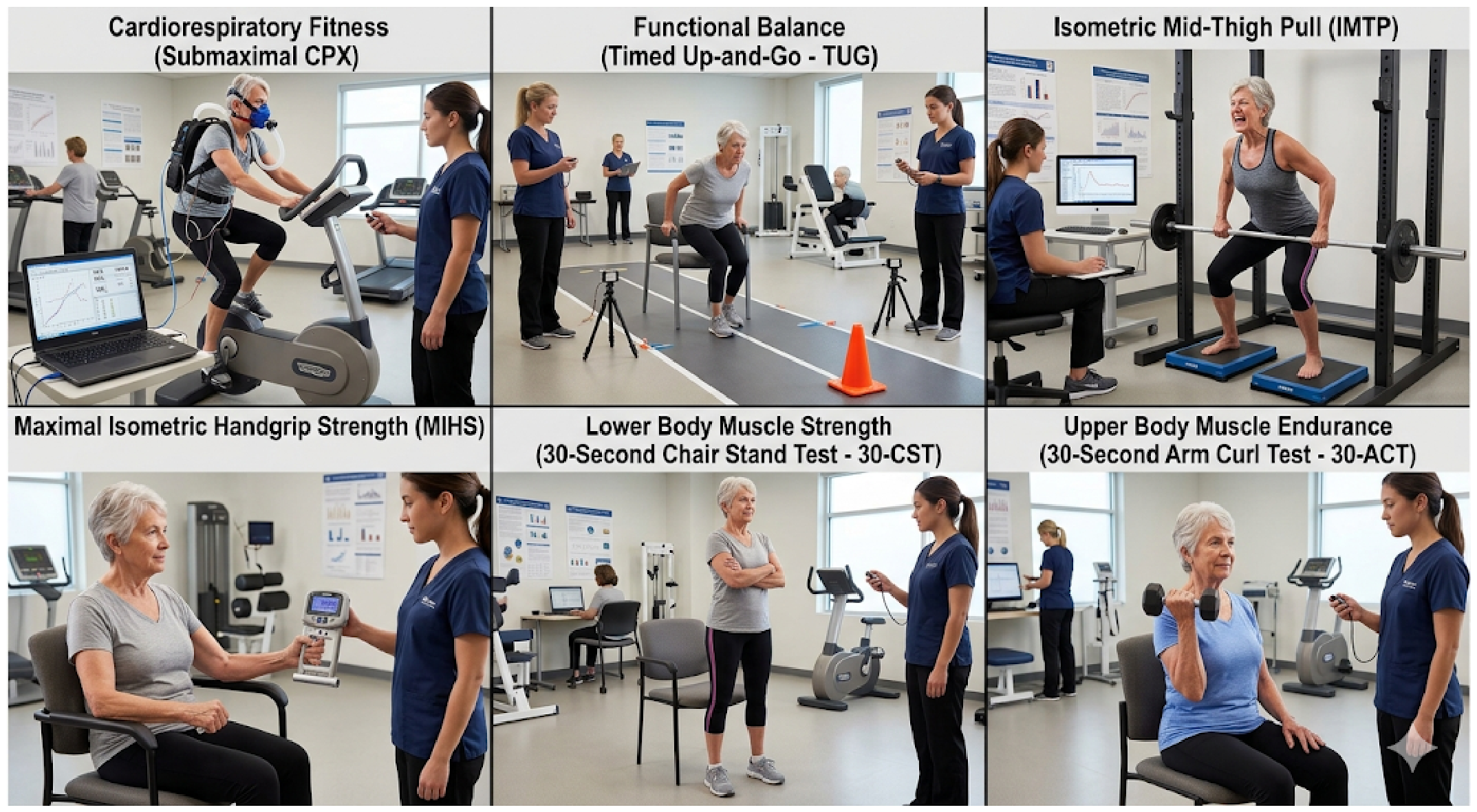
2.4.2. Cardiorespiratory Fitness
2.4.3. Timed Up-and-Go (TUG)
2.4.4. Isometric Mid-Thigh Pull (IMTP)
2.4.5. Maximal Isometric Handgrip Strength (MIHS)
2.4.6. The 30-s Chair Stand Test (30-CST)
2.4.7. The 30-s Arm Curl Test (30-ACT)
2.5. Statistical Analysis
3. Results
4. Discussion
4.1. Cardiorespiratory Fitness
4.2. TUG Perfomance
4.3. Muscle Strength Performance
4.4. Strengths and Limitations
4.5. Practical Applications
- (i)
- The IMTP may be considered a useful tool for assessing maximal multi-joint muscle strength in older people, providing complementary information to traditional measures such as MIHS, particularly in relation to lower-limb force production capacity.
- (ii)
- Given the observed correlations between IMTP peak force and selected submaximal cardiorespiratory parameters (e.g., PVT1, VO2VT2, and COP), maximal strength assessments may provide complementary information related to submaximal exercise responses, although these findings should be interpreted with caution and not as direct indicators of cardiorespiratory efficiency.
- (iii)
- The lack of correlation between IMTP and functional tests such as the TUG and 30-CST suggests that maximal isometric strength alone may not adequately capture performance in complex functional tasks, which depend on multiple physiological and coordinative factors. Therefore, practitioners are encouraged to include additional assessments targeting muscle power, rate of force development, and balance.
- (iv)
- Physical exercise programs for older people should not rely exclusively on maximal strength training but should also include interventions aimed at improving rapid force production, movement velocity, and functional task performance to better address the multidimensional nature of mobility and fall risk.
- (v)
- From a clinical and applied perspective, the combined assessment of maximal strength, functional performance, and cardiorespiratory fitness may offer a more comprehensive profile of physical capacity, potentially supporting more individualized and targeted intervention strategies.
5. Conclusions
Supplementary Materials
Author Contributions
Funding
Institutional Review Board Statement
Informed Consent Statement
Data Availability Statement
Acknowledgments
Conflicts of Interest
References
- Yerrakalva, D.; Hajna, S.; Griffin, S. Effects of Mobile Health App Interventions on Sedentary Time, Physical Activity, and Fitness in Older Adults: Systematic Review and Meta-Analysis. J. Med. Internet Res. 2019, 21, e14343. [Google Scholar] [CrossRef] [PubMed]
- Aagaard, P.; Suetta, C.; Caserotti, P.; Magnusson, S.P.; Kjaer, M. Role of the nervous system in sarcopenia and muscle atrophy with aging: Strength training as a countermeasure. Scand. J. Med. Sci. Sports 2010, 20, 49–64. [Google Scholar] [CrossRef]
- Chodzko-Zajko, W.J.; Proctor, D.N.; Fiatarone Singh, M.A.; Minson, C.T.; Nigg, C.R.; Salem, G.J.; Skinner, J.S. American College of Sports Medicine position stand. Exercise and physical activity for older adults. Med. Sci. Sports Exerc. 2009, 41, 1510–1530. [Google Scholar] [CrossRef]
- Fragala, M.S.; Cadore, E.L.; Dorgo, S.; Izquierdo, M.; Kraemer, W.J.; Peterson, M.D.; Ryan, E.D. Resistance Training for Older Adults: Position Statement From the National Strength and Conditioning Association. J. Strength Cond. Res. 2019. [Google Scholar] [CrossRef] [PubMed]
- Valdés-Badilla, P.A.; Gutiérrez-García, C.; Pérez-Gutiérrez, M.; Vargas-Vitoria, R.; López-Fuenzalida, A. Effects of Physical Activity Governmental Programs on Health Status in Independent Older Adults: A Systematic Review. J. Aging Phys. Act. 2018, 27, 265–275. [Google Scholar] [CrossRef]
- Peterson, M.D.; Zhang, P.; Choksi, P.; Markides, K.S.; Al Snih, S. Muscle Weakness Thresholds for Prediction of Diabetes in Adults. Sports Med. 2016, 46, 619–628. [Google Scholar] [CrossRef]
- McGrath, R.P.; Ottenbacher, K.J.; Vincent, B.M.; Kraemer, W.J.; Peterson, M.D. Muscle weakness and functional limitations in an ethnically diverse sample of older adults. Ethn. Health 2020, 25, 342–353. [Google Scholar] [CrossRef] [PubMed]
- Boyle, P.A.; Buchman, A.S.; Wilson, R.S.; Leurgans, S.E.; Bennett, D.A. Association of muscle strength with the risk of Alzheimer disease and the rate of cognitive decline in community-dwelling older persons. Arch. Neurol. 2009, 66, 1339–1344. [Google Scholar] [CrossRef]
- McGrath, R.P.; Kraemer, W.J.; Vincent, B.M.; Hall, O.T.; Peterson, M.D. Muscle Strength Is Protective Against Osteoporosis in an Ethnically Diverse Sample of Adults. J. Strength Cond. Res. 2017, 31, 2586–2589. [Google Scholar] [CrossRef]
- Park, H.; Kim, D.; Jeong, H.-S.; Jang, S. Grip Strength as an Indicator of Health in Elderly Females. Healthcare 2025, 13, 1127. [Google Scholar] [CrossRef]
- Sternäng, O.; Reynolds, C.A.; Finkel, D.; Ernsth-Bravell, M.; Pedersen, N.L.; Dahl Aslan, A.K. Factors associated with grip strength decline in older adults. Age Ageing 2015, 44, 269–274. [Google Scholar] [CrossRef]
- Martien, S.; Delecluse, C.; Boen, F.; Seghers, J.; Pelssers, J.; Van Hoecke, A.S.; Van Roie, E. Is knee extension strength a better predictor of functional performance than handgrip strength among older adults in three different settings? Arch. Gerontol. Geriatr. 2015, 60, 252–258. [Google Scholar] [CrossRef]
- Szaflik, P.; Zadoń, H.; Michnik, R.; Nowakowska-Lipiec, K. Handgrip Strength as an Indicator of Overall Strength and Functional Performance—Systematic Review. Appl. Sci. 2025, 15, 1847. [Google Scholar] [CrossRef]
- Crockett, K.; Ardell, K.; Hermanson, M.; Penner, A.; Lanovaz, J.; Farthing, J.; Arnold, C. The Relationship of Knee-Extensor Strength and Rate of Torque Development to Sit-to-Stand Performance in Older Adults. Physiother. Can. 2013, 65, 229–235. [Google Scholar] [CrossRef]
- Clark, D.J.; Manini, T.M.; Fielding, R.A.; Patten, C. Neuromuscular determinants of maximum walking speed in well-functioning older adults. Exp. Gerontol. 2013, 48, 358–363. [Google Scholar] [CrossRef]
- Altubasi, I.M. Is quadriceps muscle strength a determinant of the physical function of the elderly? J. Phys. Ther. Sci. 2015, 27, 3035–3038. [Google Scholar] [CrossRef] [PubMed]
- Md, J.F.B.; Kiely, D.K.; Herman, S.; Leveille, S.G.; Mizer, K.; Frontera, W.R.; Fielding, R.A. The Relationship Between Leg Power and Physical Performance in Mobility-Limited Older People. J. Am. Geriatr. Soc. 2002, 50, 461–467. [Google Scholar] [CrossRef]
- Muehlbauer, T.; Besemer, C.; Wehrle, A.; Gollhofer, A.; Granacher, U. Relationship between strength, power and balance performance in seniors. Gerontology 2012, 58, 504–512. [Google Scholar] [CrossRef]
- Bardstu, H.B.; Andersen, V.; Fimland, M.S.; Raastad, T.; Saeterbakken, A.H. Muscle Strength Is Associated With Physical Function in Community-Dwelling Older Adults Receiving Home Care. A Cross-Sectional Study. Front. Public Health 2022, 10, 856632. [Google Scholar] [CrossRef] [PubMed]
- De Witt, J.K.; English, K.L.; Crowell, J.B.; Kalogera, K.L.; Guilliams, M.E.; Nieschwitz, B.E.; Hanson, A.M.; Ploutz-Snyder, L.L. Isometric Midthigh Pull Reliability and Relationship to Deadlift One Repetition Maximum. J. Strength Cond. Res. 2018, 32, 528–533. [Google Scholar] [CrossRef]
- Drake, D.; Kennedy, R.; Wallace, E. The Validity and Responsiveness of Isometric Lower Body Multi-Joint Tests of Muscular Strength: A Systematic Review. Sports Med. Open 2017, 3, 23. [Google Scholar] [CrossRef]
- Dos’ Santos, T.; Jones, P.A.; Comfort, P.; Thomas, C. Effect of Different Onset Thresholds on Isometric Midthigh Pull Force-Time Variables. J. Strength Cond. Res. 2017, 31, 3463–3473. [Google Scholar] [CrossRef] [PubMed]
- Herrera-Valenzuela, T.; Cid-Calfucura, I.; Hernandez-Martinez, J.; Valdes-Badilla, P.; Garcia-Garcia, J.M.; Calvo-Rico, B.; Cofre-Bolados, C.; Pavez-Lizarraga, A.; Flandes-Vargas, V.; Segueida-Lorca, A.; et al. Comparative Effects of Adapted Taekwondo Versus Tai Chi on Health Status in Independent Older Women: A Randomized Controlled Trial. Life 2025, 15, 1511. [Google Scholar] [CrossRef] [PubMed]
- Cofre-Bolados, C.; Ferrari, G.; Valdivia-Moral, P.; Vidal-Diaz, F.; Ramirez-Velez, R.; Izquierdo-Redin, M. Sub Maximal Ergospirometry Parameters in Untrained Non-Frail Octogenarian Subjects. Medicina 2022, 58, 378. [Google Scholar] [CrossRef] [PubMed]
- Kondo, T.; Yamada, S.; Asai, C.; Okumura, T.; Tanimura, D.; Murohara, T. Skeletal Muscle Pump Function Is Associated With Exercise Capacity in Patients With Heart Failure. Circ. J. 2018, 82, 1033–1040. [Google Scholar] [CrossRef]
- Cofre-Bolados, C.; Vidal, F.; Gutierrez Espinoza, H.; Betancourt-Peters, I.; Orihuela, P.A.; Izquierdo, M. Periodized Aerobic Training between Thresholds Improves Submaximal Cardiorespiratory Parameters in Octogenarians. Sports 2023, 11, 219. [Google Scholar] [CrossRef]
- Weakley, J.; Black, G.; McLaren, S.; Scantlebury, S.; Suchomel, T.J.; McMahon, E.; Watts, D.; Read, D.B. Testing and Profiling Athletes: Recommendations for Test Selection, Implementation, and Maximizing Information. Strength Cond. J. 2024, 46, 159–179. [Google Scholar] [CrossRef]
- Marfell-Jones, M.; Olds, T.; Stewart, A.; Carter, L. International Standards for Anthropometric Assessment; International Society for the Advancement of Kinanthropometry (ISAK): Potchefstroom, South Africa, 2006. [Google Scholar]
- Wasserman, K.; Hansen, J.E.; Sue, D.Y.; Whipp, B.J.; Froelicher, V.F. Principles of Exercise Testing and Interpretation. J. Cardiopulm. Rehabil. Prev. 1987, 7, 189. [Google Scholar] [CrossRef]
- Rikli, R.E.; Jones, C.J. Development and validation of criterion-referenced clinically relevant fitness standards for maintaining physical independence in later years. Gerontologist 2013, 53, 255–267. [Google Scholar] [CrossRef]
- Comfort, P.; Dos’ Santos, T.; Beckham, G.K.; Stone, M.H.; Guppy, S.N.; Gregory Haff, G. Standardization and Methodological Considerations for the Isometric Midthigh Pull. J. Strength Cond. Res. 2019, 41, 57–79. [Google Scholar] [CrossRef]
- Hernandez-Martinez, J.; Castillo-Cerda, M.; Vera-Assaoka, T.; Carter-Truillier, B.; Herrera-Valenzuela, T.; Guzman-Munoz, E.; Branco, B.H.M.; Jofre-Saldia, E.; Valdes-Badilla, P. Warm-Up and Handgrip Strength in Physically Inactive Chilean Older Females According to Baseline Nutritional Status. Int. J. Environ. Res. Public Health 2022, 19, 13335. [Google Scholar] [CrossRef]
- Jones, C.J.; Rikli, R.E.; Beam, W.C. A 30-s chair-stand test as a measure of lower body strength in community-residing older adults. Res. Q. Exerc. Sport 1999, 70, 113–119. [Google Scholar] [CrossRef]
- Bruun, I.H.; Mogensen, C.B.; Nørgaard, B.; Schiøttz-Christensen, B.; Maribo, T. Validity and Responsiveness to Change of the 30-Second Chair-Stand Test in Older Adults Admitted to an Emergency Department. J. Geriatr. Phys. Ther. 2019, 42, 265–274. [Google Scholar] [CrossRef] [PubMed]
- Eisinga, R.; Grotenhuis, M.; Pelzer, B. The reliability of a two-item scale: Pearson, Cronbach, or Spearman-Brown? Int. J. Public Health 2013, 58, 637–642. [Google Scholar] [CrossRef] [PubMed]
- Afonso, J.; Andrade, R.; Clemente, F.M.; Oliveira, E.; Sarmento, H.; Wallot, S.; Ramirez-Campillo, R.; Warneke, K. Addressing p-values in multiple statistical testing: A primer for sports sciences researchers. Footb. Stud. 2026, 1. [Google Scholar] [CrossRef]
- Ogawa, T.; Spina, R.J.; Martin, W.H.; Kohrt, W.M.; Schechtman, K.B.; Holloszy, J.O.; Ehsani, A.A. Effects of aging, sex, and physical training on cardiovascular responses to exercise. Circulation 1992, 86, 494–503. [Google Scholar] [CrossRef]
- Tanaka, H.; Seals, D.R. Endurance exercise performance in Masters athletes: Age-associated changes and underlying physiological mechanisms. J. Physiol. 2008, 586, 55–63. [Google Scholar] [CrossRef]
- Roh, J.; Rhee, J.; Chaudhari, V.; Rosenzweig, A. The Role of Exercise in Cardiac Aging. Circ. Res. 2016, 118, 279–295. [Google Scholar] [CrossRef]
- Smart, T.F.F.; Doleman, B.; Hatt, J.; Paul, M.; Toft, S.; Lund, J.N.; Phillips, B.E. The role of resistance exercise training for improving cardiorespiratory fitness in healthy older adults: A systematic review and meta-analysis. Age Ageing 2022, 51. [Google Scholar] [CrossRef]
- Bardstu, H.B.; Andersen, V.; Fimland, M.S.; Aasdahl, L.; Raastad, T.; Cumming, K.T.; Saeterbakken, A.H. Effectiveness of a resistance training program on physical function, muscle strength, and body composition in community-dwelling older adults receiving home care: A cluster-randomized controlled trial. Eur. Rev. Aging Phys. Act. 2020, 17, 11. [Google Scholar] [CrossRef]
- Granacher, U.; Gruber, M.; Gollhofer, A. Force production capacity and functional reflex activity in young and elderly men. Aging Clin. Exp. Res. 2010, 22, 374–382. [Google Scholar] [CrossRef]
- Carter, N.D.; Khan, K.M.; Mallinson, A.; Janssen, P.A.; Heinonen, A.; Petit, M.A.; McKay, H.A. Knee extension strength is a significant determinant of static and dynamic balance as well as quality of life in older community-dwelling women with osteoporosis. Gerontology 2002, 48, 360–368. [Google Scholar] [CrossRef]
- Bhattacharya, P.K.; Deka, K.; Roy, A. Assessment of Inter-Rater Variability of the Senior Fitness Test in the Geriatric Population: A Community Based Study. Int. J. Biomed. Adv. Res. 2016, 7, 208. [Google Scholar] [CrossRef]
- Vasquez-Carrasco, E.; Hernandez-Martinez, J.; Cid-Calfucura, I.; Guzman-Munoz, E.; Ruiz, C.; Baeza, C.; Marquez, M.J.; Herrera-Valenzuela, T.; Branco, B.H.M.; Carmine-Pena, E.; et al. Effects of Different Interventions Using Taekwondo, Boxing, and Elastic Band Training on Body Composition and Physical Function in Chilean Older Women: A Randomized Controlled Trial. Life 2025, 15, 1049. [Google Scholar] [CrossRef]
- Löfgren, N.; Giedraitis, V.; Halvorsen, K.; Rosendahl, E.; Åberg, A.C. The Timed Up and Go dual-task test’s cognitive and motor outcomes show promising test-retest reliability in older adults with perceived memory impairment. Front. Aging 2025, 6, 1715756. [Google Scholar] [CrossRef] [PubMed]
- Porto, J.M.; Nakaishi, A.P.M.; Cangussu-Oliveira, L.M.; Freire Júnior, R.C.; Spilla, S.B.; Abreu, D.C.C.d. Relationship between grip strength and global muscle strength in community-dwelling older people. Arch. Gerontol. Geriatr. 2019, 82, 273–278. [Google Scholar] [CrossRef]
- Strandkvist, V.; Larsson, A.; Pauelsen, M.; Nyberg, L.; Vikman, I.; Lindberg, A.; Gustafsson, T.; Röijezon, U. Hand grip strength is strongly associated with lower limb strength but only weakly with postural control in community-dwelling older adults. Arch. Gerontol. Geriatr. 2021, 94, 104345. [Google Scholar] [CrossRef]
- Tatangelo, T.; Muollo, V.; Ghiotto, L.; Schena, F.; Rossi, A.P. Exploring the association between handgrip, lower limb muscle strength, and physical function in older adults: A narrative review. Exp. Gerontol. 2022, 167, 111902. [Google Scholar] [CrossRef] [PubMed]
- James, L.P.; Talpey, S.W.; Young, W.B.; Geneau, M.C.; Newton, R.U.; Gastin, P.B. Strength Classification and Diagnosis: Not All Strength Is Created Equal. Strength Cond. J. 2023, 45, 333–341. [Google Scholar] [CrossRef]



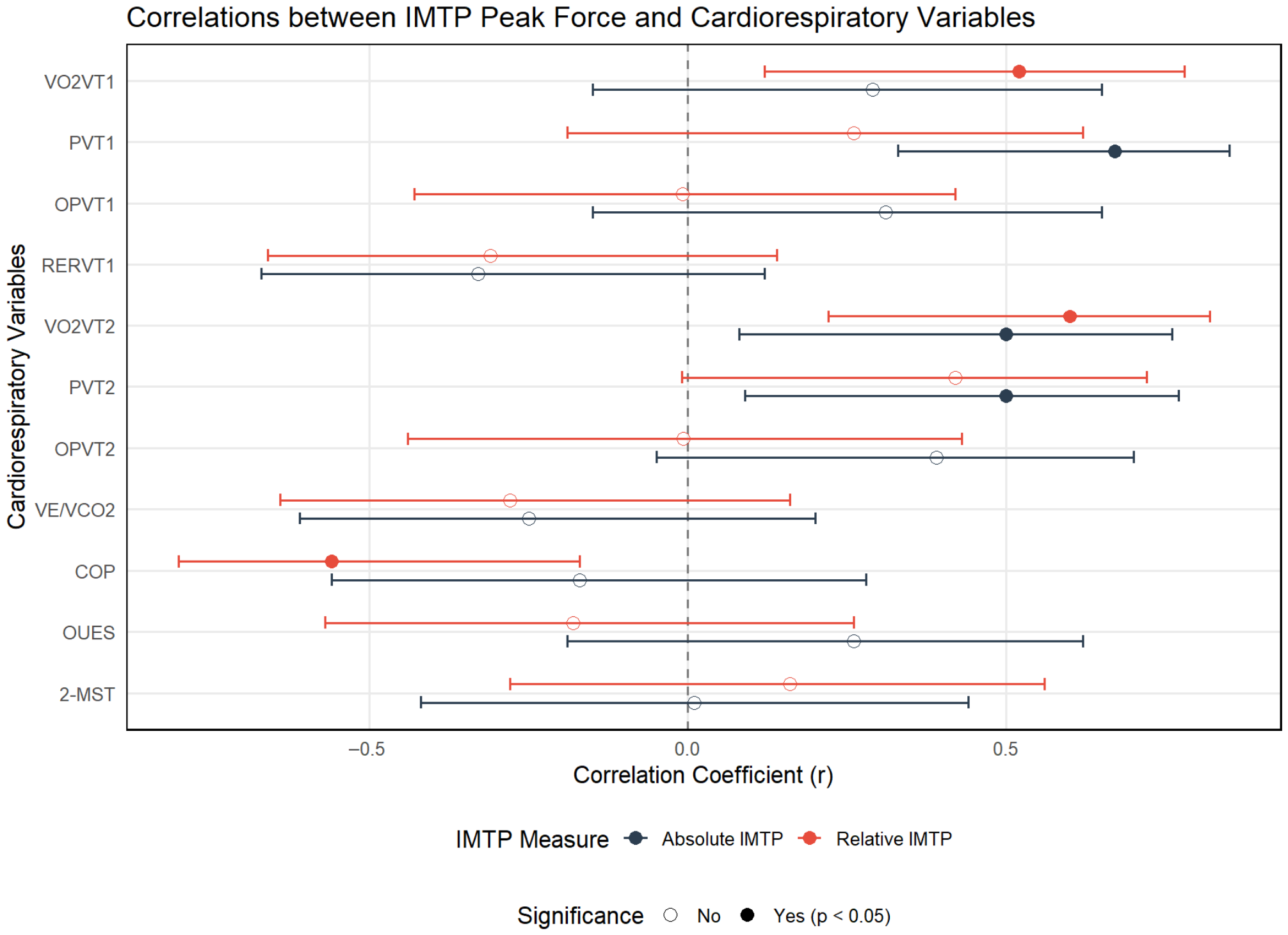
| Variables | VO2VT1 | PVT1 | OPVT1 | RERVT1 | VO2VT2 | PVT2 | OPVT2 | VE/VCO2 | COP | OUES | 2-MST | |
|---|---|---|---|---|---|---|---|---|---|---|---|---|
| IMTP | r | 0.29 | 0.67 | 0.31 | −0.33 | 0.50 | 0.50 | 0.39 | −0.25 | −0.17 | 0.26 | 0.01 |
| 95% CI | −0.15 - 0.65 | 0.33 - 0.85 | −0.15 - 0.65 | −0.67 - 0.12 | 0.08 - 0.76 | 0.09 - 0.77 | −0.05 - 0.70 | −0.61 - 0.20 | −0.56 - 0.28 | −0.19 - 0.62 | −0.42 - 0.44 | |
| p | 0.19 | 0.01 | 0.17 | 0.14 | 0.02 | 0.02 | 0.08 | 0.26 | 0.45 | 0.24 | 0.94 | |
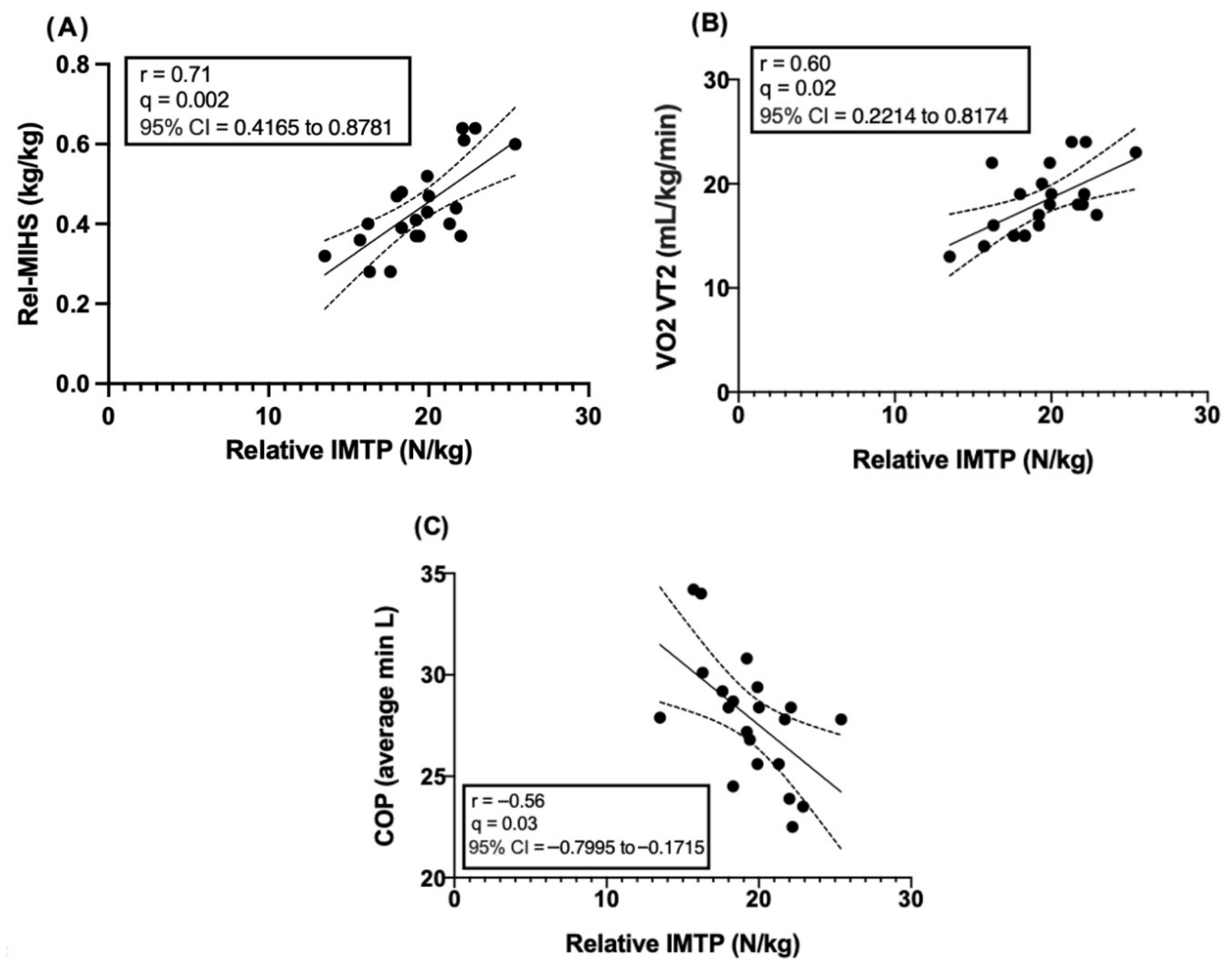
| Relative IMTP | r | 0.52 | 0.26 | −0.009 | −0.31 | 0.60 | 0.42 | −0.007 | −0.28 | −0.56 | −0.18 | 0.16 |
| 95% CI | 0.12 - 0.78 | −0.19 - 0.62 | −0.43 - 0.42 | −0.66 - 0.14 | 0.22 - 0.82 | −0.01 - 0.72 | −0.44 - 0.43 | −0.64 - 0.16 | −0.80 - −0.17 | −0.57 - 0.26 | −0.28 - 0.56 | |
| p | 0.01 | 0.25 | 0.96 | 0.16 | 0.004 | 0.06 | 0.97 | 0.20 | 0.008 | 0.41 | 0.47 |
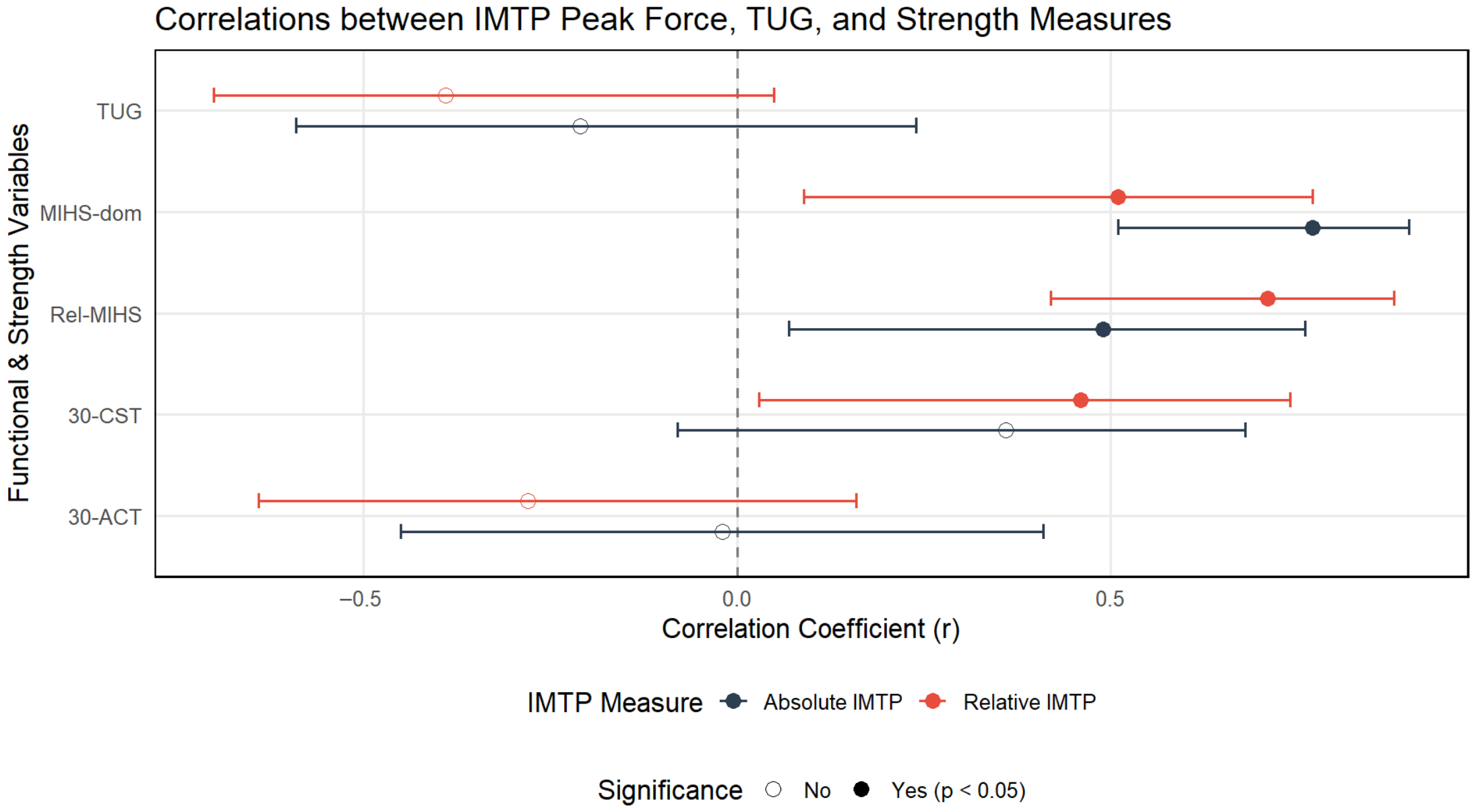
| Variables | TUG | MIHS-dom | Rel-MIHS | 30-CST | 30-ACT | |
|---|---|---|---|---|---|---|
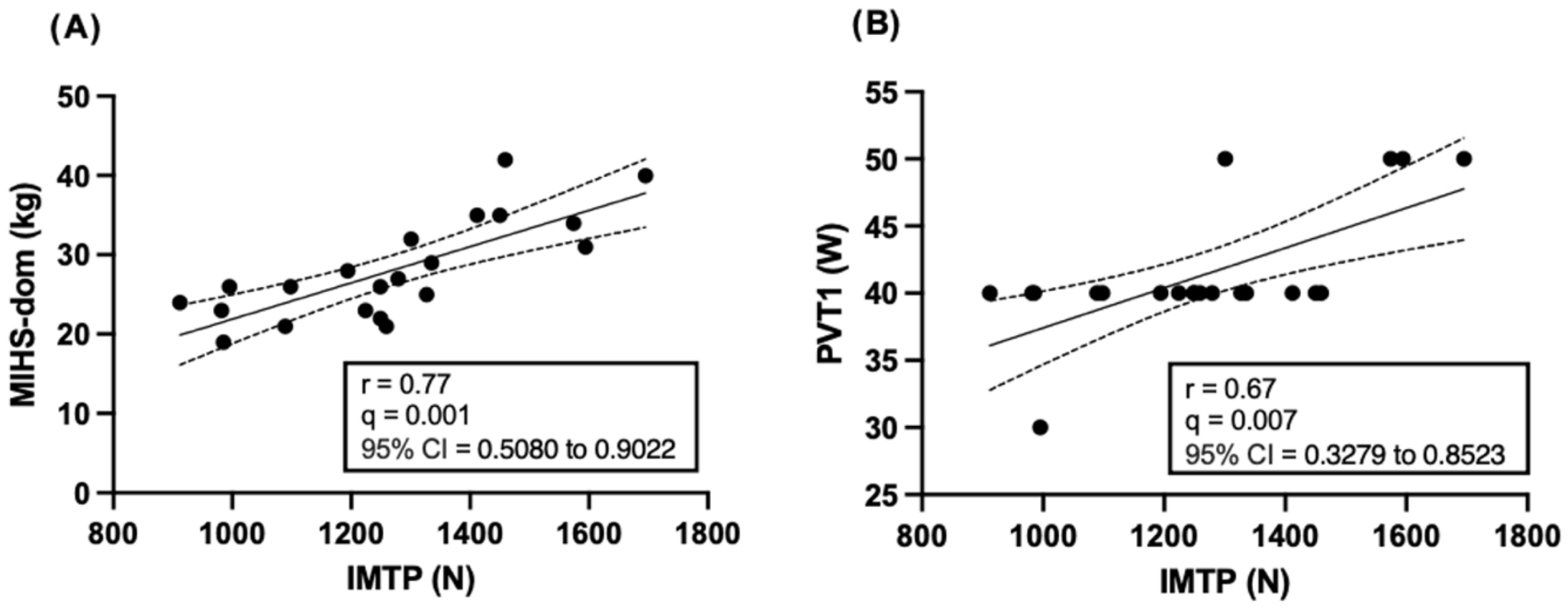
| IMTP | r | −0.21 | 0.77 | 0.49 | 0.36 | −0.02 |
| 95% CI | −0.59 - 0.24 | 0.51 - 0.90 | 0.07 - 0.76 | −0.08 - 0.68 | −0.45 - 0.41 | |
| p | 0.35 | <0.001 | 0.02 | 0.10 | 0.91 | |
| Relative IMTP | r | −0.39 | 0.51 | 0.71 | 0.46 | −0.28 |
| 95% CI | −0.70 - 0.05 | 0.09 - 0.77 | 0.42 - 0.88 | 0.03 - 0.74 | −0.64 - 0.16 | |
| p | 0.08 | 0.01 | 0.002 | 0.03 | 0.20 |
Disclaimer/Publisher’s Note: The statements, opinions and data contained in all publications are solely those of the individual author(s) and contributor(s) and not of MDPI and/or the editor(s). MDPI and/or the editor(s) disclaim responsibility for any injury to people or property resulting from any ideas, methods, instructions or products referred to in the content. |
© 2026 by the authors. Licensee MDPI, Basel, Switzerland. This article is an open access article distributed under the terms and conditions of the Creative Commons Attribution (CC BY) license.
Share and Cite
Hernandez-Martinez, J.; Cid-Calfucura, I.; Valdés-Badilla, P.; Merino-Muñoz, P.; Aedo-Muñoz, E.; Montalva-Valenzuela, F.; Delgado-Floody, P.; Núñez-Espinosa, C.; Herrera-Valenzuela, T. Associations Between Isometric Mid-Thigh Pull Peak Force and Functional and Cardiorespiratory Variables in Independent Older Women. J. Clin. Med. 2026, 15, 3858. https://doi.org/10.3390/jcm15103858
Hernandez-Martinez J, Cid-Calfucura I, Valdés-Badilla P, Merino-Muñoz P, Aedo-Muñoz E, Montalva-Valenzuela F, Delgado-Floody P, Núñez-Espinosa C, Herrera-Valenzuela T. Associations Between Isometric Mid-Thigh Pull Peak Force and Functional and Cardiorespiratory Variables in Independent Older Women. Journal of Clinical Medicine. 2026; 15(10):3858. https://doi.org/10.3390/jcm15103858
Chicago/Turabian StyleHernandez-Martinez, Jordan, Izham Cid-Calfucura, Pablo Valdés-Badilla, Pablo Merino-Muñoz, Esteban Aedo-Muñoz, Felipe Montalva-Valenzuela, Pedro Delgado-Floody, Cristian Núñez-Espinosa, and Tomás Herrera-Valenzuela. 2026. "Associations Between Isometric Mid-Thigh Pull Peak Force and Functional and Cardiorespiratory Variables in Independent Older Women" Journal of Clinical Medicine 15, no. 10: 3858. https://doi.org/10.3390/jcm15103858
APA StyleHernandez-Martinez, J., Cid-Calfucura, I., Valdés-Badilla, P., Merino-Muñoz, P., Aedo-Muñoz, E., Montalva-Valenzuela, F., Delgado-Floody, P., Núñez-Espinosa, C., & Herrera-Valenzuela, T. (2026). Associations Between Isometric Mid-Thigh Pull Peak Force and Functional and Cardiorespiratory Variables in Independent Older Women. Journal of Clinical Medicine, 15(10), 3858. https://doi.org/10.3390/jcm15103858