Prediction of Posterior Communicating Artery Aneurysm Rupture Risk: A Multivariate Analysis of Aneurysm and Surrounding Arterial Morphological Factors

 , , , , , , and
Abstract
1. Introduction
2. Materials and Methods
2.1. Ethics Approval and Patient Consent
2.2. Study Population and Clinical Characteristics
2.3. Measurement Tools
2.4. Definitions of Parameters
2.5. Statistical Analysis
3. Results
3.1. Characteristics of the Patients with PcomA Aneurysm
3.2. Morphological Parameters of the Aneurysms
3.3. Morphological Parameters of the ICAs
3.4. Combined Morphological Parameters of the Aneurysms and ICAs
4. Discussion
5. Conclusions
Supplementary Materials
Author Contributions
Funding
Institutional Review Board Statement
Informed Consent Statement
Data Availability Statement
Acknowledgments
Conflicts of Interest
Abbreviations
| SAH | Subarachnoid hemorrhage |
| PcomA | Posterior communicating artery |
| AR | Aspect ratio |
| SR | Size ratio |
| ICA | Internal carotid artery |
| 3D | Three dimensional |
| 2D | Two dimensional |
| DSA | Digital subtraction angiography |
| ROC | Receiver operating characteristic |
| HTN | Hypertension |
| DM | Diabetes mellitus |
| AUC | Area under the curve |
References
- Van Gijn, J.; Kerr, R.S.; Rinkel, G.J. Subarachnoid haemorrhage. Lancet 2007, 369, 306–318. [Google Scholar] [CrossRef] [PubMed]
- National Clinical Research Center for Neurological; Society of Neurosurgery of Chinese Medical Association; Society of Cerebrovascular Surgery of Chinese Stroke Association. Chinese guideline for the clinical management of patients with unruptured intracranial aneurysms. Zhonghua Yi Xue Za Zhi 2024, 104, 1918–1939. [Google Scholar] [CrossRef]
- Hao, W.; Hao, H.; Ren, C.F.; Wang, X.; Gao, B. Associations Between Posterior Communicating Artery Aneurysms and Morphological Characteristics of Surrounding Arteries. Front. Neurol. 2022, 13, 874466. [Google Scholar] [CrossRef]
- Huhtakangas, J.; Lehecka, M.; Lehto, H.; Jahromi, B.R.; Niemela, M.; Kivisaari, R. CTA analysis and assessment of morphological factors related to rupture in 413 posterior communicating artery aneurysms. Acta Neurochir. 2017, 159, 1643–1652. [Google Scholar] [CrossRef]
- Jiang, H.; Shen, J.; Weng, Y.X.; Pan, J.W.; Yu, J.B.; Wan, Z.A.; Zhan, R. Morphology Parameters for Mirror Posterior Communicating Artery Aneurysm Rupture Risk Assessment. Neurol. Med. Chir. 2015, 55, 498–504. [Google Scholar] [CrossRef]
- Lv, N.; Feng, Z.; Wang, C.; Cao, W.; Fang, Y.; Karmonik, C.; Liu, J.; Huang, Q. Morphological Risk Factors for Rupture of Small (<7mm) Posterior Communicating Artery Aneurysms. World Neurosurg. 2016, 87, 311–315. [Google Scholar] [CrossRef]
- Skodvin, T.O.; Johnsen, L.H.; Gjertsen, O.; Isaksen, J.G.; Sorteberg, A. Cerebral Aneurysm Morphology Before and After Rupture: Nationwide Case Series of 29 Aneurysms. Stroke 2017, 48, 880–886. [Google Scholar] [CrossRef] [PubMed]
- Yi, J.; Zielinski, D.; Chen, M. Cerebral Aneurysm Size before and after Rupture: Case Series and Literature Review. J. Stroke Cerebrovasc. Dis. 2016, 25, 1244–1248. [Google Scholar] [CrossRef] [PubMed]
- Meng, H.; Tutino, V.M.; Xiang, J.; Siddiqui, A. High WSS or Low WSS? Complex Interactions of Hemodynamics with Intracranial Aneurysm Initiation, Growth, and Rupture: Toward a Unifying Hypothesis. AJNR Am. J. Neuroradiol. 2014, 35, 1254–1262. [Google Scholar] [CrossRef]
- Rosato, R.; Comptdaer, G.; Mulligan, R.; Breton, J.M.; Lesha, E.; Lauric, A.; Malek, A.M. Increased focal internal carotid artery angulation in patients with posterior communicating artery aneurysms. J. NeuroInterv. Surg. 2020, 12, 1142–1147. [Google Scholar] [CrossRef]
- Yu, M.; Huang, Q.; Hong, B.; Qiao, F.; Liu, J. Morphological differences between the aneurysmal and normal artery in patients with internal carotid-posterior communicating artery aneurysm. J. Clin. Neurosci. 2010, 17, 1395–1398. [Google Scholar] [CrossRef]
- Dhar, S.; Tremmel, M.; Mocco, J.; Kim, M.; Yamamoto, J.; Siddiqui, A.H.; Hopkins, L.N.; Meng, H. Morphology parameters for intracranial aneurysm rupture risk assessment. Neurosurgery 2008, 63, 185–196, discussion 196–187. [Google Scholar] [CrossRef]
- Raghavan, M.L.; Ma, B.; Harbaugh, R.E. Quantified aneurysm shape and rupture risk. J. Neurosurg. 2005, 102, 355–362. [Google Scholar] [CrossRef] [PubMed]
- Liu, Q.; Jiang, P.; Jiang, Y.; Ge, H.; Li, S.; Jin, H.; Li, Y. Prediction of Aneurysm Stability Using a Machine Learning Model Based on PyRadiomics-Derived Morphological Features. Stroke 2019, 50, 2314–2321. [Google Scholar] [CrossRef] [PubMed]
- Ludwig, C.G.; Lauric, A.; Malek, J.A.; Mulligan, R.; Malek, A.M. Performance of Radiomics derived morphological features for prediction of aneurysm rupture status. J. NeuroInterv. Surg. 2021, 13, 755–761. [Google Scholar] [CrossRef] [PubMed]
- Labeyrie, P.E.; Gory, B.; Huguet, N.; Grenier, C.; Ditac, G.; Sadeh-Gonik, U.; Riva, R.; Turjman, F. Carotid siphon morphology: Is it associated with posterior communicating aneurysms? Interv. Neuroradiol. 2016, 22, 378–382. [Google Scholar] [CrossRef]
- Greving, J.P.; Wermer, M.J.; Brown, R.D., Jr.; Morita, A.; Juvela, S.; Yonekura, M.; Ishibashi, T.; Torner, J.C.; Nakayama, T.; Rinkel, G.J.; et al. Development of the PHASES score for prediction of risk of rupture of intracranial aneurysms: A pooled analysis of six prospective cohort studies. Lancet Neurol. 2014, 13, 59–66. [Google Scholar] [CrossRef]
- Lee, U.Y.; Kwak, H.S. Analysis of Morphological-Hemodynamic Risk Factors for Aneurysm Rupture Including a Newly Introduced Total Volume Ratio. J. Pers. Med. 2021, 11, 744. [Google Scholar] [CrossRef]
- Li, M.; Hu, S.; Yu, N.; Zhang, Y.; Luo, M. Association Between Meteorological Factors and the Rupture of Intracranial Aneurysms. J. Am. Heart Assoc. 2019, 8, e012205. [Google Scholar] [CrossRef]
- Castiglione, J.A.; Drake, A.W.; Hussein, A.E.; Johnson, M.D.; Palmisciano, P.; Smith, M.S.; Robinson, M.W.; Stahl, T.L.; Jandarov, R.A.; Grossman, A.W.; et al. Complex Morphologic Analysis of Cerebral Aneurysms Through the Novel Use of Fractal Dimension as a Predictor of Rupture Status: A Proof of Concept Study. World Neurosurg. 2023, 175, e64–e72. [Google Scholar] [CrossRef]
- Duan, G.; Lv, N.; Yin, J.; Xu, J.; Hong, B.; Xu, Y.; Liu, J.; Huang, Q. Morphological and hemodynamic analysis of posterior communicating artery aneurysms prone to rupture: A matched case-control study. J. NeuroInterv. Surg. 2016, 8, 47–51. [Google Scholar] [CrossRef] [PubMed]
- Yuan, J.; Huang, C.; Li, Z.; Jiang, X.; Zhao, X.; Wu, D.; Lai, N.; Liu, J.; Zhang, B.; Qin, F.; et al. Hemodynamic and Morphological Parameters of Ruptured Mirror Posterior Communicating Artery Aneurysms. Front. Neurol. 2021, 12, 653589. [Google Scholar] [CrossRef]
- Tsutsui, T.; Ikedo, T.; Kitazawa, Y.; Otsuka, R.; Nishiwaki, T.; Kushi, Y.; Niwa, A.; Ozaki, S.; Hattori, E.Y.; Shimonaga, K.; et al. Impact of Morphological Factors on the Future Growth of Unruptured Posterior Communicating Artery Aneurysms. World Neurosurg. 2023, 175, e897–e903. [Google Scholar] [CrossRef]
- Xu, Z.; Kim, B.S.; Lee, K.S.; Choi, J.H.; Shin, Y.S. Morphological and clinical risk factors for the rupture of posterior communicating artery aneurysms: Significance of fetal-type posterior cerebral artery. Neurol. Sci. 2019, 40, 2377–2382. [Google Scholar] [CrossRef] [PubMed]
- Han, K.; Nahm, M.; Ko, S.W.; Yi, H.J.; Chun, H.J.; Lee, Y.J.; Lee, S.H.; Ryu, J.; Song, S.; Choi, K.S. Influence of Fetal-Type Posterior Cerebral Artery on Morphological Characteristics and Rupture Risk of Posterior Communicating Artery Aneurysms: A Radiomics Approach. J. Clin. Med. 2025, 14, 3682. [Google Scholar] [CrossRef]
- Zheng, Y.; Xu, F.; Ren, J.; Xu, Q.; Liu, Y.; Tian, Y.; Leng, B. Assessment of intracranial aneurysm rupture based on morphology parameters and anatomical locations. J. NeuroInterv. Surg. 2016, 8, 1240–1246. [Google Scholar] [CrossRef]
- Xu, J.; Yu, Y.; Wu, X.; Wu, Y.; Jiang, C.; Wang, S.; Huang, Q.; Liu, J. Morphological and hemodynamic analysis of mirror posterior communicating artery aneurysms. PLoS ONE 2013, 8, e55413. [Google Scholar] [CrossRef]
- Turhon, M.; Li, M.; Kang, H.; Huang, J.; Zhang, F.; Zhang, Y.; Zhang, Y.; Maimaiti, A.; Gheyret, D.; Axier, A.; et al. Development and validation of a deep learning model for prediction of intracranial aneurysm rupture risk based on multi-omics factor. Eur. Radiol. 2023, 33, 6759–6770. [Google Scholar] [CrossRef] [PubMed]
- Gao, B.L.; Hao, H.; Hao, W.; Ren, C.F.; Yang, L.; Han, Y. Cerebral aneurysms at major arterial bifurcations are associated with the arterial branch forming a smaller angle with the parent artery. Sci. Rep. 2022, 12, 5106. [Google Scholar] [CrossRef]
- Gao, B.L.; Hao, W.L.; Ren, C.F.; Li, C.H.; Wang, J.W.; Liu, J.F. Greater hemodynamic stresses initiated the anterior communicating artery aneurysm on the vascular bifurcation apex. J. Clin. Neurosci. 2022, 96, 25–32. [Google Scholar] [CrossRef]
- Hussain-Amin, A.; Parekh, A.; Mohan, J. Basic Concepts of Echocardiography Hemodynamics. In StatPearls; StatPearls Publishing LLC.: Treasure Island, FL, USA, 2024. [Google Scholar]
- Cebral, J.R.; Mut, F.; Weir, J.; Putman, C.M. Association of hemodynamic characteristics and cerebral aneurysm rupture. AJNR Am. J. Neuroradiol. 2011, 32, 264–270. [Google Scholar] [CrossRef]
- Fattahi, M.; Abdollahi, S.A.; Alibak, A.H.; Hosseini, S.; Dang, P. Usage of computational method for hemodynamic analysis of intracranial aneurysm rupture risk in different geometrical aspects. Sci. Rep. 2023, 13, 20749. [Google Scholar] [CrossRef] [PubMed]
- Munarriz, P.M.; Gómez, P.A.; Paredes, I.; Castaño-Leon, A.M.; Cepeda, S.; Lagares, A. Basic Principles of Hemodynamics and Cerebral Aneurysms. World Neurosurg. 2016, 88, 311–319. [Google Scholar] [CrossRef]
- Murayama, Y.; Fujimura, S.; Suzuki, T.; Takao, H. Computational fluid dynamics as a risk assessment tool for aneurysm rupture. Neurosurg. Focus. 2019, 47, E12. [Google Scholar] [CrossRef]
- Wong, G.K.; Poon, W.S. Current status of computational fluid dynamics for cerebral aneurysms: The clinician’s perspective. J. Clin. Neurosci. 2011, 18, 1285–1288. [Google Scholar] [CrossRef] [PubMed]
- Yang, H.; Kim, J.-J.; Kim, Y.B.; Cho, K.-C.; Oh, J.H. Investigation of Paraclinoid Aneurysm Formation by Comparing the Combined Influence of Hemodynamic Parameters Between Aneurysmal and Non-Aneurysmal Arteries. J. Cereb. Blood Flow Metab. 2024, 44, 1393–1403. [Google Scholar] [CrossRef]
- Malek, A.M.; Alper, S.L.; Izumo, S. Hemodynamic shear stress and its role in atherosclerosis. JAMA 1999, 282, 2035–2042. [Google Scholar] [CrossRef] [PubMed]




| Variable | Frequency |
|---|---|
| Patient demographics, n = 64 | |
| Age, mean ± standard deviation | 65 ± 12 |
| Female, n (%) | 55 (86) |
| Medical history, n (%) | |
| Hypertension | 45 (70) |
| Hyperlipidemia | 23 (36) |
| Family history of SAH | 2 (3.1) |
| Smoking | 11 (17.2) |
| Aneurysm characteristics, n = 64 | |
| Size, mean ± standard deviation, mm | 6.8 ± 3.6 |
| Ruptured status, n (%) | 25 (39) |
| Bleb, n (%) | 19 (30) |
| Parameter | Unruptured (39) | Ruptured (25) | p-Value |
|---|---|---|---|
| Age | 66.103 ± 10.765 | 63.48 ± 12.128 | 0.185 |
| Sex (Male) | 4 (10.3%) | 5 (20.0%) | 0.274 |
| HTN | 29 (74.4%) | 16 (64.0%) | 0.376 |
| Family history | 2 (5.1%) | 0 (0.0%) | 0.250 |
| Hyperlipidemia | 15 (38.5%) | 8 (32.0%) | 0.599 |
| Smoking | 7 (17.9%) | 4 (16.0%) | 0.840 |
| BMI | 22.911 ± 3.55 | 22.792 ± 3.116 | 0.446 |
| Parameter | Unruptured (39) | Ruptured (25) | p-Value |
|---|---|---|---|
| Bleb | 12 (30.8%) | 7 (28.0%) | 0.813 |
| Smax | 6.072 ± 3.059 | 7.919 ± 4.017 | 0.021 * |
| Height | 4.806 ± 2.799 | 6.452 ± 3.412 | 0.020 * |
| Neck | 3.96 ± 1.412 | 4.339 ± 1.68 | 0.167 |
| HW | 1.113 ± 0.265 | 1.133 ± 0.238 | 0.383 |
| AR | 1.172 ± 0.493 | 1.513 ± 0.702 | 0.013 * |
| SR | 1.603 ± 3.05 | 2.65 ± 5.689 | 0.171 |
| Elongation | 0.761 ± 0.114 | 0.712 ± 0.161 | 0.080 |
| Flatness | 0.617 ± 0.103 | 0.573 ± 0.176 | 0.227 |
| M-2D Diameter Column | 5.897 ± 2.448 | 7.503 ± 3.384 | 0.016 * |
| M-2D Diameter Row | 5.912 ± 2.935 | 8.151 ± 4.177 | 0.007 * |
| M-2D Diameter Slice | 5.973 ± 2.996 | 7.62 ± 3.362 | 0.023 * |
| M-3D Diameter | 6.636 ± 3.009 | 10.874 ± 6.247 | 0.002 * |
| Mesh Volume | 91.566 ± 133.66 | 163.195 ± 207.86 | 0.067 |
| Sphericity | 0.807 ± 0.046 | 0.793 ± 0.04 | 0.108 |
| Surface Area | 99.89 ± 100.984 | 156.476 ± 136.921 | 0.031 * |
| Surface Volume Ratio | 1.972 ± 0.951 | 1.58 ± 0.722 | 0.042 * |
| Parameter | Unruptured (39) | Ruptured (25) | p-Value |
|---|---|---|---|
| Lo | 9.881 ± 2.655 | 10.094 ± 2.021 | 0.367 |
| CURo | 0.214 ± 0.058 | 0.235 ± 0.05 | 0.073 |
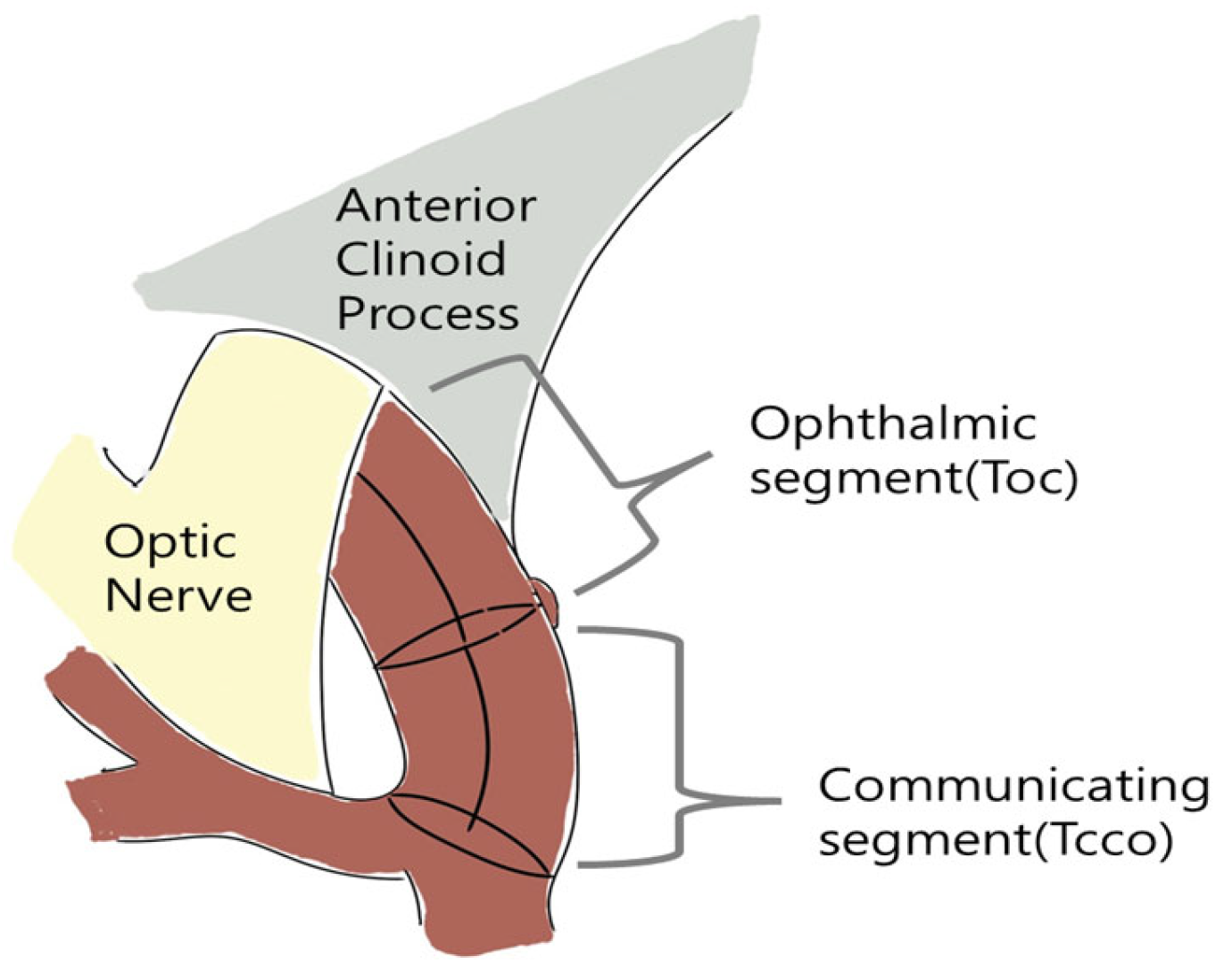
| Toc | 0.103 ± 0.077 | 0.117 ± 0.052 | 0.222 |
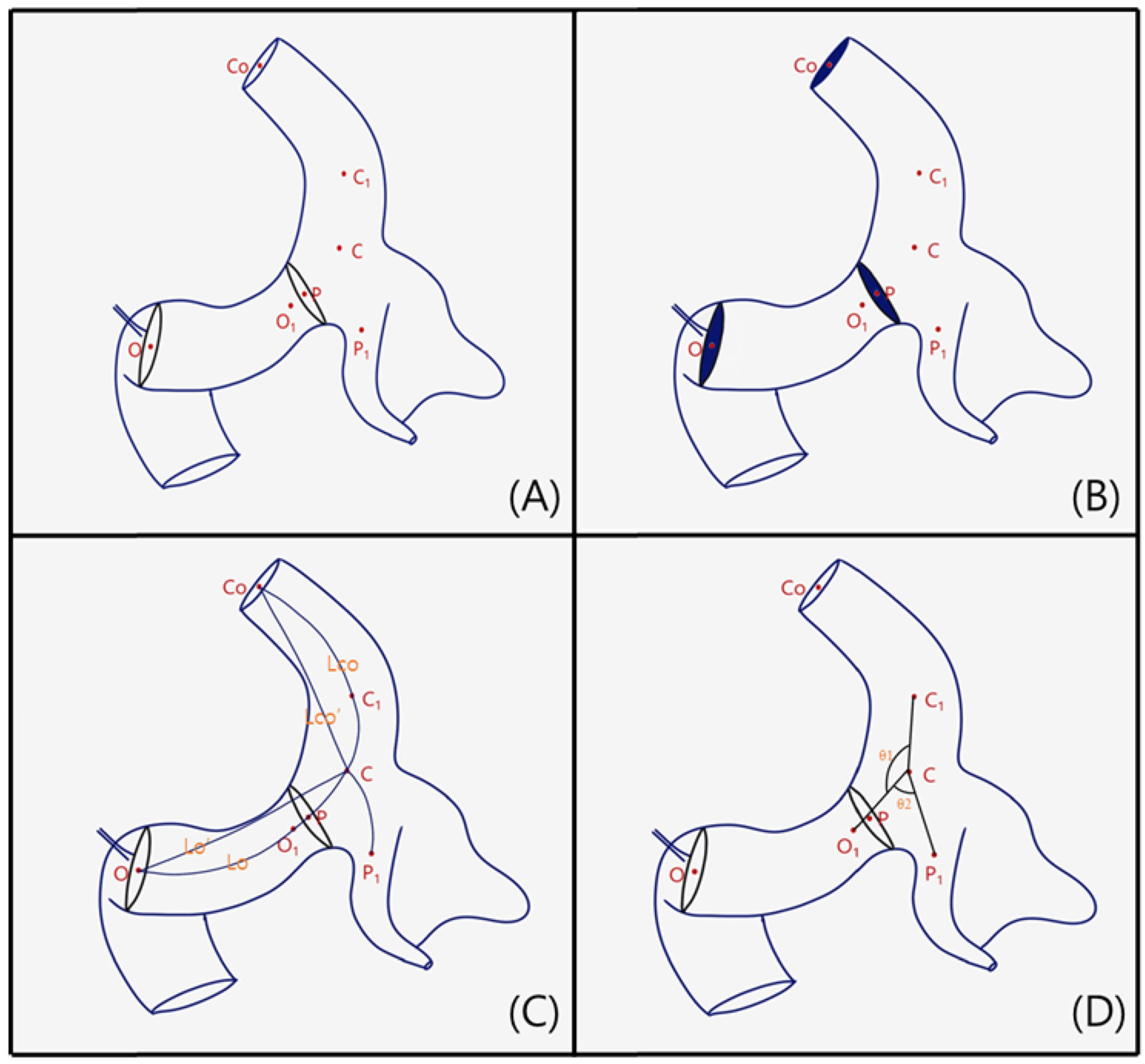
| Lco | 6.116 ± 1.471 | 7.637 ± 3.305 | 0.019 * |
| CURc | 0.178 ± 0.079 | 0.19 ± 0.068 | 0.279 |
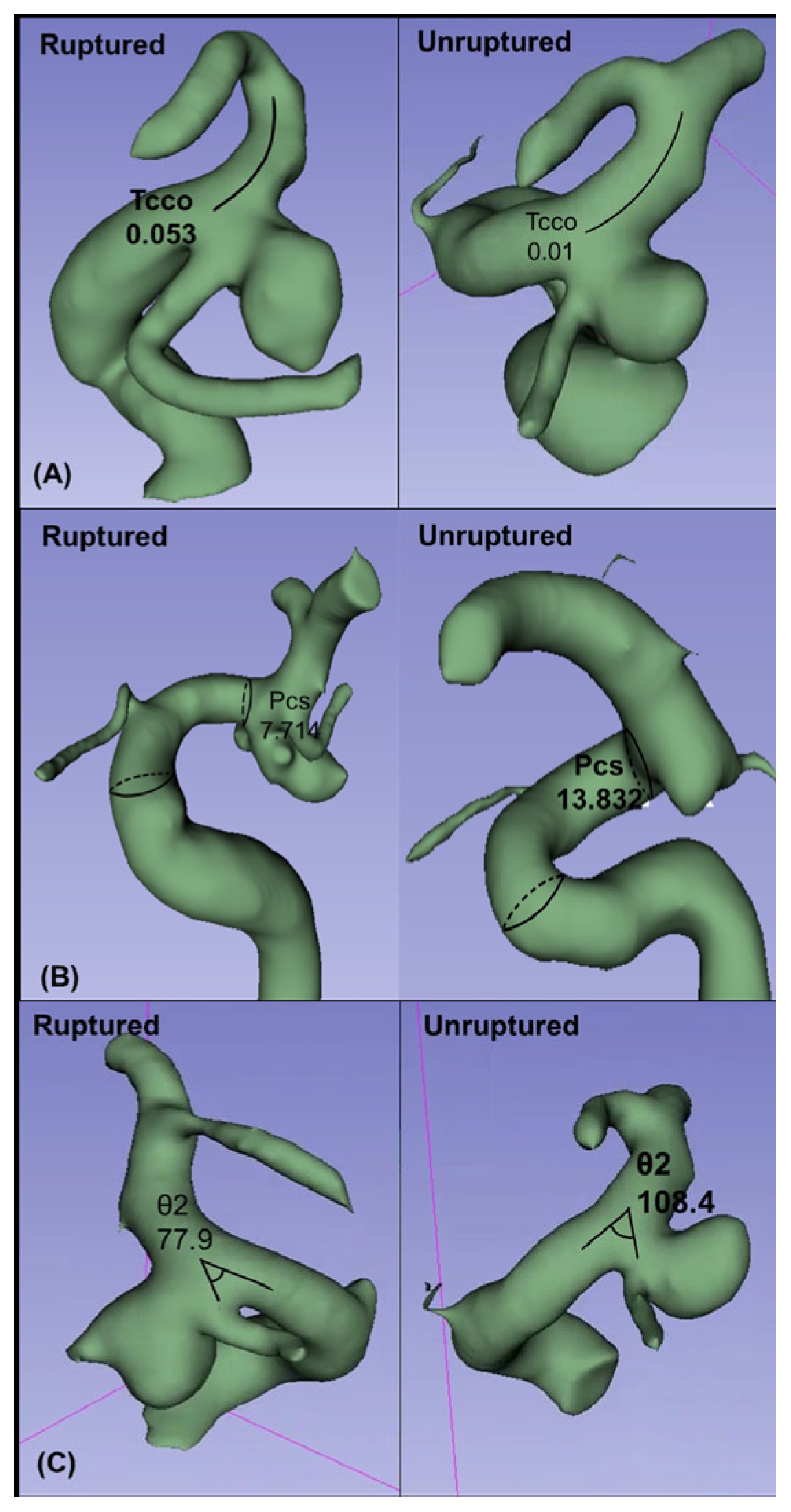
| Tcco | 0.043 ± 0.034 | 0.08 ± 0.074 | 0.013 * |
| Ocs | 14.057 ± 3.519 | 14.607 ± 3.797 | 0.278 |
| Pcs | 12.579 ± 3.886 | 10.405 ± 3.163 | 0.011 * |
| Cocs | 9.917 ± 3.185 | 8.134 ± 1.41 | 0.002 * |
| θ1 | 44.538 ± 12.778 | 46.368 ± 13.68 | 0.294 |
| θ2 | 87.277 ± 12.357 | 79.452 ± 12.534 | 0.008 * |
| Rpo | 0.927 ± 0.316 | 0.73 ± 0.188 | 0.003 * |
| Rcop | 0.823 ± 0.263 | 0.841 ± 0.257 | 0.394 |
| Parameter | B | p-Value |
|---|---|---|
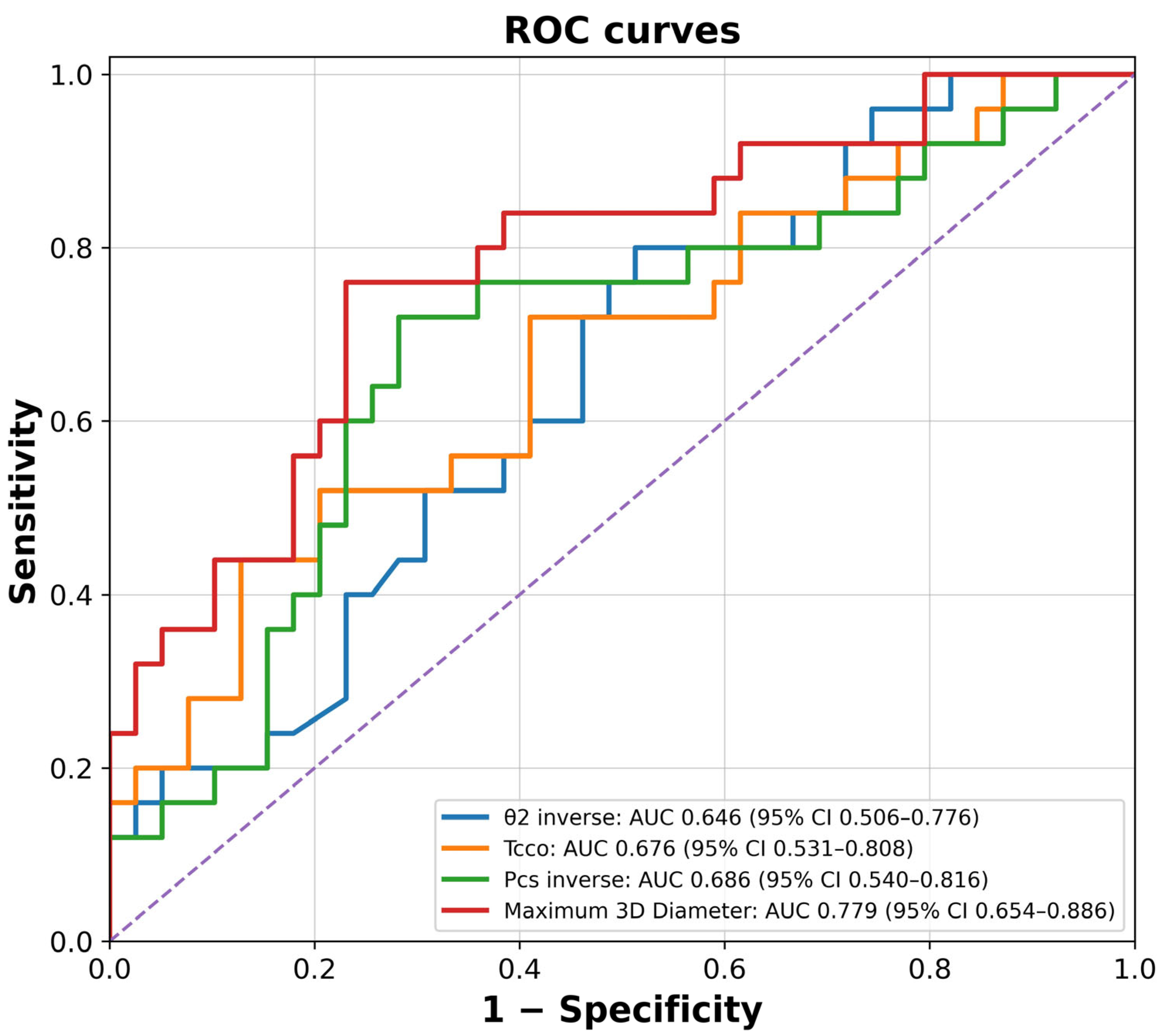
| Maximum 3D Diameter | 0.23868 | 0.0031 |
| Tcco | 15.8969 | 0.0344 |
| Pcs | −0.21794 | 0.0224 |
| θ2 | −0.05331 | 0.0407 |
Disclaimer/Publisher’s Note: The statements, opinions and data contained in all publications are solely those of the individual author(s) and contributor(s) and not of MDPI and/or the editor(s). MDPI and/or the editor(s) disclaim responsibility for any injury to people or property resulting from any ideas, methods, instructions or products referred to in the content. |
© 2026 by the authors. Licensee MDPI, Basel, Switzerland. This article is an open access article distributed under the terms and conditions of the Creative Commons Attribution (CC BY) license.
Share and Cite
Nahm, M.; Ko, S.-W.; Yi, H.-J.; Chun, H.-J.; Na, M.-K.; Lee, Y.-J.; Kim, K.; Lee, S.H.; Ryu, J.; Song, S.; et al. Prediction of Posterior Communicating Artery Aneurysm Rupture Risk: A Multivariate Analysis of Aneurysm and Surrounding Arterial Morphological Factors. J. Clin. Med. 2026, 15, 3783. https://doi.org/10.3390/jcm15103783
Nahm M, Ko S-W, Yi H-J, Chun H-J, Na M-K, Lee Y-J, Kim K, Lee SH, Ryu J, Song S, et al. Prediction of Posterior Communicating Artery Aneurysm Rupture Risk: A Multivariate Analysis of Aneurysm and Surrounding Arterial Morphological Factors. Journal of Clinical Medicine. 2026; 15(10):3783. https://doi.org/10.3390/jcm15103783
Chicago/Turabian StyleNahm, Minu, Shin-Woong Ko, Hyeong-Joong Yi, Hyeong-Joon Chun, Min-Kyun Na, Young-Jun Lee, KyuNam Kim, Sang Hyung Lee, Jaiyoung Ryu, Simon Song, and et al. 2026. "Prediction of Posterior Communicating Artery Aneurysm Rupture Risk: A Multivariate Analysis of Aneurysm and Surrounding Arterial Morphological Factors" Journal of Clinical Medicine 15, no. 10: 3783. https://doi.org/10.3390/jcm15103783
APA StyleNahm, M., Ko, S.-W., Yi, H.-J., Chun, H.-J., Na, M.-K., Lee, Y.-J., Kim, K., Lee, S. H., Ryu, J., Song, S., Han, K., & Choi, K.-S. (2026). Prediction of Posterior Communicating Artery Aneurysm Rupture Risk: A Multivariate Analysis of Aneurysm and Surrounding Arterial Morphological Factors. Journal of Clinical Medicine, 15(10), 3783. https://doi.org/10.3390/jcm15103783