1. Introduction
Concurrent chemoradiotherapy (CCRT), with or without induction or adjuvant chemotherapy, is a cornerstone in the management of locally advanced nasopharyngeal carcinoma (LA-NPC) [
1,
2,
3,
4]. Nevertheless, despite advances in radiotherapy techniques such as intensity-modulated radiotherapy (IMRT) and volumetric modulated arc therapy (VMAT), therapeutic doses of ionizing radiation continue to adversely affect adjacent normal tissues, particularly within the oral cavity, leading to a range of acute and late toxicities that can substantially impair oral health and quality of life [
5,
6,
7,
8]. Dental complications are among the most frequent of these effects and often require tooth extraction (TE) during follow-up, with potential consequences including nutritional deficits, weight loss, and impaired functional recovery [
8]. Importantly, post-CCRT TE is not merely a routine procedure but represents a clinically consequential event, given its association with impaired wound healing and its recognized role in the development of osteoradionecrosis of the jaw (ORNJ) [
9,
10,
11].
Existing studies of post-CCRT dental outcomes have predominantly adopted a dose-centric framework, in which radiation exposure to the mandible and surrounding structures is considered a principal determinant of tissue injury and subsequent complications [
5,
6,
7]. This paradigm is supported by substantial biological and clinical evidence demonstrating that radiation-induced damage to vascular, epithelial, salivary, and osseous tissues compromises tissue integrity and healing capacity, thereby predisposing to necrosis as well as dental and periodontal deterioration [
12,
13]. However, clinical outcomes remain variable, and patients with comparable dosimetric profiles frequently exhibit differing risks of TE, suggesting that these outcomes are not fully explained by radiation dose alone [
14,
15,
16].
Beyond this dose-centric perspective, host-related factors may also contribute to inter-individual variability in CCRT-related toxicity. Within this framework, studies evaluating TE after CCRT have yielded inconsistent findings, often relying on dichotomized variables and threshold-based approaches that may obscure underlying continuous risk relationships [
14,
15,
16]. Such approaches typically do not account for the functional form of associations or potential nonlinear effects, and the resulting thresholds are often derived from cohort-specific or data-driven strategies, which may limit their generalizability. In parallel, studies examining radiation dose-related dental injury have primarily described biological or observational dose gradients [
5,
6], which, while informative, do not fully capture the clinical heterogeneity of dental outcomes, including variability in progression to TE, nor directly support patient-level prediction. Consequently, the extent to which existing approaches capture the complexity of these relationships and support individualized risk estimation remains uncertain.
Building on these considerations, composite indices incorporating host-related factors have been proposed as an approach to characterize inter-individual susceptibility to post-CCRT TE. Previous studies evaluating such composite markers have demonstrated associations with radiation-induced dental complications in patients with LA-NPC [
14,
15,
16]. However, these studies have predominantly relied on categorized or cutoff-based analyses. They have not evaluated associations within a continuous modeling framework or formally assessed potential nonlinear effects. According to established statistical guidance, such approaches may obscure underlying risk gradients and limit the ability to capture the complexity of biological responses [
17,
18,
19]. Whether a composite repair–inflammation index can improve the characterization of post-CCRT TE risk within a continuous, nonlinear modeling framework, therefore, remains unknown.
Accordingly, this study evaluated the association between the Comprehensive Repair–Inflammation Index (CRII)—defined as (platelet × neutrophil × monocyte)/(lymphocyte × hemoglobin × albumin)—and post-CCRT TE in a retrospective cohort of patients with LA-NPC treated with definitive CCRT. Specifically, we aimed to characterize the continuous and potentially nonlinear relationship between CRII and TE risk and to examine this association in relation to conventional mandibular radiation dose parameters.
2. Patients and Methods
2.1. Study Population
Institutional records from the Başkent University Adana Research and Treatment Center were retrospectively reviewed to identify patients with LA-NPC who underwent definitive CCRT and received oral and dental evaluations before treatment between January 2010 and December 2021. Eligible patients were aged ≥18 years and had histopathologically confirmed squamous cell carcinoma. All patients were classified as having locally advanced disease according to the American Joint Committee on Cancer (AJCC) 8th edition staging system. Additional inclusion criteria included an Eastern Cooperative Oncology Group (ECOG) performance status of 0–1, no prior malignancy, no previous radiotherapy or systemic chemotherapy to the head and neck region, receipt of platinum-based CCRT, and availability of pre-treatment complete blood count and biochemistry data. To ensure accurate assessment of dental outcomes, patients were also required to have accessible pre-treatment and follow-up dental records, including panoramic and/or periapical radiographic examinations and documented clinical oral evaluations.
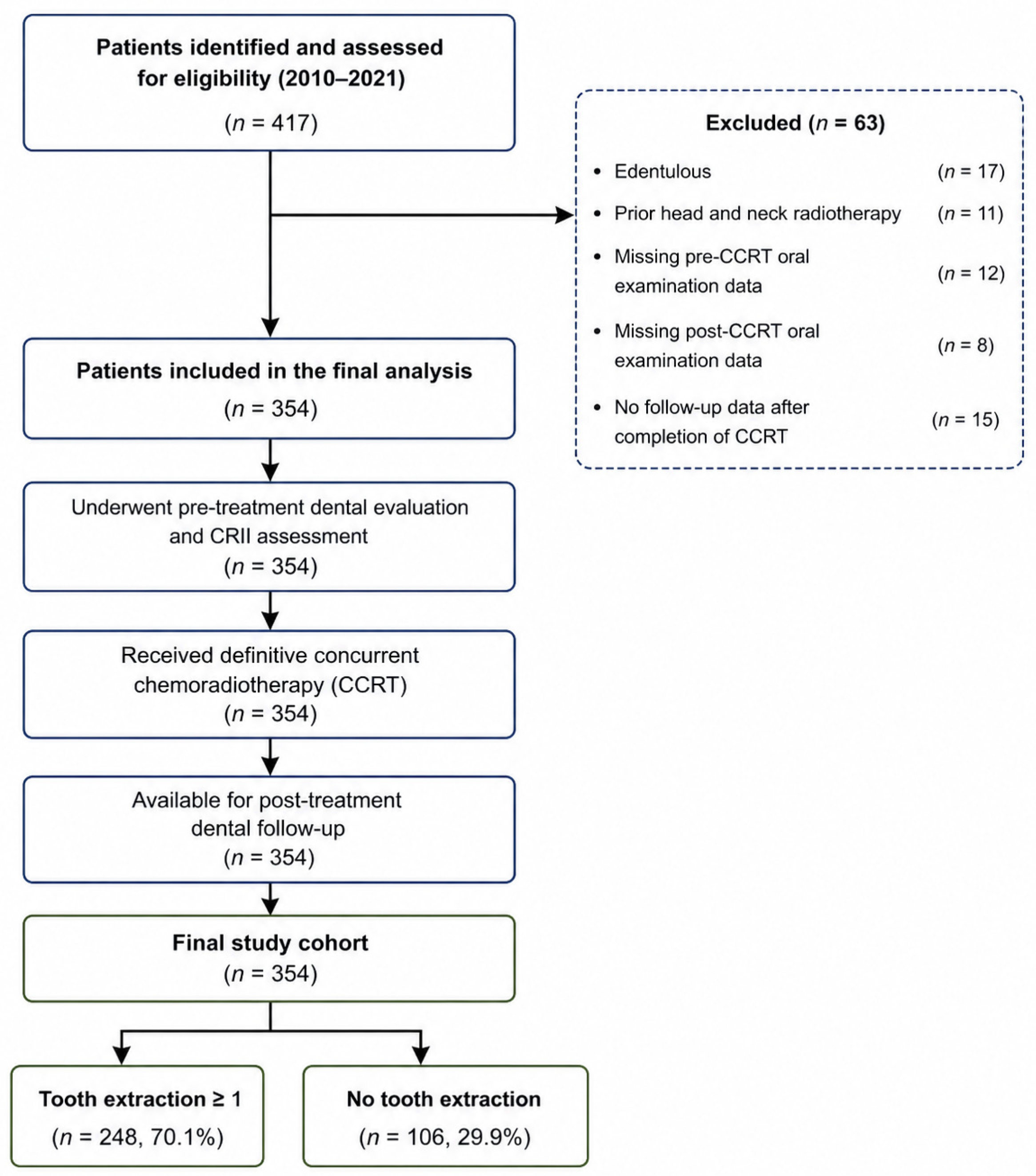
Patients were excluded if they had complete edentulism, tumor or lymph node invasion involving the mandible, prior history of jaw surgery, use of systemic steroids or immunomodulatory agents within 30 days before initiation of CCRT, receipt of blood transfusion within 30 days prior to treatment, or presence of active systemic inflammatory or immunological disorders. Patients with traumatic or non-treatment-related tooth loss during follow-up were also excluded. From an initial cohort of 417 patients identified during the study period, 63 were excluded based on these criteria (
Figure 1), resulting in a final study population of 354 patients.
2.2. Baseline Clinical Oral Examination
Pre-treatment oral and dental status was systematically assessed using standardized clinical and radiographic evaluations. Data extracted from medical records included dental and periodontal conditions such as facial swelling, toothache, gingival edema, abscess formation, dental caries, and pain on percussion. All evaluations were performed by an experienced oral and maxillofacial surgeon in collaboration with a dentomaxillofacial radiologist. Detailed dental parameters were recorded to characterize baseline oral health status, including the total number of teeth, the number of decayed teeth (crown and/or root caries), the presence of residual roots, the history of periodontal and endodontic treatments, and the number of filled or previously extracted teeth. These variables were considered in the context of potential susceptibility to post-CCRT tooth extraction. Radiographic evaluation was performed using panoramic and periapical imaging according to institutional protocols. Panoramic radiographs were obtained using a standardized digital system (Veraviewepocs 2D, J Morita, Kyoto, Japan), and periapical radiographs were acquired using the parallel technique with a digital intraoral system. Imaging acquisition was conducted under consistent conditions across all patients in accordance with manufacturer recommendations to ensure comparability.
2.3. Assessment of the Comprehensive Repair–Inflammation Index (CRII)
The CRII was calculated as follows:
For interpretability, CRII values were scaled by a factor of 10−3 (i.e., divided by 1000) prior to analysis; this scaled variable was used consistently across all statistical models, including logistic regression, restricted cubic spline modeling, and segmented regression, and is presented accordingly throughout the manuscript.
All component variables were obtained from routine laboratory measurements performed on the first day of CCRT prior to treatment initiation. Hematological parameters (platelet, neutrophil, monocyte, and lymphocyte counts) were recorded in ×109/L, hemoglobin in g/dL, and albumin in g/L, in accordance with standard clinical practice. This approach ensured a standardized, treatment-naïve assessment of systemic inflammatory burden and host-related physiological status across all patients. Laboratory measurements were performed as part of routine clinical care using institutional protocols, and CRII values were computed directly from these measurements with only scaling applied for presentation. No further normalization or transformation was applied.
2.4. Chemoradiotherapy Protocol
Radiotherapy was delivered using a simultaneous integrated boost IMRT (SIB-IMRT) technique. Target volumes were delineated based on pre-treatment co-registered computed tomography (CT), 18F-fluorodeoxyglucose positron emission tomography–CT (FDG PET-CT), and/or magnetic resonance imaging (MRI) of the primary tumor and neck regions.
Prescribed doses were 70 Gy to high-risk, 59.4 Gy to intermediate-risk, and 54 Gy to low-risk planning target volumes (PTVs), delivered in 33 fractions over approximately 6.5 weeks (once daily, 5 days per week), in accordance with institutional protocols [
20].
Concurrent chemotherapy consisted of weekly cisplatin administered at a dose of 40 mg/m2 for up to seven cycles during RT. Following completion of CCRT, patients were recommended to receive two cycles of adjuvant chemotherapy with cisplatin and 5-fluorouracil, based on clinical suitability.
Supportive care measures, including antiemetic prophylaxis, hydration, nutritional support, and other interventions as clinically indicated, were provided throughout treatment.
2.5. Follow-Up Dental Examination
Follow-up oral and dental assessments were performed using the same standardized clinical and radiographic procedures described for the baseline evaluation. Examinations were conducted at 1, 3, 6, 9, and 12 months after completion of CCRT, and subsequently at 6-month intervals or as clinically indicated.
Clinical and radiological findings were systematically recorded at each follow-up visit. Dental management decisions were made in accordance with the principles applied at baseline, ensuring consistency in assessment and treatment approaches throughout the follow-up period.
2.6. Indications for Post-CCRT Tooth Extraction
Post-CCRT TE was performed based on clinical and radiographic findings indicating poor dental prognosis. Indications included non-restorable caries, residual roots, persistent or symptomatic apical or periodontal infection, advanced periodontal breakdown, severe mobility, pain on percussion, abscess formation, and teeth considered non-maintainable despite conservative management. Extraction decisions were made by the treating dental team based on predefined clinical and radiographic criteria, following comprehensive evaluation, with consideration of impaired healing capacity associated with irradiated tissues. These criteria were applied consistently across patients within the same institutional framework to ensure uniformity in decision-making.
2.7. Endpoints and Statistical Analysis
The primary endpoint was post-CCRT TE, defined as a binary outcome (no TE vs. ≥1 TE). Continuous variables are presented as mean ± standard deviation, and categorical variables as counts and percentages. Between-group comparisons were performed using the independent-samples t-test or the χ2 test, as appropriate. The association between the CRII and TE was evaluated using logistic regression, with results reported as odds ratios (ORs) and 95% confidence intervals (CIs). A logistic approach was chosen given the study design and the absence of precise event-time data for all patients, which precluded reliable time-to-event analyses. CRII was modeled as a continuous variable in the primary analysis (per 1-unit increase), with additional estimates per 10-unit increase provided to enhance clinical interpretability. Potential nonlinearity was assessed using restricted cubic splines (three knots), with model comparisons performed using likelihood ratio tests, and segmented logistic regression was applied to identify an exploratory breakpoint in the CRII–TE relationship for subsequent descriptive stratified analyses.
Multivariable models were constructed to evaluate the independent association of CRII with TE, adjusting for age, sex, smoking status, alcohol use, and mandibular radiation dose parameters, including mean dose and high-dose volume metrics (V50 and V60, defined as ≥1 cc vs. <1 cc). Mandibular V50 and V60 were evaluated based on prior evidence supporting the relevance of dose–volume exposure in the 50–60 Gy range [
21]. Given the limited distribution of high-dose mandibular volumes in this cohort, these variables were dichotomized at ≥1 cc versus <1 cc to represent the presence versus absence of appreciable high-dose exposure; this threshold was used pragmatically to ensure model stability and was not intended to define a biological or clinical cutoff.
Covariates were selected a priori based on clinical relevance and constrained by the number of observed events to minimize the risk of overfitting. No data-driven variable selection procedures (e.g., stepwise selection) were applied, and model complexity was deliberately limited to ensure parsimony. Potential effect modification was evaluated using interaction terms, and collinearity among predictors was assessed. A formal a priori sample size calculation was not performed due to the retrospective design; model size was instead guided by the number of observed events. Model calibration was evaluated using the Hosmer–Lemeshow goodness-of-fit test. No missing data were present for variables included in the final models; therefore, complete-case analysis was applied. All analyses were performed using IBM SPSS Statistics (version 26.0) and R software (version 4.5.1). All tests were two-sided, and p-values < 0.05 were considered statistically significant.
This study was conducted and reported in accordance with the Strengthening the Reporting of Observational Studies in Epidemiology (STROBE) guidelines for observational studies, and a completed STROBE checklist is provided as
Supplementary Table S1 [
21].
4. Discussion
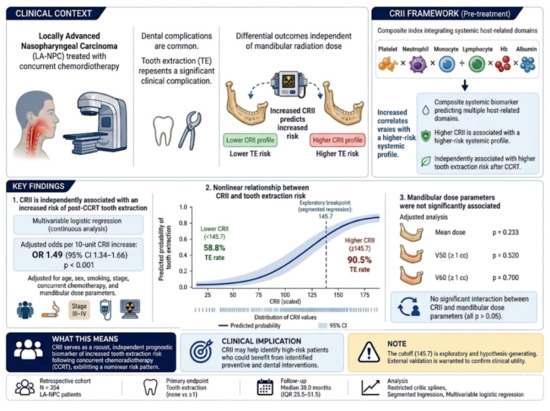
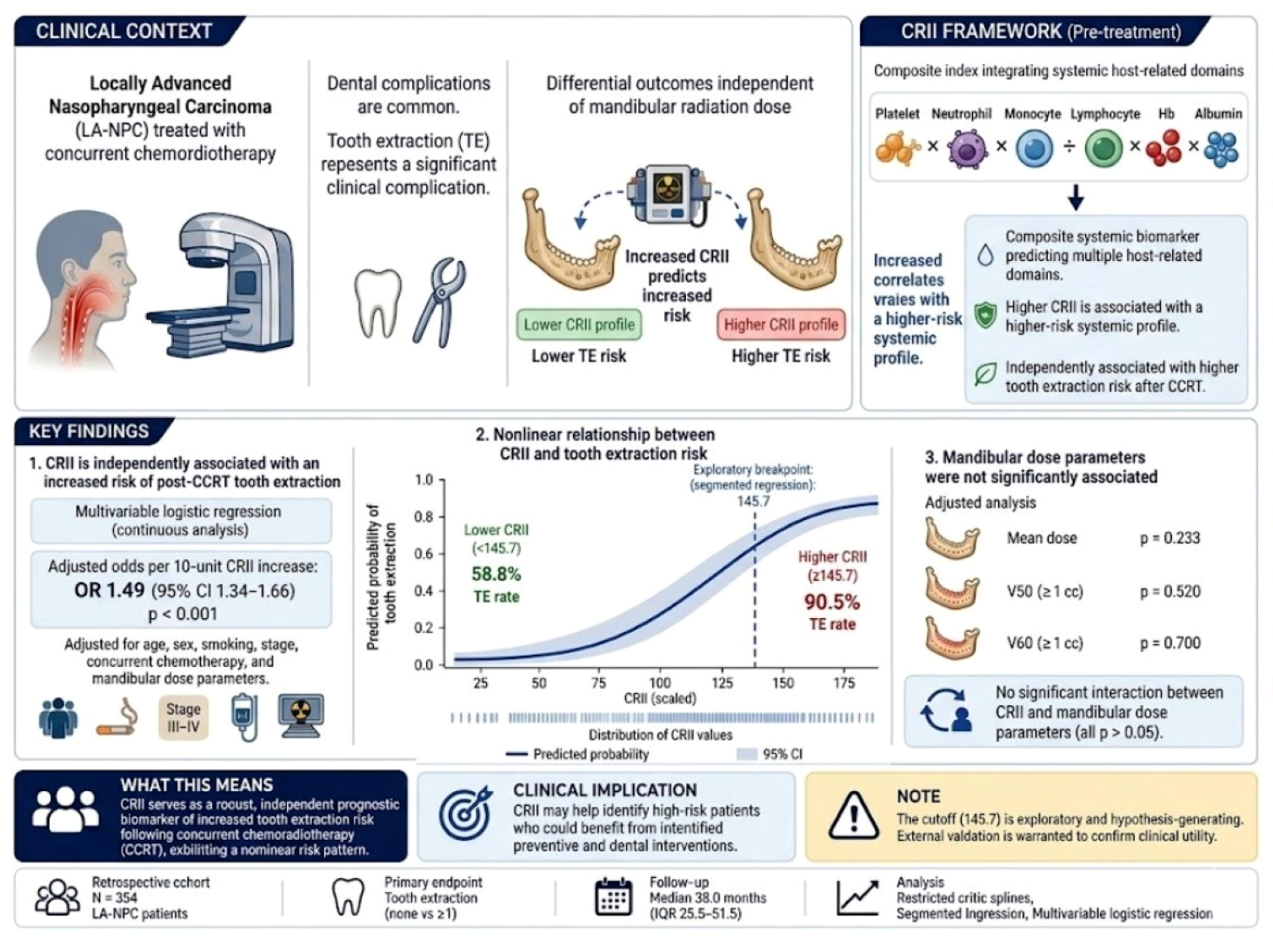
In this study, CRII demonstrated a robust association with post-CCRT TE, with consistent findings across multiple analytical approaches. The relationship between CRII and TE was not strictly linear; evidence of a nonlinear pattern and an exploratory threshold was observed, beyond which TE risk increased substantially. This association persisted after adjustment for clinical and dosimetric variables. Within this framework, tooth extraction should be interpreted as a clinically meaningful composite endpoint reflecting both biological tissue vulnerability and real-world decision-making processes in the management of irradiated dentition. Mandibular radiation dose parameters were not significantly associated with TE, and no interaction was observed between CRII and dose metrics. These findings suggest that the association between CRII and TE was not materially modified by radiation exposure within the constraints of the present analysis. Notably, conventional clinical variables, including tumor stage and performance status, were not associated with TE. This suggests that systemic host-related factors captured by CRII may contribute to inter-individual variability. CRII should be interpreted as an integrative composite index that builds upon established inflammation- and nutrition-based biomarkers rather than as a distinct construct. Collectively, these findings support a role for systemic host-related factors, as reflected by CRII, alongside clinical and dosimetric parameters in shaping TE risk.
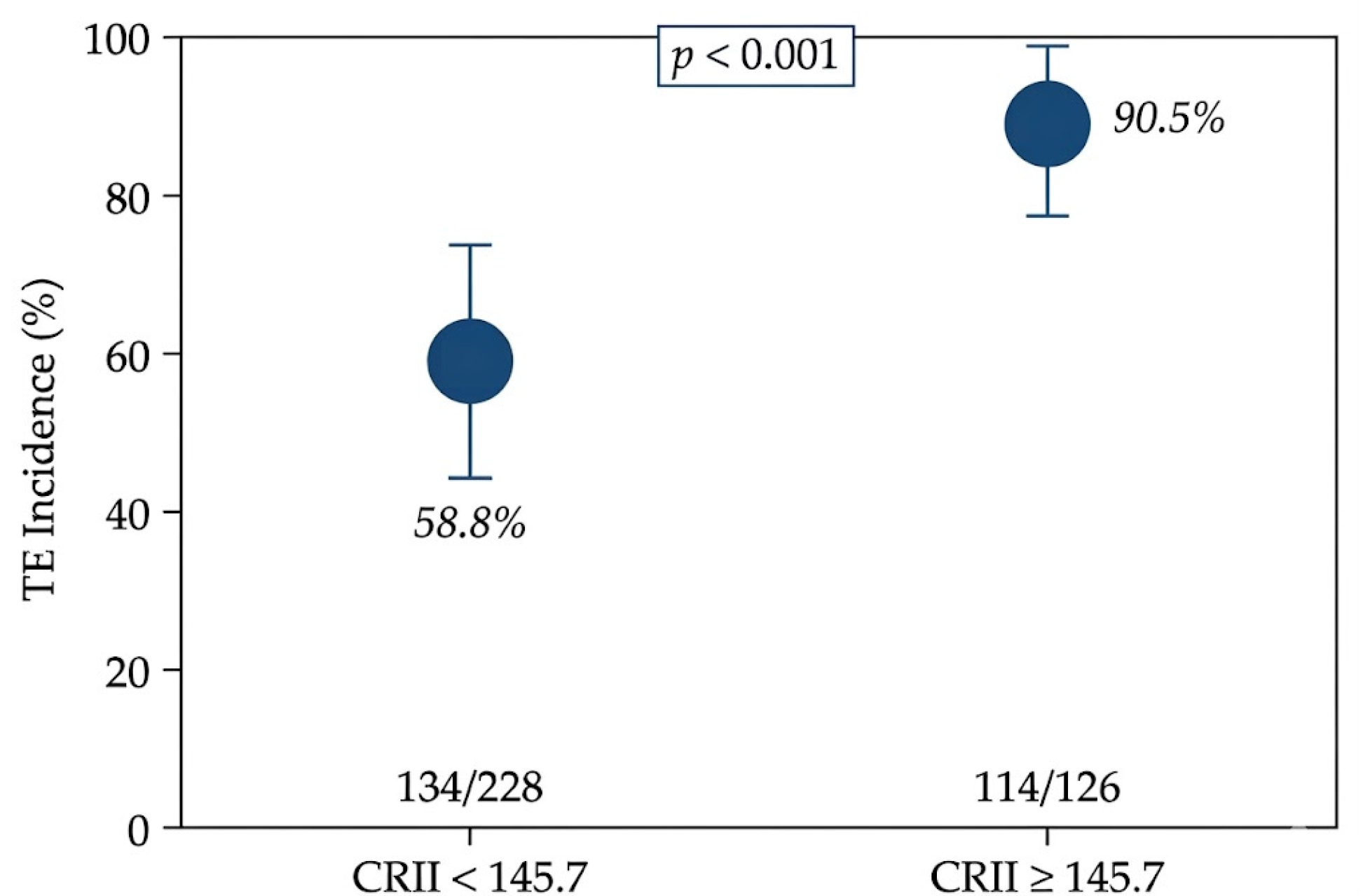
The association between CRII and tooth extraction was consistent across multiple analytical approaches, including continuous modeling, nonlinear assessment, and exploratory stratification, with minimal attenuation after multivariable adjustment. This internal consistency supports the robustness of the association, suggesting that the observed effect is not driven by a specific modeling strategy. Notably, the effect remained stable after accounting for clinical characteristics and mandibular dose parameters, indicating that CRII captures information not accounted for by conventional clinical and dosimetric variables. The observed gradient in risk across the CRII spectrum, together with the marked separation in tooth extraction incidence based on the exploratory cutoff (58.8% vs. 90.5%,
p < 0.001), further reinforces the coherence of the association across analytical frameworks. Although the present study was not designed to disentangle the individual contributions of CRII components, the index integrates multiple dimensions of systemic physiology. These include inflammatory burden, immune competence, nutritional reserve, and oxygen-carrying capacity, all of which are biologically relevant to tissue repair and response to radiation injury [
12,
22,
23,
24,
25,
26]. Within this context, CRII may be conceptualized as a composite indicator of host-related physiological reserve relevant to tissue repair rather than a surrogate for any single biological pathway.
Previous studies evaluating TE after CCRT have reported heterogeneous findings regarding the contribution of radiation dose, influenced by differences in dosimetric granularity and the incorporation of local clinical factors. Experimental and clinical data suggest that radiation-induced dental injury follows dose-dependent patterns, with minimal effects at lower doses and progressive structural damage at higher exposure levels [
5,
6]. These biological observations are also consistent with mechanisms implicated in ORNJ, although most available evidence is derived from tooth- or tissue-specific dose assessments rather than organ-level mandibular metrics. Studies specifically addressing TE have yielded inconsistent results: in one analysis, mandibular dose parameters remained significant alongside a systemic biomarker, suggesting a combined contribution of local and systemic factors [
14], whereas in another, dose variables were not retained and a systemic inflammation index emerged as the primary determinant of TE risk [
15]. Notably, composite indices such as the GLUCAR index, systemic immune–inflammation index (SII), and CARWL index have demonstrated predictive value for radiation-related dental outcomes [
14,
15,
16]. More broadly, systemic inflammation-based indices have been consistently associated with prognosis and treatment outcomes across multiple cancer types, supporting the relevance of host-related systemic factors in oncologic risk stratification [
27,
28,
29].
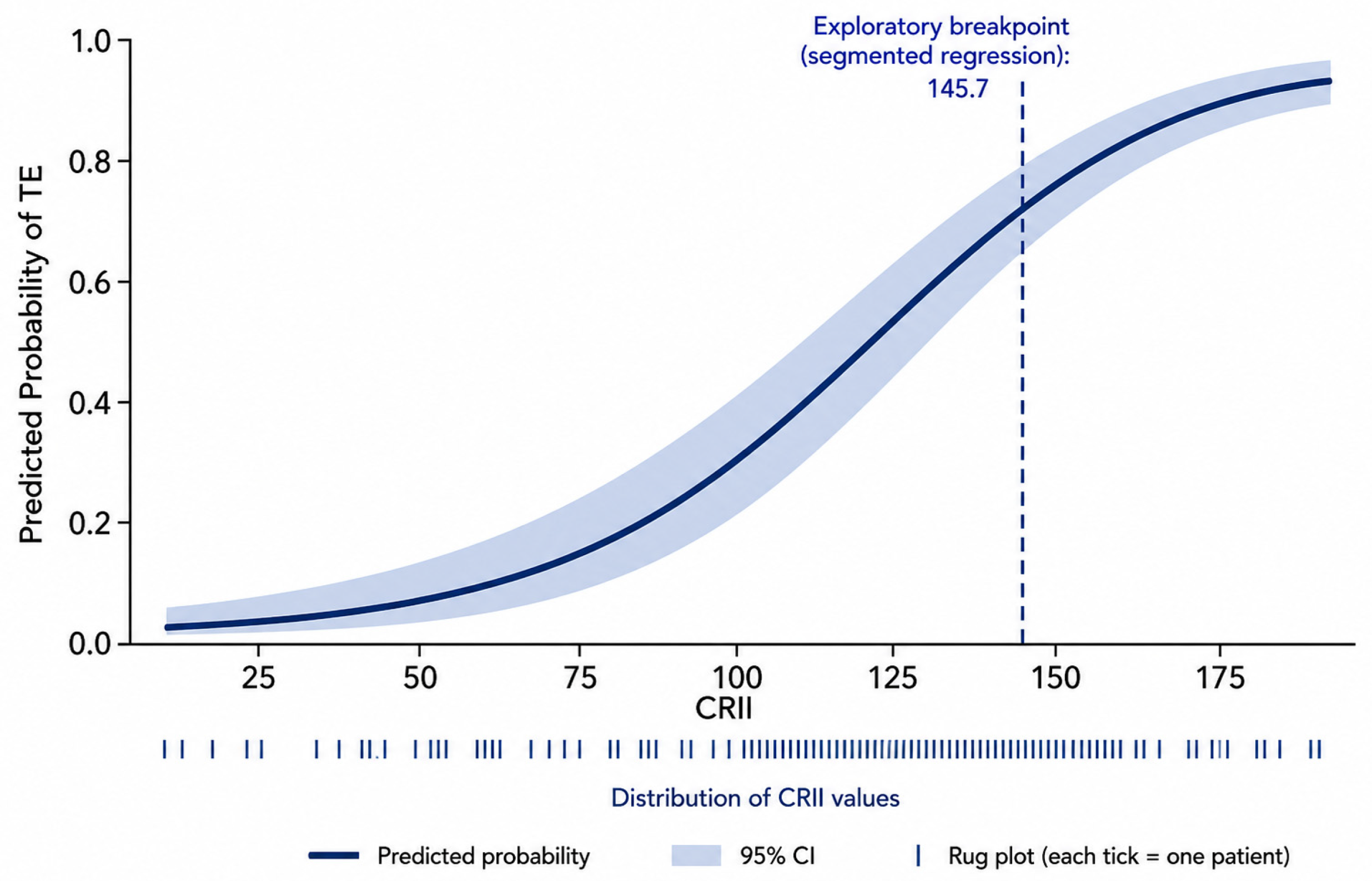
However, these indices primarily capture inflammatory or metabolic dimensions and do not integrate parameters reflecting host-related physiological reserve relevant to tissue repair, nutritional status, and oxygen-carrying capacity within a single framework. In addition, prior studies have predominantly relied on cutoff-based approaches with dichotomized variables, which may limit characterization of continuous and potentially nonlinear risk relationships. In the present study, using continuous modeling with formal assessment of nonlinearity, mandibular dose parameters—including mean dose and commonly used high-dose volume metrics (V50 and V60)—were not associated with TE, and no interaction was observed between CRII and these measures. These parameters reflect mandibular exposure at the organ level and may not capture focal dose heterogeneity relevant to individual teeth or extraction sites. Within these constraints, CRII demonstrated a consistent association across all analytical models, including after adjustment for dosimetric variables, suggesting that systemic host-related factors—integrating inflammatory burden, immune competence, nutritional status, and oxygenation—may contribute to inter-individual variability in TE risk beyond that captured by conventional dose metrics or single-domain composite indices. This pattern is illustrated in
Figure 3, supporting the observed separation in TE risk across the CRII threshold. Importantly, this interpretation does not diminish the biological relevance of radiation exposure but indicates that, within the context of the present analysis, host-related factors provide additional explanatory insight.
Beyond demonstrating an independent association, the present analysis provides important insight into the functional form of the relationship between CRII and TE. Continuous modeling demonstrated a monotonic increase in TE risk across the CRII spectrum, with formal testing indicating deviation from strict linearity (spline vs. linear: χ
2 = 8.18, df = 3,
p = 0.042; segmented vs. linear: χ
2 = 4.66, df = 1,
p = 0.031), supporting a nonlinear risk pattern rather than a simple proportional effect. Within this context, the exploratory cutoff identified through data-driven methods provides a pragmatic illustration of risk stratification, with a marked separation in TE incidence above versus below this threshold (58.8% vs. 90.5%,
p < 0.001). However, consistent with established statistical guidance, this cutoff should be interpreted as descriptive rather than definitive, as dichotomization entails information loss and may generate cohort-specific thresholds [
17,
18]. Prior studies evaluating TE outcomes, including those incorporating GLUCAR, systemic immune–inflammation indices, and the CARWL index, have largely relied on cutoff-based approaches without formal assessment of continuous or nonlinear relationships; accordingly, their reported thresholds are best interpreted as exploratory rather than generalizable risk boundaries [
14,
15,
16]. A related but distinct limitation applies to studies describing dose-dependent dental injury, such as those by Walker et al. and Klarić Sever et al., where reported dose ranges reflect biological gradients derived from experimental or observational data rather than patient-level predictive modeling for TE, limiting their direct applicability to individualized risk estimation [
5,
6]. More recently, studies incorporating tooth-level dosimetry have improved characterization of spatial heterogeneity in radiation exposure [
30,
31]; however, these approaches remain largely descriptive and have not been integrated with patient-level predictive modeling or continuous risk estimation frameworks. In contrast, the present study integrates continuous modeling, spline-based nonlinearity assessment, and exploratory breakpoint analysis within a unified framework, enabling both precise estimation of risk gradients and cautious identification of clinically interpretable thresholds. Within this framework, CRII demonstrated a consistent and biologically plausible increase in TE risk across its range, with the cutoff serving as an adjunct to, rather than a substitute for, continuous risk modeling.
These findings suggest that CRII may serve as a practical tool for risk stratification in patients undergoing CCRT, enabling identification of patients at increased risk for post-treatment TE. The observed gradient in risk across the CRII spectrum, supported by both continuous modeling and exploratory stratification, indicates that CRII captures meaningful variability not reflected by the evaluated conventional mandibular dosimetric parameters. In this context, CRII may help inform the intensity of dental surveillance, the timing of preventive interventions, and the prioritization of supportive care measures during follow-up, particularly in patients without clearly elevated dosimetric risk. Although mandibular dose metrics were not significantly associated with TE in the present analysis, this finding should be interpreted within the constraints of organ-level dosimetric assessment, which may not capture tooth- or socket-specific dose heterogeneity relevant to individual outcomes. Accordingly, reliance on conventional dosimetric parameters alone may be insufficient for individualized risk assessment, and incorporation of systemic host-related factors may provide complementary clinical insight. However, given the retrospective design and the exploratory nature of the identified cutoff, these findings should be interpreted with caution and not used as a standalone basis for clinical decision-making. Rather, CRII should be considered a complementary risk indicator that may assist in identifying patients who could benefit from closer monitoring and targeted preventive strategies. Prospective validation, together with integration of more granular dosimetric approaches—particularly tooth- or socket-level dose assessment—will be essential to refine its clinical applicability and define its role within multidisciplinary care pathways. Given the established role of post-radiotherapy TE as a trigger for ORNJ, CRII-based risk stratification may also have indirect relevance for identifying patients at increased risk of this complication and informing preventive strategies, although this requires validation in outcome-specific studies.
Several limitations should be explicitly acknowledged. These limitations relate to study design, measurement granularity, and model generalizability. First, the retrospective design introduces the potential for residual confounding and limits causal inference, despite the use of multivariable modeling and interaction analyses. Second, although comprehensive clinical and treatment-related variables were incorporated, residual confounding from unmeasured or more granular oral health–related factors cannot be excluded. Unmeasured factors—particularly those related to baseline dental status, tooth-level restorability, periodontal status, oral hygiene behaviors, and provider-level decision-making—may have influenced the indication for tooth extraction. Although all patients underwent pre-treatment dental evaluation, including extraction of non-restorable teeth, and received standardized dental support, these more granular oral health variables were not systematically captured. Therefore, they could not be included in the multivariable model. As a result, both underlying biological susceptibility and variability in clinical decision-making may have contributed to the observed associations. The relatively high rate of post-CCRT tooth extraction in this cohort may reflect institutional practice patterns, including systematic dental surveillance and a proactive extraction strategy designed to mitigate the risk of infectious complications and ORNJ. In addition, differences in baseline oral health status and oral care practices across populations may have contributed to the observed event rate, potentially limiting direct comparability with other cohorts. Accordingly, this high event rate should be interpreted in the context of these factors and the composite nature of the endpoint, rather than as a direct reflection of underlying biological susceptibility alone. Third, the dosimetric evaluation was based on mandibular-level parameters, which do not capture spatial heterogeneity at the level of individual teeth or extraction sites. In addition, mandibular dose–volume parameters (V50 and V60) were dichotomized at ≥1 cc as a pragmatic representation of appreciable high-dose exposure; although this approach facilitated model stability in the context of limited high-dose volume distribution, it does not represent a validated biological threshold. As such, the absence of a significant dose–response relationship in the present analysis should be interpreted within the constraints of the available dosimetric resolution. Fourth, while the exploratory cutoff for CRII provided clinically intuitive stratification, it remains cohort-specific and requires external validation before broader application. Fifth, CRII was derived from a single pre-treatment measurement, whereas its components may fluctuate during and after chemoradiotherapy, potentially altering its relationship with tooth extraction over time; future studies incorporating serial assessments and time-updated modeling may better capture these dynamics. Finally, although the number of events was sufficient for the primary analyses, it may limit the stability of more complex modeling strategies and subgroup evaluations; therefore, larger cohorts or pooled datasets will be required to support more granular analyses.
Future research should focus on prospective, multicenter validation and on integrative modeling frameworks that combine systemic biomarkers with refined dosimetric and clinical data to improve individualized risk prediction. In particular, approaches that incorporate dynamic assessment of host-related factors together with spatially resolved radiation exposure may enhance the precision and clinical applicability of risk stratification. Such efforts may facilitate more personalized preventive strategies and follow-up planning in patients undergoing CCRT.