Sarcopenia Is Associated with Altered Rocuronium Onset and Neuromuscular Blockade Kinetics in Liver Transplant Recipients: A Prospective Observational Cohort Study


 , , ,
, , ,
Abstract
1. Introduction
2. Materials and Methods
2.1. Study Protocol, Ethical Considerations, and Funding
2.2. A Priori Power Analysis
2.3. Study Population and Patient Selection
2.4. Sarcopenia Assessment
2.5. Anesthesia Protocol
2.6. Immunosuppressive Protocol
2.7. Postoperative Management and Routine Follow-Up
2.8. Study Endpoints
2.9. Statistical Analysis
3. Results
3.1. Patient Characteristics and Prevalence of Sarcopenia
3.2. Intraoperative Neuromuscular Blockade Parameters
3.3. Postoperative Clinical Outcomes
3.4. Comparison of Survivors and Non-Survivors
3.5. Multivariable Analysis of Factors Associated with Mortality
4. Discussion
Limitations
5. Conclusions
Author Contributions
Funding
Institutional Review Board Statement
Informed Consent Statement
Data Availability Statement
Acknowledgments
Conflicts of Interest
References
- Dag, N.; Ulubaba, H.E.; Tasolar, S.; Candur, M.; Akbulut, S. Opportunistic Bone Health Assessment Using Contrast-Enhanced Abdominal CT: A DXA-Referenced Analysis in Liver Transplant Recipients. Diagnostics 2025, 16, 29. [Google Scholar] [CrossRef]
- Akbulut, S.; Yilmaz, S. Liver transplantation in Turkey: Historical review and future perspectives. Transplant. Rev. 2015, 29, 161–167. [Google Scholar] [CrossRef] [PubMed]
- Brezeanu, L.N.; Brezeanu, R.C.; Diculescu, M.; Droc, G. Anaesthesia for Liver Transplantation: An Update. J. Crit. Care Med. 2020, 6, 91–100. [Google Scholar] [CrossRef] [PubMed]
- Akbulut, S.; Ozer, A.; Saritas, H.; Yilmaz, S. Factors affecting anxiety, depression, and self-care ability in patients who have undergone liver transplantation. World J. Gastroenterol. 2021, 27, 6967–6984. [Google Scholar] [CrossRef] [PubMed]
- Englesbe, M.J.; Patel, S.P.; He, K.; Lynch, R.J.; Schaubel, D.E.; Harbaugh, C.; Holcombe, S.A.; Wang, S.C.; Segev, D.L.; Sonnenday, C.J. Sarcopenia and mortality after liver transplantation. J. Am. Coll. Surg. 2010, 211, 271–278. [Google Scholar] [CrossRef]
- Prokopidis, K.; Affronti, M.; Testa, G.D.; Ungar, A.; Cereda, E.; Smith, L.; Pegreffi, F.; Barbagallo, M.; Veronese, N. Sarcopenia increases mortality risk in liver transplantation: A systematic review and meta-analysis. Panminerva Med. 2024, 66, 47–54. [Google Scholar] [CrossRef]
- Ponziani, F.R.; Gasbarrini, A. Sarcopenia in Patients with Advanced Liver Disease. Curr. Protein Pept. Sci. 2018, 19, 681–691. [Google Scholar] [CrossRef]
- Bozic, D.; Mamic, B.; Peric, I.; Bozic, I.; Zaja, I.; Ivanovic, T.; Gugic Ratkovic, A.; Grgurevic, I. Assessment of Sarcopenia in Patients with Liver Cirrhosis-A Literature Review. Nutrients 2025, 17, 2589. [Google Scholar] [CrossRef]
- Tandon, P.; Ney, M.; Irwin, I.; Ma, M.M.; Gramlich, L.; Bain, V.G.; Esfandiari, N.; Baracos, V.; Montano-Loza, A.J.; Myers, R.P. Severe muscle depletion in patients on the liver transplant wait list: Its prevalence and independent prognostic value. Liver Transplant. 2012, 18, 1209–1216. [Google Scholar] [CrossRef]
- van Vugt, J.L.; Levolger, S.; de Bruin, R.W.; van Rosmalen, J.; Metselaar, H.J.; IJzermans, J.N.M. Systematic Review and Meta-Analysis of the Impact of Computed Tomography-Assessed Skeletal Muscle Mass on Outcome in Patients Awaiting or Undergoing Liver Transplantation. Am. J. Transplant. 2016, 16, 2277–2292. [Google Scholar] [CrossRef]
- Li, Y.; Chen, J.; Tang, Y.; Lin, T.; Song, T. Effect of pretransplant sarcopenia on patient and graft outcomes in solid organ transplant recipients: A systematic review and meta-analysis. Asian J. Surg. 2024, 47, 1723–1733. [Google Scholar] [CrossRef]
- Cruz-Jentoft, A.J.; Bahat, G.; Bauer, J.; Boirie, Y.; Bruyère, O.; Cederholm, T.; Cooper, C.; Landi, F.; Rolland, Y.; Sayer, A.A.; et al. Sarcopenia: Revised European consensus on definition and diagnosis. Age Ageing 2019, 48, 16–31. [Google Scholar] [CrossRef]
- Popescu, C.; Aurelian, S.M.; Mirea, A.; Munteanu, C.; Vlădulescu-Trandafir, A.I.; Anghelescu, A.; Oancea, C.; Andone, I.; Spînu, A.; Suciu, A.V.; et al. Sarcopenia as a Multisystem Disorder-Connections with Neural and Cardiovascular Systems-A Related PRISMA Systematic Literature Review. Life 2026, 16, 68. [Google Scholar] [CrossRef] [PubMed]
- Liu, X.; Chen, X.; Cui, J. Therapeutic advances in sarcopenia management: From traditional interventions to personalized medicine. Clin. Nutr. 2025, 51, 187–197. [Google Scholar] [CrossRef]
- Dasarathy, S.; Merli, M. Sarcopenia from mechanism to diagnosis and treatment in liver disease. J. Hepatol. 2016, 65, 1232–1244. [Google Scholar] [CrossRef] [PubMed]
- Allen, S.L.; Quinlan, J.I.; Dhaliwal, A.; Armstrong, M.J.; Elsharkawy, A.M.; Greig, C.A.; Lord, J.M.; Lavery, G.G.; Breen, L. Sarcopenia in chronic liver disease: Mechanisms and countermeasures. Am. J. Physiol. Gastrointest. Liver Physiol. 2021, 320, G241–G257. [Google Scholar] [CrossRef] [PubMed]
- Saeki, C.; Tsubota, A. Influencing Factors and Molecular Pathogenesis of Sarcopenia and Osteosarcopenia in Chronic Liver Disease. Life 2021, 11, 899. [Google Scholar] [CrossRef]
- Martyn, J.A.; Richtsfeld, M. Succinylcholine-induced hyperkalemia in acquired pathologic states: Etiologic factors and molecular mechanisms. Anesthesiology 2006, 104, 158–169. [Google Scholar] [CrossRef]
- Moreira-Pais, A.; Ferreira, R.; Oliveira, P.A.; Duarte, J.A. A neuromuscular perspective of sarcopenia pathogenesis: Deciphering the signaling pathways involved. Geroscience 2022, 44, 1199–1213. [Google Scholar] [CrossRef]
- Radkowski, P.; Szewczyk, M.; Dabdoub, T.; Murthy, R.; Grabarczyk, Ł. Use of Neuromuscular Blocking Agents in Elderly Patients: A Narrative Review in Geriatric Medicine. Int. J. Gen. Med. 2025, 18, 7409–7424. [Google Scholar] [CrossRef]
- Khalil, M.; D’Honneur, G.; Duvaldestin, P.; Slavov, V.; De Hys, C.; Gomeni, R. Pharmacokinetics and pharmacodynamics of rocuronium in patients with cirrhosis. Anesthesiology 1994, 80, 1241–1247. [Google Scholar] [CrossRef]
- Sun, S.; Sun, Y.; Chen, R.; Yao, C.; Xia, H.; Chen, X.; Lin, Y.; Yao, S. Diaphragm ultrasound to evaluate the antagonistic effect of sugammadex on rocuronium after liver surgery in patients with different liver Child-Pugh grades: Study protocol for a prospective, double-blind, non-randomised controlled trial. BMJ Open 2022, 12, e052279. [Google Scholar] [CrossRef]
- Donati, F. Neuromuscular blocking drugs for the new millennium: Current practice, future trends--comparative pharmacology of neuromuscular blocking drugs. Anesth. Analg. 2000, 90, S2–S6. [Google Scholar] [CrossRef] [PubMed]
- Iclek, S.K.; Demiroz, D.; Colak, Y.Z.; Yagcı, N.A.; Ozdeş, O.O.; Erdogan, M.A.; Gulhas, N.; Durmus, M. The Effect of Rocuronium Dosage on Intubation Conditions in Liver Transplant Recipients. İstanb. Med. J. 2025, 26, 322–328. [Google Scholar] [CrossRef]
- Li, Z.W.; Liu, Z.; Liu, S.Q. Muscle mass correlates with rocuronium distribution volume and guides dose optimization in obese colorectal cancer patients. World J. Gastrointest. Oncol. 2026, 18, 112742. [Google Scholar] [CrossRef] [PubMed]
- Murphy, G.S.; Szokol, J.W.; Avram, M.J.; Greenberg, S.B.; Shear, T.D.; Vender, J.S.; Parikh, K.N.; Patel, S.S.; Patel, A. Residual Neuromuscular Block in the Elderly: Incidence and Clinical Implications. Anesthesiology 2015, 123, 1322–1336. [Google Scholar] [CrossRef]
- Ufuk, F.; Herek, D. Reference skeletal muscle mass values at L3 vertebrae level based on computed tomography in healthy Turkish adults. Int. J. Gerontol. 2019, 13, 221–225. [Google Scholar] [CrossRef]
- Leykin, Y.; Pellis, T.; Lucca, M.; Lomangino, G.; Marzano, B.; Gullo, A. The pharmacodynamic effects of rocuronium when dosed according to real body weight or ideal body weight in morbidly obese patients. Anesth. Analg. 2004, 99, 1086–1089. [Google Scholar] [CrossRef]
- Meyhoff, C.S.; Lund, J.; Jenstrup, M.T.; Claudius, C.; Sørensen, A.M.; Viby-Mogensen, J.; Rasmussen, L.S. Should dosing of rocuronium in obese patients be based on ideal or corrected body weight? Anesth. Analg. 2009, 109, 787–792. [Google Scholar] [CrossRef]
- Radkowski, P.; Derkaczew, M.A.; Jacewicz, M.A.; Onichimowski, D. The Dosage of Muscle Relaxants in Morbidly Obese Patients in Daily Practice—A Narrative Review. Int. J. Gen. Med. 2024, 17, 4055–4060. [Google Scholar] [CrossRef]
- Erstad, B.L.; Barletta, J.F. Dosing of Neuromuscular Blocking Agents in Patients with Obesity: A Narrative Review. Anaesth. Intensive Care 2021, 49, 98–104. [Google Scholar] [CrossRef]
- Rajan, S.; Gotluru, P.; Andews, S.; Paul, J. Evaluation of endotracheal intubating conditions without the use of muscle relaxants following induction with propofol and sevoflurane in pediatric cleft lip and palate surgeries. J. Anaesthesiol. Clin. Pharmacol. 2014, 30, 360–365. [Google Scholar] [CrossRef] [PubMed]
- Demiroz, D.; Colak, Y.Z.; Akbulut, S.; Ozdes, O.O.; Ucar, M.; Erdogan, M.A.; Karakas, S.; Gulhas, N. Effects of Sugammadex on the Coagulation Profile of Living Liver Donors Undergoing Hepatectomy: A Case-Control Study. Medicina 2025, 61, 378. [Google Scholar] [CrossRef]
- Cui, Y.; Zhang, M.; Guo, J.; Jin, J.; Wang, H.; Wang, X. Correlation between sarcopenia and cirrhosis: A meta-analysis. Front. Nutr. 2023, 10, 1342100. [Google Scholar] [CrossRef]
- Jiang, M.J.; Wu, M.C.; Duan, Z.H.; Wu, J.; Xu, X.T.; Li, J.; Meng, Q.H. Prevalence and clinical impact of sarcopenia in liver transplant recipients: A meta-analysis. World J. Gastroenterol. 2024, 30, 956–968. [Google Scholar] [CrossRef]
- Yuan, S.; Larsson, S.C. Epidemiology of sarcopenia: Prevalence, risk factors, and consequences. Metabolism 2023, 144, 155533. [Google Scholar] [CrossRef] [PubMed]
- Meng, S.; He, X.; Fu, X.; Zhang, X.; Tong, M.; Li, W.; Zhang, W.; Shi, X.; Liu, K. The prevalence of sarcopenia and risk factors in the older adult in China: A systematic review and meta-analysis. Front. Public Health 2024, 12, 1415398. [Google Scholar] [CrossRef]
- Minobes-Molina, E.; Rierola-Fochs, S.; Parés-Martínez, C.; Farrés-Godayol, P.; Ochandorena-Acha, M.; Heras, E.; Missé, J.; Zambom-Ferraresi, F.; Zambom-Ferraresi, F.; Ars, J.; et al. Deepening Physical Exercise Intervention Protocols for Older People with Sarcopenia Following Establishment of the EWGSOP2 Consensus: A Systematic Review. Geriatrics 2025, 10, 91. [Google Scholar] [CrossRef]
- Vellatt, S.; Soldera, J. From Prehabilitation to Rehabilitation: A Systematic Review of Resistance Training as a Strategy to Combat Sarcopenia in Pre- and Post-Liver Transplant Patients. Livers 2025, 5, 25. [Google Scholar] [CrossRef]
- Woo, J.; Leung, J.; Morley, J.E. Validating the SARC-F: A suitable community screening tool for sarcopenia? J. Am. Med. Dir. Assoc. 2014, 15, 630–634. [Google Scholar] [CrossRef]
- Lu, J.L.; Ding, L.Y.; Xu, Q.; Zhu, S.Q.; Xu, X.Y.; Hua, H.X.; Chen, L.; Xu, H. Screening Accuracy of SARC-F for Sarcopenia in the Elderly: A Diagnostic Meta-Analysis. J. Nutr. Health Aging 2021, 25, 172–182. [Google Scholar] [CrossRef] [PubMed]
- Voelker, S.N.; Michalopoulos, N.; Maier, A.B.; Reijnierse, E.M. Reliability and Concurrent Validity of the SARC-F and Its Modified Versions: A Systematic Review and Meta-Analysis. J. Am. Med. Dir. Assoc. 2021, 22, 1864–1876.e1816. [Google Scholar] [CrossRef]
- Tantai, X.; Liu, Y.; Yeo, Y.H.; Praktiknjo, M.; Mauro, E.; Hamaguchi, Y.; Engelmann, C.; Zhang, P.; Jeong, J.Y.; van Vugt, J.L.A.; et al. Effect of sarcopenia on survival in patients with cirrhosis: A meta-analysis. J. Hepatol. 2022, 76, 588–599. [Google Scholar] [CrossRef]
- Hwang, J.; Park, S. Sex Differences of Sarcopenia in an Elderly Asian Population: The Prevalence and Risk Factors. Int. J. Environ. Res. Public Health 2022, 19, 11980. [Google Scholar] [CrossRef] [PubMed]
- Heymsfield, S.B.; Fearnbach, N. Can increasing physical activity prevent aging-related loss of skeletal muscle? Am. J. Clin. Nutr. 2021, 114, 1579–1580. [Google Scholar] [CrossRef] [PubMed]
- Ngonadi, C.; Hopkins, L.J.; Williams, F.R.; Armstrong, M.J. Physical Frailty and Sarcopenia in Liver Transplantation: How Should They Be Assessed and Addressed? Transplantation 2026, 110, e90–e102. [Google Scholar] [CrossRef]
- Cruz-Jentoft, A.J.; Baeyens, J.P.; Bauer, J.M.; Boirie, Y.; Cederholm, T.; Landi, F.; Martin, F.C.; Michel, J.P.; Rolland, Y.; Schneider, S.M.; et al. Sarcopenia: European consensus on definition and diagnosis: Report of the European Working Group on Sarcopenia in Older People. Age Ageing 2010, 39, 412–423. [Google Scholar] [CrossRef]
- Schmartz, D.; Sghaier, R.; Bernard, P.; Fils, J.F.; Fuchs-Buder, T. Neuromuscular block in patients 80 years and older: A prospective, controlled study. BMC Anesthesiol. 2021, 21, 225. [Google Scholar] [CrossRef]
- Lee, L.A.; Athanassoglou, V.; Pandit, J.J. Neuromuscular blockade in the elderly patient. J. Pain Res. 2016, 9, 437–444. [Google Scholar] [CrossRef]
- Bjerring, C.; Vested, M.; Arleth, T.; Eriksen, K.; Albrechtsen, C.; Rasmussen, L.S. Onset time and duration of action of rocuronium 0.6 mg/kg in patients above 80 years of age: A comparison with young adults. Acta Anaesthesiol. Scand. 2020, 64, 1082–1088. [Google Scholar] [CrossRef]
- Kwon, Y.N.; Yoon, S.S. Sarcopenia: Neurological Point of View. J. Bone Metab. 2017, 24, 83–89. [Google Scholar] [CrossRef] [PubMed]
- Lifante, J.; Moreno-Rupérez, Á.; Ximendes, E.; Marin, R.; Priego, T.; López-Calderón, A.; Martín, A.I.; Nieto-Bona, M.P.; Nebot, E.; Lifante-Pedrola, G.; et al. Early in vivo detection of denervation-induced atrophy by luminescence transient nanothermometry. J. Biophotonics 2024, 17, e202300249. [Google Scholar] [CrossRef] [PubMed]
- Granic, A.; Suetterlin, K.; Shavlakadze, T.; Grounds, M.D.; Sayer, A.A. Hallmarks of ageing in human skeletal muscle and implications for understanding the pathophysiology of sarcopenia in women and men. Clin. Sci. 2023, 137, 1721–1751. [Google Scholar] [CrossRef]
- Khuenl-Brady, K.S.; Sparr, H. Clinical pharmacokinetics of rocuronium bromide. Clin. Pharmacokinet. 1996, 31, 174–183. [Google Scholar] [CrossRef] [PubMed]
- Bulka, C.M.; Cassedy, E.A.; Sandberg, W.S.; Ehrenfeld, J.M. A survey of modified rapid-sequence induction and intubation in Canadian academic centers. J. Clin. Anesth. 2013, 25, 515–516. [Google Scholar] [CrossRef]
- Thilen, S.R.; Weigel, W.A.; Todd, M.M.; Dutton, R.P.; Lien, C.A.; Grant, S.A.; Szokol, J.W.; Eriksson, L.I.; Yaster, M.; Grant, M.D.; et al. 2023 American Society of Anesthesiologists Practice Guidelines for Monitoring and Antagonism of Neuromuscular Blockade: A Report by the American Society of Anesthesiologists Task Force on Neuromuscular Blockade. Anesthesiology 2023, 138, 13–41. [Google Scholar] [CrossRef]
- Fuchs-Buder, T.; Romero, C.S.; Lewald, H.; Lamperti, M.; Afshari, A.; Hristovska, A.M.; Schmartz, D.; Hinkelbein, J.; Longrois, D.; Popp, M.; et al. Peri-operative management of neuromuscular blockade: A guideline from the European Society of Anaesthesiology and Intensive Care. Eur. J. Anaesthesiol. 2023, 40, 82–94. [Google Scholar] [CrossRef]
- Grabitz, S.D.; Rajaratnam, N.; Chhagani, K.; Thevathasan, T.; Teja, B.J.; Deng, H.; Eikermann, M.; Kelly, B.J. The Effects of Postoperative Residual Neuromuscular Blockade on Hospital Costs and Intensive Care Unit Admission: A Population-Based Cohort Study. Anesth. Analg. 2019, 128, 1129–1136. [Google Scholar] [CrossRef]
- Moitra, V.K.; Guerra, C.; Linde-Zwirble, W.T.; Wunsch, H. Relationship Between ICU Length of Stay and Long-Term Mortality for Elderly ICU Survivors. Crit. Care Med. 2016, 44, 655–662. [Google Scholar] [CrossRef]
- Pisani, M.A.; Kong, S.Y.; Kasl, S.V.; Murphy, T.E.; Araujo, K.L.; Van Ness, P.H. Days of delirium are associated with 1-year mortality in an older intensive care unit population. Am. J. Respir. Crit. Care Med. 2009, 180, 1092–1097. [Google Scholar] [CrossRef]
- Harimoto, N.; Yoshizumi, T.; Izumi, T.; Motomura, T.; Harada, N.; Itoh, S.; Ikegami, T.; Uchiyama, H.; Soejima, Y.; Nishie, A.; et al. Clinical Outcomes of Living Liver Transplantation According to the Presence of Sarcopenia as Defined by Skeletal Muscle Mass, Hand Grip, and Gait Speed. Transplant. Proc. 2017, 49, 2144–2152. [Google Scholar] [CrossRef]
- Bai, Y.W.; Liu, J.C.; Yang, C.T.; Wang, Y.L.; Wang, C.Y.; Ju, S.G.; Zhou, C.; Huang, S.J.; Li, T.Q.; Chen, Y.; et al. Inclusion of sarcopenia improves the prognostic value of MELD score in patients after transjugular intrahepatic portosystemic shunt. Eur. J. Gastroenterol. Hepatol. 2022, 34, 948–955. [Google Scholar] [CrossRef]
- Montano-Loza, A.J.; Duarte-Rojo, A.; Meza-Junco, J.; Baracos, V.E.; Sawyer, M.B.; Pang, J.X.; Beaumont, C.; Esfandiari, N.; Myers, R.P. Inclusion of Sarcopenia Within MELD (MELD-Sarcopenia) and the Prediction of Mortality in Patients With Cirrhosis. Clin. Transl. Gastroenterol. 2015, 6, e102. [Google Scholar] [CrossRef]



| Variables | Non-Sarcopenia Group (n = 69) | Sarcopenia Group (n = 70) | Effect Estimate (95%CI) | p |
|---|---|---|---|---|
| Demographic and anthropometric variables | ||||
| Age (years) | 47 (40–55) | 54.0 (45–62) | +7.0 (+1.8 to +12.2) | 0.025 |
| Sex, male, n (%) | 47 (68.1) | 52 (74.3) | 1.35 (0.65 to 2.83) | 0.538 |
| Height (cm) | 170 (165–177) | 172 (165–180) | +2.0 (−3.2 to +7.2) | 0.268 |
| Weight (kg) | 78 (68–86) | 68 (60–82) | −10.0 (−17.3 to −2.7) | 0.031 |
| IBW (kg) | 66 (55–72) | 68 (60–75) | +2.0 (−3.6 to +7.6) | 0.111 |
| BMI (kg/m2) | 26.7 (22.2–29.4) | 23.8 (20.6–28.0) | −2.9 (−5.3 to −0.5) | 0.041 |
| Liver disease severity and sarcopenia-defining variables | ||||
| MELD score | 16 (13–20) | 18 (15–23) | +2.0 (−0.4 to +4.4) | 0.045 |
| Child–Pugh score | 8 (6–9) | 8 (7–10) | 0.0 (−1.5 to +1.5) | 0.157 |
| PMA (cm2) | 18.5 (15.6–21.3) | 9.0 (7.40–12.0) | −9.5 (−11.3 to −7.7) | <0.001 |
| PMI (cm2/m2) | 6.0 (5.7–7.0) | 3.0 (2.4–3.9) | −3.02 (−3.49 to −2.55) | <0.001 |
| Handgrip strength (kg) | 40 (35–45) | 13 (5–21) | −27.0 (−30.8 to −23.2) | <0.001 |
| Laboratory variables | ||||
| ALT (IU/L) | 45 (30–71) | 46 (26–89) | 0.0 (−18.1 to +18.1) | 0.712 |
| AST (IU/L) | 64 (40–89) | 73 (43–128) | +9.0 (−11.1 to +29.1) | 0.259 |
| Total bilirubin (mg/dL) | 2.9 (1.6–5.5) | 3.7 (2.0–7.2) | +0.81 (−0.74 to +2.36) | 0.117 |
| Direct bilirubin (mg/dL) | 1.0 (0.4–2.3) | 1.6 (0.7–3.3) | +0.64 (−0.17 to +1.45) | 0.072 |
| INR | 1.3 (1.1–1.6) | 1.3 (1.2–1.7) | 0.00 (−0.17 to +0.17) | 0.525 |
| Albumin (g/dL) | 2.9 (2.4–3.5) | 2.8 (2.0–3.5) | −0.10 (−0.48 to +0.28) | 0.339 |
| Creatinine (mg/dL) | 0.9 (0.7–1.1) | 1.0 (0.7–1.2) | +0.10 (−0.07 to +0.27) | 0.199 |
| BUN | 14.5 (11.2–19.6) | 15 (12.6–22) | +0.67 (−2.34 to +3.68) | 0.148 |
| Hemoglobin (g/dL) | 11.2 (9.8–13.2) | 9.9 (8.9–12.2) | −1.30 (−2.48 to −0.12) | 0.021 |
| Platelets | 119 (73–170) | 119 (77–185) | 0.0 (−33.3 to +33.3) | 0.628 |
| Variables | Non-Sarcopenia Group (n = 69) | Sarcopenia Group (n = 70) | Effect Estimate (95%CI) | p |
|---|---|---|---|---|
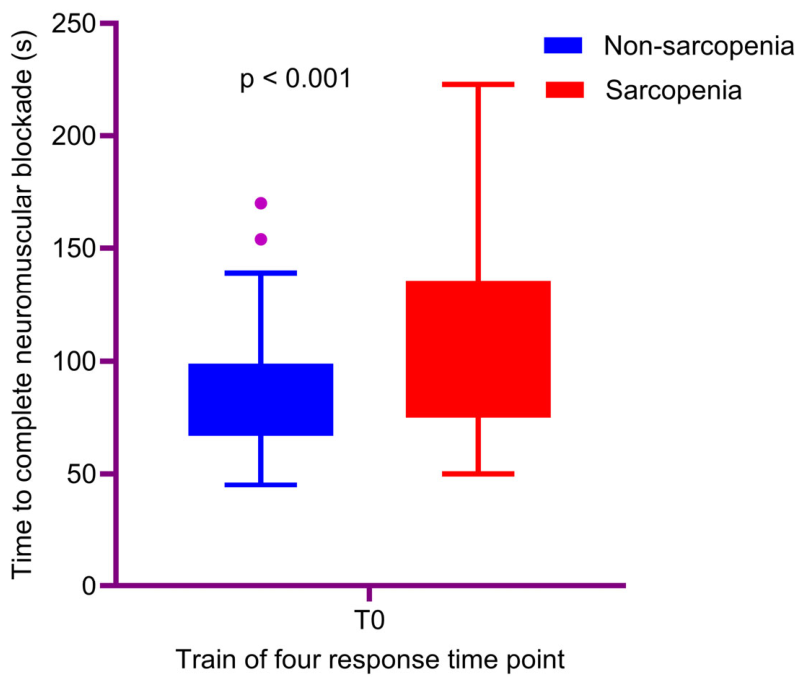
| T0—Time to TOF zero (second) | 80 (70–98) | 100 (76–135) | +20.0 (+4.0 to +36.0) | <0.001 |
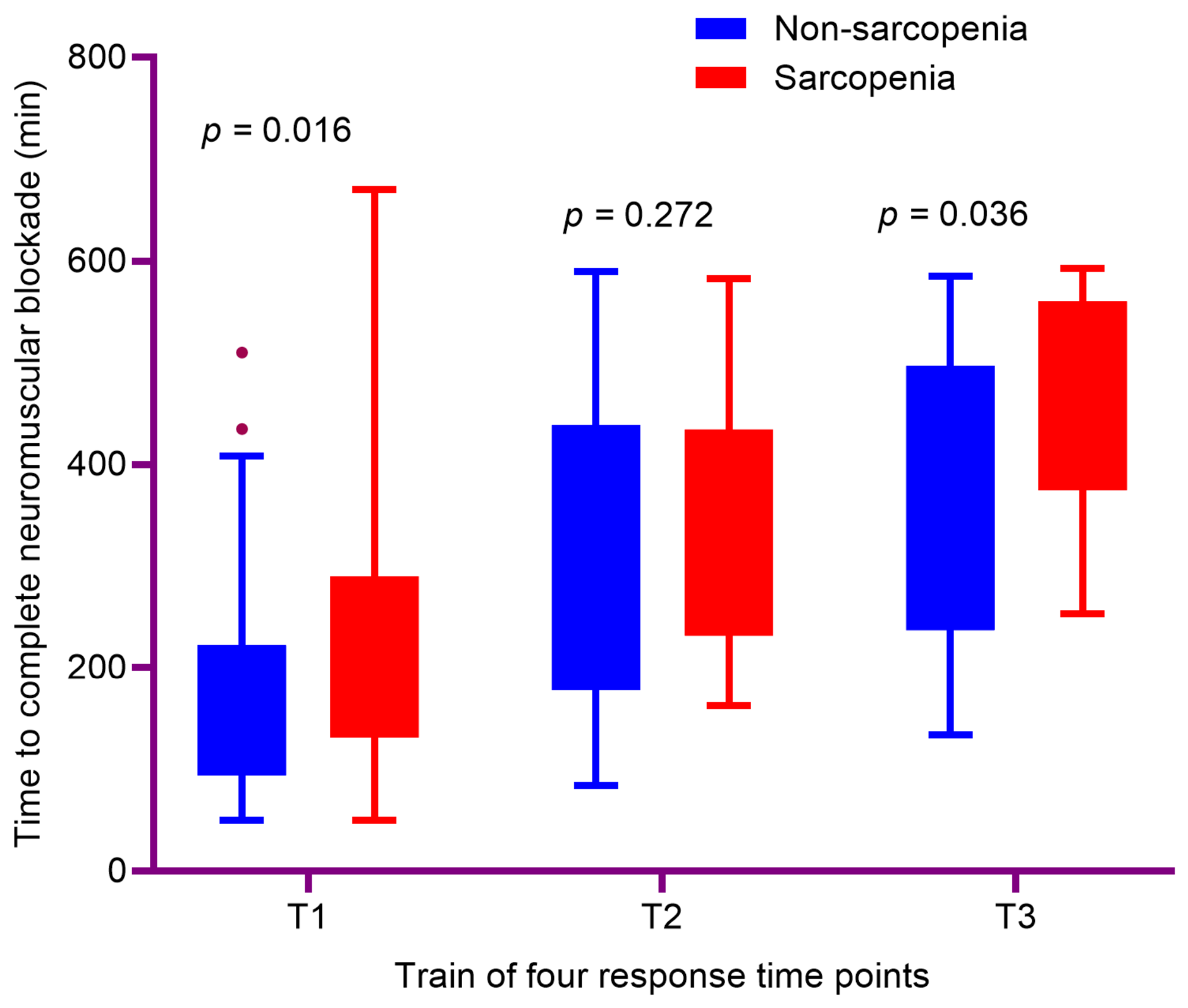
| Time to first recovery sign (T1) (min) | 165 (94–222) | 192 (132–285) | +27.0 (−24.8 to +78.8) | 0.016 |
| Time to second recovery sign (T2) (min) | 263 (179–438) | 330 (250–434) | +74.0 (−34.2 to +182.2) | 0.272 |
| Time to third recovery sign (T3) (min) | 345 (237–497) | 420 (327–560) | +90.0 (−38.7 to +218.7) | 0.036 |
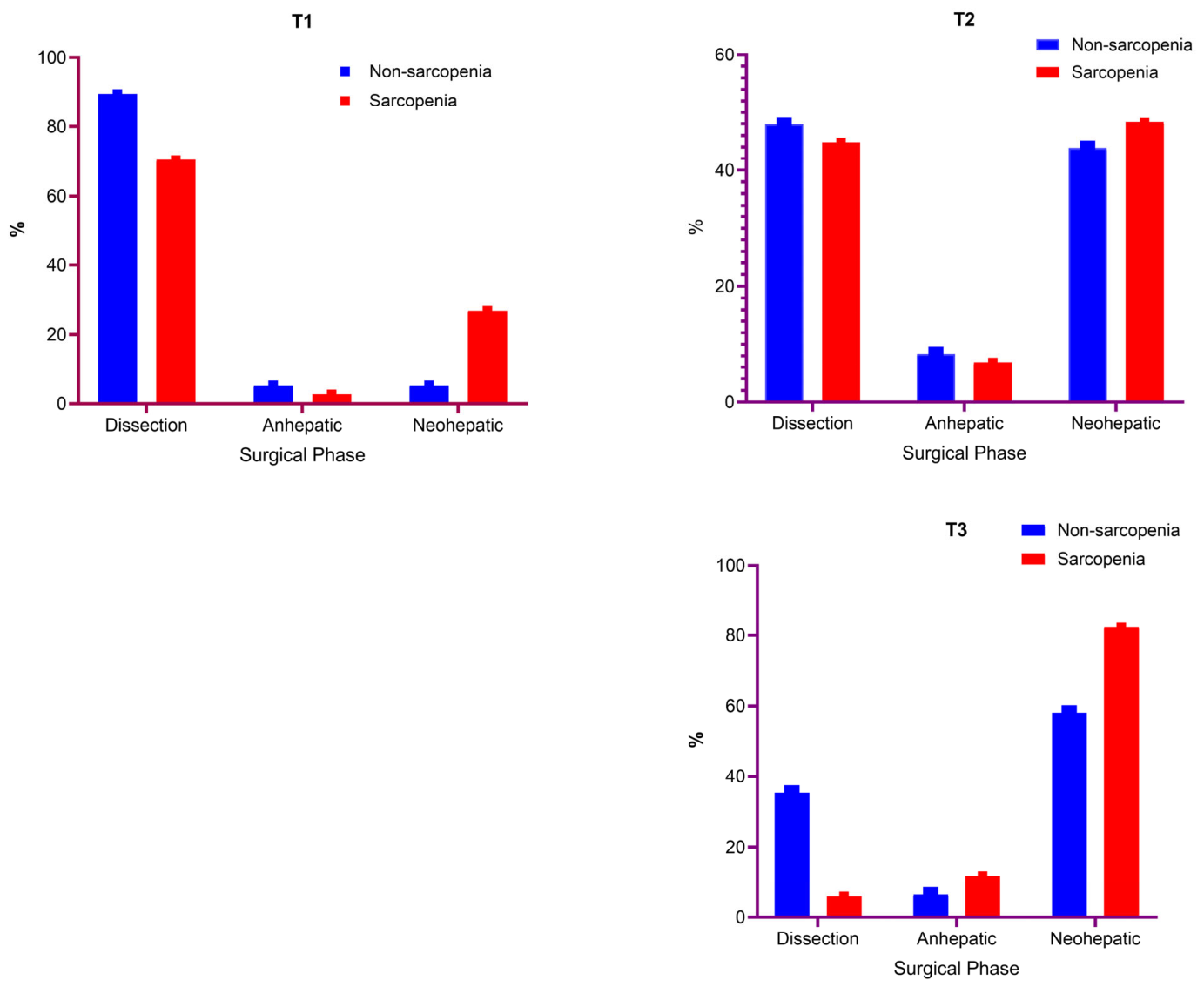
| T1, dissection phase, (n; %) | 51/57 (89.5) | 25/36 (69.4) | 0.27 (0.09 to 0.81) | 0.031 |
| T1, neohepatic phase, (n; %) | 3/57 (5.3) | 10/36 (27.8) | 6.92 (1.75 to 27.31) | 0.004 |
| T2, dissection phase, (n; %) | 23/48 (47.9) | 13/28 (46.4) | 0.94 (0.37 to 2.40) | 1.000 |
| T2, neohepatic phase, (n; %) | 21/48 (43.8) | 13/28 (46.4) | 1.11 (0.44 to 2.84) | 1.000 |
| T3, dissection phase, (n; %) | 11/31 (35.5) | 1/17 (5.9) | 0.11 (0.01 to 0.98) | 0.035 |
| T3, neohepatic phase, (n; %) | 18/31 (58.1) | 14/17 (82.4) | 3.37 (0.80 to 14.18) | 0.165 |
| Duration of surgery (hours) | 10 (9–11) | 11 (9–12) | +0.5 (−0.2 to +1.2) | 0.040 |
| Intubation score (5–20 points) | 5 (5–6) | 5 (5–5) | 0.0 (−0.3 to +0.3) | 0.037 |
| ES transfusion (units) | 2 (1–4) | 4 (2–5) | +2.0 (+1.2 to +2.8) | 0.054 |
| Variables | Non-Sarcopenia Group (n = 69) | Sarcopenia Group (n = 70) | Effect Estimate (95%CI) | p |
|---|---|---|---|---|
| ICU length of stay (days) | 6.0 (4.0–8.0) | 9.0 (6.0–17.0) | +3.0 (+0.6 to +5.4) | <0.001 |
| Hospital length of stay (days) | 30 (21–40) | 29 (21–42) | −1.0 (−8.3 to +6.3) | 0.831 |
| Time to extubation (hours) | 7 (5–9) | 10 (8–14) | +3.0 (+1.5 to +4.5) | <0.001 |
| Mortality (n; %) | 6 (8.7) | 19 (27.1) | 3.91 (1.45 to 10.52) | 0.009 |
| Variables | Survivors (n = 114) | Non-Survivors (n = 25) | Effect Estimate (95%CI) | p |
|---|---|---|---|---|
| Age (years) | 51 (42–59) | 55 (47–64) | +4.0 (−3.7 to +11.7) | 0.067 |
| Sex, male, n (%) | 82 (71.9) | 17 (68.0) | 0.83 (0.33 to 2.11) | 0.881 |
| IBW (kg) | 66.5 (59.0–73.0) | 66.0 (56.0–72.0) | −1.0 (−7.8 to +5.8) | 0.548 |
| BMI (kg/m2) | 24.2 (21.2–28.7) | 27.7 (22.5–36.3) | +3.5 (+0.02 to +7.0) | 0.065 |
| MELD score | 16.5 (14.0–20.0) | 17.0 (15.0–24.0) | +1.0 (−1.7 to +3.7) | 0.267 |
| Child–Pugh score | 8.0 (7.0–9.0) | 8.0 (6.0–10.0) | 0.0 (−1.9 to +1.9) | 0.894 |
| PMA (cm2) | 14.1 (9.2–19.0) | 9.40 (6.5–15.6) | −4.7 (−8.8 to −0.6) | 0.004 |
| PMI (cm2/m2) | 5.0 (3.2–6.1) | 3.2 (2.5–5.2) | −1.77 (−3.06 to −0.48) | 0.003 |
| Handgrip strength (kg) | 32 (15–42) | 15 (5–26) | −17.0 (−27.4 to −6.6) | 0.009 |
| ALT (IU/L) | 46 (30–80) | 35 (19–88) | −10.0 (−34.9 to +14.9) | 0.310 |
| AST (IU/L) | 68 (40–104) | 60 (43–114) | −8.0 (−35.6 to +19.6) | 0.659 |
| Total bilirubin (mg/dL) | 3.0 (1.6–5.9) | 4.3 (2.7–9.2) | +1.35 (−0.69 to +3.39) | 0.014 |
| Direct bilirubin (mg/dL) | 1.1 (0.5–2.8) | 2.1 (1.0–4.9) | +1.02 (−0.06 to +2.10) | 0.031 |
| INR | 1.3 (1.1–1.6) | 1.40 (1.2–1.7) | +0.10 (−0.13 to +0.33) | 0.173 |
| Albumin (g/dL) | 2.9 (2.4–3.5) | 2.9 (2.0–3.2) | 0.00 (−0.50 to +0.50) | 0.459 |
| Creatinine (mg/dL) | 0.9 (0.7–1.1) | 0.9 (0.7–1.1) | 0.00 (−0.18 to +0.18) | 0.796 |
| BUN | 14.3 (11.7–21.0) | 15.9 (13.6–23.0) | +1.69 (−2.53 to +5.91) | 0.188 |
| Hemoglobin (g/dL) | 10.9 (9.6–13.2) | 9.0 (8.4–11.5) | −1.90 (−3.53 to −0.27) | 0.003 |
| Platelets | 114 (75–178) | 143 (76–169) | +33.0 (−11.8 to +77.8) | 0.389 |
| Duration of surgery (hours) | 10.2 (9.3–11.2) | 10.3 (9.3–11.5) | +0.1 (−0.8 to +1.0) | 0.395 |
| Intubation score (5–20 points) | 5 (5–6) | 5 (5–6) | 0.0 (−0.5 to +0.5) | 0.745 |
| T0 | 90 (70–115) | 92 (70–150) | +3.0 (−17.8 to +23.8) | 0.184 |
| T1 | 172 (103–230) | 206.5 (162–255) | +51.0 (−18.4 to +120.4) | 0.096 |
| T2 | 285 (182–435) | 340 (285–432) | +60.0 (−91.0 to +211.0) | 0.291 |
| T3 | 375 (253–460) | 495 (435–527) | +135.0 (−44.5 to +314.5) | 0.014 |
| ES transfusion (units) | 3 (1–5) | 4 (2–6) | +1.0 (−0.9 to +2.9) | 0.019 |
| ICU length of stay (days) | 6.5 (5.0–10.0) | 14.0 (8.0–22.0) | +8.0 (+4.8 to +11.2) | <0.001 |
| Hospital length of stay (days) | 30 (23–42) | 19 (9–37) | −11.0 (−20.5 to −1.5) | 0.002 |
| Time to extubation (hours) | 8 (6–12) | 8.5 (8–9) | 0.0 (−8.5 to +8.5) | 0.872 |
| Variable | B | SE | Exp(B) | p-Value | 95% CI |
|---|---|---|---|---|---|
| Primary model | |||||
| Sarcopenia | 1.182 | 0.520 | 3.26 | 0.023 | 1.18–9.02 |
| Hemoglobin | −0.222 | 0.111 | 0.80 | 0.046 | 0.64–0.99 |
| Total bilirubin | 0.046 | 0.043 | 1.06 | 0.213 | 0.97–1.15 |
| Secondary model | |||||
| ICU length of stay (per day) | 0.089 | 0.023 | 1.09 | <0.001 | 1.05–1.14 |
Disclaimer/Publisher’s Note: The statements, opinions and data contained in all publications are solely those of the individual author(s) and contributor(s) and not of MDPI and/or the editor(s). MDPI and/or the editor(s) disclaim responsibility for any injury to people or property resulting from any ideas, methods, instructions or products referred to in the content. |
© 2026 by the authors. Licensee MDPI, Basel, Switzerland. This article is an open access article distributed under the terms and conditions of the Creative Commons Attribution (CC BY) license.
Share and Cite
Arikan, E.; Yagci, N.A.; Akbulut, S.; Colak, Y.Z.; Demiroz, D.; Arslan, A.K.; Dag, N.; Engin, F.A.; Gulhas, N.; Ucar, M. Sarcopenia Is Associated with Altered Rocuronium Onset and Neuromuscular Blockade Kinetics in Liver Transplant Recipients: A Prospective Observational Cohort Study. J. Clin. Med. 2026, 15, 3620. https://doi.org/10.3390/jcm15103620
Arikan E, Yagci NA, Akbulut S, Colak YZ, Demiroz D, Arslan AK, Dag N, Engin FA, Gulhas N, Ucar M. Sarcopenia Is Associated with Altered Rocuronium Onset and Neuromuscular Blockade Kinetics in Liver Transplant Recipients: A Prospective Observational Cohort Study. Journal of Clinical Medicine. 2026; 15(10):3620. https://doi.org/10.3390/jcm15103620
Chicago/Turabian StyleArikan, Emre, Neslihan Altunkaya Yagci, Sami Akbulut, Yusuf Ziya Colak, Duygu Demiroz, Ahmet Kadir Arslan, Nurullah Dag, Feti Ahmet Engin, Nurcin Gulhas, and Muharrem Ucar. 2026. "Sarcopenia Is Associated with Altered Rocuronium Onset and Neuromuscular Blockade Kinetics in Liver Transplant Recipients: A Prospective Observational Cohort Study" Journal of Clinical Medicine 15, no. 10: 3620. https://doi.org/10.3390/jcm15103620
APA StyleArikan, E., Yagci, N. A., Akbulut, S., Colak, Y. Z., Demiroz, D., Arslan, A. K., Dag, N., Engin, F. A., Gulhas, N., & Ucar, M. (2026). Sarcopenia Is Associated with Altered Rocuronium Onset and Neuromuscular Blockade Kinetics in Liver Transplant Recipients: A Prospective Observational Cohort Study. Journal of Clinical Medicine, 15(10), 3620. https://doi.org/10.3390/jcm15103620