Platelet Concentrates in Alveolar and Periodontal Bone Regeneration: Adjunctive Benefits and Clinical Comparability with Conventional Approaches: A Systematic Review

 ,
,  ,
,  ,
,  , ,
, ,  ,
,  ,
,  , and
, and
Abstract
1. Introduction
2. Materials and Methods
2.1. Protocol and Registration
2.2. Search Process
2.3. Inclusion and Exclusion Criteria
- Open-access articles;
- Studies written in English;
- Studies conducted in vivo or on humans;
- Randomized controlled trials (RCTs);
- Studies published in the last 15 years.
2.4. PICO Question
- I.
- Population (P):Human patients undergoing alveolar or periodontal bone regenerative procedures, including periodontal intrabony defects; furcation defects; post-extraction alveolar ridge preservation; secondary alveolar cleft grafting; periodontally accelerated PAOO.
- II.
- Intervention (I):Use of autologous PCs, including:Platelet-Rich Fibrin (PRF);Leukocyte-Platelet-Rich Fibrin (L-PRF);Injectable Platelet-Rich Fibrin (I-PRF);Advanced Platelet-Rich Fibrin (A-PRF);PCs may be used as:A biological membrane;An interpositional layer between graft and soft tissues;Mixed with bone grafting biomaterials;An adjunct to regenerative surgical procedures;
- III.
- Comparison (C):Conventional regenerative approaches performed without PCs, including:Bone grafting alone (autograft, allograft, xenograft);Bone grafting combined with CM;Conventional guided tissue regeneration (GTR);Enamel matrix derivative (EMD);Open flap debridement (OFD);Other standard regenerative techniques without PCs.
- IV.
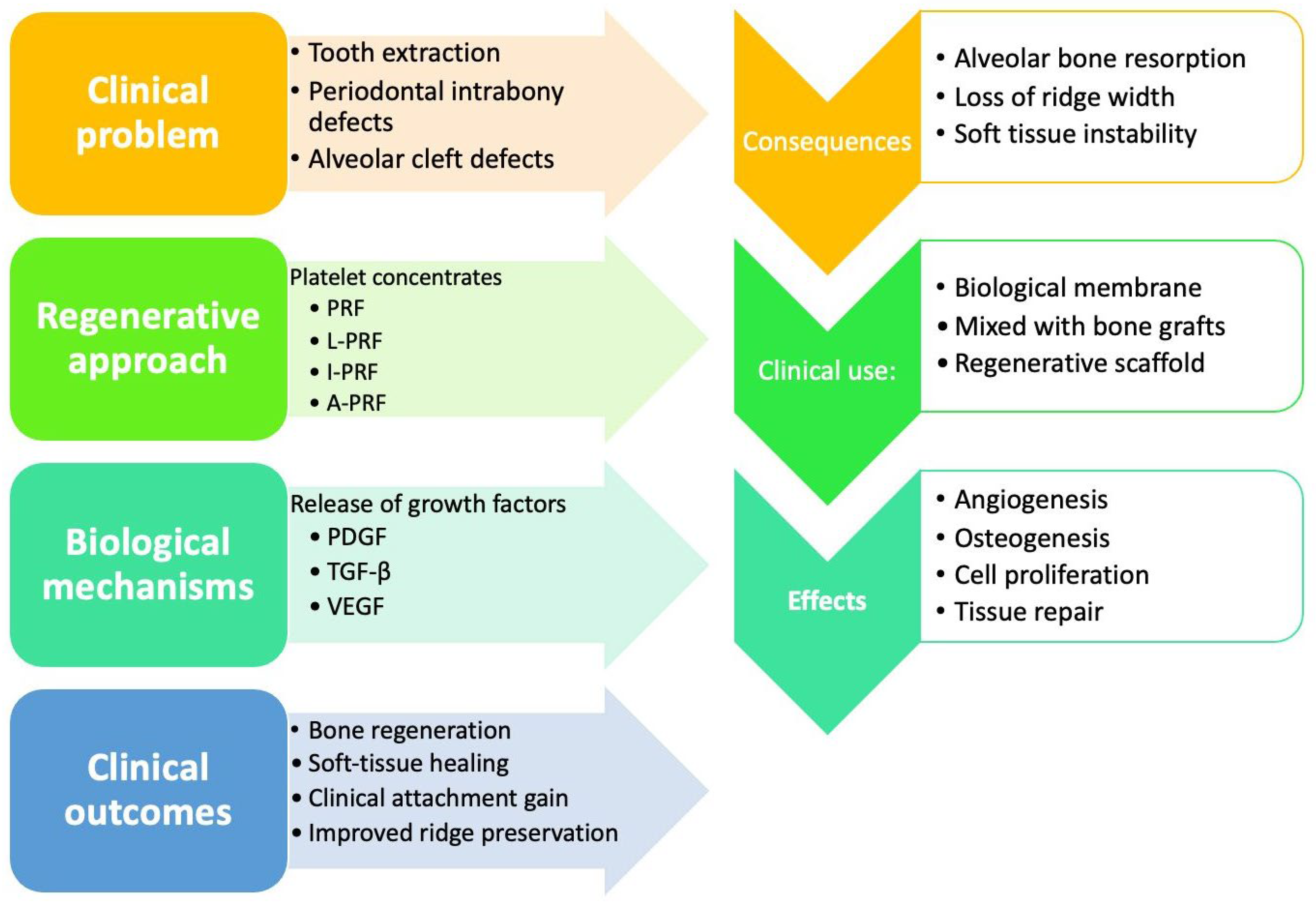
- Outcome (O):Primary Outcomes (Figure 2):Clinical Attachment Level (CAL);Radiographic bone fill/defect bone level gain;Alveolar ridge width preservation;Percentage of newly formed bone (histological evaluation).Secondary Outcomes:Probing depth (PPD) reduction;Gingival recession (GR);Marginal bone loss;Bone density (CBCT assessment);Percentage of residual graft material;Postoperative complications;Early wound healing.
2.5. Data Processing
3. Results
3.1. Selection and Characteristics of the Study
3.2. Quality Assessment and Risk of Bias of Included Articles
3.3. Structured Synthesis of Results and Analysis of Heterogeneity
3.3.1. Intrabony Defects
3.3.2. Ridge Preservation
3.3.3. Alveolar Cleft Reconstruction
3.3.4. PAOO (Periodontally Accelerated Osteogenic Orthodontics)
4. Discussion
4.1. Infraosseous Defects (Periodontal Intrabony/Non-Contained Defects)
4.2. Socket Preservation (Post-Extraction Ridge Preservation)
4.3. Alveolar Cleft Reconstruction
4.4. PAOO as Assisted Regenerative Therapy (Periodontally Accelerated Osteogenic Orthodontics)
5. Conclusions
6. Limits and Future Limitations
Supplementary Materials
Author Contributions
Funding
Institutional Review Board Statement
Informed Consent Statement
Data Availability Statement
Conflicts of Interest
Abbreviations
| A-PRF | Advanced Platelet-Rich Fibrin |
| ABG | Autogenous Bone Graft |
| BG | Bioactive Glass |
| CAL | Clinical Attachment Level |
| CM | Collagen Membrane |
| DBBM | Deproteinized Bovine Bone Mineral |
| EMD | Enamel Matrix Derivative |
| DFDBA | Demineralized Freeze-Dried Bone Allograft |
| HA | Hydroxyapatite |
| I-PRF | Injectable Platelet-Rich Fibrin |
| L-PRF | Leukocyte- and Platelet-Rich Fibrin |
| OFD | Open Flap Debridement |
| PAOO | Periodontally Accelerated Osteogenic Orthodontics |
| PC | Platelet Concentrates |
| PPD | Probing Depth |
| PRF | Platelet-Rich Fibrin |
| PRGF | Plasma Rich in Growth Factors |
| rhBMP-2 | Recombinant Human Bone Morphogenetic Protein-2 |
Appendix A
References
- Inchingolo, A.M.; Marinelli, G.; Trilli, I.; Del Vecchio, G.; Di Noia, A.; Inchingolo, F.; Del Fabbro, M.; Palermo, A.; Inchingolo, A.D.; Dipalma, G. A Histological and Clinical Evaluation of Long-Term Outcomes of Bovine Bone-Derived Xenografts in Oral Surgery: A Systematic Review. J. Funct. Biomater. 2025, 16, 321. [Google Scholar] [CrossRef] [PubMed]
- Dipalma, G.; Inchingolo, A.M.; Colonna, V.; Marotti, P.; Carone, C.; Ferrante, L.; Inchingolo, F.; Palermo, A.; Inchingolo, A.D. Autologous and Heterologous Minor and Major Bone Regeneration with Platelet-Derived Growth Factors. J. Funct. Biomater. 2025, 16, 16. [Google Scholar] [CrossRef] [PubMed]
- Inchingolo, A.M.; Patano, A.; Di Pede, C.; Inchingolo, A.D.; Palmieri, G.; de Ruvo, E.; Campanelli, M.; Buongiorno, S.; Carpentiere, V.; Piras, F.; et al. Autologous Tooth Graft: Innovative Biomaterial for Bone Regeneration. Tooth Transformer® and the Role of Microbiota in Regenerative Dentistry. A Systematic Review. J. Funct. Biomater. 2023, 14, 132. [Google Scholar] [CrossRef] [PubMed]
- Inchingolo, A.M.; Marinelli, G.; Inchingolo, F.; Giorgio, R.V.; Colonna, V.; Pennacchio, B.F.P.; Del Fabbro, M.; Tartaglia, G.; Palermo, A.; Inchingolo, A.D.; et al. Autologous Tooth-Derived Biomaterials in Alveolar Bone Regeneration: A Systematic Review of Clinical Outcomes and Histological Evidence. J. Funct. Biomater. 2025, 16, 367. [Google Scholar] [CrossRef]
- Minetti, E.; Dipalma, G.; Palermo, A.; Patano, A.; Inchingolo, A.D.; Inchingolo, A.M.; Inchingolo, F. Biomolecular Mechanisms and Case Series Study of Socket Preservation with Tooth Grafts. J. Clin. Med. 2023, 12, 5611. [Google Scholar] [CrossRef]
- Nuzzolo, P.; Celentano, A.; Bucci, P.; Adamo, D.; Ruoppo, E.; Leuci, S.; Mignogna, M.D. Lichen Planus of the Lips: An Intermediate Disease between the Skin and Mucosa? Retrospective Clinical Study and Review of the Literature. Int. J. Dermatol. 2016, 55, e473–e481. [Google Scholar] [CrossRef]
- Inchingolo, F.; Inchingolo, A.M.; Latini, G.; de Ruvo, E.; Campanelli, M.; Palermo, A.; Fabbro, M.D.; Blasio, M.D.; Inchingolo, A.D.; Dipalma, G. Guided Bone Regeneration: CGF and PRF Combined with Various Types of Scaffolds-A Systematic Review. Int. J. Dent. 2024, 2024, 4990295. [Google Scholar] [CrossRef]
- Sgolastra, F.; Petrucci, A.; Gatto, R.; Giannoni, M.; Monaco, A. Long-Term Efficacy of Subantimicrobial-Dose Doxycycline as an Adjunctive Treatment to Scaling and Root Planing: A Systematic Review and Meta-Analysis. J. Periodontol. 2011, 82, 1570–1581. [Google Scholar] [CrossRef]
- Teresa, D.M.; Stefano, M.; Annalisa, M.; Enrico, M.; Vincenzo, C.; Giuseppe, M. Orthodontic Treatment of the Transposition of a Maxillary Canine and a First Premolar: A Case Report. J. Med. Case Rep. 2015, 9, 48. [Google Scholar] [CrossRef]
- Monaco, A.; Streni, O.; Marci, M.C.; Sabetti, L.; Marzo, G.; Giannoni, M. Relationship between Mandibular Deviation and Ocular Convergence. J. Clin. Pediatr. Dent. 2004, 28, 135–138. [Google Scholar] [CrossRef]
- Campanella, V. Dental Stem Cells: Current Research and Future Applications. Eur. J. Paediatr. Dent. 2018, 19, 257. [Google Scholar] [CrossRef]
- Campanella, V.; Gallusi, G.; Di Taranto, V.; Cugini, C.; Nardi, R.; Mea, A.; Marzo, G.; Libonati, A. Effect of Pressure and Light Curing of Composite Micro Hardness. J. Biol. Regul. Homeost. Agents 2020, 34, 39–47. [Google Scholar]
- Gallusi, G.; Libonati, A.; Campanella, V. SEM-Morphology in Dentinogenesis Imperfecta Type II: Microscopic Anatomy and Efficacy of a Dentine Bonding System. Eur. J. Paediatr. Dent. 2006, 7, 9–17. [Google Scholar] [PubMed]
- Campanella, V.; Di Taranto, V.; Beretta, M.; Colombo, S.; Gallusi, G. Paediatric Endodontics. Part. 1: Portland Cements Apical Plug. Eur. J. Paediatr. Dent. 2020, 21, 248–250. [Google Scholar] [CrossRef]
- Lo Russo, L.; Ciavarella, D.; Salamini, A.; Guida, L. Alignment of Intraoral Scans and Registration of Maxillo-Mandibular Relationships for the Edentulous Maxillary Arch. J. Prosthet. Dent. 2019, 121, 737–740. [Google Scholar] [CrossRef] [PubMed]
- Troiano, G.; Dioguardi, M.; Cocco, A.; Giuliani, M.; Fabiani, C.; D’Alessandro, A.; Ciavarella, D.; Lo Muzio, L. Centering Ability of ProTaper Next and WaveOne Classic in J-Shape Simulated Root Canals. Sci. World J. 2016, 2016, 1606013. [Google Scholar] [CrossRef]
- Tepedino, M.; Illuzzi, G.; Laurenziello, M.; Perillo, L.; Taurino, A.M.; Cassano, M.; Guida, L.; Burlon, G.; Ciavarella, D. Craniofacial Morphology in Patients with Obstructive Sleep Apnea: Cephalometric Evaluation. Braz. J. Otorhinolaryngol. 2022, 88, 228–234. [Google Scholar] [CrossRef] [PubMed]
- Lo Russo, L.; Zhurakivska, K.; Montaruli, G.; Salamini, A.; Gallo, C.; Troiano, G.; Ciavarella, D. Effects of Crown Movement on Periodontal Biotype: A Digital Analysis. Odontology 2018, 106, 414–421. [Google Scholar] [CrossRef]
- Tepedino, M.; Iancu-Potrubacz, M.; Ciavarella, D.; Masedu, F.; Marchione, L.; Chimenti, C. Expansion of Permanent First Molars with Rapid Maxillary Expansion Appliance Anchored on Primary Second Molars. J. Clin. Exp. Dent. 2018, 10, e241–e247. [Google Scholar] [CrossRef]
- Avvanzo, P.; Ciavarella, D.; Avvanzo, A.; Giannone, N.; Carella, M.; Lo Muzio, L. Immediate Placement and Temporization of Implants: Three- to Five-Year Retrospective Results. J. Oral Implantol. 2009, 35, 136–142. [Google Scholar] [CrossRef]
- Cassano, M.; Russo, G.; Granieri, C.; Ciavarella, D. Modification of Growth, Immunologic and Feeding Parameters in Children with OSAS after Adenotonsillectomy. Acta Otorhinolaryngol. Ital. 2018, 38, 124–130. [Google Scholar] [CrossRef] [PubMed]
- Ciavarella, D.; Tepedino, M.; Gallo, C.; Montaruli, G.; Zhurakivska, K.; Coppola, L.; Troiano, G.; Chimenti, C.; Laurenziello, M.; Lo Russo, L. Post-Orthodontic Position of Lower Incisors and Gingival Recession: A Retrospective Study. J. Clin. Exp. Dent. 2017, 9, e1425–e1430. [Google Scholar] [CrossRef] [PubMed]
- Chapman, K.L.; Sitzman, T.; Baylis, A.; Hardin-Jones, M.; Kirschner, R.; Temkit, M.H. Cleft Outcomes Research NETwork (CORNET) Consortium. A Comparative Effectiveness Study of Speech and Surgical Outcomes: Study Overview. Cleft Palate Craniofac. J. 2024, 62, 1660–1675. [Google Scholar] [CrossRef]
- Mark, H.; Lilja, J.; Havstam, C. Long-Term Longitudinal Follow-up of Individuals with UCLP after Gothenburg Twostage Palate Closure: Surgical and Speech Outcomes. J. Plast. Surg. Hand Surg. 2023, 58, 19–25. [Google Scholar] [CrossRef] [PubMed]
- Persson, C.; Davies, J.; Havstam, C.; Søgaard, H.; Bowden, M.; Boers, M.; Nielsen, J.B.; Alaluusua, S.; Lundeborg Hammarström, I.; Emborg, B.K.; et al. Longitudinal Speech Outcome at 5 and 10 Years in UCLP: Influence of Speech Therapy and Secondary Velopharyngeal Surgery. Cleft Palate Craniofac. J. 2025, 62, 772–785. [Google Scholar] [CrossRef]
- Jørgensen, L.D.; Willadsen, E. Longitudinal Study of the Development of Obstruent Correctness from Ages 3 to 5 Years in 108 Danish Children with Unilateral Cleft Lip and Palate: A Sub-Study within a Multicentre Randomized Controlled Trial. Int. J. Lang. Commun. Disord. 2020, 55, 121–135. [Google Scholar] [CrossRef]
- Hammarström, I.L.; Nyberg, J.; Alaluusua, S.; Rautio, J.; Neovius, E.; Berggren, A.; Persson, C.; Willadsen, E.; Lohmander, A. Scandcleft Project Trial 2-Comparison of Speech Outcome in 1- and 2-Stage Palatal Closure in 5-Year-Olds with UCLP. Cleft Palate Craniofac. J. 2020, 57, 458–469. [Google Scholar] [CrossRef]
- Persson, C.; Pedersen, N.-H.; Hayden, C.; Bowden, M.; Aukner, R.; Vindenes, H.A.; Åbyholm, F.; Withby, D.; Willadsen, E.; Lohmander, A. Scandcleft Project Trial 3: Comparison of Speech Outcomes in Relation to Sequence in 2-Stage Palatal Repair Procedures in 5-Year-Olds with Unilateral Cleft Lip and Palate. Cleft Palate Craniofac. J. 2020, 57, 352–363. [Google Scholar] [CrossRef]
- Willadsen, E.; Lohmander, A.; Persson, C.; Boers, M.; Kisling-Møller, M.; Havstam, C.; Elander, A.; Andersen, M. Scandcleft Project, Trial 1: Comparison of Speech Outcome in Relation to Timing of Hard Palate Closure in 5-Year-Olds with UCLP. Cleft Palate Craniofac. J. 2019, 56, 1276–1286. [Google Scholar] [CrossRef]
- Willadsen, E.; Lohmander, A.; Persson, C.; Lundeborg, I.; Alaluusua, S.; Aukner, R.; Bau, A.; Boers, M.; Bowden, M.; Davies, J.; et al. Scandcleft Randomised Trials of Primary Surgery for Unilateral Cleft Lip and Palate: 5. Speech Outcomes in 5-Year-Olds—Consonant Proficiency and Errors. J. Plast. Surg. Hand Surg. 2017, 51, 38–51. [Google Scholar] [CrossRef]
- Dipalma, G.; Inchingolo, A.D.; Calò, F.; Lagioia, R.; Bassi, P.; de Ruvo, E.; Inchingolo, F.; Palermo, A.; Marinelli, G.; Inchingolo, A.M. Eighty-Four-Month Clinical Outcomes of Autologous Dentin Graft Using Tooth Transformer® and Concentrated Growth Factors in Maxillary Atrophy: A Retrospective Study of 31 Patients. J. Funct. Biomater. 2025, 16, 357. [Google Scholar] [CrossRef] [PubMed]
- Malcangi, G.; Patano, A.; Palmieri, G.; Di Pede, C.; Latini, G.; Inchingolo, A.D.; Hazballa, D.; de Ruvo, E.; Garofoli, G.; Inchingolo, F.; et al. Maxillary Sinus Augmentation Using Autologous Platelet Concentrates (Platelet-Rich Plasma, Platelet-Rich Fibrin, and Concentrated Growth Factor) Combined with Bone Graft: A Systematic Review. Cells 2023, 12, 1797. [Google Scholar] [CrossRef]
- Pradeep, A.R.; Bajaj, P.; Rao, N.S.; Agarwal, E.; Naik, S.B. Platelet-Rich Fibrin Combined with a Porous Hydroxyapatite Graft for the Treatment of 3-Wall Intrabony Defects in Chronic Periodontitis: A Randomized Controlled Clinical Trial. J. Periodontol. 2017, 88, 1288–1296. [Google Scholar] [CrossRef] [PubMed]
- Shawky, H.; Seifeldin, S.A. Does Platelet-Rich Fibrin Enhance Bone Quality and Quantity of Alveolar Cleft Reconstruction? Cleft Palate Craniofac. J. 2016, 53, 597–606. [Google Scholar] [CrossRef]
- Bodhare, G.H.; Kolte, A.P.; Kolte, R.A.; Shirke, P.Y. Clinical and Radiographic Evaluation and Comparison of Bioactive Bone Alloplast Morsels When Used Alone and in Combination with Platelet-Rich Fibrin in the Treatment of Periodontal Intrabony Defects-A Randomized Controlled Trial. J. Periodontol. 2019, 90, 584–594. [Google Scholar] [CrossRef] [PubMed]
- Chandra, R.V.; Rachala, M.R.; Madhavi, K.; Kambalyal, P.; Reddy, A.A.; Ali, M.H. Periodontally Accelerated Osteogenic Orthodontics Combined with Recombinant Human Bone Morphogenetic Protein-2: An Outcome Assessment. J. Indian Soc. Periodontol. 2019, 23, 257–263. [Google Scholar] [CrossRef]
- Paolantonio, M.; Di Tullio, M.; Giraudi, M.; Romano, L.; Secondi, L.; Paolantonio, G.; Graziani, F.; Pilloni, A.; De Ninis, P.; Femminella, B. Periodontal Regeneration by Leukocyte and Platelet-Rich Fibrin with Autogenous Bone Graft versus Enamel Matrix Derivative with Autogenous Bone Graft in the Treatment of Periodontal Intrabony Defects: A Randomized Non-Inferiority Trial. J. Periodontol. 2020, 91, 1595–1608. [Google Scholar] [CrossRef]
- Serroni, M.; Paolantonio, M.; Romano, L.; Santamaria, P.; Rexhepi, I.; Sinjari, B.; Paolantonio, G.; Secondi, L.; De Ninis, P.; Femminella, B. Added Benefit of L-PRF to Autogenous Bone Grafts in the Treatment of Degree II Furcation Involvement in Mandibular Molars. J. Periodontol. 2022, 93, 1486–1499. [Google Scholar] [CrossRef]
- Abdulrahman, Y.A.; Hosny, M.M.; Elfana, A.; Fawzy El-Sayed, K.M. Clinical and Radiographic Evaluation of Low-Speed Platelet-Rich Fibrin (PRF) for the Treatment of Intra-Osseous Defects of Stage-III Periodontitis Patients: A Randomized Controlled Clinical Trial. Clin. Oral Investig. 2022, 26, 6671–6680. [Google Scholar] [CrossRef]
- Yashwant, V.A.; Balu, P.; Kumar, R.S.; Ammayappan, P.; Murugaboopathy, V. Effectiveness of Platelet Rich Fibrin versus Demineralized Bone Xenograft in Periodontally Accelerated Osteogenic Orthodontics. Angle Orthod. 2022, 92, 180–188. [Google Scholar] [CrossRef]
- Ma, Z.; Zhu, Y.; Zhan, Y.; Zhang, Y.; Abdelrehem, A.; Wang, B.; Yang, C. Periosteum Coverage versus Collagen-Membrane Coverage in Periodontally Accelerated Osteogenic Orthodontics: A Randomized Controlled Clinical Trial in Class II and Class III Malocclusions. BMC Oral Health 2022, 22, 439. [Google Scholar] [CrossRef]
- Bedeer, H.M.; Asklany, A.; Ali, W.M.; Elyounsi, M.; Mohammed, M.N.A.; Youssef, M.M.; El-Shazly, M. Outcomes of Xenograft with Platelet-Rich Fibrin versus Autogenous Bone in Alveolar Cleft Grafting. Plast. Reconstr. Surg. Glob. Open 2024, 12, e6106. [Google Scholar] [CrossRef] [PubMed]
- Azangookhiavi, H.; Habibzadeh, S.; Zahmatkesh, H.; Mellati, E.; Mosaddad, S.A.; Dadpour, Y. The Effect of Platelet-Rich Fibrin (PRF) versus Freeze-Dried Bone Allograft (FDBA) Used in Alveolar Ridge Preservation on the Peri-Implant Soft and Hard Tissues: A Randomized Clinical Trial. BMC Oral Health 2024, 24, 693. [Google Scholar] [CrossRef] [PubMed]
- Balice, G.; Paolantonio, M.; De Ninis, P.; Rexhepi, I.; Serroni, M.; Frisone, A.; Romano, L.; Sinjari, B.; Murmura, G.; Femminella, B. Treatment of Unfavorable Intrabony Defects with Autogenous Bone Graft in Combination with Leukocyte- and Platelet-Rich Fibrin or Collagen Membranes: A Non-Inferiority Study. Medicina 2024, 60, 1091. [Google Scholar] [CrossRef] [PubMed]
- Camacho-Alonso, F.; Águila, O.G.-D.; Ferrer-Díaz, P.; Peñarrocha-Oltra, D.; Guerrero-Sánchez, Y.; Bernabeu-Mira, J.C. Cyanoacrylate versus Collagen Membrane as a Sealing for Alveolar Ridge Preservation: A Randomized Clinical Trial. J. Funct. Biomater. 2024, 15, 279. [Google Scholar] [CrossRef]
- Eid, M.K.; Elsaadany, W.H.; Ibrahim, M.T. Evaluation of Platelet-Rich Fibrin versus Collagen Membrane for Enhancing Healing of Secondary Grafted Alveolar Cleft: A Randomised Controlled Trial. Br. J. Oral Maxillofac. Surg. 2024, 62, 559–564. [Google Scholar] [CrossRef]
- Almoliky, N.; Hosny, M.; Elbattawy, W.; Fawzy El-Sayed, K. Low-Speed Platelet-Rich Fibrin Membrane in Conjunction with Demineralized Freeze-Dried Bone Allograft (DFDBA) Compared to Collagen Membrane with DFDBA in Noncontained Intraosseous Defects of Stage III Periodontitis: A Randomized Controlled Clinical Trial. Int. J. Dent. 2025, 2025, 6393105. [Google Scholar] [CrossRef]
- Talebi Ardakani, M.R.; Rezaei Esfahrood, Z.; Mashhadiabbas, F.; Hatami, M. Comparison of Histological, Clinical, and Radiographic Outcomes of Postextraction Ridge Preservation by Allogenic Bone Grafting with and Without Injectable Platelet-Rich Fibrin: A Double-Blinded Randomized Controlled Clinical Trial. Int. J. Dent. 2024, 2024, 8850664. [Google Scholar] [CrossRef]
- Minetti, E.; Inchingolo, A.M.; Ferrante, L.; Marinelli, G.; Inchingolo, F.; Inchingolo, A.D.; Palermo, A.; Dipalma, G. Six-Year Implants Follow-Up After Guided Bone Regeneration Using Autologous Tooth Graft: Innovative Biomaterial for Bone Regeneration Tooth Transformer®. J. Funct. Biomater. 2025, 16, 172. [Google Scholar] [CrossRef]
- Minetti, E.; Palermo, A.; Savadori, P.; Patano, A.; Inchingolo, A.D.; Rapone, B.; Malcangi, G.; Inchingolo, F.; Dipalma, G.; Tartaglia, F.C.; et al. Socket Preservation Using Dentin Mixed with Xenograft Materials: A Pilot Study. Materials 2023, 16, 4945. [Google Scholar] [CrossRef]
- Lorusso, F.; Inchingolo, F.; Dipalma, G.; Postiglione, F.; Fulle, S.; Scarano, A. Synthetic Scaffold/Dental Pulp Stem Cell (DPSC) Tissue Engineering Constructs for Bone Defect Treatment: An Animal Studies Literature Review. Int. J. Mol. Sci. 2020, 21, 9765. [Google Scholar] [CrossRef]
- Malcangi, G.; Inchingolo, A.M.; Inchingolo, A.D.; Ferrante, L.; Latini, G.; Trilli, I.; Nardelli, P.; Longo, M.; Palermo, A.; Inchingolo, F.; et al. The Role of Platelet Concentrates and Growth Factors in Facial Rejuvenation: A Systematic Review with Case Series. Medicina 2025, 61, 84. [Google Scholar] [CrossRef] [PubMed]
- Minetti, E.; Taschieri, S.; Corbella, S. A Histologic Study on the Use of Tooth as a Graft Material in Oral Surgery: Analysis of 187 Samples. Materials 2025, 18, 2518. [Google Scholar] [CrossRef] [PubMed]
- Minetti, E.; Giacometti, E.; Gambardella, U.; Contessi, M.; Ballini, A.; Marenzi, G.; Celko, M.; Mastrangelo, F. Alveolar Socket Preservation with Different Autologous Graft Materials: Preliminary Results of a Multicenter Pilot Study in Human. Materials 2020, 13, 1153. [Google Scholar] [CrossRef] [PubMed]
- Solakoglu, Ö.; Heydecke, G.; Amiri, N.; Anitua, E. The Use of Plasma Rich in Growth Factors (PRGF) in Guided Tissue Regeneration and Guided Bone Regeneration. A Review of Histological, Immunohistochemical, Histomorphometrical, Radiological and Clinical Results in Humans. Ann. Anat. 2020, 231, 151528. [Google Scholar] [CrossRef]
- Boyapati, L.; Wang, H.-L. The Role of Platelet-Rich Plasma in Sinus Augmentation: A Critical Review. Implant Dent. 2006, 15, 160–170. [Google Scholar] [CrossRef]
- Valentini, P.; Calciolari, E.; Monlezun, S.; Akcalı, A.; Donos, N.; Quirynen, M. APCs in Sinus Floor Augmentation. Periodontol. 2000 2025, 97, 254–270. [Google Scholar] [CrossRef]
- Ohba, S.; Shido, R.; Asahina, I. Application of Hydroxyapatite/Collagen Composite Material for Maxillary Sinus Floor Augmentation. J. Oral Sci. 2021, 63, 295–297. [Google Scholar] [CrossRef]
- Qiu, P.; Zhang, X.; Cao, R.; Xu, H.; Jiang, Z.; Lei, J. Assessment of the Efficacy of Autologous Blood Preparations in Maxillary Sinus Floor Elevation Surgery: A Systematic Review and Meta-Analysis. BMC Oral Health 2024, 24, 1171. [Google Scholar] [CrossRef]
- Franceschelli, S.; Lagioia, R.; De Cecco, F.; Minetti, E.; Ballini, A.; Panella, V.; Speranza, L.; Grilli, A.; Mastrangelo, F. Biological Evaluation of the Osteoinductive Potential of Dry Teeth after Chemical Demineralization Treatment Using the Tooth Transformer Device. Biomolecules 2023, 13, 1727. [Google Scholar] [CrossRef]
- Dohan Ehrenfest, D.M.; Rasmusson, L.; Albrektsson, T. Classification of Platelet Concentrates: From Pure Platelet-Rich Plasma (P-PRP) to Leucocyte- and Platelet-Rich Fibrin (L-PRF). Trends Biotechnol. 2009, 27, 158–167. [Google Scholar] [CrossRef]
- Koga, T.; Nakatani, Y.; Ohba, S.; Hara, M.; Sumita, Y.; Nagai, K.; Asahina, I. Clinical Safety Assessment of Autologous Freeze-Drying Platelet-Rich Plasma for Bone Regeneration in Maxillary Sinus Floor Augmentation: A Pilot Study. J. Clin. Med. 2021, 10, 1678. [Google Scholar] [CrossRef]
- Simonpieri, A.; Del Corso, M.; Vervelle, A.; Jimbo, R.; Inchingolo, F.; Sammartino, G.; Dohan Ehrenfest, D.M. Current Knowledge and Perspectives for the Use of Platelet-Rich Plasma (PRP) and Platelet-Rich Fibrin (PRF) in Oral and Maxillofacial Surgery Part 2: Bone Graft, Implant and Reconstructive Surgery. Curr. Pharm. Biotechnol. 2012, 13, 1231–1256. [Google Scholar] [CrossRef]
- Abdalla, R.I.B.; Alqutaibi, A.Y.; Kaddah, A. Does the Adjunctive Use of Platelet-Rich Plasma to Bone Graft during Sinus Augmentation Reduce Implant Failure and Complication? Systematic Review and Meta-Analysis. Quintessence Int. 2018, 49, 139–146. [Google Scholar] [CrossRef] [PubMed]
- Leung, M.; Alghamdi, R.; Guallart, I.F.; Bergamini, M.; Yu, P.Y.; Froum, S.J.; Cho, S.-C. Patient-Related Risk Factors for Maxillary Sinus Augmentation Procedures: A Systematic Literature Review. Int. J. Periodontics Restor. Dent. 2021, 41, e121–e128. [Google Scholar] [CrossRef]
- Egierska, D.; Perszke, M.; Mazur, M.; Duś-Ilnicka, I. Platelet-Rich Plasma and Platelet-Rich Fibrin in Oral Surgery: A Narrative Review. Dent. Med. Probl. 2023, 60, 177–186. [Google Scholar] [CrossRef]
- Arora, N.S.; Ramanayake, T.; Ren, Y.-F.; Romanos, G.E. Platelet-Rich Plasma in Sinus Augmentation Procedures: A Systematic Literature Review: Part II. Implant Dent. 2010, 19, 145–157. [Google Scholar] [CrossRef] [PubMed]
- Acerra, A.; Caggiano, M.; Chiacchio, A.; Scognamiglio, B.; D’Ambrosio, F. PRF and PRP in Dentistry: An Umbrella Review. J. Clin. Med. 2025, 14, 3224. [Google Scholar] [CrossRef] [PubMed]
- Pietruszka, P.; Chruścicka, I.; Duś-Ilnicka, I.; Paradowska-Stolarz, A. PRP and PRF-Subgroups and Divisions When Used in Dentistry. J. Pers. Med. 2021, 11, 944. [Google Scholar] [CrossRef]
- Stumbras, A.; Krukis, M.M.; Januzis, G.; Juodzbalys, G. Regenerative Bone Potential after Sinus Floor Elevation Using Various Bone Graft Materials: A Systematic Review. Quintessence Int. 2019, 50, 548–558. [Google Scholar] [CrossRef]
- Tavelli, L.; Borgonovo, A.E.; Re, D.; Maiorana, C. Sinus Presurgical Evaluation: A Literature Review and a New Classification Proposal. Minerva Stomatol. 2017, 66, 115–131. [Google Scholar] [CrossRef]
- Roldán, J.C.; Jepsen, S.; Schmidt, C.; Knüppel, H.; Rueger, D.C.; Açil, Y.; Terheyden, H. Sinus Floor Augmentation with Simultaneous Placement of Dental Implants in the Presence of Platelet-Rich Plasma or Recombinant Human Bone Morphogenetic Protein-7. Clin. Oral Implant. Res. 2004, 15, 716–723. [Google Scholar] [CrossRef]
- Testori, T.; Weinstein, T.; Taschieri, S.; Wallace, S.S. Risk Factors in Lateral Window Sinus Elevation Surgery. Periodontol. 2000 2019, 81, 91–123. [Google Scholar] [CrossRef]
- Celli, D.; Manente, A.; Grippaudo, C.; Cordaro, M. Interceptive Treatment in Ectodermal Dysplasia Using an Innovative Orthodontic/Prosthetic Modular Appliance. A Case Report with 10- Year Follow-Up. Eur. J. Paediatr. Dent. 2018, 19, 307–312. [Google Scholar] [CrossRef]
- Celli, D.; Gasperoni, E.; Deli, R. Long-Term Outcome in a Patient with a Dentoskeletal Open-Bite Malocclusion Treated without Extraction. World J. Orthod. 2007, 8, 344–356. [Google Scholar]
- Celli, D.; Greco, A.L.; Sferra, S.; Deli, R. Management of Impacted Dilacerated Maxillary Incisor with Strategic Positioning of a Straightwire Appliance. Eur. J. Paediatr. Dent. 2015, 16, 191–196. [Google Scholar] [PubMed]
- Celli, D.; Polisini, J.C.; D’Addona, A. Orthognathodontic therapy in handicapped patients. Minerva Ortognatod. 1990, 8, 1–7. [Google Scholar] [PubMed]
- Craig, F.; Crippa, A.; De Giacomo, A.; Ruggiero, M.; Rizzato, V.; Lorenzo, A.; Fanizza, I.; Margari, L.; Trabacca, A. Differences in Developmental Functioning Profiles Between Male and Female Preschoolers Children with Autism Spectrum Disorder. Autism Res. 2020, 13, 1537–1547. [Google Scholar] [CrossRef] [PubMed]
- Margari, L.; De Giacomo, A.; Craig, F.; Palumbi, R.; Peschechera, A.; Margari, M.; Picardi, F.; Caldarola, M.; Maghenzani, M.A.; Dicuonzo, F. Frontal Lobe Metabolic Alterations in Autism Spectrum Disorder: A 1H-Magnetic Resonance Spectroscopy Study. Neuropsychiatr. Dis. Treat. 2018, 14, 1871–1876. [Google Scholar] [CrossRef]
- De Giacomo, A.; Portoghese, C.; Martinelli, D.; Fanizza, I.; L’abate, L.; Margari, L. Imitation and Communication Skills Development in Children with Pervasive Developmental Disorders. Neuropsychiatr. Dis. Treat. 2009, 5, 355–362. [Google Scholar] [CrossRef][Green Version]
- d’Ayala, G.G.; De Rosa, A.; Laurienzo, P.; Malinconico, M. Development of a New Calcium Sulphate-Based Composite Using Alginate and Chemically Modified Chitosan for Bone Regeneration. J. Biomed. Mater. Res. A 2007, 81, 811–820. [Google Scholar] [CrossRef]
- Baroni, A.; De Rosa, R.; De Rosa, A.; Donnarumma, G.; Catalanotti, P. New Strategies in Dandruff Treatment: Growth Control of Malassezia Ovalis. Dermatology 2000, 201, 332–336. [Google Scholar] [CrossRef]
- Cirillo, N.; Lanza, M.; De Rosa, A.; Cammarota, M.; La Gatta, A.; Gombos, F.; Lanza, A. The Most Widespread Desmosomal Cadherin, Desmoglein 2, Is a Novel Target of Caspase 3-Mediated Apoptotic Machinery. J. Cell Biochem. 2008, 103, 598–606. [Google Scholar] [CrossRef] [PubMed]
- Minetti, E.; Palermo, A.; Inchingolo, A.D.; Patano, A.; Viapiano, F.; Ciocia, A.M.; de Ruvo, E.; Mancini, A.; Inchingolo, F.; Sauro, S.; et al. Autologous Tooth for Bone Regeneration: Dimensional Examination of Tooth Transformer® Granules. Eur. Rev. Med. Pharmacol. Sci. 2023, 27, 5421–5430. [Google Scholar] [CrossRef]
- Minervini, G.; Franco, R.; Marrapodi, M.M.; Di Blasio, M.; Isola, G.; Cicciù, M. Conservative Treatment of Temporomandibular Joint Condylar Fractures: A Systematic Review Conducted According to PRISMA Guidelines and the Cochrane Handbook for Systematic Reviews of Interventions. J. Oral Rehabil. 2023, 50, 886–893. [Google Scholar] [CrossRef]
- Isola, G.; Ramaglia, L.; Cordasco, G.; Lucchese, A.; Fiorillo, L.; Matarese, G. The Effect of a Functional Appliance in the Management of Temporomandibular Joint Disorders in Patients with Juvenile Idiopathic Arthritis. Minerva Stomatol. 2017, 66, 1–8. [Google Scholar] [CrossRef] [PubMed]
- Lo Giudice, A.; Ortensi, L.; Farronato, M.; Lucchese, A.; Lo Castro, E.; Isola, G. The Step Further Smile Virtual Planning: Milled versus Prototyped Mock-Ups for the Evaluation of the Designed Smile Characteristics. BMC Oral Health 2020, 20, 165. [Google Scholar] [CrossRef]
- Mummolo, S.; Mancini, L.; Quinzi, V.; D’Aquino, R.; Marzo, G.; Marchetti, E. Rigenera® Autologous Micrografts in Oral Regeneration: Clinical, Histological, and Radiographical Evaluations. Appl. Sci. 2020, 10, 5084. [Google Scholar] [CrossRef]
- Campanella, V.; Gallusi, G.; Nardi, R.; Mea, A.; Di Taranto, V.; Montemurro, E.; Marzo, G.; Libonati, A. Dentinal Substrate Variability and Bonding Effectiveness: SEM Investigation. J. Biol. Regul. Homeost. Agents 2020, 34, 49–54. [Google Scholar]
- Grassia, V.; D’Apuzzo, F.; Ferrulli, V.E.; Matarese, G.; Femiano, F.; Perillo, L. Dento-Skeletal Effects of Mixed Palatal Expansion Evaluated by Postero-Anterior Cephalometric Analysis. Eur. J. Paediatr. Dent. 2014, 15, 59–62. [Google Scholar] [PubMed]
- Inchingolo, F.; Inchingolo, A.D.; Palumbo, I.; Guglielmo, M.; Balestriere, L.; Casamassima, L.; Ciccarese, D.; Marotti, P.; Mancini, A.; Palermo, A.; et al. Management of Physiological Gingival Melanosis by Diode Laser Depigmentation versus Surgical Scalpel: A Systematic Review. Dent. Rev. 2024, 4, 100146. [Google Scholar] [CrossRef]
- Grassia, V.; Nucci, L.; Marra, P.M.; Isola, G.; Itro, A.; Perillo, L. Long-Term Outcomes of Nonextraction Treatment in a Patient with Severe Mandibular Crowding. Case Rep. Dent. 2020, 2020, 1376472. [Google Scholar] [CrossRef]
- Raucci, G.; Elyasi, M.; Pachêco-Pereira, C.; Grassia, V.; d’Apuzzo, F.; Flores-Mir, C.; Perillo, L. Predictors of Long-Term Stability of Maxillary Dental Arch Dimensions in Patients Treated with a Transpalatal Arch Followed by Fixed Appliances. Prog. Orthod. 2015, 16, 24. [Google Scholar] [CrossRef]
- Sammartino, G.; Gasparro, R.; Marenzi, G.; Trosino, O.; Mariniello, M.; Riccitiello, F. Extraction of Mandibular Third Molars: Proposal of a New Scale of Difficulty. Br. J. Oral Maxillofac. Surg. 2017, 55, 952–957. [Google Scholar] [CrossRef] [PubMed]
- Barlattani, A., Jr.; Franco, R.; Martelli, M.; Gianfreda, F.; Ferro, R.; Basili, M.; Bollero, P. Guided Bone Regeneration in Patients Taking Biphosphonates: Two Cases Series. Oral Implantol. 2019, 12, 194–204. [Google Scholar]
- Rampino, A.; Garofalo, M.; Nuzzo, T.; Favia, M.; Saltarelli, S.; Masellis, R.; Asselti, M.G.; Pennacchio, T.C.; Bruzzese, D.; Errico, F.; et al. Variations of Blood D-Serine and D-Aspartate Homeostasis Track Psychosis Stages. Schizophrenia 2024, 10, 115. [Google Scholar] [CrossRef]
- Lanteri, V.; Cavagnetto, D.; Abate, A.; Mainardi, E.; Gaffuri, F.; Ugolini, A.; Maspero, C. Buccal Bone Changes Around First Permanent Molars and Second Primary Molars after Maxillary Expansion with a Low Compliance Ni-Ti Leaf Spring Expander. Int. J. Environ. Res. Public Health 2020, 17, 9104. [Google Scholar] [CrossRef]
- Farronato, G.; Giannini, L.; Galbiati, G.; Maspero, C. Comparison of the Dental and Skeletal Effects of Two Different Rapid Palatal Expansion Appliances for the Correction of the Maxillary Asymmetric Transverse Discrepancies. Minerva Stomatol. 2012, 61, 45–55. [Google Scholar] [PubMed]
- Maspero, C.; Gaffuri, F.; Castro, I.O.; Lanteri, V.; Ugolini, A.; Farronato, M. Correlation between Dental Vestibular-Palatal Inclination and Alveolar Bone Remodeling after Orthodontic Treatment: A CBCT Analysis. Materials 2019, 12, 4225. [Google Scholar] [CrossRef]
- Strappa, E.M.; Memè, L.; Cerea, M.; Roy, M.; Bambini, F. Custom-Made Additively Manufactured Subperiosteal Implant. Minerva Dent. Oral Sci. 2022, 71, 353–360. [Google Scholar] [CrossRef]
- D’Amario, M.; Di Carlo, M.; Natale, S.M.; Memè, L.; Marzo, G.; Matarazzo, G.; Capogreco, M. Application of Ozone Therapy in Paediatric Dentistry. Appl. Sci. 2022, 12, 11100. [Google Scholar] [CrossRef]
- Tosco, V.; Monterubbianesi, R.; Aranguren, J.; Memè, L.; Putignano, A.; Orsini, G. Evaluation of the Efficacy of Different Irrigation Systems on the Removal of Root Canal Smear Layer: A Scanning Electron Microscopic Study. Appl. Sci. 2023, 13, 149. [Google Scholar] [CrossRef]
- Grassi, A.; Memè, L.; Strappa, E.M.; Martini, E.; Bambini, F. Modified Periosteal Inhibition (MPI) Technique for Extraction Sockets: A Case Series Report. Appl. Sci. 2022, 12, 12292. [Google Scholar] [CrossRef]
- Minetti, E.; Gianfreda, F.; Palermo, A.; Bollero, P. Autogenous Dentin Particulate Graft for Alveolar Ridge Augmentation with and without Use of Collagen Membrane: Preliminary Histological Analysis on Humans. Materials 2022, 15, 4319. [Google Scholar] [CrossRef]
- Minetti, E.; Corbella, S.; Taschieri, S.; Canullo, L. Tooth as Graft Material: Histologic Study. Clin. Implant Dent. Relat. Res. 2022, 24, 488–496. [Google Scholar] [CrossRef]
- Casamassima, L.; Ciccarese, D.; Cardarelli, F.; Sguera, N.; Memè, L.; Bambini, F.; Bordea, I.R.; Vecchio, M.D.; Qorri, E.; Fernandes, G.V.O.; et al. Anticoagulant Therapy: Challenges and Approaches in Managing Bleeding Risks during Dental Procedures. Oral Implantol. 2024, 16, 288–306. [Google Scholar] [CrossRef]
- Coloccia, G.; Inchingolo, A.D.; Inchingolo, A.M.; Malcangi, G.; Montenegro, V.; Patano, A.; Marinelli, G.; Laudadio, C.; Limongelli, L.; Di Venere, D.; et al. Effectiveness of Dental and Maxillary Transverse Changes in Tooth-Borne, Bone-Borne, and Hybrid Palatal Expansion through Cone-Beam Tomography: A Systematic Review of the Literature. Medicina 2021, 57, 288. [Google Scholar] [CrossRef]
- Pitino, A.; Gianfreda, F.; Dolci, A.; Fossati, E.; Voghera, G.; Bollero, P.; Gargari, M.; Karimi, D.; Martelli, M. A Step-by-Step Technical Report on the Novel “PREMADE Protocol” for Fabricating Acrylic Provisional Prostheses for All-on-4 Treatment Concept. Oral Implantol. 2024, 16, 133–139. [Google Scholar] [CrossRef]
- Botticelli, G.; Pizzolante, T.; Capogreco, M.; Prata, P.; Calabrò, P.; Severino, M.; Testa, G.; Rastelli, S. Clinical and Radiographical Evaluation of Two Agenesis Alveolar Ridges of Upper Lateral Incisors. A Case Report with 5 Years Follow Up. Oral Implantol. 2024, 16, 107–112. [Google Scholar] [CrossRef]
- Miron, R.J.; Pikos, M.A.; Estrin, N.E.; Kobayashi-Fujioka, M.; Espinoza, A.R.; Basma, H.; Zhang, Y. Extended Platelet-Rich Fibrin. Periodontol. 2000 2024, 94, 114–130. [Google Scholar] [CrossRef] [PubMed]
- Damsaz, M.; Castagnoli, C.Z.; Eshghpour, M.; Alamdari, D.H.; Alamdari, A.H.; Noujeim, Z.E.F.; Haidar, Z.S. Evidence-Based Clinical Efficacy of Leukocyte and Platelet-Rich Fibrin in Maxillary Sinus Floor Lift, Graft and Surgical Augmentation Procedures. Front. Surg. 2020, 7, 537138. [Google Scholar] [CrossRef]
- Miron, R.J. Optimized Bone Grafting. Periodontol. 2000 2024, 94, 143–160. [Google Scholar] [CrossRef]
- Scarano, A.; Cappucci, C.; Rapone, B.; Bugea, C.; Lorusso, F.; Serra, P.; Di Carmine, M.S. Volumetric Evaluations of the Maxillary Sinus before and Post Regenerative Surgery. Eur. Rev. Med. Pharmacol. Sci. 2023, 27, 128–134. [Google Scholar] [CrossRef] [PubMed]
- Miron, R.J.; Zucchelli, G.; Pikos, M.A.; Salama, M.; Lee, S.; Guillemette, V.; Fujioka-Kobayashi, M.; Bishara, M.; Zhang, Y.; Wang, H.-L.; et al. Use of Platelet-Rich Fibrin in Regenerative Dentistry: A Systematic Review. Clin. Oral Investig. 2017, 21, 1913–1927. [Google Scholar] [CrossRef] [PubMed]
- Primozic, J.; Federici Canova, F.; Rizzo, F.A.; Marzo, G.; Quinzi, V. Diagnostic Ability of the Primary Second Molar Crown-to-Root Length Ratio and the Corresponding Underlying Premolar Position in Estimating Future Expander Anchoring Teeth Exfoliation. Orthod. Craniofac. Res. 2021, 24, 561–567. [Google Scholar] [CrossRef] [PubMed]
- D’Esposito, V.; Lecce, M.; Marenzi, G.; Cabaro, S.; Ambrosio, M.R.; Sammartino, G.; Misso, S.; Migliaccio, T.; Liguoro, P.; Oriente, F.; et al. Platelet-Rich Plasma Counteracts Detrimental Effect of High-Glucose Concentrations on Mesenchymal Stem Cells from Bichat Fat Pad. J. Tissue Eng. Regen. Med. 2020, 14, 701–713. [Google Scholar] [CrossRef]
- Gasparro, R.; Adamo, D.; Masucci, M.; Sammartino, G.; Mignogna, M.D. Use of Injectable Platelet-Rich Fibrin in the Treatment of Plasma Cell Mucositis of the Oral Cavity Refractory to Corticosteroid Therapy: A Case Report. Dermatol. Ther. 2019, 32, e13062. [Google Scholar] [CrossRef]
- Piombino, P.; Marenzi, G.; Dell’Aversana Orabona, G.; Califano, L.; Sammartino, G. Autologous Fat Grafting in Facial Volumetric Restoration. J. Craniofac. Surg. 2015, 26, 756–759. [Google Scholar] [CrossRef]
- Dohan Ehrenfest, D.M.; Bielecki, T.; Jimbo, R.; Barbé, G.; Del Corso, M.; Inchingolo, F.; Sammartino, G. Do the Fibrin Architecture and Leukocyte Content Influence the Growth Factor Release of Platelet Concentrates? An Evidence-Based Answer Comparing a Pure Platelet-Rich Plasma (P-PRP) Gel and a Leukocyte- and Platelet-Rich Fibrin (L-PRF). Curr. Pharm. Biotechnol. 2012, 13, 1145–1152. [Google Scholar] [CrossRef]
- Sammartino, G.; Tia, M.; Gentile, E.; Marenzi, G.; Claudio, P.P. Platelet-Rich Plasma and Resorbable Membrane for Prevention of Periodontal Defects after Deeply Impacted Lower Third Molar Extraction. J. Oral. Maxillofac. Surg. 2009, 67, 2369–2373. [Google Scholar] [CrossRef]
- Dohan Ehrenfest, D.M.; Del Corso, M.; Inchingolo, F.; Sammartino, G.; Charrier, J.-B. Platelet-Rich Plasma (PRP) and Platelet-Rich Fibrin (PRF) in Human Cell Cultures: Growth Factor Release and Contradictory Results. Oral Surg. Oral Med. Oral Pathol. Oral Radiol. Endod. 2010, 110, 418–421. [Google Scholar] [CrossRef]
- Dohan Ehrenfest, D.M.; Piattelli, A.; Sammartino, G.; Wang, H.-L. New Biomaterials and Regenerative Medicine Strategies in Periodontology, Oral Surgery, Esthetic and Implant Dentistry 2018. BioMed Res. Int. 2019, 2019, 1363581. [Google Scholar] [CrossRef]
- Xiong, Y.; Chen, J.; Li, W. Research Progress in Periodontally Accelerated Osteogenic Orthodontics. Zhong Nan Da Xue Xue Bao Yi Xue Ban 2024, 49, 2005–2015. [Google Scholar] [CrossRef]
- Mandelaris, G.A.; Richman, C.; Kao, R.T. Surgical Considerations and Decision Making in Surgically Facilitated Orthodontic Treatment/Periodontally Accelerated Osteogenic Orthodontics. Clin. Adv. Periodontics 2020, 10, 213–223. [Google Scholar] [CrossRef] [PubMed]
- Simonpieri, A.; Del Corso, M.; Sammartino, G.; Dohan Ehrenfest, D.M. The Relevance of Choukroun’s Platelet-Rich Fibrin and Metronidazole during Complex Maxillary Rehabilitations Using Bone Allograft. Part I: A New Grafting Protocol. Implant Dent. 2009, 18, 102–111. [Google Scholar] [CrossRef] [PubMed]
- Bao, H.; Luo, Y.; He, Q.; Jiang, Y.; Chen, L.; Wu, Y. The Osteogenic Effect of 3D-Printed Bone Grafting Guides in PAOO: A Retrospective Cohort Study. BMC Oral Health 2025, 25, 1398. [Google Scholar] [CrossRef] [PubMed]
- Tatullo, M.; Rengo, S.; Sammartino, G.; Marenzi, G. Unlocking the Potential of Dental-Derived Mesenchymal Stem Cells in Regenerative Medicine. J. Clin. Med. 2023, 12, 3804. [Google Scholar] [CrossRef]
- Sammartino, G.; Tia, M.; Marenzi, G.; di Lauro, A.E.; D’Agostino, E.; Claudio, P.P. Use of Autologous Platelet-Rich Plasma (PRP) in Periodontal Defect Treatment after Extraction of Impacted Mandibular Third Molars. J. Oral Maxillofac. Surg. 2005, 63, 766–770. [Google Scholar] [CrossRef]
- Aliberti, A.; Mariniello, M.; Bergaminelli, M.; Dolce, P.; Gargiulo, D.; Sammartino, G.; Spagnuolo, G.; Gasparro, R. Using Injectable Platelet-Rich Fibrin to Improve Recovery after Impacted Lower Third Molar Extraction: A Randomized Controlled Clinical Trial. Clin. Oral Investig. 2025, 29, 467. [Google Scholar] [CrossRef]
- Torchia, V.; Tettamanti, L.; Brusamolino, F.; Azzi, L.; Maurino, V. Alternative Augmentative Communication in Paediatric Dentistry: A Mighty Tool to Amplify Mother Tongue’s Power. Eur. J. Paediatr. Dent. 2024, 25, 143–148. [Google Scholar] [CrossRef]
- Sen Yavuz, B.; Cekmegeli, E.; Mentes, A. Autotransplantation of an Inverse Impacted Dilacerated Incisor: A Case Report with 11-Year Follow-Up. Eur. J. Paediatr. Dent. 2024, 25, 183–187. [Google Scholar] [CrossRef] [PubMed]
- Remy, F.; Godio-Raboutet, Y.; Captier, G.; Burgart, P.; Bonnaure, P.; Thollon, L.; Guyot, L. Characterisation of the Very Young Child’s Palatal Vault Growth Pattern: How Do Its Size and Shape Evolve? Eur. J. Paediatr. Dent. 2024, 25, 318–326. [Google Scholar] [CrossRef] [PubMed]
- Ronsivalle, V.; Quinzi, V.; Marzo, G.; Minervini, G.; Leonardi, R.; Lo Giudice, A. Comparative Analysis of Treatment Outcomes between Bi-Maxillary Plates and Facemask for Treating Class III Malocclusion in Growing Subjects. A Retrospective Study. Eur. J. Paediatr. Dent. 2024, 25, 155–162. [Google Scholar] [CrossRef]
- Anitua, E.; Allende, M.; Eguia, A.; Alkhraisat, M.H. Bone-Regenerative Ability of Platelet-Rich Plasma Following Sinus Augmentation with Anorganic Bovine Bone: A Systematic Review with Meta-Analysis. Bioengineering 2022, 9, 597. [Google Scholar] [CrossRef] [PubMed]
- Rizk, H.M.; Salah Al-Deen, M.S.M.; Emam, A.A. Comparative Evaluation of Platelet Rich Plasma (PRP) versus Platelet Rich Fibrin (PRF) Scaffolds in Regenerative Endodontic Treatment of Immature Necrotic Permanent Maxillary Central Incisors: A Double Blinded Randomized Controlled Trial. Saudi Dent. J. 2020, 32, 224–231. [Google Scholar] [CrossRef]
- Yamada, Y.; Nakamura, S.; Ito, K.; Kohgo, T.; Hibi, H.; Nagasaka, T.; Ueda, M. Injectable Tissue-Engineered Bone Using Autogenous Bone Marrow-Derived Stromal Cells for Maxillary Sinus Augmentation: Clinical Application Report from a 2–6-Year Follow-Up. Tissue Eng. Part A 2008, 14, 1699–1707. [Google Scholar] [CrossRef]
- Gelpi, F.; De Santis, D.; Luciano, U.; Bertajola, A.; Bernardello, F.; Zambotti, T.; Causarano, G.; Zarantonello, M.; Iurlaro, A.; Poscolere, A.; et al. Platelet Rich Plasma Grafting Technique Combined with Trans-Sinusal Post-Extractive Implants Placement in the Posterior Maxilla: A Technical Report and Brief Literature Review. J. Biol. Regul. Homeost. Agents 2020, 34, 9–20. [Google Scholar]
- Inchingolo, F.; Tatullo, M.; Marrelli, M.; Inchingolo, A.M.; Inchingolo, A.D.; Dipalma, G.; Flace, P.; Girolamo, F.; Tarullo, A.; Laino, L.; et al. Regenerative Surgery Performed with Platelet-Rich Plasma Used in Sinus Lift Elevation before Dental Implant Surgery: An Useful Aid in Healing and Regeneration of Bone Tissue. Eur. Rev. Med. Pharmacol. Sci. 2012, 16, 1222–1226. [Google Scholar]
- Moro, G.; Casini, V.; Bastieri, A. Use of platelet-rich plasma in major maxillary sinus augmentation. Minerva Stomatol. 2003, 52, 267–271. [Google Scholar]
- Paglia, L. Interceptive Orthodontics: Awareness and Prevention Is the First Cure. Eur. J. Paediatr. Dent. 2023, 24, 5. [Google Scholar] [CrossRef]
- D’oria, V.; Bettocchi, S.; De Cosmi, V.; Paglia, M.; Colombo, S.; Scaglioni, S.; Agostoni, C.; Beretta, M.; Braiotta, F.; Berti, C.; et al. Risk Factors for Early Childhood Caries in Italian Preschoolers: A Cross-Sectional Analysis. Eur. J. Paediatr. Dent. 2024, 25, 271–276. [Google Scholar] [CrossRef]
- Paglia, M.; Braiotta, F.; Quinzi, V. Orthodontic Management of Patient with Silver-Russell Syndrome (SRS). A Case Report. Eur. J. Paediatr. Dent. 2024, 25, 69–71. [Google Scholar] [CrossRef]
- Vasakova, J.; Borovec, J.; Polackova, P.; Duskova, J. Are There Any Limits to the Dental Treatment of Children? Eur. J. Paediatr. Dent. 2024, 25, 178–182. [Google Scholar] [CrossRef]
- Page, M.J.; McKenzie, J.E.; Bossuyt, P.M.; Boutron, I.; Hoffmann, T.C.; Mulrow, C.D.; Shamseer, L.; Tetzlaff, J.M.; Akl, E.A.; Brennan, S.E.; et al. The PRISMA 2020 statement: An updated guideline for reporting systematic reviews. BMJ 2021, 372, n71. [Google Scholar] [CrossRef]



| Article screening strategy | Keywords: “Platelet-Rich Fibrin; Periodontal Regeneration; Alveolar Ridge Preservation; Intrabony Defects; Bone Grafting; Guided Tissue Regeneration.” |
| Boolean Indicators: OR and AND | |
| Timespan article: 1 January 2010 to 30 December 2025 | |
| Electronic databases: PubMed; Scopus; WOS. |
| Authors | Type of Study | Number of Ptients | Main Topic | Aim of the Study | Materials and Methods | Conclusions |
|---|---|---|---|---|---|---|
| Pradeep A.R. et al., 2017 [33] | Randomized controlled clinical trial, controlled, double-masked. | 62 patients | Regenerative treatment of intrabony periodontal defects | To evaluate the clinical and radiographic effectiveness of PRF alone or combined with HA in 3-wall intrabony defects | Patients with chronic periodontitis treated with OFD alone, OFD + PRF, or OFD + PRF + HA; clinical and radiographic outcomes measured at baseline and 9 months | PRF improves periodontal clinical outcomes and bone fill; addition of HA may enhance regenerative effects and defect fill compared with PRF alone |
| Shawky H. and Seifeldin S.A., 2016 [34] | Randomized clinical trial, parallel-group design. | 24 patients | Effect of PRF in alveolar cleft bone reconstruction | To assess whether PRF improves quantity and quality of bone regeneration in alveolar cleft grafting | Patients with unilateral cleft treated with autogenous iliac crest bone graft ± PRF; CBCT at 6 months evaluated bone volume and density | PRF significantly increases bone volume but does not significantly improve bone density; useful adjunct for enhancing graft quantity |
| Bodhare G.H. et al., 2019 [35] | Split-mouth randomized controlled clinical trial | 20 patients | Effect of PRF combined with bioactive glass (BG) in periodontal intrabony defects | To compare clinical and radiographic outcomes of BG alone versus BG combined with PRF in periodontal regeneration | Paired defects treated with BG alone vs. BG + PRF; clinical measures at 3 and 6 months; CBCT used to evaluate bone fill and defect dimensions | Combination BG+PRF resulted in greater attachment gain and bone fill, indicating enhanced periodontal regeneration compared with BG alone |
| Chandra R.V. et al., 2019 [36] | Randomized controlled clinical trial, double-blind, parallel-group design. | 30 patients | Effect of Recombinant Human Bone Morphogenetic Protein-2 (rhBMP-2) in PAOO on bone density and treatment duration | To evaluate whether rhBMP-2 improves PAOO outcomes in terms of treatment speed, bone quality, healing, and discomfort | Patients randomized to corticotomy alone vs. corticotomy + rhBMP-2; bone density measured radiographically; healing and pain recorded clinically over 6 months | rhBMP-2 reduced treatment time and increased bone density without worsening pain or healing, suggesting potential as a regenerative adjunct in accelerated orthodontics |
| Paolantonio M. et al., 2020 [37] | Randomized controlled clinical trial (RCT), non-inferiority, parallel-group, prospective | 30 patients | Periodontal outcomes of surgical exposure techniques for impacted maxillary canines | To compare periodontal health and stability after open vs. closed canine exposure | Patients treated with open vs. closed surgical exposure followed by orthodontic traction; periodontal indices measured during follow-up | Both techniques effective, but closed-eruption approach showed better periodontal and aesthetic outcomes |
| Serroni M. et al., 2022 [38] | Randomized controlled clinical trial, parallel-group, prospective | 54 patients | Effect of L-PRF adjunct to autogenous bone graft (ABG) in mandibular class II furcation defects | To assess whether adding L-PRF to ABG improves regenerative outcomes compared with graft alone or OFD | Patients randomized into 3 groups: OFD, OFD + ABG, OFD + ABG + L-PRF; clinical and radiographic parameters evaluated at baseline and 6 months | L-PRF combined with ABG significantly improved attachment gain and PPD reduction, providing superior regenerative results |
| Abdulrahman Y.A. et al., 2022 [39] | Randomized controlled clinical trial, prospective, parallel-group | 22 patients | Effect of low-speed PRF adjunct to OFD in intrabony periodontal defects | To determine whether PRF improves clinical attachment gain and defect healing compared with OFD alone | Patients randomized to OFD alone or OFD + PRF; clinical and radiographic parameters assessed up to 9 months | PRF adjunct improved attachment gain and PPD reduction, suggesting it may enhance periodontal surgical outcomes |
| Aniruddth Yashwant et al., 2022 [40] | Prospective pilot split-mouth clinical study, split-mouth, single-blind (two-arm design) | 14 patietns | Comparison of PRF vs. demineralized bone xenograft in PAOO-assisted orthodontic space closure | To compare rate of orthodontic space closure and healing outcomes between PRF and xenograft during PAOO | Split-mouth design; PAOO performed with PRF on one side and xenograft on the other; mini-implant-assisted space closure measured over time; wound healing assessed | PRF promoted faster space closure and better early healing, suggesting it may be an effective biologic alternative to xenografts in PAOO |
| Zhigui Ma et al., 2022 [41] | Randomized controlled clinical trial, single-blind, parallel-group, prospective. | 36 patients | Comparison of periosteum vs. CM coverage in PAOO and effects on alveolar bone regeneration | To determine whether periosteum coverage improves alveolar bone regeneration, periodontal outcomes, and complications compared with traditional PAOO | Adults with Class II/III malocclusion and mandibular defects randomized to periosteum-covered PAOO or collagen-membrane PAOO; CBCT at baseline, 1 week, 12 months; periodontal and complication assessment | Both techniques increased bone volume, but periosteum coverage produced significantly greater vertical bone augmentation and better graft stabilization without worsening periodontal health |
| Hageer Montaser Bedeer et al., 2024 [42] | Randomized controlled clinical trial (RCT), non-inferiority, prospective, parallel-group, two-arm | 36 patients | Comparison of xenograft + PRF vs. autogenous iliac bone graft in secondary alveolar cleft grafting | To determine whether xenograft combined with PRF can provide comparable clinical and radiographic outcomes to ABG | Children with alveolar clefts randomly assigned to autogenous iliac graft or xenograft with PRF; clinical and radiographic evaluation of bone fill, healing, and surgical outcomes | Xenograft + PRF achieved bone regeneration comparable to autograft, reduced operative time and hospital stay, and avoided donor-site morbidity, representing a valid alternative for alveolar cleft reconstruction |
| Azangookhiavi H. et al., 2024 [43] | Randomized clinical trial, prospective, parallel-group, two-arm | 40 patients | Comparison of PRF vs. Freeze-dried bone allograft (FDBA) in alveolar ridge preservation and peri-implant tissue outcomes | To determine whether PRF provides comparable hard- and soft-tissue outcomes to FDBA after ridge preservation and implant rehabilitation | Ridge preservation with PRF or FDBA; implant placement; clinical and radiographic evaluation at 6 and 12 months after loading assessing marginal bone loss, gingival recession, and bleeding | PRF showed similar bone stability and peri-implant health to FDBA but significantly reduced gingival recession, suggesting it may be a valid biologically based alternative for ridge preservation |
| Balice G. et al., 2024 [44] | Randomized controlled non-inferiority clinical trial (parallel-arm, masked) | 64 patients | Treatment of unfavorable intrabony defects using regenerative approaches | To demonstrate non-inferiority of ABG + L-PRF compared to ABG + CM in terms of CAL gain after 12 months | Patients with stage III–IV periodontitis randomly assigned to: (1) ABG + L-PRF or (2) ABG +CM. Clinical (CAL, PPD, GR) and Defect Bone Level measurements at baseline and 12 months. ANCOVA analysis with predefined non-inferiority margin (0.5 mm). | L-PRF + ABG was non-inferior to CM + ABG for CAL gain, showed greater Defect Bone Level gain and lower GR, with slightly higher PPD. Both treatments were effective for unfavorable IBDs. |
| Camacho-Alonso F. et al., 2024 [45] | Randomized controlled clinical trial, prospective, parallel-group, two-arm. | 140 patients | Adjunctive use of Plasma Rich in Growth Factors (PRGF in regenerative treatment of intrabony periodontal defects | To evaluate whether PRGF provides additional clinical and radiographic benefits when combined with Deproteinized Bovine Bone Mineral (DBBM) and CM | Patients with stage III–IV periodontitis randomly assigned to: (1) DBBM + PRGF + CM(test) or (2) DBBM + CM (control). Clinical (CAL, PPD, GR) and radiographic outcomes assessed at baseline and 12 months. | PRGF did not significantly improve CAL gain or radiographic bone fill compared to conventional regenerative therapy. Both treatments were effective and safe. |
| Eid M.K. et al., 2024 [46] | Randomized controlled clinical trial, prospective, parallel-group, three-arm. | 40 patients | Adjunctive use of I-PRF in regenerative treatment of intrabony defects | To evaluate whether adding i-PRF to DBBM improves clinical and radiographic outcomes in intrabony defect treatment | Patients with stage III periodontitis randomly assigned to: Test group (DBBM + i-PRF) or Control group (DBBM alone). Clinical (CAL, PPD, GR) and radiographic assessments at baseline and 6 months. | DBBM + i-PRF resulted in significantly greater CAL gain and radiographic bone fill compared to DBBM alone, indicating improved regenerative outcomes. |
| Almoliky N. et al., 2025 [47] | Randomized controlled clinical trial, parallel-group, double-blind, prospective, two-arm. | 22 patients | Treatment of noncontained intraosseous periodontal defects in stage III periodontitis | To compare clinical and radiographic outcomes of low-speed PRF membrane + DFDBA versus CM + DFDBA in surgical treatment of noncontained intraosseous defects. | Patients randomly assigned to two groups: test (low-speed PRF membrane + DFDBA) and control (CM+ DFDBA). Clinical and radiographic parameters (CAL, PD, Gingival Recession Depth, Full Mouth Bleeding Score, Full Mouth Plaque Score, Radiographic Linear Defect Depth, bone fill) evaluated at baseline and 3, 6, 9, and 12 months. | Both treatments significantly improved clinical and radiographic parameters with no significant intergroup differences; PRF membrane with DFDBA showed outcomes comparable to CM with DFDBA. |
| Talebi Ardakan et al., 2024 [48] | Double-blinded randomized controlled clinical trial | 12 patients | Effectiveness of I-PRF in alveolar ridge preservation after tooth extraction | To compare histological, clinical, and radiographic outcomes of ridge preservation using allograft with and without injectable PRF. | Single-rooted teeth were extracted and randomly assigned to two groups: control (allograft + collagen type I) and test (allograft + collagen type I + I-PRF). CBCT was performed before extraction and after 3 months. Clinical ridge width measurements and biopsies were obtained at implant placement. Histomorphometric analysis evaluated new bone, residual graft, and non-mineralized tissue. | Both treatments were effective for ridge preservation, but allograft + I-PRF showed significantly better bone regeneration and less ridge width reduction compared with allograft alone. |
| Authors and Years | D1 | D2 | D3 | D4 | D5 | Overall |
|---|---|---|---|---|---|---|
| Pradeep A.R. et al., 2017 [33] |  |  | | | | |
| Shawky et al., 2016 [34] | | | | | | |
| Bodhare et al., 2019 [35] | | | | | | |
| Rampalli Viswa et al., 2019 [36] | | | | | | |
| Paolantonio M. et al., 2020 [37] | | | | | | |
| Serroni M. et al., 2022 [38] | | | | | | |
| Abdulrahman et al., 2022 [39] |  | | | | | |
| Aniruddth Yashwantet al., 2022 [40] | | | | | | |
| Zhigui Ma et al., 2022 [41] | | | | | | |
| Hageer Montaser Bedeer et al., 2024 [42] | | | | | | |
| Azangookhiavi, H. et al., 2024 [43] | | | | | | |
| Balice G. et al., 2024 [44] | | | | | | |
| Camacho-Alonso, F. et al., 2024 [45] | | | | | | |
| Eid, M.K. et al., 2024 [46] | | | | | | |
| Almoliky N. et al., 2025 [47] | | | | | | |
| Talebi Ardakani et al., 2024 [48] | | | | | | |
| Domains: | Judgement: | |||||
| D1: Bias arising from the randomization process | Moderate risk |  | ||||
| D2: Bias due to deviations from intended interventions | Low risk |  | ||||
| D3: Bias due to missing outcome data | No Information |  | ||||
| D4: Bias in the measurement of the outcome | High risk | | ||||
| D5: Bias in the selection of the reported result | ||||||
| Overall: Overall risk of bias | ||||||
| Clinical Indication | Study | Intervention | Comparison | Main Outcomes | Direction of Effect |
|---|---|---|---|---|---|
| Intrabony defects | Pradeep 2017 [33] | PRF ± HA | OFD | CAL ↑ PPD ↓ Bone ↑ | Favor PRF |
| Intrabony defects | Bodhare 2019 [35] | PRF + BG | BG | CAL ↑ Bone ↑ | Favor PRF |
| Intrabony defects | Chandra 2019 [36] | BMP adjunct | Control | Bone density ↑ | Favor adjunct |
| Intrabony defects | Paolantonio 2020 [37] | PRF | Control | Similar outcomes | Non-inferior |
| Intrabony defects | Serroni 2022 [38] | PRF + graft | Control | Improved outcomes | Favor PRF |
| Intrabony defects | Abdulrahman 2022 [39] | PRF + OFD | OFD | CAL ↑ PPD ↓ | Favor PRF |
| Intrabony defects | Ma 2022 [41] | Membrane vs. periosteum | Control | Bone gain ↑ | Equivalent |
| Intrabony defects | Almoliky 2025 [47] | PRF + DFDBA | CM + DFDBA | Similar | Equivalent |
| Ridge preservation | Talebi 2024 [48] | I-PRF + graft | Graft | Bone ↑ | Favor PRF |
| Ridge preservation | Azangookhiavi 2024 [43] | PRF | FDBA | Similar | Equivalent |
| Ridge preservation | Camacho-Alonso 2024 [45] | PRGF + DBBM | DBBM | No diff | Equivalent |
| Alveolar cleft | Shawky 2016 [34] | PRF + autograft | Autograft | Bone ↑ | Favor PRF |
| Alveolar cleft | Bedeer 2024 [42] | PRF + xenograft | Autograft | Comparable | Non-inferior |
| PAOO | Yashwant 2022 [40] | PRF | Xenograft | Healing ↑ | Favor PRF |
| PAOO | Eid 2024 [46] | PRF + graft | Control | Improved | Favor PRF |
| Other | Balice 2024 [44] | PRF + ABG | CM + ABG | Similar | Non-inferior |
| Study | Clinical Indication | CAL Gain | Bone Fill/Bone Gain | Ridge Width | Effect Direction |
|---|---|---|---|---|---|
| Pradeep 2017 [33] | Intrabony defects | ↑ | ↑ | – | Favor PRF |
| Shawky 2016 [34] | Alveolar cleft | – | ↑ (volume) | ↑ | Favor PRF |
| Bodhare 2019 [35] | Intrabony defects | ↑ | ↑ | – | Favor PRF |
| Chandra 2019 [36] | PAOO | – | ↑ (density) | – | Favor adjunct |
| Paolantonio 2020 [37] | Intrabony defects | ≈ | ≈ | – | Non-inferior |
| Serroni 2022 [38] | Furcation defects | ↑ | ↑ | – | Favor PRF |
| Abdulrahman 2022 [39] | Intrabony defects | ↑ | ↑ | – | Favor PRF |
| Yashwant 2022 [40] | PAOO | – | – | – | Favor PRF (healing) |
| Ma 2022 [41] | PAOO | – | ↑ | – | Equivalent |
| Bedeer 2024 [42] | Alveolar cleft | – | ≈ | – | Non-inferior |
| Azangookhiavi 2024 [43] | Ridge preservation | – | ≈ | ≈ | Equivalent |
| Balice 2024 [44] | Intrabony defects | ≈ | ↑ | – | Non-inferior |
| Camacho-Alonso 2024 [45] | Intrabony defects | ≈ | ≈ | – | Equivalent |
| Eid 2024 [46] | Intrabony defects | ↑ | ↑ | – | Favor PRF |
| Almoliky 2025 [47] | Intrabony defects | ≈ | ≈ | – | Equivalent |
| Talebi 2024 [48] | Ridge preservation | – | ↑ | ↑ | Favor PRF |
Disclaimer/Publisher’s Note: The statements, opinions and data contained in all publications are solely those of the individual author(s) and contributor(s) and not of MDPI and/or the editor(s). MDPI and/or the editor(s) disclaim responsibility for any injury to people or property resulting from any ideas, methods, instructions or products referred to in the content. |
© 2026 by the authors. Licensee MDPI, Basel, Switzerland. This article is an open access article distributed under the terms and conditions of the Creative Commons Attribution (CC BY) license.
Share and Cite
Malcangi, G.; Inchingolo, A.D.; Marinelli, G.; Casamassima, L.; Bassi, P.; Nardelli, P.; Ciccarese, D.; Palermo, A.; Inchingolo, F.; Del Fabbro, M.; et al. Platelet Concentrates in Alveolar and Periodontal Bone Regeneration: Adjunctive Benefits and Clinical Comparability with Conventional Approaches: A Systematic Review. J. Clin. Med. 2026, 15, 3617. https://doi.org/10.3390/jcm15103617
Malcangi G, Inchingolo AD, Marinelli G, Casamassima L, Bassi P, Nardelli P, Ciccarese D, Palermo A, Inchingolo F, Del Fabbro M, et al. Platelet Concentrates in Alveolar and Periodontal Bone Regeneration: Adjunctive Benefits and Clinical Comparability with Conventional Approaches: A Systematic Review. Journal of Clinical Medicine. 2026; 15(10):3617. https://doi.org/10.3390/jcm15103617
Chicago/Turabian StyleMalcangi, Giuseppina, Alessio Danilo Inchingolo, Grazia Marinelli, Lucia Casamassima, Paola Bassi, Paola Nardelli, Danilo Ciccarese, Andrea Palermo, Francesco Inchingolo, Massimo Del Fabbro, and et al. 2026. "Platelet Concentrates in Alveolar and Periodontal Bone Regeneration: Adjunctive Benefits and Clinical Comparability with Conventional Approaches: A Systematic Review" Journal of Clinical Medicine 15, no. 10: 3617. https://doi.org/10.3390/jcm15103617
APA StyleMalcangi, G., Inchingolo, A. D., Marinelli, G., Casamassima, L., Bassi, P., Nardelli, P., Ciccarese, D., Palermo, A., Inchingolo, F., Del Fabbro, M., Inchingolo, A. M., & Dipalma, G. (2026). Platelet Concentrates in Alveolar and Periodontal Bone Regeneration: Adjunctive Benefits and Clinical Comparability with Conventional Approaches: A Systematic Review. Journal of Clinical Medicine, 15(10), 3617. https://doi.org/10.3390/jcm15103617