Misnomers in Dermatology and Other Medical Specialties—How to Deal with Science Fiction?
 ,
,
Abstract
1. Introduction
- To estimate the approximate number of misnomers in dermatology;
- To assess whether perceptual specialties, and in particular dermatology, harbor more misnomers compared to non-perceptual specialties;
- To assess whether physicians regard misnomers as clinically and/or scientifically relevant;
- To assess if and how academic physicians intend to abandon misnomers;
- To introduce so far unreported misnomers collected in the questionnaire-based survey;
- To categorize the misnomers.
2. Materials and Methods
2.1. Questionnaire
2.2. Statistical Analysis
2.3. Systematic Review
3. Results
3.1. Number of Misnomers in Dermatology
3.1.1. Number of Dermatological and Non-Dermatological Misnomers According to the Searched Databases
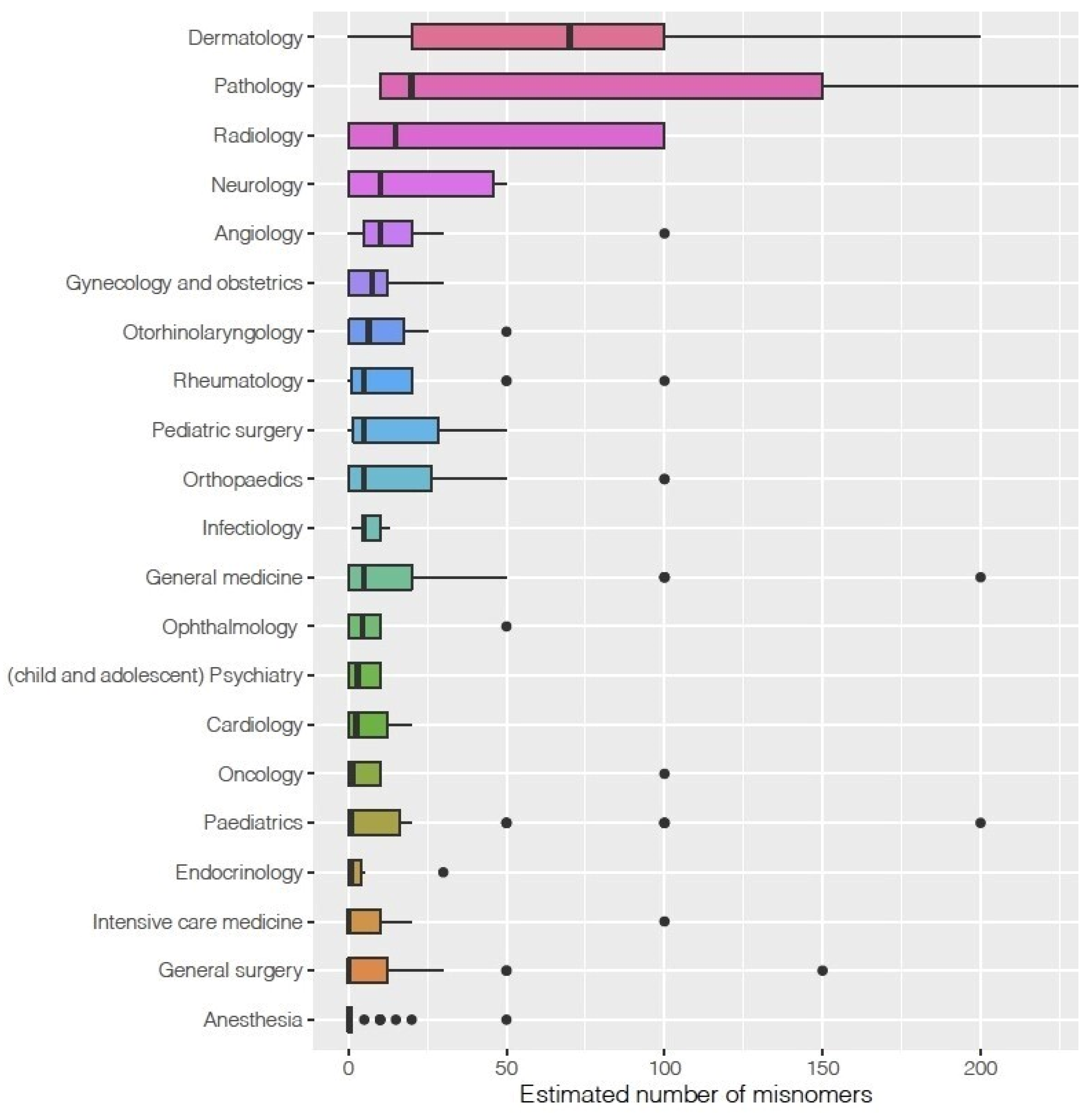
3.1.2. Number of Dermatological and Non-Dermatological Misnomers According to the Online Survey
3.2. Presence and Estimated Numbers of Misnomers Analyzed by Gender, Age, Language Region, and Specialty
3.3. Assessment of the Clinical and Scientific Relevance of Misnomers
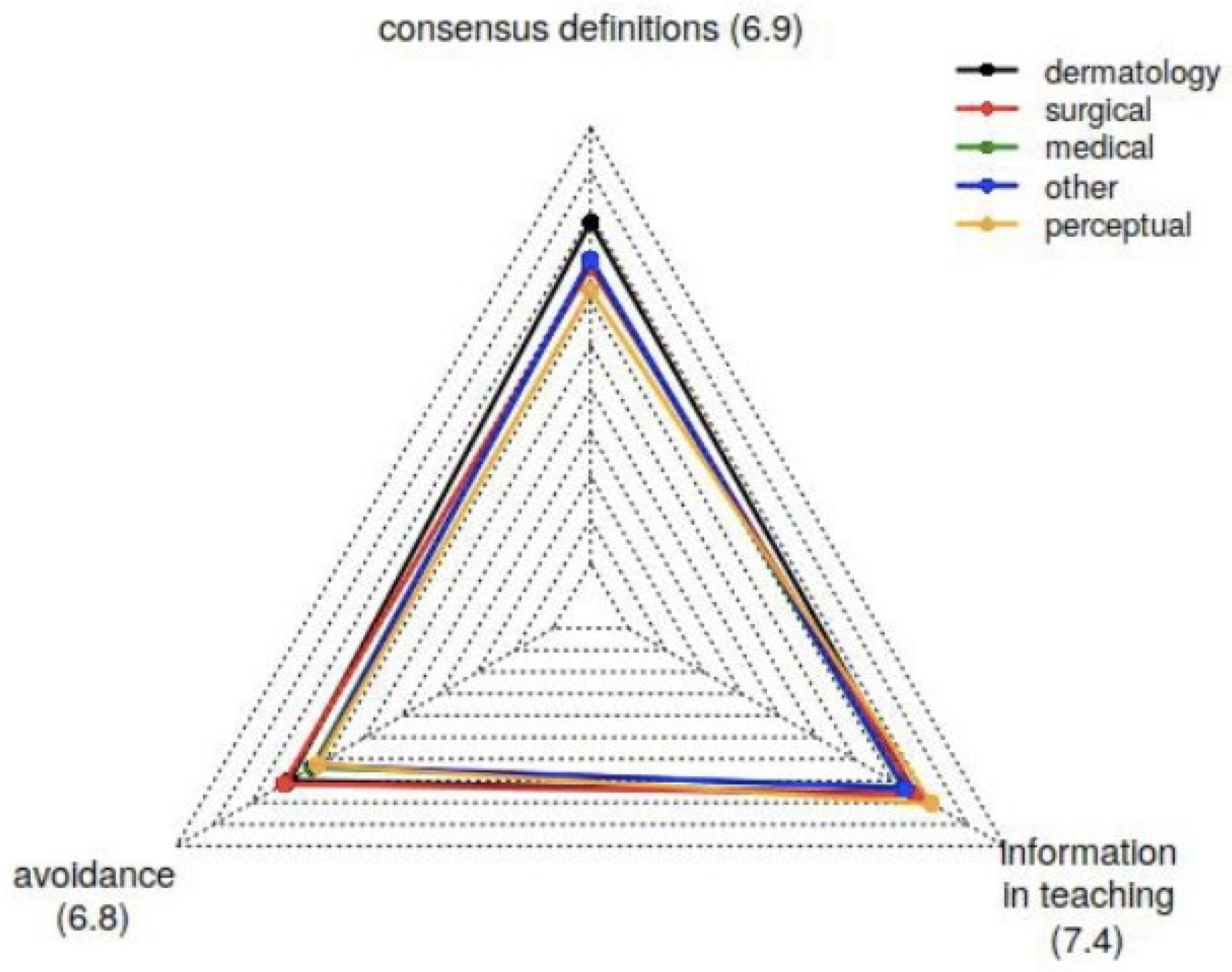
3.4. Strategies for Abandoning Misnomers as Suggested by the Participants
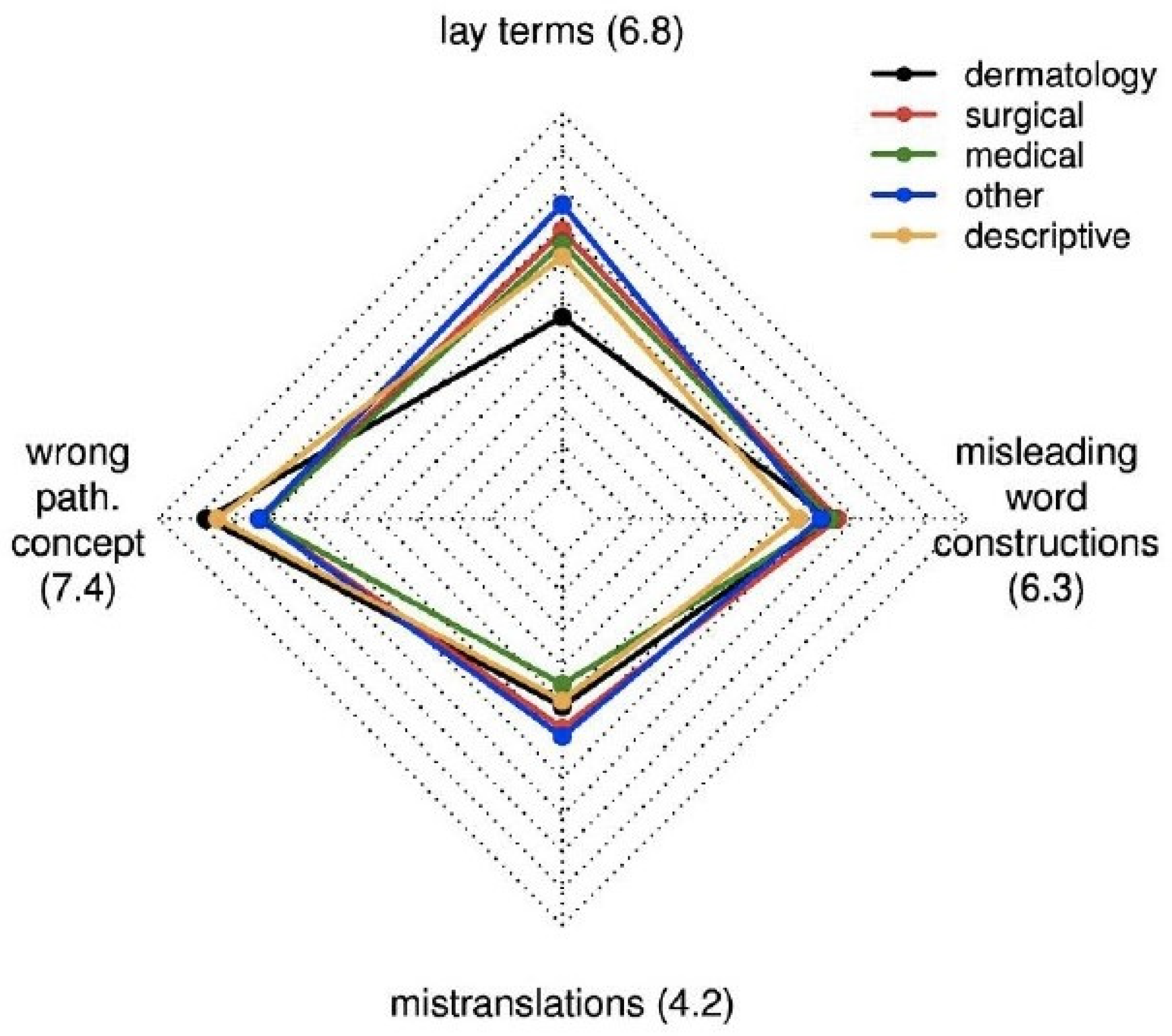
3.5. Categorization of Medical Misnomers
4. Discussion
4.1. Identified Misnomers, Their Categorization, and Their High Abundance in Dermatology and Other Perceptual Specialties
4.2. The Relevance of Misnomers
4.3. How to Abandon Misnomers?
- Raise awareness: Increase recognition of misnomers and/or critical terminology in scientific publications, at conferences, and through teaching to sensitize clinicians, educators, and researchers to their potential impact.
- Systematic collection and evaluation: Experts and boards of medical specialties could compile misnomers in structured databases for evaluation, with open-access platforms and blog sites (e.g., http://medicalmisnomers.blogspot.com/, accessed on 26 April 2026) serving as additional resources for discussion.
- Marking and standardization: Misnomers should be clearly marked—for example, with quotation marks, italics, or the annotation “(mn)” in the medical literature (e.g., “mycosis fungoides” (mn))—and critically reviewed in expert-led consensus definitions reflecting current scientific knowledge [36,37,38,39,40,41,42].
- Replacement in a standardized manner: Misnomers could be replaced when appropriate. As the legendary Canadian physician Sir William Osler (1849–1919)—to whom several eponyms are attributed, including Osler’s nodes, Osler–Weber–Rendu disease, and Osler’s sign—advised in 1902, “Use guidelines for naming diseases. If our knowledge does not permit giving a name pointing to the aetiology of the disease, the rule should be to pick the one which seems least objectionable” [43].
4.4. Recent Advances in Dermatologic Nomenclature and Outlook
4.5. Limitations
5. Conclusions
Supplementary Materials
Author Contributions
Funding
Institutional Review Board Statement
Informed Consent Statement
Data Availability Statement
Acknowledgments
Conflicts of Interest
References
- Oxford Learner’s Dictionaries. Misnomer. Available online: https://www.oxfordlearnersdictionaries.com/definition/english/misnomer (accessed on 18 March 2026).
- Skeat, W. Concise Dictionary of English Etymology: The Pioneering Work on the Roots and Origins of English Language; Wordsworth Editions Ltd.: London, UK, 1993. [Google Scholar]
- SAT-Amikaro. Misfunctional FAA Phraseology. Available online: http://www.sat-amikaro.org/misfunctional-faa-phraseology (accessed on 18 March 2026).
- Miscommunication, Bad Maps Lead to Deadly NATO Attack on Pakistan Border Post. Available online: https://www.reuters.com/article/world/us-denies-nato-attack-on-pakistani-troops-deliberate-idUSTRE7AT0K1/ (accessed on 18 March 2026).
- Miscommunication Blamed for Deadly US Mistake. Available online: https://www.dailymail.co.uk/wires/ap/article-2744651/Miscommunication-blamed-deadly-US-mistake.html (accessed on 18 March 2026).
- 10 Tiny Miscommunications with Massive Consequences. Available online: https://listverse.com/2014/03/02/10-tiny-miscommunications-with-massive-consequences/ (accessed on 18 March 2026).
- Subramanyam, R.V. Misnomers in oral pathology. Oral Dis. 2010, 16, 740–746. [Google Scholar] [CrossRef] [PubMed]
- Avioli, L.V. Editorial: Vitamin D, the kidney and calcium homeostasis. Kidney Int. 1972, 2, 241–246. [Google Scholar] [CrossRef]
- Jones, K.G.; Bell, R.E.; Sabharwal, T.; Aukett, M.; Reidy, J.F.; Taylor, P.R. Treatment of mycotic aortic aneurysms with endoluminal grafts. Eur. J. Vasc. Endovasc. Surg. 2005, 29, 139–144. [Google Scholar] [CrossRef]
- Golbus, J.; Fox, D.A. The lupus anticoagulant: A confusing misnomer. Ann. Intern. Med. 1987, 106, 911. [Google Scholar] [CrossRef]
- Wong, R.W.; Chan, J.K.; Wong, K.L. Lupus anticoagulant—A double misnomer. Asian Pac. J. Allergy Immunol. 1987, 5, 161–165. [Google Scholar]
- Young, M.; Keane, C.; English, L. Misdiagnosed dermatophytosis. J. Infect. 1982, 4, 127–129. [Google Scholar] [CrossRef]
- de Escobar, G.M. Sporadic cretinism: A dangerous misnomer. Eur. Thyroid J. 2013, 2, 68. [Google Scholar] [CrossRef] [PubMed]
- Maberly, G.F.; Haxton, D.P.; van der Haar, F. Iodine deficiency: Consequences and progress toward elimination. Food Nutr. Bull. 2003, 24, S91–S98. [Google Scholar] [CrossRef]
- Bundens, W.P.; Bergan, J.J.; Halasz, N.A.; Murray, J.; Drehobl, M. The superficial femoral vein. A potentially lethal misnomer. JAMA 1995, 274, 1296–1298. [Google Scholar] [CrossRef]
- Tilles, G.; Wallach, D. The history of nosology in dermatology. Ann. Dermatol. Venereol. 1989, 116, 9–26. [Google Scholar] [PubMed]
- Bulkley, L.D. Manual of Diseases of the Skin, 4th ed.; Putnam’s Son: New York, NY, USA, 1998. [Google Scholar]
- Scholtz, M. Dermatologic misnomers. Arch. Dermatol. Syphilol. 1920, 1, 182–190. [Google Scholar] [CrossRef][Green Version]
- Mukhopadhyay, A.K. On the History of Classification in Dermatology. Indian J. Dermatol. 2016, 61, 588–592. [Google Scholar] [CrossRef]
- Johnson, B.A. Avoiding diagnostic pitfalls in neuroimaging. Appl. Radiol. 2016, 45, 24–29. [Google Scholar] [CrossRef]
- Berner, E.S.; Graber, M.L. Overconfidence as a cause of diagnostic error in medicine. Am. J. Med. 2008, 121, S2–S23. [Google Scholar] [CrossRef]
- Hulmani, M.; Kudur, M. Misnomers in dermatology: Time to change and update. Indian J. Dermatol. Venereol. Leprol. 2013, 79, 479–491. [Google Scholar] [CrossRef] [PubMed]
- Barankin, B.; Freiman, A. Misnomers in dermatology. J. Cutan. Med. Surg. 2005, 9, 284–288. [Google Scholar] [CrossRef]
- Nosrati, N.; Harting, M.S.; Yang, D.J.; Shen, Y.A.; Maender, J.L.; Jogi, R.P.; Sonabend, M.L.; Hsu, S. Dermatology misnomers. Dermatol. Online J. 2008, 14, 22. [Google Scholar] [CrossRef]
- Savitha, S.A.; Sacchidanand, S.A.; Gowda, S.K. Misnomers in dermatology: An update. Indian J. Dermatol. 2013, 58, 467–474. [Google Scholar] [CrossRef] [PubMed]
- Danesh, M.; Pomeranz, M.K.; McMeniman, E.; Murase, J.E. Dermatoses of pregnancy: Nomenclature, misnomers, and myths. Clin. Dermatol. 2016, 34, 314–319. [Google Scholar] [CrossRef][Green Version]
- SNOMED CT. Available online: https://www.snomed.org/what-is-snomed-ct (accessed on 26 April 2026).
- ICD-11. Available online: https://icd.who.int (accessed on 18 March 2026).
- Speciality Training Curriculum for Dermatology. Available online: https://www.jrcptb.org.uk/sites/default/files/2010%20Dermatology%20(amendment%202012).pdf (accessed on 18 March 2026).
- Gerami, P.; Busam, K.; Cochran, A.; Cook, M.G.; Duncan, L.M.; Elder, D.E.; Fullen, D.R.; Guitart, J.; LeBoit, P.E.; Mihm, M.C., Jr.; et al. Histomorphologic assessment and interobserver diagnostic reproducibility of atypical spitzoid melanocytic neoplasms with long-term follow-up. Am. J. Surg. Pathol. 2014, 38, 934–940. [Google Scholar] [CrossRef]
- Ackerman, A.B. Discordance among expert pathologists in diagnosis of melanocytic neoplasms. Hum. Pathol. 1996, 27, 1115–1116. [Google Scholar] [CrossRef] [PubMed]
- Harms, K.L.; Lowe, L.; Fullen, D.R.; Harms, P.W. Atypical Spitz Tumors: A Diagnostic Challenge. Arch. Pathol. Lab. Med. 2015, 139, 1263–1270. [Google Scholar] [CrossRef]
- Kittler, H.; Tschandl, P. Dysplastic nevus: Why this term should be abandoned in dermatoscopy. Dermatol. Clin. 2013, 31, 579–588, 579–588. [Google Scholar] [CrossRef]
- Duffy, K.; Grossman, D. The dysplastic nevus: From historical perspective to management in the modern era: Part I. Historical, histologic, and clinical aspects. J. Am. Acad. Dermatol. 2012, 67, 1.e1–1.e16. [Google Scholar] [CrossRef]
- Lozeau, D.F.; Farber, M.J.; Lee, J.B. A nongrading histologic approach to Clark (dysplastic) nevi: A potential to decrease the excision rate. J. Am. Acad. Dermatol. 2016, 74, 68–74. [Google Scholar] [CrossRef]
- Kittler, H.; Marghoob, A.A.; Argenziano, G.; Carrera, C.; Curiel-Lewandrowski, C.; Hofmann-Wellenhof, R.; Malvehy, J.; Menzies, S.; Puig, S.; Rabinovitz, H.; et al. Standardization of terminology in dermoscopy/dermatoscopy: Results of the third consensus conference of the International Society of Dermoscopy. J. Am. Acad. Dermatol. 2016, 74, 1093–1106. [Google Scholar] [CrossRef]
- Haylen, B.T.; Maher, C.F.; Barber, M.D.; Camargo, S.; Dandolu, V.; Digesu, A.; Goldman, H.B.; Huser, M.; Milani, A.L.; Moran, P.A.; et al. An International Urogynecological Association (IUGA)/International Continence Society (ICS) joint report on the terminology for female pelvic organ prolapse (POP). Int. Urogynecol. J. 2016, 27, 165–194. [Google Scholar] [CrossRef] [PubMed]
- Thuong, M.; Ruiz, A.; Evrard, P.; Kuiper, M.; Boffa, C.; Akhtar, M.Z.; Neuberger, J.; Ploeg, R. New classification of donation after circulatory death donors definitions and terminology. Transpl. Int. 2016, 29, 749–759. [Google Scholar] [CrossRef] [PubMed]
- Bornstein, J.; Goldstein, A.T.; Stockdale, C.K.; Bergeron, S.; Pukall, C.; Zolnoun, D.; Coady, D. 2015 ISSVD, ISSWSH, and IPPS Consensus Terminology and Classification of Persistent Vulvar Pain and Vulvodynia. J. Sex. Med. 2016, 13, 607–612. [Google Scholar] [CrossRef]
- Basturk, O.; Hong, S.M.; Wood, L.D.; Adsay, N.V.; Albores-Saavedra, J.; Biankin, A.V.; Brosens, L.A.; Fukushima, N.; Goggins, M.; Hruban, R.H.; et al. A Revised Classification System and Recommendations From the Baltimore Consensus Meeting for Neoplastic Precursor Lesions in the Pancreas. Am. J. Surg. Pathol. 2015, 39, 1730–1741. [Google Scholar] [CrossRef]
- Spaide, R.F.; Jaffe, G.J.; Sarraf, D.; Freund, K.B.; Sadda, S.R.; Staurenghi, G.; Waheed, N.K.; Chakravarthy, U.; Rosenfeld, P.J.; Holz, F.G.; et al. Consensus Nomenclature for Reporting Neovascular Age-Related Macular Degeneration Data: Consensus on Neovascular Age-Related Macular Degeneration Nomenclature Study Group. Ophthalmology 2020, 127, 616–636. [Google Scholar] [CrossRef]
- Chmielewski, P.P. New Terminologia Anatomica: Cranium and extracranial bones of the head. Folia Morphol. 2021, 80, 477–486. [Google Scholar] [CrossRef] [PubMed]
- Osler, W. Anemia splenica. Trans. Assoc. Am. Physicians 1902, 17, 429–461. [Google Scholar]
- Çetinarslan, T.; Türel Ermertcan, A.; Temiz, P.; Fölster-Holst, R. Desmoplastic Melanocytic Naevus in a Paediatric Patient: Dermoscopical and Histopathological Findings of a Rare Entity: An Overlooked Diagnosis or a Misnomer? Acta Derm. Venereol. 2026, 106, adv–2025. [Google Scholar] [CrossRef]
- López Sanz, P.; Azaña Defez, J.M. Is ILVEN a misnomer? Proposal of MALID as an accurate nomenclature. Response to Polubothu et al’s “ILVEN should be genotyped to direct treatment and genetic counselling”. J. Am. Acad. Dermatol. 2024, 91, e107–e108. [Google Scholar] [CrossRef]
- Gawey, L.; Gunnell, L.; Shi, V.Y. Sunscreen Doping: A Misnomer. J. Investig. Dermatol. 2025, 145, 2941–2942. [Google Scholar] [CrossRef]
- Jeremian, R.; Sivachandran, S.; Galati, M.; Ramchatesingh, B.; Rijal, H.; Hanna, J.; Netchiporouk, E.; Chergui, M.; Redpath, M.; Abou Setah, S.; et al. Investigating the cell of origin and novel molecular targets in Merkel cell carcinoma: A historic misnomer. Mol. Oncol. 2026, 20, 331–347. [Google Scholar] [CrossRef] [PubMed]
- Balan, K. Medical misnomers in dermatology. J. Am. Acad. Dermatol. 2026, 94, 1373–1374. [Google Scholar] [CrossRef]
- Balagula, Y.; Braun, R.P.; Rabinovitz, H.S.; Dusza, S.W.; Scope, A.; Liebman, T.N.; Mordente, I.; Siamas, K.; Marghoob, A.A. The significance of crystalline/chrysalis structures in the diagnosis of melanocytic and nonmelanocytic lesions. J. Am. Acad. Dermatol. 2012, 67, 194.e1–194.e8. [Google Scholar] [CrossRef] [PubMed]
- Paller, A.S.; Teng, J.; Mazereeuw-Hautier, J.; Hernández-Martín, Á.; Granier Tournier, C.; Hovnanian, A.; Aldwin-Easton, M.; Tadini, G.; Schwartz, J.; Sprecher, E.; et al. Syndromic epidermal differentiation disorders: A new classification toward pathogenesis-based therapy. Br. J. Dermatol. 2025, 193, 592–618. [Google Scholar] [CrossRef]
- Akiyama, M.; Choate, K.; Hernández-Martín, Á.; Aldwin-Easton, M.; Bodemer, C.; Gostyński, A.; Hovnanian, A.; Ishida-Yamamoto, A.; Malovitski, K.; O’Toole, E.A.; et al. Nonsyndromic epidermal differentiation disorders: A new classification toward pathogenesis-based therapy. Br. J. Dermatol. 2025, 193, 619–641. [Google Scholar] [CrossRef] [PubMed]
- White, J.M.L.; Lui, H.; Chute, C.G.; Jakob, R.; Chalmers, R.J.G. The WHO ICD-11 Classification of Dermatological Diseases: A new comprehensive online skin disease taxonomy designed by and for dermatologists. Br. J. Dermatol. 2022, 186, 178–179. [Google Scholar] [CrossRef] [PubMed]
- Jonsson, P.; Pilz, A.C.; Maboudi, H.; Ranzinger, D.; Wagner, P.; Schaffert-Stone, L.N.; Burg, C.; Dadras, M.S.; Bradley, M.; Schauer, F.; et al. The Translational Dermatology Initiative: Aiming at a New Disease Classification of Inflammatory Skin Diseases. JID Innov. 2025, 5, 100381. [Google Scholar] [CrossRef] [PubMed]



| Number of Hits for “Misnomer” | Dermatological Misnomers; n (Percentage) | Non-Dermatological Misnomers; n (Percentage) | |
|---|---|---|---|
| Databases | |||
| PubMed | 347 | 36 (12.77) | 246 (87.23) |
| Embase | 373 | 22 (8.46) | 238 (91.54) |
| Web of Science | 543 | 22 (8.63) | 233 (91.37) |
| Scopus | 531 | 31 (11.36) | 242 (88.64) |
| Cochrane | 1 | 0 (0) | 1 (100) |
| Reviews on misnomers | |||
| Hulmani [22] | 86 | 86 | 0 |
| Barankin [23] | 47 | 47 | 0 |
| Nosrati [24] | 16 | 16 | 0 |
| Savitha [25] | 80 | 80 | 0 |
| Subramanyam [7] | 36 | 16 | 0 |
| Scholtz [18] | 25 | 25 | 0 |
| Danesh [26] | 4 | 4 | 0 |
| Total (multiple mentions counted only once) | 507 | 168 (32.81) | 339 (67.18) |
| Misnomer | Explanation | Suggestion for Improvement |
|---|---|---|
| 1. Basalioma | Ending suggests a benign disease | Basal cell carcinoma |
| 2. Congenital nevus | Is neither hereditary nor present at birth | Infantile nevus |
| 3. Eosinophilic cellulitis | Not an infection of the subcutis but the dermis | Eosinophilic dermatitis |
| 4. Erythema e pudore | Not only triggered by shame, but also by any involuntary flushing associated with emotions | Emotional erythema |
| 5. Granuloma telangiectaticum | Not granulomatous | Reactive vascular proliferation syndrome, telangiectatic type |
| 6. Lentigo maligna | Lentigo suggests a benign disease | Melanoma in situ |
| 7. Lichen ruber/planus | Purely descriptive, does not capture pathophysiology; moreover, “ruber” and “planus” may not be appropriate as other colors and elevated/hyperkeratotic forms exist | No suggestion made |
| 8. Lichen sclerosus | Purely descriptive, does not capture pathophysiology | No suggestion made |
| 9. Malignant melanoma | The suffix “-oma” suggests benignity. The addition of the adjective “malign” to melanoma (common in German-speaking areas) is also misleading because it suggests the existence of a “benign” melanoma | Melanoma, or more precisely, melanocytic malignancy |
| 10. Mallorca acne | Does not occur only in Mallorca | Suncream/bath oil acne |
| 11. Mycid | Does not reflect the clinical presentation | Hyperergic reaction to dermatophytes |
| 12. Neurodermatitis/Neurodermitis | Not a primary disease of skin nerves | Atopic dermatitis |
| 13. Pemphigus chronicus benignus familiaris Hailey-Hailey | Eponym, moreover, it is not pemphigus/an autoimmune bullous disease | Acantholytic dermatitis due to ATP2C1 gene mutation |
| 14. Pityriasis lichenoides acuta/chronica | Purely descriptive, does not reflect the underlying pathophysiology | No suggestion made |
| Estimate | 95% CI | z | p (>|z|) | |
|---|---|---|---|---|
| Intercept | 13.753 | [3.175, 59.908] | 3.49 | <0.001 |
| Gender (female versus male) | 0.876 | [0.559,1.371] | −0.58 | 0.562 |
| Age (10-year increase) | 0.999 | [0.776,1.285] | −0.01 | 0.991 |
| Language region (French versus German) | 0.574 | [0.346,0.951] | −2.16 | 0.031 |
| Surgical specialties versus dermatology | 0.120 | [0.027,0.540] | −2.76 | 0.006 |
| Medical specialties versus dermatology | 0.169 | [0.038,0.755] | −2.33 | 0.020 |
| Other specialties versus dermatology | 0.073 | [0.016,0.327] | −3.42 | <0.001 |
| Other perceptual specialties versus dermatology | 0.184 | [0.033,1.017] | −1.94 | 0.052 |
| Estimate | 95% CI | z | p (>|z|) | |
|---|---|---|---|---|
| Intercept | 198.412 | [74.623,527.553] | 10.60 | <0.001 |
| Gender (female versus male) | 0.771 | [0.437,1.362] | −0.90 | 0.370 |
| Age (10-year increase) | 0.733 | [0.546,0.984] | −2.07 | 0.039 |
| Language region (French versus German) | 0.288 | [0.125,0.666] | −2.91 | 0.004 |
| Surgical specialties versus dermatology | 0.083 | [0.030,0.231] | −4.76 | <0.001 |
| Medical specialties versus dermatology | 0.192 | [0.072,0.513] | −3.29 | 0.001 |
| Other specialties versus dermatology | 0.322 | [0.0104,0.998] | −1.96 | 0.050 |
| Other perceptual specialties versus dermatology | 0.549 | [0.145,2.081] | −0.88 | 0.378 |
| Type of Misnomer | Examples |
|---|---|
| Wrong pathogenic concepts | Glioblastoma multiforme, botryomycosis, incontinentia pigmenti, actinomycosis |
| Professional use of lay terms | Stroke, cancer, hay fever, shingles, hip fracture, skin tags, color blindness, whiplash injury |
| Analogies and resemblances | Raccoon eyes, butterfly rash, dirty neck, tripe palms, strawberry gingiva, nutmeg liver, port-wine stain |
| Eponyms | Erythroplasia de Queyrat, fibroepithelioma Pinkus, pityriasis rosea Gibert, Lyme’s disease |
| Neologisms/Misleading word constructions | Carcinoid, calciphylaxis, antibiosis, gestosis, warfarinise |
| Abbreviations | “IU” for “international units” insulin: may be mistaken for “10” or “IV” (intravenously) |
| Mistranslations | Chicken pox (from “chiche pois”), grenz radiation (“grenz” was not a person), grenz zone (histopathology), “annular” (instead of anular) |
Disclaimer/Publisher’s Note: The statements, opinions and data contained in all publications are solely those of the individual author(s) and contributor(s) and not of MDPI and/or the editor(s). MDPI and/or the editor(s) disclaim responsibility for any injury to people or property resulting from any ideas, methods, instructions or products referred to in the content. |
© 2026 by the authors. Licensee MDPI, Basel, Switzerland. This article is an open access article distributed under the terms and conditions of the Creative Commons Attribution (CC BY) license.
Share and Cite
Griss, V.L.B.; Velikova, R.V.; Itin, P.; Vogt, D.R.; Daunton, A.; Manjaly Thomas, Z.-R.; Geiges, M.; Mueller, S.M. Misnomers in Dermatology and Other Medical Specialties—How to Deal with Science Fiction? J. Clin. Med. 2026, 15, 3608. https://doi.org/10.3390/jcm15103608
Griss VLB, Velikova RV, Itin P, Vogt DR, Daunton A, Manjaly Thomas Z-R, Geiges M, Mueller SM. Misnomers in Dermatology and Other Medical Specialties—How to Deal with Science Fiction? Journal of Clinical Medicine. 2026; 15(10):3608. https://doi.org/10.3390/jcm15103608
Chicago/Turabian StyleGriss, Vera L. Baumann, Radina V. Velikova, Peter Itin, Deborah R. Vogt, Adam Daunton, Zita-Rose Manjaly Thomas, Michael Geiges, and Simon M. Mueller. 2026. "Misnomers in Dermatology and Other Medical Specialties—How to Deal with Science Fiction?" Journal of Clinical Medicine 15, no. 10: 3608. https://doi.org/10.3390/jcm15103608
APA StyleGriss, V. L. B., Velikova, R. V., Itin, P., Vogt, D. R., Daunton, A., Manjaly Thomas, Z.-R., Geiges, M., & Mueller, S. M. (2026). Misnomers in Dermatology and Other Medical Specialties—How to Deal with Science Fiction? Journal of Clinical Medicine, 15(10), 3608. https://doi.org/10.3390/jcm15103608