The Clinical Significance of the Manchester Colour Wheel in a Sample of People Treated for Insured Injuries


Abstract
1. Introduction
2. Materials and Methods
2.1. Participants
2.2. Procedure
2.3. Measures
2.3.1. Pain
2.3.2. Psychological Distress
2.3.3. Optimism About Recovery
2.3.4. Manchester Colour Wheel
- Which colour do you feel most drawn to?
- What colour is your favourite colour?
- What colour represents your day-to-day mood?
- What colour represents your day-to-day pain?
2.4. Software and Data Analysis
3. Results
3.1. Clinical Findings
3.1.1. Onboarding Statistics
3.1.2. Onboarding Statistics by Injury Types
3.1.3. Program Outcomes by Injury Type
3.2. Construct Validity of the Manchester Colour Wheel
3.2.1. Sensitivity to Injury Type
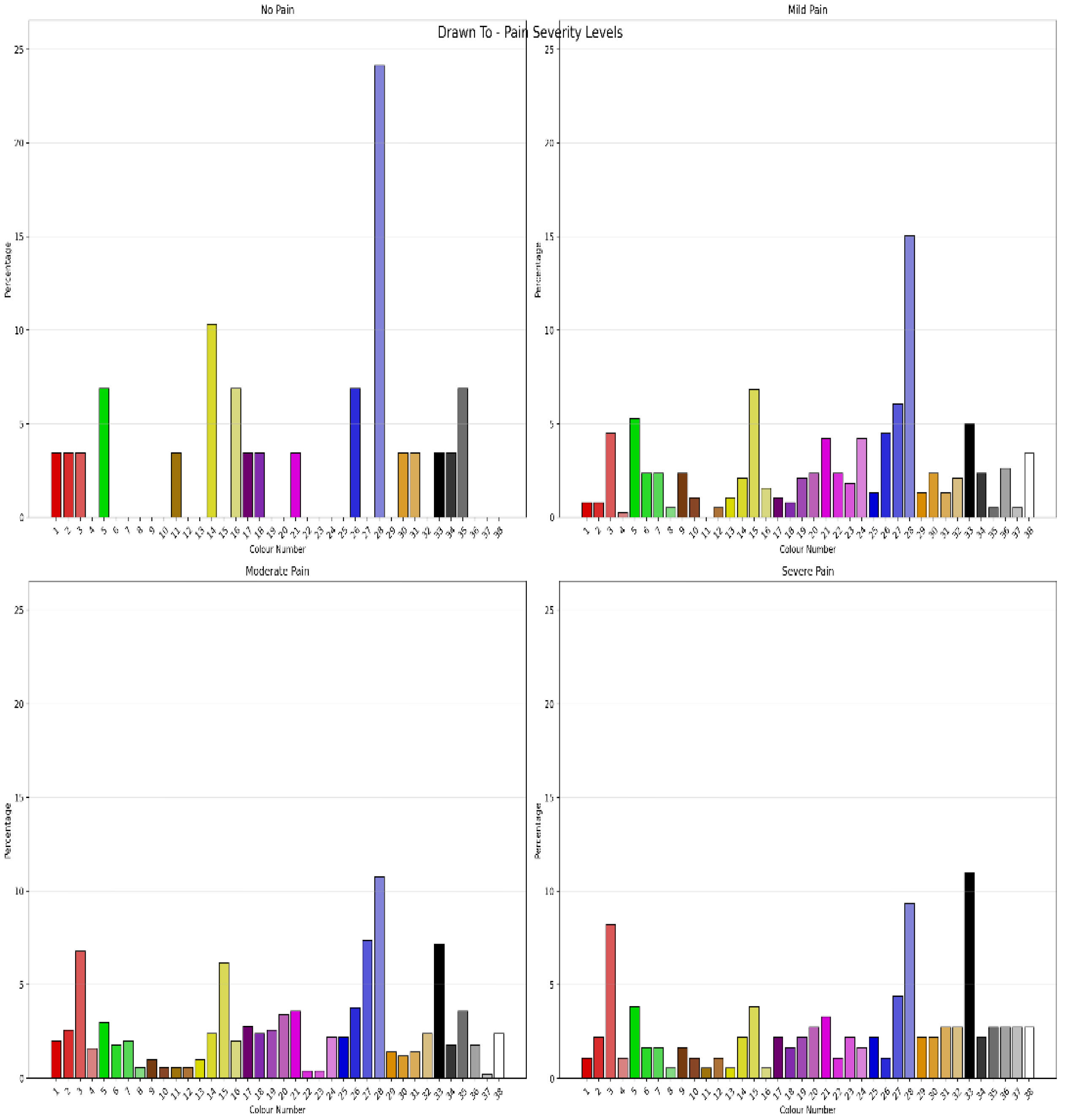
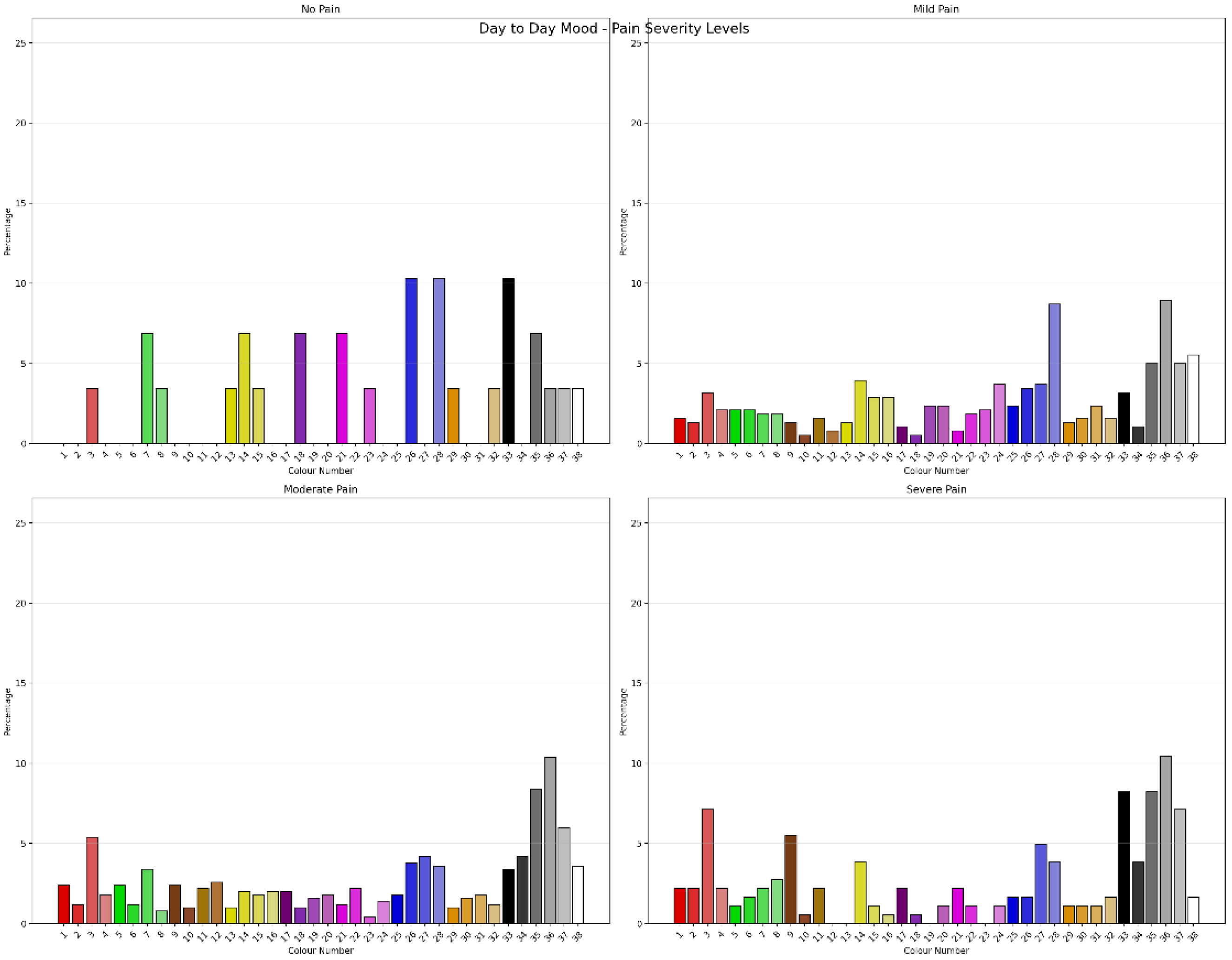
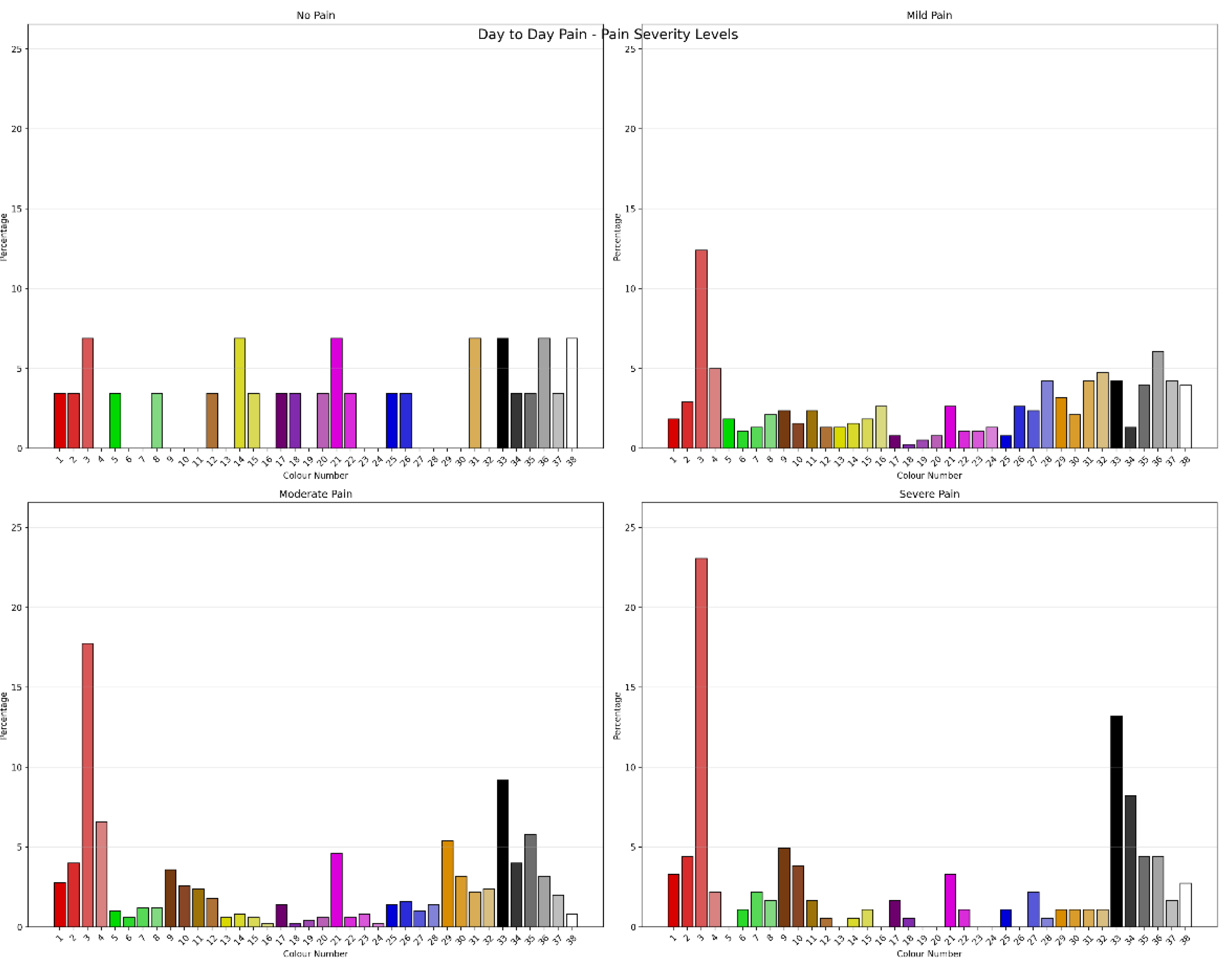
3.2.2. Sensitivity to Pain Severity Classification
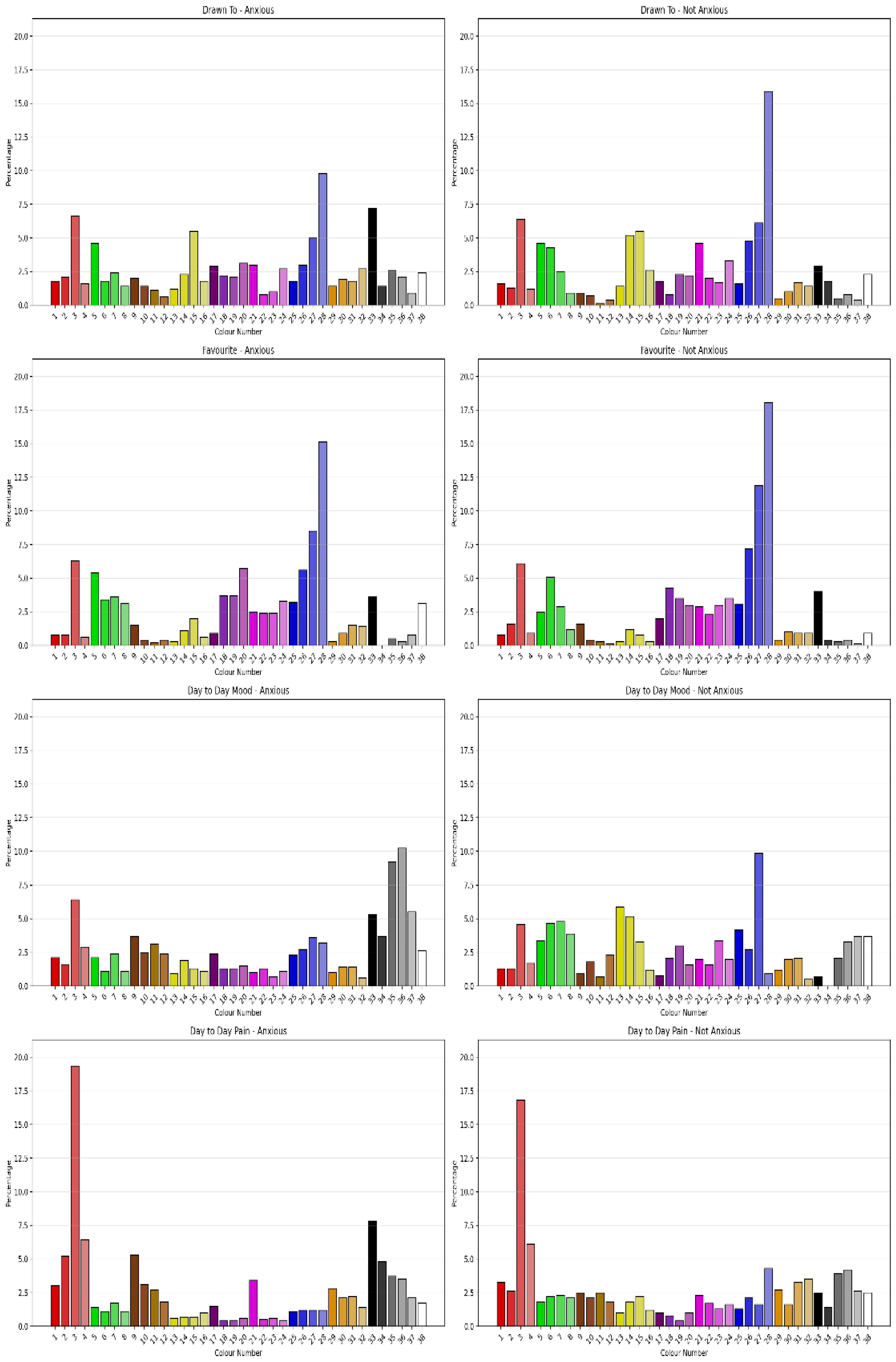
3.2.3. Sensitivity to Anxious Classification
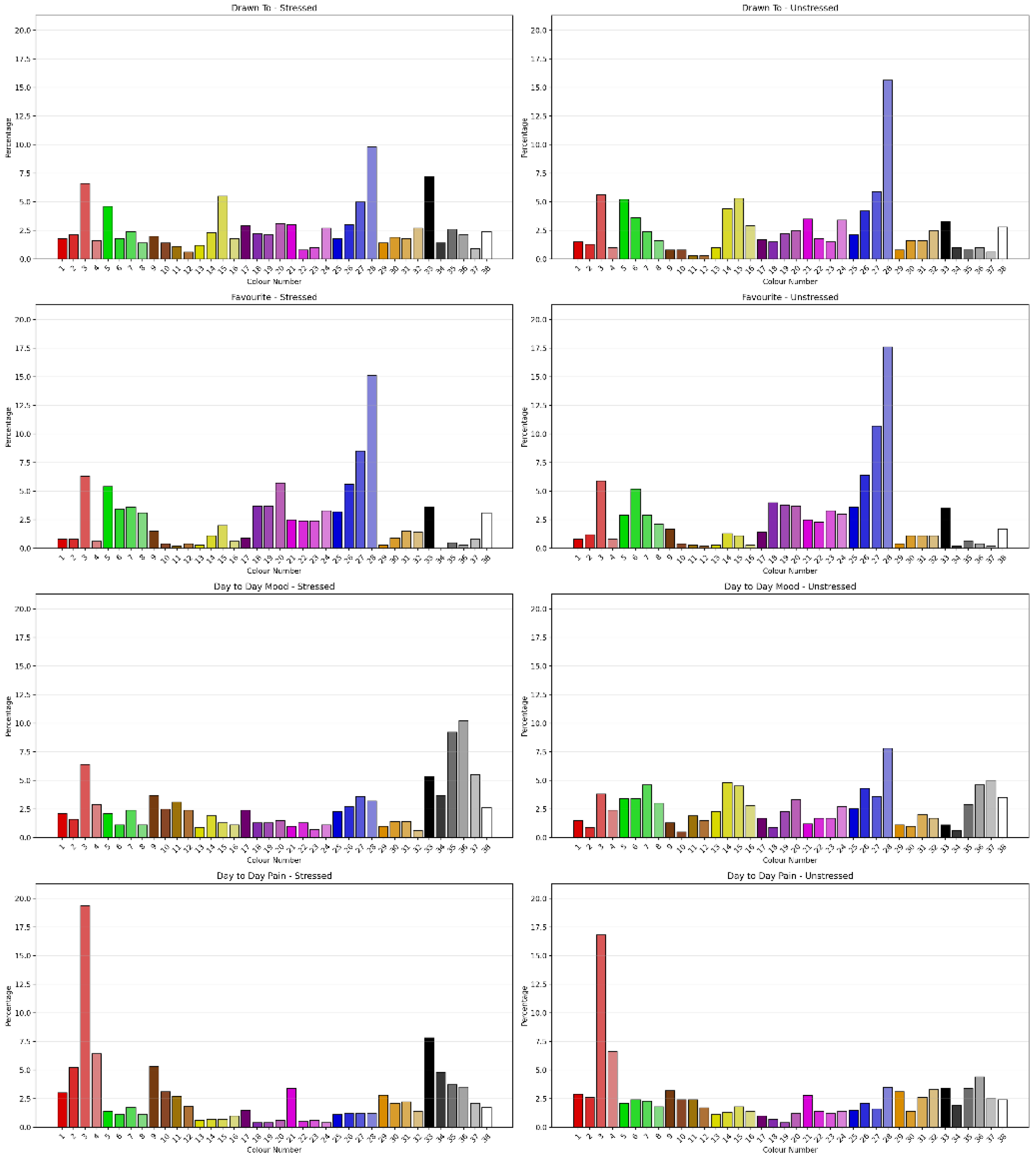
3.2.4. Sensitivity to Stressed Classification
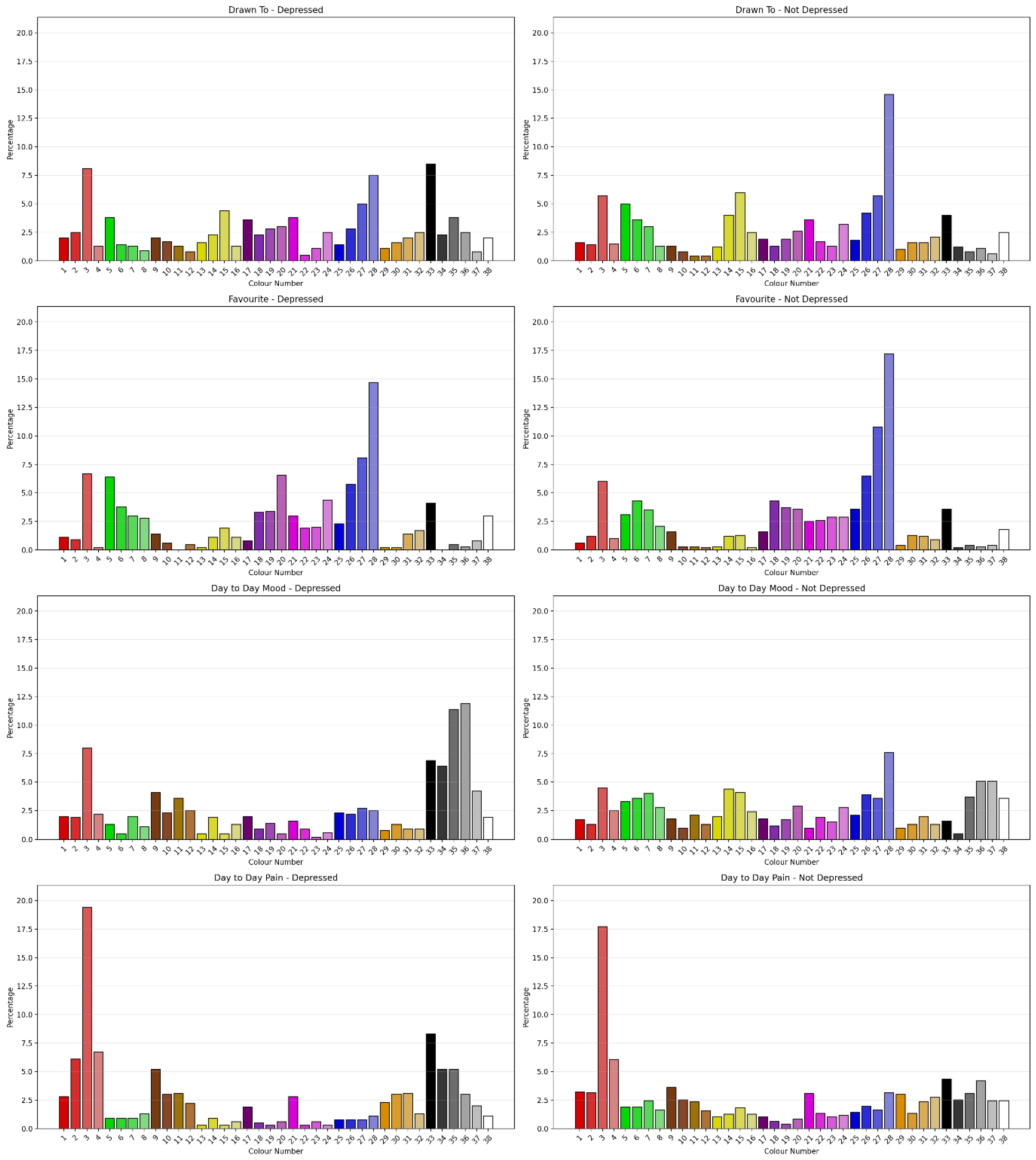
3.2.5. Sensitivity to Depressed Classification
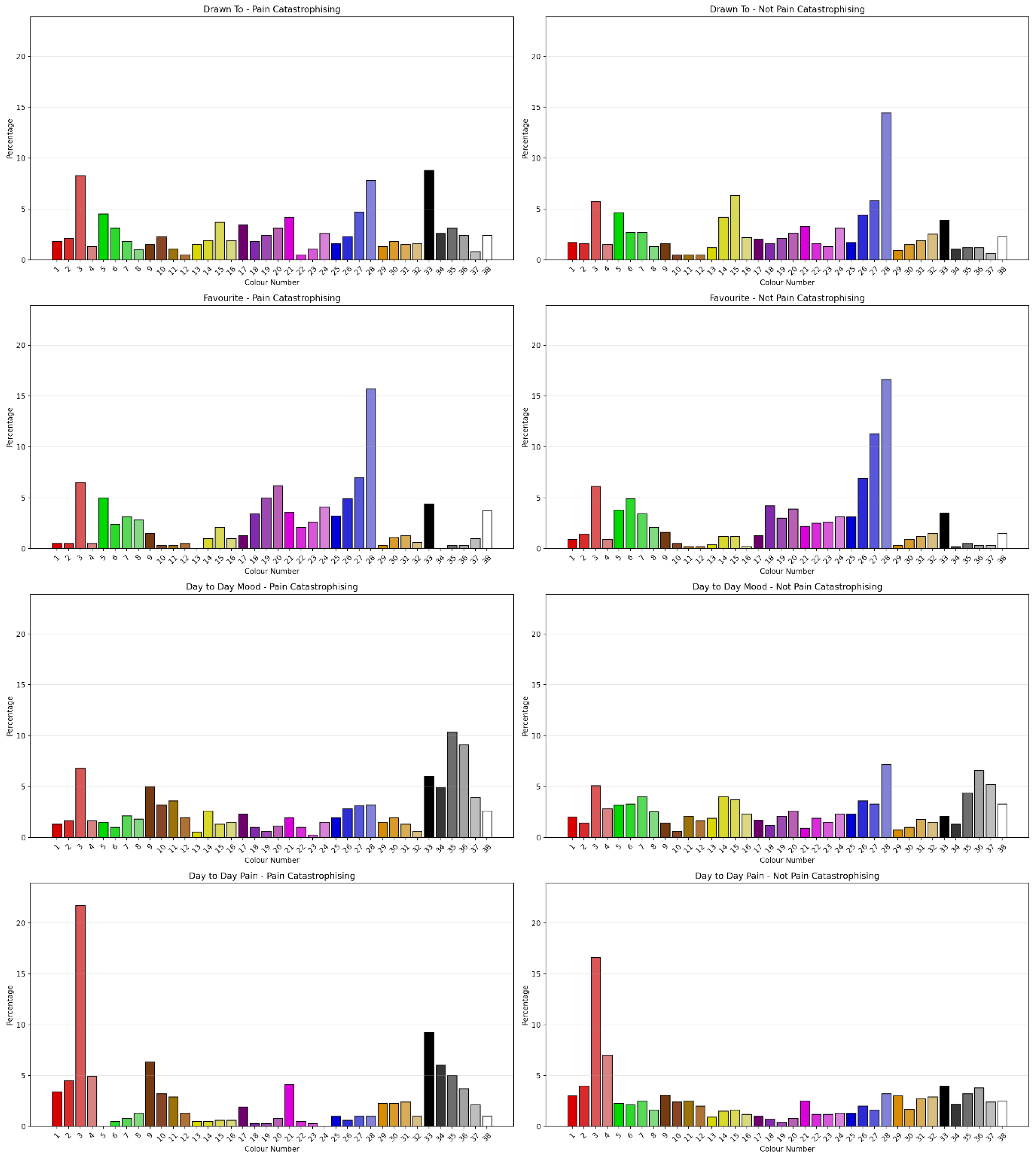
3.2.6. Sensitivity to Pain Catastrophisation Classification
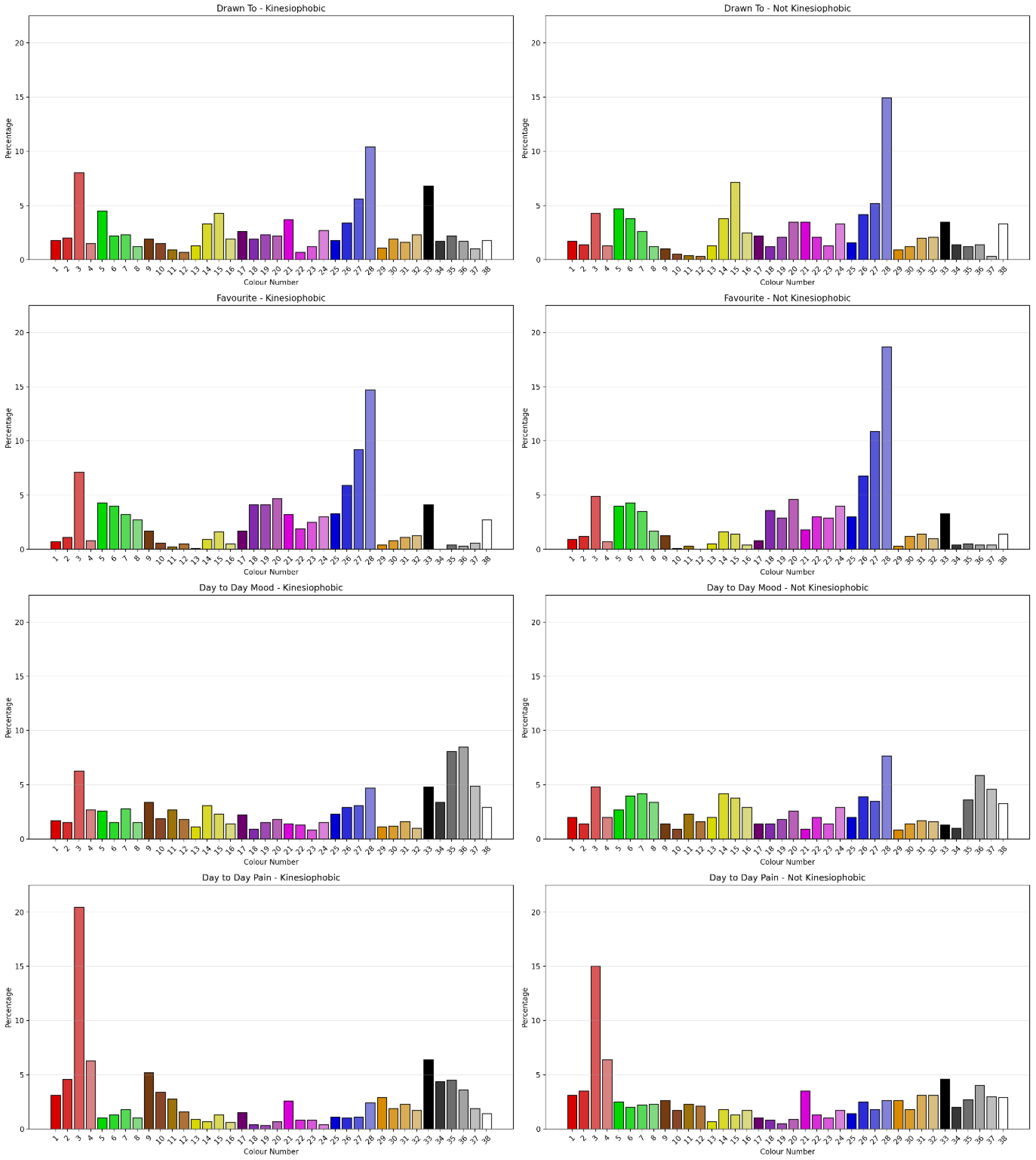
3.2.7. Sensitivity to Kinesiophobia Classification
3.3. Predictive Validity of the MCW
3.3.1. Recovery Models
3.3.2. Whiplash Associated Disorder Recovery Prediction Models
3.3.3. Back Injury Recovery Prediction Models
3.3.4. Shoulder Injury Recovery Prediction Models
3.3.5. Neck Injury Recovery Prediction Models
3.3.6. Comparison of Features in Recovery Prediction Models
4. Discussion
5. Conclusions
Supplementary Materials
Author Contributions
Funding
Institutional Review Board Statement
Informed Consent Statement
Data Availability Statement
Conflicts of Interest
Abbreviations
| AI | Artificial Intelligence |
| ARC | Active Recovery Clinics |
| AW | Administrative Withdrawal |
| BI | Back Injury |
| CHAID | Chi-Square Automatic Interaction Detector |
| CRT | Classification and Regression Tree Model |
| DI | Digital Intervention |
| DNC | Did Not Commence |
| DNCP | Did Not Complete |
| EMDR | Eye Movement Desensitisation and Reprocessing Therapy |
| fMRI | Functional Magnetic Resonance Imaging |
| FR | Full Recovery |
| MCW | Manchester Colour Wheel |
| ML | Machine Learning |
| MVC | Motor Vehicle Crash |
| NBC | Naïve Bayesian Classifier |
| NI | Neck Injury |
| NR | No Recovery |
| PR | Partial Recovery |
| PTSD | Posttraumatic Stress Disorder |
| QUEST | Quick Unbiased Efficient Statistical Tree |
| SD | Standard Deviation |
| SI | Shoulder Injury |
| SW | Surgical Withdrawals |
| USC | Unsuitable for Clinic |
| VAS | Visual Analogue Pain Scale |
| WAD | Whiplash Associated Disorder |
References
- Cattel, R.B. Personality Structure: Principles in Common to Q-, L- and T-Data. In Personality and Mood by Questionnaire; Jossey-Bass: San Francisco CA, USA, 1973; pp. 1–23. [Google Scholar]
- Carruthers, H.R.; Morris, J.; Tarrier, N.; Whorwell, P.J. The Manchester Colour Wheel: Development of a novel way of identifying color choice and its validation in healthy, anxious and depressed individuals. BMC Med. Res. Methodol. 2010, 10, 12. [Google Scholar] [CrossRef] [PubMed]
- Carruthers, H.R.; Morris, J.; Tarrier, N.; Whorwell, P.J. Mood colour choice helps to predict response to hypnotherapy in patients with irritable bowel syndrome. BMC Complement. Med. Ther. 2010, 10, 75. [Google Scholar] [CrossRef]
- Carruthers, H.R.; Magee, L.; Osborne, S.; Hall, L.K.; Whorwell, P.J. The Manchester Colour Wheel: Validation in secondary school pupils. BMC Med. Res. Methodol. 2012, 12, 136. [Google Scholar] [CrossRef] [PubMed]
- Carruthers, H.R.; Whorwell, P.J. The Manchester Colour Wheel: Enhancing its utility. Percept. Mot. Skills 2013, 116, 761–772. [Google Scholar] [CrossRef]
- Barrick, C.B.; Taylor, D.; Correa, E.I. Colour sensitivity and mood disorders: Biology or metaphor. J. Affect. Disord. 2002, 68, 67–71. [Google Scholar] [CrossRef]
- Kaya, N.; Epps, H. Relationship between color and emotion: A study of college students. Coll. Stud. J. 2004, 38, 396–405. [Google Scholar]
- Bannett, M.M.; Bartels, A. Large-scale color biases in the retinotopic functional architecture are region specific and shared across human brains. J. Neurosci. 2025, 45, e2717202025. [Google Scholar] [CrossRef]
- Wang, T.; Shu, S.; Mo, L. Blue or red? The effects of colour on the emotions of Chinese people. Asian J. Soc. Psychol. 2014, 17, 142–148. [Google Scholar] [CrossRef]
- Jonauskaite, D.; Parraga, C.A.; Quiblier, M.; Mohr, C. Feeling blue or seeing red? Similar patterns of emotion associations with colour patches and colour terms. I-Perception 2020, 11, 2041669520902484. [Google Scholar] [CrossRef]
- Jonauskaite, D.; Mohr, C. Do we feel colours? A systematic review of 128-years of psychological research linking colours and emotions. Psychon. Bull. Rev. 2025, 32, 1457–1486. [Google Scholar] [CrossRef]
- Rogger, R.; Bello, C.; Romero, C.; Urman, R.D.; Luedi, M.M.; Filipovic, M.G. Cultural framing and the impact on acute pain and pain services. Curr. Pain Headache Rep. 2023, 27, 429–436. [Google Scholar] [CrossRef]
- Miller, V.; Carruthers, H.R.; Moors, J.; Hasan, S.S.; Archbold, S.; Whorwell, P.J. Hypnotherapy for irritable bowel syndrome: An audit of one thousand adult patients. Aliment. Pharmacol. Ther. 2015, 41, 844–855. [Google Scholar] [CrossRef] [PubMed]
- Carruthers, H.R. Imagery colour and illness: A review. J. Vis. Commun. 2011, 34, 104–112. [Google Scholar] [CrossRef] [PubMed]
- Grant, M. Mark Grant’s EMDR Pain Protocol. 2016. Available online: https://emdrtherapyvolusia.com/wp-content/uploads/2016/12/Mark_Grants_Pain_Protocol.pdf (accessed on 16 November 2017).
- Carruthers, H.; Miller, V.; Morris, J.; Eveans, R.; Tarrier, N.; Whorwell, P.J. Using art to help understand the imagery of irritable bowel syndrome and its response to hypnotherapy. Int. J. Clin. Exp. Hypn. 2009, 57, 162–173. [Google Scholar] [CrossRef]
- Grant, M.; Threlfo, C. EMDR in the treatment of chronic pain. J. Clin. Psychol. 2002, 58, 1505–1520. [Google Scholar] [CrossRef] [PubMed]
- Demaree, H.A.; Everhart, D.E.; Youngstrom, E.A.; Harris, D.W. Brain lateralization of emotional processing: Historical roots and future incorporating “dominance”. Behav. Cogn. Neurosci. Rev. 2005, 4, 3–20. [Google Scholar] [CrossRef]
- Wager, T.D.; Phan, K.L.; Liberzon, I.; Taylor, S.F. Valence, gender, and lateralization of functioning brain anatomy in emotion: A meta-analysis of findings from neuroimaging. NeuroImage 2003, 19, 513–531. [Google Scholar] [CrossRef]
- Siegal, D.J. An interpersonal neurobiology of psychotherapy: The developing mind and the resolution of trauma. In Healing Trauma; Solomon, M., Siegle, D.J., Eds.; W.W. Norton: New York, NY, USA, 2002; pp. 1–56. [Google Scholar]
- Wyczesany, M.; Capotosto, P.; Zappadsodi, F.; Prete, G. Hemispheric asymmetries and emotions: Evidence from effective connectivity. Neuropsychologia 2018, 121, 98–105. [Google Scholar] [CrossRef]
- Palomero-Gallagher, N.; Amunts, K. A short review on emotion processing: A lateralized network of neuronal networks. Brain Struct. Funct. 2022, 227, 673–684. [Google Scholar] [CrossRef]
- Abdallah, C.G.; Geha, P. Chronic pain and chronic stress: Two sides of the same coin? CS 2017, 1, 2470547017704763. [Google Scholar] [CrossRef]
- Puntillo, F.; Giglio, M.; Paladini, A.; Perchiazzi, G.; Viswanath, O.; Urits, I.; Sabba, C.; Varrassi, G.; Brienza, N. Pathophysiology of musculoskeletal pain: A narrative review. Ther. Adv. Musculoskelet. Dis. 2021, 13, 1759720X21995067. [Google Scholar] [CrossRef] [PubMed] [PubMed Central]
- Khalifa, M.; Albadawy, M. AI in diagnostic imaging: Revolutionising accuracy and efficiency. Comput. Methods Programs Biomed. Update 2024, 5, 100146. [Google Scholar] [CrossRef]
- Hunter, O.F.; Perry, F.; Salehi, M.; Bandurski, H.; Hubbard, A.; Ball, C.G.; Hameed, S.M. Science fiction or clinical reality: A review of the applications of artificial intelligence along the continuum of trauma care. World J. Emerg. Surg. 2023, 18, 16–39. [Google Scholar] [CrossRef]
- Tagliaferrie, S.D.; Angelova, M.; Zhao, X.; Owen, P.J.; Miller, C.T.; Wilkin, T.; Belavy, D.L. Artificial intelligence to improve back pain outcomes and lessons learnt from clinical classification approaches: Three systematic reviews. NPJ Digit. Med. 2020, 3, 93–109. [Google Scholar] [CrossRef]
- Corban, J.; Lorange, J.-P.; Lavereiere, C.; Khoury, J.; Richevsky, G.; Burman, M.; Marineau, P.A. Artificial Intelligence in the management of anterior cruciate ligament injuries. Orthop. J. Sports Med. 2021, 9, 23259671211014206. [Google Scholar] [CrossRef]
- Kokkotis, C.; Moustakidis, S.; Tsatalas, T.; Ntakolia, C.; Chalatsis, G.; Konstadakos, S.; Hantes, M.E.; Giakis, G.; Tsaopoulous, D. Leveraging explainable machine learning to identify gait biomechanical parameters associated with anterior cruciate ligament injury. Sci. Rep. 2022, 12, 6647. [Google Scholar] [CrossRef]
- Rajaei, F.; Cheng, S.; Williamson, C.A.; Wittrup, E.; Najarian, K. AI-based decision support system for traumatic brain injury: A survey. Diagnostics 2023, 13, 1640. [Google Scholar] [CrossRef]
- Awasthi, A.; Bhaskar, S.; Panda, S.; Roy, S. A review of brain injury at multiple time scales and its clinical pathological correlation through in silico modelling. Brain Metaphys. 2024, 6, 100090. [Google Scholar] [CrossRef]
- Sigurdon, H.; Chan, J.H. Machine learning applications to sports injury: A review. In Proceedings of the 9th International Conference on Sport Sciences Research and Technology Support (icSPORTS 2021), Valletta, Malta, 28–29 October 2021; pp. 157–168. [Google Scholar]
- Schultebraucks, K.; Chang, B.P. The opportunities and challenges of machine learning in the acute care setting for precision prevention of posttraumatic stress sequelae. Exp. Neurol. 2021, 336, 113526. [Google Scholar] [CrossRef] [PubMed]
- Siegel, C.E.; Laska, E.M.; Lin, Z.; Xu, M.; Abu-Amara, D.; Jeffers, M.K.; Meng, Q.; Milton, N.; Flory, J.D.; Hammamieh, R.; et al. Utilization of machine learning for identifying symptom severity military-related PTSD subtypes and their biological correlates. Transl. Psychiatry 2021, 11, 227–239. [Google Scholar] [CrossRef] [PubMed]
- Park, A.H.; Mirabelli, P.H.; Elder, S.; Steyrl, D.; Lueger-Shuster, B.; Scharnowski, F.; O’Connor, C.; Martin, P.; Lanius, R.A.; Mckinnon, M.C.; et al. Machine learning models predict PTSD severity and functional impairment: A personalized medicine approach for uncovering complex associations among heterogenous symptom profiles. Psychol. Trauma. Theory Res. Pract. Policy 2023, 17, 372–386. [Google Scholar] [CrossRef]
- Kutcher, M.E.; Goodin, B.R.; Rao, U.; Mooris, M.C. Predicting pain among female survivors of recent interpersonal violence: A proof-of-concept machine-learning approach. PLoS ONE 2021, 16, e0255277. [Google Scholar] [CrossRef]
- Gozzi, N.; Preatoni, G.; Ciotti, F.; Hubli, M.; Schweinhardt, P.; Curt, S.; Raspopovic, S. Unravelling the physiological and psychosocial signatures of pain by machine learning. Med 2024, 13, 1495–1509.e5. [Google Scholar] [CrossRef]
- Worksafe Australia. Workers’ Compensation-Bodily Location. 2022. Available online: https://data.safeworkaustralia.gov.au/interactive-data/topic/workers-compensation (accessed on 20 November 2024).
- State Insurance Regulatory Authority. Guidelines for the Management of Acute Whiplash Associated Disorders for Health Professionals, 3rd ed.; Government of New South Gales: Sydney, Australia, 2014. [Google Scholar]
- Cui, D.; Janela, D.; Costa, F.; Molinos, M.; Areias, A.C.; Moulder, R.G.; Scheer, J.K.; Bento, V.; Cohen, S.P.; Yanamadala, V.; et al. Randomized-controlled trial assessing a digital care program versus conventional physiotherapy for chronic low back pain. NPJ Digit. Med. 2023, 6, 121. [Google Scholar] [CrossRef]
- Sword Health Inc. Sword. 2024. Available online: https://swordhealth.com/ (accessed on 30 November 2024).
- Janela, D.; Costa, F.; Molinos, M.; Moulder, R.G.; Lains, J.; Francisco, G.E.; Bento, V.; Cohen, S.P.; Correia, F.D. Asynchronous and tailored digital rehabilitation of chronic shoulder pain: A prospective longitudinal cohort study. J. Pain Res. 2022, 8, 53–66. [Google Scholar] [CrossRef] [PubMed]
- Areias, A.; Costa, F.; Janela, D.; Molinos, M.; Moulder, R.G.; Lains, J.; Scheer, J.K.; Bento, V.; Yanamadala, V.; Cohen, S.P.; et al. Impact on productivity impairment of a digital care program for chronic low back pain: A prospective longitudinal cohort study. Musculoskelet. Sci. Pract. 2023, 63, 102709. [Google Scholar] [CrossRef] [PubMed]
- Janela, D.; Costa, F.; Areias, A.C.; Molinos, M.; Moulder, R.G.; Lains, J.; Bento, V.; Scheer, J.K.; Yanamadala, V.; Cohen, S.P.; et al. Digital care programs for chronic hip pain: A prospective longitudinal cohort study. Healthcare 2022, 10, 1595. [Google Scholar] [CrossRef]
- Costa, F.; Janela, D.; Molinos, M.; Lains, J.; Franscisco, G.E.; Bento, V.; Correia, F.D. Telerehabilitation of acute musculoskeletal multi-disorders: Prospective, single arm, interventional study. BMC Musculoskelet. Disord. 2022, 23, 29–41. [Google Scholar] [CrossRef] [PubMed]
- Vaegter, H.B.; Handberg, G.; Kent, P. Brief psychological screening questions can be useful for ruling out psychological conditions in patients with chronic pain. Clin. J. Pain 2018, 35, 113–121. [Google Scholar] [CrossRef]
- Kelly, A.-M. The minimum clinically significant difference in visual analogue scale pain score does not differ with severity of pain. Emerg. Med. J. 2001, 18, 205–207. [Google Scholar] [CrossRef]
- Shapiro, F. EMDR Institute Basic Training Course Weekend 2 Training of The Two Part EMDR Therapy Basic Training; EMDR Institute Inc.: Watsonville, CA, USA, 2022. [Google Scholar]
- Vlaeyen, J.W.S.; Kole-Snijders, A.M.J.; Boeren, R.G.B.; van Eek, H. Fear of movement/(re)injury in chronic low back pain and its relation to behavioural performance. Pain 1995, 62, 363–372. [Google Scholar] [CrossRef]
- Delgado, D.A.; Lambert, B.S.; Boutris, N.; McCulloch, P.C.; Robbins, A.B.; Moreno, M.R.; Harris, J.D. Validation of Digital Visual Analog Scale Pain scoring with a traditional paper-based visual analog scale in adults. JJAAOS Glob. Res. Rev. 2018, 2, e088. [Google Scholar] [CrossRef]
- Jensen, M.P.; Chen, C.; Brugger, A.M. Interpretation of visual analog scale ratings and change scores: A reanalysis of two clinical trials of postoperative pain. J. Pain 2003, 4, 407–414. [Google Scholar] [CrossRef]
- Boonstra, A.M.; Schiphorst Preuper, H.R.; Balk, G.A.; Stewart, R.E. Cut-off points for mild, moderate, and severe pain on the visual analogue scale for pain in patients with chronic musculoskeletal pain. Pain 2014, 155, 2545–2550. [Google Scholar] [CrossRef]
- Spitzer, R.L.; Kroenke, K.; Williams, J.B.; Löwe, B. A brief measure for assessing generalized anxiety disorder: The GAD-7. Arch. Intern. Med. 2006, 166, 1092–1097. [Google Scholar] [CrossRef] [PubMed]
- Cohen, S.; Williams, G. Perceived stress in a probability sample of the United States. In The Social Psychology of Health; Spacapan, S., Oskamp, S., Eds.; Sage: Newbury Park, CA, USA, 1988; pp. 31–66. [Google Scholar]
- Sullivan, M. The Pain Catastrophizing Scale. 2009. Available online: https://www.oregon.gov/oha/HPA/dsi-pmc/PainCareToolbox/Pain%20Catastrophizing%20Scale.pdf (accessed on 1 October 2017).
- Kroenk, K.; Spitzer, R.L.; Williams, J.B. The PHQ-9: Validity of a brief depression severity measure. J. Gen. Intern. Med. 2001, 16, 606–613. [Google Scholar] [CrossRef]
- Mehta, C.R.; Patel, N.R. Exact Tests in SPSS: Fisher’s Exact Test and Monte Carlo Methods; IBM Spess Exact Tests; IBM Corporation: Winchester, UK, 2013; Available online: https://www.ibm.com/docs/en/SSLVMB_27.0.0/pdf/en/IBM_SPSS_Exact_Tests.pdf (accessed on 5 January 2024).
- Kass, G.V. An exploratory technique for investigating large quantities of categorical data. J. R. Stat. Soc. (Appl. Stat.) 1980, 29, 119–127. [Google Scholar] [CrossRef]
- Brieman, L.; Friedman, J.H.; Olshen, R.A.; Stone, C.J. Classification and Regression Trees; Wodsworth & Brooks/Cole Advanced Books & Software: Monterey, CA, USA, 1987. [Google Scholar]
- Loh, W.; Shih, Y. Split selection methods for classification trees. Stat. Sin. 1997, 7, 815–840. [Google Scholar]
- Vikramkumar; Vijaykumar, B.; Trilochan. Bayes and Naïve Bayes Classifier. arXiv 2014, arXiv:1404.0933. [Google Scholar] [CrossRef]
- Kohlmann, S.; Gierk, B.; Hilbert, A.; Brahler, E.; Lowe, B. The overlap of somatic, anxious and depressive syndromes: A population-based analysis. J. Psychosom. Res. 2016, 90, 51–56. [Google Scholar] [CrossRef] [PubMed]
- Groen, R.N.; Ryan, O.; Wigman, J.T.W.; Riese, H.; Pennix, B.W.J.H.; Gitay, E.J.; Wichers, M.; Hartman, C.A. Comorbidity between depression and anxiety: Assessing the role of bridge mental states in dynamic psychological networks. BMC Med. 2020, 18, 308. [Google Scholar] [CrossRef] [PubMed]
- Shimmelpfennig, R.; Spicer, R.; White, C.J.M.; Gervais, W.; Morenzayan, A.; Heine, S.; Henrich, J.; Muthukrishna, M. The moderating role of culture in the generalizatbility of psychological phenomena. Adv. Methods Pract. Psychol. Sci. 2024, 7, 25152459231225163. [Google Scholar] [CrossRef]



| Status | N (%) | 1 a | 2 | 3 | 4 | 5 | 6 | 7 | 8 | 9 | 10 |
|---|---|---|---|---|---|---|---|---|---|---|---|
| USC | 39 (3.37) | 47.43 (12.73) | 33.79 (45.59) | 57.7 (25.4) | 6.28 (2.63) | 7.13 (2.70) | 6.08 (3.36) | 5.87 (3.07) | 5.85 (3.44) | 5.51 (3.54) | 41.0/41.0/18.0 |
| SW | 38 (3.7) | 49.57 (13.00) | 14.29 (19.64) | 62.4 (19.9) | 5.55 (3.49) | 6.11 (3.29) | 5.55 (3.19) | 5.29 (3.12) | 5.58 (2.83) | 6.24 (3.07) | 7.9/71.1/21.0 |
| DNC | 153 (13.9) | 40.97 (13.33) | 13.27 (18.74) | 59.2 (22.8) | 6.21 (2.93) | 6.68 (2.63) | 6.24 (2.96) | 5.84 (2.73) | 5.72 (3.05) | 6.04 (3.09) | 30.1/66.0/3.9 |
| DNCP | 97 (8.9) | 40.92 (12.52) | 18.33 (28.61) | 65.2 (19.3) | 6.54 (3.01) | 7.46 (2.38) | 6.79 (2.97) | 6.51 (2.88) | 6.98 (2.81) | 6.80 (2.75) | 23.7/70.1/6.2 |
| AW | 5 (0.5) | 55.40 (7.37) | 7.40 (3.78) | 44.0 (20.7) | 4.20 (4.03) | 5.20 (3.11) | 4.40 (4.04) | 5.20 (4.09) | 3.60 (2.41) | 4.40 (2.41) | 40.0/60.0/0.0 |
| NR | 17 (1.6) | 43.53 (13.16) | 33.79 (45.99) | 61.8 (1.78) | 6.06 (2.70) | 6.94 (3.01) | 7.06 (2.82) | 6.18 (2.86) | 7.06 (2.25) | 7.94 (2.28) | 29.7/58.5/11.8 |
| NR Disc. | 62.5 (18.5) | 5.58 (3.73) | 6.33 (2.81) | 6.17 (3.09) | 5.17 (2.83) | 6.00 (2.29) | 6.00 (3.41) | ||||
| PR | 192 (17.5) | 44.55 (12.86) | 18.71 (25.00) | 58.9 (18.6) | 5.82 (2.96) | 6.51 (2.56) | 5.90 (2.97) | 5.45 (2.68) | 5.88 (2.72) | 5.49 (3.07) | 28.1/66.1/5.8 |
| PR Disc. | 51.9 (18.2) | 5.32 (2.89) | 5.76 (2.41) | 5.38 (2.78) | 4.99 (2.73) | 5.41 (2.49) | 5.29 (2.94) | ||||
| FR | 555 (50.5) | 41.34 (13.27) | 16.76 (35.00) | 42.9 (23.0) | 4.78 (3.11) | 5.38 (2.91) | 4.59 (3.19) | 4.36 (3.00) | 4.27 (3.10) | 4.36 (3.13) | 53.7/42.5/3.8 |
| FR Disc. | 41.3 (23.5) | 4.21 (3.09) | 4.73 (2.91) | 4.18 (3.05) | 4.10 (2.99) | 4.05 (3.03) | 4.32 (3.13) | ||||
| Cum. | 1096 (100) | 42.36 (13.28) | 17.51 (31.34) | 51.5 (23.6) | 5.42 (3.12) | 6.06 (2.88) | 5.37 (3.22) | 5.07 (3.00) | 5.13 (3.13) | 5.17 (3.21) | 100/100/100 |
| Injury | N | % | 1 a | 2 | 3 | 4 | 5 | 6 | 7 | 8 | 9 | 10 |
|---|---|---|---|---|---|---|---|---|---|---|---|---|
| WAD | 260 | 23.72% | 40.06 (13.51) | 7.05 (4.38) | 53.8 (24.1) | 6.53 (2.66) | 5.99 (3.08) | 5.83 (3.15) | 5.17 (2.95) | 5.18 (3.29) | 5.15 (3.33) | 164.78 (16.62) |
| NI | 55 | 5.02% | 25.36 (11.40) | 25.36 (59.03) | 53.5 (21.4) | 6.85 (2.60) | 6.85 (2.60) | 5.91 (3.11) | 5.71 (3.13) | 6.11 (3.22) | 5.69 (3.21) | 242.20 (38.80) |
| BI | 364 | 33.21% | 41.30 (12.67) | 21.20 (36.67) | 51.9 (23.1) | 6.18 (2.82) | 5.47 (3.07) | 5.56 (3.20) | 5.14 (3.00) | 5.22 (3.09) | 5.21 (3.15) | 166.33 (18.82) |
| SI | 391 | 35.75% | 45.01 (13.49) | 20.69 (27.61) | 49.0 (23.7) | 5.47 (3.03) | 6.53 (2.66) | 4.78 (3.19) | 4.82 (3.00) | 4.88 (3.02) | 5.08 (3.17) | 218.54 (16.11) |
| Cum. | 1096 | 100 | 42.41 (13.26) | 17.53 (31.37) | 51.4 (23.6) | 6.05 (2.88) | 6.05 (2.88) | 5.37 (3.22) | 5.06 (3.00) | 5.13 (3.13) | 5.17 (3.21) | 188.77 (18.57) |
| Status | USC (%) | DNC (%) | DNCP (%) | NR (%) | PR (%) | FR (%) |
|---|---|---|---|---|---|---|
| WAD | 10 (2.75) | 52 (14.28) | 21 (5.76) | 5 (1.38) | 46 (12.67) | 150 (41.21) |
| NI | 5 (18.18) | 4 (7.27) | 6 (10.90) | 3 (5.46) | 12 (21.81) | 25 (45.45) |
| BI | 18 (4.97) | 51 (14.01) | 36 (9.90) | 5 (1.37) | 81 (22.25) | 171 (46.98) |
| SI | 44 (11.28) | 46 (11.76) | 34 (8.70) | 4 (1.02) | 53 (13.55) | 209 (53.45) |
| Cum. | 77 | 153 | 97 | 17 | 192 | 555 |
| Classifier (Min. Parent/Child) and Test Trial | Anxiety | Stress | Depress. | Pain C. | Kines C. |
|---|---|---|---|---|---|
| CHAID (10/2) | 38.6/85.3/69.4 | 69.3/61.2/65.2 | 79.4/46.7/66.3 | 94.9/18.5/65.7 | 6.4/96.2/62.8 |
| Test | 28.6/80.0/60.4 | 60.2/58.4/59.3 | 77.1/32.1/61.9 | 95.5/17.2/63.4 | 7.5/96.9/62.7 |
| CHAID (5/2) | 50.6/79.7/69.6 | 72.4/53.9/62.2 | 88.1/32.8/66.6 | 85.5/39.8/67.7 | 45.3/76.1/64.4 |
| Test | 38.9/70.9/59.7 | 74.8/53.3/65.2 | 86.3/26.8/63.4 | 83.8/32.1/64.1 | 37.0/70.3/58.5 |
| Ex-CHAID (10/2) | 0.0/100/64.8 | 55.5/71.9/63.7 | 79.8/43.1/65.1 | 87.9/37.3/69.1 | 0.9/99.8/63.3 |
| Test | 0.0/100/65.5 | 51.0/61.9/56.9 | 85.2/38.6/69.8 | 84.2/30.2/59.5 | 0.0/98.5/60.0 |
| Ex-CHAID (5/2) | 26.8/91.7/68.3 | 72.9/50.8/61.7 | 94.3/21.1/66.1 | 87.3/32.6/66.4 | 37.3/80.4/64.4 |
| Test | 23.0/88.8/68.7 | 73.1/61.8/67.3 | 88.5/25.3/63.5 | 89.6/28.3/64.6 | 27.9/77.9/56.5 |
| CRT (10/2) | 61.4/77.8/71.9 | 67.7/63.7/70.0 | 87.3/54.3/74.8 | 84.1/59.9/74.7 | 50.6/79.5/68.5 |
| Test | 66.7/79.5/75.6 | 77.5/59.2/68.5 | 77.4/45.3/63.7 | 75.4/41.9/62.3 | 37.2/67.3/57.0 |
| CRT (5/2) | 50.2/85.9/74.0 | 79.3/63.7/71.4 | 85.1/55.1/73.3 | 83.4/57.8/73.6 | 42.4/82.6/67.2 |
| Test | 33.7/84.7/63.4 | 64.5/61/4/62.9 | 83.5/73.3/70.3 | 78.1/41.5/63.2 | 19.7/79.5/59.6 |
| QUEST (10/2) | 11.6/97.2/68.0 | 64.2/67.1/65.8 | 87.6/26.7/64.0 | 89.5/23.6/63.6 | 7.4/97.1/64.1 |
| Test | 9.0/97.7/64.4 | 59.7/60.2/59.9 | 86.8/14.0/58.6 | 92.8/28.2/69.4 | 6.0/98.4/61.4 |
| QUEST (5/2) | 19.9/93.5/69.1 | 65.2/64.6/64.9 | 86.4/39.9/68.1 | 89.3/22.6/63.4 | 0.0/100/62.6 |
| Test | 14.6/87.1/56.8 | 62.8/64.1/63.5 | 82.7/37.5/66.2 | 89.7/16.7/61.8 | 0/100/62.7 |
| NBC | 45.9/94.0/78.0 | 73.3/82.1/77.7 | 75.6/60.1/73.4 | 87.2/46.7/72.0 | 46.2/86.0/69.4 |
| Test | 33.7/85.8/67.4 | 65.8/63.6/60.3 | 68.1/60.4/65.1 | 72.8/33.9/58.2 | 27.3/77.8/59.5 |
Disclaimer/Publisher’s Note: The statements, opinions and data contained in all publications are solely those of the individual author(s) and contributor(s) and not of MDPI and/or the editor(s). MDPI and/or the editor(s) disclaim responsibility for any injury to people or property resulting from any ideas, methods, instructions or products referred to in the content. |
© 2025 by the authors. Licensee MDPI, Basel, Switzerland. This article is an open access article distributed under the terms and conditions of the Creative Commons Attribution (CC BY) license.
Share and Cite
McMahon, J.E.; Craig, A.; Cameron, I.D. The Clinical Significance of the Manchester Colour Wheel in a Sample of People Treated for Insured Injuries. J. Clin. Med. 2026, 15, 75. https://doi.org/10.3390/jcm15010075
McMahon JE, Craig A, Cameron ID. The Clinical Significance of the Manchester Colour Wheel in a Sample of People Treated for Insured Injuries. Journal of Clinical Medicine. 2026; 15(1):75. https://doi.org/10.3390/jcm15010075
Chicago/Turabian StyleMcMahon, John Edward, Ashley Craig, and Ian Douglas Cameron. 2026. "The Clinical Significance of the Manchester Colour Wheel in a Sample of People Treated for Insured Injuries" Journal of Clinical Medicine 15, no. 1: 75. https://doi.org/10.3390/jcm15010075
APA StyleMcMahon, J. E., Craig, A., & Cameron, I. D. (2026). The Clinical Significance of the Manchester Colour Wheel in a Sample of People Treated for Insured Injuries. Journal of Clinical Medicine, 15(1), 75. https://doi.org/10.3390/jcm15010075