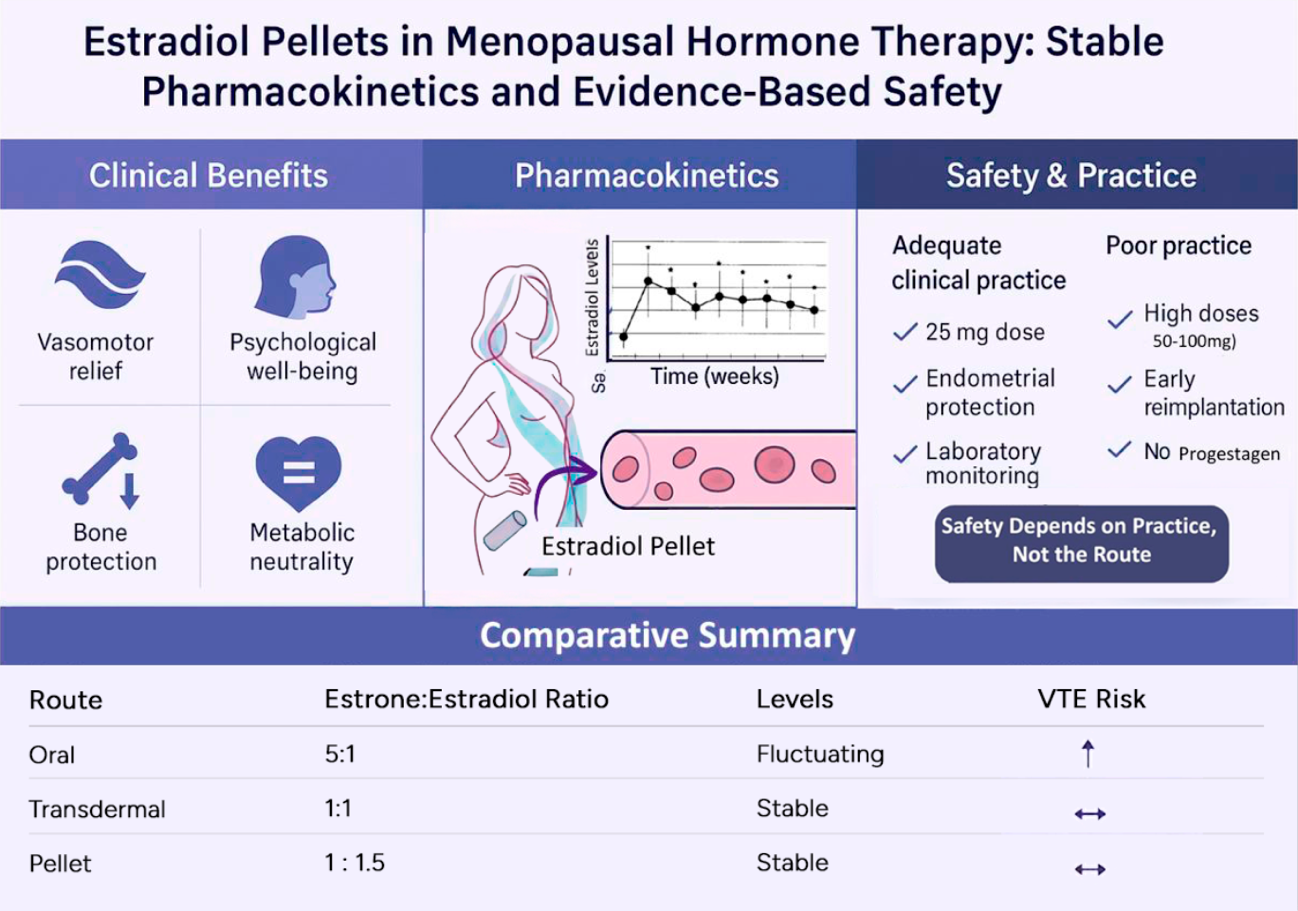
Subcutaneous Estradiol Pellets as Hormone Therapy in Menopause: Clinical Pharmacology, Patient Selection and Safety Considerations

 ,
, 
Abstract
1. Introduction
2. Materials and Methods
2.1. Data Sources and Search Strategy
2.2. Study Selection Criteria
2.3. Data Extraction and Analysis
3. Results and Discussion
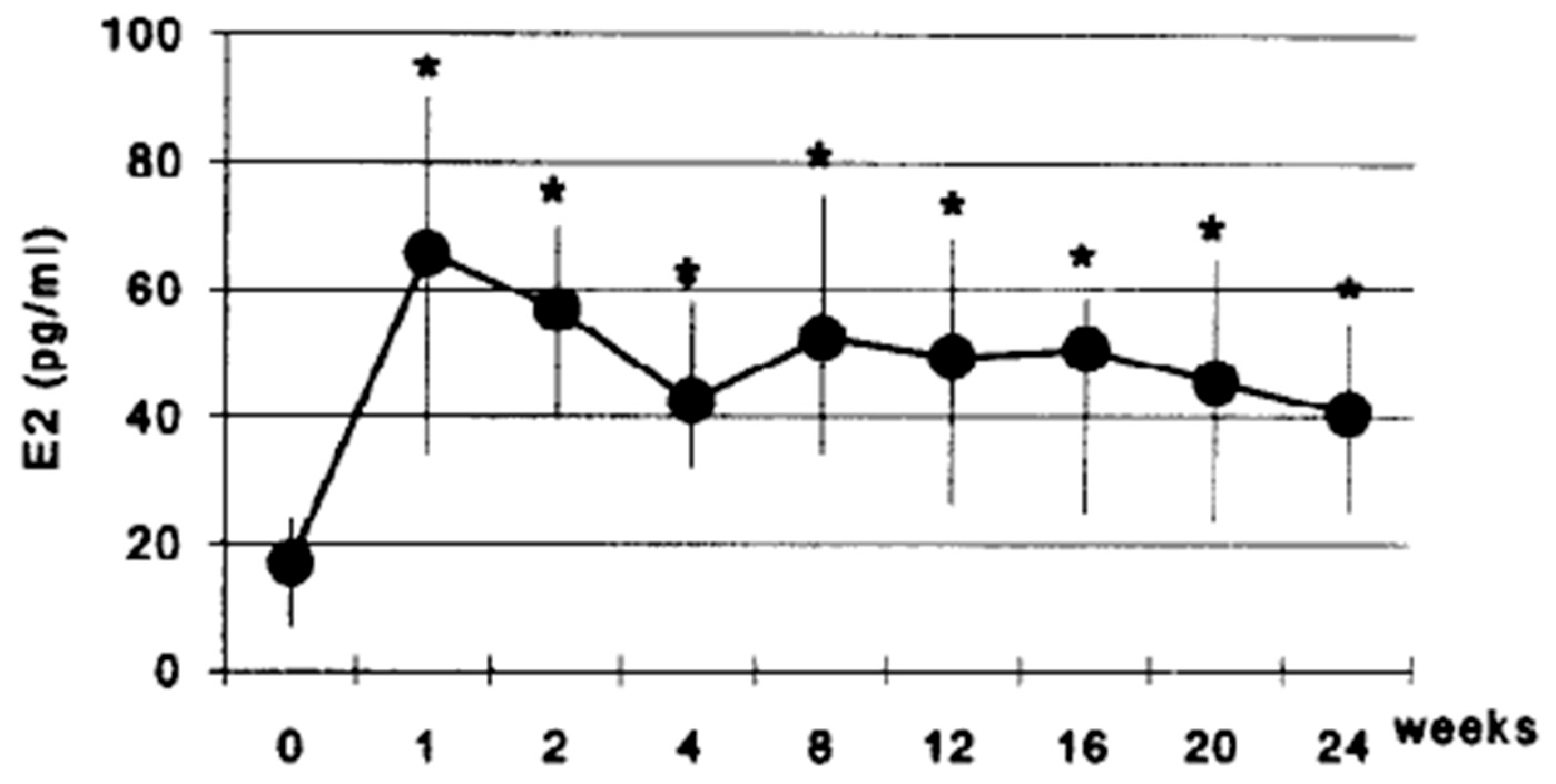
3.1. Pharmacokinetics of Estradiol Pellets
3.2. Evidence of Clinical Efficacy
3.3. Bone Health
3.4. Vasomotor Symptoms and Psychological Well-Being
3.5. Sexual Function and Body Composition
3.6. Safety Analysis and Adverse Effects
3.7. Endometrial Safety
3.8. Tachyphylaxis and the Risk of Supraphysiological Levels
3.9. Cardiovascular Safety and Thrombotic Risk
3.10. Compounded Formulations and the Importance of Standardization
3.11. Therapeutic Comparisons with Other Routes of Estradiol Administration
3.12. Implants Versus Oral Therapy
3.13. Implants Versus Transdermal Therapy
3.14. Recommendations for Clinical Practice
Patient Selection
3.15. Dosage and Reimplantation Interval
3.16. Monitoring and Patient Education
4. Conclusions
Author Contributions
Funding
Informed Consent Statement
Data Availability Statement
Acknowledgments
Conflicts of Interest
Abbreviations
| BMD | Bone Mineral Density |
| DeCS | Descritores em Ciências da Saúde |
| E1 | Estrone |
| E2 | Estradiol |
| FDA | Food and Drug Administration |
| FSH | Follicle-Stimulating Hormone |
| HDL | High-Density Lipoprotein |
| HT | Hormone therapy |
| IMS | International Menopause Society |
| LDL | Low-Density Lipoprotein |
| LILACS | Literatura Latino-Americana e do Caribe em Ciências da Saúde |
| LNG-IUS | Levonorgestrel-Releasing Intrauterine System |
| MEDLINE | Medical Literature Analysis and Retrieval System Online |
| MeSH | Medical Subject Headings |
| N | Number of participants |
| RCT | Randomized Clinical Trial |
| SANRA | Scale for the Assessment of Narrative Review Articles |
| SHBG | Sex Hormone-Binding Globulin |
| T | Testosterone |
| TIAB | Title/Abstract |
| VTE | Venous Thromboembolism |
References
- Goodman, M.P. Are All Estrogens Created Equal? A Review of Oral vs. Transdermal Therapy. J. Women’s Health 2012, 21, 161–169. [Google Scholar] [CrossRef]
- Kuhl, H. Pharmacology of Estrogens and Progestogens: Influence of Different Routes of Administration. Climacteric 2005, 8, 3–63. [Google Scholar] [CrossRef]
- Perloff, W.H. Treatment of Estrogen Deficiency with Estradiol Pellets. J. Clin. Endocrinol. Metab. 1950, 10, 447–454. [Google Scholar] [CrossRef] [PubMed]
- Jarolim, C.; Bernard, L.I.; Strauss, H.A. Estrogenic Substitution Therapy with Estradiol Pellet Implantation. Am. J. Obstet. Gynecol. 1966, 94, 170–177. [Google Scholar] [CrossRef]
- Lobo, R.A.; March, C.M.; Goebelsmann, U.; Krauss, R.M.; Mishell, D.R. Subdermal Estradiol Pellets Following Hysterectomy and Oophorectomy. Effect upon Serum Estrone, Estradiol, Luteinizing Hormone, Follicle-Stimulating Hormone, Corticosteroid Binding Globulin-Binding Capacity, Testosterone-Estradiol Binding Globulin-Binding Capacity, Lipids, and Hot Flushes. Am. J. Obstet. Gynecol. 1980, 138, 714–719. [Google Scholar] [PubMed]
- Thom, M.H.; Collins, W.P.; Studd, J.W.W. Hormonal Profiles in Postmenopausal Women after Therapy with Subcutaneous Implants. Br. J. Obstet. Gynaecol. 1981, 88, 426–433. [Google Scholar] [CrossRef]
- Gangar, K.; Cust, M.; Whitehead, M.I. Symptoms of Oestrogen Deficiency Associated with Supraphysiological Plasma Oestradiol Concentrations in Women with Oestradiol Implants. BMJ 1989, 299, 601–602. [Google Scholar] [CrossRef]
- Jiang, X.; Bossert, A.; Parthasarathy, K.N.; Leaman, K.; Minassian, S.S.; Schnatz, P.F.; Woodland, M.B. Safety Assessment of Compounded Non-FDA-Approved Hormonal Therapy versus FDA-Approved Hormonal Therapy in Treating Postmenopausal Women. Menopause 2021, 28, 867–874. [Google Scholar] [CrossRef]
- Stanczyk, F.Z.; Shoupe, D.; Nunez, V.; Macias-Gonzales, P.; Vijod, M.A.; Lobo, R.A. A Randomized Comparison of Nonoral Estradiol Delivery in Postmenopausal Women. Am. J. Obstet. Gynecol. 1988, 159, 1540–1546. [Google Scholar] [CrossRef]
- del Carmen Cravioto, M.; Larrea, F.; Delgado, N.E.; Escobar, A.R.; Díaz-Sánchez, V.; Domínguez, J.; De León, R.P. Pharmacokinetics and Pharmacodynamics of 25-Mg Estradiol Implants in Postmenopausal Mexican Women. Menopause 2001, 8, 353–360. [Google Scholar] [CrossRef] [PubMed]
- Glynne, S.; Reisel, D.; Kamal, A.; Neville, A.; McColl, L.; Lewis, R.; Newson, L. The Range and Variation in Serum Estradiol Concentration in Perimenopausal and Postmenopausal Women Treated with Transdermal Estradiol in a Real-World Setting: A Cross-Sectional Study. Menopause 2025, 32, 103–111. [Google Scholar] [CrossRef]
- Owen, E.J.; Siddle, N.C.; Mcgarrigle, H.T.; Pugh, M.A. 25 Mg Oestradiol Implants—The Dosage of First Choice for Subcutaneous Oestrogen Replacement Therapy? Br. J. Obstet. Gynaecol. 1992, 99, 671–675. [Google Scholar] [CrossRef]
- Holland, E.F.; Leather, A.T.; Studd, J.W. The Effect of 25-Mg Percutaneous Estradiol Implants on the Bone Mass of Postmenopausal Women. Obstet. Gynecol. 1994, 83, 43–46. [Google Scholar]
- Panay, N.; Versi, E.; Savvas, M. A Comparison of 25 Mg and 50 Mg Oestradiol Implants in the Control of Climacteric Symptoms Following Hysterectomy and Bilateral Salpingo-oophorectomy. Br. J. Obstet. Gynaecol. 2000, 107, 1012–1016. [Google Scholar] [CrossRef]
- Kapetanakis, E.; Dmowski, W.P.; Auletta, F.; Scommegna, A. Endocrine and Clinical Effects of Estradiol and Testosterone Pellets Used in Long-term Replacement Therapy. Int. J. Gynecol. Obstet. 1982, 20, 387–399. [Google Scholar] [CrossRef]
- Wheatley, S.; Bell, R.J.; Stuckey, B.G.A.; Robinson, P.J.; Davis, S.R. Clinical Audit of Estradiol Implant Therapy: Long Duration of Action and Implications in Non-Hysterectomised Women. Maturitas 2016, 94, 84–86. [Google Scholar] [CrossRef] [PubMed]
- Sharf, M.; Oettinger, M.; Lanir, A.; Kahana, L.; Yeshurun, D. Lipid and Lipoprotein Levels Following Pure Estradiol Implantation in Post-Menopausal Women. Gynecol. Obstet. Invest. 1985, 19, 207–212. [Google Scholar] [CrossRef] [PubMed]
- Montgomery, J.C.; Brincat, M.; Tapp, A.; Appleby, L.; Versi, E.; Fenwick, P.B.C.; Studd, J.W.W. Effect of Oestrogen and Testosterone Implants on Psychological Disorders in the Climacteric. Lancet 1987, 329, 297–299. [Google Scholar] [CrossRef] [PubMed]
- Garnett, T.; Studd, J.; Watson, N.; Savvas, M.; Leather, A. The Effects of Plasma Estradiol Levels on Increases in Vertebral and Femoral Bone Density Following Therapy with Estradiol and Estradiol with Testosterone Implants. Obstet. Gynecol. 1992, 79, 968–972. [Google Scholar] [CrossRef]
- Naessén, T.; Persson, I.; Thor, L.; Mallmin, H.; Ljunghall, S.; Bergström, R. Maintained Bone Density at Advanced Ages after Long Term Treatment with Low Dose Oestradiol Implants. Br. J. Obstet. Gynaecol. 1993, 100, 454–459. [Google Scholar] [CrossRef]
- Ryde, S.J.S.; Bowen-Simpkins, K.; Bowen-Simpkins, P.; Evans, W.D.; Morgan, W.D.; Compstont, J.E. The Effect of Oestradiol Implants on Regional and Total Bone Mass: A Three-year Longitudinal Study. Clin. Endocrinol. 1994, 40, 33–38. [Google Scholar] [CrossRef]
- Studd, J.W.W.; Nigel Holland, E.F.; Leather, A.T.; Smith, R.N.J. The Dose–Response of Percutaneous Oestradiol Implants on the Skeletons of Postmenopausal Women. Br. J. Obstet. Gynaecol. 1994, 101, 787–791. [Google Scholar] [CrossRef] [PubMed]
- Davis, S.R.; McCloud, P.; Strauss, B.J.G.; Burger, H. Testosterone Enhances Estradiol’s Effects on Postmenopausal Bone Density and Sexuality. Maturitas 1995, 21, 227–236. [Google Scholar] [CrossRef]
- Pearce, J.; Hawton, K.; Blake, F.; Barlow, D.; Rees, M.; Fagg, J.; Keenan, J. Psychological Effects of Continuation versus Discontinuation of Hormone Replacement Therapy by Estrogen Implants: A Placebo-Controlled Study. J. Psychosom. Res. 1997, 42, 177–186. [Google Scholar] [CrossRef]
- Wahab, M.; Ballard, P.; Purdie, D.W.; Cooper, A.; Willson, J.C. The Effect of Long Term Oestradiol Implantation on Bone Mineral Density in Postmenopausal Women Who Have Undergone Hysterectomy and Bilateral Oophorectomy. Br. J. Obstet. Gynaecol. 1997, 104, 728–731. [Google Scholar] [CrossRef]
- Vedi, S.; Purdie, D.W.; Ballard, P.; Bord, S.; Cooper, A.C.; Compston, J.E. Bone Remodeling and Structure in Postmenopausal Women Treated with Long-Term, High-Dose Estrogen Therapy. Osteoporos. Int. 1999, 10, 52–58. [Google Scholar] [CrossRef]
- Sands, R.H.; Studd, J.W.W.; Jones, J.; Alaghband-Zadeh, J. Comparison of the Biochemical Effects of Testosterone and Estrogen on Bone Markers in Surgically Menopausal Women. Gynecol. Endocrinol. 2000, 14, 382–387. [Google Scholar] [CrossRef]
- Hansen, R.D.; Raja, C.; Baber, R.J.; Lieberman, D.; Allen, B.J. Effects of 20-Mg Oestradiol Implant Therapy on Bone Mineral Density, Fat Distribution and Muscle Mass in Postmenopausal Women. Acta Diabetol. 2003, 40, s191–s195. [Google Scholar] [CrossRef] [PubMed]
- Rufford, J.; Hextall, A.; Cardozo, L.; Khullar, V. A Double-Blind Placebo-Controlled Trial on the Effects of 25-mg Estradiol Implants on the Urge Syndrome in Postmenopausal Women. Int. Urogynecol. J. 2003, 14, 78–83. [Google Scholar] [CrossRef] [PubMed]
- Panay, N.; Zamblera, D.; Sands, R.; Jones, J.; Alaghband-Zadeh, J.; Studd, J.W.W. Low Dose 25 Mg Oestradiol Implants and 1 Mg Norethisterone as Continuous Combined Hormone Therapy: A Prospective Study. Br. J. Obstet. Gynaecol. 2002, 109, 958–960. [Google Scholar] [CrossRef]
- Dixit, A.; Carden, N.; Stephens, E.; Chadwick, M.; Tamblyn, J.; Robinson, L. Hormone Replacement Therapy Subcutaneous Implants for Refractory Menopause Symptoms; the Patient’s Perspective. Post. Reprod. Health 2022, 28, 79–91. [Google Scholar] [CrossRef]
- Burger, H.G.; Hailes, J.; Menelaus, M.; Nelson, J.; Hudson, B.; Balazs, N. The Management of Persistent Menopausal Symptoms with Oestradiol-Testosterone Implants: Clinical, Lipid and Hormonal Results. Maturitas 1984, 6, 351–358. [Google Scholar] [CrossRef]
- Panay, N.; Ang, S.B.; Cheshire, R.; Goldstein, S.R.; Maki, P.; Nappi, R.E.; on behalf of the International Menopause Society Board. Menopause and MHT in 2024: Addressing the Key Controversies—An International Menopause Society White Paper. Climacteric 2024, 27, 441–457. [Google Scholar] [CrossRef]
- Faubion, S.S.; Crandall, C.J.; Davis, L.; El Khoudary, S.R.; Hodis, H.N.; Lobo, R.A.; Maki, P.M.; Manson, J.E.; Pinkerton, J.V.; Santoro, N.F.; et al. The 2022 Hormone Therapy Position Statement of The North American Menopause Society. Menopause 2022, 29, 767–794. [Google Scholar] [CrossRef] [PubMed]
- Vigo, F.; Lubianca, J.N.; Corleta, H.V.E. Progestógenos: Farmacologia e uso clínico. Femina 2011, 39, lil-604867. [Google Scholar]
- Magos, A.L.; Brincat, M.; O’Dowd, T.; Wardle, P.J.; Schlesinger, P.; Studd, J.W.W. Endometrial and Menstrual Response to Subcutaneous Oestradiol and Testosterone Implants and Continuous Oral Progestogen Therapy in Post-Menopausal Women. Maturitas 1985, 7, 297–302. [Google Scholar] [CrossRef] [PubMed]
- Suhonen, S.P.; Allonen, H.O.; Lähteenmäki, P. Sustained-Release Estradiol Implants and a Levonorgestrel-Releasing Intrauterine Device in Hormone Replacement Therapy. Am. J. Obstet. Gynecol. 1995, 172, 562–567. [Google Scholar] [CrossRef]
- Laing, A.; Hillard, T. Oestrogen-Based Therapies for Menopausal Symptoms. Best Pract. Res. Clin. Endocrinol. Metab. 2024, 38, 101789. [Google Scholar] [CrossRef]
- Garnett, T.; Studd, J.W.W.; Henderson, A.; Watson, N.; Savvas, M.; Leather, A. Hormone Implants and Tachyphylaxis. Br. J. Obstet. Gynaecol. 1990, 97, 917–921. [Google Scholar] [CrossRef] [PubMed]
- Forman, E.J.; Guyton, J.R.; Filip, S.J.; Price, T.M. Implanted Estrogen Pellets Associated with Hypertriglyceridemia, Biliary Dyskinesia and Focal Nodular Hyperplasia of the Liver: A Case Report. J. Reprod. Med. 2010, 55, 87–90. [Google Scholar]
- Tamblyn, J.; Robinson, L.; Maguire, E.; Hodge, A.; Briggs, P. Subcutaneous Hormone Implants. Post. Reprod. Health 2023, 29, 240–243. [Google Scholar] [CrossRef]
- Canonico, M.; Oger, E.; Plu-Bureau, G.; Conard, J.; Meyer, G.; Lévesque, H.; Trillot, N.; Barrellier, M.-T.; Wahl, D.; Emmerich, J.; et al. Hormone Therapy and Venous Thromboembolism Among Postmenopausal Women: Impact of the Route of Estrogen Administration and Progestogens: The ESTHER Study. Circulation 2007, 115, 840–845. [Google Scholar] [CrossRef]
- Notelovitz, M.; Johnston, M.; Smith, S.; Kitchens, C. Metabolic and Hormonal Effects of 25-Mg and 50-Mg 17 Beta-Estradiol Implants in Surgically Menopausal Women. Obstet. Gynecol. 1987, 70, 749–754. [Google Scholar] [PubMed]
- Donovitz, G.S. Low Complication Rates of Testosterone and Estradiol Implants for Androgen and Estrogen Replacement Therapy in over 1 Million Procedures. Ther. Adv. Endocrinol. Metab. 2021, 12, 20420188211015238. [Google Scholar] [CrossRef] [PubMed]
- O’Connell, M.B. Pharmacokinetic and Pharmacologic Variation Between Different Estrogen Products. J. Clin. Pharmacol. 1995, 35, 18S–24S. [Google Scholar] [CrossRef]
- Samsioe, G. Transdermal Hormone Therapy: Gels and Patches. Climacteric 2004, 7, 347–356. [Google Scholar] [CrossRef]
- Potts, R.O.; Lobo, R.A. Transdermal Drug Delivery: Clinical Considerations for the Obstetrician–Gynecologist. Obstet. Gynecol. 2005, 105, 953–961. [Google Scholar] [CrossRef] [PubMed]
- Järvinen, A.; Bäckström, A.-C.; Elfström, C.; Viitanen, A. Comparative Absorption and Variability in Absorption of Estradiol from a Transdermal Gel and a Novel Matrix-Type Transdermal Patch. Maturitas 2001, 38, 189–196. [Google Scholar] [CrossRef]


| Author (Year) | Study Design | Population (N) | Intervention vs. Comparison | Duration | Main Outcome(s) | Main Conclusion |
|---|---|---|---|---|---|---|
| Lobo et al. (1980) [5] | Prospective controlled study | 22 post-hysterectomy vs. 20 controls | E2 25 mg implant vs. no treatment | 6 months | Hormone levels, Lipid profile, Hot flashes | 25 mg implant is effective for symptom control and HDL improvement over 6 months |
| Thom et al. (1981) [6] | Observational study | 24 post-hysterectomy | E2 100 mg vs. 50 mg vs. 50 mg + T 100 mg vs. T 200 mg | Up to 12 months | Hormone profiles | E2 implants (50 and 100 mg) achieve physiological levels and suppress FSH |
| Kapetanakis et al. (1982) [15] | Case series | 10 with estrogen deficiency | E2 (25–75 mg) ± T (75 mg) | Up to 76 weeks | Hormone levels, Symptom relief | E2 ≥ 250 mg effective for symptom relief and long-term E2 maintenance (>70 weeks) |
| Sharf et al. (1985) [17] | Observational study | 8 post-hysterectomy | E2 100 mg vs. baseline | 6 months | Lipid profile | Improves HDL, reduces LDL, no effect on triglycerides |
| Montgomery et al. (1987) [18] | RCT, Double-blind, Placebo-controlled | 84 peri/postmenopausal | E2, E2 + T pellets vs. placebo | 2–4 months | Psychological symptoms | Superior to placebo at 2 months; equal at 4 months due to placebo effect |
| Stanczyk et al. (1988) [9] | RCT | 20 postmenopausal, hysterectomized | E2 pellets (2 × 25 mg) vs. patch (0.1 mg) | 24 weeks | Pharmacokinetics, Lipids, Bone markers | Pellets provide more stable estradiol levels than patch |
| Owen et al. (1992) [12] | Observational study | 12 postmenopausal | E2 25 mg vs. baseline | 28–35 weeks | Symptoms, Estradiol levels | 25 mg effective >6 months; should be first choice |
| Garnett et al. (1992) [19] | RCT with control | 50 postmenopausal + 25 controls | E2 75 mg vs. E2 75 mg + T 100 mg | 1 year | BMD | T does not add benefit; effect depends on E2 level |
| Naessén et al. (1993) [20] | Controlled cross-sectional | 70 (35 treated vs. 35 control) | E2 20 mg long-term vs. control | Mean 16 years | BMD (various sites) | Low-dose implants preserve bone with age |
| Holland et al. (1994) [13] | Controlled clinical trial | 36 postmenopausal (18 vs. 18) | E2 25 mg vs. no treatment | 1 year | BMD (spine and hip) | E2 25 mg increases BMD and prevents bone loss |
| Ryde et al. (1994) [21] | Longitudinal study | 29 postmenopausal, hysterectomized | E2 25–100 mg | 3 years | BMD, Body calcium | Significant, sustained BMD increase over 3 years |
| Studd et al. (1994) [22] | RCT with control | 45 postmenopausal vs. 15 controls | E2 pellets (25, 50, 75 mg) vs. none | 1 year | BMD, E2 levels | BMD gain is E2 dose-dependent; >82 pg/mL prevents loss |
| Davis et al. (1995) [23] | RCT, Single-blind | 34 postmenopausal | E2 50 mg vs. E2 50 mg + T 50 mg | 2 years | BMD, Sexual function, Lipids | T addition enhances BMD and sexual function |
| Pearce et al. (1997) [24] | RCT, Double-blind, Placebo-controlled | 40 chronic users | E2 50 mg reimplant vs. placebo | 2 months | Psychological symptoms | No difference from placebo; symptoms not hormone-related |
| Wahab et al. (1997) [25] | Controlled pilot study | 24 post-hysterectomy (12 vs. 12) | E2 implant vs. none | ≥15 years | BMD (spine and hip) | Long-term implants preserve BMD better than expected |
| Vedi et al. (1999) [26] | Case–control study | 24 (12 implants vs. 12 controls) | Long-term E2 implant vs. premenopausal | ≥14 years | Bone histomorphometry | Shows anabolic effect and increased formation |
| Panay et al. (2000) [14] | RCT, Double-blind | 44 surgical menopause | E2 25 mg vs. E2 50 mg | 6 months | Climacteric symptoms | 25 mg is as effective as 50 mg |
| Sands et al. (2000) [27] | Longitudinal study | 25 surgical menopause | E2 50 mg vs. E2 50 mg + T 100 mg | 32 weeks | Bone turnover markers | T increases bone formation |
| Cravioto et al. (2001) [10] | Open observational | 15 postmenopausal, hysterectomized | E2 25 mg vs. baseline | 24 weeks | Hormones, Symptoms, Metabolism | 25 mg improves symptoms and hormones without metabolic harm |
| Hansen et al. (2003) [28] | Controlled cohort | 34 postmenopausal (20 vs. 14) | E2 20 mg vs. control | 64 weeks | BMD, Fat distribution | E2 improved BMD and reduced abdominal fat |
| Rufford et al. (2003) [29] | RCT, Double-blind, Placebo-controlled | 40 with urgency syndrome | E2 25 mg vs. placebo | 6 months | Urinary symptoms, Endometrial safety | No benefit; high bleeding and hysterectomy risk |
| Wheatley et al. (2016) [16] | Retrospective audit | 114 postmenopausal | E2 50 mg (Estrapel) | ~311 days | Pharmacokinetics, Adverse events | Single implant lasts >12 months; most common AE: vaginal bleeding |
| Jiang et al. (2021) [8] | Retrospective cohort | 539 postmenopausal (384 pellets vs. 155 FDA HT) | Pellets vs. FDA-approved HT | Mean 3.9 years | Side effects, Hormone levels (E2, T) | Pellets have higher adverse effects and supraphysiological hormone levels |
| Parameter | Oral Route | Transdermal Route (Patch/Gel) | Subcutaneous Route (Pellet) |
|---|---|---|---|
| First-Pass Hepatic Metabolism | Extensive first-pass metabolism to estrone and conjugates | Bypasses liver; absorbed through skin | Bypasses liver; direct to bloodstream |
| Estradiol:Estrone Ratio (E2:E1) | Non-physiological (≈1:5) | Physiological (≈1:1) | Physiological (1.5:1) |
| Serum Levels | Fluctuating (peaks and valleys) | Variable (irregular absorption) | Stable and sustained |
| VTE Risk | Increased (2–4× VTE risk) | Not increased | Not increased (theoretical) |
| Effect on Triglycerides | Increases triglycerides | Neutral effect | Lowers triglycerides |
| Impact on SHBG | Significantly increases | Minimal/neutral effect | Minimal/neutral effect |
| Treatment Adherence | Requires daily dosing | Requires daily or weekly application | Guaranteed for months |
| Therapy Flexibility | Easy adjustment/discontinuation | Easy adjustment/discontinuation | Removal not possible |
| Management of Uterine Bleeding | Usually responsive to progestagen adjustment; easy discontinuation if needed | Managed by dose adjustment or switching preparation; allows immediate discontinuation | LNG-IUS is the preferred option; with adjustment of the progestagen regimen as an alternative. |
Disclaimer/Publisher’s Note: The statements, opinions and data contained in all publications are solely those of the individual author(s) and contributor(s) and not of MDPI and/or the editor(s). MDPI and/or the editor(s) disclaim responsibility for any injury to people or property resulting from any ideas, methods, instructions or products referred to in the content. |
© 2025 by the authors. Licensee MDPI, Basel, Switzerland. This article is an open access article distributed under the terms and conditions of the Creative Commons Attribution (CC BY) license.
Share and Cite
Jacobsen, L.; Fernandes, D.M.; Nagel, M.L.; Souza, E.L.d.; Viana, D.P.d.C. Subcutaneous Estradiol Pellets as Hormone Therapy in Menopause: Clinical Pharmacology, Patient Selection and Safety Considerations. J. Clin. Med. 2026, 15, 48. https://doi.org/10.3390/jcm15010048
Jacobsen L, Fernandes DM, Nagel ML, Souza ELd, Viana DPdC. Subcutaneous Estradiol Pellets as Hormone Therapy in Menopause: Clinical Pharmacology, Patient Selection and Safety Considerations. Journal of Clinical Medicine. 2026; 15(1):48. https://doi.org/10.3390/jcm15010048
Chicago/Turabian StyleJacobsen, Leonardo, Daniela Maia Fernandes, Maria Luiza Nagel, Eline Lobo de Souza, and Diogo Pinto da Costa Viana. 2026. "Subcutaneous Estradiol Pellets as Hormone Therapy in Menopause: Clinical Pharmacology, Patient Selection and Safety Considerations" Journal of Clinical Medicine 15, no. 1: 48. https://doi.org/10.3390/jcm15010048
APA StyleJacobsen, L., Fernandes, D. M., Nagel, M. L., Souza, E. L. d., & Viana, D. P. d. C. (2026). Subcutaneous Estradiol Pellets as Hormone Therapy in Menopause: Clinical Pharmacology, Patient Selection and Safety Considerations. Journal of Clinical Medicine, 15(1), 48. https://doi.org/10.3390/jcm15010048