Cybersickness Evaluation in Immersive Virtual Environments: A Systematic Review with Implications for Neurological Rehabilitation

 , , , , , , and
Abstract
1. Introduction
2. Aim
3. Methods
3.1. Search Strategy
3.2. Study Selection
3.3. Data Collection
3.4. Evaluation of Selected Studies
4. Results
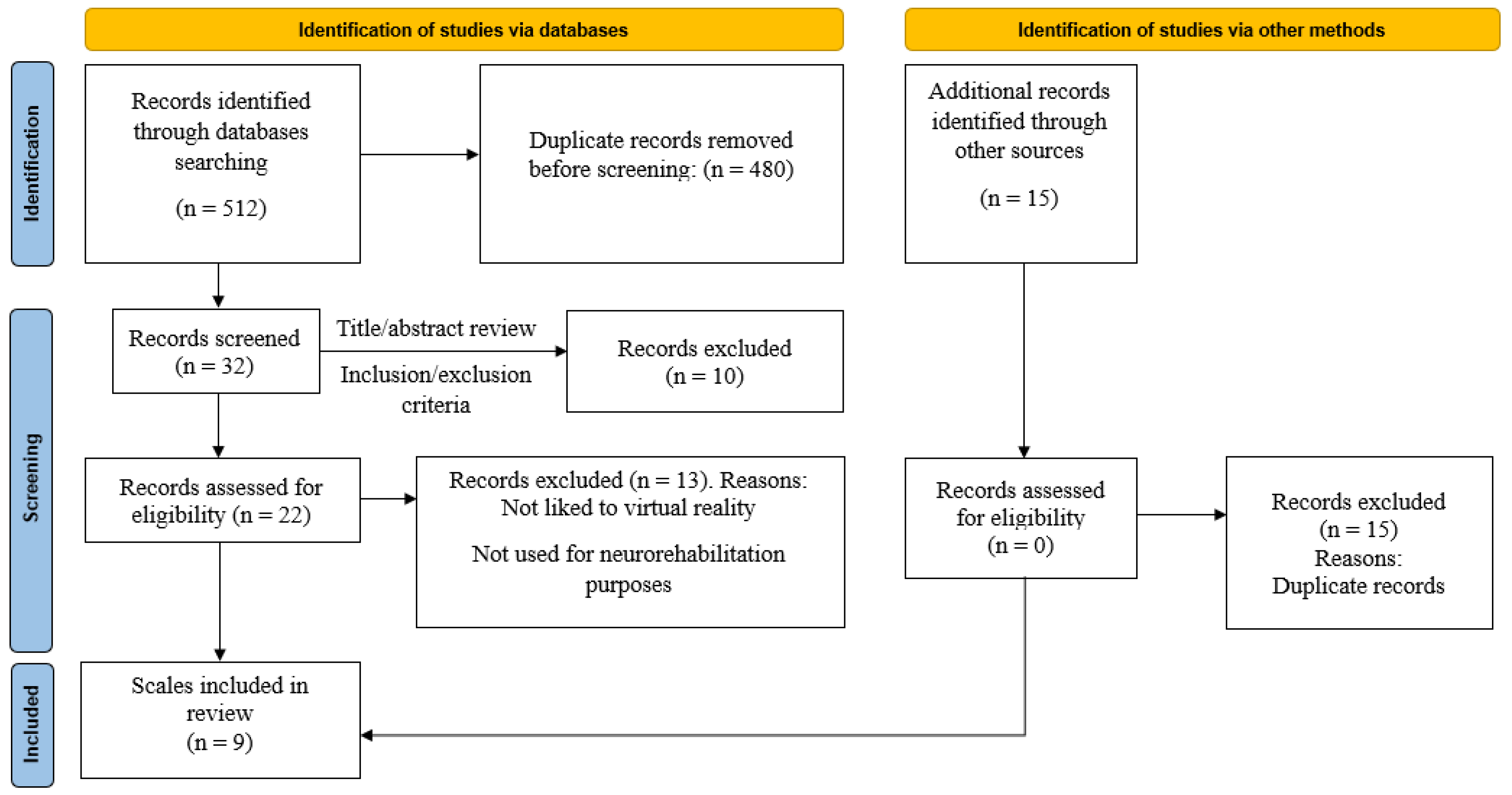
4.1. Study Selection
4.2. Characteristics of Included Assessment Instruments
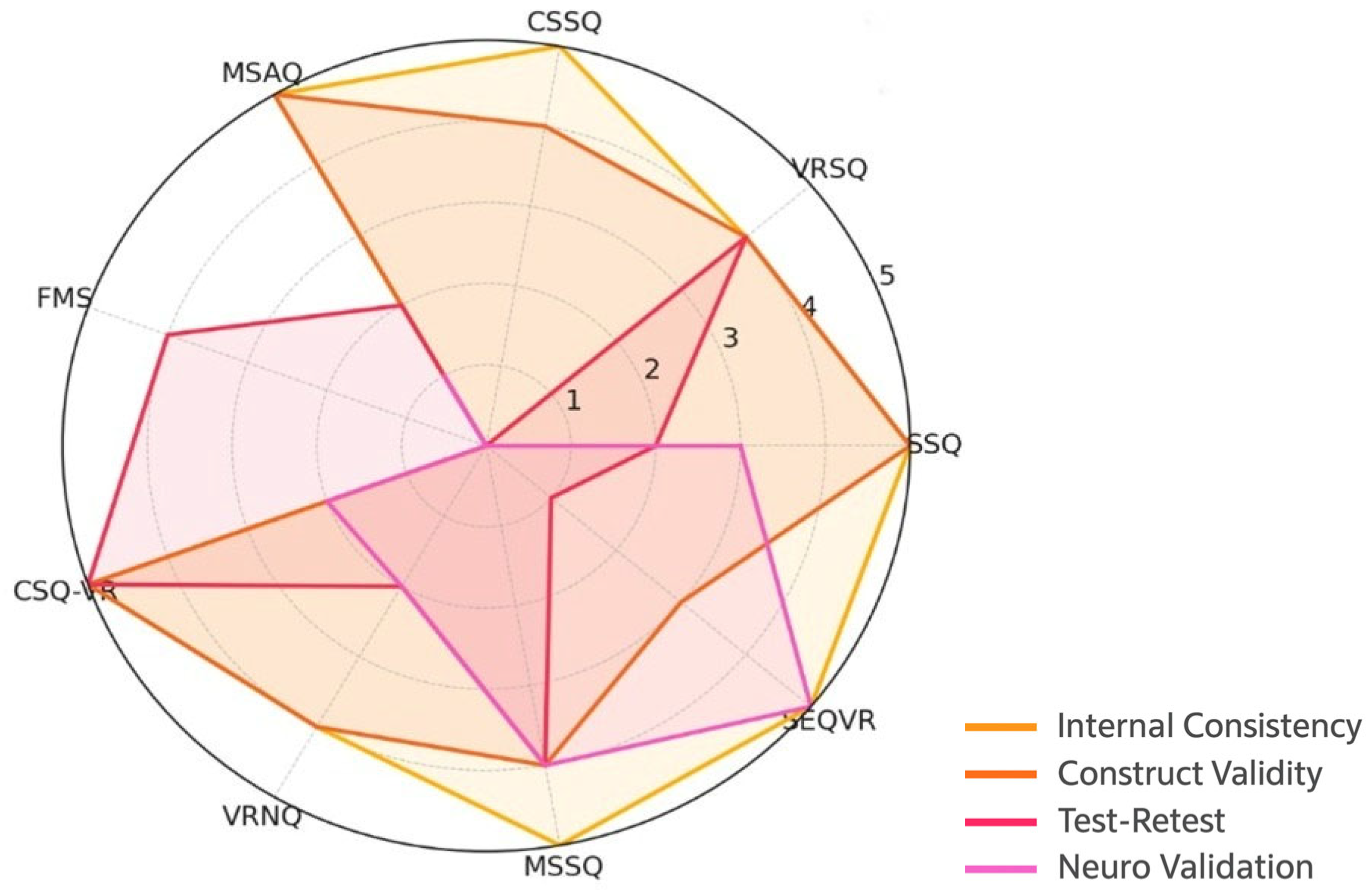
4.3. Characteristics of Validation Studies Using Cybersickness Assessment Instruments Related to Immersive VR
4.4. COSMIN-Based Evaluation of Measurement Properties
4.5. Clinical Application Contexts
5. Discussion
5.1. Cybersickness Assessment Instruments and Psychometric Properties
5.2. Cybersickness Assessment Instruments and Validation Processes in Clinical Contexts Linked to Neurorehabilitation
5.3. Implications for Research and Clinical Practice
5.4. Limitations
6. Conclusions
Supplementary Materials
Author Contributions
Funding
Institutional Review Board Statement
Informed Consent Statement
Data Availability Statement
Conflicts of Interest
References
- Ortiz-Gutiérrez, R.M.; Galán del Río, F.; Cano de la Cuerda, R.; Alguacil-Diego, I.M.; Arroyo, R.; Miangolarra-Page, J.C. A telerehabilitation program by virtual reality-video games improves balance and postural control in multiple sclerosis patients. NeuroRehabilitation 2013, 33, 545–554. [Google Scholar] [CrossRef] [PubMed]
- Luna-Oliva, L.; Ortiz-Gutiérrez, R.M.; Cano-de la Cuerda, R.; Piédrola, R.M.; Alguacil-Diego, I.M.; Sánchez-Camarero, C. Kinect Xbox 360 as a therapeutic modality for children with cerebral palsy in a school environment: A preliminary study. NeuroRehabilitation 2013, 33, 513–521. [Google Scholar] [CrossRef]
- Ortiz-Gutiérrez, R.; Cano-de-la-Cuerda, R.; Galán-del-Río, F.; Alguacil-Diego, I.M.; Palacios-Ceña, D.; Miangolarra-Page, J.C. A telerehabilitation program improves postural control in multiple sclerosis patients: A Spanish preliminary study. Int. J. Environ. Res. Public Health 2013, 10, 5697–5710. [Google Scholar] [CrossRef]
- Slater, M.; Sanchez-Vives, M.V. Enhancing our lives with immersive virtual reality. Front. Robot. AI 2016, 3, 74. [Google Scholar] [CrossRef]
- Bohil, C.J.; Alicea, B.; Biocca, F.A. Virtual reality in neuroscience research and therapy. Nat. Rev. Neurosci. 2011, 12, 752–762. [Google Scholar] [CrossRef]
- Riva, G.; Wiederhold, B.K.; Mantovani, F. Neuroscience of virtual reality: From virtual exposure to embodied medicine. Cyberpsychol. Behav. Soc. Netw. 2019, 22, 82–96. [Google Scholar] [CrossRef]
- LaViola, J.J. A discussion of cybersickness in virtual environments. ACM SIGCHI Bull. 2000, 32, 47–56. [Google Scholar] [CrossRef]
- Rebenitsch, L.; Owen, C. Review on cybersickness in applications and visual displays. Virtual Real. 2016, 20, 101–125. [Google Scholar] [CrossRef]
- Davis, S.; Nesbitt, K.; Nalivaiko, E. A systematic review of cybersickness. In Proceedings of the 2014 Conference on Interactive Entertainment, Newcastle, Australia, 2–3 December 2014; ACM: New York, NY, USA, 2014; pp. 1–9. [Google Scholar] [CrossRef]
- Weech, S.; Varghese, J.P.; Barnett-Cowan, M. Estimating the sensorimotor components of cybersickness. J Neurophysiol. 2018, 120, 2201–2217. [Google Scholar] [CrossRef] [PubMed]
- Combe, T.; Chardonnet, J.-R.; Merienne, F.; Ovtcharova, J. CAVE and HMD: Distance perception comparative study. Virtual Real. 2023, 27, 2003–2013. [Google Scholar] [CrossRef] [PubMed]
- Helou, S.; Khalil, N.; Daou, M.; El Helou, E. Virtual reality for healthcare: A scoping review of commercially available applications for head-mounted displays. Digit. Health 2023, 9, 20552076231178619. [Google Scholar] [CrossRef]
- Baashar, Y.; Alkawsi, G.; Wan Ahmad, W.N.; Alomari, M.A.; Alhussian, H.; Tiong, S.K. Towards wearable augmented reality in healthcare: A comparative survey and analysis of head-mounted displays. Int. J. Environ. Res. Public Health 2023, 20, 3940. [Google Scholar] [CrossRef]
- Fregna, G.; Schincaglia, N.; Baroni, A.; Straudi, S.; Casile, A. A novel immersive virtual reality environment for the motor rehabilitation of stroke patients: A feasibility study. Front. Robot. AI 2022, 9, 906424. [Google Scholar] [CrossRef] [PubMed]
- Casile, A.; Fregna, G.; Boarini, V.; Paoluzzi, C.; Manfredini, F.; Lamberti, N.; Baroni, A.; Straudi, S. Quantitative comparison of hand kinematics measured with a markerless commercial head-mounted display and a marker-based motion capture system in stroke survivors. Sensors 2023, 23, 7906. [Google Scholar] [CrossRef] [PubMed]
- Demeco, A.; Zola, L.; Frizziero, A.; Martini, C.; Palumbo, A.; Foresti, R.; Buccino, G.; Costantino, C. Immersive virtual reality in post-stroke rehabilitation: A systematic review. Sensors 2023, 23, 1712. [Google Scholar] [CrossRef] [PubMed]
- Fregna, G.; Paoluzzi, C.; Baroni, A.; Cano-de-la-Cuerda, R.; Casile, A.; Straudi, S. Head-mounted displays for upper limb stroke rehabilitation: A scoping review. J. Clin. Med. 2023, 12, 7444. [Google Scholar] [CrossRef]
- Patsaki, I.; Dimitriadi, N.; Despoti, A.; Tzoumi, D.; Leventakis, N.; Roussou, G.; Papathanasiou, A.; Nanas, S.; Karatzanos, E. The effectiveness of immersive virtual reality in physical recovery of stroke patients: A systematic review. Front. Syst. Neurosci. 2022, 16, 880447. [Google Scholar] [CrossRef]
- Kennedy, R.S.; Lane, N.E.; Berbaum, K.S.; Lilienthal, M.G. Simulator sickness questionnaire: An enhanced method for quantifying simulator sickness. Int. J. Aviat. Psychol. 1993, 3, 203–220. [Google Scholar] [CrossRef]
- Keshner, E.A. Virtual reality and physical rehabilitation: A new toy or a new research and rehabilitation tool? J. Neuroeng. Rehabil. 2004, 1, 8. [Google Scholar] [CrossRef]
- Saredakis, D.; Szpak, A.; Birckhead, B.; Keage, H.A.D.; Rizzo, A.; Loetscher, T. Factors associated with virtual reality sickness in head-mounted displays: A systematic review and meta-analysis. Front. Hum. Neurosci. 2020, 14, 96. [Google Scholar] [CrossRef]
- Streiner, D.L.; Norman, G.R.; Cairney, J. Health Measurement Scales: A Practical Guide to Their Development and Use, 5th ed.; Oxford University Press: Oxford, UK, 2015. [Google Scholar] [CrossRef]
- Elsman, E.B.M.; Mokkink, L.B.; Terwee, C.B.; Beaton, D.; Gagnier, J.J.; Tricco, A.C.; Baba, A.; Butcher, N.J.; Smith, M.; Hofstetter, C.; et al. Guideline for reporting systematic reviews of outcome measurement instruments (OMIs): PRISMA COSMIN for OMIs 2024. J. Clin. Epidemiol. 2024, 173, 111422. [Google Scholar] [CrossRef] [PubMed]
- Mokkink, L.B.; Terwee, C.B.; Patrick, D.L.; Alonso, J.; Stratford, P.W.; Knol, D.L.; de Vet, H.C.W.; Bouter, L.M.; Prinsen, C.A.C. The COSMIN checklist for assessing the methodological quality of studies on measurement properties: A Delphi study. Qual. Life Res. 2010, 19, 539–549. [Google Scholar] [CrossRef] [PubMed]
- Prinsen, C.A.C.; Mokkink, L.B.; Bouter, L.M.; Alonso, J.; Patrick, D.L.; de Vet, H.C.W.; Terwee, C.B. COSMIN guideline for systematic reviews of patient-reported outcome measures. Qual. Life Res. 2018, 27, 1147–1157. [Google Scholar] [CrossRef] [PubMed]
- Terwee, C.B.; Prinsen, C.A.C.; Chiarotto, A.; Westerman, M.J.; Patrick, D.L.; Alonso, J.; Bouter, L.M.; de Vet, H.C.W.; Mokkink, L.B. COSMIN methodology for evaluating the content validity of patient-reported outcome measures: A Delphi study. Qual. Life Res. 2018, 27, 1159–1170. [Google Scholar] [CrossRef]
- Terwee, C.B.; Mokkink, L.B.; Knol, D.L.; Ostelo, R.W.J.G.; Bouter, L.M.; de Vet, H.C.W. Rating the methodological quality in systematic reviews of studies on measurement properties: A scoring system for the COSMIN checklist. Qual. Life Res. 2012, 21, 651–657. [Google Scholar] [CrossRef]
- GRADE Working Group. Grading quality of evidence and strength of recommendations. BMJ 2004, 328, 1490. [Google Scholar] [CrossRef]
- Kim, H.K.; Park, J.; Choi, Y.; Choe, M. Virtual reality sickness questionnaire (VRSQ): Motion sickness measurement index in a virtual reality environment. Appl. Ergon. 2018, 69, 66–73. [Google Scholar] [CrossRef]
- Gianaros, P.J.; Muth, E.R.; Mordkoff, J.T.; Levine, M.E.; Stern, R.M. A questionnaire for the assessment of the multiple dimensions of motion sickness. Aviat. Space Environ. Med. 2001, 72, 115–119. [Google Scholar]
- Weech, S.; Kenny, S.; Barnett-Cowan, M. Presence and cybersickness in virtual reality are negatively related: A review. Front. Psychol. 2019, 10, 158. [Google Scholar] [CrossRef]
- Keshavarz, B.; Hecht, H. Validating an efficient method to quantify motion sickness. Hum. Factors 2011, 53, 415–426. [Google Scholar] [CrossRef]
- Kourtesis, P.; Collina, S.; Doumas, L.A.A.; MacPherson, S.E. Validation of the Virtual Reality Neuroscience Questionnaire: Maximum duration of immersive virtual reality sessions without the presence of pertinent adverse symptomatology. Front. Hum. Neurosci. 2019, 13, 417. [Google Scholar] [CrossRef] [PubMed]
- Kourtesis, P.; Linnell, J.; Amir, R.; Argelaguet, F.; MacPherson, S.E. Cybersickness in virtual reality questionnaire (CSQ-VR): A validation and comparison against SSQ and VRSQ. Virtual Real. 2023, 2, 16–35. [Google Scholar] [CrossRef]
- Golding, J.F. Motion sickness susceptibility questionnaire revised and its relationship to other forms of sickness. Brain Res. Bull. 1998, 47, 507–516. [Google Scholar] [CrossRef] [PubMed]
- Garcia-Agundez, A.; Reuter, C.; Becker, H.; Konrad, R.; Caserman, P.; Miede, A.; Göbel, S. Development of a classifier to determine factors causing cybersickness in virtual reality environments. Games Health J. 2019, 8, 439–444. [Google Scholar] [CrossRef]
- Gil-Gómez, J.A.; Gil-Gómez, H.; Lozano-Quilis, J.A.; Manzano-Hernández, P.; Albiol-Pérez, S.; Aula-Valero, C. SEQ: Suitability evaluation questionnaire for virtual rehabilitation systems. Application in a virtual rehabilitation system for balance rehabilitation. In Proceedings of the 7th International Conference on Pervasive Computing Technologies for Healthcare and Workshops, Venice, Italy, 5–8 May 2013; pp. 335–338. [Google Scholar] [CrossRef]
- Del Cid, D.A.; Larranaga, D.; Leitao, M.; Mosher, R.L.; Berzenski, S.R.; Gandhi, V.; Drew, S.A. Exploratory factor analysis and validity of the virtual reality symptom questionnaire and computer use survey. Ergonomics 2021, 64, 69–77. [Google Scholar] [CrossRef]
- Stanney, K.M.; Fidopiastis, C.; Foster, L. Virtual Reality Is Sexist: But It Does not Have to Be. Front. Robot. AI 2020, 7, 4. [Google Scholar] [CrossRef] [PubMed]
- Pau, M.; Arippa, F.; Leban, B.; Porta, M.; Casu, G.; Frau, J.; Lorefice, L.; Coghe, G.; Cocco, E. Cybersickness in People with Multiple Sclerosis Exposed to Immersive Virtual Reality. Bioengineering 2024, 11, 115. [Google Scholar] [CrossRef]
- McCauley, M.E.; Sharkey, T.J. Cybersickness: Perception of Self-Motion in Virtual Environments. Presence Teleoperators Virtual Environ. 1992, 1, 311–318. [Google Scholar] [CrossRef]
- Espinosa-Sanchez, J.M.; Lin, C.-C. Editorial: Vestibular migraine. Front. Neurol. 2025, 16, 1587097. [Google Scholar] [CrossRef]
- Abouzari, M.; Cheung, D.; Pham, T.; Goshtasbi, K.; Sarna, B.; Tajran, S.; Sahyouni, S.; Lin, H.W.; Djalilian, H.R. The Relationship Between Vestibular Migraine and Motion Sickness Susceptibility. Otol. Neurotol. 2020, 41, 1116–1121. [Google Scholar] [CrossRef]
- Kourtesis, P.; Collina, S.; Doumas, L.A.A.; MacPherson, S.E. A Novel Virtual Reality Tool (CSQ-VR) for Neuropsychological Assessment: Development and Initial Validation. Virtual Real. 2022, 26, 887–904. [Google Scholar]
- Feng, N.; Zhou, B.; Zhang, Q.; Hua, C.; Yuan, Y. A Comprehensive Exploration of Motion Sickness Process Analysis from EEG Signal and Virtual Reality. Comput. Methods Programs Biomed. 2025, 264, 108714. [Google Scholar] [CrossRef] [PubMed]
- Kiryu, T.; Iijima, A.; Bando, T. Relationships between Sensory Stimuli and Autonomic Regulation during Real and Virtual Exercises. In Proceedings of the 2005 IEEE Engineering in Medicine and Biology 27th Annual Conference, Shanghai, China, 17–18 January 2006; pp. 4994–4997. [Google Scholar]
- Simón-Vicente, L.; Rodríguez-Cano, S.; Delgado-Benito, V.; Ausín-Villaverde, V.; Cubo Delgado, E. Cybersickness: A Systematic Literature Review of Adverse Effects Related to Virtual Reality. Neurologia (Engl. Ed.) 2024, 39, 701–709. [Google Scholar] [CrossRef] [PubMed]
- Wang, W.; Wong, S.S.-l.; Lai, F.H.-y. The Effect of Virtual Reality Rehabilitation on Balance in Patients with Parkinson’s Disease: A Systematic Review and Meta-Analysis. Electronics 2021, 10, 1003. [Google Scholar] [CrossRef]
- Xie, M.; Zhou, K.; Patro, N.; Chan, T.; Levin, M.; Gupta, M.K.; Archibald, J. Virtual Reality for Vestibular Rehabilitation: A Systematic Review. Otol. Neurotol. 2021, 42, 967–977. [Google Scholar] [CrossRef] [PubMed]
- Gedik Toker, O.; Kuru, E.; Ozdemir, S.; Rencber, B.; Takan, E.; Araz, S.; Basoz Behmen, M.; Bal, N.; Aksoy, F. Relationship Between Motion Sickness Susceptibility and Vestibular Test Results. Medeni. Med. J. 2024, 39, 91–100. [Google Scholar] [CrossRef]



| Scale Name and Authors | Country | Purpose | Domains Assessed | Number of Items | Estimated Administration Time * | Description of the Scale | Interpretation of Total Score | Usage Context |
|---|---|---|---|---|---|---|---|---|
| Simulator Sickness Questionnaire (SSQ) Kennedy et al., 1993 [19] | USA | Quantify simulator/cybersickness symptoms | 3 subscales: Nausea, Oculomotor, Disorientation | 16 | 5–7 min | Ordinal self-report scale. 4-point Likert scale | Symptoms are scored: 0 (none symptom) to 3 (severe symptom). Higher scores indicate greater severity of symptoms. | Widely used in simulator and VR research; applied across healthy subjects |
| Virtual Reality Sickness Questionnaire (VRSQ) Kim et al., 2018 [29,30] | Republic of Korea | Assess cybersickness in VR | 2 subscales: Oculomotor Discomfort (4 items), Disorientation (5 items). | 9 | 2–3 min | Rapid self-report 4-point Likert scale (from none to very severe) | Symptoms are scored: 0 (not at all) to 3 (severe) Higher scores indicate greater severity of symptoms. | Developed for VR-specific experiences; tested in healthy users |
| Cybersickness Symptoms Questionnaire (CSSQ) Del Cid et al., 2021 [31] | USA | Exploratory assessment of symptoms in VR | Oculomotor strain, Nausea, Dizziness, Fatigue | 16 | 3–4 min | Estimated, Self-report questionnaire (recent validation) 4 level Likert scale (from none to severe) | Symptoms are scored: 0 (none) to 3 (severe) Higher scores indicating greater predicted vulnerability to VR-induced cybersickness. | Experimental use in VR-related studies, primarily with healthy users |
| Motion Sickness Assessment Questionnaire (MSAQ) Gianaros et al., 2001 [30] | USA | Evaluate multidimensional motion sickness | Items are grouped into four symptom clusters: Central, Peripheral, Gastrointestinal, Sopite-related symptoms | 16 | 7–10 min | 9 level Likert scale and multidimensional structure | Symptoms are scored: 0 (none symptom) to 9 (severe symptom) Higher total and subscale scores indicate increased severity of motion sickness | Used across transportation and VR settings; limited VR validation in healthy subjects |
| Fast Motion Sickness Scale (FMS) Keshavarz & Hecht, 2011 [32] | Germany | Rapid screening for motion sickness severity | General discomfort (single item, repeated over time) | 1 | 5 min | Estimated, short, and unidimensional self-report scale. | Single question where 0 (no symptom) to 20 (clear/severe symptom). | High temporal resolution; useful for real-time monitoring in VR. Healthy subjects. |
| Virtual Reality Neuroscience Questionnaire (VRNQ) Kourtesis et al., 2021 [33] | UK | Assess adverse symptoms and content quality in VR sessions | 4 domains: User experience, Game Mechanics, In-Game Assistance and VR-Induced Symptoms and Effects. Each domain comprises 5 items | 20 | 6–7 min | Self-report scale 7-point Likert scale | Symptoms are scored: 1 (not at all) to 7 (extremely). Higher scores indicate greater severity symptoms. | Evaluates both symptoms and technical design, for safe VR exposure |
| Cybersickness in Virtual Reality Questionnaire (CSQ-VR) Kourtesis et al., 2023 [34] | UK | Comprehensive measure for VR-related cybersickness | 3 subscales: Oculomotor, Nausea and Disorientation. Each subscale contains 2 items. | 6 | 4–5 min | Self-report scale 7-point Likert scale 6 items divided into 3 subscales. | Symptoms are scored: 1 (absent feeling) to 7 (extreme feeling). Total score is obtained by summing all items responses. Higher scores indicate greater severity symptoms. | Designed for HMD-based VR; validated against SSQ and VRSQ. Healthy subjects. |
| Motion Sickness Susceptibility Questionnaire (MSSQ-Short) Golding, 1998; Won et al., 2022 [35,36] | UK (Golding); USA (Won) | Predict individual vulnerability to motion sickness | Past experiences in various transport modes, divided into 2 parts: Short Childhood, and Short Adulthood. | 18 (items defined by Golding); 10 (items defined by Won) | 8–10 min | Self-report and retrospective scale 4-point Likert scale | Symptoms are scored: 0 (never) to 3 (frequently). Higher scores reflect greater historical susceptibility | Pre-VR screening tool; validated for general and VR contexts |
| Suitability Evaluation Questionnaire for VR (SEQ) Gil-Gómez et al., 2013 [37] | Spain | Evaluate usability and suitability of VR systems | User experience and perceived suitability in virtual environments. | 14 | 3–5 min | Self-report scale. 5-point Likert scale. (the first 13 questions) The last one is a final yes/no question. | Score ranges: from 13 (poor suitability) to 65 (excellent suitability. | Developed for rehabilitation settings, including postural VR therapy |
| Scale Name | Initial Validation Population | VR System/HMD Used | Domains Assessed | Internal Consistency | Construct Validity | Test–Retest Reliability | Additional Information About Validation in Specific Populations Related to Neurorehabilitation * |
|---|---|---|---|---|---|---|---|
| SSQ [19] | Military, aviation personnel | Flight Simulators (non-VR) | Nausea, Oculomotor, Disorientation | α ** = 0.70 to 0.90 | 3-factor (Oculomotor, Nausea, Disorientation) | ICC *** = 0.75 | Multiple sclerosis, Vestibular migraine, stroke |
| VRSQ [29,30] | Healthy students | Oculus Rift CV1 | Oculomotor, Disorientation | α = 0.87 | 2-factor (Oculomotor, Disorientation) | ICC = 0.79 | None |
| CSSQ [31] | Healthy adults | Immersive VR (unspecified) | Oculomotor, Nausea, Dizziness, Fatigue | α = 0.91 | Exploratory (2 factors: nausea, visual) | Not reported | None |
| MSAQ [30] | Healthy adults | Physical simulators | GI, Central, Peripheral, Sopite | α = 0.88–0.93 | 4-factor (GI, Central, Peripheral, Sopite) | Not consistently reported | Vestibular disorders (reported use) |
| FMS [32] | Healthy volunteers | Various HMDs/screens | General discomfort (1 item) | Not applicable | Not applicable | High (reported) | None |
| VRNQ [33] | Healthy adults | HTC Vive Pro Eye | Cybersymptoms, UX, Visual and Interaction fidelity | α = 0.86–0.94 | 4-factor (Symptoms + UX) | Not reported | Pilot study in mild cognitive impairment |
| CSQ-VR [34] | Healthy adults | HTC Vive Pro Eye | Oculomotor, Nausea, Disorientation, Headache, Fatigue | α = 0.95 | 2-factor confirmed; convergent with SSQ | ICC = 0.93 | Pilot study in stroke, cognitive impairment |
| MSSQ [35,36] | General population | Oculus Rift S | Motion history (childhood and adult) | α = 0.80–0.94 | 2-form: childhood/adult | ICC > 0.80 | Vestibular disorders, multiple sclerosis and stroke |
| SEQ [37] | Patients with balance disorders | Custom screen-based VR | Safety, Comfort, Satisfaction, Movement fidelity | α = 0.92 | Content and face validity | Not reported | Stroke |
| Scale | PROM Development | Content Validity | Structural Validity | Internal Consistency | Cross-Cultural Validity | Reliability | Measurement Error | Criterion Validity | Construct Validity (Hypothesis Testing) | Responsiveness |
|---|---|---|---|---|---|---|---|---|---|---|
| SSQ [19] | Expert-derived items from motion sickness scales | No formal content validity study | EFA * + CFA | α ** | Not tested | ICC (in some adaptations) | Not tested | Not applicable | Correlation with simulator exposure | Not tested |
| VRSQ [29,30] | Item generation by experts | Content validity by panel review | EFA | α | Not tested | Not tested | Not tested | Not tested | Comparison across device types | Not tested |
| CSSQ [31] | Developed via literature + expert input | Pilot-tested for clarity | CFA | α | Not tested | SEM ***, ICC | SEM | Not tested | VR vs. non-VR task discomfort | Not tested |
| MSAQ [30] | Derived from motion sickness framework | Face/content validity via expert consensus | EFA | α | Not tested | ICC (subsample) | Not tested | Not tested | Correlations with nausea scales | Not tested |
| FMS [32] | Short form via item reduction | No specific content validity study | EFA | α | Not tested | Not tested | Not tested | Not tested | Comparison to other measures | Not tested |
| VRNQ [33] | Developed via iterative item testing | Face validity + user feedback | CFA | α | Not tested | Not tested | Not tested | Not tested | Comparison across domains | Not tested |
| CSQ-VR [34] | Developed from previous VR instruments | Cognitive debriefing | CFA | α | Not tested | Not tested | Not tested | Not tested | Moderate correlations with usability | Not tested |
| MSSQ [35,36] | Developed from motion exposure theory | Face/content via large sample feedback | PCA | α | Tested (translations) | ICC | SEM | Not tested | Correlation with motion exposure | Not tested |
| SEQ [37] | Expert-developed items for VR rehab | No formal study | Not reported | α | Not tested | Not tested | Not tested | Not tested | Preliminary group comparisons | Not tested |
| Scale | PROM Development | Content Validity | Structural Validity | Internal Consistency | Cross-Cultural Validity | Reliability | Measurement Error | Criterion Validity | Construct Validity (Hypothesis Testing) | Responsiveness |
|---|---|---|---|---|---|---|---|---|---|---|
| SSQ [19] | Adequate | — * | Adequate | Adequate | — | Doubtful | — | — | Adequate | — |
| VRSQ [29,30] | Adequate | Adequate | Adequate | Adequate | — | — | — | — | Doubtful | — |
| CSSQ [31] | Adequate | Adequate | Very Good | Very Good | — | Adequate | Adequate | — | Adequate | — |
| MSAQ [30] | Adequate | Adequate | Adequate | Adequate | — | Adequate | — | — | Adequate | — |
| FMS [32] | Doubtful | — | Adequate | Adequate | — | — | — | — | Doubtful | — |
| VRNQ [33] | Adequate | Adequate | Very Good | Very Good | — | — | — | — | Adequate | — |
| CSQ-VR [34] | Adequate | Adequate | Very Good | Very Good | — | — | — | — | Adequate | — |
| MSSQ [35,36] | Very Good | Adequate | Adequate | Very Good | Very Good | Adequate | Adequate | — | Very Good | — |
| SEQ [37] | Doubtful | — | Inadequate | Doubtful | — | — | — | — | Doubtful | — |
| Scale | PROM Development | Content Validity | Structural Validity | Internal Consistency | Cross-Cultural Validity | Reliability | Measurement Error | Criterion Validity | Construct Validity (Hypothesis Testing) | Responsiveness |
|---|---|---|---|---|---|---|---|---|---|---|
| SSQ [19] | + * | − | + | + | − | +/− | − | − | + | − |
| VRSQ [29,30] | + | + | + | + | − | − | − | − | +/− | − |
| CSSQ [31] | + | + | ++ | ++ | − | + | + | − | + | − |
| MSAQ [30] | + | + | + | + | − | + | − | − | + | − |
| FMS [32] | +/− | − | + | + | − | − | − | − | +/− | − |
| VRNQ [33] | + | + | ++ | ++ | − | − | − | − | + | − |
| CSQ-VR [34] | + | + | ++ | ++ | − | − | − | − | + | − |
| MSSQ [35,36] | ++ | + | + | ++ | ++ | + | + | − | ++ | − |
| SEQ [37] | +/− | − | − | +/− | − | − | − | − | +/− | − |
| Scale | GRADE Level | Recommendation | Justification |
|---|---|---|---|
| CSSQ [31] | A | Recommended | High-quality evidence for internal consistency and structural validity. Developed using COSMIN standards. Recent and VR-specific. |
| CSQ-VR [34] | A | Recommended | Demonstrates strong psychometric properties (++ in key areas), specific to VR, developed with rigorous methods. |
| VRNQ [33] | A | Recommended | Covers multiple domains of VR experience including cybersickness; robust validation, strong internal consistency and structure. |
| MSSQ [35,36] | A | Recommended with scope | Strong psychometric performance, but not originally designed for VR; retrospective nature may limit utility in acute settings. |
| SSQ [19] | B | Acceptable with caution | Widely used and validated, but limited recent structural validation, and not VR-specific. Mixed test–retest reliability evidence. |
| MSAQ [30] | B | Acceptable | Developed for motion environments; adequate psychometric data, but not VR-specific. Suitable for comparison studies. |
| VRSQ [29,30] | B | Acceptable | Brief, validated for VR, good internal consistency; lacks test–retest data and structural validity across populations. |
| FMS [32] | C | Not recommended without complementary measures | Sparse evidence, limited construct validation, no data on reliability or factor structure. |
| SEQ [37] | C | Not recommended | Limited psychometric evaluation, negative structural validity findings, lacks evidence in multiple properties. |
| Strengths | Weaknesses |
|
|
| Opportunities | Threats |
|
|
Disclaimer/Publisher’s Note: The statements, opinions and data contained in all publications are solely those of the individual author(s) and contributor(s) and not of MDPI and/or the editor(s). MDPI and/or the editor(s) disclaim responsibility for any injury to people or property resulting from any ideas, methods, instructions or products referred to in the content. |
© 2025 by the authors. Licensee MDPI, Basel, Switzerland. This article is an open access article distributed under the terms and conditions of the Creative Commons Attribution (CC BY) license.
Share and Cite
Fernández-Cañas, M.; Ortiz-Gutiérrez, R.M.; Martín-Casas, P.; Estrada-Barranco, C.; Marcos-Antón, S.; Blázquez-Fernández, A.; Laguarta-Val, S.; Jiménez-Antona, C.; Cano-de-la-Cuerda, R. Cybersickness Evaluation in Immersive Virtual Environments: A Systematic Review with Implications for Neurological Rehabilitation. J. Clin. Med. 2026, 15, 46. https://doi.org/10.3390/jcm15010046
Fernández-Cañas M, Ortiz-Gutiérrez RM, Martín-Casas P, Estrada-Barranco C, Marcos-Antón S, Blázquez-Fernández A, Laguarta-Val S, Jiménez-Antona C, Cano-de-la-Cuerda R. Cybersickness Evaluation in Immersive Virtual Environments: A Systematic Review with Implications for Neurological Rehabilitation. Journal of Clinical Medicine. 2026; 15(1):46. https://doi.org/10.3390/jcm15010046
Chicago/Turabian StyleFernández-Cañas, María, Rosa María Ortiz-Gutiérrez, Patricia Martín-Casas, Cecilia Estrada-Barranco, Selena Marcos-Antón, Aitor Blázquez-Fernández, Sofía Laguarta-Val, Carmen Jiménez-Antona, and Roberto Cano-de-la-Cuerda. 2026. "Cybersickness Evaluation in Immersive Virtual Environments: A Systematic Review with Implications for Neurological Rehabilitation" Journal of Clinical Medicine 15, no. 1: 46. https://doi.org/10.3390/jcm15010046
APA StyleFernández-Cañas, M., Ortiz-Gutiérrez, R. M., Martín-Casas, P., Estrada-Barranco, C., Marcos-Antón, S., Blázquez-Fernández, A., Laguarta-Val, S., Jiménez-Antona, C., & Cano-de-la-Cuerda, R. (2026). Cybersickness Evaluation in Immersive Virtual Environments: A Systematic Review with Implications for Neurological Rehabilitation. Journal of Clinical Medicine, 15(1), 46. https://doi.org/10.3390/jcm15010046