1. Introduction
Colorectal cancer (CRC) is among the most commonly diagnosed malignancies worldwide and remains a leading cause of cancer-related death, with almost two million new cases and one million deaths estimated in 2020 [
1,
2]. Global burden analyses show that both incidence and mortality have risen steadily over recent decades, particularly in regions undergoing rapid socioeconomic transition, and predict further increases as populations age and westernized lifestyle patterns become more prevalent [
2,
3]. These trends position colorectal cancer at the intersection of demographic aging and modifiable metabolic and behavioral risk factors [
4,
5,
6].
A substantial proportion of colorectal cancers is attributable to lifestyle-related exposures. Syntheses from the World Cancer Research Fund/American Institute for Cancer Research Continuous Update Project indicate that maintaining a healthy body weight, engaging in regular physical activity, consuming a predominantly plant-based diet and limiting alcohol and processed meat intake substantially lower colorectal cancer risk [
6,
7,
8,
9,
10]. Conversely, obesity, type 2 diabetes, hypertension, dyslipidemia and non-alcoholic fatty liver disease cluster with these behaviors and have been consistently linked to increased colorectal cancer incidence and, in some cohorts, to earlier-onset disease [
11,
12,
13,
14,
15,
16,
17,
18]. At the biological level, colon carcinogenesis typically follows the classical adenoma–carcinoma sequence, in which stepwise accumulation of genetic and epigenetic alterations in adenomatous polyposis coli (APC), Kirsten rat sarcoma viral oncogene homolog (KRAS), tumor protein p53 (TP53) and related pathways drives progression from benign adenoma to invasive carcinoma [
7]. In parallel, a serrated neoplasia pathway—characterized by v-Raf murine sarcoma viral oncogene homolog B1 (BRAF) mutations, CpG island methylator phenotype (CIMP) and frequent MLH1 promoter hypermethylation—gives rise to a substantial subset of right-sided and microsatellite-unstable cancers [
8]. These molecular trajectories are strongly modulated by pro-carcinogenic exposures in the colonic lumen and mucosa, including carcinogens formed during high-temperature cooking of meats, heme iron, alcohol-derived acetaldehyde, and tobacco-related nitrosamines, as well as by chronic inflammation and oxidative stress [
4,
6,
8]. Increasing evidence also implicates microbiome dysbiosis in this process: high intra-tumoral levels of
Fusobacterium nucleatum, for example, are associated with more advanced T stage, distant metastasis, poor differentiation, and worse overall and disease-free survival, suggesting that specific microbial signatures may both reflect and promote an aggressive tumor phenotype [
9].
Metabolic comorbidities such as obesity, type 2 diabetes, hypertension, dyslipidemia, and non-alcoholic fatty liver disease cluster tightly with these lifestyle exposures and can be regarded as downstream phenotypes of unhealthy diet and inactivity. A meta-analysis of observational studies reported that individuals with metabolic syndrome have approximately 30–40% higher risk of colorectal cancer compared with metabolically healthy counterparts [
10]. Likewise, diabetes mellitus confers about a 30% increase in colorectal cancer risk, independent of body mass index, potentially through chronic hyperinsulinemia, activation of the insulin-like growth factor axis, and low-grade systemic inflammation [
11]. An umbrella review synthesizing nearly 50 meta-analyses further confirmed robust positive associations between colorectal cancer risk and obesity, diabetes, hypertension, metabolic syndrome, and non-alcoholic fatty liver disease, with summary relative risks in the range of 1.2–1.6 for these exposures [
12]. Beyond incidence, these metabolic conditions are linked to more advanced tumor stage at diagnosis, altered tumor biology, and potentially worse tolerance of surgery and systemic therapies, underscoring metabolic health as both a marker and mechanistic contributor to colon carcinogenesis [
10,
11,
12].
These trends are particularly concerning in younger adults. Several high-quality cohorts and systematic reviews have documented a rising incidence of early-onset colorectal cancer (<50 years), especially in high-income settings where obesity, sedentary behavior, and ultra-processed, Western-style diets are increasingly prevalent [
2,
3]. In the Nurses’ Health Study II, women with obesity (body mass index ≥ 30 kg/m
2) had nearly double the risk of early-onset colorectal cancer compared with lean women, and large weight gain since young adulthood was associated with further risk elevation [
13]. A systematic review of 26 studies on early-onset colorectal cancer identified processed meat, sugar-sweetened beverages, Western dietary patterns, excess body weight, low physical activity and smoking as recurrent, modifiable risk factors, with emerging roles for epigenetic alterations and microbiome-mediated mechanisms as downstream mediators [
14].
Clinically, a substantial proportion of patients still present late with complications of luminal narrowing, including sub-occlusive syndrome and frank intestinal obstruction, particularly in settings with suboptimal screening coverage and high burden of metabolic disease. Emergency or urgent surgery for obstructing colon cancer is consistently associated with more advanced tumor stage, greater physiological derangement, and adverse short-term outcomes. In a recent single-center analysis of colon cancer surgery, emergency cases had significantly poorer in-hospital survival (approximately 75% vs. substantially higher survival after elective surgery), higher rates of ostomy formation, and longer hospital stays, alongside higher preoperative systemic inflammatory markers such as neutrophil-to-lymphocyte and platelet-to-lymphocyte ratios [
15]. Obstructive presentation in colon cancer is driven not only by host factors but also by tumor-specific characteristics. Left-sided and sigmoid lesions, circumferential or annular growth patterns, and bulky, high T-stage tumors are more likely to produce luminal narrowing and acute obstruction, whereas right-sided or exophytic lesions may reach considerable size before causing mechanical compromise. In parallel, diagnostic routes and screening coverage strongly influence whether cancers are detected at an asymptomatic stage or only when obstructive symptoms develop [
12,
13,
14,
15].
In this context, we analyzed a single-center cohort of surgically treated colon cancer patients to address three objectives: (i) to describe the incidence of major metabolic and cardiovascular comorbidities and inflammatory biomarkers; (ii) to compare these features across age strata and acute presentation categories (no obstruction, sub-occlusive syndrome, and frank obstruction); and (iii) to explore independent associations between age, metabolic comorbidities, systemic inflammation, and both acute obstruction and length of hospitalization. Direct behavioral exposures (smoking, alcohol, diet) were also captured but sparsely recorded; therefore, we used metabolic comorbidities and biochemical markers as pragmatic, though imperfect, proxies of long-term lifestyle exposure. These indicators are easier to retrieve in retrospective datasets and more consistently available in routine care, but they also reflect tumor-associated catabolism, medication use and acute systemic inflammation.
2. Materials and Methods
2.1. Study Design and Population
We conducted an observational, single-center cohort study using routinely collected data from adults undergoing colon cancer surgery at the Victor Babes University of Medicine and Pharmacy-affiliated hospitals from Timisoara, Romania. The source dataset comprised 700 consecutive patients admitted to a tertiary surgical unit for histologically confirmed colon or colorectal adenocarcinoma. For the present analysis, we excluded 23 cases due to incomplete data, leading to a sample of 677 patients with complete data on age, core metabolic comorbidities, inflammatory markers, acute presentation, and length of hospital stay.
All patients were managed according to local protocols, with elective or urgent resection performed depending on the presence of obstruction or subocclusive manifestations. The dataset included both emergency and scheduled admissions, reflecting real-world practice where screening-detected lesions, symptomatic but non-obstructing tumors, and acute obstruction coexist.
In this observational cohort, all included patients had histologically confirmed colon cancer and underwent surgical treatment in a tertiary center. The index factors were age, metabolic comorbidity burden (diabetes, hypertension, chronic kidney disease, atrial fibrillation, multimorbidity), and systemic inflammatory/metabolic biomarkers, including C-reactive protein (CRP), D-dimer, fasting glucose, lipid fractions, neutrophil-to-lymphocyte ratio (NLR), platelet-to-lymphocyte ratio (PLR), C-reactive protein-to-albumin ratio (CAR), together with the severity of acute presentation (no obstruction, subocclusive syndrome, frank obstruction). The Comparators were patients with younger age, absent or lower comorbidity counts, more favorable biomarker profiles, and non-obstructive presentation. The primary Outcomes were odds and ordered severity of acute obstructive presentation, while secondary outcomes included length of hospital stay and correlations between inflammatory–metabolic indices and clinical course, analyzed using multivariable regression, correlation, and principal component methods.
2.2. Clinical and Lifestyle-Related Variables
Demographic and clinical variables included age (years) and binary indicators of diabetes mellitus, arterial hypertension, chronic obstructive pulmonary disease, asthma, chronic kidney disease (CKD), and atrial fibrillation. These were coded as 1 (present) or 0 (absent) based on medical history. To capture the overall burden of lifestyle-related chronic disease, we constructed a comorbidity count (range 0–6) summing these binary conditions and defined multimorbidity as ≥2 comorbidities. Age was analyzed both continuously and dichotomized as <65 vs. ≥65 years, a conventional threshold in colorectal cancer epidemiology and screening.
Behavioral exposures (smoking, alcohol use, and dietary patterns) were available in the electronic template but were completed for <2% of patients. Given this high degree of missingness, these variables were not included in comparative or multivariable analyses and are interpreted as non-informative in this dataset. Instead, diabetes, hypertension, chronic kidney disease, dyslipidemia, and body-weight-related laboratory indices were considered pragmatic downstream markers of long-term lifestyle exposures relevant to colon carcinogenesis.
Information on admission route (emergency versus elective) was not consistently available across the entire study period, and we therefore did not stratify length-of-stay analyses by this factor. The observed shorter hospital stays in patients with subocclusion or obstruction should thus be interpreted with caution and may partly reflect more streamlined, protocolized pathways for clearly obstructive presentations compared with the more heterogeneous trajectories of non-obstructed patients.
2.3. Laboratory Parameters and Outcomes
Preoperative laboratory parameters were extracted from the last routine blood sample obtained before surgery (typically within 24 h before skin incision); in patients undergoing urgent surgery for obstruction, this sample corresponded to the admission laboratory panel. The variables included C-reactive protein (CRP, mg/L), D-dimer (ng/mL), fasting plasma glucose (mg/dL), total cholesterol, LDL cholesterol and HDL cholesterol (all in mg/dL). These markers were chosen as they integrate systemic inflammation, coagulation activation, and cardiometabolic risk, all of which are implicated in colorectal carcinogenesis and may influence the severity of presentation and perioperative course.
Clinical presentation was categorized using two binary fields: subocclusive syndrome (yes/no) and intestinal obstruction (yes/no). From these, we derived a three-level acute presentation variable: 0 = no obstruction (neither subocclusive nor obstructive features), 1 = subocclusive syndrome only, and 2 = frank intestinal obstruction (with or without prior subocclusive symptoms, recognizing that obstruction supersedes subocclusion clinically). A secondary outcome was length of hospital stay, defined as the total number of days from admission to discharge and treated as a continuous variable.
2.4. Statistical Analysis
Continuous variables were summarized as mean ± standard deviation (SD) given the large sample size; skewness was inspected visually, but no transformations were applied for primary descriptive summaries. Categorical variables were presented as counts and percentages. Group comparisons for continuous variables between two groups (e.g., <65 vs. ≥65 years; diabetes vs. no diabetes) were performed using the Mann–Whitney U test, chosen for robustness to non-normality. Comparisons across the three acute presentation categories (no obstruction, subocclusive syndrome, obstruction) used the Kruskal–Wallis test. Associations between categorical variables were examined using χ2 tests; Fisher’s exact test was reserved for 2 × 2 tables with expected cell counts < 5. Correlations among continuous and ordinal variables (age, comorbidity count, acute presentation coded 0–2, CRP, D-dimer, fasting glucose, lipids, and length of stay) were quantified using Spearman’s rank correlation coefficient (ρ) with two-sided p-values.
To explore determinants of acute obstructive presentation, we fitted a multivariable logistic regression model with a binary outcome (any subocclusive/obstructive presentation vs. no obstruction). Predictors included age (per year), comorbidity count, diabetes, hypertension, and CRP entered per 100 mg/L to aid interpretability. To evaluate predictors of length of stay, we fitted a multivariable linear regression with age, acute presentation category, comorbidity count, diabetes, and CRP as covariates. Model estimates are reported as odds ratios (ORs) or regression coefficients (β) with 95% confidence intervals (CIs) and p-values. Candidate predictors for each multivariable model were selected a priori based on biological plausibility and previous reports linking age, metabolic comorbidities, diabetes, hypertension and systemic inflammation to colorectal cancer risk and outcomes, while maintaining a conservative events-per-parameter ratio to reduce overfitting. Because inflammatory indices and comorbidity measures can be correlated, we examined pairwise Spearman correlation coefficients among candidate predictors before model fitting and avoided entering strongly collinear variables (pre-specified threshold |ρ| > 0.7) into the same model. In the final models, all correlations between included covariates remained below this threshold, arguing against problematic multicollinearity. Analyses used a complete-case approach for the variables of interest. A two-sided alpha of 0.05 defined statistical significance, and no multiplicity correction was applied.
All analyses were performed using R v4.3.1 (R Foundation for Statistical Computing, Vienna, Austria). Ordinal logistic regression used proportional-odds modeling, and principal component analysis was performed on standardized variables using base R procedures. For the ordinal logistic regression, the proportional odds (parallel slopes) assumption was assessed using standard diagnostics (proportional-odds/parallel-lines testing and inspection of cumulative logit patterns). No material violations were observed; therefore, proportional-odds models are reported.
3. Results
Among 677 patients, mean age was 66.6 ± 11.0 years, with 270 (39.9%) younger than 65 years and 407 (60.1%) aged ≥65 years. As expected by design, chronological age differed markedly between groups, but length of hospital stay was remarkably similar (11.6 ± 6.8 vs. 11.5 ± 5.9 days; p = 0.398), suggesting that age alone did not drive early inpatient resource use in this cohort. In contrast, lifestyle-related metabolic and cardiovascular comorbidities are clearly concentrated in older patients. Diabetes prevalence almost doubled from 11.9% in those <65 years to 21.4% in those ≥65 years (p = 0.002), while hypertension rose from 23.3% to 40.3% (p < 0.001). Atrial fibrillation, another marker of chronic cardiovascular remodeling, was more than twice as common in older patients (13.3% vs. 5.2%; p = 0.001). Chronic kidney disease was only observed in the older group (1.2%), though absolute numbers were small.
When these conditions were aggregated into a multimorbidity index, 18.4% of older patients versus 9.6% of younger patients had ≥2 comorbidities (
p = 0.002), underscoring the clustering of metabolic disease later in life. By contrast, the incidence of subocclusive syndrome (≈12% in both groups) and frank intestinal obstruction (21.5% vs. 25.6%;
p = 0.261) did not significantly differ by age, suggesting that age-related comorbidity accumulation does not straightforwardly translate into a higher probability of presenting with acute obstruction. Inflammatory and lipid profiles were broadly similar, with mean CRP around 200 mg/L and modestly reduced total and LDL cholesterol, consistent with the nutritional and inflammatory milieu typical of cancer patients (
Table 1).
Acute presentation patterns were heterogeneous: 441 patients (65.1%) had no obstructive features, 74 (10.9%) presented with subocclusive syndrome, and 162 (23.9%) with frank intestinal obstruction. Age differed modestly but significantly across these categories (
p = 0.034), with patients in the obstruction group being the oldest on average (68.5 ± 12.2 years) compared with those without obstruction (66.0 ± 10.4 years) and with subocclusive syndrome (65.8 ± 11.6 years). This gradient aligns with the concept that cumulative exposure time to carcinogenic factors and delayed diagnosis in older individuals may predispose them to more advanced luminal compromise. Length of hospital stay showed a counterintuitive pattern: patients without obstruction had the longest mean stay (12.2 ± 6.4 days), whereas those with subocclusive syndrome and obstruction had shorter stays (10.5 ± 5.0 and 10.3 ± 6.1 days, respectively;
p < 0.001). Several explanations are plausible, including more streamlined diagnostic and surgical pathways in clearly obstructive presentations, earlier postoperative discharge among patients who undergo urgent but definitive resection, or prolonged preoperative staging and optimization among non-obstructed patients. Notably, the prevalence of diabetes (19.7%, 16.2%, and 12.3% across no obstruction, subocclusive, and obstruction groups, respectively;
p = 0.102) and hypertension (32.7%, 29.7%, 37.7%;
p = 0.393) did not differ significantly, nor did the proportion with ≥2 comorbidities (~13–15% across groups). CRP values were uniformly high (≈180–203 mg/L) without meaningful variation (
p = 0.315), as seen in
Table 2.
A total of 119 patients (17.6%) had diabetes. Patients with diabetes were older than those without diabetes (69.5 ± 7.7 vs. 66.0 ± 11.5 years;
p = 0.007). Fasting glucose values were substantially higher in the diabetes group (182.6 ± 69.3 vs. 157.4 ± 73.9 mg/dL;
p < 0.001), validating the historical diagnosis and reflecting a mix of chronic dysglycemia and stress hyperglycemia. Interestingly, CRP tended to be lower in patients with diabetes (183.3 ± 110.9 vs. 203.7 ± 113.3 mg/L), though the difference did not reach conventional statistical significance (
p = 0.071), and D-dimer levels were slightly higher (8.7 ± 4.1 vs. 8.0 ± 4.2 ng/mL,
p = 0.099). Lipid profiles were broadly similar, with a weak, non-significant trend toward higher LDL cholesterol in diabetics (88.6 ± 32.5 vs. 83.1 ± 31.7 mg/dL;
p = 0.089), while HDL cholesterol was almost identical. Length of stay did not differ meaningfully (11.9 ± 5.5 vs. 11.5 ± 6.4 days;
p = 0.146), suggesting that, within this surgical context, diabetes per se did not prolong hospitalization, although unmeasured factors (e.g., perioperative glycemic control, complications) may play a role. Of note, the proportion experiencing frank intestinal obstruction was numerically lower among diabetics (16.8% vs. 25.4%;
p = 0.059), a borderline finding that may be due to chance, sample size, or more intensive medical surveillance in diabetic patients leading to earlier detection before obstructive complications (
Table 3 and
Table 4).
Age correlated positively with comorbidity count (ρ = 0.265;
p < 0.001), confirming that older colon cancer patients accumulate more lifestyle-related chronic diseases such as diabetes, hypertension, and chronic kidney disease. Age also showed a small but statistically significant positive association with the ordinal acute presentation scale (0 = no obstruction, 2 = frank obstruction; ρ = 0.088;
p = 0.022), echoing the groupwise findings in
Table 1 and
Table 2 and supporting the notion that older individuals are modestly more likely to present with obstructive phenomena. Length of stay correlated weakly but significantly with both fasting glucose (ρ = 0.082;
p = 0.032) and LDL cholesterol (ρ = 0.080;
p = 0.039), suggesting that patients with poorer metabolic health may experience slightly longer hospitalizations, although effect sizes are small. Interestingly, length of stay was negatively correlated with the severity of acute presentation (ρ = −0.179;
p < 0.001), reinforcing the earlier observation that patients without obstruction tended to stay longer, possibly because their care pathways involve more diagnostic staging, adjuvant planning, or management of comorbidities. Fasting glucose displayed a negative correlation with both LDL cholesterol (ρ = −0.081;
p = 0.036) and acute presentation severity (ρ = −0.135;
p < 0.001), indicating that patients with higher glucose levels tended to have lower LDL values and less obstructive presentation; this pattern might reflect complex interactions among nutritional status, catabolic stress, and chronic medication use (e.g., statins), but causality cannot be inferred. Finally, LDL cholesterol correlated positively with comorbidity count (ρ = 0.103;
p = 0.007), consistent with its role as a component of metabolic syndrome (
Table 5).
The multivariable logistic regression model explored whether age, cumulative comorbidity burden, diabetes, hypertension, and systemic inflammation independently predicted an acute obstructive presentation. After adjustment for comorbidity count, diabetes, hypertension and CRP, age emerged as the only statistically significant host-related predictor of acute obstructive presentation in our models: each additional year of age was associated with a 1.6% increase in the odds of presenting with subocclusive syndrome or frank obstruction (OR 1.016; 95% CI 1.001–1.032;
p = 0.038). In contrast, the comorbidity count did not meaningfully influence the odds of obstruction (OR 0.927; 95% CI 0.585–1.471;
p = 0.749), suggesting that, in this dataset, having multiple lifestyle-related chronic diseases did not increase the likelihood of presenting emergently once age was accounted for. Similarly, diabetes was associated with a non-significant trend toward lower odds of acute obstruction (OR 0.630; 95% CI 0.325–1.222;
p = 0.171), echoing the descriptive finding of fewer obstructive events among diabetics; this may reflect closer surveillance, earlier symptom recognition, or residual confounding. Hypertension showed no clear effect (OR 1.205; 95% CI 0.677–2.145;
p = 0.526). CRP entered per 100 mg/L, a proxy for systemic inflammation, was not independently associated with acute obstruction (OR 0.932; 95% CI 0.809–1.074;
p = 0.329), as seen in
Table 6. We did not adjust this model for tumor location or stage, which were not available in standardized form in our database and therefore could not be reliably incorporated.
In the multivariable linear regression model, length of hospital stay was modeled as a function of age, acute presentation severity, comorbidity burden, diabetes, and CRP. Strikingly, acute presentation category emerged as the only independent predictor: each one-step increase on the 0–2 scale (from no obstruction to subocclusive syndrome to frank obstruction) was associated with a nearly one-day reduction in hospital stay (β = −0.959 days; 95% CI −1.517 to −0.402;
p = 0.001). Thus, compared with non-obstructed patients, those with obstruction were predicted to stay roughly two days less, after adjusting for age, comorbidities, diabetes, and CRP. This counterintuitive finding likely reflects structural differences in care pathways: obstructed patients may undergo expedited work-up, proceed rapidly to surgery, and have fewer delays related to diagnostic staging or adjuvant planning, whereas non-obstructed patients may experience longer preoperative evaluation or more complex postoperative management for comorbid conditions. Age was not significantly associated with length of stay after adjustment (β = −0.015 days per year;
p = 0.508), and neither was comorbidity count (β = 0.654;
p = 0.116), though the point estimate suggests a trend toward longer stay with higher comorbidity burden that the current sample may be underpowered to confirm. Diabetes had no independent effect (β = −0.541;
p = 0.511), consistent with the descriptive analyses. CRP did not predict length of stay (β ≈ 0 per mg/L;
p = 0.672), as presented in
Table 7.
Spearman correlation analysis (
Table 8) demonstrated a moderate positive association between age and comorbidity burden (ρ = 0.265,
p < 0.0001), confirming that multimorbidity clusters in older colon cancer patients. By contrast, age showed no relevant correlation with neutrophil-to-lymphocyte ratio (NLR), platelet-to-lymphocyte ratio (PLR), or CRP/albumin ratio (CAR), and was not associated with length of stay, indicating that the inflammatory and composite immune–nutritional indices were largely age-independent in this cohort. The only strong correlation observed was between NLR and PLR (ρ = 0.530,
p < 0.0001), reflecting their shared construction from lymphocyte counts and underscoring that they partly capture overlapping immunologic information. Neither NLR nor PLR nor CAR showed meaningful correlation with length of stay.
Principal component analysis (
Table 9) was used to reduce the joint inflammatory–metabolic profile (NLR, CAR, fasting glucose, total cholesterol, LDL, HDL) into latent dimensions. PC1, explaining 18.8% of variance, loaded positively on CAR (0.539), LDL (0.443), total cholesterol (0.377), and NLR (0.387), and negatively on glucose (−0.448), capturing a mixed “dyslipidemia–inflammatory” axis where higher LDL, systemic inflammation, and relative lymphopenia co-occur. PC2 (18.3% of variance) contrasted NLR (0.609) and CAR (0.373) against LDL (−0.622) and total cholesterol (−0.302), suggesting a spectrum from lipid-dominant to inflammation-dominant phenotypes at similar glycemic levels. PC3 (17.4% of variance) was driven almost entirely by HDL cholesterol (loading 0.877), delineating an orthogonal “HDL-rich” axis that is statistically independent of the other components and provides a more comprehensive view of lifestyle-related systemic milieu in colon cancer than single biomarkers alone.
All variables were standardized before PCA. We retained three components based on eigenvalues > 1 and visual inspection of the scree plot. PC1, PC2 and PC3 explained 18.8%, 18.3% and 17.4% of the total variance, respectively (cumulative 54.5%), indicating that a substantial proportion of biomarker variability remains unexplained and that these components should be interpreted as broad, low-resolution summaries of the inflammatory–metabolic milieu rather than as definitive phenotypes.
An ordinal logistic regression (
Table 10) modeled the ordered severity of acute presentation (none → subocclusive → frank obstruction) as a function of age, immune–inflammatory indices, and metabolic comorbidities. Age emerged as a significant predictor: each additional year was associated with a 1.8% increase in the odds of being in a more severe acute category (OR 1.018; 95% CI 1.003–1.033;
p = 0.017), supporting an exposure-time effect whereby older patients are slightly more likely to present with luminal compromise. NLR showed a borderline association (OR 1.013 per unit; 95% CI 0.998–1.029;
p = 0.090), suggesting that a more pro-inflammatory leukocyte profile may modestly favor obstructive presentation, although the confidence interval includes the null. CAR and hypertension were not significantly associated with acute severity. Interestingly, diabetes was inversely associated with more severe presentation (OR 0.573; 95% CI 0.368–0.893;
p = 0.0139).
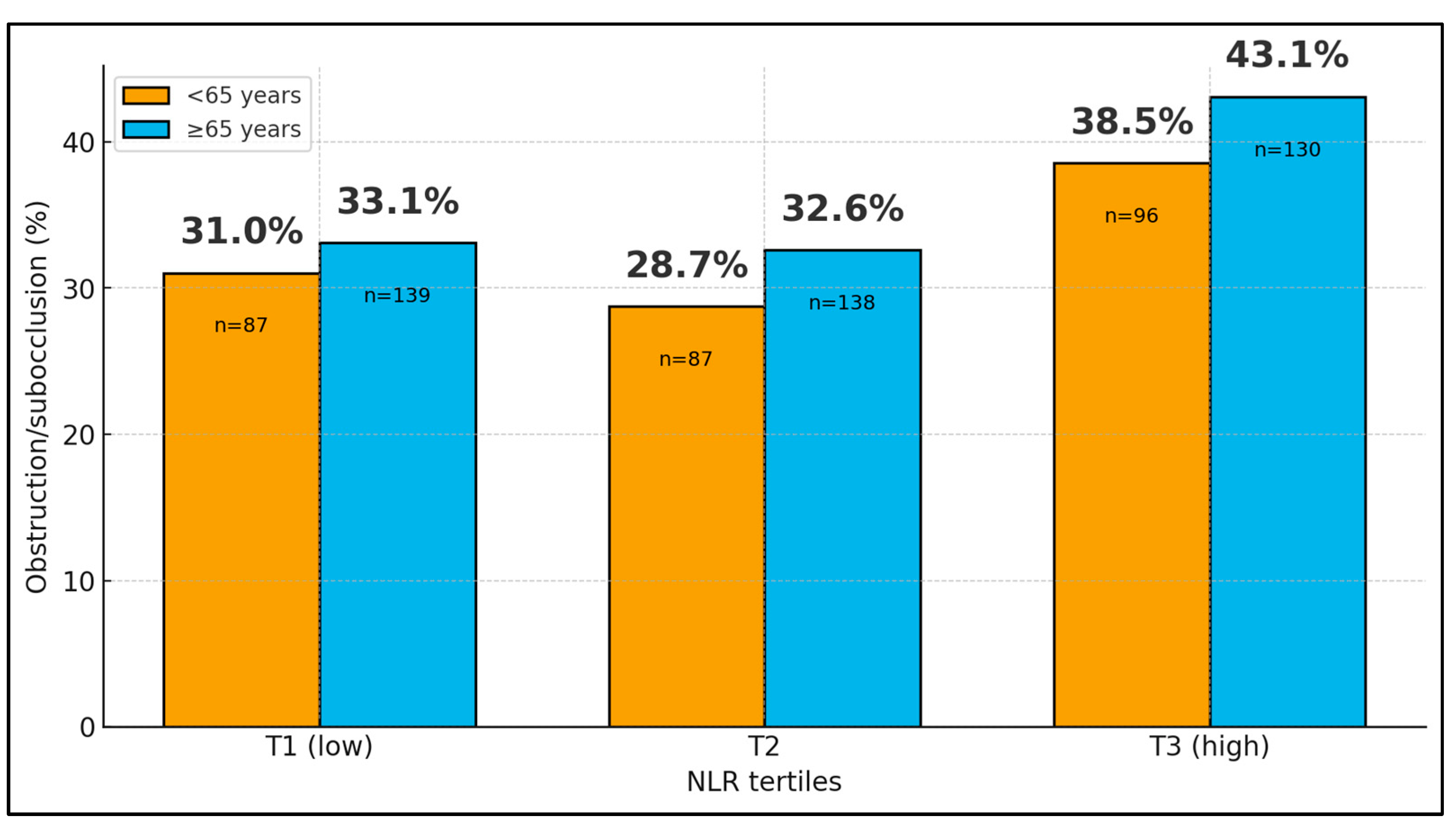
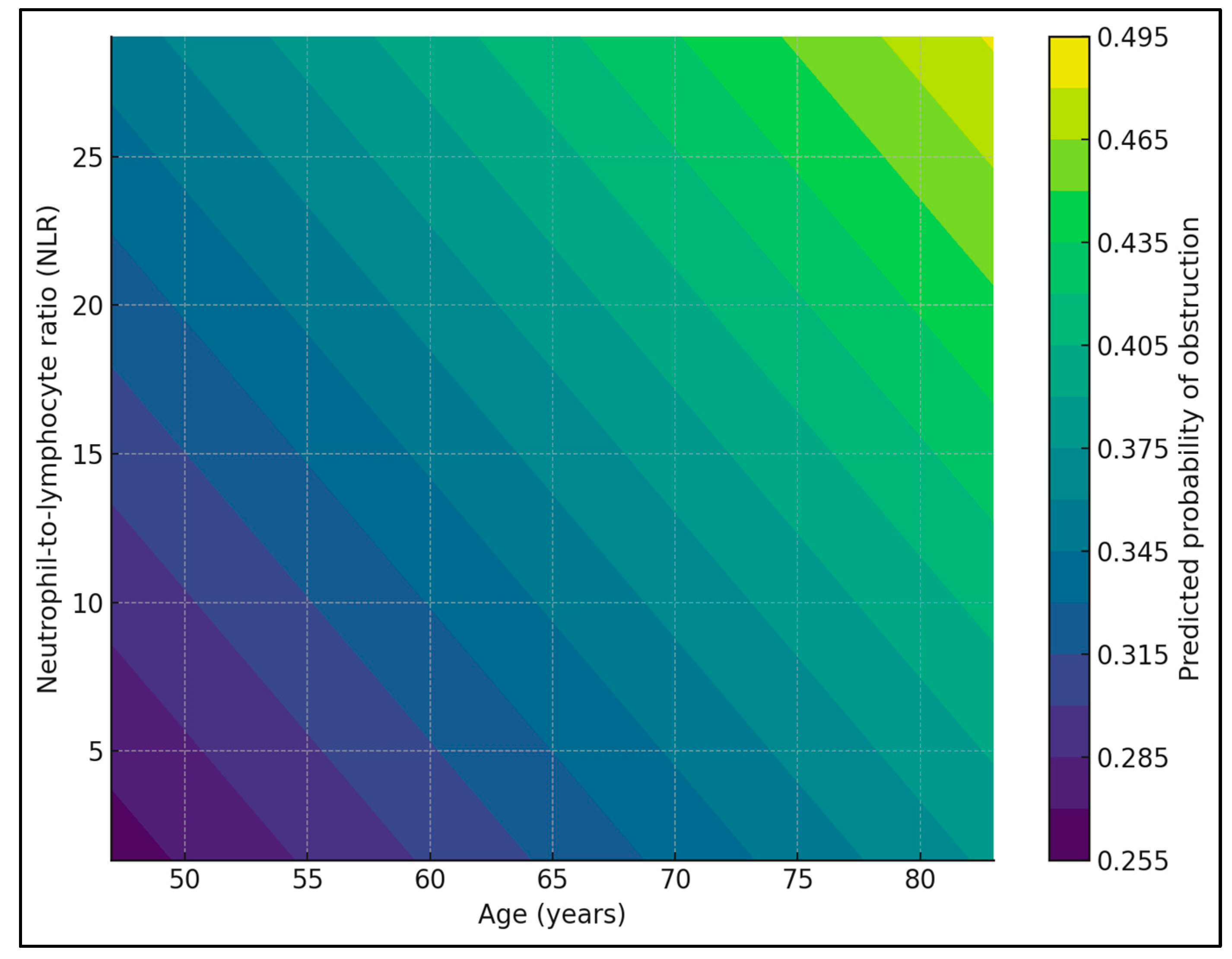
When NLR was categorized into tertiles, the overall proportion of patients with subocclusive or obstructive presentation increased from 32.3% in the lowest tertile (T1, 73/226) to 31.1% in the middle tertile (T2, 70/225) and 41.2% in the highest tertile (T3, 93/226). Stratification by age group showed similar gradients in both younger and older patients: among those <65 years, obstruction rates were 31.0% (27/87), 28.7% (25/87), and 38.5% (37/96) across T1, T2, and T3, respectively; in patients ≥ 65 years, the corresponding rates were 33.1% (46/139), 32.6% (45/138), and 43.1% (56/130). In a multivariable logistic model adjusting for age group, belonging to the highest NLR tertile versus the lowest was associated with a 47% increase in the odds of obstructive presentation (OR 1.48; 95% CI 1.00–2.17;
p = 0.048), whereas age group itself was not a significant predictor (
p = 0.35), as seen in
Figure 1 and
Figure 2.
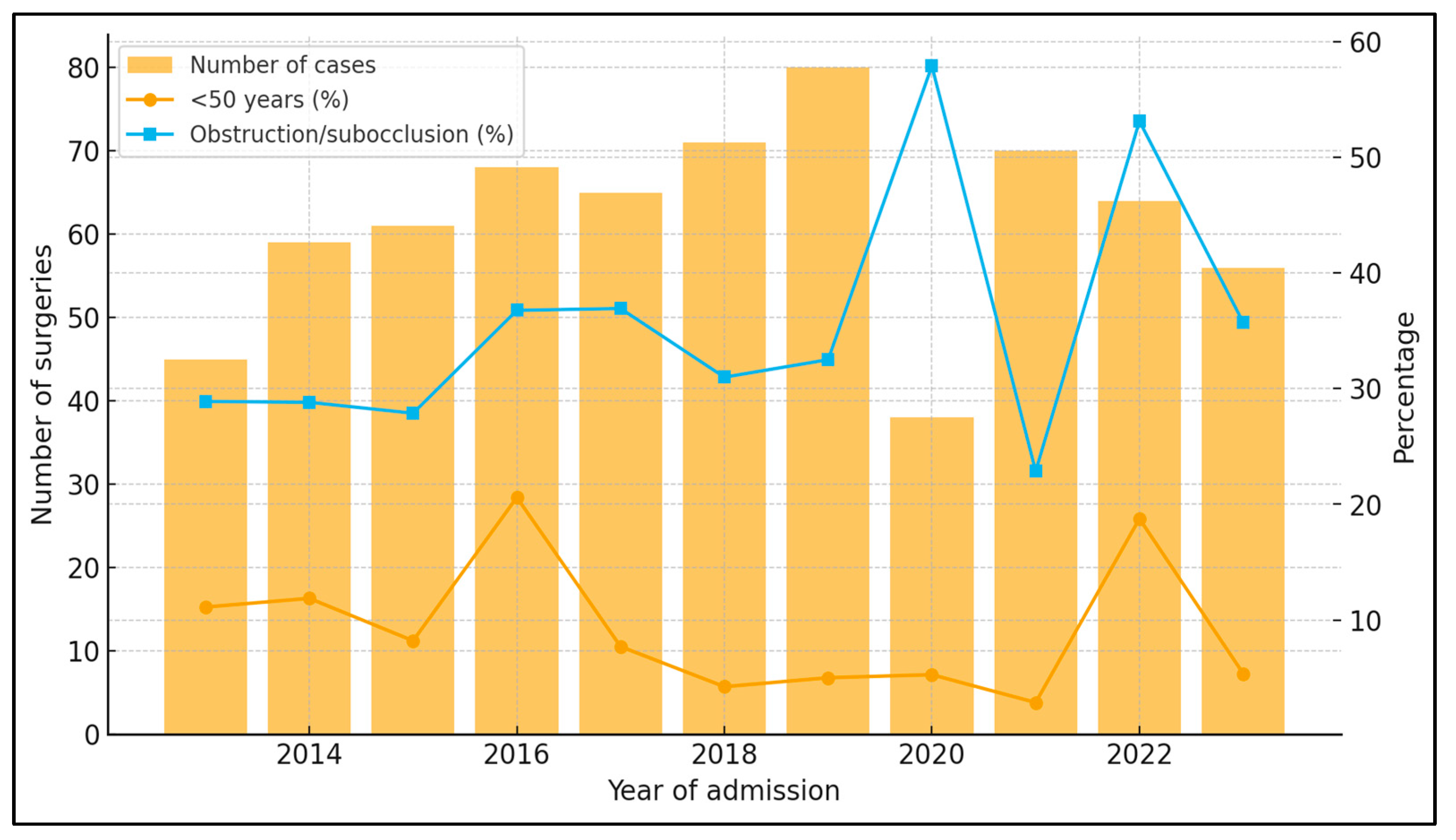
Between 2013 and 2023, the institutional caseload ranged from 38 to 80 colon cancer surgeries per year, with mean age consistently around 65–68 years (
Table 11). The proportion of early-onset cases (<50 years) fluctuated between ~3% and ~21% without a clear linear trend (logistic regression with year as a continuous predictor: OR 0.94 per year; 95% CI 0.87–1.03;
p = 0.20). The proportion of patients presenting with subocclusive syndrome or frank obstruction varied by calendar year (~23% to ~58%); modeling obstruction (yes/no) against year suggested a modest decrease in the odds of obstructive presentation over time (OR 0.95 per year; 95% CI 0.90–1.00;
p = 0.044).
Between 2013 and 2023, the annual surgical caseload ranged from 38 to 80 patients, with a median of 65 cases/year. The proportion of early-onset colon cancer (<50 years) fluctuated between 2.9% (2021) and 20.6% (2016), with no clear linear trend: logistic regression of early-onset status on calendar year yielded an odds ratio (OR) of 0.94 per year (95% CI 0.87–1.03;
p = 0.20), corresponding to a modeled probability of 11.7% in 2013 versus 7.0% in 2023. In contrast, the percentage of patients presenting with subocclusive syndrome or frank obstruction varied between 22.9% (2021) and 57.9% (2020), as seen in
Figure 3.
Logistic regression showed a modest but significant decrease in the odds of obstructive presentation over time (OR 0.95 per year; 95% CI 0.90–1.00; p = 0.044). Points show observed annual proportions, and the solid line depicts model-fitted probabilities over time (with 95% confidence bands).





 ,
,