1. Introduction
Cardiovascular diseases (CVDs) are a group of disorders of the heart and blood vessels which remain one of the greatest threats to the health of Chinese residents, accounting for 48.98% and 47.35% of deaths in rural and urban areas, respectively [
1]. Globally, it has been estimated that 17.9 million people died from CVDs in 2019, and 23.6 million annual CVD deaths are predicted to occur by 2030 [
2,
3].
Retinal ischemic perivascular lesions (RIPLs) are focal atrophy of the inner nuclear layer (INL) identified on OCT images and were first termed in 2021 [
4]. Acute ischemia of the retina initially develops at the level of the retinal deep capillary plexus, which manifests as paracentral acute middle maculopathy (PAMM). It is believed that RIPLs are the legacy of PAMM lesions [
5]. Recently, RIPLs have been linked to various cardiovascular conditions, such as coronary artery disease [
4], atrial fibrillation [
6,
7], myocardial infarction [
8], cerebral small vessel disease burden [
9], sickle cell maculopathy [
10], carotid artery stenosis (CAS) [
11,
12,
13], and even subclinical cardiovascular diseases [
14]. CAS is a known risk factor for acute cardiovascular events and requires early intervention [
15,
16]. Recognizing high-risk populations among patients with CAS may facilitate better diagnosis and medical management but remains clinically challenging. The aim of this study was to determine if RIPLs are a marker of CVD in a cohort of patients with severe carotid artery stenosis (SCAS). It has been reported that retinal structural and blood flow traits measured by OCT and OCTA are non-invasive markers that reflect systemic vascular biology, so changes in retinal structure were also studied in this research.
2. Materials and Methods
Ethics statement and study design: This was a single-center, prospective, case–control study conducted at Sichuan University, West China Hospital, China. The study was designed and performed following the ethical tenets of the 1964 Helsinki Declaration and approved by the Institute Ethics Committee of West China Hospital with verifiable consent (Approval number: 20231171). Informed consent was obtained from all participants and/or their legal guardians. The details of the study design and patient recruitment have been reported elsewhere [
17]. Briefly, participants with carotid artery stenosis ≥ 70% were included in this study. The participant exclusion criteria were as follows: (1) presented retinopathy other than RIPLs, such as epiretinal membranes, macular holes, retinal artery/vein occlusion, diabetic retinopathy, amblyopia, macular edema, uveitis, etc.; (2) previously received any fundus treatment such as retinal laser, intravitreal injection, vitrectomy, etc.; (3) axial length > 26 mm or mean spherical equivalent < −6 diopters; (4) complicated with neurodegenerative or demyelinating diseases, such as Alzheimer’s disease, Parkinson’s disease, or multiple sclerosis; and (6) poor quality of OCTA images (image quality ≤ 6).
Data collection: Individual medical records were reviewed, and information on age, gender, BMI, blood pressure, smoking and drinking history, prior diagnosis of hypertension, diabetes, and dyslipidemia was recorded. Subjects were classified into the CVD group if they had a diagnosis of coronary heart disease, congestive heart failure, myocardial infarction, atrial fibrillation, or stroke based on evaluations by primary care physicians, and others were classified into the control group.
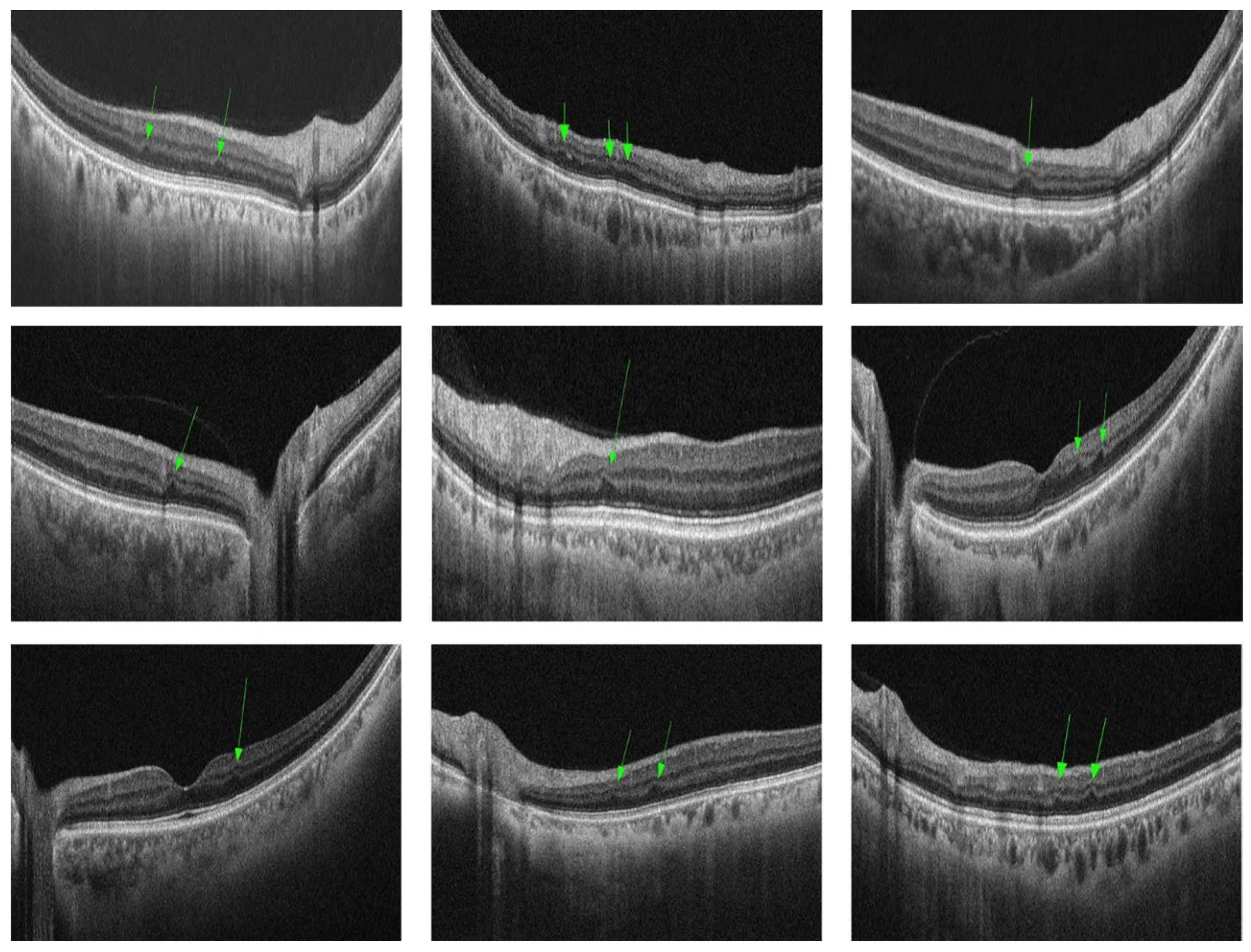
Image analysis: All patients underwent swept-source OCTA (SS-OCTA) imaging covering an area of 16 × 16 volume using a 400 kHz SS-OCTA instrument (TowardPi BMizar; TowardPi Medical Technology, Beijing, China). With an OCTA scan, 1024 OCT B-scans were generated. For each patient, RIPLs were assessed with 1024 OCT images within the range of 16 × 16 volume covered by the OCTA scan. RIPLs were defined as the presence of focal atrophy or thinning of the INL with expanded hyporeflectivity of the ONL on OCT B-scan images. All images were reviewed by 2 independent and masked trained graders. Any discrepancies were resolved by discussion and determined by a third grader.
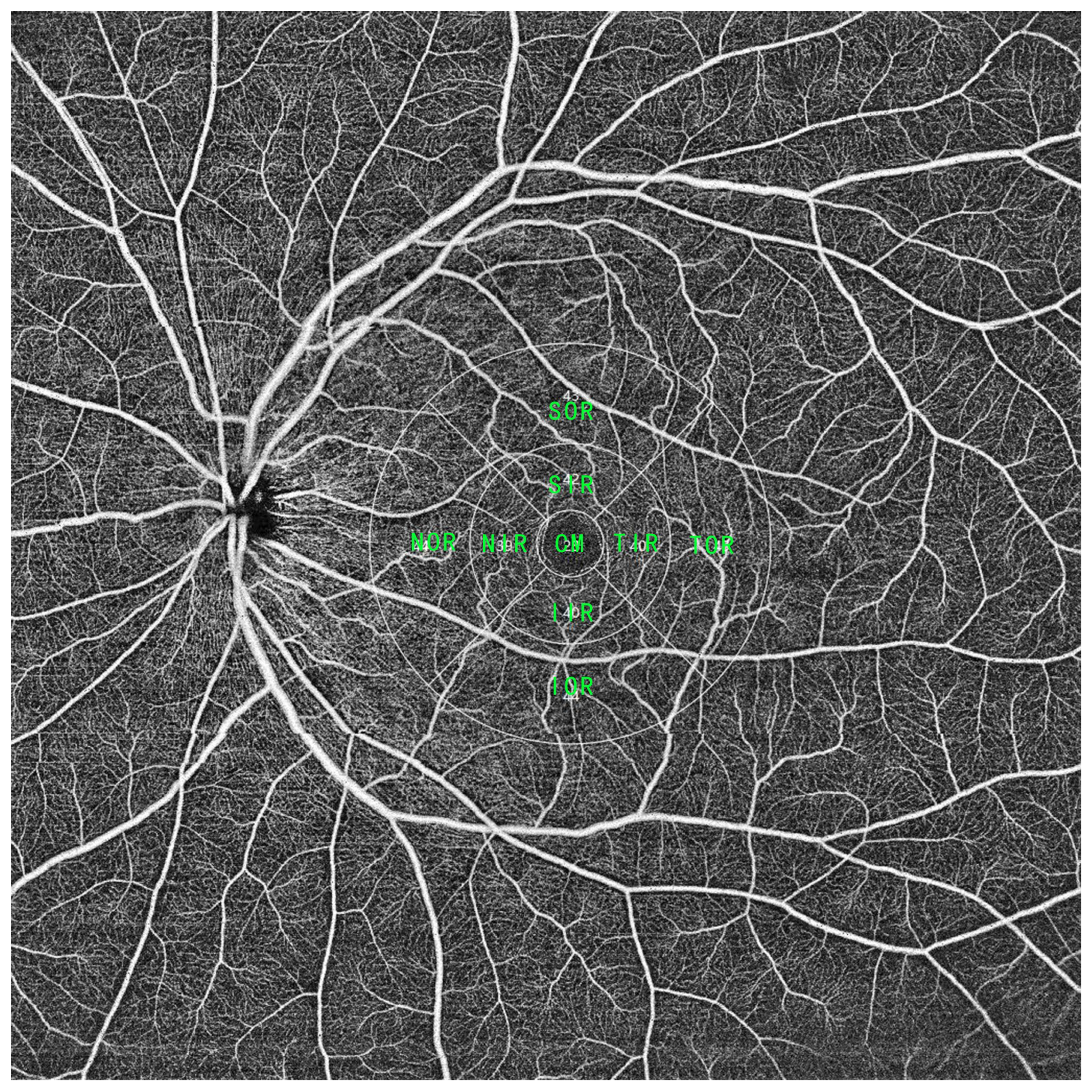
Retinal structure and blood flow assessment: Topographic measurements were performed using the built-in software of Early Treatment Diabetic Retinopathy Study (ETDRS) subfield analysis (
Figure 1). The acquired data were automatically averaged through the following subfields and sectors: the central fovea subfield within the inner 1 mm diameter circle; inner ring: the circle subfield between the 1–3 mm diameter circle and 3–6 mm diameter circle; and outer ring: the circle subfield between the 3–6 mm diameter circle and 6–9 mm diameter circle. The inner and outer circles were sectioned into nasal, temporal, superior, and inferior quadrants. The macular region was finally divided into 9 subfields including the central macula (CM), superior of the inner/outer ring (SIR/SOR), inferior of the inner/outer ring (IIR/IOR), nasal of the inner/outer ring (NIR/NOR), and temporal of the inner/outer ring (TIR/TOR). Retinal structural parameters including the inner retinal thickness (from inner limiting membrane to inner nuclear layer) and outer retinal thickness (from outer plexiform layer to retinal pigment epithelium layer) and retinal blood flow parameters including the vessel density of the retinal superficial vascular complex (VDRSVC) and vessel density of the retinal deep vascular complex (VDRDVC) were calculated automatically by the device.
Statistical analysis: All data were processed using SPSS version 26 (SPSS, Inc., Chicago, IL, USA). Mean and standard deviation were used for describing continuous variables. Frequency with percentages was used for describing categorical variables. Statistical comparisons between groups were performed using independent-sample t-tests and Chi-square tests. The concordance between graders was assessed using the kappa coefficient. A multivariate logistic regression model with stepwise backward selection was used to evaluate the relationship between RIPLs and CVD. Covariates included age, gender, BMI, smoking/drinking status, hypertension, diabetes, and dyslipidemia. p values < 0.05 were considered statistically significant.
3. Results
Demographic characteristics: OCTA images of 155 patients with severe carotid artery stenosis were acquired between September 2023 and January 2024. After excluding patients with prior retinopathy other than RIPLs, a total of 246 eyes from 123 patients (109 males and 14 females) with SCAS were included in the imaging analysis with a mean age of 66.01 ± 24.0 years and mean BMI of 24.0 ± 2.68. Among them, 61 patients (49.6%) presented with CVD, 50 (40.7%) with diabetes mellitus, 82 (66.7%) with hypertension, and 23 (18.7%) with hyperlipidemia. Seventy-two patients (58.5%) had a history of smoking, and fifty-nine patients (48.0%) had a history of drinking (
Table 1).
We identified 61 patients with CVD as cases and 62 patients without CVD as controls. The baseline characteristics for cases and controls are shown in
Table 2. There was no difference between the two groups in terms of age, sex distribution, DM, HT, HL, smoking, drinking, visual acuity, or visual symptoms. The BMI was significantly greater in patients with CVD (24.60 ± 2.79) than in patients without CVD (23.41 ± 2.56,
p = 0.013).
Retinal structural and blood flow assessment: As shown in
Table 3, compared with patients without CVD, the inner retinal thickness of patients with CVD in the subfields of NIR (122.6 mm ± 14.5 vs. 128.0 mm ± 13.6,
p = 0.035) and TOR (100.3 mm ± 10.7 vs. 105.4 mm ± 14.0,
p = 0.024) was significantly lower. The outer retinal thickness in the subfield of IOR was significantly higher in the CVD group compared with the non-CVD group (198.7 mm ± 24.3 vs. 191.0 mm ± 15.2,
p = 0.037). The VDRSVC in the subfields of IIR (37.4 ± 3.9 vs. 40.5 ± 2.9,
p < 0.001), TOR (38.1 ± 3.0 vs. 40.9 ± 3.1,
p < 0.001), and IOR (41.5 ± 3.4 vs. 43.8 ± 3.7,
p = 0.001) was significantly lower in the CVD group compared with the non-CVD group. The VDRDVC in the subfield of IIR (39.0 ± 4.4 vs. 42.4 ± 4.4,
p < 0.001) was significantly lower in the CVD group compared with the non-CVD group.
Identification of retinal ischemic perivascular lesions (RIPLs): After reviewing all the B-scan and blood flow images, we identified a total of 53 patients (43.1%) presenting with RIPLs (
Figure 2). Of them, 39 patients (31.7%) had ipsilateral RIPLs, 29 patients (23.6%) had contralateral RIPLs, and 16 patients (13.0%) had bilateral RIPLs (
Table 4). The inter-rater agreement between the two original graders for the detection of RIPLs was 85.4% with a kappa coefficient of 0.70 (
p < 0.001).
Association between RIPLs and CVD: The percentage of subjects with RIPLs, ipsilateral RIPLs, contralateral RIPLs, and bilateral RIPLs was higher in patients with CVD compared with patients without CVD (55.7% versus 30.6%, p = 0.006; 42.6% vs. 30.0%, p = 0.012, 31.1% vs. 16.1%, p = 0.05, 21.3% vs. 4.8%, p = 0.007).
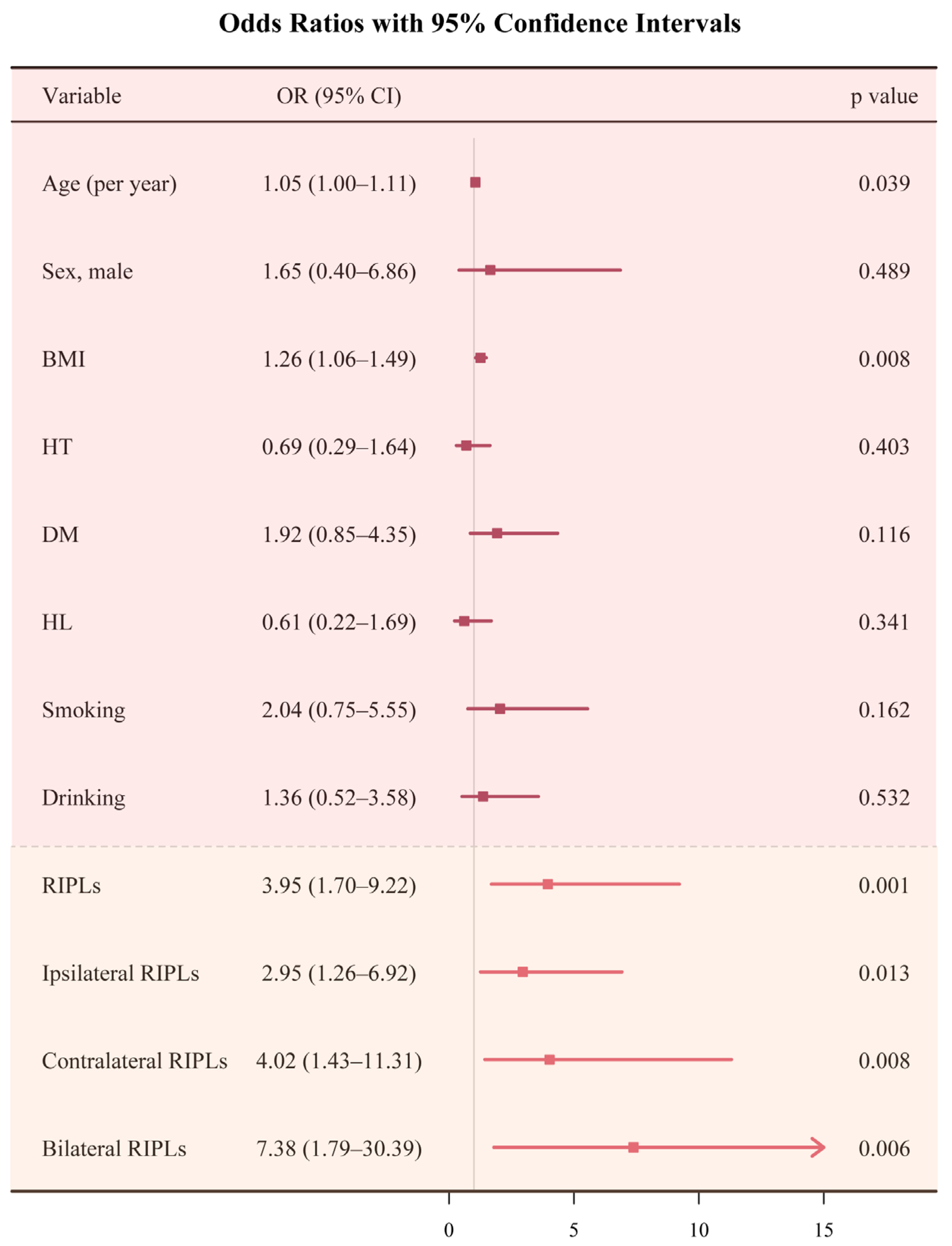
In a multivariable logistic regression model adjusted for covariates, age, BMI, and the presence of RIPLs were significantly associated with CVD (OR = 1.053 [1.003–1.106],
p = 0.039; OR = 1.259 [1.063–1.490],
p = 0.008; OR = 3.953 [1.695–9.219],
p = 0.001). Subgroup analysis revealed that bilateral RIPLs, contralateral RIPLs, and ipsilateral RIPLs were significantly associated with CVD (OR = 7.383 [1.749–30.393],
p = 0.006; OR = 4.024 [1.432–11.306],
p = 0.008; OR = 2.951 [1.258–6.921],
p = 0.013), with bilateral RIPLs showing the greatest risk (
Table 5,
Figure 3).
4. Discussion
In the present study, we found lower inner retinal thickness, higher outer retinal thickness, and lower VDRSVC and VDRDVC in SCAS patients with CVD compared with patients without CVD. We also demonstrated a higher prevalence of RIPLs, as detected by OCT imaging, in patients with CVD compared to those without in a cohort of individuals with SCAS. Specifically, in the subgroup analysis, bilateral RIPLs showed the greatest risk, followed by contralateral RIPLs and ipsilateral RIPLs.
The association between RIPLs and CVD has been evaluated in previous studies. Christopher et al. reported a higher number of RIPLs in patients with documented cardiovascular disease compared to healthy controls, and each RIPL was associated with an odds ratio of having cardiovascular disease of 1.60, and individuals with higher 10-year atherosclerotic cardiovascular disease scores had more RIPLs [
4]. Another study by them reported newly diagnosed cardiovascular disease in 72.7% of cases with priorly documented RIPLs [
14]. Recently, a prospective study also found a higher prevalence of RIPLs in patients with ischemic CVD or risk factors compared to healthy controls [
18]. The association between RIPLs and CAS has also been evaluated in several studies. David et al. reported a higher mean number of RIPLs in patients with CAS compared to age-matched controls [
11,
13]. In their study, a high incidence of RIPLs of 91% was reported in a cohort of 22 CAS patients (11 had medically managed <60% stenosis, and 11 had a history of CAS treated with carotid endarterectomy). Another study found an association between RIPL presence, number, and distribution and the stenotic degree in patients with CAS, and an incidence of RIPL presence of 52% was reported in patients with 90–99% stenosis [
12].
In the present study, we recruited CAS patients with stenosis > 70% which were at high risk of developing cardiovascular events and investigated the association between RIPLs and CVD in this specific group of patients, which was important for identifying high-risk patients and guiding further medical management. We found an overall RIPL incidence of 42.3% in patients with stenosis > 70%. The results of multivariable logistic regression analysis revealed that the presence of ipsilateral, contralateral, and bilateral RIPLs was associated with an increased risk of CVD, indicating the importance of screening for cardiovascular conditions in the management of high-risk CAS patients with RIPLs. Bilateral RIPLs showed the greatest risk, followed by contralateral and ipsilateral RIPLs. This emphasizes the necessity of evaluating both eyes in risk assessment. To relieve the ipsilateral compromised cerebral vascular condition, the blood flow of the contralateral hemisphere would be directed to the ipsilateral hemisphere via the anterior communicating artery, which means unilateral CAS may cause bilateral ocular ischemia. In a recent study [
12], researchers also found increased contralateral RIPLs with an increased stenotic degree in patients with CAS, showing the effect of decreased ipsilateral ocular perfusion on the fellow eye. Age and BMI were also found to be associated with CVD in our study, which were reported risk factors for CVD in previous studies [
19]. However, recently, a study by Bellanda et al. [
20], which prospectively included a total of 559 patients, demonstrated no significant association between RIPLs and a history of major cardiac adverse events. Their sample consisted of patients presenting to a cardiology clinic, and they found an overall RIPL prevalence of 26.3%, which differed from our sample of patients with SCAS, which was a highly selected group of patients with an overall RIPL prevalence of 43.1%. This may indicate that the association between RIPLs and cardiovascular risk does not extend to a broader population of patients.
Ocular microvasculature is thought to have identical physiological and anatomical features to cerebral and coronary microcirculation. It has been shown that retinal vascular alterations could reflect systemic processes including cardiovascular diseases [
21]. Retinal vascular features such as retinal nerve fiber thickness, retinal vessel density, the foveal avascular zone, and the retinal vascular fractal dimension have been linked to cardiovascular risks [
22,
23,
24,
25]. In the present study, we found decreased VDRSVC and VDRDVC in CVD patients, which is consistent with previous studies. However, we also detected thinner inner retinal thickness and thicker outer retinal thickness in patients with CVD, which was a new finding. RIPLs are considered to be the legacy of PAMM lesions and refer to a characteristic focal thinning of the INL because of retinal ischemia which initially affects the deep retinal vascular complex. However, unlike outer retinal atrophy in retinal artery occlusion, a compensatory upward expansion of the ONL is presented in RIPLs, possibly to increase the ability to receive light signals. This may be responsible for the increased outer retinal thickness found in the present study. These changes were consistent with our findings of retinal changes in patients with CVD, who have a higher presence of RIPLs.
We have to acknowledge the limitations of this study. Firstly, this is a cross-sectional study, which was unable to assess the predictive value of RIPLs for the development of cardiovascular events, and this should be further investigated in future studies. Secondly, the diagnoses of CVDs were based on chart reviews, which may be inaccurate and lack consistency. Thirdly, the number of RIPLs in each patient was not assessed, which should be explored in future studies.
5. Conclusions
This study investigated the association between RIPLs and CVD in SCAS patients, in a highly selected high-risk cohort, and established a link between RIPLs and CVD in patients with SCAS. These findings emphasize the utility of RIPL detection in the risk assessment of cardiovascular conditions for patients with SCAS.
Author Contributions
L.Z.: conceptualization, methodology, data curation, formal analysis, and writing—original draft; Y.-Y.C.: data curation, methodology, formal analysis, visualization, and software; C.-Y.L.: data curation and formal analysis; F.-P.J.: data curation and formal analysis; T.-Y.Y.: data curation and formal analysis; Z.-H.X.: data curation and formal analysis; S.G.: conceptualization, supervision, and writing—review and editing; M.-X.Z.: conceptualization, supervision, funding acquisition, and writing—review and editing. All authors reviewed and endorsed the final version of the manuscript. All authors have read and agreed to the published version of the manuscript.
Funding
This research was funded by the Chengdu Municipal Science and Technology Bureau Key R&D Support Program, grant number 2023-YF09-00041-SN.
Institutional Review Board Statement
The study was conducted in accordance with the Declaration of Helsinki and approved by the Institutional Ethics Committee of West China Hospital with verifiable consent (Approval number: 20231171), on 2 August 2023.
Informed Consent Statement
Informed consent was obtained from all subjects involved in the study. Written informed consent was obtained from the patient(s) to publish this paper.
Data Availability Statement
The datasets used and/or analyzed during the current study are available from the corresponding author on reasonable request.
Conflicts of Interest
The authors declare no conflicts of interest.
Abbreviations
The following abbreviations are used in this manuscript:
| RIPLs | Retinal ischemic perivascular lesions |
| CVDs | Cardiovascular diseases |
| SCAS | Severe carotid artery stenosis |
| INL | Inner nuclear layer |
| PAMM | Paracentral acute middle maculopathy |
| SS-OCTA | Swept-source optical coherence tomography angiography |
| VDRSVC | Vessel density of the retinal superficial vascular complex |
| VDRDVC | Vessel density of the retinal deep vascular complex |
| BMI | Body mass index |
| HT | Hypertension |
| DM | Diabetes mellitus |
| HL | Hyperlipidemia |
References
- National Center for Cardiovascular Diseases the Writing Committee of the Report on Cardiovascular Health and Diseases in China. Report on Cardiovascular Health and Diseases in China 2023: An Updated Summary. Biomed. Environ. Sci. 2024, 37, 949–992. [Google Scholar] [CrossRef]
- Goldsborough, E.; Osuji, N., 3rd; Blaha, M.J. Assessment of Cardiovascular Disease Risk: A 2022 Update. Endocrinol. Metab. Clin. N. Am. 2022, 51, 483–509. [Google Scholar] [CrossRef]
- Roth, G.A.; Mensah, G.A.; Johnson, C.O.; Addolorato, G.; Ammirati, E.; Baddour, L.M.; Barengo, N.C.; Beaton, A.Z.; Benjamin, E.J.; Benziger, C.P. Global Burden of Cardiovascular Diseases and Risk Factors, 1990–2019: Update From the GBD 2019 Study. J. Am. Coll. Cardiol. 2020, 76, 2982–3021. [Google Scholar] [CrossRef] [PubMed]
- Long, C.P.; Chan, A.X.; Bakhoum, C.Y.; Toomey, C.B.; Madala, S.; Garg, A.K.; Freeman, W.R.; Goldbaum, M.H.; DeMaria, A.N.; Bakhoum, M.F. Prevalence of subclinical retinal ischemia in patients with cardiovascular disease—A hypothesis driven study. eClinicalMedicine 2021, 33, 100775. [Google Scholar] [CrossRef]
- Limoli, C.; Khalid, H.; Wagner, S.K.; Huemer, J. Retinal Ischemic Perivascular Lesions (RIPLs) as Potential Biomarkers for Systemic Vascular Diseases: A Narrative Review of the Literature. Ophthalmol. Ther. 2025, 14, 1183–1197. [Google Scholar] [CrossRef]
- Bakhoum, C.Y.; Au, A.; Bousquet, E.; Matesva, M.; Singer, M.B.; Jayaraj, C.; Romero-Morales, V.A.; Somisetty, S.; Santina, A.; Bajar, B.; et al. Retinal Ischemic Perivascular Lesions Are Associated with Stroke in Individuals with Atrial Fibrillation. J. Am. Heart Assoc. 2024, 13, e035079. [Google Scholar] [CrossRef] [PubMed]
- Bakhoum, C.Y.; Madala, S.; Lando, L.; Yarmohammadi, A.; Long, C.P.; Miguez, S.; Chan, A.X.; Singer, M.; Jin, A.; Steren, B.J.; et al. Retinal Ischemic Perivascular Lesions in Individuals with Atrial Fibrillation. J. Am. Heart Assoc. 2023, 12, e028853. [Google Scholar] [CrossRef]
- Bousquet, E.; Santina, A.; Au, A.; Somisetty, S.; Abraham, N.; Voichanski, S.; Estawro, R.; Fouad, Y.A.; Romero-Morales, V.; Bakhoum, M.F.; et al. Retinal Ischemic Perivascular Lesions Are Associated with Myocardial Infarction in Patients with Coronary Artery Disease. Am. J. Ophthalmol. 2024, 264, 224–228. [Google Scholar] [CrossRef]
- Kwapong, W.R.; Yan, Y.; Cao, L.; Wang, H.; Ye, C.; Jiang, S.; Tao, W.; Wu, B. Retinal Ischemic Perivascular Lesion Reflects Cerebral Small Vessel Disease Burden in Single Subcortical Infarction. J. Am. Heart Assoc. 2024, 13, e033081. [Google Scholar] [CrossRef]
- Delhiwala, K.; Shah, K.; Khamar, B. Retinal ischemic perivascular lesions and sickle cell maculopathy. Can. J. Ophthalmol. 2024, 59, e85–e86. [Google Scholar] [CrossRef] [PubMed]
- Zhang, D.L.; Zhang, K.X.; Cheng, B.T.; Heisel, C.J.; Nadel, A.; Eskandari, M.K.; Mirza, R.G. Retinal Ischemic Perivascular Lesions are Increased in Carotid Artery Stenosis. Ophthalmol. Retina 2023, 7, 1020–1022. [Google Scholar] [CrossRef]
- Wang, H.; Cao, L.; Kwapong, W.R.; Liu, R.; Yan, Y.; Wan, J.; Liu, G.; Hu, F.; Wu, B. Retinal ischemic perivascular lesions are associated with increased carotid artery stenotic degree. Retina 2025, 45, 748–755. [Google Scholar] [CrossRef]
- Drakopoulos, M.; Zhang, D.L.; Cheng, B.T.; Sadiq, S.A.; Nadel, A.; Marchese, A.; Eskandari, M.; Mirza, R.G. Swept-source optical coherence tomography angiography metrics of retinal ischaemic perivascular lesions in patients being evaluated for carotid artery stenosis and controls. BMJ Open Ophthalmol. 2023, 8, e001226. [Google Scholar] [CrossRef]
- Madala, S.; Adabifirouzjaei, F.; Lando, L.; Yarmohammadi, A.; Long, C.P.; Bakhoum, C.Y.; Goldbaum, M.H.; Sarraf, D.; DeMaria, A.N.; Bakhoum, M.F. Retinal Ischemic Perivascular Lesions, a Biomarker of Cardiovascular Disease. Ophthalmol. Retina 2022, 6, 865–867. [Google Scholar] [CrossRef]
- Poorthuis, M.H.F.; Hageman, S.H.J.; Fiolet, A.T.L.; Kappelle, L.J.; Bots, M.L.; Steg, P.G.; Visseren, F.L.; Bhatt, D.L.; de Borst, G.J. Prediction of Severe Baseline Asymptomatic Carotid Stenosis and Subsequent Risk of Stroke and Cardiovascular Disease. Stroke 2024, 55, 2632–2640. [Google Scholar] [CrossRef] [PubMed]
- Poorthuis, M.H.F.; Sherliker, P.; De Borst, G.J.; Clack, R.; Lewington, S.; Clarke, R.; Bulbulia, R.; Halliday, A. Detection rates of asymptomatic carotid artery stenosis and atrial fibrillation by selective screening of patients without cardiovascular disease. Int. J. Cardiol. 2023, 391, 131262. [Google Scholar] [CrossRef]
- Zhang, L.; Liu, J.W.; Tang, Q.Q.; Lei, C.-Y.; Lin, X.; Gao, S.; Yang, T.-Y.; Hu, F.-Y.; Zhang, M.-X. Decreased Choriocapillaris Vessel Density in the Ipsilateral Eye after Carotid Artery Revascularization Detected by Widefield Swept-Source OCT Angiography. Ophthalmol. Sci. 2025, 5, 100654. [Google Scholar] [CrossRef] [PubMed]
- Carretero, M.M.; Parejo, A.; Pérez, M.B.; Amores, R.R.; Gómez, Á.P.; Martinez-Perez, C. Retinal Ischemic Perivascular Lesions: An Exploratory Study of Their Potential as Biomarkers for Cardiovascular Disease. J. Clin. Med. 2025, 14, 3837. [Google Scholar] [CrossRef] [PubMed]
- Junaid, V.; Hinkamp, C.; Hamid, A.; Jabbar, A.B.A.; Minhas, A.M.K.; Inam, M.; Khoja, A.; Sheikh, S.; Krittanawong, C.; Vaughan, E.M.; et al. Highlights of Cardiovascular Disease Prevention Studies Presented at the 2025 American College of Cardiology Conference. Curr. Atheroscler. Rep. 2025, 27, 67. [Google Scholar] [CrossRef]
- Bellanda, V.; Delaney, A.; Schulgit, M.J.; Barbosa, G.C.S.; Arline, A.; Mizuno, Y.; Mohan, N.; Rajasekar, B.; Bala, S.; Mahmoud, M.; et al. Screening for Retinal Ischemic Perivascular Lesions in Patients Undergoing Cardiovascular Assessment: A Cross-Sectional Study. Ophthalmol. Retina. 2025. Epub ahead of print. [Google Scholar] [CrossRef] [PubMed]
- Monteiro-Henriques, I.; Rocha-Sousa, A.; Barbosa-Breda, J. Optical coherence tomography angiography changes in cardiovascular systemic diseases and risk factors: A Review. Acta Ophthalmol. 2022, 100, e1–e15. [Google Scholar] [CrossRef]
- Sturm, B.; Zang, A.L.; Stingl, J.; Hasseli-Fräbel, R.; Fanouriakis, A.; Schwarting, A.; Geber, C.; Weinmann-Menke, J.; Alhaddad, M.; Triantafyllias, K. Ocular markers of microangiopathy and their possible association with cardiovascular risk in patients with systemic inflammatory rheumatic diseases: A systematic review. Front. Immunol. 2025, 16, 1543157. [Google Scholar] [CrossRef] [PubMed]
- Lian, Y.; Li, G.; Liu, H.; Zhang, Q. Fractal analysis of retinal microvasculature and cardiovascular outcome: A systematic review and meta-analysis. BMC Ophthalmol. 2025, 25, 668. [Google Scholar] [CrossRef] [PubMed]
- Chua, J.; Tan, B.; Wong, D.; Garhöfer, G.; Liew, X.W.; Popa-Cherecheanu, A.; Chin, C.W.L.; Milea, D.; Chen, C.L.-H.; Schmetterer, L. Optical coherence tomography angiography of the retina and choroid in systemic diseases. Prog. Retin. Eye Res. 2024, 103, 101292. [Google Scholar] [CrossRef]
- Wang, J.; Wang, Y.X.; Zeng, D.; Zhu, Z.; Li, D.; Liu, Y.; Sheng, B.; Grzybowski, A.; Wong, T.Y. Artificial intelligence-enhanced retinal imaging as a biomarker for systemic diseases. Theranostics 2025, 15, 3223–3233. [Google Scholar] [CrossRef] [PubMed]
| Disclaimer/Publisher’s Note: The statements, opinions and data contained in all publications are solely those of the individual author(s) and contributor(s) and not of MDPI and/or the editor(s). MDPI and/or the editor(s) disclaim responsibility for any injury to people or property resulting from any ideas, methods, instructions or products referred to in the content. |




 ,
,