Comparison Between RIRS and Mini-PCNL in the Treatment of Kidney Stones Exceeding 15 mm: Outcome Evaluation and Cost Analysis

 , , , , , ,
  , , , and
Abstract
1. Introduction
2. Materials and Methods
2.1. Study Design, Population, and Data Collection
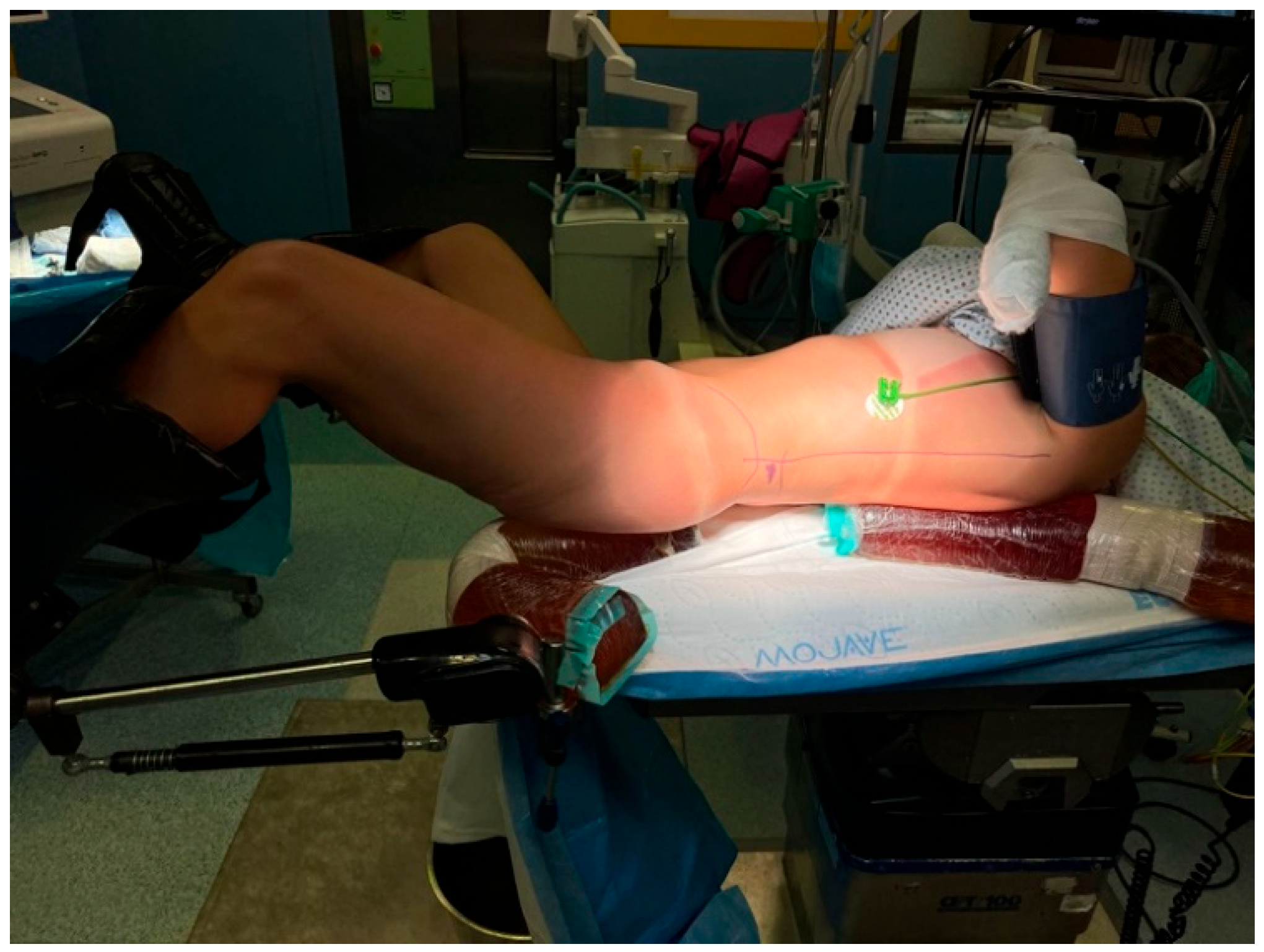
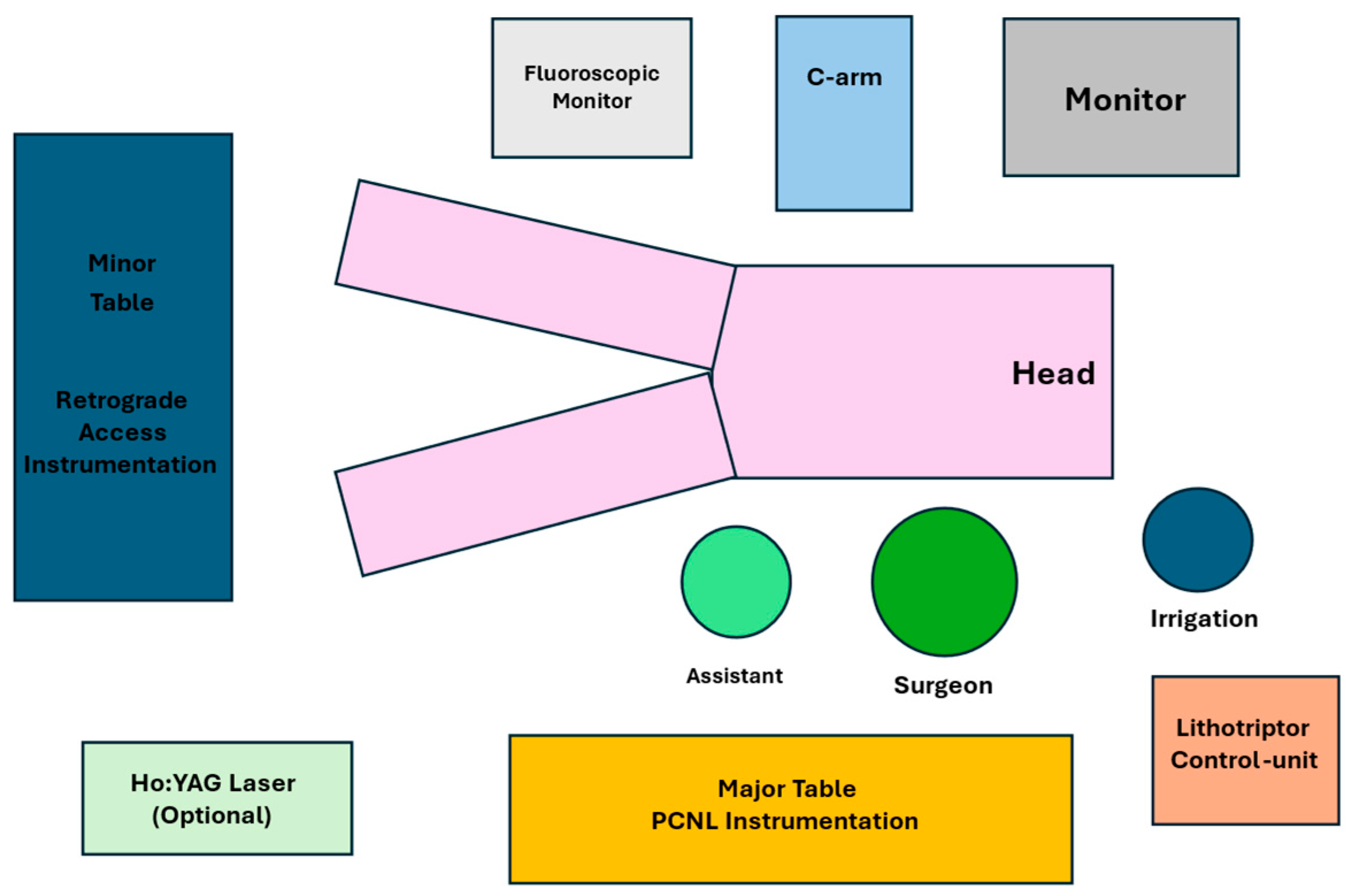
2.2. Surgical Technique and Instrumentation Used in RIRS
2.3. Surgical Technique and Instrumentation Used in the Mini-PCNL
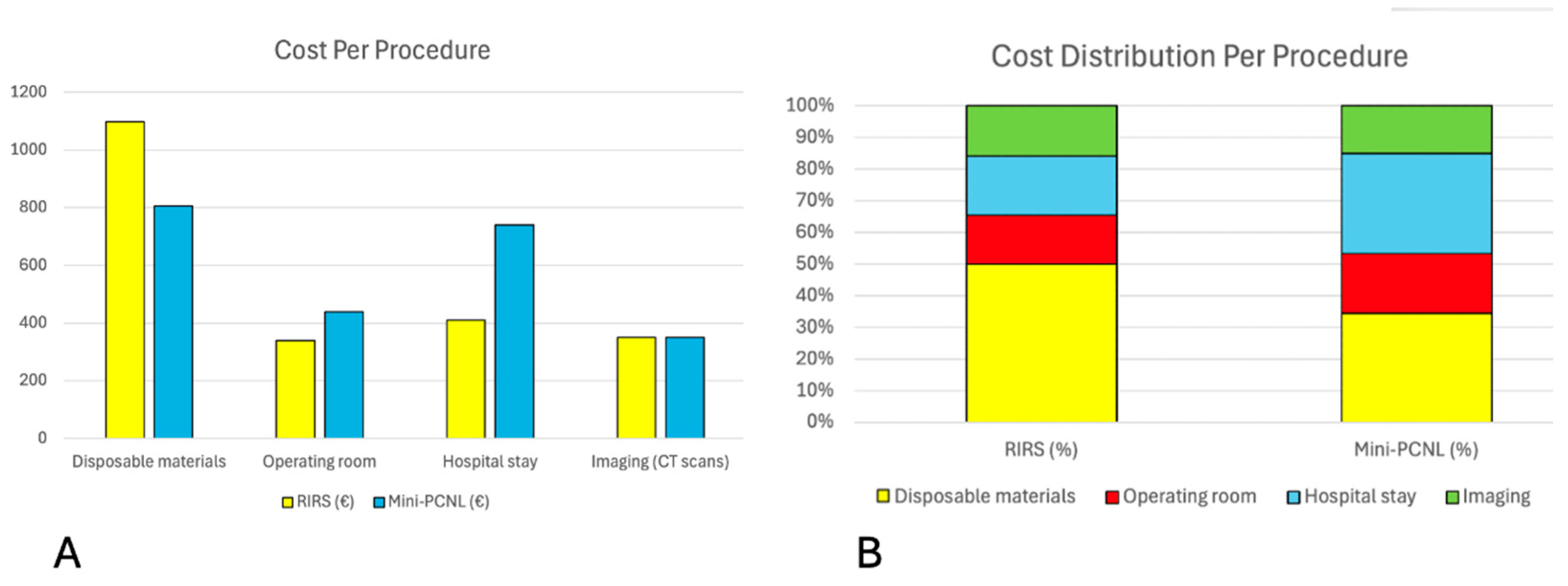
2.4. Cost Analysis
2.5. Statistical Analysis
3. Results
3.1. Baseline Characteristics and Postoperative Outcomes
3.2. Postoperative Outcomes
3.3. Multivariable Analysis
3.4. Cost Analysis
3.4.1. Direct Costs
3.4.2. Indirect Costs
3.4.3. Re-Intervention Costs
4. Discussion
5. Limitations
6. Conclusions
Supplementary Materials
Author Contributions
Funding
Institutional Review Board Statement
Informed Consent Statement
Data Availability Statement
Conflicts of Interest
Abbreviations
| AUA | American Urological Association |
| BMI | Body mass index |
| CIRF | clinically insignificant residual fragments |
| CT | Computed tomography |
| Dmax | Maximum stone diameter |
| DRG | Diagnosis-related group |
| EAU | European Association of Urology |
| ESWL | Extracorporeal shock wave lithotripsy |
| Hb | Hemoglobin |
| HDI | Human Development Index |
| HU | Hounsfield unit |
| ICOT | Istituto Chirurgico Ortopedico Traumatologico |
| LoS | Length of stay |
| mini-PCNL | Mini-percutaneous nephrolithotomy |
| NHS | National Health Service |
| OR | Operating room |
| OT | Operative time |
| PCNL | Percutaneous nephrolithotomy |
| POD | Postoperative say |
| PUJ | Pyelo-ureteral junction |
| QoL | Quality of life |
| RIRS | Retrograde intrarenal surgery |
| SD | Standard deviation |
| SF | Stone-free |
| SFR | Stone-free rate |
| URS | Ureteroscopy |
| WBC | White blood cell count |
References
- Stamatelou, K.K.; Francis, M.E.; Jones, C.A.; Nyberg, L.M.; Curhan, G.C. Time trends in reported prevalence of kidney stones in the United States: 1976–1994. Kidney Int. 2003, 63, 1817–1823. [Google Scholar] [CrossRef] [PubMed]
- Izzo, F.; Langella, A.; Germinario, C.; Grifa, C.; Varricchio, E.; Di Meo, M.C.; Salzano, L.; Lotrecchiano, G.; Mercurio, M. Morpho-Constitutional Classification of Urinary Stones as Prospective Approach for the Management of Human Pathological Biomineralization: New Insights from Southern Italy. Minerals 2022, 12, 1421. [Google Scholar] [CrossRef]
- Iossa, A.; Pastore, A.L.; Coluzzi, I.; Valenzi, F.M.; De Angelis, F.; Bellini, D.; Lelli, G.; Cavallaro, G. Bariatric surgery does not affect kidney stone disease. Sci. Rep. 2024, 14, 30193. [Google Scholar] [CrossRef] [PubMed] [PubMed Central]
- Hesse, A.; Brändle, E.; Wilbert, D.; Köhrmann, K.U.; Alken, P. Study on the prevalence and incidence of urolithiasis in Germany comparing the years 1979 vs. 2000. Eur. Urol. 2003, 44, 709–713. [Google Scholar] [CrossRef]
- Sánchez-Martín, F.M.; Millán Rodríguez, F.; Esquena Fernández, S.; Segarra Tomás, J.; Rousaud Barón, F.; Martínez-Rodríguez, R.; Villavicencio Mavrich, H. Incidence and prevalence of published studies about urolithiasis in Spain. A review. Actas Urol. Esp. 2007, 31, 511–520. [Google Scholar] [CrossRef]
- Scales, C.D., Jr.; Smith, A.C.; Hanley, J.M.; Saigal, C.S.; Urologic Diseases in America Project. Prevalence of kidney stones in the United States. Eur. Urol. 2012, 62, 160–165. [Google Scholar] [CrossRef]
- Shafi, H.; Moazzami, B.; Pourghasem, M.; Kasaeian, A. An overview of treatment options for urinary stones. Casp. J. Intern. Med. 2016, 7, 1–6. [Google Scholar]
- Skolarikos, A.; Geraghty, R.; Somani, B.; Tailly, T.; Jung, H.; Neisius, A.; Petřík, A.; Kamphuis, G.M.; Davis, N.; Bezuidenhout, C.; et al. European Association of Urology Guidelines on the Diagnosis and Treatment of Urolithiasis. Eur. Urol. 2025, 88, 64–75. [Google Scholar] [CrossRef]
- Association, A.U. Kidney Stones: Surgical Management Guideline. Available online: https://www.auanet.org/guidelines-and-quality/guidelines/surgical-management-of-kidney-and-ureteral-stones (accessed on 12 December 2025).
- Ministero Della Salute. Tariffe Nazionali per le Prestazioni di Assistenza Ospedaliera per Acuti Erogate in Regime di Ricovero Ordinario e Diurno (DRG 2023); Gazzetta Ufficiale della Repubblica Italiana—Serie Generale n. 23; Italian State Printing Office and Mint: Rome, Italy, 2023. [Google Scholar]
- Tan, S.S.; Rutten, F.F.; van Ineveld, B.M.; Redekop, W.K.; Hakkaart-van Roijen, L. Comparing methodologies for the cost estimation of hospital services. Eur. J. Health Econ. 2009, 10, 39–45. [Google Scholar] [CrossRef]
- Assimos, D.; Krambeck, A.; Miller, N.L.; Monga, M.; Murad, M.H.; Nelson, C.P.; Pace, K.T.; Pais, V.M., Jr.; Pearle, M.S.; Preminger, G.M.; et al. Surgical Management of Stones: American Urological Association/Endourological Society Guideline, PART I. J. Urol. 2016, 196, 1153–1160. [Google Scholar] [CrossRef]
- Inoue, T.; Okada, S.; Hamamoto, S.; Fujisawa, M. Retrograde intrarenal surgery: Past, present, and future. Investig. Clin. Urol. 2021, 62, 121–135. [Google Scholar] [CrossRef] [PubMed]
- Taguchi, K.; Yang, H.; Bayne, D.B.; Unno, R.; Hamamoto, S.; Chi, T.; Yasui, T. New Technology in Percutaneous Nephrolithotomy: Application of Navigation System, Robotics, Artificial Intelligence, and Suction Access Sheath. Int. J. Urol. 2025, 32, 793–803. [Google Scholar] [CrossRef] [PubMed]
- Jiang, K.; Chen, H.; Yu, X.; Chen, Z.; Ye, Z.; Yuan, H. The “all-seeing needle” micro-PCNL versus flexible ureterorenoscopy for lower calyceal stones of ≤ 2 cm. Urolithiasis 2019, 47, 201–206. [Google Scholar] [CrossRef] [PubMed]
- Cabrera, J.D.; Manzo, B.O.; Torres, J.E.; Vicentini, F.C.; Sánchez, H.M.; Rojas, E.A.; Lozada, E. Mini-percutaneous nephrolithotomy versus retrograde intrarenal surgery for the treatment of 10-20 mm lower pole renal stones: A systematic review and meta-analysis. World J. Urol. 2020, 38, 2621–2628. [Google Scholar] [CrossRef]
- Kumar, A.; Kumar, N.; Vasudeva, P.; Kumar Jha, S.; Kumar, R.; Singh, H. A prospective, randomized comparison of shock wave lithotripsy, retrograde intrarenal surgery and miniperc for treatment of 1 to 2 cm radiolucent lower calyceal renal calculi: A single center experience. J. Urol. 2015, 193, 160–164. [Google Scholar] [CrossRef]
- Bozzini, G.; Verze, P.; Arcaniolo, D.; Dal Piaz, O.; Buffi, N.M.; Guazzoni, G.; Provenzano, M.; Osmolorskij, B.; Sanguedolce, F.; Montanari, E.; et al. A prospective randomized comparison among SWL, PCNL and RIRS for lower calyceal stones less than 2 cm: A multicenter experience: A better understanding on the treatment options for lower pole stones. World J. Urol. 2017, 35, 1967–1975. [Google Scholar] [CrossRef]
- De, S.; Autorino, R.; Kim, F.J.; Zargar, H.; Laydner, H.; Balsamo, R.; Torricelli, F.C.; Di Palma, C.; Molina, W.R.; Monga, M.; et al. Percutaneous nephrolithotomy versus retrograde intrarenal surgery: A systematic review and meta-analysis. Eur. Urol. 2015, 67, 125–137. [Google Scholar] [CrossRef]
- Kyriazis, I.; Panagopoulos, V.; Kallidonis, P.; Özsoy, M.; Vasilas, M.; Liatsikos, E. Complications in percutaneous nephrolithotomy. World J. Urol. 2015, 33, 1069–1077. [Google Scholar] [CrossRef]
- Lai, W.S.; Assimos, D. Factors Associated With Postoperative Infection After Percutaneous Nephrolithotomy. Rev. Urol. 2018, 20, 7–11. [Google Scholar] [CrossRef]
- Dotta, F.; Sequi, M.B.; Graziani, D.; Tosi, M.; Benelli, A.; Carbone, A.; Introini, C. The impact of antegrade guidewire positioning outside the external urethral meatus in supine PCNL: The through and through technique. Urolithiasis 2025, 53, 72. [Google Scholar] [CrossRef]
- Demir, D.O.; Doluoglu, O.G.; Yildiz, Y.; Bozkurt, S.; Ayyildiz, A.; Demirbas, A. Risk Factors for Infectious Complications in Patients Undergoing Retrograde Intrarenal Surgery. J. Coll. Physicians Surg. Pak. 2019, 29, 558–562. [Google Scholar] [CrossRef] [PubMed]
- Berardinelli, F.; De Francesco, P.; Marchioni, M.; Cera, N.; Proietti, S.; Hennessey, D.; Dalpiaz, O.; Cracco, C.; Scoffone, C.; Schips, L.; et al. Infective complications after retrograde intrarenal surgery: A new standardized classification system. Int. Urol. Nephrol. 2016, 48, 1757–1762. [Google Scholar] [CrossRef] [PubMed]
- Wollin, D.A.; Preminger, G.M. Percutaneous nephrolithotomy: Complications and how to deal with them. Urolithiasis 2018, 46, 87–97. [Google Scholar] [CrossRef] [PubMed]
- Baseskioglu, B. The Prevalence of Urinary Tract Infection Following Flexible Ureterenoscopy and the Associated Risk Factors. Urol. J. 2019, 16, 439–442. [Google Scholar] [CrossRef]
- El-Nahas, A.R.; Shokeir, A.A.; El-Assmy, A.M.; Mohsen, T.; Shoma, A.M.; Eraky, I.; El-Kenawy, M.R.; El-Kappany, H.A. Post-percutaneous nephrolithotomy extensive hemorrhage: A study of risk factors. J. Urol. 2007, 177, 576–579. [Google Scholar] [CrossRef]
- Guo, T.; Zhang, J.; Gao, W.; Ma, Y. Analysis of risk factors for urinary tract infection and bleeding after retrograde flexible ureteroscopy for stone removal. Front. Surg. 2025, 12, 1573485. [Google Scholar] [CrossRef]
- Mille, E.; El-Khoury, E.; Haddad, M.; Pinol, J.; Charbonnier, M.; Gastaldi, P.; Dariel, A.; Merrot, T.; Faure, A. Comparison of single-use flexible ureteroscopes with a reusable ureteroscope for the management of paediatric urolithiasis. J. Pediatr. Urol. 2023, 19, 248.e241–248.e246. [Google Scholar] [CrossRef]
- Al-Balushi, K.; Martin, N.; Loubon, H.; Baboudjian, M.; Michel, F.; Sichez, P.C.; Martin, T.; Di-Crocco, E.; Gaillet, S.; Delaporte, V.; et al. Comparative medico-economic study of reusable vs. single-use flexible ureteroscopes. Int. Urol. Nephrol. 2019, 51, 1735–1741. [Google Scholar] [CrossRef]
- Talso, M.; Goumas, I.K.; Kamphuis, G.M.; Dragos, L.; Tefik, T.; Traxer, O.; Somani, B.K. Reusable flexible ureterorenoscopes are more cost-effective than single-use scopes: Results of a systematic review from PETRA Uro-group. Transl. Androl. Urol. 2019, 8, S418–S425. [Google Scholar] [CrossRef]
- Ventimiglia, E.; Somani, B.K.; Traxer, O. Flexible ureteroscopy: Reuse? Or is single use the new direction? Curr. Opin. Urol. 2020, 30, 113–119. [Google Scholar] [CrossRef]
- Ventimiglia, E.; Godínez, A.J.; Traxer, O.; Somani, B.K. Cost comparison of single-use versus reusable flexible ureteroscope: A systematic review. Turk. J. Urol. 2020, 46, S40–S45. [Google Scholar] [CrossRef] [PubMed]
- Marchini, G.S.; Torricelli, F.C.; Batagello, C.A.; Monga, M.; Vicentini, F.C.; Danilovic, A.; Srougi, M.; Nahas, W.C.; Mazzucchi, E. A comprehensive literature-based equation to compare cost-effectiveness of a flexible ureteroscopy program with single-use versus reusable devices. Int. Braz. J. Urol. 2019, 45, 658–670. [Google Scholar] [CrossRef]
- Lievore, E.; Zanetti, S.P.; Fulgheri, I.; Turetti, M.; Silvani, C.; Bebi, C.; Ripa, F.; Lucignani, G.; Pozzi, E.; Rocchini, L.; et al. Cost analysis between mini-percutaneous nephrolithotomy with and without vacuum-assisted access sheath. World J. Urol. 2022, 40, 201–211. [Google Scholar] [CrossRef]
- Leow, J.J.; Valiquette, A.S.; Chung, B.I.; Chang, S.L.; Trinh, Q.D.; Korets, R.; Bhojani, N. Costs variations for percutaneous nephrolithotomy in the U.S. from 2003–2015: A contemporary analysis of an all-payer discharge database. Can. Urol. Assoc. J. 2018, 12, 407–414. [Google Scholar] [CrossRef]
- Edmonds, V.S.; Wymer, K.M.; Humphreys, M.R.; Stern, K.L. Trends in Patient Complexity, Practice Setting, and Surgeon Reimbursement for Urolithiasis: Do Rural Urologists Pay the Price? Urology 2024, 192, 30–35. [Google Scholar] [CrossRef]
- Thakker, P.U.; Mithal, P.; Dutta, R.; Carreno, G.; Gutierrez-Aceves, J. Comparative outcomes and cost of ambulatory PCNL in select kidney stone patients. Urolithiasis 2022, 51, 22. [Google Scholar] [CrossRef]
- Smith, D.; Wiseman, O.; Starr, K.; Aucott, L.; Hernández, R.; Thomas, R.; MacLennan, S.; Clark, C.T.; MacLennan, G.; McRae, D.; et al. PUrE Randomised Controlled Trial 2: Clinical and Cost Effectiveness of Flexible Ureterorenoscopy and Percutaneous Nephrolithotomy for Lower-pole Stones of 10–25 mm. Eur. Urol. Focus. 2025, 11, 684–694. [Google Scholar] [CrossRef]



| Variable | Group A (n° 62) | Group B (n° 57) | p |
|---|---|---|---|
| Patient Characteristics | |||
| Age, years (SD) | 62.5 (5.14) | 63.2 (6.12) | 0.132 |
| Sex F, % | 45 | 47 | 0.111 |
| BMI, kg/m2 (SD) | 22.6 (3.56) | 23.1 (4.29) | 0.098 |
| Hypertension, % | 37.1 | 38.6 | 0.76 |
| Diabetes Mellitus, % | 16.12 | 15.8 | 0.84 |
| Metabolic syndrome, % | 22.58 | 26.31 | 0.53 |
| Hb pre-op, g/dL (SD) | 13.1 (0.93) | 12.6 (0.99) | 0.144 |
| Pre-op serum creatinine, mg/dL (SD) | 1.14 (0.34) | 1.16 (0.22) | 0.112 |
| Pre-op WBC, 103/µL (SD) | 7.2 (0.48) | 7.4 (0.83) | 0.244 |
| ASA II, % | 59.7 | 61.4 | 0.92 |
| ASA III, % | 33.85 | 33.34 | 0.98 |
| ASA IV, % | 6.45 | 5.26 | 0.83 |
| Stone Characteristics | |||
| Average Stone Dmax (SD) | 21.9 (3.94) | 24.1 (4.61) | 0.003 |
| Multiple adjacent stones, % | 8.06 | 4 | 0.43 |
| Mean Stone density “HU” (SD) | 1031 (217.3) | 1058 (197.7) | 0.322 |
| Stone location, % | |||
| -Left Kidney | 46.77 | 56.14 | 0.21 |
| -Right Kidney | 53.33 | 43.86 | 0.23 |
| -Renal Pelvis/UPJ | 9.67 | 10.52 | 0.86 |
| -Upper Calyx | 30.6 | 28.07 | 0.72 |
| -Middle Calyx | 25.8 | 29.84 | 0.58 |
| -Inferior Calyx | 33.93 | 31.57 | 0.79 |
| Variable | Group A (n° 62) | Group B (n° 57) | p |
|---|---|---|---|
| Mean OT, minutes (SD) | 87 (12.97) | 113 (15.25) | <0.001 |
| Mean LoS (SD) | 1.22 (0.26) | 2.24 (0.46) | 0.008 |
| Hb 24H post-op, g/dL (SD) | 12.2 (0.95) | 10.7 (1.53) | 0.032 |
| Serum creatinine 24H post-op, mg/dL (SD) | 1.2 (0.37) | 1.14 (0.28) | 0.232 |
| 24H post-op WBC, 103/µL (SD) | 13.4 (3.42) | 13.1 (2.67) | 0.187 |
| Clavien–Dindo I | 16 | 17 | |
| Clavien–Dindo II | 1 | 2 | |
| Clavien–Dindo IIIa | 1 | 0 | |
| Clavien–Dindo IIIb | 0 | 1 | |
| Average N° of procedures per patient (SD) | 1.68 (0.52) | 1.35 (0.27) | <0.001 |
| SFR 1°, % | 43.55 | 70.17 | <0.0001 |
| SFR 2°, % | 88.71 | 94.74 | 0.043 |
| Absolute SFR, % | 74.2 | 82.45 | 0.035 |
| Variable | β | Adjusted OR | 95% CI (Lower–Upper) | p |
|---|---|---|---|---|
| Constant | 9.26 | - | - | - |
| Procedure (mini-PCNL vs. RIRS) | 0.86 | 2.35 | 0.47–11.69 | 0.296 |
| Stone size (Dmax, per 1 mm) | 0.01 | 1.01 | 0.84–1.21 | 0.933 |
| Stone density (per 100 HU) | −0.64 | 0.53 | 0.35–0.79 | 0.002 |
| Lower pole location (yes vs. no) | −0.26 | 0.77 | 0.17–3.42 | 0.730 |
| Consumable Materials Used for Standard Procedure | RIRS (Unit N°) | PCNL (Unit N°) | Cost per Unit (€) |
|---|---|---|---|
| Sensor Guidewire | 1 | 2 | 120 |
| Rocamed Dual-Lumen Sheath | 1 | 1 | 117 |
| Pusen Flexible Ureteroscope | 1 | 0 | 800 |
| JJ Coloplast Stent | 1 | 0 | 60 |
| Clear Petra Nephrostomy | 0 | 1 | 360 |
| Clear Petra Collection Bottle | 0 | 1 | 10 |
| Coloplast Ureteral Catheter | 0 | 1 | 5.90 |
| Rocamed Nephrostomy | 0 | 1 | 73.52 |
| Total, € | 1097 | 806.42 |
| Cost Component (€) | RIRS | Mini-PCNL | p |
|---|---|---|---|
| Disposable materials | 1097 | 806 | 0.004 |
| OR cost | 340 | 440 | 0.012 |
| LoS | 410 | 740 | 0.001 |
| Imaging | 350 | 350 | N/A |
| Total cost per procedure | 2197 | 2336 | 0.138 |
| Average procedures per patient | 1.68 | 1.35 | 0.021 |
| Total cost per treated patient, € | 3689 | 3154 | 0.009 |
| SFR, % | 88.7 | 94.7 | 0.043 |
| Cost per stone-free patient, € | 4159 | 3331 | 0.007 |
| Absolute SFR, % | 74.2 | 82.45 | 0.035 |
| Cost per absolute stone-free patient, € | 4971 | 3825 | 0.002 |
Disclaimer/Publisher’s Note: The statements, opinions and data contained in all publications are solely those of the individual author(s) and contributor(s) and not of MDPI and/or the editor(s). MDPI and/or the editor(s) disclaim responsibility for any injury to people or property resulting from any ideas, methods, instructions or products referred to in the content. |
© 2025 by the authors. Licensee MDPI, Basel, Switzerland. This article is an open access article distributed under the terms and conditions of the Creative Commons Attribution (CC BY) license.
Share and Cite
Suraci, P.P.; Fuschi, A.; Sequi, M.B.; Valenzi, F.M.; Antonioni, A.; Rera, O.A.; Al Salhi, Y.; Graziani, D.; Martino, G.; Candita, G.; et al. Comparison Between RIRS and Mini-PCNL in the Treatment of Kidney Stones Exceeding 15 mm: Outcome Evaluation and Cost Analysis. J. Clin. Med. 2026, 15, 177. https://doi.org/10.3390/jcm15010177
Suraci PP, Fuschi A, Sequi MB, Valenzi FM, Antonioni A, Rera OA, Al Salhi Y, Graziani D, Martino G, Candita G, et al. Comparison Between RIRS and Mini-PCNL in the Treatment of Kidney Stones Exceeding 15 mm: Outcome Evaluation and Cost Analysis. Journal of Clinical Medicine. 2026; 15(1):177. https://doi.org/10.3390/jcm15010177
Chicago/Turabian StyleSuraci, Paolo Pietro, Andrea Fuschi, Manfredi Bruno Sequi, Fabio Maria Valenzi, Alice Antonioni, Onofrio Antonio Rera, Yazan Al Salhi, Damiano Graziani, Giorgio Martino, Giuseppe Candita, and et al. 2026. "Comparison Between RIRS and Mini-PCNL in the Treatment of Kidney Stones Exceeding 15 mm: Outcome Evaluation and Cost Analysis" Journal of Clinical Medicine 15, no. 1: 177. https://doi.org/10.3390/jcm15010177
APA StyleSuraci, P. P., Fuschi, A., Sequi, M. B., Valenzi, F. M., Antonioni, A., Rera, O. A., Al Salhi, Y., Graziani, D., Martino, G., Candita, G., Gianfrancesco, F., Benanti, P., De Nunzio, C., Bozzini, G., Di Dio, M., Russo, P., Pacini, M., Introini, C., Carbone, A., & Pastore, A. L. (2026). Comparison Between RIRS and Mini-PCNL in the Treatment of Kidney Stones Exceeding 15 mm: Outcome Evaluation and Cost Analysis. Journal of Clinical Medicine, 15(1), 177. https://doi.org/10.3390/jcm15010177