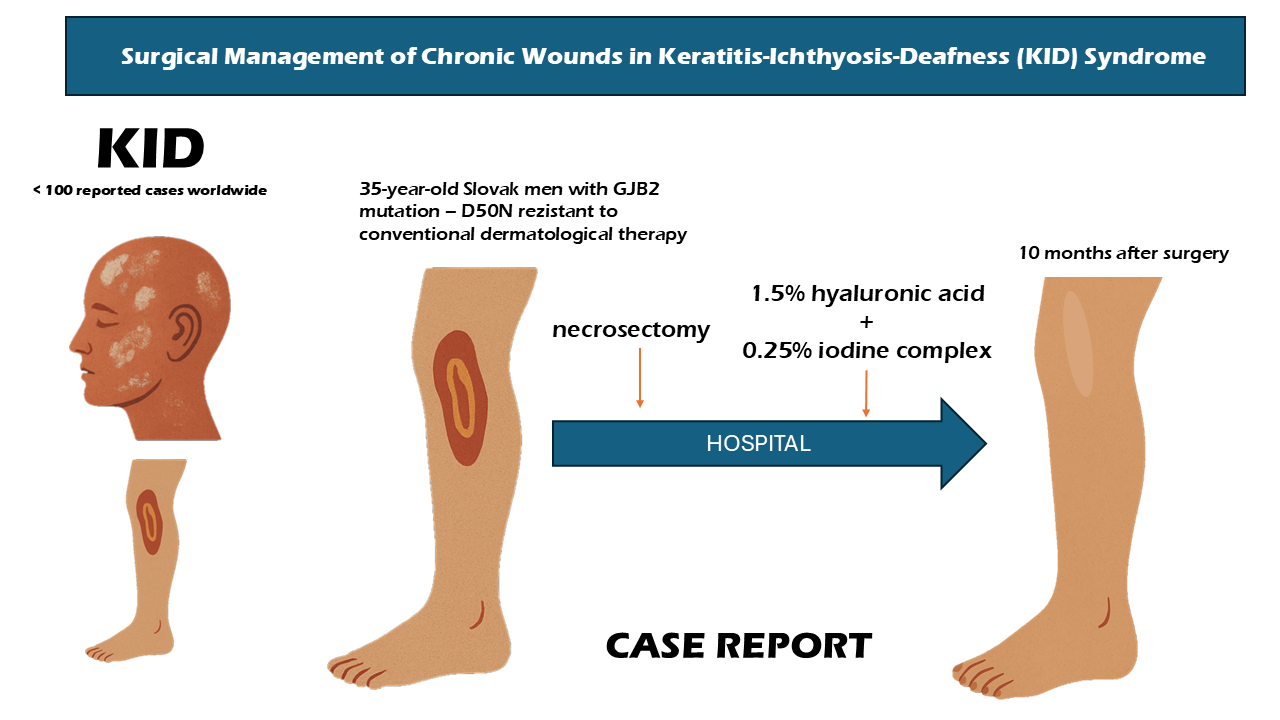
Case Report of Wound Treatment with Hyiodine Gel in an Occasional KID Syndrome Patient


Abstract
1. Introduction
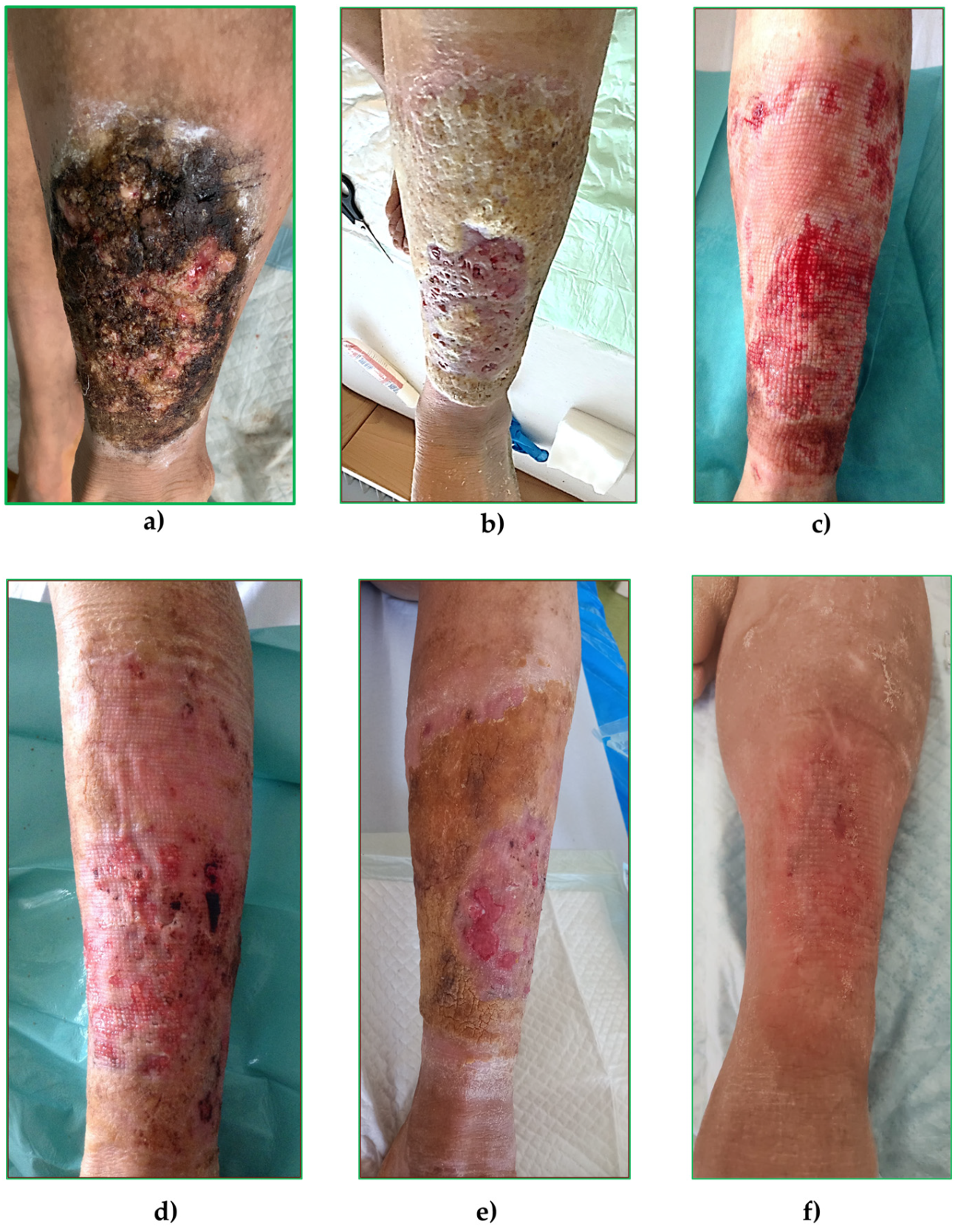
2. Detailed Case Description
Pharmacological Treatment
3. Discussion
4. Conclusions
Author Contributions
Funding
Institutional Review Board Statement
Informed Consent Statement
Data Availability Statement
Acknowledgments
Conflicts of Interest
Abbreviations
| KID | Keratitis–Ichthyosis–Deafness |
| ICU | Intensive Care Unit |
| NPWT | Negative Pressure Wound Therapy |
| MSSA | Methicillin-Susceptible Staphylococcus aureus |
| CRP | C-Reactive Protein |
References
- Montanari, A.; Caroppo, F.; Amabile, A.; Fortina Belloni, A.; Bassetto, F. Suspect Dyskeratotic Neoformations in a 7-Year-Old Child with Keratitis-Ichthyosis-Deafness Syndrome: Diagnostic, Surgical and Wound Care Management. Dermatol. Rep. 2024, 16, 9953. [Google Scholar] [CrossRef]
- Lilly, E.; Bunick, C.G.; Maley, A.M.; Zhang, S.; Spraker, M.K.; Theos, A.J.; Vivar, K.L.; Seminario-Vidal, L.; Bennett, A.E.; Sidbury, R.; et al. More than Keratitis, Ichthyosis, and Deafness: Multisystem Effects of Lethal GJB2 Mutations. J. Am. Acad. Dermatol. 2019, 80, 617–625. [Google Scholar] [CrossRef]
- Kalezić, T.; Vuković, I.; Stojković, M.; Stanojlović, S.; Karanović, J.; Brajušković, G.; Savić-Pavićević, D. Keratitis-Ichthyosis-Deafness Syndrome with Heterozygous p.D50N in the GJB2 Gene in Two Serbian Adult Patients. Balk. J. Med. Genet. 2022, 25, 79–84. [Google Scholar] [CrossRef]
- Djalilian, A.R.; Kim, J.Y.; Saeed, H.N.; Holland, E.J.; Chan, C.C. Histopathology and Treatment of Corneal Disease in Keratitis, Ichthyosis, and Deafness (KID) Syndrome. Eye 2010, 24, 738–740. [Google Scholar] [CrossRef][Green Version]
- Derse, M.; Wannke, E.; Payer, H.; Rohrbach, J.M.; Zierhut, M. Erfolgreiche Topische Cyclosporin-A-Therapie Bei Progredienter Vaskularisierender Ulzerierender Keratitis Beim Keratitis-Ichthyosis-Deafness(KID)-Syndrom. Klin. Monbl. Augenheilkd. 2002, 219, 383–386. [Google Scholar] [CrossRef]
- Shanker, V.; Gupta, M.; Prashar, A. Keratitis-Ichthyosis-Deafness Syndrome: A Rare Congenital Disorder. Indian Dermatol. Online J. 2012, 3, 48. [Google Scholar] [CrossRef]
- Travis, L.; Ou Yang, J.; Andersen, R.K.; Skovby, F.; Jemec, G.B.E.; Saunte, D.M. Keratitis-Ichthyosis-Deafness Syndrome and Hidradenitis Suppurativa. JAAD Case Rep. 2023, 38, 158–162. [Google Scholar] [CrossRef]
- Al-Bustanji, R.; AlRababah, B.K.; Rumman, M.S.A.; Abukhaled, Y.; Al-Rabadi, N.; Younis, H.K.B.; Ghalyon, G.; Al-Tawalbeh, S.; Aloudat, O.; Alrashdan, M.M.M.; et al. Expanding the Clinical Spectrum: A Case Report of the First Jordanian Presentation of KID Syndrome with Neurological and Skeletal Anomalies beyond the Classical Triad. Medicine 2025, 104, e45577. [Google Scholar] [CrossRef]
- Raghavon, U.N.; Bhuptani, N.V.; Patel, B.K. KID Syndrome: A Rare Congenital Ichthyosiform Disorder. Indian Dermatol. Online J. 2022, 13, 505–507. [Google Scholar] [CrossRef]
- Braun, L.; Gieding, C. Die Dermatologie vormals Der Hautarzt. Dermatologie 2025. ahead of print. [Google Scholar] [CrossRef]
- Gizzi, G.; Didona, D.; Pascolini, G.; Gores, M.; Amer, M.I.; Thal, S.C.; Scarsella, L. Keratitis, Ichthyosis, and Deafness Syndrome with Endocarditis and Myelitis: A Rare Case Report. Case Rep. Dermatol. 2025, 17, 291–298. [Google Scholar] [CrossRef]
- Bebenina, A.A.; Chundokova, M.A.; Smirnov, A.N.; Golovanev, M.A.; Dokshukina, A.A. KID Syndrome Complicated by Multiple Abscesses of the Parietal Region Skin: Clinical Case. Glob. J. Med. Res. F Dis. 2021, 21, 21–25. [Google Scholar] [CrossRef]
- Mssillou, I.; Bakour, M.; Slighoua, M.; Laaroussi, H.; Saghrouchni, H.; Ez-Zahra Amrati, F.; Lyoussi, B.; Derwich, E. Investigation on Wound Healing Effect of Mediterranean Medicinal Plants and Some Related Phenolic Compounds: A Review. J. Ethnopharmacol. 2022, 298, 115663. [Google Scholar] [CrossRef]
- Mane, S.; Singer, J.; Corin, A.; Semprini, A. Successful Treatment of Actinic Keratosis with Kanuka Honey. Case Rep. Dermatol. Med. 2018, 2018, 4628971. [Google Scholar] [CrossRef]
- Hekmatpou, D.; Mehrabi, F.; Rahzani, K.; Aminiyan, A. The Effect of Aloe Vera Clinical Trials on Prevention and Healing of Skin Wound: A Systematic Review. Iran. J. Med. Sci. 2019, 44, 1. [Google Scholar]
- Li, Y.; Wang, S.W.; Liu, Y.H.; Zou, M.Y.; Wu, J.X.; Luo, S.K.; Hong, W.J. Efficacy and Safety of Non-Cross-Linked Hyaluronic Acid Compound in the Treatment of Keratosis Pilaris: A Split-Body Randomized Clinical Trial. J. Cosmet. Dermatol. 2024, 23, 3903–3910. [Google Scholar] [CrossRef]
- Chen, L.H.; Xue, J.F.; Zheng, Z.Y.; Shuhaidi, M.; Thu, H.E.; Hussain, Z. Hyaluronic Acid, an Efficient Biomacromolecule for Treatment of Inflammatory Skin and Joint Diseases: A Review of Recent Developments and Critical Appraisal of Preclinical and Clinical Investigations. Int. J. Biol. Macromol. 2018, 116, 572–584. [Google Scholar] [CrossRef]
- Hajská, M.; Kurin, E.; Bittner Fialová, S.; Vidiščák, M.; Panyko, A. Antimicrobial Efficacy of Impregnated Human Acellular Dermal Substitutes in Burn Wound Models. Antibiotics 2025, 14, 707. [Google Scholar] [CrossRef]
- Fan, H.; Wang, Y.; Zhang, X.; Chen, J.; Zhou, Q.; Yu, Z.; Chen, Y.; Chen, Z.; Gu, J.; Shi, Y. Ginsenoside Compound K Ameliorates Imiquimod-Induced Psoriasis-like Dermatitis through Inhibiting REG3A/RegIIIγ Expression in Keratinocytes. Biochem. Biophys. Res. Commun. 2019, 515, 665–671. [Google Scholar] [CrossRef]
- Chummun Phul, I.; Gómez-Llonín, A.; Bhaw-Luximon, A. From Traditional Medicine to Nanomedicine: Potential of Ginkgo Biloba Extracts in Treating Inflammatory Skin Diseases. RSC Med. Chem. 2024, 15, 2643–2656. [Google Scholar] [CrossRef]
- Höner, M.W.; Kainz, A.; Erfurt-Berge, C. Cranial Osteomyelitis in a Patient with KID Syndrome: Importance of Thorough Investigation in Chronic Wounds. JDDG—J. Ger. Soc. Dermatol. 2025. Online ahead of print. [Google Scholar] [CrossRef]
- Kapila, A.K.; De Baerdemaeker, R.; Bakal, F.; Hanssens, V.; Spinnael, J.; Hendrickx, B.; Zeltzer, A.; Hamdi, M. A Rare Case of KID Syndrome: The Use of Hydrosurgery and Strategies for Antiseptic Wound Care. Adv. Skin Wound Care 2019, 32, 1–6. [Google Scholar] [CrossRef]
- Cutting, K.F. Wound Healing through Synergy of Hyaluronan and an Iodine Complex. J. Wound Care 2011, 20, 424–430. [Google Scholar] [CrossRef]
- Juncan, A.M.; Moisă, D.G.; Santini, A.; Morgovan, C.; Rus, L.L.; Vonica-țincu, A.L.; Loghin, F. Advantages of Hyaluronic Acid and Its Combination with Other Bioactive Ingredients in Cosmeceuticals. Molecules 2021, 26, 4429. [Google Scholar] [CrossRef]
- Papakonstantinou, E.; Roth, M.; Karakiulakis, G. Hyaluronic Acid: A Key Molecule in Skin Aging. Derm.-Endocrinol. 2012, 4, 253–258. [Google Scholar] [CrossRef]
- Frenkel, J.S. The Role of Hyaluronan in Wound Healing. Int. Wound J. 2014, 11, 159–163. [Google Scholar] [CrossRef]
- Slavkovsky, R.; Kohlerova, R.; Jiroutova, A.; Hajzlerova, M.; Sobotka, L.; Cermakova, E.; Kanta, J. Effects of Hyaluronan and Iodine on Wound Contraction and Granulation Tissue Formation in Rat Skin Wounds. Clin. Exp. Dermatol. 2010, 35, 373–379. [Google Scholar] [CrossRef]
- Hajská, M.; Slobodníková, L.; Hupková, H.; Koller, J. In Vitro Efficacy of Various Topical Antimicrobial Agents in Different Time Periods from Contamination to Application against 6 Multidrug-Resistant Bacterial Strains Isolated from Burn Patients. Burns 2014, 40, 713–718. [Google Scholar] [CrossRef]
- Farokh Forghani, S.; Bagheri, T.; Naderi Gharahgheshlagh, S.; Hoveidamanesh, S.; Ghadimi, T.; Ghorbanian Kelachayeh, S.; Irilouzadian, R. The Effect of Hyaluronic Acid and Iodine Complex Gel Compared to Vaseline on Deep Second-Degree Burn Wound in Rats. Int. Wound J. 2024, 21, e14738. [Google Scholar] [CrossRef]

| Pathogen | Characteristics |
|---|---|
| Proteus mirabilis | massive growth; susceptible to meropenem, cefotaxime, cefepime, ampicillin-sulbactam |
| Pseudomonas aeruginosa | sparse to moderate growth; susceptible to meropenem, ceftazidime, colistin, and aminoglycosides |
| Staphylococcus aureus (MSSA) | moderate growth; susceptible to oxacillin, cefazolin, vancomycin, linezolid, and tigecycline |
| Corynebacterium striatum | moderate to massive growth |
| Enterococcus avium | moderate to massive growth |
| Candida albicans | susceptible to a broad spectrum of antifungals |
Disclaimer/Publisher’s Note: The statements, opinions and data contained in all publications are solely those of the individual author(s) and contributor(s) and not of MDPI and/or the editor(s). MDPI and/or the editor(s) disclaim responsibility for any injury to people or property resulting from any ideas, methods, instructions or products referred to in the content. |
© 2025 by the authors. Licensee MDPI, Basel, Switzerland. This article is an open access article distributed under the terms and conditions of the Creative Commons Attribution (CC BY) license.
Share and Cite
Hajská, M.; Bittner Fialová, S.; Dubovský, M.; Panyko, A. Case Report of Wound Treatment with Hyiodine Gel in an Occasional KID Syndrome Patient. J. Clin. Med. 2026, 15, 11. https://doi.org/10.3390/jcm15010011
Hajská M, Bittner Fialová S, Dubovský M, Panyko A. Case Report of Wound Treatment with Hyiodine Gel in an Occasional KID Syndrome Patient. Journal of Clinical Medicine. 2026; 15(1):11. https://doi.org/10.3390/jcm15010011
Chicago/Turabian StyleHajská, Marianna, Silvia Bittner Fialová, Martin Dubovský, and Arpád Panyko. 2026. "Case Report of Wound Treatment with Hyiodine Gel in an Occasional KID Syndrome Patient" Journal of Clinical Medicine 15, no. 1: 11. https://doi.org/10.3390/jcm15010011
APA StyleHajská, M., Bittner Fialová, S., Dubovský, M., & Panyko, A. (2026). Case Report of Wound Treatment with Hyiodine Gel in an Occasional KID Syndrome Patient. Journal of Clinical Medicine, 15(1), 11. https://doi.org/10.3390/jcm15010011