


Comparative Outcomes of Adalimumab and Infliximab Dose Escalation in Inflammatory Bowel Disease Patients Failing First-Line Biologic Treatment
 , , , and
Abstract
1. Introduction
2. Material and Methods
2.1. Study Design and Patients
2.2. Variables and Outcomes
2.3. Statistical Analysis
3. Results
3.1. Study Population, Demographics and Clinical Findings
3.2. Outcomes of Treatments
3.3. Predictors of Remission-Free Treatment Discontinuation
3.4. Predictors by Disease Type
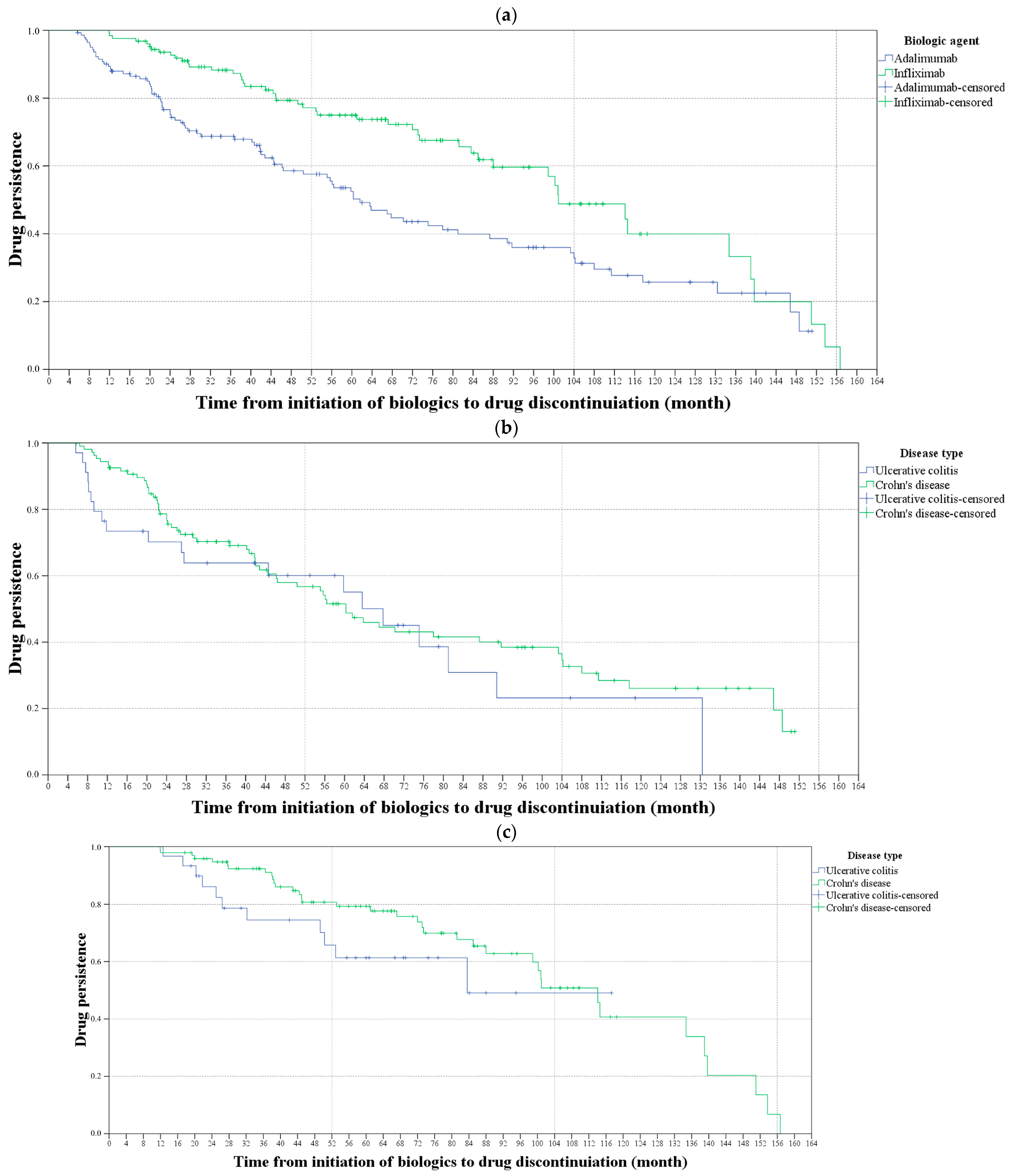
3.5. Survival Analysis of Treatments
4. Discussion
5. Conclusions
Supplementary Materials
Author Contributions
Funding
Institutional Review Board Statement
Informed Consent Statement
Data Availability Statement
Conflicts of Interest
References
- Bernstein, C.N.; Eliakim, A.; Fedail, S.; Fried, M.; Gearry, R.; Goh, K.-L.; Hamid, S.; Khan, A.G.; Khalif, I.; Ng, S.C.; et al. World Gastroenterology Organisation Global Guidelines Inflammatory Bowel Disease: Update August 2015. J. Clin. Gastroenterol. 2016, 50, 803–818. [Google Scholar] [CrossRef] [PubMed]
- Denson, L.A.; Curran, M.; McGovern, D.P.B.; Koltun, W.A.; Duerr, R.H.; Kim, S.C.; Sartor, R.B.; Sylvester, F.A.; Abraham, C.; de Zoeten, E.F.; et al. Challenges in IBD Research: Precision Medicine. Inflamm. Bowel Dis. 2019, 25, S31–S39. [Google Scholar] [CrossRef]
- Seyed Tabib, N.S.; Madgwick, M.; Sudhakar, P.; Verstockt, B.; Korcsmaros, T.; Vermeire, S. Big Data in IBD: Big Progress for Clinical Practice. Gut 2020, 69, 1520–1532. [Google Scholar] [CrossRef] [PubMed]
- Qiu, Y.; Chen, B.-L.; Mao, R.; Zhang, S.-H.; He, Y.; Zeng, Z.-R.; Ben-Horin, S.; Chen, M.-H. Systematic Review with Meta-Analysis: Loss of Response and Requirement of Anti-TNFα Dose Intensification in Crohn’s Disease. J. Gastroenterol. 2017, 52, 535–554. [Google Scholar] [CrossRef] [PubMed]
- Kósa, F.; Kunovszki, P.; Borsi, A.; Iliás, Á.; Palatka, K.; Szamosi, T.; Vincze, Á.; Molnár, T.; Lakatos, P.L. Anti-TNF Dose Escalation and Drug Sustainability in Crohn’s Disease: Data from the Nationwide Administrative Database in Hungary. Dig. liver Dis. Off. J. Ital. Soc. Gastroenterol. Ital. Assoc. Study Liver 2020, 52, 274–280. [Google Scholar] [CrossRef] [PubMed]
- Danese, S.; Fiorino, G.; Reinisch, W. Review Article: Causative Factors and the Clinical Management of Patients with Crohn’s Disease Who Lose Response to Anti-TNF-α Therapy. Aliment. Pharmacol. Ther. 2011, 34, 1–10. [Google Scholar] [CrossRef]
- Ma, C.; Huang, V.; Fedorak, D.K.; Kroeker, K.I.; Dieleman, L.A.; Halloran, B.P.; Fedorak, R.N. Crohn’s Disease Outpatients Treated with Adalimumab Have an Earlier Secondary Loss of Response and Requirement for Dose Escalation Compared to Infliximab: A Real Life Cohort Study. J. Crohns. Colitis 2014, 8, 1454–1463. [Google Scholar] [CrossRef] [PubMed]
- Fine, S.; Papamichael, K.; Cheifetz, A.S. Etiology and Management of Lack or Loss of Response to Anti-Tumor Necrosis Factor Therapy in Patients With Inflammatory Bowel Disease. Gastroenterol. Hepatol. 2019, 15, 656–665. [Google Scholar]
- Vande Casteele, N.; Herfarth, H.; Katz, J.; Falck-Ytter, Y.; Singh, S. American Gastroenterological Association Institute Technical Review on the Role of Therapeutic Drug Monitoring in the Management of Inflammatory Bowel Diseases. Gastroenterology 2017, 153, 835–857.e6. [Google Scholar] [CrossRef] [PubMed]
- Einarson, T.R.; Bereza, B.G.; Ying Lee, X.; Lelli, F. Dose Escalation of Biologics in Crohn’s Disease: Critical Review of Observational Studies. Curr. Med. Res. Opin. 2017, 33, 1433–1449. [Google Scholar] [CrossRef] [PubMed]
- Gemayel, N.C.; Rizzello, E.; Atanasov, P.; Wirth, D.; Borsi, A. Dose Escalation and Switching of Biologics in Ulcerative Colitis: A Systematic Literature Review in Real-World Evidence. Curr. Med. Res. Opin. 2019, 35, 1911–1923. [Google Scholar] [CrossRef] [PubMed]
- Gomollón, F.; Dignass, A.; Annese, V.; Tilg, H.; Van Assche, G.; Lindsay, J.O.; Peyrin-Biroulet, L.; Cullen, G.J.; Daperno, M.; Kucharzik, T.; et al. 3rd European Evidence-Based Consensus on the Diagnosis and Management of Crohn’s Disease 2016: Part 1: Diagnosis and Medical Management. J. Crohns. Colitis 2017, 11, 3–25. [Google Scholar] [CrossRef] [PubMed]
- Raine, T.; Bonovas, S.; Burisch, J.; Kucharzik, T.; Adamina, M.; Annese, V.; Bachmann, O.; Bettenworth, D.; Chaparro, M.; Czuber-Dochan, W.; et al. ECCO Guidelines on Therapeutics in Ulcerative Colitis: Medical Treatment. J. Crohns. Colitis 2022, 16, 2–17. [Google Scholar] [CrossRef] [PubMed]
- Torres, J.; Bonovas, S.; Doherty, G.; Kucharzik, T.; Gisbert, J.P.; Raine, T.; Adamina, M.; Armuzzi, A.; Bachmann, O.; Bager, P.; et al. ECCO Guidelines on Therapeutics in Crohn’s Disease: Medical Treatment. J. Crohns. Colitis 2020, 14, 4–22. [Google Scholar] [CrossRef]
- Harbord, M.; Eliakim, R.; Bettenworth, D.; Karmiris, K.; Katsanos, K.; Kopylov, U.; Kucharzik, T.; Molnár, T.; Raine, T.; Sebastian, S.; et al. Third European Evidence-Based Consensus on Diagnosis and Management of Ulcerative Colitis. Part 2: Current Management. J. Crohns. Colitis 2017, 11, 769–784. [Google Scholar] [CrossRef]
- Satsangi, J.; Silverberg, M.S.; Vermeire, S.; Colombel, J.-F. The Montreal Classification of Inflammatory Bowel Disease: Controversies, Consensus, and Implications. Gut 2006, 55, 749–753. [Google Scholar] [CrossRef]
- Kennedy, N.A.; Heap, G.A.; Green, H.D.; Hamilton, B.; Bewshea, C.; Walker, G.J.; Thomas, A.; Nice, R.; Perry, M.H.; Bouri, S.; et al. Predictors of Anti-TNF Treatment Failure in Anti-TNF-Naive Patients with Active Luminal Crohn’s Disease: A Prospective, Multicentre, Cohort Study. lancet. Gastroenterol. Hepatol. 2019, 4, 341–353. [Google Scholar] [CrossRef]
- Papamichael, K.; Rivals-Lerebours, O.; Billiet, T.; Vande Casteele, N.; Gils, A.; Ferrante, M.; Van Assche, G.; Rutgeerts, P.J.; Mantzaris, G.J.; Peyrin-Biroulet, L.; et al. Long-Term Outcome of Patients with Ulcerative Colitis and Primary Non-Response to Infliximab. J. Crohns. Colitis 2016, 10, 1015–1023. [Google Scholar] [CrossRef] [PubMed]
- Bae, J.H.; Park, J.-B.; Baek, J.E.; Hong, S.W.; Park, S.H.; Yang, D.-H.; Ye, B.D.; Byeon, J.-S.; Myung, S.-J.; Yang, S.-K.; et al. Effectiveness of Switching to Subcutaneous Infliximab in Ulcerative Colitis Patients Experiencing Intravenous Infliximab Failure. Gut Liver 2024, 18, 667–676. [Google Scholar] [CrossRef]
- O’Donnell, S.; Stempak, J.M.; Steinhart, A.H.; Silverberg, M.S. Higher Rates of Dose Optimisation for Infliximab Responders in Ulcerative Colitis than in Crohn’s Disease. J. Crohns. Colitis 2015, 9, 830–836. [Google Scholar] [CrossRef] [PubMed]
- Savelkoul, E.H.J.; Thomas, P.W.A.; Derikx, L.A.A.P.; den Broeder, N.; Römkens, T.E.H.; Hoentjen, F. Systematic Review and Meta-Analysis: Loss of Response and Need for Dose Escalation of Infliximab and Adalimumab in Ulcerative Colitis. Inflamm. Bowel Dis. 2023, 29, 1633–1647. [Google Scholar] [CrossRef] [PubMed]
- Long, M.D.; Cohen, R.D.; Smith, T.W.; DiBonaventura, M.; Gruben, D.; Bargo, D.; Salese, L.; Quirk, D. Retrospective Database Analysis: Dose Escalation and Adherence in Patients Initiating Biologics for Ulcerative Colitis. Dig. Dis. 2022, 40, 553–564. [Google Scholar] [CrossRef] [PubMed]
- Ghosh, S.; Kathe, N.; Umashankar, K.; Mirchandani, K.; Hait, A.; Paul, R.; Candela, N.; Fan, T. Dose Escalation of Biologics in Biologic-Naïve Patients With Ulcerative Colitis: Outcomes From the ODESSA-UC Study. Crohn’s Colitis 360 2023, 5, otad061. [Google Scholar] [CrossRef] [PubMed]
- Kapizioni, C.; Desoki, R.; Lam, D.; Balendran, K.; Al-Sulais, E.; Subramanian, S.; Rimmer, J.E.; De La Revilla Negro, J.; Pavey, H.; Pele, L.; et al. Biologic Therapy for Inflammatory Bowel Disease: Real-World Comparative Effectiveness and Impact of Drug Sequencing in 13 222 Patients within the UK IBD BioResource. J. Crohns. Colitis 2024, 18, 790–800. [Google Scholar] [CrossRef]
- Gil-Candel, M.; Gascón-Cánovas, J.J.; Urbieta-Sanz, E.; Rentero-Redondo, L.; Onteniente-Candela, M.; Iniesta-Navalón, C. Comparison of Drug Survival between Infliximab and Adalimumab in Inflammatory Bowel Disease. Int. J. Clin. Pharm. 2020, 42, 500–507. [Google Scholar] [CrossRef]

| Characteristics | Total (n = 268) | ADA (n = 142) | IFX (n = 126) | p |
|---|---|---|---|---|
| Age at onset of IBD (years), median (IQR) | 29.0 (23.0–39.0) | 29.0 (23.0–35.2) | 30.0 (23.0–40.0) | 0.278 a |
| Current age (years), median (IQR) | 39.0 (29.0–50.0) | 37.0 (30.0–48.0) | 40.0 (29.0–53.2) | 0.194 a |
| Gender, n (%) | ||||
| Male | 167 (62.3) | 90 (63.4) | 77 (61.1) | 0.702 b |
| Female | 101 (37.7) | 52 (36.6) | 49 (38.9) | |
| Smoking, n (%) | ||||
| Never | 114 (42.5) | 62 (43.7) | 52 (41.3) | 0.894 b |
| Ex-smoker | 87 (32.5) | 46 (32.4) | 41 (32.5) | |
| Current smoker | 67 (25.0) | 34 (23.9) | 33 (26.2) | |
| Family history of IBD, n (%) | 28 (10.4) | 13 (9.2) | 15 (11.9) | 0.463 b |
| BMI (kg/m2), median (IQR) | 23.3 (22.9–24.7) | 23.3 (23.0–25.0) | 23.1 (22.8–24.5) | 0.021 a |
| Total disease duration (years), median (IQR) | 7.5 (3.0–13.0) | 8.0 (3.0–12.0) | 7.0 (3.0–13.2) | 0.916 a |
| Time from IBD onset to biologic therapy (months), median (IQR) | 43.2 (13.0–99.7) | 42.0 (16.5–89.6) | 47.8 (10.2–107.4) | 0.953 a |
| Follow-up from biologic therapy to dose escalation (months), median (IQR) | 14.7 (7.0–29.6) | 12.5 (6.2–28.6) | 15.4 (8.4–30.8) | 0.280 a |
| Follow-up from dose escalation to last visit (months), median (IQR) | 39.7 (19.6–76.2) | 38.6 (19.1–81.0) | 41.9 (19.6–67.0) | 0.816 a |
| Disease type, n (%) | ||||
| UC | 64 (23.9) | 34 (23.9) | 30 (23.8) | 0.979 b |
| CD | 204 (76.1) | 108 (76.1) | 96 (76.2) | |
| Disease extension in UC patients, n (%) | ||||
| Proctitis | 1 (1.6) | 1 (2.9) | 0 (0.0) | 0.890 c |
| Left-sided colitis | 20 (31.3) | 11 (32.4) | 9 (30.0) | |
| Extensive colitis | 43 (67.2) | 22 (64.7) | 21 (70.0) | |
| Disease location in CD patients, n (%) | ||||
| Ileal (L1) | 84 (41.2) | 42 (38.9) | 42 (43.8) | 0.780 b |
| Colonic (L2) | 31 (15.2) | 17 (15.7) | 14 (14.6) | |
| Ileo-colonic (L3) | 89 (43.6) | 49 (45.4) | 40 (41.7) | |
| Disease behavior in CD patients, n (%) | ||||
| Inflammatory disease (B1) | 100 (49.0) | 59 (54.7) | 41 (42.7) | 0.219 b |
| Stricturing (B2) | 51 (25.0) | 25 (23.1) | 26 (27.1) | |
| Penetrating (B3) | 53 (26.0) | 24 (22.2) | 29 (30.2) | |
| Perianal disease in CD patients, n (%) | 89 (43.6) | 47 (43.5) | 42 (43.8) | 0.973 b |
| Appendectomy, n (%) | 22 (8.2) | 12 (8.5) | 10 (7.9) | 0.878 b |
| Extra-intestinal manifestations, n (%) | 151 (56.3) | 83 (58.5) | 68 (54.0) | 0.460 b |
| Peripheral arthralgia, n (%) | 101 (37.7) | 52 (36.6) | 49 (38.9) | 0.702 b |
| Backache, n (%) | 51 (19.0) | 30 (21.1) | 21 (16.7) | 0.353 b |
| Aphthous ulcer, n (%) | 42 (15.7) | 28 (19.7) | 14 (11.1) | 0.053 b |
| Peripheral arthritis, n (%) | 35 (13.1) | 19 (13.4) | 16 (12.7) | 0.869 b |
| Ankylosing spondylitis, n (%) | 28 (10.4) | 17 (12.0) | 11 (8.7) | 0.387 b |
| Sacroiliitis, n (%) | 14 (5.2) | 8 (5.6) | 6 (4.8) | 0.749 b |
| Thromboembolism, n (%) | 10 (4.1) | 6 (4.2) | 5 (4.0) | 0.916 b |
| Erythema nodosum, n (%) | 9 (3.4) | 8 (5.6) | 1 (0.8) | 0.039 c |
| PSC, n (%) | 4 (1.5) | 2 (1.4) | 2 (1.6) | 0.999 c |
| Pyoderma gangrenous, n (%) | 3 (1.1) | 3 (2.1) | 0 (0.0) | 0.250 c |
| Uveitis, n (%) | 3 (1.1) | 3 (2.1) | 0 (0.0) | 0.250 c |
| Others, n (%) | 4 (1.5) | 1 (0.7) | 3 (2.4) | 0.345 c |
| Prior major abdominal surgery for IBD, n (%) | 111 (41.4) | 58 (40.8) | 53 (42.1) | 0.840 b |
| Prior conventional medications, n (%) | 243 (90.7) | 132 (93.0) | 111 (88.1) | 0.172 b |
| Mesalazine oral, n (%) | 214 (79.9) | 112 (78.9) | 102 (81.0) | 0.672 b |
| Mesalazine enema, n (%) | 59 (22.0) | 35 (24.6) | 24 (19.0) | 0.269 b |
| Mesalazine suppository, n (%) | 11 (4.1) | 7 (4.9) | 4 (3.2) | 0.470 b |
| Sulfasalazine, n (%) | 48 (17.9) | 25 (17.6) | 23 (18.3) | 0.890 b |
| Budesonide, n (%) | 55 (20.5) | 40 (28.2) | 15 (11.9) | 0.001 b |
| Steroids, n (%) | 191 (71.3) | 104 (73.2) | 87 (69.0) | 0.449 b |
| Thiopurine, n (%) | 238 (88.8) | 125 (88.0) | 113 (89.7) | 0.668 b |
| Methotrexate, n (%) | 96 (35.8) | 56 (39.4) | 40 (31.7) | 0.190 b |
| Steroid dependence, n (%) | 249 (92.9) | 129 (90.8) | 120 (95.2) | 0.162 b |
| Concomitant medication at biologic initiation, n (%) | 122 (45.5) | 63 (44.4) | 59 (46.8) | 0.687 b |
| Immunomodulatory therapy d | 119 (44.4) | 60 (42.3) | 59 (46.8) | 0.452 b |
| Thiopurine | 82 (30.6) | 36 (25.4) | 46 (36.5) | 0.048 b |
| Methotrexate | 37 (13.8) | 24 (16.9) | 13 (10.3) | 0.119 b |
| Mesalazine | 4 (1.5) | 4 (2.8) | 0 (0.0) | 0.125 c |
| Sulfasalazine | 0 (0.0) | 0 (0.0) | 0 (0.0) | n.a. |
| Budesonide | 0 (0.0) | 0 (0.0) | 0 (0.0) | n.a. |
| Steroids | 7 (2.6) | 6 (4.2) | 1 (0.8) | 0.125 c |
| Baseline CDAI, median (IQR) | 335.0 (248.5-423.0) | 347.5 (256.0–431.8) | 319.5 (225.8–415.5) | 0.230 a |
| Baseline partial Mayo score, median (IQR) | 6.0 (5.0–7.3) | 6.0 (5.0–8.0) | 7.0 (6.0–7.0) | 0.590 a |
| Baseline endoscopic Mayo score, median (IQR) | 2.0 (2.0–3.0) | 3.0 (2.0–3.0) | 2.0 (2.0–3.0) | 0.172 a |
| Baseline CRP (mg/L), median (IQR) | 6.0 (5.0–22.5) | 5.9 (4.2–22.1) | 6.5 (5.0–24.3) | 0.237 a |
| Baseline Hb (g/dL), median (IQR) | 12.1 (11.6–13.7) | 12.2 (11.8–13.9) | 12.0 (11.4–13.1) | 0.052 a |
| Baseline Albumin (g/dL), median (IQR) | 4.0 (3.9–4.3) | 4.0 (3.9–4.3) | 4.0 (3.9–4.3) | 0.715 a |
| Total (n = 268) | ADA (n = 142) | IFX (n = 126) | p | |
|---|---|---|---|---|
| Treatment persistence, n (%) | 117 (43.7) | 50 (35.2) | 67 (53.2) | 0.003 a |
| Treatment discontinuation, n (%) | 151 (56.3) | 92 (64.8) | 59 (46.8) | |
| Sustained remission, n (%) | 12 (4.5) | 3 (2.1) | 9 (7.1) | 0.047 a |
| Remission-free treatment discontinuation, n (%) | 139 (51.9) | 89 (62.7) | 50 (39.7) | <0.001 a |
| Patient lack of compliance, n (%) | 4 (1.5) | 2 (1.4) | 2 (1.6) | 0.999 b |
| Patient intolerance, n (%) | 12 (4.5) | 2 (1.4) | 10 (7.9) | 0.010 a |
| Therapeutic failure, n (%) | 122 (45.5) | 84 (59.1) | 38 (30.2) | <0.001 a |
| Primary lack of response, n (%) | 13 (4.9) | 11 (7.7) | 2 (1.6) | 0.019 a |
| Secondary loss of response, n (%) | 109 (40.7) | 73 (51.4) | 36 (28.6) | <0.001 a |
| Steroid, n (%) | 19 (7.1) | 15 (10.6) | 4 (3.2) | 0.019 a |
| Hospitalization, n (%) | 15 (5.6) | 9 (6.3) | 6 (4.8) | 0.575 a |
| Surgery, n (%) | 10 (3.7) | 6 (4.2) | 4 (3.2) | 0.754 b |
| Switch to another biotherapy, n (%) | 107 (39.9) | 72 (50.7) | 35 (27.8) | <0.001 a |
| Serious adverse events, n (%) | 13 (4.9) | 3 (2.1) | 10 (7.9) | 0.027 a |
| Allergic reaction, n (%) | 7 (2.6) | 0 (0.0) | 7 (5.6) | 0.005 b |
| Serious infection, n (%) | 3 (1.1) | 3 (2.1) | 0 (0.0) | 0.250 b |
| Other serious adverse events, n (%) | 3 (1.1) | 0 (0.0) | 3 (2.4) | 0.103 b |
| Characteristics | ADA | p | IFX | p | ||
|---|---|---|---|---|---|---|
| UC (n = 34) | CD (n = 108) | UC (n = 30) | CD (n = 96) | |||
| Treatment persistence, n (%) | 11 (32.4) | 39 (36.1) | 0.689 a | 15 (50.0) | 52 (54.2) | 0.690 a |
| Treatment discontinuation, n (%) | 23 (67.6) | 69 (63.9) | 15 (50.0) | 44 (45.8) | ||
| Sustained remission, n (%) | 1 (2.9) | 2 (1.9) | 0.563 b | 2 (6.7) | 7 (7.3) | 0.999 b |
| Remission-free treatment discontinuation, n (%) | 22 (64.7) | 67 (62.0) | 0.779 a | 13 (43.3) | 37 (38.5) | 0.640 a |
| Patient lack of compliance, n (%) | 1 (2.9) | 1 (0.9) | 0.423 b | 1 (3.3) | 1 (1.0) | 0.421 b |
| Patient intolerance, n (%) | 1 (2.9) | 1 (0.9) | 0.423 b | 2 (6.7) | 8 (8.3) | 0.999 b |
| Therapeutic failure, n (%) | 20 (58.8) | 64 (59.3) | 0.964 a | 10 (33.3) | 28 (29.2) | 0.664 a |
| Primary lack of response, n (%) | 6 (17.6) | 5 (4.6) | 0.023 b | 2 (6.7) | 0 (0.0) | 0.055 b |
| Secondary loss of response, n (%) | 14 (41.2) | 59 (54.6) | 0.171 a | 8 (26.7) | 28 (29.2) | 0.791 a |
| Steroid, n (%) | 6 (17.6) | 9 (8.3) | 0.199 b | 1 (3.3) | 3 (3.1) | 0.999 b |
| Hospitalization, n (%) | 2 (5.9) | 7 (6.5) | 0.999 b | 0 (0.0) | 6 (6.3) | 0.334 b |
| Surgery, n (%) | 2 (5.9) | 4 (3.7) | 0.630 b | 2 (6.7) | 2 (2.1) | 0.240 b |
| Switch to another biotherapy, n (%) | 14 (41.2) | 58 (53.7) | 0.563 b | 8 (26.7) | 27 (28.1) | 0.563 b |
| Serious adverse events, n (%) | 1 (2.9) | 2 (1.9) | 0.563 b | 2 (6.7) | 8 (8.3) | 0.999 b |
| Allergic reaction, n (%) | 0 (0.0) | 0 (0.0) | n.a. | 1 (3.3) | 6 (6.3) | 0.999 b |
| Serious infection, n (%) | 1 (2.9) | 2 (1.9) | 0.563 b | 0 (0.0) | 0 (0.0) | n.a. |
| Other serious adverse events, n (%) | 0 (0.0) | 0 (0.0) | n.a. | 1 (3.3) | 3 (2.1) | 0.561 b |
| Characteristics | Total (n = 268) | ADA (n = 142) | IFX (n = 126) | ||||||
|---|---|---|---|---|---|---|---|---|---|
| Bivariate Analysis | Multivariate Analysis | Bivariate Analysis | Multivariate Analysis | Bivariate Analysis | Multivariate Analysis | ||||
| p | HR (95 CI%) | p | p | HR (95 CI%) | p | p | HR (95 CI%) | p | |
| Age at onset of IBD (years) | 0.606 | 0.767 | 0.823 | ||||||
| Current age (years) | 0.219 | 0.190 | 0.826 | ||||||
| Female gender | 0.793 | 0.830 | 0.803 | ||||||
| Smoking | |||||||||
| Never | 1 | 1 | |||||||
| Ex-smoker | 0.052 | 0.64 (0.43–0.94) | 0.024 | 0.061 | 0.58 (0.35–0.96) | 0.033 | 0.420 | ||
| Current smoker | 0.354 | 1.06 (0.69–1.64) | 0.793 | 0.128 | 0.75 (0.43–1.31) | 0.315 | 0.621 | ||
| Family history of IBD | 0.054 | 1.01 (0.59–1.76) | 0.960 | 0.909 | 0.006 | 2.34 (1.20–4.57) | 0.012 | ||
| BMI (kg/m2) | 0.724 | 0.946 | 0.858 | ||||||
| Total disease duration (years) | 0.133 | 0.032 | 0.97 (0.93–1.02) | 0.183 | 0.981 | ||||
| Appendectomy | 0.791 | 0.447 | 0.521 | ||||||
| Prior major abdominal surgery for IBD | 0.071 | 1.85 (1.29–2.67) | 0.001 | 0.518 | 0.055 | 2.71 (1.37–5.35) | 0.004 | ||
| Prior conventional medications | 0.626 | 0.167 | 0.162 | ||||||
| Mesalazine oral | 0.117 | 0.464 | 0.103 | ||||||
| Mesalazine enema | 0.003 | 2.42 (1.59–3.66) | <0.001 | 0.084 | 1.49 (0.93–2.38) | 0.101 | 0.008 | 4.16 (1.90–9.12) | <0.001 |
| Mesalazine suppository | 0.667 | 0.336 | 0.736 | ||||||
| Sulfasalazine | 0.444 | 0.254 | 0.876 | ||||||
| Budesonide | 0.552 | 0.707 | 0.349 | ||||||
| Steroids | 0.156 | 0.149 | 0.870 | ||||||
| Thiopurine | 0.666 | 0.210 | 0.399 | ||||||
| Methotrexate | 0.001 | 1.83 (1.29–2.59) | 0.001 | 0.005 | 1.75 (1.10–2.77) | 0.018 | 0.155 | ||
| Steroid dependence | 0.067 | 1.86 (0.86–4.02) | 0.117 | 0.014 | 3.90 (1.20–12.68) | 0.023 | 0.378 | ||
| Concomitant medication at biologic initiation | 0.374 | 0.539 | 0.087 | ||||||
| Immunomodulatory therapy a | 0.378 | 0.441 | 0.087 a | 0.79 (0.44–1.40) | 0.413 | ||||
| Thiopurine | 0.462 | 0.551 | 0.318 | ||||||
| Methotrexate | 0.760 | 0.713 | 0.245 | ||||||
| Mesalazine | 0.930 | 0.686 | n.a. | ||||||
| Steroids | <0.001 | 5.31 (2.22–12.68) | <0.001 | <0.001 | 4.01 (1.61–9.93) | 0.003 | 0.106 | ||
| Baseline CRP (mg/L) | 0.176 | 0.342 | 0.216 | ||||||
| Baseline Hb (g/dL) | 0.398 | 0.159 | 0.843 | ||||||
| Baseline Albumin (g/dL) | 0.139 | 0.079 | 0.64 (0.40–1.04) | 0.069 | 0.558 | ||||
| Characteristics | ADA (n = 142) | IFX (n = 126) | ||||||||||
|---|---|---|---|---|---|---|---|---|---|---|---|---|
| UC (n = 34) | CD (n = 108) | UC (n = 30) | CD (n = 96) | |||||||||
| Bivariate Analysis | Multivariate Analysis | Bivariate Analysis | Multivariate Analysis | Bivariate Analysis | Multivariate Analysis | Bivariate Analysis | Multivariate Analysis | |||||
| p | HR (95 CI%) | p | p | HR (95 CI%) | p | p | HR (95 CI%) | p | p | HR (95 CI%) | p | |
| Age at onset of IBD (years) | 0.904 | 0.814 | 0.129 | 0.640 | ||||||||
| Current age (years) | 0.325 | 0.350 | 0.068 | 0.97 (0.93–3.03) | 0.127 | 0.686 | ||||||
| Female gender | 0.446 | 0.989 | 0.759 | 0.630 | ||||||||
| Smoking | ||||||||||||
| Never | ||||||||||||
| Ex-smoker | 0.185 | 0.163 | 0.492 | 0.726 | ||||||||
| Current smoker | 0.915 | 0.259 | 0.317 | 0.203 | ||||||||
| Family history of IBD | 0.592 | 0.463 | 0.551 | 0.003 | 2.45 (1.11–5.42) | 0.027 | ||||||
| BMI (kg/m2) | 0.057 | 0.88 (0.73–1.06) | 0.172 | 0.523 | 0.636 | 0.665 | ||||||
| Total disease duration (years) | 0.106 | 0.112 | 0.469 | 0.948 | ||||||||
| Disease extension in UC patients | ||||||||||||
| Proctitis (E1) | ||||||||||||
| Left-sided colitis (E2) | 0.311 | 0.906 | ||||||||||
| Extensive colitis (E3) | 0.781 | n.a. | ||||||||||
| Disease location in CD patients | ||||||||||||
| Ileal (L1) | ||||||||||||
| Colonic (L2) | 0.947 | 0.502 | ||||||||||
| Ileo-colonic (L3) | 0.117 | 0.826 | ||||||||||
| Disease behavior in CD patients | ||||||||||||
| Inflammatory disease (B1) | 1 | |||||||||||
| Stricturing (B2) | 0.817 | 0.605 | 0.78 (0.14–4.40) | 0.774 | ||||||||
| Penetrating (B3) | 0.815 | 0.004 | 1.41 (0.23–6.62) | 0.711 | ||||||||
| Perianal disease in CD patients | 0.255 | 0.209 | ||||||||||
| Appendectomy | 0.137 | 0.339 | n.a. | 0.311 | ||||||||
| Prior major abdominal surgery for IBD | 0.053 | 1.42 (0.45–4.46) | 0.551 | 0.887 | 0.361 | 0.021 | 1.70 (0.33–8.85) | 0.527 | ||||
| Prior conventional medications | 0.393 | 0.250 | n.a. | 0.067 | ||||||||
| Mesalazine oral | 0.393 | 0.165 | 0.448 | 0.053 | 0.50 (0.24–1.06) | 0.072 | ||||||
| Mesalazine enema | 0.176 | 0.592 | 0.129 | 0.333 | ||||||||
| Mesalazine suppository | 0.729 | 0.272 | 0.305 | 0.282 | ||||||||
| Sulfasalazine | 0.383 | 0.076 | 1.47 (0.82–2.62) | 0.193 | 0.006 | 5.46 (1.44–20.66) | 0.013 | 0.390 | ||||
| Budesonide | 0.616 | 0.920 | n.a. | 0.177 | ||||||||
| Steroids | 0.976 | 0.163 | 0.597 | 0.616 | ||||||||
| Thiopurine | 0.886 | 0.136 | 0.880 | 0.241 | ||||||||
| Methotrexate | 0.371 | 0.003 | 1.73 (1.04–2.87) | 0.035 | 0.766 | 0.035 | 2.15 (1.12–4.15) | 0.022 | ||||
| Steroid dependence | n.a. | 0.017 | 4.32 (1.34–13.91) | 0.014 | 0.570 | 0.437 | ||||||
| Concomitant medication at biologic initiation | 0.645 | 0.393 | 0.653 | 0.081 | ||||||||
| Immunomodulatory therapy a | 0.550 | 0.262 | 0.653 | 0.081 | 0.79 (0.40–1.55) | 0.495 | ||||||
| Thiopurine | 0.470 | 0.315 | 0.109 | 0.149 | ||||||||
| Methotrexate | 0.832 | 0.652 | 0.378 | 0.609 | ||||||||
| Mesalazine | 0.697 | 0.573 | n.a. | n.a. | ||||||||
| Steroids | 0.098 | 1.50 (0.13–17.82) | 0.749 | <0.001 | 5.37 (1.77–16.36) | 0.003 | n.a. | 0.079 | 1.22 (0.11–13.37) | 0.869 | ||
| Baseline CDAI | 0.539 | 0.017 | 1.00 (0.99–1.01) | 0.164 | ||||||||
| Baseline partial Mayo score | 0.007 | 1.46 (0.95–2.23) | 0.084 | 0.191 | ||||||||
| Baseline endoscopic Mayo score | 0.619 | 0.796 | ||||||||||
| Baseline CRP (mg/L) | 0.014 | 1.01 (0.97–1.04) | 0.697 | 0.553 | 0.345 | 0.192 | ||||||
| Baseline Hb (g/dL) | 0.118 | 0.384 | 0.393 | 0.926 | ||||||||
| Baseline albumin (g/dL) | 0.477 | 0.036 | 0.59 (0.35–1.02) | 0.058 | 0.111 | 0.453 | ||||||
Disclaimer/Publisher’s Note: The statements, opinions and data contained in all publications are solely those of the individual author(s) and contributor(s) and not of MDPI and/or the editor(s). MDPI and/or the editor(s) disclaim responsibility for any injury to people or property resulting from any ideas, methods, instructions or products referred to in the content. |
© 2025 by the authors. Licensee MDPI, Basel, Switzerland. This article is an open access article distributed under the terms and conditions of the Creative Commons Attribution (CC BY) license (https://creativecommons.org/licenses/by/4.0/).
Share and Cite
Atay, A.; Cagir, Y.; Ergul, M.; Ozturk, O.; Durak, M.B.; Yuksel, I. Comparative Outcomes of Adalimumab and Infliximab Dose Escalation in Inflammatory Bowel Disease Patients Failing First-Line Biologic Treatment. J. Clin. Med. 2025, 14, 1228. https://doi.org/10.3390/jcm14041228
Atay A, Cagir Y, Ergul M, Ozturk O, Durak MB, Yuksel I. Comparative Outcomes of Adalimumab and Infliximab Dose Escalation in Inflammatory Bowel Disease Patients Failing First-Line Biologic Treatment. Journal of Clinical Medicine. 2025; 14(4):1228. https://doi.org/10.3390/jcm14041228
Chicago/Turabian StyleAtay, Ali, Yavuz Cagir, Mucahit Ergul, Oguz Ozturk, Muhammed Bahaddin Durak, and Ilhami Yuksel. 2025. "Comparative Outcomes of Adalimumab and Infliximab Dose Escalation in Inflammatory Bowel Disease Patients Failing First-Line Biologic Treatment" Journal of Clinical Medicine 14, no. 4: 1228. https://doi.org/10.3390/jcm14041228
APA StyleAtay, A., Cagir, Y., Ergul, M., Ozturk, O., Durak, M. B., & Yuksel, I. (2025). Comparative Outcomes of Adalimumab and Infliximab Dose Escalation in Inflammatory Bowel Disease Patients Failing First-Line Biologic Treatment. Journal of Clinical Medicine, 14(4), 1228. https://doi.org/10.3390/jcm14041228

