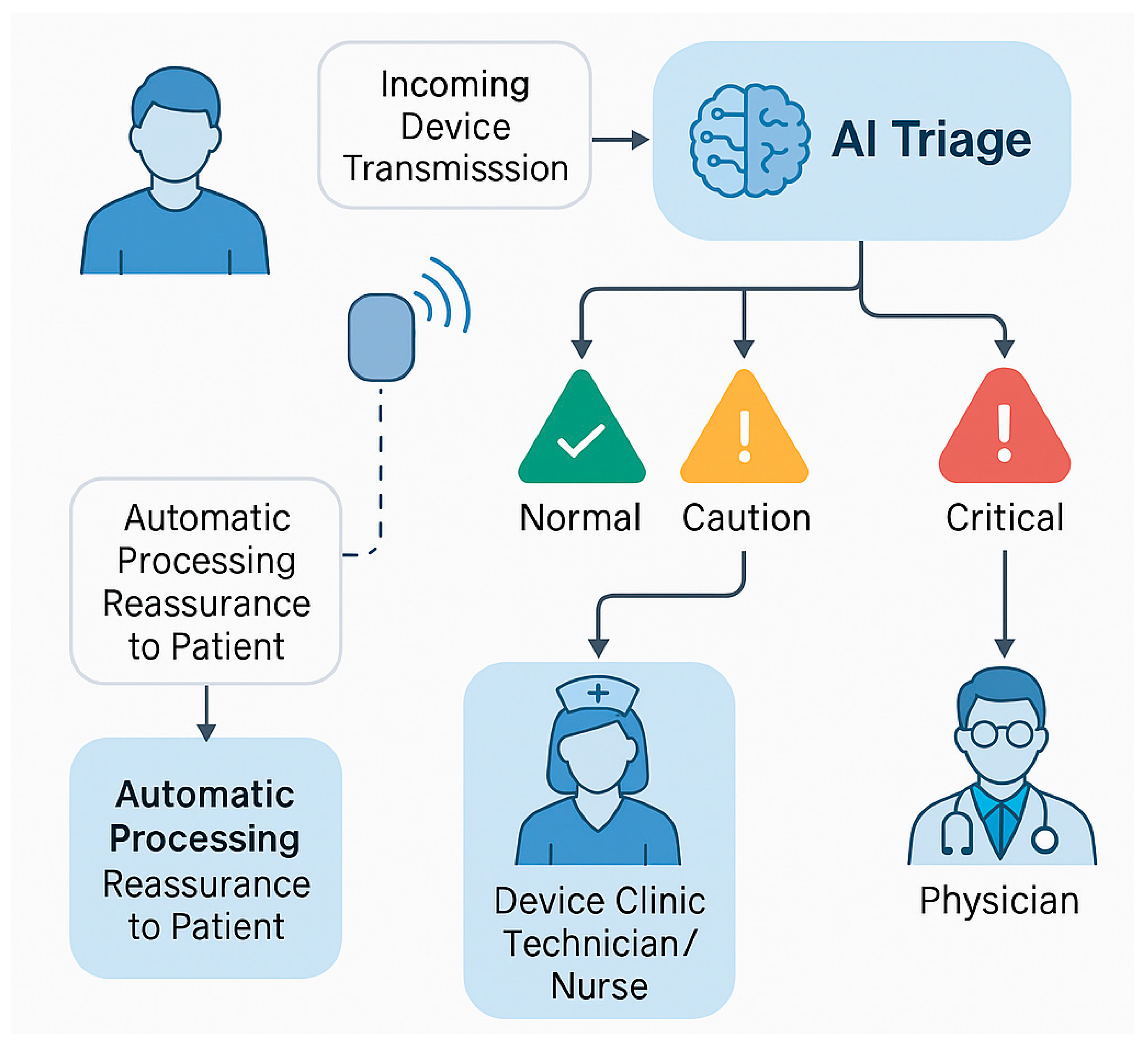
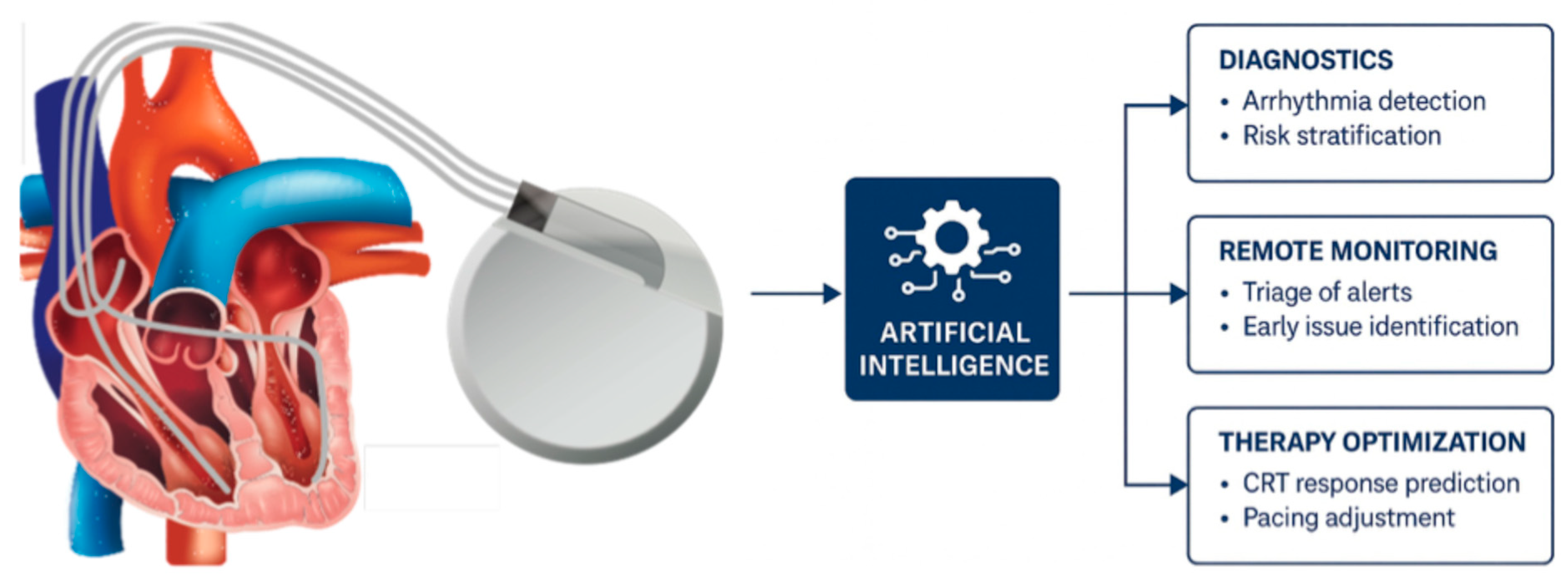
Artificial Intelligence and the Future of Cardiac Implantable Electronic Devices: Diagnostics, Monitoring, and Therapy
 , , ,
, , ,
Abstract
1. Introduction
1.1. Scientific Motivation for the Three Focus Areas
1.2. Methodology
1.3. Overview of Core AI Techniques Used in CIED Research
2. AI in CIED Diagnostics
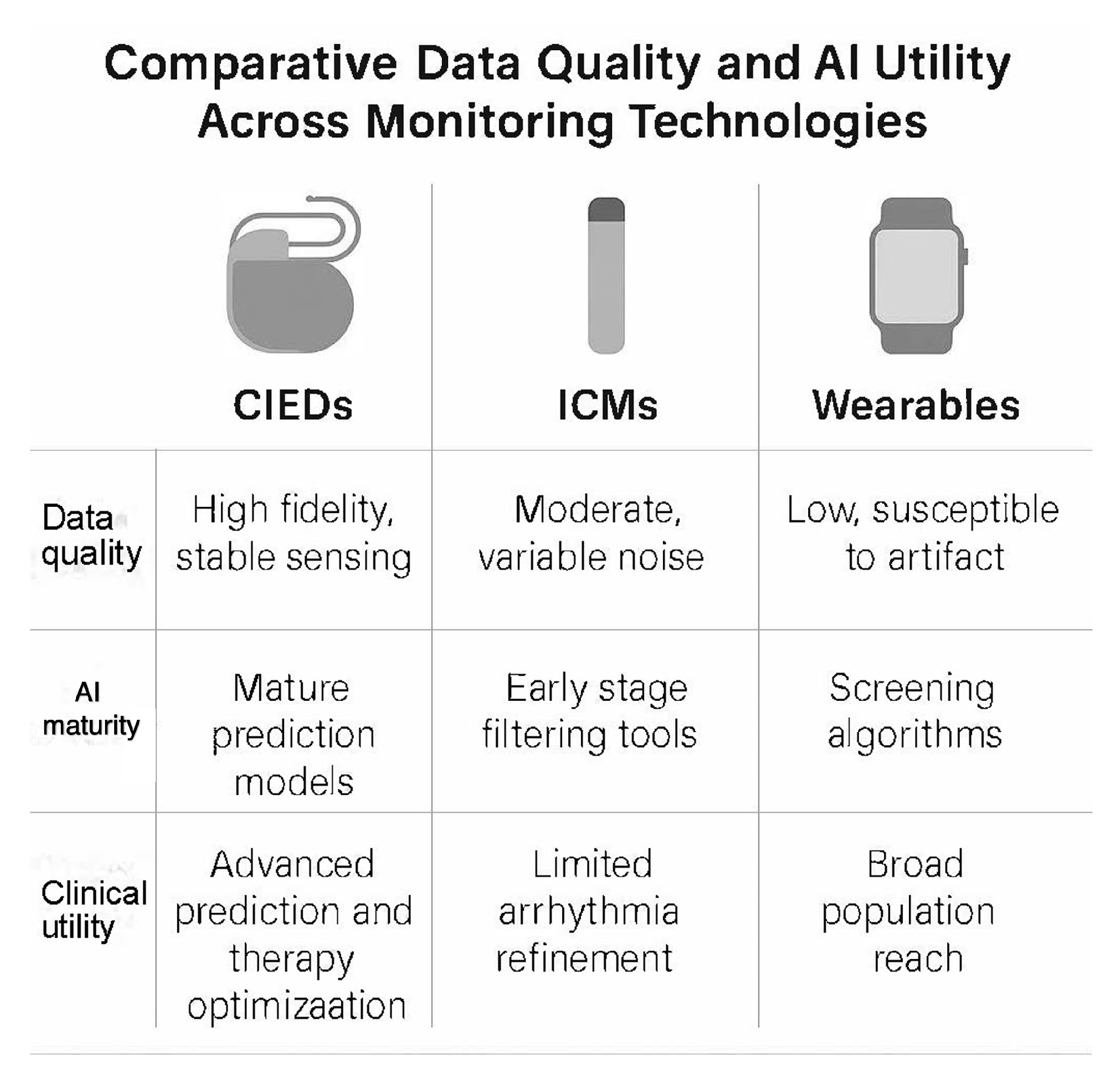
2.1. Comparative Data Quality and AI Utility Across Monitoring Technologies
2.2. Clinical Context: Variability of AI-Based Arrhythmia Detection Across Patient Groups
3. AI for Remote Monitoring and Data Management
4. AI in Therapy Optimisation and Device Programming
5. AI in Predicting CIED Infections and Device Malfunctions
6. Economic and Health System Implications of AI in CIED
7. Future Directions and Challenges
8. Conclusions
Author Contributions
Funding
Data Availability Statement
Conflicts of Interest
Abbreviations
References
- Verma, N.; Knight, B.P. Update in cardiac pacing. Arrhythm. Electrophysiol. Rev. 2019, 8, 228. [Google Scholar] [CrossRef] [PubMed]
- Chiu, C.S.L.; Gerrits, W.; Guglielmo, M.; Cramer, M.J.; van der Harst, P.; van Es, R.; Meine, M. From Clinic to Cloud: Efficacy of AI-Assisted Remote Monitoring of Patients With Implantable Cardiac Devices. Pacing Clin. Electrophysiol. 2025, 48, 1106–1113. [Google Scholar] [CrossRef] [PubMed]
- Zhan, C.; Baine, W.B.; Sedrakyan, A.; Steiner, C. Cardiac device implantation in the United States from 1997 through 2004: A population-based analysis. J. Gen. Intern. Med. 2008, 23, 13–19. [Google Scholar] [CrossRef] [PubMed]
- Antoun, I.; Nizam, A.; Ebeid, A.; Rajesh, M.; Abdelrazik, A.; Eldesouky, M.; Thu, K.M.; Barker, J.; Layton, G.R.; Zakkar, M. Artificial Intelligence in Adult Congenital Heart Disease: Diagnostic and Therapeutic Applications and Future Directions. Rev. Cardiovasc. Med. 2025, 26, 41523. [Google Scholar] [CrossRef]
- Antoun, I.; Abdelrazik, A.; Eldesouky, M.; Li, X.; Layton, G.R.; Zakkar, M.; Somani, R.; Ng, G.A. Artificial intelligence in atrial fibrillation: Emerging applications, research directions and ethical considerations. Front. Cardiovasc. Med. 2025, 12, 1596574. [Google Scholar] [CrossRef]
- Kabra, R.; Israni, S.; Vijay, B.; Baru, C.; Mendu, R.; Fellman, M.; Sridhar, A.; Mason, P.; Cheung, J.W.; DiBiase, L. Emerging role of artificial intelligence in cardiac electrophysiology. Cardiovasc. Digit. Health J. 2022, 3, 263–275. [Google Scholar] [CrossRef]
- Antoun, I.; Li, X.; Abdelrazik, A.; Eldesouky, M.; Thu, K.M.; Ibrahim, M.; Dhutia, H.; Somani, R.; Ng, G.A. Artificial intelligence in ventricular arrhythmias and sudden cardiac death: A guide for clinicians. Indian Pacing Electrophysiol. J. 2025. [Google Scholar] [CrossRef]
- Mittal, S.; Oliveros, S.; Li, J.; Barroyer, T.; Henry, C.; Gardella, C. AI Filter Improves Positive Predictive Value of Atrial Fibrillation Detection by an Implantable Loop Recorder. JACC Clin. Electrophysiol. 2021, 7, 965–975. [Google Scholar] [CrossRef]
- Katapadi, A.; Chelikam, N.; Rosemas, S.; Higuera, L.; Colombowala, I.; Bansal, S.; Darden, D.; Pothenini, N.V.K.; Koerber, S.; Tummala, R.; et al. Impact of Artificial Intelligence-Enhanced Insertable Cardiac Monitors on Device Clinic Workflow and Resource Utilization. JACC Adv. 2025, 4, 101656. [Google Scholar] [CrossRef]
- Ginder, C.; Li, J.; Halperin, J.L.; Akar, J.G.; Martin, D.T.; Chattopadhyay, I.; Upadhyay, G.A. Predicting malignant ventricular arrhythmias using real-time remote monitoring. J. Am. Coll. Cardiol. 2023, 81, 949–961. [Google Scholar] [CrossRef]
- Kolk, M.Z.; Deb, B.; Ruipérez-Campillo, S.; Bhatia, N.K.; Clopton, P.; Wilde, A.A.; Narayan, S.M.; Knops, R.E.; Tjong, F.V. Machine learning of electrophysiological signals for the prediction of ventricular arrhythmias: Systematic review and examination of heterogeneity between studies. EBioMedicine 2023, 89, 104462. [Google Scholar] [CrossRef]
- Howard, J.P.; Fisher, L.; Shun-Shin, M.J.; Keene, D.; Arnold, A.D.; Ahmad, Y.; Cook, C.M.; Moon, J.C.; Manisty, C.H.; Whinnett, Z.I. Cardiac rhythm device identification using neural networks. JACC Clin. Electrophysiol. 2019, 5, 576–586. [Google Scholar] [CrossRef] [PubMed]
- Abdelrazik, A.; Eldesouky, M.; Antoun, I.; Lau, E.Y.M.; Koya, A.; Vali, Z.; Suleman, S.A.; Donaldson, J.; Ng, G.A. Wearable Devices for Arrhythmia Detection: Advancements and Clinical Implications. Sensors 2025, 25, 2848. [Google Scholar] [CrossRef] [PubMed]
- Rosier, A.; Mabo, P.; Temal, L.; Van Hille, P.; Dameron, O.; Deléger, L.; Grouin, C.; Zweigenbaum, P.; Jacques, J.; Chazard, E. Personalized and automated remote monitoring of atrial fibrillation. Europace 2016, 18, 347–352. [Google Scholar] [CrossRef] [PubMed]
- Bawa, D.; Ghazal, R.; Kabra, R.; Pham, N.; Ahmed, A.; Katapadi, A.; Bansal, S.; Colombowala, I.; Darden, D.; Pothineni, N.V.K.; et al. Role of Artificial Intelligence in Reducing Data Deluge From Cardiac Implantable Electronic Devices. JACC Adv. 2025, 4, 102057. [Google Scholar] [CrossRef]
- Kratka, A.; Rotering, T.L.; Munson, S.; Raitt, M.H.; Whooley, M.A.; Dhruva, S. Patient and Clinician Perspectives on Alert-Based Remote Monitoring-First Care for Cardiovascular Implantable Electronic Devices: Semistructured Interview Study Within the Veterans Health Administration. JMIR Cardio 2025, 9, e66215. [Google Scholar] [CrossRef]
- Saha, S.; Ross, H.; Velmovitsky, P.E.; Wang, C.X.; Vishram-Nielsen, J.K.; Manlhiot, C.; Wang, B.; Cafazzo, J.A. Machine learning enhanced expert system for detecting heart failure decompensation using patient reported vitals and electronic health records. Sci. Rep. 2025, 15, 30979. [Google Scholar] [CrossRef]
- Yasmin, F.; Shah, S.M.I.; Naeem, A.; Shujauddin, S.M.; Jabeen, A.; Kazmi, S.; Siddiqui, S.A.; Kumar, P.; Salman, S.; Hassan, S.A. Artificial intelligence in the diagnosis and detection of heart failure: The past, present, and future. Rev. Cardiovasc. Med. 2021, 22, 1095–1113. [Google Scholar] [CrossRef]
- Feeny, A.K.; Rickard, J.; Patel, D.; Toro, S.; Trulock, K.M.; Park, C.J.; LaBarbera, M.A.; Varma, N.; Niebauer, M.J.; Sinha, S. Machine learning prediction of response to cardiac resynchronization therapy: Improvement versus current guidelines. Circ. Arrhythm. Electrophysiol. 2019, 12, e007316. [Google Scholar] [CrossRef]
- Chang, Y.-F.; Yen, K.-C.; Wang, C.-L.; Chen, S.-Y.; Chen, J.; Chu, P.-H.; Lai, C.-S. Deep Learning Significantly Boosts CRT Response Prediction Using Synthetic Longitudinal Strain Data: Training on Synthetic Data and Testing on Real Patients. Biomed. J. 2024, 48, 100803. [Google Scholar] [CrossRef]
- Nejadeh, M.; Bayat, P.; Kheirkhah, J.; Moladoust, H. Predicting the response to cardiac resynchronization therapy (CRT) using the deep learning approach. Biocybern. Biomed. Eng. 2021, 41, 758–778. [Google Scholar] [CrossRef]
- Odigwe, B.E.; Rajeoni, A.B.; Odigwe, C.I.; Spinale, F.G.; Valafar, H. Application of machine learning for patient response prediction to cardiac resynchronization therapy. In Proceedings of the 13th ACM International Conference on Bioinformatics, Computational Biology and Health Informatics, Chicago, IL, USA, 7–10 August 2022; pp. 1–4. [Google Scholar]
- Hung, Y.; Lin, C.; Lin, C.-S.; Lee, C.-C.; Fang, W.-H.; Lee, C.-C.; Wang, C.-H.; Tsai, D.-J. Artificial intelligence-enabled electrocardiography predicts future pacemaker implantation and adverse cardiovascular events. J. Med. Syst. 2024, 48, 67. [Google Scholar] [CrossRef] [PubMed]
- Moore, P.; Coucher, J.; Ngai, S.; Stanton, T.; Wahi, S.; Gould, P.; Booth, C.; Pratap, J.; Kaye, G. Imaging and right ventricular pacing lead position: A comparison of CT, MRI, and echocardiography. Pacing Clin. Electrophysiol. 2016, 39, 382–392. [Google Scholar] [CrossRef] [PubMed]
- Nazar, W.; Szymanowicz, S.; Nazar, K.; Kaufmann, D.; Wabich, E.; Braun-Dullaeus, R.; Daniłowicz-Szymanowicz, L. Artificial intelligence models in prediction of response to cardiac resynchronization therapy: A systematic review. Heart Fail. Rev. 2024, 29, 133–150. [Google Scholar] [CrossRef]
- Komp, J.; Boggaram, A.; Kao, D.P.; Trivedi, A.; Rosenberg, M.A. Strategies and Considerations for Safe Reinforcement Learning in Programming Cardiac Implantable Electronic Devices. Med. Res. Arch. 2025, 13, 6363. [Google Scholar] [CrossRef]
- Matteucci, A.; Pignalberi, C.; Pandozi, C.; Magris, B.; Meo, A.; Russo, M.; Galeazzi, M.; Schiaffini, G.; Aquilani, S.; Di Fusco, S.A. Prevention and risk assessment of cardiac device infections in clinical practice. J. Clin. Med. 2024, 13, 2707. [Google Scholar] [CrossRef]
- Asundi, A.; Stanislawski, M.; Mehta, P.; Mull, H.J.; Schweizer, M.L.; Barón, A.E.; Ho, P.M.; Gupta, K.; Branch-Elliman, W. Development and validation of a semi-automated surveillance algorithm for cardiac device infections: Insights from the VA CART program. Sci. Rep. 2020, 10, 5276. [Google Scholar] [CrossRef]
- Maclean, E.; Mahtani, K.; Honarbakhsh, S.; Butcher, C.; Ahluwalia, N.; Dennis, A.S.; Creta, A.; Finlay, M.; Elliott, M.; Mehta, V. The BLISTER score: A novel, externally validated tool for predicting cardiac implantable electronic device infections, and its cost-utility implications for antimicrobial envelope use. Circ. Arrhythm. Electrophysiol. 2024, 17, e012446. [Google Scholar] [CrossRef]
- Neupane, S. Machine Learning Approaches on Predicting Pacemaker Battery Life. Master’s Thesis, Wright State University, Dayton, OH, USA, 2025. [Google Scholar]
- Tateishi, R.; Suzuki, M.; Shimizu, M.; Shimada, H.; Tsunoda, T.; Miyazaki, H.; Misu, Y.; Yamakami, Y.; Yamaguchi, M.; Kato, N. Risk prediction of inappropriate implantable cardioverter-defibrillator therapy using machine learning. Sci. Rep. 2023, 13, 19586. [Google Scholar] [CrossRef]
- Jakaityte, I.; Brown, S.; Gillies, K.; Furniss, G.; Dayer, M.; Allen, M. Machine learning can predict implantable cardioverter defibrillator therapy: A development study. EP Eur. 2024, 26, euae102.596. [Google Scholar] [CrossRef]
- Alkhatib, S.A.; Katmah, R.; Kosaji, D.; Afzal, S.U.B.; Tariq, M.H.; Simsekler, M.C.E.; Ellahham, S. AI-Driven Decision Support Framework for Preventing Medical Equipment Failure and Enhancing Patient Safety: A New Perspective. J. Multidiscip. Healthc. 2025, ume 18, 6299–6313. [Google Scholar] [CrossRef] [PubMed]
- Arcinas, L.A.; Alyosif, M.; Rennert-May, E.; Piccini, J.P.; Varma, N.; Frazier-Mills, C.; Raj, S.J.; Mark, D.B.; Miller, R.J.H.; Chew, D.S. Cost-effectiveness of remote monitoring for cardiac implantable electronic devices compared with conventional follow-up: A systematic review. Eur. Heart J. 2023, 44, ehad655.696. [Google Scholar] [CrossRef]
- Greenspon, A.J.; Eby, E.L.; Petrilla, A.A.; Sohail, M.R. Treatment patterns, costs, and mortality among Medicare beneficiaries with CIED infection. Pacing Clin. Electrophysiol. 2018, 41, 495–503. [Google Scholar] [CrossRef] [PubMed]
- Frausing, M.H.J.P.; Johansen, J.B.; Afonso, D.; Jørgensen, O.D.; Olsen, T.; Gerdes, C.; Johansen, M.L.; Wolff, C.; Mealing, S.; Nielsen, J.C. Cost-effectiveness of an antibacterial envelope for infection prevention in patients undergoing cardiac resynchronization therapy reoperations in Denmark. Europace 2023, 25, euad159. [Google Scholar] [CrossRef]
- Wilkoff, B.L.; Boriani, G.; Mittal, S.; Poole, J.E.; Kennergren, C.; Corey, G.R.; Krahn, A.D.; Schloss, E.J.; Gallastegui, J.L.; Pickett, R.A. Cost-effectiveness of an antibacterial envelope for cardiac implantable electronic device infection prevention in the US healthcare system from the WRAP-IT trial. Circ. Arrhythm. Electrophysiol. 2020, 13, e008503. [Google Scholar] [CrossRef]
- Kotb, A.; Armstrong, S.; Koev, I.; Antoun, I.; Vali, Z.; Panchal, G.; Barker, J.; Mavilakandy, A.; Chin, S.H.; Lazdam, M. Digitally enabled acute care for atrial fibrillation: Conception, feasibility and early outcomes of an AF virtual ward. Open Heart 2023, 10, e002272. [Google Scholar] [CrossRef]
- Desai, A.N. Artificial intelligence: Promise, pitfalls, and perspective. JAMA 2020, 323, 2448–2449. [Google Scholar] [CrossRef]
- Barzilai, D.H.; Sudri, K.; Goshen, G.; Klang, E.; Zimlichman, E.; Barbash, I.; Shelly, M.C. Randomized Controlled Trials Evaluating Artificial Intelligence in Cardiovascular Care: A Systematic Review. JACC Adv. 2025, 4, 102152. [Google Scholar] [CrossRef]
- Murdoch, B. Privacy and artificial intelligence: Challenges for protecting health information in a new era. BMC Med. Ethics 2021, 22, 122. [Google Scholar] [CrossRef]
- Brożek, B.; Furman, M.; Jakubiec, M.; Kucharzyk, B. The black box problem revisited. Real and imaginary challenges for automated legal decision making. Artif. Intell. Law 2024, 32, 427–440. [Google Scholar] [CrossRef]
- Svennberg, E.; Han, J.K.; Caiani, E.G.; Engelhardt, S.; Ernst, S.; Friedman, P.; Garcia, R.; Ghanbari, H.; Hindricks, G.; Man, S.H. State of the art of artificial intelligence in clinical electrophysiology in 2025: A scientific statement of the European heart rhythm association (EHRA) of the ESC, the heart rhythm society (HRS), and the ESC working group on E-cardiology. Europace 2025, 27, euaf071. [Google Scholar] [CrossRef]



| Application | AI Approach | Example Findings |
|---|---|---|
| Arrhythmia detection and prediction | ML/DL on device data streams | Deep neural networks analysing daily device telemetry predicted ICD shocks up to 30 days early (AUC ~0.90). AI algorithms for insertable monitors cut false arrhythmia alerts by >60%. |
| Remote monitoring alert triage | Automated filtering (rule-based + ML) | Integrated data systems reduced device alert workload by ~84%. AI-enhanced monitors (with smart filters) achieved ~58% fewer non-actionable alerts, saving ~559 staff hours annually per clinic. |
| Therapy optimization (CRT) | Predictive modelling; imaging analysis | ML models trained on CRT trial data can predict responders (one 9-variable model is available as an online tool). AI-guided MRI analysis is being used to plan optimal lead placement for CRT. |
| Device programming automation | Reinforcement learning control | Proposed safe-RL frameworks allow pacemakers/ICDs to self-adjust settings based on patient physiology, while using safeguards to prevent unsafe changes. |
Disclaimer/Publisher’s Note: The statements, opinions and data contained in all publications are solely those of the individual author(s) and contributor(s) and not of MDPI and/or the editor(s). MDPI and/or the editor(s) disclaim responsibility for any injury to people or property resulting from any ideas, methods, instructions or products referred to in the content. |
© 2025 by the authors. Licensee MDPI, Basel, Switzerland. This article is an open access article distributed under the terms and conditions of the Creative Commons Attribution (CC BY) license (https://creativecommons.org/licenses/by/4.0/).
Share and Cite
Antoun, I.; Alkhayer, A.; Abdelrazik, A.; Eldesouky, M.; Thu, K.M.; Dhutia, H.; Somani, R.; Ng, G.A. Artificial Intelligence and the Future of Cardiac Implantable Electronic Devices: Diagnostics, Monitoring, and Therapy. J. Clin. Med. 2025, 14, 8824. https://doi.org/10.3390/jcm14248824
Antoun I, Alkhayer A, Abdelrazik A, Eldesouky M, Thu KM, Dhutia H, Somani R, Ng GA. Artificial Intelligence and the Future of Cardiac Implantable Electronic Devices: Diagnostics, Monitoring, and Therapy. Journal of Clinical Medicine. 2025; 14(24):8824. https://doi.org/10.3390/jcm14248824
Chicago/Turabian StyleAntoun, Ibrahim, Alkassem Alkhayer, Ahmed Abdelrazik, Mahmoud Eldesouky, Kaung Myat Thu, Harshil Dhutia, Riyaz Somani, and G. André Ng. 2025. "Artificial Intelligence and the Future of Cardiac Implantable Electronic Devices: Diagnostics, Monitoring, and Therapy" Journal of Clinical Medicine 14, no. 24: 8824. https://doi.org/10.3390/jcm14248824
APA StyleAntoun, I., Alkhayer, A., Abdelrazik, A., Eldesouky, M., Thu, K. M., Dhutia, H., Somani, R., & Ng, G. A. (2025). Artificial Intelligence and the Future of Cardiac Implantable Electronic Devices: Diagnostics, Monitoring, and Therapy. Journal of Clinical Medicine, 14(24), 8824. https://doi.org/10.3390/jcm14248824