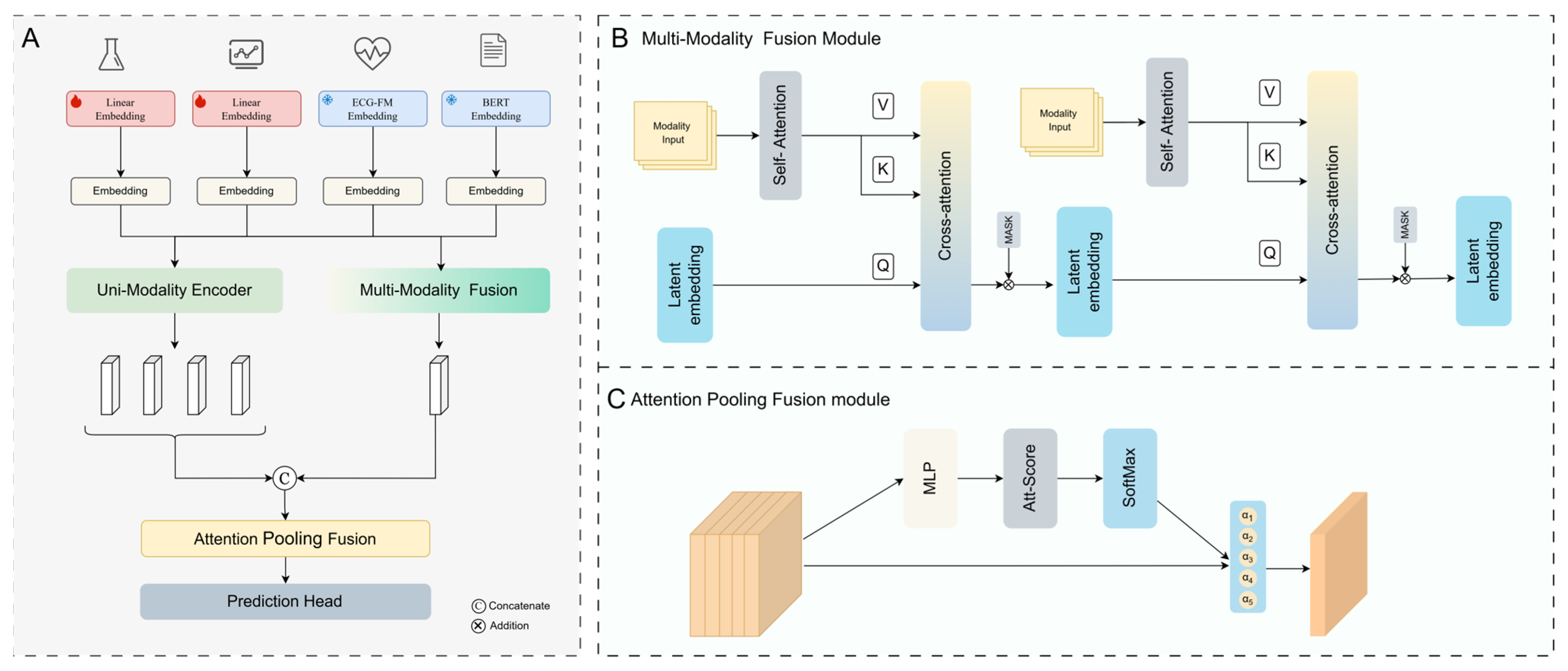
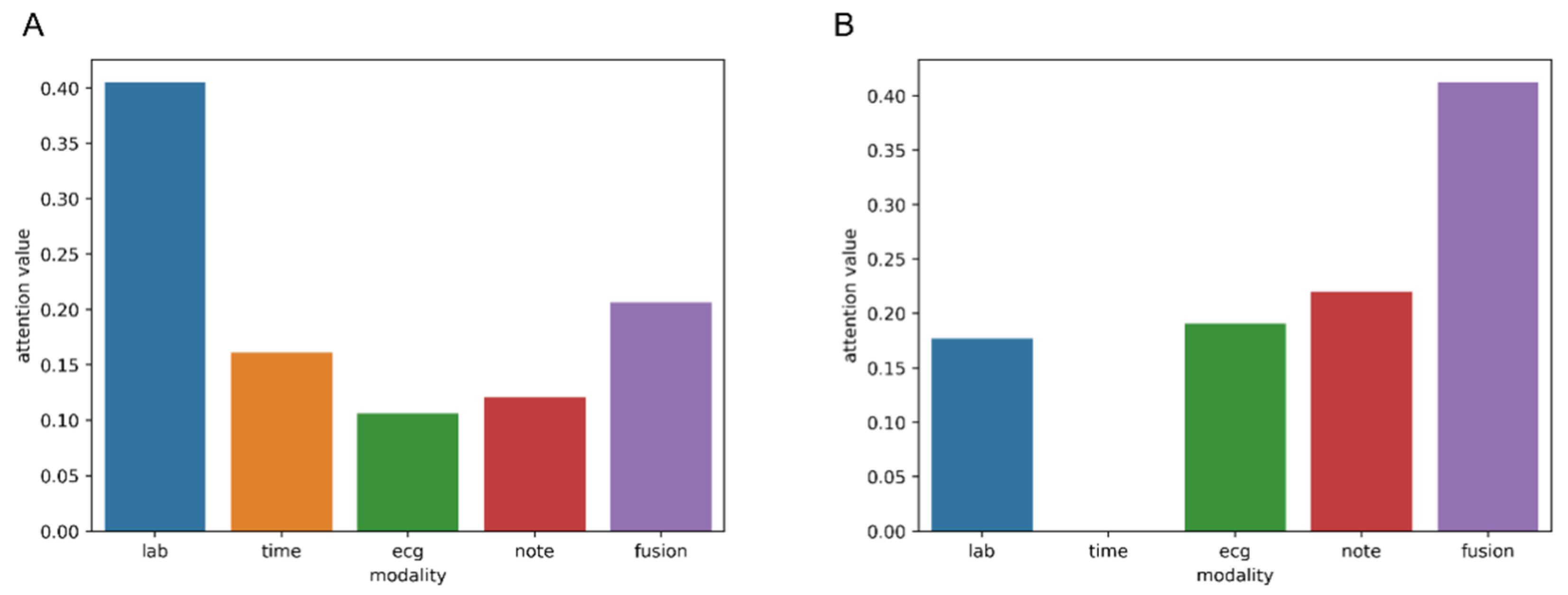
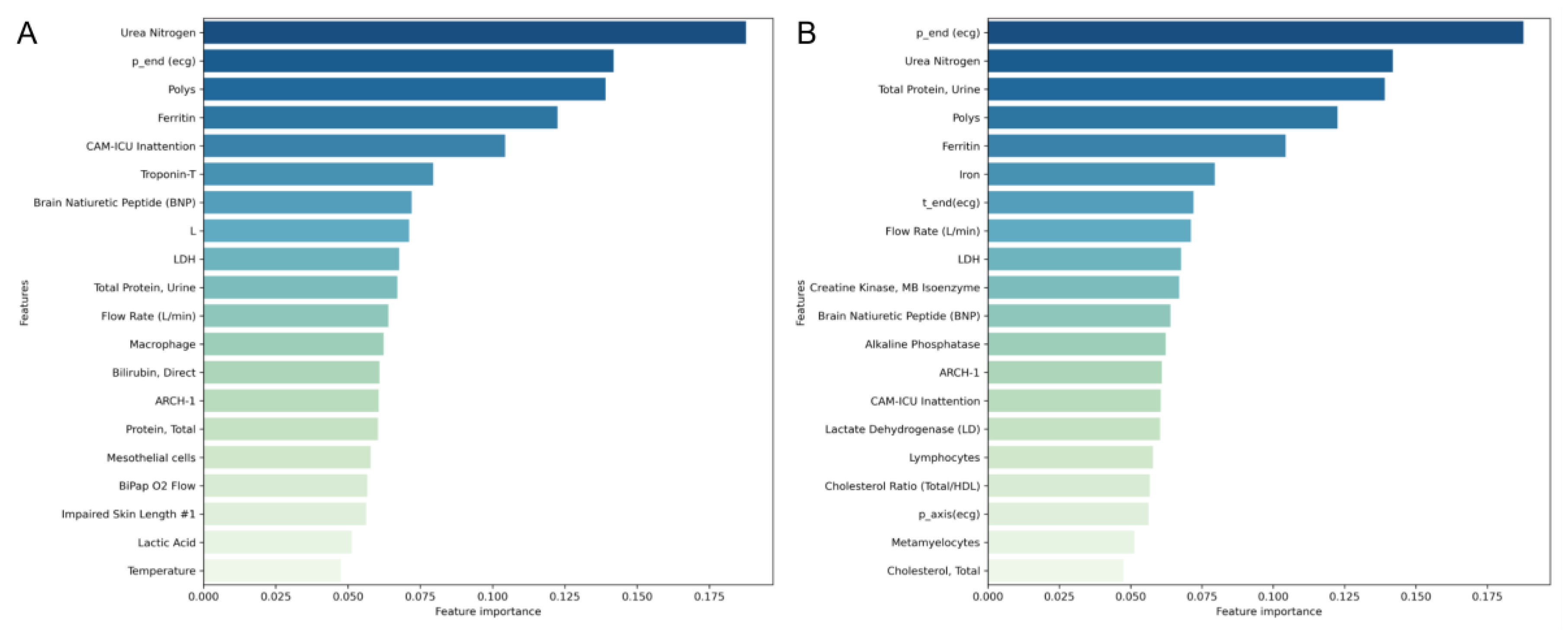
The Application of Multimodal Data Fusion Algorithm MULTINet in Postoperative Risk Assessment of TAVR


Abstract
1. Introduction
2. Materials and Methods
2.1. Dataset
2.2. Data Preprocessing
2.3. Postoperative 30-Day All-Cause Mortality Prediction for TAVR Based on Multimodal Data
2.4. Experimental Setup
2.5. Model Evaluation
2.6. Model Interpretability Analysis
3. Results
4. Discussion
4.1. Principal Findings
4.2. Missing Modality Problem
4.3. Model Interpretability
4.4. Limitations and Future Directions
5. Conclusions
Supplementary Materials
Author Contributions
Funding
Institutional Review Board Statement
Informed Consent Statement
Data Availability Statement
Acknowledgments
Conflicts of Interest
Abbreviations
| SD | Standard deviation |
| TAVR | Transcatheter aortic valve replacement |
| MULTINet | Multimodal learning for TAVR risk network |
| ICU | Intensive care unit |
| MIMIC-IV | Medical Information Mart for Intensive Care IV |
| AUC | Area under the receiver operating characteristic curve |
| AUPR | Area under the Precision–Recall curve |
| IGs | Integrated gradients |
| XGBoost | eXtreme Gradient Boosting |
| EuroSCORE II | European System for Cardiac Operative Risk Evaluation II |
| PROM | Society of Thoracic Surgeons Predicted Risk of Mortality |
| ECGs | Electrocardiograms |
| ICD | International classification of diseases |
| MICE | Multiple imputation by chained equations |
| LOCF | Last observation carried forward |
| CT | Computed tomography |
| MRI | Magnetic resonance imaging |
| ECG-FM | Electrocardiogram foundation model |
| M-MHSA | masked multi-head self-attention |
| M-MHCA | masked multi-head cross-attention |
| DFL | dual focal loss |
| FP | false positive |
| FN | False Negative |
| TP | true positive |
| TN | true negative |
| FPR | false positive rate |
| TPR | true positive rate |
| HAIM | Holistic AI in Medicine |
| LSTM | long short-term memory |
| CAM-ICU | confusion assessment method for the intensive care unit |
| BNP | brain natriuretic peptide |
| UN | urea nitrogen |
| AVA | aortic valve area |
References
- Kumar, V.; Sandhu, G.S.; Harper, C.M.; Ting, H.H.; Rihal, C.S. Transcatheter aortic valve replacement programs: Clinical outcomes and developments. J. Am. Heart Assoc. 2020, 9, e015921. [Google Scholar] [CrossRef] [PubMed]
- Vinayak, M.; Leone, P.P.; Tanner, R.; Dhulipala, V.; Camaj, A.; Makhija, R.R.K.; Hooda, A.; Kini, A.S.; Sharma, S.K.; Khera, S. Transcatheter aortic valve replacement: Current status and future indications. J. Clin. Med. 2024, 13, 373. [Google Scholar] [CrossRef]
- Lim, G.B. Suitability of TAVI in low-risk patients. Nat. Rev. Cardiol. 2023, 20, 284. [Google Scholar] [CrossRef]
- Puskas, J.D.; Kilgo, P.D.; Thourani, V.H.; Lattouf, O.M.; Chen, E.; Vega, J.D.; Cooper, W.; Guyton, R.A.; Halkos, M. The society of thoracic surgeons 30-day predicted risk of mortality score also predicts long-term survival. Ann. Thorac. Surg. Off. J. Soc. Thorac. Surg. South. Thorac. Surg. Assoc. 2012, 93, 26–35. [Google Scholar] [CrossRef]
- Nashef, S.A.M.; Roques, F.; Sharples, L.D.; Nilsson, J.; Smith, C.; Goldstone, A.R.; Lockowandt, U. EuroSCORE II. Eur. J. Cardio-Thorac. Surg. 2012, 41, 734–745. [Google Scholar] [CrossRef]
- Cao, X.; Wang, C.; Wang, Q.; Li, X.; Han, L.; Xu, Z.; Zou, L. Validation of the EuroSCORE and the STS-PROM in adult patients undergoing aortic valve replacement. Chin. J. Thorac. Cardiovaescular Surg. 2011, 27, 717–719. [Google Scholar] [CrossRef]
- Lopes, R.R.; van Mourik, M.S.; Schaft, E.V.; Ramos, L.A.; Baan, J., Jr.; Vendrik, J.; de Mol, B.A.J.M.; Vis, M.M.; Marquering, H.A. Value of machine learning in predicting TAVI outcomes. Neth. Heart J. 2019, 27, 443–450. [Google Scholar] [CrossRef]
- Penso, M.; Pepi, M.; Fusini, L.; Muratori, M.; Cefalù, C.; Mantegazza, V.; Gripari, P.; Ali, S.G.; Fabbiocchi, F.; Bartorelli, A.L.; et al. Predicting long-term mortality in TAVI patients using machine learning techniques. J. Cardiovasc. Dev. Dis. 2021, 8, 44. [Google Scholar] [CrossRef] [PubMed]
- Agasthi, P.; Ashraf, H.; Pujari, S.H.; Girardo, M.E.; Tseng, A.; Mookadam, F.; Venepally, N.R.; Buras, M.; Khetarpal, B.K.; Allam, M.; et al. Artificial intelligence trumps TAVI2-SCORE and CoreValve score in predicting 1-year mortality post-transcatheter aortic valve replacement. Cardiovasc. Revascularization Med. 2021, 24, 33–41. [Google Scholar] [CrossRef]
- Kwiecinski, J.; Dabrowski, M.; Nombela-Franco, L.; Grodecki, K.; Pieszko, K.; Chmielak, Z.; Pylko, A.; Hennessey, B.; Kalinczuk, L.; Tirado-Conte, G.; et al. Machine learning for prediction of all-cause mortality after transcatheter aortic valve implantation. Eur. Heart J.-Qual. Care Clin. Outcomes 2023, 9, 768–777. [Google Scholar] [CrossRef]
- Gomes, B.; Pilz, M.; Reich, C.; Leuschner, F.; Konstandin, M.; Katus, H.A.; Meder, B. Machine learning-based risk prediction of intrahospital clinical outcomes in patients undergoing TAVI. Clin. Res. Cardiol. 2021, 110, 343–356. [Google Scholar] [CrossRef]
- Huang, S.-C.; Pareek, A.; Seyyedi, S.; Banerjee, I.; Lungren, M.P. Fusion of medical imaging and electronic health records using deep learning: A systematic review and implementation guidelines. NPJ Digit. Med. 2020, 3, 136. [Google Scholar] [CrossRef]
- Soenksen, L.R.; Ma, Y.; Zeng, C.; Boussioux, L.; Carballo, K.V.; Na, L.; Wiberg, H.M.; Li, M.L.; Fuentes, I.; Bertsimas, D. Integrated multimodal artificial intelligence framework for healthcare applications. NPJ Digit. Med. 2022, 5, 149. [Google Scholar] [CrossRef]
- Le, L.P.; Nguyen, T.; Riegler, M.A.; Halvorsen, P.; Nguyen, B.T. Multimodal missing data in healthcare: A comprehensive review and future directions. Comput. Sci. Rev. 2025, 56, 100720. [Google Scholar] [CrossRef]
- Acosta, J.N.; Falcone, G.J.; Rajpurkar, P.; Topol, E.J. Multimodal biomedical AI. Nat. Med. 2022, 28, 1773–1784. [Google Scholar] [CrossRef] [PubMed]
- Mamprin, M.; Zelis, J.M.; Tonino, P.A.L.; Zinger, S.; de With, P.H.N. Decision trees for predicting mortality in transcatheter aortic valve implantation. Bioengineering 2021, 8, 22. [Google Scholar] [CrossRef] [PubMed]
- Yu, Y.; Li, M.; Liu, L.; Li, Y.; Wang, J. Clinical big data and deep learning: Applications, challenges, and future outlooks. Big Data Min. Anal. 2019, 2, 288–305. [Google Scholar] [CrossRef]
- Johnson, A.E.W.; Bulgarelli, L.; Shen, L.; Gayles, A.; Shammout, A.; Horng, S.; Pollard, T.J.; Hao, S.; Moody, B.; Gow, B.; et al. MIMIC-IV, a freely accessible electronic health record dataset. Sci. Data 2023, 10, 1. [Google Scholar] [CrossRef]
- Van Buuren, S.; Groothuis-Oudshoorn, K. mice: Multivariate imputation by chained equations in R. J. Stat. Softw. 2011, 45, 1–67. [Google Scholar] [CrossRef]
- Sugden, R.A. Multiple Imputation for Nonresponse in Surveys. J. R. Stat. Soc. Ser. A Stat. Soc. 1988, 151, 567. [Google Scholar] [CrossRef]
- Harel, O.; Mitchell, E.M.; Perkins, N.J.; Cole, S.R.; Tchetgen Tchetgen, E.J.; Sun, B.; Schisterman, E. Multiple imputation for incomplete data in epidemiologic studies. Am. J. Epidemiol. 2018, 187, 576–584. [Google Scholar] [CrossRef]
- McKeen, K.; Oliva, L.; Masood, S.; Rubin, B.; Wang, B. Ecg-fm: An open electrocardiogram foundation model. arXiv 2024, arXiv:2408.05178. [Google Scholar] [CrossRef]
- Lee, S.A.; Wu, A.; Chiang, J.N. Clinical modernbert: An efficient and long context encoder for biomedical text. arXiv 2025, arXiv:2504.03964. [Google Scholar] [CrossRef]
- Lin, T.Y.; Goyal, P.; Girshick, R.; He, K.; Dollár, P. Focal loss for dense object detection. In Proceedings of the IEEE International Conference on Computer Vision, Venice, Italy, 29 October 2017; pp. 2980–2988. [Google Scholar]
- Tao, L.; Dong, M.; Xu, C. Dual focal loss for calibration. In Proceedings of the International Conference on Machine Learning, ICML, Honolulu, HI, USA, 23–29 July 2023; pp. 33833–33849. [Google Scholar]
- Sundararajan, M.; Taly, A.; Yan, Q. Axiomatic attribution for deep networks. In Proceedings of the International Conference on Machine Learning, ICML, Sydney, NSW, Australia, 6–11 August 2017; pp. 3319–3328. [Google Scholar]
- Hayat, N.; Geras, K.J.; Shamout, F.E. MedFuse: Multi-modal fusion with clinical time-series data and chest X-ray images. In Proceedings of the Machine Learning for Healthcare Conference, MLHC, Durham, NC, USA, 5–6 August 2022; pp. 479–503. [Google Scholar]
- Delijani, D.; Li, L.; Rutkin, B.; Wilson, S.; Kennedy, K.F.; Hartman, A.R.; Yu, P.J. Impact of age on outcomes after transcatheter aortic valve implantation. Eur. Heart J. Qual. Care Clin. Outcomes 2023, 9, 135–141. [Google Scholar] [CrossRef] [PubMed]
- Cersosimo, A.; Zito, E.; Pierucci, N.; Matteucci, A.; La Fazia, V.M. A Talk with ChatGPT: The Role of Artificial Intelligence in Shaping the Future of Cardiology and Electrophysiology. J. Pers. Med. 2025, 15, 205. [Google Scholar] [CrossRef] [PubMed] [PubMed Central]
- Alhwiti, T.; Aldrugh, S.; Megahed, F.M. Predicting in-hospital mortality after transcatheter aortic valve replacement using administrative data and machine learning. Sci. Rep. 2023, 13, 10252. [Google Scholar] [CrossRef]
- Kwiecinski, J.; Grodecki, K.; Pieszko, K.; Dabrowski, M.; Chmielak, Z.; Wojakowski, W.; Niemierko, J.; Fijalkowska, J.; Jagielak, D.; Ruile, P.; et al. Preprocedural CT angiography and machine learning for mortality prediction after transcatheter aortic valve replacement. Prog. Cardiovasc. Dis. 2025, 90, 119–128. [Google Scholar] [CrossRef] [PubMed] [PubMed Central]
- Tomii, D.; Shiri, I.; Baj, G.; Nakase, M.; Kazaj, P.M.; Samim, D.; Bartkowiak, J.; Praz, F.; Lanz, J.; Stortecky, S.; et al. Multimodal Machine Learning-Based Technical Failure Prediction in Patients Undergoing Transcatheter Aortic Valve Replacement. JACC Adv. 2025, 4 Pt 2, 102168. [Google Scholar] [CrossRef] [PubMed] [PubMed Central]
- Ghassemi, M.; Oakden-Rayner, L.; Beam, A.L. The false hope of current approaches to explainable artificial intelligence in health care. Lancet Digit. Health 2021, 3, e745–e750. [Google Scholar] [CrossRef] [PubMed]
- Tomsett, R.; Preece, A.; Braines, D.; Cerutti, F.; Chakraborty, S.; Srivastava, M.; Pearson, G.; Kaplan, L. Rapid trust calibration through interpretable and uncertainty-aware AI. Patterns 2020, 1, 100049. [Google Scholar] [CrossRef]
- Haberman, D.; Shimoni, S.; George, J. Blood Urea Predicts All-cause Mortality in Patients with Severe Aortic Stenosis. Circulation 2017, 136 (Suppl. S1), A18328. [Google Scholar]
- Gulsen, K.; Ince, O.; Akgun, T.; Demir, S.; Uslu, A.; Kup, A.; Ocal, L.; Emiroglu, M.Y.; Kargin, R.; Sahin, I.; et al. The effect of P wave indices on new onset atrial fibrillation after trans-catheter aortic valve replacement. J. Electrocardiol. 2020, 61, 71–76. [Google Scholar] [CrossRef] [PubMed]
- Lehtola, H.; Piuhola, J.; Niemelä, M.; Tauriainen, T.; Junttila, J.; Mäkikallio, T.; Juvonen, T.; Biancari, F. B-type natriuretic peptide ability to predict mortality after transcatheter aortic valve replacement. J. Cardiovasc. Med. 2022, 23, e18–e20. [Google Scholar] [CrossRef]
- Seoudy, H.; Lambers, M.; Winkler, V.; Dudlik, L.; Freitag-Wolf, S.; Frank, J.; Kuhn, C.; Rangrez, A.Y.; Puehler, T.; Lutter, G.; et al. Elevated high-sensitivity troponin T levels at 1-year follow-up are associated with increased long-term mortality after TAVR. Clin. Res. Cardiol. 2021, 110, 421–428. [Google Scholar] [CrossRef]
- Imamura, T.; Oshima, A.; Narang, N.; Onoda, H.; Tanaka, S.; Ushijima, R.; Sobajima, M.; Fukuda, N.; Ueno, H.; Kinugawa, K. Clinical implications of troponin-T elevations following TAVR: Troponin Increase Following TAVR. J. Cardiol. 2022, 79, 240–246. [Google Scholar] [CrossRef]
- Schindler, M.; Stöckli, F.; Brütsch, R.; Jakob, P.; Holy, E.; Michel, J.; Manka, R.; Vogt, P.; Templin, C.; Kasel, M.; et al. Postprocedural troponin elevation and mortality after transcatheter aortic valve implantation. J. Am. Heart Assoc. 2021, 10, e020739. [Google Scholar] [CrossRef]
- Khalil, C.; Pham, M.; Sawant, A.C.; Sinibaldi, E.; Bhardwaj, A.; Ramanan, T.; Qureshi, R.; Khan, S.; Ibrahim, A.; Gowda, S.N.; et al. Neutrophil-to-lymphocyte ratio predicts heart failure readmissions and outcomes in patients undergoing transcatheter aortic valve replacement. Indian Heart J. 2018, 70, S313–S318. [Google Scholar] [CrossRef]
- Rawat, A.; Goyal, P.; Ahsan, S.A.; Srivyshnavi, K.S.S.; Asghar, A.H.; A Riyalat, A.; Wei, C.R.; Khan, A. The Prognostic Value of Neutrophil-to-Lymphocyte Ratio on Mortality in Patients Undergoing Transcatheter Aortic Valve Implantation: A Systematic Review and Meta-Analysis. Cureus 2025, 17, e77909. [Google Scholar] [CrossRef]
- Hoffmann, J.; Mas-Peiro, S.; Berkowitsch, A.; Boeckling, F.; Rasper, T.; Pieszko, K.; De Rosa, R.; Hiczkiewicz, J.; Burchardt, P.; Fichtlscherer, S.; et al. Inflammatory signatures are associated with increased mortality after transfemoral transcatheter aortic valve implantation. ESC Heart Fail. 2020, 7, 2597–2610. [Google Scholar] [CrossRef]
- Prasitlumkum, N.; Mekritthikrai, R.; Kewcharoen, J.; Kanitsoraphan, C.; Mao, M.A.; Cheungpasitporn, W. Delirium is associated with higher mortality in transcatheter aortic valve replacement: Systemic review and meta-analysis. Cardiovasc. Interv. Ther. 2020, 35, 168–176. [Google Scholar] [CrossRef] [PubMed]
- Caldararu, C.; Balanescu, S. Modern Use of Echocardiography in Transcatheter Aortic Valve Replacement: An Up-Date. Maedica 2016, 11, 299–307. [Google Scholar] [PubMed]




| Method | AUC | AUPR | Recall | Brier |
|---|---|---|---|---|
| XGBoost | 0.8958 (0.85–0.93) | 0.4053 (0.26–0.57) | 0.7793 (0.62–0.90) | 0.0343 (0.03–0.04) |
| MedFuse | 0.5571 (0.53–0.61) | 0.2487 (0.15–0.32) | 0.3089 (0.15–0.47) | 0.2496 (0.24–0.25) |
| MULTINet | 0.9153 (0.87–0.95) | 0.5708 (0.48–0.66) | 0.8051 (0.71–0.90) | 0.0269 (0.02–0.03) |
| Method | AUC | AUPR | Recall | Brier |
|---|---|---|---|---|
| Median interpolation | 0.7242 (0.62–0.81) | 0.2517 (0.11–0.41) | 0.6586 (0.50–0.81) | 0.0377 (0.03–0.04) |
| Uni-modality | 0.9015 (0.85–0.94) | 0.5553 (0.39–0.70) | 0.7491 (0.59–0.89) | 0.0329 (0.03–0.04) |
| Multi-modality | 0.8715 (0.86–0.88) | 0.4192(0.31–0.50) | 0.6845 (0.53–0.83) | 0.0389 (0.03–0.04 |
| Mean pooling | 0.8977 (0.84–0.94) | 0.4385 (0.28–0.61) | 0.7790 (0.63–0.90) | 0.0328 (0.03–0.04) |
| ECG-FM finetuned | 0.9286 (0.88–0.96) | 0.5325 (0.38–0.70) | 0.8463 (0.71–0.96) | 0.0287 (0.02–0.03) |
| MULTINet | 0.9153 (0.87–0.95) | 0.5708 (0.48–0.66) | 0.8051 (0.71–0.90) | 0.0269 (0.02–0.03) |
| AUC | AUPR | Recall | Brier | |
|---|---|---|---|---|
| Age | ||||
| <80 (307, 40%) | 0.8808 (0.78–0.96) | 0.5907 (0.52–0.64) | 0.8165 (0.62–0.98) | 0.0268 (0.02–0.03) |
| ≥80 (454, 60%) | 0.8779 (0.76–0.97) | 0.5565 (0.55–0.56) | 0.8541 (0.64–0.99) | 0.0269 (0.02–0.03) |
| Sex | ||||
| Male (402, 53%) | 0.8812 (0.83–0.93) | 0.5108 (0.37–0.65) | 0.8208 (0.72–0.92) | 0.0361 (0.03–0.04) |
| Female (359, 47%) | 0.8803 (0.80–0.94) | 0.5715(0.36–0.78) | 0.8013 (0.78–0.82) | 0.0336 (0.03–0.04) |
Disclaimer/Publisher’s Note: The statements, opinions and data contained in all publications are solely those of the individual author(s) and contributor(s) and not of MDPI and/or the editor(s). MDPI and/or the editor(s) disclaim responsibility for any injury to people or property resulting from any ideas, methods, instructions or products referred to in the content. |
© 2025 by the authors. Licensee MDPI, Basel, Switzerland. This article is an open access article distributed under the terms and conditions of the Creative Commons Attribution (CC BY) license (https://creativecommons.org/licenses/by/4.0/).
Share and Cite
He, W.; Luo, J.; Yang, X. The Application of Multimodal Data Fusion Algorithm MULTINet in Postoperative Risk Assessment of TAVR. J. Clin. Med. 2025, 14, 8620. https://doi.org/10.3390/jcm14248620
He W, Luo J, Yang X. The Application of Multimodal Data Fusion Algorithm MULTINet in Postoperative Risk Assessment of TAVR. Journal of Clinical Medicine. 2025; 14(24):8620. https://doi.org/10.3390/jcm14248620
Chicago/Turabian StyleHe, Wei, Jiawei Luo, and Xiaoyan Yang. 2025. "The Application of Multimodal Data Fusion Algorithm MULTINet in Postoperative Risk Assessment of TAVR" Journal of Clinical Medicine 14, no. 24: 8620. https://doi.org/10.3390/jcm14248620
APA StyleHe, W., Luo, J., & Yang, X. (2025). The Application of Multimodal Data Fusion Algorithm MULTINet in Postoperative Risk Assessment of TAVR. Journal of Clinical Medicine, 14(24), 8620. https://doi.org/10.3390/jcm14248620