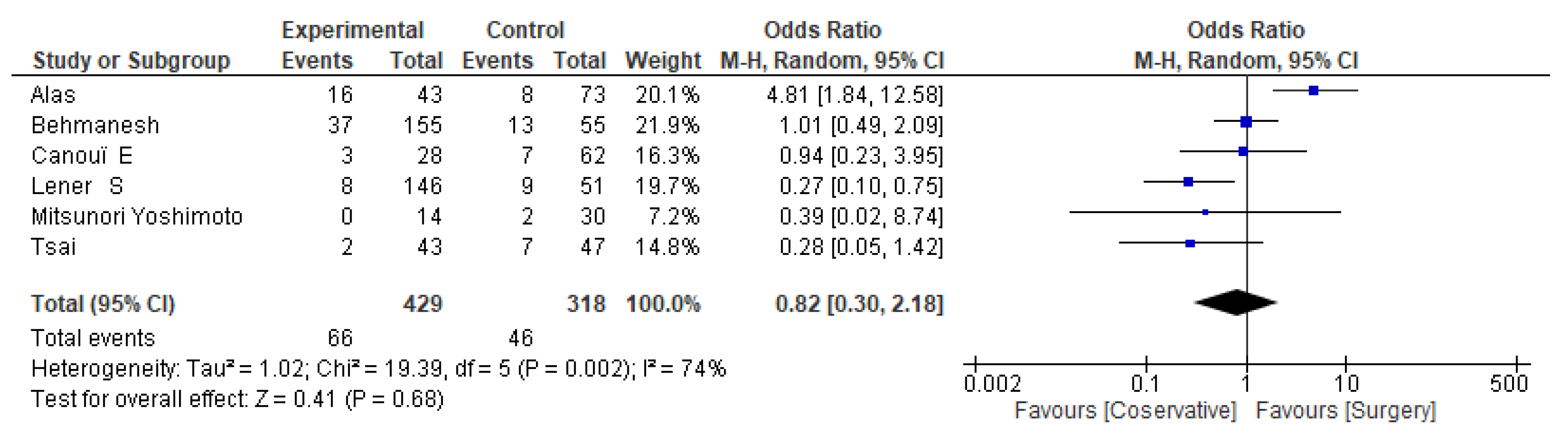
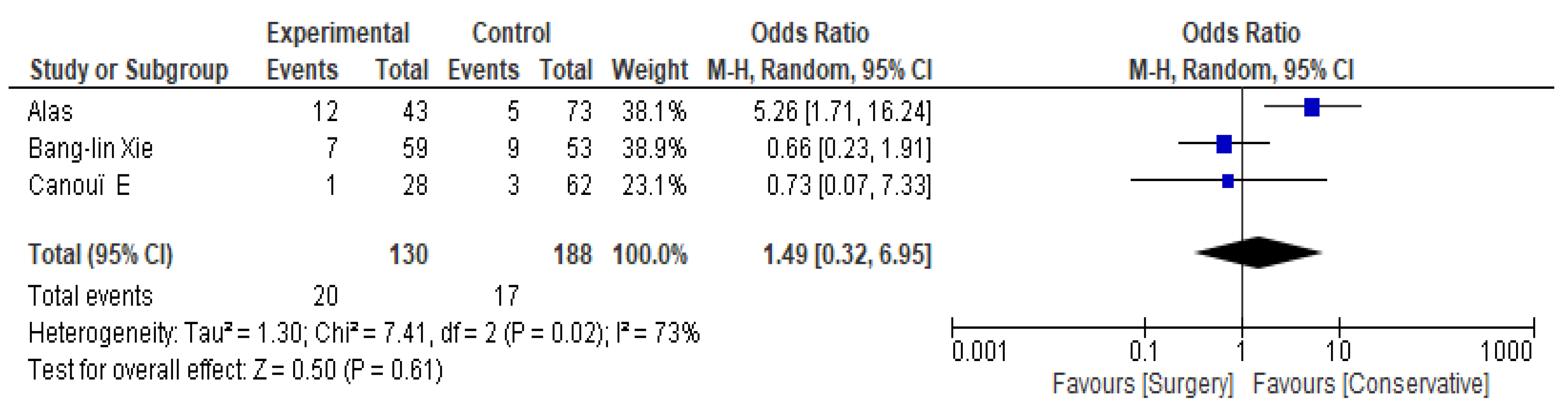
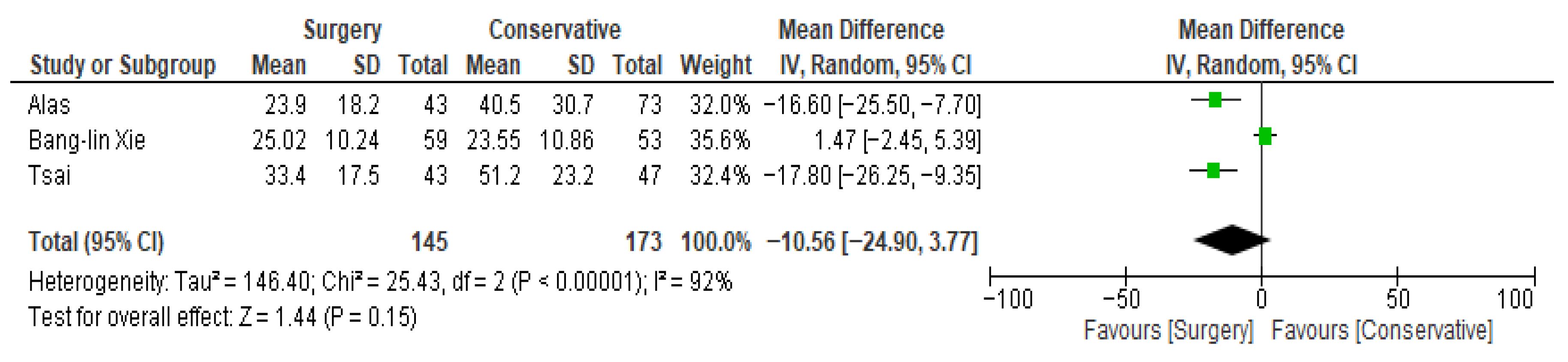
Is Conservative Treatment Superior to Surgical Intervention in Hematogenous Primary Septic Spinal Infection in Terms of Mortality, Recurrence, and Hospital Stay? A Systematic Review and Meta-Analysis



Abstract
1. Introduction
2. Materials and Methods
2.1. Literature Search
- (“spondylodiscitis” OR “spondylitis”) AND NOT “ankylosing spondylitis” AND NOT “tuberculosis”.
- (“spinal infection” OR “infection of the spine”) AND (“conservative treatment” OR “surgical treatment”).
- Study Design: Retrospective double-arm cohort studies comparing surgical to conservative treatment of spinal infections. No RCTs were found in our search.
- Comparative Analysis: Studies comparing surgical treatment (ST) to conservative treatment (CT).
- Patient Population: Studies involving patients with hematogenous, septic spondylodiscitis or spondylitis—not ankylosing spondylitis, not tuberculosis, not post-surgical, and not fungal.
- Primary Endpoint: Studies with the primary endpoint of the incidence of hematogenous spinal infection.
- Population (P): Adults with primary hematogenous septic spinal infection, encompassing the subgroups of native spondylitis, septic spondylodiscitis, discitis, spondylitis, and vertebral osteomyelitis, specifically referring to adult patients (≥18 years) diagnosed with an acute or subacute infection of the spinal column resulting from hematogenous spread of pathogens, primarily bacterial in origin, affecting the cervical, thoracic, thoracolumbar, lumbar, or lumbosacral spine.
- Interventional Treatment (I): Traditional open anterior, posterior, or combined surgery, using minimally invasive, endoscopic techniques potentially involving spinal instrumentation.
- Comparison Controls (C): Patients who received conservative treatment (CT) (antibiotics, brace, aspiration).
- Outcome (O): Incidence rate differences between conservative and surgical treatment regarding mortality, recurrence, and length of hospital stay.
- Condition: Adults with hematogenous, septic spondylodiscitis or spondylitis—not ankylosing spondylitis, not tuberculosis, not fungal, and not caused by previous surgery or trauma.
- Clinical Presentation: Fever, pain, or cachexia.
- Diagnostic Confirmation: MRI showing destruction of the vertebral endplates and disks, roentgenograms, biopsy, or elevated CRP.
- Study Size: Studies with at least 10 cases each.
- Outcome Reporting: Series specifically reporting on adults with hematogenous, septic spondylodiscitis or spondylitis—not ankylosing spondylitis, not tuberculosis, not fungal, and not caused by previous surgery or trauma—treated surgically, conservatively, or both.
- Language: Articles published in English and German.
- Study Type: Narrative reviews, systematic reviews, meta-analyses, and case reports; studies reporting solely or mainly on spinal abscesses.
- Sample Size: Studies with fewer than 10 participants.
- Language: Articles published in languages other than English and German.
- Intervention: Studies that identified spinal intracanal or paravertebral abscess as the main focus of investigation.
- Study Population: Studies including spinal infections due to TBC, mycosis, abscess, or post-surgical spinal infections.
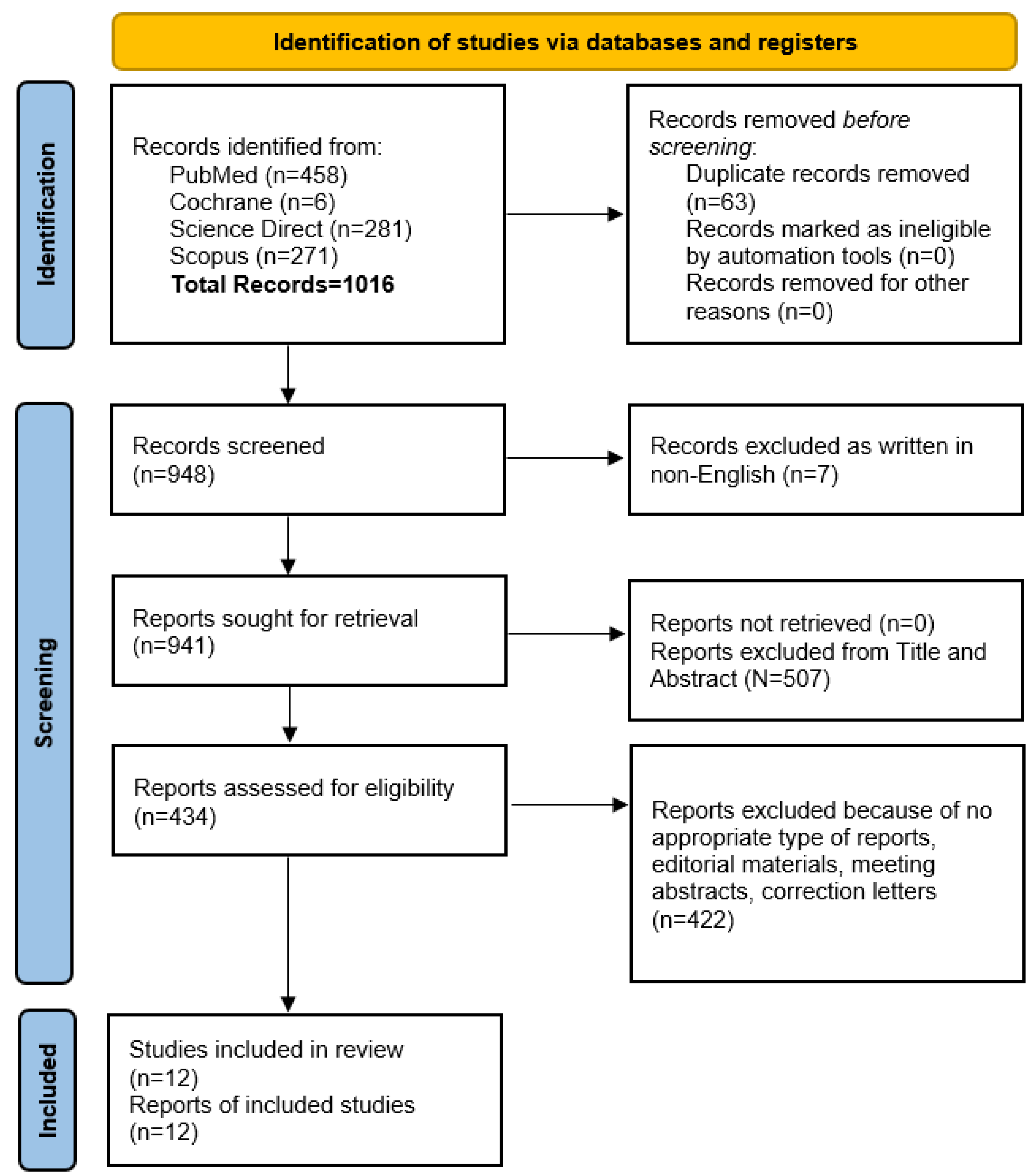
2.2. Selection of Studies
2.3. Key Steps in the Review Process
- Initial Selection: Articles were evaluated based on titles and abstracts. Full texts were retrieved for studies with unclear inclusion/exclusion criteria.
- Resolution of Doubts: If uncertainties persisted, the decision was made through discussion, with a third reviewer brought in if necessary.
- Scoring: Each primary study was assigned a score independently by the two reviewers. The final score for each study was the average of the two scores.
2.4. Protocol and Data Extraction
2.5. Quality Assessment and Risk of Bias
2.6. Statistical Analysis
3. Results
4. Discussion
4.1. Mortality Predictors in Hematogenous Spinal Infection
4.2. Strategies to Reduce Mortality
4.3. Study Limitations
4.4. Future Directions
5. Conclusions
Supplementary Materials
Funding
Data Availability Statement
Acknowledgments
Conflicts of Interest
Abbreviations
| HPSSI | Hematogenous Primary Septic Spinal Infection |
| VO | Vertebral Osteomyelitis |
References
- Zimmerli, W. Clinical practice. Vertebral osteomyelitis. N. Engl. J. Med. 2010, 362, 1022–1029. [Google Scholar] [CrossRef]
- Ablin, G.; Erickson, T.C. Osteomyelitis of cervical vertebrae (and quadriparesis) secondary to urinary tract infection: Case report and review of literature. J. Neurosurg. 1958, 15, 455–459. [Google Scholar] [CrossRef] [PubMed]
- Tali, E.T.; Oner, A.Y.; Koc, A.M. Pyogenic spinal infections. Neuroimaging Clin. 2015, 25, 193–208. [Google Scholar] [CrossRef] [PubMed]
- Aljawadi, A.; Sethi, G.; Imo, E.; Arnall, F.; Choudhry, M.N.; George, K.J.; Tambe, A.; Verma, R.; Yasin, M.N.; Mohammed, S.; et al. Medium-term outcome of posterior surgery in the treatment of non-tuberculous bacterial spinal infection. J. Orthop. 2019, 16, 569–575. [Google Scholar] [CrossRef] [PubMed]
- Frangen, T.M.; Kälicke, T.; Gottwald, M.; Andereya, S.; Andress, H.-J.; Russe, O.J.; Müller, E.J.; Muhr, G.; Schinkel, C. Surgical management of spondylodiscitis. An analysis of 78 cases. Unfallchirurg 2006, 109, 743–753. [Google Scholar] [CrossRef]
- Sobottke, R.; Seifert, H.; Fätkenheuer, G.; Schmidt, M.; Gossmann, A.; Eysel, P. Current diagnosis and treatment of spondylodiscitis. Dtsch. Arztebl. Int. 2008, 105, 181–187. [Google Scholar] [CrossRef]
- Tyrrell, P.N.; Cassar-Pullicino, V.N.; McCall, I.W. Spinal infection. Eur. Radiol. 1999, 9, 1066–1077. [Google Scholar] [CrossRef]
- Duarte, M.R.; Vaccaro, R.A. Spinal infection: State of the art and management algorithm. Eur. Spine J. 2013, 22, 2787–2799. [Google Scholar] [CrossRef]
- Kehrer, M.; Pedersen, C.; Jensen, T.G.; Hallas, J.; Lassen, A.T. Increased short- and long- term mortality among patients with infectious spondylodiscitis compared with a reference population. Spine J. Off. J. N. Am. Spine Soc. 2015, 15, 1233–1240. [Google Scholar] [CrossRef]
- Herren, C.; Jung, N.; Pishnamaz, M.; Breuninger, M.; Siewe, J.; Sobottke, R. Spondylodiscitis: Diagnosis and Treatment Options. Dtsch. Ärzteblatt Int. 2017, 114, 875–882. [Google Scholar]
- Aagaard, T.; Roed, C.; Dahl, B.; Obel, N. Long-term prognosis and causes of death after spondylodiscitis: A Danish nationwide cohort study. Infect. Dis. 2016, 48, 201–208. [Google Scholar] [CrossRef] [PubMed]
- Aagaard, T.; Roed, C.; Larsen, A.R.; Petersen, A.; Dahl, B.; Skinhøj, P.; Obel, N.; Danish Staphylococcal Bacteraemia Study Group. Long-term mortality after Staphylococcus aureus spondylodiscitis: A Danish nationwide population-based cohort study. J. Infect. 2014, 69, 252–258. [Google Scholar] [CrossRef] [PubMed]
- Yagdiran, A.; Otto-Lambertz, C.; Lingscheid, K.M.; Sircar, K.; Samel, C.; Scheyerer, M.J.; Zarghooni, K.; Eysel, P.; Sobottke, R.; Jung, N.; et al. Quality of life and mortality after surgical treatment for vertebral osteomyelitis (VO): A prospective study. Eur. Spine J. 2021, 30, 1721–1731. [Google Scholar] [CrossRef] [PubMed]
- Abram, S.R.; Tedeschi, A.A.; Partain, C.L.; Blumenkopf, B. Differential diagnosis of severe back pain using MRI. South Med. J. 1988, 81, 1487–1492. [Google Scholar] [CrossRef] [PubMed]
- Gupta, A.; Kowalski, T.J.; Osmon, D.R.; Enzler, M.J.; Steckelberg, J.M.; Huddleston, P.; Nassr, A.; Mandrekar, J.M.; Berbari, E.F. Long-Term Outcome of Pyogenic Vertebral Osteomyelitis: A Cohort Study of 260 Patients. Open Forum Infect. Dis. 2014, 1, ofu107. [Google Scholar] [CrossRef] [PubMed]
- Butler, J.S.; Shelly, M.J.; Timlin, M.; Powderly, W.G.; O’Byrne, J.M. Nontuberculous pyogenic spinal infection in adults: A 12-year experience from a tertiary referral center. Spine 2006, 31, 2695–2700. [Google Scholar] [CrossRef]
- Mylona, E.; Samarkos, M.; Kakalou, E.; Fanourgiakis, P.; Skoutelis, A. Pyogenic vertebral osteomyelitis: A systematic review of clinical characteristics. Semin Arthritis Rheum. 2009, 39, 10–17. [Google Scholar] [CrossRef]
- Kim, U.J.; Bae, J.Y.; Kim, S.E. Comparison of pyogenic postoperative and native vertebral osteomyelitis. Spine J. 2019, 19, 880–887. [Google Scholar] [CrossRef]
- Nolla, J.M.; Ariza, J.; Gómez-Vaquero, C. Spontaneous pyogenicvertebral osteomyelitis in nondrug users. Semin Arthritis Rheum. 2002, 31, 271–278. [Google Scholar] [CrossRef]
- Pigrau, C.; Almirante, B.; Flores, X. Spontaneous pyogenic vertebral osteomyelitis and endocarditis: Incidence, risk factors, and outcome. Am. J. Med. 2005, 118, 1287. [Google Scholar] [CrossRef]
- Chew, F.S.; Kline, M.J. Diagnostic yield of CT-guided percutaneous aspiration procedures in suspected spontaneous infectious diskitis. Radiology 2001, 218, 211–214. [Google Scholar] [CrossRef] [PubMed]
- Gentile, L.; Benazzo, F.; De Rosa, F.; Boriani, S.; Dallagiacoma, G.; Franceschetti, G.; Gaeta, M.; Cuzzocrea, F. A systematic review: Characteristics, complications and treatment of spondylodiscitis. Eur. Rev. Med. Pharmacol. Sci. 2019, 23 (Suppl. S2), 117–128. [Google Scholar] [PubMed]
- Lee, J.H.; Kim, J.; Kim, T.H. Clinical outcomes in older patients aged over 75 years who underwent early surgical treatment for pyogenic vertebral osteomyelitis. J. Clin. Med. 2021, 10, 5451. [Google Scholar] [CrossRef] [PubMed]
- Carragee, E.J.; Kim, D.; van der Vlugt, T.; Vittum, D. The clinical use of erythrocyte sedimentation rate in pyogenic vertebral osteomyelitis. Spine 1997, 22, 2089–2093. [Google Scholar] [CrossRef]
- Verla, T.; North, R.; Simpson, V.; Ropper, A.E. Osteomyelitis-discitis at the thoracolumbar junction and the development of postinfectious spinal deformity: A surgical case series. Int. J. Spine Surg. 2020, 14, 552–558. [Google Scholar] [CrossRef]
- Lener, S.; Wipplinger, C.; Stocsits, A.; Hartmann, S.; Hofer, A.; Thomé, C. Early surgery may lower mortality in patients suffering from severe spinal infection. Acta Neurochirurgica 2020, 162, 2887–2894. [Google Scholar] [CrossRef]
- Jung, N.; Ernst, A.; Joost, I.; Yagdiran, A.; Peyerl-Hoffmann, G.; Grau, S.; Breuninger, M.; Hellmich, M.; Kubosch, D.C.; Klingler, J.H.; et al. Vertebral osteomyelitis in patients with Staphylococcus aureus bloodstream infection: Evaluation of risk factors for treatment failure. J. Infect. 2021, 83, 314–320. [Google Scholar] [CrossRef]
- Hasan, G.A.; Raheem, H.Q.; Qutub, A.; Wais, Y.B.; Katran, M.H.; Shetty, G.M. Management of pyogenic spondylodiscitis following nonspinal surgeries: A tertiary care center experience. Int. J. Spine Surg. 2021, 15, 591–599. [Google Scholar] [CrossRef]
- Zadran, S.; Pedersen, P.H.; Eiskjær, S. Vertebral osteomyelitis: A mortality analysis comparing surgical and conservative management. Glob. Spine J. 2020, 10, 456–463. [Google Scholar] [CrossRef]
- Behmanesh, B.; Gessler, F.; Duetzmann, S.; Seifert, V.; Weise, L.; Setzer, M. Quality of Life Following Surgical and Conservative Therapy of Pyogenic Spinal Infection: A Study of Long-term Outcome in 210 Patients. J. Neurol. Surg. A. 2023, 84, 014–020. [Google Scholar] [CrossRef]
- Canouï, E.; Zarrouk, V.; Canouï-Poitrine, F.; Desmoulin, U.; Leflon, V.; Allaham, W.; de Lastours, V.; Guigui, P.; Fantin, B. Surgery is safe and effective when indicated in the acute phase of hematogenous pyogenic vertebral osteomyelitis. Infect. Dis. 2019, 51, 268–276. [Google Scholar] [CrossRef] [PubMed]
- Alas, H.; Fernando, H.; Baker, J.F.; Brown, A.E.; Bortz, C.; Naessig, S.; Pierce, K.E.; Ahmad, W.; Diebo, B.G.; Passias, P.G. Comparative outcomes of operative relative to medical management of spondylodiscitis accounting for frailty status at presentation. J. Clin. Neurosci. 2020, 75, 134–138. [Google Scholar] [CrossRef] [PubMed]
- Tsai, T.-T.; Yang, S.-C.; Niu, C.-C.; Lai, P.-L.; Lee, M.-H.; Chen, L.-H.; Chen, W.-J. Early surgery with antibiotics treatment had better clinical outcomes than antibiotics treatment alone in patients with pyogenic spondylodiscitis: A retrospective cohort study. BMC Musculoskelet. Disord. 2017, 18, 175. [Google Scholar] [CrossRef] [PubMed]
- Pola, E.; Taccari, F.; Autore, G.; Giovannenze, F.; Pambianco, V.; Cauda, R.; Maccauro, G.; Fantoni, M. Multidisciplinary management of pyogenic spondylodiscitis: Epidemiological and clinical features, prognostic factors and long-term outcomes in 207 patients. Eur. Spine J. 2018, 27, 229–236. [Google Scholar] [CrossRef]
- Lener, S.; Hartmann, S.; Barbagallo, G.M.V.; Certo, F.; Thome, C.; Tschugg, A. Management of spinal infection: A review of the literature. Acta Neurochir. 2018, 160, 487–496. [Google Scholar] [CrossRef]
- Valancius, K.; Hansen, E.S.; Høy, K.; Helmig, P.; Niedermann, B.; Bünger, C. Failure modes in conservative and surgical management of infectious spondylodiscitis. Eur. Spine J. 2012, 22, 1837–1844. [Google Scholar] [CrossRef]
- Lu, M.-L.; Niu, C.-C.; Tsai, T.-T.; Fu, T.-S.; Chen, L.-H.; Chen, W.-J. Transforaminal lumbarinterbody debridement and fusion for the treatment of infective spondylodiscitis in the lumbar spine. Eur. Spine J. 2015, 24, 555–560. [Google Scholar] [CrossRef]
- Dobran, M.; Iacoangeli, M.; Nasi, D.; Nocchi, N.; Di Rienzo, A.; di Somma, L.; Colasanti, R.; Vaira, C.; Benigni, R.; Liverotti, V.; et al. Posterior titanium screw fixation without debridement of infected tissue for the treatment of thoracolumbar spontaneous pyogenic spondylodiscitis. Asian Spine J. 2016, 10, 465. [Google Scholar] [CrossRef]
- Lin, C.-P.; Ma, H.-L.; Wang, S.-T.; Liu, C.-L.; Yu, W.-K.; Chang, M.-C. Surgical results of long posterior fixation with short fusion in the treatment of pyogenic spondylodiscitis of the thoracic and lumbar spine: A retrospective study. Spine 2012, 37, E1572–E1579. [Google Scholar] [CrossRef]
- Gepstein, R.; Folman, Y.; Lidor, C.; Barchilon, V.; Catz, A.; Hallel, T. Management of pyogenic vertebral osteomyelitis with spinal cord compression in the elderly. Spinal Cord. 1992, 30, 795–798. [Google Scholar] [CrossRef][Green Version]
- Mohamed, A.S.; Yoo, J.; Hart, R.; Mohamed, A.S.; Yoo, J.; Hart, R.; Ragel, B.T.; Hiratzka, J.; Hamilton, D.K.; Barnes, P.D.; et al. Posterior fixation without debridement for vertebral body osteomyelitis and discitis. Neurosurg. Focus 2014, 37, E6. [Google Scholar] [CrossRef] [PubMed]
- McHenry, M.C.; Easley, K.A.; Locker, G.A. Vertebral osteomyelitis: Long-term outcome for 253 patients from 7 Cleveland-area hospitals. Clin. Infect. Dis. 2002, 34, 1342–1350. [Google Scholar] [CrossRef] [PubMed]
- Bettini, N.; Girardo, M.; Dema, E.; Cervellati, S. Evaluation of conservative treatment of non specific spondylodiscitis. Eur. Spine J. 2009, 18 (Suppl. S1), 143–150. [Google Scholar] [CrossRef] [PubMed]
- Livorsi, D.J.; Daver, N.G.; Atmar, R.L.; Shelburne, S.A.; White, A.C., Jr.; Musher, D.M. Outcomes of treatment for hematogenous Staphylococcus aureus vertebral osteomyelitis in the MRSA era. J. Infect. 2008, 57, 128–131. [Google Scholar] [CrossRef]
- Bhavan, K.P.; Kirmani, N. Hematogenous vertebral osteomyelitis. Mo. Med. 2009, 106, 277–282. [Google Scholar]
- Chelsom, J.; Solberg, C.O. Vertebral osteomyelitis at a Norwegian university hospital 1987–97: Clinical features, laboratory findings and outcome. Scand. J. Infect. Dis. 1998, 30, 147–151. [Google Scholar]
- Lim, J.S.; Kim, T.-H. Recurrence Rates and Its Associated Factors after Early Spinal Instrumentation for Pyogenic Spondylodiscitis: A Nationwide Cohort Study of 2148 Patients. J. Clin. Med. 2022, 11, 3356. [Google Scholar] [CrossRef]
- Park, K.-H.; Cho, O.-H.; Lee, Y.-M.; Moon, C.; Park, S.Y.; Moon, S.M.; Lee, J.H.; Park, J.S.; Ryu, K.N.; Kim, S.-H. Therapeutic Outcomes of Hematogenous Vertebral Osteomyelitis with Instrumented Surgery. Clin. Infect. Dis. 2015, 60, 1330–1338. [Google Scholar] [CrossRef]
- Roblot, F.; Besnier, J.M.; Juhel, L.; Vidal, C.; Ragot, S.; Bastides, F.; Le Moal, G.; Godet, C.; Mulleman, D.; Azaïs, I.; et al. Optimal duration of antibiotic therapy in vertebral osteomyelitis. Semin. Arthritis Rheum. 2007, 36, 269–277. [Google Scholar] [CrossRef]
- Breuninger, M.; Yagdiran, A.; Willinger, A.; Biehl, L.M.; Otto-Lambertz, C.; Kuhr, K.; Harald, S.; Gerd, F.; Clara, L.; Rolf, S.; et al. Vertebral osteomyelitis after spine surgery—A disease with distinct characteristics. Spine 2020, 45, 1426–1434. [Google Scholar] [CrossRef]
- Loibl, M.; Stoyanov, L.; Doenitz, C.; Brawanski, A.; Wiggermann, P.; Krutsch, W.; Nerlich, M.; Oszwald, M.; Neumann, C.; Salzberger, B.; et al. Outcome-related co-factors in 105 cases of vertebral osteomyelitis in a tertiary care hospital. Infection 2014, 42, 503–510. [Google Scholar] [CrossRef] [PubMed]
- Heuer, A.; Strahl, A.; Viezens, L.; Koepke, L.G.; Stangenberg, M.; Dreimann, M. The Hamburg Spondylodiscitis Assessment Score (HSAS) for Immediate Evaluation of Mortality Risk on Hospital Admission. J. Clin. Med. 2022, 11, 660. [Google Scholar] [CrossRef] [PubMed]
- Philipneri, M.; Al-Aly, Z.; Amin, K.; Gellens, M.E.; Bastani, B. Routine replacement of tunneled, cuffed, hemodialysis catheters eliminates paraspinal/vertebral infections in patients with catheter-associated bacteremia. Am. J. Nephrol. 2003, 23, 202–207. [Google Scholar] [CrossRef] [PubMed]
- Page, M.J.; McKenzie, J.E.; Bossuyt, P.M.; Boutron, I.; Hoffmann, T.C.; Mulrow, C.D.; Shamseer, L.; Tetzlaff, J.M.; Akl, E.A.; Brennan, S.E.; et al. The PRISMA 2020 statement: An updated guideline for reporting systematic reviews. Syst. Rev. 2021, 10, 89. [Google Scholar] [CrossRef]
- Eriksen, B.M.; Frandsen, F.T. The impact of patient, intervention, comparison, outcome (PICO) as a search strategy tool on literature search quality: A systematic review. J. Med. Libr. Assoc. 2018, 106, 420–431. [Google Scholar] [CrossRef]
- Yoshimoto, M.; Takebayashi, T.; Kawaguchi, S.; Tsuda, H.; Ida, K.; Wada, T.; Yamashita, T. Pyogenic spondylitis in the elderly. Eur. Spine J. 2011, 20, 649–654. [Google Scholar] [CrossRef]
- Woertgen, C.; Rothoerl, R.D.; Englert, C.; Neumann, C. Pyogenic spinal infections and outcome according to the 36-item short form health survey. J. Neurosurg. Spine 2006, 4, 441–446. [Google Scholar] [CrossRef]
- Xie, B.L.; Wei, J.D.; Xiong, J.; Zhong, B.; Ai, Q.X.; Yang, D. Comparative analysis of different treatment strategies for septic spondylitis: A retrospective study of one hundred and twelve patients. Int. Orthop. (SICOT) 2024, 48, 2445–2454. [Google Scholar] [CrossRef]
- Clarke, M.; Horton, R. Bringing in all together: Lancet-cochrane collaborate on systematic reviews. Lancet 2001, 357, 1728. [Google Scholar] [CrossRef]
- Stroup, D.F.; Berlin, J.A.; Morton, S.C.; Olkin, I.; Williamson, G.D.; Rennie, D.; Moher, D.; Becker, B.J.; Sipe, T.A.; Thacker, S.B.; et al. Meta-analysis of observational studies in epidemiology, a proposal for reporting: Meta-analysis of observational studies in epidemiology (MOOSE) group. J. Am. Med. Assoc. 2000, 283, 2008–2012. [Google Scholar] [CrossRef]
- DerSimonian, R.; Maird, N. Meta-analysis in clinical trials. Control Clin. Trials 1986, 7, 177–178. [Google Scholar] [CrossRef]
- Wells, G.A.; Shea, B.; O’Connell, D.; Peterson, J.; Welch, V.; Losos, M.; Tugwell, P. The Newcastle-Ottawa Scale (NOS) for Assessing the Quality if Nonrandomized Studies in Meta-Analyses. 2012. Available online: https://www.ohri.ca/programs/clinical_epidemiology/oxford.asp (accessed on 20 September 2024).
- Dettori, J.R.; Norvell, D.C.; Chapman, J.R. Fixed-effect vs. random-effects models for meta-analysis: 3 points to consider. Glob. Spine 2022, 12, 1624–1626. [Google Scholar] [CrossRef]
- Truumees, E.; Alexander, J.; Chandler, C.; Singh, D.; Geck, M.; Stokes, J. Clinical Characteristics of 96 Patients Presenting with Hematogenous Spinal Osteomyelitis—A Retrospective Study. Glob. Spine J. 2025, 15, 332–340. [Google Scholar] [CrossRef]
- Thavarajasingam, G.S.; Vemulapalli, V.K.; Vishnu, K.S.; Subbiah, H.P.; Vogel, A.S.-M.; Vardanyan, R.; Neuhoff, J.; Kramer, A.; Shiban, E.; Ringel, F.; et al. Conservative versus early surgical treatment in the management of pyogenic spondylodiscitis: A systematic review and meta-analysis. Sci. Rep. 2023, 13, 15647. [Google Scholar] [CrossRef]
- Neuhoff, J.; Kramer, A.; Thavarajasingam, S.G.; Sutherland, K.R.; McCaughan, H.; Joerger, A.-K.; Wostrack, M.; Lyell, B.; Berkulian, O.; Ponniah, H.S.; et al. Comparing Conservative and Early Surgical Treatments for Pyogenic Spondylodiskitis: An International Propensity Score-Matched Retrospective Outcome Analysis. Neurosurgery 2024, 96, 1008–1022. [Google Scholar] [CrossRef]



| Paper | Single- or Multi-Center Study | Diagnosis | Conservative Group Pts | Surgical Group Pts | Median Age Years in Surg Group | Median Age Years in Cons Group | Gender (M, F) | Concomitant Diseases/Comorbidities | Causative Bacteria | Infection Location | Rate of Positive Cultures |
|---|---|---|---|---|---|---|---|---|---|---|---|
| Verla 2020 [25] | Single | Spinal Osteomyelitis/Discitis | 12 | 8 | 51.7 | 51.7 | (81 M−19 F)% | Diabetes, final-stage renal disease, intravenous drug users, sacral ulcers | MRSA (4 pts) | T10-L2 | 13/16 pts (81%) |
| Lener 2020 [26] | Single | Spondylodiscitis | 51 | 146 | 65.1 ± 12.4 | 71.2 ± 9.6 | (66.5 M−33.5 F)% | Renal failure, diabetes, dental disease | Multi-sensitive S. aureus (n = 5/24, 20.8%) | Cervical 24, thoracic 37, lumbar 116, cervical and thoracic 2, cervical and lumbar 1, thoracic and lumbar 17 | 68.6% |
| Jung 2021 [27] | Multicenter (2) | Vertebral Osteomyelitis (VO) | 32 | 60 | 69 [56.5–74] | 69 [56.5–74] | not reported | Diabetes mellitus, congestive heart failure, cardiovascular, peripheral vascular (arterial), cerebro-vascular, renal, liver, or chronic lung disease, rheumatoid arthritis | S. aureus only | Lumbosacral (67%) | 63% (38/60) |
| Hasan 2021 [28] | Multicenter (5) | Pyogenic Spondylodiscitis | 26 | 14 | 36.4 ± 11.8 | 36.4 ± 11.8 | (20 M−80 F)% | Diabetes, hypertension, urinary tract infection, steroid intake, smoking | S. aureus, E. coli | Lumbar 31 (77.5%), cervical 8 (20%), thoracic 1 (2.5%) | Blood culture positive in 42.5%, biopsy culture positive in 82.5% |
| Behmanesh 2023 [30] | Single | Pyogenic Spinal Infection | 55 | 155 | 67.3 ± 14.3 | 69.6 ± 16.2 | (66 M−34 F)% | Not reported | S. aureus, E. coli, Streptococcus | Cervical 45 patients (40 vs. 5), thoracic 54 patients (38 vs. 16), lumbar 111 patients (77 vs. 34) | surg group 100 (65%) pts, cons group 7 (13%) pts |
| Zadran 2020 [29] | Single | Vertebral Osteomyelitis (VO) | 50 | 75 | 67.25 (38–92) | 67.24 (38–92) | (71 M−29 F)% | Diabetes, cardiovascular disease, lung disease, cancer, renal disease, intravenous drug abuse, alcoholism | S. aureus, S. epidermitis, Streptococcus, E. coli, Enterococci | Τhoracic: cons 13 (26%) vs. surg 22 (29%); non-thoracic: cons 37 (74%) vs. surg 53 (71%) | Not reported |
| Canouï 2019 [31] | Single | Spondylitis, Discitis, Spondylodiscitis, Osteomyelitis | 62 | 28 | 64.3 (40–80) | 64.4 (32–93) | (63 M−37 F)% | Diabetes mellitus, alcohol users, malignancy, heart disease, immunosuppression | S. aureus 19 (31%) vs. 13 (46%), coagulase-negative Staphyloccocus 8 (13%) vs. 2 (7%), Streptococci 19 (31%) vs. 8 (29%), Enterobacteriaceae 15 (24%) vs. 5 (18%) | Cervical: cons 13 (21%) vs. surg 7 (25%), thoracic: cons 21 (34%) vs. surg 9 (32%), lumbosacral: cons 34 (55%) vs. surg 12 (43%) | Not reported |
| Alas 2020 [32] | Multicenter | Spondylodiscitis | 73 | 43 | 62.9 ± 9.7 | 70.7 ± 12.7 | Not reported | Diabetes, chronic renal failure, neoplasia, chronic alcoholism, intravenous drug use, rheumatological disease, chronic steroid use, chronic immunosuppression, liver cirrhosis | S. aureus, MRSA, Klebsiella pneumoniae, E. coli | Lumbar (57.8%), thoracic (19.0%), cervical (14.7%) | 90.5% |
| Tsai Tsung-Ting 2017 [33] | Single | Pyogenic Spondylodiscitis | 47 | 43 | 58.9 (16–82) | 62.5 (30–85) | (68 M−32 F)% | Diabetes, end-stage renal disease, liver cirrhosis, rheumatoid arthritis, drug addiction | Not reported | Not reported | cons: 23 (48.9%), surg: 36 (83.7%) |
| Yoshimoto 2011 [56] | Single | Pyogenic Spondylitis | 30 | 15 | 71 (65–93) | 71 (65–93) | (62 M−38 F)% | Diabetes, malignant tumors, pyelonephritis, renal failure, esophageal rupture, chronic hepatitis | S. aureus in 13 cases (MRSA 9/13) | Cervical 5, thoracic 8, thoracolumbar 6, lumbar 26 | 36% |
| Woertgen 2006 [57] | Single | Pyogenic Spinal Infection | 28 | 34 | 64.3 (32–82) | 64.3 (32–82) | (56 M−44 F)% | Not reported | S. aureus | Lumbar (59.6%), thoracic and thoracolumbar (31%), cervical (9.6%) | 49/62 (79%) |
| Xie B-L 2024 [58] | Multicenter (3) | Pyogenic Spondylitis | 53 | 59 | 60.82 ± 11.50 | 60.82 ± 11.50 | (61 M−39 F)% | Not reported | S. aureus, E. coli, S. epidermitis | Cervical 2 (3.8) vs. 1 (1.7), thoracic 10 (18.9) vs. 9 (15.3), lumbar 34 vs. 37, cervicothoracic 0 vs. 0, thoracolumbar 1 (1.9) vs. 2 (3.4), lumbosacral 6 (11.3) | cons 39.4% (13/33), surg 32.7% (16/49) |
| Author | Publication | Selection | Comparability | Outcome | Total |
|---|---|---|---|---|---|
| Caoui [31] | 2019 | 4 | 2 | 3 | 9 |
| Hasan [28] | 2021 | 3 | 1 | 3 | 7 |
| Jung [27] | 2021 | 4 | 2 | 3 | 9 |
| Lener [26] | 2020 | 4 | 2 | 3 | 9 |
| Yoshimoto [56] | 2010 | 3 | 0 | 3 | 6 |
| Tsai [33] | 2017 | 3 | 1 | 2 | 6 |
| Verla [25] | 2020 | 4 | 1 | 2 | 7 |
| Woertgen [57] | 2006 | 3 | 1 | 2 | 6 |
| Zadran [29] | 2020 | 4 | 1 | 3 | 8 |
| Alas [32] | 2020 | 4 | 1 | 3 | 8 |
| Bang-lin Xie [58] | 2024 | 4 | 1 | 3 | 8 |
| Behmanesh [30] | 2021 | 3 | 0 | 2 | 5 |
| Average | 3.58/4 | 1.08/2 | 2.66/3 | 7.33/9 |
| Study | Mortality Rate | Follow-Up Duration | Patient Characteristics |
|---|---|---|---|
| Alas et al., 2020 [32] | Surgical: 2.3% (30 days), 11.6% (1 year); Conservative: 17.8% (30 days), 20.5% (1 year) | 30 days, 1 year | Adults, mean age 67.8 y, spondylodiscitis |
| Lener et al., 2020 [26] | Surgical: 8/146 (6%); Conservative: 9/51 (18%) | 2010–2017 | Mean age 65–71 y, spinal infection |
| Canouï et al., 2019 [31] | Surgical: 3/28 (11%); Conservative: 7/62 (11%) | 12 months | Mean age 64 y, 63% male, hematogenous pyogenic vertebral osteomyelitis |
| Tsai et al., 2017 [33] | 9 deaths (7 conservative, 2 surgical), all excluded from main analysis | During hospitalization | Mean age 60.7 y, 68% male |
| Behmanesh et al., 2023 [30] | Surgical: 37/155 (24%); Conservative: 13/55 (24%) | Last follow-up | Mean age 68.6 y, 66% male |
| Study | Conservative Group Recurrence | Surgical Group Recurrence | Statistical Significance |
|---|---|---|---|
| Canouï et al., 2019 [31] | 5% (total 4/90; group-specific, no mention found) | 5% (total 4/90; group-specific, no mention found) | p = 1.000 |
| BL Xie et al., 2024 [58] | 9/53 (17.0%) | 7/59 (11.8%) | p = 0.440 |
| Alas et al., 2020 [32] | 16.4% (no numerical data reported) | 11.6% (no numerical data reported) | p = 0.592 |
| Study | Surgical Length of Stay (Avg) | Conservative Length of Stay (Avg) | Statistical Significance |
|---|---|---|---|
| BL Xie et al., 2024 [58] | 25.02 ± 10.24 days | 23.55 ± 10.86 days | No significant difference |
| Tsai et al., 2017 [33] | 33.4 (SD = 17.5) days | 51.2 (SD = 23.2) days | p < 0.001 |
| Alas et al., 2020 [32] | 23.9 ± 18.2 days | 40.5 ± 30.7 days | p = 0.002 |
Disclaimer/Publisher’s Note: The statements, opinions and data contained in all publications are solely those of the individual author(s) and contributor(s) and not of MDPI and/or the editor(s). MDPI and/or the editor(s) disclaim responsibility for any injury to people or property resulting from any ideas, methods, instructions or products referred to in the content. |
© 2025 by the authors. Licensee MDPI, Basel, Switzerland. This article is an open access article distributed under the terms and conditions of the Creative Commons Attribution (CC BY) license (https://creativecommons.org/licenses/by/4.0/).
Share and Cite
Korovessis, P.; Syrimpeis, V.; Dimakopoulos, G. Is Conservative Treatment Superior to Surgical Intervention in Hematogenous Primary Septic Spinal Infection in Terms of Mortality, Recurrence, and Hospital Stay? A Systematic Review and Meta-Analysis. J. Clin. Med. 2025, 14, 8650. https://doi.org/10.3390/jcm14248650
Korovessis P, Syrimpeis V, Dimakopoulos G. Is Conservative Treatment Superior to Surgical Intervention in Hematogenous Primary Septic Spinal Infection in Terms of Mortality, Recurrence, and Hospital Stay? A Systematic Review and Meta-Analysis. Journal of Clinical Medicine. 2025; 14(24):8650. https://doi.org/10.3390/jcm14248650
Chicago/Turabian StyleKorovessis, Panagiotis, Vasileios Syrimpeis, and Georgios Dimakopoulos. 2025. "Is Conservative Treatment Superior to Surgical Intervention in Hematogenous Primary Septic Spinal Infection in Terms of Mortality, Recurrence, and Hospital Stay? A Systematic Review and Meta-Analysis" Journal of Clinical Medicine 14, no. 24: 8650. https://doi.org/10.3390/jcm14248650
APA StyleKorovessis, P., Syrimpeis, V., & Dimakopoulos, G. (2025). Is Conservative Treatment Superior to Surgical Intervention in Hematogenous Primary Septic Spinal Infection in Terms of Mortality, Recurrence, and Hospital Stay? A Systematic Review and Meta-Analysis. Journal of Clinical Medicine, 14(24), 8650. https://doi.org/10.3390/jcm14248650