1. Introduction
Immune checkpoint inhibitors (ICIs), including agents targeting cytotoxic T-lymphocyte-associated antigen 4 (CTLA-4), programmed cell death protein 1 (PD-1), and its ligand PD-L1, have become the standard of care treatments across a broad spectrum of malignancies. Notwithstanding their clinical efficacy, ICIs are associated with a unique array of toxicities, which are often unpredictable and can be severe, collectively referred to as immune-related adverse events (irAEs). These adverse events are classified by severity, ranging from grade 1 (mild) to grade 5 (death), in accordance with the Common Terminology Criteria for Adverse Events (CTCAE) (Haanen et al., 2022) [
1]. IrAEs are frequently caused by autoimmune mechanisms initiated when ICIs interfere with immune self-tolerance, resulting in inflammatory damage across various organ systems, occasionally with potentially life-threatening outcomes.
High-grade irAEs (grades 3–4) require prompt recognition and intervention, typically involving the discontinuation of ICI therapy and the initiation of systemic corticosteroids or other immunosuppressive agents. While many irAEs resolve with appropriate management, the decision to rechallenge patients with ICIs after a severe event remains complex and clinically nuanced.
Recent evidence suggests that ICI rechallenge can be both safe and effective in carefully selected patients. Comparative data indicate comparable objective response rates (ORR) between initial and rechallenged ICIs; however, the risk of irAE recurrence remains. Meticulous patient selection and vigilant monitoring are crucial for mitigating risks and enhancing outcomes (Fujita et al., 2018; Nomura et al., 2017; Ravi et al., 2020; Santini et al., 2018) [
2,
3,
4,
5]. The mean event rate for overall irAEs at any grade was 40.0% (37.3–42.7%), with high-grade events occurring at 19.7% (15.8–23.7%). The mean event frequencies for ICI monotherapy, ICI combination therapy, and the use of both ICI monotherapy and combination therapy were 30.5% (28.1–32.9%), 45.7% (29.6–61.7%), and 30.0% (25.3–34.6%), respectively (Jayathilaka et al., 2025) [
6].
In clinical practice, patients receiving ICIs are often prescribed concomitant medications to manage comorbid conditions. The simultaneous pharmacological activity of these agents can complicate the identification of the true causative agent in the event of an adverse reaction, as their pharmacodynamic effects interact within the same biological system. Therefore, a comprehensive causality assessment is imperative. This process typically involves a detailed clinical history, targeted laboratory investigations, and the use of validated algorithms to assess causality. In this study, causality was assessed using the drug causality algorithm of the Spanish Pharmacovigilance System. When deemed necessary, additional diagnostic tools—such as the Lymphocyte Transformation Test (LTT)—were employed to further clarify the probable source of irAEs.
The LTT, an in vitro assay that evaluates T-cell activation in response to specific drugs, may offer supportive information in distinguishing between irAEs attributable to ICIs and those triggered by concomitant medications. Although its use in oncology remains investigational, the LTT may contribute to pharmacovigilance efforts and individualized decision-making, particularly when considering whether to safely rechallenge immunotherapy after an adverse event.
Given the clinical complexity and individualized nature of irAE management, particularly in the context of ICI rechallenge, there is a pressing need for real-world data to inform decision-making. While randomized controlled trials offer high-level evidence, they often exclude patients with prior severe irAEs or multiple comorbidities, limiting their generalizability. In contrast, case series offer valuable insights into clinical heterogeneity, therapeutic decision-making processes, and outcomes in real-life settings, where standard protocols may not be fully applicable. They enable the systematic description of patient characteristics, causality assessments, and treatment outcomes, facilitating the identification of patterns that may inform future clinical practice.
Therefore, the objective of this study was to describe the clinical characteristics and outcomes of a case series of oncology patients who developed irAEs during ICI treatment. Specific objectives include evaluating the contribution of the LTT to the causality assessment of these events, particularly in differentiating the involvement of the ICI from that of concomitant medications, and analyzing how this information influenced the clinical decision to rechallenge with immunotherapy, as well as describing the outcomes of the patients who were rechallenged.
2. Methodology
A retrospective case series study was conducted at La Paz University Hospital in Madrid, Spain, a tertiary-care teaching facility. Since 2007, all admissions have been monitored by the Proactive Pharmacovigilance Program from Laboratory Signals in Hospital to proactively detect serious ADRs (Ramirez et al., 2010) [
7].
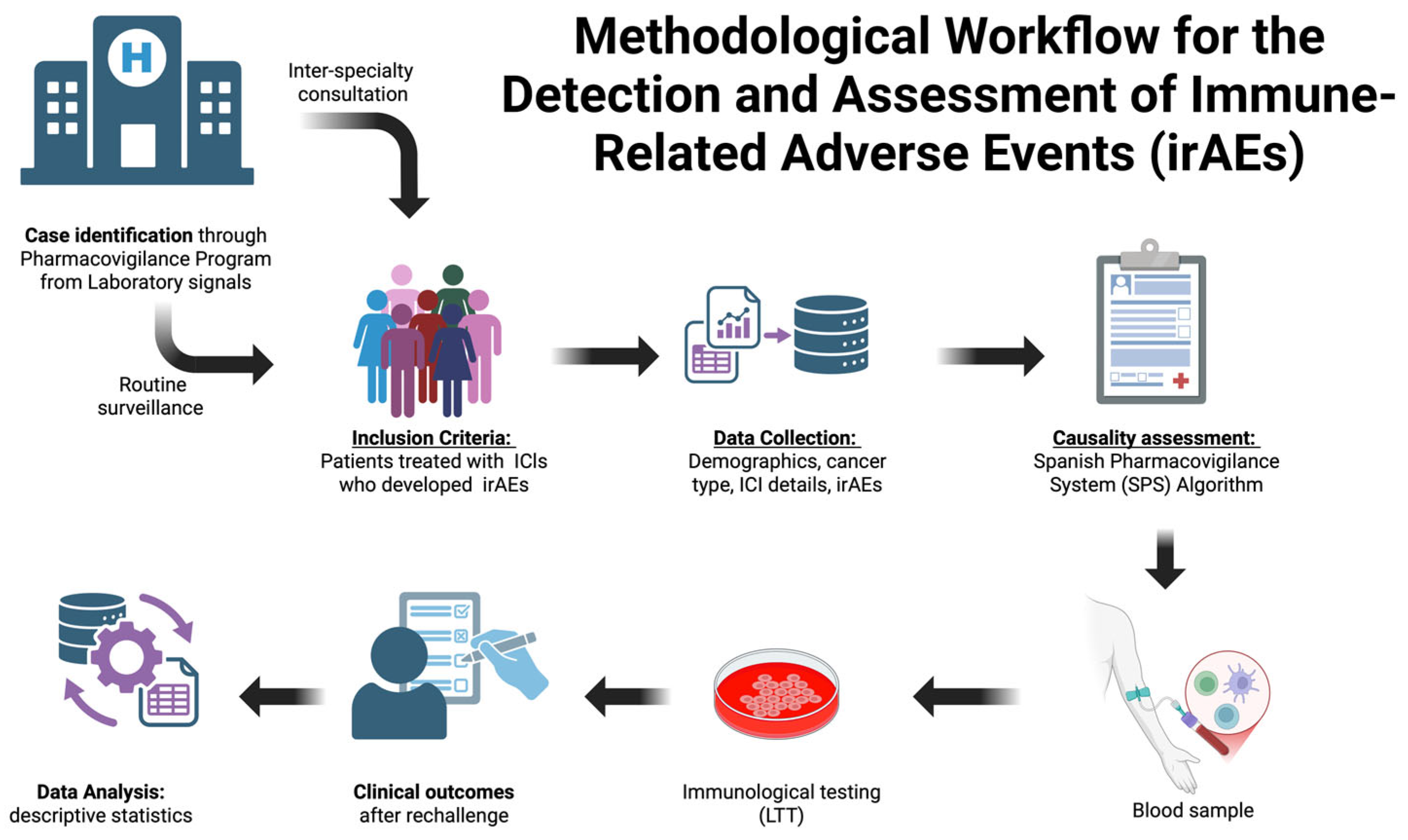
Cases were identified through two sources: (i) routine surveillance within the institutional pharmacovigilance program; (ii) inter-specialty consultations managed by the Pharmacovigilance Unit of the Clinical Pharmacology Department (
Figure 1). The study was approved by the La Paz University Hospital Ethics Committee (Code PI-3226; 25 May 2018). While informed consent for the retrospective data review was waived, specific informed consent was obtained from all patients who underwent flow cytometry (results published in Ruiz-Fernández et al., 2025) [
8] and participated in inter-specialty consultations at the hospital.
Each case underwent a structured causality assessment using the Spanish Pharmacovigilance System (SPS) algorithm, complemented by LTT to evaluate T-cell sensitization. Clinical outcomes following ICI rechallenge were recorded, and descriptive analyses were performed to summarize demographic, clinical, and immunological data.
The inclusion criteria were patients who were treated with ICIs for various malignancies and who subsequently developed an irAE requiring clinical intervention. For all patients with suspected adverse drug reactions, a complete report was submitted to the pharmacovigilance center in Madrid, Spain (
https://www.notificaram.es, accessed on 30 June 2025).
Data were collected from electronic health records, encompassing patient demographics, oncological history, details of ICI treatment (including drug, dose, duration), and information on all concomitant medications. For each irAE, we documented the type, time to onset, and severity, graded according to the Common Terminology Criteria for Adverse Events (CTCAE) version 5.0. A comprehensive causality assessment was performed for each case, which included the application of the Spanish Pharmacovigilance System’s (SPS) drug causality algorithm (Aguirre & García, 2016) [
9]. The SPS algorithm evaluates the relationship between a suspected drug and an ADR based on seven criteria: (a) Time sequence (chronology between the start of treatment with the suspected drug(s) and the appearance of the adverse effects); (b) Identification of plausible adverse drug reactions using knowledge extracted from the literature; (c) Withdrawal effect: evolution of the adverse effect after withdrawal of the suspected medication; (d) Re-exposure effect: reaction after readministration (rechallenge) of the suspected drug; (e) Alternative explanation for the observed effects; (f) Contributing factors favoring the causal relationship (e.g., renal failure and relative overdose of a drug with predominantly renal elimination); g) Complementary explorations: serum drug levels, biopsies, positive radiological examinations, positive specific skin tests, etc. The maximum possible score is 12.
Based on the obtained scores, the causal relationship is classified as: definite (≥8), probable (6–7), possible (4–5), conditional (1–3), or unrelated (<0). An SPS score ≥ +4 was considered drug-related.
In addition, peripheral blood mononuclear cells were collected from patients to perform an in vitro LTT to assess T-cell sensitization to the implicated ICI and to any suspected concomitant drugs including polysorbates as excipients.
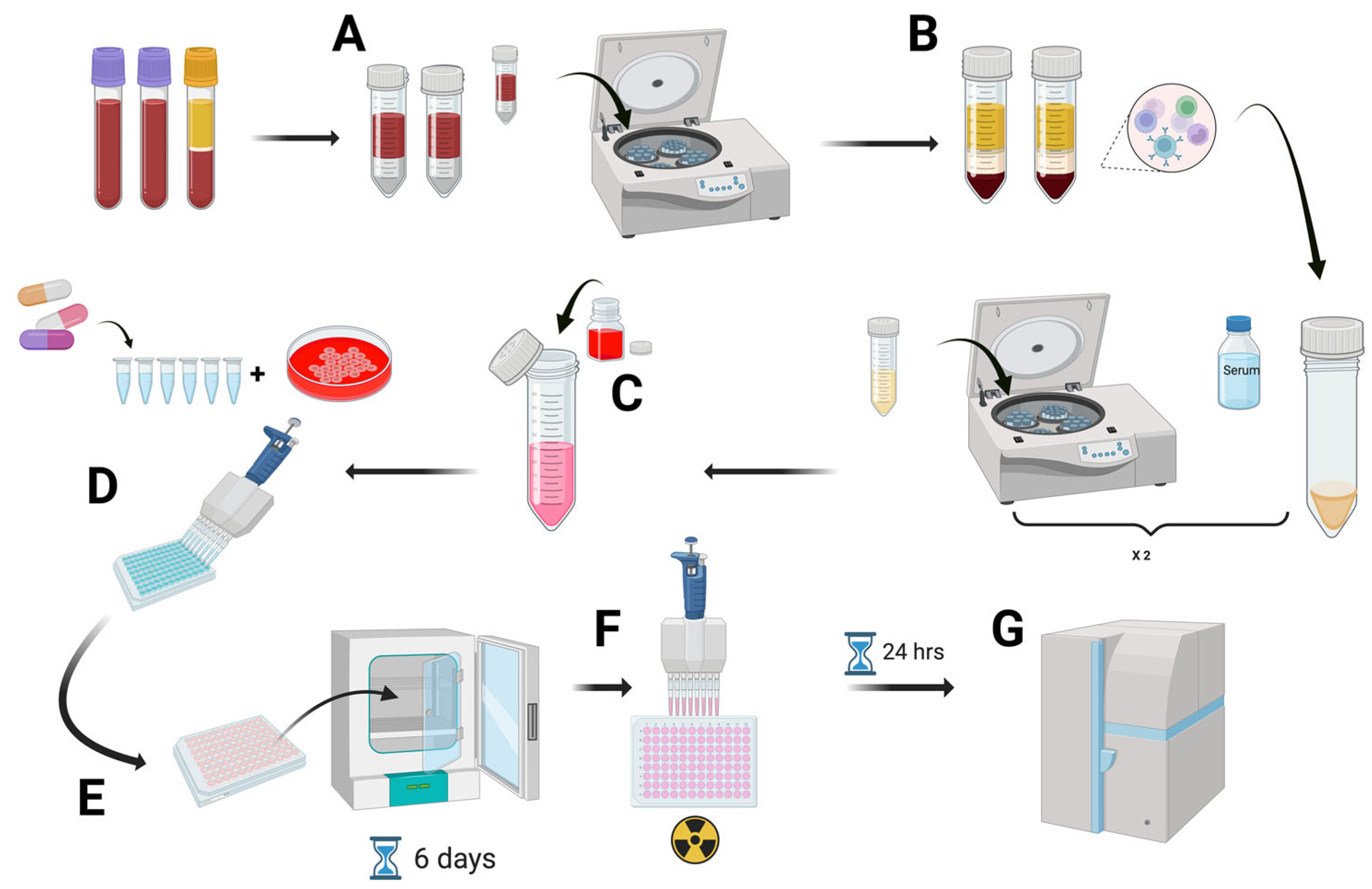
Lymphocyte proliferation was measured as previously described (Pichler & Tilch, 2004) [
10]; see
Figure 2. Briefly, mononuclear cells were isolated from fresh peripheral blood using density gradient medium (Histopaque-1077, Sigma-Aldrich, Darmstadt, Germany) and subsequently plated in flat-bottom wells of microtiter plates at 2 × 10
5 cells per well. These cells were incubated for a period of six days with various drug concentrations in triplicate. The drugs were tested at concentrations of 1, 10 and 100 μg/mL, with occasional use of lower or higher concentrations (0.1, 200 or 500 μg), as previously described (Pichler & Tilch, 2004) [
10]. In the case of the ICIs, the concentrations were 1, 10, 50, and 100 μg/mL for ipilimumab, nivolumab, and pembrolizumab, and 10, 100, 250, and 500 μg/mL for atezolizumab, durvalumab, and tremelimumab. Phytohemagglutinin (5 μg/mL) was used as a positive control. For the final 18 h of the incubation, cell proliferation was assessed by the addition of 1 μCi (3H) thymidine. Proliferative responses were expressed as the stimulation index (SI), calculated as the ratio between the mean counts per minute in cultures with the drug and those without the drug. The concentration range used in the LTT included the clinically relevant plasma levels of each drug, ensuring that the in vitro stimulation reflected systemic exposures achievable in treated patients. An LTT result was considered positive if the SI was ≥2 at any tested drug concentration, as this threshold is the most widely accepted in clinical and research practice. Five healthy controls were tested with the ICIs, and the stimulation index obtained was <2. To improve interpretability, we applied the binary classification positive/negative across all cases. In some cases, drug-induced CD69 expression on T lymphocytes was analyzed by flow cytometry as previously described (Ruiz-Fernández et al., 2025) [
8]. Finally, for patients who were rechallenged with an ICI, we systematically recorded the clinical outcomes, including the incidence, type, and grade of any subsequent irAE.
The statistical analysis conducted for this study was purely descriptive. Categorical variables, such as patient sex, cancer type, and the frequency of specific irAEs, were summarized using absolute numbers and percentages. Continuous variables, such as patient age, were described using the mean and range. For ordinal data, such as the scores obtained from the SPS drug causality algorithm, the median and range were used. No inferential statistical tests were performed due to the descriptive design and the limited sample size of the case series. All data were compiled and analyzed using Microsoft Excel for Mac Version 16.103.2 (25112216) standard spreadsheet software.
3. Results
Seventeen cases fulfilled the inclusion criteria of having received ICIs for various malignancies and subsequently developing an immune-related adverse event (irAE) requiring clinical intervention.
3.1. Baseline Characteristics
Patient demographics, oncological diagnoses, and characteristics of the initial irAEs are summarized in
Table 1.
The case series consisted of twelve males (70.6%) and five females (29.4%), with a mean age of 64.8 years (range: 45–76). The most common malignancy was lung cancer, identified in 8 patients (47.1%), followed by melanoma in 3 patients (17.6%) and urothelial carcinoma in 2 patients (11.8%). Other cancer types included kidney, squamous cell, cecum, and thyroid carcinoma, each in one patient. The ICIs administered were primarily PD-1 inhibitors like pembrolizumab and nivolumab, PD-L1 inhibitors such as durvalumab and atezolizumab, and the CTLA-4 inhibitors ipilimumab and tremelimumab, either as monotherapy or in combination.
The irAEs observed were diverse, affecting multiple organ systems. The most frequent events were pneumonitis, hepatitis, acute tubular interstitial nephritis (ATIN), and colitis. The severity of the initial irAEs varied, with 53.9% of patients experiencing high-grade (Grade 3–4) events. The latency from ICI initiation to irAE onset ranged from 5 to 497 days.
3.2. Structured Causality Assessment (SPS Algorithm)
Each case underwent a structured causality assessment using the Spanish Pharmacovigilance System (SPS) algorithm. Median SPS scores were similar for ICIs and concomitant medications (median 6 for both), indicating that clinical assessment alone was insufficient to distinguish the causative agent when multiple therapies were involved. The SPS algorithm classified most cases as either “probable” or “possible”.
3.3. Lymphocyte Transformation Test (LTT) and Immunological Assessment
Peripheral blood mononuclear cells were collected to perform an LTT in all cases. LTT results, also summarized in
Table 2, provided additional immunological evidence supporting causality. Five patients (29.4%) had a positive LTT for an ICI (stimulation index [SI] 3.9–13.6), all of whom had experienced high-grade irAEs. Six patients (35.3%) had positive LTT responses to a concomitant medication, and three patients were positive for both an ICI and another drug. In select cases, flow cytometric assessment of CD69 upregulation supported sensitization to excipients such as polysorbate 80.
3.4. ICI Rechallenge and Outcomes
The decision to reintroduce an ICI following the resolution of the initial adverse event was made for eight patients.
Table 3 provides a detailed account of these rechallenge cases, specifying the ICI used, the time to onset for the subsequent irAE, its type, and its grade. Eight patients who were rechallenged all experienced a recurrent or new irAE. Notably, four of these patients (50%) developed a high-grade irAE upon rechallenge. For instance, patient IRAE02, who initially presented with Grade 3 pneumonitis, experienced a recurrence of high-grade pneumonitis just 17 days after the first rechallenge with pembrolizumab and again 5 days after a second rechallenge. In contrast, patients who initially had low-grade irAEs, such as IRAE03 and IRAE05, developed different, low-grade events (arthralgias) upon rechallenge.
.
3.5. Integrated Interpretation of Causality and Clinical Outcomes
A comprehensive causality assessment was performed for all patients. This included applying the SPS algorithm and the LTT for both the suspected ICI and concomitant medications. The detailed results of this assessment, including LTT values, SPS scores, clinical recommendations, and patient outcomes, are presented in
Table 2. The SPS algorithm yielded a probable or possible causal relationship in most cases. Five patients (29.4%) had a positive LTT result for an ICI (stimulation index range: 3.9–13.6), all of whom had experienced high-grade irAEs. Six patients (35.3%) showed a positive LTT for a concomitant medication, and three patients tested positive for both an ICI and a co-administered drug.
Final outcomes varied across the cohort, as shown in
Table 2. Five patients exhibited markedly positive LTTs to ICIs (range: 3.9 to 13.6), all of whom experienced high-grade irAEs and were not rechallenged. Six patients demonstrated positive results for concomitant medications (range: 2.2–25.8), with three patients testing positive for both the ICI and the concomitant medication. In several instances, sensitization to excipients (e.g., polysorbate 80) was suspected and subsequently confirmed through positive cytometry.
The results of the causality assessment and the rechallenge outcomes are summarized in
Table 4. The analysis reveals several key findings.
First, the SPS algorithm yielded an identical median score of 6 for both ICIs and co-medications, indicating that clinical assessment alone was often insufficient to distinguish the causative agent. This ambiguity highlights a significant diagnostic challenge, underscoring the need for more objective tools to guide clinical decisions in patients receiving multiple therapies.
To address this limitation, the LTT provided crucial in vitro evidence of drug-specific T-cell sensitization. Positive LTT results, with stimulation indices well above the established cut-off (3.9–13.6 for ICIs; and 2.2–25.8 for co-medications), allowed for a more definitive identification of the causative agent. This moved the assessment beyond clinical suspicion to an evidence-based conclusion, demonstrating the LTT’s value as a differentiating tool.
Furthermore, the data reveal a substantial risk associated with ICI rechallenge. Of the eight rechallenge events, five (45.5%) resulted in high-grade irAEs, primarily pneumonitis and hepatitis. This finding represents a clinically significant signal, suggesting that re-initiating ICI therapy after an irAE carries a high risk of inducing another severe, and potentially life-threatening, event. In contrast, patients who were not rechallenged based on strong LTT evidence of sensitization to a concomitant drug or excipient (e.g., dexketoprofen, hydrochlorothiazide, paclitaxel) showed no further immune-related complications, further validating this targeted diagnostic approach.
4. Discussion
This case series provides real-world evidence on the role of the LTT in determining the causality of irAEs caused by ICIs. It also explores its potential utility for informing rechallenge decisions. The findings extend prior meta-analyses and observational studies by incorporating immunological diagnostic testing with pharmacovigilance data, thereby bridging a translational gap between immunotoxicity detection and clinical decision-making.
Our findings indicate that the recurrence rate of irAEs following ICI rechallenge, 81.8% for all grades and 45.5% for high-grade events, was notably higher than that reported in the meta-analysis by Zhao et al. (2021) [
11], in which the recurrence rate of all-grade irAEs following rechallenge was 34.2%, with high-grade recurrences occurring in 11.7% of cases. Similarly, Santini et al., 2018 [
5] in a real-world cohort of 482 patients with advanced non–small cell lung cancer (NSCLC) treated with anti-PD-(L)1 agents, found that among 68 patients (14%) who developed serious irAEs requiring treatment interruption, 56% were successfully retreated, with 48% showing no recurrent toxicity, while 26% experienced recurrence and 26% developed new irAEs, most of which were mild and manageable. These findings support the feasibility of rechallenge but also underscore that outcomes are highly context-dependent. In a more recent systematic review stratified by cancer type and treatment, reported mean high-grade irAE rates were 19.7%, with variability across tumor and regimen (Jayathilaka et al., 2025) [
6]. In contrast, our real-world case series identified considerably higher recurrence rates among rechallenged patients. The disparity between controlled datasets and our real-world experience likely reflects differences in patient selection and clinical complexity. Prospective trials and meta-analyses often exclude patients with multiple comorbidities, polypharmacy, or severe prior irAEs, while our case series embodies the heterogeneity of oncology practice, in which therapeutic decisions must balance efficacy with safety amidst diagnostic uncertainty.
Regarding organ specificity, our cohort aligns with published data, which show that hepatic, pulmonary, and renal involvement are the most frequent targets (Haanen et al., 2022) [
1]. Notably, among rechallenged patients, pneumonitis emerged as the predominant recurrent irAE. This is consistent with observations from both Haanen et al. (2022) [
1] and Jayathilaka et al. (2025) [
6], who highlight respiratory and hepatic events as particularly prone to recurrence and severity upon rechallenge.
Although the present study was not designed to assess oncological outcomes, it is noteworthy that three of the eight rechallenged patients achieved disease stabilization, one developed pulmonary sequela, two experienced relapses of the underlying malignancy, and two died due to disease progression. Among these, IRAE10 exhibited a positive LTT result for ipilimumab (IPI) and was subsequently rechallenged with nivolumab (NIV), successfully completing oncological treatment without recurrence. These findings exemplify the clinical trade-off between maintaining antitumor control and avoiding potentially life-threatening toxicity. In line with previous findings by Zhao et al. (2021) [
11], who reported an objective response rate (ORR) of 43.1% and a disease control rate (DCR) of 71.9% following ICI rechallenge, our results suggest that efficacy may be preserved, but only at the cost of increased risk in unselected, real-world populations.
A distinctive feature of this series of cases is the incorporation of immunological testing, specifically LTT, to assess T-cell sensitization to both ICIs and concomitant medications. Five patients showed markedly positive LTTs to ICIs, all of whom had experienced high-grade irAEs and were not rechallenged. The mechanistic basis of LTT in the setting of checkpoint blockade remains inherently limited, as ICIs induce systemic immune disinhibition rather than classic hapten-driven sensitization. However, the positive results observed in this study suggest that, for a subset of patients, irAEs may involve a focused expansion of drug-reactive memory T cells superimposed on the broader immune activation typical of ICI therapy. Furthermore, six patients exhibited sensitization to concomitant medications or excipients (e.g., polysorbate 80), and only three patients exhibited dual positivity. In these cases, avoidance of the offending non-ICI agent prevented further immune complications, thereby reinforcing the potential of the LTT to discriminate between ICI-induced and co-medication-related events.
These observations underscore several clinically significant points. Firstly, reliance solely on clinical algorithms, such as the Spanish Pharmacovigilance System (SPS) scale, may be insufficient for accurately identifying the causative drug in patients receiving multiple concurrent treatment therapies. The incorporation of in vitro assays, such as the LTT, could improve diagnostic precision and support personalized pharmacovigilance. Secondly, although the severity and type of the initial irAE influenced decisions regarding rechallenge, neither the timing of reintroduction nor the underlying malignancy predicted recurrence, aligning with previous findings (Zhao et al., 2021) [
11]. This emphasizes the multifactorial nature of immune reactivation, which likely results from a combination of host predisposition, immune memory, and drug pharmacodynamics.
The LTT remains an investigational instrument with significant methodological limitations. False-negative results may occur due to transient loss of reactive lymphocytes after immunosuppression, and there is a lack of standardization across laboratories. Moreover, as the assay reflects peripheral rather than tissue-resident immune responses, its predictive capacity for organ-specific irAEs remains uncertain. Nonetheless, in the context of comprehensive causality assessment, it may provide valuable supportive evidence, particularly when clinical and pharmacological data are equivocal.
4.1. Strengths and Limitations
A primary strength of this research is reflected in its real-world, multidisciplinary design, through which clinical and immunological data were integrated to evaluate the utility of LTT in the assessment of irAEs. Clinically significant insights into safety management within high-risk settings were gained through the inclusion of patients who underwent ICI rechallenge. Furthermore, the interpretation of LTT results within structured causality algorithms was applied, providing a translational framework by which laboratory findings were linked to clinical pharmacovigilance, thereby fostering a more personalized understanding of immune toxicity.
Our study is subject to several limitations. The small sample size and retrospective design hinder the ability to draw statistical inferences. Subgroup analyses were not feasible due to the limited number of cases, and we note that larger, multi-center cohorts will be necessary to evaluate such differences reliably in the future; therefore, these findings should be considered as exploratory and hypothesis-generating. Additionally, a further limitation is the absence of a comparator group, which restricts the generalizability of our findings, given that this was an exploratory real-world series. A control group was not available, and the study does not aim to establish diagnostic accuracy.
Moreover, because the LTT was conducted after the resolution of acute events, the time interval between exposure and testing may have affected sensitivity. Unlike larger datasets that rely on standardized protocols, our approach integrates clinical reasoning with immunodiagnostic testing, providing a nuanced understanding of the evolving field of irAE management.
The external validity of these results is inherently constrained by the study design and sample size; however, the cohort reflects real-world clinical practice in a tertiary oncology setting, with patients treated using widely employed ICIs and managed according to current pharmacovigilance standards. Consequently, these findings may be relevant to comparable populations and serve as a foundation for future research aimed at validating the generalizability of LTT-based causality assessment in broader clinical contexts.
4.2. Clinical Implications and Future Directions
The LTT may serve as a valuable supplementary tool in the assessment of drug-induced and -related adverse events, particularly in cases where conventional diagnostic methods are either unsafe or produce inconclusive outcomes. By detecting drug-specific T-cell activation, LTT provides objective evidence that can enhance existing algorithms for causality assessment in pharmacovigilance and immunotoxicity.
A comprehensive immune profiling of PBMCs—such as the characterization of tumor-specific and non-tumor-specific immune subsets—was not available in this real-world cohort, as these analyses are not part of routine clinical practice. Future prospective studies integrating advanced immunophenotyping with LTT may help elucidate the immunological mechanisms underpinning irAEs and enhance clinical decision-making regarding ICI rechallenge.




 ,
,