Article

Liver Fibrosis as a Predictor of Cardiovascular Risk in Patients with Severe Obesity

by
Alina N. Saidi
1,2,*,
Willy B. Theel
2,
Vivian D. de Jong
3,4,
Stefanie R. van Mil
2,
Aart-Jan van der Lely
2,
Diederick E. Grobbee
3,4,
Jan Apers
5,
Ellen van der Zwan-van Beek
6 and
Manuel Castro Cabezas
1,2,4
1
Department of Internal Medicine, Franciscus Gasthuis & Vlietland, 3045 PM Rotterdam, The Netherlands
2
Department of Internal Medicine, Erasmus University Medical Center, 3015 GD Rotterdam, The Netherlands
3
Julius Center for Health Science and Primary Care, University Medical Center Utrecht, 3584 CG Utrecht, The Netherlands
4
Julius Clinical, 3704 EC Zeist, The Netherlands
5
Department of Surgery, Franciscus Gasthuis & Vlietland, 3045 PM Rotterdam, The Netherlands
6
Department of Clinical Chemistry, Franciscus Gasthuis & Vlietland, 3045 PM Rotterdam, The Netherlands
*
Author to whom correspondence should be addressed.
J. Clin. Med. 2025, 14(23), 8532; https://doi.org/10.3390/jcm14238532 (registering DOI)
Submission received: 30 September 2025 / Revised: 26 November 2025 / Accepted: 27 November 2025 / Published: 1 December 2025

Abstract

Background: Obesity is a substantial global health issue associated with increased risk of cardiovascular disease (CVD) and metabolic dysfunction-associated steatotic liver disease (MASLD). Despite the known link between obesity, CVD and MASLD, it remains unknown which factors contribute to higher cardiovascular (CV) risk in patients with obesity-induced liver fibrosis. Liver fibrosis, assessed by the Fibrosis-4 (FIB-4) index, may help to identify patients with obesity at increased CV risk. Methods: Patients with severe obesity (Body Mass Index (BMI) ≥ 40 kg/m2) scheduled for bariatric surgery were subdivided into FIB-4 categories. Systemic leukocyte activation markers were measured by flow cytometry. Additionally, markers of vascular damage, namely the carotid intima media thickness (cIMT) and pulse wave velocity (PWV), were included. Results: The cohort predominantly consisted of women (74%) with an average age of 41 years and mean BMI of 42.7 kg/m2. Patients with an elevated FIB-4 (≥1.3) had higher systolic (146 ± 16 vs. 139 ± 15, p = 0.002) and diastolic blood pressure (91 ± 13 vs. 83 ± 12, p = 0.002), increased cIMT (0.66 ± 0.11 vs. 0.55 ± 0.10, p < 0.001), and higher PWV (8.2 ± 0.9 vs. 6.8 ± 1.1, p < 0.001) compared to those with a low FIB-4 (<1.3). Additionally, patients with a high FIB-4 tended to show increased expression of CD66b on granulocytes. Conclusions: Patients with severe obesity who were at risk of liver fibrosis showed greater signs of vascular damage, insulin resistance, and systemic inflammation. This suggests that liver fibrosis can be a useful marker for identifying patients with obesity at high CV risk.

1. Introduction

Obesity has emerged as a significant global health problem, with its prevalence steadily rising in recent decades [1,2]. According to the World Health Organization (WHO), more than 2.5 billion adults with overweight were reported in 2022, of which over 890 million were classified as people with obesity [3]. This increasing trend has significant implications for public health, given the numerous clinical complications associated with obesity, including cardiovascular disease (CVD), which remains the leading cause of morbidity and mortality worldwide, particularly among individuals with obesity [4].
Besides CVD, obesity is also strongly related to metabolic dysfunction-associated steatotic liver disease (MASLD), formerly known as non-alcoholic fatty liver disease (NAFLD), a spectrum of liver diseases ranging from simple steatosis, in the presence of at least one cardiometabolic risk factor, to more severe stages such as metabolic dysfunction-associated steatohepatitis (MASH), which is characterized by steatosis, hepatocyte ballooning, and lobular inflammation with or without fibrosis, cirrhosis, and hepatocellular carcinoma (HCC) [5,6,7,8,9]. The prevalence of MASLD among individuals with obesity is notably high and is expected to rise alongside the global obesity rates [10]. Population studies indicate that MASLD can be found in 65% of patients with obesity (BMI 30–39.9 kg/m2) and in approximately 85% of patients with severe obesity (BMI ≥ 40 kg/m2) [11].
While obesity is closely linked to both CVD and MASLD, the factors determining individual susceptibility to cardiovascular (CV) complications remain unclear. Liver fibrosis, which can develop as a consequence of chronic inflammation in obesity, may be associated with an elevated CV risk. Excessive fat accumulation in adipose tissue drives chronic inflammation in obesity. This metabolic stress leads adipocytes to release adipokines. These signaling molecules recruit and activate innate immune cells, including granulocytes and monocytes [12,13,14]. Upon activation, these cells express surface receptors like CD66b and CD11b. The increased expression of CD66b, in particular, serves as a reliable marker for neutrophil activation [15]. Once activated, immune cells release pro-inflammatory cytokines and chemokines, which promote endothelial dysfunction and further perpetuate the inflammatory state in obesity [16,17]. This chronic inflammation also facilitates the infiltration of leukocytes into the liver, contributing to the development of liver fibrosis [18]. Given the role of liver fibrosis in increasing CV risk, its presence in individuals with obesity may play a critical role in determining their higher susceptibility to CV complications. This study focuses on patients with severe obesity, a high-risk group that remains underrepresented in prior liver fibrosis research. Our hypothesis is that the presence of liver fibrosis, as indicated by the Fibrosis-4 (FIB-4) index, may distinguish patients with severe obesity at higher CV risk from their counterparts. The FIB-4 index is a non-invasive, cost-effective tool that estimates the degree of liver fibrosis and serves as an alternative to liver biopsy, which is invasive and carries potential risks [19,20].
This study aims to investigate the association between FIB-4 and CV risk factors in patients with severe obesity, and to evaluate the potential contribution of systemic leukocyte activation markers to liver fibrosis and CV risk.

2. Materials and Methods

2.1. Study Design

This study is a post hoc analysis of the ASSISI project, which was a prospective study with the primary aim to evaluate the effects of bariatric surgery on complement component 3 (C3) and systemic inflammatory markers associated with CV risk in patients with severe obesity [21,22,23]. The study protocol was in accordance with the Declaration of Helsinki, approved by the Medical Ethical Committee Rotterdam (Maasstad Hospital, Rotterdam, the Netherlands; ABR no. NL47891.101.14, approval date: 29 April 2015) and registered in the Dutch Trial register (NTR5172) [24]. Prior to collecting data written informed consent was obtained from each participant.

2.2. Study Population

The study population consisted of 200 patients aged 18 to 65 who were scheduled for bariatric surgery. All patients met the criteria of the International Federation for the Surgery of Obesity (IFSO) for bariatric surgery [25]. Inclusion criteria were: having a body mass index (BMI) of ≥40 kg/m2, or a BMI of 35 kg/m2 and obesity related clinical complications, including hypertension, type 2 diabetes mellitus (T2DM), dyslipidemia, respiratory disorders, severe joint disease, and significant obesity-related psychological or functional limitations. Patients were excluded if they were using immune-modulating medication, if they had an acute inflammatory disease within 6 weeks prior to inclusion, or if they previously underwent bariatric surgery or cholecystectomy. All data were collected at study entry, prior to the bariatric procedure.

2.3. Baseline Characteristics

Baseline characteristics were obtained during standard preoperative screening prior to bariatric surgery and included medical history and current medication profile. Anthropometric measurements included waist circumference, height, weight, and blood pressure. BMI was calculated using weight and height.

2.4. Laboratory Measurements

Preoperative laboratory tests were performed on non-fasting blood samples following the hospital’s standard procedures [22]. Leukocyte activation markers (CD11b and CD66b) were measured by flow cytometry using blood samples collected in EDTA tubes. Fluorescent-labeled antibodies against CD66b and CD11b were used to identify granulocytes and monocytes, with CD45 used to distinguish leukocytes from other blood cells. Whole blood was incubated with antibodies for 15 min at room temperature in the dark, with isotype controls included to correct for nonspecific binding. Erythrocytes were lysed using a standard isotonic solution. Samples were analyzed using a Coulter Epics XL-MCL (Beckman Coulter, Miami, FL, USA) or Navios flow cytometer (Beckman Coulter, Miami, FL, USA), and data were processed with EXPO 32 or Kaluza 1.2 software. Marker expression was reported as mean fluorescence intensity in arbitrary units [26].

2.5. Carotid Intima Media Thickness

Carotid intima media thickness (cIMT) measurements were performed by a trained and experienced sonographer using the ART-LAB (Esaote, Genoa, Italy) following procedures outlined in prior studies [22,27]. Ultrasound scans were performed with participants in a supine position, head resting comfortably and neck slightly hyperextended and rotated opposite to the probe. Images of the distal 1 cm of the far wall of each common carotid artery (CCA) were obtained using B-mode ultrasound, producing two echogenic lines representing the combined thickness of the intima and media layers. Each CCA was imaged in three views (right side: 90°, 120°, 150°; left side: 210°, 240°, 270°), and the segments were measured semi-automatically in triplicate. The mean of these measurements was used for analyses.

2.6. Pulse Wave Velocity

Pulse wave velocity (PWV) was measured using the Mobil-O-Graph (I.E.M. Germany) [28]. To measure the PWV, an inflatable cuff was placed on the patient’s bare left upper arm, with the cuff size chosen based on arm circumference. These cuffs detect fluctuations in cuff pressure caused by pulse waves when inflated to sub-diastolic pressures [29]. PWV is calculated by analyzing the time delay between these fluctuations at different arterial locations. This value reflects the speed at which a mechanical wave propagates along the arterial wall, serving as an indicator of arterial stiffness. Higher PWV values are linked to increased vascular stiffness, which is a significant predictor of CV events [30]. To ensure accuracy and reliability, PWV measurements were performed in triplicate.

2.7. Fibrosis-4 Index

The FIB-4 is the most commonly used non-invasive test (NIT) to estimate the degree of hepatic fibrosis. The FIB-4 was calculated according to the following formula: F I B 4 = A g e y e a r s × A S T ( U / L ) P l a t e l e t   c o u n t 10 9 / L × A L T   ( U / L ) . Based on previously published literature, a cut-off of 1.3 was applied, as values ≥ 1.3 have been associated with an increased risk of advanced fibrosis [7,31]. Low fibrosis risk was defined as a FIB-4 < 1.3 and high fibrosis risk as a FIB-4 ≥ 1.3.

2.8. Statistical Analyses

All statistical analyses were conducted using IBM SPSS statistics version 28.0.1.0 (IBM SPSS Statistics, New York, NY, USA). Continuous variables are presented as mean ± SD or median (IQR), and categorical variables as frequencies (%). Patients were stratified into a low FIB-4 group (<1.3) and a high FIB-4 group (≥1.3) based on the EASL recommendation on NITs [7,32,33]. Between-group differences (low vs. high FIB-4) were assessed using independent samples t-tests or Mann–Whitney U tests as appropriate. Associations between medication use and FIB-4 categories were evaluated using Chi-square tests. Correlation analyses were performed using Pearson’s correlation or Spearman’s correlation where applicable. The primary aim of this post hoc analysis was to examine FIB-4 in relation to vascular and metabolic parameters. Established relationships between classical cardiometabolic risk factors and subclinical vascular measures in this cohort have been reported previously [22,28]. Associations between FIB-4 and vascular or metabolic parameters were assessed using multivariable regression analyses. For continuous FIB-4, a linear regression model included key demographic and cardiometabolic variables (age, cIMT, sex, BMI, systolic BP, HbA1c, LDL-C, HDL-C, triglycerides, creatinine, CRP). For dichotomized FIB-4 (<1.3 vs. ≥1.3), an exploratory logistic regression was applied using the same set of predictors (N = 92 with complete data). To account for potential non-linear effects of age, a separate sensitivity analysis modeled age using four linear spline terms (knots at 30, 40, and 50 years). Systemic leukocyte activation markers were included as exploratory outcomes, and no formal correction for multiple testing was applied. p-values of <0.05 were considered statistically significant.

3. Results

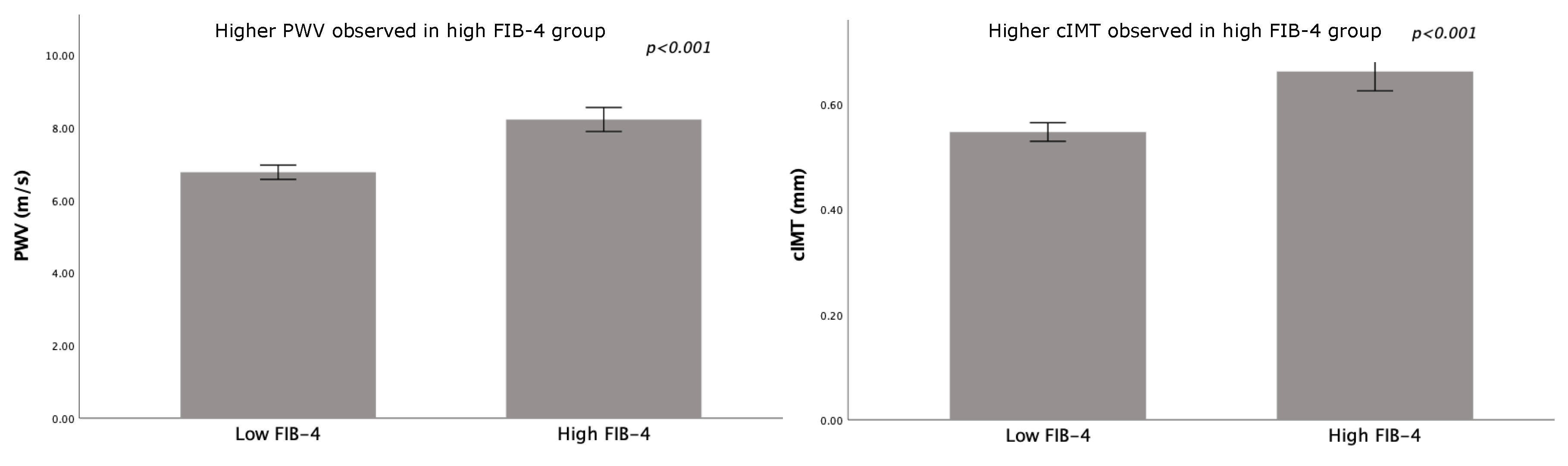
The total cohort consisted of 200 patients, predominantly women (N = 148), with a mean age of 41 ± 12 years and a mean BMI of 42.7 ± 5.2 kg/m2. FIB-4 values in the study population ranged from 0.23 to 2.5, with a mean of 1.02 ± 0.44 (Table A1). Of the total cohort, 155 patients (77.5%) were classified as having a low FIB-4 score (<1.3), while 45 patients (22.5%) had a high FIB-4 score (≥1.3). Additional details can be found in Table A1. BMI and waist circumference were not significantly different between patients with low and high FIB-4 scores. The group with high FIB-4 scores was older (Table 1). Patients in the elevated FIB-4 group showed higher systolic and diastolic blood pressure compared to those with low FIB-4. They were also more frequently treated with antihypertensive medications (48.9% vs. 27.7%, p = 0.011) (Table 1). Significant positive correlations were observed between FIB-4 and both systolic and diastolic blood pressure (Figure 1). Additionally, those with a high FIB-4 showed increased cIMT and PWV, with positive correlations observed between FIB-4 and both cIMT and PWV (Figure 2). Moreover, those with a high FIB-4 showed increased levels of HbA1c and glucose (Table 1), with correlation analyses indicating significant positive associations between FIB-4 and both HbA1c and glucose levels (Figure 1). Classical CVD risk factors such as low HDL-C, high LDL-C, and high TG did not show significant differences between the groups (Table 1). Subgroup analyses compared lipid levels in patients based on hypertension, statin use, and T2DM status. Overall, no major differences in lipid levels were observed between low and high FIB-4 across these subgroups. Patients in the high FIB-4 group showed higher use of statins, antihypertensive medications, and antidiabetic medication, including the use of insulin (Table 2). Those in the high FIB-4 group also tended to have an increased expression of granulocyte CD66b (Table 3), with a significant positive correlation between FIB-4 and granulocyte CD66b (rho = 0.177, p = 0.012). Conversely, these patients tended to have a decreased expression of monocyte CD11b surface markers (Table 3). Subgroup analyses (Table A2) showed that hypertensive patients with high FIB-4 had significantly higher cIMT and PWV than those with low FIB-4 (cIMT: 0.67 ± 0.11 vs. 0.59 ± 0.11 mm; PWV: 8.4 ± 0.9 vs. 7.4 ± 1.0 m/s; both p < 0.001), consistent with greater arterial stiffness. In diabetic patients, cIMT and PWV were numerically higher in the high FIB-4 group, but differences were not statistically significant (p = 0.29 and p = 0.07). Multivariable regression of baseline demographics and cardiometabolic factors, showed that only age and cIMT were independently associated with continuous FIB-4 (Table A3). Multivariable logistic regression of dichotomized FIB-4 (low vs. high) including 92 patients with complete data showed that age and HbA1c were independent predictors, whereas cIMT and CRP showed trends but were not significant (Table A4). Multivariable regression analysis identified age as the most significant predictor of cIMT (p < 0.001). CD66b on granulocytes also significantly influenced cIMT (p = 0.033), indicating its role in cIMT variation. Sex showed a significant negative association with cIMT (p = 0.003), with women exhibiting lower cIMT values than men. FIB-4 categories approached significance (p = 0.069), suggesting a potential, though less clear, link to cIMT. No significant associations were observed between cIMT and BMI, systolic blood pressure, or diastolic blood pressure (Table 4). To account for potential non-linear effects of age, age was modeled using four linear spline terms with knots at 30, 40, and 50 years. In this spline-adjusted model, FIB-4 remained significantly associated with cIMT (B = 0.054, p = 0.026), whereas the age spline segments were not statistically significant (Table A5).

4. Discussion

This study evaluated liver fibrosis, assessed by FIB-4, in patients with severe obesity and its association with CV risk markers, including cIMT and PWV. Patients with elevated FIB-4 exhibited early vascular changes, higher blood pressure, insulin resistance (IR), and systemic inflammation. Traditional CV risk factors, including BMI and lipid profiles, neither differentiated between groups nor showed independent associations with cIMT. Regression analyses revealed that sex and granulocyte CD66b expression were independently associated with cIMT, whereas FIB-4 showed a borderline association that became significant in spline-adjusted models accounting for age. Women had lower cIMT values, emphasizing sex as an important modifier of early vascular alterations. These results suggest that classical measures may have limited predictive value for early subclinical atherosclerosis in this population, which appears to be primarily mediated by fibrosis and inflammatory pathways.
Analyses treating FIB-4 as a continuous variable showed significant associations with age and cIMT, while exploratory logistic regression using dichotomized FIB-4 (≥1.3) revealed associations with age and HbA1c, with cIMT and CRP showing non-significant trends. The smaller number of individuals above the FIB-4 threshold likely reduced statistical power in the logistic analysis.
Patients with elevated FIB-4 had higher systolic and diastolic blood pressure despite more frequent use of antihypertensive medications, suggesting a greater burden of hypertension or CV comorbidity. This is consistent with the higher prevalence of hypertension in MASLD [34,35] and a cross-sectional study of 4705 patients showing an association between hypertension and liver fibrosis (OR 2.0, 95% CI 1.3–3.0), which was stronger in obesity (OR 2.1, 95% CI 1.4–3.2) [36]. Both hypertensive and non-hypertensive subgroups also showed that higher FIB-4 was associated with increased cIMT and PWV, reflecting greater arterial stiffness. These observations are reinforced by external cohorts, where in 8336 adults higher PWV was independently associated with MASLD [37], and in 2550 participants advanced liver fibrosis nearly doubled the risk of elevated cIMT and increased PWV [38], further underscoring the link between liver fibrosis and vascular dysfunction.
Metabolic factors further distinguished patients with elevated FIB-4. Glucose and HbA1c were elevated independently of BMI and despite more intensive antidiabetic therapy, highlighting the central role of IR and glycemic dysregulation in liver fibrosis. Most diabetic patients in the overall cohort had FIB-4 < 1.3, consistent with prior studies [39,40], but T2DM was relatively more frequent among patients with elevated FIB-4, suggesting a link between glycemic status and fibrosis burden that warrants further investigation in larger cohorts.
Despite greater use of statins and other cardiometabolic medications, vascular damage in patients with elevated FIB-4 was not mitigated. While statins can induce vascular calcification, this generally reflects plaque stabilization rather than increased CV risk, and randomized trials demonstrate that statins reduce atherosclerotic progression [41,42,43]. These findings imply that FIB-4 identifies individuals with severe obesity who remain at residual CV risk despite intensive preventive therapy.
Inflammatory profiling revealed higher CD66b expression on granulocytes in patients with elevated FIB-4, whereas CD11b expression on monocytes was decreased. This pattern suggests a shift toward granulocyte-driven inflammation, while monocyte-mediated pathways, typically involved in atherosclerosis [44,45], appear less prominent. These results align with prior studies showing granulocyte activation contributes to systemic inflammation and vascular alterations in liver disease [46,47].
Lipid profiles did not differ significantly between groups, likely due to the higher prevalence of statin use in patients with elevated FIB-4. This observation is consistent with the understanding that advanced liver disease can reduce total cholesterol and LDL-C via impaired hepatic cholesterol synthesis, whereas statin therapy may mask underlying dyslipidemia [46,47,48,49]. Importantly, fibrosis has been linked to CV risk independent of lipid abnormalities [50,51].
FIB-4 was selected for its widespread validation, guideline endorsement, and ease of clinical application [7]. Although other non-invasive fibrosis scores, such as the NAFLD Fibrosis Score, are available, elevated FIB-4 effectively identifies patients with severe obesity at high CV risk. Future studies should assess how FIB-4 compares with alternative scores in predicting CV outcomes, which may further refine risk stratification in this population.
Collectively, these findings suggest that targeting liver fibrosis could prevent early vascular alterations independently of traditional risk factors, while granulocyte activation may mechanistically link liver fibrosis to vascular dysfunction. FIB-4 may identify patients with persistent CV risk despite optimal therapy, highlighting its potential as a clinically useful biomarker beyond traditional markers such as BMI, blood pressure, and lipid profiles. Given the exploratory nature of the study, these results are hypothesis-generating, and provide a basis for future larger, well-designed studies investigating the mechanisms linking liver fibrosis, inflammation, sex differences, and early CVD in this population.
The current study has several limitations. The study population was predominantly female, reflecting a common trend in research involving severe obesity. The relatively small, exploratory, hypothesis-generating design limited the scope of analyses and precluded exhaustive multivariable modeling. Non-fasting blood samples may have introduced variability but reflect real-world clinical conditions. Only a limited number of inflammatory markers were analyzed, and follow-up FIB-4 measurements or imaging-based assessments (e.g., ultrasound or elastography) were not available. Medication use was reported descriptively, without adjustment for confounding by indication, which could be addressed in larger, future studies. Importantly, this post hoc analysis evaluated multiple vascular outcomes without a pre-specified primary endpoint or formal sample size calculations, yet it provides novel, hypothesis-generating insights into the links between liver fibrosis, systemic inflammation, and subclinical CVD in bariatric surgery candidates.

5. Conclusions

In conclusion, assessing liver fibrosis in individuals with severe obesity can help identify those with a very high CV risk. Our findings suggest that incorporating FIB-4 into routine CV risk assessment could improve patient stratification and support more tailored preventive strategies in this high-risk population.

Author Contributions

A.N.S.: Writing—Original Draft, Conceptualization, Investigation, Formal analysis, Visualization. W.B.T.: Writing—Review and Editing, Conceptualization. V.D.d.J.: Writing—Review and Editing, Conceptualization. S.R.v.M.: Writing—Review and Editing, Data Curation, Project Administration. A.-J.v.d.L.: Writing—Review and Editing, Conceptualization, Methodology, Supervision. D.E.G.: Writing—Review and Editing, Methodology, Conceptualization. J.A.: Writing—Review and Editing, Investigation, Conceptualization, Resources. E.v.d.Z.-v.B.: Writing—Review and Editing, Conceptualization, Resources. M.C.C.: Writing—Review and Editing, Conceptualization, Methodology, Supervision. All authors have read and agreed to the published version of the manuscript.

Funding

This research received no external funding.

Institutional Review Board Statement

All procedures were performed in accordance with the Declaration of Helsinki and in compliance with relevant laws and institutional guidelines. The study procedures were approved by the Medical Ethical Committee Rotterdam (Maasstad Hospital, Rotterdam, the Netherlands; ABR no. NL47891.101.14, approval date: 29 April 2015).

Informed Consent Statement

Informed consent was obtained from all subjects involved in the study.

Data Availability Statement

The original contributions presented in this study are included in the article. Further inquiries can be directed to the corresponding author.

Acknowledgments

Parts of this study were presented in abstract form at the European Atherosclerosis Society (EAS) Congress, Lyon, France, 26–29 May 2024, and at the Annual Dutch Diabetes Research Meeting (ADDRM), Wageningen, 14–15 November 2024.

Conflicts of Interest

The authors declare no conflicts of interest.

Abbreviations

The following abbreviations are used in this manuscript:
ALTAlanine aminotransferase
ASTAspartate aminotransferase
cIMTCarotid intima media thickness
CVCardiovascular
CVDCardiovascular disease
FIB-4Fibrosis-4 index
HCCHepatocellular carcinoma
IFSOInternational Federation for the Surgery of Obesity
MASLDMetabolic dysfunction-associated steatotic liver disease
MASHMetabolic dysfunction-associated steatohepatitis
NAFLDNon-alcoholic fatty liver disease
NITNon-invasive test
PWVPulse wave velocity
T2DMType 2 diabetes mellitus
WHOWorld health organization

Appendix A

Table A1. Baseline clinical and demographic characteristics of the total cohort (N = 200). Data are given as mean (standard deviation), median (interquartile range) or number (%).
Patients (N = 200)
Demographic characteristics
Sex (f/m) [n, %]148 (74)/52 (26)
Age (years) 41 ± 12
Body weight (kg)125 ± 21
Body mass index (kg/m2) 42.7 ± 5.2
Ethnicity
 Caucasian [n, %]

145 (73.2)
 African [n, %]20 (10.1)
 Latin-American [n, %]6 (3.0)
 Indian [n, %]8 (4.0)
 Asian [n, %]1 (0.5)
Clinical characteristics
Hematocrit (L/L)0.43 ± 0.04
Hemoglobin (mmol/L)8.7 ± 0.81
Systolic blood pressure (mmHg)140 ± 16
Diastolic blood pressure (mmHg)85 ± 12
Total cholesterol (mmol/L)5.2 ± 1.1
LDL-C (mmol/L)3.1 ± 0.96
HDL-C (mmol/L)1.2 ± 0.29
Triglycerides (mmol/L)1.7 (1.2–2.7)
Apolipoprotein B (g/L)1.1 ± 0.3
Glucose (mmol/L)6.1 ± 2.4
C-reactive protein (mg/L)6 (3.0–10)
Leukocytes (109/L)8.7 ± 2.4
Carotid Intima Media thickness (mm)0.57 ± 0.11
Medication
 Statins [n, %]31 (15.5)
 Antihypertensives [n, %]65 (32.5)
 Antidiabetics [n, %]35 (17.5)
Medical history
 Diabetes [n, %]43 (21.5)
 Hypertension [n, %]69 (34.5)
 Hypercholesterolemia [n, %]58 (29)
 CVA or TIA [n, %]5 (2.5)
 Myocardial infarction6 (3)
Fibrosis markers
Fibrosis-4 index (FIB-4)
 Total population 1.02 ± 0.44
   FIB-4 score <1.3 [n, %]155 (77.5)
   FIB-4 score ≥1.3 [n, %]45 (22.5)
Abbreviations: HDL-C, high-density lipoprotein cholesterol; LDL-C, low-density lipoprotein cholesterol; CVA, cerebrovascular accident; TIA, transient ischemic attack; FIB-4, Fibrosis-4 index.
Table A2. Subgroup analyses of cIMT and PWV according to FIB-4 category in hypertensive and diabetic patients.
SubgroupFIB-4 CategorycIMT (mm)Np-Value cIMTPWV
(m/s)
Np-Value PWV
Hypertensive Low FIB-40.59 ± 0.1166<0.0017.4 ± 1.064<0.001
High FIB-40.67 ± 0.11288.4 ± 0.925
DiabeticLow FIB-40.60 ± 0.11210.3037.4 ± 1.0200.079
High FIB-40.64 ± 0.10108.2 ± 0.98
Notes: Values are mean ± SD. p-values compare low vs. high FIB-4 within each subgroup. Abbreviations: cIMT, carotid intima media thickness; PWV, pulse wave velocity; FIB-4, Fibrosis-4 index.
Table A3. Multivariable linear regression of factors associated with continuous FIB-4.
VariableBStd. ErrorBetap-ValueVIF
Constant−0.5660.660-0.394-
Age (years)0.0210.0040.501<0.0012.02
cIMT (mm)0.8320.4160.2080.0492.04
Sex (female/male)−0.1300.100−0.1260.1981.77
BMI (kg/m2)0.0070.0080.0830.3731.62
Systolic BP (mmHg)−0.0010.003−0.0180.8311.35
HbA1c (mmol/mol)0.0050.0040.1050.2151.32
LDL-c (mmol/L)0.0170.0370.0380.6511.28
HDL-c (mmol/L)0.0290.1720.0170.8651.80
Triglycerides (g/L)0.0080.0480.0140.8771.63
Creatinine (µmol/L)−0.0020.004−0.0360.6951.60
CRP (mg/L)−0.0070.005−0.1180.1621.30
Notes: Dependent variable: FIB-4. VIF values indicate no substantial multicollinearity among included variables. Abbreviations: FIB-4, Fibrosis-4 index; cIMT, carotid intima media thickness; BMI, body mass index; BP, blood pressure; HbA1c, glycated hemoglobin; LDL-c, low-density lipoprotein cholesterol; HDL-c, high-density lipoprotein cholesterol; CRP, C-reactive protein; VIF, Variance Inflation Factor.
Table A4. Multivariable logistic regression of factors associated with dichotomized FIB-4 (<1.3 vs. ≥1.3).
PredictorOR95% CIp-Value
Age (years)1.2661.089–1.4710.002
cIMT (per 0.1 mm)1.9470.871–4.3540.107
Sex (female/male)0.3390.040–2.8810.363
BMI (kg/m2)1.0640.907–1.2470.446
Systolic BP (mmHg)1.0110.960–1.0650.692
HbA1c (mmol/mol)1.1001.000–1.2100.049
LDL-C (mmol/L)1.5970.614–4.1500.336
HDL-C (mmol/L)1.9020.116–31.1980.758
Creatinine (µmol/L)1.4040.482–4.0890.522
CRP (mg/L)0.9900.909–1.0780.838
Note: cIMT was rescaled per 0.1 mm to provide interpretable odds ratios. Abbreviations: OR, odds ratio; CI, confidence interval; cIMT, carotid intima media thickness; BMI, body mass index; BP, blood pressure; HbA1c, glycated hemoglobin; LDL-C, low-density lipoprotein cholesterol; HDL-C, high-density lipoprotein cholesterol; CRP, C-reactive protein.
Table A5. Regression of carotid intima-media thickness (cIMT) on FIB-4 and age modeled with splines.
PredictorBStandard Errorp-Value
Constant0.4310.088<0.001
FIB-40.0540.0240.026
Age spline 10.0010.0030.839
Age spline 20.0060.0030.066
Age spline 30.0040.0030.166
Age spline 40.0040.0040.264
Note: Dependent variable: carotid intima-media thickness (cIMT). Age was modeled using four linear spline terms with knots at 30, 40, and 50 years (Age spline 1–4).

References

  1. Friedrich, M.J. Global Obesity Epidemic Worsening. JAMA 2017, 318, 603. [Google Scholar] [CrossRef]
  2. Riazi, K.; Azhari, H.; Charette, J.H.; Underwood, F.E.; King, J.A.; Afshar, E.E.; Swain, M.G.; Congly, S.E.; Kaplan, G.G.; Shaheen, A.A. The prevalence and incidence of NAFLD worldwide: A systematic review and meta-analysis. Lancet Gastroenterol. Hepatol. 2022, 7, 851–861. [Google Scholar] [CrossRef] [PubMed]
  3. WHO. Fact Sheet Obesity and Overweight; World Health Organization: Geneva, Switzerland, 2022. [Google Scholar]
  4. Afshin, A.; Forouzanfar, M.H.; Reitsma, M.B.; Sur, P.; Estep, K.; Lee, A.; Marczak, L.; Mokdad, A.H.; Moradi-Lakeh, M.; Naghavi, M.; et al. Health Effects of Overweight and Obesity in 195 Countries over 25 Years. N. Engl. J. Med. 2017, 377, 13–27. [Google Scholar] [CrossRef] [PubMed]
  5. Harris, R.; Card, T.R.; Delahooke, T.; Aithal, G.P.; Guha, I.N. Obesity Is the Most Common Risk Factor for Chronic Liver Disease: Results From a Risk Stratification Pathway Using Transient Elastography. Am. J. Gastroenterol. 2019, 114, 1744–1752. [Google Scholar] [CrossRef] [PubMed]
  6. Francque, S.M.A.; Dirinck, E. NAFLD prevalence and severity in overweight and obese populations. Lancet Gastroenterol. Hepatol. 2023, 8, 2–3. [Google Scholar] [CrossRef]
  7. Tacke, F.; Horn, P.; Wong, V.W.-S.; Ratziu, V.; Bugianesi, E.; Francque, S.; Zelber-Sagi, S.; Valenti, L.; Roden, M.; Schick, F.; et al. EASL-EASD-EASO Clinical Practice Guidelines on the management of metabolic dysfunction-associated steatotic liver disease (MASLD). J. Hepatol. 2024, 81, 492–542. [Google Scholar] [CrossRef]
  8. Moore, J.B. Non-alcoholic fatty liver disease: The hepatic consequence of obesity and the metabolic syndrome. Proc. Nutr. Soc. 2010, 69, 211–220. [Google Scholar] [CrossRef]
  9. Wong, V.W.; Ekstedt, M.; Wong, G.L.; Hagström, H. Changing epidemiology, global trends and implications for outcomes of NAFLD. J. Hepatol. 2023, 79, 842–852. [Google Scholar] [CrossRef]
  10. Theel, W.; Boxma-de Klerk, B.M.; Dirksmeier-Harinck, F.; van Rossum, E.F.C.; Kanhai, D.A.; Apers, J.; van Dalen, B.M.; de Knegt, R.J.; Holleboom, A.G.; Tushuizen, M.E.; et al. Evaluation of nonalcoholic fatty liver disease (NAFLD) in severe obesity using noninvasive tests and imaging techniques. Obes. Rev. 2022, 23, e13481. [Google Scholar] [CrossRef]
  11. Divella, R.; Mazzocca, A.; Daniele, A.; Sabbà, C.; Paradiso, A. Obesity, Nonalcoholic Fatty Liver Disease and Adipocytokines Network in Promotion of Cancer. Int. J. Biol. Sci. 2019, 15, 610–616. [Google Scholar] [CrossRef]
  12. Ghaben, A.L.; Scherer, P.E. Adipogenesis and metabolic health. Nat. Rev. Mol. Cell Biol. 2019, 20, 242–258. [Google Scholar] [CrossRef]
  13. Khanna, D.; Khanna, S.; Khanna, P.; Kahar, P.; Patel, B.M. Obesity: A Chronic Low-Grade Inflammation and Its Markers. Cureus 2022, 14, e22711. [Google Scholar] [CrossRef] [PubMed]
  14. Kawai, T.; Autieri, M.V.; Scalia, R. Adipose tissue inflammation and metabolic dysfunction in obesity. Am. J. Physiol.-Cell Physiol. 2021, 320, C375–C391. [Google Scholar] [CrossRef] [PubMed]
  15. Nijhuis, J.; Rensen, S.S.; Slaats, Y.; van Dielen, F.M.; Buurman, W.A.; Greve, J.W. Neutrophil activation in morbid obesity, chronic activation of acute inflammation. Obesity (Silver Spring) 2009, 17, 2014–2018. [Google Scholar] [CrossRef] [PubMed]
  16. Blaszczak, A.M.; Jalilvand, A.; Hsueh, W.A. Adipocytes, innate immunity and obesity: A mini-review. Front. Immunol. 2021, 12, 650768. [Google Scholar] [CrossRef]
  17. Maurizi, G.; Della Guardia, L.; Maurizi, A.; Poloni, A. Adipocytes properties and crosstalk with immune system in obesity-related inflammation. J. Cell. Physiol. 2018, 233, 88–97. [Google Scholar] [CrossRef]
  18. Tanwar, S.; Rhodes, F.; Srivastava, A.; Trembling, P.M.; Rosenberg, W.M. Inflammation and fibrosis in chronic liver diseases including non-alcoholic fatty liver disease and hepatitis C. World J. Gastroenterol. 2020, 26, 109–133. [Google Scholar] [CrossRef]
  19. Blanco-Grau, A.; Gabriel-Medina, P.; Rodriguez-Algarra, F.; Villena, Y.; Lopez-Martínez, R.; Augustín, S.; Pons, M.; Cruz, L.M.; Rando-Segura, A.; Enfedaque, B.; et al. Assessing Liver Fibrosis Using the FIB4 Index in the Community Setting. Diagnostics 2021, 11, 2236. [Google Scholar] [CrossRef]
  20. Lambrecht, J.; Verhulst, S.; Mannaerts, I.; Reynaert, H.; van Grunsven, L.A. Prospects in non-invasive assessment of liver fibrosis: Liquid biopsy as the future gold standard? Biochim. Biophys. Acta Mol. Basis Dis. 2018, 1864, 1024–1036. [Google Scholar] [CrossRef]
  21. van Mil, S.R.; Vijgen, G.; van Huisstede, A.; Klop, B.; van de Geijn, G.M.; Birnie, E.; Braunstahl, G.J.; Mannaerts, G.H.H.; Biter, L.U.; Castro Cabezas, M. Discrepancies Between BMI and Classic Cardiovascular Risk Factors. Obes. Surg. 2018, 28, 3484–3491. [Google Scholar] [CrossRef]
  22. van Mil, S.R.; Biter, L.U.; van de Geijn, G.M.; Birnie, E.; Dunkelgrun, M.; JNM, I.J.; van der Meulen, N.; Mannaerts, G.H.H.; Castro Cabezas, M. Contribution of Type 2 Diabetes Mellitus to Subclinical Atherosclerosis in Subjects with Morbid Obesity. Obes. Surg. 2018, 28, 2509–2516. [Google Scholar] [CrossRef]
  23. Leeman, M.; van Mil, S.R.; Al-Ghanam, I.; Biter, L.U.; Dunkelgrun, M.; Castro Cabezas, M. Structural and functional vascular improvement 1 year after bariatric surgery: A prospective cohort study. Surg. Obes. Relat. Dis. 2019, 15, 1773–1779. [Google Scholar] [CrossRef]
  24. Association, W.M. World Medical Association Declaration of Helsinki: Ethical Principles for Medical Research Involving Human Subjects. JAMA 2013, 310, 2191–2194. [Google Scholar] [CrossRef]
  25. Melissas, J. IFSO Guidelines for Safety, Quality, and Excellence in Bariatric Surgery. Obes. Surg. 2008, 18, 497–500. [Google Scholar] [CrossRef] [PubMed]
  26. de Vries, M.A.; Klop, B.; Alipour, A.; van de Geijn, G.J.; Prinzen, L.; Liem, A.H.; Valdivielso, P.; Rioja Villodres, J.; Ramírez-Bollero, J.; Castro Cabezas, M. In vivo evidence for chylomicrons as mediators of postprandial inflammation. Atherosclerosis 2015, 243, 540–545. [Google Scholar] [CrossRef]
  27. Bovenberg, S.A.; Klop, B.; Alipour, A.; Martinez-Hervas, S.; Westzaan, A.; van de Geijn, G.J.; Janssen, H.W.; Njo, T.; Birnie, E.; van Mechelen, R.; et al. Erythrocyte-associated apolipoprotein B and its relationship with clinical and subclinical atherosclerosis. Eur. J. Clin. Investig. 2012, 42, 365–370. [Google Scholar] [CrossRef] [PubMed]
  28. van Mil, S.R.; Biter, L.U.; van de Geijn, G.J.M.; Birnie, E.; Dunkelgrun, M.; Ijzermans, J.N.M.; van der Meulen, N.; Mannaerts, G.H.H.; Castro Cabezas, M. The effect of sex and menopause on carotid intima-media thickness and pulse wave velocity in morbid obesity. Eur. J. Clin. Investig. 2019, 49, e13118. [Google Scholar] [CrossRef] [PubMed]
  29. Jilek, J.; Fukushima, T. Oscillometric blood pressure measurement: The methodology, some observations, and suggestions. Biomed. Instrum. Technol. 2005, 39, 237–241. [Google Scholar] [CrossRef]
  30. Sang, T.; Lv, N.; Dang, A.; Cheng, N.; Zhang, W. Brachial-ankle pulse wave velocity and prognosis in patients with atherosclerotic cardiovascular disease: A systematic review and meta-analysis. Hypertens. Res. 2021, 44, 1175–1185. [Google Scholar] [CrossRef]
  31. Davyduke, T.; Tandon, P.; Al-Karaghouli, M.; Abraldes, J.G.; Ma, M.M. Impact of Implementing a “FIB-4 First” Strategy on a Pathway for Patients With NAFLD Referred From Primary Care. Hepatol. Commun. 2019, 3, 1322–1333. [Google Scholar] [CrossRef]
  32. Loosen, S.H.; Kostev, K.; Keitel, V.; Tacke, F.; Roderburg, C.; Luedde, T. An elevated FIB-4 score predicts liver cancer development: A longitudinal analysis from 29,999 patients with NAFLD. J. Hepatol. 2022, 76, 247–248. [Google Scholar] [CrossRef]
  33. EASL Clinical Practice Guidelines on non-invasive tests for evaluation of liver disease severity and prognosis—2021 update. J. Hepatol. 2021, 75, 659–689. [CrossRef]
  34. Li, G.; Peng, Y.; Chen, Z.; Li, H.; Liu, D.; Ye, X. Bidirectional Association between Hypertension and NAFLD: A Systematic Review and Meta-Analysis of Observational Studies. Int. J. Endocrinol. 2022, 2022, 8463640. [Google Scholar] [CrossRef]
  35. Klein, S.; Gastaldelli, A.; Yki-Järvinen, H.; Scherer, P.E. Why does obesity cause diabetes? Cell Metab. 2022, 34, 11–20. [Google Scholar] [CrossRef] [PubMed]
  36. Fu, H.; Yu, H.; Zhao, Y.; Chen, J.; Liu, Z. Association between hypertension and the prevalence of liver steatosis and fibrosis. BMC Endocr. Disord. 2023, 23, 85. [Google Scholar] [CrossRef] [PubMed]
  37. Kim, B.S.; Kim, H.J.; Shin, J.H. Association between Estimated Pulse Wave Velocity and Incident Nonalcoholic Fatty Liver Disease in Korean Adults. Pulse 2024, 12, 1–11. [Google Scholar] [CrossRef] [PubMed]
  38. Chen, Y.; Xu, M.; Wang, T.; Sun, J.; Sun, W.; Xu, B.; Huang, X.; Xu, Y.; Lu, J.; Li, X.; et al. Advanced fibrosis associates with atherosclerosis in subjects with nonalcoholic fatty liver disease. Atherosclerosis 2015, 241, 145–150. [Google Scholar] [CrossRef]
  39. Alhabahbeh, R.H.; Obeidat, A.N.; Jaber, D.S.; AlKhaldi, M.M.; Ghanem, L.K.; Tubasi, A.A.; Obeidat, Z.N.; Alhawari, H.H. Screening for the Prevalence of Nonalcoholic Fatty Liver Disease (NAFLD) Among Patients With Prediabetes and Type 2 Diabetes: A Comparison of Three Screening Systems. Int. J. Endocrinol. 2025, 2025, 6676114. [Google Scholar] [CrossRef]
  40. Mignot, V.; Fabre, O.; Legrand, R.; Bailly, S.; Costentin, C. FIB-4: A screening tool for advanced liver fibrosis in a cohort of subjects participating in a primary care weight-loss program. PLoS ONE 2025, 20, e0333490. [Google Scholar] [CrossRef]
  41. Baigent, C.; Blackwell, L.; Emberson, J.; Holland, L.E.; Reith, C.; Bhala, N.; Peto, R.; Barnes, E.H.; Keech, A.; Simes, J.; et al. Efficacy and safety of more intensive lowering of LDL cholesterol: A meta-analysis of data from 170,000 participants in 26 randomised trials. Lancet 2010, 376, 1670–1681. [Google Scholar] [CrossRef]
  42. Nicholls, S.J.; Ballantyne, C.M.; Barter, P.J.; Chapman, M.J.; Erbel, R.M.; Libby, P.; Raichlen, J.S.; Uno, K.; Borgman, M.; Wolski, K.; et al. Effect of two intensive statin regimens on progression of coronary disease. N. Engl. J. Med. 2011, 365, 2078–2087. [Google Scholar] [CrossRef] [PubMed]
  43. Almeida, S.O.; Budoff, M. Effect of statins on atherosclerotic plaque. Trends Cardiovasc. Med. 2019, 29, 451–455. [Google Scholar] [CrossRef] [PubMed]
  44. Paulson, K.E.; Zhu, S.N.; Chen, M.; Nurmohamed, S.; Jongstra-Bilen, J.; Cybulsky, M.I. Resident intimal dendritic cells accumulate lipid and contribute to the initiation of atherosclerosis. Circ. Res. 2010, 106, 383–390. [Google Scholar] [CrossRef] [PubMed]
  45. Van Brussel, I.; Ammi, R.; Rombouts, M.; Cools, N.; Vercauteren, S.R.; De Roover, D.; Hendriks, J.M.H.; Lauwers, P.; Van Schil, P.E.; Schrijvers, D.M. Fluorescent activated cell sorting: An effective approach to study dendritic cell subsets in human atherosclerotic plaques. J. Immunol. Methods 2015, 417, 76–85. [Google Scholar] [CrossRef]
  46. Hoekstra, M.; Van Eck, M. High-density lipoproteins and non-alcoholic fatty liver disease. Atheroscler. Plus 2023, 53, 33–41. [Google Scholar] [CrossRef]
  47. Katsiki, N.; Mikhailidis, D.P.; Mantzoros, C.S. Non-alcoholic fatty liver disease and dyslipidemia: An update. Metabolism 2016, 65, 1109–1123. [Google Scholar] [CrossRef]
  48. Jiang, Z.G.; Mukamal, K.; Tapper, E.; Robson, S.C.; Tsugawa, Y. Low LDL-C and high HDL-C levels are associated with elevated serum transaminases amongst adults in the United States: A cross-sectional study. PLoS ONE 2014, 9, e85366. [Google Scholar] [CrossRef]
  49. Zhou, F.; Sun, X. Cholesterol Metabolism: A Double-Edged Sword in Hepatocellular Carcinoma. Front. Cell Dev. Biol. 2021, 9, 762828. [Google Scholar] [CrossRef]
  50. Chi-Cervera, L.A.; Montalvo, G.I.; Icaza-Chávez, M.E.; Torres-Romero, J.; Arana-Argáez, V.; Ramírez-Camacho, M.; Lara-Riegos, J. Clinical relevance of lipid panel and aminotransferases in the context of hepatic steatosis and fibrosis as measured by transient elastography (FibroScan®). J. Med. Biochem. 2021, 40, 60–66. [Google Scholar] [CrossRef]
  51. Henson, J.B.; Simon, T.G.; Kaplan, A.; Osganian, S.; Masia, R.; Corey, K.E. Advanced fibrosis is associated with incident cardiovascular disease in patients with non-alcoholic fatty liver disease. Aliment. Pharmacol. Ther. 2020, 51, 728–736. [Google Scholar] [CrossRef]
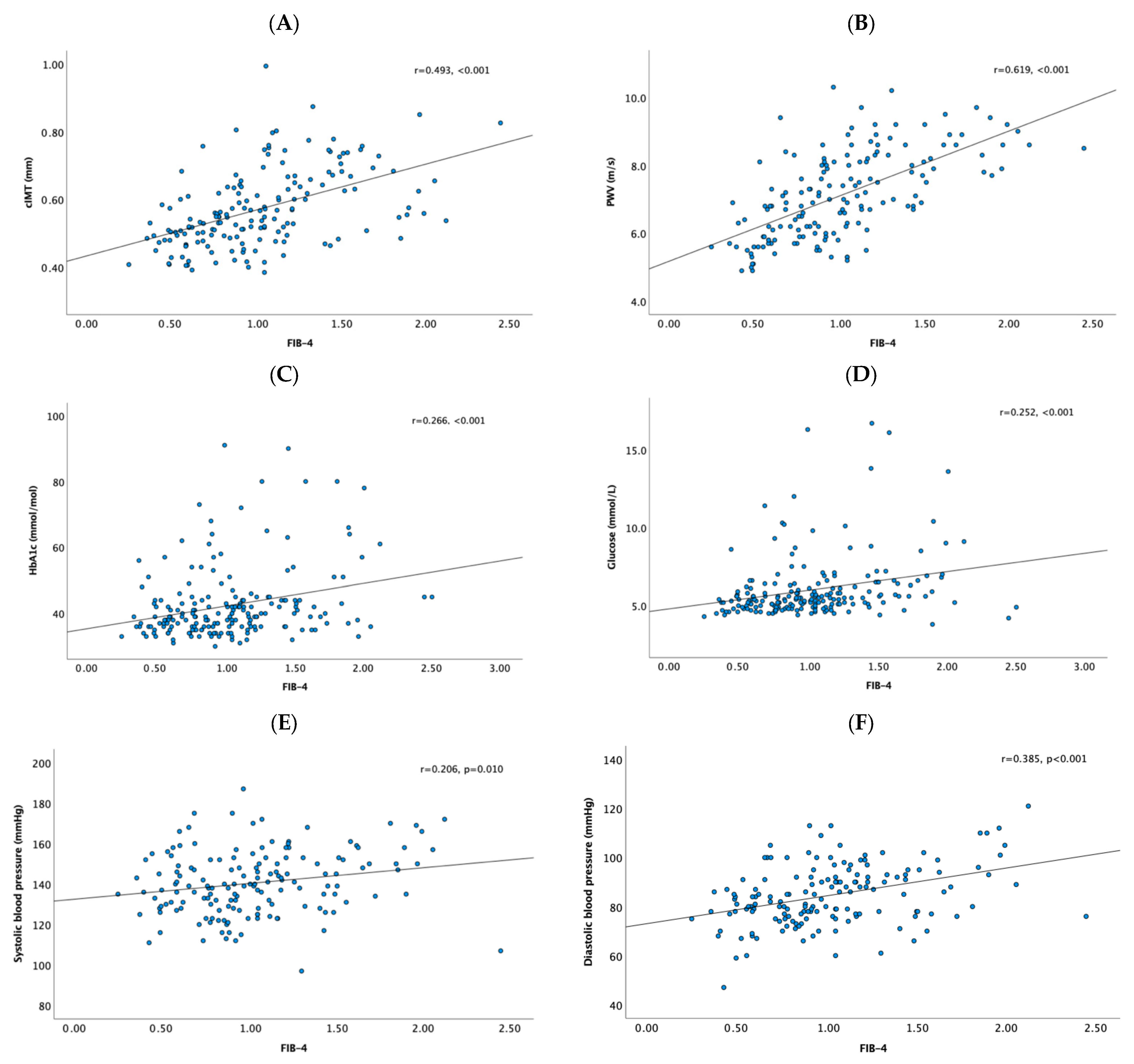
Figure 1. Correlations of the Fibrosis-4 (FIB-4) index with (A) carotid intima-media thickness (cIMT), (B) pulse wave velocity, (C) glycated hemoglobin A1c (HbA1c), (D) glucose levels, (E) systolic blood pressure, and (F) diastolic blood pressure.
Jcm 14 08532 g001
Figure 2. Mean pulse wave velocity (PWV) and carotid intima-media thickness (cIMT) values by FIB-4 group. Low FIB-4 (<1.3) vs. high FIB-4 (≥1.3): 6.8 ± 1.1 vs. 8.2 ± 0.9 m/s for PWV, and 0.55 ± 0.10 vs. 0.66 ± 0.11 mm for cIMT. Error bars indicate standard error of the mean (SE).
Jcm 14 08532 g002
Table 1. Baseline characteristics by FIB-4 group: comparison of low FIB-4 (<1.3) versus high FIB-4 (≥1.3). Data presented as mean (standard deviation), median (interquartile range), or number (%).
Low FIB-4
N = 155
High FIB-4
N = 45
p-Value
Demographic characteristics
Age (years)38 ± 1153 ± 5.2<0.001
Sex, n (%) female123 (79)25 (56)0.001 *
Body weight (kg)124 ± 19126 ± 280.691
Body mass index (kg/m2)42.5 ± 4.443.3 ± 7.20.458
Waist circumference (cm)129 ± 12131 ± 160.341
Diabetes mellitus, n (%)27 (17.4)16 (35.6)0.013
Clinical characteristics
FIB-40.83 ± 0.261.67 ± 0.30<0.001
Hematocrit (L/L)0.42 ± 0.040.43 ± 0.030.524
Hemoglobin (mmol/L) 8.7 ± 0.88.8 ± 0.70.194
Systolic blood pressure (mmHg)139 ± 15146 ± 160.002
Diastolic blood pressure (mmHg)83 ± 1291 ± 130.002
Total cholesterol (mmol/L)5.1 ± 1.05.4 ± 1.20.197
Triglycerides (g/L)2.0 ± 1.12.2 ± 1.20.359
HDL-C (mmol/L)1.2 ± 0.291.3 ± 0.310.278
LDL-C (mmol/L)3.1 ± 0.923.3 ± 1.10.221
Apolipoprotein B (g/L)1.1 ± 0.291.2 ± 0.330.069
HbA1c (mmol/mol)41 ± 9.548 ± 140.002
Glucose (mmol/L)5.7 ± 1.67.0 ± 2.90.006
Insulin (µIU/mL)23 (17–44)30 (18–47)0.998
C-reactive protein (mg/L)6 (3–10)5 (3–9)0.199
Creatinine (µmol/L)65 ± 1471 ± 160.038
Homocystein (µmol/L)11.5 ± 4.114.0 ± 9.60.167
TSH (mU/l)1.8 (1.4–2.3)2.0 (1.5–2.6)0.934
Medication
 Statins, n (%)16 (10.3%)15 (33.3%)<0.001
 Antihypertensives, n (%)43 (27.7%)22 (48.9%)0.011
 Antidiabetics, n (%)22 (14.2%)13 (28.9%)0.027
Abbreviations: FIB-4, Fibrosis-4 index; HDL-C, high-density lipoprotein cholesterol; LDL-C, low-density lipoprotein cholesterol; HbA1c, hemoglobin A1c; TSH, thyroid stimulating hormone. * p-value for sex calculated using Pearson Chi-square. Forty patients had a prior diagnosis of T2DM, and three were newly diagnosed at the time of inclusion.
Table 2. Chi-square test results for the association between low FIB-4 (<1.3) versus high FIB-4 (≥1.3) and medication use.
Medication Low FIB-4 (%) High FIB-4 (%) X2 p -Value
Statins10.333.314.099<0.001
Antihypertensives27.748.97.1090.011
Antidiabetics14.228.95.2170.027
Table 3. Flow cytometry results for leukocyte activation markers by FIB-4 group (low < 1.3 vs. high ≥ 1.3).
Leukocyte Activation MarkerLow FIB-4High FIB-4p-Value
CD35 on monocytes (au)7.3 ± 3.67.1 ± 3.00.680
CD35 on granulocytes (au)10.7 ± 5.010.5 ± 6.50.815
CD11b on monocytes (au)34.6 ± 10.231.6 ± 7.80.070
CD11b on granulocytes (au)47.5 ± 1544.8 ± 160.303
CD66b on granulocytes (au)5.9 ± 1.86.7 ± 2.60.070
Table 4. Multivariable linear regression analysis of variables associated with carotid intima media thickness (cIMT).
Standardized Coefficients BetaVIFp-Value
(Constant)-0.016-
Age (years)0.4381.782<0.001
CD66b on granulocytes (au)0.1631.3560.033
CD11b on monocytes (au)0.0611.4270.429
FIB-40.1431.4430.069
Sex (m/f)−0.2291.3390.003
BMI (kg/m2)0.0631.2410.387
Systolic blood pressure (mmHg)0.0392.2670.691
Diastolic blood pressure (mmHg)−0.0332.5760.749
Abbreviations: FIB-4; Fibrosis-4 index; BMI, Body Mass Index; VIF, Variance Inflation Factor.
Disclaimer/Publisher’s Note: The statements, opinions and data contained in all publications are solely those of the individual author(s) and contributor(s) and not of MDPI and/or the editor(s). MDPI and/or the editor(s) disclaim responsibility for any injury to people or property resulting from any ideas, methods, instructions or products referred to in the content.