
Thymectomy in Ocular Myasthenia Gravis: Results Before and After Generalization and Prognostic Predictors of Outcomes
 , , ,
, , ,  , ,
, ,  , , , , , , , , , , , , , , add
Show full author list
, , , , , , , , , , , , , , add
Show full author list
Abstract
1. Introduction
Objectives
2. Materials and Methods
2.1. Study Design
2.2. Patient Population
2.3. Inclusion Criteria
- A confirmed diagnosis of OMG at disease onset, with at least 3 months of isolated ocular symptoms prior to surgery.
- Thymectomy performed with curative intent.
- R0 resection in cases of thymoma histology.
- A minimum postoperative follow-up of 2 years.
2.4. Exclusion Criteria
- Thymic cysts or carcinoma.
- Prior thymic surgery or thymoma recurrence.
- Incomplete clinical data or loss to follow-up.
2.5. Diagnosis of OMG
- Typical clinical manifestations (fluctuating diplopia, ptosis, or both);
- And at least one of the following:
- Positive anti-acetylcholine receptor antibodies (Anti-AChR Ab).
- Abnormal repetitive nerve stimulation (RNS).
- Positive edrophonium chloride (Tensilon test) or pyridostigmine response.
2.6. Surgical Technique
2.7. Postoperative Management and Follow-Up
2.8. Study Endpoints
- Identification of predictors of CSR and secondary generalization.
- In the non-thymomatous subgroup: comparison of CSR between OMG and g-OMG and identification of predictors for CSR and generalization.
2.9. Statistical Analysis
3. Results
3.1. Study Cohort
3.2. Baseline Clinical Characteristics
3.3. Perioperative Outcomes
3.4. Long-Term Outcomes
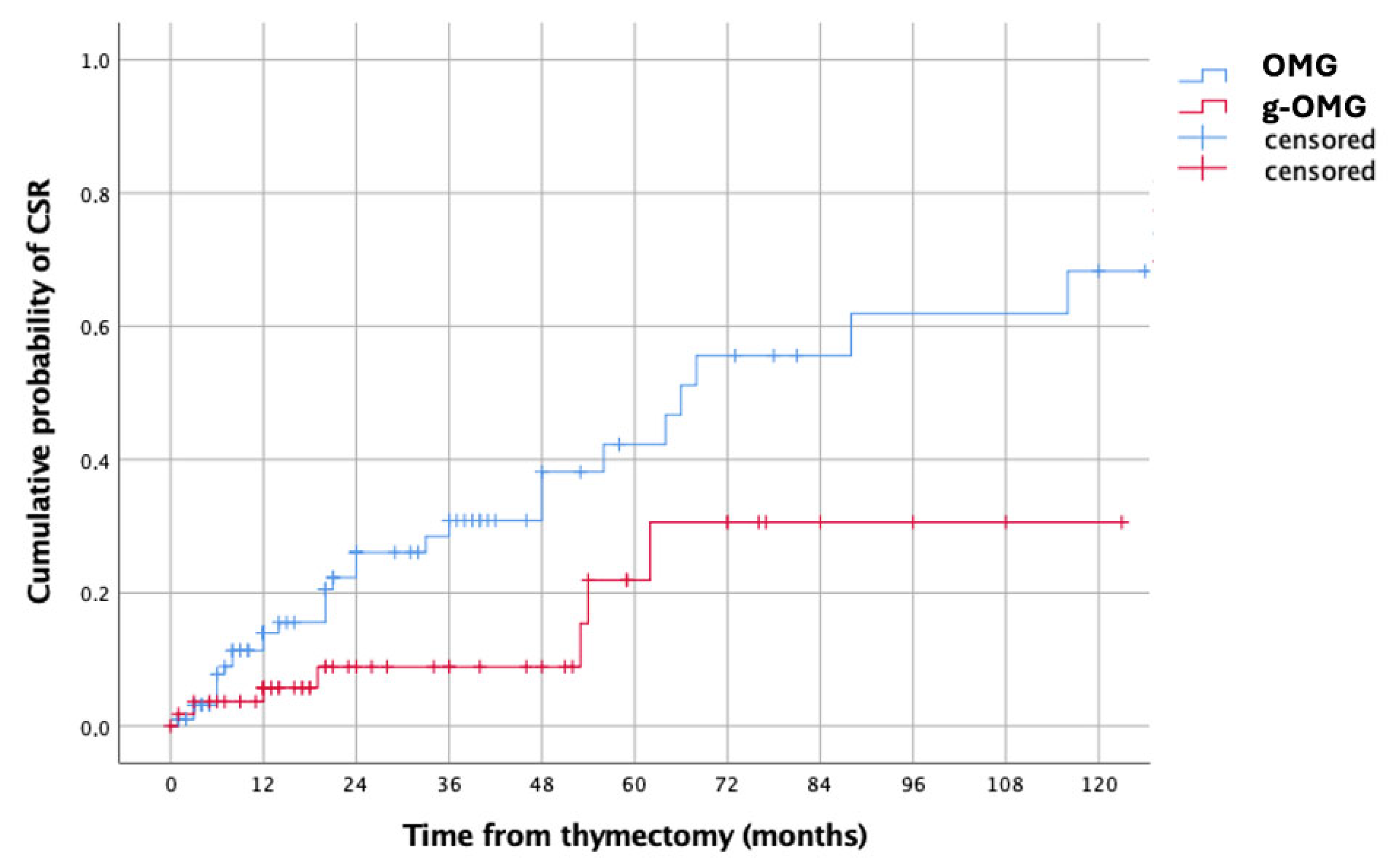
3.5. Kaplan–Meier Analysis
3.6. Predictors of CSR
3.7. Predictors of Generalization
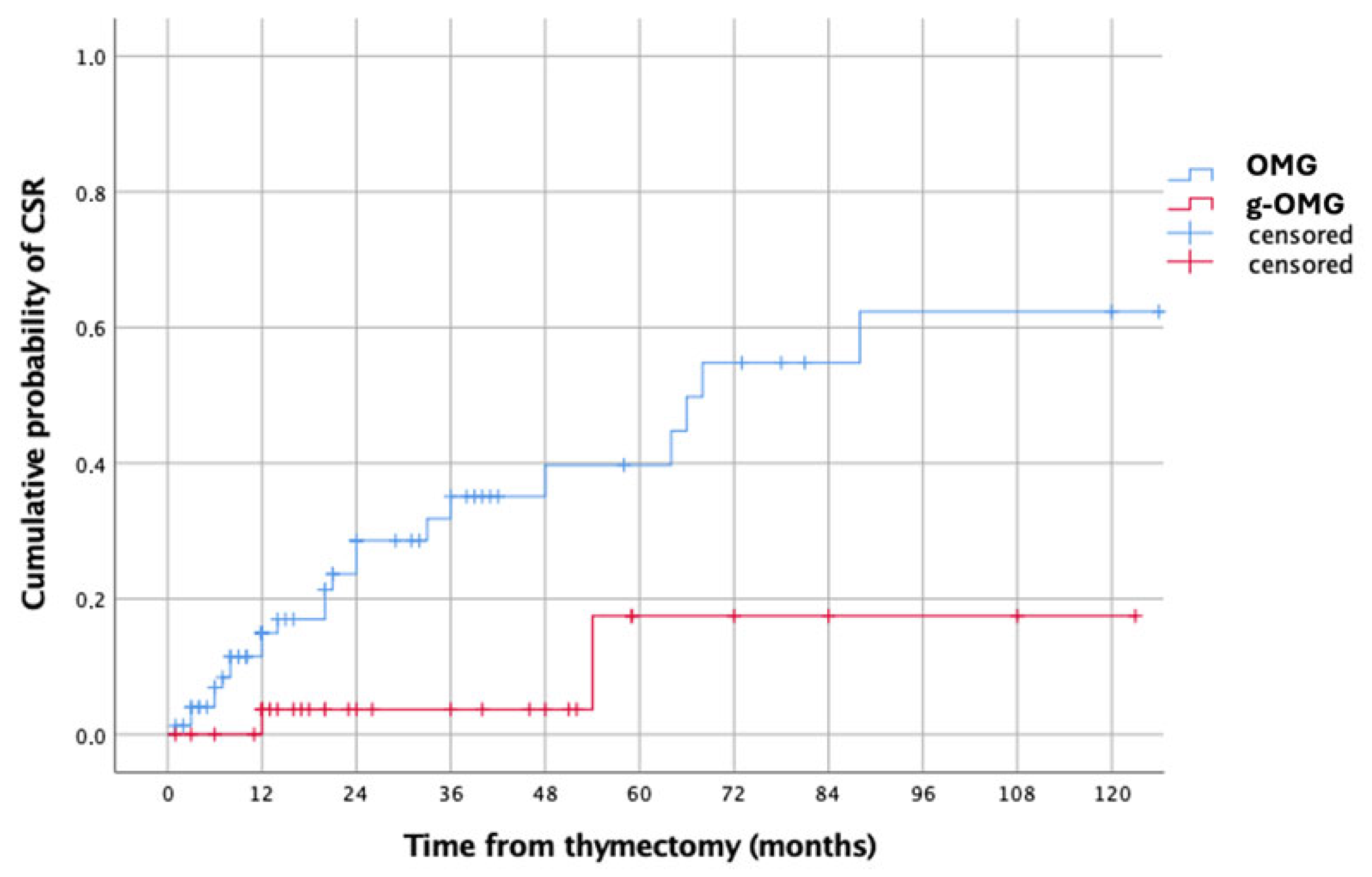
3.8. Subgroup Analysis—Non-Thymomatous MG
4. Discussion
4.1. Remission Outcomes and Timing of Surgery
- The stringent MGFA-PIS CSR definition used in our study (no symptoms and no therapy for ≥12 months), which yields lower absolute remission rates than broader definitions.
- Inclusion of patients with thymoma and g-OMG, both associated with more refractory disease, likely diluting the overall CSR signal.
4.2. Influence of Thymic Histology
4.3. Predictors of CSR and Generalization
4.4. Perioperative Safety and Surgical Approach
4.5. Strengths and Limitations
4.6. Clinical Implications
4.7. Future Research Directions
5. Conclusions
Author Contributions
Funding
Institutional Review Board Statement
Informed Consent Statement
Data Availability Statement
Conflicts of Interest
References
- Gilhus, N.E.; Tzartos, S.; Evoli, A.; Palace, J.; Burns, T.M.; Verschuuren, J. Myasthenia gravis. Nat. Rev. Dis. Prim. 2019, 5, 30. [Google Scholar] [CrossRef]
- Gilhus, N.E.; Verschuuren, J.J. Myasthenia gravis: Subgroup classification and therapeutic strategies. Lancet Neurol. 2015, 14, 1023–1036. [Google Scholar] [CrossRef]
- Luchanok, U.; Kaminski, H.J. Ocular myasthenia: Diagnostic and treatment recommendations and the evidence base. Curr. Opin. Neurol. 2008, 21, 8–15. [Google Scholar] [CrossRef]
- Wong, S.H.; Huda, S.; Vincent, A.; Plant, G.T. Ocular myasthenia gravis: Controversies and updates. Curr. Neurol. Neurosci. Rep. 2014, 14, 421. [Google Scholar] [CrossRef]
- Benatar, M.; Kaminski, H. Medical and surgical treatment for ocular myasthenia. Cochrane Database Syst. Rev. 2012, 12, CD005081. [Google Scholar] [CrossRef]
- Bever, C.T., Jr.; Aquino, A.V.; Penn, A.S.; Lovelace, R.E.; Rowland, L.P. Prognosis of ocular myasthenia. Ann. Neurol. 1983, 14, 516–519. [Google Scholar] [CrossRef] [PubMed]
- Kupersmith, M.J.; Moster, M.; Bhuiyan, S.; Warren, F.; Weinberg, H. Beneficial effects of corticosteroids on ocular myasthenia gravis. Arch. Neurol. 1996, 53, 802–804. [Google Scholar] [CrossRef]
- Sommer, N.; Sigg, B.; Melms, A.; Weller, M.; Schepelmann, K.; Herzau, V.; Dichgans, J. Ocular myasthenia gravis: Response to long-term immunosuppressive treatment. J. Neurol. Neurosurg. Psychiatry 1997, 62, 156–162. [Google Scholar] [CrossRef] [PubMed][Green Version]
- Oosterhuis, H.J. The natural course of myasthenia gravis: A long-term follow-up study. J. Neurol. Neurosurg. Psychiatry 1989, 52, 1121–1127. [Google Scholar] [CrossRef] [PubMed]
- Lee, Y.G.; Kim, U.S. Efficacy and safety of low-to-moderate dose oral corticosteroid treatment in ocular myasthenia gravis. J. Pediatr. Ophthalmol. Strabismus 2018, 55, 339–342. [Google Scholar] [CrossRef]
- Farrugia, M.E.; Goodfellow, J.A. A practical approach to managing patients with myasthenia gravis—Opinions and a review of the literature. Front. Neurol. 2020, 11, 604. [Google Scholar] [CrossRef] [PubMed]
- Shimizu, Y.; Suzuki, S.; Nagasao, T.; Ogata, H.; Yazawa, M.; Suzuki, N.; Kishi, K. Surgical treatment for medically refractory myasthenic blepharoptosis. Clin. Ophthalmol. 2014, 8, 1859–1867. [Google Scholar] [CrossRef]
- Nagane, Y.; Utsugisawa, K.; Suzuki, S.; Masuda, M.; Shimizu, Y.; Utsumi, H.; Uchiyama, S.; Suzuki, N. Topical naphazoline in the treatment of myasthenic blepharoptosis. Muscle Nerve 2011, 44, 41–44. [Google Scholar] [CrossRef] [PubMed]
- Smith, S.V.; Lee, A.G. Update on ocular myasthenia gravis. Neurol. Clin. 2017, 35, 115–123. [Google Scholar] [CrossRef]
- Sonett, J.R.; Magee, M.J.; Gorenstein, L. Thymectomy and myasthenia gravis: A history of surgical passion and scientific excellence. J. Thorac. Cardiovasc. Surg. 2017, 154, 306–309. [Google Scholar] [CrossRef] [PubMed][Green Version]
- Wolfe, G.I.; Kaminski, H.J.; Aban, I.B.; Minisman, G.; Kuo, H.-C.; Marx, A.; Ströbel, P.; Mazia, C.; Oger, J.; Cea, J.G.; et al. Randomized trial of thymectomy in myasthenia gravis. N. Engl. J. Med. 2016, 375, 511–522. [Google Scholar] [CrossRef]
- Evoli, A.; Batocchi, A.P.; Provenzano, C.; Ricci, E.; Tonali, P. Thymectomy in the treatment of myasthenia gravis: Report of 247 patients. J. Neurol. 1988, 235, 272–276. [Google Scholar] [CrossRef]
- Hatton, P.D.; Diehl, J.T.; Daly, B.D.T.; Rheinlander, H.F.; Johnson, H.; Schrader, J.B.; Bloom, M.; Cleveland, R.J. Transsternal radical thymectomy for myasthenia gravis: A 15-year review. Ann. Thorac. Surg. 1989, 47, 838–840. [Google Scholar] [CrossRef]
- Hamedani, A.G.; Pistilli, M.; Singhal, S.; Shindler, K.S.; Avery, R.A.; Tamhankar, M.A.; Liu, G.T. Outcomes after transcervical thymectomy for ocular myasthenia gravis: A retrospective cohort study with inverse probability weighting. J. Neuroophthalmol. 2020, 40, 8–14. [Google Scholar] [CrossRef]
- Liu, Z.; Feng, H.; Yeung, S.-C.J.; Zheng, Z.; Liu, W.; Ma, J.; Zhong, F.-T.; Luo, H.; Cheng, C. Extended transsternal thymectomy for the treatment of ocular myasthenia gravis. Ann. Thorac. Surg. 2011, 92, 1993–1999. [Google Scholar] [CrossRef]
- Mineo, T.C.; Ambrogi, V. Outcomes after thymectomy in class I myasthenia gravis. J. Thorac. Cardiovasc. Surg. 2013, 145, 1319–1324. [Google Scholar] [CrossRef]
- Li, F.; Li, Z.; Chen, Y.; Bauer, G.; Uluk, D.; Elsner, A.; Swierzy, M.; Ismail, M.; Meisel, A.; Rückert, J.-C. Thymectomy in ocular myasthenia gravis before generalization results in a higher remission rate. Eur. J. Cardiothorac. Surg. 2020, 57, 478–487. [Google Scholar] [CrossRef]
- Zhu, K.; Li, J.; Huang, X.; Xu, W.; Liu, W.; Chen, J.; Chen, P.; Feng, H. Thymectomy is a beneficial therapy for patients with nonthymomatous ocular myasthenia gravis: A systematic review and meta-analysis. Neurol. Sci. 2017, 38, 1753–1760. [Google Scholar] [CrossRef]
- Melzer, N.; Ruck, T.; Fuhr, P.; Gold, R.; Hohlfeld, R.; Marx, A.; Melms, A.; Tackenberg, B.; Schalke, B.; Schneider-Gold, C.; et al. Clinical features, pathogenesis, and treatment of myasthenia gravis: A supplement to the guidelines of the German Neurological Society. J. Neurol. 2016, 263, 1473–1494. [Google Scholar] [CrossRef]
- Sussman, J.; Farrugia, M.E.; Maddison, P.; Hill, M.; Leite, M.I.; Hilton-Jones, D. Myasthenia gravis: Association of British Neurologists’ management guidelines. Pract. Neurol. 2015, 15, 199–206. [Google Scholar] [CrossRef]
- Kerty, E.; Elsais, A.; Argov, Z.; Evoli, A.; Gilhus, N.E. EFNS/ENS Guidelines for the treatment of ocular myasthenia. Eur. J. Neurol. 2014, 21, 687–693. [Google Scholar] [CrossRef]
- Jaretzki, A., III; Barohn, R.J.; Ernstoff, R.M.; Kaminski, H.; Keesey, J.; Penn, A.; Sanders, D. Myasthenia gravis: Recommendations for clinical research standards. Task Force of the Medical Scientific Advisory Board of the Myasthenia Gravis Foundation of America. Neurology 2000, 55, 16–23. [Google Scholar] [CrossRef] [PubMed]
- Ruffini, E.; Filosso, P.L.; Guerrera, F.; Lausi, P.; Lyberis, P.; Oliaro, A. Optimal surgical approach to thymic malignancies: New trends challenging old dogmas. Lung Cancer 2018, 118, 161–170. [Google Scholar] [CrossRef] [PubMed]
- De Iaco, G.; Brascia, D.; Geronimo, A.; Sampietro, D.; Fiorella, A.; Schiavone, M.; Panza, T.; Signore, F.; Marulli, G. Standardized definitions and concepts of radicality during minimally invasive thymoma resection. Mini-Invasive Surg. 2020, 4, 63. [Google Scholar] [CrossRef]
- Girard, N.; Ruffini, E.; Marx, A.; Faivre-Finn, C.; Peters, S. ESMO Guidelines Committee. Thymic epithelial tumours: ESMO Clinical Practice Guidelines for diagnosis, treatment and follow-up. Ann. Oncol. 2015, 26 (Suppl. S5), v40–v55. [Google Scholar] [CrossRef]
- Maddison, P.; Ambrose, P.A.; Sadalage, G.; Vincent, A. A prospective study of the incidence of myasthenia gravis in the East Midlands of England. Neuroepidemiology 2019, 53, 93–99. [Google Scholar] [CrossRef]
- Lotan, I.; Benninger, F.; Hellmann, M.A.; Sicsic, C.; Brenner, T.; Kahana, E.; Steiner, I. Incidence of AChR Ab-positive myasthenia gravis in Israel: A population-based study. Acta Neurol. Scand. 2020, 142, 66–73. [Google Scholar] [CrossRef] [PubMed]
- Gattellari, M.; Goumas, C.; Worthington, J.M. A national epidemiological study of myasthenia gravis in Australia. Eur. J. Neurol. 2012, 19, 1413–1420. [Google Scholar] [CrossRef] [PubMed]
- Breiner, A.; Widdifield, J.; Katzberg, H.D.; Barnett, C.; Bril, V.; Tu, K. Epidemiology of myasthenia gravis in Ontario, Canada. Neuromuscul. Disord. 2016, 26, 41–46. [Google Scholar] [CrossRef]
- Boldingh, M.I.; Maniaol, A.H.; Brunborg, C.; Dekker, L.; Heldal, A.T.; Lipka, A.F.; Popperud, T.H.; Niks, E.H.; Verschuuren, J.; Tallaksen, C.M. Geographical distribution of myasthenia gravis in northern Europe—Results from a population-based study from two countries. Neuroepidemiology 2015, 44, 221–231. [Google Scholar] [CrossRef]
- Narayanaswami, P.; Sanders, D.; Wolfe, G.; Benatar, M.; Cea, G.; Evoli, A.; Gilhus, N.E.; Illa, I.; Kuntz, N.L.; Massey, J.; et al. International Consensus Guidance for Management of Myasthenia Gravis: 2020 Update. Neurology 2021, 96, 114–122. [Google Scholar] [CrossRef]
- Li, F.; Hotter, B.; Swierzy, M.; Ismail, M.; Meisel, A.; Rückert, J.C. Generalization after ocular onset in myasthenia gravis: A case series in Germany. J. Neurol. 2018, 265, 2773–2782. [Google Scholar] [CrossRef]
- Liu, X.; Zhou, W.; Hu, J.; Hu, M.; Gao, W.; Zhang, S.; Zeng, W. Prognostic predictors of remission in ocular myasthenia after thymectomy. J. Thorac. Dis. 2020, 12, 422–430. [Google Scholar] [CrossRef] [PubMed]
- Zhang, J.; Zhang, Z.; Zhang, H.; Cui, Y.; Chen, Y.; Lv, P.; Zhang, P. Thymectomy in ocular myasthenia gravis—Prognosis and risk factors analysis. Orphanet J. Rare Dis. 2022, 17, 309. [Google Scholar] [CrossRef]
- Sudarshan, M.; Raja, S. Re-operative surgery after paraesophageal hernia repair: Narrative review. Video Assist. Thorac. Surg. 2021, 7, 9. [Google Scholar] [CrossRef]
- Friedant, A.J.; Handorf, E.A.; Su, S.; Scott, W.J. Minimally Invasive versus Open Thymectomy for Thymic Malignancies: Systematic Review and Meta-Analysis. J Thorac Oncol. 2016, 11, 30–38. [Google Scholar] [CrossRef] [PubMed]
- Wei, B.; Lu, G.; Zhang, Y. Predictive factors for postoperative myasthenic crisis in patients with myasthenia gravis. Interdiscip. Cardiovasc. Thorac. Surg. 2023, 36, ivad040. [Google Scholar] [CrossRef] [PubMed]
- Ruan, Z.; Su, Y.; Tang, Y.; Lin, J.; Lu, Q.; Zhou, Y.; Guo, R.; Liu, Y.; Li, H.; Sun, C.; et al. Nomogram for predicting the risk of postoperative myasthenic crisis in patients with thymectomy. Ann. Clin. Transl. Neurol. 2023, 10, 644–655. [Google Scholar] [CrossRef]
- Schumm, F.; Wiethölter, H.; Fateh-Moghadam, A.; Dichgans, J. Thymectomy in myasthenia with pure ocular symptoms. J. Neurol. Neurosurg. Psychiatry 1985, 48, 332–337. [Google Scholar] [CrossRef] [PubMed]
- Roberts, P.F.; Venuta, F.; Rendina, E.; De Giacomo, T.; Coloni, G.F.; Follette, D.M.; Richman, D.P.; Benfield, J.R. Thymectomy in the treatment of ocular myasthenia gravis. J. Thorac. Cardiovasc. Surg. 2001, 122, 562–568. [Google Scholar] [CrossRef]
- He, T.; Chen, K.; Zhou, Q.; Cai, H.; Yang, H. Immune repertoire profiling in myasthenia gravis. Immunol. Cell Biol. 2024, 102, 891–906. [Google Scholar] [CrossRef] [PubMed]
- Marco, C.; Simó, M.; Alemany, M.; Casasnovas, C.; Domínguez, R.; Vilariño, N.; Calvo, M.; Martín-Liberal, J.; Brenes, J.; Sabater-Riera, J.; et al. Myasthenia Gravis Induced by Immune Checkpoint Inhibitors: An Emerging Neurotoxicity in Neuro-Oncology Practice: Case Series. J. Clin. Med. 2022, 12, 130. [Google Scholar] [CrossRef] [PubMed] [PubMed Central]



| OMG (n = 112) | g-OMG (n = 62) | p | |
|---|---|---|---|
| Male sex | 62 (55.4%) | 31 (50.0%) | 0.459 |
| Age MG onset (years) | 37.78 ± 13.74 | 39.07 ± 14.63 | 0.569 |
| Age at surgery (years) | 42.99 ± 12.94 | 41.05 ± 14.10 | 0.349 |
| Diplopia onset | 88 (78.6%) | 42 (67.7%) | 0.310 |
| Anti-AChR-Ab positive | 70 (62.5%) | 44 (70.9%) | 0.179 |
| Preoperative medications | |||
| Cholinesterase inhibitors | 74 (66.1%) | 48 (77.4%) | 0.225 |
| Corticosteroids | 67 (59.8%) | 41 (66.1%) | 0.168 |
| Azathioprine | 4 (3.6%) | 10 (16.1%) | 0.015 |
| Type of surgery | 0.746 | ||
| Open | 24 (21.4%) | 12 (19.4%) | |
| RATS | 88 (78.6%) | 50 (80.6%) | |
| Thymic histology | 0.006 | ||
| Hyperplasia | 63 (56.3%) | 19 (30.6%) | |
| Thymoma | 28 (25.0%) | 23 (37.9%) | |
| Involuted thymus | 21 (18.8%) | 20 (32.3%) |
| OMG (n = 112) | g-OMG (n = 62) | p | |
|---|---|---|---|
| Post-operative MG crisis | 0 | 5 (8.1%) | 0.004 |
| Time to outcomes (months) | 31.99 ± 41.89 | 32.93 ± 29.13 | 0.882 |
| CSR | 26 (23.2%) | 7 (11.3%) | 0.036 |
| Change in MG status | 0.036 | ||
| Improved | 46 (41.1%) | 37 (59.7%) | |
| Unchanged | 27 (24.1%) | 11 (17.7%) | |
| worse | 13 (11.6%) | 7 (11.3%) | |
| Postoperative medications | |||
| Cholinesterase inhibitors | 46 (41%) | 40 (64.5%) | 0.366 |
| Corticosteroids | 29 (25.0%) | 14 (22.5%) | 0.729 |
| Azathioprine | 13 (10.7%) | 8 (13%) | 0.577 |
| Variables | Univariable Analysis | Multivariable Analysis | |
|---|---|---|---|
| p-Value | HR [95% CI] | p-Value | |
| Male sex | 0.357 | ||
| Age | 0.512 | ||
| Diplopia | 0.597 | ||
| Anti-AChR Ab | 0.518 | ||
| Open surgery | 0.404 | ||
| Thymoma histology | 0.837 | ||
| Cholinesterase inhibitors (monotherapy) before surgery | <0.001 | 31.776 [4.188–241.111] | 0.001 |
| Steroids before surgery | 0.237 | ||
| Azathioprine before surgery | 0.027 | ||
| Variables | Univariable Analysis | Multivariable Analysis | |
|---|---|---|---|
| p-Value | HR [95% CI] | p-Value | |
| Male sex | 0.729 | ||
| Age | 0.468 | ||
| Diplopia | 0.490 | ||
| Anti-AChR Ab | 0.309 | ||
| Thymic hyperplasia vs. others histologies | 0.002 | 0.541 [0.264–1.107] | 0.093 |
| Pyridostigmine interruption before surgery | 0.646 | ||
| Steroids interruption before surgery | 0.405 | ||
| Study | Design | Population & Pathology (OMG) | Surgical Approach | Outcome Definitions | F-Up Months | Key Efficacy Results | Independent Prognostic Factors | P.O Outcomes | Notable Predictors/Insights |
|---|---|---|---|---|---|---|---|---|---|
| Schumm 1985 [44] | RC | 18 | Transsternal | Improvement/remission | NR | Signal of benefit in OMG | NR | NR | Early series suggesting benefit in OMG |
| Roberts 2001 [45] | RC | 61 | Transsternal Transcervical | Improvement/remission | NR | Thymectomy effective and safe in OMG | NR | NR | Early dedicated OMG surgical series |
| Liu 2011 [20] | RC | 110 (5 thymoma) | Transsternal | General CR | Median 33.5 | General CR: 41.8% (24 mo), 47.3% (48 mo); strict CR: 24.5% (24 mo), 26.4% (48 mo) | NR | OC 7.8% | Better outcomes in N-T patients |
| Mineo 2013 [21] | Case–control | 47 thymectomy vs. 62 medical | Transsternal | CR; PI | NR | Stable remission: 64% surgical vs. 55% medical; | NR (timing reported as significant). | Major morbidity 4.2%; no mortality | Earlier surgery associated with faster remission |
| Zhu 2017 [23] | SR-MA (26 studies) | N-T OMG; n = 640 | Mixed | CSR (heterogeneous definitions) | NA | Pooled CSR ≈ 50% (high heterogeneity) better in children | NA | NA | Highlights definition heterogeneity/regional differences |
| Hamedani 2020 [19] | RC IPW | 30 Transcervical vs. 52 medical | Transcervical | Neuro-ophthalmic remission/improvement | NR | No significant differences | IPW causal weighting | NR | No significant differences |
| Li 2020 [22] | RC | 65 OMG vs. 65 g-Omg N-T subgroup | Robotic | MGFA-aligned CSR | NR | 5-yr CSR: 49.5% (OMG) vs. 33.4% (g-OMG); N-T 53.5% vs. 28.9% | Thymectomy in OMG associated with higher CSR | NR | Strong timing effect |
| Liu 2020 [38] | RC | OMG after thymectomy; n = 51 (thymomatous + N-T) | Mixed (extended) | CSR (MGFA-like) | NR | 5-yr CSR: 41.8% overall | Age at onset ≤ 40 y → higher CSR (p = 0.027) | NR | Younger age favorable |
| Li 2018 [37] | RC | OMG; risk of generalization | Mixed | Generalization to GMG | Mean 23.6 | High conversion overall | Thymoma ↑ generalization (p = 0.029). Steroids protective in hyperplasia subgroup (interaction) | NR | Pathology-specific steroid effect |
| Zhang 2022 [39] | RC | 58 OMG post-thymectomy; histology stratified | Mixed | CSR; conversion to GMG | NR | Hyperplasia & stage I thymoma → higher CSR. RNS+ & B2/B3 thymoma → higher conversion | CSR: hyperplasia & stage I thymoma (p = 0.026). GMG conversion: RNS+ (p = 0.021); B2/B3 thymoma (p = 0.048) | NR | RNS-positivity and histotype B2/B3 thymoma: independent predictors of conversion. Thymic hyperplasia and stage I thymoma independently predict CSR. |
Disclaimer/Publisher’s Note: The statements, opinions and data contained in all publications are solely those of the individual author(s) and contributor(s) and not of MDPI and/or the editor(s). MDPI and/or the editor(s) disclaim responsibility for any injury to people or property resulting from any ideas, methods, instructions or products referred to in the content. |
© 2025 by the authors. Licensee MDPI, Basel, Switzerland. This article is an open access article distributed under the terms and conditions of the Creative Commons Attribution (CC BY) license (https://creativecommons.org/licenses/by/4.0/).
Share and Cite
Nachira, D.; Congedo, M.T.; Kuzmych, K.; Evoli, A.; Iorio, R.; Vita, M.L.; Petracca-Ciavarella, L.; Nocera, A.; Sassorossi, C.; Evangelista, J.; et al. Thymectomy in Ocular Myasthenia Gravis: Results Before and After Generalization and Prognostic Predictors of Outcomes. J. Clin. Med. 2025, 14, 7840. https://doi.org/10.3390/jcm14217840
Nachira D, Congedo MT, Kuzmych K, Evoli A, Iorio R, Vita ML, Petracca-Ciavarella L, Nocera A, Sassorossi C, Evangelista J, et al. Thymectomy in Ocular Myasthenia Gravis: Results Before and After Generalization and Prognostic Predictors of Outcomes. Journal of Clinical Medicine. 2025; 14(21):7840. https://doi.org/10.3390/jcm14217840
Chicago/Turabian StyleNachira, Dania, Maria Teresa Congedo, Khrystyna Kuzmych, Amelia Evoli, Raffaele Iorio, Maria Letizia Vita, Leonardo Petracca-Ciavarella, Adriana Nocera, Carolina Sassorossi, Jessica Evangelista, and et al. 2025. "Thymectomy in Ocular Myasthenia Gravis: Results Before and After Generalization and Prognostic Predictors of Outcomes" Journal of Clinical Medicine 14, no. 21: 7840. https://doi.org/10.3390/jcm14217840
APA StyleNachira, D., Congedo, M. T., Kuzmych, K., Evoli, A., Iorio, R., Vita, M. L., Petracca-Ciavarella, L., Nocera, A., Sassorossi, C., Evangelista, J., Lyberis, P., Comacchio, G. M., Brandolini, J., Aprile, V., Zifara, C. C., Mastromarino, M. G., Patirelis, A., Asteggiano, E., Anile, M., ... Meacci, E. (2025). Thymectomy in Ocular Myasthenia Gravis: Results Before and After Generalization and Prognostic Predictors of Outcomes. Journal of Clinical Medicine, 14(21), 7840. https://doi.org/10.3390/jcm14217840