The Impact of Conception Method, Chorionicity, Amnionicity, Fetal Growth Types, and Birth Order on the Postnatal Status of Twins Born Vaginally and by Cesarean Section: A Retrospective Analysis of Data from a University Centre of Obstetrics and Gynecology (1990–2017)

Abstract
1. Introduction
2. Materials and Methods
3. Results
3.1. Conception Method
3.2. Chorionicity and Amnionicity
3.3. Weight Difference
3.3.1. Inter-Twin Weight Discrepancy
3.3.2. Being Bigger or Smaller Twin
3.4. Delivery Method
3.5. Birth Order
4. Discussion
4.1. Conception Method
4.2. Type of Twins
4.3. Weight Difference
4.4. Birth Order
4.5. Delivery Method
5. Conclusions
Author Contributions
Funding
Institutional Review Board Statement
Informed Consent Statement
Data Availability Statement
Acknowledgments
Conflicts of Interest
Abbreviations
| ART | Assisted reproductive methods |
| DCDA | Dichorionic, diamniotic |
| MCDA | Monochorionic, diamniotic |
| MCMA | Monochorionic, monoamniotic |
| FGR | Fetal growth restriction |
| IVF | In vitro fertilization |
| LBW | Low birth weight |
| IUGR | Intrauterine growth restriction |
| TRAP | Twin reversed arterial perfusion |
| TTTS | Twin-to-twin transfusion syndrome |
| NICU | Neonatal Intensive Care Unit |
| SGA | Small for gestational age |
| MA | Maternal age |
| GA | Gestational age (in the moment of delivery) |
Appendix A

| Variable | Group Size (Percentage) | Age—Mean (Standard Deviation) | IVF | Spontaneously | p-Value | ||||
|---|---|---|---|---|---|---|---|---|---|
| Apgar 0–3 | Apgar 4–7 | Apgar 8–10 | Apgar 0–3 | Apgar 4–7 | Apgar 8–10 | ||||
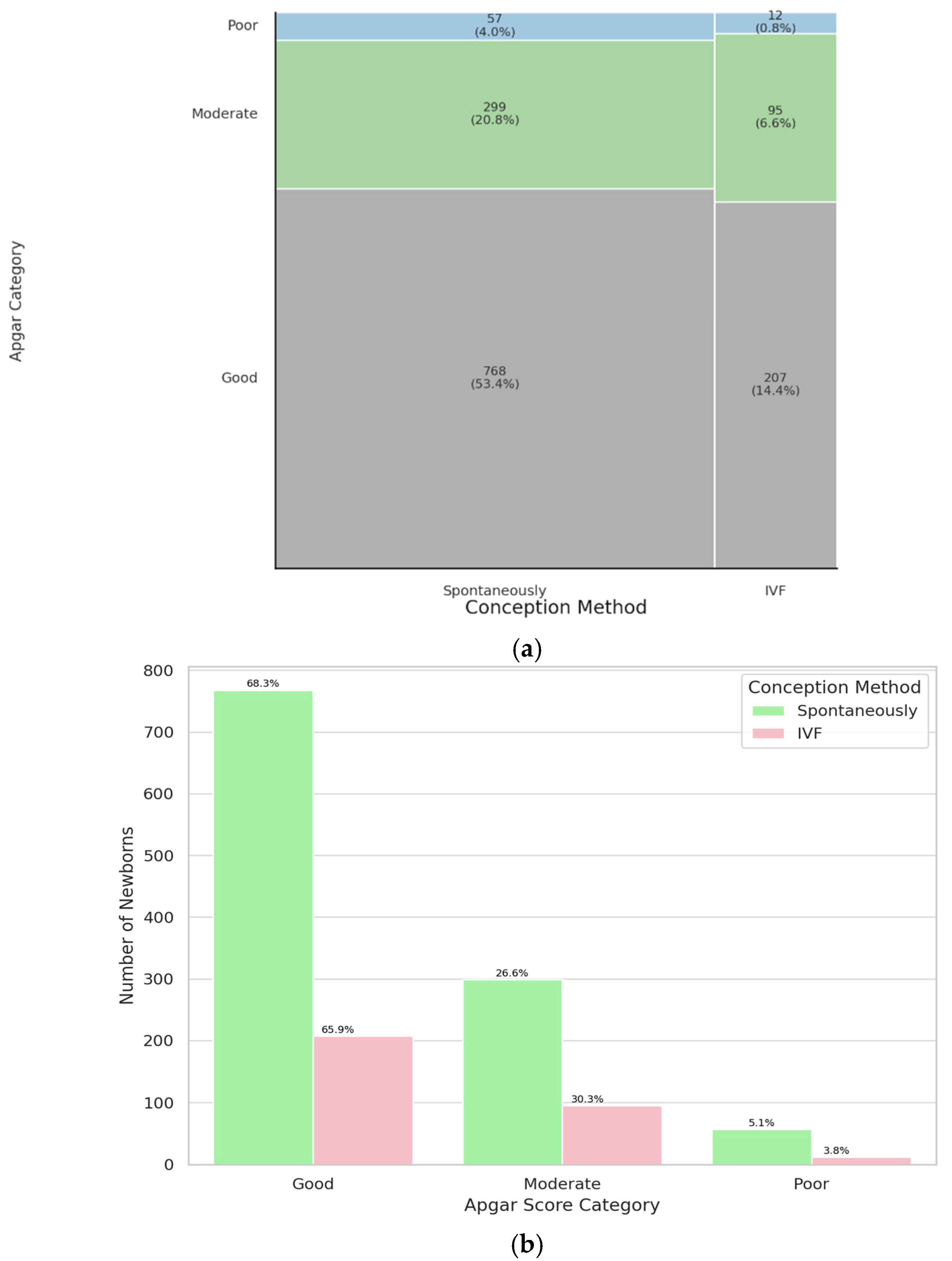
| Total | 1438 (100.0%) | 29.5, 5.0 | 12 (0.8%) | 95 (6.6%) | 207 (14.4%) | 57 (4.0%) | 299 (20.8%) | 768 (53.4%) | NS |
| Primiparae | 834 (58.0%) | 28.5, 4.9 | 10 (1.2%) | 76 (9.1%) | 164 (19.7%) | 33 (4.0%) | 153 (18.3%) | 398 (47.7%) | NS |
| Multiparae | 604 (42.0%) | 30.8, 5.0 | 2 (0.3%) | 19 (3.1%) | 43 (7.1%) | 24 (4.0%) | 146 (24.2%) | 370 (61.3%) | NS |
| MA 18–24 | 246 (17.1%) | 22.5, 1.7 | 0 (0.0%) | 1 (0.4%) | 15 (6.1%) | 15 (6.1%) | 59 (24.0%) | 156 (63.4%) | NS |
| MA 25–34 | 962 (66.9%) | 29.3, 2.8 | 9 (0.9%) | 80 (8.3%) | 157 (16.3%) | 35 (3.6%) | 193 (20.1%) | 488 (50.7%) | NS |
| MA > 34 | 230 (16.0%) | 37.5, 2.4 | 3 (1.3%) | 14 (6.1%) | 35 (15.2%) | 7 (3.0%) | 47 (20.4%) | 124 (53.9%) | NS |
| GA < 28 weeks | 38 (2.6%) | 27.5, 3.3 | 2 (5.3%) | 6 (15.8%) | 0 (0.0%) | 14 (36.8%) | 16 (42.1%) | 0 (0.0%) | NS |
| GA 28–32 weeks | 208 (14.5%) | 29.5, 5.5 | 7 (3.4%) | 25 (12.0%) | 14 (6.7%) | 21 (10.1%) | 94 (45.2%) | 47 (22.6%) | NS |
| GA 33–37 weeks | 886 (61.6%) | 29.5, 4.8 | 3 (0.3%) | 55 (6.2%) | 150 (16.9%) | 15 (1.7%) | 141 (15.9%) | 522 (58.9%) | NS |
| GA 38–43 weeks | 306 (21.3%) | 29.5, 5.5 | 0 (0.0%) | 9 (2.9%) | 43 (14.1%) | 7 (2.3%) | 48 (15.7%) | 199 (65.0%) | NS |
| Twin I | 719 (50.0%) | 29.5, 5.0 | 7 (1.0%) | 55 (7.6%) | 95 (13.2%) | 35 (4.9%) | 172 (23.9%) | 355 (49.4%) | NS |
| Twin II | 719 (50.0%) | 29.5, 5.0 | 5 (0.7%) | 40 (5.6%) | 112 (15.6%) | 22 (3.1%) | 127 (17.7%) | 413 (57.4%) | NS |
| Vaginal delivery | 262 (18.2%) | 28.9, 5.3 | 0 (0.0%) | 1 (0.4%) | 9 (3.4%) | 37 (14.1%) | 85 (32.4%) | 130 (49.6%) | NS |
| Cesarean section | 1176 (81.8%) | 29.6, 5.0 | 12 (1.0%) | 94 (8.0%) | 198 (16.8%) | 20 (1.7%) | 214 (18.2%) | 638 (54.3%) | <0.05 |
| MCDA | 310 (21.6%) | 28.9, 5.4 | 3 (1.0%) | 8 (2.6%) | 13 (4.2%) | 15 (4.8%) | 90 (29.0%) | 181 (58.4%) | NS |
| DCDA | 1128 (78.4%) | 29.6, 4.9 | 9 (0.8%) | 87 (7.7%) | 194 (17.2%) | 42 (3.7%) | 209 (18.5%) | 587 (52.0%) | NS |
| Weight difference < 15% | 992 (69.0%) | 29.5, 5.1 | 8 (0.8%) | 149 (15.0%) | 149 (15.0%) | 28 (2.8%) | 191 (19.3%) | 557 (56.1%) | NS |
| Weight difference 15–19% | 196 (13.6%) | 29.2, 4.7 | 0 (0.0%) | 19 (9.7%) | 19 (9.7%) | 6 (3.1%) | 46 (23.5%) | 106 (54.1%) | <0.05 |
| Weight difference 20–24% | 80 (5.6%) | 29.9, 5.6 | 2 (2.5%) | 6 (7.5%) | 12 (15.0%) | 3 (3.8%) | 18 (22.5%) | 39 (48.8%) | NS |
| Weight difference 25–30% | 78 (5.4%) | 29.9, 5.0 | 0 (0.0%) | 4 (5.1%) | 12 (15.4%) | 3 (3.8%) | 21 (26.9%) | 38 (48.7%) | NS |
| Weight difference >30% | 92 (6.4%) | 29.0, 4.4 | 2 (2.2%) | 7 (7.6%) | 15 (16.3%) | 17 (18.5%) | 23 (25.0%) | 28 (30.4%) | NS |
| Smaller twin | 719 (50.0%) | 29.5, 5.0 | 9 (1.3%) | 42 (5.8%) | 106 (14.7%) | 31 (4.3%) | 149 (20.7%) | 382 (53.1%) | NS |
| Bigger twin | 719 (50.0%) | 29.5, 5.0 | 3 (0.4%) | 53 (7.4%) | 101 (14.0%) | 26 (3.6%) | 386 (53.7%) | 386 (53.7%) | NS |
| Variable | Group Size (Percentage) | Age—Mean (Standard Deviation) | MCDA | DCDA | p-Value | ||||
|---|---|---|---|---|---|---|---|---|---|
| Apgar 0–3 | Apgar 4–7 | Apgar 8–10 | Apgar 0–3 | Apgar 4–7 | Apgar 8–10 | NS | |||
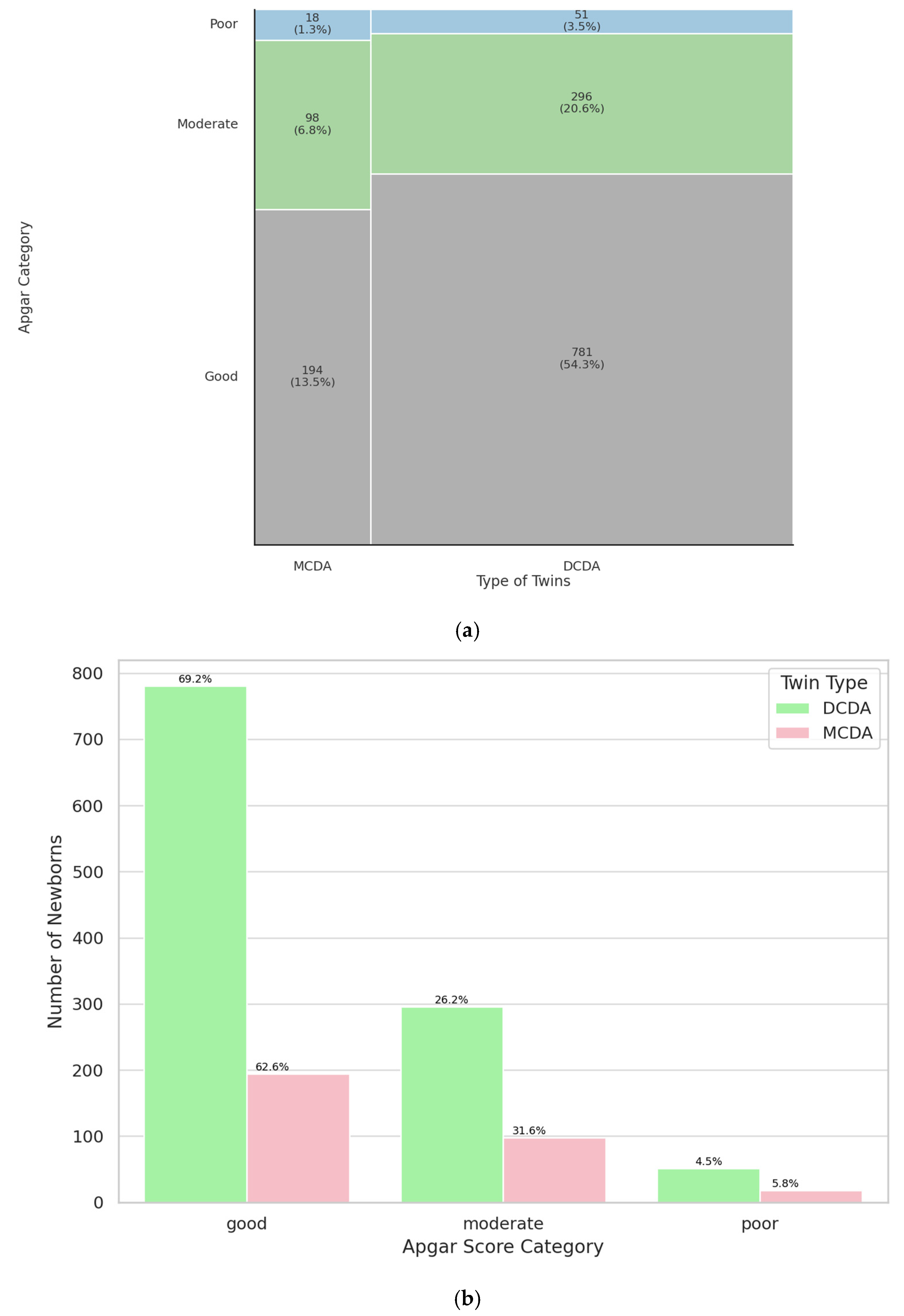
| Total | 1438 (100.0%) | 29.5, 5.0 | 18 (1.3%) | 98 (6.8%) | 194 (13.5%) | 51 (3.5%) | 296 (20.6%) | 781 (54.3%) | NS |
| Primiparae | 834 (58.0%) | 28.5, 4.9 | 9 (1.1%) | 68 (8.2%) | 107 (12.8%) | 34 (4.1%) | 161 (19.3%) | 455 (54.6%) | <0.01 |
| Multiparae | 604 (42.0%) | 30.8, 5.0 | 9 (1.5%) | 30 (5.0%) | 87 (14.4%) | 17 (2.8%) | 135 (22.4%) | 326 (54.0%) | NS |
| MA 18–24 | 246 (17.1%) | 22.5, 1.7 | 6 (2.4%) | 18 (7.3%) | 46 (18.7%) | 9 (3.7%) | 42 (17.1%) | 125 (50.8%) | NS |
| MA 25–34 | 962 (66.9%) | 29.3, 2.8 | 7 (0.7%) | 73 (7.6%) | 114 (11.9%) | 37 (3.8%) | 200 (20.8%) | 531 (55.2%) | <0.01 |
| MA > 34 | 230 (16.0%) | 37.5, 2.4 | 5 (2.2%) | 7 (3.0%) | 34 (14.8%) | 5 (2.2%) | 54 (23.5%) | 125 (54.3%) | <0.05 |
| GA < 28 weeks | 38 (2.6%) | 27.5, 3.3 | 2 (5.3%) | 4 (10.5%) | 0 (0.0%) | 14 (36.8%) | 18 (47.4%) | 0 (0.0%) | NS |
| GA 28–32 weeks | 208 (14.5%) | 29.5, 5.5 | 7 (3.4%) | 20 (9.6%) | 15 (7.2%) | 21 (10.1%) | 99 (47.6%) | 46 (22.1%) | NS |
| GA 33–37 weeks | 886 (61.6%) | 29.5, 4.8 | 6 (0.7%) | 62 (7.0%) | 130 (14.7%) | 12 (1.4%) | 134 (15.1%) | 542 (61.2%) | <0.001 |
| GA 38–43 weeks | 306 (21.3%) | 29.5, 5.5 | 3 (1.0%) | 12 (3.9%) | 49 (16.0%) | 4 (1.3%) | 45 (14.7%) | 193 (63.1%) | NS |
| Twin I | 719 (50.0%) | 29.5, 5.0 | 12 (1.7%) | 56 (7.8%) | 87 (12.1%) | 30 (4.2%) | 363 (50.5%) | 363 (50.5%) | NS |
| Twin II | 719 (50.0%) | 29.5, 5.0 | 6 (0.8%) | 42 (5.8%) | 107 (14.9%) | 21 (2.9%) | 125 (17.4%) | 418 (58.1%) | NS |
| Vaginal delivery | 262 (18.2%) | 28.9, 5.3 | 9 (3.4%) | 22 (8.4%) | 21 (8.0%) | 28 (10.7%) | 64 (24.4%) | 118 (45.0%) | NS |
| Cesarean section | 1176 (81.8%) | 29.6, 5.0 | 9 (0.8%) | 76 (6.5%) | 173 (14.7%) | 23 (2.0%) | 232 (19.7%) | 663 (56.4%) | NS |
| IVF | 314 (21.8%) | 30.7, 4.2 | 3 (1.0%) | 8 (2.5%) | 13 (4.1%) | 9 (2.9%) | 87 (27.7%) | 194 (61.8%) | NS |
| Spontaneous conception | 1124 (78.2%) | 29.1, 5.2 | 15 (1.3%) | 90 (8.0%) | 181 (16.1%) | 42 (3.7%) | 209 (18.6%) | 587 (52.2%) | NS |
| Weight difference < 15% | 992 (69.0%) | 29.5, 5.1 | 5 (0.5%) | 37 (3.7%) | 126 (12.7%) | 31 (3.1%) | 213 (21.5%) | 580 (58.5%) | NS |
| Weight difference 15–19% | 196 (13.6%) | 29.2, 4.7 | 2 (1.0%) | 28 (14.3%) | 36 (18.4%) | 4 (2.0%) | 37 (18.9%) | 89 (45.4%) | NS |
| Weight difference 20–24% | 80 (5.6%) | 29.9, 5.6 | 2 (2.5%) | 7 (8.8%) | 9 (11.2%) | 3 (3.8%) | 42 (52.5%) | 42 (52.5%) | NS |
| Weight difference 25–30% | 78 (5.4%) | 29.9, 5.0 | 1 (1.3%) | 11 (14.1%) | 14 (17.9%) | 2 (2.6%) | 14 (17.9%) | 36 (46.2%) | NS |
| Weight difference >30% | 92 (6.4%) | 29.0, 4.4 | 8 (8.7%) | 15 (16.3%) | 9 (9.8%) | 11 (12.0%) | 15 (16.3%) | 34 (37.0%) | <0.05 |
| Smaller twin | 719 (50.0%) | 29.5, 5.0 | 9 (1.3%) | 48 (6.7%) | 98 (13.6%) | 31 (4.3%) | 143 (19.9%) | 390 (54.2%) | NS |
| Bigger twin | 719 (50.0%) | 29.5, 5.0 | 9 (1.3%) | 50 (7.0%) | 96 (13.4%) | 20 (2.8%) | 153 (21.3%) | 391 (54.4%) | NS |
| Variable | Group Size (Percentage) | Age—Mean (Standard Deviation) | Very Small Difference <15% | Small Difference 15–19% | Moderete Difference 20–24% | Big Difference 25–30% | Very Big Difference >30% | p-Value | ||||||||||
|---|---|---|---|---|---|---|---|---|---|---|---|---|---|---|---|---|---|---|
| Apgar 0–3 | Apgar 4–7 | Apgar 8–10 | Apgar 0–3 | Apgar 4–7 | Apgar 8–10 | Apgar 0–3 | Apgar 4–7 | Apgar 8–10 | Apgar 0–3 | Apgar 4–7 | Apgar 8–10 | Apgar 0–3 | Apgar 4–7 | Apgar 8–10 | ||||
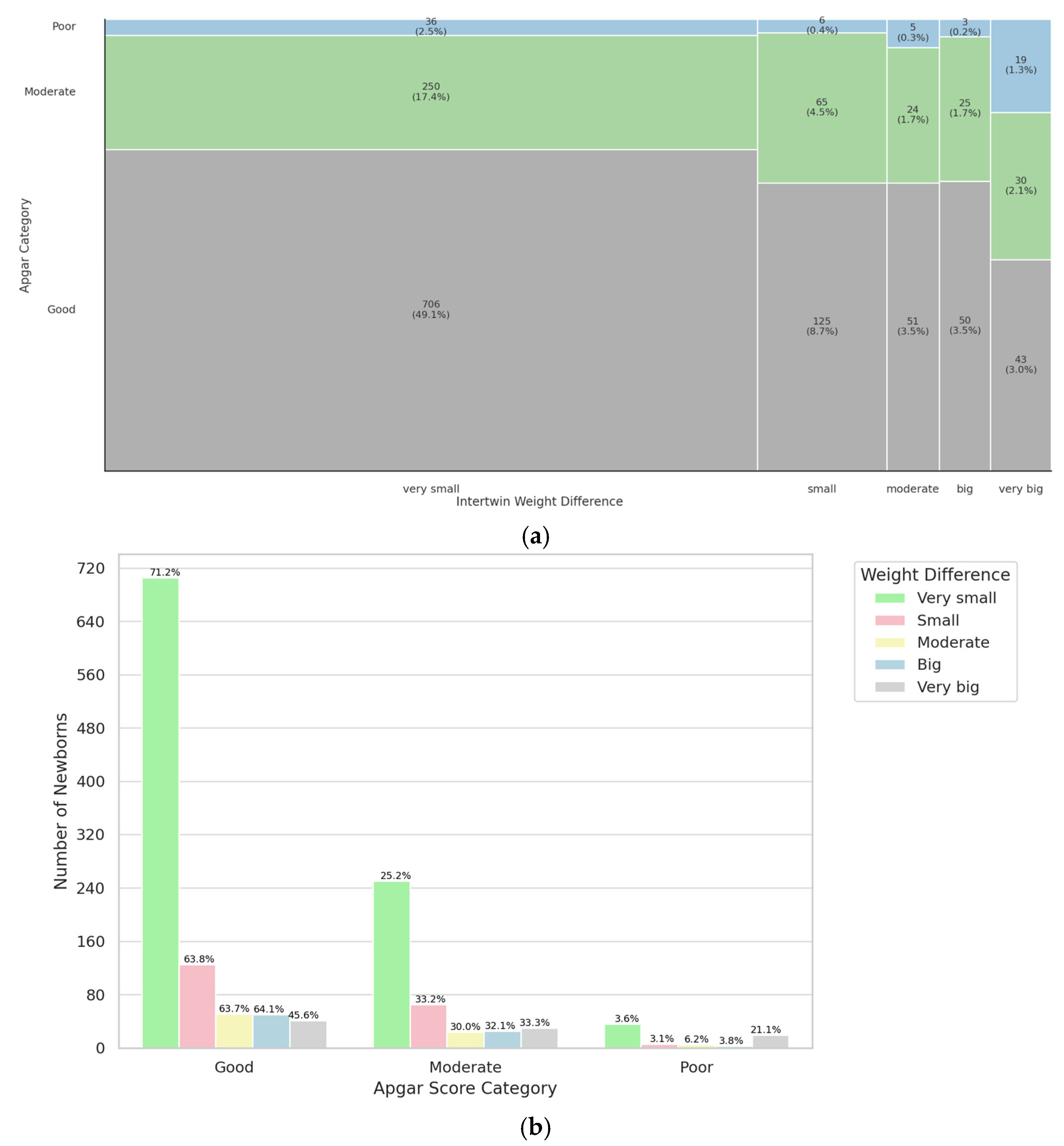
| Total | 1438 (100.0%) | 29.5, 5.0 | 36 (2.5%) | 250 (17.4%) | 706 (49.1%) | 6 (0.4%) | 65 (4.5%) | 125 (8.7%) | 5 (0.3%) | 24 (1.7%) | 51 (3.5%) | 3 (0.2%) | 25 (1.7%) | 50 (3.5%) | 19 (1.3%) | 30 (2.1%) | 43 (3.0%) | <0.001 |
| Primiparae | 834 (58.0%) | 28.5, 4.9 | 23 (2.8%) | 136 (16.3%) | 399 (47.8%) | 4 (0.5%) | 45 (5.4%) | 73 (8.8%) | 5 (0.6%) | 12 (1.4%) | 39 (4.7%) | 1 (0.1%) | 19 (2.3%) | 20 (2.4%) | 10 (1.2%) | 17 (2.0%) | 31 (3.7%) | <0.001 |
| Multiparae | 604 (42.0%) | 30.8, 5.0 | 13 (2.2%) | 114 (18.9%) | 307 (50.8%) | 2 (0.3%) | 20 (3.3%) | 52 (8.6%) | 0 (0.0%) | 12 (2.0%) | 12 (2.0%) | 2 (0.3%) | 6 (1.0%) | 30 (5.0%) | 9 (1.5%) | 13 (2.2%) | 12 (2.0%) | <0.001 |
| MA 18–24 | 246 (17.1%) | 22.5, 1.7 | 4 (1.6%) | 45 (18.3%) | 125 (50.8%) | 2 (0.8%) | 7 (2.8%) | 27 (11.0%) | 3 (1.2%) | 4 (1.6%) | 11 (4.5%) | 1 (0.4%) | 3 (1.2%) | 4 (1.6%) | 5 (2.0%) | 1 (0.4%) | 4 (1.6%) | <0.001 |
| MA 25–34 | 962 (66.9%) | 29.3, 2.8 | 27 (2.8%) | 166 (17.3%) | 461 (47.9%) | 4 (0.4%) | 48 (5.0%) | 82 (8.5%) | 0 (0.0%) | 13 (1.4%) | 29 (3.0%) | 2 (0.2%) | 20 (2.1%) | 40 (4.2%) | 11 (1.1%) | 26 (2.7%) | 33 (3.4%) | <0.001 |
| MA > 34 | 230 (16.0%) | 37.5, 2.4 | 5 (2.2%) | 39 (17.0%) | 120 (52.2%) | 0 (0.0%) | 10 (4.3%) | 16 (7.0%) | 2 (0.9%) | 7 (3.0%) | 11 (4.8%) | 0 (0.0%) | 2 (0.9%) | 6 (2.6%) | 3 (1.3%) | 3 (1.3%) | 6 (2.6%) | <0.05 |
| GA < 28 weeks | 38 (2.6%) | 27.5, 3.3 | 7 (18.4%) | 15 (39.5%) | 0 (0.0%) | 6 (15.8%) | 4 (10.5%) | 0 (0.0%) | 0 (0.0%) | 0 (0.0%) | 0 (0.0%) | 0 (0.0%) | 2 (5.3%) | 0 (0.0%) | 3 (7.9%) | 1 (2.6%) | 0 (0.0%) | NS |
| GA 28–32 weeks | 208 (14.5%) | 29.5, 5.5 | 19 (9.1%) | 80 (38.5%) | 39 (18.8%) | 0 (0.0%) | 16 (7.7%) | 6 (2.9%) | 1 (0.5%) | 6 (2.9%) | 1 (0.5%) | 3 (1.4%) | 11 (5.3%) | 8 (3.8%) | 7 (3.4%) | 6 (2.9%) | 5 (2.4%) | NS |
| GA 33–37 weeks | 886 (61.6%) | 29.5, 4.8 | 8 (0.9%) | 123 (13.9%) | 483 (54.5%) | 0 (0.0%) | 35 (4.0%) | 99 (11.2%) | 4 (0.5%) | 9 (1.0%) | 35 (4.0%) | 0 (0.0%) | 8 (0.9%) | 28 (3.2%) | 6 (0.7%) | 21 (2.4%) | 27 (3.0%) | <0.001 |
| GA 38–43 weeks | 306 (21.3%) | 29.5, 5.5 | 2 (0.7%) | 32 (10.5%) | 184 (60.1%) | 0 (0.0%) | 10 (3.3%) | 20 (6.5%) | 0 (0.0%) | 9 (2.9%) | 15 (4.9%) | 0 (0.0%) | 4 (1.3%) | 14 (4.6%) | 5 (1.6%) | 2 (0.7%) | 9 (2.9%) | <0.001 |
| Twin I | 719 (50.0%) | 29.5, 5.0 | 24 (3.3%) | 147 (20.4%) | 325 (45.2%) | 3 (0.4%) | 40 (5.6%) | 55 (7.6%) | 3 (0.4%) | 12 (1.7%) | 25 (3.5%) | 2 (0.3%) | 11 (1.5%) | 26 (3.6%) | 10 (1.4%) | 17 (2.4%) | 19 (2.6%) | <0.001 |
| Twin II | 719 (50.0%) | 29.5, 5.0 | 12 (1.7%) | 103 (14.3%) | 381 (53.0%) | 3 (0.4%) | 25 (3.5%) | 70 (9.7%) | 2 (0.3%) | 12 (1.7%) | 26 (3.6%) | 1 (0.1%) | 14 (1.9%) | 24 (3.3%) | 9 (1.3%) | 13 (1.8%) | 24 (3.3%) | <0.001 |
| Vaginal delivery | 262 (18.2%) | 28.9, 5.3 | 19 (7.3%) | 62 (23.7%) | 105 (40.1%) | 6 (2.3%) | 8 (3.1%) | 14 (5.3%) | 2 (0.8%) | 11 (4.2%) | 9 (3.4%) | 2 (0.8%) | 4 (1.5%) | 6 (2.3%) | 8 (3.1%) | 1 (0.4%) | 5 (1.9%) | <0.001 |
| Cesarean section | 1176 (81.8%) | 29.6, 5.0 | 17 (1.4%) | 188 (16.0%) | 601 (51.1%) | 0 (0.0%) | 57 (4.8%) | 111 (9.4%) | 3 (0.3%) | 13 (1.1%) | 42 (3.6%) | 1 (0.1%) | 21 (1.8%) | 44 (3.7%) | 11 (0.9%) | 29 (2.5%) | 38 (3.2%) | <0.001 |
| IVF | 314 (21.8%) | 30.7, 4.2 | 8 (2.5%) | 59 (18.8%) | 149 (47.5%) | 0 (0.0%) | 19 (6.1%) | 19 (6.1%) | 2 (0.6%) | 6 (1.9%) | 12 (3.8%) | 0 (0.0%) | 4 (1.3%) | 12 (3.8%) | 2 (0.6%) | 7 (2.2%) | 15 (4.8%) | NS |
| Spontaneous conception | 1124 (78.2%) | 29.1, 5.2 | 28 (2.5%) | 191 (17.0%) | 557 (49.6%) | 6 (0.5%) | 46 (4.1%) | 106 (9.4%) | 3 (0.3%) | 18 (1.6%) | 39 (3.5%) | 3 (0.3%) | 21 (1.9%) | 38 (3.4%) | 17 (1.5%) | 23 (2.0%) | 28 (2.5%) | <0.001 |
| MCDA | 310 (21.6%) | 28.9, 5.4 | 5 (1.6%) | 37 (11.9%) | 126 (40.6%) | 2 (0.6%) | 28 (9.0%) | 36 (11.6%) | 2 (0.6%) | 7 (2.3%) | 9 (2.9%) | 1 (0.3%) | 11 (3.5%) | 14 (4.5%) | 8 (2.6%) | 15 (4.8%) | 9 (2.9%) | <0.001 |
| DCDA | 1128 (78.4%) | 29.6, 4.9 | 31 (2.7%) | 213 (18.9%) | 580 (51.4%) | 4 (0.4%) | 37 (3.3%) | 89 (7.9%) | 3 (0.3%) | 17 (1.5%) | 42 (3.7%) | 2 (0.2%) | 14 (1.2%) | 36 (3.2%) | 11 (1.0%) | 15 (1.3%) | 34 (3.0%) | <0.001 |
| Smaller twin | 719 (50.0%) | 29.5, 5.0 | 20 (2.8%) | 124 (17.2%) | 352 (49.0%) | 4 (0.6%) | 30 (4.2%) | 64 (8.9%) | 3 (0.4%) | 9 (1.3%) | 28 (3.9%) | 2 (0.3%) | 13 (1.8%) | 24 (3.3%) | 11 (1.5%) | 15 (2.1%) | 20 (2.8%) | <0.001 |
| Bigger twin | 719 (50.0%) | 29.5, 5.0 | 16 (2.2%) | 126 (17.5%) | 354 (49.2%) | 2 (0.3%) | 35 (4.9%) | 61 (8.5%) | 2 (0.3%) | 15 (2.1%) | 23 (3.2%) | 1 (0.1%) | 12 (1.7%) | 26 (3.6%) | 8 (1.1%) | 15 (2.1%) | 23 (3.2%) | <0.001 |
| Variable | Group Size (Percentage) | Age—Mean (Standard Deviation) | Smaller Twin | Bigger Twin | p-Value | ||||
|---|---|---|---|---|---|---|---|---|---|
| Apgar 0–3 | Apgar 4–7 | Apgar 8–10 | Apgar 0–3 | Apgar 4–7 | Apgar 8–10 | ||||
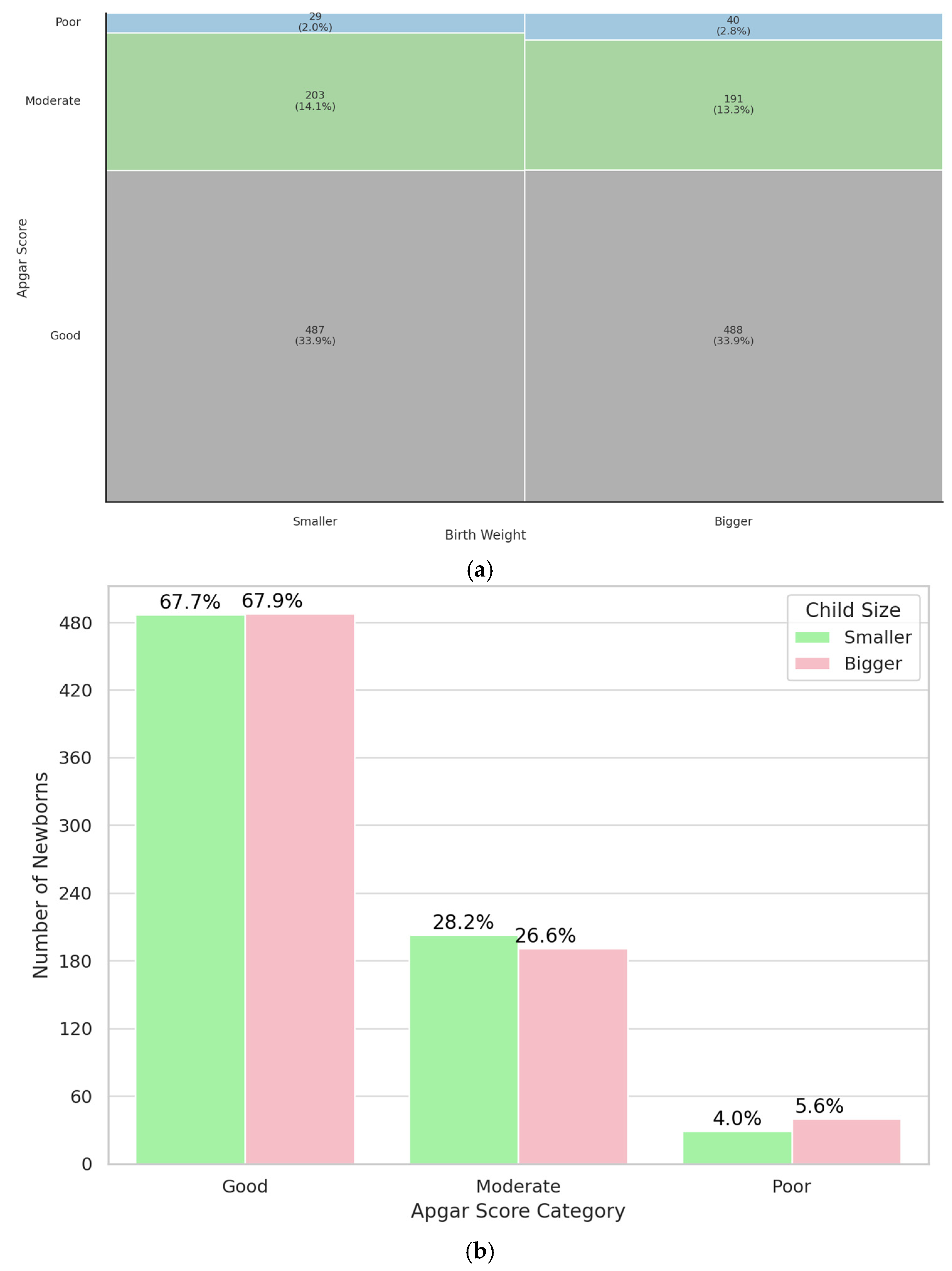
| Total | 1438 (100.0%) | 29.5, 5.0 | 40 (2.8%) | 191 (13.3%) | 488 (33.9%) | 29 (2.0%) | 203 (14.1%) | 487 (33.9%) | NS |
| Primiparae | 834 (58.0%) | 28.5, 4.9 | 24 (2.9%) | 109 (13.1%) | 284 (34.1%) | 19 (2.3%) | 120 (14.4%) | 278 (33.3%) | NS |
| Multiparae | 604 (42.0%) | 30.8, 5.0 | 16 (2.6%) | 82 (13.6%) | 204 (33.8%) | 10 (1.7%) | 83 (13.7%) | 209 (34.6%) | NS |
| MA 18–24 | 246 (17.1%) | 22.5, 1.7 | 8 (3.3%) | 29 (11.8%) | 86 (35.0%) | 7 (2.8%) | 31 (12.6%) | 85 (34.6%) | NS |
| MA 25–34 | 962 (66.9%) | 29.3, 2.8 | 27 (2.8%) | 131 (13.6%) | 323 (33.6%) | 17 (1.8% | 142 (14.8%) | 322 (33.5%) | NS |
| MA > 34 | 230 (16.0%) | 37.5, 2.4 | 5 (2.2%) | 31 (13.5%) | 79 (34.3%) | 5 (2.2%) | 30 (13.0%) | 80 (34.8%) | NS |
| GA < 28 weeks | 38 (2.6%) | 27.5, 3.3 | 10 (26.3%) | 9 (23.7%) | 0 (0.0%) | 6 (15.8%) | 13 (34.2%) | 0 (0.0%) | NS |
| GA 28–32 weeks | 208 (14.5%) | 29.5, 5.5 | 17 (8.2%) | 59 (28.4%) | 28 (13.5%) | 11 (5.3%) | 60 (28.8%) | 33 (15.9%) | NS |
| GA 33–37 weeks | 886 (61.6%) | 29.5, 4.8 | 11 (1.2%) | 93 (10.5%) | 339 (38.3%) | 7 (0.8%) | 103 (11.6%) | 333 (37.6%) | NS |
| GA 38–43 weeks | 306 (21.3%) | 29.5, 5.5 | 2 (0.7%) | 30 (9.8%) | 121 (39.5%) | 5 (1.6%) | 27 (8.8%) | 121 (39.5%) | NS |
| Twin I | 719 (50.0%) | 29.5, 5.0 | 20 (2.8%) | 90 (12.5%) | 170 (23.6%) | 22 (3.1%) | 137 (19.1%) | 280 (38.9%) | NS |
| Twin II | 719 (50.0%) | 29.5, 5.0 | 20 (2.8%) | 101 (14.0%) | 318 (44.2%) | 7 (1.0%) | 66 (9.2%) | 207 (28.8%) | NS |
| Vaginal delivery | 262 (18.2%) | 28.9, 5.3 | 19 (7.3%) | 45 (17.2%) | 67 (25.6%) | 18 (6.9%) | 41 (15.6%) | 72 (27.5%) | NS |
| Cesarean Section | 1176 (81.8%) | 29.6, 5.0 | 21 (1.8%) | 146 (12.4%) | 421 (35.8%) | 11 (0.9%) | 162 (13.8%) | 415 (35.3%) | NS |
| MCDA | 310 (21.6%) | 28.9, 5.4 | 9 (2.9%) | 48 (15.5%) | 98 (31.6%) | 9 (2.9%) | 50 (16.1%) | 96 (31.0%) | NS |
| DCDA | 1128 (78.4%) | 29.6, 4.9 | 31 (2.7%) | 143 (12.7%) | 390 (34.6%) | 20 (1.8%) | 153 (13.6%) | 391 (34.7%) | NS |
| Weight difference < 15% | 992 (69.0%) | 29.5, 5.1 | 20 (2.0%) | 124 (12.5%) | 352 (35.5%) | 16 (1.6%) | 126 (12.7%) | 354 (35.7%) | NS |
| Weight difference 15–19% | 196 (13.6%) | 29.2, 4.7 | 4 (2.0%) | 30 (15.3%) | 64 (32.7%) | 2 (1.0%) | 35 (17.9%) | 61 (31.1%) | NS |
| Weight difference 20–24% | 80 (5.6%) | 29.9, 5.6 | 3 (3.8%) | 9 (11.2%) | 28 (35.0%) | 2 (2.5%) | 15 (18.8%) | 23 (28.7%) | NS |
| Weight difference 25–30% | 78 (5.4%) | 29.9, 5.0 | 2 (2.6%) | 13 (16.7%) | 24 (30.8%) | 1 (1.3%) | 12 (15.4%) | 26 (33.3%) | NS |
| Weight difference >30% | 92 (6.4%) | 29.0, 4.4 | 11 (12.0%) | 15 (16.3%) | 20 (21.7%) | 8 (8.7%) | 15 (16.3%) | 23 (25.0%) | NS |
| IVF | 314 (21.8%) | 30.7, 4.2 | 9 (2.9%) | 42 (13.4%) | 106 (33.8%) | 3 (1.0%) | 53 (16.9%) | 101 (32.2%) | NS |
| Spontaneous conception | 1124 (78.2%) | 29.1, 5.2 | 31 (2.8%) | 149 (13.3%) | 382 (34.0%) | 26 (2.3%) | 150 (13.3%) | 386 (34.3%) | NS |
| Variable | Group Size (Percentage) | Age—Mean (Standard Deviation) | Vaginal Delivery | Cesarean Section | p-Value | ||||
|---|---|---|---|---|---|---|---|---|---|
| Apgar 0–3 | Apgar 4–7 | Apgar 8–10 | Apgar 0–3 | Apgar 4–7 | Apgar 8–10 | ||||
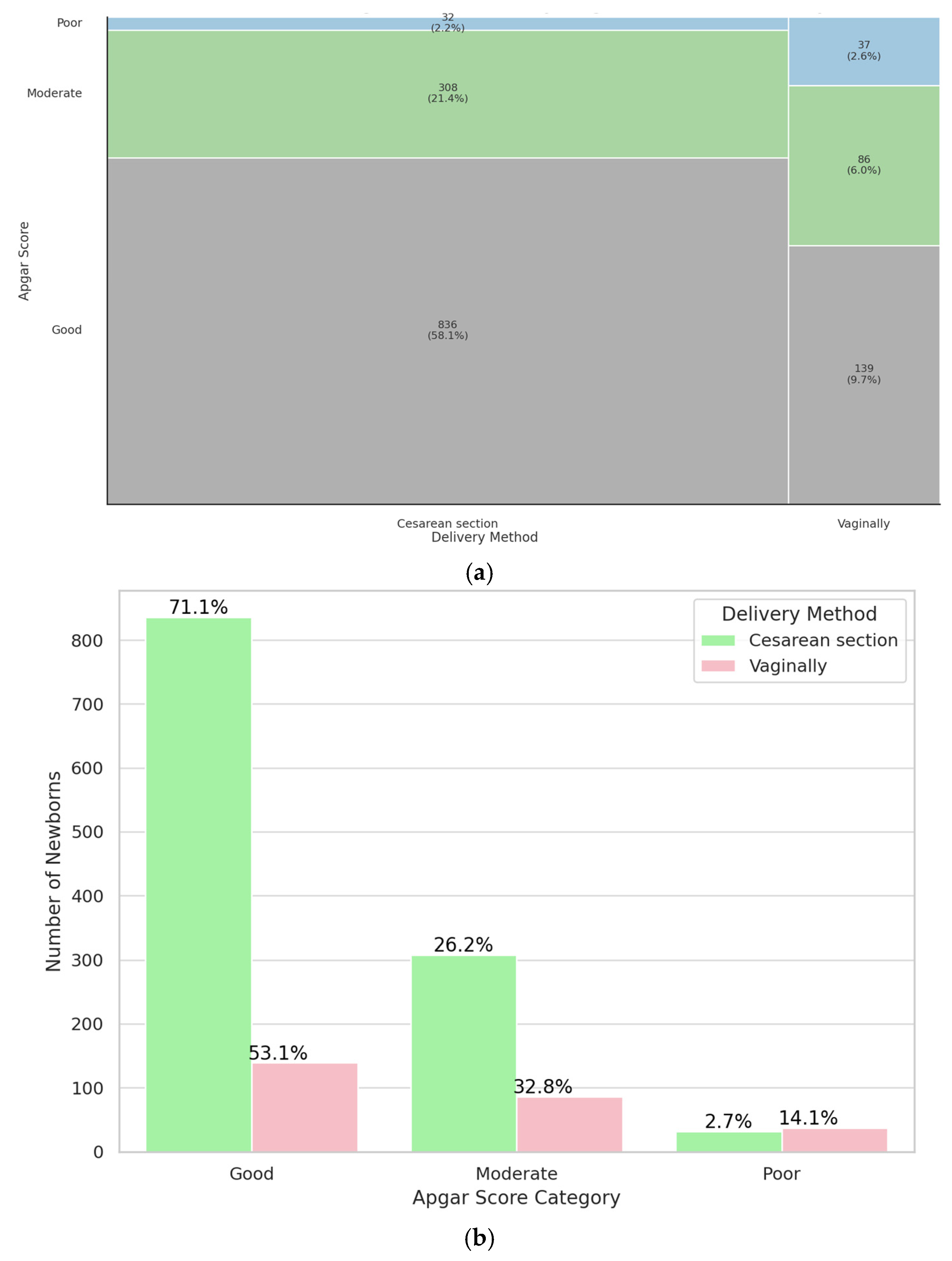
| Total | 1438 (100.0%) | 29.5, 5.0 | 37 (2.6%) | 86 (6.0%) | 139 (9.7% | 32 (2.2%) | 308 (21.4%) | 836 (58.1%) | <0.001 |
| Primiparae | 834 (58.0%) | 28.5, 4.9 | 19 (2.3%) | 29 (3.5%) | 54 (6.5%) | 24 (2.9%) | 200 (24.0%) | 508 (60.9%) | <0.001 |
| Multiparae | 604 (42.0%) | 30.8, 5.0 | 18 (3.0%) | 57 (9.4%) | 85 (14.1%) | 8 (1.3%) | 108 (17.9%) | 328 (54.3%) | <0.001 |
| MA 18–24 | 246 (17.1%) | 22.5, 1.7 | 8 (3.3%) | 16 (6.5%) | 30 (12.2%) | 7 (2.8%) | 44 (17.9%) | 141 (57.3%) | <0.01 |
| MA 25–34 | 962 (66.9%) | 29.3, 2.8 | 23 (2.4%) | 55 (5.7%) | 92 (9.6%) | 21 (2.2%) | 218 (22.7%) | 553 (57.5%) | <0.001 |
| MA > 34 | 230 (16.0%) | 37.5, 2.4 | 6 (2.6%) | 15 (6.5%) | 17 (7.4%) | 4 (1.7%) | 46 (20.0%) | 142 (61.7%) | <0.001 |
| GA < 28 weeks | 38 (2.6%) | 27.5, 3.3 | 12 (31.6%) | 6 (15.8%) | 0 (0.0%) | 4 (10.5%) | 16 (42.1%) | 0 (0.0%) | <0.01 |
| GA 28–32 weeks | 208 (14.5%) | 29.5, 5.5 | 13 (6.2%) | 24 (11.5%) | 3 (1.4%) | 15 (7.2%) | 95 (45.7%) | 58 (27.9%) | <0.001 |
| GA 33–37 weeks | 886 (61.6%) | 29.5, 4.8 | 10 (1.1%) | 35 (4.0%) | 65 (7.3%) | 8 (0.9%) | 161 (18.2%) | 607 (68.5%) | <0.001 |
| GA 38–43 weeks | 306 (21.3%) | 29.5, 5.5 | 2 (0.7%) | 21 (6.9%) | 71 (23.2%) | 5 (1.6%) | 36 (11.8%) | 171 (55.9%) | NS |
| Twin I | 719 (50.0%) | 29.5, 5.0 | 20 (2.8%) | 54 (7.5%) | 57 (7.9%) | 22 (3.1%) | 173 (24.1%) | 393 (54.7%) | <0.001 |
| Twin II | 719 (50.0%) | 29.5, 5.0 | 17 (2.4%) | 32 (4.5%) | 82 (11.4%) | 10 (1.4%) | 135 (18.8%) | 443 (61.6%) | <0.001 |
| IVF | 314 (21.8%) | 30.7, 4.2 | 0 (0.0%) | 9 (2.9%) | 9 (2.9%) | 12 (3.8%) | 94 (29.9%) | 198 (63.1%) | NS |
| Spontaneous conception | 1124 (78.2%) | 29.1, 5.2 | 37 (3.3%) | 85 (7.6%) | 130 (11.6%) | 20 (1.8%) | 214 (19.0%) | 638 (56.8%) | <0.001 |
| MCDA | 310 (21.6%) | 28.9, 5.4 | 9 (2.9%) | 22 (7.1%) | 21 (6.8%) | 9 (2.9%) | 76 (24.5%) | 173 (55.8%) | <0.001 |
| DCDA | 1128 (78.4%) | 29.6, 4.9 | 28 (2.5%) | 64 (5.7%) | 118 (10.5%) | 23 (2.0%) | 232 (20.6%) | 663 (58.8%) | <0.001 |
| Weight difference < 15% | 992 (69.0%) | 29.5, 5.1 | 19 (1.9%) | 62 (6.2%) | 105 (10.6%) | 17 (1.7%) | 188 (19.0%) | 601 (60.6%) | <0.001 |
| Weight difference 15–19% | 196 (13.6%) | 29.2, 4.7 | 6 (3.1%) | 8 (4.1%) | 14 (7.1%) | 0 (0.0%) | 57 (29.1%) | 111 (56.6%) | <0.001 |
| Weight difference 20–24% | 80 (5.6%) | 29.9, 5.6 | 2 (2.5%) | 11 (13.8%) | 9 (11.2%) | 3 (3.8%) | 13 (16.2%) | 42 (52.5%) | <0.05 |
| Weight difference 25–30% | 78 (5.4%) | 29.9, 5.0 | 2 (2.6%) | 4 (5.1%) | 6 (7.7%) | 1 (1.3%) | 21 (26.9%) | 44 (56.4%) | <0.05 |
| Weight difference >30% | 92 (6.4%) | 29.0, 4.4 | 8 (8.7%) | 1 (1.1%) | 5 (5.4%) | 11 (12.0%) | 29 (31.5%) | 38 (41.3%) | <0.001 |
| Smaller twin | 719 (50.0%) | 29.5, 5.0 | 19 (2.6%) | 45 (6.3%) | 67 (9.3%) | 21 (2.9%) | 146 (20.3%) | 421 (58.6%) | <0.001 |
| Bigger twin | 719 (50.0%) | 29.5, 5.0 | 18 (2.5%) | 41 (5.7%) | 72 (10.0%) | 11 (1.5%) | 162 (22.5%) | 415 (57.7%) | <0.001 |
| Variable | Group Size (Percentage) | Age—Mean (Standard Deviation) | Twin I | Twin II | p-Value | ||||
|---|---|---|---|---|---|---|---|---|---|
| Apgar 0–3 | Apgar 4–7 | Apgar 8–10 | Apgar 0–3 | Apgar 4–7 | Apgar 8–10 | ||||
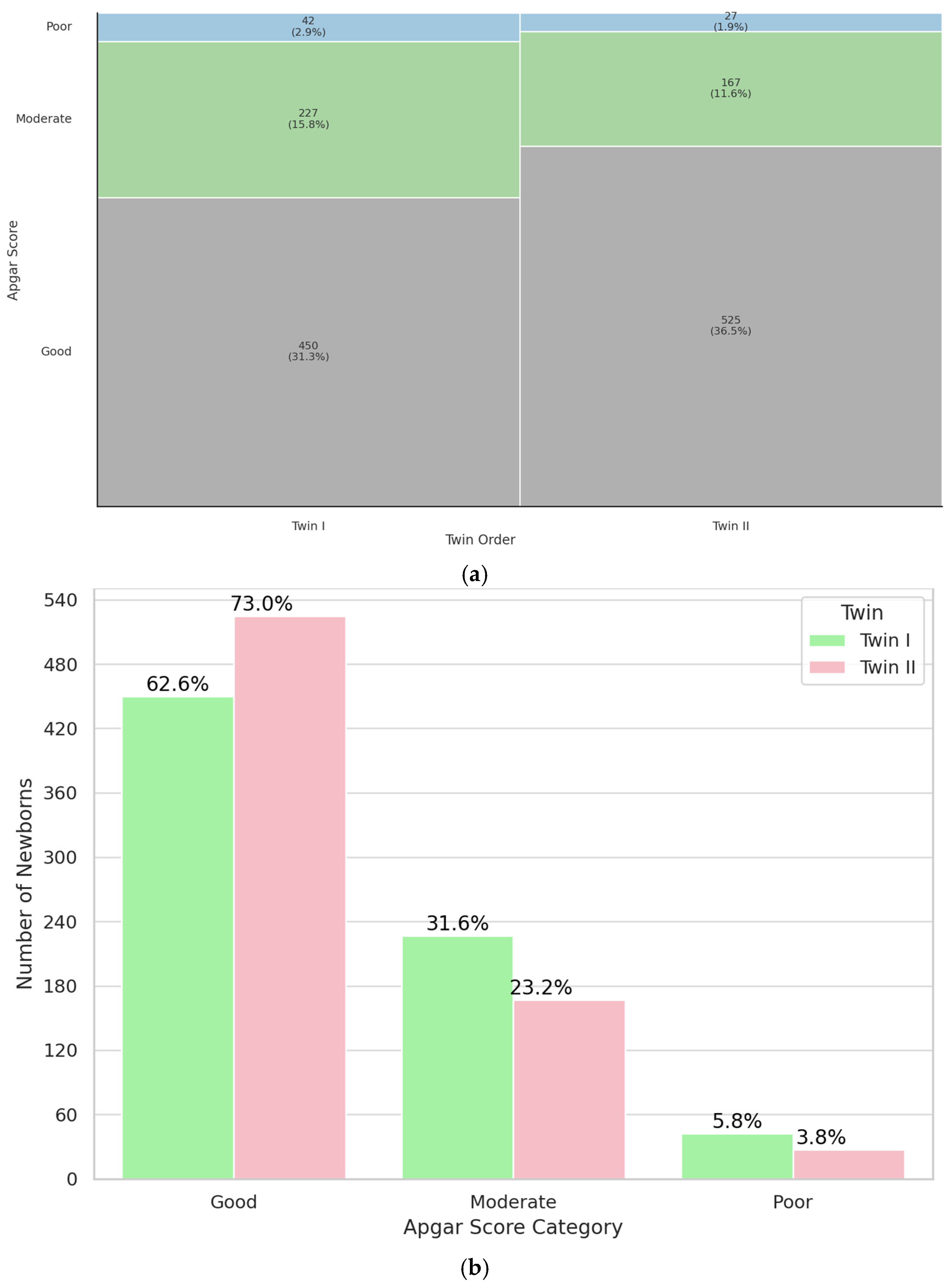
| Total | 1438 (100.0%) | 29.5, 5.0 | 42 (2.9%) | 227 (15.8%) | 450 (31.3%) | 27 (1.9%) | 167 (11.6%) | 525 (36.5%) | <0.001 |
| Primiparae | 834 (58.0%) | 28.5, 4.9 | 26 (3.1%) | 132 (15.8%) | 259 (31.1%) | 17 (2.0%) | 97 (11.6%) | 303 (36.3%) | <0.01 |
| Multiparae | 604 (42.0%) | 30.8, 5.0 | 16 (2.6%) | 95 (15.7%) | 191 (31.6%) | 10 (1.7%) | 70 (11.6%) | 222 (36.8%) | <0.05 |
| MA 18–24 | 246 (17.1%) | 22.5, 1.7 | 9 (3.7%) | 34 (13.8%) | 80 (32.5%) | 6 (2.4%) | 26 (10.6%) | 91 (37.0%) | NS |
| MA 25–34 | 962 (66.9%) | 29.3, 2.8 | 27 (2.8%) | 158 (16.4%) | 296 (30.8%) | 17 (1.8%) | 115 (12.0%) | 349 (36.3%) | <0.01 |
| MA > 34 | 230 (16.0%) | 37.5, 2.4 | 6 (2.6%) | 35 (15.2%) | 74 (32.2%) | 4 (1.7%) | 26 (11.3%) | 85 (37.0%) | NS |
| GA < 28 weeks | 38 (2.6%) | 27.5, 3.3 | 8 (21.1%) | 11 (28.9%) | 0 (0.0%) | 8 (21.1%) | 11 (28.9%) | 0 (0.0%) | NS |
| GA 28–32 weeks | 208 (14.5%) | 29.5, 5.5 | 19 (9.1%) | 56 (26.9%) | 29 (13.9%) | 9 (4.3%) | 63 (30.3%) | 32 (15.4%) | NS |
| GA 33–37 weeks | 886 (61.6%) | 29.5, 4.8 | 10 (1.1%) | 121 (13.7%) | 312 (35.2%) | 8 (0.9%) | 75 (8.5%) | 360 (40.6%) | <0.001 |
| GA 38–43 weeks | 306 (21.3%) | 29.5, 5.5 | 5 (1.6%) | 39 (12.7%) | 109 (35.6%) | 2 (0.7%) | 18 (5.9%) | 133 (43.5%) | <0.01 |
| IVF | 314 (21.8%) | 30.7, 4.2 | 7 (2.2%) | 55 (17.5%) | 95 (30.3%) | 5 (1.6%) | 40 (12.7%) | 112 (35.7%) | NS |
| Spontaneous conception | 1124 (78.2%) | 29.1, 5.2 | 35 (3.1%) | 172 (15.3%) | 355 (31.6%) | 22 (2.0%) | 127 (11.3%) | 413 (36.7%) | <0.001 |
| Vaginal delivery | 262 (18.2%) | 28.9, 5.3 | 20 (7.6%) | 54 (20.6%) | 57 (21.8%) | 17 (6.5%) | 32 (12.2%) | 82 (31.3%) | <0.01 |
| Cesarean section | 1176 (81.8%) | 29.6, 5.0 | 22 (1.9%) | 173 (14.7%) | 393 (33.4%) | 10 (0.9%) | 135 (11.5%) | 443 (37.7%) | <0.01 |
| MCDA | 310 (21.6%) | 28.9, 5.4 | 12 (3.9%) | 56 (18.1%) | 87 (28.1%) | 6 (1.9%) | 42 (13.5%) | 107 (34.5%) | <0.05 |
| DCDA | 1128 (78.4%) | 29.6, 4.9 | 30 (2.7%) | 171 (15.2%) | 363 (32.2%) | 21 (1.9%) | 125 (11.1%) | 418 (37.1%) | <0.01 |
| Weight difference < 15% | 992 (69.0%) | 29.5, 5.1 | 24 (2.4%) | 147 (14.8%) | 325 (32.8%) | 12 (1.2%) | 103 (10.4%) | 381 (38.4%) | <0.001 |
| Weight difference 15–19% | 196 (13.6%) | 29.2, 4.7 | 3 (1.5%) | 40 (20.4%) | 55 (28.1%) | 3 (1.5%) | 25 (12.8%) | 70 (35.7%) | NS |
| Weight difference 20–24% | 80 (5.6%) | 29.9, 5.6 | 3 (3.8%) | 12 (15.0%) | 25 (31.2%) | 2 (2.5%) | 12 (15.0%) | 26 (32.5%) | NS |
| Weight difference 25–30% | 78 (5.4%) | 29.9, 5.0 | 2 (2.6%) | 11 (14.1%) | 26 (33.3%) | 1 (1.3%) | 14 (17.9%) | 24 (30.8%) | NS |
| Weight difference >30% | 92 (6.4%) | 29.0, 4.4 | 10 (10.9%) | 17 (18.5%) | 19 (20.7%) | 9 (9.8%) | 13 (14.1%) | 24 (26.1%) | NS |
| Smaller twin | 719 (50.0%) | 29.5, 5.0 | 20 (2.8%) | 90 (12.5%) | 170 (23.6%) | 20 (2.8%) | 101 (14.0%) | 318 (44.2%) | <0.01 |
| Bigger twin | 719 (50.0%) | 29.5, 5.0 | 22 (3.1%) | 137 (19.1%) | 280 (38.9%) | 7 (1.0%) | 66 (9.2%) | 207 (28.8%) | <0.05 |
| Variable | p-Value | Conclusion |
|---|---|---|
| Mode of conception | NS | Method of conception does not significantly influence the postnatal condition of twins assessed by the 5-minute Apgar score. |
| Chorionicity and amnionicity | NS | Chorionicity and amnionicity does not significantly influence the postnatal condition of twins assessed by the 5-minute Apgar score. |
| Weight difference (percentage between twins) | p < 0.05 | Twins with weight difference < 15% proportionally more likely received a good 5–minute Apgar score. |
| Weight difference (being bigger or smaller twin) | NS | Being a bigger or smaller twin does not significantly influence the postnatal condition of twins assessed by the 5-minute Apgar score. |
| Delivery method | p < 0.05 | Twins born by a cesarean section proportionally more likely received a good 5–minute Apgar score. |
| Birth order | p < 0.05 | Second-born twins proportionally more likely received a good 5-minute Apgar score. |
References
- Rebar, R.W. What are the risks of the assisted reproductive technologies (ART) and how can they be minimized? Reprod. Med. Biol. 2013, 12, 151–158. [Google Scholar] [CrossRef]
- Caserta, D.; Bordi, G.; Stegagno, M.; Filippini, F.; Podagrosi, M.; Roselli, D.; Moscarini, M. Maternal and perinatal outcomes in spontaneous versus assisted conception twin pregnancies. Eur. J. Obstet. Gynecol. Reprod. Biol. 2014, 174, 64–69. [Google Scholar] [CrossRef]
- Marleen, S.; Kodithuwakku, W.; Nandasena, R.; Mohideen, S.; Allotey, J.; Fernández-García, S.; Gaetano-Gil, A.; Ruiz-Calvo, G.; Aquilina, J.; Khalil, A.; et al. Maternal and perinatal outcomes in twin pregnancies following assisted reproduction: A systematic review and meta-analysis involving 802 462 pregnancies. Hum. Reprod. Update 2024, 30, 309–322. [Google Scholar] [CrossRef]
- Reimundo, P.; Gutiérrez Romero, J.M.; Rodríguez Pérez, T.; Veiga, E. Single-embryo transfer: A key strategy to reduce the risk for multiple pregnancy in assisted human reproduction. Adv. Lab. Med. 2021, 2, 179–198. [Google Scholar] [CrossRef]
- Ochsenbein-Kölble, N. Twin pregnancies. Ultraschall Med. 2021, 42, 246–269. [Google Scholar] [CrossRef]
- Tsakiridis, I.; Giouleka, S.; Mamopoulos, A.; Athanasiadis, A.; Dagklis, T. Management of twin pregnancies: A comparative review of national and international guidelines. Obstet. Gynecol. Surv. 2020, 75, 419–430. [Google Scholar] [CrossRef]
- Duy Anh, N.; Thu Ha, N.T.; Khac Toan, N.; Tuan Dat, D.; Huyen Thuong, P.T.; Tra Giang, D.T.; Duc, T.A.; Anh, B.X.; Ha, N.M.; Duc, N.M. Obstetric and Perinatal Outcomes of Dichorionic-Diamniotic Twin Pregnancies Conceived by IVF/ICSI Compared with Those Conceived Spontaneously. Clin. Ter. 2022, 173, 155–163. [Google Scholar] [PubMed]
- Jordan, B.K.; Bernard, L.; Segel, S.; Go, M.D.; Schilling, D.; McEvoy, C.T. Premature monochorionic monoamniotic twins have lower lung compliance at birth than matched dichorionic diamniotic twins. J. Neonatal Perinat. Med. 2023, 16, 87–92. [Google Scholar] [CrossRef] [PubMed]
- Zhu, J.; Zhang, J.; Wu, Y.; Gao, L.; Zhao, X.; Cheng, W.; Wang, Y. Intertwin growth discordance throughout gestation and hypertensive disorders of pregnancy. Am. J. Obstet. Gynecol. 2023, 228, 730.e1–730.e13. [Google Scholar] [CrossRef] [PubMed]
- Chew, L.C.; Osuchukwu, O.O.; Reed, D.J.; Verma, R.P. Fetal Growth Restriction. In StatPearls; StatPearls Publishing: Treasure Island, FL, USA, 2025. [Google Scholar]
- Helmerhorst, F.M.; Perquin, D.A.M.; Donker, D.; Keirse, M.J.N.C. Perinatal outcome of singletons and twins after assisted conception: A systematic review of controlled studies. BMJ 2004, 328, 261. [Google Scholar] [CrossRef]
- Barrett, J.F.R. Delivery of the term twin. Best. Pract. Res. Clin. Obstet. Gynaecol. 2004, 18, 625–630. [Google Scholar] [CrossRef] [PubMed]
- Konar, H.; Sarkar, M.; Paul, J. Perinatal outcome of the second twin at a tertiary care center in India. J. Obstet. Gynaecol. India 2016, 66, 441–447. [Google Scholar] [CrossRef] [PubMed]
- Di Mascio, D.; Acharya, G.; Khalil, A.; Odibo, A.; Prefumo, F.; Liberati, M.; Buca, D.; Manzoli, L.; Flacco, M.E.; Brunelli, R.; et al. Birthweight discordance and neonatal morbidity in twin pregnancies: A systematic review and meta-analysis. Acta Obstet. Gynecol. Scand. 2019, 98, 1245–1257. [Google Scholar] [CrossRef]
- Shah, J.S.; Nasab, S.H.; Chappell, N.; Chen, H.-Y.; Schutt, A.; Mendez-Figueroa, H. Neonatal outcomes among twins stratified by method of conception: Secondary analysis of maternal fetal medicine (MFMU) network database. J. Assist. Reprod. Genet. 2018, 35, 1011–1017. [Google Scholar] [CrossRef]
- Andrijasevic, S.; Dotlic, J.; Aksam, S.; Micic, J.; Terzic, M. Impact of conception method on twin pregnancy course and outcome. Geburtshilfe Frauenheilkd. 2014, 74, 933–939. [Google Scholar] [CrossRef]
- Lin, L.; Yao, T.; Liao, Q.; Liu, J.; Huang, L.; Zheng, L. Neonatal outcomes among twins born through assisted reproduction, compared to those born naturally. Medicine 2024, 103, e40630. [Google Scholar] [CrossRef]
- Özçil, M.D. Comparison of Feto-maternal Effects of Twin Pregnancies and Twin Pregnancies Caused by Assisted Reproductive Technology. J. Acad. Res. Med. 2021, 11, 17–23. [Google Scholar] [CrossRef]
- Nazneen, S.; Kandasamy, V.; Shinde, R.V. A comparative study of spontaneously conceived twin pregnancies vs. twins conceived by assisted reproductive techniques and their maternal and perinatal outcomes: A prospective observational study. Int. J. Reprod. Contracept. Obstet. Gynecol. 2024, 13, 2770–2775. [Google Scholar] [CrossRef]
- Henningsen, A.K.; Pinborg, A. Birth and perinatal outcomes and complications for babies conceived following ART. Semin. Fetal Neonatal Med. 2014, 19, 234–238. [Google Scholar] [CrossRef] [PubMed]
- Pelkonen, S.; Koivunen, R.; Gissler, M.; Nuojua-Huttunen, S.; Suikkari, A.M.; Hydén-Granskog, C.; Martikainen, H.; Tiitinen, A.; Hartikainen, A.-L. Perinatal outcome of children born after frozen and fresh embryo transfer: The Finnish cohort study 1995–2006. Hum Reprod. 2010, 25, 914–923. [Google Scholar] [CrossRef]
- Luke, B.; Brown, M.B.; Missmer, S.A.; Bukulmez, O.; Leach, R.; Stern, J.E.; Society for Assisted Reproductive Technology writing group. The effect of increasing obesity on the response to and outcome of assisted reproductive technology: A national study. Fertil. Steril. 2011, 96, 820–825. [Google Scholar] [CrossRef]
- Rashid, D.; Alalaf, S. Maternal and perinatal outcomes in twin pregnancies conceived spontaneously and by assisted reproductive techniques: Cross-sectional study. East. Mediterr. Health J. 2020, 26, 1285–1293. [Google Scholar] [CrossRef] [PubMed]
- Coutinho Nunes, F.; Domingues, A.P.; Vide Tavares, M.; Belo, A.; Ferreira, C.; Fonseca, E.; Moura, P. Monochorionic versus dichorionic twins: Are obstetric outcomes always different? J. Obstet. Gynaecol. 2016, 36, 598–601. [Google Scholar] [CrossRef]
- Rissanen, A.-R.S.; Gissler, M.; Nupponen, I.K.; Nuutila, M.E.; Jernman, R.M. Perinatal outcome of dichorionic and monochorionic-diamniotic Finnish twins: A historical cohort study. Acta Obstet. Gynecol. Scand. 2022, 101, 153–162. [Google Scholar] [CrossRef]
- Wandel, L.; Abele, H.; Pauluschke-Fröhlich, J.; Kagan, K.O.; Brucker, S.; Rall, K. Mode of birth in monochorionic versus dichorionic twin pregnancies: A retrospective study from a large tertiary centre in Germany. BMC Pregnancy Childb. 2022, 22, 214. [Google Scholar] [CrossRef]
- Miranda, F.; Teixeira, A.; Castro, L.; Carvalho, C.; Lopes, L. Neonatal outcome of second-born twins: A 15-year retrospective study. J. Pediatr. Neonatal Individ. Med. 2024, 13, e130116. Available online: https://jpnim.com/index.php/jpnim/article/view/e130116 (accessed on 1 July 2025).
- Appleton, C.; Pinto, L.; Centeno, M.; Clode, N.; Cardoso, C.; Graça, L.M. Near term twin pregnancy: Clinical relevance of weight discordance at birth. J. Perinat. Med. 2007, 35, 62–66. [Google Scholar] [CrossRef] [PubMed]
- Yang, L.; Zhou, Y.; Qiu, J.; Lin, N.; Gu, N.; Dai, Y. Birth weight discordance and adverse neonatal outcomes in appropriately grown premature twins. Heliyon 2024, 10, e27057. [Google Scholar] [CrossRef]
- Yum, S.K.; Lee, J.H. Role of birthweight discordance in preterm twins’ outcomes in the Korean neonatal network. Pediatr. Neonatol. 2023, 64, 570–576. [Google Scholar] [CrossRef]
- D’Antonio, F.; Odibo, A.O.; Prefumo, F.; Khalil, A.; Buca, D.; Flacco, M.E.; Liberati, M.; Manzoli, L.; Acharya, G. Weight discordance and perinatal mortality in twin pregnancy: Systematic review and meta-analysis. Ultrasound Obstet. Gynecol. 2018, 52, 11–23. [Google Scholar] [CrossRef]
- Bagchi, S.; Salihu, H.M. Birth weight discordance in multiple gestations: Occurrence and outcomes. J. Obstet. Gynaecol. 2006, 26, 291–296. [Google Scholar] [CrossRef]
- Wen, S.W.; Fung, K.F.K.; Huang, L.; Demissie, K.; Joseph, K.S.; Allen, A.C.; Kramer, M.S.; Fetal, N.F.T.; Infant Health Study Group of the Canadian Perinatal Surveillance System. Fetal and neonatal mortality among twin gestations in a Canadian population: The effect of intrapair birthweight discordance. Am. J. Perinatol. 2005, 22, 279–286. [Google Scholar] [CrossRef]
- Branum, A.M.; Schoendorf, K.C. The effect of birth weight discordance on twin neonatal mortality. Obstet. Gynecol. 2003, 101, 570–574. [Google Scholar]
- Demissie, K.; Ananth, C.V.; Martin, J.; Hanley, M.L.; MacDorman, M.F.; Rhoads, G.G. Fetal and neonatal mortality among twin gestations in the United States: The role of intrapair birth weight discordance. Obstet. Gynecol. 2002, 100, 474–480. [Google Scholar] [CrossRef]
- Florjański, J.S.; Homola, W.; Fuchs, T.; Pawłosek, A.; Kasperski, M. Postnatal condition of the second twin in respect to mode of delivery, chorionicity and type of fetal growth. Adv. Clin. Exp. Med. 2019, 28, 237–242. [Google Scholar] [CrossRef]
- Axelsdóttir, Í.; Ajne, G. Short-term outcome of the second twin during vaginal delivery is dependent on delivery time interval but not chorionicity. J. Obstet. Gynaecol. 2019, 39, 308–312. [Google Scholar] [CrossRef]
- Rahman, R.A.; Mohammed Nawi, A.; Ishak, S.; Balaraman, K.; Abu, M.A.; Abd Azman, S.H.; Kalok, A.H.; Ismail, N.A.M.; Mahdy, Z.A.; Ahmad, S. Second twin outcome at birth: Retrospective analysis in a single tertiary centre in Malaysia. J. Perinat. Med. 2024, 52, 385–391. [Google Scholar] [CrossRef] [PubMed]
- Cukierman, R.; Heland, S.; Palmer, K.; Neil, P.; da Silva Costa, F.; Rolnik, D.L. Inter-twin delivery interval, short-term perinatal outcomes and risk of caesarean for the second twin. Aust. N. Z. J. Obstet. Gynaecol. 2019, 59, 375–379. [Google Scholar] [CrossRef] [PubMed]
- Tal, A.; Peretz, H.; Garmi, G.; Zafran, N.; Romano, S.; Salim, R. Effect of inter-twin delivery interval on umbilical artery pH and Apgar score in the second twin. Birth 2018, 45, 37–42. [Google Scholar] [CrossRef] [PubMed]
- Algeri, P.; Callegari, C.; Mastrolia, S.A.; Brienza, L.; Vaglio Tessitore, I.; Paterlini, G.; Incerti, M.; Cozzolino, S.; Vergani, P. What is the effect of intertwin delivery interval on the outcome of the second twin delivered vaginally? J. Matern. Fetal Neonatal Med. 2019, 32, 3480–3486. [Google Scholar] [CrossRef]
- Algeri, P.; Callegari, C.; Bernasconi, D.P.; Incerti, M.; Cozzolino, S.; Paterlini, G.; Mastrolia, S.A.; Pellizzoni, F.; Vergani, P. Neonatal hypoxia of the second twin after vaginal delivery of the first twin: What matters? J. Matern. Fetal Neonatal Med. 2019, 32, 2889–2896. [Google Scholar] [CrossRef]
- Benito, M.; De Bonrostro, C.; Agustín, A.; Roca, M.; Campillos, J.M.; Castán, S. Impact of intertwin interval on short-term neonatal outcomes of the second twin in dichorionic pregnancies with vaginal delivery. Int. J. Gynaecol. Obstet. 2019, 145, 193–198. [Google Scholar] [CrossRef] [PubMed]
- Stein, W.; Misselwitz, B.; Schmidt, S. Twin-to-twin delivery time interval: Influencing factors and effect on short-term outcome of the second twin. Acta Obstet. Gynecol. Scand. 2008, 87, 346–353. [Google Scholar] [CrossRef] [PubMed]
- Lindroos, L.; Elfvin, A.; Ladfors, L.; Wennerholm, U.B. The effect of twin-to-twin delivery time intervals on neonatal outcome for second twins. BMC Pregnancy Childb. 2018, 18, 36. [Google Scholar] [CrossRef]
- Erdemoglu, E.; Mungan, T.; Tapisiz, O.L.; Ustunyurt, E.; Caglar, E. Effect of inter-twin delivery time on Apgar scores of the second twin. Aust. N. Z. J. Obstet. Gynaecol. 2003, 43, 203–206. [Google Scholar] [CrossRef]
- Mok, S.L.; Lo, T.K. Vaginal delivery of second twins: Factors predictive of failure and adverse perinatal outcomes. Hong Kong Med. J. 2022, 28, 376–382. [Google Scholar] [CrossRef]
- Chibwesha, C.J.; Zanolini, A.; Smid, M.; Vwalika, B.; Phiri Kasaro, M.; Mwanahamuntu, M.; Stringer, J.S.; Stringer, E.M. Predictors and outcomes of low birth weight in Lusaka, Zambia. Int. J. Gynaecol. Obstet. 2016, 134, 309–314. [Google Scholar] [CrossRef] [PubMed]
- Thorngren-Jerneck, K.; Herbst, A. Low 5-minute Apgar score: A population-based register study of 1 million term births. Obstet. Gynecol. 2001, 98, 65–70. [Google Scholar] [CrossRef]
- Eller, D.P.; VanDorsten, J.P. Route of delivery for the breech presentation: A conundrum. Am. J. Obstet. Gynecol. 1995, 173, 393–396; discussion 396. [Google Scholar] [CrossRef]
- Jhaveri, R.R.; Nadkarni, T.K. Perinatal Outcome of Second Twin with Respect to Mode of Delivery: An Observational Study. J. Clin. Diagn. Res. 2016, 10, QC26–QC28. [Google Scholar] [CrossRef]
- Adam, C.; Allen, A.C.; Baskett, T.F. Twin delivery: Influence of the presentation and method of delivery on the second twin. Am. J. Obstet. Gynecol. 1991, 165, 23–27. [Google Scholar] [CrossRef]
- Armson, B.A.; O’Connell, C.; Persad, V.; Joseph, K.S.; Young, D.C.; Baskett, T.F. Determinants of perinatal mortality and serious neonatal morbidity in the second twin. Obstet. Gynecol. 2006, 108 Pt 1, 556–564. [Google Scholar] [CrossRef] [PubMed]
- Ylilehto, E.; Palomäki, O.; Huhtala, H.; Uotila, J. Term twin birth—Impact of mode of delivery on outcome. Acta Obstet. Gynecol. Scand. 2017, 96, 589–596. [Google Scholar] [CrossRef] [PubMed]
- Rossi, A.C.; Mullin, P.M.; Chmait, R.H. Neonatal outcomes of twins according to birth order, presentation and mode of delivery: A systematic review and meta-analysis. BJOG Int. J. Obstet. Gynaecol. 2011, 118, 523–532. [Google Scholar] [CrossRef]
- Barrett, J.F.R.; Hannah, M.E.; Hutton, E.K.; Willan, A.R.; Allen, A.C.; Armson, B.A.; Gafni, A.; Joseph, K.; Mason, D.; Ohlsson, A.; et al. A randomized trial of planned cesarean or vaginal delivery for twin pregnancy. N. Engl. J. Med. 2013, 369, 1295–1305. [Google Scholar] [CrossRef] [PubMed]
- Sadeh-Mestechkin, D.; Daykan, Y.; Bustan, M.; Markovitch, O.; Shechter-Maor, G.; Biron-Shental, T. Trial of vaginal delivery for twins—Is it safe? A single center experience. J. Matern. Fetal Neonatal Med. 2018, 31, 1967–1971. [Google Scholar] [CrossRef]
- Hofmeyr, G.J.; Barrett, J.F.; Crowther, C.A. Planned caesarean section for women with a twin pregnancy. Cochrane Database Syst. Rev. 2011, CD006553. [Google Scholar] [CrossRef]


| Reason for Exclusion | N (Newborns) |
|---|---|
| Unknown chorionicity/amnionicity | 6 |
| MCMA | 7 |
| TTTS | 38 |
| TRAP | 1 |
| Fetal defects (structural/chromosomal) | 50 |
Disclaimer/Publisher’s Note: The statements, opinions and data contained in all publications are solely those of the individual author(s) and contributor(s) and not of MDPI and/or the editor(s). MDPI and/or the editor(s) disclaim responsibility for any injury to people or property resulting from any ideas, methods, instructions or products referred to in the content. |
© 2025 by the authors. Licensee MDPI, Basel, Switzerland. This article is an open access article distributed under the terms and conditions of the Creative Commons Attribution (CC BY) license (https://creativecommons.org/licenses/by/4.0/).
Share and Cite
Pełka, K.; Sawicka, S.; Bator, A.; Wnęk, M.; Florjański, J. The Impact of Conception Method, Chorionicity, Amnionicity, Fetal Growth Types, and Birth Order on the Postnatal Status of Twins Born Vaginally and by Cesarean Section: A Retrospective Analysis of Data from a University Centre of Obstetrics and Gynecology (1990–2017). J. Clin. Med. 2025, 14, 7317. https://doi.org/10.3390/jcm14207317
Pełka K, Sawicka S, Bator A, Wnęk M, Florjański J. The Impact of Conception Method, Chorionicity, Amnionicity, Fetal Growth Types, and Birth Order on the Postnatal Status of Twins Born Vaginally and by Cesarean Section: A Retrospective Analysis of Data from a University Centre of Obstetrics and Gynecology (1990–2017). Journal of Clinical Medicine. 2025; 14(20):7317. https://doi.org/10.3390/jcm14207317
Chicago/Turabian StylePełka, Karolina, Sara Sawicka, Aleksandra Bator, Magdalena Wnęk, and Jerzy Florjański. 2025. "The Impact of Conception Method, Chorionicity, Amnionicity, Fetal Growth Types, and Birth Order on the Postnatal Status of Twins Born Vaginally and by Cesarean Section: A Retrospective Analysis of Data from a University Centre of Obstetrics and Gynecology (1990–2017)" Journal of Clinical Medicine 14, no. 20: 7317. https://doi.org/10.3390/jcm14207317
APA StylePełka, K., Sawicka, S., Bator, A., Wnęk, M., & Florjański, J. (2025). The Impact of Conception Method, Chorionicity, Amnionicity, Fetal Growth Types, and Birth Order on the Postnatal Status of Twins Born Vaginally and by Cesarean Section: A Retrospective Analysis of Data from a University Centre of Obstetrics and Gynecology (1990–2017). Journal of Clinical Medicine, 14(20), 7317. https://doi.org/10.3390/jcm14207317