Cerebral Haemodynamics and Cognitive Impairment in Chronic Haemodialysis Patients: A Pilot Study
 ,
,
Abstract
1. Introduction
2. Materials and Methods
2.1. Subjects and Study Design
| EPV (coeff = 0.067) | Sample Size | Model Variables |
| 0.067 x | 10 | 0.67 => approximated to1 |
| 0.067 x | 20 | 1.34 => approximated to 1 |
| 0.067 x | 30 | 2.01 => approximated to 2 |
| 0.067 x | 32 | 2.144 => approximated to 2 |
| 0.067 x | 90 | 6 |
| 0.067 x | 100 | 7 |
| 0.067 x | 150 | 10 |
| 0.067 x | 200 | 13 |
| 0.067 x | 300 | Max 20 var |
- Diagnosis or evidence in neuroradiological imaging of established cerebrovascular disease prior to HD (ischemic and/or haemorrhagic stroke);
- Evidence of small vessel disease prior to HD;
- Previous diagnosis of a severe psychiatric disorder (e.g., schizophrenia, major depression, bipolar disorder);
- Previous neurosurgical interventions;
- Inability to perform apnoea testing because of respiratory failure or any other reason;
- Unable to complete neuropsychological tests;
- Previous diagnosis of atheroembolic disease;
- Previous endarterectomy interventions and/or carotid stenting.
- Demographic data (age, sex, weight, height, Body Mass Index, Body Surface Area);
- Relevant medical history;
- Comorbidity (hypertension, diabetes, dyslipidaemia, coronary artery disease, atrial fibrillation, Peripheral Arterial Obstructive Disease, Systemic Lupus Erythematosus, Fabry disease);
- Dialytic data (HD age, filter type, haemodialytic mode, filter surface, mean intradialytic pressure, vascular access, average Kt/V, sodium and bicarbonate conductivity);
- Secondary complications of ESRD (anaemia, inflammation, hyperparathyroidism, dyslipidaemia).
2.2. Instruments
- a.
- Neuropsychological assessmentTo evaluate the cognitive functions of patients undergoing HD, specific tests were selected to provide a comprehensive cognitive assessment.
- Montreal Cognitive Assessment (MoCa)It is a short first-level evaluation battery widely used in the neuropsychological domain. The battery includes a series of items that examine visual–spatial and executive functions (Trail-Making Test, Clock-Drawing Test, Cube Imitation Test), naming, attention (in particular, selective attention, sustained attention and serial calculation or “series of 7”), language (through repetition and fluency items), abstraction, delayed recall (of five words) and, finally, orientation (day, month, year, place, plan). The test administration time is 10–15 minutes and provides a draft of a possible cognitive impairment. The maximum battery score is 30 and the raw score obtained by administration must be adjusted by means of tables of correction in terms of age and education level. Santangelo’s standardisation was used in this study [21]. The cut-off of MoCa with Santangelo’s standardisation is equal to 15.5. A score of <15.5 is a wake-up call for cognitive impairment, a score between 15.5 and 17.54 suggests borderline performance, while a score of >17.54 is associated with normal cognitive functioning.
- Frontal Assessment Battery (FAB)It is a useful battery to evaluate the functioning of one’s executive functions, a set of faculties generally located in the frontal areas of the brain that underlie different processes involved in flexibility, working memory, focused attention, motor planning and the inhibition of response. This battery consists of six cognitive tests and each of them has a score ranging from 0 to 3; the overall range is 0–18 and the administration time does not exceed 10 minutes on average. Specifically, it includes the following tests: similarities, lexical fluency, motor series with the dominant hand (Luria’s Sequence or “fist-edge-palm” test), response to conflicting instructions, go-no-go and prehension behaviour. For the present study, the Italian Apollonio standardisation was applied, as it is suitable for a population with a minimum age of 20 and a maximum age of 95, and years of education ranging from 0 to 13 [22]. The cut-off was identified in the score of 13.50. Afterwards, the raw score had to be corrected by age and education level and converted into equivalent scores.
- Trail-Making Test A and B (TMT-A/B)They are two tests which assess spatial planning ability in visual–motor tasks and attention skills. Patients are invited to perform the test as quickly as possible. The final score depends on the seconds used to perform the test. For this study, the ENB-2 standardisation (Short Neuropsychological Examination 2) developed by Mondini—which can be administered to patients with a minimum age of 15 and a maximum age of 96 and has a correction based on age and education level (below or above 8 years)—was used [23].
- b.
- Vascular assessmentTo evaluate the vascular features of patients undergoing HD, the following instruments were used:
- Transcranial DopplerTranscranial Doppler (TCD) conducted with a low-frequency probe (≤2 MHz) allows us to monitor CBF velocity and vessel pulsatility over relatively short to extended periods and to assess cerebral autoregulation. The acoustic window used in this study was the transtemporal window, located above the zygomatic arch, at a midpoint between the canthus of the eye and the auricle. The cerebral artery taken into consideration was the middle cerebral artery (MCA). The indices collected were the following: Peak Systolic Velocity (PSV), End-diastolic Velocity (EDV), Mean Flow Velocity (MFV), Gosling’s Pulsatility Index (PI), Pourcelot’s Resistance Index (RI) and the Breath Hold Index (BHI). MFV can be influenced by factors such as age, sex, mean arterial pressure and haematocrit. Normal values for the MCA for adults are 55 ± 12 cm/s. An increased value may be an index of stenosis, vasospasm or hyperdynamic flow, while a reduced value may indicate hypotension, decreased CFB and intracranial pressure (ICP) or brain death. Gosling’s Pulsatility Index (PI) provides information on downstream cerebral vascular resistance and is calculated as follows: (PSV-EDV)/MFV. Standard values are within a range of 0.5–1.19. Lower values may correspond to stenosis, proximal occlusions, arteriovenous malformation of the brain; higher values may indicate distal occlusion or stenosis and intracranial hypertension. The RI corresponds to (PSV-EDV) /PSV. Values greater than 0.8 indicate increased downstream resistance. The BHI, instead, provides an estimate of the ability to autoregulate brain pressure following a few seconds of apnoea (25/30 s) after which, in a non-pathological situation, there should be an increase in the velocity of flows and therefore of the MFV [24]. The calculation of the BHI is as follows: (MFV test—MFV baseline) /MFV baseline X (100/s of breath holding) [25]. In this study, a Chison XBit 70 ultrasound machine—with Chison sector probe (≤2 MHz)—was used to perform the TCD. The soundproofed cerebral artery was the MCA through the transtemporal window.
- Supra-Aortic Arterial Trunk EchocolourdopplerThe Supra-Aortic Arterial Trunk Ultrasound (SAT) is a diagnostic test usually used for the detection of signals typical of atherosclerotic disease of the extracranial carotid district. High-frequency probes (from 7.5 to 12 MHz) are used for this examination. The examination consists of two phases: the former is in B-mode and Color-flow on a transversal and longitudinal plan; the latter is by Doppler pulsed on the longitudinal plan. During the former phase in B-mode and Color-flow, the percentage of possible stenosis, presence of plaques and the intima-media thickness (IMT) are detected. Standard values of IMT are influenced by age and sex. A value below 0.9 is considered standard, while higher values are markers of atherosclerosis. With regard to the percentage of stenosis, it was calculated using the NASCET method. The plaques—in addition to being displayed in B-mode and analysed through the Grey Scale—can be examined by the Color-Doppler to evaluate the haemodynamic framework that accompanies them and to mainly verify the presence of aliasing, which is flow acceleration. A third-phase examination refers to the spectral analysis from which essential parameters are obtained to evaluate the severity of any haemodynamic stenosis. The systolic–diastolic velocity (PSV/EDV) increases as the degree of stenosis increases, since they are usually related. If stenosis exceeds 90% of the diameter reduction, the flow velocity decreases. In this study, a Chison X Bit 70 ultrasound machine, in B-mode and in Color-Doppler mode, was used. The following variables were collected for the Common Carotid Artery (CCA) and the Internal Carotid Artery (ICA), both on the right and on the left: IMT, number of plaques, EDV, PSV and percentage of stenosis (NASCET method) [26].
2.3. Data Collection and Statistical Analysis
3. Results
3.1. Cognitive Results
3.2. Transcranial Doppler Results
TCD and Cognitive Results
3.3. Supra-Aortic Arterial Trunk Echocolourdoppler
SAT and Cognitive Results
4. Discussion
5. Conclusions
Supplementary Materials
Author Contributions
Funding
Institutional Review Board Statement
Informed Consent Statement
Data Availability Statement
Acknowledgments
Conflicts of Interest
Abbreviations
| CKD | Chronic kidney disease |
| CI | Cognitive impairment |
| HD | Haemodialysis |
| SAT | Supra-Aortic Trunk Echodoppler |
| TCD | Transcranial Doppler |
| MoCA | Montreal Cognitive Assessment |
| FAB | Frontal Assessment Battery |
| TMT-a/b | Trail-Making Test a/b |
| CBF | Cerebral blood flow |
| CAD | Coronary artery disease |
| ESRD | End-stage renal disease |
| MFV | Mean cerebral flow velocity |
| PSV | Peak systolic velocity |
| EDV | End-diastolic velocity |
| PI | Gosling’s Pulsatility Index |
| RI | Pourcelot’s Resistance Index |
| BHI | Breath Hold Index |
| ICP | Intracranial pressure |
| MCA | Middle cerebral artery |
| IMT | Intima-media thickness |
| CCA | Common carotid artery |
| ICA | Internal carotid artery |
| BMI | Body Mass Index |
| BSA | Body Surface Area |
| CVR | Cerebrovascular reactivity |
| CG | Control group |
| PD | Peritoneal dialysis |
References
- Drew, D.A.; Weiner, D.E.; Sarnak, M.J. Cognitive Impairment in CKD: Pathophysiology, Management, and Prevention. Am. J. Kidney Dis. 2019, 74, 782–790. [Google Scholar] [CrossRef] [PubMed]
- Kelly, D.; Rothwell, P.M. Disentangling the multiple links between renal dysfunction and cerebrovascular dis-ease. J. Neurol. Neurosurg. Psychiatry 2020, 91, 88–97. [Google Scholar] [CrossRef] [PubMed]
- Lee, M.; Saver, J.L.; Chang, K.-H.; Liao, H.-W.; Chang, S.-C.; Ovbiagele, B. Low glomerular filtration rate and risk of stroke: Meta-analysis. BMJ 2010, 341, c4249. [Google Scholar] [CrossRef]
- Kurella Tamura, M.; Pajewski, N.M.; Bryan, R.N.; Weiner, D.E.; Diamond, M.; Van Buren, P.; Taylor, A.; Beddhu, S.; Rosendorff, C.; Jahanian, H.; et al. Chronic kidney disease, cerebral blood flow, and white matter volume in hypertensive adults. Neurology 2016, 86, 1208–1216. [Google Scholar] [CrossRef]
- Miyazawa, H.; Ookawara, S.; Ito, K.; Ueda, Y.; Yanai, K.; Ishii, H.; Mutsuyoshi, Y.; Kitano, T.; Shindo, M.; Aomatsu, A.; et al. Association of cerebral oxygenation with estimated glomerular filtration rate and cognitive function in chronic kidney disease patients without dialysis therapy. PLoS ONE 2018, 13, e0199366. [Google Scholar] [CrossRef]
- Polinder-Bos, H.A.; García, D.V.; Kuipers, J.; Elting, J.W.J.; Aries, M.J.; Krijnen, W.P.; Groen, H.; Willemsen, A.T.; van Laar, P.J.; Strijkert, F.; et al. Hemodialysis Induces an Acute Decline in Cerebral Blood Flow in Elderly Patients. J. Am. Soc. Nephrol. 2018, 29, 1317–1325. [Google Scholar] [CrossRef]
- Karras, A.; Haymann, J.-P.; Bozec, E.; Metzger, M.; Jacquot, C.; Maruani, G.; Houillier, P.; Froissart, M.; Stengel, B.; Guardiola, P.; et al. Large artery stiffening and remodeling are independently associated with all-cause mortality and cardiovascular events in chronic kidney disease. Hypertension 2012, 60, 1451–1457. [Google Scholar] [CrossRef] [PubMed]
- Chen, W.-H.; Jin, W.; Lyu, P.-Y.; Liu, Y.; Li, R.; Hu, M.; Xiao, X.-J. Carotid Atherosclerosis and Cognitive Impairment in Nonstroke Patients. Chin. Med. J. 2017, 130, 2375–2379. [Google Scholar]
- Ma, L.; Zhao, S. Risk factors for mortality in patients undergoing hemodialysis: A systematic review and meta-analysis. Int. J. Cardiol. 2017, 238, 151–158. [Google Scholar] [CrossRef]
- Novak, V. Cognition and Hemodynamics. Curr. Cardiovasc. Risk Rep. 2012, 6, 380–396. [Google Scholar] [CrossRef]
- Yan, Q.; Liu, M.; Xie, Y.; Lin, Y.; Fu, P.; Pu, Y.; Wang, B. Kidney-brain axis in the pathogenesis of cogni-tive impairment. Neurobiol. Dis. 2024, 200, 106626. [Google Scholar] [CrossRef] [PubMed]
- Foley, R.N.; Gilbertson, D.T.; Murray, T.; Collins, A.J. Long interdialytic interval and mortality among patients receiving hemodialysis. N. Engl. J. Med. 2011, 365, 1099–1107. [Google Scholar] [CrossRef]
- Power, A. Stroke in dialysis and chronic kidney disease. Blood Purif. 2013, 36, 179–183. [Google Scholar] [CrossRef]
- Murray, A.M.; Seliger, S.; Lakshminarayan, K.; Herzog, C.A.; Solid, C.A. Incidence of stroke before and after dialysis initiation in older patients. J. Am. Soc. Nephrol. 2013, 24, 1166–1173. [Google Scholar] [CrossRef]
- Baron, J.C. Perfusion thresholds in human cerebral ischemia: Historical perspective and therapeutic implications. Cerebrovasc. Dis. 2001, 11 (Suppl. S1), 2–8. [Google Scholar] [CrossRef] [PubMed]
- Soubassi, L.P.; Chiras, T.C.; Papadakis, E.D.; Poulos, G.D.; Chaniotis, D.I.; Tsapakidis, I.P.; Soubassi, S.P.; Zerefos, S.N.; Zerefos, N.S.; Valis, D.A. Incidence and risk factors of coronary heart disease in elderly patients on chronic hemodialysis. Int. Urol. Nephrol. 2006, 38, 795–800. [Google Scholar] [CrossRef]
- Burkauskas, J.; Lang, P.; Bunevičius, A.; Neverauskas, J.; Bučiūtė-Jankauskienė, M.; Mickuvienė, N. Cognitive function in patients with coronary artery disease: A literature review. J. Int. Med. Res. 2018, 46, 4019–4031. [Google Scholar] [CrossRef]
- Stefanidis, I.; Bach, R.; Mertens, P.; Liakopoulos, V.; Liapi, G.; Mann, H.; Heintz, B. Influence of hemodialysis on the mean blood flow velocity in the middle cerebral artery. Clin. Nephrol. 2005, 64, 129–137. [Google Scholar] [CrossRef] [PubMed]
- Trimarchi, G.; Pizzino, F.; Paradossi, U.; Gueli, I.A.; Palazzini, M.; Gentile, P.; Di Spigno, F.; Ammirati, E.; Garascia, A.; Tedeschi, A.; et al. Charting the Unseen: How Non-Invasive Imaging Could Redefine Cardiovascular Prevention. J. Cardiovasc. Dev. Dis. 2024, 11, 245. [Google Scholar] [CrossRef]
- Harrell, F.E., Jr.; Lee, K.L.; Califf, R.M.; Pryor, D.B.; Rosati, R.A. Regression modelling strategies for improved prognostic prediction. Stat. Med. 1984, 3, 143–152. [Google Scholar] [CrossRef]
- Santangelo, G.; Siciliano, M.; Pedone, R.; Vitale, C.; Falco, F.; Bisogno, R.; Siano, P.; Barone, P.; Grossi, D.; Santangelo, F.; et al. Normative data for the Montreal Cognitive Assessment in an Italian population sample. Neurol. Sci. 2015, 36, 585–591. [Google Scholar] [CrossRef]
- Appollonio, I.; Leone, M.; Isella, V.; Piamarta, F.; Consoli, T.; Villa, M.L.; Forapani, E.; Russo, A.; Nichelli, P. The Frontal Assessment Battery (FAB): Normative values in an Italian population sample. Neurol. Sci. 2005, 26, 108–116. [Google Scholar] [CrossRef]
- Arcara, G.; Bisiacchi, P.S.; Mapelli, D.; Mondini, S.; Vestri, A. Esame Neuropsicologico Breve 2: Una Batteria di Test per lo Screening Neuropsicologico; Raffaello Cortina Editore: Milan, Italy, 2011. [Google Scholar]
- Naqvi, J.; Yap, K.H.; Ahmad, G.; Ghosh, J. Transcranial Doppler ultrasound: A review of the physical principles and major applications in critical care. Int. J. Vasc. Med. 2013, 2013, 629378. [Google Scholar] [CrossRef]
- Sarkar, S.; Ghosh, S.; Ghosh, S.K.; Collier, A. Role of transcranial Doppler ultrasonography in stroke. Postgrad. Med. J. 2007, 83, 683–689. [Google Scholar] [CrossRef] [PubMed]
- Hathout, G.M.; Fink, J.R.; El-Saden, S.M.; Grant, E.G. Sonographic NASCET index: A new doppler parameter for assessment of internal carotid artery stenosis. AJNR Am. J. Neuroradiol. 2005, 26, 68–75. [Google Scholar]
- Iyasere, O.; Brown, E.A. Cognitive function before and after dialysis initiation in adults with chronic kidney disease—A new perspective on an old problem? Kidney Int. 2017, 91, 784–786. [Google Scholar] [CrossRef] [PubMed]
- Belluardo, G.; Galeano, D.; Sessa, C.; Zanoli, L.; Morale, W. Executive Dysfunction in Patients Undergoing Chronic Haemodialysis Treatment: A Possible Symptom of Vascular Dementia. G. Ital. Nefrol. 2024, 41, 72–87. [Google Scholar]
- Marshall, R.S.; de la Torre, J. Effects of Altered Cerebral Hemodynamics on Cognitive Function. J. Alzheimer’s Dis. 2012, 32, 633–642. [Google Scholar] [CrossRef]
- van Dinther, M.; Hooghiemstra, A.M.; Bron, E.E.; Versteeg, A.; Leeuwis, A.E.; Kalay, T.; Moonen, J.E.; Kuipers, S.; Backes, W.H.; Jansen, J.F.; et al. Lower cerebral blood flow predicts cognitive decline in patients with vascular cognitive impairment. Alzheimer Dement. 2024, 20, 136–144. [Google Scholar] [CrossRef]
- Gorelick, P.B.; Scuteri, A.; Black, S.E.; DeCarli, C.; Greenberg, S.M.; Iadecola, C.; Launer, L.J.; Laurent, S.; Lopez, O.L.; Nyenhuis, D.; et al. Vascular contributions to cognitive impairment and dementia. Stroke 2011, 42, 2672–2713. [Google Scholar] [CrossRef]
- Slessarev, M.; Mahmoud, O.; Albakr, R.; Dorie, J.; Tamasi, T.; McIntyre, C.W. Hemodialysis Patients Have Impaired Cerebrovascular Reactivity to CO2 Compared to Chronic Kidney Disease Patients and Healthy Controls: A Pilot Study. Kidney Int. Rep. 2021, 16, 1868–1877. [Google Scholar] [CrossRef] [PubMed]
- Andreoli, M.C.C.; Totoli, C. Peritoneal Dialysis. Rev. Assoc. Med. Bras. 2020, 66 (Suppl. S1), s37–s44. [Google Scholar] [CrossRef] [PubMed]
- Shankar, M.; Satheesh, G.; Sreedhara, C.G.; Reddy, G.G. Gender disparity in maintenance hemodialysis units in South India: A cross-sectional observational study. Front. Nephrol. 2024, 4, 1322003. [Google Scholar] [CrossRef] [PubMed]



| Total Patients | 32 |
| Age (mean ± SD) | 65 ± 12 |
| Gender (%) | Male 20 (62.5%) Female 12 (37.5%) |
| Body Mass Index (mean ± SD) | 25 ± 6 |
| Body Surface Area (mean ± SD) | 2 ± 0.1 |
| HD age | 3 ± 4 years |
| Vascular access | ● AVS (56.2%) ● CVC (40.36%) ● GRAFT (3.2%) |
| Filter type | ● 1.4 (6.5%) ● 1.6 (15.6%) ● 1.7 (3.1%) ● 1.8 (65.6%) ● 2.1 (3.1%) ● 2.15 (6.2%) ● 2.2 (3.1%) |
| Type of HD | ● HD standard (68.7%) ● AFB-K (15.6%) ● HDF-pre (9.38%) ● HDF-post (6.2%) |
| Sodium conductivity (mean) | 141 |
| Bicarbonate (mean) | 32 |
| Systolic blood pressure (mean) | 132 mmHG |
| Diastolic blood pressure (mean) | 71 mmHG |
| Mean arterial pressure | 92.7 mmHG |
| Kt/v (mean ± SD) | 1.30 ± 0.1 |
| GFR mL/min (mean ± SD) | 4 ± 1 mL/min/1.73 m2 |
| Smoking | 3.13% |
| Obesity | 18.75% |
| Hypercholesterolaemia | 28.13% |
| Hypertension | 81.25% |
| Diabetes | 53.12% |
| Atrial fibrillation | 9.38% |
| Coronary heart disease | 40.63% |
| Peripheral Arterial Obstructive Disease | 18.75% |
| Stroke | 9.38% |
| Iper-PTH | 96.77% |
| C-reactive Protein | 71.8% |
| Systemic Lupus Erythematosus | 6.25% |
| Haemoglobin (media ± DS) | 10.7 ± 0.5 |
| Haematocrit (media ± DS) | 35.8% ± 3 |
| PH pre-HD (media ± DS) | 73,155 ± 0.04 |
| PH post-HD (media ± DS) | 74,128 ± 0.04 |
| (A) Montreal Cognitive Assessment (MoCA) | ||
| Sub-item | Total | Score (mean and DS) |
| Visuospatial and executive | 5 | 2.4 ± 1.6 |
| Naming | 3 | 2.6 ± 0.6 |
| Attention | 6 | 4.4 ± 1.5 |
| Language | 3 | 1.6 ± 0.7 |
| Abstraction | 2 | 1.1 ± 0.7 |
| Delayed recall | 5 | 1.8 ± 1.7 |
| Orientation | 6 | 5.2 ± 0.7 |
| Global results | 19.3 ± 5.4 | |
| Correct score | 19.3 ± 4.5 | |
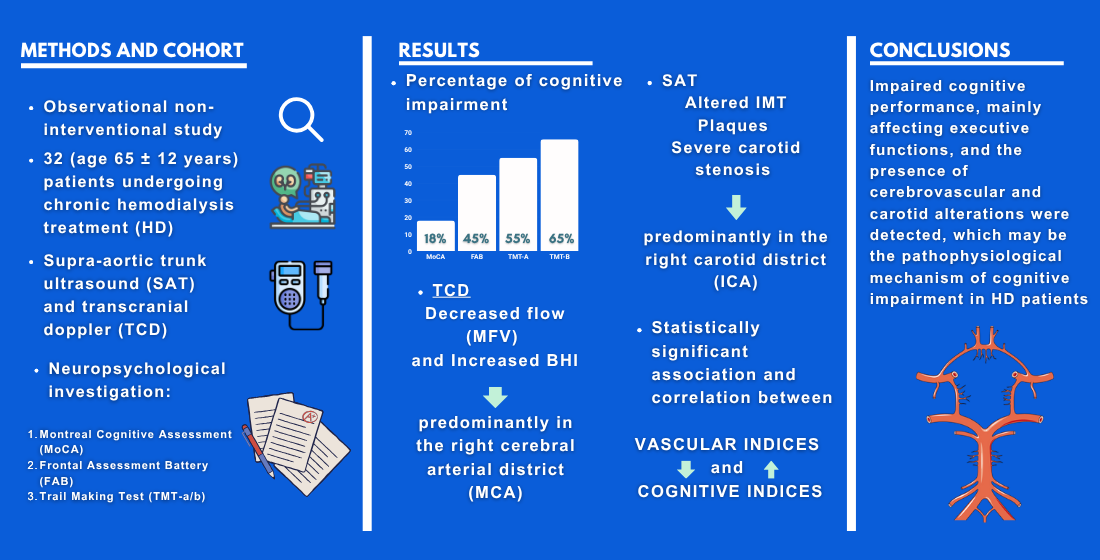
| % of decline | 17.24 | |
| % of borderline | 24.12 | |
| % of normal | 58.62 | |
| (B) Frontal Assessment Battery (FAB) | ||
| Sub-item | Total | Score (mean and DS) |
| Similarities | 3 | 2.3 ± 0.7 |
| Lexical fluency | 3 | 2.2 ± 0.8 |
| Motor series | 3 | 1.9 ± 0.8 |
| Conflicting instructions | 3 | 2.4 ± 1 |
| Go-no-go | 3 | 1.8 ± 1.2 |
| Prehension behaviour | 3 | 2.3 ± 0.6 |
| Global score | 13.1 ± 3.8 | |
| Correct score | 13.2 ± 3.2 | |
| % of deficit | 44.83 | |
| % of borderline | 17.24 | |
| % of normal | 41.38 | |
| % of higher mis | 44.81 | |
| (C) Trail-Making Test a-b | ||
| Seconds | Score below norm | |
| 110 s ± 75 | 55.17% | |
| 234 s ± 148 | 65.52% | |
| Normal Values | Right (Mean) | Left (Mean) | |
|---|---|---|---|
| PSV (cm/s) | ≤160 | 74.2 | 72.3 |
| EDV (cm/s) | 51 ± 11 | 31.4 | 30 |
| MFV (cm/s) | 55 ± 12 | 45.2 | 44 |
| RI | <0.8 | 0.57 | 0.56 |
| PI | 0.5–1.19 | 0.96 | 0.92 |
| MFV test | 60 ± 18 | 53.9 | 54.2 |
| Seconds | 25–30 s | 27 | 26 |
| BHI | 1.03–1.65 | 0.69 | 0.82 |
| Normal Values | Right (Mean or %) | Left (Mean or %) | |
|---|---|---|---|
| IMT (mm) | <0.9 | 0.96 | 1.07 |
| n° plaques | 0 | 1.77 | 1.75 |
| % of stenosis | 0% | 15.7% | 15.4% |
| ICA PSV (cm/s) | <125 | 65.5 | 64.8 |
| ICA EDV (cm/s) | <40 | 17.3 | 18.2 |
| ICA CCA (cm/s) | <2 | 58.7 | 61 |
| Stenosis degree | |||
| <50% | 15.30% | 7.7% | |
| 50–60% | 61.54% | 92.3% | |
| >70% | 23.1% | 0% | |
Disclaimer/Publisher’s Note: The statements, opinions and data contained in all publications are solely those of the individual author(s) and contributor(s) and not of MDPI and/or the editor(s). MDPI and/or the editor(s) disclaim responsibility for any injury to people or property resulting from any ideas, methods, instructions or products referred to in the content. |
© 2025 by the authors. Licensee MDPI, Basel, Switzerland. This article is an open access article distributed under the terms and conditions of the Creative Commons Attribution (CC BY) license (https://creativecommons.org/licenses/by/4.0/).
Share and Cite
Belluardo, G.; Galeano, D.; Sessa, C.; Zelante, G.; Morale, W.; De Bartolo, P. Cerebral Haemodynamics and Cognitive Impairment in Chronic Haemodialysis Patients: A Pilot Study. J. Clin. Med. 2025, 14, 4890. https://doi.org/10.3390/jcm14144890
Belluardo G, Galeano D, Sessa C, Zelante G, Morale W, De Bartolo P. Cerebral Haemodynamics and Cognitive Impairment in Chronic Haemodialysis Patients: A Pilot Study. Journal of Clinical Medicine. 2025; 14(14):4890. https://doi.org/10.3390/jcm14144890
Chicago/Turabian StyleBelluardo, Giulia, Dario Galeano, Concetto Sessa, Giuseppe Zelante, Walter Morale, and Paola De Bartolo. 2025. "Cerebral Haemodynamics and Cognitive Impairment in Chronic Haemodialysis Patients: A Pilot Study" Journal of Clinical Medicine 14, no. 14: 4890. https://doi.org/10.3390/jcm14144890
APA StyleBelluardo, G., Galeano, D., Sessa, C., Zelante, G., Morale, W., & De Bartolo, P. (2025). Cerebral Haemodynamics and Cognitive Impairment in Chronic Haemodialysis Patients: A Pilot Study. Journal of Clinical Medicine, 14(14), 4890. https://doi.org/10.3390/jcm14144890